As Israel Extends Its Genocide Into the West Bank, It Targets and Kills Children
By Marjorie Cohn , Truthout, 8 Oct 24, https://truthout.org/articles/as-israel-extends-its-genocide-into-the-west-bank-it-targets-and-kills-children/
Israel is killing scores of Palestinian children, Defense for Children International-Palestine’s Miranda Cleland says.
The Israeli occupation forces have extended their genocidal campaign in Gaza to the occupied West Bank, including East Jerusalem. Using drone strikes, troops in armored vehicles and bulldozers, their regular raids since October 7, 2023, have escalated into extensive and deadly attacks. Between August 28 and September 6, Israel launched “Operation Summer Camps,” a major military invasion, in the northern West Bank. “We watched their bulldozers tear up streets, demolish businesses, pharmacies, schools. They even bulldozed the town soccer field, and a tree in the middle of a road,” Kamal Abu al-Rub, the governor of Jenin, told The New York Times.
Since October 7, 2023, Israeli forces have killed at least 722 Palestinians, including at least 164 children, in the occupied West Bank, including East Jerusalem.
In Jenin city, within the governorate, approximately 70 percent of the roads have been damaged or destroyed in the attacks, according to the city’s mayor, Nidal Obeidi. Electricity, internet and telephone lines were shut down. Water and sewage lines were cut, leaving about 80 percent of Jenin with no running water, including the main hospital.
“They are imposing conditions, materially and psychologically, that make people feel: Gaza is coming to you,” Shawan Jabarin, director of Al Haq, a human rights group based in the West Bank, reported to the Times. “There is a feeling among Palestinians across the West Bank that what is coming is very bad — that it will be a plan to kill and expel us.”
UN Special Rapporteur for the Occupied Palestinian Territory Francesca Albanese warns that “Apartheid Israel is targeting Gaza and the West Bank simultaneously, as part of an overall process of elimination, replacement and territorial expansion.” Likewise, European Union Foreign Affairs Chief Josep Borrell said, “Without action, the West Bank will become a new Gaza. And Gaza will become a new West Bank, as settlers’ movements are preparing new settlements.”
We documented 10 cases where Palestinian children were shot and killed by Israeli forces in October 2023, during demonstrations in solidarity with Palestinians in Gaza. Four of these children were shot with expanding bullets, which expand inside the body upon impact and cause massive internal bleeding. The use of expanding bullets is a war crime.
What happened to their bodies after they died? Did the Israeli forces allow medical aid to reach the injured children?
In 43 percent of cases documented in the report, Israeli forces deliberately prevented injured Palestinian children from receiving medical care by detaining and firing live ammunition toward ambulances, paramedics and civilians attempting to provide aid. In many cases, these were children who sustained gunshot wounds from Israeli soldiers to the head or chest, or sometimes multiple locations on their bodies. In some cases, Israeli drone-fired missiles struck a child, leaving them with burns and shrapnel wounds all over their body. Israeli forces fired at ambulances and paramedics, and even civilian bystanders who tried to run and offer help to the child. Israeli soldiers surrounded a wounded child just long enough to confirm they were dead. This is an act of incredible cruelty, to ensure that a child dies alone and in immense pain, bleeding out on the ground.
Israeli forces enter refugee camps and kill Palestinians, including children. They have targeted refugee camps in the past. How does the current campaign differ from prior incursions? Why do you think they target refugee camps?
Israeli forces carry out incursions into Palestinian communities in the occupied West Bank, including refugee camps, on a daily basis. In recent incursions, Israeli forces have seriously escalated their efforts to not only kill and arrest Palestinians, including children, but also to damage and destroy civilian infrastructure like roads and power lines. They also besiege hospitals, like we witnessed in Jenin. And it’s not just Israeli ground forces carrying out these incursions; they are accompanied by military bulldozers, tanks and heavily armored military vehicles, in addition to drones and Apache attack helicopters.
Do Israeli forces use U.S.-provided weapons in the killing of Palestinians and destruction of infrastructure in the West Bank, including East Jerusalem?
The United States provides $3.8 billion in military assistance to Israel every year, and since October 7, it has provided tens of millions more in funding as well as weapons. The U.S. places virtually no restrictions on how this funding and these weapons are used, so they are certainly used in the Israeli military’s campaign to target and kill Palestinian children.
What role do Israeli settlers play in the violence against children? Do Israeli forces restrain or enable settler violence?
Israeli settlers have been emboldened by the current right-wing Israeli government, and there have been more and more cases of Israeli settler violence in the occupied West Bank since October 7. In two cases of Palestinian child fatalities cited in our report, we could not determine who shot the bullet that killed the child, since Israeli soldiers and settlers were firing toward the child simultaneously. Of course, this is a difference without a distinction. In some cases, Israeli soldiers stand by and watch as Israeli settlers attack Palestinians; in other cases, they attack alongside one another.
Does Israel’s escalation of violence in the occupied West Bank, including East Jerusalem, correspond to the increased construction of illegal Jewish settlements there?
Absolutely — in many parts of the occupied West Bank, illegal Israeli settlements surround Palestinian villages and communities and encroach on Palestinian land, leading to Israeli settler attacks in these Palestinian communities.
How does targeting children violate international law?
Targeting children with live ammunition is first and foremost a violation of their basic right to life as outlined in the Convention on the Rights of the Child, which Israel has ratified along with nearly every other country in the world. It is also a violation of international humanitarian law as well as international criminal law.
Israel has an obligation as the “Occupying Power” under international humanitarian law to protect the Palestinian population living under Israeli military occupation. Yet Israeli forces overwhelmingly fail to intervene to stop or prevent settler attacks and instead protect the settlers, empowering them to perpetuate violent attacks against the Palestinian civilian population in the occupied West Bank.
Has there been legal accountability for those responsible for the deaths of these children?
No. Israeli authorities, which are able to hold Israeli military officials and soldiers responsible, are clearly unwilling to hold perpetrators accountable, which is why we believe the international community must intervene and enact an arms embargo as well as sanctions to force accountability.
What evidence would you cite that Israel maintains an apartheid system in the occupied West Bank, including East Jerusalem?
The Israeli military legal system is applied only to Palestinians living in the occupied West Bank. This means that Palestinians, including children, who are arrested by the Israeli military are prosecuted in the Israeli military court system, where the judge and prosecutor are soldiers and the conviction rate is upwards of 95 percent. Israeli settlers living in illegal settlements in the occupied West Bank never come into contact with the military legal system and instead are subject to the Israeli civil legal system. That’s what apartheid is: Different legal systems and statuses applied to different populations based on ethnicity in the same territory.
Do you think Israel is extending its nearly yearlong genocidal campaign in Gaza into the West Bank, including East Jerusalem?
Absolutely. As with Gaza, the Israeli government and military has made very clear its intentions to ethnically cleanse Palestinians from their land until there is no Palestinian life to speak of.
What actions does DCIP demand that the international community take to prevent additional violence against children and to hold those responsible accountable?
In our report, we list three demands for the international community, which includes many countries and actors that have either watched, or turned away entirely, as Israeli forces have slaughtered Palestinian children at an unprecedented rate from Gaza to the occupied West Bank:
- Enact an immediate and comprehensive arms embargo alongside diplomatic and financial pressure to pressure Israeli authorities and forces to end the genocide of Palestinians in Gaza, the Israeli apartheid regime and the Israeli military occupation of the occupied Palestinian territory.
- Investigate allegations of war crimes and crimes against humanity and support investigations by the International Criminal Court, in order to hold perpetrators accountable.
- Use all available means, including those listed above, to demand that Israeli authorities uphold Palestinian children’s rights as outlined in the Convention on the Rights of the Child, which Israel has ratified.
On September 18, the UN General Assembly overwhelmingly adopted a resolution initiated by the State of Palestine, demanding an end to the illegal Israeli occupation of Palestinian territory in accordance with international law, as recently established by the International Court of Justice. The resolution calls for sanctioning Israel and forbidding member states from conducting business with Israel or promoting the legitimacy of Israel’s occupation of Palestinian territory.
Marjorie Cohn is professor emerita at Thomas Jefferson School of Law, dean of the People’s Academy of International Law and past president of the National Lawyers Guild. She sits on the national advisory boards of Assange Defense and Veterans For Peace. A member of the bureau of the International Association of Democratic Lawyers, she is the U.S. representative to the continental advisory council of the Association of American Jurists. Her books include Drones and Targeted Killing: Legal, Moral and Geopolitical Issues.
Could small modular reactors be used to create nuclear warheads?
The global pursuit of small modular reactor (SMR) technology could feed
into the development of nuclear warheads. SMRs are near the top of the
agenda in the nuclear industry in the UK. At least four companies –
GE-Hitachi, Holtec Britain, Rolls-Royce SMR and Westinghouse Electric Co. –
are competing to have their designs adopted by Great British Nuclear, and
at the same time, the UK’s nuclear weapons stockpile is due to increase.
NCE asked the Department for Energy Security and Net Zero (DESNZ) under the
Freedom of Information (FoI) Act if it had made any assessment of the
potential for SMRs to produce material for nuclear weapons. In its
response, DESNZ said that the deployment of SMRs in the UK “will comply
with UK civil nuclear safety and security regulations and international
conventions to ensure that nuclear material intended for use in civil
nuclear deployments is used for that purpose only, and cannot be diverted
or manipulated for use in nuclear weapons”.
However, this statement does
not mean that SMRs cannot be used to create materials for nuclear warheads.
The fissile material that could potentially be used in nuclear weapons is
what is produced by the reactor, not what is used within it. DESNZ went on
to say that it “neither confirms nor denies that it holds information”
on whether assessments have been made on whether material from SMRs could
be used in nuclear weapons. “This is a qualified exemption, and we have
considered the public interest arguments in confirming or denying whether
we hold the requested information,” it continued.
“We acknowledge that
confirming or denying if information is held would provide assurance that
the Department takes the safe and secure deployment of nuclear energy
seriously. “However, confirming or denying that the information relevant
to your request is held may itself disclose the presence of sensitive
nuclear information. Such information could assist in potential criminal
activity if the information was used by malicious parties.
New Civil Engineer 9th Oct 2024
Israeli Snipers Routinely, Deliberately Shoot Palestinian Kids In The Head
Caitlin Johnstone, Oct 10, 2024, https://www.caitlinjohnst.one/p/israeli-snipers-routinely-deliberately?utm_source=post-email-title&publication_id=82124&post_id=150036170&utm_campaign=email-post-title&isFreemail=true&r=1ise1&triedRedirect=true&utm_medium=email
There’s yet another doctors’ testimony about Israeli forces constantly shooting Palestinian children in the head, this one published in The New York Times.
The report, titled “65 Doctors, Nurses and Paramedics: What We Saw in Gaza,” begins as follows:
“I worked as a trauma surgeon in Gaza from March 25 to April 8. I’ve volunteered in Ukraine and Haiti, and I grew up in Flint, Mich. I’ve seen violence and worked in conflict zones. But of the many things that stood out about working in a hospital in Gaza, one got to me: Nearly every day I was there, I saw a new young child who had been shot in the head or the chest, virtually all of whom went on to die. Thirteen in total.
“At the time, I assumed this had to be the work of a particularly sadistic soldier located nearby. But after returning home, I met an emergency medicine physician who had worked in a different hospital in Gaza two months before me. ‘I couldn’t believe the number of kids I saw shot in the head,’ I told him. To my surprise, he responded: ‘Yeah, me, too. Every single day.’”
Numerous named medical staff who worked in Gaza then testify in the report about routine encounters with children who’d been shot in the head and chest by Israeli forces, as well as children and infants suffering from severe malnutrition and easily preventable infections.
Such reports have been coming out all year. Because Israel has not been allowing foreign press into Gaza, medical staff have in many ways become the de facto western journalists on the ground in the enclave — and they are all saying the same thing.
Back in July a group of 45 doctors and nurses who’d been working in Gaza signed an open letter to President Biden testifying that “every single signatory to this letter treated children in Gaza who suffered violence that must have been deliberately directed at them.”
“Specifically, every one of us on a daily basis treated pre-teen children who were shot in the head and chest,” the letter continues.
Also in July, Politico published an article by two American surgeons named Mark Perlmutter and Feroze Sidhwa titled “‘Nothing Prepared Us for What We Saw’: Two Weeks Inside a Gaza Hospital,” which contains the following passage:
“We started seeing a series of children, preteens mostly, who’d been shot in the head. They’d go on to slowly die, only to be replaced by new victims who’d also been shot in the head, and who would also go on to slowly die. Their families told us one of two stories: the children were playing inside when they were shot by Israeli forces, or they were playing in the street when they were shot by Israeli forces.”
by Israeli snipers in Gaza” was published in The Guardian, citing nine doctors who’d worked in Gaza after October 7 who “reported treating a steady stream of children, elderly people and others who were clearly not combatants with single bullet wounds to the head or chest.”
Forensic pathologists were able to identify bullets used by the Israeli military in these attacks on children:
“The Guardian shared descriptions and images of gunshot wounds suffered by eight children with military experts and forensic pathologists. They said it was difficult to conclusively determine the circumstances of the shootings based on the descriptions and photos alone, although in some of the cases they were able to identify ammunition used by the Israeli military.”
In February the Los Angeles Times published an article titled “I’m an American doctor who went to Gaza. What I saw wasn’t war — it was annihilation”. The author, a reconstructive surgeon named Irfan Galaria, writes as follows:
“On one occasion, a handful of children, all about ages 5 to 8, were carried to the emergency room by their parents. All had single sniper shots to the head. These families were returning to their homes in Khan Yunis, about 2.5 miles away from the hospital, after Israeli tanks had withdrawn. But the snipers apparently stayed behind. None of these children survived.”
So this is happening. The evidence is undeniable, and the sourcing is as solid as it gets. There are mountains upon mountains of rock solid proof that Israeli forces routinely, deliberately shoot Palestinian children in the head in Gaza.
The only reason this isn’t being treated as an established fact by the western political-media class is because the Israeli military denies it, telling The Guardian in response to the aforementioned report that “The IDF only targets terrorists and military targets. In stark contrast to Hamas’s deliberate attacks on Israeli civilians, including men, women and children, the IDF follows international law and takes feasible precautions to mitigate civilian harm.”
“Doctors say otherwise,” The Guardian wrote.
Indeed, there is no longer any fact-based reason to deny that Israel is deliberately targeting children with sniper fire. The facts are in and the case is closed. The only basis anyone can have for denying this established fact is their own personal loyalty to the state of Israel and its military, and/or their own personal disdain for Palestinian lives.
This fact punches holes in so many of the narratives used to defend Israel over the past year. That Israel is conducting itself in a more ethical way than Hamas. That Israel is waging a war against Hamas and not the Palestinian people. That the IDF are “the most moral army in the world” and are taking extraordinary measures to avoid civilian casualties. That civilians are being killed in Gaza because Hamas uses them as “human shields”. That this is a war fought for Israel’s self-defense, and not a campaign of extermination driven by racism and hate.
There is simply no way to believe any of these things are true when you acknowledge the extensively-documented fact that Israeli forces are routinely shooting children in the head throughout the Gaza Strip.
Blinken approved Israeli attacks on Gaza aid convoys: Report

Since the start of Israel’s ethnic cleansing campaign in Gaza, the US-backed army has become the leading cause of death for humanitarian workers worldwide
News Desk, OCT 8, 2024, https://thecradle.co/articles/blinken-approved-israeli-attacks-on-gaza-aid-convoys-report
US State Secretary Anthony Blinken gave the green light for Israel to launch attacks against humanitarian aid convoys inside the Gaza Strip in the early days of Israel’s genocide of Palestinians, according to a report by Drop Site News (DSN) citing Israeli journalists and media outlets.
Tel Aviv’s decision was made during a marathon session of the Security Cabinet between 16 and 17 October that Blinken took part in.
“From within the Kirya, the Israeli military’s main headquarters in Tel Aviv, Blinken participated in the frantic discussions of the Israeli War Cabinet … that were occurring in parallel to conversations in the broader Security Cabinet,” DSN reports.
Citing Channel 12 reporter Yaron Avraham, the report states that these sessions saw Israeli officials “[deliberate] for hours over the precise wording of the decision, with each draft being passed between the Cabinet room and Blinken’s room, a distance of a few meters away, inside the Kirya … Eventually, around 3 am, they arrive at an agreed upon text that is read in the Cabinet room in English.”
Channel 13 independently corroborated Avraham’s reporting, detailing: “The discussion with Blinken is conducted as follows: he is sitting in a room in the Kirya with his advisors and security team, while Security Cabinet holds the discussion; [Minister of Strategic Affairs Ron] Dermer goes back and forth and interfaces with him.”
A day later, following additional Cabinet sessions “helmed by both Blinken and [US President Joe] Biden,” Israeli Prime Minister Benjamin Netanyahu’s office publicly announced its final decision.
“In light of President Biden’s demand, Israel will not thwart humanitarian supplies from Egypt as long as it is only food, water, and medicine for the civilian population located in the southern Gaza Strip or moving there, and as long as these supplies do not reach Hamas. Any supplies that reach Hamas will be thwarted,” the statement, issued in Hebrew, reads.
However, DSN highlights that “the Hebrew word לסכל, ‘to thwart,’ is frequently used by Israel to describe targeted killings and assassinations. The previous policy of ‘thwarting’ all humanitarian supplies from entering Gaza was conveyed to Egypt as an explicit threat to ‘bomb’ aid trucks.”
“We in the cabinet were promised at the outset that there would be monitoring, and that aid trucks hijacked by Hamas and its organizations [sic] would be bombed from the air, and the aid would be halted,” Israeli Finance Minister Bezalel Smotrich said a few days after the Security Cabinet’s decision was announced.
When pressed for comment by DSN, State Department spokesperson Vedant Patel called the report “absurd.”
Nevertheless, the State Department did not clarify whether Blinken approved attacks on alleged Hamas fighters “who secure aid convoys or seize their contents.”
Over the past year, intentional Israeli attacks have become the leading cause of death for humanitarian workers across the world, as the Israeli army is now responsible for more than 75 percent of aid workers’ deaths recorded since October 2023.
In the last three months of 2023, following the Security Cabinet session that Blinken took part in, Israeli attacks targeting humanitarian workers across the occupied Palestinian territories were responsible for more deaths “than the deadliest full year ever recorded.”
Last month, ProPublica revealed that two US government offices on humanitarian assistance recommended earlier this year that Washington suspend some or all weapons shipments to Israel because its forces were restricting the delivery of aid inside Gaza. However, their recommendations were sidelined by Blinken, who went on to lie to Congress about the findings.
“Escalation dominance” and the new nuclear threat: We face more than 1,000 Holocausts
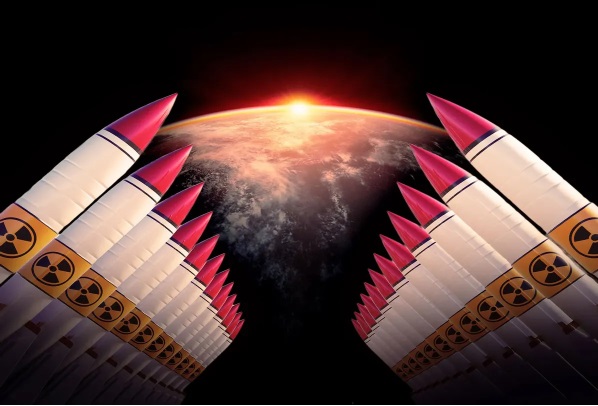
Nuclear arsenals are vastly more powerful today than during the Cold War — and the risk of apocalypse keeps growing
By Norman Solomon, 6 Oct 24, https://www.salon.com/2024/10/06/escalation-dominance-and-the-new-nuclear-threat-we-face-more-than-1000-holocausts/?fbclid=IwY2xjawFxjVhleHRuA2FlbQIxMQABHYLvOjzWp_vKRXdaiTZlKovXxdlnIxjKp_6EBAU3dN7rFD8OsR-o1Kd2eQ_aem_pgdCaz3-fGi_NP8MdUsIfw
Everything is at stake. Everything is at stake with nuclear weapons.
While working as a nuclear war planner for the Kennedy administration, Daniel Ellsberg was shown a document calculating that a U.S. nuclear attack on Communist countries would result in 600 million dead. As he put it later: “A hundred Holocausts.”
That was in 1961.
Today, with nuclear arsenals vastly larger and more powerful, scientists know that a nuclear exchange would cause “nuclear winter.” And the nearly complete end of agriculture on the planet. Some estimates put the survival rate of humans on Earth at 1 or 2 percent.
No longer 100 Holocausts.
More than 1,000 Holocausts.
If such a nuclear war happens, of course we won’t be around for any retrospective analysis. Or regrets. So candid introspection is in a category of now or never.
What if we did have the opportunity for hindsight? What if we could somehow hover over this planet? And see what had become a global crematorium and an unspeakable ordeal of human agony? Where, in words attributed to both Nikita Khrushchev and Winston Churchill, “the living would envy the dead.”
What might we Americans say about the actions and inaction of our leaders?
In 2023, the nine nuclear-armed countries spent $91 billion on their nuclear weapons. Most of that amount, $51 billion, was the U.S. share. And our country accounted for 80 percent of the increase in nuclear weapons spending.
The United States is leading the way in the nuclear arms race. And we’re encouraged to see that as a good thing: “escalation dominance.”
But escalation doesn’t remain unipolar. As time goes on, “Do as we say, not as we do” isn’t convincing to other nations.
China is now expanding its nuclear arsenal. That escalation does not exist in a vacuum. Official Washington pretends that Chinese policies are shifting without regard to the U.S. pursuit of “escalation dominance.” But that’s a disingenuous pretense. What the great critic of Vietnam War escalation during the 1960s, Sen. William Fulbright, called “the arrogance of power.”
Of course there’s plenty to deplore about Russia’s approach to nuclear weapons. Irresponsible threats about using “tactical” nukes in Ukraine have come from Moscow. There’s now public discussion — by Russian military and political elites — of putting nuclear weapons in space.
We should face the realities of the U.S. government’s role in fueling such ominous trends, in part by dismantling key arms control agreements. Among crucial steps, it’s long past time to restore three treaties that the United States abrogated — ABM, Intermediate-Range Nuclear Forces and Open Skies.
On the non-proliferation front, opportunities are being spurned by Washington. For instance, as former CIA analyst Melvin Goodman wrote in September: “Iran’s Ayatollah has indicated a readiness to open discussions with the United States on nuclear matters, but the Biden administration has turned a deaf ear to such a possibility.”
That deaf ear greatly pleases Israel, the only nuclear-weapons state in the Middle East. On Sept. 22, former Defense Secretary Leon Panetta said unequivocally that Israel’s pager attack in Lebanon was “a form of terrorism.” The U.S. keeps arming Israel, but won’t negotiate with Iran.
The U.S. government has a responsibility to follow up on every lead, and respond to every overture. Without communication, we vastly increase the risk of devastation.
We can too easily forget what’s truly at stake.
Despite diametrical differences in ideologies, in values, in ideals and systems, programs for extermination are in place at a magnitude dwarfing what occurred during the first half of the 1940s.
Today, Congress and the White House are in the grip of what Martin Luther King Jr. called “the madness of militarism.” In a toxic mix with the arrogance of power. Propelling a new and more dangerous Cold War.
And so, at the State Department, the leadership talks about a “rules-based order,” which all too often actually means: “We make the rules, we break the rules.”
Meanwhile, the Doomsday Clock set by the Bulletin of the Atomic Scientists is now just 90 seconds away from apocalyptic midnight.
Six decades ago, the Doomsday Clock was a full 12 minutes away. And President Lyndon Johnson was willing to approach Moscow with the kind of wisdom that is now absent at both ends of Pennsylvania Avenue.
Here’s what Johnson said at the end of his extensive summit meeting with Soviet Premier Alexei Kosygin in June 1967 in Glassboro, New Jersey: “We have made further progress in an effort to improve our understanding of each other’s thinking on a number of questions.”
Two decades later, President Ronald Reagan — formerly a supreme Cold Warrior — stood next to Soviet leader Mikhail Gorbachev and said: “We decided to talk to each other instead of about each other.”
But such attitudes would be heresy today.
As each day brings escalation toward a global nuclear inferno, standard-issue legislators on both sides of the aisle keep boosting the Pentagon budget. Huge new appropriations for nuclear weapons are voted under the euphemism of “modernization.”
And here’s a sad irony: The few members of Congress willing to issue urgent warnings about the danger of nuclear war often stoke that danger with calls for “victory” in the Ukraine war. Instead, what’s urgently needed is a sober push for actual diplomacy to end it.
The U.S. should not use the Ukraine war as a rationale for pursuing a mutually destructive set of policies toward Russia. It’s an approach that maintains and worsens the daily reality on the knife-edge of nuclear war.
We don’t know how far negotiations with Russia could get on an array of pivotal issues. But refusing to negotiate is a catastrophic path.
Continuation of the war in Ukraine markedly increases the likelihood of spinning out from a regional to a Europe-wide to a nuclear war. Yet calls for vigorously pursuing diplomacy to end the Ukraine war are dismissed out of hand as serving Vladimir Putin’s interests.
That’s a zero-sum view of the world. A one-way ticket to omnicide.
The world has gotten even closer to the precipice of a military clash between the nuclear superpowers, with a push to green-light NATO-backed Ukrainian attacks heading deeper into Russia.
Consider what John F. Kennedy had to say, eight months after the Cuban missile crisis, in his historic speech at American University: “Above all, while defending our own vital interests, nuclear powers must avert those confrontations which bring an adversary to a choice of either a humiliating retreat or a nuclear war. To adopt that kind of course in the nuclear age would be evidence only of the bankruptcy of our policy, or of a collective death wish for the world.”
That crucial insight from Kennedy is currently in the dumpsters at the White House and on Capitol Hill.
And where is this all headed?
Daniel Ellsberg tried to alert members of Congress. Five years ago, in a letter that was hand-delivered to the offices of every senator and House member, he wrote: “I am concerned that the public, most members of Congress, and possibly even high members of the Executive branch have remained in the dark, or in a state of denial, about the implications of rigorous studies by environmental scientists over the last dozen years.” Those studies “confirm that using even a large fraction of the existing U.S. or Russian nuclear weapons that are on high alert would bring about nuclear winter, leading to global famine and near extinction of humanity.”
In the quest for sanity and survival, isn’t it time for reconstruction of the nuclear arms control infrastructure? Yes, the Russian war against Ukraine violates international law and “norms,” as did U.S. wars in Iraq and Afghanistan. But real diplomacy with Russia is in the interests of global security.
And some great options don’t depend on what happens at the negotiation table.
Many experts say that the most important initial step our country could take to reduce the chances of nuclear war would be a shutdown of all ICBMs.
The word “deterrence” is often heard. But the land-based part of the triad is actually the opposite of deterrence — it’s an invitation to be attacked. That’s the reality of the 400 intercontinental ballistic missiles that are on hair-trigger alert in five Western states.
Uniquely, ICBMs invite a counterforce attack. And they allow a president just minutes to determine whether what’s incoming is actually a set of missiles — or, as in the past, a flock of geese or a drill message that’s mistaken for the real thing.
Former Secretary of Defense William Perry wrote that ICBMs are “some of the most dangerous weapons in the world” and “they could even trigger an accidental nuclear war.”
And yet, so far, we can’t get anywhere with Congress in order to shut down ICBMs. “Oh no,” we’re told, “that would be unilateral disarmament.”
Imagine that you’re standing in a pool of gasoline, with your adversary. You’re lighting matches, and your adversary is lighting matches. If you stop lighting matches, that could be condemned as “unilateral disarmament.” It would also be a sane step to reduce the danger — whether or not the other side follows suit.
Mistaking a false alarm for a nuclear-missile attack becomes more likely amid the stresses, fatigue and paranoia that come with the protracted war in Ukraine and extending war into Russia.
The ongoing refusal to shut down the ICBMs is akin to insisting that our side must keep lighting matches while standing in gasoline.
The chances of ICBMs starting a nuclear conflagration have increased with sky-high tensions between the world’s two nuclear superpowers. Mistaking a false alarm for a nuclear-missile attack becomes more likely amid the stresses, fatigue and paranoia that come with the protracted war in Ukraine and extending war into Russia.
Their unique vulnerability as land-based strategic weapons puts ICBMs in the unique category of “use them or lose them.” So, as Secretary Perry explained, “If our sensors indicate that enemy missiles are en route to the United States, the president would have to consider launching ICBMs before the enemy missiles could destroy them. Once they are launched, they cannot be recalled. The president would have less than 30 minutes to make that terrible decision.”
The U.S. should dismantle its entire ICBM force. Former ICBM launch officer Bruce Blair and Gen. James Cartwright, former vice chair of the Joint Chiefs of Staff, wrote: “By scrapping the vulnerable land-based missile force, any need for launching on warning disappears.”
In July, the Union of Concerned Scientists released a letter signed by more than 700 scientists. They not only called for cancellation of the Sentinel program for a new version of ICBMs, they also called for getting rid of the entire land-based leg of the triad.
Meanwhile, the current dispute in Congress about ICBMs has focused on whether it would be cheaper to build the cost-overrunning Sentinel system or upgrade the existing Minuteman III missiles. But either way, the matches keep being lit for a global holocaust.
During his Nobel Peace Prize speech, Martin Luther King Jr. declared: “I refuse to accept the cynical notion that nation after nation must spiral down a militaristic stairway into the hell of thermonuclear destruction.”
I want to close with some words from Daniel Ellsberg’s book “The Doomsday Machine: Confessions of a Nuclear War Planner,” summing up the preparations for nuclear war. He wrote:
No policies in human history have more deserved to be recognized as immoral, or insane. The story of how this calamitous predicament came about, and how and why it has persisted for over half a century is a chronicle of human madness. Whether Americans, Russians and other humans can rise to the challenge of reversing these policies and eliminating the danger of near-term extinction caused by their own inventions and proclivities remains to be seen. I choose to join with others in acting as if that is still possible.
Israel Planning Major Attack on Iran
The US is coordinating with Israel on its plans.
by Dave DeCamp, October 2, 2024, https://news.antiwar.com/2024/10/02/israel-planning-major-attack-on-iran/#gsc.tab=0
Israel is planning to launch a “significant retaliation” attack against Iran over the Iranian missile barrage that targeted Israel on Tuesday, which was a response to several Israeli escalations in the region. Israeli officials acknowledged to Axios that the situation could lead to a full-blown regional war, which would involve the US.
According to the Axios report, Israel could target oil production facilities inside Iran or other strategic sites. Israeli officials say that if Iran hits back, then all options will be on the table, including strikes on Iran’s civilian nuclear facilities.
“We have a big question mark about how the Iranians are going to respond to an attack, but we take into consideration the possibility that they would go all in, which will be a whole different ball game,” an Israeli official told Axios.
Other options being considered are attacks on Iran’s air defenses or targeted assassinations. Israel has a history of killing people inside Iran, including the July 31 assassination of Hamas’s political chief, Ismail Haniyeh.
Israel would likely need US military support to launch significant strikes on Iranian territory, and the Israeli officials speaking to Axios say they are coordinating with the Biden administration. Israel wants more US support if it provokes another Iranian attack.
National Security Advisor Jake Sullivan said Tuesday that the US would work with Israel to ensure Iran faces “severe consequences.” President Biden has also said he is working with Israel on a response but said Wednesday that he wouldn’t support strikes on Iran’s nuclear facility.
“All seven of us agree that they have a right to respond, but they have to respond proportionally,” he said, referring to the Group of Seven nations. He said G7 leaders agreed to impose new sanctions on Iran, which will have little impact since Iran is already under so many.
Israel acknowledged on Wednesday that Iranian missiles made an impact on several military bases but claimed there was no significant damage. Israel is also claiming there were no major casualties, with only two Israelis suffering minor injuries. One Palestinian was killed in the Israeli-occupied West Bank when shrapnel from an intercepted missile hit him.
Iran fired about 180 ballistic missiles at Israel in response to the Israeli assassination of Haniyeh in Tehran and the Israeli killing of Hezbollah Secretary-General Hassan Nasrallah and Abbas Nilforoushan, an IRGC commander who was killed alongside Nasrallah.
‘Russia doesn’t want to use nuclear weapons’: The view from wartime Moscow
Putin is revising Russia’s nuclear doctrine at a critical juncture in Moscow’s full-scale invasion of Ukraine.
Aljazeera, By Niko Vorobyov, 7 Oct 2024
Russia, which holds the world’s largest stockpile of nuclear warheads, has unveiled its new nuclear doctrine, lowering its threshold for nuclear engagement while continuing its invasion of Ukraine.
The revised rules, outlined by President Vladimir Putin, say that an attack on Russia with “participation or support of a nuclear power” will be seen as their “joint attack on the Russian Federation”, seemingly responding to the possibility that Ukraine could strike targets deep within Russian territory using long-range weapons supplied by Western allies.
The United States, Ukraine’s most important ally, is the world’s second-largest nuclear power, with 5,224 warheads compared to Russia’s 5,889.
Alexey Malinin, the Moscow-based founder of the Center for International Interaction and Cooperation, told Al Jazeera that from the Russian perspective, a reassessment of nuclear capabilities was necessary in the face of encirclement by hostile powers.
But as panic sets in across some Western nations, Russian experts say Moscow does not want to tap into its arsenal.
“Russia does not want to use nuclear weapons, understanding the seriousness of the consequences of a conflict with the use of such weapons,” he said.
“However, at present, our country is forced to respond to the growing threats directed against us. The West continues to pump Ukraine with weapons, including F-16 fighters and long-range missiles like [US-made] ATACMS. Moreover, NATO is developing its infrastructure around the borders of Russia: new units are being created in Finland.”
He claimed that although Russia is trying to avoid the use of nuclear weapons, Moscow is “forced to demonstrate” that it is ready to defend “integrity and sovereignty” by any possible means”.
However, Kremlin critics worry that Putin is pushing closer towards, if not a nuclear apocalypse, then at least a regional humanitarian disaster.
“The USSR said that it would never strike first … Now Putin says that he will strike whenever he wants,” exiled politician Leonid Gozman wrote in the Novaya Gazeta newspaper…………………………..
During the Cold War, both Washington and Moscow operated on the principle of mutually assured destruction, the understanding that a nuclear strike from one side would prompt a response in kind, leading to an all-out atomic altercation and mass devastation on a global scale.
However, Putin is warning that Russia would use nuclear weapons in response to a “critical threat to our sovereignty” – referring to not necessarily a nuclear assault, but also a conventional one.
Alexandra, an everyday Russian in Moscow who works as an architect, told Al Jazeera: “I’m scared, but I don’t understand much of what’s going on.”
The Russian government and its supporters believe they are sending a strong signal to Ukraine’s Western allies, warning against interfering in the conflict.
Russian Foreign Minister Sergey Lavrov has warned the UN that should the West allow Ukraine to strike further into Russia, it will be dragging itself into a “suicidal escapade”.
“Whether or not they will provide the permission for Ukraine for long-range weapons, then we will see what their understanding was of what they heard,” he said recently.
Washington has recently greenlit additional aid for Ukraine, but permission to use US-supplied weapons does not yet go beyond what was previously agreed.
Writing on Telegram, the hawkish former President Dmitry Medvedev stated the new doctrine “could cool the passions of those opponents who have not yet lost their sense of self-preservation.”…………
https://www.aljazeera.com/news/2024/10/7/russia-doesnt-want-to-use-nuclear-weapons-the-view-from-wartime-moscow
Let’s remember the 365 days of genocide as well as October 7 attack.

Walt Zlotow, West Suburban Peace Coaliton, Glen Ellyn IL, 7 Oct 24
The Chicago Tribune editorial ‘Remember October 7, 2023’ was right to mourn the Israeli dead, injured and those taken hostage from the Hamas attack a year earlier.
But it’s unfortunate there was no mention of the of Israel’s genocidal ethnic cleansing that followed which has inflicted near total destruction on Gaza’s 139 square miles in the following 365 days. The Tribune ignores the over 40,000 officially dead (likely upwards of 100,000), nearly all schools universities, hospitals, homes destroyed and most food, water and medicine kept from reaching the most devastated people on earth.
It’s unfortunate that there is no mention that the year long genocide in Gaza could not be occurring without tens of billions in US weaponry flowing into Israel for their ‘defense.’ Genocide is not defense…it is genocide.
It is unfortunate there was no mention of the people Israeli genocide is designed to remove from Gaza and eventually the West Bank. Say the word Chicago Tribune Editorial Board…they are Palestinians.
For the Tribune to state that the horrors unleased over the past year “can no longer be contained” is an abrogation of the media’s role to provide a solution to the most grotesque destruction of a people in this century. To state “we suspect it (the anniversary) will not be seen as a day to discuss politics or even the ongoing conflict now raging on another front” is being blind to evil that must be confronted relentlessly.
This is precisely the day for the Chicago Tribune to engage its readership, regardless of ethnicity or religion, over the ongoing conflict. Had the Trib, along with the rest of mainstream media been doing just that for the past 365 days, this genocide might be over and negotiations for a Palestinian state underway.
Carnegie nuclear expert James Acton explains why it would be counterproductive for Israel to attack Iran’s nuclear program
Bulletin, By John Mecklin | October 5, 2024
In the aftermath of Iran’s massive missile attack on Israel this week, it has become clear that Israeli missile defenses are robust. Of the estimated 180 ballistic missiles that Iran launched, only a small percentage evaded Israel’s anti-missile defenses, causing limited damage at or near some Israeli intelligence and military sites and apparently having little impact on Israeli military operations. But the attack marks a major escalation in the Israel-Iran conflict and has led to widespread speculation about when and where Israel will respond. Much of that speculation has centered on the question of whether Israel will attack facilities related to Iran’s nuclear program.
Late this week, I asked James Acton, a physicist and wide-ranging nuclear policy expert who co-directs the Nuclear Policy Program at the Carnegie Endowment for International Peace, for his assessment of the Israel-Iran situation, especially as regards the possibility of an Israeli attack on Iran’s nuclear facilities. His answers follow in a lightly edited and condensed Q&A format.
John Mecklin: I gather you think it would be a bad idea for Israel to attack Iran’s nuclear facilities. Can you explain why for our readers?
James Acton: Sure. If Israel or the United States tries to attack Iran’s nuclear facilities, my belief is that that will harden Iranian resolve to acquire nuclear weapons without eliminating Iran’s capability to do so. Israel would be motivated, in part, to punish Iran for its recent attack on Israel, using that as an opportunity to try and destroy Iran’s nuclear program, so the Israelis didn’t have to worry about it in the future. I think if they decide to attack Iran’s nuclear program, they will find themselves worrying much more about Iran’s nuclear program in the future. We’ll elaborate on this, but an attack would, I believe, simultaneously harden Iranian resolve to acquire nuclear weapons while also not destroying permanently their capability to achieve that goal…………………….
…………..If the Iranian program today comprised a single reactor that had not been turned on, I think you could make a fair argument that it could be in Israel’s interests to attack it. But that’s nothing like what the Iranian program actually looks like…..
……………..But the Iranian program today is based around centrifuges, which are very small and can be manufactured quickly and placed almost anywhere. So even if an Israeli attack destroys Iran’s current centrifuge plants at Fordow and Natanz—and it’s not obvious to me that Iran has the capability to destroy Fordow, which is buried inside a mountain—but even if Israel can destroy Iran’s existing centrifuge plants, Iran is almost certainly going to reconstruct centrifuge facilities………………………………………………………………….
So people tend to say the Israelis can destroy Iran’s nuclear weapons program. Even if that is true in the short term, the question they have to answer is: Then what?
Mecklin: Okay, the second question is: How likely do you think it is that Israel is actually contemplating attacking the nuclear facilities?
Acton: Let me distinguish between two ideas. Are they contemplating doing so? And will they do so?
I think there is an extremely high probability that there is a serious discussion going on right now in the Israeli Security Cabinet about whether to attack Iran’s nuclear facilities. Many Israeli leaders have openly called for that at this juncture. And you know, Netanyahu has been publicly mentioning this possibility on and off for many years now. So I would be staggered if there was not a serious discussion within Israel right now about attacking Iranian nuclear facilities.
Would Israel actually go ahead and do that? I think it would be tough without a lot of US support. And Biden has come out and said unequivocally, no. And doing it without US support would do enormous damage to the US Israeli relationship. And I think the Israelis understand that.
I think the Israelis fully understand that if they attack Iran’s nuclear program, Iran then attacks Israel in a much larger way than we’ve seen before. The Israelis are going to want America’s help in defending against those attacks, and there must be at least some uncertainty in their mind, if they just point blank defy an American president, whether that help would be forthcoming. So for all of those reasons, if the US is being as clear in private as it is in public, I do think it’s substantially less than 50/50 that the Israelis are going to attack Iranian nuclear facilities. I think it’s higher than 10 percent, but it’s not, I think, 50/50. Which I find somewhat reassuring.
………………………..one thing that I feel pretty confident in saying is that if Iran has not yet made a decision to build a nuclear weapon, an Israeli strike makes it much, much more likely that It will make that decision to do so—both for reasons of defending the state and for reasons of domestic politics…….. more https://thebulletin.org/2024/10/carnegie-nuclear-expert-james-acton-explains-why-it-would-be-counterproductive-for-israel-to-attack-irans-nuclear-program/?utm_source=Newsletter&utm_medium=Email&utm_campaign=MondayNewsletter10072024&utm_content=NuclearRisk_NuclearExpert_10062024#post-heading
US’ next-gen nuclear submarines suffer delay with costs soaring past $130 billion.
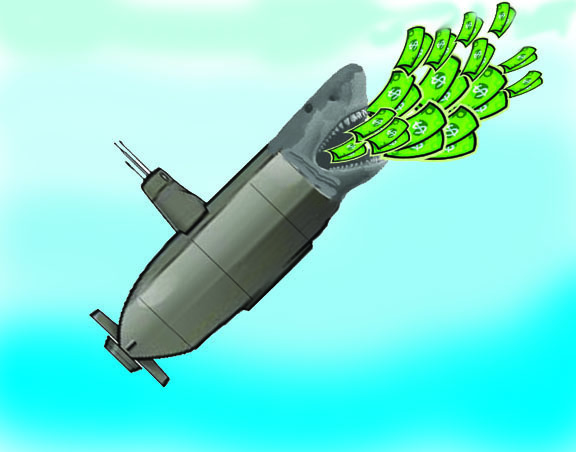
The US Navy’s next-generation nuclear submarines face delays and rising costs, surpassing $130 billion.
Interesting Engineering, Bojan Stojkovski Oct 05, 2024
A new report from the Government Accountability Office (GAO), a nonpartisan watchdog that reviews government operations for Congress, highlighted problems with the construction of the new submarines.
The GAO noted that both cost and schedule targets for the lead submarine have consistently been missed, according to the report released on Monday, Gizmodo reported.
“Our independent analysis calculated likely cost overruns that are more than six times higher than Electric Boat’s estimates and almost five times more than the Navy’s. As a result, the government could be responsible for hundreds of millions of dollars in additional construction costs for the lead submarine,” the GAO said in its report.Re-Timer and cold plasma, the best of IE this week
Navy plans to replace aging Ohio-class subs
The country’s nuclear weapons are deployed through three methods: intercontinental ballistic missiles launched from silos, bombs dropped from strategic bombers, and missiles fired from stealth submarines. …………………………………………………………………..
General Dynamics Electric Boat is currently building the first Columbia-class submarine, but the construction is facing significant challenges. According to the GAO report, the program has struggled with ongoing issues such as delays in materials and design products, despite efforts over the years to address these problems. The report also stated that swift and substantial action is needed to improve the construction performance.
Submarine construction faces skilled labor shortages
Some of the challenges are systemic, as there are few skilled workers in the US capable of building nuclear submarines. Between the 1980s and 2020, the submarine supplier base, which provides critical parts and materials, has drastically reduced from around 17,000 suppliers to just 3,500.
This has led Columbia-class shipbuilders to increasingly depend on single-source suppliers, limiting competition for contracts, according to the GAO.
As Defense One writes, the Navy and shipbuilders provide “supplier development funding” to support these critical suppliers. This funding is divided into two categories: “direct investments in suppliers,” which cover expenses like equipment, factory upgrades, and workforce development, and “specialized purchases to signal demand,” which involve placing orders to ensure that suppliers remain capable and motivated to produce, even when their products are not immediately required.
However, the GAO found that the Navy has not adequately assessed whether its financial investments in the supplier base are being utilized effectively. The GAO report outlined that the Navy has inconsistently defined the necessary information to evaluate whether these investments have led to increased production or cost savings and how these outcomes align with the program’s objectives https://interestingengineering.com/military/us-nuclear-submarines-delayed-exceeding-costs
Recognition of “double madness” at the International Day for Total Elimination of Nuclear Weapons

In his opening remarks, the UN Secretary-General called nuclear weapons being “a double madness.” He described the first madness being “the existence of weapons that can wipe out entire populations, communities and cities in a single attack.”
In 2023, nuclear-armed states invested 91.4 billion USD in nuclear weapons.
Emma Bjertén, 2 October 2024, https://www.reachingcriticalwill.org/news/latest-news/17237-recognition-of-double-madness-at-the-international-day-for-total-elimination-of-nuclear-weapons
On 26 September 2024, the UN General Assembly held a high-level event to commemorate the annual International Day for the Total Elimination of Nuclear Weapons. Established with the adoption of resolution 68/32 in 2013, the Day aims to enhance “public awareness and education about the threat posed to humanity by nuclear weapons and the necessity for their total elimination, in order to mobilise international efforts towards achieving the common goal of a nuclear-weapon-free world.” The high-level meeting is an opportunity for states and civil society to reflect on the progress made on nuclear disarmament. However, most interventions expressed deep concern with the lack of disarmament and described a world moving in the opposite direction, where nuclear-armed states are engaged in conflicts and new technologies are making the risk of nuclear weapon use higher than ever before.
In his opening remarks, the UN Secretary-General called nuclear weapons being “a double madness.” He described the first madness being “the existence of weapons that can wipe out entire populations, communities and cities in a single attack.” He described the second madness being that despite these existential risks, states are no closer to eliminating nuclear weapons than they were ten years ago. Instead, the UN Secretary-General stressed, we are heading in the “wrong direction entirely,” lamenting that “nuclear saber-rattling has reached a fever pitch.” He warned that established norms against the use and testing of nuclear weapons are being “eroded,” emphasising recent threats to use nuclear weapons and underscoring the fear of a new arms race. Nearly 80 years after the bombings of Hiroshima and Nagasaki, he stressed how nuclear-armed states “continue to roll the dice, resisting disarmament measures and believing that, somehow, our luck will never run out.”
Nuclear-armed states at war
Most delegations raised concerns about the current geopolitical tensions, in particular the alarming situation of two wars that include nuclear-armed states. Russia’s invasion of Ukraine and Israel’s aggressions against Palestine were frequently mentioned. Several delegations stressed how the risk of nuclear war is at its highest since the height of the Cold War.
Malta argued that “Russia, a nuclear-armed state, has not only waged an illegal war of aggression against Ukraine, but it has also normalised nuclear rhetoric and withdrawn its ratification from the CTBT [Comprehensive Nuclear-Test-Ban Treaty].” Türkiye noted that “the issue of non-NPT nuclear weapon possessing states has gained even more traction with Israel’s almost confession of possession of these weapons,” and argued it should be substantially addressed.
Several state representatives specifically condemned the nuclear threats made by an Israeli minister, who called for launching nuclear weapons against the Palestinian people in Gaza. Many delegations also called on Russia to cease its dangerous nuclear rhetoric and warned that these kinds of statements can contribute to escalation.
Increased role of nuclear weapons in military doctrines
Many delegations expressed distress over the increased role nuclear weapons play in military doctrines. Others, such as Brazil, warned that the resumption of explosive testing and the establishment of new nuclear sharing arrangements have become mainstream. Mexico raised concern about the rhetoric of those who speak of nuclear weapons as doctrines of deterrence and argued that nuclear weapons are not compatible with humanitarian law. Jamaica said it is a false narrative that nuclear weapons would provide security and said their continued existence only serve to raise tensions. Malaysia regretted that nuclear weapons continue to be in doctrines and argued that the false narrative of nuclear deterrence cannot be allowed. Similarly, Austria raised concern with “shaky assumptions” of nuclear deterrence saying we cannot base security on assumptions but must base them on facts.
Malta emphasised the importance to move away from the logics of war and militarism arguing “we can no longer accept deterrence doctrines as a given. They are fallacious and will never ensure security.” It said, “the only guarantee against the use of nuclear weapons is their total elimination,” which many delegations echoed. Malta argued that dialogue and diplomacy are the only means through which the goal of the elimination of nuclear weapons can be achieved.
In contrast, the United States tried to justify its nuclear weapons and doctrine, arguing that it is “necessary” to “maintain a safe, secure and effective nuclear deterrent consistent with the NPT,” and saying that it extends “deterrence to our allies and partners so they feel no need to pursue nuclear weapons in their own defense.” The US claimed to do this “alongside our efforts to prevent nuclear buildups and proliferation.”
Nuclear spending and modernisation
Despite such claims, as several delegations stressed, nuclear-armed states are modernising and upgrading their nuclear arsenals, not preventing nuclear buildups but actively engaging in them. Some delegations specifically highlighted how these investments violate the Nuclear Non-Proliferation Treaty (NPT). As Brazil summarised:
Every single state in possession of nuclear weapons has worked, over the past year, to improve their nuclear arsenals quantitatively or qualitatively, or both. Budgets for nuclear weapons have increased, modernisation efforts have advanced and even topics which were once considered beyond the pale, such as the resumption of explosive testing, the creation of new basing locations and the establishment of new nuclear sharing arrangements have now become mainstream.
In 2023, nuclear-armed states invested 91.4 billion USD in nuclear weapons. A number of delegations mentioned this figure in their statements, questioning the moral aspect of investing in something that aims to destroy rather than advancing humanity. The Maldives emphasised how funding is a common roadblock to address challenges such as extreme poverty, childhood mortality, and lack of primary health care and education, yet there seems to be no shortage of funds for nuclear weapons. Several delegations stressed that the investments made in nuclear weapons should be allocated instead to fund sustainable development and peace, which nuclear weapons undermine. Namibia stressed that “the production, stockpiling, testing, and modernisation of such weapons of mass destruction perpetuate war and militarism. It is not a strategy for keeping peace.”
The self-image of nuclear-armed states
In recent years, the high-level meeting to commemorate the annual International Day for the Total Elimination of Nuclear Weapons has often illustrated the lack of engagement by nuclear-armed states and their allies. While a small group of nuclear-armed states usually attend to deliver statements, most members of the North Atlantic Treaty Organisation (NATO), the self-described nuclear alliance, have kept their distance. It was therefore surprising that the United States this year delivered a statement. Other nuclear-armed states participating were China, India, and Pakistan.
The United States referred to its achievements of establishing norms, treaties, and practices to prevent nuclear war and reducing the number of nuclear weapons, but argued, “now these achievements are at risk as some turn away from the tools that have held back the possibility of nuclear war, withdrawing from key agreements, rejecting dialogue and transparency, engaging in irresponsible nuclear rhetoric, the slender thread holding back nuclear catastrophe is framed in this unprecedented security environment.” While these factors are of major concern, the statement did not recognise the US role in this development. It was less than six years ago that a former US president tweeted nuclear weapons threats saying his nuclear button is “much bigger and more powerful” than Kim Jong-un’s and that “it works!” It was also not long ago the same US president decided to pull out of the Joint Comprehensive Plan of Action (JCPOA), which caused a diplomatic crises and was accused of undermining the value of multilateral diplomacy. With this in mind, it might be hard to convince the world that the US is any different from what it accuses others of being, and for those that argue that it was under another administration, it is not a comforting thought knowing that the US election is in less than six weeks away—and so far the investments into the US nuclear arsenal are independent of party.
The ban on nuclear weapons
Most delegations addressed the alarming humanitarian consequences of nuclear weapons. The President of the Marshall Islands described how her country was subjected to 67 known atmospheric nuclear and thermonuclear weapons tests that poisoned the environment and had devastated consequences for the health of its people. Kazakhstan also described the devastating impacts of nuclear weapons testing on its people and highlighted the importance of a trust fund for victim assistance. The representative of the Steppe Organization for Peace: Qazaq Youth Initiative for Nuclear Justice demanded nuclear justice and described how the nuclear tests still impact the third-generation survivors.
While many delegations expressed their disappointment over the failure to adopt an outcome document in the last two Review Conferences of the NPT and emphasised their concern about the stagnation in nuclear disarmament, several delegations referred to the Treaty on the Prohibition of Nuclear Weapons (TPNW) as a more positive engagement. Several delegations including the African Group, Community of Latin American and Caribbean States (CELAC), International Committee of the Red Cross, Pacific Islands Forum, Austria, Bangladesh, Cambodia, Chile, Comoros, Ecuador, Holy See, Indonesia, Jamaica, Kazakhstan, Kiribati, Malaysia, Malta, Mexico, Myanmar, Nepal, Peru, Solomon Islands, South Africa, Sri Lanka, Suriname, Tanzania, Thailand, Timor-Lester, Trinidad and Tobago, Uruguay, Venezuela, Viet Nam and Zimbabwe, indicated their support for the TPNW and its contribution to nuclear disarmament. Many delegations also called on other states that have not yet done so to sign, ratify, or accede to the TPNW.
Among others, Malaysia, Mexico, and Thailand welcomed or congratulated Indonesia, Sierra Leone, and the Solomon Islands, which two days earlier had ratified the TPNW during a high-level ceremony, adding themselves to the now 73 state parties of the Treaty.
Several states emphasised that the TPNW complements the NPT and its article VI, welcomed the outcomes of the previous two meetings of states parties, and/or stated they were looking forward to the third meeting taking place in New York in March 2025.
Netanyahu’s dangerous gambit to start nuclear war
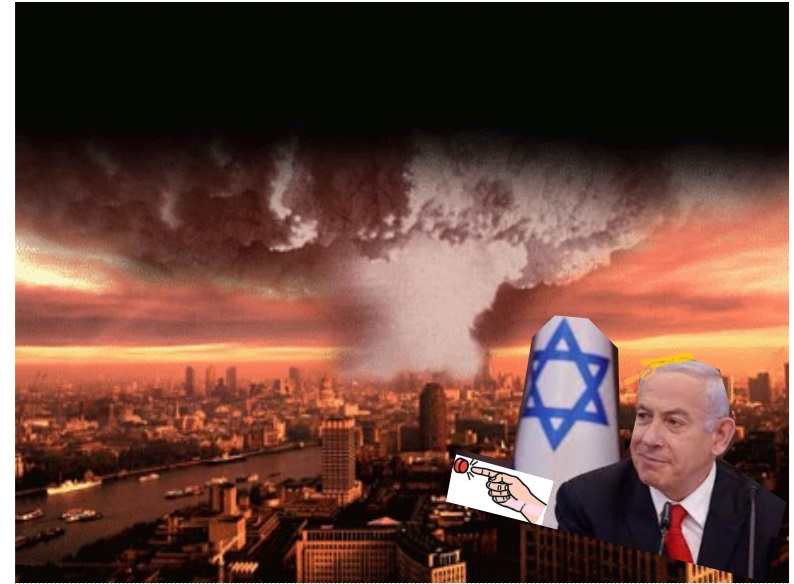
by Hakkı Öcal, Oct 07, 2024 more https://www.dailysabah.com/opinion/columns/netanyahus-dangerous-gambit-to-start-nuclear-war
He is doing everything to unite all Muslims and to sever the Western civilization’s centuries-old relations with the Islamic world.
My realism-in-international-relations-theory cap on: Unless you make it intentionally, peace cannot occur all by itself. But wars can. You don’t have to do anything special to start a war. But if there is a war you want to start and for some reason, you yourself cannot initiate it, then you find a dog. After all, why keep a dog and bark yourself?
Now, the cap off; back to what is really happening!
Israeli Prime Minister (or the prime suspect of the only genocide of the 21st century that has been going on for the last year) Benjamin Netanyahu started a deluge in his country, and now he is about to let in all those who facilitated his genocide on the prospect of exterminating at least 2 millions of Tehran residents and making about 100 million people injured and sick in Iran and neighboring countries that is on the path of the wind storms of the thermo-nuclear weapons he is going to drop on Iran.
That seems the only way for Netanyahu to keep himself out of Israeli prison: It would gratify the Zionist Armageddon troops in his coalition government who would never allow the Jerusalem District Court to put its claws on him in one count of bribery and three of fraud; he denies them all. His wife and other family members have been involved in all cases.
Netanyahu refused to resign for the trial; he argued that it would not contradict his work. His trial was suspended in October due to Hamas’s Oct. 7, 2023, raid in the occupied territories; his lawyers asked for another delay claiming he does not have time to prepare, and he will only be able to testify in March of next year. That is, Netanyahu needs to prolong that war to something large and endless like George W. Bush’s “War on Terror.”
As the Hamas Raid provided the favorable circumstances to begin his coalition partners’ plan for the “Final Solution in Palestine,” now he has ample opportunity to respond to the 200 plus rockets the Iranian Mullahs fired on Israel last week as retaliation to Israel’s killing Hezbollah leaders in Lebanon. Now it is Netanyahu’s turn to retaliate against Iran’s counterretaliation. That is his last opening to spread his war on Gaza to the entire Shiite Crescent, starting at the two ends of it, Lebanon and Yemen, and reaching to the center: Iran, itself.
Netanyahu’s Likud has seven coalition partners – United Torah Judaism, Shas, Religious Zionist Party, Otzma Yehudit, New Hope and Noam – and they actually keep him trapped inside the hardline coalition. His partners are spending billions of dollars in the Occupied Territories opening new settlements and religious schools. Hard-line religious parties allowed gun ownership without investigation. If Netanyahu ever objects to any of these government decrees, his National Security Minister Itamar Ben-Gvir the leader of the far-right Jewish Power party, threatened to end the coalition, which might mean Netanyahu goes to prison with his wife.
This political paralysis will not only keep him doing whatever Ben-Gvir wants him to do, but he has to gear up so that he keeps his allies at the U.N. Security Council, the U.S., Britain and France, on a leash. He knows that in America going to a fateful election would not allow him to keep the Israeli armed forces permanently in the Gaza Strip. America wants Israel to withdraw completely, to let the Palestinian Authority take control. Netanyahu cannot accept cooperation with the Palestinians and he can no longer oppose the U.S. demands. The only way out for him seems to raise the level of hostilities in the region.
State built on blood
Israel was created (at the expense of the Ottoman Empire) to provide a safe refuge for Jews. But it has never been what it was intended for. Since its establishment in 1948, over 20,000 Jews have been killed and over 100,000 of them injured and maimed in the wars the Israeli government started. Not all the Israeli prime ministers were warmongers. Yitzhak Rabin, the fifth prime minister of Israel, for instance, wanted to put an end to the violence caused by Israel’s rejection of the U.N.’s partition of Palestine between the Jews and native Muslims and Christians. He signed the Oslo Accords to finally make peace in Palestine. But Yigal Amir, an Israeli law student and ultranationalist who radically opposed Prime Minister Yitzhak Rabin’s peace initiative, particularly the signing of the Oslo Accords, killed him. Guess who benefited from this political murder?
After a brief interval of seven months with Shimon Peres, Netanyahu became the prime minister and again with a coalition of religious hardliners, he rejected the peace accords Rabin signed and began occupying the Palestinian villages and towns.
According to Mouin Rabbani, former senior analyst at the International Crisis Group and co-editor of Jadaliyya Ezine magazine, Netanyahu has three modi vivendi since his first tour of government in 1996. The first is to launch outrageous provocation guaranteed to elicit an armed response. The second is to use overwhelming firepower to kill Arabs and remind them who is boss. The third and the last is to mobilize foreign parties to quickly restore calm on improved conditions.
Forcing their hands
Now Netanyahu is the prime minister for the sixth time, and he has successfully paved the way to elicit any support not only from the U.S. but also from the British, French and German governments.
If, for any reason, he cannot drag the American generals with him into a disastrous war in Iran, there is a way to bring peace to Palestine. American politicians and their trigger-happy generals (who, overruling President Kennedy’s objection, helped Israel go nuclear in the first place) should understand that millions of dead people in Iran and their neighbors, a devastated Tehran and the misery that would follow would make all the Muslim people in the region, Türkiye included, turn their back on the West for good. Those generals should not even think that Iran is a Shiite country and most of the Arabs and Turks are not, so they won’t really bother about the mass killings and devastation in Iran! Even one single, small Jericho rocket with a nuclear bomb would not only demolish the years of efforts to win the hearts and minds of the Middle Eastern nations, but also any future cooperation between the West and the East would be impossible for the foreseeable future.
As professor Stephen Walt, whose realistic cap and basic teachings I borrowed here, says: “If you don’t want someone to do something, you don’t give them the means to do it. One must therefore conclude the U.S. government does not object to what Israel has been doing for the past year.”
We hope the U.S. still has the final control of Netanyahu’s push-button of those bombs which U.S. President Johnson acquiesced to be built in the Negev Desert in Israel after Kennedy was assassinated. (No, I don’t mean that Kennedy was killed by the Israeli Zionists!)
Inside the State Department’s Weapons Pipeline to Israel
Leaked cables and emails show how the agency’s top officers dismissed internal evidence of Israelis misusing American-made bombs and worked around the clock to rush more out while the Gaza death toll mounted.
ProPublica, by Brett Murphy, Oct. 4, 2024
In late January, as the death toll in Gaza climbed to 25,000 and droves of Palestinians fled their razed cities in search of safety, Israel’s military asked for 3,000 more bombs from the American government. U.S. Ambassador to Israel Jack Lew, along with other top diplomats in the Jerusalem embassy, sent a cable to Washington urging State Department leaders to approve the sale, saying there was no potential the Israel Defense Forces would misuse the weapons.
The cable did not mention the Biden administration’s public concerns over the growing civilian casualties, nor did it address well-documented reports that Israel had dropped 2,000-pound bombs on crowded areas of Gaza weeks earlier, collapsing apartment buildings and killing hundreds of Palestinians, many of whom were children. Lew was aware of the issues. Officials say his own staff had repeatedly highlighted attacks where large numbers of civilians died. Homes of the embassy’s own Palestinian employees had been targeted by Israeli airstrikes.
Still, Lew and his senior leadership argued that Israel could be trusted with this new shipment of bombs, known as GBU-39s, which are smaller and more precise. Israel’s air force, they asserted, had a “decades-long proven track record” of avoiding killing civilians when using the American-made bomb and had “demonstrated an ability and willingness to employ it in [a] manner that minimizes collateral damage.”
While that request was pending, the Israelis proved those assertions wrong. In the months that followed, the Israeli military repeatedly dropped GBU-39s it already possessed on shelters and refugee camps that it said were being occupied by Hamas soldiers, killing scores of Palestinians. Then, in early August, the IDF bombed a school and mosque where civilians were sheltering. At least 93 died. Children’s bodies were so mutilated their parents had trouble identifying them.
Weapons analysts identified shrapnel from GBU-39 bombs among the rubble.
In the months before and since, an array of State Department officials urged that Israel be completely or partially cut off from weapons sales under laws that prohibit arming countries with a pattern or clear risk of violations. Top State Department political appointees repeatedly rejected those appeals.
……………………………….“But it is a question of making judgments,” Blinken said of his agency’s efforts to minimize harm. “We started with the premise on October 7 that Israel had the right to defend itself, and more than the right to defend itself, the right to try to ensure that October 7 would never happen again.”
The embassy’s endorsement and Blinken’s statements reflect what many at the State Department have understood to be their mission for nearly a year. As one former official who served at the embassy put it, the unwritten policy was to “protect Israel from scrutiny” and facilitate the arms flow no matter how many human rights abuses are reported. “We can’t admit that’s a problem,” this former official said.
The embassy has even historically resisted accepting funds from the State Department’s Middle East bureau earmarked for investigating human rights issues throughout Israel because embassy leaders didn’t want to insinuate that Israel might have such problems, according to Mike Casey, a former U.S. diplomat in Jerusalem. “In most places our goal is to address human rights violations,” Casey added. “We don’t have that in Jerusalem.”
Last week, ProPublica detailed how the government’s two foremost authorities on humanitarian assistance — the U.S. Agency for International Development and the State Department’s refugees bureau — concluded in the spring that Israel had deliberately blocked deliveries of food and medicine into Gaza and that weapons sales should be halted. But Blinken rejected those findings as well and, weeks later, told Congress that the State Department had concluded that Israel was not blocking aid.
The episodes uncovered by ProPublica, which have not been previously detailed, offer an inside look at how and why the highest ranking policymakers in the U.S. government have continued to approve sales of American weapons to Israel in the face of a mounting civilian death toll and evidence of almost daily human rights abuses. This article draws from a trove of internal cables, email threads, memos, meeting minutes and other State Department records, as well as interviews with current and former officials throughout the agency, most of whom spoke on the condition of anonymity because they were not authorized to speak publicly.
The records and interviews also show that the pressure to keep the arms pipeline moving also comes from the U.S. military contractors who make the weapons. Lobbyists for those companies have routinely pressed lawmakers and State Department officials behind the scenes to approve shipments both to Israel and other controversial allies in the region, including Saudi Arabia. When one company executive pushed his former subordinate at the department for a valuable sale, the government official reminded him that strategizing over the deal might violate federal lobbying laws, emails show.
The Biden administration’s repeated willingness to give the IDF a pass has only emboldened the Israelis, experts told ProPublica………………………………………………………………………………………………………………….
Weapons sales are a pillar of American foreign policy in the Middle East. Historically, the U.S. gives more money to Israel for weapons than it does to any other country. Israel spends most of those American tax dollars to buy weapons and equipment made by U.S. arms manufacturers……………………………………………………………………
There is little sign that either party is prepared to curtail U.S. weapons shipments. ………………………………………………………………………………………
The U.S. gives the Israeli government about $3.8 billion every year and much more during wartime to help maintain its military edge in the region. Congress and the executive branch have imposed legal guardrails on how Israel and other countries can use the weapons they buy with U.S. money. The State Department must review and approve most of those large foreign military sales and is required to cut off a country if there is a pattern or clear risk of breaking international humanitarian law, …………………
the bulk of that review is conducted by the State Department’s arms transfers section, known as the Bureau of Political-Military Affairs, with input from other bureaus. For Israel and NATO allies, if the sale is worth at least $100 million for weapons or $25 million for equipment, Congress also gets final approval. If lawmakers try to block a sale, which is rare, the president can sidestep with a veto.
For years, Josh Paul, a career official in the State Department’s arms transfers bureau, reviewed arms sales to Israel and other countries in the Middle East. Over time, he became one of the agency’s most well-versed experts in arms sales.
Even before Israel’s retaliation for Oct. 7, he had been concerned with Israel’s conduct. On multiple occasions, he said, he believed the law required the government to withhold weapons transfers. In May 2021, he refused to approve a sale of fighter jets to the Israeli Air Force. “At a time the IAF are blowing up civilian apartment blocks in Gaza,” Paul wrote in an email, “I cannot clear on this case.” The following February, he wouldn’t sign off on another sale after Amnesty International published a report accusing Israeli authorities of apartheid.
In both cases, Paul later told ProPublica, his immediate superiors signed off on the sales over his objections……………………………………………………………
Paul resigned in protest over arms shipments to Israel last October, less than two weeks after the Hamas attack. It was the Biden administration’s first major public departure since the start of the war. By then, local authorities said Israeli military operations had killed at least 3,300 Palestinians in Gaza.
Internally, other experts began to worry the Israelis were violating human rights almost from the onset of the war as well……………………………………………………
. In late December, just before Christmas, staff in the arms transfers bureau walked into their Washington, D.C., office and found something unusual waiting for them: cases of wine from a winery in the Negev Desert, along with personalized letters on each bottle.
The gifts were courtesy of the Israeli embassy………………………………………………
One month later, Lew delivered his endorsement of Israel’s request for the 3,000 precision GBU-39 bombs, which would be paid for with both U.S. and Israeli funds. Lew is a major figure in Democratic circles, having served in various administrations. He was President Barack Obama’s chief of staff and then became his treasury secretary. He has also been a top executive at Citigroup and a major private equity firm.
The U.S. defense attaché to Israel, Rear Adm. Frank Schlereth, signed off on the January cable as well. In addition to its assurances about the IDF, the memo cited the Israeli military’s close ties with the American military: Israeli air crews attend U.S. training schools to learn about collateral damage and use American-made computer systems to plan missions and “predict what effects their munitions will have on intended targets,” the officials wrote.
In the early stages of the war, Israel used American-made unguided “dumb” bombs, some likely weighing as much as 2,000 pounds, which many experts criticized as indiscriminate. But at the time of the embassy’s assessment, Amnesty International had documented evidence that the Israelis had also been dropping the GBU-39s, manufactured by Boeing to have a smaller blast radius, on civilians. Months before Oct. 7, a May 2023 attack left 10 civilians dead. Then, in a strike in early January this year, 18 civilians, including 10 children, were killed. Amnesty International investigators found GBU-39 fragments at both sites. (Boeing declined to comment and referred ProPublica to the government.)
At the time, State Department experts were also cataloging the effect the war has had on American credibility throughout the region. Hala Rharrit, a career diplomat based in the Middle East, was required to send daily reports analyzing Arab media coverage to the agency’s senior leaders. Her emails described the collateral damage from airstrikes in Gaza, often including graphic images of dead and wounded Palestinians alongside U.S. bomb fragments in the rubble.
“Arab media continues to share countless images and videos documenting mass killings and hunger, while affirming that Israel is committing war crimes and genocide and needs to be held accountable,” she reported in one early January email alongside a photograph of a dead toddler. “These images and videos of carnage, particularly of children getting repeatedly injured and killed, are traumatizing and angering the Arab world in unprecedented ways.”
Rharrit, who later resigned in protest, told ProPublica those images alone should have prompted U.S. government investigations and factored into arms requests from the Israelis. She said the State Department has “willfully violated the laws” by failing to act on the information she and others had documented. “They can’t say they didn’t know,” Rharrit added……………………………………………………..
In Israel’s New York consulate, weapons procurement officers occupy two floors, processing hundreds of sales each year. One former Israeli officer who worked there said he tried to purchase as many weapons as possible while his American counterparts tried just as hard to sell them. “It’s a business,” he said.
Behind the scenes, if government officials take too long to process a sale, lobbyists for powerful corporations have stepped in to apply pressure and move the deal along, ProPublica found.
Some of those lobbyists formerly held powerful positions as regulators in the State Department. In recent years, at least six high-ranking officials in the agency’s arms transfers bureau left their posts and joined lobbying firms and military contractors…………………………………………….more https://www.propublica.org/article/israel-gaza-america-biden-administration-weapons-bombs-state-department
France asserts itself against Netanyahu over Lebanon: Macron calls for Arms Embargo against Israel
Informed Comment Juan Cole10/06/2024
Ann Arbor (Informed Comment) – In a radio interview with France Inter on Saturday, French president Emmanuel Macron called for an arms embargo against Israel over its ongoing attacks on Gaza and now Lebanon.
BFMTV reported that he said, “I think that today the priority is to return to a political solution, and that we must halt the delivery of arms for pursuing combat against Gaza. France will not deliver them.”
He clarified that France would continue to export defensive materiel, such as parts for the Israeli Iron Dome anti-missile defense system.
The station notes that President Joe Biden has often called for the avoidance of civilian casualties but has steadfastly declined to use his leverage with Israel, given its dependence on US weaponry and ammunition, to pressure it. In Britain, the Labour government of PM Keir Starmer has halted 10 out of 350 weapons licenses on the grounds that those ten weapons would likely be used by Israel against civilians.
Macron is the first leader of a major European country to argue for an embargo of offensive weapons to Israel in response to its total war on Gaza.
The French president has been heavily criticized by former French diplomats and other public figures for not showing the spine toward the Israeli……………………………. more https://www.juancole.com/2024/10/asserts-against-netanyahu.html
1 This Month

of the week – Shut Down Drone Warfare!


Tell the Ukrainian Government to Drop Prosecution of Peace Activist Yurii Sheliazhenko

Petition to revoke the licensing of the Near Surface Nuclear Disposal Facility (NSDF) at Chalk River. https://www.ourcommons.ca/petitions/en/Petition/Details?Petition=e-7247
To see nuclear-related stories in greater depth and intensity – go to https://nuclearinformation.wordpress.com
-
Archives
- April 2026 (79)
- March 2026 (251)
- February 2026 (268)
- January 2026 (308)
- December 2025 (358)
- November 2025 (359)
- October 2025 (376)
- September 2025 (257)
- August 2025 (319)
- July 2025 (230)
- June 2025 (348)
- May 2025 (261)
-
Categories
- 1
- 1 NUCLEAR ISSUES
- business and costs
- climate change
- culture and arts
- ENERGY
- environment
- health
- history
- indigenous issues
- Legal
- marketing of nuclear
- media
- opposition to nuclear
- PERSONAL STORIES
- politics
- politics international
- Religion and ethics
- safety
- secrets,lies and civil liberties
- spinbuster
- technology
- Uranium
- wastes
- weapons and war
- Women
- 2 WORLD
- ACTION
- AFRICA
- Atrocities
- AUSTRALIA
- Christina's notes
- Christina's themes
- culture and arts
- Events
- Fuk 2022
- Fuk 2023
- Fukushima 2017
- Fukushima 2018
- fukushima 2019
- Fukushima 2020
- Fukushima 2021
- general
- global warming
- Humour (God we need it)
- Nuclear
- RARE EARTHS
- Reference
- resources – print
- Resources -audiovicual
- Weekly Newsletter
- World
- World Nuclear
- YouTube
-
RSS
Entries RSS
Comments RSS
 nuclear-news