Chris Hedges: Trump’s Christian Fascists and the War on Palestine
the usual absurdity that the Hebrew Bible, written 4,000 years ago, can be used to draw contemporary national borders.
March 11, 2025, By Chris Hedges / ScheerPost
Christian Nationalists who form the bedrock of support for Donald Trump — 80 percent voted for Trump in the last election according to a voter survey by the Associated Press — have mounted a concerted campaign calling on the White House to back Israel’s annexation of the West Bank and Gaza.
This campaign includes visits to Israel by prominent leaders, including Ralph Reed, Tony Perkins and Mario Bramnick, petitioning the White House, lobbying Congress and calls for annexation at Christian conferences, including a resolution of support for Israeli sovereignty over the West Bank adopted at the most recent Conservative Political Action Conference. The National Religious Broadcasters (NRB) Convention in Dallas, in March, gathered over 200 signatures from pastors and right-wing religious leaders from across the United States calling for the annexation of “Judea and Samaria” — the purported biblical name for the West Bank —and declaring the two state solution “a failed experiment.”
American Christian Leaders for Israel, which says it represents a network of “over 3,000 organizational leaders from across the nation, including the National Religious Broadcasters,” endorsed the NRB resolution and sent it to Trump. Congresswoman Claudia Tenney and five other members of the congressional “Friends of Judea and Samaria Caucus,” sent a letter to Trump asking to “recognize the right of Israel” to declare sovereignty over the occupied Palestinian territories, arguing that it will advance “the Judeo-Christian heritage on which our nation was founded.”
Trump, who rescinded a Biden administration executive order that sanctioned Jewish colonists in the West Bank for human rights violations, promised, on Feb. 4, to make an announcement in the “next four weeks,” about possible annexation of the West Bank. This follows Trump’s call for the ethnic cleansing of Gaza and death threats to the Palestinians unless they release Israeli hostages. “You’re talking about probably a million and a half people, and we just clean out that whole thing,” Trump said of Gaza while speaking to reporters aboard Air Force One.
The agenda of Zionist extremists and Christian fascists, who hold senior positions throughout the Trump administration, have long converged. The language, iconography and symbolism used by the Christian and Jewish fascists is biblical. But the bonds are political, not religious.
I detail the history and ideology of our homegrown fascism and its kinship with Jewish fascism in my book, “American Fascists: The Christian Right and the War on America.”
Mike Huckabee, the former governor of Arkansas and a Baptist minister, has been nominated by Trump to be the U.S. ambassador to Israel. Huckabee has said there is “no such thing as a Palestinian” and asserted that Palestinian identity is “a political tool to try and force land away from Israel.” He proposes that any Palestinian state should be created outside of Israel in neighboring countries such as Egypt, Syria or Jordan. He dismisses the two-state solution as “irrational and unworkable.”
“I believe the scripture. Genesis 12: Those who bless Israel will be blessed; those who curse Israel will be cursed. I want to be on the blessing side, not the curse side,” Huckabee says.
John Ratcliffe, appointed by Trump to run the Central Intelligence Agency, advocates assisting Israel in what he described as its “foot-on-their-throat” approach against Iran.
Trump’s Defense Secretary Pete Hegseth — who argues that “Zionism and Americanism are the front-lines of Western civilization and freedom in our world today” — pedals the usual absurdity that the Hebrew Bible, written 4,000 years ago, can be used to draw contemporary national borders…………………………………………………………………………………….
Jewish supremacy, like the supremacy of the Christian fascists, is, these fanatics claim, sanctified by God. The slaughter of the Palestinians, who Benjamin Netanyahu compared to the biblical Amalekites, are the incarnate of evil and deserve to be massacred. Euro-Americans in the American colonies used the same biblical passage to justify the genocide of Native Americans. Violence and the threat of violence are the only forms of communication those inside the magical circle of Jewish nationalism or Christian nationalism speak…………………………………………………………………………….. more https://scheerpost.com/2025/03/11/chris-hedges-trumps-christian-fascists-and-the-war-on-palestine/
Qatar calls for Israel’s nuclear facilities to be under IAEA supervision
March 10, 2025 , https://www.middleeastmonitor.com/20250310-qatar-calls-for-israels-nuclear-facilities-to-be-under-iaea-supervision/
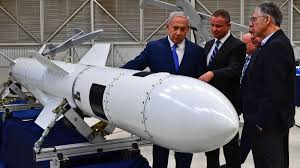
Qatar called on Sunday for all of Israel’s nuclear facilities to be subjected to the International Atomic Energy Agency (IAEA) safeguards and for Israel to sign the Treaty on the Non-Proliferation of Nuclear Weapons (NPT) as a non-nuclear state if that is what it claims to be.
Qatar’s Ambassador and Permanent Representative to the UN Office and International Organisations in Vienna, Jassim Yacoup Al-Hammadi, said before the session of the IAEA Board of Governors in the Austrian capital, that there is a “need for the international community and its institutions to uphold their commitments under resolutions of the UN Security Council, the UN General Assembly, the IAEA, and the 1995 Review Conference of the NPT, which called on Israel to subject all its nuclear facilities to IAEA safeguards.”
He noted that some of these resolutions explicitly urged Israel to join the NPT as a non-nuclear state if its non-confirmation of its nuclear programme is, in effect, a denial of its existence.
The Qatari Ambassador pointed out that all Middle Eastern countries, except Israel, are parties to the NPT and have effective safeguard agreements with the Agency.
He also noted that. “Israel continues its aggressive policies, including increasing extremist calls for the forced displacement of the Palestinian people, intensifying military operations against cities and refugee camps in the West Bank, blocking humanitarian aid to Gaza, and maintaining restrictions on the operations of the United Nations Relief and Works Agency for Palestine Refugees in the Near East (UNRWA).”
Al-Hammadi stated that Qatar “submitted a written memorandum last week to the International Court of Justice (ICJ) regarding a request for an advisory opinion based on the UN General Assembly resolution of 19 December, 2024. The request seeks clarification on Israel’s obligations concerning the activities of the United Nations, other international organisations, and third-party states.”
The nuclear testing revival: Global fallout with deadly consequences
By Karl Grossman | 10 March 2025 https://independentaustralia.net/life/life-display/the-nuclear-testing-revival-global-fallout-with-deadly-consequences,19502
The push to restart U.S. nuclear testing raises fears of global fallout, echoing a dangerous past with lasting consequences, writes Karl Grossman
RESEARCH FELLOW for nuclear deterrence and missile defence at The Heritage Foundation, Robert Peters, declared:
‘The United States may need to restart explosive nuclear weapons testing.’
The right-wing organisation close to the Trump Administration released a lengthy report on 15 January, titled: ‘America Must Prepare to Test Nuclear Weapons‘, in which Peters also stated:
‘…The President may order the above-ground testing of a nuclear weapon….And while the United States leaving the [Nuclear] Test Ban Treaty may not be optimal and may indeed have negative downstream effects, doing so may be necessary to stave off further adversary escalation.’
There has not been a nuclear weapon tested above-ground in the United States since 1962, Peters said. That was a year before the Test Ban Treaty 1963 was signed by the U.S., Soviet Union and United Kingdom. It prohibited nuclear weapons tests in the atmosphere, underwater or in outer space. It allowed underground tests as long as they didn’t result in ‘radioactive debris to be present outside the territorial limits of the state under whose jurisdiction or control’ the test was conducted.
“ [Nuclear testing] leads to children and grandchildren with cancer in their bones, with leukemia in their blood, or with poison in their lungs.”
~ President John F Kennedy
However, executive director of the Radiation and Public Health Project Joseph Mangano says:
‘Resuming atmospheric testing of nuclear weapons would be disastrous.’
Mangano also cited:
‘…lessons learned from above-ground nuclear weapons testing — the radioactive fall-out that harmed many people, especially infants and children.’
Testimony by a co-founder of the Radiation and Public Health Project, the late Dr Ernest Sternglass – a physicist, before the then Congressional Joint Committee on Atomic Energy – was instrumental in U.S. President John F Kennedy signing the Nuclear Test Ban Treaty of 1963.
As Kennedy said in a 1963 national address:
This treaty can be a step towards freeing the world from the fears and dangers of radioactive fallout…over the years the number and the yield of weapons tested have rapidly increased and so have the radioactive hazards from such testing.
Continued unrestricted testing by the nuclear powers, joined in time by other nations which may be less adept in limiting pollution, will increasingly contaminate the air that all of us must breathe.
Kennedy also spoke of “children and grandchildren with cancer in their bones, with leukaemia in their blood, or with poison in their lungs” as a result of the testing.
According to Susan Caskie, executive editor of The Week, the Heritage Foundation’s 900-page publication ‘Project 2025‘ is the ‘governing agenda’ for the Trump Administration. She notes, ‘many of its authors and contributors’ are now members of the Trump Administration, with some even appointed to Cabinet posts.
Tom Armbruster, former U.S. Ambassador to the Marshall Islands and earlier the U.S. Embassy in Moscow’s nuclear affairs wrote in an article in the Bulletin of the Atomic Scientists titled, ‘Project 2025’s stance on nuclear testing: A dangerous step back’:
‘On page 431, Project 2025 calls for the United States to “Reject ratification of the Comprehensive Test Ban Treaty and indicate a willingness to conduct nuclear tests in response to adversary nuclear developments if necessary. This will require that the National Nuclear Security Administration be directed to move to immediate test readiness…”.’
Ambruster also said:
We should be negotiating further cuts in the world’s nuclear arsenals, a prohibition of weapons in outer space, and cleanup of the “legacy” test sites around the world. It would help if Russia were a responsible partner in denuclearisation but sadly that is not the case.
We could be working together to find ways to mend the planet, rather than inflict further damage that will last for thousands of years.
But in The Heritage Foundation’s report, Peters writes:
‘There are two major reasons why the United States may want to restart nuclear testing in the coming years. First, it may be technically correct that the United States does not need to test its current arsenal, but the United States is building new warheads as part of the nuclear modernisation effort.’
He goes on:
It may, in fact, be necessary to test these new systems to ensure that they work as designed. Modelling and simulation may be sufficient to assess the viability and characteristics of these new warheads — but that is not a proven proposition.
Moreover, the purpose of nuclear weapons is to deter one’s adversaries from carrying out breathtaking acts of aggression. In that sense, even if nuclear explosive testing is not necessary to convince American policymakers that next-generation nuclear systems work, it may be necessary to convince America’s adversaries that its nuclear arsenal is credible.
Peters continued:
Second and more importantly, a nuclear explosive test may be necessary to demonstrate resolve. In recent years, autocrats have increasingly leveraged nuclear coercion or nuclear threats in an attempt to intimidate the West or secure geopolitical concessions.
While the United States signed and ratified the Treaty under President Kennedy – and has adhered to its requirements for over six decades – the Treaty allows a state to withdraw with three months notification if it deems it in its national interests to do so.
It was also in the Bulletin of the Atomic Scientists that Mangano and Robert Alvarez, former senior policy advisor to the secretary of the U.S. Department of Energy and now senior policy advisor at the Institute for Policy Studies, wrote an article in 2021 on radioactive fallout from nuclear weapons tests and the ‘baby tooth’ study, which began:
How many nuclear weapons can be detonated in support of weapons development or during a war before imperilling humans from radioactive fallout?
To find the answer, independent scientists and citizens turned to baby teeth. Lots and lots of baby teeth. Why baby teeth?….The most commonly measured isotope in these tissues – strontium 90 – is absorbed as if it were calcium. This isotope lodges in human bone tissue for many years and was the principal contaminant of concern in fallout investigations…
Beginning in December 1958, the St. Louis Committee for Nuclear Information and scientists at Washington University, ‘began assembling the most significant collection of human samples in the atmospheric bomb test era.’ Donated were 320,000 baby teeth.
Findings were published in a 2023 issue of the Journal of Social Determinants of Health and Health Services titled, ‘Strontium 90 in Baby Teeth as a Basis for Eliminating U.S. Cancer Deaths From Nuclear Weapons Fallout’. The report was written by biology professor at the University of South Carolina Dr Timothy Mousseau, professor emeritus of chemistry and biology at North Arizona University Dr Michael Ketterer, and Kelli S. Gaus and, comments Mangano, ‘This saved many lives.’
It detailed a 63-fold increase in strontium-90 in baby teeth from children born in the years after large-scale nuclear weapons testing in the atmosphere started in 1950, then dropping in half in the five years after the Nuclear Test Ban Treaty of 1963 took effect.
If there is a return to atmospheric nuclear weapons testing, are we to go back to the years of radioactive fallout – and the resulting health impacts – fallout that would have a global impact? And, as Kennedy stated, “children and grandchildren with cancer in their bones, with leukaemia in their blood, or with poison in their lungs”?
Karl Grossman is a professor of journalism at the State University of New York. He is also an award-winning investigative reporter. Click here to go to Karl’s website.
How many nuclear weapons does the United States have in 2025?
10 Mar 2025
Since 1987, the Bulletin of the Atomic Scientists has published the Nuclear Notebook, an authoritative accounting of world nuclear arsenals compiled by top experts from the Federation of American Scientists.
Today, it is prepared by Hans M. Kristensen, Matt Korda, Eliana Johns, and Mackenzie Knight of FAS.
This video explores the United States’ nuclear arsenal, which is currently undergoing a broad modernization effort to replace every nuclear delivery system over the next decade. You can read more from the Nuclear Notebook about other nuclear arsenals here: https://thebulletin.org/nuclear-noteb… https://www.youtube.com/watch?v=3vsNKk9vkIE
Treaty on the Prohibition of Nuclear Weapons States agree – the ban is the alternative to reckless nuclear deterrence and proliferation as Third Meeting of States Parties draws to a close.
The Third Meeting of States Parties to the UN Treaty on the Prohibition of Nuclear Weapons (TPNW) has successfully concluded at UN Headquarters with a powerful political declaration rejecting nuclear weapons and challenging nuclear deterrence, and adopting a host of decisions that strengthen the Treaty’s process.
86 countries participated in the meeting as states parties or observers, engaging in a robust and interactive debate during the week, adopting a political declaration and package of decisions. The meeting also counted the active participation of a thousand representatives from 163 civil society organisations, including many affected community voices, and nine International Organisations. Over 70 events took place in the context of the 3MSP, in the UN and across the city during Nuclear Ban Week.
Connecting nuclear disarmament to global security concerns and introducing the roadmap to dismantle nuclear deterrence
80 years after nuclear weapons were first tested and used, and against a backdrop of increasing instability and calls for nuclear proliferation in Asia and Europe, the states parties and signatories to the Treaty are showing leadership to put an end to the threats that nuclear weapons and nuclear deterrence pose to their – and everyone else’s – security.
In the Declaration adopted at the end of the meeting, TPNW states parties agreed that the best way to advance global security from nuclear weapons is to bring more countries on board the Treaty, now including 94 signatories and 73 states parties. States parties agreed that “nuclear weapons are a threat to the security, and ultimately the existence, of all states, irrespective of whether they possess nuclear weapons, subscribe to nuclear deterrence or firmly oppose it.”
A report submitted to the conference provided detailed recommendations on how TPNW states can challenge current nuclear weapon doctrines and ways in which it threatens their security, including at the UN Security Council, with media and bilaterally with nuclear-armed states. The Declaration also rejects nuclear deterrence as a threat to TPNW member states, challenging the increasing reliance on deterrence by the nuclear-armed states and other pro-nuclear weapons states that we are seeing in both Europe and Asia, stating: “Nuclear deterrence is posited on the very existence of nuclear risk, which threatens the survival of all.” This is the strongest condemnation of nuclear deterrence seen in a multilateral process.
Incorporating calls for nuclear justice from affected communities
Communities affected by nuclear weapons, including Indigenous Peoples, were integral to the meeting and the strength of its outcomes. The 3MSP heard the calls from Nobel Peace Laureates, Nihon Hidankyo, and affected individuals from the Yankunytjatjara People, Kazakhstan, the Republic of Korea, Maohi Nui (French Polynesia), Kiribati, Fiji, the Navajo Nation, among others on how TPNW states can best support those most affected through their implementation of the Treaty.
Across a series of events, including the fourth edition of the Nuclear Survivors Forum, affected community representatives were active and vocal in reinforcing the urgent need to address past harms from the use and testing of nuclear weapons – and do so in a manner that is meaningfully inclusive. The Declaration emerging from the meeting pledged “to continue to collaborate through an inclusive approach with all States, international organizations, parliamentarians, civil society, scientists, financial institutions, youth as well as communities and individuals affected by nuclear weapons, including Indigenous Peoples.”
Outlining an inclusive and bold path forward for the TPNW
States agreed to continue to work on the 50 point Vienna Action Plan adopted at the first Meeting of States Parties in 2022, in order to be able to take stock of progress and prepare the next series of actions at the Review Conference.
The Review Conference for the TPNW will be held at UN Headquarters in New York in November 2026, with South Africa serving as the president.
Britain’s nuclear submarines bill spirals by £5bn
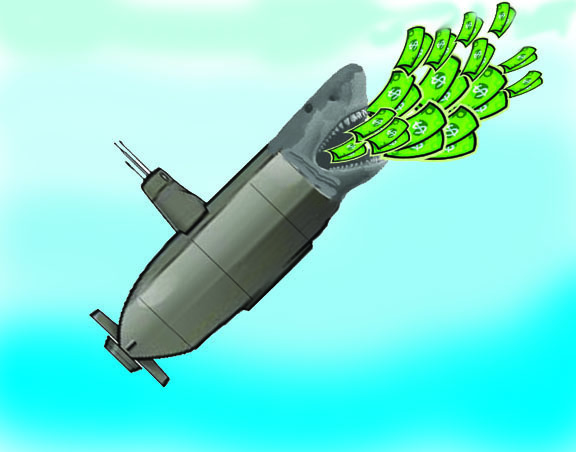
The MoD blames inflation as the cost of replacing the UK’s at-sea deterrent hits £37bn
Szu Ping Chan Economics Editor. Matt Oliver Industry Editor
The cost of replacing the submarines carrying Britain’s nuclear deterrent
has ballooned by more than £5bn in just three years, according to official
documents. The Ministry of Defence (MoD) has raised its estimate for the
lifetime cost of manufacturing and maintaining four new ballistic missile
submarines to £36.7bn as of March last year, up from an estimate of
£31.5bn in 2020-21. It is also £2.5bn more than projected in March 2023.
Telegraph 9th March 2025, https://www.telegraph.co.uk/business/2025/03/09/cost-for-britains-new-nuclear-submarines-spirals-by-5bn/
US support to maintain UK’s nuclear arsenal is in doubt, experts say.
Guardian 8th March 2025,
Malcolm Rifkind joins diplomats and analysts urging focus on European cooperation to replace Trident.
Britain’s ability to rely on the US to maintain the UK’s nuclear arsenal is now in doubt, experts have warned, but working with European states to replace it will be costly and take time.
An existing debate about the future of Trident – Britain’s ageing submarine-launched nuclear missile system – has taken a dramatic new turn in recent weeks amid fears Donald Trump could pull out of Nato.
A range of concerns had already loomed over the £3bn-a-year programme, not least around its efficiency and effectiveness after a second embarrassing failed test launch last year.
Costs have also been a longstanding challenge but replacing Vanguard submarines on time has been prioritised over coming in under budget.
Downing Street sought to play down concerns earlier this week after diplomatic figures including the former British ambassador to the US Sir David Manning floated the scenario of an end to Anglo-US nuclear cooperation.
However, calls for Britain to make alternative plans have been joined by the former UK foreign secretary Sir Malcolm Rifkind, who initiated talks in the 90s between the UK and France on nuclear weapons cooperation.
“It really is necessary for Britain and France to work more closely together because if American reliability ever came into question, then Europe could be defenceless in the face of Russian aggression,” he said.
“The contribution by America must now be to some degree in doubt, not today or tomorrow, but over the next few years and certainly as long as Trump and people like him are in control in Washington.”………………………………………………………………………………………………. https://www.theguardian.com/world/2025/mar/08/us-support-uk-nuclear-arsenal-in-doubt-trident-france
Britain’s nuclear weapons fiasco is a nightmare for Rachel Reeves
Overhauling the UK’s ageing defence has left the Chancellor facing a fresh battle to balance the books
Sir Keir Starmer was the first Labour leader in three decades to visit the
Barrow shipyard where Britain’s next generation of nuclear submarines are
being assembled. The Prime Minister, on the opposition benches at the time,
was unflinching in his support for the UK’s submarines-based nuclear
deterrent – a continuous at-sea presence that the Royal Navy has
maintained since 1969.
But while keeping Britain safe may be priceless,
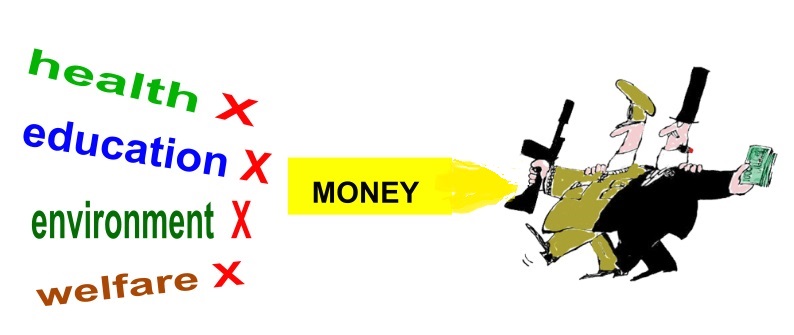
being ready for war doesn’t come cheap. Trident, Britain’s nuclear
deterrent, gobbles up a significant share of our defence budget, leaving
the share devoted to troops and guns far below the 2pc Nato baseline. While
the Treasury said in October that its commitment to the UK’s nuclear
deterrent was “absolute”, many have warned that costs are spiralling
out of control, piling more pressure on a Chancellor who is already
struggling to balance the books.
Telegraph 8th March 2025, https://www.telegraph.co.uk/business/2025/03/08/britains-nuclear-weapons-fiasco-nightmare-rachel-reeves/
Air Force Activates Key Unit for Nuclear Modernization at VSFB

COMMENT. Well, they conned a woman into this killer industry, coddled and “educated” her into this top military job.
The nuclear lobby made keen to promote their pretence that nuclear weapons are good for women!
Most women would not like being part of this.
March 7, 2025, By Jennifer Green-Lanchoney
VANDENBERG SPACE FORCE BASE, Calif. —
In a ceremony marking a new chapter in America’s nuclear deterrence strategy, U.S. Air Force Lt. Col. Suzanne Lamar assumed command of the newly activated Site Activation Task Force (SATAF) Detachment 9 at Vandenberg Space Force Base, March 6.
The activation of SATAF Detachment 9 represents a crucial step in modernizing the nation’s Intercontinental Ballistic Missile (ICBM) capabilities, as the Air Force prepares to replace the aging Minuteman III system with the new LGM-35A Sentinel.
Vandenberg SFB’s Western Range serves as the primary testing ground for the Air Force Global Strike Command’s ICBM deterrent architecture. The Sentinel program represents a significant update to U.S. nuclear deterrent capabilities.
“Space superiority and nuclear deterrence start here at Vandenberg,” said U.S. Air Force Lt. Gen. Michael Lutton, Air Force Global Strike Command deputy commander. “Seventy years ago, Vandenberg hosted the dawn of ICBM testing, and we carry that forward here as we bring this new capability to the joint force.”……………………………….
The SATAF detachments, including Detachment 9 at Vandenberg, are crucial components of AFGSC’s strategy to maintain a “continuously viable, secure, and effective land-based nuclear deterrent.” Similar detachments are scheduled for activation at F.E. Warren AFB, Wyoming (April 3); Malmstrom AFB, Montana (April 4); and Minot AFB, North Dakota (summer 2025)……………………………………………………… https://www.afgsc.af.mil/News/Article-Display/Article/4112894/air-force-activates-key-unit-for-nuclear-modernization-at-vsfb/
It’s time to ditch Virginia subs for AUKUS and go to Plan B
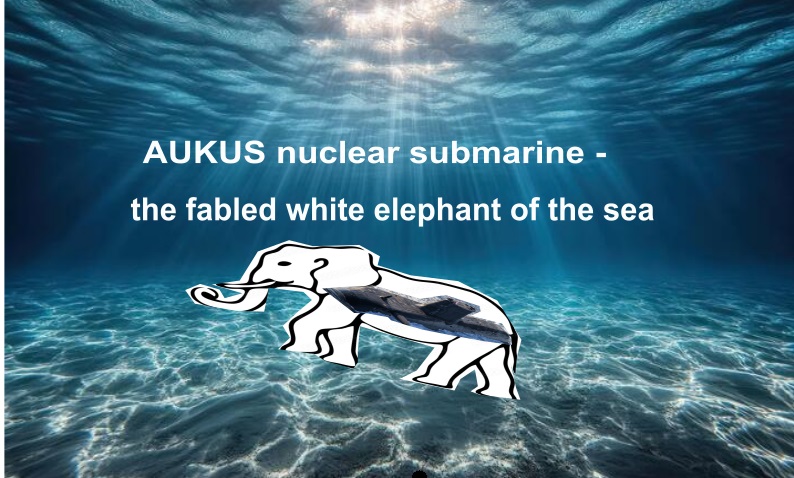
In this op-ed, Henry Sokolski argues Australia should switch its focus from buying Virginia-class submarines and instead put that money towards Pillar 2 technologies.
Breaking Defense Henry Sokolski March 06, 2025
Earlier this month, the Australian government made its first payment of $500 million toward eventually obtaining US nuclear-powered submarines under the 2021 AUKUS agreement. Because the submarine deal is unlikely to overcome budgetary, organizational, and personnel hurdles, that payment should be Australia’s last.
Rather than sacrificing much of its defense program to buy nuclear submarines, Canberra should instead adopt an AUKUS Plan B that would field new defense technologies such as uncrewed systems and hypersonic weapons that would enhance Australia’s security faster, and for far less.
Most experts believe funding AUKUS’s nuclear submarine plans will be challenging. Australia’s defense budget this year is almost $35 billion USD, and is planned to rise to almost $63 billion annually by the end of this decade when Australia would begin buying US nuclear submarines. At more than $3 billion per boat, each Virginia sub will eat up five to ten percent of the Australia defense budget that year, assuming Australia can double its defense spending in five years. Already, a former top officer has warned that the submarine pact will “cannibalize” other priorities and require deferring future surface warships or eliminating some ground units.
Another potential stumbling block is what’s needed to manage a nuclear propulsion program. More than 8,000 people work for the US Naval Nuclear Propulsion program. Today only about 680 people work at the Australian Submarine Agency. If Australia wants a sovereign submarine force that isn’t dependent on Washington’s oversight, it will need thousands of additional skilled civilian workers.
Military personnel is also a challenge. The Royal Australian Navy (RAN) includes about 16,000 sailors today. Each Virginia-class submarine has a crew of about 130 people, and about 400 sailors per ship to account for training, shore duty, and maintenance. With retention already difficult for the Australian Defence Force, the RAN may be hard-pressed to find and keep the thousand-plus highly-qualified personnel it needs to crew the nuclear sub fleet……………………………..
https://breakingdefense.com/2025/03/its-time-to-ditch-virginia-subs-for-aukus-and-go-to-plan-b/
Surface tension: could the promised Aukus nuclear submarines simply never be handed over to Australia?

Guardian, Ben Dohert, 7 Mar 25
The multi-billion dollar deal was heralded as ensuring the security of the Indo-Pacific. But with America an increasingly unreliable ally, doubts are rising above the waves.
Maybe Australia’s boats just never turn up.
To fanfare and flags, the Aukus deal was presented as a sure bet, papering over an uncertainty that such an ambitious deal could ever be delivered.
It was assured, three publics across two oceans were told – signed, sealed and to-be-delivered: Australia would buy from its great ally, the US, its own conventionally armed nuclear-powered attack submarines before it began building its own.
But there is an emerging disquiet on the promise of Aukus pillar one: it may be the promised US-built nuclear-powered submarines simply never arrive under Australian sovereign control.
Instead, those nuclear submarines, stationed in Australia, could bear US flags, carry US weapons, commanded and crewed by American officers and sailors.
Australia, unswerving ally, reduced instead to a forward operating garrison – in the words of the chair of US Congress’s house foreign affairs committee, nothing more than “a central base of operations from which to project power”.
Reliable ally no longer
Officially at least, Aukus remains on course, centrepiece of a storied security alliance.
Pillar one of the Australia-UK-US agreement involves, first, Australia buying between three and five Virginia-Class nuclear-powered submarines from the US – the first of these in 2032.
Then, by the “late 2030s”, according to Australia’s submarine industry strategy, the UK will deliver the first specifically designed and built Aukus submarine. The first Australian-built version will be in the water “in the early 2040s”. Aukus is forecast to cost up to $368bn to the mid-2050s.
But in both Washington and Canberra, there is growing concern over the very first step: America’s capacity to build the boats it has promised Australia, and – even if it had the wherewithal to build the subs – whether it would relinquish them into Australian control.
The gnawing anxiety over Aukus sits within a broader context of a rewritten rulebook for relations between America and its allies. Amid the Sturm und Drang of the first weeks of Trump’s second administration, there is growing concern that the reliable ally is no longer that…………………….
‘The cheque did clear’
On 8 February, Australia paid $US500m ($AUD790m) to the US, the first instalment in a total of $US3bn pledged in order to support America’s shipbuilding industry. Aukus was, Australia’s defence minister Richard Marles said, “a powerful symbol of our two countries working together in the Indo-Pacific”.

“It represents a very significant increase of the American footprint on the Australian continent … it represents an increase in Australian capability, through the acquisition of a nuclear‑powered submarine capability … it also represents an increase in Australian defence spending”.
………….. just three days after Australia’s cheque cleared, the Congressional Research Service quietly issued a paper saying while the nuclear-powered attack submarines (known as SSNs) intended for Australia might be built, the US could decide to never hand them over.
It said the post-pandemic shipbuilding rate in the US was so anaemic that it could not service the needs of the US Navy alone, let alone build submarines for another country’s navy…………………………………………………………………………………………………..
‘Almost inevitable’
Clinton Fernandes, professor of international and political Studies at the University of New South Wales and a former Australian Army intelligence analyst, says the Aukus deal only makes sense when the “real” goal of the agreement is sorted from the “declared”.
“The real rather than declared goal is to demonstrate Australia’s relevance to US global supremacy,” he tells the Guardian.
“The ‘declared goal’ is that we’re going to become a nuclear navy. The ‘real goal’ is we are going to assist the United States and demonstrate our relevance to it as it tries to preserve an American-dominated east Asia.”
Fernandes, author of Sub-Imperial Power, says Australia will join South Korea and Japan as the US’s “sentinel states in order to hold Chinese naval assets at risk in its own semi-enclosed seas”.
“That’s the real goal. We are demonstrating our relevance to American global dominance. The government is understandably uneasy about telling the public this, but in fact, it has been Australia’s goal all along to preserve a great power that is friendly to us in our region.”
Fernandes says the Aukus pillar one agreement “was always an article of faith” based on a premise that the US could produce enough submarines for itself, as well as for Australia.
“And the Congressional Research Service study argues that … they will not have enough capacity to build boats for both themselves and us.”
He argues the rotation of US nuclear-powered submarines through Australian bases – particularly HMAS Stirling in Perth – needs to be understood as unrelated to Aukus and to Australia developing its own nuclear-powered submarine capability.
“Submarine Rotational Force-West (SRF-W) is presented by the spin doctors as an ‘optimal pathway’ for Aukus. In fact, it is the forward operational deployment of the United States Navy, completely independent of Aukus. It has no connection to Aukus.”
The retired rear admiral and past president of the Submarine Institute of Australia, Peter Briggs, argues the US refusing to sell Virginia-class submarines to Australia was “almost inevitable”, because the US’s boat-building program was slipping too far behind.
“It’s a flawed plan, and it’s heading in the wrong direction,” he tells the Guardian.
Before any boat can be sold to Australia, the US commander-in-chief – the president of the day – must certify that America relinquishing a submarine will not diminish the US Navy’s undersea capability.
“The chance of meeting that condition is vanishingly small,” Briggs says.
It now takes the US more than five years to build a single submarine (it was between three and 3.5 years before the pandemic devastated the workforce). By 2031, when the US is set to sell its first submarine to Australia, it could be facing a shortfall of up to 40% of the expected fleet size, Briggs says.
Australia, he argues, will be left with no submarines to cover the retirement from service of the current Collins-class fleet, weakened by an unwise reliance on the US.
The nuclear-powered submarines Australia wants to buy and then build “are both too big, too expensive to own and we can’t afford enough of them to make a difference”.
He argues Australia must be clear-eyed about the systemic challenges facing Aukus and should look elsewhere. He nominates going back to France to contemplate ordering Suffren-class boats – a design currently in production, smaller and requiring fewer crew, “a better fit for Australia’s requirements”……. https://www.theguardian.com/world/2025/mar/07/surface-tension-could-the-promised-aukus-nuclear-submarines-simply-never-be-handed-over-to-australia
EU ‘rearmament’ plan has no funding – Euractiv
Defense spending will be given an “escape clause” from EU budget rules, allowing governments to shift funds “rather than coming up with fresh money,” according to Euractiv.
The proposal to increase defense spending by $840 billion is based largely on debt, according to the news outlet
European Commission President Ursula von der Leyen’s attempt to increase military spending across the EU is not backed by cash and shifts the financial burden to member states, Euractiv has reported, citing senior EU officials.
The so-called ‘ReArm Europe Plan,’ backed mostly by debt and fiscal adjustments, asks EU nations to spend $840 billion, twice the EU’s 2024 defense budget, to counter “grave security threats.”
The plan “includes close to no fresh money,” leaving member states to secure “the real cash” themselves, Euractiv reported on Wednesday.
The total figure is based more on “hopes and guesses” than concrete reforms addressing the bloc’s production shortages, the report argued.
Von der Leyen has also proposed raising $158 billion through capital markets and offering it to members as loans on condition they buy weapons made in the bloc or its regional allies.
The requirement could involve at least three EU countries or two EU countries plus Ukraine. However, loan approval criteria and the prioritization of EU-made equipment remain undecided, the report pointed out.
Defense spending will be given an “escape clause” from EU budget rules, allowing governments to shift funds “rather than coming up with fresh money,” according to Euractiv.
While increased deficits could generate nearly $700 billion, it’s uncertain if the measure applies to all countries or only those meeting NATO’s 2% GDP target.
Another senior EU official told Euractiv that over time, governments must offset spending by raising taxes or cutting costs.
Von der Leyen’s push for increased defense spending comes amid growing pressure from Washington. US President Donald Trump has distanced himself from supporting Ukraine while urging the EU to take greater responsibility for its defense.
The shift intensified this week, with news agencies’ reports on Monday suggesting that Trump had ordered a pause in military aid to Kiev. The US president has repeatedly accused Ukrainian leader Vladimir Zelensky of refusing to negotiate peace with Russia and exploiting US support for his own gain.
EU leaders will discuss von der Leyen’s proposals at a special summit on Thursday. According to a senior EU official, the measures should work “very fast and very efficiently” and require only a majority vote for adoption.
Some experts, however, warn that increasing military spending could strain national budgets already under pressure.
Delays in Trident renewal put our deterrent in peril
In 2016 the House of Commons voted overwhelmingly in favour of renewing
the UK’s nuclear deterrent. Then hardly a second thought was given to
undertaking the upgrade programme without the full involvement of the US
military.
Ever since the British government first opted to introduce the
Continuous at Sea Deterrent (CASD) model to deliver our nuclear weapons
capability – replacing the Royal Air Force’s airborne Vulcan system –
it has been an article of faith that the project should be a joint US-UK
undertaking.
The tumult caused by US President Donald Trump’s return to
the White House has inevitably raised concerns both about the wisdom of
relying so heavily on US support for our own nuclear deterrent, especially
in the wake of Trump’s less-than-friendly treatment of Ukrainian
president Volodymyr Zelensky when he visited the White House last week. If
the leader of the free world can treat someone like Zelensky, who is
supposed to be one of Washington’s key allies, with such studied
contempt, then why not other allies, such as the UK?
Telegraph 5th March 2025
https://www.telegraph.co.uk/news/2025/03/05/delays-in-trident-renewal-put-our-deterrent-in-peril/
Air Force picks remote Pacific atoll as site for cargo rocket trials.

COMMENT. Dressed up as “humanitarian aid” blah blah. They never give up until they’ve wrecked every beautiful indigenous home.
By SETH ROBSON STARS AND STRIPES • March 4, 2025
The Department of the Air Force has tagged an isolated Pacific island as a test site for landing rockets capable of delivering tons of cargo anywhere on the planet at lightning speed. The department signaled its intent Monday to build two rocket landing pads on Johnston Island within Johnston Atoll, an unincorporated U.S. territory 717 nautical miles southwest of Honolulu, according to a notice in the Federal Register.
……………………………………………………………In October 2020, Army Gen. Stephen Lyons, at the time the head of the U.S. Transportation Command, told the National Defense Transportation Association that officials were working with Elon Musk’s Space X on rocket cargo deliveries. The Federal Register notice does not mention Space X participation in the trial.
………………..U.S. forces are preparing to disperse across the Indo-Pacific in the expectation of missile attacks on established bases in a conflict with China over Taiwan or in the South China Sea.
To sustain forces across a vast swathe of territory the Air Force has been renovating World War II-era airfields from Micronesia to the Philippines.
………………………..Officials also considered Kwajalein Atoll, Midway Island and Wake Island as rocket landing sites, according to the Federal Register notice states. March 4, 2025
Potentially ‘catastrophic’ use of AI in nuclear weapons systems raised by former Royal Navy boss

Concerns about the potentially “catastrophic” introduction of
artificial intelligence (AI) into the nuclear weapons’ command, control
and communication (N3) systems have been raised by the former First Sea
Lord and former Security Minister Lord West of Spithead.
An AI expert told the Canary that the potential worst-case scenario for introducing AI into
nuclear weapons command and control systems is a situation like the one
which caused the apocalypse in the Terminator franchise. The Terminator
films revolve around an event where the AI in control of the USA’s
nuclear weapons system gains self-awareness, views its human controllers as
a threat, and chooses to attempt to wipe out humanity.
The Canary 3rd March 2025, https://www.thecanary.co/uk/analysis/2025/03/03/ai-nuclear-weapons/
1 This Month

of the week – Shut Down Drone Warfare!


Tell the Ukrainian Government to Drop Prosecution of Peace Activist Yurii Sheliazhenko

Petition to revoke the licensing of the Near Surface Nuclear Disposal Facility (NSDF) at Chalk River. https://www.ourcommons.ca/petitions/en/Petition/Details?Petition=e-7247
To see nuclear-related stories in greater depth and intensity – go to https://nuclearinformation.wordpress.com
-
Archives
- March 2026 (251)
- February 2026 (268)
- January 2026 (308)
- December 2025 (358)
- November 2025 (359)
- October 2025 (376)
- September 2025 (257)
- August 2025 (319)
- July 2025 (230)
- June 2025 (348)
- May 2025 (261)
- April 2025 (305)
-
Categories
- 1
- 1 NUCLEAR ISSUES
- business and costs
- climate change
- culture and arts
- ENERGY
- environment
- health
- history
- indigenous issues
- Legal
- marketing of nuclear
- media
- opposition to nuclear
- PERSONAL STORIES
- politics
- politics international
- Religion and ethics
- safety
- secrets,lies and civil liberties
- spinbuster
- technology
- Uranium
- wastes
- weapons and war
- Women
- 2 WORLD
- ACTION
- AFRICA
- Atrocities
- AUSTRALIA
- Christina's notes
- Christina's themes
- culture and arts
- Events
- Fuk 2022
- Fuk 2023
- Fukushima 2017
- Fukushima 2018
- fukushima 2019
- Fukushima 2020
- Fukushima 2021
- general
- global warming
- Humour (God we need it)
- Nuclear
- RARE EARTHS
- Reference
- resources – print
- Resources -audiovicual
- Weekly Newsletter
- World
- World Nuclear
- YouTube
-
RSS
Entries RSS
Comments RSS
 nuclear-news