Trump’s threats reignite talk of nuclear bombs in Iran
Trump is still met with defiance from the leadership in Tehran as he threatens military strikes against Iran.
Aljazeera, By Maziar Motamedi, 19 Mar 2025
Tehran, Iran – The latest threats of military action against Iran by United States President Donald Trump have prompted more discussions about the possibility of Iran abandoning nuclear non-proliferation.
Senior White House officials have again said Iran must do away with its nuclear programme entirely, leaving all uranium enrichment activity, even at low levels.
Amid intense US air strikes on Yemen, Trump has also said the US will hold Tehran responsible for any attacks by Yemen’s Houthis, dismissing Iran’s insistence that the group operates independently.
This has only led to more calls from within Iran to abandon its officially stated policy that it will never pursue nuclear weapons.
‘Nuclear year’
On Tuesday, Vatan-e Emrooz, a top daily newspaper run by ultraconservatives, marked the upcoming end of the Iranian year on March 20 by saying more countries will ponder nuclear bombs for their security as a result of Trump’s policies.
“Nuclear year”, read its headline, complete with an image of a massive nuclear explosion.
Nournews, an outlet affiliated with Iran’s Supreme National Security Council, said there will be “no guarantees” Iran will not abandon the Non-Proliferation Treaty (NPT) if Trump and his team keep threatening.
Ahmad Naderi, a member of the presiding board of the Iranian parliament, told a public session of the assembly last week that “perhaps it is time for us to rethink our nuclear, military and security doctrine”.
The Tehran lawmaker has also previously backed testing intercontinental ballistic missiles capable of carrying nuclear warheads, claiming “there will be no balance in the region” unless Iran possesses a bomb
Such calls have increasingly gained favour among hardline factions in Iran, echoing a sentiment that the establishment is prepared to dash for a bomb if its existence is threatened.
Last week, Supreme Leader Ayatollah Ali Khamenei, whose religious ruling currently bars Iran from seeking weapons of mass destruction, also commented.
“If we wanted to make nuclear weapons, America could not stop us. If we do not have nuclear weapons and are not pursuing them, it is because we do not want it,” Khamenei said.
According to the International Atomic Energy Agency (IAEA), which carries out inspections of Iranian nuclear sites, Iran has amassed enough fissile material for multiple bombs but has made no effort to build one.
On the same page with China, Russia
In the years since Trump’s 2018 unilateral withdrawal from Iran’s nuclear deal with world powers, Washington’s European allies have become increasingly hawkish on the Iranian nuclear programme.
They have pushed Iran to curb its nuclear advances despite no prospects of lifting sanctions, introduced censure resolutions at the board of the global nuclear watchdog, and demanded more answers over several nuclear-related cases – some dating back two decades.
Years of escalation over Tehran’s cooperation with the IAEA, in addition to European anger over Iran’s closer ties with Moscow in light of the Ukraine war, have prompted Iran to maintain closer coordination with China and Russia.
The three countries have been holding talks in Beijing to present a more unified approach on the Iranian nuclear issue, especially over sanctions.
France, Germany and the United Kingdom, the European powers still party to the Iranian nuclear accord of 2015, continue to threaten to activate its “snapback” mechanism to reinstate all United Nations sanctions against Iran.
China and Russia oppose the move.
The E3 have said they are pursuing the snapback because they are concerned about the use of advanced centrifuges to enrich high-purity uranium, alleged non-compliance with the nuclear accord, and alleged provision of ballistic missiles by Iran to Russia.
Iran has strongly rejected that it delivered missiles to Russia, and has maintained that it only sent some drones to Russia months before the start of the war.
Iranian officials also held talks with IAEA chief Rafael Grossi this week, and the country objected to what it called “an unwarranted interference” in its engagements with the IAEA after the United Nations Security Council held a meeting over its nuclear programme.
The closed-door meeting prompted Iran’s foreign ministry to summon the E3 ambassadors to protest against “misuse” of the UNSC mechanism.
The White House said on Tuesday that Trump and Russian President Vladimir Putin agreed during a phone call that “Iran should never be in a position to destroy Israel”
Trump letter, threats
The US president’s threat that “every shot” fired by the Houthis in Yemen will be viewed as an attack from Iran has escalated tensions.
In a post on his Truth Social platform, Trump said Iran provides “so-called intelligence” to the Houthis, which has been viewed in Iranian media and online as a potential military threat against Iran’s Zagros warship, inaugurated in January.
The Iranian army in a statement on Tuesday rejected speculation that had circulated online claiming that the Zagros was hit with any projectiles, and said the warship was safely anchored at Bandar Abbas in Iran’s southern waters…………………..more https://www.aljazeera.com/news/2025/3/19/trumps-threats-reignite-talk-of-nuclear-bombs-in-iran
UK will not shy away from nuclear weapons, John Healey tells Russia
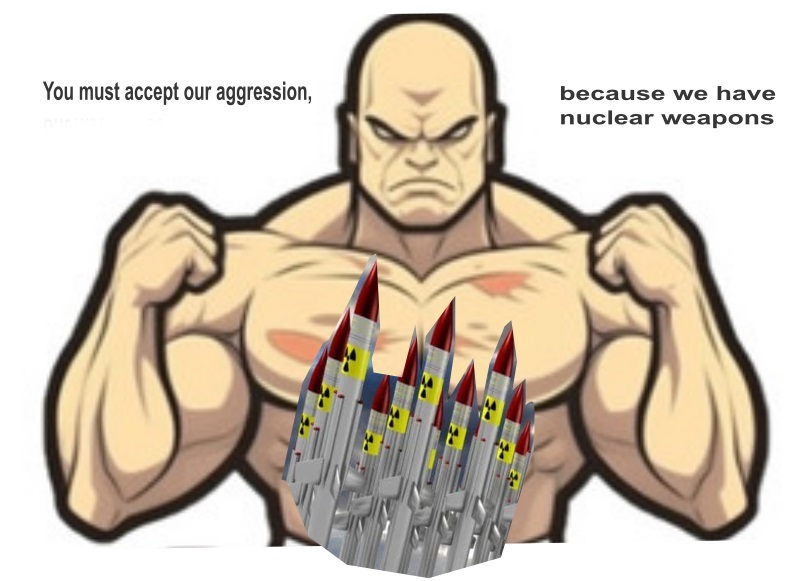
Defence secretary warned the weapons could do ‘untold damage’ as construction began on the successor to Trident
Larisa Brown, Defence Editor |Bruno Waterfield, Brussels, Thursday March 20 2025, The Times
Britain has the power to do “untold damage” to adversaries such as Russia with its nuclear deterrent, the defence secretary has warned, as he marked the build of the next generation of nuclear submarines.
John Healey said he took Vladimir Putin’s threats to use his nuclear arsenal seriously and the UK should not “fight shy” of the fact it has such weapons.
On a visit to a submarine yard, he also said that France could follow the UK’s example and commit its nuclear weapons to defend Nato and protect the security of Europe. At the moment, France will only officially use its weapons to protect itself.
In an interview with The Times, he said: “Our nuclear deterrent is there as a deterrent.
https://www.thetimes.com/uk/defence/article/britain-nuclear-power-damage-russia-cd8bv0d
Europe’s ‘nuclear umbrella’ risks catastrophic escalation

political leaders need to get a grip on reality. Bankrupting Britain and Europe in some desperate attempt to replace the US’s $800 billion military spending in Nato will destroy our societies and worsen all these global crises.
Morning Star 15th March 2025,
https://morningstaronline.co.uk/article/europes-nuclear-umbrella-risks-catastrophic-escalation
As Macron and Merz propose French nuclear-armed jets be stationed in Poland and Germany, the dangerous implications for peace and the possibility of nuclear confrontation grow, warns SOPHIE BOLT
AS Trump brutally hammers out a settlement for Ukraine and Russia, he’s also been hammering Europe for vast, cold-war levels of military spending. And European leaders seem very keen to oblige.
Along with Keir Starmer’s so-called peace plan for a 30,000-strong European army, France’s Emmanuel Macron and Germany’s chancellor-in-waiting Friedrich Merz are pushing for a European “nuclear umbrella” — where France could deploy its nuclear-capable jets outside its borders. Merz also wants Britain to step up and deploy its British nuclear submarines to “defend” Europe against Russian aggression.
So what does this “nuclear umbrella” really mean in practice — and what are the risks?
Currently, France has 290 warheads that can be launched by nuclear-capable fighter jets and nuclear-powered submarines. While France’s nuclear weapons doctrine states the weapons are to “defend” its “vital interests,” in 2020, Macron announced that France’s “vital interests now have a European dimension.”
However, he also stated in 2022 that France’s vital interests “would not be at stake if there was a nuclear ballistic attack in Ukraine or in the region.” So, Macron would have to radically shift French nuclear doctrine if the “defence” of Ukraine was to be incorporated. It would mean France being prepared to launch a nuclear strike on Russia, a country that currently possesses over 5,000 nuclear weapons.
Speculation about how this nuclear umbrella would work includes the possibility of nuclear-armed jets being stationed in Germany or Poland (both countries have expressed interest).
Stationing nuclear weapons in countries that don’t have them — known as nuclear sharing — is in violation of the Nuclear Non-Proliferation Treaty. If a nuclear-sharing agreement was secured between France and Poland, nuclear-armed jets could be deployed along Poland’s 130-mile border with Russia.
If a future ceasefire arrangement was breached, could French nuclear jets deployed in Germany and Poland be used against Russia?
Another suggestion is that these French bombers could patrol European borders. Would such borders also include Ukraine’s? In the event of a ceasefire breach, would nuclear-armed French bombers also be deployed in Ukraine?
While Macron’s “nuclear umbrella” idea is getting widespread coverage, these terrifying scenarios — and the human cost of such confrontations — are not.
Behind these wild proposals is the speculation that the US under Trump will withdraw its military and nuclear presence in Europe — and turn off the nuclear tap for its “critical” partner, Britain.
In Britain, figures like former defence secretary Malcolm Rifkind are arguing that Britain has to work more closely with France in case “US reliability ever came into question” in “defending Europe against Russian aggression.”
It has also prompted more challenges to Britain’s so-called special relationship with the US. And shone a welcome spotlight on Britain’s nuclear dependence, with widespread reporting that the ballistic missiles launched from Britain’s nuclear submarines are leased from the US, and that the warheads are a US design.
In fact, the whole nuclear weapons system is under US-led Nato command. So, if Britain wanted its nuclear-armed submarines to be part of a European nuclear umbrella, it would effectively have to get permission from US President Donald Trump.
In response, military analysts like Marion Messmer argue that to end its nuclear dependence on the US, Britain should build an entirely new, air-launching nuclear weapons system. Paid for, no doubt, by British and French taxpayers.
This would be on top of the £205 billion the British government is already wasting on the system’s replacement. A programme the government’s own watchdog has labelled as “unachievable” and unaffordable.
Prime Minister Keir Starmer is silent on the European nuclear umbrella. Having positioned himself against Trump, as champion of Ukraine’s Nato membership, he shifted rapidly to parroting Trump’s “peace through strength” rhetoric.
He now argues that his “peace plan” should be made “in conjunction with the US” because “it’s that ability to work with the US and our European partners that has kept the peace for 80 years now.”
Such an alliance has, of course, totally failed to keep peace, and instead has driven war and poverty globally, causing humanitarian catastrophe, economic crises and environmental devastation.
Instead, political leaders need to get a grip on reality. Bankrupting Britain and Europe in some desperate attempt to replace the US’s $800 billion military spending in Nato will destroy our societies and worsen all these global crises.
Sustainable peace for Europe, Ukraine and Russia cannot be achieved by troops and missiles, backed by the constant, looming threat of nuclear war. That means developing a sustainable security architecture that can ensure long-term peace and prosperity for the entire region.
It means withdrawing US nukes from Europe and Russian ones from Belarus. And it means the US, Russia, Britain and France developing programmes to get rid of their own nuclear weapons. As Trump has said he wants nuclear disarmament, Starmer should be working with him to do so.
Sophie Bolt is general secretary of the Campaign for Nuclear Disarmament.
The Script of Anxiety: Poland’s Nuclear Weapons Fascination
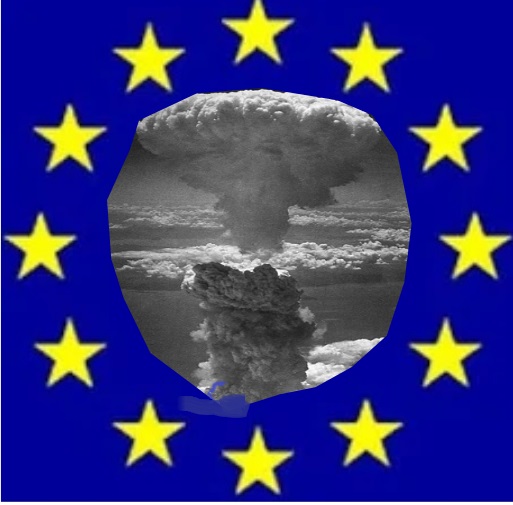
we can only assume that the desire to have massively lethal weapons on one’s own soil that would risk obliterating life, limb and everything else is but a sporting parlour game of misplaced assumptions.
March 17, 2025 Dr Binoy Kampmark , https://theaimn.net/the-script-of-anxiety-polands-nuclear-weapons-fascination/
With the Ukraine War and the retreat of the United States from what has routinely been called Europe’s security architecture, states are galloping to whatever point of presumed sanctuary is on offer. The general presumption is that the galloping is done in the same step and rhythm. But Europe, for all the heavy layers of union driven diplomacy, retains its salty differences.
Poland is particularly striking in this regard, having always positioned itself as a defender against the continent’s enemies, perceived or otherwise. This messianic purpose was well on show with the exploits of King John III Sobieski in his triumphant defence of Vienna against the Ottoman Empire in 1683. The seemingly endless wars against Russia, including the massacres and repressions, have also left their wounding marks on a fragile national psyche. These marks continue to script the approach of Warsaw’s anxiety to its traditional enemy, one that has become fixated with a nuclear option, in addition to a massive buildup of its armed forces and a defence budget that has reached 4.7% of its national income. While there is some disagreement among government officials on whether Poland should pursue its own arsenal, a general mood towards stationing the nuclear weapons of allies has taken hold. (As a matter of interest, a February 21 poll for Onet found that 52.9 percent of Poles favoured having nuclear weapons, with 27.9 percent opposed.)
This would mirror, albeit from the opposite side, the Cold War history of Poland, when its army was equipped with Soviet nuclear-capable 8K11 and 3R10 missiles. With sweet irony, those weapons were intended to be used against NATO member states.
The flirtatious offer of French President Emmanual Macron to potentially extend his country’s nuclear arsenal as an umbrella of reassurance to other European states did make an impression on Poland’s leadership. Prudence might have dictated a more reticent approach, but Prime Minister Donald Tusk would have none of that before the Polish parliament. In his words, “We must be aware that Poland must reach for the most modern capabilities also related to nuclear weapons and modern unconventional weapons.” According to the PM, “this is a race for security, not for war.”
The Polish President, Andrzej Duda, is also warm to the US option (he has been, over his time in office, profoundly pro-American), despite Tusk’s concerns about a “profound change in American geopolitics.” He was already ruminating over the idea in 2022 when he made the proposal to the Biden administration to host US nuclear weapons, one that was also repeated in June 2023 by then-Prime Minister Mateusz Morawiecki. To have such weapons in Poland was a necessary “defensive tactic […] to Russia’s behaviour, relocating nuclear weapons to the NATO area,” he explained to the BBC. “Poland is ready to host this nuclear weapon.”
Duda then goes on to restate a familiar theme. Were US nuclear weapons stored on Polish soil, Washington would have little choice but to defend such territory against any threat. “Every kind of strategic infrastructure, American and NATO infrastructure, which we have on our soil is strengthening the inclination of the US and the North Atlantic Alliance to defend this territory.” To the Financial Times, Duda further reasoned that, as NATO’s borders had moved east in 1999, “so twenty-six years later there should also be a shift of the NATO infrastructure east.”
Much of this seems like theatrical, puffy nonsense, given Poland’s membership of the NATO alliance, which has, as its central point, Article 5. Whether it involves its protection by a fellow NATO ally using conventional or nuclear weapons, hosting such nuclear weapons is negated as a value. Poland would receive collective military aid in any case should it be attacked. But, as Jon Wolfsthal of the Federation of American Scientists reasons, an innate concern of being abandoned in the face of aggression continues to cause jitters. Tusk’s remarks were possibly “a signal of concern – maybe to motivate the United States, but clearly designed to play on the French and perhaps the British.”
The crippling paranoia of the current government in the face of any perceived Russian threat becomes even less justifiable given the presence of US troops on its soil. According to the government’s own information, a total of 10,000 troops are present on a rotational basis, with US Land Forces V Corps Forward Command based in Poznań. In February, Duda confirmed to reporters after meeting the US envoy to Ukraine Gen. Keith Kellogg that there were “no concerns that the US would reduce the level of its presence in our country, that the US would in any way withdraw from its responsibility or co-responsibility for the security of this part of Europe.”
Duda goes further, offering a sycophantic flourish. “I will say in my personal opinion,America has entered the game very strongly when it comes to ending the war in Ukraine. I know President Donald Trump, I know that he is an extremely decisive man and when he acts, he acts in a very determined and usually effective way.” With those remarks, we can only assume that the desire to have massively lethal weapons on one’s own soil that would risk obliterating life, limb and everything else is but a sporting parlour game of misplaced assumptions.
Canada to review the purchase of US-made F-35 fighter jets in light of Trump’s trade war
By ROB GILLIES, March 16, 2025
TORONTO (AP) — Canada’s new Prime Minister Mark Carney has asked Defense Minister Bill Blair to review the purchase of America’s F-35 fighter jet to see if there are other options “given the changing environment,” a spokesman for Blair said Saturday.
Defense ministry press secretary Laurent de Casanove said the contract to purchase U.S. military contractor Lockheed Martin’s F-35 currently remains in place and Canada has made a legal commitment of funds for the first 16 aircraft. Canada agreed to buy 88 F-35’s two years ago.
Carney, who was sworn in on Friday, has asked Blair to work with the military “to determine if the F-35 contract, as it stands, is the best investment for Canada, and if there are other options that could better meet Canada’s needs,” de Casanove said……………………………………………………………………………………………………..more https://apnews.com/article/f35-canada-trump-0d3bf192d3490d87570d48475ff2c3a6
Towards a Eurobomb: The Costs of Nuclear Sovereignty
it would be much better if the leaders of the EU spend as much time on diplomacy with Russia than in building up European defense.
Instead of investing in weapons of mass destruction, making EU defense more efficient should be the priority as well as integrating Russia into a larger collective security organization
Tom Sauer |11.03.2025 , https://www.aa.com.tr/en/opinion/opinion-towards-a-eurobomb-the-costs-of-nuclear-sovereignty/3505915
The author is a professor in International Politics at the University of Antwerp in Belgium.
- If American soldiers or the tactical nuclear weapons are withdrawn, the odds are that the Europeanization of the French (and maybe British) nuclear weapons in one way or another may indeed become reality
ISTANBUL
The Trump administration’s recent isolationist statements, amid the talks of war in Europe, have revived discussions on Europeanizing French (and possibly British) nuclear weapons. After 75 years of NATO, concerns over US abandonment are increasingly shaping European foreign policy discussions. In the past, the French idea of a “dissuasion concertée (concerted deterrence) was mostly met with silence, especially in Germany. This time around the conservative leader Friedrich Merz seems in favor despite the fact that NATO is still alive and the US still has 100,000 soldiers and 100 tactical nuclear weapons in Europe. These weapons are stationed in Türkiye, Germany, Italy, the Netherlands, and Belgium. If the soldiers or the tactical nuclear weapons are withdrawn, the odds are that the Europeanization of the French (and maybe British) nuclear weapons in one way or another may indeed become reality.
There are different scenarios imaginable. The first step is for European nuclear states to declare that their “national interests” align with “European interests,” a principle already reflected in the Lisbon Treaty. The latter, by the way, also contains a collective defense clause similar to NATO’s Article 5. Further steps could be imagined to make these statements more credible: information exchange, consultation, joint planning, joint exercises, and co-financing. Another step could involve deploying French dual-capable aircraft in Germany or Poland. A final step would be the creation of an EU nuclear bomb in a European Defense Union (EDU). It remains, however, still to be seen how the Ukraine war will accelerate the pace towards such an EDU.
What are the costs of Europeanization of nuclear weapons?
First of all, the assumption that nuclear deterrence works is uncertain. Advocates of nuclear weapons believe that it works. They forget that in history many nuclear weapon states (including Israel, India, the UK) have been attacked by non-nuclear weapon states. In theory, it is very hard to make it work as it assumes for instance a rational enemy. It also assumes that the possessor is really prepared to use them. However, if used on a massive scale, it means the annihilation of the planet. In the war in Ukraine, French President Emmanuel Macron for that reason stated that even if Russia uses a tactical nuclear weapon in Ukraine, France would not retaliate with nuclear weapons.
Secondly, emerging and disruptive technologies (like AI) and weapon systems (like hypersonic missiles) will further undermine the so-called nuclear stability. Ideally, conventional deterrence (using hypersonic missiles) could and should replace nuclear deterrence on the condition that all nuclear states agree.
Thirdly, extended nuclear deterrence, read the atomic umbrella, is even more incredible. As early as the 1970s, Henry Kissinger cautioned Europeans against assuming that the US would employ nuclear weapons for their defense. That is also the reason why France did not want to shelter under the US umbrella, and why it built its own nuclear arsenal in the 1950s. Ironically, France now offers its umbrella to its European partners.
Fourthly, as long as there is no EDU, the question will be whose finger will be on the button. Macron is very clear: it will be his finger. The question then becomes whether German taxpayers would be interested in co-financing a strategic weapon system that they cannot control in times of war.
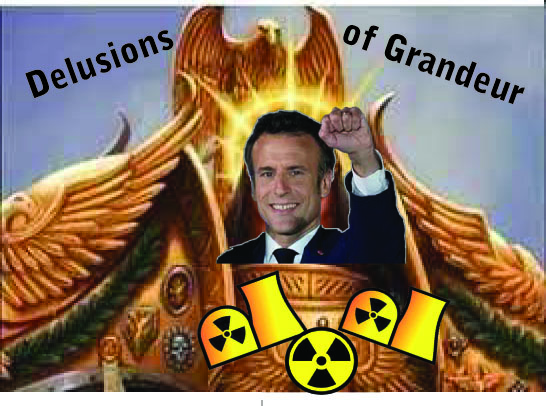
Fifthly, by Europeanizing the French nuclear weapons, the EU legitimizes nuclear weapons. This complicates the fight against proliferation. How sustainable is it to ask Iran not to produce nuclear weapons when the EU itself is setting up a nuclear arsenal?
There are also concerns about whether Europeanization aligns with the Nuclear Non-Proliferation Treaty, particularly if Germany and Poland were to develop their own nuclear capabilities. Both ideas also go against the spirit and the letter of the Treaty on the Prohibition of Nuclear Weapons (2017) that in the meantime has been signed by more or less 100 states.
Sixthly and lastly, it would be much better if the leaders of the EU spend as much time on diplomacy with Russia than in building up European defense. It is high time that the war in Ukraine ends, not only for humanitarian but also economic reasons. A peace agreement ideally includes a beginning of a restructuring of the European collective security architecture that includes both Russia and Ukraine, either in a transformed NATO or an upgraded Organization for Security and Cooperation in Europe (OSCE). If such an agreement is reached, there would be little justification for further fragmenting European defense into over 25 separate, small-scale military forces. Nowadays already the European NATO member states spend $485 billion on defense, much more than Russia ($120 billion). The primary challenge for EU defense today is not the absence of a Eurobomb but the lack of coordination in pooling, sharing, and specialization. Instead of investing in weapons of mass destruction, making EU defense more efficient should be the priority as well as integrating Russia into a larger collective security organization.
An Unreliable America Means More Countries Want the Bomb
By Debak Das, an assistant professor at the Josef Korbel School of International Studies at the University of Denver, and Rachel A. Epstein, a professor of international relations at the Josef Korbel School of International Studies at the University of Denver.
Without credible U.S. security guarantees, nuclear proliferation is likely to increase
rapidly across Europe and Asia. U.S. President Donald Trump’s recent
foreign-policy moves have alienated the country’s traditional allies in
Europe while stirring glee in Moscow. While it’s a catastrophic
development for Ukrainian security and democracy, this paradigmatic shift
portends much larger risks for global security.
The most pressing is the
threat of rampant nuclear proliferation that the Trump administration’s
actions will elicit. While on the surface it might seem as though a warmer
relationship between two of the world’s largest nuclear powers could
reduce the risk of nuclear war, the opposite is true.
We are on the precipice of a global turn toward nuclear instability, in which many
countries will be newly incentivized to build their own arsenals,
increasing the risk of nuclear use, terrorist subversion, and accidental
launch. Countries like South Korea, Japan, Iran, and Saudi Arabia are all
so-called nuclear latent states that could potentially build nuclear
weapons quickly—as are Germany, Belgium, Italy,
Foreign Policy 14th March 2025, https://foreignpolicy.com/2025/03/14/trump-nuclear-weapons-proliferation-nato-security-guarantees-korea-poland-germany-japan/
How multi-billion nuclear weapons facility aims to overcome challenge of limited supply chain
New Civil Engineer 14th March 2025, By Tom Pashby
The UK’s nuclear warhead manufacturing organisation is facing recruitment challenges as it attempts to attract civil engineering firms to work on its multi-billion pound Future Materials Campus (FMC) project.
What is AWE’s FMC?
AWE (the Atomic Weapons Establishment) is seeking construction and engineering partners to build a new manufacturing facility at its AWE Aldermaston site in Berkshire for its next generation ‘Astraea’ nuclear warhead.
AWE said: “[The FMC] is part of a wider, multi-year multi-billion-pound portfolio of infrastructure investment that will support us in our overall purpose to protect the UK through nuclear science and technology and enable nuclear science for generations to come.”
AWE recognises supply chain capacity is ‘one of the biggest challenges’
NCE spoke with AWE to learn about what the organisation is doing to address supply chain constraints as the civil nuclear sector – and infrastructure more broadly – gears up for expected increase in investment and demand.
“One of the biggest challenges we anticipate is ensuring sufficient supply chain capacity and capability to deliver a programme of this scale and complexity,” AWE said.
……………………………………….NCE recently spoke with University of Sussex principal research fellow Phil Johnstone, who said that the demand for more skills capacity in the wider UK nuclear sector is push factor for the demand for the FMC, in addition to its role in providing warheads. This aligns with AWE’s assertion that its FMC will “enable nuclear science for generations to come”……………………………………………………………………………………..
Civil engineering trade representative says all projects facing skills challenges………………………………………………………………………………. https://www.newcivilengineer.com/latest/how-multi-billion-nuclear-weapons-facility-aims-to-overcome-challenge-of-limited-supply-chain-14-03-2025/
Europe going nuclear would be a catastrophic mistake
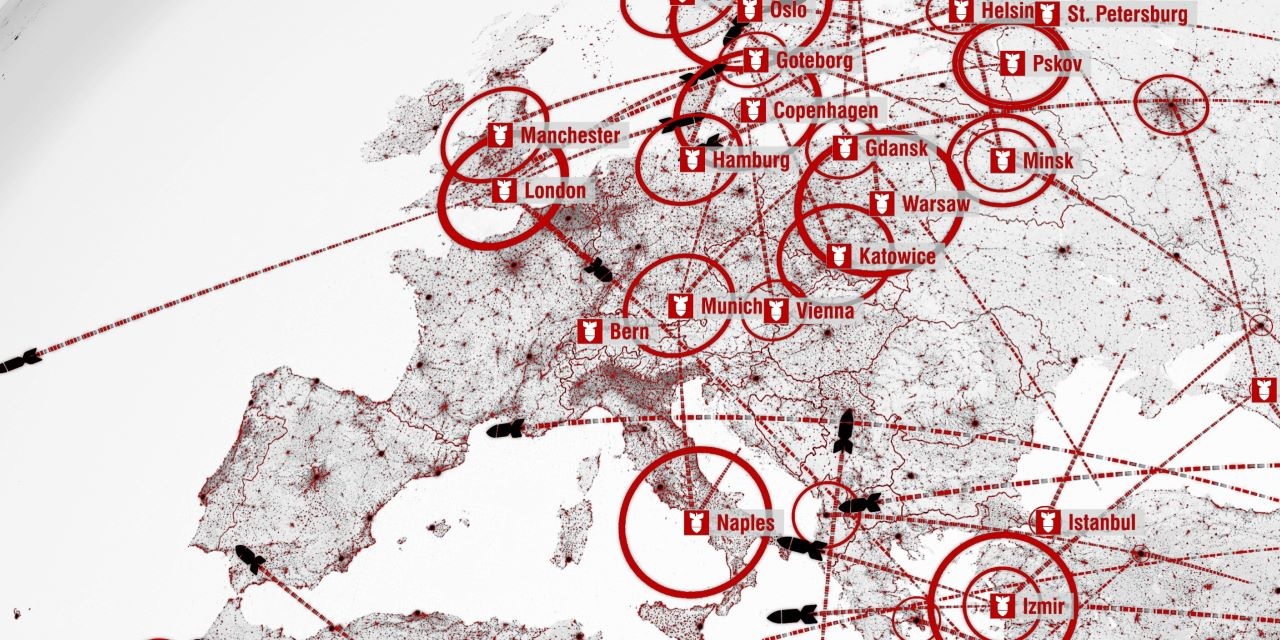
Proposals for nuclear sharing as a form of deterrence risk bringing more insecurity to Europe.
Olamide Samuel, International security expert, 11 Mar 25 https://www.aljazeera.com/opinions/2025/3/11/europe-going-nuclear-would-be-a-catastrophic-mistake
The second administration of US President Donald Trump has brought about tectonic shifts in the European security calculus. Growing anxieties about American retrenchment and the collapse of post-World War II security arrangements have sent European leaders scrambling to put forward alternatives.
Ahead of the German elections last month, Friedrich Merz, the head of the Christian Democratic Union, who was already expected to become the next German chancellor, opined: “We need to have discussions with both the British and the French – the two European nuclear powers – about whether nuclear sharing, or at least nuclear security from the UK and France, could also apply to us”.
Last week, French President Emmanuel Macron said that in response to Merz, he has decided to “open the strategic debate on the protection of our allies on the European continent through our [nuclear] deterrence”.
The proposal for some form of European nuclear sharing arrangement with France and the United Kingdom to protect against threats from Moscow is not new. Versions of it have been floated around for decades.
But today, resurfacing this proposal is not just a geopolitical miscalculation; it is a strategic dead end. It reflects a misreading of both the nuclear balance of power and the existential risks of fragmenting Europe’s security architecture further. Rather than bolstering deterrence, this gambit risks accelerating the very instability it seeks to avert.
Amid the growing unpredictability of United States-Russia relations under the second Trump administration, Europe must pivot from nuclear escapism to a bold agenda of diplomatic engagement on nuclear disarmament.
The fantasy of European nuclear sharing
The proposal for European nuclear sharing founders on arithmetic and strategic reality. Russia’s nuclear arsenal boasts 5,580 warheads, including hypersonic Avangard glide vehicles and Sarmat intercontinental ballistic missiles (ICBMs). This dwarfs the combined Anglo-French stockpile of 515 warheads.
This asymmetry isn’t merely quantitative; it is also doctrinal. Moscow’s “escalate to de-escalate” strategy represents a calculated approach to conflict escalation designed to coerce adversaries into concessions. It is a strategy the British and French nuclear arsenals, optimised for minimal deterrence, cannot counter.
Data on defence spending reveals a deeper flaw: Europeans do not have the funds or the technological capabilities to carry it out while executing their ambitious rearmament plans.
Germany’s 90.6-billion euro ($98bn) military budget remains crippled by inefficiencies, with only 50 percent of army equipment meeting NATO readiness standards. Meanwhile, France and the UK lack the conventional force multipliers – global surveillance networks, intelligence capabilities, or even complete nuclear triads – that underpin US extended deterrence. Even if every euro cent of the European Union’s recently announced 800 billion-euro ($867 billion) defence boost were spent on nuclear weapons programmes, cold-starting the sort of production complexes required for a credible deterrent would still take decades.
Attempting to replicate NATO’s nuclear-coalition model at a European level ignores six decades of integrated command structures and fails to address hybrid threats now defining modern conflict.
What is more, replacing one dependency with another solves nothing. Proponents claim nuclear sharing offers protection, but the reality is that it can lead to strategic subjugation.
Neither France nor the UK is likely to give up control over its nuclear arsenals and transfer it to the EU. That means that a nuclear-sharing agreement would reduce Germany and other European countries participating in the arrangement to Franco-British warhead warehouses with no real agency. This Potemkin deterrence—all ceremony, no substance—would only further irritate Washington.
Trump has already shown that he has no qualms about abandoning allies if he sees no benefit for the US strategic interest. His recent moves to stop intelligence sharing and military aid for Ukraine and his conditioning mutual defence on military spending have exposed NATO’s fraying norms – the alliance is witnessing a collapse of shared purpose.
As experts note, Trump’s “MAGA Carta” foreign policy explicitly rejects strategic altruism. A European nuclear caucus would signal panic, validating Trump’s transactional world view while undermining NATO’s cohesion.
A European nuclear club would deepen fragmentation, emboldening revisionist actors like Russia and China while diverting resources from critical gaps in AI advancement, sustainable economic output, and energy resilience that define 21st-century power.
The economic argument compounds the folly. Pouring billions of euros from Europe’s finite resources into redundant warheads while neglecting practical gaps in conventional capability isn’t statecraft—it’s generational malpractice.
Disarmament and fiscal realpolitik
The EU’s opportunity lies not in nuclear posturing, but in revitalising arms control and mediation. The collapse of the US-Russia strategic dialogue since the invasion of Ukraine has left critical arms control frameworks in disarray.
The New START treaty, which limits deployed strategic nuclear warheads to 1,550 each for Russia and the US, remains the last pillar of bilateral arms control. Its expiration in 2026 without a successor would mark the first time since 1972 that the world’s nuclear superpowers operate without mutually verified limits—a scenario that could trigger a new nuclear arms race.
Herein lies Europe’s opportunity. Rather than pursuing a European nuclear umbrella, it could lead efforts to revive nuclear disarmament dialogue.
Austria, an EU member, has already played a key role in nuclear talks between the West and Iran as well as the 2020 US-Russia-China trilateral arms control discussions. This positions it as an ideal venue for restarting negotiations on nuclear risk reduction issues, especially at a time when Washington is open to renewed dialogue with Moscow.
Taking a lead on nuclear disarmament would be the sort of leadership that would reflect a more mature interpretation of security policy, as opposed to seeking an impossible nuclear deterrence.
Some critics maintain that negotiating with Russia rewards aggression. Yet history shows even bitter adversaries can cooperate on arms control when interests align. The 1987 Intermediate-Range Nuclear Forces Treaty, which eliminated 2,692 missiles, was finalised after years of heightened tensions between the USSR and the US in the early 1980s.
The treaty succeeded not because US President Ronald Reagan and Soviet leader Mikhail Gorbachev trusted each other, but because dismantling missiles saved both sides a significant amount of funds that would have gone into continuing the arms race and maintaining the destroyed ordinance.
Today, with Russia’s economy faltering amid the war in Ukraine and Trump’s fixation with cost-cutting, there is an opportunity to pursue another deal if disarmament is framed not as idealism, but as fiscal pragmatism. Europe can help broker a deal that serves all parties’ wallets—and humanity’s survival.
The unintended consequences of Trump’s first-term nuclear gambits – escalated arms racing, eroded alliances, and emboldened adversaries – offer cautionary lessons. His second term, however, can offer an opportunity to shift the Doomsday Clock back from its position of 89 seconds to midnight.
Europe now faces a choice: to cling to Cold War relics while the planet burns, or to pioneer a security paradigm prioritising planetary survival over great-power vanity. The decision it makes will define not just Europe’s future—but all of humanity’s.

Olamide Samuel. International security expert
Dr Olamide Samuel is a renowned international security expert and Network Specialist at the Open Nuclear Network. Previously, he served as Special Envoy of the African Commission on Nuclear Energy (AFCONE), established by the African Nuclear-Weapon-Free Zone Treaty, also known as the Treaty of Pelindaba.
Poland’s president urges U.S. to move nuclear warheads to Polish territory, FT reports
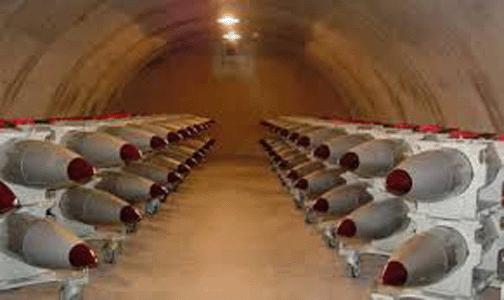
By Reuters, March 13, 2025, Reporting by Gnaneshwar Rajan in Bengaluru, Pawel Florkiewicz and Alan Charlish in Warsaw; Editing by Christopher Cushing and Gareth Jones, https://www.reuters.com/world/polands-president-urges-us-move-nuclear-warheads-polish-territory-ft-reports-2025-03-13/
WARSAW, March 13 (Reuters) – Poland’s president has called on the U.S. to transfer nuclear weapons to its territory as a deterrent against future Russian aggression, the Financial Times reported on Thursday.
President Andrzej Duda also told the newspaper he had discussed the proposal recently with U.S. President Donald Trump’s special envoy for Ukraine and Russia, Keith Kellogg.
Poland has previously said it would be ready to host U.S. weapons under a nuclear arms sharing programme, and Polish policymakers have also more recently expressed interest in an idea floated by French President Emmanuel Macron that Paris’s nuclear umbrella could be extended to its European allies.
The borders of NATO moved east in 1999, so 26 years later there should also be a shift of the NATO infrastructure east. For me this is obvious,” the FT cited Duda as saying in an interview.
It would be safer if those weapons were already in the country, Duda added.
Polish Prime Minister Donald Tusk, a political opponent of Duda, said on Thursday he thought it was better to address such issues discreetly rather than in media interviews, although he added that he believed the president had good intentions.
“We should formulate certain expectations… publicly when we are certain, or have reasons to be convinced, that such appeals or calls will be heard and that the addressee, in this case the American administration, President Trump, is prepared for a positive response,” Tusk told reporters.
Galvanised by Russia’s invasion of neighbouring Ukraine three years ago, Poland now spends a higher proportion of its gross domestic product (GDP) on defence than any other NATO member, including the United States.
Last year Poland’s defence spending reached 4.1% of GDP, according to NATO estimates, and it plans to hit 4.7% this year. Duda has suggested enshrining defence spending of at least 4% of GDP in the Polish constitution.
Could Poland and Germany acquire nuclear bombs?
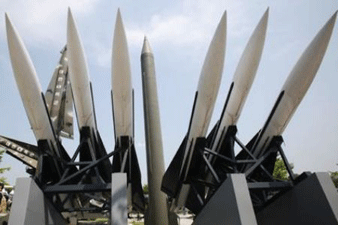
A proposal to place US atomic weapons in Poland could lead to Poland and Germany having nuclear weapons stationed.
Poland’s outgoing head of state has appealed to President Trump to
station American atomic weapons on Polish territory as a close-range
deterrent against Russia. The rift between the US and Europe has opened up
a broad debate about how to shore up Nato’s nuclear deterrence.
Germany’s probable next chancellor has expressed an interest in sharing
France or Britain’s arsenal. Poland, however, remains one of the most
staunchly Atlanticist members of the alliance and is seeking to use its
good standing with the Trump administration to keep the US on side.
Times 14th March 2025,
https://www.thetimes.com/world/russia-ukraine-war/article/nuclear-bombs-poland-germany-weapons-3pwvwdwhz
Chinese nuclear weapons, 2025
Bulletin, By Hans M. Kristensen, Matt Korda, Eliana Johns, Mackenzie Knight | March 12, 2025
The modernization of China’s nuclear arsenal has both accelerated and expanded in recent years. In this issue of the Nuclear Notebook, we estimate that China now possesses approximately 600 nuclear warheads, with more in production to arm future delivery systems. China is believed to have the fastest-growing nuclear arsenal among the nine nuclear-armed states; it is the only Party to the Treaty on the Non-Proliferation of Nuclear Weapons that is significantly increasing its nuclear arsenal. The Nuclear Notebook is researched and written by the staff of the Federation of American Scientists’ Nuclear Information Project: director Hans M. Kristensen, associate director Matt Korda, and senior research associates Eliana Johns and Mackenzie Knight.
………………………………………………………………………………………………………………………………………………………………………… more https://thebulletin.org/premium/2025-03/chinese-nuclear-weapons-2025/
Labour’s arms exports to Israel exposed Labour allowed dozens of arms exports to Israel after weapons sanctions
Keir Starmer’s government has continued to approve arms exports to Israel even after some licences were suspended in September
UK trade department approved 34 military export licences to Israel in the two months since David Lammy announced a partial arms embargo, new data shows.
DECLASSIFIED UK, JOHN McEVOY, 12 December 2024
Labour government hasn’t completed a review on Israel’s compliance with international humanitarian law since July
Foreign Office has not asked to see footage from RAF spy flights over Gaza, which could provide evidence of Israeli war crimes
“No particular appetite” to restrict exports of F-35 components to Israel, even as minister admits US government can track whether British-made spare parts are being sent to Israel
Trade committee chairman warned ministers he was “not convinced” that F-35 carve-out complied with UN arms trade treaty.
Keir Starmer’s government has continued to approve arms exports to Israel even after some licences were suspended in September, it can be revealed.
31 “standard” and three “open” licences for military goods have been issued to Israel since 2 September, when UK foreign secretary David Lammy announced partial restrictions on arms sales to Israel.
Those items included “components for trainer aircraft” and “commercial aircraft” which were “not assessed to be used in relation to current military operations in Gaza”.
However, training aircraft can still be used to instruct Israeli pilots on how to conduct offensive operations in Gaza.
35 “standard” and six “open” licences were also approved for items classed as “non-military” such as telecommunications equipment and imaging cameras.
The UK government refused to issue a further 18 licences to Israel for “components for combat aircraft and naval vessels, as well as components for targeting and radar equipment”.
The information is contained in new data released this week on an “ad hoc” basis by Britain’s trade department in response to “significant parliamentary and public interest” in the issue.
The data was evaluated at parliament’s trade committee on Tuesday, during which ministers admitted that the UK government has still not determined whether Israel’s bombing of Gaza amounts to a violation of International Humanitarian Law (IHL).
The committee was told that the UK government has not updated its assessment on Israel’s compliance with IHL since 31 July, some four and a half months ago. Previous assessments have taken less than half that time to finalise.
One minister further confirmed that there was “no appetite” for stopping the export of F-35 fighter jet components for use by Israel, despite concerns that this breaches Britain’s legal obligations.
It comes days after Amnesty International accused Israel of committing a genocide in Gaza and warned the UK to “immediately suspend the direct and indirect supply, sale or transfer, to Israel of all weapons” in order to “stop fuelling violations of international law”………………………………………………………………………………………….
more https://www.declassifieduk.org/labour-allowed-dozens-of-arms-exports-to-israel-after-weapons-sanctions/
Movements across the world call for an end to all US military exercises on the Korean peninsula
The call to cancel the military exercises takes on increased urgency given the military accident last week when South Korean jets bombed their own citizens in the region bordering North Korea during the preparation of yet another joint military exercise with the US.
March 12, 2025 by Abdul Rahman, people’s dispatch
Pressure continues to grow against the ongoing Freedom Shield 25, a joint military exercise between the US and South Korea.
The International People’s Assembly (IPA) and International League of Peoples Struggle (ILPS) joined Nodutdol, an anti-imperialist Korean diaspora group, in launching a joint statement calling for the Freedom Shield military exercises to be cancelled, claiming it is drumming up threats of war on the Korean peninsula. The anti-imperialist and anti-war platforms bring together hundreds of people’s movements and organizations across the world.
“Freedom Shield 25 has dire implications for regional and global peace and stability. As part of Washington’s New Cold War against China, the NATO bloc and its Asian and Oceanian partners are escalating in East Asia, using the Korean peninsula as a staging ground. Freedom Shield poses a most immediate threat to the stability of the region, but its effects also extend far beyond,” the statement reads……………………………………………………………………………………………………………………………………. more https://peoplesdispatch.org/2025/03/12/movements-across-the-world-call-for-an-end-to-all-us-military-exercises-on-the-korean-peninsula/
WSJ’s Chief Foreign Correspondent Declares It’s Over For Ukraine In Kursk
by Tyler Durden, Thursday, Mar 13, 2025, https://www.zerohedge.com/geopolitical/ukraine-losing-its-trump-card-key-kursk-town-liberated-russian-troops
It’s a major turning point in the conflict when the Chief Foreign-Affairs Correspondent for The Wall Street Journal declares that Ukrainian forces are now in a full-on withdrawal from Russia’s Kursk amid rapid Russian gains…
Reuters too is reporting that Ukrainian forces are losing in Kursk:
Ukrainian troops appeared on the point of losing their hard-won foothold inside Russia’s Kursk region on Wednesday as Moscow claimed further advances there and military bloggers on both sides said Kyiv’s forces were withdrawing.
Ukraine sprang one of the biggest shocks of the war on August 6 last year by storming across the border and grabbing a chunk of land inside Russia, boosting citizens’ morale and gaining a potential bargaining chip.
There are no more cards to play, as Trump put it last month while hosting Zelensky at the White House, and now this assessment proves truer than ever.
Ukraine is losing the little bit of leverage it might have had left amid discussions toward preparing negotiations with Moscow. Russia’s Kursk is now fast being retaken, and Ukrainian forces are folding, as on Wednesday Russian troops raised their flags over the key town of Sudzha .
The central square of the town in the southwestern Kursk region was scene of where Russia’s Airborne Troops published a short aerial video showing soldiers unfurling a Russian flag as well as military unit banners. Other state media outlets subsequently featured the footage. Newsweek has underscored that Ukraine is fast “losing its trump card.”
Moscow has been focusing its forces on to regaining control around Sudzha in recent days, having retaken 12 settlements in the border region earlier this week.
Fighting is said to still be ongoing, but Moscow forces have asserted control over the center. Ukrainian media also acknowledges the following:
Russian troops have launched an offensive on the Ukrainian-controlled town of Sudzha in Russia’s Kursk Oblast, entering the settlement, the DeepState monitoring group, the Institute for the Study of War (ISW), and the Russian state news agency TASS claimed on March 12. Fighting in the town is reportedly ongoing.
…According to DeepState, Russian forces have entered the eastern part of Sudzha and are entrenching their positions. TASS published purported drone footage claiming that Russian troops had entered the town center and raised a Russian flag.
War bloggers have been closely monitoring the fight for control of Sudzha, with Ruslan Leviev of the war monitor Conflict Intelligence Team describing that Ukrainian troops have been in steady retreat from the entire region.
“We’ve seen that all the areas coming under Russian control have been taken with little to no resistance. The same goes for Sudzha,” Leviev said. “Today, we’re seeing them on the opposite side [of the town]. And again, there are no images of any fighting.”
“At this point, it’s fair to say that the entire city of Sudzha is now under Russian control,” he described of the ground situation.
While months ago Ukrainian forces occupied several hundred square kilometers of Russian territory in Kursk region, as of Wednesday that control has shrunk to less than 200 square kilometers (77 square miles), according to the Ukraine-military linked DeepState war tracker.
Video said to be from on the ground in Russia’s Sudzha, including interviews with elderly Russians that stayed the whole time:
Recall that in the late last month famous Oval Office blow-up involving Trump, Zelensky, and J.D. Vance – Trump told the Ukrainian leader: “You don’t have the cards right now.”
That now appears truer than ever, at a moment the Russians are studying the new US-Ukraine proposal for a 30-day truce in order to jump-start direct negotiations to end the war.
1 This Month

of the week – Shut Down Drone Warfare!


Tell the Ukrainian Government to Drop Prosecution of Peace Activist Yurii Sheliazhenko

Petition to revoke the licensing of the Near Surface Nuclear Disposal Facility (NSDF) at Chalk River. https://www.ourcommons.ca/petitions/en/Petition/Details?Petition=e-7247
To see nuclear-related stories in greater depth and intensity – go to https://nuclearinformation.wordpress.com
-
Archives
- March 2026 (251)
- February 2026 (268)
- January 2026 (308)
- December 2025 (358)
- November 2025 (359)
- October 2025 (376)
- September 2025 (257)
- August 2025 (319)
- July 2025 (230)
- June 2025 (348)
- May 2025 (261)
- April 2025 (305)
-
Categories
- 1
- 1 NUCLEAR ISSUES
- business and costs
- climate change
- culture and arts
- ENERGY
- environment
- health
- history
- indigenous issues
- Legal
- marketing of nuclear
- media
- opposition to nuclear
- PERSONAL STORIES
- politics
- politics international
- Religion and ethics
- safety
- secrets,lies and civil liberties
- spinbuster
- technology
- Uranium
- wastes
- weapons and war
- Women
- 2 WORLD
- ACTION
- AFRICA
- Atrocities
- AUSTRALIA
- Christina's notes
- Christina's themes
- culture and arts
- Events
- Fuk 2022
- Fuk 2023
- Fukushima 2017
- Fukushima 2018
- fukushima 2019
- Fukushima 2020
- Fukushima 2021
- general
- global warming
- Humour (God we need it)
- Nuclear
- RARE EARTHS
- Reference
- resources – print
- Resources -audiovicual
- Weekly Newsletter
- World
- World Nuclear
- YouTube
-
RSS
Entries RSS
Comments RSS
 nuclear-news