Moon and Trump agree on South Korea purchase of state-of-the-art US weaponry during summit
Hankyoreh Sep.22,2017The deal is reportedly set to include nuclear powered submarines
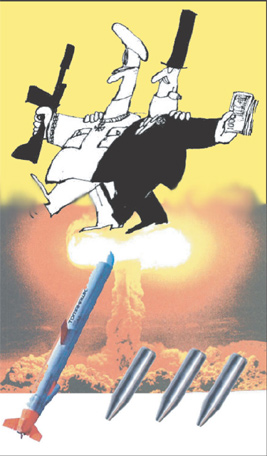
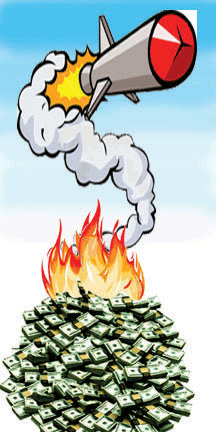
South Korean President Moon Jae-in and US President Donald Trump agreed on Sept. 21 on a plan for South Korea to introduce state-of-the-art US weaponry or develop its own to counter North Korea’s recent nuclear and missile provocations. Later the same day, Moon had a luncheon and trilateral summit with Trump and Japanese Prime Minister Shinzo Abe, where the three agreed that the entire international community “must apply the maximum intensity sanctions and pressure so that North Korea cannot withstand it anymore and must come to the table for dialogue.” ……http://english.hani.co.kr/arti/english_edition/e_northkorea/812155.html
HAWAII READYING FOR NUCLEAR ATTACK IN SECRET MEETING TO AVOID PANIC, NewsWeek, BY CHRISTAL HAYESThe state of Hawaii prepped for a nuclear attack in a meeting this week, but wouldn’t allow the public to attend and kicked out a photojournalist who snapped a picture.
Dozens of lawmakers met behind closed doors and talked about how to ready the state for an attack, including planned tests of alarms that would notify people they had 12 to 15 minutes to seek shelter, according to the Honolulu Civil Beat.
The presentation given at the meeting was marked “for official use only” and showed where North Korea could target and how bad the impact would be, Hawaii Representative Gene Ward told the news organization.
Ward added that officials don’t “want to spook any of the public”—which includes 1.4 million residents and 8 million tourists who visit the state annually.
Hawaii has been preparing for an attack for months, as military experts estimate a missile would take 20 minutes to reach the island from North Korea.
Hawaii Emergency Management Agency officials have said the chances of a nuclear attack are still “extremely small,” but the “unpredictable leadership” of North Korea means they should be prepared. They plan to have a public meeting and will start testing the attack alarms in November, but there are no plans to build any fallout shelters……..http://www.newsweek.com/nuclear-hawaii-trump-north-korea-kim-jong-un-669502
“You are the states that are showing moral leadership in a world that desperately needs such moral leadership today,” Beatrice Fihn, executive director of the International Campaign to Abolish Nuclear Weapons, said as a signing ceremony began.
Before the day was out, 50 signatories as different as Indonesia and Ireland had put their names to the treaty; others can sign later if they like. Guyana, Thailand and the Vatican also have already ratified the treaty, which needs 50 ratifications to take effect among the nations that back it.
They would be barred from developing, testing, producing, manufacturing, otherwise acquiring, possessing or stockpiling nuclear weapons “under any circumstances.”
Seven decades after the United States dropped two atomic bombs on Japan during World War II — the only use of nuclear weapons — there are believed to be about 15,000 of them in the world today. Amid rising tensions over North Korea’s nuclear and missile tests, U.N. Secretary-General Antonio Guterres said Tuesday that the threat of a nuclear attack is at its highest level since the end of the Cold War.
“This treaty is an important step towards the universally held goal of a world free of nuclear weapons,” he said Wednesday.
Supporters of the pact say it is time to push harder toward eliminating atomic weapons than nations have done through the nearly 50-year-old Nuclear Non-Proliferation Treaty.
Under its terms, non-nuclear nations agreed not to pursue nukes in exchange for a commitment by the five original nuclear powers — the U.S., Russia, Britain, France and China — to move toward nuclear disarmament and to guarantee other states’ access to peaceful nuclear technology for producing energy.
More than 120 countries approved the new nuclear weapons ban treaty in July over opposition from nuclear-armed countries and their allies, who boycotted negotiations.
The U.S., Britain and France said the prohibition wouldn’t work and would end up disarming their nations while emboldening “bad actors,” in U.S. Ambassador Nikki Haley’s words. French Foreign Minister Jean-Yves Le Drian has called the treaty “wishful thinking” that is “close to irresponsible.” The nuclear powers have suggested instead strengthening the nonproliferation treaty, which they say has made a significant dent in atomic arsenals.
Absent from the signing ceremony were the five permanent U.N. Security Council seat holders — Britain, China, France, Russia and the United States — which all possess the destructive devices.
Nuclear umbrella nations, such as Japan and South Korea, and North Atlantic Treaty Organization members like Germany and The Netherlands did not endorse it either
“Although we share the same feelings about nuclear abolition, (the treaty) differs from Japan’s approach, so we will not be signing it,” Foreign Minister Taro Kono told reporters in New York.
“Unfortunately, the reality is that there are divisions between countries with nuclear weapons and those without, as well as between the countries without them, when it comes to recognizing (both) the inhumanity of nuclear weapons and the severity of the security environment,” he said, adding that Japan will try to bridge those gaps through existing frameworks.
Brazil was the first country to sign onto the ban Wednesday, followed by nations from Algeria to Venezuela.
“Those who still hold nuclear arsenals, we call upon them to join this date with history,” Costa Rican President Luis Guillermo Solis said as he prepared to sign.
In attendance at the signing ceremony were Japanese atomic bomb survivors and the mayor of Nagasaki.
The adoption of the treaty on July 7, when 122 countries voted in favor of banning atomic weapons for the first time after decades of prodding by atomic bomb victims — known as hibakusha in Japanese — and civil society.
The treaty’s backers believe that their path is the best option to prevent future nuclear catastrophes of the kind experienced by Japan in 1945 during the closing days of World War II. The bombings of Hiroshima on Aug. 6 of that year and Nagasaki three days later ushered in the nuclear era.
“The heroic survivors of Hiroshima and Nagasaki — the hibakusha — continue to remind us of the devastating humanitarian consequences of nuclear weapons,” Guterres said.
Also speaking was Peter Maurer, president of the International Committee of the Red Cross, who said the organization received a cable from Hiroshima on Aug. 30, 1945 describing a “city wiped out,” a great number of dead and over 100,000 wounded.
“The world today needs the promise of this treaty: the hope for a future without nuclear weapons,” he said. “Humanity simply cannot live under the dark shadow of nuclear warfare, and the immense suffering which we all know would result.”
In Hiroshima ahead of the signing, hibakusha and other citizens urged that all countries — including Japan — sign and ratify the treaty.
Close to 90 people gathered in front of the Atomic Bomb Dome. After observing a moment of silence, participants held up origami cranes and papers with messages demanding that countries sign the treaty.
The assembly was part of the Peace Wave 2017 campaign, in which citizens start a chain of movements from Japan in hopes of realizing a peaceful world free of nuclear weapons.
The event was planned by an organization of atomic bomb survivors in Hiroshima Prefecture and the Hiroshima Congress against A- and H-Bombs, or Hiroshima Gensuikin.
“If people believe that getting rid of nuclear weapons will lead to peace, a democratic government (sharing the belief) will be born, followed by the signing of the treaty,” said Kunihiko Sakuma, 72, head of the hibakusha organization.
“The governments of the nuclear nations will also change,” Sakuma added, emphasizing the importance of starting a civil movement.
As part of the campaign, more events will be held over the period through Tuesday, which has been set by the U.N. as International Day for the Total Elimination of Nuclear Weapons.
America’s ‘doomsday’ plane will be Donald Trump’s HQ if nuclear war breaks out with North Korea, news.com.au , 21 Sept 17 TAKE a look on board the “doomsday” plane which will protect Donald Trump’s team if nuclear war becomes a reality. THESE incredible photos reveal the inner workings of the ‘Doomsday’ planes — America’s secretive set of jets designed to wage nuclear war from the skies.
The specially-designed aircraft follow President Donald Trump wherever he travels in Air Force One in case nuclear war erupts, reports The Sun.
Known officially as National Airborne Operation Centres, they allow US leaders and wartime hawks to issue directives and wage war from the sky.
The Boeing E-4Bs costs around $A311 million each to create and $A201,000 per hour to operate.
They also feature a vast array of defence mechanisms, including the ability to withstand electromagnetic pulses.
The jets’ crews also use traditional analog flight instruments to navigate as they are less susceptible to cyber attack.
The flurry of military drills came after Pyongyang fired another mid-range ballistic missile over Japan on Friday and the reclusive North conducted its sixth and most powerful nuclear test on Sept. 3 in defiance of United Nations sanctions and other international pressure.
A pair of U.S. B-1B bombers and four F-35 jets flew from Guam and Japan and joined four South Korean F-15K fighters in the latest drill, South Korea’s defense ministry said.
The joint drills were being conducted “two to three times a month these days”, Defence Minister Song Young-moo told a parliamentary hearing on Monday.
In Beijing, the official Xinhua news agency said China and Russia began naval drills off the Russian far eastern port of Vladivostok, not far from the Russia-North Korea border. Those drills were being conducted between Peter the Great Bay, near Vladivostok, and the southern part of the Sea of Okhotsk, to the north of Japan, it said.
The drills are the second part of China-Russian naval exercises this year, the first part of which was staged in the Baltic in July. Xinhua did not directly link the drills to current tension over North Korea.
China and Russia have repeatedly called for a peaceful solution and talks to resolve the issue.
On Sunday, however, U.S. Ambassador to the United Nations Nikki Haley said the U.N. Security Council had run out of options on containing North Korea’s nuclear program and the United States might have to turn the matter over to the Pentagon.
Senate Passes Defense Bill That Would Bolster Nuclear Weapons Programs TruthOut September 19, 2017By Mike Ludwig, Truthout The Senate approved a massive defense policy bill by a vote of 89 to 9 on Monday that is raising concerns about nuclear weapons proliferation amid rising tensions between the United States and countries such as North Korea and Russia.
The Senate version of the National Defense Authorization Act (NDAA), an annual piece of “must-pass” legislation that shapes dozens of policies at the Pentagon, would authorize $640 billion in discretionary defense spending and an additional $60 billion for overseas military operations, such as the ongoing war efforts in Iraq, Afghanistan and Syria.
What’s the value of $700 billion? It’s more than twice the size of Denmark’s entire economy, and the same amount of money that the government spent bailing out banks during the financial collapse in 2008. Both the Senate and House versions of the bill name amounts that exceed President Trump’s request for military funding by tens of billions of dollars.
The numbers put forth in the defense authorization bill set the bar for future defense spending legislation and policy determinations. As an authorization bill, this legislation does not actually permit the expenditure of those funds; an appropriations bill is needed for that.
The bill authorizes billions of dollars for nuclear weapons and nonproliferation programs, including $65 million for developing a cruise missile that nonproliferation groups fear could derail the 1987 Intermediate-Range Nuclear Forces (INF) Treaty, a landmark nuclear treaty between the US and Russia.
Critics say increasing spending on the US nuclear arsenal could trigger other countries to invest in their own capabilities and add to the number of highly destructive weapons on the planet.
“We [are] already investing in nuclear weapons to a tune of about $20 million a year, so we really have to ask ourselves what the point of an increased investment would be, considering these are weapons that should never be used,” said Lindsay Koshgarian, director of the National Priorities Project, a group that tracks military spending, in an interview with Truthout.
The US has accused Russia of violating the INF Treaty by developing and fielding a land-based cruise missile with nuclear capabilities, a charge Russia has denied. The Senate’s version of NDAA authorizes research and development of a mid-range, road-mobile cruise missile system that could carry a nuclear warhead, similar to the missile Russia allegedly developed.
The Senate Armed Services Committee claims that the money could only be used for research and development of the missile, not testing and deployment, so it would not violate the treaty in the way that Russia allegedly has. Rather, the committee says, it would close a “capability” gap opened by Russia.
However, developing such a weapon would suck money away from nonproliferation programs while sowing divisions within NATO and giving Russia an excuse to reject the treaty and deploy large numbers of noncompliant missiles without constraint, according to the Arms Control Association.
Senators Elizabeth Warren (D-Massachusetts) and Mike Lee (R-Utah) added an amendment to the bill that requires the defense secretary to submit a report to Congress on the rationale and strategic implications for developing such a weapon before the $65 million can be spent. Warren also included an amendment asking the Department of Defense to consider existing treaty obligations in an upcoming Nuclear Posture Review. The House rejected similar measures offered by Rep. Earl Blumenauer (D-Oregon).
The House version of the bill provides $25 million to develop conventional (non-nuclear) land-based cruise missiles and requires the president to submit a report on Russian compliance with the INF treaty within 15 months. If Russia is determined to be out of compliance, the treaty would no longer bind the US, effectively dissolving a decades-old nonproliferation agreement between the two countries that control about 90 percent of the world’s nuclear weapons.
The House bill would also block funding for extending the 2010 New Strategic Arms Reduction Treaty, a nuclear nonproliferation agreement considered a bright spot in US-Russia relations, unless Russia returns to compliance with the INF Treaty.
Senators Elizabeth Warren (D-Massachusetts) and Mike Lee (R-Utah) added an amendment to the bill that requires the defense secretary to submit a report to Congress on the rationale and strategic implications for developing such a weapon before the $65 million can be spent. Warren also included an amendment asking the Department of Defense to consider existing treaty obligations in an upcoming Nuclear Posture Review. The House rejected similar measures offered by Rep. Earl Blumenauer (D-Oregon).
The House version of the bill provides $25 million to develop conventional (non-nuclear) land-based cruise missiles and requires the president to submit a report on Russian compliance with the INF treaty within 15 months. If Russia is determined to be out of compliance, the treaty would no longer bind the US, effectively dissolving a decades-old nonproliferation agreement between the two countries that control about 90 percent of the world’s nuclear weapons.
The House bill would also block funding for extending the 2010 New Strategic Arms Reduction Treaty, a nuclear nonproliferation agreement considered a bright spot in US-Russia relations, unless Russia returns to compliance with the INF Treaty…….
The US defense budget easily dwarfs that of any other country on the planet, and the NDAA would authorize an annual budget for the Pentagon that is even larger than the ones it received during the height of the wars in Iraq and Afghanistan. The Pentagon already receives more than half of federal discretionary spending, but if Congress were to honor the White House’s requests for domestic cuts, the portion of the discretionary budget that is earmarked for defense could top 68 percent.
However, since the bill does not actually appropriate any money, Congress faces difficult budget negotiations going forward. Democrats typically use defense spending as leverage to maintain or increase funding for domestic programs. If the funding levels specified in the NDAA were to be approved, a 2011 law that placed limits on military spending would need to be lifted or otherwise circumvented, because the bill outlines spending that would easily exceeds those limits.http://www.truth-out.org/news/item/41984-senate-passes-defense-bill-that-would-bolster-nuclear-weapons-programs
Sign up to the UN ban on nuclear weapons https://www.theguardian.com/world/2017/sep/19/sign-up-to-the-un-ban-on-nuclear-weapons The Campaign for Nuclear Disarmament calls on the British government to support a historic treaty Around the world there are growing fears about the prospect of a nuclear war. The US-North Korea nuclear crisis is a terrifying reminder of the dangers of nuclear weapons and a powerful, yet unwelcome, riposte to the nuclear states who have long argued that these weapons of mass destruction deter war. But there is an alternative. The overwhelming majority of states want abolition of all nuclear weapons and have taken matters into their own hands. A legally binding nuclear weapons ban treaty has been agreed by 122 states at the UN, the culmination of decades of global civil society campaigning.
That treaty opens for signature today, and more than 100 states are set to sign this ground-breaking document. This is an open invitation from the majority of the world’s states to all countries to sign up and work to make the abolition of nuclear weapons a reality. Our government says it is committed to the same aim, yet it boycotted the talks that produced the treaty and insists the UK will never sign. But the opportunity is there; the UK must seize it and work to make a success of it. The alternative is spiralling nuclear proliferation, massively increased danger and inevitable annihilation. For all our futures, we urge Theresa May to sign the treaty. Caroline Lucas MP Chair Parliamentary CND, Malcolm McMahon Archbishop of Liverpool, Kelvin Hopkins MP, Mark SerwotkaPCS union, Stephen Cottrell Bishop of Chelmsford, Mohammed KozbarMuslim Association of Britain, Tommy Sheppard MP, Hywel Williams MP, Kate Hudson CND general secretary, Jill BakerMethodist Church in Britain, Juliet Prager Quakers in Britain, Ronnie Cowan MP
Holy See ratifies treaty on the prohibition of nuclear arms, (Vatican Radio) 21 Sept 17, The Holy See on Thursday became one of the first entities to sign and ratify a new treaty prohibiting nuclear weapons. The treaty was signed by Archbishop Paul Richard Gallagher, Secretary for Relations with States, for the Holy See, and in the name of and on behalf of Vatican City State.
More than 40 countries signed the treaty during a high level signing ceremony at the United Nations Headquarters in New York. Along with the Holy See, Thailand also ratified the treaty. More nations are expected to sign in coming days, with the treaty set to go into effect 90 days after it has been ratified by at least 50 nations…….http://en.radiovaticana.va/news/2017/09/21/holy_see_ratifies_treaty_on_the_prohibition_of_nuclear_arms/1338124
Treaty banning nuclear weapons opened for signatures at United Nations, but key nations won’t take part, by UN News Centre , 21 Sept 17,
The world’s first legally-binding treaty prohibiting nuclear weapons opened for signature on Wednesday at the United Nations Headquarters in New York at a ceremony at which speakers from international organizations, governments and civil society hailed this milestone in achieving a world free of such arsenals as well as the work that remains to be done……
..nuclear-armed States and most of their allies stayed out of the negotiations. Immediately following its adoption, the United States, the United Kingdom and France issued a joint press statement saying that they “have not taken part in the negotiation of the treaty… and do not intend to sign, ratify or ever become party to it.”
The Treaty will enter into force 90 days after it has been ratified by at least 50 countries.
At Wednesday’s ceremony, chaired by UN High Representative for Disarmament Affairs Izumi Nakamitsu, 42 countries signed the Treaty, with more expected. The Holy See and Thailand not only signed but also ratified it.
The President of the General Assembly, Miroslav Lajčák, noted at the ceremony that the Treaty demonstrates the will of Member States to bring about change.
With tensions growing, people have looked into bunkers, a concept that dates to federal government directives from early in the Cold War. On its website, the Department of Homeland Security says that “shielding” is among the factors that a person can use to protect him or herself from the radiation or fallout from a nuclear blast, and that “taking shelter during a nuclear blast is absolutely necessary.” The agency identifies two types of shelters: blast shelters, which protect against initial radiation, heat and fire, and fallout shelters, with thick walls and a roof that can absorb the radiation from fallout particles. “The heavier and denser the materials—thick walls, concrete, bricks, books and earth—between you and the fallout particles, the better,” the guidance says.
Ron Hubbard, president of the California-based company Atlas Survival Shelters, told the Miami Herald in August that he expects to sell 1,000 shelters by the end of 2017 and that he plans to open a new 400,000-square-foot plant in Dallas. “We are back in the 1960s again,” he said. The company also told Fox Business Network that in 30 days it sold more than 30 shelters, more than it would have sold all year six years ago. The company sells different types of shelters, from ones made of corrugated pipe to hardened concrete bunkers.
Another manufacturer, Gary Lynch, of the Texas-based Rising S Bunkers, told the Miami Herald in August that the company had sold 67 shelters so far in 2017, compared with nine in all of 2016. That company’s shelters range from $39,500 to $8.4 million. The most expensive one, called the Aristocrat Luxury Bunker, sleeps more than 50 and has a sauna, a swimming pool and hot tub, a game room with billiard tables, a bowling alley, a movie theater and a gun range.
A similar trend in bunkers is happening in Japan, which is also facing the threat from North Korea, Bloomberg Businessweekreported in July. The Japanese are importing shelters from companies in the U.S. and Israel.
“It does seem that there are some very significant investments that are going into this,” Jeff Schlegelmilch, deputy director of the National Center for Disaster Preparedness at Columbia University’s Earth Institute, tells Newsweek. “Certainly there are investors who are making pretty large bets that this is a market that is going to grow.” As for their effectiveness, he adds, “it depends on who’s building them and how well they’re building them…. I suspect there’s a little bit of you-get-what-you-pay for.”
For people in urban areas such as New York City who don’t have access to underground areas to build shelters, companies such as Gaffco Ballistics build safe rooms with “bio-defense” capabilities. Tom Gaffney, CEO of that company, tells Newsweek that trend dates back six or seven years. Such rooms contain air-filtration systems that can “offer protection from the effects of nuclear, chemical and biological gases for an extended period of time,” according to the Gaffco Ballistics website. People inside those safe rooms can monitor in real time the contamination levels of the air outside. Gaffney estimates that he’s received a 20 to 30 percent increase in calls and emails since May or June.
Some of the interest predates the recent tensions with North Korea. In 2014, the Ventura County Health Care Agency in California posted a video online containing “steps you and your family should take to protect yourselves in the event of a nuclear explosion.” Schlegelmilch says that over the past one or two decades people have expressed interest in such shelters to deal not only with nuclear threats, but also biological ones.
“There’s more of an awareness out there,” says Gaffney of Gaffco Ballistics.
On Wednesday at the United Nations, the Treaty on the Prohibition of Nuclear Weapons will open for signature. For signatories, this treaty prohibits nuclear weapons altogether. Its explicit goal is a universal norm against all forms of participation in the nuclear weapons industry.
Designing, testing, producing, possessing, threatening with, deploying and using nuclear weapons are to be banned. Crucially, assistance or encouragement in these illegal acts will also be banned, as will stationing of nuclear weapons, both of which impact U.S. nuclear alliances, including NATO. Signatory states will be required to enact administrative and penal sanctions against anyone involved with the nuclear weapons industry.
The ban treaty was negotiated against heavy opposition from the U.S. and other nuclear weapon states — they obviously won’t sign. In the end, the text was approved by 122 countries. It is likely to enter into force next year and to gradually gain adherents thereafter, a process that will keep U.S. nuclear “modernization” in the news around the world.
In all this, whither Santa Fe? While the City Different seeks a positive international reputation, the metro area hosts the world’s most lavishly funded labs and production facilities for soon-to-be-outlawed nuclear weapons.
So far, our congressional delegation, following Los Alamos National Laboratory, wants to restart production of plutonium warhead cores (“pits”). The new pits are “needed” solely for building a new kind of (untested and redundant) warhead the U.S. Navy doesn’t want. The U.S. Air Force has secretly admitted the same. Pits in existing weapons are all in fine condition and will remain so for decades.
As a dubious reward for its enduring loyalty to the Los Alamos lab, the Santa Fe metro area has long hosted the state’s largest nuclear waste dump, visible from high ground anywhere from Eldorado to Truchas. Area G is now stuffed to the gills and might finally close at the end of this month. Then again, the lab may expand the site.
A plutonium factory for outlawed weapons and a nuclear waste dump. That’s a city “different” all right.
Actually, Los Alamos seeks two unnecessary plutonium programs, not just pit production but also the messy and dangerous processing of tons of surplus pits for disposal at the Waste Isolation Pilot Plant. Instead of this, permanently demilitarizing pits without opening them up, followed by direct disposal, would be adequate, cheap, safe and quick. The lab need not and should not be involved, no matter what plan the Department of Energy chooses.
Without new warheads (that the rest of the world hates), the labs would shrink. Los Alamos would not need to make pits, let alone build underground workshops (estimated cost: $300,000 per square foot).
Why have silo-based intercontinental ballistic missiles at all? Former Secretary of Defense William Perry and former U.S. Strategic Command Commander (and later, vice chairman of the Joint Chiefs of Staff) James Cartwright are among those who believe the U.S. would be more secure without any ICBMs.
We agree. By 2030 or so, U.S. ICBMs will age out. Former President Barack Obama began (and Trump continues) a huge program to replace them. Department of Defense estimates the new missiles, equipment and software will cost between $85 billion and $150 billion, a fiscal disaster comparable to Hurricane Harvey. Building missiles creates no productive infrastructure, mitigates no climate change and creates few jobs.
That sum, wisely invested in leveraging more renewable energy, would go a long way toward ending coal burning in the U.S. while building nonexportable jobs, skills and communities.
The new missiles are just part of the Obama-Trump plan to replace every single nuclear weapon system, reliably estimated to cost more than $1 trillion. These are not the “deployments” our children need. The world is crying out for fresh priorities that will give their children and our world a chance. Will our congressional delegation listen?
Greg Mello is director of the Los Alamos Study Group, a nuclear disarmament-focused nonprofit, based in Albuquerque.
North Korea: UN has ‘exhausted’ its options and America may hand issue to Pentagon, Nikki Haley says, ABC News 18 Sept 17 The US ambassador to the United Nations says the UN Security Council has run out of options to contain North Korea’s nuclear program, adding Washington may have to turn the matter over to the Pentagon.
Key points:
Ms Haley says if North Korea continues it “will be destroyed”
Donald Trump calls Kim Jong-un “rocket man” and praises sanctions effects
Security adviser HR McMaster says preparing a military option is becoming necessary
“We have pretty much exhausted all the things that we can do at the Security Council at this point,” Nikki Haley told CNN, adding that she was perfectly happy to hand the North Korea issue over to Defence Secretary James Mattis.
“If North Korea keeps on with this reckless behaviour, if the United States has to defend itself or defend its allies in any way, North Korea will be destroyed,” she said………
Military options available to Mr Trump range from a sea blockade aimed at enforcing sanctions to cruise missile strikes on nuclear and missile facilities to a broader campaign aimed at overthrowing leader Kim Jong-un.
Soviet officer saves world from Armageddon – Cold War unknown facts
A decision that Soviet lieutenant colonel Stanislav Petrov once took went down in history as one that stopped the Cold War from turning into nuclear Armageddon, largely thanks to Karl Schumacher, a political activist from Germany who helped the news of his heroism first reach a western audience nearly two decades ago.
On September 7, Schumacher, who kept in touch with Petrov in the intervening years, phoned him to wish him a happy birthday, but instead learned from Petrov’s son, Dmitry, that the retired officer had died on May 19 in his home in a small town near Moscow.
On September 26, 1983, Stanislav Petrov was on duty in charge of an early warning radar system in a bunker near Moscow, when just past midnight he saw the radar screen showing a single missile inbound from the United States and headed toward the Soviet Union.
“When I first saw the alert message, I got up from my chair. All my subordinates were confused, so I started shouting orders at them to avoid panic. I knew my decision would have a lot of consequences,” Petrov recalled of that fateful night in an interview with RT in 2010.
“The siren went off for a second time. Giant blood-red letters appeared on our main screen, saying START. It said that four more missiles had been launched,” he said. From the moment the warheads had taken off, there was only half an hour for the Kremlin to decide on whether to push the red button in retaliation and just 15 minutes for Petrov to determine whether the threat was real and report to his commanders.
“My cozy armchair felt like a red-hot frying pan and my legs went limp. I felt like I couldn’t even stand up. That’s how nervous I was when I was taking this decision,” he told RT.
Taught that in case of a real attack the US would have gone on an all-out offensive, Petrov told his bosses the alarm must have been caused by a system malfunction. “I’ll admit it, I was scared. I knew the level of responsibility at my fingertips,” he said.
It was later revealed that what the Soviet satellites took for missiles launch was sunlight reflected from clouds. Petrov’s action, however, received no praise, and he was scolded for not filling in a service journal. His superiors were blamed for the system’s flaws. “My superiors were getting the blame and they did not want to recognize that anyone did any good, but instead chose to spread the blame.”
For over 10 years, the incident was kept secret as highly classified. Even Petrov’s wife, Raisa, who died in 1997, didn’t know anything of the role her husband played in averting nuclear war.
That was until 1998, when Petrov’s superintendent, Colonel General Yury Votintsev, spoke out and a report about the officer’s quiet deed appeared in the German tabloid Bild.
“After reading this report, I was as if struck by thunder,” Karl Schumacher wrote in his blog.
“I could not get rid of the idea that I had to do something for the man who prevented an atomic war and thus saved the world,” says Schumacher, for whom “nuclear threat was so real for decades.”
Schumacher flew to Russia to find the man who saved the world, and found him living in a flat in Fryazino, northeast of Moscow. Schumacher invited Petrov to the German town of Oberhausen, so that locals would find out about the episode of when the world was teetering on the edge of nuclear catastrophe.
During his stay in Germany, Petrov appeared on local TV and gave interviews to several daily newspapers. Global recognition followed that trip, with major awards presented to him. In 2006, the Association of World Citizens handed him an award, which reads: “To the man who averted nuclear war,” in the UN headquarters in New York.
In 2012, Petrov was honored with the German Media Prize, also awarded to Nelson Mandela, Dalai Lama and Kofi Annan. Next year he received another accolade, the Dresden Peace Prize, with the prize given by a 25-year-old Dresden resident, who “belongs to the generation that would not have survived had it not been for Stanislav Petrov.”
Based on his story, the movie “The man who saved the world”premiered in 2014, featuring actor Kevin Costner. The actor sent Petrov $500 as a “thank you” for making the right decision.
“At first when people started telling me that these TV reports had started calling me a hero, I was surprised. I never thought of myself as one – after all, I was literally just doing my job,” Petrov said.
Theresa May under growing pressure to sign UN anti-nuclear treaty
Campaigners urge the Prime Minister to back global treaty calling for the total ban of nuclear weapons, Inde[endent Lizzy Buchan Political Correspondent, 17 Sept 17 Pressure is mounting on Theresa May to sign up to a UN treaty calling for the eventual elimination of nuclear weapons.
More than 120 nations endorsed the global treaty at a summit in July, which warns that a complete ban is the only way to prevent the “catastrophic humanitarian consequences” of the use of nuclear weapons.
Britain and other nuclear nations opposed the move, but critics have called on the Prime Minister to change course this week when the treaty will be opened for signatures at the UN’s annual general assembly.It comes amid escalating tensions between the US and North Korea, after a string of nuclear tests from the pariah state and war-like rhetoric from Donald Trump.
Anti-nuclear campaigners called on Britain to take the lead on disarmament, or risk offering a “blank cheque” to other nations seeking to boost their nuclear arsenal.
The UK and other nuclear powers support a non-proliferaton treaty, which prevents the spread of nuclear weapons – but the pact has previously attracted criticism for being ineffective.
Green Party co-leader Caroline Lucas said the Government had “utterly failed” in its commitment to nuclear disarmament, and urged the Prime Minister to back the UN treaty, in which signatories agree not to develop, test, buy or possess nuclear weapons………
Andrew Smith, of the Campaign Against Arms Trade, said: “For far too long, UK foreign policy has been guided by an unbending commitment to militarism and interventionism. Trident has been right at the heart of it.
“Despite this, there is a growing international consensus against nuclear weapons.
“It’s time for Trident-owning countries like the UK to take a lead, and take a crucial step towards a nuclear-free world.
“To continue doing otherwise will only provide an excuse and a blank cheque for every other country that seeks nuclear proliferation.”
North Korea secretly building nuclear submarine: report Washington Times, By Guy Taylor – The Washington Times – Sunday, September 17, 2017 North Korea is clandestinely building a nuclear-powered submarine, according to a Japanese newspaper report highlighting the potential new threat from Pyongyang, whose increased naval activities during recent months already had U.S. military and intelligence officials on edge.
The report by Japan’s Sekai Nippo — citing an “informed” but unnamed “source familiar with the North Korean situation” — said the size of the nuclear-powered submarine under construction is unclear, but that the Kim Jong Un regime in Pyongyang hopes to have it deployed within three years.
The claim could not be independently verified by The Washington Times and U.S. intelligence sources could not immediately be reached for comment. If true, however, the claim could indicate a dramatic naval evolution by North Korea, which analysts say presently has a fleet of between 50 and 60 diesel-electric submarines that are louder and easier to detect than nuclear-powered vessels…….http://www.washingtontimes.com/news/2017/sep/17/report-north-korea-secretly-building-nuclear-subma/