David Lowry’s Blog 16th Aug 2017,Bennett Ramberg, now a professor at the University of California at Los Angeles (U.C.L.A.) – and formerly a senior official at the State Department’s Bureau of Politico-Military Affairs under the first Bush
administration – has written extensively that, even if the U.S. were to destroy North Korea’s military nuclear infrastructure, Kim Jong-un has thousands of conventional missiles, many aimed at South Korea’s national infrastructure, including its 23 nuclear reactors at four sites ( with another under construction at Yeongdeok.)
Any such attack would inevitably destroy the containment for the irradiated (spent) nuclear fuel storage ponds adjoining each reactor complex, distributing uncontrolled radiation across the densely populated peninsula, and, almost certainly near –neighbor Japan too.
South Korea’s new President Moon Jae-in has recognised the risk of his nation having nuclear power plants and has
pledged to pull out of the nuclear business, asserting in a speech in June “We will abolish our nuclear-centred energy policy and move towards a nuclear-free era.” http://drdavidlowry.blogspot.co.uk/2017/08/korean-crisis-conventional-threat-to.html
With the United States and South Korea set to begin joint military exercises on Monday—and as Trump administration officials attempt to de-escalate tensions after the president threatened to bring “fire and fury” upon North Korea—the regime of Kim Jong-un published an editorial in a state-run newspaper on Sunday calling the planned war games “reckless behavior” that is “driving the situation into the uncontrollable phase of a nuclear war.” The editorial added that the military exercises amount to “pouring gasoline on fire,” and warned that the U.S. would not be able to “dodge the merciless strike” the regime claims it is prepared to launch.
“The Korean People’s Army is keeping a high alert, fully ready to contain the enemies,” the editorial continued. “It will take resolute steps the moment even a slight sign of the preventive war is spotted.”
“If the U.S. is lost in a fantasy that war on the peninsula is at somebody else’s doorstep far away from them across the Pacific, it is far more mistaken than ever,” the editorial concluded.
The U.S.-South Korea military exercises are set to last for ten days, and they will consist of 17,500 American troops and 50,000 South Korean troops. As the Associated Pressnoted, the drills “hold more potential to provoke than ever,” and some are calling on the U.S. and South Korea “to postpone or drastically modify drills to ease the hostility on the Korean Peninsula.
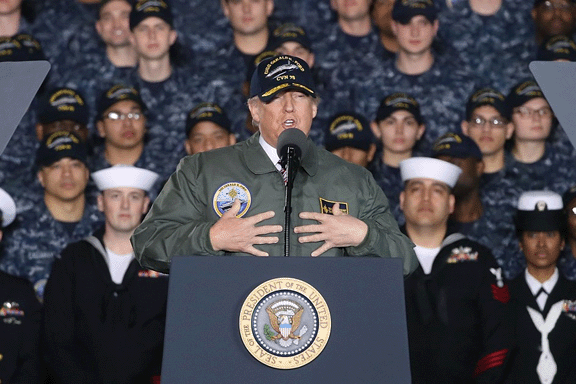
Tensions between the U.S. and North Korea have been running high of late as the North continues to develop its nuclear capacities and as U.S. President Donald Trump continues to ratchet up tensions by responding erratically. Trump recently suggested that his “fire and fury” remarks were not “tough enough.”
As a result, a growing number of lawmakers are calling for Trump to be stripped of the “nuclear football.” “No U.S. President, certainly not Trump, should have sole authority to initiate an unprovoked nuclear war,” argued Sen. Ed Markey (D-Mass.).
According to a recent CBS Newspoll, nearly 60 percent of Americans are “uneasy” about Trump’s ability to deal reasonably with North Korea, and the same percentage believes that the U.S. should not be threatening Pyongyang with military action.
As Common Dreams has reported, activists and analysts have issued urgent calls for diplomacy in recent weeks as tensions continue to intensify. The failure to pursue diplomatic avenues could result in a “nuclear nightmare,” some have warned.
“Time has proven that coercion doesn’t work,” CODEPINK co-founder Medea Benjamin recently wrote. “There’s an urgent need to hit the reset button on U.S.-Korean policy.”
Herald 20th Aug 2017,COUNCIL leaders are backing a call by Hiroshima and Nagasaki, the two
Japanese cities devastated by US atomic bombs 72 years ago, to accelerate
international moves for a nuclear ban.
They are calling for the UK and other nations to renew their nuclear disarmament efforts in a bid to defuse
growing fears of nuclear war in the wake of destabilising tensions between
North Korea and the Trump administration. A conference of ‘Mayors for
Peace’ in Nagasaki earlier this month passed a resolution urging
countries to ratify a new United Nations (UN) treaty prohibiting nuclear
weapons as soon as possible.
Time for nuclear balancing act?, Korea HeraldBy Yeo Jun-suk, 20 Aug 17 Calls grow in Seoul to deploy tactical atomic weapons to counter NK nuclear threats, Aug 20, 2017 Despite under a constant threat of war from the communist North Korea, South Korea has remained a nuclear weapons-free zone since 1991. But with Pyongyang nearing the finish line in its atomic weapons program, politicians and security experts in Seoul are calling for “a balancing act” to adapt to the new security environment on the Korean Peninsula: A North Korean nuclear weapon can only be deterred by a nuclear weapon — by either South Korea’s own or the US, they said.
“We can’t fight against the North with bare hands,” said Rep. Jeong Yong-ki, a spokesman for the main opposition Liberty Party Korea. “It’s time for us to be in a tit-for-tat over North Korea’s nuclear weapons.”
The conservative party, who favors hardline approaches toward the North, adopted as its party platform last week a call for redeploying US tactical nuclear weapons that were withdrawn from the peninsula in 1991.The minor conservative Bareun Party, while also advocating nuclear deterrence, floated an idea of US “sharing” its nuclear weapons with South Korea.
As opposed to the Liberty Party’s proposal of bringing US nuclear weapons back here, the idea calls for the US granting South Korea a right to use US nuclear assets operating outside the peninsula, such as nuclear-powered submarines or fighter jets carrying nuclear bombs, when the need arises.
“Our idea allows us to have nuclear deterrence without deploying nukes here,” while avoiding possible backlashes from neighboring countries, said Rep. Ha Tae-kyung of Bareun Party.
The need for a nuclear deterrent was echoed even from a former security advisor to President Moon Jae-in, a liberal favoring re-engagement with the North and nuclear disarmament of both Koreas. …….http://www.koreaherald.com/view.php?ud=20170820000215
President Trump’s Top Defense and Diplomatic Chiefs Insist There’s a Military Option for North Korea, Time, Matthew Pennington / AP, Aug 17, 2017 (WASHINGTON) — America’s diplomatic and defense chiefs sought Thursday to reinforce the threat of possible U.S. military action against North Korea after President Donald Trump’s top strategist essentially called the commander-in-chief’s warnings a bluff.
Secretary of State Rex Tillerson stressed after security talks with close ally Japan that the U.S. seeks a peaceful solution to the standoff over North Korea’s nuclear weapons program. But he said a U.S.-led campaign of economic pressure and diplomacy needs to be backed by potential military consequences.
Washington is “prepared militarily” to respond, if necessary, he said…..
North Korea’s missile launches “must stop immediately,” Tillerson said. Given the magnitude of the threat posed by the North’s weapons development, he said any diplomatic effort “has to be backed by a strong military consequence if North Korea chooses wrongly.”
“That is the message the president has wanted to send to the leadership of North Korea,” Tillerson said, “to remind the regime of what the consequences for them would be if they chose to carry out those threats.”
Trump last week pledged to answer North Korean aggression with “fire and fury.” He later tweeted that a military solution was “locked and loaded,” after leader Kim Jong Un was said to be considering a provocative launch of missiles into waters near Guam…..
Tensions have since eased somewhat since North Korea said Kim doesn’t immediately plan to fire the missiles. But fears of conflict remain as the U.S. and South Korea next week begin military drills that the North views as preparation for invasion, and as Washington seeks to stop the North’s progress toward having a nuclear-tipped missile that could strike the continental United States……http://time.com/4905989/donald-trump-steve-bannon-rex-tillerson-north-korea/
The potential conflict between nuclear powers that Trump barely acknowledges, https://www.washingtonpost.com/news/worldviews/wp/2017/08/18/the-potential-conflict-between-nuclear-powers-that-trump-barely-acknowledges/?utm_term=.bdf29c5159e7By Adam TaylorAugust 18, The two most populous countries in the world are dangerously close to armed conflict. Both are fast-growing and ambitious nations with something to prove — and they have nuclear weapons. Yet you’ll find surprisingly little discussion of the issue in Washington, where President Trump’s ongoing controversies and the threat of terrorist attacks (more on the horrific attack in Barcelona later in the newsletter) continue to dominate the discussion.The military standoff between India and China over a remote plateau in the Himalayas has been going on for months now. This week, The Post’s Annie Gowen and Simon Denyer took a look at the complicated dispute, which was sparked by China’s move to build a road in territory claimed by Bhutan, a close ally of India that does not have formal diplomatic relations with Beijing.
Territorial disputes between in the area are far from new — India and China briefly went to war over contest territory in 1962. And much of the present dispute dates back to an 1890 border agreement made between British India and China’s Qing Dynasty, one of a number of lingering problems caused by colonial cartographers.
But experts say the current standoff is the worst in decades and has taken on a different tone than previous flare-ups. “It would be very complacent to rule out escalation,” Shashank Joshi, an analyst with the Royal United Services Institute in London, told The Post. “It’s the most serious crisis in India-China relations for 30 years.”
Both India and China are speaking openly and seriously of armed conflict, with Beijing’s state media striking a indigent and at times uncharacteristically vulgar tone. An English-language video posted by the Xinhua news agency Wednesday accused India of “trampling international law” and “inventing various excuses to whitewash its illegal moves” — before showing a Chinese actor in a Sikh turban who spoke in an insulting Indian accent.
If India and China were to go to war, it would be no small matter. Over 2.6 billion people live in the two nations. Between them, they are estimated to have 380 nuclear weapons (though both China and India subscribe to a “no first use” policy, which should — hopefully — mean they wouldn’t be used in such any conflict).
In a briefing last month, the U.S. State Department urged restraint. During a press briefing last week, spokeswoman Heather Nauert said, “It’s a situation that we have certainly followed closely. And as you know, we have relationships with both governments. We continue to encourage both parties to sit down and have conversations about that.”
The dispute centers not only on the territory in question — an obscure, 34-square-mile area known as the Dolam Plateau that is claimed by both Bhutan and China — but a narrow strip of strategically important Indian land called the Siliguri Corridor. This tract, unaffectionately nicknamed the “chicken’s neck,” connects the bulk of the India with its remote east. Delhi has long feared Chinese troops could cut across the corridor if war broke out, effectively cutting the country in half. It’s not an unreasonable fear, given that the region is just 14 miles wide at its thinnest point; Ankit Panda of the Diplomat once dubbed it a “terrifyingly vulnerable artery in India’s geography.”
It is widely assumed that Washington would side with India in the dispute. Trump is a frequent critic of China, and some in his administration have pushed for tough responses to other territorial claims made by Beijing, such as the ongoing disputes in the South China Sea. Trump called Indian Prime Minister Narendra Modi on India’s Independence Day this week, which some media outlets interpreted as a gesture of support for New Delhi.
And yet, there is a nagging sense among some in India that Trump won’t have Modi’s back if push comes to shove. “If ever there was a war with China, America would never come to our rescue,” one government official told Indian journalist Barkha Dutt recently, according to a story Dutt wrote for The Post’s Global Opinion section.
Washington also may be diplomatically limited in the region: A number of key State Department positions that would have responsibility for handling an India-China crisis remain unfilled. Another part of the problem is simply the complexity of the issue, which could prove hard to communicate to a leader with seemingly limited knowledge of the world and a notoriously short attention span.
There is also an argument that perhaps Trump should keep his nose out of this. The Post’s Jackson Diehl wrote he didn’t find much enthusiasm for U.S. involvement in the dispute while in Delhi last week. The U.S. president has gained a reputation there for being hotheaded and impulsive — even the drawdown in tensions with North Korea seems to have happened in spite of his involvement, not because of it.
Americans are afraid of war with North Korea — and of how Trump could handle it, New polls show Americans are divided on how to handle the North Korea threat , Vox, by Ella Nilsen Aug 11, 2017,
“…….New polls show a majority of Americans are afraid the US is about to wade into a war with North Korea, but are split on whether America should take military action in the face of increased threats from Pyongyang. At the same time, some of the public’s anxiety is about Trump and his off the cuff handling of the situation. Trump’s approval rating has dipped to historic lows, and Republicans and Democrats disagree sharply on whether they think the president is capable of dealing with North Korea…..
in the past month, North Korea has successfully completed an intercontinental ballistic missile test that could reach the mainland United States, and American intelligence officials say the country is nearing its goal of being able to fit a nuclear weapon on one of those long-range missiles.
And Trump hasn’t exactly been doing a lot to quell those fears. On Tuesday, Trump appeared to threaten nuclear war, vowing to respond to North Korean threats with “fire and fury like the world has never seen.”
Two days later, the president doubled down, saying of his remarks, “maybe it wasn’t tough enough.” He followed that up with a Friday tweet that the US military solutions were “locked and loaded should North Korea act unwisely.”
As a result, the possibility of war is on a lot of people’s minds.
A new poll from Public Policy Polling released by Axios on Friday morning shows 82 percent of Americans say they are afraid of nuclear war with North Korea. Another poll released by Rasmussen Report on Friday showed 63 percent of voters polled believe the US is now likely to take nuclear action against Kim Jong Un.
Meanwhile, the CBS poll conducted last week revealed 72 percent of Americans were already feeling uneasy about a possible conflict, while another 26 percent said they were confident things would be resolved.
However, the majority of those polled (60 percent), were optimistic the threat from North Korea could still be contained, with another 29 percent saying they believed it required immediate military action……
Another poll conducted by the Chicago Council on Foreign Affairs earlier this month found something similar, with a slim majority of respondents saying they supported military intervention if North Korea attacked South Korea.
The Chicago Council poll is the first time that more than half of Americans voiced support for sending in troops to help South Korea in the event of an attack. However, the same poll found Americans were still reticent to get involved in an armed conflict with North Korea and more likely to support increased sanctions instead.
Amidst the escalation, Americans still don’t have a lot of confidence in their commander in chief.
Just 35 percent of respondents to the CBS poll said they were confident in Trump’s ability to handle the North Korea threat, while 61 percent said they were uneasy. Confidence in Trump’s ability fell largely along party lines, with 76 percent of Republicans saying they were confident, and 31 percent of independents and just 10 percent of Democrats agreeing with them.
North Korea Could Unleash the Unthinkable: Nuclear War Between Russia and America, National Interest, Dave Majumdar, 18 Aug 17, In the event that North Korea tests another Intercontinental Ballistic Missile (ICBM) or potentially launches an attack on the United States, the Pentagon could try to intercept those missiles with the Ground-Based Midcourse Defense (GMD) system. However, as many analysts have pointed out, the interceptors that miss their target could reenter the Earth’s atmosphere inside Russian airspace. Such an eventuality could prove to be a serious problem unless steps are taken to address the issue now.
“You should also be aware of the concern that those interceptors fired from Alaska that miss or don’t engage an incoming North Korean ICBM(s) will continue on and reenter the Earth’s atmosphere over Russia,” Kingston Reif, director for disarmament and threat reduction policy at the Arms Control Association told The National Interest.
“This carries a nontrivial risk of unintended escalation.”
Jeffrey Lewis, director of the East Asia Nonproliferation Program at the James Martin Center for Nonproliferation Studies at the Middlebury Institute of International Studies at Monterey, told The National Interest that the United States should open a dialogue with Russia on the issue immediately.
“Good god, yes,” Lewis said emphatically.
Olya Oliker, director of the Russia and Eurasia program at the Center for Strategic and International Studies agreed.
“We have time now to consult with Moscow, talk about plans, discuss how notification would work,” Oliker told The National Interest.
“This isn’t the rocket science part of all this.”
Indeed, in a recent op-ed, Lewis argues that an American interceptor launch could accidentally trigger a nuclear exchange if the Russians mistook such a weapon for an incoming ICBM.
“We can’t assume that Russia would realize the launch from Alaska was a missile defense interceptor rather than an ICBM. From Russia, the trajectories might appear quite similar, especially if the radar operator was under a great deal of stress or pressure,” Lewis wrote forThe Daily Beast.
“It doesn’t matter how Russia’s early warning system ought to work on paper, the reality of the Russian system in practice has been a lot less impressive.”
Joshua H. Pollack, editor of the The Nonproliferation Review and a senior research associate at the James Martin Center for Nonproliferation Studies, said that the danger is real.
“Whether they actually would enter Russian airspace is probably less important than whether they break the line of sight of Russia’s early-warning radars,” Pollack said…….
Pavel Podvig, an independent analyst based in Geneva who runs the Russian Nuclear Forces research project disagreed with Lewis and Pollack. Podvig noted that the Russian early warning system is in far better shape today than it was during the 1990s. While a GMD launch from Alaska might cause alarm, the Russian philosophy has been to essentially absorb the first initial blows before launching a retaliatory counterstrike.
“The Russian system is built to ‘absorb’ events like this,” Podvig told The National Interest……..
The Russians, however, are not too worried by the prospect of discarded American interceptors landing on their soil. However, Moscow would likely want to be consulted because the interceptors might set off Russia’s ballistic missile early warning system (BMEWS)……..
What is surprising to the Russians is that the United States did not install a self-destruct system on the GMD interceptors to prevent the missiles from landing where they should not……..
the United States should probably consult with Russia about the possibility of intercepting North Korean ICBMs over Moscow’s territory and set up an agreement ahead of time. But even then, during a real intercept attempt, the United States will likely have to count on Russia’s early warning system operating correctly and the Kremlin’s restraint to avoid an unintended nuclear war.
Ex-CIA analyst Bruce Klinger predicts Kim Jong-un will target Guam to defy Trump. Australian Financial Review, by John Kehoe, 13 Aug 17, Kim Jong-un will probably defy Donald Trump and soon try to land missiles in waters near the US Pacific island of Guam to show off strength and test the US President’s resolve, according to one of the world’s top North Korean analysts.
Ahead of a trip this week to Australia to speak to government officials about the North Korean nuclear crisis, former senior US Central Intelligence Agency officer for Korea, Bruce Klinger, said President Trump could hasten or delay war in attempting to shoot down any missile around the US military island.
“Given the specificity of what North Korea is saying they are thinking of doing and about the number of seconds the flight would take I would think they will launch the missiles towards Guam,” Mr Klinger said in an interview with The Australian Financial Review.
“I don’t think it’s an attack. It would be a very, very provocative demonstration…….
Mr Klinger, who led the CIA’s Korea branch in 1994 when president Bill Clinton nearly went to war with Pyongyang to stop its nuclear weapons program, said it was debatable whether or not the US or its allies should unleash missile defence systems if a North Korean demonstration missile were targeted just outside US territory………
Mr Klinger will visit Canberra and Sydney and consult with government intelligence and defence officials about the rapidly escalating North Korea nuclear weapon crisis.
He met North Korean officials in Europe earlier this year and recently testified before Congress…….
Unless there was very strong evidence that Mr Kim was about to strike the US, Mr Klinger opposed a preventative US attack and said it could have “catastrophic” consequences for millions of people.
“The President’s trying to demonstrate resolve to our allies and send a signal to North Korea and China,” Mr Klinger said.
Threats of nuclear war between the US and North Korea are bringing “horrifying realities” of such weapons back into focus.
Not only do nuclear bombs cause devastation where they explode, survivors and people exposed to fallout suffer from increased cancer rates and birth defects.
The entire world still shows effects from the era of widespread nuclear testing.
No one escapes a nuclear blast unscathed.
North Korea’s recent weapon tests, along with the exchange of aggressive statements between the US and North Korea, have brought the threat of nuclear war back to present consciousness.
Most experts think that sort of catastrophic conflict is unlikely, but even the possibility should be sobering. Physicist Lawrence Krauss recently wrote that any discussion of nuclear weapons should force leaders to confront the “horrifying realities” involved.
In that vein, it’s worth remembering that such an event isn’t just devastating for the people and areas exposed to the initial blast. Those who survive are still likely to be contaminated by radiation.
From what researchers can tell, even people more than five hundred miles away from massive nuclear tests have encountered enough radiation (due to weather blowing it in their direction) to increase cancer rates and permanently harm babies in utero.
The nuclear explosions that came at the end of World War II — and the explosions from hundreds of nuclear tests in subsequent years — still have demonstrable effects on human health. Every living thing on the planet today shows some sign of being exposed to the radiation emitted in the era of widespread nuclear testing.
What we know about long term effects of radiation exposure
The bomb dropped on Hiroshima on August 6, 1945 killed between 90,000 and 166,000 people, due to the initial force, heat, and direct radiation exposure. Three days later, the bomb at Nagasaki killed another 60,000 to 80,000.
But that wasn’t all — radiation continued to affect the survivors. Those effects have been studied ever since, with most research conducted by a joint Japan-US organisation called the Radiation Effects Research Foundation.
Researchers have found that babies who were exposed to radiation from the bombings in utero were significantly more likely to be born with small head size, mental disabilities, and were less likely to grow to normal height. Children born to women who were within 2.5 km of the edge of the fireballs were at least five times as likely to demonstrate these effects when compared to people farther away.
Among survivors, cancer rates in general rose approximately 10%, according to RERF data. Leukemia rates rose more — almost 50% — and had the biggest effect on children. (This primarily affected people who were young at the time of the explosions, so the effect has mostly disappeared in the years since.)
After the war, nuclear testing by major superpowers entered its heyday. The US and Soviet Union both detonated hundreds of nuclear weapons before signing the Partial Test Ban Treaty in 1963, which prohibited above-ground nuclear tests.
Because of those tests, “radioactive particles and gases were spread in the atmosphere,” according to the CDC. That effect was widespread enough to deposit radiation all over the globe. Anyone who has lived in the US after 1951 has received some exposure to fallout. All of our organs and tissues show some sign of it.
In most cases, the potential increased cancer risk from that exposure is very small. (Most of us receive far more radiation regularly from X-rays and similar procedures.) But at least one CDC study estimated that fallout could eventually be responsible for up to 11,000 cancer deaths in the US, according to New York Times coverage of the study.
People who were closer to locations where nuclear weapons were tested between 1951 and 1963 have fared worse than residents of other areas. Soldiers who witnessed and participated in tests in Nevada were approximately 14% more likely to die from leukemia, 20% more likely to die from prostate cancer, and more than 20% more likely to die from nasal cancer than soldiers not involved in those tests. Soldiers who witnessed Pacific Ocean tests had similar changes.
One analysis looked at Norwegians exposed to fallout from Soviet tests conducted more than 500 miles away. The researchers found that people in some areas were hit for years by annual doses of radiation about 60 times the size of an X-ray mammogram (or twice the dose of a full-body CT scan) — enough to cause harm. Kids who were born in exposed Norwegian regions during that time period were more likely to have lower IQs and educational achievement. Even the children of exposed individuals were later found to have lower cognitive scores.
As Harold Pollack described in the Washington Post, famed Soviet physicist Andrei Sakharov estimated that the potential health consequences of Russia’s nuclear tests could eventually cause hundreds of thousands of cancer deaths. That risk assessment transformed Sakharov from a respected government scientist into an active dissident.
One of Sakharov’s biographers quoted his reaction to his inability to prevent one such nuclear test, according to Pollack: “A terrible crime had been committed, and I couldn’t prevent it … I dropped my face on the table and wept,” Sakharov said.
North Korea’s nuclear weapons ‘aren’t going away’, says former US intelligence boss,ABC News Breakfast, 17 Aug 17,
The world will need to get used to North Korea having nuclear weapons for now, according to a former top US intelligence advisor currently visiting Australia.
Gregory Treverton was the chairman of the powerful US National Intelligence Council until he stood down in January, and today said the US may need to back down a bit to avoid conflict.
“We have got to find a way to avoid [war] … That means climbing down on our side,” he told News Breakfast.
“It means, over time, I think [it will be] very, very hard for us, but to recognise those North Korean nuclear weapons aren’t going to go away.
“The best thing we can try and do is cap them, contain them.”
After a week of rising tensions and threats, US President Donald Trump this week praised North Korean leader Kim Jong-un for a “wise and well reasoned” decision not to fire missiles towards Guam. However, Mr Treverton said the threat of war had by no means passed…….
The plain fact is there is no good military option.”
According to Mr Treverton a pre-emptive attack by the US against North Korea was not a feasible option.
He said North Korea had been building hidden facilities and moving its missiles around. And even if the US could target its nuclear facilities, it would still have non-nuclear options that could devastate South Korean targets.
Trump’s diplomacy is ‘erratic’
Mr Treverton said Mr Trump had “painted himself into a corner” after ramping up his threats towards North Korea and that his approach to foreign policy was “really quite erratic”.
“I came to realise that almost nothing he says has any content,” Mr Treverton said.
How War Pollutes the Potomac River,DAVID SWANSON AND PAT ELDER FOR BUZZFLASH AT TRUTHOUT, 17 AUG 17, The Pentagon’s impact on the river on whose bank it sits is not simply the diffuse impact of global warming and rising oceans contributed to by the U.S. military’s massive oil consumption. The U.S. military also directly poisons the Potomac River in more ways than almost anyone would imagine.
Let’s take a cruise down the Potomac from its source in the mountains of West Virginia to its mouth at the Chesapeake Bay. The journey down this mighty waterway details six EPA Superfund sites created by the Pentagon’s reckless disregard for the fragile ecosystem of the Potomac River watershed.
The U.S. Navy’s Allegany Ballistics Laboratory in Rocket Center, West Virginia, 130 miles north of Washington, is a critical source of contamination in the Potomac River. The on-site disposal of explosive metals and solvent wastes contaminates soil and groundwater with hazardous chemicals. The groundwater and soil along the river are laced with explosives, dioxins, volatile organic compounds, acids, laboratory and industrial wastes, bottom sludge from solvent recovery, metal plating pretreatment sludge, paints, and thinners. The site also has a beryllium landfill. An active burning area is still used for waste disposal, sprinkling chemical dust over the river. It’s not good.
Traveling the river 90 miles further south brings us to Fort Detrick in Frederick, Maryland, the Army’s “proving ground” for the nation’s biological warfare program. Anthrax, Phosgene, and radioactive carbon, sulfur, and phosphorous are buried here. The groundwater is laced with deadly trichloroethylene, a human carcinogen, and tetrachloroethene, suspected of causing tumors in laboratory animals. The Army tested ghastly and heinous agents here, like Bacillus globigii, Serratia marcescens, and Escherichia coli. Although the DOD says it ceased biological weapons testing for offensive purposes in 1971, the claim is like the military’s placement of “defensive” missile systems near an enemy’s border.
Fort Detrick also has a history of dumping high levels of phosphorus into its drain system that ultimately washes into the lower Monocacy River, a tributary of the Potomac. In fact, the Maryland Department of Environment has cited the Army for exceeding allowable permit levels. Too much phosphorus in the water causes algae to grow faster than the Potomac ecosystem can handle. It is deadly. The Army is a leading polluter of the Potomac River watershed……..
The Potomac is far from unique. Sixty-nine percent of U.S. Superfund environmental disaster sites are the result of war preparations.
Preparations for war cost over 10 times the money that actual wars do, and cause at least 10 times the deaths. Routine U.S. military war preparations cause deaths by diverting resources from human needs and directly through massive environmental destruction spread all over the world including in the United States, and including in the Potomac.
So-called foreign intervention in civil wars around the world is, according to comprehensive studies, 100 times more likely — not where there is suffering, not where there is cruelty, not where there is a threat to the world, but where the country at war has large reserves of oil or the intervener has a high demand for oil.
The U.S. military is the top consumer of petroleum around, burning more of it than most entire countries, and burning much of it in routine preparations for more wars. There are military planes that can cause more damage with jet fuel in 10 minutes than you can with gasoline driving your car for a year.
All such calculations omit the environmental destruction done by private weapons makers and by their weapons. The U.S. is the leading exporter of war weapons to the rest of the world.
All such calculations also omit much of the damage and all of the details of the human suffering. The U.S. military burns toxic waste in the open, near its own troops in places like Iraq, near the homes of the people who live in the countries it has invaded, and within the United States in many — often poor and minority — communities such as Colfax, Louisiana, and at Dahlgren on the Potomac.
Much of the damage is essentially permanent, such as the poison of depleted uranium, used in places like Syria and Iraq. But this is true in locations all around the United States as well. Near St. Louis, Missouri, an underground fire is moving ever closer to an underground pile of radioactive waste.
And then there is the Potomac River. It flows south between the Lincoln and Jefferson Memorials in Washington, D.C. on the east, and Arlington, Virginia, on the west, where the Pentagon Lagoon brings the water up to the headquarters of world militarism.
Not only does the home of war making sit near rising waters — rising first and foremost because of the effects of war making, but those particular waters — the waters of the Potomac and of the Chesapeake Bay into which it flows, and the tides of which raise and lower the waters of the Pentagon Lagoon each day — are heavily polluted by war preparations.
This is why we are planning and invite you to join in a kayactivist flotilla to the Pentagon on September 16th. We need to bring the demand of No More Oil for Wars to the doorstep of our leading destroyer of the environment.
Sakharov become an ardent supporter of the 1963 Partial Test Ban, and an outspoken critic of nuclear proliferation and, in the late 1960s, anti-missile defences that he feared would spur another nuclear arms race. He became increasingly ostracised by the state, a dissident against oppression who would in 1975 be awarded the Nobel Peace Prize, and referred to as “the conscience of mankind”, says von Hippel.
The monster atomic bomb that was too big to use, In 1961, the Soviet Union tested a nuclear bomb so powerful that it would have been too big to use in war. And it had far-reaching effects of a very different kind. By Stephen Dowling, BBC, 16 August 2017, On the morning of 30 October 1961, a Soviet Tu-95 bomber took off from Olenya airfield in the Kola Peninsula in the far north of Russia……
nothing the Soviet Union had tested would compare to this.
TSAR BOMBA – Most Horrific Man-made Explosion in History – USSR Hydrogen Bomb
The Tu-95 carried an enormous bomb underneath it, a device too large to fit inside the aircraft’s internal bomb-bay, where such munitions would usually be carried. The bomb was 8m long (26ft), had a diameter of nearly 2.6m (7ft) and weighed more than 27 tonnes. It was, physically, very similar in shape to the ‘Little Boy’ and ‘Fat Man’ bombs which had devastated the Japanese cities of Hiroshima and Nagasaki a decade-and-a-half earlier. The bomb had become known by a myriad of neutral technical designations – Project 27000, Product Code 202, RDS-220, and Kuzinka Mat (Kuzka’s Mother). Now it is better known as Tsar Bomba – the ‘Tsar’s bomb’……
It was more than a metal monstrosity too big to fit inside even the largest aircraft – it was a city destroyer, a weapon of last resort…… In order to give the two planes a chance to survive – and this was calculated as no more than a 50% chance – Tsar Bomba was deployed by a giant parachute weighing nearly a tonne. The bomb would slowly drift down to a predetermined height – 13,000ft (3,940m) – and then detonate. By then, the two bombers would be nearly 50km (30 miles) away. It should be far enough away for them to survive.
Tsar Bomba detonated at 11:32, Moscow time. In a flash, the bomb created a fireball five miles wide. The fireball pulsed upwards from the force of its own shockwave. The flash could be seen from 1,000km (630 miles) away.
The bomb’s mushroom cloud soared to 64km (40 miles) high, with its cap spreading outwards until it stretched nearly 100km (63 miles) from end to end. It must have been, from a very far distance perhaps, an awe-inspiring sight.
On Novaya Zemlya, the effects were catastrophic. In the village of Severny, some 55km (34 miles) from Ground Zero, all houses were completely destroyed (this is the equivalent to Gatwick airport being destroyed by a bomb that had fallen on Central London). In Soviet districts hundreds of miles from the blast zone, damage of all kinds – houses collapsing, roofs falling in, damage to doors, windows shattering – were reported. Radio communications were disrupted for more than an hour.……
Tsar Bomba unleashed almost unbelievable energy – now widely agreed to be in the order of 57 megatons, or 57 million tons of TNT. That is more than 1,500 times that of the Hiroshima and Nagasaki bombs combined, and 10 times more powerful than all the munitions expended during World War Two. Sensors registered the bomb’s blast wave orbiting the Earth not once, not twice, but three times……
One of the architects of this formidable device was a Soviet physicist called Andrei Sakharov – a man who would later become world famous for his attempts to rid the world of the very weapons he had helped create. He was a veteran of the Soviet atomic bomb programme from the very beginning, and had been part of the team that had built some of the USSR’s earliest atom bombs…….
With such immense power, there would be no guarantee that the giant bomb wouldn’t swamp the north of the USSR with a vast cloud of radioactive fallout.
That was of particular concern to Sakharov, says Frank von Hippel, a physicist and head of Public and International Affairs at Princeton University.
“He was really apprehensive about the amount of radioactivity it would create,” he says, “and the genetic effects that could have on future generations
“It was the beginning of his journey from being a bomb designer to becoming a dissident.”…….
The Soviets had built a weapon so powerful that they were unwilling to even test it at its full capacity. And that was only one of the problems with this devastating device.
The Tu-95 bombers built to carry the Soviet Union’s nuclear weapons were designed to carry much lighter weapons. The Tsar Bomba was so big that it couldn’t be placed on a missile, and so heavy that the planes designed to carry it wouldn’t have been able to take them all the way to their targets with enough fuel. And, if the bomb was as powerful as intended, the aircraft would have been on a one-way mission anyway…..
Tsar Bomba had other effects. Such was the concern over the test – which was 20% of the size of every atmospheric test combined before it, von Hippel says – that it hastened the end of atmospheric testing in 1963. Von Hippel says that Sakharov was particularly worried by the amount of radioactive carbon 14 that was being emitted into the atmosphere – an isotope with a particularly long half-life. “This has been partly mitigated by all the fossil fuel carbon in the atmosphere which has diluted it,” he says.
Sakharov worried that a bomb bigger than the one tested would not be repelled by its own blastwave – like Tsar Bomba had been – and would cause global fallout, spreading toxic dirt across the planet.
Sakharov become an ardent supporter of the 1963 Partial Test Ban, and an outspoken critic of nuclear proliferation and, in the late 1960s, anti-missile defences that he feared would spur another nuclear arms race. He became increasingly ostracised by the state, a dissident against oppression who would in 1975 be awarded the Nobel Peace Prize, and referred to as “the conscience of mankind”, says von Hippel.
Korean leaders, US open door to diplomacy in nuclear crisis, Yahoo News, The Canadian Press, August 16, 2017 SEOUL, Korea, Republic Of — North Korea’s military on Tuesday presented leader Kim Jong Un with plans to launch missiles into waters near Guam and “wring the windpipes of the Yankees,” even as both Koreas and the United States signalled their willingness to avert a deepening crisis, with each suggesting a path toward negotiations.
The tentative interest in diplomacy follows unusually combative threats between President Donald Trump and North Korea amid worries Pyongyang is nearing its long-sought goal of being able to send a nuclear missile to the U.S. mainland. Next week’s start of U.S.-South Korean military exercises that enrage the North each year could make diplomacy even more difficult.
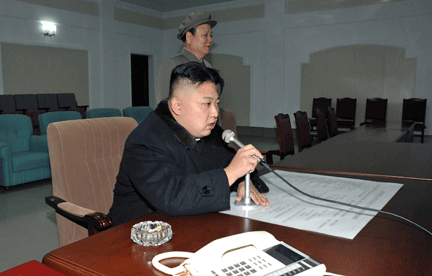
During an inspection of the North Korean army’s Strategic Forces, which handles the missile program, Kim praised the military for drawing up a “close and careful plan” and said he would watch the “foolish and stupid conduct of the Yankees” a little more before deciding whether to order the missile test, the state-run Korean Central News Agency said. Kim appeared in photos sitting at a table with a large map marked by a straight line between what appeared to be northeastern North Korea and Guam, and passing over Japan — apparently showing the missiles’ flight route.
The missile plans were previously announced. Kim said North Korea would conduct the launches if the “Yankees persist in their extremely dangerous reckless actions on the Korean Peninsula and its vicinity,” warning the United States to “think reasonably and judge properly” to avoid shaming itself, the news agency said.
The Trump administration had no immediate comments on Kim’s declaration……..
Kim’s conditional tone, however, hinted the friction could ease if the U.S. offered a gesture that Pyongyang sees as a step back from “extremely dangerous reckless actions.”
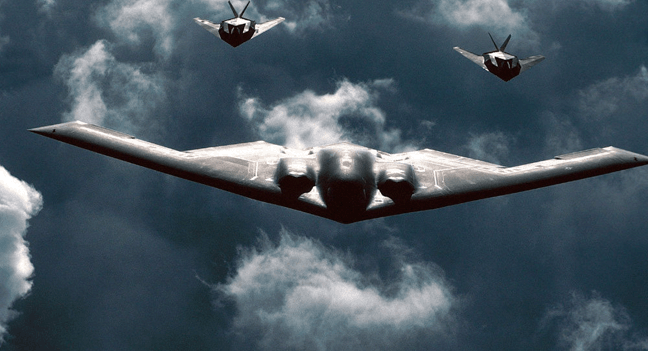
That could refer to the U.S.-South Korean military drills set to begin Aug. 21, which the North claims are rehearsals for invasion. It also could mean the B-1B bombers that the U.S. occasionally flies over the Korean Peninsula as a show of force…….
South Korean President Moon Jae-in, meanwhile, a liberal who favours diplomacy, urged North Korea to stop provocations and to commit to talks over its nuclear weapons program……..
North Korea’s military said last week it would finalize the plan to fire four ballistic missiles near Guam, which is about 3,200 kilometres (2,000 miles) from Pyongyang. It would be a test of the Hwasong-12, a new missile the country flight-tested for the first time in May. The liquid-fuel missile is designed to be fired from road mobile launchers and has been described by North Korea as built for attacking Alaska and Hawaii. https://ca.ne
The Real Nuclear Option, Americans are disturbingly unbothered by the idea of striking first with nuclear weapons, Slate ,By Fred Kaplan, 15 Aug 17, As President Trump rails against North Korea, threatening to rain down “fire and fury like the world has never seen” if it so much as tests another long-range missile, the world can’t help but wonder: Would he really do this? Would he order a nuclear strike, the ultimate fire and fury, against a country that hadn’t attacked us first?
Many are doubtful. His top security advisers would oppose such a move. So would the American people who, though they have no formal say in the matter, would impose constraints on a president’s actions—or so goes the conventional wisdom. Some scholars have written of a “nuclear taboo” ingrained in our sensibilities since the bombing of Hiroshima. Others detect a growing revulsion against the killing of noncombatants even with conventional weapons.
However, a new study suggests that these comforting notions are mistaken.
In the latest issue of the journal International Security, Scott Sagan and Benjamin Valentino, respectively professors at Stanford University and Dartmouth College, conclude that the American public is “unlikely to serve as a serious constraint on any president who might consider using nuclear weapons in the crucible of war.” In fact, under pressures similar to those facing President Harry Truman at the end of World War II, a clear majority of the public would support the first use of nuclear weapons now, just as it did back then.
Some opinion polls appear at first glance to show otherwise. A majority of Americans now say that Truman was wrong to drop atomic bombs on Hiroshima and Nagasaki. But Sagan and Valentino regard those polls as “a misleading guide” to understanding Americans’ “real views” on the use of nuclear weapons and the killing of civilians.
The problem with the Hiroshima polls is that Americans today lack the mindset of Americans in the time of World War II. Japan is now a leading U.S. ally. Few among the living remember the shock of Pearl Harbor or the horrors of the war in the Pacific and the desperate desire to stop the slaughter of American troops by any means necessary. So, the two professors—Sagan an eminent scholar of nuclear strategy, Valentino an expert on public opinion and the use of force—came up with a clever way of gauging how Americans would react in a similar situation today.
They commissioned the polling firm YouGov to conduct a survey in which those polled were shown a mock news story. In this story, the United States imposes sanctions on Iran for violating the Iran nuclear deal. Iran then attacks an American aircraft carrier in the Persian Gulf, killing 2,403 U.S. military personnel (the same number as those killed at Pearl Harbor, though this parallel isn’t drawn explicitly). The U.S. responds with airstrikes on Iranian military facilities. Iran refuses to surrender. The U.S. invades Iran but gets bogged down after 10,000 American troops are killed.
Those polled were then given a choice. Should we persist with the ground invasion all the way to Tehran, knowing that 20,000 American soldiers would be killed? Or should we drop a nuclear bomb on Mashhad, Iran’s second-largest city, “to pressure the Iranian government to surrender”—an attack that would kill 100,000 Iranian civilians (an arbitrarily chosen number).
The results were unsettling, though not so surprising. More than half of the respondents, 55 percent, favored dropping a nuclear bomb rather than proceeding with the invasion. An even higher number, 59 percent, said they would approve the president’s action after the fact if he chose to drop the bomb.
Then the pollster changed one key premise: What if the nuking of Mashhad killed 2 million Iranian citizens—which would you prefer: dropping the nuclear bomb or proceeding with the ground invasion, which would kill 20,000 U.S. soldiers?
Those favoring the nuclear option did drop, but not by much—from 55 percent (under the scenario with 100,000 killed) to 47 percent (under the scenario with 2 million killed). More sobering, the same number as before—59 percent—said they would approve the president’s action, after the fact, if he decided to drop the bomb.
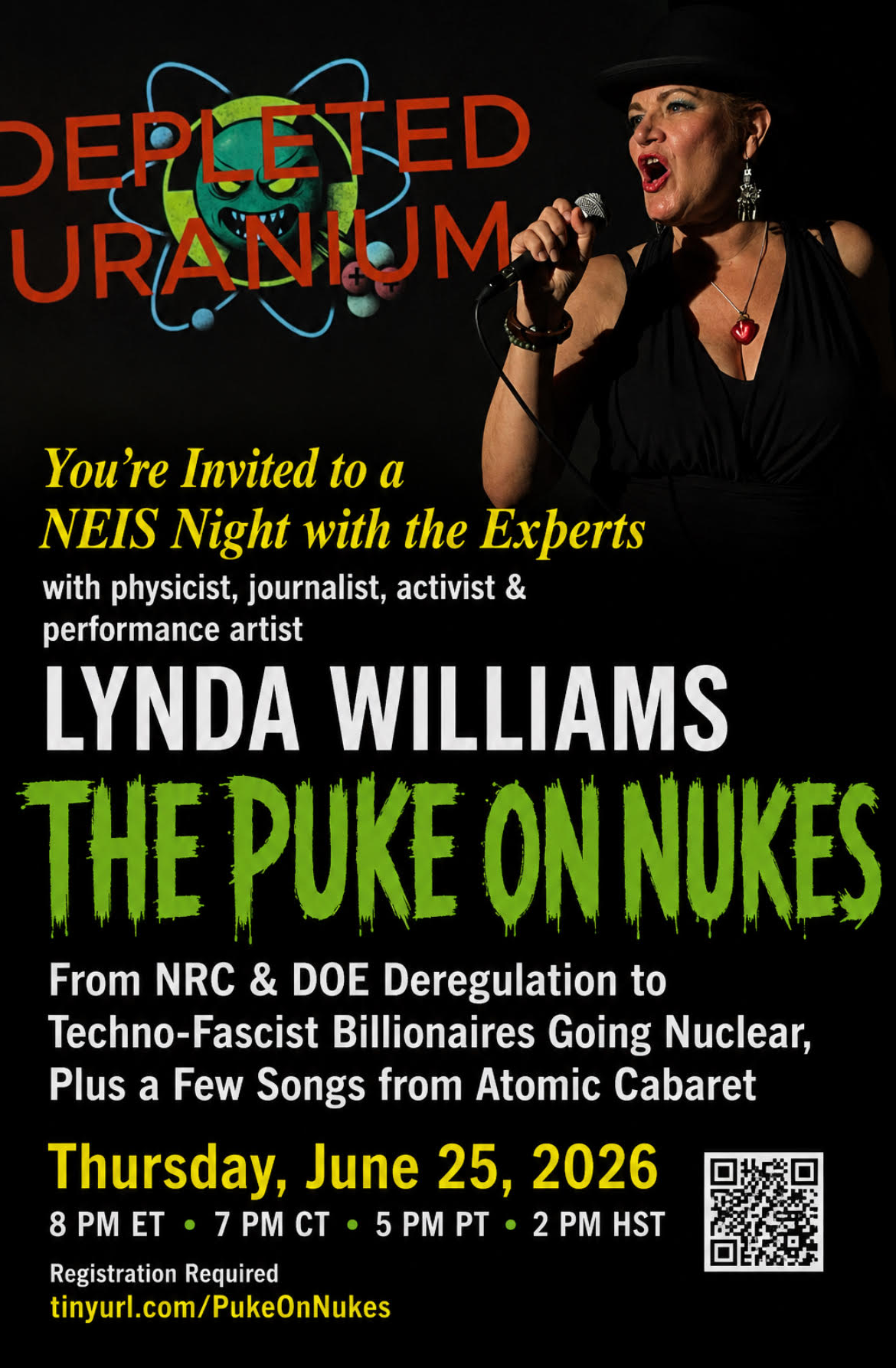
7pm Central Time (8pm ET, 6pm MT, 5pm PT) UTC – 5 From NRC & DOE Deregulation to Techno-Fascist Billionaires Going Nuclear, Plus a Few Songs from Atomic Cabaret REGISTER











 nuclear-news