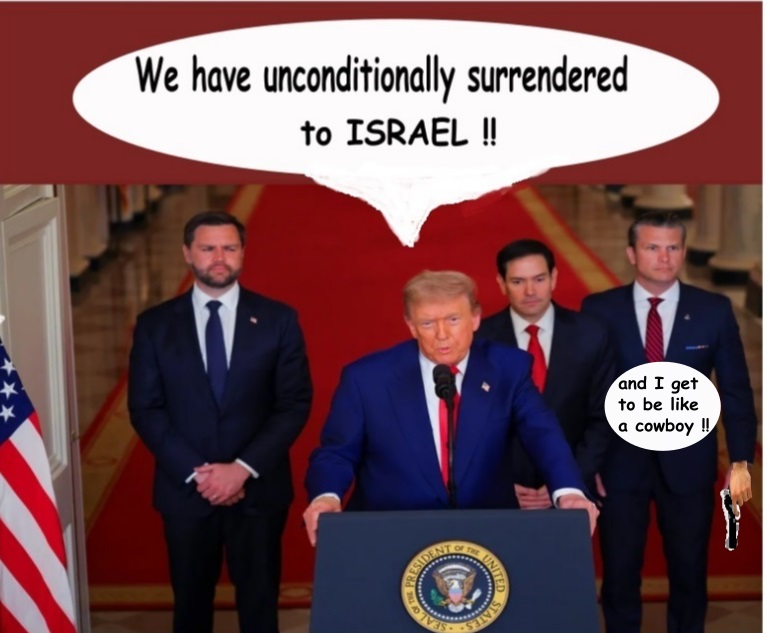
Trump’s attack on Iran is ‘unconditional surrender’ to Israel
Aaron Maté, Jun 22, 2025, https://www.aaronmate.net/p/trumps-attack-on-iran-is-unconditional?utm_source=post-email-title&publication_id=100118&post_id=166521469&utm_campaign=email-post-title&isFreemail=true&r=ln98x&triedRedirect=true&utm_medium=email
Shunning the US intelligence consensus, Trump and top principals rely on Israeli fraud to bomb Iran.
Since his election in 2016, Donald Trump’s political opponents have portrayed him as a dangerous, unstable fabulist doing the bidding of a malign, nuclear-armed foreign power.
Having returned to the White House this year, Trump is proving his detractors correct on all counts but one: the location on the map. The rogue state that he’s colluding with — at great peril to the planet — is not Russia, as his most vocal detractors alleged, but Israel.
Israel’s June 13th attack on Iran sabotaged the then-ongoing talks on a new nuclear deal with the United States, and Trump has gone to unprecedented lengths to support its aggression. Trump undercut his own Secretary of State’s claim that Israel had undertaken “unilateral action” by acknowledging that “we knew everything” in advance of what he called a “very successful attack.” Administration officials then disclosed that Trump had previously authorized giving Israel intelligence support for the bombing. Trump then called on Tehran’s 9.8 million residents to evacuate, mused about killing Iran’s supreme leader, Ayatollah Ali Khamenei, and declared that “we” – meaning Israel – “have complete and total control of the skies over Iran.”
After Iran rejected his demand for “unconditional surrender”, Trump imposed a new deadline of two weeks, only to break it three days later by ordering a US military attack on three Iranian nuclear energy sites, including the deeply buried mountain complex Fordo, which he quickly hailed as a “great success.” Just as with Trump’s diplomacy with Iran, his two-week deadline turns out to have been a ruse whose “goal was to create a situation when everyone wasn’t expecting it,” a senior administration official said.
To wage war on Iran, Trump and his allies have employed the traditional Iraq WMD playbook of ignoring or manipulating the available evidence to fear-monger about a foreign state marked for regime change. Unlike the Iraq war, where the fraudulent case for invading was mostly concocted in-house, Trump has outsourced the job to Israel, while not even pretending to care about public opinion or Congressional approval.
Back in March, the US intelligence community assessed that “Iran is not building a nuclear weapon” and “has not reauthorized the nuclear weapons program… suspended in 2003.” According to US officials who spoke to the New York Times, “[t]hat assessment has not changed.” Moreover, the US has found that “not only was Iran not actively pursuing a nuclear weapon, it was also up to three years away from being able to produce and deliver one,” CNN reports, citing four sources.
Whereas Dick Cheney and company went through the trouble of nudging subordinates to fabricate intelligence, including via torture, Trump does not care about seeking their imprimatur. “[M]y intelligence community is wrong,” Trump told reporters on Friday. White House Press Secretary Karoline Leavitt insisted that “Iran has all that it needs to achieve a nuclear weapon,” and, if authorized by Ayatollah Khamenei, “it would take a couple weeks to complete the production of that weapon.” In White House meetings, CIA chief John Ratcliffe has argued that Iran is close to a nuclear bomb and that claiming otherwise “would be similar to saying football players who have fought their way to the one-yard line don’t want to score a touchdown,” according to one US official who spoke to CBS News. (After the Iraq war, a “Slam dunk” basketball analogy is no longer available).
If Trump’s intelligence community is “wrong,” who does he think is right? As US officials told the New York Times, the claims from Trump and his circle “echoed material provided by Mossad,” Israel’s intelligence agency. And whereas some in the government, undoubtedly those close to Trump, “find the Israeli estimate credible”, others believe that “Israeli assessments have been colored by Prime Minister Benjamin Netanyahu’s desire to gain American support for his military campaign against Iran.” Moreover, according to multiple officials, “[n]one of the new assessments on the timeline to get a bomb are based on newly collected intelligence,” but instead on “new analysis of existing work.” In other words, Trump is sidelining his own intelligence community to trust a “new analysis” that is based on no new information, just the manipulation of a foreign government.
Trump’s disdain for his own agencies is a particular slight to intelligence chief Tulsi Gabbard. “I don’t care what she said,” Trump said this week, referring to Gabbard’s presentation of the US intelligence consensus on Iran in March. “I think they [Iran] were very close to having it.”
Rather than defend the agencies she oversees – and the record she earned challenging previous US-driven regime change deceptions — Gabbard has bent the knee to Trump, and Israel by extension. In a social media post, Gabbard chided “the dishonest media” for taking her March testimony “out of context.” The US, Gabbard now claimed, “has intelligence that Iran is at the point that it can produce a nuclear weapon within weeks to months, if they decide to finalize the assembly.” Gabbard also shared video of that March testimony, without addressing the contradictory fact that it does not include any mention of her newfound claim that Iran has the capability to produce a nuclear bomb “within weeks to months.”
Gabbard is engaging in disingenuous wordplay. If Israel tells America that Iran “can produce a nuclear weapon within weeks”, then yes, American intelligence now “has” that intelligence. That doesn’t mean it is true, or that American intelligence believes it, which it does not. A US official familiar with the available record on Iran tells me that there is no US intelligence assessment concluding that Iran is “weeks” away from building a nuclear weapon. Gabbard is only saying, therefore, that the US intelligence community has received “intelligence” from Israel, without mentioning that the IC does not actually endorse it.
Moreover, pretend for a moment that the Israeli claim is correct. Gabbard’s caveat of “if they decide to finalize” is an acknowledgment that Iran has not decided to build a nuclear weapon. That’s because Iran has said it does not want one, and is willing to commit to that in a binding agreement — the one they were negotiating with the US until Trump and Israel sabotaged it, and not for the first time. In fact, as US intelligence officials have also predicted, Trump’s bombing now increases the likelihood that Iran will pursue the nuclear bomb that it has long foresworn. Iran claims to have moved enriched uranium stockpiles prior to the US bombing, which preserves its capacity to weaponize.
Trump and Israel insisted, in the president’s words, on “unconditional surrender”: capitulation to maximalist US-Israeli demands that Iran end its uranium enrichment program, which it is entitled to have under the Non-Proliferation Treaty; and that it limit its arsenal of missiles. In other words, Trump and Netanyahu demanded that Iran agree to abandon its sovereignty and right to self-defense just as it is under attack from US-backed Israeli aggression; and all while US-backed Israeli mass murder in Gaza and annexation of the West Bank continues unimpeded.
Iranian officials did not surrender. Trump, by contrast, cannot say the same. By enabling its bombing campaign, parroting its deceptions, and now going to war against Iran on its behalf, Trump has already offered an unconditional surrender to Israel — a betrayal that grows more dangerous by the day.
Trump Announces ‘Successful’ Attack On Iranian Nuclear Sites

Trump said Iran must quickly make peace or he will authorize larger attacks
by Kyle Anzalone | Jun 21, 2025, https://news.antiwar.com/2025/06/21/trump-announces-successful-attack-on-iranian-nuclear-sites/
President Donald Trump announced on Saturday that the US has completed an attack on three nuclear sites in Iran.
“We have completed our very successful attack on the three Nuclear sites in Iran, including Fordow, Natanz, and Esfahan. All planes are now outside of Iran air space. A full payload of BOMBS was dropped on the primary site, Fordow,” the President wrote on Truth Social. “All planes are safely on their way home. Congratulations to our great American Warriors. There is not another military in the World that could have done this. NOW IS THE TIME FOR PEACE! Thank you for your attention to this matter.”
In an address to the nation, Trump said that Iran’s three main nuclear enrichment sites had been “completely obliterated.” Trump added that if “peace does not come quickly,” the US would conduct larger attacks soon.
Iranian state media downplayed the success of the strike, saying the personnel and nuclear material were removed from the facilities before the attack.
Fox News reporter Jennifer Griffin spoke with a “well-placed source” who did not believe the Esfahan facility was destroyed. “ There is no way they got in that tunnel It’s deeper than [Fordow]- and harder rock,” they explained.
Axios reporter Barak Ravid said an Israeli official confirmed that Tel Aviv was informed of the strike before the operation. He added that Trump had called him following the attack, with the message, “We had great success tonight. Your Israel is much safer now.”
Ravid is an Israeli who served in an Israeli Army intelligence unit.
Trump also called Israeli Prime Minister Benjamin Netanyahu after the strike.
Netanyahu posted a video message on social media Saturday night praising Trump’s decision to bomb Iran. “Congratulations, President Trump. Your bold decision to target Iran’s nuclear facilities with the awesome and righteous might of the US will change history.” The Israeli leader continued, “In operation Rising Lion, Israel has done truly amazing things. But in tonight’s action against Iran’s nuclear facilities, America has been truly unsurpassed. It has done what no other country on earth could do.”
Reuters reports speaking with a US official who confirmed B-2 bombers were involved in the attack. Earlier on Saturday, six B-2 bombers departed a US airbase in Missouri, with officials saying they were en route to Guam.
B-2s are capable of dropping the GBU-57A/B MOP, a 30,000-pound bunker-busting bomb, that some US officials believed to be capable of destroying Iran’s Fordow nuclear site.
Fox News host Sean Hannity said that six GBU-57s were used to strike Fordow. The nuclear facilities in Natanz and Esfahan were targeted with 30 submarine-launched Tomahawk missiles.
Shortly after announcing the attack, Trump posted an image from the “Open Source Intel” X account that claimed Fordow is gone. The owner of the account says he is based in Israel.
Following the attack, the Pentagon began warning US troops in the region that the stikes likely put them in danger of Iranian retaliatory attacks. Ken Klippenstein reports obtaining a briefing that said strike on Iran “will likely result in counterstrikes on US bases and facilities” in the Middle East, and “likely activate Iran and other foreign terrorist organizations cells abroad including the US to conduct strikes against US persons and facilities.”
In a post on Truth Social, Trump threatened that any Iranian response “WILL BE MET WITH FORCE FAR GREATER THAN WHAT WAS WITNESSED TONIGHT.”
The American strike follows Israeli requests that the US enter the war it started last week with Iran. Over the past week, Trump appeared convinced that Iran was weeks away from building a nuclear weapon, an intelligence assessment that originated with Israel’s intelligence agency, Mossad. That message was amplified in the White House by CIA Director John Ratcliffe.
Trump Bombs Iran, Then Demands Iran Agree to End the War.
After the unprovoked attack, Trump demanded that Iran effectively surrender while continuing to threaten the country.
By Sharon Zhang , Truthout, June 21, 2025, https://truthout.org/articles/trump-bombs-iran-then-demands-iran-agree-to-end-the-war/?utm_source=Truthout&utm_campaign=4917bf90b8-EMAIL_CAMPAIGN_2025_06_22_07_19_COPY_01&utm_medium=email&utm_term=0_bbb541a1db-cb3a7b1ac8-650192793
resident Donald Trump announced on Saturday that the U.S. military struck three sites in Iran, in an unprovoked act of aggression. The strikes come after Israel launched its own unprovoked attack on Iran on June 13, leading to an all-out war between the two countries. The U.S. strikes mark a major escalation and threaten to bring further instability to the region.
In a post on Truth Social, Trump said that the U.S. has bombed three nuclear facilities in Iran, at Fordow, Natanz, and Esfahan.
The Iranian government’s Atomic Energy Organization confirmed the strikes, saying that they “were attacked in a violent act against international laws, including the Non-Proliferation Treaty, by the enemies of Islamic Iran.” Regional Iranian officials also confirmed the strikes, as Iranian news outlets have reported.
Iran has not directly targeted U.S. bases with an attack thus far in its war with Israel. Still, in his post announcing the strikes, Trump also demanded that Iran effectively surrender.
“NOW IS THE TIME FOR PEACE!” he wrote. In a follow-up post, he said, “IRAN MUST NOW AGREE TO END THIS WAR.”
The strikes mark the U.S.’s official direct entry into the war, though the U.S. has provided Israel with support in its bombings on Iran and has also helped provide defense for Israel. The attacks come after politicians and war mongers in the U.S. have called for war with Iran for decades.
In a brief address on Saturday night, Trump layered further threats against Iran, saying that the U.S. would continue its strikes if Iran doesn’t “make peace.” He called Iran the “bully of the Middle East” and said the strikes had gone “a long way to erasing this horrible threat to Israel” — the state that, in addition to currently conducting a genocide in Gaza, has been relentlessly attacking and invading countries and territories around it for decades.
“This cannot continue. There will be either peace, or there will be tragedy for Iran far greater than we have witnessed over the last eight days. Remember, there are many targets left,” Trump said.
Numerous lawmakers slammed the strikes, saying that they are unconstitutional as domestic law prohibits the president from launching an unprovoked strike without approval from Congress. Rep. Alexandria Ocasio-Cortez (D-New York) called for Trump to be impeached.
“The President’s disastrous decision to bomb Iran without authorization is a grave violation of the Constitution and Congressional War Powers. He has impulsively risked launching a war that may ensnare us for generations. It is absolutely and clearly grounds for impeachment,” said Ocasio-Cortez.
UN Secretary-General António Guterres condemned the strikes, and called for de-escalation and diplomacy.
“This is a dangerous escalation in a region already on the edge — and a direct threat to international peace and security. There is a growing risk that this conflict could rapidly get out of control — with catastrophic consequences for civilians, the region, and the world,” Guterres said.
Juan Cole: The Current Iran War Will Likely End Soon, But the Arms Race Will Heat Up
Regime change in Iran as a result of the US and Israeli attacks is unlikely. Even Iranians in the opposition are likely to rally around the flag.
America’s credibility as a negotiator and mediator is completely ruined, since Trump hit Iran in the midst of negotiations
It is still not clear to me that the ayatollahs’ longstanding opposition to nuclear weapons will change.
June 23, 2025
Ann Arbor (Informed Comment) – The Al Jazeera bureau chief in Tehran, Abdul Qader Fayez, reports from “informed sources” in Tehran that Iran’s clerical Leader, Ali Khamenei, and his National Security Council have still not decided how to respond to the US attack on Iranian civilian nuclear facilities, though they want the response to be appropriate to the damage done them.
Al Jazeera notes, “Fayez pointed out that this Iranian hesitation suggests a tendency to respond in a carefully considered strategic manner not based on momentary revenge, but rather on a more comprehensive approach that allows Tehran multiple options rather than drawing it into a specific tactical confrontation or a direct, ill-considered reaction.”
Fayez says that the Iranian elite is attempting to distinguish between Washington’s attack and the ongoing Israeli escalation, especially since the US bombardment was unprecedented.
I would add (this is Juan Cole speaking) that Iran is weak. It has lost control of its own skies and so is as helpless as Lebanon and Syria before the Israeli Air Force (and the American). Iran still has some drones and hypersonic missiles that can penetrate Israeli defenses, but although it is able to do some damage to Tel Aviv and Haifa, it isn’t anything the Israelis can’t survive.
The weapons of the weak are guerrilla warfare, covert operations and terrorism. The US and Israel do not have troops on Iranian soil, so a guerrilla war against them is difficult to mount. Moreover, Iran has a return address and so cannot pursue classic guerrilla warfare.
Iran can hit bases in the Middle East that host US troops, as it did in January 2020 after Trump assassinated Iranian General Qasem Soleimani. In that instance, Iranian commanders were careful not to kill the troops, though the latter did get severe concussions from the missile impacts. Such a response would be purely symbolic and for the sake of Iranian domestic politics, with no military significance. US troops in Iraq and Syria are particularly vulnerable to this sort of reprisal.
If Trump is speaking truly and the strikes really were a one-off, then the direct US-Iran engagement could subside quickly. Iran has no reason to want continued direct involvement with the US while it is facing an concerted Israeli campaign. It should be noted that in his first term Trump bombed Syria, then largely ignored the country except for the Obama-initiated defeat of ISIL in Raqqa. He bombed Afghanistan and then more or less surrendered to the Taliban. He bombed an Iranian general at Baghdad International Airport and watched Iran reply, but then went back to using economic sanctions. Trump has a history of splashy one-off bombings with no follow-through, and this episode could be just as transitory.
During the first Trump round of “maximum pressure” sanctions, Iran covertly set fires to petroleum tankers of the United Arab Emirates in the Gulf. But Iran now has good relations with the Arab Gulf states and is unlikely to take the American strikes out on them.
There may, however, be attacks on other oil pipelines or tankers of states with bad relations with Iran. Oil attacks would benefit Iran by raising the price of the petroleum it smuggles to China and by hurting the US and Israeli economies.
Terrorism is a possibility, but there is a danger it would be traced back to Iran, and it is bad for a country’s reputation, foreign relations, and economic affairs.
Regime change in Iran as a result of the US and Israeli attacks is unlikely. Even Iranians in the opposition are likely to rally around the flag. Some disgruntled ethnic minorities may attempt to take advantage of perceived state weakness, but they are small and cannot disrupt the Persian Iranian Plateau, the regime stronghold. If anything, the Israeli and US attacks may have extended the life of an oppressive government that is widely disliked inside the country but which can now claim to stand against powerful external foes dedicated to attacking and destroying the Iranian nation.
……………………………………………………………………………….. The hot war will end, but the Middle East arms race is with us for the foreseeable future, and the opportunities for Russia and China, should they want them, to play a bigger role in the region have expanded.
America’s credibility as a negotiator and mediator is completely ruined, since Trump hit Iran in the midst of negotiations, which a reader reminded me is a violation of the Hague Regulations of 1907 and was held against Japan in the attack on Pearl Harbor.
It is still not clear to me that the ayatollahs’ longstanding opposition to nuclear weapons will change. Many countries throughout the world, however, may now be tempted to go for a nuclear weapon, since the difference between North Korea on the one hand and Iraq and Iran on the other is glaringly clear.
Israel’s war with Iran costs $200M a day, raising pressure for swift end

Oh dear! – Killing people is so expensive!
Israel’s war with Iran is costing the country an estimated $200 million per day, according to early assessments reported by The Wall Street Journal—a staggering figure that is quickly becoming a major constraint on the duration of the conflict, Anadolu reports.
The most expensive burden is the interception of Iranian missiles, which alone can run into tens or even hundreds of millions daily, the WSJ reported on Thursday.
Systems like David’s Sling and Arrow 3—each interception costing between $700,000 and $4 million—have been activated repeatedly in response to over 400 missiles launched by Iran in recent days.
Offensive operations are also increasing costs. Deploying Israeli F-35s over 1,000 miles to hit targets in Iran costs approximately $10,000 per hour per jet, in addition to the price of precision bombs like JDAMs and MK84s.
Altogether, the Aaron Institute for Economic Policy estimates that a month-long war could cost Israel $12 billion.
“This war is far more expensive than Gaza or Hezbollah,” said economist Zvi Eckstein. “The ammunition—defensive and offensive—is the big expense.”
The economic pressure is leading to calls for a shorter war, though Prime Minister Benjamin Netanyahu has not indicated any intention to halt operations before achieving strategic objectives such as crippling Iran’s nuclear and missile programs.
While Israeli markets remain stable—some even rising—damage on the ground is mounting.
Engineers estimate that reconstruction costs from missile strikes will exceed $400 million, as hundreds of buildings have been damaged, and more than 5,000 civilians have been evacuated.
Israel’s largest oil refinery was temporarily shut down after being hit, and work in several critical infrastructure sectors has been suspended.
Former Bank of Israel Governor Karnit Flug told the WSJ that the duration of the conflict is key to economic sustainability: “If it is a week, it is one thing. If it is two weeks or a month, it is a very different story.”
Trump Has Bombed Iran. What Happens Next Is His Fault.
Caitlin Johnstone, Jun 22, 2025,https://www.caitlinjohnst.one/p/trump-has-bombed-iran-what-happens?utm_source=post-email-title&publication_id=82124&post_id=166504460&utm_campaign=email-post-title&isFreemail=true&r=1ise1&triedRedirect=true&utm_medium=email
The US military has bombed multiple Iranian nuclear sites on the orders of President Trump, immediately putting tens of thousands of US military personnel in the region at risk of an Iranian retaliation which can then escalate to full-scale war.
Earlier this month Iran’s Defense Minister Aziz Nasirzadeh explicitly warned the United States that a direct US attack would result in Tehran ordering strikes on US bases in the middle east, saying “all US bases are within our reach and we will boldly target them in host countries.”
In the lead-up to Trump’s act of war on Iran, the president told the press that an attack on American troops will mean a harsh response from the US, saying, “We’ll come down so hard if they do anything to our people. We’ll come down so hard. The gloves are off. I think they know not to touch our troops.”
Trump reiterated this threat to Iran in his announcement of the US attack today.
“There will be either peace, or there will be tragedy for Iran, far greater than we have witnessed over the last eight days,” Trump said. “Remember, there are many targets left. Tonight’s was the most difficult of them all, by far, and perhaps the most lethal. But if peace does not come quickly, we will go after those other targets with precision, speed and skill. Most of them can be taken out in a matter of minutes.”
So you can see how we might already be on our way toward a war of nightmarish proportions as a result of the president’s unprovoked act of aggression. Tehran now has to choose between reestablishing deterrence with extreme aggression or opening the floodgates to a whole host of existential threats from both outside and inside the country. Add to that the possibility of Iran blockading the Strait of Hormuz and the fact that Iran has now been strongly incentivized to actually obtain a nuclear weapon, and it looks very likely that we are plunging into a situation that could unfold in any number of horrific ways.
Right now American political discourse is rife with the narrative that the US has been “dragged” into Israel’s war, which I reject entirely. Every step of the way this entire thing has been signed off on by US leadership. We are at this point because Trump and his regime knowingly chose to take us here.
US troops within reach of Iran’s missiles are reportedly being briefed that they can expect to be on the receiving end of retaliatory strikes in the coming days.
Again, Iran explicitly warned it would attack the US military if the US military did the thing it just did. If and when these retaliatory strikes come, the warmongers will try to argue that this is a valid reason to escalate this war. They will be lying. They chose to make this happen.
Whatever transpires from this point on is the fault of Donald Trump and the unelected thugs he listens to. If US troops are killed, the war sluts in Washington and the Pentagon propagandists in the press will list their names and bandy about their photos and demand that their deaths be avenged with further acts of war — but it will not be Iran’s fault that they died.
It will be Trump’s fault. It will be the fault of everyone whose decisions led up to bombs being dropped on Iranian energy infrastructure, and the fault of everyone who put those soldiers in harm’s way.
None of this needed to happen. Iran was at the negotiating table. The Iran deal was working fine before Trump shredded it to put us on this terrible trajectory. The warmongers artificially manufactured this situation and knowingly inflicted this horror upon our world.
I am really not looking forward to all the melodramatic victim-LARPing if and when Iran kills US military personnel stationed in west Asia. The US is the only nation on earth that can rival Israel in its ability to play the victim when the ball they’ve thrown at the wall bounces back.
Ted Cruz Suggests US Is Involved in Israeli Strikes on Iran, Despite US Denials
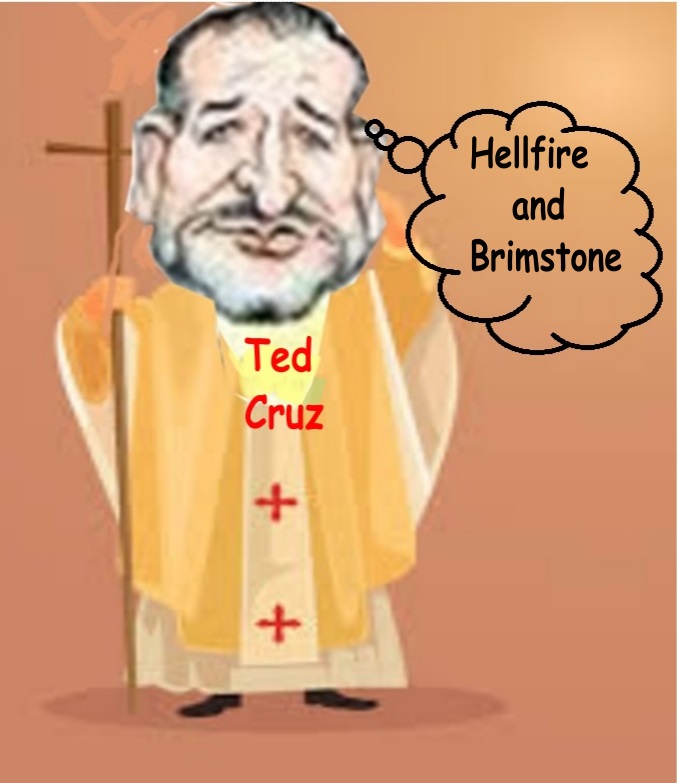
“We are carrying out military strikes today,” Senator Cruz said in an interview.
By Sharon Zhang , Truthout, June 18, 2025, https://truthout.org/articles/ted-cruz-suggests-us-is-involved-in-israeli-strikes-on-iran-despite-us-denials/
Sen. Ted Cruz (R-Texas) was caught stumbling to answer basic questions about Iran and the U.S.’s role in Israel’s war in an eye-opening interview airing Wednesday, despite his full-throated support for overthrowing the Iranian government and deeper U.S. involvement in the fighting.
In clips of the interview with far right provocateur Tucker Carlson posted on social media on Tuesday, the senator alarmingly suggests that the U.S. is, in fact, already heavily involved in Israel’s strikes on Iran.
“We are carrying out military strikes today,” Cruz said. “I said we — Israel is leading them, but we’re supporting them.”
This directly contradicts what federal officials have said about the U.S.’s involvement. The State Department has said that Israel’s strikes are “unilateral,” and directed all embassies and consular posts to reiterate that claim in a cable, CBS reported on Sunday. The cable instructed officials to emphasize to their respective host governments that the U.S. “is not involved in Israel’s unilateral action against targets in Iran and did not provide tanker support.”
This position has not changed in recent days, as the strikes have intensified and President Donald Trump openly mulls becoming more deeply involved in the war. Numerous Trump administration spokespeople claimed on Tuesday that any reports of the U.S. participating in Israeli strikes in Iran are “not true.”
“American forces are maintaining their defensive posture, and that has not changed. We will defend American interests,” said spokesperson Alex Pfeiffer on Tuesday.
The U.S. military is already involved in the conflict. Officials have been open about the U.S.’s defensive positions in helping to strike down missiles fired at Israel.
However, direct U.S. involvement in conducting strikes on Iran, as Cruz suggests is happening, would be a major escalation of the war. Cruz’s statements potentially suggest that the U.S. is actually directly aiding in the bombings, as the Senate is privy to classified information about the military not available to the public.
“You’re breaking news here,” said Carlson. “This is high stakes, you’re a senator. If you’re saying the United States government is at war with Iran right now, people are listening!”
It’s possible that Cruz is suggesting deeper U.S. involvement to push the Trump administration into striking Iran, as many conservative lawmakers have done in recent days — in hopes of pushing the dangerous pipe dream of regime change in Iran.
“I think it is very much in the interest of America to see regime change,” Cruz told Fox News on Sunday. “I don’t think there’s any redeeming the ayatollah.”
Despite his confidence that he could install a better government in Iran, earlier in the interview, Cruz is caught unable to even name basic facts about Iran’s population.
“I don’t know the population,” Cruz says.
“You don’t know the population of the country you seek to topple?” Carlson asks, incredulously. “How could you not know that?”
In a follow up, Carlson says, “okay, what’s the ethnic mix of Iran?”
Cruz hesitates, then says, “they are Persians, and predominantly Shia,” he says, tellingly naming a religious sect rather than an ethnicity. When Carlson asks what proportion of the population is Persian, Cruz becomes incensed.
“I’m not the Tucker Carlson expert on Iran,” Cruz says sarcastically, his voice raised.
“You’re a senator who’s calling for the overthrow of the government!” Carlson exclaims in response.
The exchange highlights a rift among the right over the U.S.’s role in the Middle East. Carlson’s interview circulated widely online for exposing Cruz’s blasé ignorance of the country he wants to wage war against.
However, Carlson, who has consistently allied with white supremacists, himself owes much of his career to the figures who peddled the lies that led to the Iraq War. Early on, Carlson was a proponent of the U.S.’s invasion, and only changed his mind later because of racist beliefs that Iraq and Afghanistan aren’t “worth invading” because “the people aren’t civilized.”
This is, as commentators have noted, a drastically different approach to anti-interventionism from the left’s anti-war and anti-imperialist foundations. And yet, Carlson’s interview caught attention online as the right has sought to capitalize on genuine anti-war sentiment among the public that’s been completely dismissed by the Democratic Party.
The Guardian view on Israel, the US and Iran: you can’t bomb your way out of nuclear proliferation

The age of disarmament is over. But military action only increases the dangers instead of ending the threat.
Eighty years after the US dropped atomic bombs on Hiroshima and Nagasaki, and 40 years after the US and Soviet Union pledged to reduce their arsenals, the threat of nuclear war has resurged with a vengeance. The age of disarmament is over, a prominent thinktank warned this week: “We see a clear trend of growing nuclear arsenals, sharpened nuclear rhetoric and the abandonment of arms control agreements,” said Hans M Kristensen of the Stockholm International Peace Research Institute.
The world’s nine nuclear-armed states have amassed the equivalent of 145,000 Hiroshima bombs. Israel’s illegal attack upon Iran is purportedly a last-ditch attempt to prevent it joining this club – as Israel did long ago, though does not admit it. While Tehran possesses the capacity to develop a nuclear weapon if it chose to, US intelligence believes it has not made that decision – and would still need up to three years to build and deploy one. Israel does not appear to be striking Iran because US nuclear diplomacy has failed, but because it fears it might succeed. Many of its targets are unrelated to the nuclear programme, and some even to Iran’s military. Benjamin Netanyahu has repeatedly invoked regime change: more honestly, regime collapse.
Few believe Israel can destroy Iran’s nuclear programme without the US. The Israeli prime minister seeks to bait Donald Trump into joining this assault: if he can’t get one of the peace deals he wants, how about taking a military triumph? Mr Trump’s shifting rhetoric has suggested he is being dragged along, to the alarm of Maga isolationists and others who recognise the folly of seeing an easy win. But he may still hope to threaten Iran into a deal.
The bigger threat is nuclear proliferation globally. The remaining US-Russian nuclear arms control treaty, New Start, is due to lapse in February – leaving them without limits on their arsenals for the first time in half a century. Both are already pursuing extensive modernisation programmes. China is still far behind, but its armoury is growing fastest, at around 100 warheads a year. This month’s strategic defence review commits the UK to spending £15bn on new submarine-launched warheads and opens the door to the reintroduction of air-launched nuclear weapons. North Korea appears to be building a third uranium enrichment site. Taboos elsewhere are eroding, in an increasingly unstable world where impunity reigns. Support for an independent deterrent has soared in South Korea, no longer confident of the US umbrella.
Weapons are becoming not only deadlier, but riskier, with the integration of nuclear and conventional capabilities increasing the prospect of miscalculations. And potential flashpoints dot this bleak landscape. Russia has repeatedly talked up the threat of nuclear war in Ukraine – but that does not guarantee it is an empty one. India’s unprecedented use of Brahmos cruise missiles in last month’s clash with Pakistan signals a new and dangerous phase in south Asia’s strategic balance.
The 2003 US invasion of Iraq, coupled with the survival of North Korea, sent the message that the safest course is not to shun weapons of mass destruction but to pursue and cling to them at all costs. Attacking Iran, which limited its programme in exchange for sanctions relief, will only fuel that conviction. It may set back Tehran’s nuclear progress somewhat, but makes it more likely to rush for the bomb – and avoid the international scrutiny it previously accepted. Saudi Arabia and others would surely follow fast. Arab and Muslim countries have rightly denounced Israel’s strikes and called for disarmament “without selectivity”. The current crisis makes that look a more hopeless cause than ever – but is the clearest evidence of why it is needed in place of a nuclear race which can have no winners.
Going to war with China will be an unequivocal disaster for Australia

Perhaps the Honourable Minister should also be and remain quiet – or better still be removed from his portfolio – because he is doing nothing for the Labor cause; and seems to be actively attempting to reduce Labor’s chance at a second term. He should unequivocally realise that if Australia goes to war the Liberal mantra will become, ‘this is on you Labor, you dragged us into this war and it is up to the LNP to get us out.’
the US will not place any of its assets at risk in order to defend Australia, this should be fundamentally and clearly understood by the people of Australia.
19 June 2025 AIMN Editorial, By Dr Strobe Driver https://theaimn.net/going-to-war-with-china-will-be-an-unequivocal-disaster-for-australia/
“Up shit creek in a barbed-wire canoe, without a paddle”: The implausible direction Australia’s current Defence Minister is taking the country.
For those of you who aren’t familiar with the above mentioned expression it means things are about as bad as they can get; likely to get worse; and are as it stands, a continuum of a disaster.
This is where Australia stands at the moment when examining Australia’s role in the Asia-Pacific; the rise of China; the ‘position’ this is placing Australia in terms of it being a ‘middle power’ in the region; the dependence on the United States of America (US) as an ally; and the way in which the current Defence Minister (the Honourable Richard Marles (MP) is approaching the current and future components of the regional strategic situations.
The spat between former prime minister Keating and the current Deputy Prime Minister and Defence Minister Marles is ongoing and is far too detailed to go into here other than to mention Keating believes Marles has essentially ‘ceded Australia’s sovereignty’ to another country (the US); and Marles wants ‘strategic transparency from China in its regional military build-up’ and of course the well-worn argument that Australia will be dragged into a war should the US-China situation become ‘kinetic’ – in other words the fighting becomes real. So, with this in mind let’s ‘cut to the chase’ and figure out how Australia would actually ‘fair’ in the outbreak of a war with China and utilise some rationale.
First and foremost, and as I have previously stated in my book The Brink of 2036, the US having sought and gained assurance that Australia is its ‘closest ally’ decides it will ‘go after’ China over its retrocession claims on Taiwan and a war breaks out – the question that begs is, what does that make Australia? This makes Australia an enemy of China and therefore, the Chinese military is now legally entitled to strike Australia.
China would veto any and all conversation in the UNSC (as it is a Permanent Five (P5) member) and use all of its legal powers to circumvent any and all United Nations’ debate about its use of force against US allies. Secondly, the US will not place any of its assets at risk in order to defend Australia, this should be fundamentally and clearly understood by the people of Australia. The US may come to Australia’s aid – it will utilise discretion – however, should it be deemed necessary, it will only enter into any and all aspects associated with the protection of Australia when its assets are not at a high risk of destruction/incapacitation. Where does this leave Australia? One could safely argue a dyad: alone, unless the US’ intervenes.
For the purpose of this essay war has been declared and therefore, a perspective is needed.
The most telling perspective is that Australia faces a rising power and bearing in mind China has continued its rise exponentially since circa-2010, as before that one could safely argue its rise was only incremental, and thus, it is now a major regional power – soon to become a global one. Hence, Australia will have become the enemy of an enormously powerful country.
What then, would said country do to its middle-power regional enemy? There are no surprises here as it is being played out by Israel in the Gaza strip; and the Russian Federation in Ukraine and moreover, it is exceedingly visible; and easy-to-understand. As a side issue, though an important one, and just to strike further terror into the hearts of Australians, the US and Russia as members of the P5 have shut down through the power of veto any and all conversation about whether Israel’s incursion into Gaza and Russia’s invasion of Ukraine are not warranted. One need not even bother to assume what pathway China will take in its war/fight with Australia. With this in mind let’s move towards China’s kinetic tactics on Australia.
As with any war the first things that need to be destroyed are ‘bases and bridges.’ Bases because they house personnel and vital equipment and bridges which essentially refer to anything (not just bridges over a waterway) that equipment can be transported from in order to get ‘to’ a place/location. China with its significant and enormous amount of missiles and the ability to place them through assets (submarines in particular), will fire hundreds of them into Australian assets – some for advantage and some for ‘publicity,’ that is to say, ‘here’s what we can do.’ The former will be RAAF bases, RAN and RAA bases with a single focus on maintenance and repair facilities; and the latter will be major railway lines (the Ghan; Indo-Pacific; and north east coast public lines); and then major highways the Bruce Highway in particular, will be targeted as will the Darwin-Adelaide highway.
As with any war the first things that need to be destroyed are ‘bases and bridges.’ Bases because they house personnel and vital equipment and bridges which essentially refer to anything (not just bridges over a waterway) that equipment can be transported from in order to get ‘to’ a place/location. China with its significant and enormous amount of missiles and the ability to place them through assets (submarines in particular), will fire hundreds of them into Australian assets – some for advantage and some for ‘publicity,’ that is to say, ‘here’s what we can do.’ The former will be RAAF bases, RAN and RAA bases with a single focus on maintenance and repair facilities; and the latter will be major railway lines (the Ghan; Indo-Pacific; and north east coast public lines); and then major highways the Bruce Highway in particular, will be targeted as will the Darwin-Adelaide highway.
As with any war the first things that need to be destroyed are ‘bases and bridges.’ Bases because they house personnel and vital equipment and bridges which essentially refer to anything (not just bridges over a waterway) that equipment can be transported from in order to get ‘to’ a place/location. China with its significant and enormous amount of missiles and the ability to place them through assets (submarines in particular), will fire hundreds of them into Australian assets – some for advantage and some for ‘publicity,’ that is to say, ‘here’s what we can do.’ The former will be RAAF bases, RAN and RAA bases with a single focus on maintenance and repair facilities; and the latter will be major railway lines (the Ghan; Indo-Pacific; and north east coast public lines); and then major highways the Bruce Highway in particular, will be targeted as will the Darwin-Adelaide highway.
The Honourable Defence Minister should cease and desist with his current monologue and political ineptness toward China and should be upfront with the Australian people in what will happen, should we go down this ‘rabbit hole’ of exceptionalism in the region; and yet, willingly yet aimlessly back the US. Australia will become a failed state if we go to war and it is timely to remind the Australian public there are (approximately) as many personnel in the NYPD as there are personnel in the Australian Defence Force.
Perhaps the Honourable Minister should also be and remain quiet – or better still be removed from his portfolio – because he is doing nothing for the Labor cause; and seems to be actively attempting to reduce Labor’s chance at a second term. He should unequivocally realise that if Australia goes to war the Liberal mantra will become, ‘this is on you Labor, you dragged us into this war and it is up to the LNP to get us out.’
The level of political-ineptness and downright political-maladroitness shown by this minister is however nothing new, as Australia seems to have had a cavalcade of utterly hopeless defence ministers over the past three decades. The real problem this time is this one is politically stupid-to-the-core when Australians need astute, articulate and well-defined decision-making.
Meanwhile, China continues to plan its ongoing rise to ‘pax-Sino’ and we have someone at the helm who is plainly and insufferably politically incompetent when there is a dire need to truly understand the milieu of Australia’s defence needs.
‘Punishment phase’ explained: The punishment phase of aerial bombardment is designed to ‘inflict enough pain on enemy civilians to overwhelm their territorial interests’ and in doing so induce surrender, or hasten total defeat. See: Robert Pape. Bombing To Win: Air Power and Coercion in War. New York: Cornell University Press, 1996, 59.
Dr Strobe Driver – Strobe completed his PhD in war studies in 2011 and since then has written extensively on war, terrorism, Asia-Pacific security, the ‘rise of China,’ and issues within Australian domestic politics. Strobe is a recipient of Taiwan Fellowship 2018, MOFA, Taiwan, ROC, and is an adjunct researcher at Federation University.
Trump Rejects Intel on Iran’s Nuclear Program, Raising War Fears

19 June 2025 Michael Taylor, https://theaimn.net/trump-rejects-intel-on-irans-nuclear-program-raising-war-fears/
In a move that’s barely registering in Australian media, President Trump has publicly dismissed U.S. intelligence assessments concluding Iran is not actively building a nuclear weapon, prompting concerns he may be leaning toward military conflict. The story carries significant global implications, including for Australia as a U.S. ally in the Indo-Pacific.
While returning from the G7 summit in Canada, Trump told reporters aboard Air Force One, “I don’t care what [U.S. intelligence] said. I think [Iran] were very close to having one.” This directly contradicted Director of National Intelligence Tulsi Gabbard’s March 2025 congressional testimony, where she stated Iran’s supreme leader had not restarted the nuclear weapons program suspended in 2003. Gabbard noted Iran’s enriched uranium stockpile was at historic highs but maintained it was not pursuing a bomb. U.S. intelligence, including a November 2024 report under President Biden, similarly found no evidence of an active Iranian nuclear weapons program, though it highlighted activities such uranium enrichment that could position Iran to build one if it chose.
Trump’s remarks align him closely with Netanyahu, who has long warned of an “imminent” Iranian nuclear threat and recently advocated for pre-emptive strikes. Israel launched airstrikes on Iranian facilities last week, citing an International Atomic Energy Agency report that Iran breached non-proliferation obligations and had enough near-weapons-grade uranium for multiple bombs, despite U.S. intelligence sources countering that Iran is “not actively pursuing a nuclear weapon” and is up to three years away from producing one.
Trump’s dismissal of his own intelligence community has fueled speculation about his intentions. His frustration with stalled diplomatic efforts to curb Iran’s nuclear ambitions was evident when he said, “I’m not too much in the mood to negotiate with Iran.” The U.S. has deployed additional military assets to the region, including a carrier group and fighter jets, to provide Trump with “more options” for intervention.
The White House has reiterated Trump’s long-standing stance: “Iran cannot have a nuclear weapon.” A June 17 statement listed over a dozen instances since February 2025 where Trump emphasised this, framing it as a non-negotiable red line. Yet, his recent rhetoric, including a social media post demanding “UNCONDITIONAL SURRENDER” from Iran, suggests a hardening position.
Trump may be under pressure from pro-Israel hawks in his circle, who downplay the risk of Iranian retaliation and frame strikes as a limited operation against nuclear sites. Others, such as former CIA analyst Ray McGovern, argue Trump’s threats are “mainly bluster” to project strength, predicting he’ll back off to avoid derailing U.S.-Russia détente or triggering a global economic crisis. Still, the absence of Gabbard from key national security discussions signals a possible sidelining of voices advocating restraint.
Australia’s strategic alignment with the U.S. through AUKUS and its role in Middle East operations (e.g., past deployments in Iraq) mean a U.S.-Iran conflict could draw Canberra into logistical or political support, yet public discourse hasn’t engaged. The Australian government has not commented publicly on Trump’s stance (that I am aware of), and local coverage of Iran remains limited to brief mentions of Israel’s strikes.
A U.S. military strike on Iran could destabilise the Middle East, spike global oil prices, and strain Australia’s economy, which relies heavily on energy markets. It risks escalating into a broader conflict, potentially involving China or Russia, both of which have ties to Iran. Australia’s alliance obligations could also pressure it to back U.S. actions, complicating its Indo-Pacific balancing act. Either Trump is flexing his military muscle to deter Iran without war, or he’s being nudged toward a catastrophic conflict by Israel’s agenda.
The bottom line: The disconnect between Trump’s rhetoric and U.S. intelligence underscores a volatile decision-making process, with implications Australia can’t afford to ignore.
US Reportedly Assesses Only a Nuclear Bomb Could Destroy Iran Nuclear Facility
One expert has warned that attacks on nuclear facilities “should never take place” because of the radioactive fallout.
By Sharon Zhang ,
The Pentagon has reportedly assessed that the only weapon that could
destroy a nuclear facility in Iran deemed by war hawks to be a key part of
Iran’s nuclear program is a nuclear bomb — an intensely ironic finding
in a war fought over the pretense of stopping nuclear proliferation.
According to U.S. sources cited by The Guardian, defense officials have
been told that only a “tactical nuclear weapon” could penetrate deep
enough underground to destroy Fordow, a nuclear facility reportedly built
inside a mountain in northwestern Iran.
Truthout 20th June 2025, https://truthout.org/articles/us-reportedly-assesses-only-a-nuclear-bomb-could-destroy-iran-nuclear-facility/
Israeli missile defense at risk of collapse in coming days: WashPo
- ByAl Mayadeen English
- Source: The Washington Post
- 18 Jun 2025 https://english.almayadeen.net/news/politics/israeli-missile-defense-at-risk-of-collapse-in-coming-days
A Washington Post report reveals that “Israel’s” missile defense could fail within days under sustained Iranian attacks, as costs skyrocket and interceptor supplies dwindle.
A long war of attrition between “Israel” and Iran may not be sustainable for Tel Aviv, according to a new report by The Washington Post, which highlights mounting costs and dwindling interceptor supplies as critical vulnerabilities in “Israel’s” air defense network.
The report, published Monday, cites assessments from US and Israeli intelligence officials indicating that without urgent resupply or direct US military intervention, “Israel” may only be able to sustain its current level of missile defense for another 10 to 12 days.
“They will need to select what they want to intercept,” one source briefed on the matter said. “The system is already overwhelmed.”
The Post’s analysis aligns with recent warnings by military-focused open-source intelligence (OSINT) account @METT_Project, which projected that Iran’s sustained ballistic missile salvos could begin heavily breaching “Israel’s” multi-layered missile shield around Day 18 of the war. That projection, based on interceptor usage rates and known inventories, suggested that daily missile penetrations would increase significantly as the Israeli grid begins to ration munitions and prioritize critical zones.
Read more: Analysis finds Israeli missile defenses may crumble by day 18 of war
High cost of BMD necessitates quick end to war
The economic strain of defending against Iran’s heavy missile barrages is also becoming untenable. According to The Marker, an Israeli financial outlet, the cost of operating missile defense systems has soared to approximately one billion shekels per night, about $285 million. “Israel’s” reliance on high-end systems like the Arrow-2 and Arrow-3, whose interceptors cost roughly $3 million apiece, has raised alarms over the sustainability of its current escalation.
High cost of BMD necessitates quick end to war
The economic strain of defending against Iran’s heavy missile barrages is also becoming untenable. According to The Marker, an Israeli financial outlet, the cost of operating missile defense systems has soared to approximately one billion shekels per night, about $285 million. “Israel’s” reliance on high-end systems like the Arrow-2 and Arrow-3, whose interceptors cost roughly $3 million apiece, has raised alarms over the sustainability of its current escalation.“It’s like shooting a 9-millimeter pistol at a freight train,” said Israeli strategic analyst Efraim Inbar, describing the mismatch between cheaper, widely deployed Iron Dome interceptors and the supersonic ballistic missiles used by Iran. While Iron Dome is optimized for short-range rocket threats, such as those from Gaza, it is virtually ineffective against long-range Iranian missiles that travel through the upper atmosphere.
The Washington Post report adds that US officials are closely monitoring the pace of Iran’s strikes and the strain on Israeli systems. As Iranian salvos continue, Israeli commanders are increasingly forced to make difficult decisions about which targets to protect, a scenario that could soon expose strategic infrastructure and population centers to successful hits.
Read more: Iran’s heavy barrages impact multiple Israeli targets overnight
Cross your fingers, Australia, and hope the AUKUS deal collapses

he Americans agreed to the deal because they saw it to be in their strategic interest, not ours. As then-U.S. Deputy Secretary of State Kurt Campbell observed (indiscreetly) last year, “we have them locked in now for the next 40 years.”
All that AUKUS and its associated alliance commitments have done for Australia is paint more targets on our back.
The crazy irony is that we are spending huge sums to build a new capability intended to defend us from military threats that are most likely to arise simply because we have that capability
The U.S. sub purchase was a bad deal then and it makes even less sense now.
By Gareth Evans, Project Syndicate, https://www.japantimes.co.jp/commentary/2025/06/18/world/australia-should-hope-for-aukuss-collapse/
MELBOURNE –
The AUKUS partnership, the 2021 deal whereby the United States and the United Kingdom agreed to provide Australia with at least eight nuclear-propelled submarines over the next three decades, has come under review by the U.S. Defense Department.
The prospect of its collapse has generated predictable handwringing among those who welcomed the deepening alliance, and especially among those interested in seeing Australia inject billions of dollars into underfunded, underperforming American and British naval shipyards. But in Australia, an AUKUS breakdown should be a cause for celebration.
After all, there has never been any certainty that the promised subs would arrive on time. The U.S. is supposed to supply three or possibly five Virginia-class submarines from 2032, with another five newly designed SSN-AUKUS-class subs (built mainly in the U.K.) coming into service from the early 2040s. But the U.S. and the U.K.’s industrial capacity is already strained, owing to their own national submarine-building targets and both have explicit opt-out rights.
Some analysts assume that the Defense Department review is just another Trumpian extortion exercise, designed to extract an even bigger financial commitment from Australia. But while comforting to some Australians (though not anyone in the Treasury), this interpretation is misconceived.
There are very real concerns in Washington that even with more Australian dollars devoted to expanding shipyard capacity, the U.S. will not be able to increase production to the extent required to make available three — let alone five — Virginia-class subs by the early 2030s. Moreover, Elbridge Colby, the U.S. under-secretary of defense for policy who is leading the review, has long been a skeptic of the project and he will not hesitate to put America’s own new-boat target first.
Even in the unlikely event that everything falls smoothly into place — from the transfers of Virginia-class subs to the construction of new British boats, with no human-resource bottlenecks or cost overruns — Australia will be waiting decades for the last boat to arrive. But given that our existing geriatric Collins-class fleet is already on life support, this timeline poses a serious challenge. How will we address our capability gap in the meantime?
Cost-benefit analysis should have killed the project from the outset. But in their eagerness to embrace the deal, political leaders on both sides of parliament failed to review properly what was being proposed. Even acknowledging the greatly superior speed and endurance of nuclear-powered subs and accepting the heroic assumption that their underwater undetectability will remain immune from technological challenge throughout their lifetimes, the final fleet size seems hardly fit for the purpose of national defense.
Given the usual operating constraints, Australia would have only two such subs deployed at any one time. Just how much intelligence gathering, archipelagic chokepoint protection, sea-lane safeguarding or even deterrence at a distance will be possible under such conditions? Moreover, the program’s eye-watering cost will make it difficult to acquire the other capabilities that are already reshaping the nature of modern warfare: state-of-the-art drones, missiles, aircraft and cyber defense.
The remaining reason for believing, as former Australian Prime Minister Paul Keating put it, that an American opt-out “will be the moment Washington saves Australia from itself,” concerns AUKUS’s negative implications for Australia’s sovereignty. The Americans agreed to the deal because they saw it to be in their strategic interest, not ours. As then-U.S. Deputy Secretary of State Kurt Campbell observed (indiscreetly) last year, “we have them locked in now for the next 40 years.”
It defies credibility to believe that the U.S. would transfer such a sensitive technology to us — with all the associated emphasis on the “interchangeability” of our fleets and new basing arrangements in Australia — unless it could avail itself of these subs in a future war. I have had personal ministerial experience of being a junior U.S. ally in a hot conflict situation — the first Gulf War in 1991 — and my recollections are not pretty.
Alongside the Pine Gap satellite communications and signals intelligence facility — which has always been a bull’s-eye — one can add Perth’s Stirling submarine base, the Northern Territory, with its U.S. Marine and B-52 bases and possibly a future east-coast submarine base.
The crazy irony is that we are spending huge sums to build a new capability intended to defend us from military threats that are most likely to arise simply because we have that capability — and using it to support the U.S., without any guarantee of support in return should we ever need it.
If the AUKUS project does collapse, it would arguably still be possible for Australia to acquire replacements for its aging submarine fleet within a reasonable time frame — and probably at less cost, while retaining real sovereign control — by purchasing off-the-shelf technology elsewhere. One can even imagine us going back to France, which was snubbed in the AUKUS deal, and making a bid for its new-generation Suffren-class nuclear-powered sub.
But a better defense option may simply be to recognize that the latest revolution in military technology is real and that our huge continent and maritime surroundings will be better protected by a combination of self-managed air, missile, underwater and cyber capabilities than by a handful of crewed submarines. There is no better time to start thinking outside the U.S. alliance box.
Gareth Evans was Australia’s foreign minister (1988-1996), president of the International Crisis Group (2000-2009) and chancellor of the Australian National University (2010-2019). © Project Syndicate, 2025
Israel’s Bombing Won’t Stop Iran from Going Nuclear
NPEC – Non Proliferation Policy Education Center, June 17, 2025
Spotlighting Greg Jones‘ latest research on the difficulty of targeting Iran’s nuclear program. Mr. Jones is one of the nation’s top nuclear analysts and has had close ties to NPEC for more than three decades.
Most of the analyses of Israel’s air campaign against Iran’s nuclear program have focused on two questions: Can Israel destroy Iran’s enrichment plants on its own? Or does Israel need Washington’s help to knock them out?
The question too infrequently asked, however, is can any bombing campaign, with or without U.S. assistance, keep Iran from getting a bomb? Greg’s short answer is no.
As he points out, bombing Iran’s enrichment plants may temporarily put them out of commission, but the centrifuges and cascades can be repaired. Tehran, he argues, can remove undamaged centrifuges, build new cascades, and be back in business in four to six months.
Fordow, for now, remains untouched. Conservatively, Fordow could produce a bomb’s worth of nuclear fuel every 2.5 weeks. Again, the centrifuges there can be removed to other locations.
Then, there’s the matter of the 440 kgs. of 60 percent enriched uranium that Iran already has – conservatively, enough to build 12 bombs. This material, Greg points out, is stored in hardy metal cylinders that are extremely difficult to destroy via bombing attacks and can be moved by truck to remote locations. Meanwhile, the International Atomic Energy Agency has determined that Iran has all but developed the nonnuclear components necessary to build a nuclear weapon.
This is why Greg concludes that any quick military fix to prevent Iran from going nuclear is impractical and that the threat of an Iranian nuclear weapon will remain until and unless Iran agrees to relinquish its entire stockpile of enriched uranium and eliminates its centrifuge enrichment program.
You can read Greg’s full, footnoted analysis here.
…………………………………………………………………………………………………… https://npolicy.org/israels-bombing-wont-stop-iran-from-going-nuclear/
Report: Trump Privately Approved Plans To Attack Iran But Has Withheld Final Order
Iran has made clear it will hit US bases in the region if the US attacks
by Dave DeCamp | Jun 18, 2025, https://news.antiwar.com/2025/06/18/report-trump-privately-approved-plans-to-attack-iran-but-has-withheld-final-order/
The Wall Street Journal reported on Wednesday that President Trump has told his top officials that he approved plans to attack Iran but is holding off on giving the final order for now.
Sources told the Journal that Trump was waiting to see if Iran would agree to give up its nuclear program, which is almost certainly not going to happen. Iranian Supreme Leader Ayatollah Ali Khamenei has rejected the US president’s calls for surrender, and Tehran’s position is that it won’t negotiate while under Israeli attack.
Iran also has no reason to trust the US at the moment since Trump backed Israel’s attack amid negotiations between Washington and Tehran. Trump has refused to say if he will launch airstrikes on Iran, telling reporters on Wednesday, “I have ideas on what to do, but I haven’t made a final—I like to make the final decision one second before it’s due.”
The Journal report didn’t specify what attack plans Trump approved, but it would likely involve US airstrikes on the Fordow nuclear plant, which is buried deep underground, making it impossible to do significant damage without US bunker buster bombs and the US heavy bombers needed to drop them.
Iran has made clear it would hit back if the US launches airstrikes, and many US bases in the region are in range of Iranian missiles. Trump could be planning to launch limited airstrikes to damage Fordow, but American casualties could lead the US into deeper involvement in the war.
Israeli officials are expecting the US to intervene with direct attacks on Iran soon. “The whole operation is premised on the fact that the US will join at some point,” an Israeli official told CNN on Tuesday.
Israeli Prime Minister Benjamin Netanyahu launched the war based on the pretext of preventing Iran from obtaining nuclear weapons, but US intelligence had assessed that Tehran wasn’t seeking a nuclear bomb.
1 This Month

of the week – Shut Down Drone Warfare!


Tell the Ukrainian Government to Drop Prosecution of Peace Activist Yurii Sheliazhenko

Petition to revoke the licensing of the Near Surface Nuclear Disposal Facility (NSDF) at Chalk River. https://www.ourcommons.ca/petitions/en/Petition/Details?Petition=e-7247
To see nuclear-related stories in greater depth and intensity – go to https://nuclearinformation.wordpress.com
-
Archives
- March 2026 (244)
- February 2026 (268)
- January 2026 (308)
- December 2025 (358)
- November 2025 (359)
- October 2025 (376)
- September 2025 (257)
- August 2025 (319)
- July 2025 (230)
- June 2025 (348)
- May 2025 (261)
- April 2025 (305)
-
Categories
- 1
- 1 NUCLEAR ISSUES
- business and costs
- climate change
- culture and arts
- ENERGY
- environment
- health
- history
- indigenous issues
- Legal
- marketing of nuclear
- media
- opposition to nuclear
- PERSONAL STORIES
- politics
- politics international
- Religion and ethics
- safety
- secrets,lies and civil liberties
- spinbuster
- technology
- Uranium
- wastes
- weapons and war
- Women
- 2 WORLD
- ACTION
- AFRICA
- Atrocities
- AUSTRALIA
- Christina's notes
- Christina's themes
- culture and arts
- Events
- Fuk 2022
- Fuk 2023
- Fukushima 2017
- Fukushima 2018
- fukushima 2019
- Fukushima 2020
- Fukushima 2021
- general
- global warming
- Humour (God we need it)
- Nuclear
- RARE EARTHS
- Reference
- resources – print
- Resources -audiovicual
- Weekly Newsletter
- World
- World Nuclear
- YouTube
-
RSS
Entries RSS
Comments RSS
 nuclear-news