The Chris Hedges Report: Starvation and Profiteering in Gaza (w/ Francesca Albanese)
Francesca Albanese joins Chris Hedges to break down the current starvation campaign in Gaza, and her upcoming report detailing the profiteering corporations capitalizing on the erasure of Palestinians
Chris Hedges, Jun 26, 2025
This interview is also available on podcast platforms and Rumble.
There is not much more that can be said about the unfathomable levels of devastation the genocide in Gaza has reached. Francesca Albanese, the United Nations Special Rapporteur on the Occupied Palestinian Territories, has been chronicling the genocide and joins host Chris Hedges on this episode of The Chris Hedges Report to shed light on the current situation in Gaza, including parts from her upcoming report on the profiteers of the genocide.
Israel’s siege on the Palestinians is leaving the population starving, and Albanese lambasts other nations for not stepping up and completing their obligations under international law. “[Countries] have an obligation not to aid, not to assist, not to trade with Israel, not to send weapons, not to buy weapons, not to provide military technology, not to buy military technology. This is not an act of charity that I’m asking you. This is your obligation,” she explains.
Albanese compares Gaza and Israel’s siege to a concentration camp, stating it is unsustainable but also allows the world to witness how a Western settler colonial entity functions. “There is a global awareness of something that has for a long time been a prerogative, a painful prerogative of the global majority, the Global South, meaning the awareness of the pain and the wounds of colonialism,” Albanese tells Hedges.
In her forthcoming report, Albanese will detail exactly how Palestine has been exploited by the global capitalist system and will highlight the role certain corporations have played in the genocide. “[T]here are corporate entities, including from Palestine-friendly states, who have for decades made businesses and made profits out of the economy of the occupation, because Israel has always exploited Palestinian land and resources and Palestinian life,” she says.
“The profits have continued and even increased as the economy of the occupation transformed into an economy of genocide.”……………………………………………TRANSCRIPT………………………………….. …………..https://scheerpost.com/2025/06/25/the-chris-hedges-report-starvation-and-profiteering-in-gaza-w-francesca-albanese/
Iran Shows Us Why The US And Israel Should Not Be Allowed To Have Nukes.
Caitlin Johnstone, Jun 25, 2025
Well it’s been a crazy couple of days.
Trump bombed Iran’s civilian nuclear energy facilities in an attack that CNN reports did no lasting damage, and Iran exercised extraordinary restraint with symbolic retaliatory strikes on US military bases coordinated to avoid American casualties — a move many are comparing to Iran’s non-lethal response to the US assassination of General Qassem Soleimani in 2020.
After pumping out deception and fake diplomacy for weeks in order to assist Israel’s unprovoked war on Iran and launch an unprovoked attack on his own, Trump took to social media to proudly celebrate his administration’s facilitation of a ceasefire to the war he himself needlessly started, like an arsonist giving himself a trophy for extinguishing one of his own house fires.
And, for the moment at least, the ceasefire appears to be holding. Which is good. There are a lot of terrible people who did everything they could to get Iran to kill US troops and spark a horrific war, but Iran didn’t take the bait. Iran doesn’t want war at all. Trump found out that Americans disapproved of the airstrikes and opposed war with Iran. And Israel found out that fighting an actual military force is a lot less easy than fighting hospital patients and children.
So for now we’ve got a ceasefire.
We have never been shown any evidence that Iran was working on obtaining nuclear weapons, which given the US empire’s extensive history of lying about this sort of thing means we should assume it was not. But it has certainly been given every incentive to obtain them now, given that that’s probably the only thing that can stop the US and Israel from casually committing these egregious acts of aggression whenever they feel like it.
And isn’t it interesting how Iran keeps demonstrating a degree of restraint that we all know we’d never see from the United States or Israel if another country bombed their energy infrastructure or assassinated their military leaders, and yet Iran is the country we’re told can never be trusted with nuclear weapons?
The US empire and Israel both exist in a perpetual state of war and attack other countries constantly; Iran never invades other countries and avoids war like Melania Trump avoids missionary position. But we’re meant to accept that it’s fine for the US and Israel to have nukes and do anything necessary to prevent Iran from getting any?
Even if you accept the evidence-free premise that Iran would do crazy and reckless things if it became a nuclear-armed state, there is no rational argument that Trump and his handlers have been going about preventing this outcome intelligently. As Joe Lauria explains in Consortium News, the Iran nuclear deal was a remarkable achievement of international diplomacy that was working fine until Trump shredded it in 2018. Iran was following all the agreed upon rules and its nuclear enrichment was capped at 3.67 percent, but Trump killed it because the Zionists and warmongers who brought him to power want more aggression toward Iran instead of less.
It’s so intensely stupid that we have to keep doing this horrifying dance every few years just because there are too many war-horny freaks with way too much power inside the US empire. And every time they get closer to getting their wish. Iran is being given more and more reasons to view the US and Israel as an existential threat, more and more motive to obtain nuclear weapons, and less and less reason to negotiate anything with Washington.
These bastards keep pushing us toward something very ugly. Let’s hope people keep waking up to the depravity of Israel and the US empire before the warmakers succeed in obtaining their long-sought prize.
2
Aukus will cost Australia $368bn. What if there was a better, cheaper defence strategy?

Jonathan Barrett and Patrick Commins, Guardian, 15 June 25
As questions swirl around the nuclear submarine deal, some strategists are pushing for an alternative, ‘echidna’ policy that focuses less on offensive capability
As Australia’s nuclear submarine-led defence strategy threatens to fray, strategists say it’s time to evaluate whether the military and economic case of the tripartite deal still stacks up.
The defence tie-up with the US and UK, called Aukus, is estimated to cost up to $368bn over 30 years, although the deal could become even more costly should Donald Trump renegotiate terms to meet his “America first” agenda.
The current deal, struck in 2021, includes the purchase of three American-made nuclear-powered submarines, the construction of five Australian-made ones, as well as sustaining the vessels and associated infrastructure.
Such a price tag naturally comes with an opportunity cost paid by other parts of the defence force and leaves less money to address societal priorities, such as investing in regional diplomacy and accelerating the renewable energy transition.
This choice is often described as one between “guns and butter”, referring to the trade-off between spending on defence and social programs.
Luke Gosling, Labor’s special envoy for defence and veterans’ affairs, last year described Aukus as “Australia’s very own moonshot” – neatly capturing both the risks and the potential benefits.
Opportunity cost
Sam Roggeveen, director of the Lowy Institute’s international security program, says there are cheaper ways to replicate submarine capabilities, which are ultimately designed to sink ships and destroy other submarines.
These include investing in airborne capabilities, more missiles, maritime patrol aircraft and naval mines, he says.
“If you imagine a world without Aukus, it does suddenly free up a massive portion of the defence budget,” says Roggeveen.
“That would relieve a lot of pressure, and would actually be a good thing for Australia.”
Roggeveen coined the term “echidna strategy” to argue for an alternative, and cheaper, defence policy for Australia that does not include nuclear-powered submarines.
Like the quill-covered mammal, the strategy is designed to build defensive capabilities that make an attack unpalatable for an adversary. The strategy is meant to radiate strength but not aggression.
“The uncertainty that Aukus introduces is that we are buying submarines that actually have the capabilities to fire Tomahawk cruise missiles on to an enemy land mass,” says Roggeveen.
“That is an offensive capability that’s ultimately destabilising. We should be focusing on defensive capabilities only.”
Those advocating for a more defensive approach, including Albert Palazzo from the University of New South Wales, point out that it is more costly to capture ground than it is to hold it…………………..
Social cost
…………………..Saul Eslake, an independent economist, says higher defence spending is coming at a time of substantially higher demands on the public purse across a range of areas, from aged care, to disability services and childcare………………………..
Political cost
While expert opinion divides over whether nuclear-powered submarines are the best strategic option for Australia’s long-term defence strategy, there’s a separate question over whether the submarines will be delivered……………………………….. https://www.theguardian.com/world/2025/jun/15/aukus-will-cost-australia-368bn-what-if-there-was-a-better-cheaper-defence-strategy?fbclid=IwY2xjawLHNQpleHRuA2FlbQIxMQBicmlkETFyMEl3YVlwYXlzdE5HaUFzAR7t2VVyRqzmPs-WhsC_dhvz9susqUAqTdxsascsmPSKfkWBQ93MS4DJ24z_9Q_aem_lR5byRgSjQDcUUkIsx-k0w
US didn’t destroy Iran’s nuclear programme: Here’s what new intel says
US President Trump doubles down on his assertion that the Iranian nuclear programme has been set back by decades.
By Al Jazeera Staff, 25 Jun 2025, https://www.aljazeera.com/news/2025/6/25/us-didnt-destroy-irans-nuclear-programme-heres-what-new-intel-says
The United States’ strikes on three key Iranian nuclear sites on Sunday failed to destroy underground facilities, and set Tehran’s nuclear programme back only by a few months, according to an assessment of a confidential American intelligence report.
The “top secret” document prepared by the Defense Intelligence Agency (DIA) – the intelligence arm of the Pentagon – and published by major US news outlets on Tuesday is at odds with President Donald Trump’s claims about the strikes. Trump has insisted that the nuclear facilities at Fordow, Natanz, and Isfahan were “obliterated” by a combination of bunker busting and conventional bombs.
Trump and his administration’s senior officials are dismissing the intelligence report and calling out the reporting over the DIA’s assessment as “fake news”.
Speaking at a NATO summit in The Hague, the US president said he believed Iran’s nuclear programme was set back by decades.
So, what did the DIA assessment say about US strikes? What has Iran said about the attacks? And how does the intelligence report contrast with the Trump administration’s public claims?
What did the DIA report say?
A preliminary report prepared by the DIA noted that rather than obliterating Iran’s nuclear programme, the US bombings had only set it back by a few months.
Before Israel attacked Iran on June 13, US agencies had noted that if Iran rushed to assemble a nuclear weapon, it would take it about three months.
The DIA’s five-page report now estimates this to be delayed by less than six months, reported The New York Times. As per the early findings, the US strikes blocked the entrances to two of the facilities but did not collapse the underground facilities.
The DIA report also reveals that the US agency believes that Iran’s stockpile of enriched uranium was moved before the strikes, which destroyed little of the nuclear material.
Shortly after the US strikes on June 22, Mehdi Mohammadi, an adviser to the chairman of the Iranian parliament, claimed that the authorities had evacuated the Fordow facility in advance. “Iran has been expecting strikes on Fordow for several days. This nuclear facility was evacuated, no irreversible damage was sustained during today’s attack,” Mohammadi had said.
The US president on Wednesday said he doesn’t buy Iranian claims that they moved enriched uranium out of the Fordow nuclear facility. “I believe they didn’t have a chance to get anything out because they acted fast,” said Trump. “If it would have taken two weeks, maybe, but it’s very hard to remove that kind of material… and very dangerous.
“Plus, they knew we were coming,” Trump added. “And if they know we’re coming, they’re not going to be down there.”
CNN first reported on the DIA report, quoting unnamed officials that the US strikes’ effect on all three sites – Fordow, Natanz, and Isfahan – was largely restricted to aboveground structures, which were severely damaged.
On Tuesday, the Trump administration told the United Nations Security Council that the US strikes had “degraded” the Iranian facilities – short of Trump’s earlier assertion that the attacks had “obliterated” the sites.
The strikes have reportedly badly damaged the electrical system at the Fordow facility. However, it was not immediately clear how long Iran could take to gain access to the underground facilities and repair these systems.
On Monday, Rafael Grossi, the head of the UN nuclear watchdog IAEA, said that while “no one, including the IAEA, is in a position to have fully assessed the underground damage at Fordow”, it is expected to be “very significant”.
Two people familiar with the DIA’s assessment told CNN that Iran’s stockpile of enriched uranium was not destroyed and the centrifuges are largely “intact”.
Some analysts cautioned against drawing final conclusions. Analysts told the Reuters news agency that the extent of damage to the Fordow uranium enrichment facility would not necessarily be revealed if the assessment was based on satellite imagery.
How did the US strike Iranian nuclear sites?
After 10 days of fighting between Israel and Iran, the US had militarily intervened on June 22 by hitting the Iranian nuclear sites.
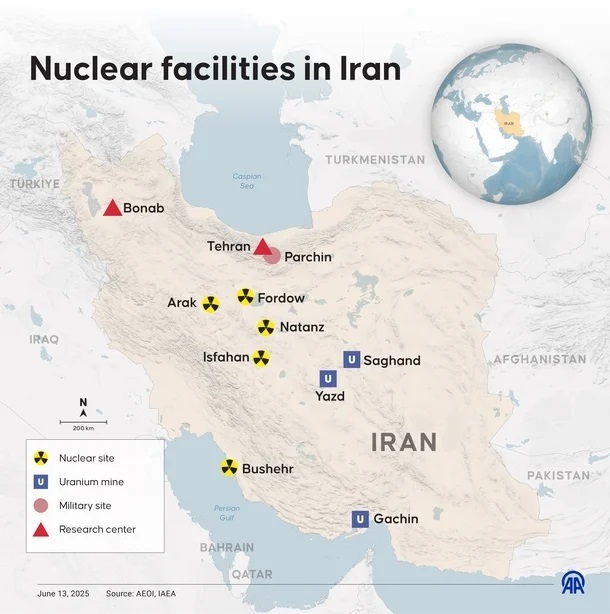
Fordow is a highly fortified underground uranium enrichment facility reportedly buried hundreds of metres deep in the mountains in northwestern Iran. While Natanz is Iran’s largest and most central enrichment complex, containing vast halls of centrifuges, some underground, Isfahan is a major nuclear research and production centre that includes a uranium conversion facility and fuel fabrication plants.
How did the US strike Iranian nuclear sites?
After 10 days of fighting between Israel and Iran, the US had militarily intervened on June 22 by hitting the Iranian nuclear sites.
Fordow is a highly fortified underground uranium enrichment facility reportedly buried hundreds of metres deep in the mountains in northwestern Iran. While Natanz is Iran’s largest and most central enrichment complex, containing vast halls of centrifuges, some underground, Isfahan is a major nuclear research and production centre that includes a uranium conversion facility and fuel fabrication plants.
The US forces dropped 14 30,000-pound (13,000kg) bunker-buster bombs, while Navy submarines are said to have coordinated strikes by cruise missiles at the Natanz and Isfahan sites.
The GBU-57 Massive Ordnance Penetrator (MOP) – the most powerful bunker-buster bomb in the US military arsenal weighing nearly 13,000kg (30,000lb) – was used in the strike.
The US intervention was understood to be critical for the Israeli campaign against Iranian nuclear facilities, especially Fordow, due to its depth that kept it out of reach for the Israeli military.
How did the DIA report contrast with Trump’s claims?
In March this year, the US spy chief Tulsi Gabbard had informed Congress that there was no evidence Iran was building a nuclear weapon, and Iranian Supreme Leader Ali Khamenei had not authorised the nuclear weapons programme that he had earlier suspended in 2003.
On June 17, as Israel and Iran continued to trade ballistic missiles, Trump was returning to Washington from the G7 summit in Canada, when he snubbed his own administration, including the spy chief Gabbard, saying she and the intel agencies had gotten it “wrong”.
He claimed that Iran was “very close” to having a nuclear weapon. On June 22, the US struck Iranian nuclear facilities. “The strikes were a spectacular military success,” Trump said in a televised address. “Iran’s key nuclear enrichment facilities have been completely and totally obliterated.”
The next day, Trump wrote on his Truth Social platform, “The damage to the Nuclear sites in Iran is said to be ‘monumental.’ The hits were hard and accurate. Great skill was shown by our military. Thank you!”
On Wednesday, at the NATO summit, he reiterated his stance. “The last thing they [Iran] want to do is enrich anything right now… They’re not going to have a bomb and they’re not going to enrich,” he said at The Hague.
Top officials from his administration, including Vice President JD Vance and Defense Secretary Pete Hegseth, have repeated the obliteration claims since then.
“Based on everything we have seen – and I’ve seen it all – our bombing campaign obliterated Iran’s ability to create nuclear weapons,” Hegseth said in a statement provided to Reuters.
“Our massive bombs hit exactly the right spot at each target – and worked perfectly. The impact of those bombs is buried under a mountain of rubble in Iran; so anyone who says the bombs were not devastating is just trying to undermine the President and the successful mission.”
How has Trump, the White House reacted?
Trump spent a good amount of time letting off steam on his Truth Social platform after the DIA report dropped.
“THE NUCLEAR SITES IN IRAN ARE COMPLETELY DESTROYED! BOTH THE TIMES AND CNN ARE GETTING SLAMMED BY THE PUBLIC!” Trump wrote in all-caps, referring to the reporting by The New York Times and CNN.
“FAKE NEWS CNN, TOGETHER WITH THE FAILING NEW YORK TIMES, HAVE TEAMED UP IN AN ATTEMPT TO DEMEAN ONE OF THE MOST SUCCESSFUL MILITARY STRIKES IN HISTORY,” Trump said in a post.
The US president also posted a series of apparently bizarre videos, including one of B-2 bombers taking off to a “bomb Iran” song in the background.
Trump is currently in the Netherlands, attending this week’s NATO summit, and reiterated to reporters that the damage from the strikes was significant. “I think it’s been completely demolished,” he said, adding, “Those pilots hit their targets. Those targets were obliterated, and the pilots should be given credit.
“That place is under rock. That place is demolished,” Trump responded to a question on the possibility of Iran rebuilding its nuclear program.
He took further shots at CNN, saying: “These cable networks are real losers. You’re gutless losers. I say that to CNN because I watch it – I have no choice. I got to watch it. It’s all garbage. It’s all fake news.”
He said the intelligence following the strikes in Iran was “inconclusive”. “The intelligence says we don’t know. It could’ve been very severe. That’s what the intelligence suggests.”
“It was very severe. There was obliteration,” he reiterated on Wednesday.
The White House press secretary, Karoline Leavitt, called the DIA assessment “flat-out wrong” and leaked to the press “by an anonymous, low-level loser in the intelligence community”.
“The leaking of this alleged assessment is a clear attempt to demean President Trump, and discredit the brave fighter pilots who conducted a perfectly executed mission to obliterate Iran’s nuclear program,” she said in a statement. “Everyone knows what happens when you drop 14 30,000 pound bombs perfectly on their targets: Total obliteration.”
Israeli, US bombing of Iran a failure of epic proportions
25 June 2025 AIMN Editorial, By Walt Zlotow West Suburban Peace Coalition, Glen Ellyn IL https://theaimn.net/israeli-us-bombing-of-iran-a-failure-of-epic-proportions/
The illegal, criminal bombings on Iran which killed over 800 and wounded over 2,500 have failed spectacularly.
While still going on, there are indications from the Trump administration a ceasefire may soon be possible.
What has 11 days of bombings accomplished?
It has not destroyed Iran’s nuclear facilities or its enriched uranium. It has not achieved regime change in Iran. It has not shattered Iran into failed state status. It has likely rallied Iran’s population to coalesce around besieged Iranian leadership.
It has brought retaliation bombings to Israel killing dozens and wounding hundreds, the largest such attacks in its 77 year existence.
It has likely motivated Iran to repair and rebuild its nuclear capabilities outside of oversight of nuclear inspectors. Iran may decide to withdraw from the Nuclear Non-Proliferation Treaty (NPT) designed to give signatories the inalienable right to civilian nuclear development. When they observe how Israel and the US cavalierly bomb non-nuclear weapons states, Iran may decide they have no choice but to join the nuclear club. Since Iran was not developing nuclear weapons, the Israeli, US misadventure may speed up the very thing they claimed urgency in preventing.
Possibly the worst bombing campaign failure was to obliterate US credibility as a responsible diplomatic partner. By using the duplicity of negotiating an end to the imagined nuclear crisis to enable Israel’ sneak attack, US now ranks dead last of all 194 other countries to negotiate anything of consequence. Check that, the US can still negotiate with Israel which has complete trust in US backing of their ongoing genocide in Gaza and lust to topple Iran as their only hegemonic rival in the Middle East.
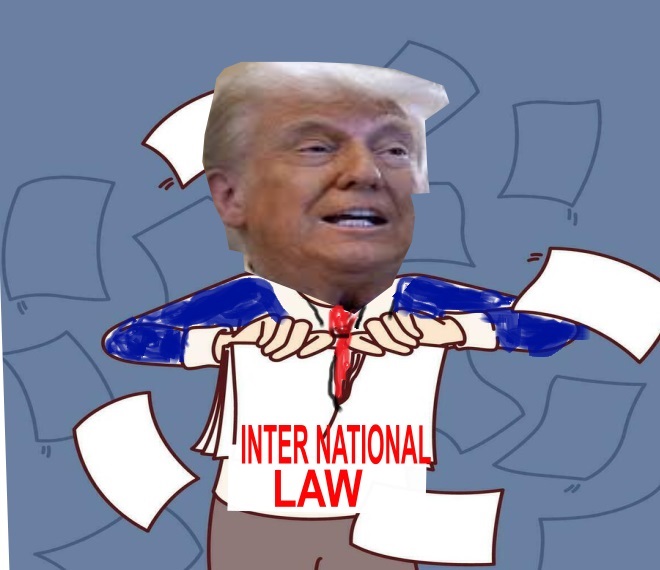
The US has made of shambles of international law. It has substituted its Orwellian ‘Rules Based Order’ allowing it to wage regime change, including outright war, on any targeted state at the point of a smart bomb fired by dumb, international war criminals.
But no matter how badly deranged US policy turns out, the current CICW (Commander in Criminal War) will call it “a spectacular success.”
UK to purchase US jets capable of carrying nuclear weapons
Britain will join Nato’s airborne atomic mission in a significant overhaul of the
country’s defence strategy. The UK is to purchase 12 US-made F-35 stealth
fighter jets capable of carrying nuclear weapons, in a sweeping overhaul of
the country’s defence strategy. Under the plans, Britain will join
Nato’s airborne nuclear mission, and the F-35A jets are expected to carry
American atomic bombs, as the military alliance contends with the growing
threat of Russia.
FT 24th June 2025, https://www.ft.com/content/1b779329-18c5-4984-a308-58a2afd12746
The Growing Nuclear Arsenals and Sharpened Rhetoric

By Alice Slater* https://indepthnews.net/the-growing-nuclear-arsenals-and-sharpened-rhetoric/
NEW YORK | 20 June 2025 (IDN) — The recent report from the Stockholm International Peace Institute (SIPRI), despite its assertion that “understanding the conditions for peaceful solutions to international conflicts is a key part of their work”, has just issued alarming news that there is a “clear trend of growing nuclear arsenals, sharpened nuclear rhetoric and the abandonment of arms controls agreements!
The report then goes on to count the many ways that nuclear arsenals are expanding and new and more lethal technology is being developed in a growing number of nuclear weapons states and nuclear wannabe weapons states, bemoaning the “abandonment of arms control agreements”.
But it is precisely because these arms “controllers” never advocate for nuclear elimination, abolition, or disarmament and fail to promote the many missed opportunities to achieve an end to the bomb while repeatedly proposing step-by-step measures for an infinite number of various controls on arsenals, that we never get to see the end to nuclear weapons.
Indeed, scholars writing of the repeated proposals for insufficient steps have nowhere coined a term for these meaningless measures—antipreneurism—the action was taken for only illusory progress in finally banning the bomb.
Since SIPRI correctly notes that it is the US and Russia who have 90% of the total 2025 global inventory of some 12,241 warheads on the planet, it is really up to those countries to make the first move.
The US has rejected many opportunities over the years, starting from the very beginning of the nuclear age when Stalin proposed to Truman that the US put its new and terrifying nuclear weapons under the control of the newly formed United Nations, devoted to “ending the scourge of war” with its first resolution calling for nuclear disarmament. Truman refused, and Russia got the bomb!
The US walked out of the 1972 Anti-Ballistic Missile Treaty in 2002, which it had negotiated with the USSR and put new missile bases in Romania and Poland.
Russia and China repeatedly urge the US to move forward on nuclear abolition; they need to preserve their “strategic security”, which would require the US to enter into treaties to ban weapons in space and cyber war. The US refuses to support those treaties and has vetoed negotiating proposals for draft treaties tabled by Russia and China in the consensus-bound UN Committee on Disarmament in Geneva.
When Gorbachev dissolved the Warsaw Pact and freed all of occupied Eastern Europe, he proposed to Reagan that the countries could eliminate their nuclear arsenals provided the US would end its Star Wars program to dominate and control the military use of space.
The US refused, and Gorbachev withdrew his offer. He was also very concerned that a united Germany would be a member of NATO since the USSR lost 27 million people to the Nazi onslaught.
The US assured Gorbachev and Yeltsin that we would not expand NATO one inch to the east. Still, Clinton began the expansion with the annexation of Poland, Hungary, and the Czech Republic in1999, followed by Bulgaria, Estonia, Latvia, Lithuania, Romania, Slovakia, and Slovenia in 2004; Albania, Croatia, Montenegro. and North Macedonia between 2009 and 2917, and most recently, Sweden and Finland during the Ukraine War.
The US keeps nuclear weapons in five NATO states: Turkey, Germany, Italy, Netherlands and Belgium. Russia recently placed its nuclear weapons in Belarus during the Ukraine War. Indeed, some kind of deal should be urged to remove the US weapons in Europe in return for Russia taking its newly placed nuclear weapons out of Belarus.
Despite SIPRI’s assertion that its mission includes “understanding the conditions for peaceful solutions to international conflicts is a key part of their work”, history shows that there have been many possible solutions to genuine nuclear disarmament and abolition, repeatedly rejected by the US in the awful grip of what has now been described as the MICIMATT—the Military, Industrial, Congressional, Intelligence, Media, Academic Think Tank complex!
Perhaps a more thorough and emphatic discussion and understanding of all the possible solutions over the years by SIPRI would enable more progress than the meaningless steps to “arms control” that are constantly being promoted and have brought us to this burgeoning new arms race today!
*Alice Slater serves on the Board of World BEYOND War and is a UN Representative of the Nuclear Age Peace Foundation. [IDN-InDepthNews]
Image: In this handout photo released by Roscosmos Space Agency Press Service on April 20, 2022, a Sarmat intercontinental ballistic missile is launched from Plesetsk in Russia’s northwest. (Roscosmos Space Agency Press Service via AP, File)
Did the US wipe out Iran’s nuclear programme? What researchers know
Nuclear-policy specialist David Albright told Nature how his organization is monitoring for damage to nuclear sites following US and Israeli strikes.
By , Davide Castelvecchi, Nature, 23 June 25
On 22 June, many people woke to the news that the United States had bombed nuclear sites in Iran, with the goal of destroying its ability to produce nuclear weapons. The raids targeted Iran’s uranium-enrichment facilities in Fordow and Natanz, and its nuclear research centre in Esfahan, using stealth bombers — which dropped massive ‘bunker-busters’ — and cruise missiles.
Although Iran says its nuclear programme is for peaceful purposes, experts have long assessed that Iran was close to having the capability of building nuclear weapons, if it chose to do so. The US attacks followed a bombing campaign by Israel, which has since carried out further attacks on Iranian nuclear facilities. On 23 June, the International Atomic Energy Agency (IAEA) reported that “very significant damage is expected to have occurred” at the underground Fordow site.
Researchers at academic institutions and think tanks are also assessing the potential impacts of the attacks on Iran’s nuclear capabilities. Analysts have said that the attacks probably set the nuclear programme back substantially, but not permanently. In particular, Iran could have moved stockpiles of highly-enriched uranium, and perhaps some enrichment centrifuges, elsewhere. David Albright, a nuclear-policy specialist and president of the Institute for Science and International Security in Washington DC, spoke to Nature about what researchers know.
How do you assess the impact of the bombings on Iran’s nuclear capabilities?
There aren’t many researchers who are able to assess the impact of the bombings. We have decades of experience with the Iranian nuclear programme, so we know their facilities and activities very well. And we have great access to satellite imagery — which we have to buy. We try to buy some every day. And we utilize analysts who have decades of experience to analyze these images. We also have lots of contacts with governments, and we have colleagues who also have contacts with governments.
A lot of the damage is on the surface, so it’s a question of knowing what the building did [in terms of its role in the nuclear program]. We rely on our repository of information about the sites that are attacked. So it’s pretty straightforward.
Obviously, more problematic are the underground sites. When we initially assessed Israel’s bombing of Natanz, three days later I saw a very small crater above the underground hall. I could work out and link it to a type of Earth-penetrating weapon that Israel is known to have. It would leave a really small crater when it went in, and the damage would be underground. The United States bombed it with a much more powerful Earth penetrator, so the damage is probably more extensive.
How and when will the extent of the damage be known for sure?
As nuclear experts, we’d like to see this done with diplomatic agreements, where Iran would allow intrusive inspections into its programme. If that does not happen, then it’s the job of US and Israeli intelligence to assess the damage. They’re looking at communications intercepts, or trying to recruit people on the inside to reveal information.
Would radioactive material be detected outside Natanz, Esfahan and Fordow if the attacks were successful?
So far, the IAEA reports no such leaks. And it appears that Iran had moved the enriched uranium stockpiles in the days before the bombings. The United States has said that the target of its bombings was the facilities, so they understand they are not getting at the nuclear material………………………….… (Subscribers only)
https://www.nature.com/articles/d41586-025-01992-2
William Hague: Long term, this makes an Iran bomb likelier.
We do not know how much of the regime’s nuclear material and knowledge survives and how quickly it can be put to use. In the long term, the efforts to prevent Iran
possessing nuclear weapons are more likely to have been weakened than
strengthened.
This is the key judgment. It is why we did the deal with Iran
a decade ago and why it should have been renegotiated now. It is why Trump
was pursuing a diplomatic strategy until diverted from it. We do not know
what has happened to the 400kg of uranium that Iran has enriched. But we
should not be surprised if future Iranian leaders will have drawn the
lesson from recent events that the case for a nuclear bomb has now been
demonstrated beyond all doubt.
Times 23rd June 2025,
https://www.thetimes.com/comment/columnists/article/long-term-this-makes-an-iran-bomb-likelier-wrnvnx90w
War on Iran Is Fight for US Unipolar Control of World
The plan to use Netanyahu as America’s counterpart to Ukraine’s Zelensky, demanding U.S. intervention with his willingness to fight to the last Israeli, much as the U.S./NATO are fighting to the last Ukrainian, is a tactic that is quite obviously at the expense of strategy.
June 24, 2025 , By Michael Hudson / Geopolitical Economy Report, https://geopoliticaleconomy.com/2025/06/22/michael-hudson-war-iran-us-unipolar-control/
Economist Michael Hudson explains how the war on Iran seeks to stop countries from breaking away from U.S. unipolar control and dollar hegemony, and to disrupt Eurasian integration with China and Russia.
Opponents of the war with Iran say that the war is not in American interests, seeing that Iran does not pose any visible threat to the United States.
This appeal to reason misses the neoconservative logic that has guided U.S. foreign policy for more than a half century, and which is now threatening to engulf the Middle East in the most violent war since Korea.
That logic is so aggressive, so repugnant to most people, so much in violation of the basic principles of international law, the United Nations, and the U.S. Constitution, that there is an understandable shyness in the authors of this strategy to spell out what is at stake.
What is at stake is the U.S. attempt to control the Middle East and its oil as a buttress of U.S. economic power, and to prevent other countries from moving to create their own autonomy from the U.S.-centered neoliberal order administered by the IMF, World Bank, and other institutions to reinforce U.S. unipolar power.
The 1970s saw much discussion about creating a New International Economic Order (NIEO). U.S. strategists saw this as a threat, and since my book Super Imperialism ironically was used as something like a textbook by the government, I was invited to comment on how I thought countries would break away from U.S. control.
I was working at the Hudson Institute with Herman Kahn, and in 1974 or 1975, he brought me to sit in on a military strategy discussion of plans being made already at that time to possibly overthrow Iran and break it up into ethnic parts. Herman found the weakest spot to be Baluchistan, on Iran’s border with Pakistan. The Kurds, Tajiks, and Turkic Azeris were others whose ethnicities were to be played off against each other, giving U.S. diplomacy a key potential client dictatorship to reshape both Iranian and Pakistani political orientation if need be.
Three decades later, in 2003, General Wesley Clark pointed to Iran as being the capstone of seven countries that the United States needed to control in order to dominate the Middle East, starting with Iraq, Syria, Lebanon, Libya, Somalia, and Sudan, culminating in Iran.
The U.S. fight for unipolar control of the world
Most of today’s discussion of the geopolitical dynamics of how the international economy is changing is understandably (and rightly) focusing on the attempt by BRICS and other countries to escape from U.S. control by de-dollarizing their trade and investment.
But the most active dynamic presently reshaping the international economy has been the attempts of Donald Trump’s whirlwind presidency since January to lock other countries into a U.S.-centered economy, by agreeing not to focus their trade and investment on China and other states seeking autonomy from U.S. control. (Trade with Russia is already heavily sanctioned.)
As will be described below, the war in Iran likewise has as an aim blocking trade with China and Russia and countering moves away from the U.S.-centered neoliberal order.
Trump, hoping in his own self-defeating way to rebuild U.S. industry, expected that countries would respond to his threat to create tariff chaos by reaching an agreement with America not to trade with China, and indeed to accept U.S. trade and financial sanctions against it, Russia, Iran, and other countries deemed to be a threat to the unipolar U.S. global order.
Maintaining that order is the U.S. objective in its current fight with Iran, as well as its fights with Russia and China – and Cuba, Venezuela, and other countries seeking to restructure their economic policies to recover their independence.
From the view of U.S. strategists, the rise of China poses an existential danger to U.S. unipolar control, both as a result of China’s industrial and trade dominance outstripping the U.S. economy and threatening its markets and the dollarized global financial system, and by China’s industrial socialism providing a model that other countries might seek to emulate and/or join with to recover the national sovereignty that has been eroded in recent decades.
U.S. administrations and a host of U.S. cold warriors have framed the issue as being between “democracy” (defined as countries supporting U.S. policy as client regimes and oligarchies) and “autocracy” (countries seeking national self-reliance and protection from foreign trade and financial dependency).
This framing of the international economy views not only China but any other country seeking national autonomy as an existential threat to U.S. unipolar domination. That attitude explains the U.S./NATO attack on Russia that has resulted in the Ukraine war of attrition, and most recently the U.S./Israeli war against Iran that is threatening to engulf the whole world in U.S.-backed war.
The motivation for the attack on Iran has nothing to do with any attempt by Iran to protect its national sovereignty by developing an atom bomb. The basic problem is that the United States has taken the initiative in trying to preempt Iran and other countries from breaking away from dollar hegemony and U.S. unipolar control.
Here’s how the neocons spell out the U.S. national interest in overthrowing the Iranian government and bringing about a regime change – not necessarily a secular democratic regime change, but perhaps an extension of the ISIS/Al-Qaida Wahhabi terrorists who have taken over Syria.
With Iran broken up and its component parts turned into a set of client oligarchies, U.S. diplomacy can control all Middle Eastern oil. And control of oil has been a cornerstone of U.S. international economic power for a century, thanks to U.S. oil companies operating internationally (not only as domestic U.S. producers of oil and gas) and remitting economic rents extracted from overseas to make a major contribution to the U.S. balance of payments.
Control of Middle Eastern oil also enables the dollar diplomacy that has seen Saudi Arabia and other OPEC countries invest their oil revenues into the U.S. economy by accumulating vast holdings of U.S. Treasury securities and private-sector investments.
The United States holds OPEC countries hostage through these investments in the U.S. economy (and in other Western economies), which can be expropriated much as the United States grabbed $300 billion of Russia’s monetary savings in the West in 2022. This largely explains why these countries are afraid to act in support of the Palestinians or Iranians in today’s conflict.
But Iran is not only the capstone to full control of the Near East and its oil and dollar holdings. Iran is a key link for China’s Belt and Road Initiative for a New Silk Road of railway transport to the West.
If the United States can overthrow the Iranian government, this interrupts the long transportation corridor that China already has constructed and hopes to extend further west.
Iran also is a key to blocking Russian trade and development via the Caspian Sea and access to the south, bypassing the Suez Canal. And under U.S. control, an Iranian client regime could threaten Russia from its southern flank.
To the neocons, all this makes Iran a central pivot on which the U.S. national interest is based – if you define that national interest as creating a coercive empire of client states observing dollar hegemony by adhering to the dollarized international financial system.
I think that Trump’s warning to Tehran’s citizens to evacuate their city is just an attempt to stir up domestic panic as a prelude to a U.S. attempt to mobilize ethnic opposition as a means to break up Iran into component parts. It is similar to the U.S. hopes to break up Russia and China into regional ethnicities.
That is the U.S. strategic hope for a new international order that remains under its command.
The irony, of course, is that U.S. attempts to hold onto its fading economic empire continue to be self-defeating.
The objective is to control other nations by threatening economic chaos. But it is this U.S. threat of chaos that is driving other nations to seek alternatives elsewhere. And an objective is not a strategy.
The plan to use Netanyahu as America’s counterpart to Ukraine’s Zelensky, demanding U.S. intervention with his willingness to fight to the last Israeli, much as the U.S./NATO are fighting to the last Ukrainian, is a tactic that is quite obviously at the expense of strategy.
It is a warning to the entire world to find an escape hatch.
Like the U.S. trade and financial sanctions intended to keep other countries dependent on U.S. markets and a dollarized international financial system, the attempt to impose a military empire from Central Europe to the Middle East is politically self-destructive.
It is making the split that already is occurring between the U.S.-centered neoliberal order and the Global Majority irreversible on moral grounds, as well as on the grounds of simple self-preservation and economic self-interest.
Trump’s Republican budget plan and its vast increase in military spending
The ease with which Iranian missiles have been able to penetrate Israel’s much-vaunted Iron Dome defense shows the folly of Trump’s pressure for an enormous trillion-dollar subsidy to the U.S. military-industrial complex for a similar Golden Dome boondoggle here in the United States.
So far, the Iranians have used only their oldest and least effective missiles. The aim is to deplete Israel’s anti-missile defenses so that in a few weeks it will be unable to block a serious Iranian attack.
Iran already demonstrated its ability to evade Israel’s air defenses a few months ago, just as during Trump’s previous presidency it showed how easily it could hit U.S. military bases.
The U.S. military budget actually is much larger than is reported in the proposed bill before Congress to approve Trump’s trillion-dollar subsidy.
Congress funds its military-industrial complex (MIC) in two ways: The obvious way is by arms purchases paid for by Congress directly. Less acknowledged is MIC spending routed via U.S. foreign military aid to its allies – Ukraine, Israel, Europe, South Korea, Japan, and other Asian countries – to buy U.S. arms.
This explains why the military burden is what normally accounts for the entire U.S. budget deficit and hence the rise in government debt (much of it self-financed via the Federal Reserve since 2008, to be sure).
The need for alternative international organizations
Unsurprisingly, the international community has been unable to prevent the U.S./Israeli war against Iran.
The United Nations Security Council is blocked by the United States’ veto, and that of Britain and France, from taking measures against acts of aggression by the United States and its allies.
The United Nations is now seen to have become toothless and irrelevant as a world organization able to enforce international law. (Its situation is much as Stalin remarked regarding Vatican opposition, “How many troops does the Pope have?”)
Just as the World Bank and International Monetary Fund are instruments of U.S. foreign policy and control, so too are many other international organizations which are dominated by the United States and its allies, including (relevantly for today’s crisis in West Asia) the International Atomic Energy Agency (IAEA), that Iran has accused of having provided Israel targeting information for its attack on Iranian nuclear scientists and sites.
Breaking free of the U.S. unipolar order requires a full spectrum set of alternative international organizations independent of the United States, NATO, and other client allies.
Trump’s attack on Iran
The sound and fury of Trump’s missile attack on Iran’s most famous nuclear sites on June 21 turned out not to be the capstone of America’s conquest of the Middle East. But it did more than signify nothing.
Trump must have listened to the military’s warnings that all game plans for conflict with Iran at this time showed the United States losing badly.
His Trumpian solution was to brag on his social media account that he had won a great victory in stopping Iran’s march toward making an atom bomb.
Iran for its part evidently was glad to cooperate with the public relations charade. The U.S. missiles seem to have landed on mutually agreed-upon sites that Iran had vacated for just such a diplomatic stand-down.
Trump always announces any act as a great victory, and in a way it was, over the hopes and goading of his most ardent neoconservative advisors. The United States has deferred its hopes for conquest at this time.
The fight is now to be limited to Iran and Israel. And Israel already has offered to stop hostilities if Iran does. Iran gave hope for an armistice once it has exacted due retaliation for Israeli assassinations and terrorist acts against civilians.
Israel is the big loser, and its ability to serve as America’s proxy has been crippled. The devastation from Iranian rockets has left a reported one-third of Tel Aviv and much of Haifa in ruins.
Israel has lost not only its key military and national security structures, but will lose much of its skilled population as it emigrates, taking its industry with it.
By intervening on Israel’s side by supporting its genocide, the United States has turned most of the UN’s Global Majority against it.
Washignton’s ill-thought backing of the reckless Netanyahu has catalyzed the drive by other countries to speed their way out of the U.S. diplomatic, economic, and military orbit.
So America’s Oil War against Iran can now be added to the long list of wars that the United States has lost since the Korean and Vietnam wars, Afghanistan, Iraq, and the rest of its adventures leading up to its imminent loss in Ukraine. Its victories have been against Grenada and German industry – its own imperial “backyard,” so to speak.
Trump Claims Iran Nuclear Sites ‘Totally Destroyed’—But That Clashes With Vance And Experts
By Ty Roush, Forbes Staff. https://www.forbes.com/sites/tylerroush/2025/06/23/did-the-us-destroy-irans-uranium-supply-or-not-vance-experts-clash-with-trumps-claims/
President Donald Trump on Monday said U.S. strikes “totally destroyed” nuclear facilities in Iran and criticized “sleazebags” in the media for suggesting otherwise—but comments from Vice President JD Vance, military officials and nuclear watchdogs all suggest the damage to Iran’s nuclear program remains unconfirmed.
Key Facts
“The sites we hit in Iran were totally destroyed, and everyone knows it,” Trump wrote on Truth Social, disputing “Fake News” he claims “would say anything different in order to try and demean, as much as possible—and even they say they were ‘pretty well destroyed!’”
White House press secretary Karoline Leavitt told ABC on Monday the U.S. is “confident” Iran’s nuclear program was “completely and totally obliterated,” noting there is a “high degree of confidence” the locations the U.S. strikes took place is where Iran stored its enriched uranium and that Iran “no longer [has] the capability … to threaten the world.”
International Atomic Energy Agency chief Rafael Grossi appeared to dispute Trump’s claims in a statement earlier Monday by suggesting the agency would need to verify damage to Iran’s underground Fordow facility, including whether the site’s uranium enrichment halls were impacted, though he noted the U.S. strikes likely caused “very significant” damage.
On Sunday, Defense Secretary Pete Hegseth and Chairman of the Joint Chiefs of Staff Gen. Dan Caine said an assessment on damage to Iran’s nuclear sites was “still pending,” and Caine claimed it was “way too early for me to comment on what may or may not still be there.”
Vance, in an interview with ABC on Sunday, suggested the U.S. strikes only set back Iran’s potential to weaponize its uranium stockpile and said the U.S. was “going to work in the coming weeks to ensure that we do something with that fuel.”
Jeffrey Lewis, a professor of nonproliferation at the Middlebury Institute of International Studies at Monterey, wrote on X he was “unimpressed” by the U.S. strikes while citing satellite images of the attacks, claiming the U.S. “failed to target significant elements of Iran’s nuclear materials and production infrastructure.”
How Large Is Iran’s Uranium Stockpile?
Iran stored about 400 kilograms (about 881 pounds) of uranium enriched to 60%, near weapons-grade enrichment of 90%, according to Grossi. It’s unclear whether Iran’s uranium stockpile is still this large, Grossi noted, adding IAEA’s inspectors last verified Iran’s stockpile a “few days” before Iran’s conflict with Israel began earlier this month.
Could Iran Rebuild Its Uranium Stockpile?
It’s possible Iran could rebuild its nuclear program, but a timeline for development would depend on how much damage was done to Iran’s nuclear sites, according to the Centers for Strategic and International Studies, a U.S.-based think tank. Recent U.S. strikes would make Iran “more motivated than ever” to obtain nuclear weapons, Rosemary Kelanic, a director at the U.S.-based think tank Defense Priorities, told the New York Times. Some American officials estimated an attack on Fordow set back Iran’s nuclear program by as much as five years, the Times reported.
Nuclear peril

by beyondnuclearinternational, https://beyondnuclearinternational.org/2025/06/23/nuclear-peril/
US and Israeli bombing of Iran’s nuclear facilities set the stage for disaster, writes Linda Pentz Gunter from London
There was widespread if not quite universal condemnation on Sunday after President Trump’s decision to bomb Iran’s nuclear facilities and an immediate call for protests in cities across the United States and other countries. The US attack was launched to support Israel’s determination not to let Iran develop nuclear weapons at its civil nuclear facilities, although presently there is little to no indication that Iran is planning to do so.
“Military action against Iran is not the way to resolve concerns over Tehran’s nuclear programme,” said Melissa Parke, executive director of the Nobel Peace Prize-winning International Campaign to Abolish Nuclear Weapons. “Given that US intelligence agencies assess Iran is not pursuing nuclear weapons, this is a senseless and reckless act that could undermine international efforts to prevent the further proliferation of nuclear weapons.”
Overnight on Saturday and into the early hours of Sunday morning, Trump authorized more than 100 US war planes to bomb Iran and claimed to have “obliterated” Iran’s nuclear program. The Iranians admit damage but not full destruction.
“Operation Midnight Hammer” as it was known, included B-2 bombers that dropped more than a dozen bunker busters on the heavily fortified Fordow uranium enrichment site, believed to be 80 meters below ground. American planes also bombed the Natanz uranium enrichment complex, while Tomahawk missiles were reportedly used to strike the Isfahan uranium conversion facility.
Fordow is believed by western powers to be the location where Iran could be working on producing nuclear weapons. However, the International Atomic Energy Agency had reiterated as recently as a day before this latest attack that “we did not find in Iran elements to indicate that there is an active, systematic plan to build a nuclear weapon,” its general secretary, Rafael Mariano Grossi told Al Jazeera.
Concerns remain about Iran’s only operating civil reactor at Bushehr. Even before the American incursion, Russia, which built and operates Bushehr, had warned the Israelis of the grave risks of another Chornobyl-style disaster should they strike the reactor. Russia had already begun evacuating some of its personnel but threatened to remove more if they were in danger from Israeli bombs. Alexei Likhachev, the CEO of state nuclear company Rosatom said “We are prepared for any scenario, including the rapid evacuation of all our employees.”
But a reactor, even if shut down, cannot be left unattended, raising other grave concerns about its longterm safety during the current war.
A day after the American bombing raid, Israel launched more attacks on Iran, including in Bushehr province. This now means there are two countries actively under attack where civil nuclear power plants are located — Ukraine and Iran. The consequences of a successful bombing raid on a civil nuclear plant could include widespread release of highly harmful and persistent radiation, forcing mass and permanent evacuations and sickening and killing thousands or more in both the near- and long-term.
Even greater concerns have been mounting that US involvement could trigger a wider conflict in the region. As many have pointed out consistently, Israel is a nuclear-armed state, albeit absurdly an undeclared one even though the country likely possesses as many as 200 warheads. Israel refuses UN inspections and has never signed the nuclear Non-Proliferation Treaty. Iran on the other hand is a signatory to the NPT and has long claimed it is exercising its “inalienable right” under that treaty to pursue a civil nuclear weapons program.
Those concerns were further heightened when Christian Zionist US Ambassador to Israel Mike Huckabee urged Trump to consider using a nuclear bomb on Iran, advice Trump fortunately ignored for now. But Trump remains an unpredictable tinder box, illustrating once again the peril of countries continuing to possess nuclear weapons that an unhinged leader might launch on an impulse.
Protests erupted immediately in US cities and elsewhere across the world on the news of the US attack on Iran, which came hours after 350,000 people had marched through London in the latest monthly demonstration against Israel’s attack on Palestine, but this time also calling for halt to its bombing of Iran.
At that rally, there was skepticism that Israel’s attacks on Iran were really just about stopping Iran developing nuclear weapons. Somaye Bagher Zadeh, with Iranians For Palestine UK, said Israel’s actions were potentially about “getting rid of the Iranian regime, but to be frank, regime change by any foreign power is not in the interests of the Iranian people. And it’s entirely up to the Iranian people to decide who rules them.”
“Since they destroyed Iraq, we have known that it was inevitable that they would eventually come for us,” said prominent British-Iranian trade union leader, Maryam Eslamdoust. “We Iranians feel like we have been waiting our whole lives for the US or Israel to attack us.”
Saturday’s mass march in London to Whitehall was followed by an emergency protest called for Monday outside the US Embassy in London by Stop the War Coalition and Campaign for Nuclear Disarmament, alongside other rallies across the country. So far, the UK government has continued to politically support and materially aid and abet Israel’s attacks on Gaza as well as its starvation of the Palestinian population there. A rally was also called by American groups in front of the White House.
British activists are concerned that their government may be drawn back into another disastrous war, similar to the UK’s support of the US in the war in Iraq. That war cost countless lives on all sides and failed to stabilize the Middle East region, instead giving birth to further radicalization.
“Trump’s attack on Iran is brutal, illegal and unjustified,” said a statement from Stop the War Coalition on Sunday. The group said it condemned the US attack on Iran “unequivocally and urges every possible mobilization against British military or political support for the aggression.”
In the US, Senator Chris Van Hollen, a Maryland Democrat, was quick to criticize the bombing raids. “While we all agree that Iran must not have a nuclear weapon, Trump abandoned diplomatic efforts to achieve that goal and instead chose to unnecessarily endanger American lives, further threaten our armed forces in the region, and risk pulling America into another long conflict in the Middle East,” said Van Hollen, who has also spoken out consistently against Israel’s attacks on Gaza. “The U.S. intelligence community has repeatedly assessed that Iran is not building a nuclear weapon. There was more time for diplomacy to work.”
The diplomacy Van Hollen referred to was a resumption of negotiations for a nuclear agreement with Iran that would either limit or eliminate its civil uranium enrichment program. Such an agreement — the Joint Comprehensive Plan of Action, limiting enrichment and allowing for stringent inspections in exchange for a lifting of sanctions — had already been in place until Trump withdrew the US during his previous administration. New talks had been progressing poorly, with Israel chomping at the bit to use military force instead, which it did then initiate with US prior knowledge.
Independent Vermont senator, Bernie Sanders, said “We cannot allow ourselves to be dragged into another Middle East war based on lies,” reflecting on previous such ventures in Vietnam and Iraq based on similar falsehoods.
While most Republicans have lined up behind Trump’s warmongering, one Republican, Representative Thomas Massie of Kentucky, called the attack “not Constitutional.” Earlier in the week, Massie and California Democrat Ro Khanna had introduced a resolution that would have blocked US participation in Israel’s attacks on Iran without Congressional approval.
“This is an extremely dangerous situation,” said a statement from the grassroots movement, Our Revolution, which promotes the campaigning of Sanders on a number of domestic and foreign issues, including Gaza and now Iran. “Trump has immediately threatened even more attacks, and U.S. service members are now directly in harm’s way,” the group said. “We are on the cusp of a catastrophic conflict that could cost countless American and Iranian lives.”
Linda Pentz Gunter is the international specialist at Beyond Nuclear and writes for and edits Beyond Nuclear International. She is currently reporting from London, England.
Iran Fires Missiles at US Base in Qatar
Qatar’s Foreign Ministry said the missiles were intercepted and that there were no casualties
by Dave DeCamp | Jun 23, 2025, https://news.antiwar.com/2025/06/23/iran-fires-missiles-at-us-base-in-qatar/
The Iranian military announced on Monday that it launched an attack on the US’s Al Udeid base in Qatar in response to the US bombing of Iran’s nuclear facilities.
The attack was first reported by Axios reporter Barak Ravid, who cited Israeli sources that said Iran fired at least 10 missiles at the US base. Initial reports said that another missile targeted a US base in Iraq, but US officials later said the attack targeted only a base in Qatar.
“This base is the headquarters of the Air Force and the largest strategic asset of the US terrorist army in the West Asia region,” Iran’s Islamic Revolutionary Guard Corps (IRGC) said of the US base in Qatar.
The IRGC said Iran would not “leave any attack on its territorial integrity, sovereignty, and national security unanswered under any circumstances.”
The Qatari Foreign Ministry issued a statement that said Qatar’s air defenses “successfully thwarted the attack and intercepted the Iranian missiles” and that there were no injuries or deaths caused by the attack.
The reported missile launch comes after Fox News and other outlets said that an Iranian attack on US assets in the region was “imminent” and Qatar announced that it was closing its airspace, signaling the US has at least a few hours’ notice that the barrage was coming.
The New York Times reported that Iran had notified Qatar of its plans to attack in order to minimize casualties, signaling Tehran is seeking de-escalation with the US. In 2020, after the US assassinated Iranian Gen. Qassem Soleimani, Iran launched a similar attack on a US base in Iraq, which the US didn’t respond to.
A White House official told CNN that the US was expecting an Iranian response and claimed President Trump didn’t want more military engagement in the region. “We knew they’d retaliate. They had a similar response after Soleimani,” the official said.
AUKUS collapse offers Australia the chance to navigate an innovative future.

(Cartoon by Mark David / @MDavidCartoons)
By Alan Austin | 23 June 2025, https://independentaustralia.net/politics/politics-display/aukus-collapse-offers-australia-the-chance-to-navigate-an-innovative-future,19859
Donald Trump’s likely abandonment of the AUKUS contract offers the Albanese Government a welcome reprieve from a costly folly, as Alan Austin reports.
THE USA LOOKS LIKE it is abandoning the controversial AUKUS contract signed by the miserably inept Morrison Government in its dying days.
The corrupt and incompetent U.S. President Donald Trump wants out. He has proven to the world that the only projects he strongly supports are those that enrich himself and his companies directly. Australia, with other Westminster nations, refuses to pay direct bribes to individual national leaders — as it should.
Now showing advanced cognitive decline and a failing grip on reality, Trump has effectively signalled the contract’s demise by calling for a formal review by Defence Under Secretary Elbridge Colby. Colby has long been a vocal AUKUS critic and will probably recommend cancellation.
Sound reasons to abandon AUKUS
The first pillar of the deal between Australia, the UK and the USA is for the Americans to supply Australia with nuclear-powered attack submarines for its defence, starting with three Virginia-class submarines in the early 2030s.
The second pillar is collaboration between the three nations on new military technology. These include undersea capabilities, artificial intelligence, electronic warfare and advanced cyber, hypersonic and counter-hypersonic capabilities.
Colby’s argument against the AUKUS deal is simply that the USA doesn’t have enough submarines for their own needs and can’t build them fast enough to have any to spare in the foreseeable future. That is true. The current U.S. Administration is the least competent in its history.
Other AUKUS critics have more compelling reasons for its abandonment. The most cogent of these, articulated by former prime ministers Paul Keating and Malcolm Turnbull and others, is that nuclear subs supplied by the USA will necessarily be operated by American personnel and automatically commandeered by the U.S. military in the event of hostilities between the USA and China, over Taiwan or any other conflict.
It would be disastrous for Australia’s relationship with China and other nations, Keating argues, to be dragged into such a war.
Resources lost forever
If AUKUS collapses, Australia has little chance of getting back the billions already invested.
Among the countless failures of the monumentally inept Morrison Coalition Government was leaving out of the contract any penalties for defaults.
In any event, the lifelong criminal grifter currently running the White House has never felt obliged to fulfil contracts, however legally or morally binding.
The losses to Australia as a result of the incompetence of the Coalition from 2014 to 2022 now amount to hundreds of billions of borrowed dollars, including the billions paid out for AUKUS so far.
These simply have to be accepted as penalties citizens must bear for the abject stupidity of those who elected such a hopeless rabble to try to run the country.
Visionary naval future
If AUKUS fails and Australians write off the losses, they can then grasp this as an opportunity to pursue advantageous alternatives.
The future of underwater naval warfare increasingly appears to be in unmanned underwater vessels (UUVs). Australia is well-placed to build these for its own purposes and then sell them to regional neighbours and beyond.
This may seem a quantum leap for shipbuilding in Australia, but it can be accomplished.
Australia proved to the world it could build the Collins-class submarines during the Hawke/Keating period and has successfully procured other military ordnance since then.
In its first term, the Albanese Government began its investment in small UUVs. Australian marine vessel manufacturer Anduril Australia, a subsidiary of the American Anduril Industries, is already building a modest UUV which it calls Ghost Shark.
Although technical information is restricted, military monitor The War Zone has revealed details of the partnership involving Anduril, the Royal Australian Navy (R.A.N.) and the Defence Science and Technology Group.
A Ghost Shark prototype, according to The War Zone, has a 3D-printed exterior, weighs 2.8 tons, is 5.6 metres long and can operate at a depth of 6,000 metres for ten days. Advanced AI technology enables autonomous operations.
The R.A.N. hopes to get three UUVs suitable for both military and non-military missions between 2025 and 2028.
Challenges for the future, beyond Ghost Shark, are for vessels capable of higher speeds, deeper dives, longer missions, greater stealth and more advanced assignments, including accurate delivery of lethal weapons.
If Australia’s current submarines can be replaced with technologically advanced UUVs, costs will be much lower and risks to personnel dramatically reduced. This may allow Australia to cut military spending overall.
Potential partnerships
Australia does not have the resources to build UUVs alone. Just as the Collins-class submarines were built collaboratively with Swedish shipbuilder Kockums, new ventures will require partners.
Possibilities, besides American firms like Anduril, are many. Current UUVs in service include Germany’s Greyshark, France’s XLUUV and vessels from Japan and South Korea.
Prime Minister Anthony Albanese’s discussion topics with his Canadian counterpart, Prime Minister Mark Carney, at last week’s G7 meeting included Canada joining AUKUS. That’s another possible partner.
Grounds for optimism
Australia has shipyards in South Australia and the solid experience of designing, building and maintaining the Collins-class submarines from the 1980s to the present.
Australia enjoys the goodwill of all neighbouring nations, has no current engagement in any conflict and sees no threats on the horizon.
Australians have banished the destructive Coalition parties from any chance of forming government for the foreseeable future.
So, to borrow a line from Michael J Fox in The American President, let’s take this 94-seat majority out for a spin and see what it can do.
Out of pocket and stranded: What happens if Trump pulls out of AUKUS | Four Corners Documentary
War With Iran: Made in Britain?

By Kit Klarenberg / Substack, 23 June 25, https://scheerpost.com/2025/06/23/war-with-iran-made-in-britain/
On June 14th, British Prime Minister Keir Starmer bragged he was moving the country’s military assets and fighter jets to West Asia, to provide “contingency support in the region” in response to Iran’s counterattack on the Zionist entity. Asked by Sky News if he ruled out direct military involvement, he evasively responded, “I’m not getting into that.” He also refused to clarify whether Tel Aviv gave London any advance warning of its criminal, unprovoked strike on Tehran a day prior:
“These are obviously operational decisions and the situation is ongoing and developing…I’m not going to go into what information we had at the time or since. But we discuss these things intensely with our allies.”
On June 15th, Chancellor Rachel Reeves was less ambiguous, openly declaring British military assets could “potentially” be used to defend Israel, and the government was “not ruling anything out,” noting Britain had previously “supported Israel when there had been missiles coming in.” She explicitly framed London’s interest in the conflict as driven by the threat of rising oil prices, and trade route disruption, placing further pressure on the country’s already collapsing economy.
Yet, there have been ominous indications for some time Britain has sought to ignite a wider conflict across West Asia – and all-out war between Iran and Israel, and its Western puppetmasters, upon the precipice of which we now teeter, has been London’s objective all along. On October 8th 2023, just over 24 hours after Palestinian freedom fighters breached Gaza’s concentration camp walls, veteran client ‘journalist’ Robert Peston took to ‘X’ to publish explosive insight provided to him by nameless “government and intelligence sources”:
“Hamas’ attack on Israel has the potential to be as destabilising to global security as Putin’s attack on Ukraine…[Benjamin] Netanyahu is highly likely to retaliate. Biden and the US would try to limit the scope of any Israeli strike on Iran, but would neither want or be able to veto it. There is a risk of this crisis spreading well beyond the Middle East…We are in the early stages of a conflict with ramifications for much of the world.”
At this point, the shape and scale of Tel Aviv’s response to Operation AlAqsa Flood was far from certain. Zionist Occupation Forces did not even enter Gaza until five days hence. We therefore must ask ourselves how British intelligence could’ve correctly forecast with such alacrity that Israel’s impending genocide of the Palestinians would cause mass tumult not merely in West Asia, but globally, and potentially culminate with conflict with Iran.
‘Joint Activity’
London’s direct involvement in the Gaza genocide has been evident almost from the moment of its eruption. Media reports in late October 2023 hinted at SAS units being “on standby” at British military and intelligence bases in nearby Cyprus, purportedly preparing to conduct daring operations in Gaza. Subsequent articles suggested these squadrons were “training in Lebanon to rescue Britons” in West Asia, should they get caught up in the war in Gaza, or “be taken hostage” by Resistance groups.
These revelations prompted Britain’s Defense and Security Media Advisory Committee to issue D-notices to major news outlets, demanding they “prevent inadvertent disclosure of classified information about Special Forces and other units engaged in security, intelligence and counter-terrorist operations [in Gaza], including their methods, techniques and activities.” True to form, the Committee’s “advice” was universally heeded, and references to the SAS’ presence in West Asia vanished from mainstream media reporting on Zionist entity’s 21st century Holocaust.
The DSMA’s reference to “security, intelligence and counter-terrorist operations” pointed to a very different purpose to their purpose in the region than mere hostage rescue. Investigations by Declassified UK bolster this suspicion. The independent outlet has revealed how military transport flights traveling to Tel Aviv, from the same British bases in Cyprus where SAS operatives are stationed, have been a routine occurrence since October 2023. It may be relevant that in December 2020, London and Tel Aviv signed a military cooperation agreement.
The accord has been described by British Ministry of Defense officials as “important…defense diplomacy” that “strengthens” military ties between the two countries, while providing “a mechanism for planning our joint activity.” The contents of this agreement, however, remain hidden not only from British citizens, but also elected lawmakers. Speculation thus arises the agreement obligates Britain to defend Israel in the event of attack, in turn reinforcing the conclusion the SAS has been directly involved in the Zionist entity’s genocidal assault on Gaza since day one.
‘Emergency Missions’
In November 2023, The Cradle exposed a covert initiative by Britain to secure unfettered access to Lebanese territory for its armed forces. A leaked document on the proposals offered neither a rationale for London doing so, nor specified the specific mission British Army soldiers would be fulfilling in Beirut. The demands ultimately weren’t approved, but if greenlit, the terms of London’s mandate in Beirut would’ve been unprecedented.
The agreement granted “all [British] military personnel” unprecedented access to Lebanon’s ground, air and sea territory, bypassing the need for “prior diplomatic authorization” for “emergency missions.” The nature of those missions was not specified. Moreover, British soldiers would’ve been permitted to travel in uniform with their weapons visible anywhere in Lebanon, while enjoying immunity from arrest or prosecution for committing any crime.
These audacious stipulations draw unsettling parallels with the NATO-drafted Rambouillet Agreement, presented to Yugoslavia in 1999, where refusal became a pretext for a US-led military onslaught. At the time, a senior State Department official boastfully admitted to “deliberately [setting] the bar higher” than could possibly be accepted by Yugoslavia’s government, explicitly to trigger a 78-day-long NATO bombing campaign when Belgrade inevitably rejected the derisory non-deal.
However, London had good cause to believe Beirut would capitulate to its exorbitant demands. As exposed by this journalist, British intelligence has over many years conduct multiple clandestine operations to infiltrate Lebanese military, security and intelligence agencies at the highest levels, while inserting its operatives and allies into key state ministries. Each of these initiatives was supported by a dedicated memorandum of understanding between the two states, although their precise terms have never been publicly disclosed.
Britain has-long maintained a watchful eye on Hezbollah’s military wing from a GCHQ listening post on Cyprus’ Mount Olympus. October 2023 mainstream media reports justified this spying on the basis London was deeply concerned about the Resistance group attacking the Zionist entity. Did the British know Tel Aviv intended to launch an intensive air and ground campaign against Beirut, which came to pass a year later? Was the attempted occupation of Lebanon by British forces intended to prepare for that eventuality?
‘American Aegis’
With hindsight, there are unambiguous, deeply ominous insinuations that Britain has played a key role, both overtly and covertly, in shaping the theatre in West Asia for industrial scale upheaval ever since October 7th 2023. In addition to London’s opaque conniving in Lebanon pre-invasion, Bashar Assad’s government fell in Syria in December 2024. At the time, Benjamin Netanyahu took personal credit – but subsequent disclosures indicate MI6 were grooming Assad’s replacements, Al Qaeda and ISIS-offshoot Hayat Tahrir al-Sham, for power since at least 2023.
The obvious question is what Britain seeks to gain from unalloyed chaos endlessly reverberating throughout West Asia. To date, the “conflict with ramifications for much of the world” predicted with eerie foresight by Robert Peston’s intelligence sources on October 8th 2023 has redrawn borders, destabilised every state in the region, claimed countless lives, and wrought the possible onset of World War III. At the very least, one might think the damage inflicted to London’s domestic economy might be a deterrent to stirring up such trouble.
Yet, leaked documents indicate British military and intelligence planners are well-aware of the devastating financial impact their provocation and prolongation of overseas proxy wars has on average Britons, and remain unfazed. As exposed by The Grayzone, a secret Ministry of Defence cell dubbed Project Alchemy has resolved to “keep Ukraine fighting…at all costs” ever since the conflict erupted in February 2022, despite knowing anti-Russian sanctions would “hit British voters in the pocket” as long as they were in place.
Project Alchemy also masterminded Kiev’s war on Russia’s Black Sea Fleet. The concerted effort to destroy Moscow’s entire navy serves no military purpose from Ukraine’s perspective, as it has zero frontline implications whatsoever. It also, the cell acknowledged, has produced a “cost of living crisis” in Britain. But London has major geopolitical objectives in neutralising Russia’s regional presence and influence, in order to dominate the region under a wider intended “tilt” to the Indo-Pacific.
It must also not be forgotten that today’s standoff between Israel and Iran results from an August 1953 coup in Tehran. Orchestrated by MI6, it removed popular, democratically elected, anti-imperialist leader Mossad Mossadeq from power, and installed the brutal reign of Shah Mohammad Reza Pahlavi, which resultantly led to the 1979 Iranian Revolution and Islamic Republic’s creation. Due to Britain’s expulsion by Mossadeq, London had to rely on the CIA to do the bulk of the in-country work.
Initially, the Agency, along with the State Department and White House, was opposed to the plot. However, after falsely being led to believe by MI6 a well-developed plan with a certain chance of success had been drawn up, and the Eisenhower administration being offered a hefty chunk of BP’s profits once Mossadeq’s nationalisation of Iranian oil was reversed, the CIA acquiesced. Mossadeq’s removal was quite some victory. Towards the end of World War II, a Foreign Office official lamented how post-conflict Britain would “be expected to take her place as junior partner in an orbit of power predominantly under American aegis.”
Ever since, London’s political, military, intelligence and security apparatus has been overwhelmingly concerned with exploiting and manipulating that aegis for its own ends. The 1953 Iran coup showed MI6, and their controllers in London, precisely how to very effectively steer the bigger, richer, more powerful US Empire in directions of its own choosing. For the British, the past 60 years have been an unending battle to repeat that success.
1 This Month

of the week – Shut Down Drone Warfare!


Tell the Ukrainian Government to Drop Prosecution of Peace Activist Yurii Sheliazhenko

Petition to revoke the licensing of the Near Surface Nuclear Disposal Facility (NSDF) at Chalk River. https://www.ourcommons.ca/petitions/en/Petition/Details?Petition=e-7247
To see nuclear-related stories in greater depth and intensity – go to https://nuclearinformation.wordpress.com
-
Archives
- March 2026 (244)
- February 2026 (268)
- January 2026 (308)
- December 2025 (358)
- November 2025 (359)
- October 2025 (376)
- September 2025 (257)
- August 2025 (319)
- July 2025 (230)
- June 2025 (348)
- May 2025 (261)
- April 2025 (305)
-
Categories
- 1
- 1 NUCLEAR ISSUES
- business and costs
- climate change
- culture and arts
- ENERGY
- environment
- health
- history
- indigenous issues
- Legal
- marketing of nuclear
- media
- opposition to nuclear
- PERSONAL STORIES
- politics
- politics international
- Religion and ethics
- safety
- secrets,lies and civil liberties
- spinbuster
- technology
- Uranium
- wastes
- weapons and war
- Women
- 2 WORLD
- ACTION
- AFRICA
- Atrocities
- AUSTRALIA
- Christina's notes
- Christina's themes
- culture and arts
- Events
- Fuk 2022
- Fuk 2023
- Fukushima 2017
- Fukushima 2018
- fukushima 2019
- Fukushima 2020
- Fukushima 2021
- general
- global warming
- Humour (God we need it)
- Nuclear
- RARE EARTHS
- Reference
- resources – print
- Resources -audiovicual
- Weekly Newsletter
- World
- World Nuclear
- YouTube
-
RSS
Entries RSS
Comments RSS
 nuclear-news