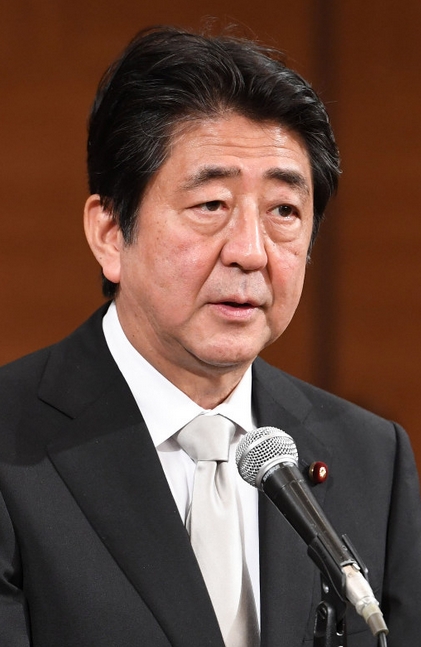
Is Japan moving to renege on no-nuclear weapon policy? http://www.nationmultimedia.com/detail/opinion/30337363, opinion January 29, 2018 , By Cai Hong ,China Daily , Asia News Network , Tokyo Beatrice Fihn, executive director of the 2017 Nobel Peace Prize-winning International Campaign to Abolish Nuclear Weapons, was denied a meeting with Japanese Prime Minister Shinzo Abe during her recent visit to Japan.
Visiting Hiroshima and Nagasaki, Fihn urged Japan, the only country to have suffered nuclear attacks, to play a leading role in the campaign aimed at abolishing nuclear weapons.
It is not difficult to understand why Abe shunned Fihn. She has appealed to the Japanese government to join the nuclear weapons ban treaty. But on January 17, Japan and the United States allowed their agreement on nuclear cooperation to automatically renew in July, when it is supposed to expire. The agreement, signed in 1988, gives Japan blanket approval to reprocess spent nuclear fuel for weapons-grade plutonium. Japan adopted nuclear power in the 1950s (one of the first countries to do so) at the urging of the US. In fact, the US began engaging with Japan on nuclear energy soon after the end of World War II, as it was eager to promote and sell its nuclear reactor technology around the world.
Japan had to return some 300 kilograms of plutonium, provided by the US, Britain and France decades ago for what was described as research purposes, to the US in 2016. Thanks to the US-Japan cooperation agreement on peaceful uses of nuclear energy, Japan now owns 48 tonnes of separated plutonium, most of which is in Europe, where it was reprocessed. And Japan has no clearly defined use for this huge amount of nuclear material. Japan once hoped fast reactors would help meet its energy security needs, take care of its surplus plutonium and solve its spent fuel problem. But that hope has faded. Commercialising of fast reactors is still decades away. Surplus weapons-grade material have always worried arms control experts. In 1977, believing that nuclear weapons could be made from plutonium extracted from spent nuclear fuel in Japan’s light water reactors, the US conveyed its view to Tokyo, according to Japanese diplomatic documents declassified in 2013.
Now, despite having surplus plutonium, Japan is planning to open a massive spent reactor fuel reprocessing plant at Rokkasho, the country’s large commercial reprocessing facility, in the autumn of 2018. It is designed to produce 8,000kg of weapons-usable plutonium enough to make 1,000 nuclear weapons a year, according to International Atomic Energy Agency standards. The ostensible reason for operating the plant is recycling spent fuel to supply power reactors and a fast reactor.
In their Foreign Policy article on August 17, 2017, Henry Sokolski, executive director of the Nonproliferation Policy Education Centre, and William Tobey, a senior fellow at Harvard Kennedy School, said Japan has five reactors on line and terminated its only fast reactor project. So Japan cannot operate Rokkasho in the northern part of the country without piling up tons of plutonium for years on end. The Rokkasho plant would significantly increase Japan’s existing plutonium surplus. A potential linkage between Rokkasho’s product and nuclear weapons has been hanging over the project from the start. Japan will only be able to burn a fraction of the huge amount of nuclear material extracted there. Japanese reprocessing plants will produce reactor-grade plutonium, but they will have high weapons’ potential.
Japan has a “three Nos” national policy on nuclear weapons: no possession, no manufacture and no allowing nuclear weapons on Japanese territory. But there is no lack of Japanese politicians talking about nuclear weapons. Former Japanese defence minister Shigeru Ishiba, seen as a possible successor to Abe, said in September that Japan should have the technology to build a nuclear weapon if it wants to do so. He added, though, that he is not taking the position that Japan should have nuclear weapons.
Japan’s plutonium surplus goes against its principle of not possessing the material without a specified purpose.
The recent false alarm in Hawaii underscores the threat from nuclear devices. While there has been media attention placed on how the United States is taking military and diplomatic action against North Korea from launching a nuclear strike, there is little media attention given to how well the United States is medically prepared for a nuclear attack. According to a recent report in the Bulletin of the Atomic Scientists, U.S. cities are not medically prepared for a nuclear detonation. This report, written by Dr. Jerome Hauer, who was the former assistant secretary for the Office of Public Health Emergency Preparedness at the U.S. Department of Health and Human Services, asserts that the United States is completely unprepared to manage the aftermath of a nuclear detonation. We are at a moment in history where nuclear terrorism is an unfortunate reality. North Korea and Iran have established nuclear capabilities, and Pakistan has stockpiles of highly enriched uranium.
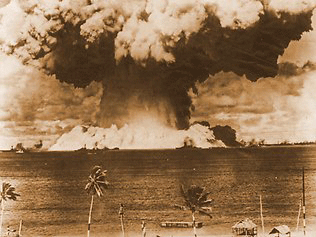
These countries have a history of supporting terrorist groups. It has been acknowledged by our government that highly enriched uranium can be smuggled into this country to build a 10-kiliton improvised nuclear bomb, like that dropped on Hiroshima in 1945. A nuclear threat would even include a dirty bomb that combines a conventional explosive with radioactive isotopes, which could contaminate an area and leave a residual radioactive “hot zone” that is too dangerous for even first responders to enter. Also, radioactive particles can disperse into the air and create a “plume” that could extend hundreds of miles away from ground zero and create a contamination area that would last for years.
A nuclear blast would instantly release a massive pressure wave and heat that would incinerate everything within half a mile and kill an estimated 75,000 to 100,000 people. Another 100,000 to 200,000 would suffer complexed radiation burns, while others would be exposed to high doses of radiation that would cause acute radiation syndrome that is characterized by bone marrow failure and gastrointestinal, cardiac, neurological and pulmonary toxicity. The starkest fact about a nuclear bomb attack is that it destroys the capacity to respond from a medical and civil service perspective. There will be a loss of local government services from firefighters, police and hospitals, along with loss of water, sewage and utilities. There will be a loss of communication systems to direct survivors where to evacuate for treatment.
The management of mass casualties from nuclear detonation is far more complex than for natural disasters. Hot zones are too dangerous for first responders to enter to render medical assistance to casualties. Yet, victims would still need to be evacuated somehow. According to the report, most U.S. cities lack medical preparedness to manage the aftermath of a nuclear explosion. FEMA has not devoted enough attention to address this issue. This makes it important for cities and states to develop plans for the worse case scenarios. Each state should have a plan of preparedness that includes special medical triage centers; coordinated schemes from state military and local police to provide mobile communication assets and protection against civil unrest; and specialized trained hospitals that can medical manage the injuries associated with a nuclear bomb. There needs to be a statewide plan from the governor’s office from each state, along with each state’s department of public health, to ensure there is sufficient medical preparedness.
Several government officials stated they were unable to take steps forward out of being accused of inciting fearmongering. However, developing a comprehensive preparedness program against nuclear threats should not just stop with military action but should include a medical preparation program regardless of how politically undesirable the subject may be. Preparedness should be mandated at every local and state government level.
• Alan Moy is CEO of Cellular Engineering Technologies and scientific director of the John Paul II Medical Research Institute.
Annick Girardin has told journalists in Tahiti that there will be an answer to the recently raised calls for such a study.Last week, a child psychiatrist, who had worked in French Polynesia for years, suggested that an independent investigation be carried out after noticing a high incidence of disturbed and deformed children among the off-spring of people exposed to radiation from the atmospheric tests.
Girardin has acknowledged the concerns, saying it has to be established how to deal with the question and to see if it is possible to work on it with other countries.
The minister has restated that the former president Francois Hollande recognised two years ago in Papeete the French legacy and assumed responsibility.
She has also launched a project in Papeete to build an institute of archives and documents related to the tests.
She has also frozen the sale of land in the city previously used by the navy for its command for it to be able to be used for a memorial site.The head of the nuclear test veteran’s organisation Roland Oldham is dismissive, saying this will only see the light of day once people are dead.
He has continued to urge Paris to compensate the nuclear test victims suffering from poor health.
Until 2009, France claimed its weapons tests were clean but then passed a law accepting compensation demands.
Hundreds of applications have been filed since but almost all have been thrown out.
Soros: Trump has US ‘set on a course towards nuclear war’CNBC , Jeff Cox | @JeffCoxCNBCcom, 26 Jan 18
Billionaire investor and political activist George Soros said President Donald Trump has the U.S. set on a course for nuclear war with North Korea.
Speaking at the World Economic Forum in Davos, Switzerland, Soros said Trump is trying to establish a “mafia state” in the U.S. but has failed so far.
The progressive activist said he sees the president’s place in the world as “temporary” and likely to “disappear in 2020 or even sooner.”
President Donald Trump has the U.S. on course for a nuclear war with North Korea, billionaire investor and progressive political activist George Soros said Thursday.
In a blistering critique of the country under Trump’s leadership, the head of Soros Fund Management and the Open Society Foundations painted a bleak picture.
“The fact of nuclear war is so horrendous that we are trying to ignore it, but it is real,” Soros said during a speech at the World Economic Forum in Davos, Switzerland. “Indeed, the United States is set on a course towards nuclear war by refusing to accept that [North] Korea has become a nuclear power.”
“This creates a strong incentive for North Korea to develop its nuclear capacity with all possible speed, which in turn may induce the United States to use its nuclear superiority pre-emptively, in effect to start a nuclear war to prevent a nuclear war, obviously a self-contradictory strategy.”
That wasn’t the only place Soros attacked Trump.
He compared the president to Russian strongman Vladimir Putin, saying Trump also would like to create a “mafia state” that suppresses individual rights. He can’t “because the Constitution and the institutions and a vibrant society won’t allow it.”
U.S. modernization efforts risk sparking a nuclear arms race with China. The Diplomat, By Kim Mu Kwan (Harry) 26 Jan 18, Since the end of the Cold War, the United States has been a leader of nuclear disarmament efforts. It gradually reduced its nuclear weapons stockpile through a series of arms reduction treaties with Russia. In 2009, then-President Barack Obama also affirmed “America’s commitment to seek the peace and security of a world without nuclear weapons.”
However, the United States still has an inexplicably large number of nuclear weapons. It maintains an arsenal of 1,393 strategic warheads deployed on 660 intercontinental ballistic missiles (ICBMs), 240 Trident II D5 submarine-launched ballistic missiles (SLBMs), 20 of which are on 12 Ohio-class submarines, and air-launched cruise missiles (ALCMs) equipped on 18 B-2 Spirit stealth bombers and 76 B-52H bombers.
In addition, contrary to global disarmament efforts, the United States recently began modernizing its nuclear arsenal. The Department of Defense (DOD) seeks to maintain and upgrade the country’s aging nuclear triad – IBCMs, SLBMs, and strategic bombers. The Congressional Budget Office (CBO) estimates the current modernization plans for U.S. nuclear forces would cost $400 billion between FY 2017 and FY 2026.
The Trump administration’s nuclear posture review is yet to be published (though a draft leaked earlier this month). However, it is hard to imagine his administration will discontinue this modernization effort. During the presidential campaign, Donald Trump repeatedly expressed his frustration about the “very terrible shape” of the country’s nuclear arsenal. He also has said he is preparing to have the arsenal in “tip-top shape,” though he denied reports that he wants a tenfold increase in the nuclear arsenal
This modernization effort not only undermines global disarmament efforts but also will force China to reevaluate its nuclear doctrine and reinvigorate its nuclear arsenal in order to maintain deterrence against the United States. China’s response could pose a serious threat to global disarmament efforts, U.S. national security, and regional stability in the Asia-Pacific………
North Korean leader Kim Jong Un provides guidance on a nuclear weapons program in this undated photo released by North Korea’s Korean Central News Agency (KCNA) in Pyongyang September 3, 2017. KCNA via REUTERS
Kim Jong-un has blown family cash on missile tests and has no money left to run North Korea
KIM Jong-un has reportedly spent almost an entire “slush fund” left to him by his dad on missile testing, leaving little money to run North Korea. The Sun News Corp Australia Network, JANUARY 27, 2018 KIM Jong-un has nearly blown the entire “slush fund” he inherited from his dad on nuclear tests, it has been claimed. Trigger happy Kim has staged a series of pricey nuke trials since taking over as leader after the death of his father Kim Jong-il in 2011.
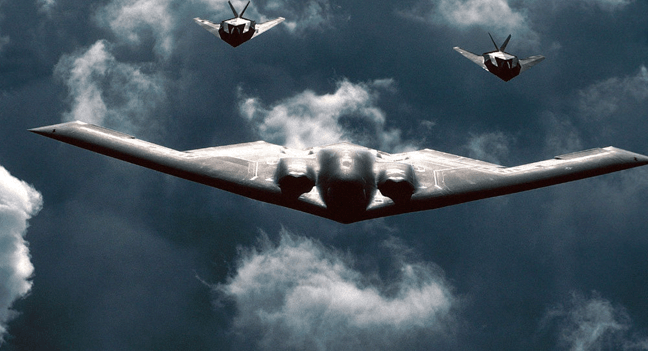
US stealth bombers in Guam appear to be readying for a tactical nuclear strike on North Korea, Business Insider, ALEX LOCKIE, JAN 25, 2018,
The US recently sent nuclear bombers to Guam that can carry tactical nukes that would be perfect for taking out Kim Jong Un.
Some have suggested that a quick tactical nuclear strike on North Korea could cripple the country’s nuclear infrastructure with few casualties.
Recent reports have suggested President Donald Trump considering a strike on North Korea, but some experts and politicians think the idea of a tactical nuclear strike is a recipe for disaster.
The US has been quietly amassing firepower in the Pacific during a lull in tensions with North Korea, but recent developments on an under-the-radar nuclear weapon suggest preparation for a potential tactical nuclear strike.
While the B-2 and B-52 are known as the air leg of the US’s nuclear triad, as they carry nuclear-capable air-launched cruise missiles, a smaller nuclear weapon that has undergone some upgrades may lend itself to a strike on North Korea………..
Despite evidence that tactical nuclear weapons won’t solve the North Korean military quagmire, President Donald Trump’s administration has looked favourably on smaller nuclear weapons.
Trump’s recent nuclear posture review recommended building more small nuclear weapons, as their size would make them easier to use in a conflict – something the International Security paper supports.
CIA Boss Gives Latest Indication Trump May Consider Preemptive Strike on North Korea,Daily BeastThe spy agency is briefing the president about military options on North Korea, which outside analysts warn could escalate to nuclear war. SPENCER ACKERMAN, 01.23.18 THE CENTRAL INTELLIGENCE AGENCY IS BRIEFING President Donald Trump on the risks and opportunities of a limited attack on North Korea, its director suggested on Tuesday.
CIA Director Mike Pompeo would not discuss the “wisdom of a preemptive strike” on Pyongyang or its nuclear weapons program, he told an audience at the conservative American Enterprise Institute. But in rare public remarks, Pompeo portrayed North Korea as an urgent priority for the agency, and disclosed aspects of its role in setting back Kim Jong Un’s nuclear program during his first year at Langley……..
A former North Korean spy, Kim Hyon-hui, indicated to NBC News that Trump’s goal of denuclearizing a country that has been a nuclear state for over a decade is not achievable diplomatically: “North Korea won’t give up its nuclear weapons. They’re its lifeline.”……….
A group of scientists is trying to limit Trump’s nuclear authority, CNBC 25 Jan 18
A plan pushed by group of scientists would cut presidential authority to unilaterally order nuclear strikes.
As commander in chief, the U.S. president currently has the authority to order the military to launch nuclear missiles.
This proposal would require the vice president and speaker of the House to also approve any nuclear strike.
“No one person should be able to order a nuclear attack,” wrote one of the scientists proposing the plan.
Jeff Daniels | @jeffdanielscaA group of scientists proposed a plan Wednesday that would limit presidential authority to unilaterally order a nuclear attack.
The plan would require that the president first obtain approval from the next two officials in the presidential succession chain — the vice president and speaker of the House, according to a paper in the Bulletin of the Atomic Scientists, a global disarmament advocacy.
As commander in chief, the U.S. president currently has the authority to order the U.S. military to launch nuclear missiles.
“No one person should be able to order a nuclear attack,” said paper co-author Lisbeth Gronlund, a senior scientist and co-director of the Global Security Program at the Union of Concerned Scientists (UCS). “There’s no reason to maintain this dangerous policy, since there are viable alternatives that would allow other officials to take part in any decision to use nuclear weapons, whether it’s a first use or a launch responding to a nuclear attack.”
According to the paper, “the risks are not hypothetical. During the Watergate scandal, President [Richard] Nixon was drinking heavily and many advisers considered him unstable. During the 1974 impeachment hearings, Nixon told reporters that ‘I can go back into my office and pick up the telephone and in 25 minutes 70 million people will be dead.'”
The paper was co-authored by David Wright, a UCS senior scientist, and University of Maryland professor Steve Fetter.
The authors of the paper said the “proposal applies to any use of nuclear weapons, regardless of whether it would be the first use of nuclear weapons or in response to a nuclear attack or warning of an attack.”………
The majority of Americans are afraid of Trump’s ability to launch nuclear missiles. They also don’t have a lot of faith in his mental stability. Vox, By Rachel Wolferachel.wolfe@vox.comWe may no longer be teaching American schoolchildren how to “duck and cover,” but a new Washington Post/ABC News poll shows the threat of nuclear war is once again on the minds of the American populace. A new poll finds most Americans don’t trust President Trump with the power to launch nuclear weapons, and a majority are at least “somewhat” concerned that he’ll launch an unjustified attack.
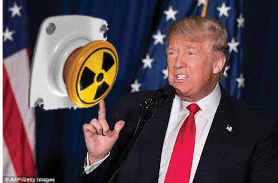
The poll comes less than a month after Trump’s tweet comparing the size of his “nuclear button” to North Korean leader Kim Jong Un’s.
Democrats are far more likely than Republicans to report fear, for example, with almost six in 10 Democrats saying they are “very concerned” about Trump ordering an unjustified nuclear attack, compared to about three in 10 independents and fewer than one in 10 Republicans.
Gender also plays a role, with twice as many women as men saying they are “very” concerned Trump could launch a nuclear attack — 42 percent versus 22 percent.
Those who are most concerned about him launching a nuclear attack without justification are also those who have the least confidence in his mental stability. Only 48 percent of respondents said they thought Trump was mentally stable when asked about the president’s description of himself as a “very stable genius.” Forty-seven percent, meanwhile, don’t think he’s mentally stable.
Helen Caldicott on Our Denial of the Threat of Nuclear Armageddonhttp://www.truth-out.org/progressivepicks/item/42494-helen-caldicott-on-our-denial-of-the-threat-of-nuclear-armageddon November 05, 2017 By Mark Karlin, Truthout | Interview Since the corporate media give short shrift to the peril of nuclear weapons, most world residents are unaware of how close we are to nuclear annihilation. So argues advocate and physician Dr. Helen Caldicott, editor of Sleepwalking to Armageddon: The Threat of Nuclear Annihilation, in this interview with Truthout. Mark Karlin: Despite Donald Trump’s insinuation that he might launch a first-strike nuclear attack on North Korea, the anti-nuclear weapons movement is still relatively quiescent. Do you have thoughts as to why most people on the Earth are “sleepwalking to Armageddon”? Helen Caldicott: Yes. It’s because the US media has totally failed in its duty to educate and inform the American people about the current state of world affairs, including the current US plans for a winnable nuclear war and the huge nuclear arsenals still being maintained by Russia and America. As Thomas Jefferson said so long ago, “An informed democracy will behave in a responsible fashion.” Of the 16,400 nuclear bombs in the world, Russia and the US own 94 percent — only they can destroy most life on Earth, so in reality, these two nations are today’s real terrorists.
Do you think the fact that the 2017 Nobel Peace Prize was awarded to the International Campaign to Abolish Nuclear Weapons will bring the issue more to the forefront?
No I don’t. However, their strategy is wise and relatively subliminal. Already, 122 nations have committed to the pledge of nuclear abolition. This massive support will no doubt place pressure upon the NATO countries that harbor US tactical nuclear weapons — the Netherlands, Turkey, Germany, Italy and Belgium — to forgo these commitments. This, then, will place further pressure upon other nuclear armed nations to abolish their nuclear stocks, including India, Pakistan, France, Britain, China, North Korea and Israel. Only then will international condemnation be so great that Russia and the US will be forced to contemplate abandoning their nuclear arsenals once and for all. Whether we have time before all hell breaks loose, nobody knows.
You state that the United States will spend $1 trillion over the next 30 years modernizing its nuclear arsenal. What exactly does that mean?
It means exactly that. In order for the New Strategic Arms Reduction Treaty (New START) to pass the Senate, Obama promised then-Senator Jon Kyl that he would authorize the spending of $1 trillion over the next 30 years to replace every single nuclear weapon, missile, aircraft carrier, submarine, ship and plane.
How are corporations stirring the pot of militarizing international relations? Clearly, the military corporations have huge influence upon the House and Senate by funding the campaigns of the representatives, so in effect, most Congress people and senators … in a fundamental sense do not represent the health, well-being and lives of their constituents.
You comment that “an order to launch [nuclear weapons] in US missile silos is the length of a tweet.” How long does it take to launch a nuclear weapon?
Three minutes once the presidential order has been received. This is why the men in the missile silos are called Minutemen. [As described by former Minuteman ICBM launch control officer Bruce Blair here.]
What are some of the promising forms of resistance to nuclear weapons that are taking shape?
There are young people in many countries involved in the UN ban treaty; however, I see very little awareness in the general public about the fact that we are closer to nuclear war than we have ever been, and this according to former Secretary of Defense William Perry, retired Gen. James Cartwright and others highly knowledgeable and experienced in this area. Most people are in fact practicing psychic numbing and denial.
Despite the appearance of thawing tensions with North Korea, both Washington and Pyongyang have made several steps that suggest things could escalate soon.
The US has quietly moved heavy firepower, like nuclear bombers and aircraft carriers, to the region.
On the sidelines of important diplomatic meetings, talk of military action has been ever present, if not front and center.
While much of the world has celebrated the progress in talks between North Korea and South Korea before the Winter Olympics in Pyeongchang next month, as well as an apparent thaw in tensions with North Korea, the US has taken steps to move heavy firepower to the region.
Though the US will delay its military exercises with South Korea until the end of the Paralympics in March, it has elsewhere trained for scenarios that seem tailor-made for fighting North Korea.
The New York Times reports that 48 Apache gunships and Chinook helicopters last month trained in Fort Bragg in North Carolina to move troops under artillery fire, and that soldiers will train next month to set up mobilization centres designed to quickly send forces overseas.
Surviving artillery fire and mastering the tricky logistics of an overseas deployment would be needed skills if conflict broke out with North Korea, as Pyongyang maintains a massive range of artillery guns pointing at Seoul, South Korea’s capital with 25 million people.
Besides the exercises, the US has for the second time ever positioned both its nuclear-capable bombers in its territory of Guam, just a short flight from North Korea.
While the US military maintains that these exercises are routine and unrelated to North Korea, the increased tensions with Pyongyang bring scrutiny to every move.
Quiet – too quiet
While Secretary of State Rex Tillerson attended a meeting of 20 ministers this week in Vancouver, Canada to discuss sanctions implementation on North Korea, Secretary of Defence Jim Mattis joined and briefed the ministers on the US’s plan for military strikes.
When news of the inter-Korean talks dominated usually bleak headlines about North Korea, Trump’s National Security Adviser H.R. McMaster met with his Japanese and South Korean counterparts and dismissed the talks as “diversions.”
Although few expect the US to initiate conflict with North Korea while civilians from around the world gather in Northern South Korea to watch one of the world’s most important sporting events, a satellite launch provides a suitable target for a “bloody nose” strike, which the US is reportedly considering.
After a year in office, President Donald Trump’s foreign policy has an established history of upsetting norms. After a successful strike on Syria in April 2017, and a handful of unilateral foreign policy decisions going unpunished by supposedly riled actors, Trump’s White House may soon feel emboldened to make a statement.
From the beginning of the Atomic Age, says Ellsberg, the true purpose of our nuclear arsenal, the whole terrifying array of warheads and delivery systems in all their vast numbers and varieties, has not been the “defense” of our country. It has not been, as trumpeted by politicians and generals (and as believed by citizens and schoolchildren), to “deter” an adversary from launching a nuclear attack against the U.S. It is the maintenance of a first-strike nuclear force —not so much for the purpose of launching a deliberate surprise attack on anyone else, but to be ready to respond instantly
DANIEL ELLSBERG is perhaps the premier whistleblower of all time, the man who in 1971 dragged the Pentagon Papers out of top-secret darkness into the light. Yet even as excerpts from the papers’ 7,000 pages were being published by The New York Times, The Washington Post, and other newspapers, Ellsberg was sitting on an entire second set of secrets, having nothing to do with Vietnam: all his material on nuclear policy, such as the operational plans for general nuclear war that he had drafted for the Joint Chiefs of Staff in his job as a RAND Corporation defense analyst.
With the Vietnam War raging, Ellsberg made what he calls a “tactical judgment” to release those papers first, holding off on the nuclear material until the fallout (so to speak) from the Vietnam revelations had settled. As he faced trial, he entrusted the nuclear papers to his brother Harry, who hid the cache in a compost heap and later moved it to the local dump to evade FBI searches. But the papers were irrevocably lost when the dump was later ravaged by a tropical storm.
Ellsberg’s new book, “The Doomsday Machine: Confessions of a Nuclear War Planner,” is his revelation of what was in those lost papers, made possible not only by his prodigious memory and note-keeping but also the declassification and release of much of the material through official channels and Freedom of Information Act requests (many filed by Ellsberg himself). Speaking with the authority of an insider who was intimately involved with nuclear strategy and policymaking at the highest levels, he reveals that practically everything the American public believes about nuclear war and nuclear weapons is, quite simply, a “deliberate deception.” Continue reading →
U.N. chief: Threat from nuclear and other weapons gathers force, Asahi Shimbun, THE ASSOCIATED PRESS, January 19, 2018 UNITED NATIONS–Russia’s foreign minister warned Thursday that a failure of the Iran nuclear deal, especially as a result of action by the Trump administration, would send “an alarming message” to North Korea and impact all international agreements.
Sergey Lavrov took aim at U.S. President Donald Trump at a U.N. Security Council meeting on confidence-building measures to tackle the proliferation of weapons of mass destruction, saying that “we cannot for the benefit of political agendas of certain countries abandon a genuine achievement of international diplomacy.”
Last Friday, Trump kept alive the Iran agreement, which has won international praise including from U.S. allies, by extending sanctions waivers. But the president warned that the United States would pull out in a few months unless “terrible flaws” in the deal are fixed.
Lavrov and others worry that a U.S. pullout from the 2015 deal could mean that Washington cannot be trusted to keep agreements, which could harm any future efforts to get North Korea to abandon nuclear weapons.
Secretary-General Antonio Guterres opened Thursday’s meeting warning that the threat from weapons of mass destruction “seems to be gathering force.”
He urged expanded diplomatic efforts to tackle what he called the greatest security challenge in the world today–North Korea.
The international community must build on the “small signs of hope” from the recent contacts between the two Koreas to pursue diplomacy and denuclearize the Korean Peninsula, the U.N. chief said.
“Global anxieties about nuclear weapons are the highest since the Cold War,” Guterres said. “I remain deeply concerned over the growing risk of military confrontation and the unimaginable consequences that would result.”
China’s deputy U.N. ambassador, Wu Haitao, urged all countries to “reject Cold War mentality” and commit to peaceful solutions, including on the Korean Peninsula where he pointed to “some positive changes” emerging.
“All parties should make concerted efforts to extend this hard-won momentum of reduced tension, create conditions for relaunching dialogue and negotiation and return the nuclear issue of the Korean Peninsula to the correct track of dialogue and negotiation,” Wu said…….. http://www.asahi.com/ajw/articles/AJ201801190018.html
Casually prep for nuclear war with this Minecraft tour of the Russian and American fallout bunkers
by Taylor Hatmaker(@tayhatmake 19 JAN 18, To draw attention to the escalating threat of global nuclear annihilation, the Nuclear Threat Initiative (NTI), which works to “prevent catastrophic attacks with weapons of mass destruction and disruption—nuclear, biological, radiological, chemical and cyber,” has partnered with the James Martin Center for Nonproliferation Studies to craft a virtual tour of the nuclear fallout facilities that Russian and/or American leadership will be whisked into in the event of nuclear war.
The team has really outdone itself with the Fallout-esque teaser video.
The Lavish Bunkers Where U.S and Russian Leaders (still) Plan to Fight A Nuclear War
As NTI explains:
Nothing better illustrates the continuing absurdity of plans to fight a nuclear war than the massive complex of underground bunkers that the United States and Russia have built to survive and fight on even after both societies have collapsed. To help explain the scale of these facilities, we have reconstructed two, Site R in rural Pennsylvania (also known as Raven Rock) and the Kosvinsky underground command facility in Russia, roughly to scale using the popular immersive gaming platform Minecraft………https://techcrunch.com/2018/01/18/minecraft-nuclear-fallout-shelter-nti/
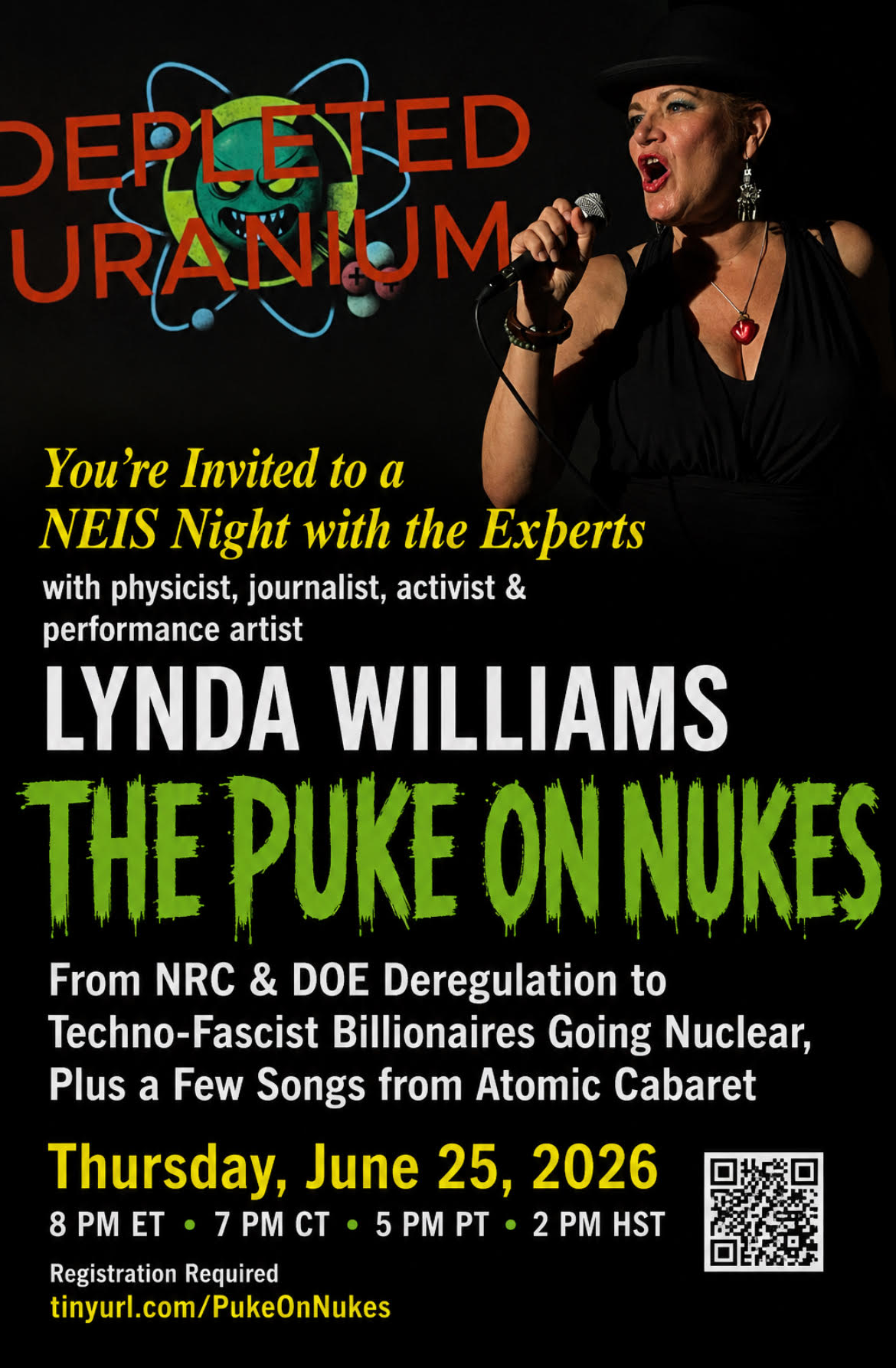
7pm Central Time (8pm ET, 6pm MT, 5pm PT) UTC – 5 From NRC & DOE Deregulation to Techno-Fascist Billionaires Going Nuclear, Plus a Few Songs from Atomic Cabaret REGISTER








 nuclear-news