Very dangerous to put low-yield nuclear weapons on submarines

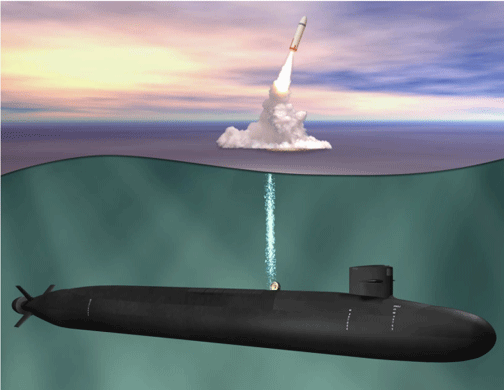 THE DISCRIMINATION PROBLEM: WHY PUTTING LOW-YIELD NUCLEAR WEAPONS ON SUBMARINES IS SO DANGEROUS, VIPIN NARANG , War on the Rocks, 8 Feb 18
India keeping up in the nuclear arms race – 2 Nuclear Capable Ballistic Missile in one Week
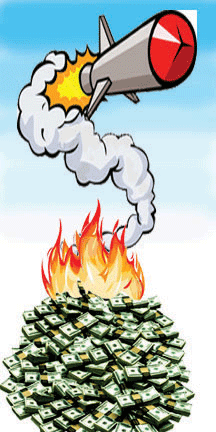
 India Test Fires Second Nuclear Capable Ballistic Missile in a Week, The nuclear capable Prithvi-II missile was test fired on February 7. The Diplomat, By Franz-Stefan GadyFebruary 09, 2018
Donald Trump Wants to Make It Easier to Start a Nuclear War. This Should Petrify Us
 https://theintercept.com/2018/02/08/donald-trump-nuclear-war/ Mehdi Hasan, 9 Feb 18,
SHE DID TRY and warn us.
“Imagine, if you dare … imagine him in the Oval Office facing a real crisis,” Hillary Clinton said in her speech to the Democratic National Convention in 2016, referring to her then-Republican opponent, Donald J. Trump. “A man you can bait with a tweet is not a man we can trust with nuclear weapons.”
Yet four months later, in November 2016, almost 63 million of her fellow Americans voted to put the short-tempered, thin-skinned former reality TV star in charge of their country’s 6,800 nuclear warheads. Never forget: As president of the nuclear-armed United States, Trump — Trump! — has the power to destroy humanity many times over, while rendering the planet uninhabitable in the process.
If that wasn’t terrifying enough, last week, less than 72 hours after the State of the Union speech, in which Trump ramped up his war of words with North Korea, his administration announced that it wanted to make it much easier for the president to start a nuclear holocaust.
You might have missed that rather important piece of news. Last Friday, while cable news channels rolled on the Nunes memo, the Pentagon published the latest Nuclear Posture Review, or NPR, which includes two pretty alarming new components.
First, while Barack Obama’s 2010 NPR for the first time ruled out a nuclear attack against non-nuclear weapon states that are in compliance with the Nuclear Non-Proliferation treaty, Trump’s NPR goes in the opposite direction and suggests that the U.S. could employ nuclear weapons in “extreme circumstances” to defend the “vital interests” of the United States and its allies. The document states:
Extreme circumstances could include significant non-nuclear strategic attacks. Significant non-nuclear strategic attacks include, but are not limited to, attacks on the U.S., allied, or partner civilian population or infrastructure, and attacks on U.S. or allied nuclear forces, their command and control, or warning and attack assessment capabilities.
Got that? Trump wants to be able to retaliate against a non-nuclear and perhaps even non-military attack on U.S. infrastructure — say, a cyberattack on the power grid? — with a nuclear strike that could kill hundreds of thousands, if not millions.
To call such a move disproportionate would be a severe understatement.
Second, the new NPR calls for the development of a new generation of so-called low-yield nuclear weapons. These smaller nukes, the document suggests, would be tactical, not strategic; deployed to the battlefield, rather than dropped on a city. The problem with this argument is that the atomic bombs used against Hiroshima (200,000 dead) and Nagasaki (70,000 dead) could also be considered low-yield nuclear weapons, in terms of their explosive capacity.
There is also the clear lowering of the threshold for nuclear weapons use: It becomes easier to justify the launch of a small nuclear weapon on the basis of a supposedly lower explosive force. Yet “a nuclear weapon is a nuclear weapon,” as Ronald Reagan’s former Secretary of State George Shultz testified in front of the Senate Armed Services Committeethe day before the release of Trump’s NPR. “One of the alarming things to me is this notion that we can have something called a small nuclear weapon … and that somehow that’s usable,” Shultz added. “Your mind goes to the idea that, yes, nuclear weapons become usable. And then we’re really in trouble, because a big nuclear exchange can wipe out the world.”
It would be a worrying development if any president of the United States announced, with little debate or discussion, a plan both to build more tactical nuclear weapons and use them in response to non-nuclear attacks; a nuclear strategy that makes the use of nukes more, not less, likely. But when that president is Donald J. Trump, it should be deemed a national, if not a global, emergency.
Lest we forget, this is a president who, during his election campaign, displayed complete ignorance about the “nuclear triad”; called for an “unpredictable” nuclear weapons policy, while refusing to rule out using nukes against the Islamic State or even in Europe (because “it is a big place”); and asked a foreign policy adviser three times, during a single hourlong briefing, “Why can’t we use nuclear weapons?” This is a commander-in-chief, who since coming to office a year ago, has demanded a tenfold increase in the number of U.S. nuclear weapons; casually threatened North Korea “with fire and fury like the world has never seen”; and began 2018 by bragging on Twitter about his “much bigger & more powerful” nuclear button.
“Giving Trump new nukes AND new ways to use them is like giving matches and gasoline to Curious George,” wrote nuclear weapons expert Tom Collina of the Ploughshares Fund on CNN’s website last Friday. “It will not end well.” Or as one retired senior Army officer told the American Conservative, the NPR provides Trump with “a kind of gateway drug for nuclear war.”
Indeed. And even prior to the publication of this hawkish nuclear strategy document, a Washington Post-ABC News poll in mid-January revealed that 60 percent of Americans did not trust Trump to responsibly handle his “authority to order nuclear attacks on other countries,” while 52 percent of them were “very” or “somewhat” concerned the president “might launch a nuclear attack without justification.”
Remember: The courts may be able to strike down his executive orders as unconstitutional, and Special Counsel Robert Mueller may be able to indict him over collusion or obstruction of justice, but there are no checks or balances on the president’s authority to wage nuclear war. None. Zero. To quote Bruce Blair, a former nuclear missile launch officer and research scholar at the Program on Science and Global Security at Princeton University: “We all need to confront the fact that [the U.S. political system] gives one person the God-like power to end the world.”
The questions, therefore, that matter far more than any other in 2018: Does the narcissist-in-chief plan on using this “God-like power?” Will an impulsive and aggressive Trump get us all killed by launching a nuclear war? Everything else is noise.
France in the nuclear weapons race – to spend 37 bn euros on upgrading nuclear arsenal
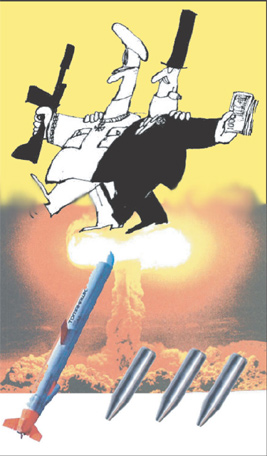
 France to spend 37 bn euros on upgrading nuclear arsenal, Digital Journal, By Daphné BENOIT (AFP) , 8 Feb 18
Cost of replacing Britain’s nuclear submarines rockets by £1billion.
Daily Record 8th Feb 2018, SNP slam ‘folly of Trident’ as cost of replacing Britain’s nuclear
submarines rockets by £1billion. The cost of replacing Britain’s nuclear
submarines has risen by almost £1billion in a year. SNP defence spokesman
Stewart McDonald MP will raise questions in the Commons about the soaring
cost of the £31billion Trident replacement programme after the
Government’s spending watchdog rapped MoD chiefs. A recent National Audit
Office report on the MoD’s financial plan for equipment slammed the
defence budget as unaffordable and unrealistic as it failed to include a
string of costs.
https://www.dailyrecord.co.uk/news/politics/snp-slam-folly-trident-cost-11989163
Depleted uranium “helped sow deaths and illnesses” in Italian soldiers
 Uranium caused cancer – probe http://www.ansa.it/english/news/politics/2018/02/07/uranium-caused-cancer-probe_560c540f-b60e-4f90-8ce4-29c0dc42cd6d.html But expert denies saying there was causal link, Redazione ANSA, 7 Feb 18 ANSA) -Rome – The final report of a commission on depleted uranium said Italian soldiers had been exposed to “shocking” levels of it in Italy and on foreign missions, and that it had “helped sow deaths and illnesses”.
However, the doctor whose expert opinion informed the panel’s conclusions denied a link between uranium and cancer. Levels of uranium in the sectors of security and workplace health for soldiers had been toxic and deadly, said the report from the parliamentary commission of inquiry. The report highlighted that military chiefs had been in “denial” on the phenomenon, and also stressed the “deafening silences maintained by government authorities.” Experts heard by the panel had verified the links between exposure to depleted uranium and tumours, the report said.
Commission Chair Gian Piero Scanu of the Democratic Party said “repeated judicial sentences have consistently affirmed the existence of a causal link between exposure to depleted uranium and the pathologies cited by the soldiers: this is a milestone and now those who were exposed will have the possibility of getting justice without having to struggle as they have done so far”.
The relatives of soldiers who died of uranium-linked cancer have been suing the government for years and pursuing cases in the courts, amid denials from military authorities.
In 2016 a Rome appeals court upheld a guilty verdict for the defence ministry in the 1999 death from leukemia due to depleted uranium exposure of 23-year-old Corporal Salvatore Vacca who handled uranium-tipped munitions during a 150-day mission in Bosnia in 1998-99.
The court found the ministry guilty of not having protected Vacca.
It ordered the ministry to pay more than one and a half million euros in compensation to Vacca’s family.
The families of other victims are suing the ministry for deaths allegedly due to depleted uranium exposure on several Italian missions.
Domenico Leggiero of the Military Observatory group said the sentence was “historic, because it confirms that the ministry was aware of the danger the soldiers sent to those zones were subject to”.
He said “I am sure Defence Minister Roberta Pinotti will bear this ruling in mind when she appears before the parliamentary depleted uranium commission”.
Italian authorities consistently played down the uranium risks
The Trump administration’s planned nuclear upgrade is being undermined by cost overruns.
Tennessean 5th Feb 2018, https://www.tennessean.com/story/news/2018/02/05/trump-administrations-planned-nuclear-upgrade-being-undermined-cost-overruns/303310002/
Amarillo-area nuclear weapons plant affected by cost overruns for federal
program. Millions of dollars in promised savings at the Pantex Plant in the
Panhandle and another nuclear weapons facility in Tennessee haven’t
appeared. But the federal government has still awarded a contractor extra
profits.
World back in Cold War peril, with Trump’s new Nuclear Posture Review
Ironically, an Obama-era nuclear agreement with Russia went into full effect Monday. It was aimed, like previous agreements forged by the Reagan and George W. Bush administrations, to defuse the possibility of just such a cataclysmic “Great Power” conflict. Under the terms of the New START treaty, as it’s known, both Russia and the United States are committed to deploying no more than 1,550 nuclear warheads. There’s a strict verification regime on both sides, and proponents of the pact say those inspections have built confidence in the otherwise severely strained U.S.-Russia relationship.
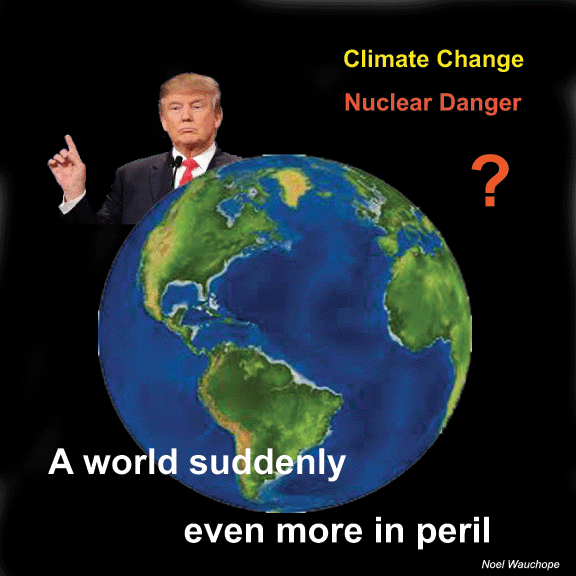 Trump’s nuclear policy is taking us back to the Cold War, WP The Trump administration has touted its new nuclear policy, released at the end of last week by the Pentagon, as a tough, realistic assessment of foreign threats and U.S. capabilities. The Nuclear Posture Review, the first to be conducted since 2010, purportedly describes “the world as it is, not as we wish it to be” — and calls for an expansion of America’s nuclear arsenal to confront the evolving capabilities of other nuclear powers.
If that is the administration’s view of the world, it is far from a consensus. A legion of critics blasted a potential nuclear buildup as dangerous, fiscally ruinous and redolent of outdated Cold War thinking. Some pointed out that a coterie of nuclear hawks helped draft the NPR, including one academic who argued in 1980 that the United States could defeat the Soviet Union in a nuclear war, while stomaching “approximately 20 million” casualties, “a level compatible with national survival and recovery.”
Rep. Mac Thornberry (R-Tex.), chairman of the House Armed Services Committee, echoed the administration’s recommendations to increase the stockpile of “low-yield” nuclear weapons — armaments that could still wipe out whole cities — and deploy a number of these warheads on submarine-launched intercontinental ballistic missiles as a sign of American intent. “The U.S. must recognize the reality of a return to great power competition and posture itself accordingly,” he wrote in an op-ed for Defense News.
President Trump also plugged the new approach during last week’s State of the Union address.
Though boosters of the administration’s nuclear agenda frame it as a continuation of long-standing American policy, it is a marked reversal from the strategy of Trump’s predecessor. “The previous administration’s policy hinged on what President Barack Obama called a moral obligation for the United States to lead by example in ridding the world of nuclear weapons,” wrote my colleague Paul Sonne. “Officials in the Trump administration and the U.S. military argue that Obama’s approach proved overly idealistic, particularly as relations with Moscow soured. Russia, China and North Korea, they say, all advanced their nuclear weapons capabilities instead of following suit.”
Skeptics of the Trump administration’s embrace of nuclear weapons argue that they won’t be able to credibly deter the sort of low-level aggression carried out by countries like Russia in Eastern Europe and North Korea in northeast Asia. The strategy seems to embrace the weapons more for their own sake than any utility they might provide.
“The document reads less like a strategy of how best to deter threats to the United States and its allies and more like a piece of advocacy for nuclear weapons — a self-conscious defense of their utility, affordability, and an effort to expand their mission. It is less a Pentagon policy document than a memo from a powerful lobby,” wrote Adam Mount, a senior fellow at the Federation of American Scientists. “Rather than working to reduce nuclear dangers, the nation’s nuclear policy now reflects the reasoning of U.S. adversaries and readily follows them into a more dangerous world.”
Joe Cirincione, president of the Ploughshares Fund, which pushes for global disarmament, warned that the new nuclear posture also gives Trump wider scope to order nuclear strikes. That’s something a majority of Americans don’t trust him with, according to a recent Washington Post poll.
“The authors spend pages arguing that the world has grown exponentially more dangerous due to the weakness of Trump’s predecessors,” Cirincione said in a recent op-ed. “They completely ignore the agreements that decreased Russian arsenals, rolled back and froze Iran’s nuclear program, and eliminated and secured tons of nuclear material from terrorists. The Nuclear Posture Review paints a world of terrifying ‘Great Power’ conflict.”
Ironically, an Obama-era nuclear agreement with Russia went into full effect Monday. It was aimed, like previous agreements forged by the Reagan and George W. Bush administrations, to defuse the possibility of just such a cataclysmic “Great Power” conflict. Under the terms of the New START treaty, as it’s known, both Russia and the United States are committed to deploying no more than 1,550 nuclear warheads. There’s a strict verification regime on both sides, and proponents of the pact say those inspections have built confidence in the otherwise severely strained U.S.-Russia relationship.
But there’s little indication that the Trump administration has much interest in extending the agreement beyond 2021, when it is set to expire. Critics say that’s a scary prospect. “Even in this environment, as long as Russia complies, extension is critical,” wrote John F. Kerry, the former secretary of state, who as a senator marshaled support for the treaty’s passage through Congress. “To let one of the last elements of constructive engagement expire with no follow-on process would ignore the hard-fought lessons of the Cold War. It would court nuclear competition that brings neither stability nor security.”
ndeed, experts warn that the climate of nuclear competition ushered in by Trump could risk a new global buildup of nuclear weapons that offers little strategic gain.
“Risking a new nuclear arms race, as is now likely and would be even more so should New START be allowed to expire without a replacement in hand, would divert American resources away from our conventional advantage, and bring us no additional security,” wrote Jon Wolfsthal, a nonresident fellow at Harvard University’s Belfer Center for Science and International Affairs and a former Obama administration official. “It would also repeat the great mistakes of the Cold War when we learned that arms races and nuclear wars cannot be won, and are better left unfought.” https://www.washingtonpost.com/news/worldviews/wp/2018/02/06/trumps-nuclear-policy-is-taking-us-back-to-the-cold-war/?utm_term=.4f13c0dbcc63
USA Secretary of Defence Jim Mattis changes his mind – now wants massive increase in nuclear weapons
 Mattis has flipped on nuclear weapons since the Pentagon decided to take on China and Russia, Business Insider, ALEX LOCKIE, FEB 6, 2018
USA- Russia New START Treaty takes effect – with central limits on strategic arsenals for 7 years

The United States of America and the Russian Federation have implemented the Treaty on Measures for the Further Reduction and Limitation of Strategic Offensive Arms (New START Treaty) for seven years. February 5, 2018 marks the date that the Treaty’s central limits on each country’s strategic nuclear arsenal take effect.
The United States completed its reductions and achieved these limits in August 2017. The Russian Federation has repeatedly stated its commitment to the New START Treaty, including meeting the central limits, and we expect our upcoming data exchange under the Treaty to reaffirm that commitment.
Implementation of the New START Treaty enhances the safety and security of the United States and our allies and makes strategic relations between the United States and the Russian Federation more stable, transparent, and predictable; critically important at a time when trust in the relationship has deteriorated, and the threat of miscalculation and misperception has risen. The Treaty exemplifies an enduring commitment by both parties to cooperate on issues affecting the strategic relationship and international security. The United States looks forward to continuing implementation of the Treaty with the Russian Federation.
The United States and the Russian Federation will exchange data on their respective strategic nuclear arsenals within the next month, as we have done twice per year over the last seven years in accordance with the Treaty. Through the Treaty’s verification regime, which includes short-notice, on-site inspections at military bases and facilities, the United States is able to verify the data provided by the Russian Federation regarding its strategic nuclear arsenal. The verification regime provides both countries insight into each other’s strategic nuclear delivery systems, warheads, and facilities, as well as data exchanges to track the status and makeup of nuclear weapons systems.
The recently released U.S. Nuclear Posture Review notes that arms control can contribute to U.S. security by helping to manage strategic competition among states. The United States remains committed to arms control efforts that advance U.S., allied, and partner security. The United States will continue to fully implement the New START Treaty and remains committed to working with others, including the Russian Federation, to create the conditions to support the ultimate goal of the global elimination of nuclear weapons. The New START Treaty remains a critical component for supporting global non-proliferation efforts and strategic stability between the United States and the Russian Federation. Through implementing the New START Treaty, the United States continues to demonstrate its commitment to fulfilling its arms control obligations, including under the Treaty on the Non-Proliferation of Nuclear Weapons.
Artificial intelligence to enhance the thinking skills of nuclear submarine commanding officers,
China’s plan to use artificial intelligence to boost the thinking skills of nuclear submarine commanders
Equipping nuclear submarines with AI would give China an upper hand in undersea battles while pushing applications of the technology to a new level, SCMP, Stephen Chen, 05 February, 2018, China is working to update the rugged old computer systems on nuclear submarines with artificial intelligence to enhance the potential thinking skills of commanding officers, a senior scientist involved with the programme told the South China Morning Post.
A submarine with AI-augmented brainpower not only would give China’s large navy an upper hand in battle under the world’s oceans but would push applications of AI technology to a new level, according to the researcher, who spoke on condition of anonymity because of the project’s sensitivity.
“Though a submarine has enormous power of destruction, its brain is actually quite small,” the researcher said.
While a nuclear submarine depends on the skill, experience and efficiency of its crew to operate effectively, the demands of modern warfare could introduce variables that would cause even the smoothest-run operation to come unglued.
For instance, if the 100 to 300 people in the sub’s crew were forced to remain together in their canister in deep, dark water for months, the rising stress level could affect the commanding officers’ decision-making powers, even leading to bad judgment.
An AI decision-support system with “its own thoughts” would reduce the commanding officers’ workload and mental burden, according to the researcher……….
Up till now, the “thinking” function on a nuclear sub, including interpreting and answering signals picked up by sonar, a system for detecting objects under water by emitting sound pulses, has been handled almost exclusively by human naval personnel, not by machines.
Now, through AI technology, a convolutional neural network undergirds so-called machine learning. This structure underpins a decision support system that can acquire knowledge, improve skills and develop new strategy without human intervention.
By mimicking the workings of the human brain, the system can process a large amount of data. On a nuclear submarine, data could come from the Chinese navy’s rapidly increasing observation networks, the submarine’s own sensors or daily interactions with the crew…….. http://www.scmp.com/news/china/society/article/2131127/chinas-plan-use-artificial-intelligence-boost-thinking-skills
Trump administration wants $716 billion for defense for fiscal 2019
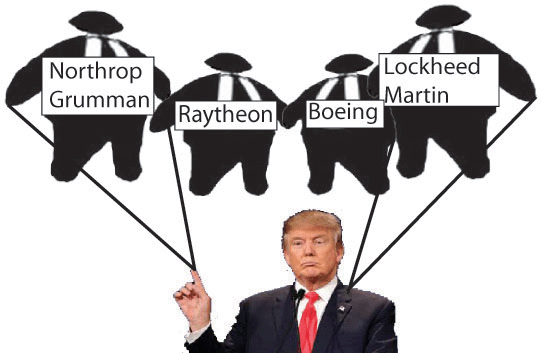 Why the military wants $716 billion from Congress,The Hill , BY REBECCA KHEEL – 02/04/18 The Trump administration is poised to ask Congress for $716 billion for defense for fiscal 2019, a major hike that budget analysts say aligns with administration’s stated goals of bulking up the military and preparing it to potentially fight near-peer rivals after years of focusing on terrorism.
“A total of $716 billion means that they are putting themselves on the trajectory for a big buildup in military power,” said Todd Harrison, a defense budget expert at the Center for Strategic and International Studies. “The caveat, though, is to really carry out the plans that they talked about in the past, you wouldn’t just need 7 percent growth in [fiscal] ’19; you would need similar levels of growth in the years following.”
President Trump came into office pledging to rebuild what he described as a “depleted” military. …..
“I’m not subtle,” Mattis told House and Senate Republicans on Thursday at their annual retreat at The Greenbrier resort in West Virginia.
“I need to make the military more lethal. Some people think I’m supposed to be an equal-opportunity employer,” Mattis added, according to several sources in the closed-door meeting.
Mattis told reporters at the Pentagon on Friday that he is “very happy” with the $716 billion request for next year.
“The money is going from readiness to modernization to nuclear deterrent,” he said. “You look at the strategy, and you see where it’s going.” ……..http://thehill.com/policy/defense/372110-why-the-military-wants-716-billion-from-congress
Divestment from nuclear weapons funds – one strong move to reduce danger of nuclear war
Global Voices: Citizens can help reduce risk of nuclear conflict http://www.timescolonist.com/life/global-voices-citizens-can-help-reduce-risk-of-nuclear-conflict-1.23163769, Marc and Craig Kielburger / .FEBRUARY 4, 2018
Marzhan Nurzhan has a mission. The 25-year-old from Kazakhstan is rallying global youth to tackle one of the biggest threats to her generation. But time may be running out.
On Jan. 25, partly in response to North Korea’s recent weapons tests, international scientists moved the hands of the “Doomsday Clock” — a symbolic gauge that measures the risk of nuclear war — to 11:58. It’s the closest to midnight we’ve been since 1953.
Midnight represents Armageddon.
Nurzhan has been an international advocate for nuclear disarmament ever since she learned of the impact nuclear weapons had on her country. Two million Kazakhstanis still suffer cancer and birth defects, the fallout from decades of Soviet weapons tests.
While many international organizations are active on nuclear disarmament, advocates such as Nurzhan face a major challenge getting ordinary people engaged, especially youth.
During the Cold War, public demonstrations against nuclear arms were common. Today, not so much. Increased threats haven’t increased public interest, says Nurzhan.
Rob van Riet, peace and disarmament co-ordinator for the World Future Council, says: “[Nuclear disarmament] feels too large for a lot of people and they feel powerless.”
Issues such as climate change are daunting, but tangible. Ordinary citizens can contact politicians, demanding policies that reduce emissions.
More importantly, people have at least some control over their household energy use. But making superpowers give up their huge arsenals, let alone influencing a rogue state such as North Korea, seems unattainable.
Still, Nurzhan and Van Riet insist ordinary people can help reduce the global risk of nuclear conflict.
A powerful tool is divestment. The U.S., Russia and China want to upgrade their aging nuclear arsenals, and develop new types of smaller weapons that could be used on the battlefield. The companies that build parts for those bombs are supported by investors such as pension funds, and even our personal RRSP funds.
We can pressure investors to drop these companies from their portfolios, pushing them to get out of the bomb business.
Canada is uniquely positioned to be a leader in nuclear disarmament. As climate change makes Arctic waters more accessible to submarines, Russia and the US increasingly see the north as a key part of their nuclear strategy, according to van Riet.
As a respected Arctic nation, Canada could lead the campaign to make the region a nuclear-free zone.
Likewise, with public pressure, Canada could play a diplomatic leadership role and insist that all nuclear states follow the example of China and India and declare a “no first use” policy.
This would reduce the risk of conventional conflicts escalating into nuclear war.
But if Canada is to be that leader, we have to make it a priority for our government. Prime Minister Justin Trudeau has been conducting town halls across the country — a great opportunity to raise the issue, notes Douglas Roach, a former Canadian senator and Ambassador for Nuclear Disarmament.
“If he’s not hearing from people, he’s going to think people don’t care.”
The Cold War might be a distant memory, but its terrifying ghost still haunts us.
It’s time for us to engage again on nuclear disarmament.
The clock is ticking.
Craig and Marc Kielburger are the co-founders of the WE movement, which includes WE Charity ME to WE Social Enterprise and WE Day. For more dispatches from WE, check out WE Stories.
Downwinders could be eligible for compensation for illnesses caused by nuclear radiation

Days Past: Are you a Downwinder? , Shannon Williams, The Courier, 4 Feb 18 Downwinder: this term has become well known in Yavapai County. Downwind radiation exposure has been cited in many cancer diagnoses and blamed for the deaths of many long-term residents of the county.
How did this happen? During the Cold War, the U.S. government built a huge nuclear arsenal. Above-ground testing began in 1951 at the Nevada Test Site, where over 100 nuclear bombs were detonated through 1958. All nuclear testing stopped in 1958 by agreement among the United States, the United Kingdom and the USSR.
The government detonated several above-ground devices in July 1962. This was the last time nuclear weapons were tested above ground. Nuclear testing continued below ground at the Nevada Test Site. From Jan. 21, 1951, to Oct. 31, 1958, and June 30, 1962, to July 31, 1962, when above-ground testing was conducted, were later designated as Downwind time periods.
After the 1962 testing period, many of the workers at the test sites and local residents filed class action lawsuits alleging exposure to known radiation hazards. All of the suits were dismissed by the courts. Congress responded by creating the Radiation Exposure Compensation Act (RECA) on Oct. 5, 1990. The Act was then expanded in 2000, when the Radiation Exposure Screening and Education Program (RESEP) was created. RECA provides monetary compensation as an apology to individuals who developed certain cancers after their exposure to radiation. RECA authorized the payment of $50,000 to individuals who lived downwind from the Nevada Test Site and developed one of the specified diseases.
Congress designated several counties in Nevada, Utah and Arizona as areas impacted by the radiation exposure. In Arizona, the Downwind-eligible counties include Apache, Coconino, Gila, Mohave (above the Grand Canyon), Navajo and Yavapai………
Many local residents have been affected by these nuclear tests, as we now know. Perhaps the most well-known was longtime Prescott resident and former City Council member John Hanna, who died of non-Hodgkin’s lymphoma in October 2013 – which the government has acknowledged was likely caused by radiation from nuclear testing. Quoting from the book “Downwind: A People’s History of the Nuclear West,” by Sarah Alisabeth Fox: “Many families” in the areas affected by fallout “kept livestock and gardens or bought meat, milk, and produce from their neighbors, unwittingly gathering radiological contamination … and placing it on their dinner tables.”
To file a RECA claim, individuals need to provide documentation to show physical presence in the Downwind counties for two years during the Downwind time periods.
In addition, individuals need to establish their diagnosis of a compensable cancer. Compensable diagnoses include leukemia, multiple myeloma, lymphoma, and cancers of the thyroid, lungs, esophagus, and breast, among others. Applicants do not need to provide causation on their cancer diagnosis. They only need to gather medical records that show proof of the eligible cancer.
RECA expires on July 9, 2022. All Downwinder RECA claims must be submitted before this date.
Join Shannon Williams, health promotions manager with RESEP, when she presents “Downwinders Program: Are You Eligible?” at 2 p.m. Saturday, Feb. 10, at Sharlot Hall Museum. Come early, as seating is limited.
“Days Past” is a collaborative project of the Sharlot Hall Museum and the Prescott Corral of Westerners International (www.prescottcorral.org). This and other Days Past articles are also available at www.sharlot.org/library-archives/days-past. The public is encouraged to submit proposed articles to dayspastshmcourier@gmail.com. Please contact SHM Library & Archives reference desk at 928-277-2003, or via email at dayspastshmcourier@gmail.com for information. https://www.dcourier.com/news/2018/feb/04/days-past-are-you-downwinder/
Pre-emptive strike on North Korea – “tempting” “a rational argument” -says Kissinger

A nuclear first strike of North Korea is ‘tempting’, says legendary U.S. diplomat Henry Kissinger as Kim  Jong-un warns Trump is pushing towards war, Daily Mail, 2 Feb 18
- Kissinger, 94, warned that North Korean denuclearization was vital
- He said that relations with Kim Jong-un’s country have reached a key juncture
- The U.S. must now choose between pre-emptive military action or increasingly tighter sanctions, he said
- His warning came before North Korea warned that the U.S. is pushing the whole world towards a ‘nuclear war’
By Alastair Tancred For Mailonline and Afp 3 February 2018
Former Secretary of State Henry Kissinger has said that the temptation to launch a pre-emptive strike on North Korea ‘is strong and the argument rational’.
He told a meeting of the Senate Armed Services Committee last week that North Korea poses the most immediate threat to global security, arguing that denuclearization of the regime must be a ‘fundamental’ American foreign policy goal.
The veteran diplomat was speaking before North Korea warned that the U.S. is pushing the whole world towards a ‘nuclear war’ in its latest letter submitted to the UN.
Former U.S. secretary of state Henry Kissinger), former secretary of state George Shultz, and former deputy secretary of state Richard Armitage, were testifng before the Senate Armed Services Committee on global security challenges
It said that joint military exercises between the U.S. and South Korea – coupled with American rhetoric in the Korean peninsula region – were bound to derail improving relationships between the two Koreas.
Mr Kissinger said that relations between the U.S, and north Korea had reached ‘a fork in the road’ in which the Trump administration may consider pre-emptive military action or increasingly tighter sanctions against Kim Jong-un’s regime.
‘We will hit that fork in the road, and the temptation to deal with it with a pre-emptive attack is strong, and the argument is rational, but I have seen no public statement by any leading official,’ President Nixon’s secretary of State told members of the Committee.
Kissinger, who at 94 continues to advise on foreign policy matters, joined two other foreign policy heavyweights – former Secretary of State George Shultz, 97, and ex-Deputy Secretary of State Richard Armitage, 72 — in testifying to the Committee about global security challenges.
The elder statesmen presented a picture of mounting international threats, including nuclear proliferation, Chinese authoritarianism, and Russia’s interference in US elections and its interventions in Eastern Europe.
‘The most immediate challenge to international security is posed by the evolution of the North Korea nuclear program,’ Kissinger told the Senate Armed Services Committee, describing an ‘unprecedented’ scenario………… http://www.dailymail.co.uk/news/article-5344473/Kissinger-Nuclear-strike-North-Korea-tempting.html
1 This Month
22 June – Virtual Event –Climate Change: New Data, New Debate

Monday, June 22, 2026 2:30 p.m. – 3:15 p.m. CT
YouTube. Register here

Protect Sazan Island from the Trump family! https://secure.avaaz.org/campaign/en/protect_sazan_island_from_the_trump_family_loc/?bqFCVab&v=174511&cl=22707147157&_checksum=5e9dde668860e8231c33699735e16a1fbf22ab2cb01da50c999fe8732b9775ef&utm_source=email&utm_medium=blast_email&utm_campaign=174511
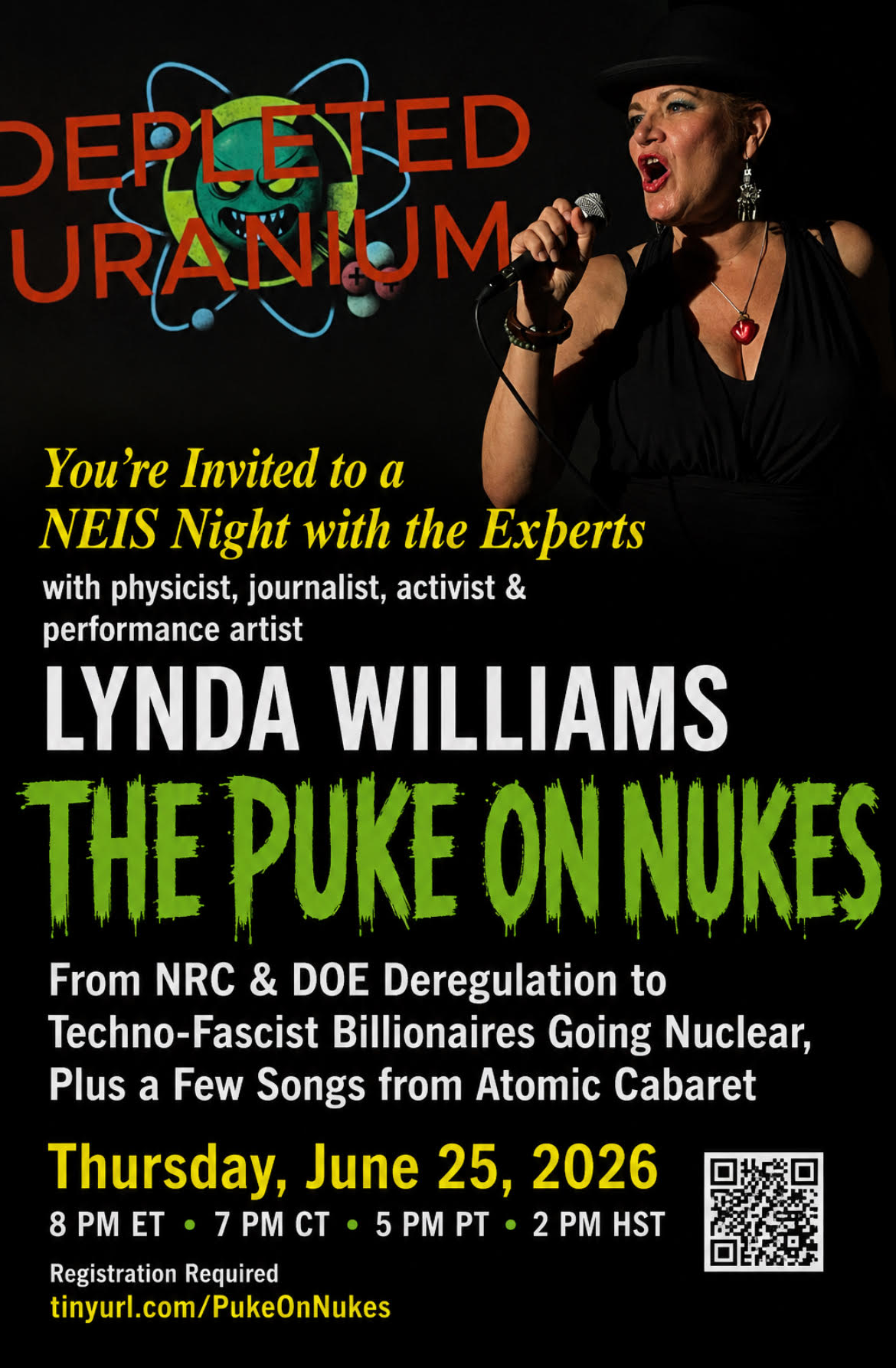
25 June- THE PUKE ON NUKES
Thursday, June 25, 2026
7pm Central Time (8pm ET, 6pm MT, 5pm PT) UTC – 5
From NRC & DOE Deregulation to Techno-Fascist Billionaires Going Nuclear, Plus a Few Songs from Atomic Cabaret REGISTER
26 June – Radiation Trainwreck at the NRC / Join the Protect Better Campaign – https://us02web.zoom.us/meeting/register/4ZlZ5_qLSHGiLSCg8FF6Bg#/registration


Cuba Is Not a Failed State – It Is a Besieged State
PETITION: “Global Appeal to Endorse Palestinian Right of Return of Refugees”
To see nuclear-related stories in greater depth and intensity – go to https://nuclearinformation.wordpress.com
-
Archives
- June 2026 (193)
- May 2026 (306)
- April 2026 (356)
- March 2026 (251)
- February 2026 (268)
- January 2026 (308)
- December 2025 (358)
- November 2025 (359)
- October 2025 (376)
- September 2025 (257)
- August 2025 (319)
- July 2025 (230)
-
Categories
- 1
- 1 NUCLEAR ISSUES
- business and costs
- climate change
- culture and arts
- ENERGY
- environment
- health
- history
- indigenous issues
- Legal
- marketing of nuclear
- media
- opposition to nuclear
- PERSONAL STORIES
- politics
- politics international
- Religion and ethics
- safety
- secrets,lies and civil liberties
- spinbuster
- technology
- Uranium
- wastes
- weapons and war
- Women
- 2 WORLD
- ACTION
- AFRICA
- Atrocities
- AUSTRALIA
- Christina's notes
- Christina's themes
- culture and arts
- Events
- Fuk 2022
- Fuk 2023
- Fukushima 2017
- Fukushima 2018
- fukushima 2019
- Fukushima 2020
- Fukushima 2021
- general
- global warming
- Humour (God we need it)
- Nuclear
- RARE EARTHS
- Reference
- resources – print
- Resources -audiovicual
- Weekly Newsletter
- World
- World Nuclear
- YouTube
-
RSS
Entries RSS
Comments RSS
 nuclear-news