How civil nuclear power funds nuclear weapons – video
Civil nuclear power is thought to be about providing a low carbon energy
alternative to fossil fuels and is seldom connected to nuclear weapons. But
the closer you look these two industries are intrinsically linked for
nuclear-armed countries. Josh Toussaint-Strauss investigates how the
connection between civil nuclear power and nuclear weapons spans decades
and continents as well as exposes siphoning of public money and the origins
of the Iran nuclear program.
Guardian 24th July 2025,
https://www.theguardian.com/world/video/2025/jul/24/how-civil-nuclear-power-funds-nuclear-weapons-video
AUKUS Submarine Regulations: Friends of the Earth Adelaide submission

Friends of the Earth Adelaide > Publications > Adelaide FoE Notes > AUKUS Submarine Regulations: FoE Adelaide submission
Philip White July 24, 2025, https://adelaidefoe.org/aukus-submarine-regulations-foe-adelaide-submission/
Friends of the Earth Adelaide today (24 July 2025) sent a submission in response to the government’s call for public comments on draft Australian Naval Nuclear Power Safety Regulations. These Regulations were drafted under the Australian Naval Nuclear Power Safety Act, which was passed in October last year. Our submission can be accessed here.
The consultation is open until 30 July 2025. Details can be found on the following web site: https://www.defence.gov.au/about/reviews-inquiries/australian-naval-nuclear-power-safety-regulations-public-consultation
FoE Adelaide’s submission can be summarised as follows:
— AUKUS should be cancelled. It compromises Australia’s sovereignty and is not in our strategic, economic, or environmental interests.
— If it is not cancelled, there should be a proper consultation about the Stirling and Osborne designated zones, which were declared in the Australian Naval Nuclear Power Safety Act without consultation.
— The principles of “free, prior and informed consent” should be followed in siting any site for storage and disposal of radioactive waste.
— That includes respecting laws of State and Territory governments that restrict or prohibit siting of nuclear waste facilities.
— The Regulator must be completely independent of the Defence portfolio. In the current proposal it will be answerable to the Minister for Defence.
— All submissions should be published in full, unless the submitter specifically requests otherwise. Government representatives informed us on 17 July at a public forum in Port Adelaide that they only intend to publish a summary put together by bureaucrats.
Anti-Genocide Protesters Block Hundreds of Israeli Tourists From Disembarking in Greek Port
A group of residents on the island of Syros organized the protest and said it was ‘unacceptable’ that Israeli tourists be welcomed as Palestinians suffer from starvation and war in Gaza
News Desk, JUL 22, 2025, https://thecradle.co/articles/anti-genocide-protesters-block-hundreds-of-israeli-tourists-from-disembarking-in-greek-port
Israeli passengers on a cruise ship arriving in Greece on 22 July were unable to disembark the vessel due to a large crowd of pro-Palestine protesters demonstrating against the Israeli genocide of Palestinians in the Gaza Strip.
The MS Crown Iris, owned by Israeli cruise line Mano Maritime, arrived on Tuesday at the Greek island of Syros in the Aegean Sea. The passengers were supposed to disembark for six hours.
However, they were forced to remain on board due to the protests in support of Palestine.
“The demonstrators posed no danger to us,” an Israeli on board the ship told Hebrew news site Walla.
Between 120 and 300 protesters waved Palestinian flags and held banners reading “stop the genocide” as the ship arrived.
Israeli Foreign Minister Gideon Saar spoke with his Greek counterpart, Giorgos Gerapetritis, to request intervention to resolve the issue.
Yet the cruise ship ended up being redirected to Limassol, Cyprus. Around 1,600 Israelis were traveling on the MS Crown Iris, according to Israel’s Channel 12.
A group of the Greek island’s residents organized the protest and posted on social media that they “raise their fists in solidarity with the Palestinians in Gaza,” adding that “it is unacceptable that tourists from Israel continue to be welcomed here while the Palestinians are suffering in the Strip.”
Israel’s genocidal war has resulted in a significant decline in Tel Aviv’s popularity worldwide.
Israeli soldiers responsible for war crimes, including the destruction of civilian infrastructure in Gaza, are regularly pursued and targeted with criminal complaints issued by pro-Palestine organizations in courts around the world.
Two Israeli soldiers were detained at the Tomorrowland festival in Belgium last week. Belgian police released them after conducting an interview.
The legal complaint was filed by the Hind Rajab Foundation (HRF), which has been leading a global campaign against Israeli soldiers involved in war crimes.
In January, the Israeli army issued restrictions against media coverage of active-duty soldiers due to legal risks they face over war crimes in Gaza while traveling abroad.
This came after an Israeli army reservist’s vacation in Brazil ended abruptly after HRF convinced a federal judge in Brazil to open a war crimes investigation into his participation in the demolition of civilian homes in Gaza.
Trillion dollar AUKUS subs plus nuclear waste in perpetuity?

by Rex Patrick | Jul 22, 2025 , https://michaelwest.com.au/trillion-dollar-aukus-subs-plus-nuclear-waste-in-perpetuity/
Everything about AUKUS nuclear waste is a political secret, including the cost, which will more than double the $368B announced AUKUS price tag. Former submariner Rex Patrick with the story.
Rex Patrick with the story.
If we ever get these subs, the total price tag may well be over $1 trillion. I’m in the Federal Court at present, trying to pry open a November 2023 report into how the Government intends to deal with the high-level nuclear waste from AUKUS submarines.
But there’s already a lot we can deduce by combining what has been extracted from the Government using Freedom of Information (FOI) laws, from Senate testimony and also looking at how the United States does and doesn’t take care of its naval nuclear waste.
Cost explosion
For starters, there was a short but insightful exchange in Senate Estimates last year between Senator Lidia Thorpe and the head of the Australian Submarine Agency (ASA), Admiral Jonathon Mead.
After making quick reference to the cost of nuclear waste facilities overseas, Senator Thorpe asked about the waste costs for AUKUS, “There’s no costing as yet; is that right?” Mead responded, “That’s correct”.
For an organisation that is required to cost its capability from cradle to grave, including support facilities, it’s a huge omission. It might be the case that
“they’re too frightened to do the math.”
As I will set out below, the price of safely storing AUKUS waste is likely to double the AUKUS price tag. But first, we need to take a look at what radioactive waste AUKUS will produce and what will be done with it.
Low-level waste
We know that Australia’s nuclear-powered submarines will produce small amounts of low-level waste every year (disposable gloves, wipes, reactor coolant and Personal Protective Equipment). ASA Senate Estimates briefs obtained under FOI suggest that this will amount to “roughly the volume of a small skip bin each year.”
This, along with low-level waste from US and UK submarines operating out of Perth, will be stored at HMAS Stirling until the Australian Waste Management Agency builds and commissions the National Radioactive Waste Management Facility.
Barely noticed by the national media, the Parliamentary Standing Committee on Public Works approved the construction of a ‘Controlled Industrial Facility’ at HMAS Stirling in August 2024.
High-level waste
When each AUKUS submarine decommissions, Australia will need to handle the recovery, transport, storage and disposal of two different types of high-level nuclear waste: spent nuclear fuel, about the size of a small hatchback, and the reactor compartment, about the size of a four-wheel drive.
Noting the total lack of transparency around Australia’s plans, MWM is making a reasonable assessment as to how this waste will be handled by looking to the US.
Fuel rods will be removed from the submarine at a decommissioning yard (possibly Henderson in WA for the Virginia Class and Osborne in SA for the SSN-AUKUS submarines).
The hull is cut open, and a defueling enclosure is installed on the submarine to provide a controlled work area. The fuel is removed into a shielded transfer container and moved to a wharf enclosure. It’s then placed into a specially designed shipping container for transfer to, in the case of the US, an intermediate ‘storage site’ in Idaho. Despite 70 years of nuclear-powered submarine operations (USS Nautilus was commissioned in 1955), the US has not yet sorted out its long-term ‘disposal site’.
It is not clear whether Australia will have an intermediate ‘storage site’ and a ‘disposal site’ or a combined site. Certainly, both storage and disposal are talked about in the information that has been released under FOI.
Australia is not permitted, by the text of the AUKUS Treaty and by commitments made to the International Atomic Energy Agency, to reprocess the fuel. Reprocessing involves separating the plutonium and fissile uranium from the spent fuel to reduce the amount of spent fuel that needs to be stored long term, but doing so raises nuclear weapon proliferation concerns.
For Australia, we have to find a geologically suitable place to bury the fuel in the state it was when it left the submarine. Whilst the Defence Minister has declared this will be on ’Defence land’, the ASA can identify a news site and the Minister can compulsory acquire it – anywhere in Australia.
Reactor compartment
To deal with the reactor compartment, all of the elements of the reactor that will remain in the compartment – the pressure vessel, piping, tanks and fluid system components – are drained to the maximum extent practicable. About 2% of the liquid remains trapped in discrete pockets.
All openings are then sealed.
The reactor compartment is then cut from the submarine, and with the pressure hull remaining as part of the disposal package, the high-strength steel serves as an outer seal.
In the United States, the reactor compartment is transported to “Trench 94” in Washington state.
It is not yet known whether the Australian Government will bury the reactor compartments in a final disposal site.
Looking after high-level nuclear waste is complex. You can’t responsibly just bury it or dump it in a deep mine shaft.
Nuclear waste facility
A waste facility must be carefully located, away from seismic activity, away from flooding and other weather events and generally where geological structure allows for deep, very long-term storage. Geoscience Australia has looked at suitable locations for a high-level radioactive Waste store on occasions between 1976 and 1999 (subject to a National Archives request).
It must also be located with suitable transport pathways from the submarine dismantling yard or possibly several yards.
The site must be prepared and built/bored. It must have access to electricity supplies, water, communications and sewerage. It must allow for the safe receipt and storage of fuel and the reactor compartments, it must be resilient to loss of heating or ventilation, loss of electricity, flow blockages, structural failures, etc.
“It must be resilient for well over a millennium.”
It must also be designed with the necessary security in mind, with access control, constant monitoring, intrusion detection and central alarms in place, and be secure in relation to protest and sabotage and have a co-located response capability. It must provide for safe long-term storage, with multiple barriers in place to prevent release of radioactive material, and be designed to deal with large accidental radioactive releases.
At the same time, the facility will be subject to international non-proliferation safeguards overseen by the International Atomic Energy Agency, which will require periodic access and perhaps remote monitoring and surveillance.
It will likely need a level of remoteness, but be able to be staffed by relevantly qualified personnel, and to receive surge responders in the event of an emergency.
Design and construction would take close to ten years.
What will it take?
The Government has committed to consultation as it selects a site for long-term disposal, yet the law does not require it.The decision to locate a National Radioactive Waste Management facility at Kimba in South Australia involved a lot of communication, some consultation, but very little listening. The Federal Court ultimately found that the decision-making process for that site was seriously flawed. The Liberals get a D minus.
Labor got the Parliament to declare both HMAS Stirling in Perth and the shipyard precinct at Osborne in Adelaide a ‘designated zone’ for nuclear activities. There was no consultation, so they get an F.
Section 10(2)(c) of the Australian Naval Nuclear Power Safety Act 2024 allows the minister to designate more zones. The consultation can be of a ‘tick-the-box’ nature.
While we don’t know what the cost of an underground storage/disposal facility would be, documents released under FOI show that a 2019 cost estimates study by Altus Expert Services placed the cost of an above ground facility at Kimba at $923 million. We could reasonably expect a deep storage facility could cost billions.
Then there are the ongoing operational costs of the facilities, over several hundred years.
Even at an annual cost of only $30 million per annum, that’s close to $4B over 120 years. And if the site is then sealed for 100,000 years, as the Finnish intend to do with their underground facility, there’s even more cost. Even if monitoring of sealed waste only cost 1/10th of the yearly operating cost, say $3million, the cradle-to-grave cost of dealing with AUKUS high level waste will add up to more than $300 billion; $300B that seems to have slipped ASA’s minds.
One thing’s for sure, there’s been too much secrecy around this radioactive hot potato. Maybe things will fall my way in the Federal Court. But it would be much better if the Government was just be up-front with everyone, particularly as we tax-payers have to pay for it.
Rex Patrick
Rex Patrick is a former Senator for South Australia and, earlier, a submariner in the armed forces. Best known as an anti-corruption and transparency crusader, Rex is also known as the “Transparency Warrior.”
The inside story of how America sent nuclear weapons to Britain
Nukewatch UK explains how it tracked the bombs being flown across the Atlantic.
American nuclear weapons with three times the power of the Hiroshima bomb
were transported to England last week, new evidence suggests. The arsenal
is under the control of president Donald Trump and could be used without
British approval.
Our team at Nukewatch UK observed a special flight
carrying the bombs as it landed at RAF Lakenheath in Suffolk on 17 July,
having tracked its journey and monitored radio messages. The transport
plane, a giant C-17 Globemaster (flight number RCH4574 or Reach 4574) had
taken off from Lewis–McChord base in Washington state two days earlier.
Declassified UK 22nd July 2025, https://www.declassifieduk.org/the-inside-story-of-how-america-sent-nuclear-weapons-to-britain/
Precisely Designed Mass Starvation”: Aid Access as Weapon in Israel’s War on Gaza, Researchers Find
July 21, 2025
The starvation crisis in Gaza is deepening under Israel’s brutal blockade and amid regular massacres of civilians attempting to secure aid at the only officially sanctioned aid sites, run by Israeli troops and American mercenaries. The so-called Gaza Humanitarian Foundation and the onset of famine are the subjects of a new report by analysts Davide Piscitelli and Alex de Waal for the research organization Forensic Architecture on the “architecture of genocidal starvation” in Gaza. “I’ve been working on this field of famine, food crisis and humanitarian action for more than 40 years, and there is no case, over those four decades, of such minutely engineered, closely monitored, precisely designed mass starvation of a population as is happening in Gaza today,” says de Waal, who is also the author of Mass Starvation: The History and Future of Famine.
Transcript
AMY GOODMAN: In one of the deadliest days yet for aid seekers in Gaza, Israeli forces killed at least 115 people on Sunday, including 92 who were killed while seeking aid. In the deadliest attack, at least 79 people at the Zikim crossing in North Gaza were massacred as they gathered near an aid convoy sent by the U.N. World Food Programme in northern Gaza in the hopes of getting flour. In a statement, the U.N. agency said, quote, “As the convoy approached, the surrounding crowd came under fire from Israeli tanks, snipers and other gunfire,” unquote.
These latest killings come as the starvation crisis in Gaza continues to deepen. UNRWA, the U.N. agency for Palestinian refugees, has accused Israel of starving civilians, including a million children. The entire population, more than 2 million people, lack access to sufficient food, putting their lives at immediate risk. Health authorities in Gaza say 19 people died of starvation over the last day, including at least one infant. This is the uncle of 3-month-old Yahya Al-Najjar.
ANAN AL-NAJJAR: [translated] He died due to malnutrition and the unavailability of baby formula at the Gaza Strip. We urge the entire world, all Arab countries and everyone with a living consciousness, humanity and dignity, to just stand with the children, just to let baby formula get into the Gaza Strip.
AMY GOODMAN: Since late May, when militarized aid sites run by the U.S.- and Israeli-backed so-called Gaza Humanitarian Foundation were established, nearly 900 Palestinians have been killed while attempting to access aid, and more than 5,700 have been injured……………………………………………………………………………………………………………………….https://www.democracynow.org/2025/7/21/forensic_architecture
It’s A Genocide, But It’s Also So Much More Than That
Caitlin Johnstone, Jul 23, 2025, https://www.caitlinjohnst.one/p/its-a-genocide-but-its-also-so-much?utm_source=post-email-title&publication_id=82124&post_id=169008966&utm_campaign=email-post-title&isFreemail=true&r=1ise1&triedRedirect=true&utm_medium=email
The mass atrocity in Gaza is a genocide, obviously, and is an undisguised ethnic cleansing operation.
But it’s also a lot more than that.
It’s an experiment — to see what kinds of abuses the public will accept without causing significant disruption to the imperial status quo.
It’s a psychological operation — to push out the boundaries of what’s normal and acceptable in our minds so that we will consent to even more horrific abuses in the future.
It’s a symptom — of Zionism, of colonialism, of militarism, of capitalism, of western supremacism, of empire-building, of propaganda, of ignorance, of apathy, of delusion, of ego.
It’s a manifestation — of violent racist, supremacist and xenophobic belief systems that have always been there but were previously restrained, meeting with the unwholesome nature of alliances that have long been in place but have been aggressively normalized.
It’s a mirror — showing us accurately and impartially who we currently are as a civilization.
It’s a disclosure — showing us what the western empire we live under really is underneath its fake plastic mask of liberal democracy and righteous humanitarianism.
It’s a revelation — showing us who among us really stands for truth and justice and who has been deceiving us about themselves and their motives this entire time.
It’s a catalyst — a galvanizing force and a rallying cry for all who realize that the murderous power structures we live under can no longer be allowed to stand, and a blaring alarm clock opening more and more snoozing eyes to the need for revolutionary change.
It’s a test — of who we are as a species and what we are made of, and of whether we can transcend the destructive patterning that is driving humanity to its doom.
It’s a question — asking us what kind of world we want to live in going forward, and what kind of people we want to be.
It’s an invitation — to become something better than what we are now.
US nuclear weapons ‘on UK soil’ for first time in 17 years.
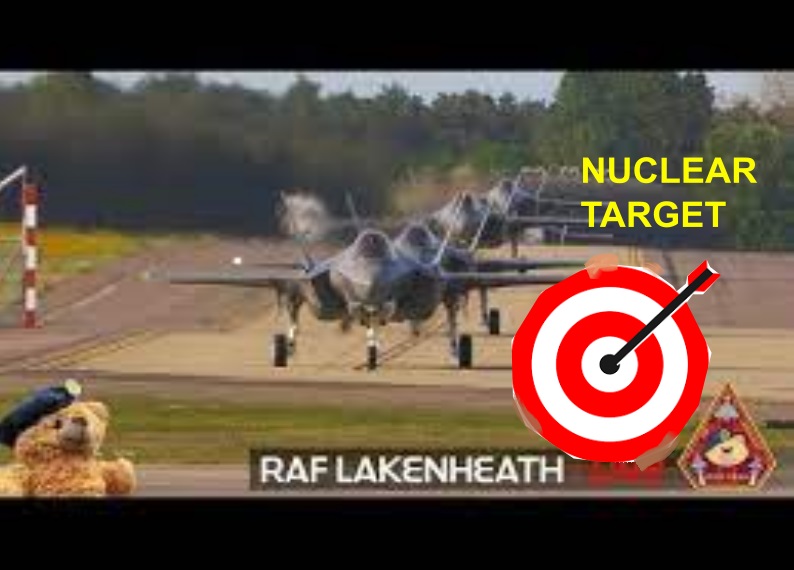
Flight from New Mexico to RAF Lakenheath believed to have dropped off B61 nuclear bombs that can be carried by Britain’s new F-35A fighter jets
The US has stationed nuclear weapons in Britain for the first time in
nearly 20 years for potential deployment on a new squadron of British jets,
analysts have said. A transport plane was tracked on Thursday during a
ten-hour flight from Kirtland Air Force Base in New Mexico, the US Air
Force’s main nuclear storage site, to RAF Lakenheath in Suffolk.
Analysts said that the route taken by the C-17 transport looked like a “one-way
drop-off” and meant that it was likely that the UK was hosting US nuclear
weapons for the first time since 2008. The US and the UK declined to
comment.
Times 21st July 2025, https://www.thetimes.com/uk/defence/article/us-nuclear-weapons-uk-soil-first-time-17-years-wvgz8m6wl
Grave Nation: Ukrainian Cemetery Mega-Project Reveals Dimming Military Hopes

a shroud of occlusion wears heavy over the outcome of the war is because the West has done their utmost in hiding Ukrainian losses.
“The right question is not whether Ukraine has lost the war – that seems all too obvious to me – but how far it will lose it.“
the Ukrainian deputies who still have some brain left understand that with the current state of affairs in Ukraine, the country will soon cease to exist. All the Ukrainian “partners” who were verbally ready to fight for Zelensky’s regime have now completely “frozen” and don’t even want to contribute money.
Simplicius, Jul 22, 2025, https://simplicius76.substack.com/p/grave-nation-ukrainian-cemetery-mega?utm_source=post-email-title&publication_id=1351274&post_id=168791044&utm_campaign=email-post-title&isFreemail=true&r=ln98x&triedRedirect=true&utm_medium=email
A new Le Monde article sends spider cracks through the facade of Ukrainian losses:
Right off the bat, they reveal that cemeteries throughout Ukraine are full, requiring a national project of building a large-scale network of new military burial sites:
The squares reserved for the soldiers are full. Everywhere, teams of architects are working on memorials that tell us as much about the scale of the slaughter as they do about the ongoing reflection on the idea of nationhood.
They visit one of the first under construction, which already has a main square of plots for 10,000, eventually to be expanded to 160,000 graves:
In the village, only a brand-new brown sign, the color reserved for national sites, currently marks the road leading the trucks to the construction site. It reads: “National Military Memorial Cemetery”. A first square of 10,000 graves, already partially dotted with wide, light-colored granite paths lined with benches and lime trees, will welcome the first “heroes” this summer. Eventually, however, “130,000 or even 160,000” deceased will be laid to rest on this future mortuary site, explains architect Serhi Derbin, wearing khaki linen pants and a straw panama, in the bright Saturday sunshine of July.
Rightly, the Le Monde staff turn to the issue of “official” Ukrainian casualty statistics. In a growing Western trend, they admit that the number of dead is likely “much higher” than Zelensky gives credit for. Of course, pro-UA zealots will ignore the fact that there is no such project in Russia, no inordinately exceptional outgrowth of military cemeteries anywhere. They’ll make excuses, pointing to the cliche of “Russia’s size” as somehow ‘concealing’ such markers of losses, ignoring that Ukraine itself is the largest country in Europe and remains oddly unable to ‘conceal losses’ in the same way.
In the same circles, there are increased talks of Ukrainian collapse by end of year. Le Figaro’s new article making the rounds offers such a prediction. The writers spoke to French military officers who believe the situation is turning dire:
A French military source:
Moscow’s “thousand cuts” strategy is intensifying. The front is not set in stone. Offensives are localized in a multitude of small battles fought over a few kilometers. The cuts are getting deeper, even though the Ukrainian army is already weakened. It is stretched over a front of more than 1,000 km. Lacking sufficiently frequent replacements and human resources, the units are becoming exhausted.
“The Russians are multiplying offensive sectors to disperse enemy reserves,” explains a French military source. Russia has deployed nearly 700,000 soldiers in Ukraine, more than the Ukrainian army. Patiently, it continues to nibble away at territory, at the cost of colossal human losses: up to a hundred dead a day; some 40,000 casualties (dead and wounded) a month. The Russian army has adapted its tactics, preferring to launch assaults with small infantry units or units mounted on motorcycles, in order to advance faster and more lightly.
They slip in the usual sop about the “costs” Russia is incurring, but then critically add:
But the army, the Ukrainian, it also lost some of the material she had received from Western for the past three years. Time plays against it with the risk of a break in a part of the front. “Forces of Ukraine are in [dire straits]… Can they last six months? A year? In reality, the war is already lost“, continued in the military source. In this war of attrition, the time changes everything.
And in another even more erudite offering, Figaro interviews French historian Stéphane Audoin-Rouzeau, who is particularly a leading expert on the First World War.
Utilizing his expertise on the Great War, he makes some fascinating parallels to the current Ukrainian conflict that are worth a deeper look.
First, he notes that in his opinion the Ukrainian war is only the third war of its particular type in recent history—the type being ‘siege warfare, but in the open country’:
You note another similarity between the First World War and the Ukraine, as both were wars of position…
There are few historical examples of this very recent form of warfare, as it requires armaments that only became available at the end of the 19th century. Structurally, it is siege warfare, but fought in open country over hundreds of kilometers. There have only been three conflicts of this type: the Great War (from late 1914 to spring 1918, not beyond); the Iran-Iraq war (from 1980 to 1988); the Ukraine war (from April 2022, not before).
He goes on to draw further parallels:
What are the invariants of such a war?
The main point is the superiority of the defensive over the offensive. Had this not been the case, Ukraine would have been beaten long ago. Already during the First World War, it was necessary to cross a “no man’s land” saturated with barbed wire, one of the most effective weapons of the early 20th century. Then there were the minefields we saw in Iran-Iraq and now in Ukraine. They are an extraordinarily compact barrier. The Ukrainians came up against it in the summer of 2023 during their failed counter-offensive, and the Russians since 2024. As a result, it’s impossible to break through dozens of kilometers wide and break the enemy’s front line.
He notes that due to these peculiarities, there is a kind of obligatory “regression” in each conflict, where previous means are no longer workable:
There is a kind of regression in all three conflicts. In Ukraine, helicopters and airplanes fly very little above and beyond the front line. Nor are there any major armored offensives. We’ve never seen anything like the Battle of Kursk in 1943. As a result, the battle is heavily infantry-based.
And at the same time, firepower…
Yes, that’s another invariant of this type of warfare. Initially, this firepower was linked to artillery, with the cannon dominating the battlefield during the First World War. This overwhelming dominance of the cannon can be seen again in Ukraine, until 2024. Unfortunately, Russia has always had very good artillery and, unlike the Ukrainians, has had the means to supply it, where the latter ran out of ammunition well into 2024.
But the point in setting the stage above, is that by analyzing these parallels, this preeminent historian has reached a final decisive conclusion: that Ukraine has already lost the war:
It was by considering these invariants that you came to a radical conclusion, set out at a Senate hearing in April: in your view, Ukraine has already lost the war…
Indeed, as we speak, Ukraine unfortunately seems to have lost the war, probably as early as the summer of 2023, when it became clear that its long-awaited counter-offensive had failed. One could imagine a spectacular turnaround, but it’s not clear how. Of course, when you say this, people are shocked because it’s unbearable to think that Ukraine has lost the war. It’s unbearable for me too.
He adds to the list of peculiarities of the war the fact that even Ukraine’s now-certain loss is not overtly visible:
But here’s the thing: there’s no point in remaining incantatory, we have to get out of a new denial, that of defeat, after that of the possibility of war itself. For I would add another characteristic of the war of position: defeat is not immediately discernible when it looms. It takes a long time to appear. It’s not like Stalingrad, where the vanquished leave the battlefield and the victor occupies it. It’s not like the blitzkrieg of May-June 1940. In a war of position, it’s two bodies in battle, slowly wearing each other down. Only in the end does it become clear that one has worn out faster than the other.
He hits the nail on the head, but likely in a way even he doesn’t fully understand—or at least not in a way he’s ready to admit. You see, the reason such a shroud of occlusion wears heavy over the outcome of the war is because the West has done their utmost in hiding Ukrainian losses. His final pithy admonition that only in the end does it become clear who lost the war of attrition inadvertently bears testament to this: only those of us who truly care about facts and uncovering the truth—not dogmatic reasoning and propaganda—are able to demystify the more-than-obvious signals that Ukraine is taking ungodly and unsustainable losses comparative to Russia.
He goes on to demonstrate his cause with an example:
Let’s do a little thought experiment. Let’s imagine that in early October 1918, a group of military experts, journalists and historians were gathered in a neutral country to ask their opinion on the situation. And now suppose someone had then suggested that Germany had already lost the war. Well, everyone would have cried out! At that time, the Reich was still occupying immense territories in the east at the expense of Russia, since the Treaty of Brest-Litovsk. It occupied the whole of Belgium and large parts of France. It’s true that the German army has been retreating since the summer, but nowhere has the front given way. The Germans are inflicting heavy losses on the Allies, since it is the Allies who are on the offensive and therefore taking the greatest risks. So where is the German defeat?
In reality, German defeat has been certain since July-August 1918. It has happened, but it is not yet apparent. Since the summer, the German General Staff has been well aware of this, and has called for negotiations to be launched. Except that the political powers don’t understand it, nor does German public opinion, and never will. This failure to understand the defeat of 1918 was one of the reasons for the rise of Nazism.
The interviewer lightly pushes back, stating that the Ukrainians are not yet visibly collapsing despite Russia’s slow-moving gains:
Here again, let’s think back to the First World War. When the Allies launched their counter-offensive in July 1918, it was a general one, but apart from the Americans, the soldiers were no longer capable of attacking. They were so used to throwing themselves on the ground at the first danger that everyone was extremely cautious. But we could have imagined that part of the front would be breached, in which case… Germany had no more reserves to plug the holes. That’s why I’m worried about the risk of a Russian offensive in Ukraine this summer: given the disproportion of forces, could it break through the front? We would then be entering a different configuration, as any break in the front would risk producing a powerful moral effect on the Ukrainian armed forces, on political power and on public opinion.
He concludes by stating that the right question is no longer whether Ukraine has lost—which is rhetorical at this point—but how far Ukraine will lose:
The right question is not whether Ukraine has lost the war – that seems all too obvious to me – but how far it will lose it. On the basis of the current balance of power, or on that of an even more unfavorable balance of power? This will determine whether or not the Ukrainian defeat represents a strategic victory for Russia.
On that note, Russia again launched one of the largest attacks of the war last night—at least according to frenetic Ukrainian commentators who, admittedly, could be playing things up for dramatic effect to curry sympathy:
There has been a surge of such attacks the last few weeks, particularly ones targeting Ukrainian recruitment centers operated by the notorious TCK (Territorial Recruitment Center). Farsighted Ukrainian officials have ‘brilliantly’ concluded this is a Russian effort to cripple Ukraine’s ability to round up meat for Zelensky’s conveyor belt of horror.
Likewise, Russian strikes have been completely erasing Ukrainian weapons industries. Many people watch the endless parade of explosions in a detached manner—at this point it has become passé to the point that people assume these strikes do little, or are just carrying out some vague ‘background work’. In reality, they have been neutering Ukrainian industries, halting many of the farfetched Ukrainian weapons ambitions which were at one point widely talked about.
For instance, a recent hit was said to have destroyed the Grom-2 production line, a big Ukrainian ballistic missile that was meant to be their answer to Russia’s Iskander. There’s a reason you don’t see much of the weaponry constantly talked about and billed as the next “wunderwaffen”: it’s because these ongoing, systematic Russian strikes are wiping out their industries, leaving Ukraine with no ability to produce anything other than small quadcopter drones in tiny boutique workshops which can be hidden anywhere. The larger facilities which were meant to produce more prestige-level systems, from mobile artillery, to various analogues of Russian air-to-ground and ballistic missiles, to artillery shell production lines, etc., have all been extirpated by these relentless systematic strikes.
More and more, top Ukrainian figures are panicking over this and concluding that if it continues on this way, Ukraine will have nothing left. Listen to the Ukrainian officer below, who states that “at this rate, Ukraine will be returned to the stone age”:
🇺🇦The chair under Zelensky is starting to shake more and more. After all, allowing such statements on the air of pro-Kyiv media was previously unimaginable👍
➖Apparently, the recent report about the production of Geran-2 drones and their quantity, along with massive attacks on Ukrainian military infrastructure, really forced the top officials of Zelensky’s office to activate the “brown” alert.
➖Because the Ukrainian deputies who still have some brain left understand that with the current state of affairs in Ukraine, the country will soon cease to exist. All the Ukrainian “partners” who were verbally ready to fight for Zelensky’s regime have now completely “frozen” and don’t even want to contribute money. Support is dwindling, and stealing is becoming difficult. The people fully realize that Zelensky will shout about VICTORY from his bunker or Europe until he is hoarse, while Ukrainians rejoice at the Geran-2 strikes on the TCC.
He’s referring in particular to the new videos showcasing Russia’s Geran (Shahed) drone production at the Alabuga factory in Tatarstan where hundreds of the drones are produced each day around the clock:
The full episode where the above excerpt is from, which deals with many other drone types being used in the Russian Army, can be viewed here.
One of the reasons, by the way, that the French historian, Stéphane Audoin-Rouzeau, saw Russia winning the war despite parallels to ‘stalemated’ conflicts like the Iran-Iraq war, is because in previous examples he believes the industrial capacities and general capabilities of the combatants were likewise roughly static. But in the case of the Russo-Ukrainian war, he admits that Russian capabilities are growing each year, far out-pacing Ukrainian ones. This goes toward things like the previously-talked-about manpower gains of 100k per year—while Ukraine’s manpower shrinks—as well as the industrial growth of the arms industry.
That being said, there’s one last important point to be made. Many point to Russia’s “growing economic problems” as a counter-argument for why Russia could begin “losing” in the future, despite its seeming present dominance. I even saw one Western publication spin Putin’s announcement that Russia would be reducing its military budget next year as an “act of desperation” which means Russian military capability is finally “weakening”.
On the contrary, the signals here are the complete opposite: Putin’s plan to begin slowly reining in Russia’s military spending is the acknowledgement that Russia has finally reached a total equilibrium in the war, where current production levels are stable and sustainable indefinitely in relation to the losses. That means further inordinate military expansion is unnecessary, and Russia sees a successful path in defeating Ukraine at current levels.
This is obviously in conjunction with the fact that Russia has now attritioned the AFU to such an extent that it no longer requires the same disparity levels in military spending—as Ukrainian capabilities shrink, Russia likewise settles its war-making into a manageable level by taking things from overdrive to simply ‘autopilot’—if the analogy makes sense. Once again, dogmatic Western analysts incapable of impartial reasoning fail to pick up on this obvious cue, which totally spoils their analyses.
To leave off, here’s a typically comical new “threat” issued by beltway bugger Lindsey Graham against Putin. He boasts that Trump will “put a whoopin’ on your ass”, but then veers to say Trump will “punish” not Russia, but countries buying Russian oil:
This again proves the US has no cards against Russia, and must desperately punch Russia’s friends on the arm as a substitute threat. The problem is, this hurts the US and its relations with key foreign powers more than it does anything to Russia.
More and more Ukrainian commentators and political figures are cottoning on to the fact that “sanctions” were always nothing more than a desperate and hollow performative act:
The West, with its illusory economies, fraudulent GDPs based on hyper-financialized and leveraged debt, and miserably deteriorated industrial capacities has worn out its ‘sanctions’ cudgel—at least for anything more than performative ‘punishments’.
Hiroshima to Today: Confronting the Nuclear Threat
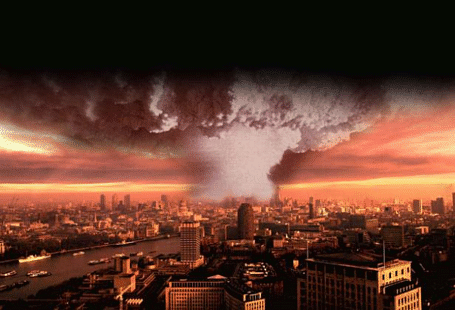
Kate Hudson: As we commemorate the eightieth anniversary of the criminal
attacks on Hiroshima and Nagasaki by US atomic bombs, we must recognise
that we are closer than ever to nuclear war.
The war on Ukraine has greatly
increased the risk. So too has Nato’s location of upgraded nuclear weapons
across Europe — including Britain — and Russia’s resultant siting of
similar weapons in Belarus. Irresponsible talk suggesting that
“tactical” nuclear weapons could be deployed on the battlefield — as
if radiation can be constrained in a small area — has made nuclear use
more likely.
And last year, after decades of reductions since the end of
the Cold War, the global nuclear stockpile increased. Governments across
Europe are making these problems worse. They are leading a massive
programme of rearmament, including talk of European nuclear proliferation;
but they are in denial about the dangers it is unleashing. This is a bad
time for humanity — and for all forms of life on Earth.
It’s time for us
to stand up and say No: we refuse to be taken into nuclear Armageddon.
Labour Outlook 19th July 2025,
https://labouroutlook.org/2025/07/19/hiroshima-to-today-confronting-the-nuclear-threat/
Japanese Doctor Picked for U.N. Panel on Nuclear War Impact.

U.N. Secretary-General Antonio Guterres has appointed 21 experts, including
Japanese doctor Masao Tomonaga, who survived the 1945 U.S. atomic bombing
of the southwestern Japan city of Nagasaki, as members of a panel to
examine the possible impact of a nuclear war.
The independent panel was set
up based on a resolution adopted by the U.N. General Assembly in December
last year. It consists of specialists in various fields, including nuclear
and radiation studies, climate, environment, medicine and agriculture. It
will examine the effects of a nuclear war on public health, ecosystems and
global socioeconomic systems at both regional and global levels. The panel
is set to hold its first meeting in September and submit a report to the
U.N. General Assembly in 2027.
Jiji press 19th July 2025,
https://jen.jiji.com/jc/eng?g=eco&k=2025071900252
80 Years After Trinity

No longer represented as a plausible deterrent, the bomb now stood poised to become what Los Alamos Director J. Robert Oppenheimer would describe shortly after the war as “weapons of terror, of surprise, of aggression… [used] against an essentially defeated enemy.”
Why Was There So Little Dissent at Los Alamos and What Does It Mean Today?
By Eric Ross, 17 July 25, https://tomdispatch.com/80-years-after-trinity/
In recent months, nuclear weapons have reemerged in global headlines. Nuclear-armed rivals India and Pakistan approached the brink of a full-scale war, a confrontation that could have become an extinction-level event, with the potential to claim up to two billion lives worldwide.
The instability of a global order structured on nuclear apartheid has also come into sharp relief in the context of the recent attacks on Iran by Israel and the United States. That system has entrenched a dangerous double standard, creating perverse incentives for the proliferation of world-destroying weaponry, already possessed by nine countries. Many of those nations use their arsenals to exercise imperial impunity, while non-nuclear states increasingly feel compelled to pursue nuclear weapons in the name of national security and survival.
Meanwhile, the largest nuclear powers show not the slightest signs of responsibility or restraint. The United States, Russia, and China are investing heavily in the “modernization” and expansion of their arsenals, fueling a renewed arms race. And that escalation comes amid growing global instability contributing to a Manichean world of antagonistic armed blocs, reminiscent of the Cold War at its worst.
The nuclear threat endangers not only global peace and security but the very continuity of the human species, not to speak of the simple survival of life on Earth. How, you might wonder, could we ever have arrived at such a precarious situation?
The current crisis coincides with the 80th anniversary of the Trinity Test, the first detonation of an atomic weapon that would soon obliterate the Japanese cities of Hiroshima and Nagasaki and so inaugurate the atomic age. So many years later, it’s worth critically reassessing the decisions that conferred on humanity such a power of self-annihilation. After all, we continue to live with the fallout of the choices made (and not made), including those of the scientists who created the bomb. That history also serves as a reminder that alternative paths were available then and that another world remains possible today.
A Tale of Two Laboratories
In the summer of 1945, scientists and technicians at Los Alamos National Laboratory in New Mexico worked feverishly to complete the construction of the atomic bomb. Meanwhile, their colleagues at the University of Chicago’s Metallurgical Laboratory mounted a final, ultimately unsuccessful effort to prevent its use.
The alarm spreading in Chicago stemmed from a sobering realization. The Manhattan Project that they had joined on the basis of a belief that they were in an existential arms race with Nazi Germany had, by then, revealed itself to be a distinctly one-sided contest. Until then, the specter of a possible German atomic bomb had conferred a sense of urgency and a veneer of moral legitimacy on what many scientists otherwise recognized as a profoundly unethical undertaking.
Prior to the fall of Berlin, Allied intelligence had already begun to cast serious doubt on Germany’s progress toward developing an atomic weapon. By April 1945, with the Nazi regime in a state of collapse and Japan’s defeat imminent, the threat that served as the original justification for the bomb’s development had all but vanished.
No longer represented as a plausible deterrent, the bomb now stood poised to become what Los Alamos Director J. Robert Oppenheimer would describe shortly after the war as “weapons of terror, of surprise, of aggression… [used] against an essentially defeated enemy.”
By that point, it was evident that the bomb would be used not to deter Germany but to destroy Japan, and not as the final act of World War II but as the opening salvo of what would become the Cold War. The true target of the first atomic bomb wasn’t, in fact, Tokyo, but Moscow, with the people of Hiroshima and Nagasaki sacrificed on the altar of American global imperial ambition.
For the scientists at Chicago, that new context demanded new thinking. In June 1945, a committee of physicists led by James Franck submitted a report to Secretary of War Henry Stimson warning of the profound political and ethical consequences of employing such a bomb without exhausting all other alternatives. “We believe,” the Franck Report stated, “that the use of nuclear bombs for an early, unannounced attack against Japan [would be] inadvisable.” The report instead proposed a demonstration before international observers, arguing that such a display could serve as a gesture of goodwill and might avert the need to use the bombs altogether.
One of that report’s signatories, Leo Szilard, who had been among the bomb’s earliest advocates, further sought to prevent what he had come to recognize as the catastrophic potential outcome of their creation. With Germany defeated, he felt a personal responsibility for reversing the course he had helped set in motion. Echoing concerns articulated in the Franck Report, he drafted a petition to be circulated among the scientists. While acknowledging that the bomb might offer short-term military and political advantages against Japan, he warned that its deployment would ultimately prove morally indefensible and strategically self-defeating, a position which would also be held by six of the seven U.S. five-star generals and admirals of that moment.
Szilard emphasized that the atomic bomb wasn’t just a more powerful weapon but a fundamental transformation in the nature of warfare, an instrument of annihilation. He already feared Americans might come to regret that their own government had sown the seeds of global destruction by legitimizing the sudden obliteration of Japanese cities, a precedent that would render a heavily industrialized, densely populated country like the United States especially vulnerable.
Moreover, he concluded that using such weapons of unimaginable destructive power without sufficient military justification would severely undermine American credibility in future arms control efforts. He observed that the development of the bomb under conditions of extreme wartime secrecy had created an abjectly anti-democratic situation, one in which the public was denied any opportunity to deliberate on such an irrevocable and consequential decision.
As Eugene Rabinowitch, a co-author of the Franck Report (who would later co-found The Bulletin of Atomic Scientists), would note soon after, the scientists in Chicago were growing increasingly uneasy in the face of escalating secrecy: “Many scientists began to wonder: against whom was this extreme secrecy directed? What was the sense of keeping our success secret from the Japanese? Would it have helped them to know that we had an atomic bomb ready?”
Rabinowitch concluded that the only “danger” posed by such a disclosure was that the Chicago scientists might be proven right, and Japan might surrender. “Since there was no justifiable reason to hold the bomb secret from the Japanese,” he argued, “many scientists felt that the purpose of deepened secrecy was to keep the knowledge of the bomb… from the American people.”
In other words, officials in Washington were concerned that a successful demonstration might deprive them of the coveted opportunity to use the bomb and assert their newly acquired monopoly (however temporary) on unprecedented power.
The Road to Trinity and the Cult of Oppenheimer
Seventy scientists at Chicago endorsed the Szilard Petition. By then, however, their influence on the project had distinctly diminished. Despite their early contributions, notably the achievement of the first self-sustained nuclear chain reaction in December 1942, the project’s center of gravity had shifted to Los Alamos.
Recognizing this, Szilard sought to circulate the petition among his colleagues there, too, hoping to invoke a shared sense of scientific responsibility and awaken their moral conscience in the critical weeks leading up to the first test of the weapon. Why did that effort fail? Why was there so little dissent, debate, or resistance at Los Alamos given the growing scientific opposition, bordering on revolt, that had emerged in Chicago?
One answer lies in Oppenheimer himself. In popular culture and historical scholarship, his legacy is often framed as that of a tragic figure: the reluctant architect of the atomic age, an idealist drawn into the ethically fraught task of creating a weapon of mass destruction compelled by the perceived exigencies of an existential war.
Yet the myth of him as a Promethean figure who suffered for unleashing the fundamental forces of nature onto a society unprepared to bear responsibility for it obscures the extent of his complicity. Far from being a passive participant, in the final months of the Manhattan Project, he emerged as a willing collaborator in the coordination of the coming atomic bombings of Hiroshima and Nagasaki.
When Oppenheimer and physicist Edward Teller (who would come to be known as “the father of the hydrogen bomb”) received Szilard’s petition, neither shared it. While Oppenheimer offered no response, Teller provided a striking explanation: “The things we are working on are so terrible that no amount of protesting or fiddling with politics will save our souls.” He further rejected the idea that he held any authority to influence the bomb’s use. “You may think it is a crime to continue to work,” he conceded, “but I feel that I should do the wrong thing if I tried to say how to tie the little toe of the ghost to the bottle from which we just helped it escape.”
Teller later claimed to be in “absolute agreement” with the petition, but added that “Szilard asked me to collect signatures… I felt I could not do so without first seeking Oppenheimer’s permission more directly. I did so and Oppenheimer talked me out of it, saying that we as scientists have no business meddling in political pressure of that kind… I am ashamed to say that he managed to talk me out of [it].”
Teller’s explanation was likely self-serving given his later acrimonious rift with Oppenheimer over the hydrogen bomb. Yet further evidence indicates that Oppenheimer actively sought to suppress debate and dissent. Physicist Robert Wilson recalled that upon arriving at Los Alamos in 1943, he raised concerns about the broader implications of their work and the “terrible problems” it might create, particularly given the exclusion of the Soviet Union, then an ally. The Los Alamos director, Wilson remembered, “didn’t want to talk about that sort of thing” and would instead redirect the conversation to technical matters. When Wilson helped organize a meeting to discuss the future trajectory of the project in the wake of Germany’s defeat, Oppenheimer cautioned him against it, warning that “he would get into trouble by calling such a meeting.”
The meeting nonetheless proceeded, with Oppenheimer in attendance, though his presence proved stifling. “He participated very much, dominating the meeting,” Wilson remembered. Oppenheimer pointed to the upcoming San Francisco Conference to establish the United Nations and insisted that political questions would be addressed there by those with greater expertise, implying that scientists had no role to play in such matters and ought to abstain from influencing the applications of their work.
Reflecting on his mindset at the time, Oppenheimer explained, “When you see something that is technically sweet, you go ahead and do it and you argue about what to do about it only after you have had your technical success. That is the way it was with the atomic bomb.” In a similar vein, his oft-quoted remark that “the physicists have known sin” was frequently misinterpreted. He was not referring, he insisted, to the “sin” of the destruction of Hiroshima and Nagasaki, but to pride for “intervening explicitly and heavy-handedly in the course of human history.”
When situated within this broader context of a professed commitment to scientific detachment, Oppenheimer’s behavior becomes more intelligible. In practice, however, his stated ideals stood in stark contrast to his conduct. While he claimed to reject political engagement, he ultimately intervened in precisely such a manner, using his position to advocate forcefully for the bomb’s immediate military use against Japan without prior warning. He emerged as a leading opponent of any prospective demonstration, cautioning that it would undermine the psychological impact of the bomb’s use, which could only be realized through a sudden, unannounced detonation on a relatively untouched, non-military target like the city of Hiroshima. This position stood in sharp contrast to that of the Chicago scientists, of whom only 15% supported using the bomb in such a manner.
That climate of deference fostered a culture of complicity, where questions of social responsibility were subordinated to uncritical faith in authority. Reflecting on that dynamic, physicist Rudolf Peierls acknowledged, “I knew that Oppenheimer was on a committee and was briefing with the high-ups. I felt there were two things one could rely on: Oppenheimer to put the reasonable ideas across, and that one could trust people. After all, we are not terrorists at heart or anything… Both these statements might now be somewhat optimistic.”
Ultimately, the only member of Los Alamos to register dissent was Joseph Rotblat, who quietly resigned on ethical grounds after learning in November 1944 that there was no active Nazi atomic bomb program. His departure remained a personal act of conscience, however, rather than an effort to initiate a broader moral reckoning within the scientific community.
“Remember Your Humanity”
The legacy of Oppenheimer, a burden we all now carry, lies in his mistaking proximity to power for power itself. Rather than using his influence to restrain the bomb’s use, he exercised what authority he had to facilitate its most catastrophic outcome, entrusting its consequences to political leaders who soon revealed their recklessness. In doing so, he helped lay the groundwork for what President Dwight D. Eisenhower would, in his farewell address to Congress in 1961, warn against as “the disastrous rise of misplaced power.”
Yet we are not doomed. This history should also remind us that the development and use of nuclear weapons was not inevitable. There were those who spoke out and a different path might well have been possible. While we cannot know exactly how events would have unfolded had dissent been amplified rather than suppressed, we can raise our own voices now to demand a safer, saner future. Our collective survival may well depend on it. How much longer a world armed with nuclear weapons can endure remains uncertain. The only viable path forward lies in renewing a commitment to, as Albert Einstein and Bertrand Russell urged, “remember your humanity, and forget the rest.” With ever more nations developing increasingly powerful arsenals, one thing remains clear: as the Doomsday Clock moves ever closer to midnight, there is no time to waste.
Ominous Plans: Making Concentration Camp Gaza
18 July 2025, Dr Binoy Kampmark, https://theaimn.net/ominous-plans-making-concentration-camp-gaza/
The odious idea of a camp within a camp. The Gaza Strip, with an even greater concentration of Palestinian civilian life within an ever-shrinking stretch of territory. These are the proposals ventured by the Israeli government even as the official Palestinian death toll marches upwards to 60,000. They envisage the placement of some 600,000 displaced and houseless beings currently living in tents in the area of al-Mawasi along Gaza’s southern coast in a creepily termed “humanitarian city”. This would be the prelude for an ultimate relocation of the strip’s entire population of over 2 million in an area that will become an even smaller prison than the Strip already is.
The preparation for such a forced removal – yet another among so many Israel has inflicted upon the Palestinians – is in full swing. The analysis of satellite imagery from the United Nations Satellite Centre (UNOSAT) by Al Jazeera’s Sanad investigations unit found that approximately 12,800 buildings were demolished in Rafah between early April and early July alone. In the Knesset on May 11 this year, Prime Minister Benjamin Netanyahu gave words to those deeds: “We are demolishing more and more [of their] homes, they have nowhere to return to. The only obvious result will be the desire of the Gazans to emigrate outside the Strip.”
Camps of concentrated human life – concentration camps, in other words – are often given a different dressing to what they are meant to be. Authoritarian states enjoy using them to re-educate and reform the inmates even as they gradually kill them. Indeed, the proposals from the Israel’s Defense Department carry with them plans for a “Humanitarian Transit Area” where Gazans would “temporarily reside, deradicalize, re-integrate, and prepare to relocate if they wish to do so.”
The emetic candy floss of “humanitarian” in the context of a camp is a self-negating nonsense similar to other experiments in cruelty: the relocation of Boer civilians during the colonial wars waged by Britain to camps which saw dysentery and starvation; the movement of Vietnamese villagers into fortified hamlets to prevent their infiltration by the Vietcong in the 1960s; the creation of Pacific concentration camps to detain refugees seeking Australia by boat in what came to be called the “Pacific Solution.”
Those in the business of doing humanitarian deeds were understandably appalled by Israel’s latest plans. Philippe Lazzarini, head of the United Nations agency for Palestinian refugees (UNRWA), stated that this would “de facto create massive concentration camps at the border with Egypt for the Palestinians, displaced over and over across generations.” It would certainly “deprive Palestinians of any prospects of a better future in their homeland.” Self-evidently and sadly, that would be one of the main aims.
A few of Israeli’s former Prime Ministers have ditched the coloured goggles in considering the plans for such a mislabelled city. Yair Lapid, who spent a mere six months in office in 2022, told Israeli Army Radio that it was “a bad idea from every possible perspective – security, political, economic, logistical.” While preferring not to use the term “concentration camp” with regards such a construction, incarcerating individuals by effectively preventing their exit would make such a term appropriate.
Ehud Olmert’s words to The Guardian were even less inclined to varnish the matter. “If they [the Palestinians] will be deported into the new ‘humanitarian city’, then you can say that this is part of an ethnic cleansing.” To create a camp that would effectively “clean” more than half of Gaza of its population could hardly be understood as a plan to save Palestinians. “It is to deport them, to push and to throw them away. There is no other understanding that I have at least.”
Israeli political commentator Ori Goldberg was also full of candour in expressing the view that the plan was “for all facts and purposes a concentration camp” for Gaza’s Palestinians, “an overt crime against humanity under international humanitarian law”. This would also add the burgeoning grounds of illegality already being alleged in this month’s petition by three Israeli reserve soldiers of Israel’s Supreme Court questioning the legality of Operation Gideon’s Chariots. Instancing abundant examples of forced transfer and expulsions of the Palestinian population during its various phases, commentators such as former chief of staff of the IDF, Moshe “Bogy” Ya’alon, are unreserved about how such programs fare before international law. “Evacuating an entire population? Call it ethnic cleansing, call it transfer, call it deportation, it’s a war crime,” he told journalist Lucy Aharish. “Israel’s soldiers had been sent in “to commit war crimes.”
There is also some resistance from within the IDF, less on humanitarian grounds than practical ones. To even prepare such a plan in the midst of negotiations for a lasting ceasefire and finally resolving the hostage situation was the first telling problem. The other was how the IDF could feasibly undertake what would be a grand jailing experiment while preventing the infiltration of Hamas.
This ghastly push by the Netanyahu government involves an enormous amount of wishful thinking. Ideally, the Palestinians will simply leave. If not, they will live in even more carceral conditions than they faced before October 2023. But to assume that this cartoon strip humanitarianism, papered over a ghoulish program of inflicted suffering, will add to the emptying well of Israeli security, is testament to how utterly desperate, and delusionary, the Israeli PM and his cabinet members have become.
New reports cast doubt on impact of US strikes on Iran’s nuclear sites
Citing intelligence assessments, NBC News and Washington Post report that only Fordow site was destroyed in US attack.
US Secretary of Defense attacks media for questioning Iran strikes
By Al Jazeera Staff, 18 Jul 202518 Jul 2025, https://www.aljazeera.com/news/2025/7/18/new-reports-cast-doubt-on-impact-of-us-strikes-on-irans-nuclear-sites
Washington, DC – New media reports in the United States, citing intelligence assessments, have cast doubt over President Donald Trump’s assertion that Washington’s military strikes last month “obliterated” Iran’s nuclear programme.
The Washington Post and NBC News reported that US officials were saying that only one of the three Iranian nuclear sites – the Fordow facility – targeted by the US has been destroyed.
The Post’s report, released on Friday, also raised questions on whether the centrifuges used to enrich uranium at the deepest level of Fordow were destroyed or moved before the attack.
“We definitely can’t say it was obliterated,” an unidentified official told the newspaper, referring to Iran’s nuclear programme.
Trump has insisted that the US strikes were a “spectacular” success, lashing out at any reports questioning the level of damage they inflicted on Iran’s nuclear programme.
An initial US intelligence assessment, leaked to several media outlets after the attack last month, said the strikes failed to destroy key components of Iran’s nuclear programme and only delayed its work by months.
But the Pentagon said earlier in July that the attacks degraded the Iranian programme by one to two years.
While the strikes on Fordow – initially thought to be the most guarded facility, buried inside a mountain – initially took centre stage, the NBC News and Washington Post reports suggested that the facilities in Natanz and Isfahan also had deep tunnels.
‘Impenetrable’
The US military did not use enormous bunker-busting bombs against the Isfahan site and targeted surface infrastructure instead.
A congressional aide familiar with intelligence briefings told the Post that the Pentagon had assessed that the underground facilities at Isfahan were “pretty much impenetrable”.
The Pentagon responded to both reports by reiterating that all three sites were “completely and totally obliterated”.
Israel, which started the war by attacking Iran without direct provocation last month, has backed the US administration’s assessment, while threatening further strikes against Tehran if it resumes its nuclear programme.
For its part, Tehran has not provided details about the state of its nuclear sites.
Some Iranian officials have said that the facilities sustained significant damage from US and Israeli attacks. But Supreme Leader Ali Khamenei said after the war that Trump had “exaggerated” the impact of the strikes.
The location and state of Iran’s highly enriched uranium also remain unknown.
Iran’s nuclear agency and regulators in neighbouring states have said they did not detect a spike in radioactivity after the bombings, suggesting the strikes did not result in uranium contamination.
But Rafael Grossi, the head of the United Nations nuclear watchdog, the IAEA, did not rule out that the uranium containers may have been damaged in the attacks.
“We don’t know where this material could be or if part of it could have been under the attack during those 12 days,” Grossi told CBS News last month.
According to Grossi, Iran could resume uranium enrichment in a “matter of months”.
The war
Israel launched a massive attack against Iran on June 13, killing several top military officials, as well as nuclear scientists.
The bombing campaign targeted military sites, civilian infrastructure and residential buildings across the country, killing hundreds of civilians.
Iran responded with barrages of missiles against Israel that left widespread destruction and claimed the lives of at least 29 people.
The US joined the Israeli campaign on June 22, striking the three nuclear sites. Iran retaliated with a missile attack against an air base housing US troops in Qatar.
Initially, Trump said the Iranian attack was thwarted, but after satellite images showed damage at the base, the Pentagon acknowledged that one of the missiles was not intercepted.
“One Iranian ballistic missile impacted Al Udeid Air Base June 23 while the remainder of the missiles were intercepted by US and Qatari air defence systems,” Pentagon spokesperson Sean Parnell told Al Jazeera in an email last week.
Advertisement
“The impact did minimal damage to equipment and structures on the base. There were no injuries.”
After a ceasefire was reached to end the 12-day war, both the US and Iran expressed willingness to engage in diplomacy to resolve the nuclear file. But talks have not materialised.
Iran and the US were periodically holding nuclear talks before Israel launched its war in June.
During his first term in 2018, Trump withdrew the US from the 2015 multilateral nuclear agreement, known as the Joint Comprehensive Plan of Action (JCPOA).
The agreement saw Iran scale back its nuclear programme in exchange for lifting international sanctions against its economy.
In recent days, European officials have suggested that they could impose “snap-back” sanctions against Iran as part of the deal that has long been violated by the US.
Tehran, which started enriching uranium beyond the limits set by the JCPOA after the US withdrawal, insists that Washington was the party that nixed the agreement, stressing that the deal acknowledges Iran’s enrichment rights.
On Friday, Iranian Foreign Minister Abbas Araghchi said he held talks with the top diplomats of France, the United Kingdom and Germany – known as the E3 – as well as the European Union’s high representative.
Araghchi said Europeans should put aside “worn-out policies of threat and pressure”.
“It was the US that withdrew from a two-year negotiated deal – coordinated by EU in 2015 – not Iran; and it was US that left the negotiation table in June this year and chose a military option instead, not Iran,” the Iranian foreign minister said in a social media post.
“Any new round of talks is only possible when the other side is ready for a fair, balanced, and mutually beneficial nuclear deal.”
Tehran denies seeking a nuclear bomb. Israel, meanwhile, is widely believed to have an undeclared nuclear arsenal.
Trump Asked Zelensky If He Could Strike Moscow If the US Provided Longer-Range Weapons.

Trump later denied that he was considering sending long-range weapons to Ukraine and said that Ukraine shouldn’t target Moscow
by Dave DeCamp | Jul 15, 2025, https://news.antiwar.com/2025/07/15/trump-asked-zelensky-if-he-could-strike-moscow-if-the-us-provided-longer-range-weapons/
President Trump has encouraged Ukraine to step up strikes deep inside Russia and even asked Ukrainian President Volodymyr Zelensky if his forces were capable of striking Moscow if the US provided longer-range weapons, the Financial Times reported on Tuesday.
Sources told the FT that the conversation occurred during a July 4 phone call. “Volodymyr, can you hit Moscow? . . . Can you hit St Petersburg too?” Trump asked. Zelensky replied that his forces could “absolutely” strike the Russian cities if the US provided the necessary weapons.
The report said that Trump signaled backing for the idea of providing long-range weapons in order to “make them [Russians] feel the pain” to pressure Moscow at the negotiating table. In comments to reporters, Trump later denied that he was considering providing Ukraine with long-range weapons and said that Zelensky “shouldn’t target Moscow.”
The White House confirmed that the conversation about striking Moscow took place, but insisted Trump wasn’t encouraging Ukrainian attacks inside Russia. A White House official told the BBC that Trump was “merely asking a question, not encouraging further killing. He’s working tirelessly to stop the killing and end this war.”
The FT report said that US officials have also provided Zelensky with a list of potential long-range weapons the US could supply. The Ukrainians have been asking for Tomahawk missiles, which have a range of over 1,000 miles, making them capable of hitting Moscow from Ukrainian territory.
Last year, the Biden administration gave Ukraine the green light to use ATACMS missiles in strikes on Russian territory. The ATACMS have a range of about 190 miles, which is not far enough to hit Moscow. Russia has made clear that attacks on its territory risk nuclear escalation since it lowered the threshold for its use of nuclear weapons in response to the US backing the ATACMS attacks.
The revelation about the Trump-Zelensky call came after the US president announced a new plan to provide Ukraine with “billions of dollars” worth of weapons by selling arms to NATO countries that will then transfer them to the war-torn nation. He also threatened major tariffs on Russia and its trading partners if a peace deal isn’t reached in 50 days, an ultimatum Moscow has rejected.
1 This Month

of the week – Shut Down Drone Warfare!


Tell the Ukrainian Government to Drop Prosecution of Peace Activist Yurii Sheliazhenko

Petition to revoke the licensing of the Near Surface Nuclear Disposal Facility (NSDF) at Chalk River. https://www.ourcommons.ca/petitions/en/Petition/Details?Petition=e-7247
To see nuclear-related stories in greater depth and intensity – go to https://nuclearinformation.wordpress.com
-
Archives
- March 2026 (237)
- February 2026 (268)
- January 2026 (308)
- December 2025 (358)
- November 2025 (359)
- October 2025 (376)
- September 2025 (257)
- August 2025 (319)
- July 2025 (230)
- June 2025 (348)
- May 2025 (261)
- April 2025 (305)
-
Categories
- 1
- 1 NUCLEAR ISSUES
- business and costs
- climate change
- culture and arts
- ENERGY
- environment
- health
- history
- indigenous issues
- Legal
- marketing of nuclear
- media
- opposition to nuclear
- PERSONAL STORIES
- politics
- politics international
- Religion and ethics
- safety
- secrets,lies and civil liberties
- spinbuster
- technology
- Uranium
- wastes
- weapons and war
- Women
- 2 WORLD
- ACTION
- AFRICA
- Atrocities
- AUSTRALIA
- Christina's notes
- Christina's themes
- culture and arts
- Events
- Fuk 2022
- Fuk 2023
- Fukushima 2017
- Fukushima 2018
- fukushima 2019
- Fukushima 2020
- Fukushima 2021
- general
- global warming
- Humour (God we need it)
- Nuclear
- RARE EARTHS
- Reference
- resources – print
- Resources -audiovicual
- Weekly Newsletter
- World
- World Nuclear
- YouTube
-
RSS
Entries RSS
Comments RSS
 nuclear-news