Threat of nuclear war: Not a thing of the past

Threat of nuclear war: Not a thing of the past, Daily Star, António Guterres, Sun Jan 2, 2022 ”……………………. the existential threat that cast a shadow over the first half of my life no longer receives the attention it should. Nuclear weapons have faded from headlines and Hollywood scripts. But the danger they pose remains as high as ever, and is growing by the year. Nuclear annihilation is just one misunderstanding or miscalculation away—a sword of Damocles that threatens not only suffering and death on a horrific scale, but the end of all life on earth.
Through a combination of luck and judgement, nuclear weapons have not been used since they incinerated Hiroshima and Nagasaki in 1945. But with more than 13,000 nuclear weapons held in arsenals around the world, how long can our luck hold? The Covid-19 pandemic has brought a new awareness of the catastrophic impact of a low-probability event.
Following the end of the Cold War, nuclear arsenals were dramatically reduced and even eliminated. Entire regions declared themselves nuclear-weapons free zones. A deep and widespread repudiation of nuclear testing took hold. As the prime minister of my country, I ordered Portugal to vote for the first time against the resumption of nuclear testing in the Pacific.
But the end of the Cold War also left us with a dangerous falsehood: that the threat of nuclear war was a thing of the past.
Nothing could be more mistaken. These weapons are not yesterday’s problem. They remain today’s growing threat.
The risk that nuclear weapons will be used is higher now than at any point since the duck-and-cover drills and fallout shelters of the Cold War…………
The nuclear landscape is a tinderbox. One accident or miscalculation could set it alight.
Our main hope to reverse course and steer our world away from nuclear cataclysm is the Treaty on the Non-Proliferation of Nuclear Weapons—better known as the NPT—which dates from the height of the Cold War in 1970.
The NPT is one of the main reasons why nuclear weapons have not been used since 1945. It contains legally binding commitments to achieve nuclear disarmament, including by the five largest nuclear-armed countries. It is also a catalyst for disarmament—the only way to eliminate these horrendous weapons once and for all…………..
We must seize the opportunity of January’s NPT Review Conference to reverse dangerous and growing trends and escape the long shadow cast by these inhumane weapons.
The review conference must take bold action on six fronts: 1) Chart a path forward on nuclear disarmament; 2) Agree new measures of transparency and dialogue, to reduce the risk of nuclear war; 3) Address simmering nuclear crises in the Middle East and Asia; 4) Work to strengthen the global frameworks that support non-proliferation, including the IAEA; 5) Promote the peaceful use of nuclear technology for medical and other uses – one reason why the NPT has won the adherence of non-nuclear-weapons states; 6) And remind the world’s people—especially its young people—that eliminating nuclear weapons is the only way to guarantee they will never be used.
I urge governments to approach the conference in a spirit of solidarity, frank dialogue, and flexibility.
What happens in the NPT negotiating rooms in January matters to everyone—because any use of nuclear weapons will affect everyone.
The fragility of our world has never been clearer.
I hope people everywhere will push governments to step back from the abyss and create a safer, more secure world for all: a world free of nuclear weapons.
Antonio Guterres is the secretary-general of the United Nations. https://www.thedailystar.net/views/opinion/news/threat-nuclear-war-not-thing-the-past-2930251
Why a U.S.-Russia War Would Inevitably Be a Globe-Annihilating Nuclear War
https://moderndiplomacy.eu/2021/12/31/why-a-u-s-russia-war-would-inevitably-be-a-globe-annihilating-nuclear-war/ December 31, 2021, By Eric Zuesse Even Russia acknowledges that any conventional war between the U.S. and Russia would destroy Russia but not destroy the U.S. Consequently, for Russia, any such war will not be waged. Only idiots would choose to engage in a war that they are certain to lose, and which would utterly destroy themselves. This means that if the U.S. strikes Russia by a conventional (i.e., non-nuclear) invasion, then Russia has only two options: (1) to respond with conventional weapons and assuredly be destroyed while achieving nothing; or, else (2) promptly release at least enough of its 6,255 nuclear warheads so as to maximally weaken the U.S.A.-and-allied retaliatory capability so as to be able then to go into a “Round Two” nuclear attack against the U.S.-and-allied side by having a much stronger military position than all of its many enemies (America and its allies) do.
That second option would leave BOTH SIDES, and (because of the then-inevitable nuclear winter) actually the entire planet, either doomed or else being close to being so. However, the U.S. and its many allies would be in far worse condition than Russia would be (because they’d have been greatly weakened by Russia’s nuclear first-strike); and then, MAYBE, Russians could survive that war by having lives that might be worth living.
The second option, for Russia, would be enormously less horrible than the first option; and here is why:
First of all: Russia would still retain its sovereign independence, not become a slave-nation (which the survivors in any U.S.-and-allied nation would then be: slaves, then, to Russia).
Secondly: Russia wouldn’t need to worry any longer whether the U.S.-and-allied side would be the first to go nuclear. Instead, the war would be over.
This is the reason why, ever since at least 2006, the U.S. has been planning and building its war against Russia for the U.S. side to be the first to go nuclear. (That plan is called “Nuclear Primacy,” and it replaces the previous system, which still continued on in Russia, and which was called “M.A.D” for “Mutually Assured Destruction.”)
Consequently: any idea that Russia would likely respond to a non-nuclear invasion of Russia without promptly going nuclear against the invading powers is stupid. Russia now knows how voracious America’s rulers (America’s billionaires) are. Ever since 24 February 1990, the U.S. had been secretly informing its allies that though the Soviet Union would soon end, and Soviet communism would soon end, and the Soviets’ Warsaw-Pact that they had built up in response to America’s NATO military alliance would also soon end, the U.S. side of the Cold War was to be secretly continued against Russia, until Russia itself becomes conquered and swallowed-up by the U.S. side, and the U.S. thereby becomes the unchallengeable dictator over the entire world.
Russia’s recent demand that all U.S.-and-allied weaponry that is less than a ten-minute flying-distance from Moscow be removed, and that NATO expansion be permanently halted, is a desperate attempt by Russia to avoid becoming yet-another slave-country to the U.S. regime. Russia doesn’t have good options. But, given the insatiably voracious appetite for expanding yet further America’s power that America’s rulers have, neither does any other country. And even Russia’s enormous nuclear force can’t protect Russians against so evil an enemy. But, perhaps, Russia’s nuclear force will be able to prevent Russians from becoming slaves to the U.S. regime. And that would be something worthy of achieving.
This entire matter was brought to a head because Barack Obama perpetrated in 2014 a coup-takeover of Ukraine, which has the longest European border with Russia. He had planned to seize Russia’s largest naval base, which was (and remained) on Crimea, but Russia was able to block that part of Obama’s plan. (Obama’s team had started by no later than 23 June 2011 to plan that coup.)Attachments areaPreview YouTube video Ukraine Crisis – What You’re Not Being ToldUkraine Crisis – What You’re Not Being Told

 | |||

South Korea presidential contender vows to seek nuclear-powered submarines, months after Australia’s Aukus deal.

South Korea presidential contender vows to seek nuclear-powered submarines, months after Australia’s Aukus deal, Guardian, 31 Dec 21,
Lee Jae-myung aims to counter North Korea threats and pledges to restart stalled talks between Pyongyang and Washington
South Korea’s ruling party presidential candidate said he will seek US support to build nuclear-powered submarines to better counter threats from North Korea and proactively seek to reopen stalled denuclearisation talks between Pyongyang and Washington.
In an interview with Reuters and two other media outlets, Lee Jae-myung also pledged to put aside “strategic ambiguity” in the face of intensifying Sino-US rivalry, vowing pragmatic diplomacy would avoid South Korea being forced to choose between the two countries………………
Lee said he will persuade the US to win diplomatic and technology aid to launch nuclear-powered submarines, which can operate more quietly for longer periods, amid renewed calls for building one in the military and parliament after North Korea test-fired a new missile from a submarine in October.
Lee cited the deal Australia struck under a trilateral security partnership with the US and Britain in September to build its own nuclear-powered submarines…………………………… https://www.theguardian.com/world/2021/dec/30/south-korea-presidential-contender-vows-to-seek-nuclear-powered-submarines-months-after-australias-aukus-deal
Scottish MP slams UK plans to increase nuclear arsenal.
Kirsten Oswald slams plans to increase nuclear arsenal https://www.barrheadnews.com/news/19817662.kirsten-oswald-slams-plans-increase-nuclear-weapons/By William Brown
East Renfrewshire’s MP has hit out at plans by the UK Government to increase Britain’s nuclear arsenal.
Kirsten Oswald was speaking in her role as chair of Parliamentary CND – a cross-party group of MPs and Peers which supports the Campaign for Nuclear Disarmament.
The UK Government announced earlier this year that it will increase Britain’s nuclear arsenal by more than 40% but legal opinion obtained by CND states that this puts Britain in breach of the Nuclear Non-proliferation Treaty.
Ms Oswald said: “The decision to announce an increase in the UK’s nuclear arsenal, in contravention of the Nuclear Non-proliferation Treaty, is a worrying example of this Tory government’s contempt for international law.
“There is no place in Scotland for nuclear weapons and the importance of working together to achieve nuclear disarmament worldwide has never been clearer.
“Our priorities should lie in supporting communities through the Covid pandemic, not in stockpiling weapons of mass destruction in contravention of international law.”
Britain under pressure to follow Joe Biden’s plan to honour nuclear test veterans

Britain under pressure to follow Joe Biden’s plan to honour nuclear test veterans
Shadow Defence Secretary John Healey has written to Defence Secretary Ben Wallace urging the British Government to follow the White House’s example, Mirror UK, ByBen Glaze, Deputy Political Editor, 30 Dec 2021
Ministers are under fresh pressure to grant medals to Britain’s nuclear test veterans after Joe Biden pledged to honour America’s nuke guinea pigs.
The US President announced legislation for an “Atomic Veterans Service Medal” to “honor retired and former members of the Armed Forces who are radiation-exposed veterans”.
The plan would cover those who “participated in nuclear tests between 1945 and 1962”………..
t is thought around 22,000 men, many of them on National Service, took part in hundreds of nuclear blasts in America, Australia and the South Pacific.
They now report a legacy of rare cancers, a higher risk of miscarriages for their wives, and 10 times the usual rate of birth defects in their children.
Genetic research has proved they have the same level of DNA damage as clean-up workers at Chernobyl……………….. https://www.mirror.co.uk/news/politics/britain-under-pressure-follow-joe-25819130
Pentagon retains aircraft carrier, strike group in Mediterranean to confront Russia

US Keeps Carrier in Mediterranean Amid Russia Tensions The United States has ordered an aircraft carrier to remain in the Mediterranean in a bid to reassure European allies amid fears Russia…. Defense Secretary Lloyd Austin ordered the USS Harry S Truman aircraft carrier strike group to stay in the region and hold off on its […]
Pentagon retains aircraft carrier, strike group in Mediterranean to confront Russia — Anti-bellum
Consider the potential risks of having nuclear submarines on Devonport Dockyard
After news broke this year that Devonport Dockyard is getting a £1billion
rebuild to meet the requirements of the Navy’s futuristic
Dreadnought-class ballistic missile subs, you might be left thinking about
the potential risks of an increased nuclear presence in the west of
Plymouth. Although the subs won’t enter service until the 2030s, it’s
better to be safe than sorry. Or maybe you’ve considered the potential risk
associated with the 12 submarines which still have their nuclear cargo
intact on the dock.
Plymouth Live 29th Dec 2021
https://www.plymouthherald.co.uk/news/plymouth-news/what-nuclear-disaster-declared-plymouth-6238969
Nuclear Twilight – the ”limited” nuclear war
‘Nuclear twilight’: Something else to worry about, Stuff Gwynne Dyer05:00, Dec 30 2021 ”………………… A different team of researchers discovered nuclear winter almost 40 years ago, and it helped to convince the great powers they must never fight a nuclear war.
The reason we don’t worry much about nuclear winter now is that we think they have finally learned that lesson.
True, there are now other countries with nuclear weapons that don’t seem immune to outbreaks of major war, like India and Pakistan. However, everybody assumed the damage would be confined to their own region.
If we don’t let it escalate into a superpower clash, the rest of the world should be all right.
Wrong.
The Indian and Pakistani nuclear arsenals each amount to about 150 warheads now. That’s a modest number compared to the thousands held by the superpowers, but it turns out to be quite enough to cause…let’s call it a nuclear twilight.
What makes this so worrisome is that India and Pakistan have already fought three full-scale wars and half a dozen major skirmishes since they got their independence.
Another is entirely possible, and the risk of escalation to nuclear weapons would be very high, for two reasons.
First, most of their nuclear-capable aircraft and missiles are vulnerable to being destroyed on the ground in a surprise attack.
Secondly, the two countries are so close together that only a very brief warning time is available. In these circumstances, a policy of ‘launch on warning’, with all the risk of mistakes that entails, is the only rational option for both sides
The first victims of such a war would be Pakistani and Indian civilians, because cities will be on the target lists: that’s where the major ports, airfields and critical infrastructure are.
Robock’s team calculated that those burning cities would loft enough ‘black carbon’ into the stratosphere to create a shroud of soot over the whole world within a few weeks.
t wouldn’t be the full-dress nuclear winter of superpower war, with ‘darkness at noon’. However, 300 nuclear explosions in the Indian subcontinent, most of them airbursts over cities, would dim the sun enough to drop temperatures and severely damage crop yields in the main food-producing regions of the planet.
The main effects would be a severe drop in the average global temperature and a comparable decline in global food production – with the worst-hit areas being in the Northern Hemisphere, north of latitude 30°N. (Almost all of India and Pakistan are south of that.)
It’s counter-intuitive, but that’s the way the climate system works.
The most important ‘breadbaskets’ of the planet – grain-growing areas that produce a big crop surplus for export – are the United States, Canada and Europe (including European Russia) – and they are all just north of 30.
The dimming effects of an Indo-Pak nuclear war in 2025, say, would drop the average global temperature by 5 °C over all the continents, but in the key regions of North America and Europe it could reach 10 °C colder.
That maximum cooling would be reached in the fourth year after the war, and would gradually return to ‘normal’ by around year 15.
Australia, Brazil and Argentina, the Southern Hemisphere’s bread-baskets, might still be able to export some grain, but they would not be remotely capable of compensating for the huge shortfalls of food in the Northern Hemisphere.
Tens, maybe hundreds of millions would starve in the poorer parts of the north, and scrabbling for food in the cold and the dark would certainly take our minds off our longer-term problem: global heating.
But when the effects of the local nuclear war in the Indian subcontinent finally faded, it would be right back to that bigger climate crisis.
And it would be bigger, for carbon dioxide would not have stopped accumulating during the hungry years. Indeed, the world might find that it was returning not to the average global temperature of +1.3 °C that prevailed when the Indo-Pak war started, but to a climate that was now hovering on the brink of +2.0 °C. https://www.stuff.co.nz/manawatu-standard/opinion/300487679/nuclear-twilight-something-else-to-worry-about
A Ukrainian invasion could go nuclear: 15 reactors would be in a war zone
| |||
|
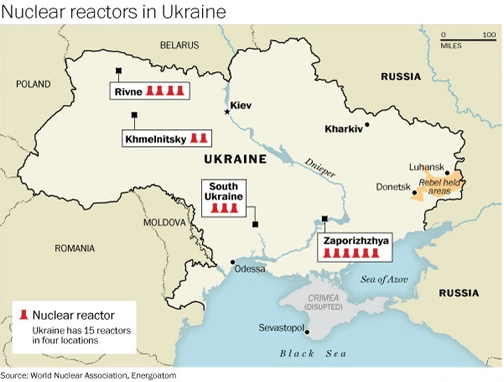
A Ukraine Invasion Could Go Nuclear: 15 Reactors Would Be In War Zone https://www.forbes.com/sites/craighooper/2021/12/28/a-ukraine-invasion-will-go-nuclear-15-reactors-are-in-the-war-zone/?sh=1c9a8a0a27aa&fbclid=IwAR1k5sz1_5PLOb7Lg6qMjULu_lj0nqF-6SXx7NifPxr6uakDliSUlgyHFqI Craig HooperSenior Contributor
As Russia’s buildup on the Ukrainian border continues, few observers note that an invasion of Ukraine could put nuclear reactors on the front line of military conflict. The world is underestimating the risk that full-scale, no-holds-barred conventional warfare could spark a catastrophic reactor failure, causing an unprecedented regional nuclear emergency.
The threat is real. Ukraine is heavily dependent upon nuclear power, maintaining four nuclear power plants and stewardship of the shattered nuclear site at Chernobyl. In a major war, all 15 reactors at Ukraine’s nuclear power facilities would be at risk, but even a desultory Russian incursion into eastern Ukraine is likely to expose at least six active reactors to the uncertainty of a ground combat environment.
The world has little experience with reactors in a war zone. Since humanity first harnessed the atom, the world has only experienced two “major” accidents—Chernobyl and Japan’s Fukushima disaster. A Russian invasion, coupled with an extended conventional war throughout Ukraine, could generate multiple International Atomic Energy Agency “Level 7” accidents in a matter of days. Such a contingency would induce a massive refugee exodus and could render much of Ukraine uninhabitable for decades.
Turning the Ukraine into a dystopian landscape, pockmarked by radioactive exclusion zones, would be an extreme method to obtain the defensive zone Russian President Vladimir Putin seems to want. Managing a massive Western-focused migratory crisis and environmental cleanup would absorb Europe for years. The work would distract European leaders and empower nativist governments that tend to be aligned with Russia’s baser interests, giving an overextended Russia breathing room as the country teeters on the brink of technological, demographic, and financial exhaustion.
Put bluntly, the integrity of Ukrainian nuclear reactors is a strategic matter, critical for both NATO and non-NATO countries alike. Causing a severe radiological accident for strategic purposes is unacceptable. A deliberate aggravation of an emerging nuclear catastrophe—preventing mitigation measures or allowing reactors to deliberately melt down and potentially contaminate wide portions of Europe—would simply be nuclear warfare without bombs.
Such a scenario can’t be ruled out. Russia has repeatedly used Ukraine to test out concepts for “Gray Zone” warfare, where an attacker dances just beyond the threshold of open conflict. Given Russia’s apparent interest in radiation-spewing nuclear-powered cruise missiles, robotic undersea bombs with a radiological fallout-oriented payload, destructive anti-satellite tests and other nihilistic, world-harming weapons, Russia’s ongoing dalliance with “Gray Zone” warfare in Ukraine may, for the rest of Europe, become a real matter of estimating radiological “grays,” or, in other words, estimating the amount of ionizing radiation absorbed by humans.
When War Comes To Zaporizhzhia
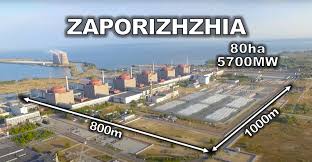
Ukraine’s Zaporizhzhia nuclear power plant is a particular risk. It is the second-largest nuclear power plant in Europe (essentially tied with a French reactor complex near Calais), and one of the 10 largest nuclear power plants in the world. The site has little protection, and the six VVER-1000 pressurized water reactors could easily be embroiled in any Russian invasion.
If war comes, the fight will be close by. The Zaporizhzhia nuclear power plant is located only 120 miles from the current “front line” in the Donbass region and is on the hard-to-defend east bank of the Dnieper River. Aside from the geographical hazards, the power plant provides about a quarter of Ukraine’s total electrical power. Given the importance of the electricity, plant managers will be reluctant to shut it down, securing the reactors only at the very last possible second. Ukraine’s desperate need for energy only compounds the opportunities for an accident.
Outside of direct battle damage, cyber and other Russian-sourced “grey zone” mischief could make the plant unmanageable even before the battle arrives at the reactor gates.
Though unlikely, direct bombardment could cause serious damage to reactor containment structures. While the reactor structures themselves are strong, warfare at the plant could kill key personnel and destroy command-and-control structures, monitoring sensors or critical reactor-cooling infrastructure. And, as an operating power plant, the reactors are not the only threat. Dangerous spent fuel rods are sitting in vulnerable cooling ponds, while older fuel sits in the site’s 167 dry spent fuel assemblies.
If the reactors suffer any operational anomalies, crisis management is not going to happen. Support infrastructure needed for safe reactor management will collapse during conflict. Plant security forces will disappear, operators will flee, and, if an accident occurs, mitigating measures will be impossible.
It seems unlikely that Russia has mobilized trained reactor operators and prepared reactor crisis-management teams to take over any “liberated” power plants. The heroic measures that kept the Chernobyl nuclear accident and Japan’s Fukushima nuclear disaster from becoming far more damaging events just will not happen in a war zone.
Again, the risks are very high. The world has never dealt with an unmanaged meltdown at a large nuclear power plant. The very real prospect of an extended and unmitigated incident at a six-reactor powerplant in a war zone is worth urgent and immediate consultations throughout Europe and NATO.
Gray Zone Nuclear Conflict Can Happen
The world has never experienced war that threatens active nuclear power infrastructure, and world leaders may be underestimating the peril conventional warfare presents to these powerful and perilous assets.
On the other hand, heedless purveyors of “gray zone” warfare may be underestimating the risk themselves, all too eager to determine just how degraded nuclear infrastructure might serve as a “less risky” surrogate for nuclear conflict.
To them, it’s not nuclear war, but just a series of unfortunate nuclear accidents.
Thorium and nuclear weapons.
The Hype About Thorium Reactors, by Gordon Edwards, Canadian Coalition for Nuclear Responsibility, December 26 2021.
There has recently been an upsurge of uninformed babble about thorium as if it were a new discovery with astounding potentiality. Some describe it as a nearly miraculous material that can provide unlimited amounts of problem-free energy. Such hype is grossly exaggerated.
Thorium and Nuclear Weapons
One of the most irresponsible statements is that thorium has no connection with nuclear weapons. On the contrary, the initial motivation for using thorium in nuclear reactors was precisely for the purposes of nuclear weaponry.
It was known from the earliest days of nuclear fission that naturally-occurring thorium can be converted into a powerful nuclear explosive – not found in nature – called uranium-233, in much the same way that naturally-occurring uranium can be converted into plutonium.
Working at a secret laboratory in Montreal during World War II, nuclear scientists from France and Britain collaborated with Canadians and others to study the best way to obtain human-made nuclear explosives for bombs. That objective can be met by converting natural uranium into human-made plutonium-239, or by converting natural thorium into human-made uranium-233. These conversions can only be made inside a nuclear reactor.
The Montreal team designed the famous and very powerful NRX research reactor for that military purpose as well as other non-military objectives. The war-time decision to allow the building of the NRX reactor was made in Washington DC by a six-person committee (3 Americans, 2 Brits and 1 Canadian) in the spring of 1944.
The NRX reactor began operation in 1947 at Chalk River, Ontario, on the Ottawa River, 200 kilometres northwest of the nation’s capital. The American military insisted that thorium rods as well as uranium rods be inserted into the reactor core. Two chemical “reprocessing” plants were built and operated at Chalk River, one to extract plutonium-239 from irradiated uranium rods, and a second to extract uranium-233 from irradiated thorium rods. This dangerous operation required dissolving intensely radioactive rods in boiling nitric acid and chemically separating out the small quantity of nuclear explosive material contained in those rods. Both plants were shut down in the 1950s after three men were killed in an explosion.
The USA detonated a nuclear weapon made from a mix of uranium-233 and plutonium-239 in 1955. In that same year the Soviet Union detonated its first H-bomb (a thermonuclear weapon, using nuclear fusion as well as nuclear fission) with a fissile core of natural uranium-235 and human-made uranium-233.
In 1998, India tested a nuclear weapon using uranium-233 as part of its series of nuclear test explosions in that year. A few years earlier, In 1994, the US government declassified a 1966 memo that states that uranium-233 has been demonstrated to be highly satisfactory as a weapons material.
Uranium Reactors are really U-235 reactors
Uranium is the only naturally-occurring material that can be used to make an atomic bomb or to fuel a nuclear reactor. In either case, the energy release is due to the fissioning of uranium-235 atoms in a self-sustaining “chain reaction”. But uranium-235 is rather scarce. When uranium is found in nature, usually as a metallic ore in a rocky formation, it is about 99.3 percent uranium-238 and only 0.7 percent uranium-235. That’s just seven atoms out of a thousand!
Uranium-238, the heavier and more abundant isotope of uranium, cannot be used to make an A-Bomb or to fuel a reactor. It is only the lighter isotope, uranium-235, that can sustain a nuclear chain reaction. If the chain reaction is uncontrolled, you have a nuclear explosion; if it is controlled, as it is in a nuclear reactor, you have a steady supply of energy.
But you cannot make a nuclear explosion with uranium unless the concentration of uranium-238 is greatly reduced and the concentration of uranium-235 is drastically increased. This procedure is called “uranium enrichment”, and the enrichment must be to a high degree – preferably more than 90 percent U-235, or at the very least 20 percent U-235 – to get a nuclear explosion. For this reason, the ordinary uranium fuel used in commercial power reactors is not weapons-usable; the concentration of U-235 is typically less than five percent.
However, as these uranium-235 atoms are split inside a nuclear reactor, the broken fragments form new smaller atoms called “fission products”. There are hundreds of varieties of fission products, and they are collectively millions of times more radioactive than the uranium fuel itself. They are the main constituents of “high-level radioactive waste” (or “irradiated nuclear fuel”) that must be kept out of the environment of living things for millions of years.
In addition, stray neutrons from the fissioning U-235 atoms convert many of the uranium-238 atoms into atoms if plutonium-239. Reactor-produced plutonium is always weapons-usable, regardless of the mixture of different isotopes; no enrichment is needed! But that plutonium can only be extracted from the used nuclear fuel by “reprocessing” the used fuel. That requires separating the plutonium from the fiercely radioactive fission products that will otherwise give a lethal dose of radiation to workers in a short time.
Thorium Reactors are really U-233 reactors
Unlike uranium, thorium cannot sustain a nuclear chain reaction under any circumstances. Thorium can therefore not be used to make an atomic bomb or to fuel a nuclear reactor. However, if thorium is inserted into an operating nuclear reactor (fuelled by uranium or plutonium), some of the thorium atoms are converted to uranium-233 atoms by absorbing stray neutrons. That newly created material, uranium-233, is even better than uranium-235 at sustaining a chain reaction. That’s why uranium-233 can be used as a powerful nuclear explosive or as an exemplary reactor fuel.
But thorium cannot be used directly as a nuclear fuel. It has to be converted into uranium-233 and then the human-made isotope uranium-233 becomes the reactor fuel. And to perform that conversion, some other nuclear fuel must be used – either enriched uranium or plutonium
Of course, when uranium-233 atoms are split, hundreds of fission products are created from the broken fragments, and they are collectively far more radioactive than the uranium-233 itself – or the thorium from which it was created. So once again, we see that high-level radioactive waste is being produced even in a thorium reactor (as in a normal present-day uranium reactor).
In summary, a so-called “thorium reactor” is in reality a uranium-233 reactor.
Some other nuclear fuel (enriched uranium-235 or plutonium) must be used to convert thorium atoms into uranium-233 atoms. Some form of reprocessing must then be used to extract uranium-233 from the irradiated thorium. The fissioning of uranium-233, like the fissioning of uranium-235 or plutonium, creates hundreds of new fission products that make up the bulk of the high-level radioactive waste from any nuclear reactor. And, as previously remarked, uranium-233 is also a powerful nuclear explosive, posing serious weapons proliferation risks. Moreover, uranium-233 – unlike the uranium fuel that is currently used in commercial power reactors around the world – is immediately usable as a nuclear explosive. The moment uranium-233 is created it is very close to 100 percent enriched – perfect for use in any nuclear weapon of suitable design.
Uranium-232 — A Fly in the Ointment
Continue readingUSA is examining its ”nuclear declaratory policy”, while Biden considers how to reduce the role of nuclear weapons.
Nuclear declaratory policy examined as Biden eyes curbing nukes, By Ryohei Takagi, KYODO NEWS , 26 Dec 21, The United States is examining its “declaratory policy” on the use of nuclear arms under President Joe Biden’s commitment to seeking to reduce the role of such weaponry, the State Department’s top arms control official Bonnie Jenkins said recently.
Her remarks came as focus is increasing on whether the Biden administration will declare the “sole purpose” of U.S. nuclear forces is to deter or respond to nuclear attacks in its upcoming nuclear posture review, a guideline for American nuclear policy for the coming years………….
The U.S. nuclear declaratory policy has so far centered on what is known as “strategic ambiguity” regarding the exact circumstances that might lead to a nuclear response, though efforts have been seen in the past to offer clarification.
Former President Barack Obama, who pledged in 2009 to pursue a world free of nuclear weapons, considered adopting a “no first use” policy, which would mean limiting the U.S. use of nuclear weapons only in response to nuclear attacks on itself or allies.
But his administration gave up the idea in the face of objections from some allies including Japan.
The Financial Times reported early this month that U.S. officials have reassured allies in Europe and Asia that Biden, who was vice president during the Obama administration, will not adopt a “no first use” policy. The officials will provide the president with options for a “sole purpose” declaratory policy, the newspaper said.
The sole purpose posture could leave open the possibility of using nuclear weapons first, if it were the only way to preempt an imminent nuclear attack by a country such as North Korea, pundits say.
Still, it could demonstrate a more restrained approach toward the use of U.S. nuclear weapons compared with the 2018 nuclear posture review compiled under Biden’s predecessor Donald Trump. Under the former leader, the possibility remained nuclear weapons could be used not only against nuclear attacks but against “significant” non-nuclear attacks………………………… https://english.kyodonews.net/news/2021/12/3b69a0d35603-nuclear-declaratory-policy-examined-as-biden-eyes-curbing-nukes.html
Iran Simulated Attack On Israel’s Dimona Nuclear Site In Recent Wargames
Iran Simulated Attack On Israel’s Dimona Nuclear Site In Recent Wargames, Iran International, 26 Dec 21, Iran simulated an attack against Israel’s Dimona nuclear reactor during extensive military drills this week, that included launching multiple ballistic missiles.
Fars news agency, an affiliate of Iran’s Revolutionary Guard, published a video on Sunday that shows a mock-up of the Israeli nuclear site as the target of the simulated operation.
The Dimona reactor, officially known as the Shimon Peres Negev Nuclear Research Center, was marked as “WMD production center” in the high-resolution video.
Sixteen ballistic missiles and five suicide drones were launched against the mock target in the operation.
Rhetoric has intensified between Iran and Israel in recent weeks as nuclear talks between Tehran and world powers have stalled in Vienna. Israel has vowed that if Iran’s nuclear program reaches a statge close to production of weapons, it will act regardless of an agreement the United States and other world powers reach with Tehran……………. https://www.iranintl.com/en/202112260336
Depleted uranium exports to Russia are not a ”resource” – they are radioactive waste
Our conclusion is that this form of TENORM (technically enhanced naturally occurring radioactive material) should be considered in principle as a waste material, for which full transparency should be assured over its complete chain of management,
DU Exports to Russia – A case of lack of transparency and research Nuclear Transparency Watch By Jan Haverkamp (Greenpeace, WISE) December 21,
From 1996, the uranium enrichment facilities URENCO Almelo (Netherlands) and URENCO Gronau (Germany) regularly sent shipments of depleted uranium (DU) in the form of UF6 (uranium hexafluoride) to TENEX, later TVEL, in Russia, where this was stored in the open air in Seversk in the Krasnoyarsk region. Protests in Europe then halted these transports in 2009. TVEL is since 2007 a subsidiary of the Russian nuclear giant Rosatom. URENCO carries out enrichment for nuclear fuel production from natural uranium to low-enriched uranium for clients all over the world and has facilities in the Netherlands, Germany and the UK.
In 2019 and 2020, these transports were resumed from the enrichment facility of URENCO Gronau and URENCO UK in Capenhurst.
URENCO Almelo currently has a permit for export, but does not use it. Its DU is sent to France for conversion into stable U3O8 (depleted tri-uranium-octo-oxide or uranium oxide), which is returned to the Netherlands and handed over to the waste management organisation COVRA for interim storage in the VOG facility, awaiting final disposal after 2100.
The claim is that the DU is sent to TENEX, later TVEL, for re-enrichment to natural level and reuse of the resulting double depleted uranium (DDU). Rosatom furthermore claims[2] that DDU and DU are used industrially and that the UF6 also delivers fluorine for reuse purposes. It furthermore, describes in detail how it wants to convert its UF6 stockpile into uranium oxide for waste treatment before 2057.
Continue readingUSA puts pressure on Japan to not attend nuclear ban treaty meeting, not even as an observer

U.S. urges Japan not to join nuclear ban treaty meeting: sources KYODO NEWS 20 Dec 21, The United States has urged Japan not to attend as an observer the first meeting of signatories to a U.N. treaty banning nuclear weapons, according to U.S. government sources, reflecting Washington’s opposition to the pact.The Japanese government has suggested it will come into line with the United States and take a cautious approach to the issue, the sources said. Prime Minister Fumio Kishida told a parliamentary committee on Thursday that Tokyo has no “concrete plans” to attend the meeting as an observer.
The sources said the U.S. administration of President Joe Biden made the request to Japan through diplomatic channels after German political parties announced Nov. 24 that the deal for the new ruling coalition included taking part as an observer at the meeting scheduled for March in Vienna.
Maybe because of the request, Kishida also suggested last week that participation in the meeting would be premature “before building a relationship of trust with President Biden.”
Germany’s move has put Japan — which has stated it aspires to a world free of nuclear weapons as the only country to have suffered the devastation of atomic bombings — in the spotlight. Both countries are key U.S. allies that rely on American nuclear forces for protection.
The U.S. government has maintained its opposition to the Treaty on the Prohibition of Nuclear Weapons, which entered into force in January this year, even as Biden has pledged to strive for a world without nuclear weapons………..
The U.S. government is also calling on the new three-party German government, launched in December, to give up on the idea of taking part in the March 22-24 meeting in Vienna, according to the sources.
The new U.N. treaty completely outlaws the development, testing, possession and use of nuclear weapons. It only binds states that have formally signed and ratified it.
More than 50 countries, including Austria, Malaysia, Mexico, New Zealand, the Philippines, South Africa and Vietnam, have ratified the pact, according to the website of the U.N. Office for Disarmament Affairs.
But nuclear weapon states, including the United States, Russia and China, are not signatories. Japan has also refrained from signing the pact in consideration of its long-standing security alliance with the United States. https://english.kyodonews.net/news/2021/12/54ab486540a3-us-urges-japan-not-to-join-nuclear-ban-treaty-meeting-sources.html
Report: “Moving Beyond Missile Defense and Space Weapons”
Report of the International Working Group “Moving Beyond Missile Defense and Space Weapons”http://inesglobal.net/MBMDS-report/
Read the executive summary of the report: Executive Summary MDMDS-Report.
On November 20, 2000, the U.N. General Assembly, by a vote of 97 to 0 with 65 abstentions, adopted a resolution demanding a comprehensive approach to missiles that would “contribute to international peace and security.” The resolution gave impetus to civil society to take up the issue. One such initiative was a project by the International Network of Engineers and Scientists Against Proliferation (INESAP)1. They produced a report called Beyond Missile Defense by an international team of scientists and policy analysts. Jayantha Dhanapala, then U.N. Under-Secretary General for Disarmament, forwarded the report to the U.N. General Assembly in 2002. They made a number of far-reaching recommendations, summarized later, to develop a verifiable global treaty to ban the development, testing, proliferation, and the acquisition of missiles.
It has been two decades since the above-mentioned U.N. resolution and the publication of the INESAP report. During this time there has been little or no action toward controlling missiles and missile defense systems. On the contrary, a signal event took place within a short time after the U.N. resolution. It was the U.S. unilateral withdrawal on July 1, 2002 from the Anti-Ballistic Missile (ABM) Treaty, which served for thirty years as a landmark in the history of arms control agreements. In the post-ABM treaty years, there has been proliferation of both missiles and missile defense systems. Our focus for this report is global missile defense systems, because of their adverse impact on strategic stability.
Similar to the previous effort, INES organized anew an international working group in the summer of 2016 to study the consequences for international peace and security resulting from both the ongoing development and deployment of missile defense systems globally as well as the programs to develop weapons in space. From the start, the group reached a conclusion that, as desirable as it might be, it would not be practical to advocate a global missile ban in the present internationa
l situation. The focus instead should be on banning missile defense systems and space weapons. In a nutshell, this report focuses on two subject areas, namely, missile defense and the weaponization of space. It explores the linkages between the two in the larger context of nuclear arms control and disarmament.
The membership of the working group is described elsewhere. It is important to note that the membership represents a broad spectrum of people who are individually affiliated to civil society organizations and universities. Some are former government officials and others are independent analysts.
Because of unforeseen circumstances, the work of the group could not proceed as planned. The present report is the product of mostly individual efforts in writing specific sections. In addition to the members of the original group, who contributed to the report, we invited several scholars outside the group to contribute. While we generally agree on the broad parameters of our analysis, it is by no means a consensus document. Therefore, the views expressed in the articles are solely those of the respective authors.
Download the Sections of the Report
- The 2001-2006 INESAP project Moving Beyond Missile Defense
A brief summary – Jürgen Scheffran - The U.S. missile defense systems – history, politics, waste, and fraud
- The Anti-Ballistic Missile Treaty
The impact of the ABM treaty on the nuclear arms race – Claus Montonen - The U.S. missile defense programs
The status of the U.S. missile defense programs – Christian Alwardt - European and NATO Missile Defense Programs
The Deployment of missile defense systems and its implications for European Security and Nuclear Disarmament – Götz Neuneck
Missile proliferation and missile defense systems in East Asia
Missile Proliferation and the Security Dilemma in East Asia – Masako Ikegami- A critical examination of the U.S. missile defense program: a view from Moscow
Evolution of the U.S, Missile Defense Systems: a Russian Perspective – Vladimir Kozin - Ballistic Missile and Missile Defense programs in India
Ballistic Missile and Ballistic Missile Defense capability in India – Rajaram Nagappa - The evolution of the public perception of space as a battleground
Public Acceptance of Space as a Battleground – Monica Zoppe - Preventing weaponization and an arms race in outer space
Prevention of Arms Race in Outer Space: obstacles and options – Dave Webb and Jürgen Scheffran - Weaponization of space: a view from India
India and weaponization of space – Rajaram Nagappa - The interchangeability of antisatellite and missile defense systems
Anti-Satellite Weapons and Ballistic Missile Defense: the Siamese Twins? – Dave Webb and Jürgen Scheffran - Weaponization of space: a Russian view
The United States seeks domination in space – Vladimir Kozin - Nuclear weapons, disarmament, and missile defense: a Chinese perspective
China’s nuclear weapons strategy and modernization program – Hui Zhang - The Pentagon’s secret X-37B space plane program tocdevelop space weapons technology
X-37B: Backdoor weaponization of space? – Subrata Ghoshroy - International Control of Delivery Systems: Towards a Ballistic Missile Ban
Jürgen Scheffran
Do you want to have printed copies of the executive summary of the report?
Please contact us at lucas.wirl@inesglobal.net.
1 This Month





PLEASE OPPOSE HR 8255 AND S.3639 – bills would accelerate satellite deployment, with no environmental review or safeguards – https://ncstd5li.quorum.us/campaign/169331/
To see nuclear-related stories in greater depth and intensity – go to https://nuclearinformation.wordpress.com
-
Archives
- October 2026 (39)
- September 2026 (339)
- August 2026 (330)
- July 2026 (355)
- June 2026 (287)
- May 2026 (306)
- April 2026 (356)
- March 2026 (251)
- February 2026 (267)
- January 2026 (308)
- December 2025 (358)
- November 2025 (359)
-
Categories
- 1
- 1 NUCLEAR ISSUES
- business and costs
- climate change
- culture and arts
- ENERGY
- environment
- health
- history
- indigenous issues
- Legal
- marketing of nuclear
- media
- opposition to nuclear
- PERSONAL STORIES
- politics
- politics international
- Religion and ethics
- safety
- secrets,lies and civil liberties
- spinbuster
- technology
- Uranium
- wastes
- weapons and war
- Women
- 2 WORLD
- ACTION
- AFRICA
- Atrocities
- AUSTRALIA
- Christina's notes
- Christina's themes
- culture and arts
- Events
- Fuk 2022
- Fuk 2023
- Fukushima 2017
- Fukushima 2018
- fukushima 2019
- Fukushima 2020
- Fukushima 2021
- general
- global warming
- Humour (God we need it)
- Nuclear
- RARE EARTHS
- Reference
- resources – print
- Resources -audiovicual
- Weekly Newsletter
- World
- World Nuclear
- YouTube
-
RSS
Entries RSS
Comments RSS

