Los Alamos Study Group outlines a clear solution to the Ukraine war

Understanding why Russia invaded is not condoning the invasion. Russia’s view is that of existential dangers to its very existence. …… Russia’s view has to be respected, whether or not we agree with it. Failure by the U.S. and NATO over the course of decades to respect Russia’s position, and to provide a humane and reasonable provision for Russia’s security needs is the main if not the only material cause of the present conflict.
An end to the invasion and war in Ukraine can only be guaranteed if Russia’s security is itself guaranteed. …… The fundamental cause of the current conflict is the desire of the U.S. to weaken or “break”Russia.
A Proposed Solution to the Ukraine War
An end to the invasion and war in Ukraine can only be guaranteed if Russia’s security is itself guaranteed. Security is largely indivisible. Security for one state requires security for others, says the Los Alamos Study Group.
Consortium News By Greg Mello, March 7, 2022
Los Alamos Study Group Since the Russian invasion of Ukraine began, what was a regional conflict has become a global hybrid war with ever-greater stakes, not least the risk of nuclear war.
Perhaps the greatest danger lies in the difference of motives between parties, which is also the fundamental cause of this war: Russia seeks security, while the U.S. and its NATO allies have been using Ukraine to deny that security — to “break Russia,” in Henry Kissinger’s 2015 phrase. The U.S. does not want peace, unless it be the peace of a conquered Russia. That is why there is no obvious end to the escalations and counter-escalations. The U.S. and NATO see opportunity in the war they have been trying so hard to provoke.
The tragedy is that few people seem to understand that at the root of the Ukraine crisis is a specific strategy known as the Wolfowitz Doctrine, named after Paul Wolfowitz who, as under secretary of defense in the administration of George H. W. Bush, was one of the authors of a 1992 document that laid out a neo-conservative manifesto aimed at ensuring American dominance of world affairs following the collapse of the Soviet Union………….
The Wolfowitz Doctrine triggered the post-Cold War use of NATO as an instrument of bloody aggression against Yugoslavia, Afghanistan, Iraq and Libya. It declared, in effect, that diplomacy was dead and that American power ruled by violence if necessary. A resurgent Russia led by Vladimir Putin was next, and on the horizon, a risen China.
The 2014 Washington-engineered coup in Ukraine that removed an elected leader who sought to reinforce his country’s relationship with neighboring Russia, was a product of the 1992 Doctrine and the extremism it represented. Victoria Nuland, a neo-conservative ideologue and President Barack Obama’s “point person” in Ukraine, has played the same role in President Joe Biden’s State Department.
The 1992 Doctrine is elaborated in an infamous RAND study on how to overextend and, in Kissinger’s words, “break Russia.” This is U.S. foreign policy today: a fact well understood by the Russian leadership who regard their country as effectively under siege by the United States.
The potential of American missiles pointed at Moscow from former Soviet satellite countries, together with NATO troop deployments, is the reality they see. A militarized and virulently anti-Russian Ukraine being used as a tool by the U.S., with an expressed wish for nuclear weapons, on the brink of invading Russian-sympathizing provinces on the Russian border — all that was too much for Russia. What, do you suppose, the U.S. would do if such a situation arose in Mexico or Canada?The potential of American missiles pointed at Moscow from former Soviet satellite countries, together with NATO troop deployments, is the reality they see. A militarized and virulently anti-Russian Ukraine being used as a tool by the U.S., with an expressed wish for nuclear weapons, on the brink of invading Russian-sympathizing provinces on the Russian border — all that was too much for Russia. What, do you suppose, the U.S. would do if such a situation arose in Mexico or Canada?
Since 2014, the Las Alamos Study Group has made it part of our business to understand the conflict in Ukraine and its significance for the world. In that year we held public meetings and teach-ins discussing it and since then have tried to examine developments as we could. In the Obama Administration, we took our concerns to the offices of the National Security Council — and were appalled by the lack of knowledge and understanding we found there.
Many non-governmental organizations (NGOs) have taken positions on this conflict. In our view, most (not all) of their statements are superficial, and/or omit the causes of the invasion as Russia understands them, or are in lock-step with U.S. and NATO propaganda.
The Study Group’s Basic Conclusions
- Understanding why Russia invaded is not condoning the invasion. Russia’s view is that of existential dangers to its very existence. The sincerity of that view is evident in the grave risks Russia is taking in this invasion which, again, we need neither justify nor condemn. Russia’s view has to be respected, whether or not we agree with it. Failure by the U.S. and NATO over the course of decades to respect Russia’s position, and to provide a humane and reasonable provision for Russia’s security needs is the main if not the only material cause of the present conflict.
- Telling Russia what to do is the problem, not the solution. We in NATO countries and in the West more broadly, and in peace-oriented groups, should confine our imperatives and judgments to what we ourselves can do, in our own countries and in relation to NATO. It is imperative to bring peace to Ukraine as best we can and to not inflame or broaden this conflict further. Our words can kill, or heal.
- An end to the invasion and war in Ukraine can only be guaranteed if Russia’s security is itself guaranteed. Security is largely indivisible. Security for one state requires security for others. This is a core principle of European security which Russia rightly insists upon. The U.S. should honor that. The fundamental cause of the current conflict is the desire of the U.S. to weaken or “break”Russia.
- Human rights, including the right of political self-determination, are pillars of Western values and institutions. The government of Ukraine has denied human rights and political self-determination to the peoples of the Donbass. Some 13,000 people have died during the eight years since the 2014 coup, according to the United Nations. The Ukrainian government has overtly genocidal policies toward Russian minorities. Since the 2014 U.S. sponsored coup, the U.S. and its European allies have used Ukraine to undermine Russian security.
- Nazi and neo-Nazi formations and ideologies in Ukraine present a clear danger to human rights and human life everywhere.
- Peace and nuclear disarmament organizations should be alarmed by NGO support for U.S. efforts to demonize and destabilize Russia.
What the Study Group Wants
1. We want a negotiated peace at the earliest possible time. In our own countries, every effort should be made to achieve this. We do not see those efforts.
2. We want an end to further escalation and broadening of the conflict, which threatens the well-being and security of the whole world. None of our countries should be introducing or transporting arms or conducting military activities or providing training or support of any kind in Ukraine. Peace groups should oppose all such escalation. “Helping Ukraine” with military “aid” is just a way of getting more people killed in the service of long-term U.S. aims to destroy the Russia.
3. Weapons should not be provided to civilian individuals, gangs, criminals, children, and “stay-behind,” guerrilla, or Volkssturmgroups. This only inflicts needless suffering and damages prospects for peace now and in the long run. There is no honor or legitimacy in such tactics in the present circumstances.
4. All economic sanctions – which hurt ordinary citizens more than elites – should be lifted. Economic sanctions are weapons of mass destruction, with global effects.
5. We want measured, just, de jure de-nazification of the Ukrainian government and laws.
6. The independence of the Donbass region within pre-conflict administrative boundaries should be accepted by all peace organizations and states.
7. The democratic decision of Crimea to rejoin Russia should be accepted by all peace organizations and states.
8. Peace groups should support a neutral, demilitarized (i.e. without heavy weapons or force projection capability) Ukraine, which is similar if not identical to the outcome sought by Russia.
9. Civilian areas must not be used as military staging or artillery bases. This is illegal, in fact. There is evidence that the Ukrainian Armed Forces are engaging in this odious practice.
10. Ukraine should not be allowed to join NATO. That was a capital demand of Russia and one that we should all support.
11. NATO should disband. The largest military alliance in the world, NATO consumes more resources than all the world’s militaries combined, and has conducted multiple wars of aggression, in violation of the U.N. Charter and Nuremberg principles. NATO is also a nuclear weapons alliance.
12. The U.S. and the five states that host U.S. nuclear weapons should, jointly or individually, end nuclear hosting arrangements, as well as end the training of non-U.S. pilots in nuclear weapons use and the prospective use of non-U.S. dual-capable aircraft for nuclear missions.
13. Clearly, all of the above is urgent if the killing is to end, and there is to be a lasting peace in Europe.
Greg Mello is the executive director of the Los Alamos Study Group in Albuquerque, New Mexico. https://consortiumnews.com/2022/03/07/a-proposed-solution-to-the-ukraine-war/
USA cheers Ukrainian fighters on, makes sure to keep Americans out of it.
US Policy: Cheer Ukrainians On – and Keep Us Out! Anti War.com by Patrick J. Buchanan March 08, 2022
After Friday’s NATO summit refused to establish a no-fly zone over Ukraine, President Volodymyr Zelensky said the allies’ failure to “close the skies” to Russian military aircraft gives “a green light for further bombing of Ukrainian cities.”
“All the people who will die starting from this day will … die because of you,” said Zelensky to NATO, “because of your weakness.”
Zelensky’s indictment of NATO for cowardice came after NATO Secretary General Jens Stoltenberg ruled out a no-fly zone:
“NATO is not party to the conflict. NATO is a defensive alliance. … We don’t seek war, conflict with Russia. … We should not have NATO planes operating over Ukrainian airspace or NATO troops on Ukrainian territory.”
Secretary of State Antony Blinken echoed Stoltenberg:
“Ours is a defensive alliance. We seek no conflict. … President Biden has been clear that we are not going to get into a war with Russia.”
Sunday, Blinken expanded:
President Joe Biden has “a responsibility to not get us into a direct conflict, a direct war with Russia, a nuclear power, and risk a war that expands even beyond Ukraine to Europe. … What we’re trying to do is end this war in Ukraine, not start a larger one.”
U.S. policy in summary: Ukrainians should keep fighting and dying, killing Russians, while we stay out – and cheer them on.
In the greatest European military crisis since NATO was founded, U.S. actions and inaction speak louder than its words.
Simply put, establishing a no-fly zone over Ukraine would entail U.S. planes and pilots shooting down Russia’s planes and pilots. This would mean war between Russia and America. Given Russian military doctrine, such a war could swiftly escalate to the use of tactical nuclear weapons.
Bottom line: We are not willing to risk war with Russia over Ukraine, as that nation of 44 million is not a vital interest nor a member of NATO.
We will not establish a no-fly zone over Ukraine, as that would mean war with Russia. But had Russia attacked Estonia, not Ukraine, we would be at war with Russia, because Estonia is a member of NATO……………….
Russian President Vladimir Putin has been clear and convincing.
Any attempt to establish a no-fly zone over Ukraine will be treated as an act of war. And Russia reserves the right to attack any nation whose planes are enforcing this no-fly zone.
As for the transfer from former Warsaw Pact countries like Poland of older MiGs to Ukraine, for use against Russian troops, says Putin, this would be an act of war, and Russia would retaliate against the nations putting the MiGs into the fight.
Biden also met last week with President Sauli Niinisto of Finland, a neutral nation that shares an 833-mile border with Russia. Niinisto may be considering membership in NATO.
Yet, this presents problems, among them the warning Friday from the Russian Foreign Ministry’s Maria Zakharova:
“We regard the Finnish government’s commitment to a military non-alignment policy as an important factor in ensuring security and stability in northern Europe. … Finland’s accession to NATO would have serious military and political repercussions.”……………….
Did Ukraine’s trolling for membership in NATO trigger Putin’s war?
Friday’s Wall Street Journal writes:
“The Russian invasion of Ukraine resulted from two immense strategic blunders, (Russian historian) Robert Service says. The first came on Nov. 10, when the U.S. and Ukraine signed a Charter on Strategic Partnership, which asserted America’s support for Kyiv’s right to pursue membership in the North Atlantic Treaty Organization. The pact made it likelier than ever that Ukraine would eventually join NATO – an intolerable prospect for Vladimir Putin. ‘It was the last straw,’ Mr. Service says. Preparations immediately began for Russia’s so-called special military operation in Ukraine.”
An alliance established to prevent war may have just ignited one. https://original.antiwar.com/buchanan/2022/03/07/us-policy-cheer-ukrainians-on-and-keep-us-out/
Serbia will not join NATO, will never forget bombing victims – president — Anti-bellum
B92March 9, 2022 Vučić in Kuzmin: We won’t join NATO, we want to protect our country on our own The citizens of Kuzmin gathered in large numbers to welcome the President of Serbia and the Serbian Progressive Party, Aleksandar Vučić. *** “We will not join NATO, we want to protect our country and our sky […]
Serbia will not join NATO, will never forget bombing victims – president — Anti-bellum
Serbian parliament president: When Hitler entered Ukraine, the U.S. did not declare war — Anti-bellum
B92March 2, 2022 “We have died for the sake of others; they aren’t against Russia, but against Serbia” ==== Also see: Serbia is only free country in Europe, only one not obeying NATO’s orders – official Serbia: West plans to oust Russia from UN, trigger total collapse of existing order ==== Speaker of the National […]
Serbian parliament president: When Hitler entered Ukraine, the U.S. did not declare war — Anti-bellum
Russia prepared to stop war, if Ukraine agrees to conditions, including independence of Donbass areas

Russia will stop ‘in a moment’ if Ukraine meets terms – Kremlin, https://www.swissinfo.ch/eng/russia-will-stop–in-a-moment–if-ukraine-meets-terms—kremlin/47409340 Mon, March 7, By Catherine Belton, LONDON (Reuters) -Russia has told Ukraine it is ready to halt military operations “in a moment” if Kyiv meets a list of conditions, the Kremlin spokesman said on Monday.
Dmitry Peskov said Moscow was demanding that Ukraine cease military action, change its constitution to enshrine neutrality, acknowledge Crimea as Russian territory, and recognise the separatist republics of Donetsk and Lugansk as independent states.
It was the most explicit Russian statement so far of the terms it wants to impose on Ukraine to halt what it calls its “special military operation”, now in its 12th day.
Peskov told Reuters in a telephone interview that Ukraine was aware of the conditions. “And they were told that all this can be stopped in a moment.”
There was no immediate reaction from the Ukrainian side.
Russia has attacked Ukraine from the north, east and south, pounding cities including Kyiv, Kharkiv and the port of Mariupol. The invasion launched on Feb. 24, has caused the worst refugee crisis in Europe since World War Two, provoked outrage across the world, and led to heavy sanctions on Moscow.
But the Kremlin spokesman insisted Russia was not seeking to make any further territorial claims on Ukraine and said it was “not true” that it was demanding Kyiv be handed over.
“We really are finishing the demilitarisation of Ukraine. We will finish it. But the main thing is that Ukraine ceases its military action. They should stop their military action and then no one will shoot,” he said.
On the issue of neutrality, Peskov said: “They should make amendments to the constitution according to which Ukraine would reject any aims to enter any bloc.”
He added: “We have also spoken about how they should recognise that Crimea is Russian territory and that they need to recognise that Donetsk and Lugansk are independent states. And that’s it. It will stop in a moment.”
NEW TALKS
The outlining of Russia’s demands came as delegations from Russia and Ukraine prepared to meet on Monday for a third round of talks aimed at ending Russia’s war against Ukraine.
It began soon after Putin recognised two breakaway regions of eastern Ukraine, where Russian-backed separatists have been fighting Ukrainian government forces since 2014, as independent – an action denounced as illegal by the West.
“This is not us seizing Lugansk and Donetsk from Ukraine. Donetsk and Lugansk don’t want to be part of Ukraine. But it doesn’t mean they should be destroyed as a result,” Peskov said.
“For the rest. Ukraine is an independent state that will live as it wants, but under conditions of neutrality.”
He said all the demands have been formulated and handed over during the first two rounds of talks between Russian and Ukrainian delegations, which took place last week.
“We hope that all this will go OK and they will react in a suitable way,” Peskov said.
Russia had been forced into taking decisive actions to force the demilitarisation of Ukraine, he said, rather than just recognising the independence of the breakaway regions.
This was in order to protect the 3 million Russian-speaking population in these republics, who he said were being threatened by 100,000 Ukrainian troops.
“We couldn’t just recognise them. What were we going to do with the 100,000 army that was standing at the border of Donetsk and Lugansk that could attack at any moment. They were being brought U.S. and British weapons all the time,” he said.
In the run-up to the Russian invasion, Ukraine repeatedly and emphatically denied Moscow’s assertions that it was about to mount an offensive to take back the separatist regions by force.
Peskov said the situation in Ukraine had posed a much greater threat to Russia’s security than it had in 2014, when Russia had also amassed 150,000 troops at its border with Ukraine, prompting fears of a Russian invasion, but had limited its action to the annexation of Crimea.
“Since then the situation has worsened for us. In 2014, they began supplying weapons to Ukraine and preparing the army for NATO, bringing it in line with NATO standards,” he said.
“In the end what tipped the balance was the lives of these 3 million people in Donbass. We understood they would be attacked.”
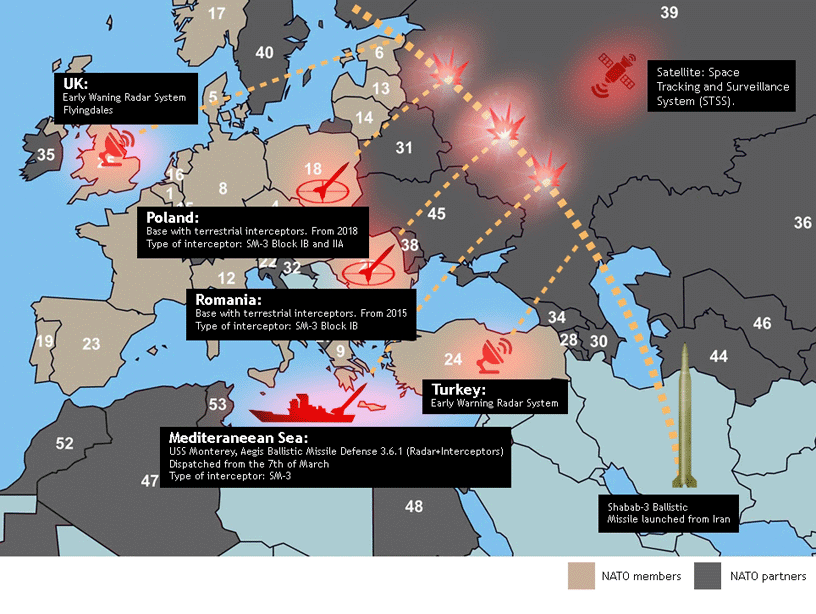
Peskov said Russia had also had to act in the face of the threat it perceived from NATO, saying it was “only a matter of time” before the alliance placed missiles in Ukraine as it had in Poland and Romania.
“We just understood we could not put up with this any more. We had to act,” he said.
(Reporting by Catherine Belton, editing by Mark Trevelyan, Gareth Jones and Angus MacSwan)
Ukraine is a sacrificial pawn on the imperial chessboard.
 | |||


No meaningful diplomatic effort is being made by Washington to end the violence. Ukrainian lives are being spent like pennies to facilitate the agenda of US planetary domination by whipping up international support for the strangulation of Russia while pouring vast fortunes into the military-industrial complex rather than taking even the tiniest step toward de-escalation, diplomacy and detente.
Ukraine Is A Sacrificial Pawn On The Imperial Chessboard, https://caitlinjohnstone.com/2022/03/06/ukraine-is-a-sacrificial-pawn-on-the-imperial-chessboard/ Caitlin Johnstone, The war is not going well for Kyiv, and it would be unreasonable to expect that to change. As a vastly superior military force overwhelms the US client state, reality is in the process of crashing down hard in the face of western liberals who bought into the war propaganda that the brave, sexy comedian was leading an upset victory to kick Putin’s ass out of Ukraine.
Zelensky is now raging at NATO powers for refusing to intervene militarily against Russia, apparently having previously been given the impression that the US-centralized empire might risk its very existence defending its dear friends the Ukrainians from an invasion.
“Unfortunately, today there is a complete impression that it is time to give a funeral repast for something else: security guarantees and promises, determination of alliances, values that seem to be dead for someone,” Zelensky said Friday.
“All the people who will die starting from this day will also die because of you,” Ukraine’s president added. “Because of your weakness, because of your disunity.”
It must be hard, the process of learning that you were never actually a valued partner in western civilization’s fight for freedom and democracy. That you were always just one more sacrificial pawn on the imperial chessboard.
In a new article titled “U.S. and allies quietly prepare for a Ukrainian government-in-exile and a long insurgency“, The Washington Post reports that US officials anticipate Russia will reverse its early losses and successfully drive the Zelensky regime out of the country, after which “a long, bloody insurgency” is planned against the invaders backed by billions of dollars in US funding.
The US has a history of working to draw Moscow into gruelling, costly military quagmires which monopolize its military firepower while leaching it of blood and treasure. Jimmy Carter’s National Security Advisor Zbigniew Brzezinski, author of US hegemonic manifesto The Grand Chessboard: American Primacy and Its Geostrategic Imperatives, openly bragged about having lured Russia into its own Vietnam fighting the US-backed mujahideen in Afghanistan for a decade.
Just two years ago then-US Special Representative for Syria engagement said during a video event hosted by the Hudson Institute that his job was to make Syria “a quagmire for the Russians”.
So this isn’t something new or out of the blue, and what it means is that all the self-righteous posturing by the western political/media class about the need to pour weapons into Ukraine is not really about saving Ukrainian lives (only negotiating a ceasefire can do that), but about seizing this golden opportunity to hurt Russia’s geostrategic interests as much as possible. Ukraine on its own is powerless to stop Russia from taking Kyiv no matter how many weapons are sent, but those weapons can be used to fight a “long, bloody insurgency” after that happens which costs many more lives, keeps Moscow militarily preoccupied and hemorrhaging money, and ultimately hurts Putin’s popularity at home.
This by itself would do a great deal to advance US interests, but on top of that you’ve got the even greater benefit of manufacturing international consent for unprecedented acts of economic warfare against the entire nation of Russia, as well as killing Nord Stream 2 and rallying immense support for NATO and the imperial military/intelligence machine. The western world is now a united front against the Sauron-like menace of Vladimir Putin in much the same way it united against the threat of global terrorism after 9/11, and we’re probably only seeing the beginnings of the agendas this will be used to roll out.
We can expect these agendas to be used in an attempt to impoverish, undermine, agitate, and ultimately collapse and balkanize Russia, as the CIA and Washington swamp monsters have wanted to do since the fall of the Soviet Union.
This would leave China standing alone without its nuclear superpower guard bear and much more vulnerable to imperial operations geared toward thwarting the emergence of a true multipolar world, a goal US imperialists have had in writing for three decades.
That’s a whole lot of potential benefit to the US empire just for losing Ukraine. Kind of like sacrificing a pawn to get the queen in chess.
I think a big part of why I and others wrongly underestimated the likelihood of a full-scale invasion of Ukraine was that the cost-to-benefit math never made sense; on paper Moscow stands so much more to lose by this action in the long term than it stood to gain. There was also a bit of an assumption that the empire would rather Russia not take Ukraine, preferring to gradually encroach with NATO salami slicing tactics than give up a useful client state on Russia’s border, and would adjust its actions accordingly.
But chess is all about out-maneuvering your opponent to leave them nothing but bad options to choose from, and in the end leaving the king with no safe moves. The drivers of empire would have known that, as the late Justin Raimondo explained all the way back in 2014 for Antiwar, Putin could not afford to lose Ukraine to the west without losing crucial support in Russia. Combine that with increased attacks on Donbas separatists and the west’s adamant refusal to make even the most meaningless concessions like guaranteeing they wouldn’t add a nation to NATO who they had no intention of adding anyway, and you can understand if not support Putin’s drastic course of action.
No meaningful diplomatic effort is being made by Washington to end the violence. Ukrainian lives are being spent like pennies to facilitate the agenda of US planetary domination by whipping up international support for the strangulation of Russia while pouring vast fortunes into the military-industrial complex rather than taking even the tiniest step toward de-escalation, diplomacy and detente.
And it’s entirely possible that this was all planned years in advance.
Is it a coincidence that before this started we were bombarded with shrieking anti-Russia narratives for five years, all of which were initiated by secretive and unaccountable intelligence agencies and none of which have ever been substantiated with hard evidence? The discredited conspiracy theories that there was a Kremlin asset in the Oval Office had nothing to do with Ukraine. Neither did the plot hole–riddled and still completely unproven claim that Russian hackers intervened in the US election, or the baseless claim that St Petersburg trolls did the same. Neither did the claim that Russia was paying Taliban-linked fighters to kill US troops in Afghanistan, which was eventually walked back by the same intelligence cartel that made it.
All these hysterical anti-Russia narratives were shoved in everyone’s face day after day, year after year, with nothing really uniting them apart from the fact that they drove up general anxiety about Russia and that they were initiated by the US intelligence cartel. Even the empty Ukrainegate scandal which led to Trump’s unsuccessful impeachment was initiated by a CIA officer who just happened to be in the right place at the right time.
And while all those shrill narratives about a Putin puppet serving as America’s commander-in-chief were being aggressively hammered into public consciousness, Trump’s actual policies toward Moscow were extremely hawkish and aggressive. Beneath the narratives about Kremlin servitude, a new cold war was being dangerously escalated.
And now, lubricated years in advance by these mass-scale anti-Russia narratives, I’ve got western liberals in my social media notifications with blue and yellow profile pictures calling me a Russian propagandist and a Kremlin shill all day, every day. Because of that mass-scale propaganda campaign, we were paced to this point all the way from where we were at a few years ago when Obama was mocking Mitt Romney for his then-outlandish Russia hawkishness.
So we’re looking at increasingly aggressive confrontations between the US power alliance and the China-Russia bloc for the foreseeable future in a struggle which has already erupted in hot war and could easily get infinitely worse. All because a few manipulators in high places convinced the US establishment that global unipolar domination would be a good thing. Many of these unipolarist empire architects were involved in the murderous and influential Project for a New American Century (PNAC), whose founding members are now providing expert punditry on what should be done about the war in Ukraine.
Michael Parenti saw this all coming long ago:
The PNAC plan envisions a strategic confrontation with China, and a still greater permanent military presence in every corner of the world. The objective is not just power for its own sake but power to control the world’s natural resources and markets, power to privatize and deregulate the economies of every nation in the world, and power to hoist upon the backs of peoples everywhere — including North America — the blessings of an untrammeled global “free market.” The end goal is to ensure not merely the supremacy of global capitalism as such, but the supremacy of American global capitalism by preventing the emergence of any other potentially competing superpower.
We should not have to live this way. We should not have to see the horrors of war inflicted upon humanity with the risk of total nuclear annihilation hanging over our heads every minute of every day, all for some dopey grand chessboard maneuverings of a few sociopaths who can’t just let humanity be.
There is no good reason why nations cannot simply collaborate with each other for everyone’s benefit. There is no good reason we should accept these omnicidal games of planetary conquest as inevitable, normal, or fine. If our minds weren’t so pervasively locked down by mass-scale psychological manipulation, there is no way we would stand for this madness.
I don’t know if the US will succeed in this grand strategic confrontation to prevent the rise of a multipolar world. From where I’m sitting it depends on which side of the conflict has more tricks up their sleeve, and that could easily be the emerging China-centralized alliance of which Russia is a key player. But I do think it’s far too early for anyone to declare that the US-led world order is over and a true multipolar world has solidified.
There are many moves on the chessboard still to be played.
NATO Intervention In Ukraine Could Spark Nuclear War. Here’s How It Could Happen

NATO Intervention In Ukraine Could Spark Nuclear War. Here’s How It Could Happen,The Federsalist, BY: HARRY KAZIANIS, MARCH 04, 2022
In the simulation we mapped out, not only does NATO get sucked in unintentionally, but Russia releases nuclear weapons in its desperation.
How did we just kill a billion people?”
Over just three days, as I have done countless times over the last several years, a group of past and present senior U.S. government officials from both sides of the aisle gathered to wage a NATO-Russia war in a simulation at the end of 2019. In the course of what we called the NATO-Russia War of 2019, we estimated one billion people died. And if we aren’t careful, what happened in a simulation could happen if a NATO-Russia war erupts over Ukraine.
In fact, in the simulation I mentioned above from 2019, in which Russia invades Ukraine in a similar way as it did over the last week or so, not only does NATO get sucked in unintentionally, but Russia eventually releases nuclear weapons in its desperation. The result is an eventual escalation of bigger and more dangerous nuclear weapons whereby over one billion lives are lost.
But before we start staring into the abyss, allow me to explain the goal of such simulations. NATO clearly would have a massive conventional advantage in any war with Moscow, ensuring that in a straight-up fight Putin would lose. However, Russia has stated time and time again it will use nuclear weapons to defend its territory and its regime if it feels mortally threatened. Our simulation always seems to ask: Can we ever defeat Russian President Vladamir Putin in an armed conflict over Ukraine or the Baltics and not start a nuclear war in the process?
So far, over at least several years, and with at least 100 different participants that all held different ideas about war and political allegiances, the answer is a flat out no.
Setting the Scene for War
The scenario the group decided to test back in late 2019 was similar to today: The scenario the group decided to test back in late 2019 was similar to today: Russia decided to invade Ukraine under the excuse that it is must defend Russian-speaking peoples that are being “oppressed” by Ukraine’s fascist government. In our scenario, we assumed Russia performs far more admirably than it does today but has more limited objectives, in that Moscow wants to connect Crimea to separatist regions in Eastern Ukraine that are under its effective control. We assumed that Russia does that quickly, achieving most of its military objectives in roughly four days.
But Ukraine does not give up so easily, just like in real life today. Ukrainian forces, after taking heavy losses, mount an impressive counterattack, whereby Russia loses over 100 tanks and over 2,500 soldiers. Images on social media show Russian armor ablaze, elite Su-35 fighter jets are shut down from the skies, and arms are now flowing in from the West in massive numbers.
Putin is outraged. He thought Ukraine would simply roll over, but he does not factor into his calculus the nearly decades-long training Kyiv received from the U.S. and NATO nor Ukraine’s military build-up for the last several years that was focused on this scenario.
Russia then decides that its limited military objectives were a mistake, and that all of Ukraine must be “demilitarized.” Moscow then launches a massive ballistic and cruise missile strike followed up by Russia’s air force launching its own shock and awe campaign, destroying a vast majority of Ukraine’s command and control structure, air force, air defense, and armored units in the process. At the same time, Russia starts surging troops to the borders of Ukraine in what looks like an imminent general invasion and occupation of the entire country.
The Spark
Here is where things take a turn for the worst. A Russian ballistic missile’s guidance system fails and crash-lands into NATO member Poland, killing 34 civilians as it tragically lands into a populated village along the Polish-Ukraine border. While the missile was not directed at Poland intentionally, pictures on social media show children crying for their mothers and bodies left unrecognizable, and demands for justice and revenge mount.
To its credit, Poland, which has its own tortured history with the Soviet Union and Russia, does its best to show restraint. While not responding with its own military, it leads an effort to see that Moscow pays a steep price for its aggression in Ukraine and actions, even unintentional, in Poland. Warsaw leads a diplomatic and economic boycott of Moscow resulting in Russia being kicked out of SWIFT as well as direct sanctions on Russian banks, similar to what we are seeing today.
In our scenario, Russia’s reaction is also swift. Moscow decides to launch a massive cyber attack on Poland, having based cyber warriors all throughout NATO territory, using their geography and proxy servers to mask the origin of the attack. Russia, in just two hours, takes off-line Poland’s entire electrical grid, banking sector, energy plants, and more — essentially taking Poland back to the stone age.
And this is where the nightmare begins. Even though attribution is hard to achieve, Poland appeals to NATO and starts to privately share its desire to invoke Article 5 of the NATO Charter, declaring that an attack on one is an attack on the entire alliance. NATO is worried, as there is debate on how far to punish Russia while also feeling as if they do not have a clear military objective amongst the member states as some want to respond to what happened to Poland while others feel they must intervene militarily in Ukraine.
The Response
Here is where NATO surprises everyone. The alliance decides to set up a limited no-fly zone around the Ukrainian city of Lviv to protect innocent civilians and refugees that are trapped and have nowhere to go. Russia is warned: NATO is not intervening in the conflict, but will ensure that its planes and the airspace around Lviv are protected. NATO does make clear its jets will be in the skies above Ukraine, but will not operate from Ukrainian territory.
In Moscow, Putin now gets a sense that NATO is destined to intervene on Ukraine’s side. Russia fears NATO will use this protected corridor as a base of operations to send ever more sophisticated weapons. And with its economy now in a tailspin due to sanctions, Putin feels the walls closing in him. Before NATO can impose its no-fly zone, Putin orders strikes on any remaining airfields and military assets around Lviv.
But here is where Putin miscalculates and sets the stage for a NATO-Russia war. Putin orders another massive cyber attack on the Baltic states’ military infrastructure, thinking that NATO will use the Baltics to stage an invasion of Russia.
This ends up being the last straw for NATO, which then decides direct intervention in Ukraine is necessary to push back against Russian aggression. Before even an announcement is made, Russian intelligence sees missile and troop movements that indicate an impending NATO attack and decide to strike first — with tactical nuclear weapons. NATO decides to respond in kind.
Russia then targets European cities with nuclear weapons, with NATO and America also responding in kind. What is left is nothing short of an apocalypse, with what we estimate is billion people dead.
No War Goes As Planned
In every scenario I have been a part of there is one common theme to all of them: When Vladimir Putin feels boxed in and feels Russia is directly threatened, usually from a mistake he makes on the battlefield, he decides to use whatever escalatory step he desires to try and make up for it.
While we may well soon see Ukraine and Russia find a diplomatic path out of this brutal war, both sides seem dug in. That means the chances for escalation like the above are high. And if Russia and NATO do become involved in direct conflict, Putin knows that in a conventional fight his regime would be defeated. That means Russia will choose nuclear war.
The only question in a NATO-Russia war seems obvious: how many millions or billions of people would die?
Harry J. Kazianis is director of defense studies at the Center for the National Interest in Washington DC and executive editor of their publishing arm, The National Interest. The views expressed in this article are his own. He’s on Twitter @grecianformula. https://thefederalist.com/2022/03/04/nato-involvement-in-ukraine-could-spark-nuclear-genocide-heres-how-it-could-happen/
The US and NATO’s Sacrifice Of Ukraine
The US and NATO’s Sacrifice Of Ukraine https://www.pressenza.com/2022/03/the-us-and-natos-sacrifice-of-ukraine/ 04.03.22 Mark Lesseraux
THE INCEPTION POINT OF A NEW ERA
We are fast approaching the 33rd anniversary of Mikhail Gorbachev’s decision to untie the Soviet knot that held back the countries of Eastern Europe from moving in an independent, democratic direction. A decision that led to the collapse of the Berlin Wall in November 1989, and, subsequently, to the overturning of the Communist regime in Eastern Europe.
It was a turning point, a hopeful moment, that marked both the beginning of the end of the Cold War conflict and the inception point of a new era of cooperative possibilities between East and West.
THE U.S. AND EUROPE PROMISE TO END NATO EXPANSION
With the breakup of the Soviet Union it became clear to pretty much everyone involved in the diplomatic and political instigation of these major changes, that NATO had become obsolete. Washington and Europe met with Mikhail Gorbachev to create a new security pact that aimed to bring Russia into the cooperative fold. The Reagan administration, along with their West German allies, promised Gorbachev that once German unification was underway NATO would, for certain, cease expanding itself in an eastward direction.
This promise to end the expansion of NATO, which France and Great Britain also agreed to, seemed to signal the onset of a new era of global cooperation. It was agreed then and there by all parties present that a de-escalation of military spending and weapons production was in order now that the Cold War was winding down.
THE PROMISE IS BROKEN
In the years that followed, the war industry completely went back on the aforementioned promises. In fact, a massive eastward expansion of NATO was set in motion along with an unprecedented increase in military spending, weapons production and global weapons sales. NATO added Poland, Hungary, the Czech Republic, Bulgaria, Estonia, Latvia, Lithuania, Romania, Slovakia, Slovenia, Albania, Croatia, Montenegro, and North Macedonia to its fold.
These countries were all forced to restructure and reconfigure their militaries to become compatible with NATO’s military alignment policies. Most of the aforementioned countries achieved this realignment via large loans, creating debt and dependence on corporate lenders.
NO NEW ERA OF COOPERATION
Over the course of the last two-plus decades NATO has become a multi-billion-dollar cash cow for huge corporations that depend on the Cold War for profit. There has been no new era of cooperation with Russia, as promised by all who were involved in setting the new age of supposed partnership in motion. On the contrary, NATO has ignored Russia’s constant warnings and requests to stop its campaign of expansion. Instead NATO, led by the US, has pushed itself right up to Russia’s border, all the while generating a steady stream of new Cold War propaganda, demonizing Russia while proceeding to encircle its territory.
THE SACRIFICE OF UKRAINE
Seven years ago the Obama administration prudently refused to sell arms to Kiev. This act of cautiousness was subsequently cast aside by the Trump and Biden administrations. Over the past several years weapons from the U.S. and Great Britain have been pouring into Ukraine.
By flooding Ukraine with weapons (which is what the US did in the 2008 conflict between Russia and Georgia) over the past few years and refusing Russia’s constant requests that NATO drop its plan to annex Ukraine, an extremely volatile and deeply dangerous situation was created for Ukraine. A situation that has basically amounted to the sacrifice of the people of Ukraine.
NO JUSTIFICATION
There is no justification for the savage actions that Vladimir Putin has undertaken in Ukraine over the past week and a half. Putin is responsible for the bloodshed that he has generated. What this article is pointing to has nothing to do with absolving Putin for the violence in Ukraine. What this article is pointing to is the fact that the US and NATO have been myopic and reckless. What this article is illustrating is that what is going on now in Ukraine is, in part, the result of a thirty-three year history of broken promises and careless, greed propelled decisions made by the US and NATO.
MANY SAW THIS COMING
Over the past three decades, dozens of diplomats and historians have warned that a situation like the one we are seeing now in Ukraine was inevitable if NATO expansion continued. I’m going to end this article here with a quote from George Kennan who was considered by many to be the most respected voice on the matter of US-Soviet relations:
I think it is the beginning of a new cold war. I think the Russians will gradually react quite adversely and it will affect their policies. I think it is a tragic mistake. There was no reason for this whatsoever. No one was threatening anybody else. This expansion would make the founding fathers of this country turn over in their graves. We have signed up to protect a whole series of countries, even though we have neither the resources nor the intention to do so in any serious way. [NATO expansion] was simply a lighthearted action by a Senate that has no real interest in foreign affairs. What bothers me is how superficial and ill-informed the whole Senate debate was. I was particularly bothered by the references to Russia as a country dying to attack Western Europe.
Don’t people understand? Our differences in the Cold War were with the Soviet Communist regime. And now we are turning our backs on the very people who mounted the greatest bloodless revolution in history to remove that Soviet regime. And Russia’s democracy is as far advanced, if not farther, as any of these countries we’ve just signed up to defend from Russia. Of course, there is going to be a bad reaction from Russia, and then [the NATO expanders] will say that we always told you that is how the Russians are — but this is just wrong.”
– George Kennen 1998 Mark Lesseraux
Mark Lesseraux is a singer/songwriter/socio-political columnist from Brooklyn, New York, USA. He is a Humanist, a proponent and practitioner of Active Nonviolence and a student of Nonduality.
Western govt, media, and public, ignorant about the complex history of Ukraine
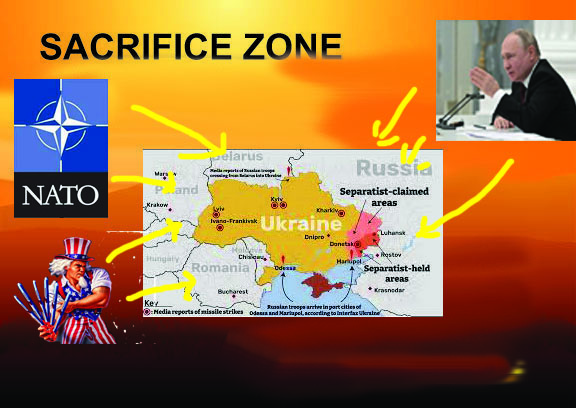
Lenin were he alive today would no doubt point out that Russia today, as well as the U.S., is a capitalist-imperialist country…….. He [Putin] is despicable, but his demand that NATO ceases expansion is as eminently reasonable and Biden’s desire to expand it seems crazier by the day.
Putin, Lenin, Imperialism and the (Real) History of Ukraine, Portside, March 5, 2022 Gary Leupp
— The people of this country suffer, I’ve always thought, from a general ignorance of history. ………
In 2014 having, having given little thought to Ukraine to that point, people in this county (self-defined Americans and others) were informed by the most authoritative sources they knew, the cable TV news anchors and commentators. They were treated to a history lesson that went something like this: The country of Ukraine has always been oppressed by Russia. It was colonized by Russia for centuries. Russia still, after the end of the Soviet Union, wants to control Ukraine! So it responded to a popular revolution in Kyiv, an expression of the Ukrainians’ longing to fulfill its “European aspirations,” by invading Ukraine!
having made its point clear in the brief invasion of Georgia in 2008 (to end talk of Georgian membership), having watched a U.S.-backed coup topple a president friendly to Russia replacing him with a pro-NATO cabal—was re-annexing Crimea (not just Russian from 1783 to 1954, but still Russia’s main naval port, then on lease from Crimea, and coveted by NATO) and supporting separatists in the primarily Russian speaking population in the Donbass region primarily to prevent further NATO expansion……………
In the real world, the U.S. has acted in the world since the collapse of the Soviet Union, the collapse of the Warsaw Pact, the collapse of what Washington perceived as the global communist movement, with an effort to encircle Russia with the most horrifically threatening military force in world history. It has expanded NATO in the absence of any real threat to itself from 16 to 28 members, bordering Russia on the Baltic coast and threatening to encircle it entirely. It has used NATO to pursue wars in Serbia, Afghanistan, Libya, and Syria, in the last case illegally intervening in a failed effort to gain control over a longstanding Russian ally…………
In the real world, Biden became president determined to both reassert U.S. “global leadership” and to continue NATO expansion. His campaign literature in 2020 reminded us that he believed in the cause. And it was clear he had a particular interest in drawing Ukraine in, which meant convincing Germany and other unenthusiastic NATO members to agree that Ukraine had cleaned up its corruption sufficient to get the nod.
He sent his secretary of state Anthony Blinken, who as Biden’s foreign policy advisor had urged him in 2002 to support Bush’s war on Iraq, to persuade the Germans that their gas pipeline to Russia threatened NATO unity! Meanwhile, U.S. puppet and NATO secretary-general Stoltenberg visited Kyiv to assure Ukraine that it will, indeed, be admitted to NATO. And the arms flowed into Ukraine.
Putin considered all this more threatening than ever………… The Russians were talking about their security, and need to defend their borders; the U.S. president was talking about his right to expand the alliance as he pleased.
For the U.S. media, what we see here is a clearly drawn conflict between Good and Evil, or in Blinken’s schoolmarmish conception “Democracy versus Autocracy.” What I see is two evils, neither of them democratic, locked in a conflict over the more powerful evil’s lust for further expansion. Both evils have their controlled news media and means to shape public consciousness.
Ukraine has been inhabited and crisscrossed by Scythians, Celts, Germanic peoples, Huns, Khazars, Mongols as well as Slavs. Given its history of incorporation into different states ………… at least the closest approximation of an independent state so far—was the Ukrainian Soviet Socialist Republic. Russia demanded that Ukraine be considered an independent state on the world stage; it held a separate UN seat. With Belarus it was one of the closest SSRs to Moscow, and most hesitant to withdraw from the union when Boris Yeltsin unilaterally dissolved it by pulling Russia itself out. Once established in its current configuration, Ukraine agreed to abandon its nuclear arsenal; it also agreed to a long-lease arrangement with Russia involving the vital Crimean naval base.
When Putin points to this history or at least aspects of it, he is not churning out lies at the level of the dutiful U.S. ……………
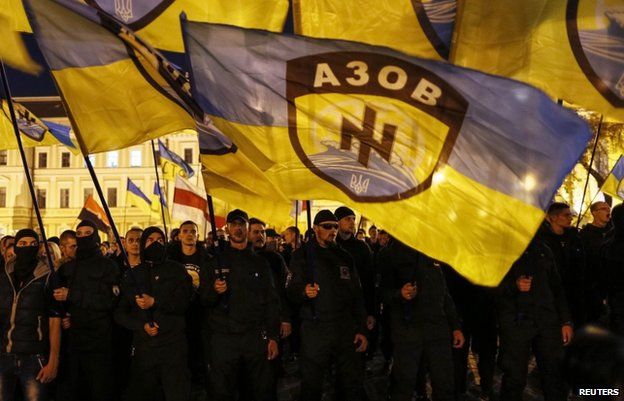
In the real world, Ukrainian fascist movements exist and were surely on display in the Maidan coup in 2014. They played a key role in the violent overthrow of an elected government, under Victoria Nuland’s watchful eye. There remains much support in some quarters for the wartime nationalist leader Stepan Bandera, who espoused a fascist ideology and helped round up Jews in Ukraine for the Nazi death camps. Anyone paying attention realizes that there are fascist elements in the military (the entire Azov Battalion) and that fascist parties, while small and with little electoral influence, have been able to stymie the implementation of the now-defunct Minsk Accords. So, yes, there is a fascist movement in Ukraine and it has a long history……
Crucial battles in this 1941-1945 war, also known as the Anti-Fascist War, were fought on Ukrainian soil, where some local communities sided with the fascists and embraced the Nazis’ Russophobia. Putin wants to essentialize Ukrainians as tending towards fascism, now working in tandem again with Russia’s enemies. This effort could well backfire among Russians who realize that Ukrainians are divided politically and ideologically among themselves and in any case undeserving of Putin’s characterization.
……….. Russians and Ukrainians retained amicable relations; the mere fact of new mutual independence was not a great problem for the relationship. Relations only deteriorated when, from around 2005, Ukrainian leaders requested NATO membership. In 2010 an anti-NATO president was democratically elected; the U.S. State Department oversaw a massive regime change effort to depict him as corrupt, anti-EU, impeding “Ukrainian’s European aspirations.” It succeeded in ousting him….
…….. Lenin were he alive today would no doubt point out that Russia today, as well as the U.S., is a capitalist-imperialist country…….. He [Putin] is despicable, but his demand that NATO ceases expansion is as eminently reasonable and Biden’s desire to expand it seems crazier by the day………………….. https://portside.org/2022-03-05/putin-lenin-imperialism-and-real-history-ukraine
Russian forces approach Ukraine’s second-largest nuclear power plant in Yuzhnoukrainsk
– The US ambassador to the United Nations has warned that the world averted
nuclear catastrophe ‘by the grace of God,’ as troops move closer to the
country’s second-largest nuclear power plant. In a statement given during
an emergency meeting of the UN Security Council following the news that
Russian forces had shelled Europe’s largest nuclear power plant, Linda
Thomas-Greenfield said that troops were ‘now 20 miles, and closing, from
Ukraine’s second-largest nuclear facility,’ the South Ukraine nuclear
power plant in Yuzhnoukrainsk.
Unilad 5th March 2022
How the Narcotic of Defense Spending Undermines a Sensible Grand Strategy,

MARCH 2, 2022, How the Narcotic of Defense Spending Undermines a Sensible Grand Strategy, CounterPunch, BY FRANKLIN SPINNEY The Military-Industrial-Congressional-Complex’s (MICC) grand-strategic chickens are coming home to roost big time. While war is bad, the Russo-Ukrainian War has the champagne corks quietly popping in the Pentagon, on K Street, in the defense industry, and throughout the halls of Congress. Taxpayers are going to be paying for their party for a long time.
It is no accident that the United States is on the cusp of the Second Cold War.
Future historians may well view the last 30 years as a case study in the institutional survival of the American Military – Industrial – Congressional Complex (MICC), together with its supporting blob now saturating the media, think tanks, academia, and the intelligence community. Perhaps, these future historians will come also to view the Global War on Terror (GWOT) as the bridging operation that greased the transition to Cold War II by keeping defense budgets at Cold War levels after Cold War I ended. Also, 9-11 may have re-acclimated the American people to the climate of fear now needed to sustain Cold War II for the remainder of the 21st Century.
The First Cold War’s 40-year climate of fear was something Mikhail Gorbachev tried to end. But Presidents Clinton and Bush (the 2nd) were busy planting the seed money for a new generation of cold-war inspired weapons. These weapons required massive future defense budgets that would require a climate of fear to sustain (especially for the across-the-board nuclear modernization program). President Obama then locked in these programs, and won a Nobel Peace Prize to boot. President Trump and the Dems in Congress worked overtime to ice the Pentagon’s budget cake by incestuously amplifying the growing Russophobia
No one wants war, but rising tension and the politics of fear … and their bedfellow: demonization … had to be magnified to justify the huge bow wave of defense spending looming in the budgetary offing, particularly the trillion+ dollars to pay for the nuclear modernization program. This “chicken” takes us back to the “egg” laid in the 1990s.
As it gradually sank in that the First Cold War had indeed ended when the Soviet threat evaporated in 1991, the titans in the defense industry understood their comfortable market for new hi-tech, high-cost weapons could dry up.
At the same time, the defense industrialists recognized that market diversification was necessary. So, it was no accident that a lobbying operation named the Committee to Expand NATO emerged in the early 1990s and was headed by a vice president of Lockheed Martin — see also Why is US Foreign Policy a Shambles?. At the very least, in the mid-1990s, it seemed that expanding NATO implied dramatically increased requirements for what is known in NATO jargon as weapons interoperability……………..
the Pentagon’s strategy of maximizing its budget has created a growing dependency on defense spending in the American political economy. This grotesque distortion was first recognized by President Eisenhower in 1961. In 1987, George Kennan, forty years after he fathered the dominant US policy of “Containment” for the entire First Cold War, summed up the narcotic of defense spending, saying prophetically:
“Were the Soviet Union to sink tomorrow under the waters of the ocean, the American military-industrial complex would have to remain, substantially unchanged, until some other adversary could be invented. Anything else would be an unacceptable shock to the American economy,” …………..
Understanding the internal political-economic causes of the American addiction to the narcotic of defense spending is at the heart of the problem. This understanding is essential to reforming the foreign policy mess exacerbated by NATO expansion. …….
Franklin “Chuck” Spinney is a former military analyst for the Pentagon and a contributor to Hopeless: Barack Obama and the Politics of Illusion, published by AK Press. He be reached at chuck_spinney@mac.com https://www.counterpunch.org/2022/03/02/how-the-narcotic-of-defense-spending-undermines-a-sensible-grand-strategy/
Now Is the Time for a Global Movement Demanding Nuclear De-escalation

Now Is the Time for a Global Movement Demanding Nuclear De-escalation, https://truthout.org/articles/now-is-the-time-for-a-global-movement-demanding-nuclear-de-escalation/?eType=EmailBlastContent&eId=552e5725-9297-4a7c-a214-53c8c51615a3 Norman Solomon, Truthout March 3, 2022
President Joe Biden spoke 6,500 words during his State of the Union speech Tuesday night, but not one of them acknowledged the dangers of nuclear war that have spiked upward during the last decade and even more steeply in recent days. The militarism that Martin Luther King Jr. warned us about has been spiraling toward its ultimate destination in the nuclear era — a global holocaust that would likely extinguish almost all human life on Earth.
In the midst of this reality, leaders of the world’s two nuclear superpowers continue to fail — and betray — humanity.
In the stark light of March 2022, Albert Einstein’s outlook 75 years ago about the release of atomic energy has never been more prescient or more urgent: “This basic power of the universe cannot be fitted into the outmoded concept of narrow nationalisms. For there is no secret and there is no defense, there is no possibility of control except through the aroused understanding and insistence of the peoples of the world.”
The phrase “narrow nationalisms” aptly describes the nuclear-weapons policies of the United States and Russia. They have been engaged in a dance of death with foreseeable human consequences on a scale that none of us can truly fathom.
Einstein expressed a belief that “an informed citizenry will act for life and not death.” But the dire nuclear trends have been enabled by citizenry uninformed and inactive.
Twenty years ago, the George W. Bush administration withdrew from the Anti-Ballistic Missile (ABM) Treaty. Despite his promising rhetoric, President Barack Obama plunged ahead to begin a $1.7 trillion program for further developing the U.S. nuclear arsenal under the euphemism of “modernization.” President Donald Trump pulled the United States out of the Intermediate-Range Nuclear Forces (INF) Treaty, which had removed an entire category of missiles from Europe since the late 1980s — largely as a result of the international movement against nuclear weapons.
By killing the ABM and INF agreements, the U.S. government pushed the world further away from nuclear arms control, let alone disarmament. And by insisting on expansion of the North Atlantic Treaty Organization (NATO) to Russia’s borders — and in recent months continuing to insist that Ukrainian membership in NATO should stay on the table — the United States ignored Russia’s longstanding and reasonable concerns about NATO expansion.
Placement of ABM systems in Poland and Romania, touted as defensive, gave NATO the capacity to retrofit those systems with offensive cruise missiles. Overall, NATO’s claims of being a “defensive” alliance have been undercut by three decades of broken promises, as well as intensive war operations in Serbia, Afghanistan and Libya.
Russia has its own military-industrial complex and nationalistic fervor. The duplicity and provocations by the United States and its NATO allies do not in the slightest justify the invasion of Ukraine that Russia launched a week ago. Russia is now on a murderous killing spree no less abhorrent than what occurred from the U.S. invasions of Afghanistan and Iraq.
Right now, an overarching truth remains to be faced and acted upon: The nuclear superpowers have dragged humanity to a precipice of omnicide. The invasion of Ukraine is the latest move in that direction.
Last week, the extreme recklessness of Russian President Vladimir Putin’s not-so-veiled threat to use nuclear weapons was an indication of just how dangerous the Ukraine conflict has gotten — for everyone, everywhere. Passivity will get us nowhere. In the U.S., supporting antiwar protests and demanding real diplomacy while organizing for peace are essential.
“However soon the war ends, its effects on the European security order and the world will be and already are profound,” San Francisco State University scholar Andrei Tsygankov wrote days ago. “In addition to human suffering and devastation, the European continent is entering a new era of social and political divisions comparable to those of the Cold War. The possibility of further escalation is now closer than ever. Instead of building an inclusive and just international order, Russia and most European nations will now rely mainly on nuclear weapons and military preparations for their security.”
Any “conventional” war that puts Russia and the United States in even indirect conflict has the very real potential of being a tripwire that could set off an exchange of nuclear missiles. Heightened tensions lead to fatigue, paranoia and greater likelihood of mistaking a false alarm for the real thing. This is especially dangerous because of land-based Intercontinental Ballistic Missiles (ICBMs), which are uniquely vulnerable to attack and therefore are on hair-trigger, “launch on warning” alert.
“First and foremost,” former Defense Secretary William Perry wrote in 2016, “the United States can safely phase out its land-based intercontinental ballistic missile force, a key facet of Cold War nuclear policy. Retiring the ICBMs would save considerable costs, but it isn’t only budgets that would benefit. These missiles are some of the most dangerous weapons in the world. They could even trigger an accidental nuclear war.” As Daniel Ellsberg and I wrote in The Nation last fall, “Contrary to uninformed assumptions, discarding all ICBMs could be accomplished unilaterally by the United States with no downside. Even if Russia chose not to follow suit, dismantling the potentially cataclysmic land-based missiles would make the world safer for everyone on the planet.”
But we’re not hearing anything from Congress or the White House about taking steps to reduce the chances of nuclear war. Instead, we’re hearing jacked-up rhetoric about confronting Russia. It’s all too clear that responsible leadership will not come from official Washington; it must come from grassroots activism with determined organizing and political pressure.
“I refuse to accept the cynical notion that nation after nation must spiral down a militaristic stairway into the hell of thermonuclear destruction,” Dr. King said as he accepted the Nobel Peace Prize in 1964. “I believe that even amid today’s mortar bursts and whining bullets, there is still hope for a brighter tomorrow.”
Realistic hope seems to be in very short supply right now. But at this dire moment, all that we love demands our determination to organize.
How many more lives does Europe want to sacrifice to extend NATO’s borders?
| |||
| to me |
| |||

How many more lives does Europe want to sacrifice to extend NATO’s borders? https://www.pressenza.com/2022/03/how-many-more-lives-does-europe-want-to-sacrifice-to-extend-natos-borders/
04.03.22 – Gerardo Femina
This post is also available in: Spanish, French, Italian, Catalan It is urgent to stop the war and put an end to the pain of the Ukrainian people. Russia must immediately withdraw its troops and stop the aggression against Ukraine.
But how many more lives is Europe willing to sacrifice to extend NATO’s borders? The armed conflict could stop immediately and put an end to enormous suffering if Russia’s demands were seriously considered: a militarily neutral Ukraine, like Austria and Finland.
A reasonable proposal, a state buffer policy that has already been adopted in the past. Instead, Europe is choosing the path of arms and violence.
Sending arms to Ukraine means pursuing a goal that is contrary to peace. It is to put geopolitical goals above human life and risk dragging us all into a nightmare with no way out.
Sending arms is not the way to stop the war. On the contrary, all efforts must be directed towards dialogue.
Europe for Peace
Europe for Peace
Read the declaration
Gerardo Femina
Former president of the Community for Human Development in Italy, engaged in social, political and cultural activity. For 20 years he has lived in Prague, where he was among the promoters of the campaign “Europe for Peace” and the protest against the so-called Missile Shield, that the United States wanted to install in the Czech Republic. He writes about politics and social matters. In recent years he has dedicated himself to the construction of the Park of Study and Reflection in the Czech Republic.
Russia’s nuclear alert means Nato must tread carefully
Russia’s nuclear alert means Nato must tread carefully, There is a scenario in which Moscow could use such weapons to ward off a western intervention ft.com
JEREMY SHAPIRO, 4 Mar 22, The writer is research director at the European Council on Foreign Relations and a former official in the US state department .
President Vladimir Putin announced on Sunday that he was putting Russian nuclear forces on “high alert”. Alert status probably means little in terms of increasing the risk of escalation in Ukraine. But Putin’s ominous declaration reminded the world that Russia has, among the many destructive tools in its arsenal, many thousands of nuclear weapons. ……………….
How could Russia’s invasion of Ukraine lead to a nuclear confrontation? The most likely route is through Russian employment of a tactical nuclear weapon. Tactical nuclear weapons are relatively smaller bombs intended to be used in battlefield situations against concentrations of enemy forces. Estimates vary widely but Russia probably has between 1,000 and 2,000 such weapons in its arsenal, with a wide variety of yields and delivery mechanisms. They also vary greatly in explosive effect but could destroy anything from an armoured column to an entire town. …………
The current situation …..highlights that tactical nuclear weapons are probably not a weapon that would be used against the Ukrainians. It is not necessary to pay the price of crossing the nuclear threshold to achieve Russian goals in Ukraine.
High-yield conventional weapons or the dreaded thermobaric bombs, which draw in oxygen to create an intense explosion, are more than sufficient for any effect they might want and don’t force them to bear the nuclear stigma. ………….
tactical nuclear weapons are intended to send the following message to Nato leaders: “You may have a more impressive military than I do, but I care a lot more and will kill us all if necessary.”
Now, the Russian military is heavily engaged in Ukraine and thus particularly vulnerable to a Nato conventional attack in Belarus and western Russia, as well as in Ukraine. So in the current scenario, Russian leaders are most likely to use a tactical nuclear weapon to prevent or put an end to Nato intervention. In theory, therefore, it should be straightforward to avoid that outcome by not intervening. The west, in the minds of its own leaders, has no intention of intervening so they may not feel there is much chance of nuclear escalation.
The problem is that, given the paranoia of Russian leaders, they probably expect Nato intervention, and may even believe it is already happening given European and American arms deliveries and Nato troop movements to eastern Europe. They may view Nato troop concentrations in states on Ukraine’s eastern flank as potential intervention forces and they may lack sufficient precision-guided weapons in their already very depleted inventory to attack them conventionally. They might also view weapons depots in neighbouring states that are supplying Ukrainian government forces as legitimate targets.
Russian attacks of these sorts are not likely, but they are possible. Beyond the horrible death and radioactive fallout they would cause, such attacks would cross the nuclear threshold for the first time since 1945 and thus open the path to further nuclear escalation to the strategic level (ie the end of the world). Given that we very much want to avoid that, western leaders might think about taking steps to make it even less likely.
Such steps would involve thinking carefully about how the Russians understand “intervention”. Russian leaders, for example, might see volunteers from Nato countries filtering into Ukraine as covert advance guards for a full-scale intervention. They might regard arms convoys coming to Ukraine from Nato states as the functional equivalent of intervention. And, depending on their orientation, they might see troop dispositions in eastern flank states or troop movements to, say, help manage refugee flows at the border as a precursor to intervention.
If it is truly not the intention of western leaders to intervene, they should make sure that their forces act in ways that will convince Russian leaders of that. The world may depend on it. https://www.ft.com/content/b6bfd338-f2e0-43c2-96f2-0cd918303ea2
Ukraine war – a great opportunity Each new NATO country was a new customer for the weapons industry

“Lockheed began looking at Poland right after the wall came down,” veteran salesman Dick Pawlowski recalled. “There were contractors flooding through all those countries.” Arms makers became the most aggressive lobbyists for NATO expansion. The security umbrella was not simply a formidable alliance but also a tantalizing market.
New alliance members meant new clients. And NATO would literally require them to buy Western military equipment.
Arms Industry Sees Ukraine Conflict as an Opportunity, Not a Crisis, Jonathan Ng, Truthout , 2 Mar 22,In February, a photograph of Russian President Vladimir Putin sitting hunched over a 13-foot table with French President Emmanuel Macron circulated the globe. News about their sprawling table and sumptuous seven-course dinner was reminiscent of a Lewis Carroll story. But their meeting was deadly serious. Macron arrived to discuss the escalating crisis in Ukraine and threat of war. Ultimately, their talk foundered over expansion of the North Atlantic Treaty Organization (NATO)

Yet the meeting was surreal for another reason. Over the past year, Macron, the leading European Union (EU) peace negotiator, has led an ambitious arms sales campaign, exploiting tensions to strengthen French commerce. The trade press even reported that he hoped to sell Rafale fighter jets to Ukraine, breaking into the “former bastion of Russian industry.”
Macron is not alone. NATO contractors openly embrace the crisis in Ukraine as sound business. In January, Raytheon CEO Greg Hayes cited “tensions in Europe” as an opportunity, saying, “I fully expect we’re going to see some benefit.” Likewise, CEO Jim Taiclet of Lockheed Martin highlighted the benefits of “great power competition” in Europe to shareholders.
On February 24, Russia invaded Ukraine, pounding cities with ordnance and dispatching troops across the border. The sonic boom of fighter jets filled the air, as civilians flooded the highways in Kyiv, attempting to flee the capital. And the stock value of arms makers soared.
The spiraling conflict over Ukraine dramatizes the power of militarism and the influence of defense contractors. A ruthless drive for markets — intertwined with imperialism — has propelled NATO expansion, while inflaming wars from Eastern Europe to Yemen.
Selling NATO
The current conflict with Russia began in the wake of the Cold War. Declining military spending throttled the arms industry in the United States and other NATO countries. In 1993, Deputy Secretary of Defense William Perry convened a solemn meeting with executives. Insiders called it the “Last Supper.” In an atmosphere heavy with misapprehension, Perry informed his guests that impending blows to the U.S. military budget called for industry consolidation. A frantic wave of mergers and takeovers followed, as Lockheed, Northrop, Boeing and Raytheon acquired new muscle and smaller firms expired amid postwar scarcity.
While domestic demand shrunk, defense contractors rushed to secure new foreign markets. In particular, they set their sights on the former Soviet bloc, regarding Eastern Europe as a new frontier for accumulation. “Lockheed began looking at Poland right after the wall came down,” veteran salesman Dick Pawlowski recalled. “There were contractors flooding through all those countries.” Arms makers became the most aggressive lobbyists for NATO expansion. The security umbrella was not simply a formidable alliance but also a tantalizing market.
However, lobbyists faced a major obstacle. In 1990, Secretary of State James Baker had promised Soviet leader Mikhail Gorbachev that if he allowed a reunited Germany to join NATO, the organization would move “not one inch eastward.” Yet lobbyists remained hopeful. The Soviet Union had since disintegrated, Cold War triumphalism prevailed, and vested interests now pushed for expansion. “Arms Makers See Bonanza In Selling NATO Expansion,” The New York Times reported in 1997. The newspaper later noted that, “Expansion of the North Atlantic Treaty Organization — first to Poland, Hungary and the Czech Republic and then possibly to more than a dozen other countries — would offer arms makers a new and hugely lucrative market.”
New alliance members meant new clients. And NATO would literally require them to buy Western military equipment.
Lobbyists poured into Washington, D.C. fêting legislators in royal style. Vice President Bruce Jackson of Lockheed became the president of the advocacy organization U.S. Committee to Expand NATO. Jackson recounted the extravagant meals that he hosted at the mansion of the Republican luminary Julie Finley, which boasted “an endless wine cellar.”
“Educating the Senate about NATO was our chief mission,” he informed journalist Andrew Cockburn. “We’d have four or five senators over every night, and we’d drink Julie’s wine.”
Lobby pressure was relentless. “The most interested corporations are the defense corporations, because they have a direct interest in the issue,” Romanian Ambassador Mircea Geoană observed. Bell Helicopter, Lockheed Martin, and other firms even funded Romania’s lobbying machine during its bid for NATO membership……………… https://truthout.org/articles/arms-industry-sees-ukraine-conflict-as-an-opportunity-not-a-crisis/?eType=EmailBlastContent&eId=734c56bc-48da-4e66-bea1-f2bedb7d1431
1 This Month





PLEASE OPPOSE HR 8255 AND S.3639 – bills would accelerate satellite deployment, with no environmental review or safeguards – https://ncstd5li.quorum.us/campaign/169331/
To see nuclear-related stories in greater depth and intensity – go to https://nuclearinformation.wordpress.com
-
Archives
- October 2026 (39)
- September 2026 (339)
- August 2026 (330)
- July 2026 (355)
- June 2026 (287)
- May 2026 (306)
- April 2026 (356)
- March 2026 (251)
- February 2026 (267)
- January 2026 (308)
- December 2025 (358)
- November 2025 (359)
-
Categories
- 1
- 1 NUCLEAR ISSUES
- business and costs
- climate change
- culture and arts
- ENERGY
- environment
- health
- history
- indigenous issues
- Legal
- marketing of nuclear
- media
- opposition to nuclear
- PERSONAL STORIES
- politics
- politics international
- Religion and ethics
- safety
- secrets,lies and civil liberties
- spinbuster
- technology
- Uranium
- wastes
- weapons and war
- Women
- 2 WORLD
- ACTION
- AFRICA
- Atrocities
- AUSTRALIA
- Christina's notes
- Christina's themes
- culture and arts
- Events
- Fuk 2022
- Fuk 2023
- Fukushima 2017
- Fukushima 2018
- fukushima 2019
- Fukushima 2020
- Fukushima 2021
- general
- global warming
- Humour (God we need it)
- Nuclear
- RARE EARTHS
- Reference
- resources – print
- Resources -audiovicual
- Weekly Newsletter
- World
- World Nuclear
- YouTube
-
RSS
Entries RSS
Comments RSS

