Ukraine: Why Negotiations Are the Only Rational Option in the Face of Climate Chaos and Nuclear Dangers

By Fabian Scheidler / Original to ScheerPost 26 May 23
The Pentagon Leaks have shown that, from the U.S. military’s perspective, the confrontation between Russia and Ukraine has reached a stalemate. Neither side can win in the foreseeable future, according to the assessment. Senior military leaders, such as General Mark Milley, chairman of the Joint Chiefs of Staff, had said so publicly before. This makes negotiations, as difficult as they may be, the only rational option. For a continuation of the war under these conditions would lead to endless bloodshed, to a new Verdun, without achieving the restoration of Ukrainian territory. At the same time, nuclear escalation would become increasingly likely.
Any ethically sound position in such a conflict must weigh the risks and sacrifices to be made for a goal against what can realistically be achieved. Yet even the question of how many people in Ukraine should die in order to shift the future course of the border by how many kilometers is considered cynical and lacking in solidarity by many who loudly pose as friends of Ukraine. But isn’t it, on the contrary, cynical not to ask this very question in the current situation? After all, those who die are Ukrainians and Russian soldiers, not those who muse in Berlin or Washington about war aims and noble principles. And those affected in Ukraine themselves currently have no opportunity to express their views on the matter by voting. …………………………………………………………………..
Geopolitical and ecological tipping points
The question, which kind of ethics we choose, goes far beyond the consequences of war in the narrower sense and relates to the entire global situation. The world faces a whole series of dangerous tipping points, both geopolitical and ecological. For one thing, a lasting new bloc confrontation greatly increases the risk of nuclear war. Even a “limited” nuclear exchange would lead globally to a nuclear winter and wipe out a large part of humanity. For this reason alone, diplomacy based on an ethics of responsibility is the only rational option.
Second, the new cold and hot war destroys the chances of preventing climate and biosphere collapse in several ways. If we cross some of the imminent tipping points in the climate system, the Earth threatens to enter an entirely new state that climate scientists call Hothouse Earth. Entire regions of the Earth, including parts of South Asia, the Middle East and Africa, would become uninhabitable. To prevent this, most of the fossil fuels in the Earth’s crust must remain in the ground. For this, in turn, intensified international cooperation – including with China and Russia – is indispensable.
As far-fetched as this may seem at the moment, the West must make Russia offers on how it can transform itself from an exporter of fossil fuels into a producer of renewable energies – because the largest country on earth has enormous potential for this. If Russia remains a pariah from the Western perspective, a nation with whom one does not talk, such a perspective is unthinkable.
The new bloc confrontation also threatens to channel the resources urgently needed for a socio-ecological transformation into the most destructive and climate-damaging of all sectors: the military. ……………………………..
According to the calculations of U.S. economist Robert Pollin, an effective Global Green New Deal that could still prevent devastating climate chaos would cost about $4.5 trillion annually – about 5 percent of global GDP. This sum would be affordable, but only if global military spending were curbed at the same time…………………………………………..
The question of sovereignty
The urgent need for negotiation initiatives is often brushed aside with two arguments. One, it is said, is that one cannot negotiate with a monster like Putin. But the history of the March 2022 negotiations, which had led to significant rapprochements between the two sides, proves otherwise. Secondly, it is repeatedly pointed out, especially by the U.S. government, that it is not up to us to propose compromises, that it is exclusively up to the Ukrainians. Of course, it is up to Ukraine and especially its citizens – who, however, have not even been consulted about any of this for years – to make decisions about war, peace and negotiations. But it is completely out of touch with reality to pretend that this war is taking place in a geopolitical vacuum………………………………………
……………….It is also interesting that the argument against interference comes from the U.S., of all countries, which has massively interfered in Ukraine’s affairs for a long time……………
………………………… more https://scheerpost.com/2023/05/25/ukraine-why-negotiations-are-the-only-rational-option-in-the-face-of-climate-chaos-and-nuclear-dangers/
Nuclear umbrella to protect Taiwan could be globally catastrophic
May 25, 2023
Analysts say a new plan to protect Taiwan could be globally catastrophic, as Taiwan’s Foreign Minister suggested he’s in talks with the United States to have the country covered by the US “nuclear umbrella”.
That would mean the US could use nuclear weapons if Taiwan was attacked. https://www.skynews.com.au/world-news/global-affairs/nuclear-umbrella-to-protect-taiwan-could-be-globally-catastrophic/video/21b5ceffa74672b99ce3c61552d89e78
Russian vessel attacked by Ukrainian sea drones off Bosporus
The navy ship, which was patrolling the TurkStream gas pipeline, destroyed all of the incoming drones, the Russian military says
The Russian Navy reconnaissance ship, ‘Ivan Churs’, has fended off an attack by three unmanned speed boats launched by the Ukrainian military, the Defense Ministry claimed on Wednesday.
The vessel was targeted by the drones in the early morning in Türkiye’s exclusive economic zone, some 140km (86 miles) to the northeast of the Bosporus Strait, the ministry’s spokesman, Lieutenant General Igor Konashenkov, said during a daily briefing……………………
Over the course of the ongoing conflict, Ukraine has repeatedly used sea drones in order to strike Russia’s Black Sea Fleet. The latest attack is the most long-range, with previous attempts targeting warships stationed at the port of Sevastopol on the Russian Crimean Peninsula. The attacks, however, have been unsuccessful, with the unmanned speedboats detected and destroyed during approach, or becoming caught in the harbor’s protective netting. https://www.rt.com/russia/576839-russian-vessel-ukrainian-drones/
Russia Issues Dire Warning After US Approves Ukrainian Strikes On Crimea
BY TYLER DURDEN, MAY 23, 2023 https://www.zerohedge.com/markets/russia-issues-dire-warning-after-us-approves-ukrainian-strikes-crimea
Russia has issued another stern warning related to further potential Ukrainian attacks on Crimea. “Strikes on this territory are considered by us as an attack on any other region of the Russian Federation. It is important that the United States is fully aware of the Russian response,” Moscow’s ambassador to the US, Anatoly Antonov, warned Sunday.
This was in response to an earlier weekend statement by US National Security Advisor Jake Sullivan to CNN. He said while speaking from the G7 summit in Japan over the weekend, “we have not placed limitations on Ukraine being able to strike on its territory… What we’ve said is that we won’t enable Ukraine with US-systems to attack Russia. And we believe Crimea is Ukraine.”
However, the US has consistently denied that it has OK’d Ukraine using US-supplied advanced weaponry to mount such attacks.
Antonov further stated on Telegram in response that “the unconditional approval of strikes on Crimea using American and other Western weapons” alongside the move among Western allies to supply Ukraine with jets “clearly demonstrate that the United States has never been interested in peace.”
He warned the US administration against “thoughtless judgments on Crimea, especially in terms of ‘blessing’ the Kiev regime for air attacks” on the peninsula.
Per Russian state media, other Kremlin officials weighed in even more forcefully, warning that even nuclear disaster could be the result:
Sullivan’s remarks likewise triggered outrage from Crimean Deputy Prime Minister Georgy Muradov, who opined that by allowing Ukraine to use US-made planes to target the peninsula, the White House had “agreed to unleashing a nuclear war.”
The official recalled that Crimea hosts Russia’s Black Sea Fleet. “An attack on one of the pillars of Russia’s strategic security legally obliges our country to use all available means to prevent it from being undermined.”
Russia has also recently accused Ukrainian forces of using UK-supplied long range rockets which are capable of hitting inside Russia.
This is also a cause for concern in terms of possible Russia-NATO direct escalation: “Storm Shadow missiles, which have a range of more than 250 kilometers, give Ukraine the capacity to strike well behind Russian front lines and as far as Moscow-occupied Crimea,” US state-funded RFERL underscores, while adding that “British media reports said Kyiv had promised not to use the missiles to strike inside Russia’s territory.”
Belgorod Attacks | Russia Removes Nuclear Warheads From Grayvoron Amid Attacks | Ukraine War
Anti-Russia militias, allegedly run by Ukraine, launched an operation into Russia on May 22 focused on the outskirts of Belgorod.
Anti-Russia militias, namely the Legion “Freedom for Russia” and the RDK (Russian Volunteer Corps), entered the Russian region. These militias mostly comprise of Russians who are now being called “traitors” by Russian Telegram channels. The militias claim to have overrun a border village in Belgorod region and call for an “end to the Kremlin’s dictatorship”. The militia groups called on locals to stay at home and not resist as they fought Russian forces in the region. However, reports say that unless they pull back across the border fairly quickly, the militia troops are likely to be annihilated. The Legion Freedom for Russia said they are trying to create a demilitarised zone to ensure Russian troops can’t shell Ukrainian civilians.
However, some experts believe that this operation had some bigger objectives. Watch this video to know what were the militias objectives and why they may aimed at Russia’s nuclear weapons.
A grim vision of nuclear warfare in Ukraine

The very real danger of nuclear escalation in Ukraine arises not from a putative Putin decision to win on the battlefield at any cost, but from the West’s constant crossing of its own red lines on military aid to Ukraine. NATO states began by sending large quantities of ammunition, small arms and defensive weaponry, then came long-range howitzers and HIMARs followed by air defence systems, tanks and armoured vehicles. Britain has now supplied Ukraine with long-range missiles capable of hitting a multitude of targets deep in Russia. Next will come F16 fighter jets, flown, perhaps, by western as well as Ukrainian pilots.
In Ukraine, grim visions of a new age of nuclear warfare are the natural counterpart of western hardliners’ march of folly towards the nuclear brink. Thankfully, there is an alternative, one that has been possible since the very beginning of the conflict and now has growing support among Western publics.
The Harvard-based website, Russia Matters, recently published an article by retired Brigadier-General Kevin Ryan with the alarmist but accurate headline ‘Why Putin Will Use Nuclear Weapons in Ukraine’.
According to Ryan, who served as a US defence attaché in Moscow, Putin’s use of tactical nuclear weapons is all but preordained because Russia does not have the conventional military power to defeat Ukraine.
In support of this supposition, Ryan recycles the well-worn mantras of western wishful thinking about the military situation in Ukraine: Russia is running out of materiel, its troops are of poor quality and Kiev is going to launch an offensive that will decisively turn the tide of the war in its favour.
As Bakhmut falls and Ukraine reels under successive waves of Russian missile strikes on its infrastructure, air defences and ammunition dumps, Ryan’s words ring more than a little hollow.
Most observers see Putin’s nuclear sabre-rattling as an instrument to deter and limit direct western involvement in the war, but Ryan construes it as evidence that Putin is preparing to use tactical nukes to defeat Ukraine’s coming offensive.
While Ryan is right to emphasise that Western decision-makers underestimate the chances of nuclear war in Ukraine, it is their own escalatory policies that constitute the main risk, not the possibility that Putin might decide to authorise the use of tactical nuclear weapons.
Ryan rightfully points out that Putin has defined Russia’s proxy war with NATO in Ukraine as existential for the Russian Federation. But does that mean battlefield defeat or the loss of occupied territories in Ukraine will prompt him to press the nuclear button?
Putin has defined the existential threat to Russia as Western aspirations to break-up the Russian Federation and subjugate its peoples. That is the outcome he is pledged to do everything in his power to avert, even if it means risking strategic nuclear war.
Ryan also finds foreboding Putin’s appointment of his General Staff Chief, Valery Gerasimov, as overseer of the ‘Special Military Operation’ in Ukraine, together with the heads of Russian ground and air forces as his deputies. This is worrying, says Ryan, because these three officers control Russia’s tactical nuclear weapons, though he concedes that they can only use them at Putin’s behest. Even so, as the 1962 Cuban missile crisis showed, the risk of unauthorised use of tactical nuclear weapons by local commanders is not to be lightly dismissed.
In the absence of a Stavka (HQ) headed by a military-political Supreme Commander – as was the case with Joseph Stalin during the Great Patriotic War – the aforementioned high command structure is only logical, especially when Gerasimov is also the country’s leading military strategist.
Gerasimov and his team must surely be willing and able to use tactical nuclear weapons should Putin consider it necessary, but their conduct of the actual war signals no such strategy or intention. The low risk, force-conservation grind of Russia’s attrition tactics are, if anything, indicative of a concern to restrict the war to the use of conventional weaponry.
The very real danger of nuclear escalation in Ukraine arises not from a putative Putin decision to win on the battlefield at any cost, but from the West’s constant crossing of its own red lines on military aid to Ukraine. NATO states began by sending large quantities of ammunition, small arms and defensive weaponry, then came long-range howitzers and HIMARs followed by air defence systems, tanks and armoured vehicles. Britain has now supplied Ukraine with long-range missiles capable of hitting a multitude of targets deep in Russia. Next will come F16 fighter jets, flown, perhaps, by western as well as Ukrainian pilots.
Western weapons, technicians, trainers, military planners, intelligence gatherers and special forces have killed or contributed to the deaths of tens of thousands of Russian soldiers. At some point Putin may well decide to retaliate by stepping on to the escalatory ladder himself, with who knows what consequences if his spilling of American blood leads to a tit-for-tat response from would-be two-term President Joe Biden.
We will know soon enough if Ryan’s prognostications about the future course of the war are correct. But let’s assume, for the sake of argument, he is right and that facing defeat in Crimea or the Donbass, Putin would go nuclear. Surely that means we should redouble efforts to end the war as soon as possible? What sense does it make to continue a proxy war with Russia that, according to Ryan, is leading to Ukraine’s nuclear obliteration?
Pessimism and passivity are the natural allies of Ryan’s alarmism. Far from advocating restraining Ukraine so as to avoid nuclear escalation, Ryan is content for the West to simply “anticipate a nuclear weapon will be used.” And since, according to him, the use of nuclear weapons by Putin is inevitable, the West needs to prepare for a world in which they have been normalised as a weapon of war.
Ryan seems to discount the possibility that the United States would respond to Putin’s use of nuclear weapons in Ukraine by radical escalatory action of its own – a dubious assumption given Professor Joseph M. Siracusa’s recent report from the NATO-funded Tallinn Security Conference, where a high-ranking American official claimed it would be met by a massive US conventional attack on Crimea and on Russia’s Black Sea fleet.
According to Perth-based political scientist, Siracusa, the numerous Western hawks at the conference were gung-ho for throwing gasoline on the fires of the Ukraine war.
Siracusa’s reporting reveals that the true danger of nuclear escalation stems not from what Putin may or may not do, but from the inscribed logic of the western hardline view of the war as a zero-sum game in which either Russia or the West must triumph.
It is not clear to what extent Ryan supports such extremism but his grim vision of a new age of nuclear warfare is the natural counterpart of the western hardliners’ march of folly towards the nuclear brink.
Thankfully, there is an alternative, one that has been possible since the very beginning of the conflict and now has growing support among Western publics: a peace for land deal in which Ukraine concedes already-lost territory to Russia in exchange for security guarantees about its future as an independent, sovereign state. Such a deal would be a bitter pill for Ukrainians to swallow after so much sacrifice, but it would be far better fate than becoming the nuclear wasteland envisaged by General Ryan.
Russia warns about nuclear power war risk
The involvement of the country members of the North Atlantic Treaty Organization in the Ukrainian conflict, increases the risk of a war between the nuclear powers, Russian Foreign Minister Sergei Lavrov warned.
https://www.plenglish.com/news/2023/05/24/russia-warns-about-nuclear-power-war-risk/ May 24, Luis Linares Petrov
NATO nations are rightfully directly involved in the conflict on Kiev’s side, and such an irresponsible line of behavior seriously raises the risk of a direct confrontation between nuclear powers,” Lavrov said during the 11th International Meeting of Senior Security Representatives.
The official added that the West must abandon the attempts to marginalize the United Nations Organization.
“In the interest of reducing international tension, we call on Washington and Brussels to stop making unilateral decisions, undertaking attempts to marginalize the UN and creating structures outside of it with a limited number of members that lack legitimacy, but seeking to dominate everyone else,” he said.
Lavrov went on to note that Western countries deliberately provoke inter-state and inter-ethnic conflicts in Africa, Latin America and the Caribbean.
In line with colonial practices, they intend to continue exploiting the resources of the African continent, and the United States continues to view Latin America and the Caribbean as its “back yard”, and reacts nervously when these countries pursue independent and autonomous policies, Lavrov said.
America’s Wars and the US Debt Crisis
To surmount the debt crisis, America needs to stop feeding the Military-Industrial Complex, the most powerful lobby in Washington.
JEFFREY D. SACHS, May 20, 2023, Common Dreams https://www.commondreams.org/opinion/military-spending-debt-crisis
In the year 2000, the U.S. government debt was $3.5 trillion, equal to 35% of the Gross Domestic Product (GDP). By 2022, the debt was $24 trillion, equal to 95% of GDP. The U.S. debt is soaring, hence America’s current debt crisis. Yet both Republicans and Democrats are missing the solution: stopping America’s wars of choice and slashing military outlays.
Suppose the government’s debt had remained at a modest 35% of GDP, as in 2000. Today’s debt would be $9 trillion, as opposed to $24 trillion. Why did the U.S. government incur the excess $15 trillion in debt?
The single biggest answer is the U.S. government’s addiction to war and military spending. According to the Watson Institute at Brown University, the cost of U.S. wars from fiscal year 2001 to fiscal year 2022 amounted to a whopping $8 trillion, more than half of the extra $15 trillion in debt. The other $7 trillion arose roughly equally from budget deficits caused by the 2008 financial crisis and the Covid-19 pandemic
Facing down the military-industrial lobby is the vital first step to putting America’s fiscal house in order
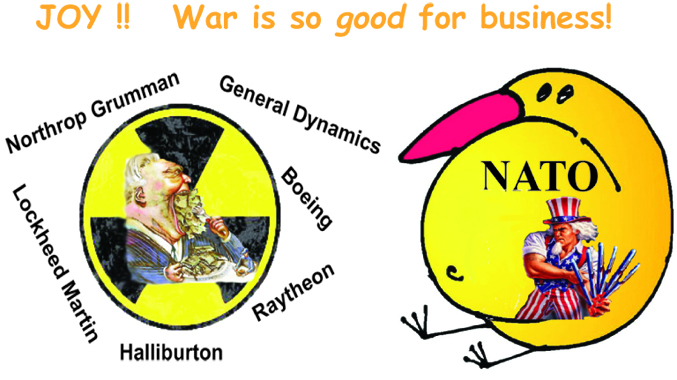
To surmount the debt crisis, America needs to stop feeding the Military-Industrial Complex (MIC), the most powerful lobby in Washington. As President Dwight D. Eisenhower famously warned on January 17, 1961, “In the councils of government, we must guard against the acquisition of unwarranted influence, whether sought or unsought, by the military-industrial complex. The potential for the disastrous rise of misplaced power exists and will persist.” Since 2000, the MIC led the U.S. into disastrous wars of choice in Afghanistan, Iraq, Syria, Libya, and now Ukraine.
The Military-Industrial Complex long ago adopted a winning political strategy by ensuring that the military budget reaches into every Congressional district. The Congressional Research Service recently reminded Congress that, “Defense spending touches every Member of Congress’s district through pay and benefits for military servicemembers and retirees, economic and environmental impact of installations, and procurement of weapons systems and parts from local industry, among other activities.” Only a brave member of Congress would vote against the military-industry lobby, yet bravery is certainly no hallmark of Congress.
America’s annual military spending is now around $900 billion, roughly 40% of the world’s total, and greater than the next 10 countries combined. U.S. military spending in 2022 was triple that of China. According to Congressional Budget Office, the military outlays for 2024-2033 will be a staggering $10.3 trillion on current baseline. A quarter or more of that could be avoided by ending America’s wars of choice, closing down many of America’s 800 or so military bases around the world, and negotiating new arms control agreements with China and Russia.
Yet instead of peace through diplomacy, and fiscal responsibility, the MIC regularly scares the American people with a comic-book style depictions of villains whom the U.S. must stop at all costs. The post-2000 list has included Afghanistan’s Taliban, Iraq’s Saddam Hussein, Syria’s Bashar al-Assad, Libya’s Moammar Qaddafi, Russia’s Vladimir Putin, and recently, China’s Xi Jinping. War, we are repeatedly told, is necessary for America’s survival.
A peace-oriented foreign policy would be opposed strenuously by the military-industrial lobby but not by the public. Significant public pluralities already want less, not more, U.S. involvement in other countries’ affairs, and less, not more, US troop deployments overseas. Regarding Ukraine, Americans overwhelmingly want a “minor role” (52%) rather than a “major role” (26%) in the conflict between Russia and Ukraine. This is why neither Biden nor any recent president has dared to ask Congress for any tax increase to pay for America’s wars. The public’s response would be a resounding “No!”
While America’s wars of choice have been awful for America, they have been far greater disasters for countries that America purports to be saving. As Henry Kissinger famously quipped, “To be an enemy of the United States can be dangerous, but to be a friend is fatal.” Afghanistan was America’s cause from 2001 to 2021, until the U.S. left it broken, bankrupt, and hungry. Ukraine is now in America’s embrace, with the same likely results: ongoing war, death, and destruction.
The military budget could be cut prudently and deeply if the U.S. replaced its wars of choice and arms races with real diplomacy and arms agreements. If presidents and members of congress had only heeded the warnings of top American diplomats such as William Burns, the U.S. Ambassador to Russia in 2008, and now CIA Director, the U.S. would have protected Ukraine’s security through diplomacy, agreeing with Russia that the U.S. would not expand NATO into Ukraine if Russia also kept its military out of Ukraine. Yet relentless NATO expansion is a favorite cause of the MIC; new NATO members are major customers of U.S. armaments.
The U.S. has also unilaterally abandoned key arms control agreements. In 2002, the U.S. unilaterally walked out of the Anti-Ballistic Missile Treaty. And rather than promote nuclear disarmament—as the U.S. and other nuclear powers are required to do under Article VI the Nuclear Non-Proliferation Treaty—the Military-Industrial Complex has sold Congress on plans to spend more than $600 billion by 2030 to “modernize” the U.S. nuclear arsenal.
Now the MIC is talking up the prospect of war with China over Taiwan. The drumbeats of war with China are stoking the military budget, yet war with China is easily avoidable if the U.S. adheres to the One-China policy that properly underpins U.S.-China relations. Such a war should be unthinkable. More than bankrupting the U.S., it could end the world.
Military spending is not the only budget challenge. Aging and rising healthcare costs add to the fiscal woes. According to the Congressional Budget Office, debt will reach 185 percent of GDP by 2052 if current policies remain unchanged. Healthcare costs should be capped while taxes on the rich should be raised. Yet facing down the military-industrial lobby is the vital first step to putting America’s fiscal house in order, needed to save the U.S., and possibly the world, from America’s perverse lobby-driven politics.
Seymour Hersh: The Ukraine Refugee Question
Ukraine’s neighbors push for Zelensky to pursue peace as millions of displaced people flow into Europe. By Seymour Hersh / Substack https://scheerpost.com/2023/05/19/seymour-hersh-the-ukraine-refugee-question/
Last Saturday the Washington Post published an exposé of classified American intelligence documents showing that Ukrainian President Volodymyr Zelensky, working behind the back of the Biden White House, pushed hard earlier this year for an expanded series of missile attacks inside Russia. The documents were part of a large cache of classified materials posted online by an Air Force enlisted man now in custody. A senior official of the Biden administration, asked by the Post for comment on the newly revealed intelligence, said that Zelensky has never violated his pledge never to use American weapons to strike inside Russia. In the view of the White House, Zelensky can do no wrong.
Zelensky’s desire to take the war to Russia may not be clear to the president and senior foreign policy aides in the White House, but it is to those in the American intelligence community who have found it difficult to get their intelligence and their assessments a hearing in the Oval Office. Meanwhile, the slaughter in the city of Bakhmut continues. It is similar in idiocy, if not in numbers, to the slaughter in Verdun and the Somme during World War I. The men in charge of today’s war—in Moscow, Kiev, and Washington—have shown no interest even in temporary ceasefire talks that could serve as a prelude to something permanent. The talk now is only about the possibilities of a late spring or summer offensive by either party.
But something else is cooking, as some in the American intelligence community know and have reported in secret, at the instigation of government officials at various levels in Poland, Hungary, Lithuania, Estonia, Czechoslovakia, and Latvia. These countries are all allies of Ukraine and declared enemies of Vladimir Putin.
This group is led by Poland, whose leadership no longer fears the Russian army because its performance in Ukraine has left the glow of its success at Stalingrad during the Second World War in tatters. It has been quietly urging Zelensky to find a way to end the war—even by resigning himself, if necessary—and to allow the process of rebuilding his nation to get under way. Zelensky is not budging, according to intercepts and other data known inside the Central Intelligence Agency, but he is beginning to lose the private support of his neighbors.
One of the driving forces for the quiet European talks with Zelensky has been the more than five million Ukrainians fleeing from the war who have crossed the country’s borders and have registered with its neighbors under an EU agreement for temporary protection that includes residency rights, access to the labor market, housing, social welfare assistance, and medical care. An assessment published by the UN High Commissioner for Refugees reports that the estimate excludes roughly 3 million Ukrainian refugees who escaped from the war zone without a visa into any of the 27 European nations that have abolished border control between each other under the Schengen agreement. Ukraine, though not in the EU, now enjoys all the benefits of the Schengen pact. A few nations, exhausted by the 15-month war, have reintroduced some forms of border control, but the regional refugee crisis will not be resolved until there is a formal peace agreement.
The UNHRC reports that free travel from Ukraine into the Baltic states and EU states in Western Europe “makes it particularly difficult to determine exactly how many Ukrainians have reached the EU in the last few months, and where they are now.” The report says the “vast majority” of the Ukrainian refugees are women and children, and one third of them are under the age of eighteen. Seventy-three per cent of the refugees of working age are women, many with children.
A February analysis of the European refugee issue by the Council on Foreign Relations found that “tens of billions of dollars” in humanitarian aid were poured into Ukraine’s neighbors during the war’s first year. “As the conflict enters its second year with no end in sight,” the report says, “experts worry that host countries are growing fatigued.”
Weeks ago I learned that the American intelligence community was aware that some officials in Western Europe and the Baltic states want the war between Ukraine and Russia to end. These officials have concluded that it is time for Zelensky to “come around” and seek a settlement. A knowledgeable American official told me that some in the leadership in Hungary and Poland were among those working together to get Ukraine involved in serious talks with Moscow. “Hungary is a big player in this and so are Poland and Germany, and they are working to get Zelensky to come around,” the American official said. The European leaders have made it clear that “Zelensky can keep what he’s got”—a villa in Italy and interests in offshore bank accounts—“if he works up a peace deal even if he’s got to be paid off, if it’s the only way to get a deal.”
So far, the official said, Zelensky has rejected such advice and ignored offers of large sums of money to ease his retreat to an estate he owns in Italy. There is no support in the Biden Administration for any settlement that involves Zelensky’s departure, and the leadership in France and England “are too beholden” to Biden to contemplate such a scenario. There is a reality that some elements in the American intelligence community can’t ignore, the official said, even if the White House is ignoring it: “Ukraine is running out of money and it is known that the next four or months are critical. And Eastern Europeans are talking about a deal.” The issue for them, the official told me, “is how to get the United States to stop supporting Zelensky,” The White House support goes beyond the needs of the war: “We are paying all of the retirement funds—the 401k’s—for Ukraine.”
And Zelensky wants more, the official said. “Zelensky is telling us that if you want to win the war you’ve got to give me more money and more stuff. He tells us, ‘I’ve got to pay off the generals.’ He’s telling us”—if he is forced out of office—“he’s going to the highest bidder. He’d rather go to Italy than stay and possibly get killed by his own people.”
“All of this talk is being reported and is now flying around inside the American intelligence community, but, as usual,” the official said, “it’s not clear to the intelligence community what the president and his foreign policy aides in the White House know of the reality” of the European discussion about finding a way to end the war. “We are still training Ukrainians how to fly our F-16s that will be shot down by Russia as soon as they get into the war zone. The mainstream press is dedicated to Biden and the war and Biden is still talking about the Great Satan in Moscow while the Russian economy is doing great. Putin can stay where he is”—in power—“despite his failure to wipe Ukraine off the map as an independent state. And he thought he would win the war with just one airborne division”—a sardonic reference to Russia’s failed effort in the first days of the war to seize a vital airport by parachuting in an attack force.
“Europe’s problem,” the official said, in terms of getting a quick settlement to the war, “is that the White House wants Zelensky to survive while there are others”—in Russia and in some European capitals—“who say Zelensky has got to go, no matter what,”
It’s not clear that this understanding has gotten to the Oval Office. I have been told that some of the better intelligence about the war does not reach the president, through no fault of those who prepare the often contrary assessments. Biden is said to rely on briefings and other materials prepared by Avril Haines, director of National Intelligence, since the Biden Administration came into office. She has spent much of her career working for Secretary of State Anthony Blinken, whose ties to Biden and agreement with him on matters pertaining to Russia and China go back decades.
The one saving grace for some in the community, I have been told, has been CIA Director William Burns. Burns was ambassador to Russia and deputy secretary of State and is seen as someone “who has come around” in opposition to some of the White House’s foreign policy follies. “He doesn’t want to be a rat on a sinking ship,” the official told me.
On the other hand, I have been told, it’s not clear to those in the CIA who prepare the President’s Daily Brief that Joe Biden is a regular reader of their intelligence summary. The document is usually three pages. Decades ago I was told—by someone who begged me not to write about it at the time—that Ronald Reagan rarely read the PDB until Colin Powell, then in the White House, began reading it to a video recorder. The tape would then be played for the president. It’s unclear who, if anyone, might take the initiative as Biden’s Colin Powell.
NOTE TO SCHEERPOST READERS: We are happy to be able to run some of Sy Hersh’s pieces from his new Substack venture. Please, if you can, sign up at seymourhersh.substack.com so you can support Sy Hersh’s work and the ability to bring it here on ScheerPost. Thank you!
AUKUS nuclear submarine bases in Western Australia will seriously weaken current safeguards against nuclear weapons proliferation

one of the possible strategic implications of the AUKUS submarine project is that it may set a dangerous new nuclear precedent for nuclear proliferation, eroding the international norms and institutions that currently safeguard against proliferation.
AUKUS drops the nuclear proliferation gauntlet
Accelerated plans to base nuclear subs in Western Australia by 2027 will significantly erode prevailing nuclear proliferation safeguards
Asia Times, By GABRIEL HONRADAMAY 24, 2023
The United States, United Kingdom and Australia have announced plans to base nuclear-powered submarines in Western Australia, using the Down Under area as an alternative to strategic bases in Guam while potentially sidestepping nuclear proliferation concerns.
The Insider reported this month that the Biden administration has established Submarine Rotational Forces–West (SRF-West), which are believed to consist of four US Virginia-class nuclear attack submarines (SSN) and one UK Astute-class SSN, and will operate out of HMAS Stirling at the western Australian city of Perth as early as 2027.
The Biden administration stated last month that SRF-West would “help build Australia’s stewardship. It will also bolster deterrence with more US and UK submarines forward in the Indo-Pacific.”
The Insider notes that the establishment of SRF-West comes at a time when US near-peer rivals China and Russia are expanding their submarine fleets, with Russia’s Yasen-class SSNs operating in the Atlantic and Pacific Oceans, and China’s nuclear-powered ballistic missile submarines (SSBNs) constantly patrolling the contested South China Sea.
Sidharth Kaushal notes in a March 2023 Royal United Services Institute (RUSI) article that Australian naval facilities that can base Virginia-class and Astute-class SSNs are relatively out of range from potential missile attacks, providing backup for Guam in case the latter is crippled by Chinese or North Korean “Guam Killer” missiles such as the DF-26 and Hwasong 14/15.
Kaushal notes that US overreliance on Guam has made US naval operations in the Pacific particularly vulnerable, with Guam’s possible loss in a conflict scenario substantially limiting the tempo of US submarine operations in the region and forcing US SSNs to travel longer distances for resupply.
Asia Times this month noted the various strategic challenges of defending Guam against missile attacks. Guam faces the perfect air and missile defense problem, as disjointed US missile defense systems on or near the island may not be effective against a saturation attack involving drones, ballistic missiles, cruise missiles and hypersonic weapons.
These unlinked missile defense systems consisting of the Terminal High Altitude Air Defense (THAAD) and Aegis-equipped nearby warships may fail first contact with advanced missiles, with the sheer number of missiles fired in a saturation attack demanding sensor fusion across various domains such as space and cyber to defeat hypersonic threats.
However, one of the possible strategic implications of the AUKUS submarine project is that it may set a dangerous new nuclear precedent for nuclear proliferation, eroding the international norms and institutions that currently safeguard against proliferation.
In a September 2021 article for Carnegie Endowment for Regional Peace, James Acton notes that AUKUS demonstrates a US double-standard regarding nuclear technology. In the context of AUKUS, Acton says that the bloc can make Australia the first non-nuclear armed state to remove nuclear material from the IAEA inspection system, setting a damaging new precedent for non-proliferation.
Acton mentions that while the Non-Proliferation Treaty (NPT) does not prohibit non-nuclear weapon states from building nuclear-powered ships, the IAEA cannot safeguard naval nuclear reactors, especially those on submarines, due to their secret locations and inaccessibility while submerged.
He also says that the IAEA Comprehensive Safeguards Agreement permits non-nuclear states to withdraw nuclear material for “non-proscribed military activity” such as naval reactors. That, Acton suggests, may set a precedent for other potential nuclear proliferators to exploit the IAEA’s loophole.
He notes that much of the world may see the US’s tacit consent for Australia to use the nuclear propulsion loophole while criticizing and punishing its adversaries for doing the same as a double standard, weakening the deterrent value of IAEA safeguards and making nuclear proliferation more likely.
South Korea in particular may take notice of the naval propulsion loophole to build its undersea nuclear deterrent, raising tensions with North Korea in an already volatile regional security environment.
Asia Times noted in June 2022 that the US and South Korea have agreed to share small modular reactor (SMR) technology, which can pave the way for the latter’s construction of nuclear submarines………………………………………………
Joel Ivre points out in a September 2021 Asia-Pacific Leadership Network article that AUKUS weakens South Korea’s commitment to nuclear non-proliferation, as nuclear-powered submarines present a much lower threshold for nuclear proliferation compared to a full nuclear weapons program………………………..
Other latent nuclear powers in Asia that may take notice of this weakening of proliferation safeguards are Japan and Taiwan, both of which have nuclear power programs and the likely resources, technology and know-how to assemble a nuclear weapon quickly should the perceived need arise. https://asiatimes.com/2023/05/aukus-drops-the-nuclear-proliferation-gauntlet/
Iran Builds an Underground and Possibly Unreachable Nuclear Facility
U.S. airstrikes would likely not be able to reach an underground Iranian
nuclear facility being built near the Zagros Mountains in central Iran,
according to experts and satellite imagery analyzed by the Associated
Press.
Photos and videos from Planet Labs PBC, a satellite-imagery
provider, reveal the construction of a new underground facility at Iran’s
pre-existing Natanz nuclear site, which has been sabotaged by repeated
attacks by Western powers because of its atomic program. I
n 2021, an
Iranian official said that thousands of nuclear-material-refinement
machines were damaged in an act of “nuclear terrorism” that it blamed
on Israel. Iran warned that it would replace affected centrifuges, which
refine or enrich uranium for nuclear usage, with more advanced ones. U.S.
intelligence officials had told the New York Times that an explosion
destroyed the site’s internal power system, necessary to supply the
centrifuges in the underground facility, estimating that enrichment
activities would need nine months to be restored. In 2020, explosives
hidden inside a table were also used to attack Natanz.
National Review 23rd May 2023
Hiroshima Survivor Slams G7 Leaders for Embracing War & Rejecting Nuclear Disarmament
Democracy Now, MAY 22, 2023
The G7 summit wrapped up Sunday in Hiroshima, where much of the summit focused on the war in Ukraine and China. While in Japan, President Biden and other world leaders paid tribute to the victims of the world’s first nuclear attack — the U.S. bombing of Hiroshima on August 6, 1945 — laying wreaths at the Hiroshima Peace Memorial and planting a tree.
But President Biden did not issue an apology for the attack, which killed an estimated 140,000 people and seriously injured another 100,000. For more, we speak with Setsuko Thurlow, who survived the U.S. bombing of Hiroshima in 1945 and devoted her life to nuclear disarmament. In 2017, she was chosen to accept the Nobel Peace Prize on behalf of the International Campaign to Abolish Nuclear Weapons.
Media Options
This is viewer supported news. Please do your part today.
TOPICS
GUESTS
- Setsuko Thurlowsurvivor of the atomic bombing of Hiroshima in 1945 and nuclear disarmament activist.
LINKS
The G7 summit wrapped up Sunday in Hiroshima, where much of the summit focused on the war in Ukraine and China. While in Japan, President Biden and other world leaders paid tribute to the victims of the world’s first nuclear attack — the U.S. bombing of Hiroshima on August 6, 1945 — laying wreaths at the Hiroshima Peace Memorial and planting a tree. But President Biden did not issue an apology for the attack, which killed an estimated 140,000 people and seriously injured another 100,000. For more, we speak with Setsuko Thurlow, who survived the U.S. bombing of Hiroshima in 1945 and devoted her life to nuclear disarmament. In 2017, she was chosen to accept the Nobel Peace Prize on behalf of the International Campaign to Abolish Nuclear Weapons.
Transcript
………………………………………………………………………………………………………………………. SETSUKO THURLOW: Well, I came to Hiroshima from Canada, where I live. I wanted to be part of this whole excitement that the world leaders are coming to Hiroshima and to discuss the nuclear disarmament. And the people here were so excited, so happy to have the opportunity to give them the — to give the leaders the opportunity to be with us, to be in the center of the calamity and catastrophe, and to have a profound encounter themselves with the meaning of the dawn of the nuclear age. And people had a great anticipation and excitement. They’ve prepared for this with all kinds of recommendations to the leaders.
But somehow their wishes were not fully listened. To put it bluntly, for us survivors, who want nothing less than the total disarmament, total abolishment of nuclear weapons, and the majority of the citizens of Japan who support survivors’ idea, to us, it was nothing but a disaster. We are feeling more than frustration. It’s a fury, anger and a total disappointment, because we —
Media Options
This is viewer supported news. Please do your part today.
TOPICS
GUESTS
- Setsuko Thurlowsurvivor of the atomic bombing of Hiroshima in 1945 and nuclear disarmament activist.
LINKS
The G7 summit wrapped up Sunday in Hiroshima, where much of the summit focused on the war in Ukraine and China. While in Japan, President Biden and other world leaders paid tribute to the victims of the world’s first nuclear attack — the U.S. bombing of Hiroshima on August 6, 1945 — laying wreaths at the Hiroshima Peace Memorial and planting a tree. But President Biden did not issue an apology for the attack, which killed an estimated 140,000 people and seriously injured another 100,000. For more, we speak with Setsuko Thurlow, who survived the U.S. bombing of Hiroshima in 1945 and devoted her life to nuclear disarmament. In 2017, she was chosen to accept the Nobel Peace Prize on behalf of the International Campaign to Abolish Nuclear Weapons.
Transcript
This is a rush transcript. Copy may not be in its final form.
AMY GOODMAN: The G7 summit wrapped up Sunday in Hiroshima, Japan. Much of the summit focused on two issues: the war in Ukraine and China. President Biden announced $375 million more in military aid for Ukraine. He also pledged to begin training Ukrainian forces on flying U.S.-made F-16 fighter jets. Biden did not offer to send any F-16s, but the U.S. has lifted its opposition to allies supplying the warplanes to Ukraine. Britain and the Netherlands have announced plans to work together to help provide Ukraine F-16s. President Biden spoke Sunday.
PRESIDENT JOE BIDEN: You know, in my private meeting with President Zelensky after the G7 meeting, and with his staff, I told — the United States, together with our allies and partners, is going to begin training Ukrainian pilots in fourth-generation fighter aircraft, including F-16s, to strengthen Ukraine’s air force as part of a long-term commitment to Ukraine’s ability to defend itself. … I have a flat assurance from the — from Zelensky that they will not — they will not use it to go on and move into Russian geographic territory. But wherever Russian troops are within Ukraine in the area, they would be able to do that.
AMY GOODMAN: Ukrainian President Volodymyr Zelensky, who attended the G7 in Hiroshima, thanked Biden for his support.
PRESIDENT VOLODYMYR ZELENSKY: We are very thankful. I think it will give us more strong positions on the battlefield. So, we are very thankful that that is a new package. I really didn’t know the details, but I know that you gave us very big package during this year. It’s more than $37 billion. My appreciations. We will never forget. Thank you.
AMY GOODMAN: While in Hiroshima, President Biden and other world leaders paid tribute to the victims of the world’s first nuclear attack — the U.S. bombing of Hiroshima on August 6, 1945 — laying wreaths at the Hiroshima Peace Memorial and planting a tree. But President Biden did not issue an apology for the attack. A group of anti-nuclear activists rallied on the streets.
PROTESTER 1: [translated] Japan and the United States are trying to conduct a war of aggression on China. I am protesting because I absolutely cannot accept the fact that they are in Hiroshima, a place where an atomic bomb was dropped, trying to hold a meeting to start a nuclear war.
PROTESTER 2: [translated] I’m absolutely against the war. I’m against using nuclear weapons. That is why I’m here. This summit is being held to prepare for a nuclear war, so we, the union, need to do whatever we can to protest against it.
AMY GOODMAN: We go now to Hiroshima, where we’re joined by Setsuko Thurlow, who survived the U.S. bombing of Hiroshima in 1945 that killed about 140,000 people. She’s devoted her life to nuclear disarmament and the ban treaty process. In 2017, she was chosen to accept the Nobel Peace Prize on behalf of the International Campaign to Abolish Nuclear Weapons, or ICAN. She’s joining us on the phone from Hiroshima.
It’s great to have you back with us, Setsuko Thurlow. If you can respond to the G7 meeting and the outcome this weekend, held in Hiroshima, where you are?
SETSUKO THURLOW: Well, I came to Hiroshima from Canada, where I live. I wanted to be part of this whole excitement that the world leaders are coming to Hiroshima and to discuss the nuclear disarmament. And the people here were so excited, so happy to have the opportunity to give them the — to give the leaders the opportunity to be with us, to be in the center of the calamity and catastrophe, and to have a profound encounter themselves with the meaning of the dawn of the nuclear age. And people had a great anticipation and excitement. They’ve prepared for this with all kinds of recommendations to the leaders.
But somehow their wishes were not fully listened. To put it bluntly, for us survivors, who want nothing less than the total disarmament, total abolishment of nuclear weapons, and the majority of the citizens of Japan who support survivors’ idea, to us, it was nothing but a disaster. We are feeling more than frustration. It’s a fury, anger and a total disappointment, because we —
AMY GOODMAN: Setsuko Thurlow, how do you think the war can end, the war in Ukraine can end?
SETSUKO THURLOW: Well, to me, personally, you know, why we keep hearing about more military aid, the support for war, than hearing about the efforts being made for a peaceful ceasefire at the earliest possible time? Every day, many, many lives have been killed. Certainly, something must be going on, some — quietly, some effort must be being paid for ceasefire. But we don’t hear about them. Are they really making that effort? Do they really feel they can win this out? I don’t know what’s their thoughts. All I can say is it has to stop at the earliest possible chance, no matter what.
AMY GOODMAN: President Biden did not apologize for the U.S. dropping the atomic bomb on Hiroshima, then three three days later on Nagasaki. Your thoughts?
SETSUKO THURLOW: Well, it’s unfortunate. He had the opportunity, but he didn’t. This time, too, in the joint statement or communiqué, he kept criticizing the Russians, the Chinese or North Korea. And why do they fail to look at themselves with a critical eye, and we don’t hear anything evil which is being committed by the West? I mean, of course, as far as the war in Ukraine is concerned, I think Putin should get a total condemnation. I do condemn. No matter what the reason is, to be willing to kill so many human lives, that’s not acceptable. That must stop.
But your question was whether the president should have — well, my opinion, yes, the United States has committed the crime against humanity. The United States has never acknowledged any guilt. And, well, this truth, old saying, the victims — victors write the history. The U.S. has been condemning —………………………………………………… more https://www.democracynow.org/2023/5/22/g7_meeting_hiroshima_nuclear_weapons
Russia evacuates nuclear munitions due to incursion from Ukraine into Belgorodoblast-Ukraine’s Intel
https://euromaidanpress.com/2023/05/22/russia-evacuates-nuclear-munitions-due-to-incursion-from-ukraine-into-belgorod-oblast-ukraines-intel-spox/ Russian authorities have urgently evacuated a nuclear munitions storage facility in the Belgorod oblast (western Russia) following the incursion of the Legion “Freedom for Russia” and RDK (Russian Volunteer Corps) from Ukraine into the Belgorod region, Ukraine’s Intelligence spox Andrii Yusov said.
On 22 May 2023, in the morning, a Russian border crossing in the Belgorod oblast was reportedly destroyed by artillery shelling from the territory of Ukraine. After that, the incursion of troops supported by armored vehicles from Ukraine into the Belgorod oblast began.
The Russian military unit no. 25624, located in the Grayvoron district of the Belgorod oblast, is a part of Russia’s Strategic Missile Forces. It is an “Object C,” which is the conventional name for Russia’s central nuclear weapons storage base, Ukrainska Pravda reported.
The Legion “Freedom for Russia” and RDK (Russian Volunteer Corps), which allegedly comprise Russian citizens who decided to fight on the side of Ukraine and joined the International Legion of Ukraine’s Armed Forces, claimed its fighters crossed the Russo-Ukrainian border and entered the Belgorod oblast from the territory of Ukraine.
The Legion “Freedom for Russia” and RDK announced on their official Telegram channels that their troops advanced deep into the Russian territory and engaged with Russia’s forces in several towns in Belgorod oblast, namely Kozinka, Gora-Podol, and Grayvoron (the latter being around ten kilometers from the Russo-Ukrainian border), and called on residents of the Russian border regions to stay at home and “not resist.” Shortly after this, locals in Grayvoron started to report gunfire in their town.
NATO to Draw Up ‘Russia War Plans’ for First Time Since Cold War

MAY 21, 2023 BY NEWS WIRE https://21stcenturywire.com/2023/05/21/nato-to-draw-up-russia-war-plans-for-first-time-since-cold-war/
NATO alliance leaders to approve thousands of pages of secret military plans that detail how to respond to a Russian attack.
David DeCamp from Antiwar.com reports…
NATO is drawing up plans on how to fight a war with Russia for the first time since the Cold War.
According to Reuters, at the upcoming NATO summit in Vilnius this July, alliance leaders will approve thousands of pages of secret military plans that will detail how to respond to a Russian attack.
The plans will be vastly different than anything drawn up during the Cold War as NATO has expanded from 16 members to 31 since the dissolution of the Soviet Union and the Warsaw Pact. The documents will also outline how NATO members should upgrade their forces and logistics.
“Allies will know exactly what forces and capabilities are needed, including where, what and how to deploy,” NATO Secretary-General Jens Stoltenberg said of the war plans.
NATO’s newest member, Finland, shares an over 800-mile border with Russia and is poised to sign a deal that will give US troops access to its territory. While the alliance is preparing to beef up its presence on its “eastern flank,” one NATO official acknowledged the danger of massing troops near Russia’s border.
“The more troops you are massing up on the border, it’s like having a hammer. At some point, you want to find a nail,” said Lt. Gen. Hubert Cottereau, the vice chief of staff for NATO’s Supreme Headquarters Allied Powers Europe. “If the Russians are massing troops on the border that will make us nervous, if we are massing troops on the border that will make them nervous.”
Biden Okays F-16s For Ukraine, US Weapons To Attack Crimea

Moscow has considered Crimea a part of the Russian Federation since its annexation in 2014, meaning efforts to recapture it would — at least in theory — be treated the same as an invasion of any other part of Russia. It was only by way of an arbitrary bureaucratic fluke that Crimea wound up a part of Ukraine after the fall of the Soviet Union, and Crimeans overwhelmingly prefer to be a part of the Russian Federation. That we may soon be staring down the barrel of a nuclear third world war over something so pedantic is a very dark shade of absurd.
As Tapper noted, both the F-16 decision and the Crimea decision marked a sharp policy shift by the Biden administration in just a few months. This proxy war just keeps escalating and escalating, with aggressions once deemed unthinkable due to their likelihood of sparking a nuclear exchange now becoming commonplace. Every time a new once-unthinkable escalation is enacted, the hawks are already pushing for the next one.
CAITLIN JOHNSTONE, MAY 22, 2023 https://caitlinjohnstone.substack.com/p/biden-okays-f-16s-for-ukraine-us?utm_source=post-email-title&publication_id=82124&post_id=123001716&isFreemail=true&utm_medium=email
The Biden administration has signed off on both F-16s for Ukraine and attacks on Crimea using US-made weapons. Both of these moves have drawn dire warnings from nuclear-armed Russia, and both would have been unthinkable a year ago.
In a Sunday interview with CNN’s Jake Tapper from the G7 summit in Hiroshima, Biden’s National Security Advisor Jake Sullivan made it clear that Washington would approve of US weapons being used in an offensive to recapture Crimea, a horrifying prospect that many experts have agreed is the most likely scenario to lead to nuclear warfare in this conflict. Sullivan told Tapper that while the US has forbidden the use of American weapons to attack Russia, the US considers Crimea to be part of Ukraine, not Russia.
Here’s CNN’s transcript of the exchange:
TAPPER: In February on this show, you would not say whether the U.S. would support Ukrainian efforts to recapture Crimea. That’s one of the concerns that has been expressed about whether or not the Ukrainians are given the ability to hit Russian targets in Crimea. Do you think that Crimea is part of Ukraine?
SULLIVAN: Of course.
TAPPER: So, what would be the objection of giving…
SULLIVAN: Crimea is Ukraine.
TAPPER: Right.
SULLIVAN: I mean, that’s a very straightforward thing.
TAPPER: Well, yes you answered it directly. I mean, Russia doesn’t think so, obviously. But do you think that Ukraine should have weapons that can reach Russian targets in Crimea?
SULLIVAN: Yes. We have not placed limitations on Ukraine being able to strike on its territory within its internationally recognized borders. What we have said is that we will not enable Ukraine with U.S. systems, Western systems, to attack Russia. And we believe Crimea is Ukraine.
TAPPER: OK.
Moscow has considered Crimea a part of the Russian Federation since its annexation in 2014, meaning efforts to recapture it would — at least in theory — be treated the same as an invasion of any other part of Russia. It was only by way of an arbitrary bureaucratic fluke that Crimea wound up a part of Ukraine after the fall of the Soviet Union, and Crimeans overwhelmingly prefer to be a part of the Russian Federation. That we may soon be staring down the barrel of a nuclear third world war over something so pedantic is a very dark shade of absurd.
In the same interview, Tapper questioned Sullivan about the Biden administration’s policy shift toward approving F-16 fighter jets to be sent to Ukraine, demanding to know why the war planes weren’t approved sooner.
“President Biden told the G7 leaders that the United States is going to support this joint effort to train Ukrainian pilots to fly F-16 fighter jets,” said Tapper. “As you know, just a few months ago, the president said there was no basis militarily for giving Ukraine jets and that Ukraine didn’t need them at all. What changed? And would these jets not have been more effective if Ukraine had been trained and had them in time for the upcoming counteroffensive?”
It’s so obnoxious how the only time you ever see these mass media propagandists challenging the US government on its warmongering is when they’re pushing it to be more warlike and demanding answers on why it isn’t warmongering more. This creates the illusion of brave adversarial journalism, when in reality these empire cronies are just manufacturing consent for the increased aggressions the US wants to wage anyway.
These escalations have drawn stern warnings from Moscow, which have just been casually hand-waved away by Biden like he’s rejecting jello for dessert. In an article titled “Russia Says West Providing F-16s to Ukraine a ‘Colossal Risk’”, Antiwar’s Dave DeCamp writes the following:
A Russian official said Saturday that the Western plans to provide Ukraine with American-made F-16 fighter jets bring “colossal risks” after the US announced it would sign off on European countries delivering the aircraft.
“We see that Western countries are still adhering to the escalation scenario. It involves colossal risks for themselves,” said Russian Deputy Foreign Minister Alexander Grushko, according to TASS.
“In any case, this will be taken into account in all our plans, and we have all the necessary means to achieve the goals we have set,” Grushko added.
During the last day of the G7 Summit in Hiroshima, Japan, President Biden was asked about Russia calling the F-16 plan a “colossal risk.” He replied, “It is for them.”
As Tapper noted, both the F-16 decision and the Crimea decision marked a sharp policy shift by the Biden administration in just a few months. This proxy war just keeps escalating and escalating, with aggressions once deemed unthinkable due to their likelihood of sparking a nuclear exchange now becoming commonplace. Every time a new once-unthinkable escalation is enacted, the hawks are already pushing for the next one.
As we’ve discussed previously, this pattern of continually escalating nuclear brinkmanship in Ukraine has built-in incentives for Russia to ramp up its own aggressions against NATO itself. Every time the west ramps up its brinkmanship and crosses another once-taboo line in the sand without Moscow responding with direct military confrontation, the west takes this as a sign that it can ramp up the escalations again. This has put things on a trajectory toward more and more direct western-backed attacks on the Russian Federation unless Russia lashes out at NATO powers in some way to show them it’s not worth it. Which would be about as dangerous an occurrence as you could possibly imagine.
It is not okay for our rulers to play games with our lives like this. It is not okay for them to keep rolling the dice on nuclear escalation more and more often in the name of securing US unipolar hegemony. These people are making it abundantly clear that sanity and level-headedness are not in the driver’s seat here. Everyone on earth should be shouting a loud, unequivocal “no” to this at the top of their lungs.
1 This Month




PLEASE OPPOSE HR 8255 AND S.3639 – bills would accelerate satellite deployment, with no environmental review or safeguards – https://ncstd5li.quorum.us/campaign/169331/
To see nuclear-related stories in greater depth and intensity – go to https://nuclearinformation.wordpress.com
-
Archives
- September 2026 (330)
- August 2026 (330)
- July 2026 (355)
- June 2026 (287)
- May 2026 (306)
- April 2026 (356)
- March 2026 (251)
- February 2026 (267)
- January 2026 (308)
- December 2025 (358)
- November 2025 (359)
- October 2025 (375)
-
Categories
- 1
- 1 NUCLEAR ISSUES
- business and costs
- climate change
- culture and arts
- ENERGY
- environment
- health
- history
- indigenous issues
- Legal
- marketing of nuclear
- media
- opposition to nuclear
- PERSONAL STORIES
- politics
- politics international
- Religion and ethics
- safety
- secrets,lies and civil liberties
- spinbuster
- technology
- Uranium
- wastes
- weapons and war
- Women
- 2 WORLD
- ACTION
- AFRICA
- Atrocities
- AUSTRALIA
- Christina's notes
- Christina's themes
- culture and arts
- Events
- Fuk 2022
- Fuk 2023
- Fukushima 2017
- Fukushima 2018
- fukushima 2019
- Fukushima 2020
- Fukushima 2021
- general
- global warming
- Humour (God we need it)
- Nuclear
- RARE EARTHS
- Reference
- resources – print
- Resources -audiovicual
- Weekly Newsletter
- World
- World Nuclear
- YouTube
-
RSS
Entries RSS
Comments RSS

