Ukraine targeting Russian nuclear power plants amid frontline losses – Rosatom head.
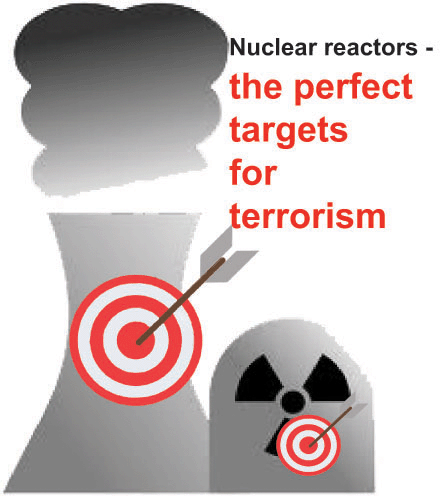
14 Nov, 2025 https://www.rt.com/russia/627793-ukraine-russian-nuclear-plants-attacks/
Kiev’s drones have once again hit the Novovoronezh NPP in Western Russia, Aleksey Likhachev has said.
Ukraine has intensified strikes on Russian nuclear power plants (NPPs) in response to its mounting battlefield losses, Rosatom head Aleksey Likhachev said on Friday.
Likhachev said that earlier this week, Ukrainian drones had once again targeted the Novovoronezh NPP in Western Russia’s Voronezh Region. He relayed that eight of the unmanned aircraft were intercepted and destroyed, but falling debris damaged a power distribution unit, forcing three reactor blocks to temporarily reduce output to below half capacity.
“We are seeing growing aggressiveness from the Kiev regime, directed deliberately against facilities of Russia’s nuclear energy sector,” Likhachev said.
“It is clear that this is a response to the successes and advances of our troops along almost the entire line of contact,” he added, stressing that Russia will provide an “adequate response” to such attacks.
Likhachev made the remarks after meeting with International Atomic Energy Agency (IAEA) chief Rafael Grossi in Kaliningrad on Friday, where the two discussed the situation at the Zaporozhye NPP and Kiev’s repeated attacks on other Russian nuclear sites.
The safety of the Zaporozhye NPP, Europe’s largest facility of its kind, had been fully ensured during the restoration of its external power supply, according to Likhachev. The plant had relied on backup diesel generators for 30 days after a Ukrainian strike severed its last high-voltage transmission line in September.
The coordination with the IAEA helped Russia “get through a very difficult month from September 23 to October 23,” Rosatom’s CEO told reporters.
Located in Zaporozhye Region, which voted to join Russia in 2022 in a move rejected by Kiev and its Western backers, the facility has repeatedly come under Ukrainian fire, according to Russian officials, who describe the attacks as reckless and highly dangerous. The IAEA maintains observers at the site but has stopped short of assigning blame, a stance Moscow says only encourages further provocations by Kiev.
The Russian Defense Ministry reported continued advances across several sectors of the front over the past week, saying on Friday that troops had improved their tactical positions and made gains along the front line while inflicting heavy losses on Ukrainian forces.
IDF Kills Two 15-Year-Old Boys in the West Bank, Israeli Settlers Torch Mosque

by Dave DeCamp | November 13, 2025, https://news.antiwar.com/2025/11/13/idf-kills-two-15-year-old-boys-in-the-west-bank-israeli-settlers-torch-mosque/
The Israeli military killed two 15-year-old boys in the Israeli-occupied West Bank on Thursday, according to the Palestinian Authority, as Jewish settlers in the territory continued their attacks on Palestinian communities.
The PA said the two boys, Bilal Bahaa Ali Baaran and Muhammad Mahmud Abu Ayash, were killed “by bullets from the occupation this afternoon, Thursday, near Beit Omar, north of Hebron.”
The Israeli military said that it killed two Palestinians, whom it claimed were on their way to “carry out a terror attack,” but offered no evidence to back up the claim or any other details about the slaying. Earlier this year, the IDF expanded its “open fire” policy in the West Bank, which led to an increase in the killing of civilians.
The Palestinian news agency WAFA reported that three Palestinians, including a 14-year-old, were wounded by Israeli military gunfire in the town of Eizariya, southeast of Jerusalem.
Also on Thursday, Jewish settlers set fire to a mosque in the Palestinian village of Deir Istiya, near Salfit in the northern West Bank. Al Jazeera reported that the settlers sprayed racist, anti-Palestinian graffiti, and photos of the scene show burned Qurans.
There’s been a surge in settler attacks in the West Bank, coinciding with the start of the olive harvesting season, as Palestinian olive farmers are frequently targeted. The UN recorded a total of 266 settler attacks in October, the highest in a single month since it began recording in 2006, according to the UN Office for the Coordination of Humanitarian Affairs (OCHA).
“Since 2006, OCHA has documented over 9,600 such attacks. About 1,500 of them took place just this year, roughly 15% of the total,” OCHA said earlier this month.
The surge in violence in the West Bank came after a de-escalation in Gaza as a result of the US-brokered ceasefire deal, which Israel has repeatedly violated by launching attacks and killing more than 240 Palestinians since the truce went into effect, according to numbers from Gaza’s Health Ministry.
‘The war of tomorrow will begin in space’: Macron
by AFP Staff Writers, Toulouse, France (AFP) Nov 12, 2025, https://www.spacewar.com/reports/The_war_of_tomorrow_will_begin_in_space_Macron_999.html
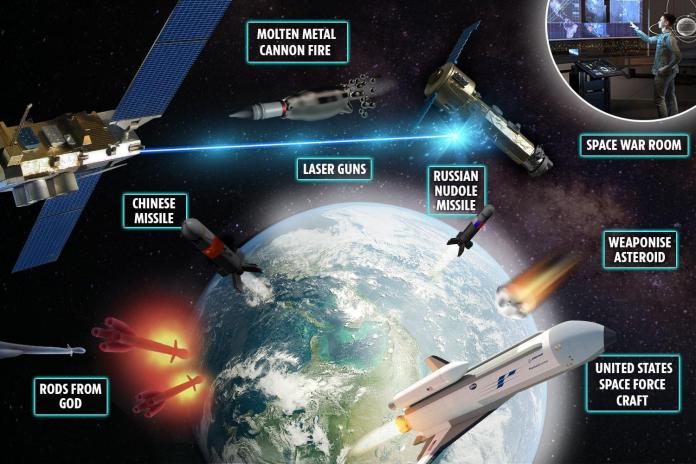
Modern conflicts are already being fought in space and the next wars will begin there, French President Emmanuel Macron said Wednesday, singling out the threat posed by Russia and announcing a multi-billion euro increase in spending on military activities in space.
“The war of today is already being fought in space, and the war of tomorrow will begin in space,” Macron said in Toulouse, France’s space and aviation hub, which is home to its new space military command centre.
“Space is no longer a sanctuary, it has become a battlefield,” Macron said.
He said that Russia in the wake of its 2022 full scale invasion of Ukraine was carrying out “espionage” activities in space.
Russian space vehicles were monitoring French satellites, there was mass jamming of GPS signals and cyberattacks against space infrastructure, he added.
Macron also pointed to the “particularly shocking Russian threat of nuclear weapons in space, the effects of which would be disastrous for the whole world”.
Without giving specific details, Macron announced an additional 4.2 billion euros ($4.9 billion) in funding for military space activities up to 2030.
In a “fragile” European space sector, he also stressed the need to “encourage our European champions to be competitive on the global market”.
The priorities outlined for France’s space strategy included “developing future launchers” that are reusable, have low-cost propulsion and high-thrust engines.
In a nod to the ambitious programmes of American billionaires Elon Musk who leads Space X and Jeff Bezos with Blue Origin, Macron said: “Depending on a major third-party power or any space magnate is out of the question.
“Let us be ready: this will be a condition for the success of military operations on land, in the air and at sea.”
He also said France was accelerating the development of advanced warning capabilities in cooperation with Germany, strengthening space surveillance with the Aurore radar system to reduce dependence on other states.
“We are investing in means of action from the ground and space while respecting international law, but without any naivety,” he said.
‘Gunboat Diplomacy’: U.S. War in Latin America Feared as Hegseth Launches ‘Operation Southern Spear’
SCHEERPOST, November 15, 2025 By DemocracyNow!
Defense Secretary Pete Hegseth has announced the launch of Operation Southern Spear to target suspected drug traffickers in South America, Central America and the Caribbean. The U.S. now has 15,000 military personnel in the region. Over the past two months the U.S. has blown up at least 20 boats in the Caribbean and eastern Pacific. “80 people have been killed in what are extrajudicial executions under international law,” says Juan Pappier, Americas deputy director at Human Rights Watch. The Pentagon claims the boats were carrying drugs but officials have acknowledged they don’t know who has been killed.
“Progressives and people of goodwill — of the U.S. and Puerto Rico — it’s time for those of us here to stand up and say that where we will not support any attempt to bring back the old gunboat diplomacy and to invade another Latin American country, and we need to do it soon, because this stuff is moving very quickly,” says Democracy Now!’s Juan González.
Transcript
………………………..AMY GOODMAN: Defense Secretary Pete Hegseth has announced the launch of Operation Southern Spear to target suspected drug traffickers, he says. In a post on X, Hegseth wrote, quote, “Today, I’m announcing Operation Southern Spear led by Joint Task Force Southern Spear and SOUTHCOM. This mission defends our homeland, removes narcoterrorism from our hemisphere, and secures our homeland from the drugs that are killing our people,” unquote.
The announcement comes as the Pentagon continues to amass warships in the Caribbean. The USS Gerald R. Ford aircraft carrier arrived earlier this week. The U.S. now has 15,000 military personnel in the region. It’s the largest buildup in the region in decades, according to the New York Times. Over the past two months, the U.S. has blown up at least 20 boats in the Caribbean and Eastern Pacific. The latest strike killed four people on Thursday.
The Pentagon claims the boats were carrying drugs, but officials have acknowledged they don’t know who’s been killed. Critics have denounced the strikes as illegal extrajudicial killings. We begin today’s show with Juan Pappier, the Americas Deputy Director at Human Rights Watch. We welcome you to Democracy Now!, Juan. Begin by talking about Operation Southern Spear and what this means.
JUAN PAPPIER: Amy, thank you for having me. We don’t know what Operation Southern Spear means. The Secretary has not provided details. But we have every reason to be concerned because in the buildup of this announcement, as you mentioned, 80 people have been killed in what are extrajudicial executions under international law…………………………………………………………………………………………………………………..
JUAN GONZÁLEZ: Yeah, well, Amy, I think with the – especially now, not only with these attacks on boats and these killings, but now with the arrival of an unprecedented military force – we’re talking the largest aircraft carrier in the world, the USS Gerald Ford, has just arrived in the Caribbean with another 5,000 troops and several other battleships accompanying it.
We now have 15,000 U.S. troops in the region, thousands of them based in Puerto Rico. The government has reopened Roosevelt Roads Naval Base, which they had closed, and U.S. planes at the old Ramey Air Force Base in Aguadilla. All of these soldiers are not there to hang out. They’re there to take military action. We have to be clear.
Even though the government hasn’t announced it, it’s clear that this is what’s coming. Our government is embarking on a totally unprovoked military assault and regime change operations in Latin America. The Trump administration has openly accused not one but two Latin-American presidents of drug dealing without any proof, Nicolas Maduro of Venezuela and Gustavo Petro of Colombia and threatened to kill Maduro. This is a bizarre return to the gunboat diplomacy of the early 20th century.
And the big prize being not democracy or not stopping drug trafficking, but grabbing the Venezuelan oil fields, the largest oil reserves in the world. The problem is, this is not the old Latin America that the U.S. could bully at will. The countries at the region are today independent sovereign states………………………………………………………………………………………………………
Yes, it’s a clear continued policy of the United States to control oil production as much as it can as the Trump administration continues on this crazy, bizarre attempt to corner as much oil supply as they can as it continues to deny the existence of climate change or the climate catastrophe we face, https://scheerpost.com/2025/11/15/gunboat-diplomacy-u-s-war-in-latin-america-feared-as-hegseth-launches-operation-southern-spear/
Trump stupidly brags about committing war crimes against Iran

Walt Zlotow, West Suburban Peace Coalition, Glen Ellyn IL, Nov 15, 2025, https://theaimn.net/trump-stupidly-brags-about-committing-war-crimes-against-iran/
Rule 1 for leaders committing war crimes is to refrain from bragging about them. President Trump jettisoned that wise rule regarding his criminal involvement in Israel’s 12 day war on Iran last June.
When Israel attacked, Trump trotted his obedient Secretary of State Marco Rubio who issued this lie to America and world. “Israel had taken unilateral action to defend itself. We are not involved in strikes against Iran and our top priority is protecting American forces in the region. Let me be clear: Iran should not target U.S. interests or personnel.”
Of course Iran had every right to target US interests and personnel since the US knew about and aided Israel’s crazed war that backfired on Israel. How so? Iran was wise to ignore US perfidy to launch a massive rocket attack on Israel that could not be defended against. After 12 days Israel threw in the towel. Israel now knows Iran will never be a genocidal punching bag like the Palestinians in Gaza and the West Bank.
US involvement was overt and covert. The former included refueling Israeli bombers during the entire 12 day war. The covert consisted of holding fake negotiations with Iran about their nuclear program to lull them into false security that no attack, which the US knew about, was imminent. Just 2 days beforehand Trump scheduled another negotiation and proclaimed “I am committed to a “diplomatic solution” with Iran.”
The US maintained the ‘not involved’ charade for nearly 5 months. Alas, Trump, an inveterate braggart on everything he maliciously touches from business partners, women wishing to be left alone, political enemies among others, just couldn’t contain his glee in assisting Israel’s unprovoked, murderous attack. ”Israel attacked first. That attack was very, very powerful. I was very much in charge of that. When Israel attacked Iran first, that was a great day for Israel because that attack did more damage than the rest of them put together.”
Iran took note of Trump’s confession of international criminality. Iranian Foreign Minister Abbas Araghchi fired off a letter to UN officials demanding the US be held to account for enabling Israel’s attacks on Iran that killed more than 1,000 people. In the letter Araghchi cited Trump’s recent comments about how he was “in charge” of the Israeli attacks. “The Islamic Republic of Iran reserves its full and unimpeachable right to pursue, through all available legal means, the establishment of accountability for the responsible States and individuals and to secure compensation for the damages sustained.”
Araghchi can Faggedaboudit. If the UN and the International Criminal Court can do nothing Trump’s complicity in Israel’s monstrous genocide in Gaza, there is zero chance they will even glance at his war crimes in Iran.
US, South Korea to ‘move forward’ on building nuclear-powered submarines
South Korean President Lee Jae Myung says the US supports Seoul’s bid to secure uranium enrichment and spent nuclear fuel reprocessing capabilities.
By Kevin Doyle and News Agencies 14 Nov 2025, https://www.aljazeera.com/news/2025/11/14/us-south-korea-to-move-forward-on-building-nuclear-powered-submarines
The United States and South Korea have released details of a trade agreement that includes a $150bn Korean investment in the US shipbuilding sector, and both countries agree to “move forward” on building nuclear-powered submarines.
Under the agreement, President Lee Jae Myung said on Friday that South Korea will build nuclear-powered submarines as part of a new partnership with Washington on shipbuilding, artificial intelligence and the nuclear industry.
A fact sheet released by the White House said the US gave approval for Seoul to build nuclear-powered submarines and that South Korea will invest an additional $200bn in US industrial sectors in addition to the $150bn in shipbuilding.
South Korea’s official Yonhap news agency said Seoul’s investment was in return for Washington’s lowering of trade tariffs on Korean goods to 15 percent from 25 percent.
“One of the greatest variables for our economy and security – the bilateral negotiations on trade, tariffs and security – has been finalised,” President Lee said at a news conference on Friday, adding the two countries had agreed to “move forward with building nuclear-powered submarines”.
“The United States has given approval for the ROK [Republic of Korea] to build nuclear-powered attack submarines,” Lee said.
Seoul also secured “support for expanding our authority over uranium enrichment and spent-fuel reprocessing”, he said.
The joint fact sheet outlining the deal said both sides would “collaborate further through a shipbuilding working group” to “increase the number of US commercial ships and combat-ready US military vessels “.
Yonhap also reported that South Korea is seeking to acquire “four or more 5,000-ton conventionally armed, nuclear-powered submarines by the mid-2030s “.
South Korea’s development of nuclear-powered vessels would provide a significant boost to its naval and defence industries, allowing Seoul to join a select group of countries with such technological capabilities, analysts say.
China had already voiced concern over a Washington-Seoul deal on nuclear submarine technology.
Such a partnership “goes beyond a purely commercial partnership, directly touching on the global nonproliferation regime and the stability of the Korean Peninsula and the wider region,” China’s Ambassador in Seoul Dai Bing told reporters on Thursday.
North Korea did not immediately comment on the development, but is likely to respond. Pyongyang has consistently accused Washington and Seoul of building up military forces on the North’s borders in preparation for an invasion one day.
Details remain murky on where the nuclear submarines will be built.
US President Donald Trump said on social media last month that “South Korea will be building its Nuclear Powered Submarine in the Philadelphia Shipyards, right here in the good ol’ U.S.A”.
However, Seoul’s national security adviser Wi Sung-lac said on Friday that “from start to finish, the leaders’ discussion proceeded on the premise that construction would take place in South Korea”.
“So the question of where construction will take place can now be considered settled,” Wi said.
One month in, the ‘ceasefire’ in Gaza exists only in name

Noor Alyacoubi, Mondoweiss, Thu, 13 Nov 2025
Palestinians hoped the Gaza ceasefire with Israel would offer a chance to recover from two years of genocide, but a month later, Israel continues to strike with impunity, the economic crisis remains, and nutritious food is nearly impossible to find.
When the ceasefire was declared in mid-October 2025, many in Gaza believed it might finally signal a return to peace — an end to the explosions, the airstrikes, and the constant buzzing of the Zannana (unmanned reconnaissance aircraft) overhead.
But the reality on the ground has been very different.
Almost every morning, the sounds of Israeli bombing can still be heard. Breaking news headlines continue to report rising numbers of martyrs and injured civilians. According to Gaza’s Ministry of Health, since the so-called end of the war, over 236 civilians have been killed and nearly 600 have been wounded. Israeli tanks continue to block access to large parts of the territory, restricting civilian movement through what is referred to as “the yellow line,” preventing thousands from returning to their homes. Surveillance drones still hover above. Bombs still fall — only now under the label of a “ceasefire.”
According to the Government Media office, Israel shot at civilians 88 times, raided residential areas beyond the “yellow line” 12 times, bombed Gaza 124 times, and demolished people’s properties on 52 occasions. It added that Israel also detained 23 Palestinians from Gaza over the past month.
Meanwhile, Israeli authorities continue to issue public threats about resuming full-scale military operations in Gaza. These threats, combined with ongoing violence, have raised a serious question among Palestinians: Is there really a ceasefire? And if there is, why are we still suffering? Why are we still deprived of food, medicine, and safety? Why are we still hungry?
and debris surround their shelters in Gaza City • November 5, 2025A life of displacement and debt
For the past 24 months, 29-year-old Raheel has lived in constant displacement — evacuating, relocating, and returning again and again, crossing Gaza from north to south and back. Her most recent displacement brought her to Al-Nusairat Camp in central Gaza, designated by Israeli authorities as a “safe zone.” There, she, her husband, and her in-laws lived in a single tent. For nearly 20 days, that fragile patch of fabric was their only shelter.
Their departure from Gaza City was not voluntary — it was a desperate decision taken under fire. As Israeli ground forces advanced and bombing intensified across the city in a systematic campaign to seize control, Raheel and her husband were forced to flee.
“We didn’t have the money to leave,” she recalled. “But we couldn’t afford to stay either.”
With no stable income, they borrowed what little they could — from some dear friends — and joined the hundreds of thousands of displaced people heading south in search of safety.
But safety was temporary.
“When the ceasefire was declared, I didn’t feel relief,” Raheel said. “I felt panic. I couldn’t think of anything but the debts we were carrying. We could barely afford the going, how would we afford now the coming back?”
Like many others, she and her family had to borrow again — this time to return to what remained of Gaza City. The pressure of surviving displacement was replaced by the pressure of returning to ruin. Just before they made it back, Raheel received the news that their home in eastern Gaza had been destroyed……………………………………………………………………………………………………………………… https://www.sott.net/article/502968-One-month-in-the-ceasefire-in-Gaza-exists-only-in-name
Threats of nuclear testing ignore its terrifying history

Computer modeling has effectively made nuclear testing obsolete
By Stephen Mihm / Bloomberg Opinion, https://www.taipeitimes.com/News/editorials/archives/2025/11/16/2003847274
Should the US and Russia resume nuclear testing?
The answer to that question must be a resounding “No.” Yet US President Donald Trump and Russian President Vladimir Putin, eager to project strength, have raised fears that they might be moving to revive the dangerous practice. While the significance of testing nuclear weapons dwindled more than 60 years ago, the terrifying circumstances that brought that era to a close should remain top of mind, reminding leaders why using nuclear testing to gain a strategic advantage is a terrible idea.
Thanks to Hollywood, many audiences know something about the dawn of the nuclear age. Led by physicist Robert Oppenheimer, a crack team of eccentric geniuses housed at Los Alamos, New Mexico, built and tested the first atomic bomb in 1945. It led Oppenheimer to recall a line from the Hindu sacred text, the Bhagavad Gita: “Now I am become death, the destroyer of worlds.”
Although the atomic scientists who followed Oppenheimer lacked his literary sensibilities, they took world-destroying quite seriously. Teams in the US and the Soviet Union competed to build and test ever-larger bombs in a blatantly obvious effort at intimidating the other side.
The US went first, forcing the indigenous people of Bikini Atoll to relocate so that it could detonate bombs in the Marshall Islands in 1946. Radioactive debris rained down on the sailors sent to watch the tests. They absorbed dangerous doses of radiation, as did many of the native islanders living in the area, inaugurating a multigenerational legacy of cancers and birth defects.
NUCLEAR RACE
Nevada, where the US military began above-ground tests in 1951, was no better. There, too, the federal government confiscated land owned by indigenous peoples and placed soldiers far too close to the detonation sites. In subsequent decades, their bodies would be plagued by cancers and other maladies born of their fateful exposure.
Back in the Marshall Islands, the US began testing a new generation of nuclear weapons that used conventional fission bombs to detonate a much larger, “fusion,” or hydrogen bomb. These experiments went terribly awry during the infamous Castle Bravo test of 1954.
The bomb in question was supposed to generate the equivalent of 5 to 6 megatonnes of TNT. However, hanks to some serious miscalculations, the explosion clocked in at 15 megatonnes, or 1,000 times the size of the bomb dropped on Hiroshima, Japan. The explosion sucked up 10 million tonnes of sand and pulverized coral, creating a massive fallout cloud that fell on islanders, US military personnel and even Japanese fishing vessels 129km east of the test site.
This was what historian Alex Wellerstein has described as “the greatest single radiological disaster in American history.” It also holds the record of being the biggest nuclear test ever conducted by the US. It might have remained the biggest test ever had it not been for the Soviet Union.
After World War II, the communist nation worked desperately to build and test its own bomb, terrified of what might happen if it failed. Indeed, a Russian nuclear scientist who attended the Bikini test in 1946 claimed that the purpose of the demonstration had been “to frighten the Soviets.”
Thanks to atomic spy Klaus Fuchs, the Soviets managed to detonate their first atomic weapon in 1949. Still, they spent much of the next decade playing catch-up, countering progressively larger tests with their own demonstrations. Former Soviet premier Nikita Khrushchev, eager to pull ahead, approved a top-secret project to build the biggest nuclear weapon in human history. It was known as “Kuzma’s mother,” an allusion to a Russian idiom that basically means: “We’ll show you.”
Threats of nuclear testing ignore its terrifying history
Computer modeling has effectively made nuclear testing obsolete
Should the US and Russia resume nuclear testing?
The answer to that question must be a resounding “No.” Yet US President Donald Trump and Russian President Vladimir Putin, eager to project strength, have raised fears that they might be moving to revive the dangerous practice. While the significance of testing nuclear weapons dwindled more than 60 years ago, the terrifying circumstances that brought that era to a close should remain top of mind, reminding leaders why using nuclear testing to gain a strategic advantage is a terrible idea.
Thanks to Hollywood, many audiences know something about the dawn of the nuclear age. Led by physicist Robert Oppenheimer, a crack team of eccentric geniuses housed at Los Alamos, New Mexico, built and tested the first atomic bomb in 1945. It led Oppenheimer to recall a line from the Hindu sacred text, the Bhagavad Gita: “Now I am become death, the destroyer of worlds.”
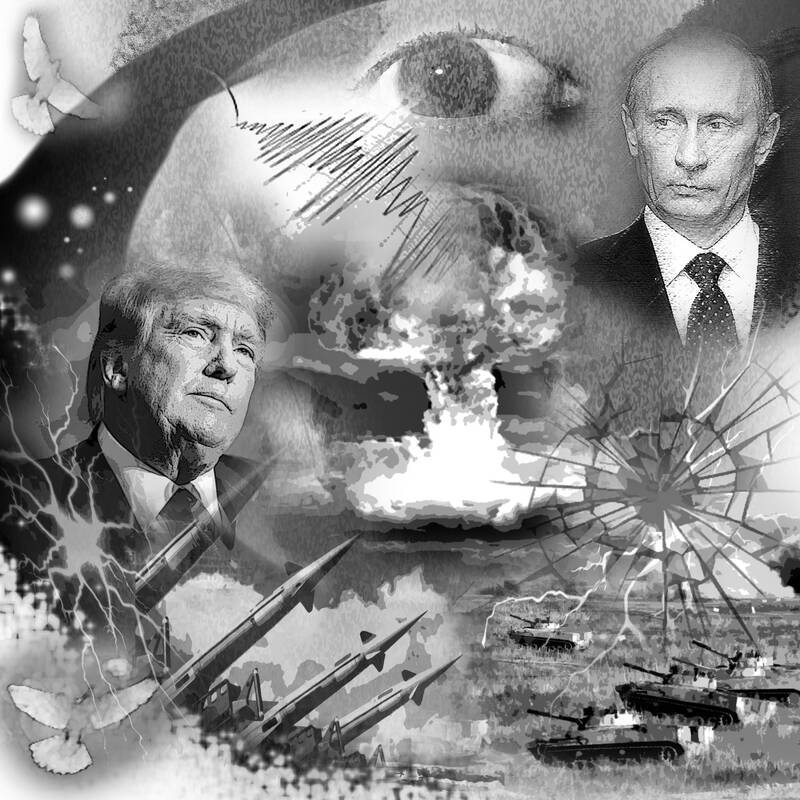
Illustration: Kevin Sheu
Although the atomic scientists who followed Oppenheimer lacked his literary sensibilities, they took world-destroying quite seriously. Teams in the US and the Soviet Union competed to build and test ever-larger bombs in a blatantly obvious effort at intimidating the other side.
The US went first, forcing the indigenous people of Bikini Atoll to relocate so that it could detonate bombs in the Marshall Islands in 1946. Radioactive debris rained down on the sailors sent to watch the tests. They absorbed dangerous doses of radiation, as did many of the native islanders living in the area, inaugurating a multigenerational legacy of cancers and birth defects.
NUCLEAR RACE
Nevada, where the US military began above-ground tests in 1951, was no better. There, too, the federal government confiscated land owned by indigenous peoples and placed soldiers far too close to the detonation sites. In subsequent decades, their bodies would be plagued by cancers and other maladies born of their fateful exposure.
Back in the Marshall Islands, the US began testing a new generation of nuclear weapons that used conventional fission bombs to detonate a much larger, “fusion,” or hydrogen bomb. These experiments went terribly awry during the infamous Castle Bravo test of 1954.
The bomb in question was supposed to generate the equivalent of 5 to 6 megatonnes of TNT. However, hanks to some serious miscalculations, the explosion clocked in at 15 megatonnes, or 1,000 times the size of the bomb dropped on Hiroshima, Japan. The explosion sucked up 10 million tonnes of sand and pulverized coral, creating a massive fallout cloud that fell on islanders, US military personnel and even Japanese fishing vessels 129km east of the test site.
This was what historian Alex Wellerstein has described as “the greatest single radiological disaster in American history.” It also holds the record of being the biggest nuclear test ever conducted by the US. It might have remained the biggest test ever had it not been for the Soviet Union.
After World War II, the communist nation worked desperately to build and test its own bomb, terrified of what might happen if it failed. Indeed, a Russian nuclear scientist who attended the Bikini test in 1946 claimed that the purpose of the demonstration had been “to frighten the Soviets.”
Thanks to atomic spy Klaus Fuchs, the Soviets managed to detonate their first atomic weapon in 1949. Still, they spent much of the next decade playing catch-up, countering progressively larger tests with their own demonstrations. Former Soviet premier Nikita Khrushchev, eager to pull ahead, approved a top-secret project to build the biggest nuclear weapon in human history. It was known as “Kuzma’s mother,” an allusion to a Russian idiom that basically means: “We’ll show you.”
When completed in 1961, “Kuzma’s mother” — also known as the Tsar Bomba or the “King of Bombs” — was the size of a school bus and weighed 25 tonnes. It was too big to fit into any of the Soviet bomber aircraft, so the military removed the bomb bay doors on a Tupolev TU-95 and strapped it to the bottom of the plane.
MASSIVE BLAST
On Oct. 31, 1961, the TU-95 left a Russian airfield bound for Novaya Zemlya, a collection of islands above the Arctic Circle; a separate plane containing a film crew accompanied it. They departed not knowing if they would return home: Authorities had given the planes a 50/50 chance of surviving the shock wave.
When they reached the target location, the bomber dropped its lethal package. The bomb, fitted with a parachute to slow its descent and give the planes time to escape, floated downward until it reached 4,000m before exploding.
The blast, which could be seen more than 1,000km away, registered at 57 megatonnes, 10 times more powerful than all the bombs and ordnance used in World War II. Had any human been within 100km of the epicenter (there were not any), they would have been immediately vaporized or have sustained third-degree burns. The shock wave shattered windows 901km away.
The test inflamed Cold War tensions, and a year later, the world came dangerously close to complete annihilation during the Cuban Missile Crisis. In its wake, saner heads began to prevail, and the US and Soviet Union signed the Partial Nuclear Test Ban Treaty in 1963, which moved nuclear testing underground, where it became less of a provocation. A complete test ban followed 30 years later, aided by that computer modeling has effectively made nuclear testing obsolete.
Trump and Putin now seem inclined to take us back to the bad old days of nuclear testing out of some misguided belief that it is an effective way to assert dominance over adversaries. History already shows how that story ends.
Stephen Mihm, a professor of history at the University of Georgia, is coauthor of Crisis Economics: A Crash Course in the Future of Finance.
Ukrainian substations hit in latest drone strike
A renewed wave of drone and missile strikes on Ukraine’s energy system have destroyed or damaged most thermal power plants, and struck substations that supply the Khmelnitsky and Rivne nuclear power plants.
November 11, 2025, https://www.power-technology.com/news/ukrainian-substations-hit-in-latest-drone-strike/?cf-view&cf-closed
Arecent drone and missile attack on Ukraine has once again struck substations supplying two major nuclear plants. The assault, targeting the country’s energy system, destroyed or damaged most of Ukraine’s thermal power plants, leaving only its nuclear power plants (NPPs) still functioning. However, the substations that provide power to the Khmelnitsky and Rivne NPPs were also affected.
Ukrainian Foreign Minister Andrii Sybiha stated that these “were not accidental but well-planned strikes”.
Russian media discussed the issue of closing down Ukraine’s NPPs to put them in the same state as the Zaporizhia NPP. “The Russians, in response to Zelensky’s threats to ‘turn off the lights’ in Moscow, responded with such retaliatory blows that all Ukrainian thermal power plants were ‘turned off’ – but what about the nuclear power plants that continue to generate electricity?” asked Dzen.
The outlet cited well-known military expert Valery Shiryaev, deputy director of Novaya Gazeta, who noted that attacks on NPPs are a “red line” for the Russian military. “It is impossible to bomb nuclear power plants, but their transformers are a disputed area,” Shiryaev explained.
According to Shiryaev, Ukraine will be able to meet all its electricity needs with the help of its NPPs even if the thermal plants no longer function. He believes that the Russian military is planning to implement the same scenario that was carried out at the Zaporizhia NPP. This involves shutting down the nuclear reactors and, consequently, stopping the production of electricity.
Dzen concluded: “It is important for us to disable the enemy’s energy infrastructure, as it will greatly complicate the logistics (including the delivery of military supplies) and the work of the military-industrial complex for the Armed Forces of Ukraine. However, in order to completely cut off Ukraine’s power supply, it is necessary to decide on the “shutdown” of nuclear power plants. It is unclear whether such a decision has been made.”
In a similar article, Svpressa noted: “For the first time, Russians have attacked nuclear power plant substations, causing power outages and electricity shortages, according to monitoring channels. It is particularly noted that… sporadic strikes will force Kiev to shut down the nuclear units and put them on repair or restart (this is a matter of a few days or a week). As a reminder, Ukraine has shut down the Zaporizhia NPP in Energodar and is not allowing it to be operated at even 15% capacity, only maintaining it in a safe mode. The Russian Armed Forces are now doing the same to Ukraine.”
To safely remove Ukraine’s NPPs from operation, it is sufficient to disable the power grid infrastructure. After that, with the full control of the International Atomic Energy Agency, it is simply necessary to allow the NPP personnel to operate on diesel generators. Ideally, it would be beneficial to allow the deployment of a separate, powerful external diesel-powered power plant. This would ensure the reliable operation of the shut-down NPP. Additionally, it is crucial to refrain from interfering with the plant during the reactor’s idle period.
Meanwhile, a member of the State Duma (parliament) Committee on Defence, Andrey Kolesnik, emphasised that Russian troops would never strike Ukraine’s NPPs. “But we can turn off the logistics chain, transformers, and everything else. I think that the supply chains for electricity from the nuclear power plant to the consumer will be disrupted,” he said in an interview with NEWS.ru.
Nuclear Force “Recapitalization”
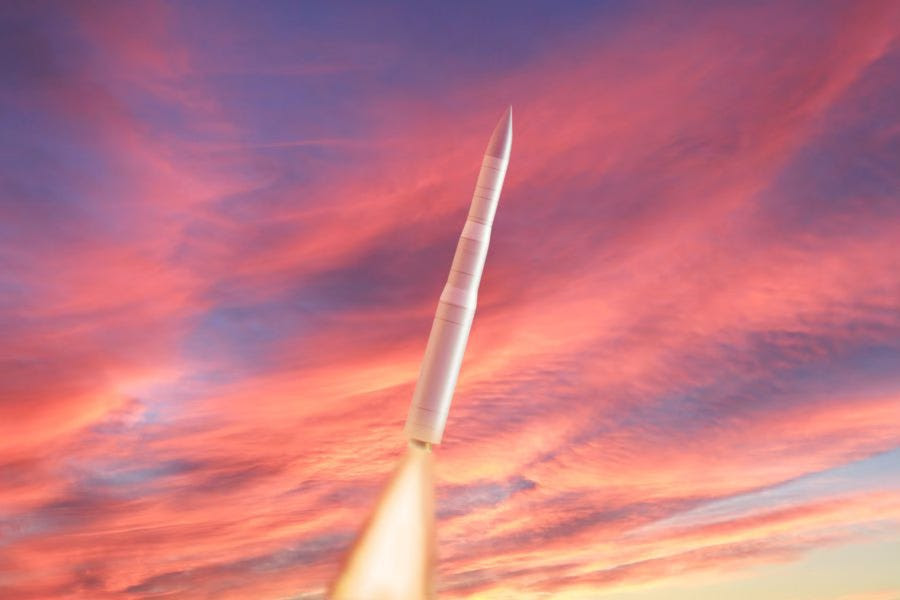
an idealized illustration of a Sentinel ICBM soon after launch. Don’t think about the aftermath of thermonuclear war. As NBC Pitchman Brian Williams once said, it’s important to be guided by the beauty of our weapons.
An Abomination of the English Language
| Just when you thought the assault on the English language couldn’t be more severe, I came across a new abomination in a recent memo (11/3/25) signed by the Chief of Staff of the Air Force (CSAF).The CSAF expressed his commitment to nuclear force “recapitalization,” meaning that he fully supports the B-21 Raider and the Sentinel ICBM, which will cost more than $500 billion over the next two decades. He vowed he’d “relentlessly advocate” for them. |
“Recapitalization”: What a word to describe more genocidal nuclear weapons!
Typically, the Air Force refers to “modernization” or “investment” when it comes to new nukes. This latest euphemism is an even more extreme example of bureaucratese and business-speak.
We’re just “recapitalizing” our nuclear forces, folks. Nothing to see here, move along.
One thing is certain. The new CSAF, with his talk of “recapitalization,” will make the smoothest of transitions to industry once he retires from the military.
It’s time for recapitalization! (Red sky in morning, America take warning.)
A day of peace?
12 November 2025 AIMN Editorial. By Walt Zlotow, West Suburban Peace Coalition, Glen Ellyn, IL https://theaimn.net/a-day-of-peace/
On Nov. 11, 1919, Armistice Day was established in the United Kingdom to commemorate the armistice that ended World War I a year earlier. Congress later signed on for the U.S. to “perpetuate peace through good will and mutual understanding between nations” with a day that is “dedicated to the cause of world peace.”
It became known as Veterans Day in 1954. Since then, it has largely become a commercial for promoting American militarism and perpetual war around the world. Today, there are more than 170,000 U.S. troops deployed in more than 80 countries. To a country engaged in perpetual war worldwide, “armistice” is a word that dare not speak its name.
America has enabled and prolonged the war against Russia in Ukraine, killing hundreds of thousands in a war where Ukraine has minimal chance of victory. Not satisfied with that bloodbath, the U.S. has funneled tens of billions of dollars in weapons for Israel to largely obliterate Gaza, killing 70,000 while leaving the remaining 2.2 million Palestinians with little food, water, medicine, electricity or hope.
We regularly bomb innocents in a number of countries, such as Somalia under the Joe Biden and Donald Trump administrations. Senseless U.S. warfare is about the only thing both parties agree upon.
While every decent function of government uplifting the commons loses funding, our defense budget has soured to over $1 trillion.
After 71 years, it’s time for another name change. How about “Peace Day,” to honour people of peace such as the Rev. Martin Luther King Jr. and a true American war hero, Pvt. Chelsea Manning, who spent seven years in prison for outing American war crimes in Iraq? Peace Day would put the focus on peace Nov. 11, not endless war.
It’s time once again, as we did in 1926, to “perpetuate peace through good will and mutual understanding between nations.”
As John Lennon famously sang, “Give peace a chance.”
Poseidon: The Ultimate Weapon of Vengeance [i]

“To wipe out the enemy coast…”
Very long article, with excellent illustrations.
Black Mountain Analysis Mike Mihajlovic, Nov 10, 2025
A weapon system on its own
The Poseidon, designated 2M39 in Russian service and known to NATO as Kanyon, is among the most enigmatic and controversial strategic systems developed in recent years. It resists conventional classification: neither a conventional torpedo nor a crewed submarine, it represents a novel class of autonomous, nuclear-powered underwater vehicle designed to carry a nuclear warhead.
This autonomous, nuclear-powered underwater vehicle, formerly designated Status-6, has been described in open sources as capable of carrying a very large thermonuclear warhead (some reports even cite yields as high as 100 megatons)1 and of transiting intercontinental distances at depths that would place it beyond the reach of most conventional antisubmarine weapons, arguably leaving only exceptionally large-yield nuclear depth charges as a theoretical counter. Open reporting also suggests it can adopt multiple mission modes: a high-speed transit phase at depth, which offers rapid repositioning but is more readily detectable by advanced acoustic sensors, and a prolonged low-speed, low-observability cruise that exploits nuclear endurance to remain submerged for effectively indefinite periods before conducting a final approach to a target.
As with many novel Russian weapons, most technical details remain classified; nevertheless, a synthesis of open-source analysis and official Russian statements permits a broad—albeit uncertain—reconstruction of Poseidon’s design philosophy, capabilities, and potential strategic effects.
………………………………………………………………………………………………………………………………………………………………………………………………………………... Summary
In summary, the Poseidon system represents a technically feasible but strategically extreme extension of known nuclear and naval technologies. It most likely uses a compact liquid-metal-cooled fast reactor to achieve long-range, high-speed operation at great depths, carries a warhead of 2-100 Mt, and could inflict catastrophic local damage and contamination on any coastal target. Yet the notion that it could raise ocean-wide radioactive tsunamis is unsupported by physical science. Its true significance may lie less in its physics than in its symbolism: a weapon designed to project the image of ultimate deterrence by threatening entire coastal societies, even if the practical mechanics of such annihilation are more limited than popular imagination suggests.
Politically, the deployment of Poseidon adds a new dimension to strategic deterrence. Its autonomous nature and perceived “doomsday” capability suggest a weapon intended more for psychological and geopolitical signaling than for practical battlefield use. Its mere existence challenges traditional arms control frameworks and complicates stability calculations by introducing a new underwater axis of nuclear deterrence.
Despite the growing public literature, many details remain unknowable. The reactor’s design, actual performance, warhead configuration, and even deployment status are tightly held secrets. Modeling the hydrodynamics of a multi-megaton underwater detonation is inherently uncertain, as no full-scale tests have ever been conducted at such yields or depths. Extrapolations from smaller historical tests provide useful guidance but cannot capture all nonlinear effects of deep-water bubble dynamics or coastal interactions. Moreover, the strategic intent behind Poseidon, whether as a second-strike deterrent, a terror weapon, or an anti-access denial system, remains speculative and politically sensitive. https://bmanalysis.substack.com/p/poseidon-the-ultimate-weapon-of-vengeance?utm_source=post-email-title&publication_id=1105422&post_id=177880124&utm_campaign=email-post-title&isFreemail=true&r=1ise1&triedRedirect=true&utm_medium=email
Russia deliberately ‘endangering nuclear safety in Europe’ says Kyiv
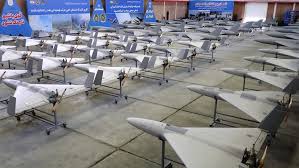
Ukraine says drones are targeting substations that power the Khmelnytskyi and Rivne nuclear plants. What we know on day 1,355
Guardian staff and agencies, 9 Nov 25
- Russia is again targeting substations that power the Khmelnytskyi and Rivne nuclear power plants in Ukraine, the country’s foreign minister Andrii Sybiha said on X on Saturday. Sybiha said drone attacks on the weekend were not accidental but well-planned strikes. “Russia is deliberately endangering nuclear safety in Europe,” he said.
- Russia launched a barrage of drones and missiles at Ukraine over the weekend, killing at least seven people and damaging energy infrastructure in three regions, according to Ukrainian officials. Ukraine’s president, Volodymyr Zelenskyy, said Russia had launched more than 450 drones and 45 missiles, most of which were shot down. Three people were killed and 12 wounded when a drone hit an apartment building in Dnipro, and another person was killed in the Kharkiv region. Three were killed in the south-eastern Zaporizhzhia region, regional officials said. https://www.theguardian.com/world/2025/nov/09/ukraine-war-briefing-russia-deliberately-endangering-nuclear-safety-in-europe-says-kyiv
Does Britain really need nuclear power? – Campaign for Nuclear Disarmament
, https://labouroutlook.org/2025/11/10/does-britain-really-need-nuclear-power-campaign-for-nuclear-disarmament/
With funding confirmed for a new nuclear power station in Suffolk, Dr Ian Fairlie, CND Vice-President and science adviser, and a leading consultant on radioactivity in the environment, questions whether we actually need this development and the technology in general.
In recent months, the government has continued to promote nuclear reactors. For example, the Energy Secretary is now asking GB Energy to assess sites to be used to host new nuclear reactors. And the Prime Minister continues to push for so-called Small Modular Reactors and has backed the US President’s wishful thinking of ‘a golden age of nuclear’.
But these announcements and proposals are mostly pie-in-the-sky statements and should be treated with a pinch (or more) of salt, as the reality is otherwise.
Let’s look at what is happening in the rest of the world. Last year, a record 582 GW of renewable energy generation capacity was added to the world’s supplies: almost no new nuclear was added.
Indeed, each year, new renewables add about 200 times more global electricity than new nuclear does.
Of course, there are powerful economic arguments for this. The main one is that the marginal (i.e. fuel) costs of renewable energy are close to zero, whereas nuclear fuel is extremely expensive. Nuclear costs – for both construction and generation – are very high and rising, and long delays are the norm. For example, the proposed Sizewell C nuclear station is now predicted to cost £47 billion, with the government and independent experts acknowledging even this estimate may rise significantly. The upshot is that new nuclear power means massive costs, a poisoned legacy to future generations, and whopping radioactive pollution.
iven these manifest disadvantages, independent commentators have questioned the government’s seeming obsession with nuclear power. It is not that nuclear provides a good solution to global warming: it doesn’t. The United Nations’ Intergovernmental Panel on Climate Change (IPCC) reports that renewables are now 10 times more efficient than new nuclear at CO2 mitigation. It’s not that AI centres will need nuclear: the International Energy Agency expects data centres will cause a mere 10% of global electricity demand growth to 2030. And it forecasts that the renewables will supply 10 to 20 times the electricity required for data-centre growth, with Bloomberg NEF predicting a 100-fold renewables expansion.
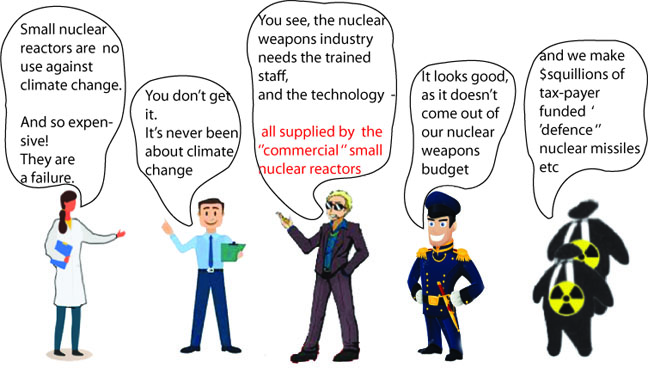
As for so-called Small Modular Reactors, the inconvenient truth is that these designs are all just paper designs and are a long way off. They would also be more expensive to run than large reactors per kWh – the key parameter. And as the former Chair of the US government’s Nuclear Regulatory Commission (NRC) says, SMRs will produce more chemical and radioactive waste per KW produced than large reactors.
Given a UK Treasury strapped for cash, the unsolved problem of radioactive nuclear waste, the spectre of nuclear proliferation, and it’s being a target in future wars, many wonder why the government is so fixated with nuclear power.
Well, the answer was supplied in 2023 by the Rishi Sunak administration which admitted that the main reason for its continued eye-watering financial support for civil reactors was that they provided needed technical support and expertise for the government’s nuclear weapons programme.
Stop the nuclear MADness

by Harlan Ullman,- 11/10/25 , https://thehill.com/opinion/national-security/5595645-strategic-nuclear-weapons-resurgence/
For better or for worse, strategic nuclear weapons are back on the docket.
Given that the Cold War ended 35 years ago, most Americans have little understanding of or interest in these weapons that could literally obliterate much if not all of our society. The marvelous Stanley Kubrick movie “Dr. Strangelove” satirized the notion of mutual assured destruction and the Soviet Union’s “doomsday device” that, once triggered, would destroy the world.
During the Cold War, the image of two scorpions in a bottle, representing the U.S. and Soviet Union, was popularized, meaning both could sting the other to death. Decades later, at least three scorpions inhabit that bottle, with the addition of China pursuing a serious strategic nuclear arsenal rivaling that of the other two military superpowers.
If not in the same bottle, certainly in the same room are the other nuclear states: Britain, France, North Korea, Israel, India and Pakistan. Iran and Saudi Arabia are in the anteroom.
Now, these strategic nuclear matters have been brought to a head by the expiration of the New START Treaty in January and President Trump’s confusing and unhelpful comment that the U.S. will resume testing its nuclear weapons.
The New START treaty limited both the U.S. and Russia to 1,550 deployed nuclear warheads and 800 deployed and non-deployed launchers. Russian President Vladimir Putin has proposed a voluntary extension of the treaty limits on warheads and launchers.
Trump’s comments on testing have completely disrupted the arms control process. By testing, does Trump mean actually exploding current warheads? Does he mean continuing the non-critical testing that does not require actual fission or fusion to take place? Or does he mean testing launchers?
If he’s talking about explosive testing, virtually all experts regard that as highly dangerous and unnecessary.
Worse, in response to Trump’s proposal to build a Golden Dome around and over America to defend against missile or bomber attacks, Putin held a press conference discussing Russia’s efforts surrounding the Skyfall and Poseidon missiles.
Skyfall is NATO’s designation for a nuclear powered, nuclear tipped cruise missile with nearly unlimited range. Poseidon is a nuclear powered, nuclear tipped unmanned underwater torpedo with transoceanic range.
While Skyfall is subsonic, flying feet above the surface, it could attack from any direction. Poseidon could sail undetected into U.S. harbors — say New York or San Francisco — and detonate a multi-megaton warhead
Megaton weapons can deliver 1,000 times more explosive power than the two nuclear bombs dropped on Japan in 1945. Multiple Poseidon attacks could destroy the American economy.
The strategic nuclear balance has been further complicated by conventional weapons with the capacity to strike and destroy these systems with pinpoint accuracy — cruise missiles such as Tomahawk and long-range convention bombs that can be launched at significant distances from targets. None of these have been included in arms control agreements, and the U.S. abrogated the Anti-Ballistic Missile Treaty in 2001.
The U.S. government has also lost experts who were deeply engaged in these issues. For example, not one of the current Joint Chiefs of Staff has any experience along these lines, as strategic arms control has not been a high priority. The same is true in the White House.
China, so far, has been unwilling to engage in arms control talks, probably waiting until it has expanded its own nuclear capability to a certain level. So under these circumstances, what if anything, can be done beyond leaders agreeing that nuclear weapons can never be used and nuclear war can never be fought?
The options are not good. Engagement with China must continue. Perhaps agreements for mutual inspection of nuclear systems to ensure safety and reliability can begin confidence-building measures. Military-to-military talks on nuclear issues and safeguards are always a good idea. However, given Russia’s intervention in Ukraine, is anyone willing to raise this possibility?
The only concrete step is to ensure that kinetic nuclear testing — namely exploding warheads underground or on the surface and in the air — remains forbidden. Otherwise, a new and unwanted and potentially threatening arms race will be on, and that cannot be permitted.
Harlan Ullman, Ph.D. is UPI’s Arnaud deBorchgrave Distinguished Columnist, a senior advisor at the Atlantic Council, the chairman of two private companies and the principal author of the doctrine of shock and awe. He and former United Kingdom Defense Chief David Richards are the authors of a forthcoming book on preventing strategic catastrophe
1 This Month

of the week – Shut Down Drone Warfare!


Tell the Ukrainian Government to Drop Prosecution of Peace Activist Yurii Sheliazhenko

Petition to revoke the licensing of the Near Surface Nuclear Disposal Facility (NSDF) at Chalk River. https://www.ourcommons.ca/petitions/en/Petition/Details?Petition=e-7247
To see nuclear-related stories in greater depth and intensity – go to https://nuclearinformation.wordpress.com
-
Archives
- March 2026 (230)
- February 2026 (268)
- January 2026 (308)
- December 2025 (358)
- November 2025 (359)
- October 2025 (376)
- September 2025 (257)
- August 2025 (319)
- July 2025 (230)
- June 2025 (348)
- May 2025 (261)
- April 2025 (305)
-
Categories
- 1
- 1 NUCLEAR ISSUES
- business and costs
- climate change
- culture and arts
- ENERGY
- environment
- health
- history
- indigenous issues
- Legal
- marketing of nuclear
- media
- opposition to nuclear
- PERSONAL STORIES
- politics
- politics international
- Religion and ethics
- safety
- secrets,lies and civil liberties
- spinbuster
- technology
- Uranium
- wastes
- weapons and war
- Women
- 2 WORLD
- ACTION
- AFRICA
- Atrocities
- AUSTRALIA
- Christina's notes
- Christina's themes
- culture and arts
- Events
- Fuk 2022
- Fuk 2023
- Fukushima 2017
- Fukushima 2018
- fukushima 2019
- Fukushima 2020
- Fukushima 2021
- general
- global warming
- Humour (God we need it)
- Nuclear
- RARE EARTHS
- Reference
- resources – print
- Resources -audiovicual
- Weekly Newsletter
- World
- World Nuclear
- YouTube
-
RSS
Entries RSS
Comments RSS
 nuclear-news