A $31 Billion Missile Program! US Looks To Reintroduce Nuclear Sea-Launched Cruise Missile Costing Equal To 10 Virginia-Class Subs
By Parth Satam, June 23, 2023, https://eurasiantimes.com/a-31-billion-missile-program-us-looks-to-reintroduce-nuclear-sea-launched-cruise-missile-costing-equal-to-10-virginia-class-subs/
A section of US Congressmen are voting for reintroducing a costly and redundant nuclear program. Republican lawmakers in the House are adopting a measure to institutionalize the Sea-Launched Cruise Missile-Nuclear (SLC)The SLCM was denied funding in last year’s Fiscal Year 2023 budget and concluded to have no battlefield use in the 2022 Nuclear Posture Review (NPR).
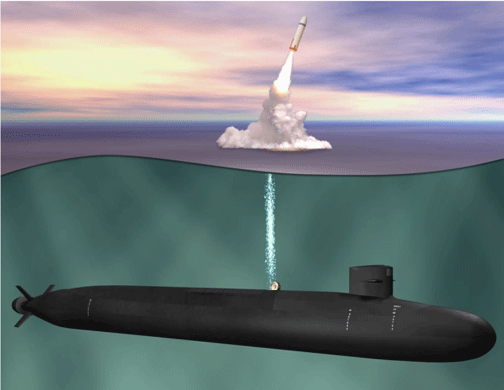
The Cold War-era concept envisages a cruise missile with a low-yield tactical nuclear warhead that can be fired from submarines, warships, or naval aircraft on a trajectory that makes it hard to track by radar.
According to a report in Defense News, the House Armed Services Committee “voted along party lines to amend the fiscal 2024 National Defense Authorization Act (NDAA) with a provision that would create a program of record (PoR) for SLCM-N.”
A PoR is a listed ‘line item record’ in current and future defense acquisition plans that make them eligible for continued funding over the years.
Obscene Cost for a Useless Weapon
If the full HASC advances the Fiscal Year 2024 (FY24) and passes the full floor vote in July, it would receive nearly $196 million as research and development funds.
However, political leaders and military experts advise against the astronomical costs and a futile capability, which they say can be invested elsewhere and be performed by other weapons systems.
Representative Courtney, a Democratic Congressman from Connecticut, who chairs the sea power subcommittee, cited May testimony from Chief of Naval Operations Admiral Michael Gilday stating that the warheads needed to make an SLCM-N program would cost at least $31 billion.
“The Navy can do a lot of other things with $31 billion. You can build 15 DDG destroyers with $31 billion, 10 Virginia-class submarines with $31 billion. You put nuclear warheads on these vessels, then you are changing the mission,” Courtney said.
Another Democratic Congressman, Representative Adam Smith of Washington, the top Democrat on the Armed Services Committee, argued that the US already has ballistic submarines in its fleet as well as lower-yield nuclear options from the air.
“It’s walking us down a path of spending enormous money on a capability that we don’t really need that will undermine our ability to build capabilities that we do (need) going forward,” said Smith.
Why Doesn’t the US Need the SLCM-N
Citing the need for flexibility and regional presence, the Trump administration’s 2018 Nuclear Posture Review (NPR) called for re-establishing a sea-launched cruise missile-nuclear capability.
President Biden’s FY 2022 budget continued funding SLCM-N, aiming to deploy it by the late 2020s. However, with the 2022 NPR identifying SLCM-N as “no longer necessary,” Biden’s 2023 budget request did not include SLCM-N funding.
The missile basically saddles important weapons platforms like submarines and warships with a mission set that can be undertaken by US Air Force (USAF) strategic bombers. It takes away the flexibility of employing diverse firepower options with a varied range of platforms.
“Should a geographic combatant commander intend to seek permission to use a nuclear weapon for tactical purposes, selecting bombers would offer more flexibility between mission sets and avoid committing to a weapons load-out decision as far in advance as would be necessary if SLCM-N were chosen” retired US Navy officer, Captain John Moulton writes in a paper.
In other words, an SLCM-N armed naval submarine or warship meets a very “narrow” mission set of destroying hardened enemy ground targets while sacrificing equally important tactical and strategic roles like hunting enemy submarines, destroying surface warships, mine laying or providing Intelligence-Surveillance-Reconnaissance (ISR).
Other currently nuclear weapons capable platforms like the B-2 Spirit, B-52 Stratofortress, B-1B Lancer, and the upcoming B-21 Raider envisaged for the same mission could also reach the warzone quickly.
The cost of revealing its position while firing an SLCM-N would also far outweigh the gains from hitting enemy ground targets with low-yield nuclear missiles, Moulton further explains. Moulton is a Senior Fellow at the Council on Strategic Risks’ Janne E. Nolan Center on Strategic Weapons.
The conditions that would justify using a tactical nuclear-tipped cruise missile would be very rare and would prevent a submarine or a naval vessel from performing optimally in a fluid battlefield situation.
In the Western Pacific, becoming part of a “joint force” in a mutually supporting pushback against a People’s Liberation Army Navy (PLAN) fleet inside China’s dangerous Anti-Access/Area-Denial (A2/AD) zone is a new evolving orientation guiding the US Navy’s submarine arm, explained in a previous EurAsian Times analysis.
Lastly, the risks of unintended nuclear escalation are exponentially higher when an SLCM-N is fired since the country sustaining the attack – China or North Korea – might legitimately retaliate with a nuclear strike, triggering a devastating atomic exchange.
Experts have long pointed out how such exchanges cannot be “controlled” given the tensions and the miscalculation involved.
A US asset firing an SLCM-N also counts as a nuclear first strike, which shifts the diplomatic narrative in the Russian, Chinese, or North Korean favor. None of these countries have ever indicated they plan to use nuclear weapons as a warfighting tool. While China has a clear No-First Use (NFU) policy, Moscow and Pyongyang have maintained they will use nukes only when the physical security of their country faces an existential threat. The author can be reached at satamp@gmail.com
Ukraine Can Develop Nuclear Weapons ‘Within a Short Time’: Ex-Zelensky Aide
BY JON JACKSON ON 6/23/23
eksii Arestovych, a former adviser to Ukrainian President Volodymyr Zelensky, said during a Thursday interview that Ukraine has the ability to quickly produce its own nuclear weapons “within a short time.”
Arestovych, who also served as an officer in Ukraine’s military intelligence service, made the remarks while speaking with Russian activist Mark Feygin…………… Arestovych has also stated that Crimea would be a major target for Zelensky’s forces during the conflict. https://www.newsweek.com/ukraine-can-develop-nuclear-weapons-within-short-time-ex-zelensky-aide-1808663
Is Russia planning to use nuclear weapons?
https://www.sbs.com.au/news/podcast-episode/is-russia-planning-to-use-nuclear-weapons/7vcas0f5l 23 June 23
President Vladimir Putin has announced the imminent deployment of Russia’s advanced Sarmat intercontinental ballistic missiles, capable of carrying multiple nuclear warheads.
This comes as Russia’s defence head says intelligence indicates Ukraine is planning to strike the annexed territories including Crimea.
Ukraine has warned Russians to flee from the occupied territories as Russia warns any strike on Crimea will be met with strikes at the centre of Ukraine’s leadership
The Silent Slaughter of the Flower of Ukraine’s Youth
Now that the Ukrainian counteroffensive is underway, it is clear that the government and its Western allies are maintaining silence to conceal the brutal cost Ukraine’s brave young people are paying.
By Medea Benjamin | Nicolas J.S. Davies / Common Dreams. June 21, 2023
https://scheerpost.com/2023/06/21/the-silent-slaughter-of-the-flower-of-ukraines-youth/
As Ukraine prepared to launch its much heralded but long delayed counteroffensive, the media published a photograph of a Ukrainian soldier with his finger on his lips, symbolizing the need for secrecy to retain some element of surprise for this widely telegraphed operation.
Now that the offensive has been under way for two weeks, it is clear that the Ukrainian government and its Western allies are maintaining silence for quite a different reason: to conceal the brutal cost Ukraine’s brave young people are paying to recover small scraps of territory from Russian occupation forces, in what some are already calling a suicide mission.
Western pundits at first described these first two weeks of fighting as “probing operations” to find weak spots in Russia’s defenses, which Russia has been fortifying since 2022 with multiple layers of minefields, “dragon’s teeth,” tank-traps, pre-positioned artillery, and attack helicopters, unopposed in the air, that can fire 12 anti-tank missiles apiece.
On the advice of British military advisers in Kyiv, Ukraine flung Western tanks and armored vehicles manned by NATO-trained troops into these killing fields without air support or demining operations. The results have been predictably disastrous, and it is now clear that these are not just “probing” operations as the propaganda at first claimed, but the long-awaited main offensive.
A Western official with intelligence access told The Associated Press on June 14, “Intense fighting is now ongoing in nearly all sectors of the front… This is much more than probing. These are full-scale movements of armor and heavy equipment into the Russian security zone.”
Other glimpses are emerging of the reality behind the propaganda. At a press conference after a summit at NATO Headquarters, U.S. General Mark Milley warned that the offensive will be long, violent, and costly in Ukrainian lives.
“This is a very difficult fight. It’s a very violent fight, and it will likely take a considerable amount of time and at high cost,” Milley said.
Russian videos show dozens of Ukrainian tanks and armored vehicles lying smashed in minefields, and NATO military advisers in Ukraine have confirmed that it lost 38 tanks in one night on June 8, including newly delivered German-built Leopard IIs.
Rob Lee of the Foreign Policy Research Institute explained to TheNew York Times that the Russians are trying to inflict as many casualties and destroy as many vehicles as possible in the areas in front of their main defensive lines, turning those areas into lethal kill zones. If this strategy works, any Ukrainian forces that reach the main Russian defense lines will be too weakened and depleted to break through and achieve their goal of severing Russia’s land bridge between Donbas and Crimea.
Russia’s Ministry of Defense reported that Ukraine’s forces suffered 7,500 casualties in the first 10 days of the offensive. If Ukraine’s real losses are a fraction of that, the long, violent bloodbath that General Milley anticipates will destroy the new armored brigades that NATO has armed and trained, and serve only to escalate the gory war of attrition that has destroyed Mariupol, Sievierodonetsk, and Bakhmut, killing and wounding hundreds of thousands of young Ukrainians and Russians.
A senior European military officer in Ukraine provided more details of the carnage to Asia Times, calling Ukraine’s operations on June 8 and 9 a “suicide mission” that violated the basic rules of military tactics.
“We tried to tell them to stop these piecemeal tactics, define a main thrust with infantry support and do what they can,” he said. “They were trained by the British, and they’re playing Light Brigade,” he added, comparing the offensive to a suicidal charge into massive Russian cannon fire that wiped out Britain’s Light Cavalry Brigade in Crimea in 1854.
If Ukraine’s “Spring Offensive” plunges on to the bitter end, it could be more like the British and French Somme Offensive, fought near the French River Somme in 1916. After 19,240 British troops were killed on the first day (including Nicolas’s 20-year-old great-uncle, Robert Masterman), the battle raged on for more than four months of pointless, wanton slaughter, with over a million British, French, and German casualties. It was finally called off after advancing only six miles and failing to capture either of the two small French towns that were its initial objectives.
The current offensive was delayed for months as Ukraine and its allies grappled with the likelihood of the outcome we are now witnessing. The fact that it went ahead regardless reflects the moral bankruptcy of U.S. and NATO political leaders, who are sacrificing the flower of Ukraine’s youth in a proxy war they will not send their own children or grandchildren to fight.
As Ukraine launches its offensive, NATO is conducting Air Defender, the largest military exercise in its history, from June 12 to 23, with 250 warplanes, including nuclear-capable F-35s, flying from German bases to simulate combat operations in and over Germany, Lithuania, Romania, the North Sea, and the Baltic Sea. The exercise has led to at least 15 incidents between NATO and Russian aircraft in the skies near Lithuania.
It seems that nobody in NATO’s foreboding fortress in Brussels has stumbled on the concept of a “security dilemma,” in which supposedly defensive actions by one party are perceived as offensive threats by another and lead to a spiral of mutual escalation, as has been the case between NATO and Russia since the 1990s. Professor of Russian history Richard Sakwa has written, “NATO exists to manage the risks created by its existence.”
These risks will be evident in the upcoming NATO Summit in Vilnius on July 11-12, where Ukraine and its eastern allies will be pushing for Ukraine membership, while the U.S. and western Europe insist that membership cannot be offered while the war rages on and will instead offer “upgraded” status and a shorter route to membership once the war ends.
The continued insistence that Ukraine will one day be a NATO member only means a prolongation of the conflict, as this is a red line that Russia insists cannot be crossed. That’s why negotiations that lead to a neutral Ukraine are key to ending the war.
But the United States will not agree to that as long as President Joe Biden keeps U.S. Ukraine policy firmly under the thumbs of hawkish neoconservative desk warriors like Antony Blinken and Victoria Nuland at the State Department and National Security Adviser Jake Sullivan at the White House. Pressure to keep escalating U.S. involvement in the war is also coming from Congress, where Republicans accuse Biden of “hemming and hawing” instead of “going all in” to help Ukraine.
Paradoxically, the Pentagon and intelligence agencies are more realistic than their civilian colleagues about the lack of any military solution. The Chairman of the Joint Chiefs of Staff, General Milley, has called for diplomacy to bring peace to Ukraine, and U.S. intelligence sources have challenged dominant false narratives of the war in leaks to Newsweek and Seymour Hersh, telling Hersh that the neocons are ignoring genuine intelligence and inventing their own, just as they did to justify the invasion of Iraq in 2003.
With the retirement of Deputy Secretary of State Wendy Sherman, the State Department is losing the voice of a professional diplomat who was President Barack Obama’s chief negotiator for the JCPOA with Iran and urged Biden to rejoin the agreement, and who has taken steps to moderate U.S. brinkmanship toward China. While publicly silent on Ukraine, Sherman was a quiet voice for diplomacy in a war-mad administration.
Many fear that Sherman’s job will now go to Nuland, the leading architect of the ever-mounting catastrophe in Ukraine for the past decade, who already holds the #3 or #4 job at State as Under Secretary of State for Political Affairs.
Other departures from the senior ranks at State and the Pentagon are likely to cede more ground to the neocons. Colin Kahl, the Under Secretary of Defense for Policy, who worked with Sherman on the JCPOA, opposed sending F-16s to Ukraine, and has maintained that China will not invade Taiwan in the near future. Kahl is leaving the Pentagon to return to his position as a professor at Stanford, just as China hawk General C.Q. Brown will replace General Milley as Chairman of the Joint Chiefs when Milley retires in September.
Meanwhile, other world leaders continue to push for peace talks. A delegation of African heads of state led by President Cyril Ramaphosa of South Africa met with President Volodymyr Zelenskyy in Kyiv, and President Vladimir Putin in Moscow on June 17, to discuss the African peace plan for Ukraine.
President Putin showed the African leaders the 18-point Istanbul Agreement that a Ukrainian representative had signed back in March 2022, and told them that Ukraine had thrown it in the “dustbin of history,” after the now disgraced Boris Johnson told Zelenskyy the “collective West” would only support Ukraine to fight, not to negotiate with Russia.
The catastrophic results of the first two weeks of Ukraine’s offensive should focus the world’s attention on the urgent need for a ceasefire to halt the daily slaughter and dismemberment of hundreds of brave young Ukrainians, who are being forced to drive through minefields and kill zones in Western gifts that are proving to be no more than U.S.- and NATO-built death-traps
SCOTT RITTER: On Horseradish & Nuclear War
| Consortium News, June 21, 2023 |
When Vladimir Putin was recently asked about the potential use of nuclear weapons in the context of Ukraine, an understanding of back-alley Russian slang was needed to understand his response.
“……………………………….During the June 16 discussion period of the plenary session of the 2023 St. Petersburg International Economic Forum, the Russian leader was asked about his views on the potential use of nuclear weapons in the context of the ongoing Ukrainian conflict.
“This use of nuclear weapons is certainly theoretically possible,” Putin bluntly answered.
“For Russia, this is possible if a threat is created to our territorial integrity, independence and sovereignty, the existence of the Russian state. Nuclear weapons are created in order to ensure our security in the broadest sense of the word and the existence of the Russian state.”
Putin’s answer reflected long-standing Russian nuclear doctrine, which postulates the use of nuclear weapons in the case of an existential threat, nuclear or otherwise, to the survival of Russia.
Putin then sought to put the audience at ease. “But we, firstly, do not have such a need,” Putin noted, “and secondly, the very factor of reasoning on this topic already lowers the possibility of lowering the threshold for the use of weapons. This is the first part.”
What came next was classic Putin. “The second is that we have more such weapons [i.e., tactical nuclear weapons] than the NATO countries. They know about it and all the time they persuade us to start talks on reductions.”
Putin paused, before shrugging and, with a half-smile, saying “Khren Im”.
Putin paused, before shrugging and, with a half-smile, saying “Khren Im”.Khren Im is a Russian slang term derived from the word “horseradish” (khren), thus a literal translation of the phrase used by Putin would be “horseradish them.” But khren closely resembles a more salty term …….. khren Im is understood to mean “F*ck them.”“F*ck them, you know?” Putin said, to the obvious mirth of the audience……………….
The “them” in the horseradish reference made by the Russian president is the United States. Two weeks prior to Putin’s man-in-the-street reaction, on June 2, U.S. President Joe Biden’s national security adviser, Jake Sullivan, addressed a conference hosted by the Arms Control Association, in Washington, D.C. The topic, not surprisingly, was the administration’s approach to U.S.-Russian arms control.
Biden’s Nuclear Strategy ……………………………………………………….
Likewise left unspoken was Russia’s contention that the U.S. was in violation of the New START Treaty by keeping some 101 strategic delivery systems from being inspected, despite being required to do so by the provisions of the New START Treaty.Khren Im.
Sullivan called out Russia’s decision to station tactical nuclear weapons in Belarus, without elaborating on either the threats made to Belarus by several NATO members, including Poland and the Baltic states. Nor did he acknowledge that the Russian action parallels a similar U.S. policy in stationing some 100 nuclear B-61 gravity bombs on the territories of five NATO nations. Khren Im.
Sullivan strongly criticized Russia for its total disregard for international law, including arms control treaties such as the Treaty on Conventional Forces in Europe (CFE) from which Russia recently withdrew, without putting the Russian decision in proper historical perspective. This perspective involves the ongoing disregard by the U.S. and NATO of deliberate inequities in the CFE structure that were brought on by the ongoing expansion of NATO.
Nor did the U.S. national security adviser acknowledge that it was the U.S., not Russia, which had withdrawn from the Anti-Ballistic Missile Treaty and the Intermediate Forces Treaty, both of which are considered foundational for all arms control treaties going forward.[Related: U.S. Establishment: Nixing Arms Control]Khren Im.
Sullivan’s presentation ignored such salient matters as the purpose behind NATO’s certification of the F-35 fighter as a nuclear-capable delivery system, and what the deployment of nuclear-capable F-35s to NATO nations not included in the existing shared nuclear defense scheme meant to the scope and scale of the NATO nuclear deterrence model considering the continued NATO Baltic Air Policing and South European Air Policing operations.
Sullivan also failed to address the current “launch-on-warning” posture employed by the Biden administration, which positions the U.S. to carry out a first nuclear strike against Russia, and the role that the continued patrols in Europe and Asia by American nuclear-capable B-52H strategic bombers, including aggressive flight profiles appearing to simulate the launch of nuclear-armed cruise missiles against Saint Petersburg.
Sullivan also ignored the impact of the Biden administration’s ongoing plans to bring back medium- and intermediate-range nuclear-capable missiles to the European theater will be on the overall nuclear balance of power between the U.S.-NATO and Russia.Khren Im.
A day before Putin addressed the St. Petersburg International Economic Forum, Russian Deputy Foreign Minister Sergey Ryabkov spoke to the media about the “opposing, irreconcilable positions” of Russia and the U.S. concerning the resumption of discussions regarding the New START treaty. “[T]he suspension of New START remains in effect,” Ryabkov said, “and this decision may be revoked or reconsidered only if the U.S. demonstrates a willingness to abandon its fundamentally hostile policy toward the Russian Federation.”Khren Im……………………………………………………………………
While people are right to be concerned about the policy recommendations made by prominent Russians such as Karaganov, they must also address the root cause of such pronouncements, namely the policies of the Biden administration to achieve the strategic defeat of Russia in Ukraine, seemingly at whatever cost (especially when the cost is paid in the blood of Ukrainian soldiers)
Russia will not use nuclear weapons to fulfil the tasks set forth in its Special Military Operation. It will use nuclear weapons to preserve Russian territorial integrity. The reality today is that the irresponsible policies of the U.S. and its NATO allies have sought the expansion of NATO up to the Russian borders . As they abandoned every opportunity to prevent a conflict with Russia over Ukraine, there is a war between Russia and Ukraine that has resulted in Ukraine irrevocably losing 20 percent of its territory (the oblasts of Kherson, Zaparizhia, Donetsk and Lugansk, along with the Crimea).
All of that territory has been absorbed into the Russian Federation and makes any effort to strip them away from Russia by definition an existential conflict where, if Russia were to lose, would necessarily trigger the use of nuclear weapons.
And yet Biden and his NATO allies continue to feed a Ukrainian fantasy where the reacquisition of these territories by Ukraine is a desirable outcome.
Has either Biden, his advisers, or the American public considered the potential consequences of this action? Are they willing to trade Boston for Poznan, or sacrifice humanity for the sake of appeasing Ukrainian sensibilities? The answer appears to be “no.”
As for Russia, one is guided by the words of Vladimir Putin: “Khren Im”F*ck them. But in reality, F*ck us. All of us. If this insanity is allowed to continue unabated, it is lights out for all of humanity.
Chew on that the next time you cheer on the Ukrainian counteroffensive or applaud the use of U.S. taxpayer dollars to fund the Ukrainian military.
It is high time for the American public to recognize that our only hope for a survivable future is one where arms control and nuclear disarmament once again serve as the cornerstone of a U.S.-Russian relationship, and that the shortest possible path toward achieving that objective is for Russia to win its war against Ukraine.
And for those politicians in the U.S. and Europe who have invested their political futures on the suicidal mission of feeding Ukraine’s anti-Russian fantasies?
Khren Im. https://consortiumnews.com/2023/06/21/scott-ritter-on-horse-radishes-nuclear-war/
The Reverse Cuban Missile Crisis
America now plans to install tactical nuclear weapons in Romania and Poland.
BY TYLER DURDEN. WEDNESDAY, JUN 21, 2023 – Authored by Gilbert Doctorow, https://www.zerohedge.com/geopolitical/reverse-cuban-missile-crisis
What I am about to say is surely known and under analysis in the American intelligence agencies. It is being used by the Pentagon to quietly change its nuclear force posture in Europe. However, we hear not a word about it in the media, not in mainstream, and not yet in alternative news.
I maintain that it is very important for it to be heard and reflected upon by the general public in the United States and in Europe, disagreeable though it may be at the start of a new week. So here goes…
Last Friday when I published my selective account of the Q&A session with President Vladimir Putin at the culmination point of the St Petersburg International Economic Forum I omitted one important issue:
how Russia will respond to the dispatch of “Ukrainian” F-16s from some air base in a NATO country into the war zone in Ukraine. I was considering remedying that oversight on Saturday morning when a comment from one reader forced my hand. She wrote in that Italy’s daily newspaper La Repubblica quoted Putin as saying on Friday Russia will destroy such a base in response. I responded on Saturday in the Comments section that the Russian President had in fact been evasive in his comment, saying only that Russia could destroy such a base and was now taking the issue under advisement.
However, yesterday evening’s edition of the Vladimir Solovyov talk show indicates that the Republicca reporter was closer to the truth than I. A patient and knowledgeable Russian colonel in retirement who is a frequent guest on the talk show explained that the Kremlin is now considering exactly with what means to destroy such a NATO air base, not whether to do it. And the likely means will be use of tactical nuclear weapons on a Ramstein or whatever NATO base is involved. We may say that Germany is placing itself in the bulls-eye of any escalation in the Ukraine war if it proceeds with the F-16s to Ukraine program.
Why all the fuss over the F-16s, you may ask. After all, Putin has said loud and clear that Russia will destroy the F-16s in the air just as it has been destroying the Leopard tanks and America’s Bradley armored personnel carriers while pushing back the ongoing Ukrainian counter-offensive. To understand better, we have to thank the good colonel once again. He alerted us to an important detail that you will not find mentioned in The New York Times:
the first F-16s scheduled to be supplied to the Ukrainian Air Force are from Belgium and Denmark, and are all nuclear-capable, which is not a necessary feature of these planes.
Since the Russians are unable to determine what kind of munitions the “Ukrainian” F-16s will actually be delivering to the war zone, they must assume that they are carrying tactical nuclear bombs intended to be dropped on the Russian Army troop concentrations. The effect of such an attack could be devastating, hence the Russian threat to the air bases from which such planes are launched.
The next important revelation made during the Solovyov show came with respect to the first delivery of tactical nuclear weapons to Minsk which was marked by a visit to Belarus and interview with Lukashenko by the co-host of the Sixty Minutes news and discussion show Olga Skabeyeva. In answer to her question about where the nuclear warheads are being stored, Lukashenko said ‘everywhere.’ The meaning of this was kindly deciphered for us laymen by the colonel in retirement on the Solovyov program: this signifies a cardinal shift in the Russian handling of tactical nuclear arms away from their traditional separation of the warheads kept in a central storage far from the delivery carriers to the method used by the U.S. military with respect to its tactical nuclear weapons in Europe. The Americans, he said stored the nukes just under the jets that would be used to deliver them. Now in Belarus, the warheads will also be just next to the planes and Iskander missiles that will carry them. This means that the time to launch will depend only on the time for approval from the Boss. And with respect to that, Lukashenko told Skabeyeva that he had just to make a phone call to Vladimir Vladimirovich and approval would be instantaneous.
Why such a hair-trigger mechanism for unleashing nuclear weapons to defend Belarus? For an answer to that, go to Monday’s article in The Financial Times on how Poland is now preparing hundreds of Belarus fighters to go across the border and overthrow Lukashenko. To which I can only say: Warsaw, watch out! Lukashenko is one bold and decisive defender of his country, as his standing on the streets with a Kalashnikov in his hands when there were Western financed and promoted street demonstrations in Minsk aiming to overthrow him.
Still another item from the Solovyov show demanding our attention concerns what the good colonel calls the American response to the shipment of nuclear arms to Belarus: America now plans to install tactical nuclear weapons in Romania and Poland. Why, one might ask, in those two countries? For that you need only consider what the Kremlin has been saying for more than a decade about the U.S. bases set up in both countries supposedly to house anti-ballistic missile systems intended to bring down Iranian missiles fired on Europe. The Russians always objected that these installations would be dual-purpose and were a cover for placing nuclear-armed cruise missiles directed against themselves. Now if the USA indeed puts such missiles into the two countries, the Russian claims will have been vindicated and Washington is shown, yet again, to be a blatant liar on the world stage.
Finally, the colonel gave us an invaluable insight to changes in Russian thinking on tactical nuclear weapons which we otherwise missed. I have in mind Putin’s answer at the Forum to the question of whether Russia would use tactical nuclear weapons in the Ukraine theater. Putin’s loud and clear ‘no’ was, of course, an answer to the proposals of Sergei Karaganov for preemptive and instructive nuclear strikes in his just published essay in the magazine Russia in Global Affairs. As I reported, Putin went on to say that Russia has no need to show force by some preemptive strike because everyone knows it has many more tactical weapons than the West. And while the United States has called for talks on reduction of stockpiles of such weapons, Russia will not enter into such talks, and says to the West, “fuck you,” if I may translate his rude remark in Russian into corresponding four-letter English.
That last remark brought smiles to the faces of many Russians in the audience. But it was not just theatrics, says the good colonel: in fact Russia had been talking with Americans about the possibility of reducing stockpiles, but now, in the context of the NATO proxy war it has no intention of resuming such talks.
With that I end today’s survey of our dismal progression on the way to Armageddon.
Russian MP believes Ukrainian counteroffensive will end in July – Zelensky says operation is not going well
https://www.rt.com/russia/578360-ukrainian-counteroffensive-end-weeks-mp/ 21 June 23
Moscow’s troops are likely to repel Kiev’s offensive in July and launch an attack of their own, Andrey Kartapolov has claimed.
Kiev’s forces will exhaust their offensive capabilities in July if the current Ukrainian casualty rate persists, the head of Russia’s State Duma Defense Committee, Andrey Kartapolov, said on Tuesday.
Ukrainian troops have lost some 900 soldiers to deaths and injuries over the past 24 hours alone, the colonel general explained. According to Kartapolov, they have also lost nine tanks and dozens of armored vehicles over the same period. “If it continues at this pace, I believe we will finish repelling [this offensive] in three weeks and move on to dynamic actions ourselves,” the MP predicted in an appearance on the ‘Solovyov Live’ show.
The lawmaker claimed that Ukraine had already lost around 20,000 soldiers out of the 40,000 to 50,000 it had reportedly trained for the offensive. While he did not name his sources, he claimed the much-awaited Ukrainian operation had largely failed.
“Every tactic they have used has not worked as of now,” he said. Kiev’s troops did not advance further than the Russian forward defense area security zone and did not even reach the first defense line, the MP added.
According to the Russian Defense Ministry, over 600 Ukrainian servicemen have been killed over the past 24 hours, as Kiev’s troops continued their attacks on Russian positions. The Ukrainian forces also lost dozens of armored vehicles, as well as a dozen artillery pieces, including at least three US-made M777 howitzers, the ministry revealed in its daily briefing on Tuesday.
Kiev’s large-scale offensive began on June 4. Ukrainian troops have suffered heavy losses in the attacks, which have been repelled by Russian forces, according to the Russian Defense Ministry.
Last week, it said that 7,500 of Kiev’s frontline troops had either been killed or wounded. Russian President Vladimir Putin also said last week that Kiev had lost up to 30% of the heavy equipment supplied to it by the West.
Kiev planning strike on Russia with Western-made missiles – Moscow
https://www.rt.com/russia/578329-himars-strike-russia-shoigu/ 21 June 23,
Attacks with Storm Shadow and HIMARS missiles outside zone of active hostilities will trigger retaliation, minister has warned
The Ukrainian military leadership has plans to use Western weapons to strike parts of Russia that are not part of the active zone of hostilities, including Crimea, Russian Defense Minister Sergey Shoigu has warned.
In particular, officials in Kiev want to use HIMARS multiple rocket launchers and Storm Shadow air-launched cruise missiles, he said. The weapon systems have been delivered to Kiev by the US and the UK respectively and, if such attacks are launched, it would escalate the NATO nations’ involvement in the conflict, according to Shoigu.
Such an operation will “result in immediate strikes against the decision-making centers in the territory of Ukraine,” he stated. The defense minister was speaking on Tuesday during a high-profile meeting in his department.
The minister also offered a brief update on the special military operation in Ukraine, stating that since June 4 Kiev’s forces launched 263 attacks against Russian positions. “All of them were repelled, the enemy failed to reach its goals,” he added.
The Ukrainian government this month launched its long-anticipated counteroffensive. So far, it has failed to achieve significant advances on the ground, according to Russian reports and to accounts in Western media.
The US and its allies have supplied Western-made military hardware worth billions of dollars in preparation for the Ukrainian operation, including main battle tanks that they’d previously hesitated to offer.
The Russian military claimed to have destroyed a significant portion of the arsenal in the past two weeks, as Ukrainian forces failed to breach minefields or to deal with Russian advantage in artillery firepower and air superiority.
The delivery in May of Storm Shadow missiles was another move to give Ukraine additional military capabilities ahead of the counteroffensive. These have a range of up to 300 kilometers (200 miles), which is superior to other weapons that Kiev has access to.
The Russian Ministry of Defense regularly reports intercepting the British-made weapons in its regular updates on the Ukraine campaign.
NATO arsenals ‘empty’ – Stoltenberg
Continued support for Ukraine will require more industrial production, the military bloc’s chief has said.
https://www.rt.com/news/578307-nato-stoltenberg-arsenals-empty/ 19 June 23
NATO needs a “more robust” industry in order to refill the stocks of weaponry and ammunition emptied by a year of supplying Kiev, the bloc’s Secretary General Jens Stoltenberg said on Monday, at an industrial conference in Germany.
The US-led military bloc “must continue to support Ukraine” as it has done since 2014, Stoltenberg insisted at the Day of Industry in Berlin, hosted by the Federation of German Industries (BDI).
“We also need a more robust defense industry,” the secretary general argued. “Our weapons and ammunition stocks are depleted and need to be replenished. Not just in Germany, but in many countries across NATO.”
He added that he met with representatives of the military industry last week and discussed how best to ramp up production and streamline supply chains, adding that this was “key to sustain our support for Ukraine.”
Stoltenberg also repeated his argument that only a Ukrainian victory on the battlefield can result in a just and lasting peace. Kiev’s forces had attempted a large-scale offensive on the southern front over the past week, with heavy losses in manpower, as well as in weaponry provided by the West.
The US and its allies have sent over $100 billion worth of weapons, equipment and ammunition to Kiev in the last year, after the conflict escalated. They insist this does not actually make them a party to the hostilities with Russia.
Russian Foreign Minister Sergey Lavrov has accused the West of direct involvement, not just with the weapons deliveries but also by training Ukrainian troops in the UK, Germany, Italy and elsewhere.
Kiev has complained that a lot of the weapons coming in are in such poor condition they have to be cannibalized for parts. At least a third of Ukraine’s military potential is undergoing repairs at any given time, according to the New York Times.
Putin warns NATO over being drawn into Ukraine war
By Zahid Mahmood, CNN, June 17, 2023
Russian President Vladimir Putin has warned there is a “serious danger” of NATO being drawn further into the Ukraine war if members of the alliance continue to supply military weaponry to Kyiv.
“NATO, of course, is being drawn into the war in Ukraine, what are we talking here,” Putin said at the St. Petersburg International Economic Forum on Friday.
“The supplies of heavy military weaponry to Ukraine are ongoing, they are now looking into giving Ukraine the jets.”
The comment appeared to be a reference to the F-16 fighter jets some members of the NATO alliance are making plans to supply Ukraine with.
NATO, or the North Atlantic Treaty Organization, was formed in the aftermath of World War II to defend Western nations from the Soviet Union [despite USSR being their ally in WW2 !]and the alliance contains a mutual defense clause where an attack on any one member is considered an attack on all. While Ukraine is not a member of NATO, some NATO members have been supplying Kyiv with tanks, armored vehicles and other weaponry – prompting threats of retaliation from Russia.
German Leopard 2 tanks, British Challenger 2 tanks and American Bradley and Stryker vehicles are among the Western equipment that has been sent to Ukraine.
In late April, NATO Secretary-General Jens Stoltenberg said that NATO allies and partners had delivered more than 1,500 vehicles and 230 tanks to the country.
During his speech in St. Petersburg, Putin said Russia had destroyed tanks “including Leopards” at the front lines.
“And if they are based abroad, but used in fighting we’ll see how to hit them, and where we can hit those means that are used against us in fighting,” Putin said.
“This is a serious danger of further drawing NATO into this military conflict,” he added………………………….. https://edition.cnn.com/2023/06/17/europe/nato-danger-ukraine-war-putin-intl-hnk/index.html
Ukraine’s “spring counteroffensive not making progress: will NATO resort to deploying tactical nuclear weapons for Ukraine?
Since the initiation of the United States’ multitrillion-dollar nuclear weapons buildup in 2016, the US has been working to create smaller and lower-yield “usable” nuclear weapons.
Are nuclear weapons the next red line NATO will cross in Ukraine?
Andre Damon @Andre__Damon, 16 June 2023, WSWS
Nearly two weeks in, it is clear that Ukraine’s “spring counteroffensive,” promoted for months by the US media, has made no significant headway, while the Ukrainian armed forces have taken devastating physical losses.
Ukrainian officials claim to have retaken 38 square miles since the start of the offensive. These scraps of territory have been purchased with as many as 1,000 casualties per day, putting the total at up to 12,000 since the start of the offensive. Russian officials have released video of armored vehicles being destroyed by missiles, drones and long-range artillery, including over one dozen advanced Leopard 2 tanks and Bradley infantry fighting vehicles.
For the first year and a half of the conflict, the US and NATO powers have operated on the premise that they could prosecute the war by sending ever more advanced weapons to Ukraine, while letting Ukrainians serve as cannon fodder on the battlefield.
With cold indifference to the catastrophic loss of human life, the Biden administration has sought to fight the war to the last Ukrainian. But the problem with this strategy is that NATO is running out of Ukrainians to send to their deaths.
Hundreds of thousands of Ukrainian soldiers have been killed or injured so far. This is a substantial portion of the fighting-age population, leading the Zelensky government to more desperate measures to find new bodies to throw at the front lines.
Against this backdrop, the defence ministers of NATO countries concluded a two-day summit Friday aimed at finalizing plans for a military alliance between NATO and Ukraine. On Thursday, a Biden administration official told CNN that they are “open” to an accelerated plan for Ukraine to join NATO.
This will be the content of the upcoming NATO summit in Vilnius, Lithuania, whether through Ukraine directly joining NATO or in the form of the provision of “security guarantees.”
The real issue, however, is not Ukraine entering NATO, but NATO “entering” Ukraine through a vast escalation of its involvement in the war. The only reason for accelerating Ukraine’s entry into NATO is to create the framework for such an escalation.
The entire credibility of NATO has been staked on an effort to hurl the Russians over the border, generating a crisis that would lead to the collapse of the Putin government. The logic of escalation leads inexorably to direct NATO intervention in the conflict.
Every time the US and NATO powers have claimed they would not do something in Ukraine, they have gone ahead and done it, from the provision of battle tanks and fighter jets, to weaponry that has been used to attack Russian soil.
What will be the next “red line” that NATO will cross in response to the deteriorating military situation in Ukraine? There are several possibilities:
First, the creation of a “no-fly zone” and the direct engagement of Russian forces by NATO aircraft.
Second, the direct deployment of NATO troops into the war zone.
And third, the deployment or even use of tactical nuclear weapons by NATO to prevent a Russian victory in the conflict.
It is worth noting that during the Cold War, the US geopolitical strategist Henry Kissinger, recently the subject of media adulation on the occasion of his 100th birthday, once described the use of tactical nuclear weapons to avert a disaster precisely like that faced by Ukrainian forces.
In his 1957 book Nuclear Weapons and Foreign Policy, Kissinger argued for the deployment of nuclear weapons in frontline combat and their use on the battlefield by the United States in the struggle to prevent advances by conventional forces.
“Limited nuclear war,” that is, nuclear war that does not lead to global annihilation and “Mutually Assured Destruction,” Kissinger argued, “is in fact a strategy which will utilize our special skills to best advantage, and it may be less likely to become all-out than conventional war.”
He argued that such a war would be “improvised in the midst of military operations [and] would be undertaken under the worst possible conditions, both psychological and military,” i.e., precisely the conditions now developing in Ukraine.
Rather than targeting “the largest centers of population,” Kissinger argued, nuclear weapons could be used as part of warfare “based on small, highly mobile, self-contained units” aimed at “depriving aggression of one of its objectives: to control territory.” He continued, “Small, mobile units with nuclear weapons are extremely useful for defeating their enemy counterparts or for the swift destruction of important objectives.”
There was one overwhelming flaw in Kissinger’s strategy. It assumed that those targeted by US nuclear weapons would restrict their own responses and that escalation would be contained. But for all their evident insanity, Kissinger’s doctrines have, in fact, been a major inspiration for the current US nuclear strategy.
Since the initiation of the United States’ multitrillion-dollar nuclear weapons buildup in 2016, the US has been working to create smaller and lower-yield “usable” nuclear weapons.
A 2015 paper by the Center for Strategic and International Studies (CSIS) noted, “The scenarios for nuclear employment have changed greatly since the ‘balance of terror’ between the two global superpowers.” As a result, the “second nuclear age” involves combatants “thinking through how they might actually employ a nuclear weapon, both early in a conflict and in a discriminate manner.”
In 2019, Foreign Affairs published an article entitled “If You Want Peace, Prepare for Nuclear War” by Elbridge Colby, one of the principal authors of Trump’s 2018 National Defense Strategy. Colby wrote, “The risks of nuclear brinkmanship may be enormous, but so is the payoff from gaining a nuclear advantage over an opponent.
“The best way to avoid a nuclear war,” Colby continued, “is to be ready to fight a limited one.”
The 2022 US Nuclear Posture Review makes clear that the US reserves the right to use nuclear weapons to achieve any kind of national objective. It declares, “Although the fundamental role of US nuclear weapons is to deter nuclear attack, more broadly they deter all forms of strategic attack, assure Allies and partners, and allow us to achieve Presidential objectives if deterrence fails.”
The US and NATO powers have staked their entire credibility on the objective of inflicting a strategic defeat on Russia……………. https://www.wsws.org/en/articles/2023/06/17/bwxw-j17.html
Ukraine sustains massive single-day losses – Russian MOD
https://www.rt.com/russia/578244-ukraine-heavy-casualties-mod/ 19 June 23
Kiev’s forces have lost over 1,000 soldiers and 20 tanks in a single day across the frontlines, the Russian Defense Ministry claims
Ukrainian military forces have sustained heavy casualties across the frontlines during the last 24 hours, the Russian Defense Ministry has said. Russia’s Zaporozhye and Donetsk regions have seen the most intense fighting, with Kiev losing more than 800 soldiers in those regions.
“Over the past day, enemy losses in the Southern Donetsk and Zaporozhye directions amounted to more than 800 Ukrainian servicemen, 20 tanks, four infantry fighting vehicles, [and] 15 armored fighting vehicles,” the military stated on Sunday during a daily media briefing. The ministry did not elaborate on whether its figures for casualties includes those killed and injured or fatalities exclusively.
As well as these setbacks in personnel and equipment, Ukrainian troops also lost two US-made M777 howitzers and several Soviet-made artillery systems, the military added.
The immediate vicinity of Donetsk city has also seen intense fighting, with Ukrainian forces losing over 200 soldiers on this axis, according to the ministry. The Russian military has destroyed multiple soft and armored vehicles on the outskirts of Donetsk, it also said, as well as two major ammunition stockpiles to the northwest of the city.
The ongoing conflict between Russia and Ukraine has intensified after Kiev launched its long-heralded counteroffensive in early June. Thus far, the Ukrainian military has failed to make any major gains, sustaining heavy losses in the process and losing large amounts of Western-supplied hardware. According to the estimates of Moscow’s military, some 7,500 Ukrainian soldiers have been killed or wounded amid the counteroffensive effort.
Darkness: nuclear winter – fire, ice, famine

A U.S.- Russia conflict could result in ‘prompt’ casualties in hundreds of millions to a billion. The subsequent global famine could claim up to 5 billion lives.
“What can be said with assurance…is that the Earth’s human population has a much greater vulnerability to the indirect effects of nuclear war…especially mediated through impacts on food productivity and availability, than to the direct effects of nuclear war itself. As a result, ‘The indirect effects could result in the loss of one to several billions of humans’”.
By John HallamJun 18, 2023, https://johnmenadue.com/darkness-nuclear-winter-fire-ice-famine/
The Ukraine conflict, and the nuclear threats uttered by Vladimir Putin have made the risk of nuclear war as high as it has ever been. The current position of the Doomsday Clock hands at 90 seconds to ‘midnight’ is the closest ever. Nuclear Winter, together with tech-ending EMP, is one of a number of civilisation- ending things we’ll have to deal with if the hands ever reach midnight.
Let’s look at the year I met my beloved – In 1983, the year Nuclear Winter became an object of discussion, and the world nearly ended twice.
First, on 26 Sept, Colonel Stanislav Petrov, working an unscheduled shift at the Serpukhov-15 nuclear command centre about 70 miles south of Moscow, singlehandedly prevented World War III. If not for his decision-making, the Nuclear Winter simulations I’ve been studying would’ve become reality. In November 1983, The USSR mistook an apocalypse rehearsal by NATO for the real thing.
Smoke, soot, and climate
The TTAPS Nuclear Winter study was published in December 1983. It warned that the smoke from burning cities and forests could create a layer of black carbon soot in the stratosphere, blocking sunlight and drastically reducing ground temperatures, with devastating consequences for life on earth.
The concept of a nuclear winter mistakenly faded from the public consciousness by the 1990s.
In 2007 interest in nuclear winter resurfaced, driven by renewed concerns about nuclear weapons and an improved climate model. Prof. Alan Robock’s study, “Nuclear Winter Revisited with a Modern Climate Model and Current Nuclear Arsenals – Still Catastrophic Consequences,” utilised the latest climate model. Unlike its predecessors, the study ran simulations for decades, incorporating the behaviour of deep oceans.
Robock’s research concluded that even a “limited” nuclear war (India vs Pakistan) could result in a nuclear winter.
The effects of such a catastrophe, it warned, would persist longer than previously thought, extending the global food shortage into decades and leading to widespread starvation.
The 2007 study made several important discoveries. Atmospheric soot, resulting from a nuclear explosion, can linger in the atmosphere for decades. Importantly, Soot could self-loft to much greater heights than previously considered.
Even a nuclear conflict involving hundreds, rather than thousands, of warheads,(e.g. India vs Pakistan) could lead to a nuclear winter capable of triggering global famine resulting in up to 2 billion subsequent fatalities.
Following 2007, researchers focussed on the aftermath of a nuclear conflict between India and Pakistan. This focus had been intensified when, during a 2003 confrontation between India and Pakistan, nuclear weapons were moved to the line of control (over which WW-II was being re-fought with an option to go to WW-III) in Kashmir. The confrontation ultimately de-escalated, but not without a close call, admitted by both countries’ leaders.
In 2008, researchers Brian Toon, Richard Turco, and Alan Robock concluded that even if significant reductions in nuclear arsenals were achieved, the humanitarian and environmental consequences of a nuclear war would still be devastating. The direct effects of using the 2012 arsenals were estimated to cause hundreds of millions of fatalities, while the indirect effects could potentially wipe out the majority of the human population.
Subsequent studies by researchers including Lili Xia, Alan Robock, and Luke Oman particularly focussed on how a nuclear conflict could disrupt global food supplies. Ira Helfand of IPPNW, concluded that up to 2 billion people could face starvation in the decade following such a conflict.
The 2022 Nature-Food study suggests that a large-scale conflict between India and Pakistan could result in a quarter of the world’s population facing famine. A NATO/Russia clash could lead to famine for the vast majority of the Earth’s population.
Comparisons between old and new climate models, consistently affirmed that a large-scale nuclear conflict would lead to nuclear winter, supporting research from the 1980s and underscoring the dire need for nuclear disarmament.
Some variables can significantly impact these conclusions. The amount of black carbon soot generated in a nuclear explosion will depend on the target’s ‘fuel load.’ The altitude that the smoke reaches in the atmosphere is also an essential consideration. The unanimous agreement among researchers, however, is that the effects would be devastatingly catastrophic. The ultimate solution lies in reducing nuclear arsenals and striving for global disarmament.
Wildfires, volcanoes, and asteroids
Can wildfires and volcanic eruptions serve as models for the impacts of a nuclear winter?
Recent wildfires, like the 2019 Australian bushfires and 2023 Canadian fires, shot smoke up into the stratosphere, just as volcanic eruptions, like the Mt Agung and Mt Tambora events in 536 AD and 1815, did.
The asteroid impact at the Yucatan peninsula 65 million years ago, often compared with nuclear winter, was cataclysmic enough to cause mass extinction, including likely that of dinosaurs.
Nuclear wars, even ‘smaller’ ones are expected to have immediate casualties ranging up to 500 million. These conflicts would eject millions of tonnes of soot into the stratosphere, causing a global famine affecting billions.
A US Russia conflict could result in ‘prompt’ casualties in hundreds of millions to a billion. The subsequent global famine could claim up to 5 billion lives.
Countries that are agriculturally challenged or heavily dependent on import for food like wheat or rice will be hardest hit.
Chinese cities have the highest fuel loads, so their targeting would produce more atmospheric black carbon, increasing the severity of a nuclear winter. China also has a very significant nuclear arsenal.
The ideal locations during such a cataclysm would be Australia and New Zealand, though Australia’s connections with major nuclear command and control installations could make them targets.
As nuclear war becomes a real possibility, both between NATO and Russia and between India and Pakistan, nuclear winter seems an imminent threat. This is due to the failure of Governments, primarily Russia and the US, but also China, India, the UK, France, Israel, Pakistan, and North Korea, to honour their legal obligations under the NPT to disarm.
In summary, the quote from Toon, Robock, and Turco in their 2008 Physics Today article speaks volumes:
“What can be said with assurance…is that the Earth’s human population has a much greater vulnerability to the indirect effects of nuclear war…especially mediated through impacts on food productivity and availability, than to the direct effects of nuclear war itself. As a result, ‘The indirect effects could result in the loss of one to several billions of humans’”.
The consequences of nuclear conflict and a potential nuclear winter must be at the forefront of our global discourse, underscoring the urgency for disarmament and peace.
1 This Month




PLEASE OPPOSE HR 8255 AND S.3639 – bills would accelerate satellite deployment, with no environmental review or safeguards – https://ncstd5li.quorum.us/campaign/169331/
To see nuclear-related stories in greater depth and intensity – go to https://nuclearinformation.wordpress.com
-
Archives
- September 2026 (330)
- August 2026 (330)
- July 2026 (355)
- June 2026 (287)
- May 2026 (306)
- April 2026 (356)
- March 2026 (251)
- February 2026 (267)
- January 2026 (308)
- December 2025 (358)
- November 2025 (359)
- October 2025 (375)
-
Categories
- 1
- 1 NUCLEAR ISSUES
- business and costs
- climate change
- culture and arts
- ENERGY
- environment
- health
- history
- indigenous issues
- Legal
- marketing of nuclear
- media
- opposition to nuclear
- PERSONAL STORIES
- politics
- politics international
- Religion and ethics
- safety
- secrets,lies and civil liberties
- spinbuster
- technology
- Uranium
- wastes
- weapons and war
- Women
- 2 WORLD
- ACTION
- AFRICA
- Atrocities
- AUSTRALIA
- Christina's notes
- Christina's themes
- culture and arts
- Events
- Fuk 2022
- Fuk 2023
- Fukushima 2017
- Fukushima 2018
- fukushima 2019
- Fukushima 2020
- Fukushima 2021
- general
- global warming
- Humour (God we need it)
- Nuclear
- RARE EARTHS
- Reference
- resources – print
- Resources -audiovicual
- Weekly Newsletter
- World
- World Nuclear
- YouTube
-
RSS
Entries RSS
Comments RSS

