Over Budget and Delayed—What’s Next for U.S. Nuclear Weapons Research and Production Projects?
August 17, 2023, https://www.gao.gov/blog/over-budget-and-delayed-whats-next-u.s.-nuclear-weapons-research-and-production-projects [Excellent diagrams]
The United States’ nuclear weapon stockpile depends on facilities that are, on average, about 50 years old. In fact, the processing of enriched uranium used in nuclear weapons is still conducted in an Oppenheimer-era facility built in 1945. These aging facilities pose safety and operational risks and cost taxpayers almost a billion dollars to maintain each year.
Over the next two decades, the United States plans to spend tens of billions of dollars to modernize the research and production infrastructure on which the nuclear stockpile depends. Today’s WatchBlog post looks at our new report about the status of these efforts, led by the National Nuclear Security Administration (NNSA), and the challenges that have resulted in them being over budget and delayed.
New infrastructure projects are important, complex, and expensive
NNSA is currently designing or constructing 23 major projects (each costing more than $100 million). Some projects will process nuclear components containing plutonium or enriched uranium, which are critical to the functioning of nuclear weapons. These projects are expensive and include three multi-billion dollar, one-of-a-kind efforts to build new or modify existing uranium and plutonium component production facilities in New Mexico, South Carolina, and Tennessee. Other projects do not involve nuclear materials and are less expensive, such as a $270 million project to build a high explosives laboratory and related facilities in Texas.
New projects will cost more and take longer to build than NNSA planned
As of March, NNSA’s projects that were in the construction phase collectively overran their cost estimates by over $2 billion and their schedules by almost 10 years. Some of the reasons for these increased costs and delays include poor management and planning, as well as COVID-19. Of the projects that are under construction, the multi-billion-dollar Uranium Processing Facility family of projects in Tennessee is responsible for a majority of the cost increases and schedule delays. These cost increases and schedule delays, as well as NNSA’s decision to refocus resources on higher-priority projects, led NNSA to propose placing two other projects (in Texas and South Carolina) currently in the design phase on hold for multiple years.
In addition, six projects in the design phase are implementing significant changes that may increase their cost and schedule beyond NNSA’s preliminary estimates. These include a project to modify existing plutonium processing facilities at Los Alamos National Laboratory in New Mexico.
We’ve made recommendations to help NNSA improve its oversight of these projects
We have previously made recommendations that would help NNSA better manage its projects as well as the programs that will operate the completed projects to achieve agency goals. For example, we recommended that the NNSA complete a lifecycle cost estimate for establishing the agency’s capability for producing plutonium pits (the central core of a nuclear weapon), as this effort involves dozens of programs, projects, and other activities, including two multi-billion dollar projects and multiple other projects that will cost hundreds of millions of dollars. However, NNSA has not taken action on some of these recommendations. We have expressed concerns about the management of nuclear projects and programs since 1990, and NNSA acquisition and program management remains on our most recent High Risk List.
Learn more about NNSA’s projects, their statuses, and challenges by checking out our new report.
Why the Glut of ‘Wonder Weapons’ to Ukraine Won’t Make a Difference

The primary purpose of American and Western militarism is to make profits for private corporations, the military-industrial complex.
Typically, the weapons are vastly overpriced, overhyped and designed for perpetual consumption.
They are not for winning a war. They’re for being used up, so you have to replace them now, with yet new buying.”
Finian Cunningham, August 15, 2023, https://strategic-culture.org/news/2023/08/15/us-capitalism-and-why-glut-of-wonder-weapons-ukraine-wont-make-difference/
It is slowly and reluctantly dawning on Western officials and their servile media that the Ukraine counteroffensive is failing. Not only the two-month-old counteroffensive but indeed the entire conflict. Ukraine hasn’t a chance of prevailing against Russia’s superior forces.
Still, the violence and killing go on. No diplomacy, peace, or sanity. Why?
Only a couple of months ago, the Western media were full of bravado claims that the United States’ and NATO’s weapons and training would turn the tide for a “stunning victory” against Russia. Today, those same media are meekly reporting on a “grinding counteroffensive” (Washington Post, New York Times, CNN) and “failed expectations” (London Times).
How to explain the glaring conundrum? The United States and its European NATO allies have supplied the Kiev regime with up to $100 billion worth of weaponry over the past year, ranging from battlefield tanks to Patriot missiles. And the military gifts keep coming, with the Biden administration requesting another $12 billion for Ukraine last week. In the coming months, the U.S. and its allies are planning to supply F-16 fighter jets.
And yet all this mind-boggling largesse won’t make a difference to the outcome of an eventual Russian victory. Tens of thousands more Ukrainian soldiers will be killed of course and a wider all-out nuclear war with Russia is a reprehensible risk. But why does the insanity continue? Why are Western politicians and media not exploring diplomatic alternatives to the endless slaughter?
A fundamental reason for this debacle and ultimate scandal is the inherent vice of U.S. militarism. American militarism and that of other Western capitalist states is not about the conventional understanding of “military” or “defense” for the purpose of defending nations, or indeed for actually winning wars. The primary purpose of American and Western militarism is to make profits for private corporations, the military-industrial complex.
Typically, the weapons are vastly overpriced, overhyped and designed for perpetual consumption. Take the U.S.-made Patriot air-defense system, or the Abrams tank, or the F-35 fighter jets. Independent military analysts will tell you these systems are overpriced junk that don’t really do the job they are supposed to do. Russian forces have been wiping out the Patriot and Western tanks with relative ease using superior hypersonic weapons.
Michael Hudson, the respected geopolitical commentator and author of the book ‘Superimperialism’, nails it when he observes that U.S. militarism is not about essentially defending that nation or its allies – it’s all about corporate profiteering. The weapons created by the U.S. military-industrial complex are not purposed for the conventional definition of military performance, that is to knock out the enemy and win battles.
“The arms are for creating huge profit for the U.S. military-industrial complex,” commented Hudson in a recent interview with Steven Grumbine.
In the case of Ukraine, he added, U.S. and NATO weapons “are for buying, and they’re for giving to the Ukrainians, to let Russia blow them up. But they’re not for fighting. They are not for winning a war. They’re for being used up, so you have to replace them now, with yet new buying.”
The conflict in Ukraine is exposing the long-held hype and charade attached to American and NATO weaponry. It’s being brutally outed as a paper tiger.
What Hudson is describing, in effect, is the utter scam and scandal of the U.S.-led proxy war in Ukraine against Russia. It’s on a level of Catch-22-style farce. It’s a racket for profiteering by U.S. and Western military industries. All paid for by taxpayers in the West and with the blood of Ukrainians blown to smithereens or maimed for life.
Fundamentally, this is what U.S. and Western capitalism is all about. The economic system for elite private profit is driven by militarism and global exports of arms. Western capitalism has long abandoned civilian industrial production and over the last few decades has become dominated by the military-industrial complex that owns politicians, media and lawmakers to do its bidding.
The war in Ukraine was instigated by NATO expansionism and strategic threat to Russia over many years. Moscow’s warnings were habitually dismissed. That was part of the showdown demanded by the U.S. executive of Western imperialism to subjugate Russia as a geopolitical rival, in the same way that China is also targeted. But in addition to that came the ultimate racket of funneling weapons to Ukraine. Not only that, but the European lackeys will now be obliged to stock up their depleted arsenals for decades to come by buying from Raytheon, Lockheed Martin, Boeing, and so on. It’s a perfectly rigged system.
By contrast, Russia’s military is designed to actually defend its nation. Russian weapons are outperforming NATO’s junk in Ukraine because the former are not manufactured for private profit and Wall Street investors but for the purpose of actually winning wars.
That’s why Ukraine is losing this conflict, disastrously and despicably. The weapons funneled to the Kiev regime were never meant to “defend a nation from Russian aggression”. That was just the laughable public relations hype to sell expensive weapons funded by Western taxpayers. Of course, the Nazi Kiev regime has milked the cash cow with corruption, but the bigger problem is the war racket at the rotten heart of U.S. capitalism and its military-industrial complex.
The Ukrainian puppet president Vladimir Zelensky is crying for more weapons. Of course, the corrupt Kiev regime is. Biden and Western politicians are calling for more weapons. Of course, they are. Their political funding depends on lobbyists from the weapons companies. The Western media distort the obscenity as “grinding counteroffensive”. Of course, they do because they are locked into their own self-serving lies about the war in Ukraine.
The corrupt Kiev regime rounds up civilians to be sent to a slaughterhouse while U.S. corporations and Wall Street feast on profits. And Western workers and the public are bled white from austerity. This war in Ukraine is the ghoulish epitome of Western capitalism.
Ralph Nader: Develop an Exit Strategy for the Endless War in Ukraine

August 16, 2023, By Ralph Nader / Nader.org https://scheerpost.com/2023/08/16/ralph-nader-develop-an-exit-strategy-for-the-endless-war-in-ukraine/
Russia’s criminal war in Ukraine intensifies as it grinds on, World War I style with heavy casualties on both sides. While President Joe Biden keeps repeating that NATO, mostly meaning the U.S., will expand military support for Ukraine “as long as it takes.” “As long as it takes,” is not a policy, it is deadly procrastination without any exit strategy.
Of course, Biden, who voted for Bush’s criminal war in Iraq as a Senator in 2003, along with hundreds of billions of dollars over the years, is experienced in “as long as it takes.” That invasion and occupation took over one million Iraqi lives, even more injuries and sicknesses and plunged Iraq into destructive chaos that persists to this day.
“As long as it takes” for a million Ukrainian lives lost and the comparable destruction of their country? For the war to escalate beyond Ukraine, into Russia and bordering countries?
Biden spends more time thinking about when he will say “Yes” to Ukrainian president Zelensky’s demand for more powerful weapons – Advanced Armored Vehicles, longer-reaching artillery, Abrams Tanks with depleted-uranium rounds. The United Nations Environment Programme (UNEP) warns such ammunition is “chemically and radiologically toxic heavy metal.” The Harvard International Review reports “Depleted uranium may pose a risk to both soldiers and local civilian populations. When ammunition made from depleted uranium strikes a target, the uranium turns into dust that is inhaled by soldiers near the explosion site. The wind then carries dust to surrounding areas, polluting local water and agriculture.”
Biden also supports providing Ukraine with F-16s which take many months to learn to fly and he has already sent Ukraine cluster bombs to match Russia’s cluster bombs so as to further endanger Ukrainians, including children, for years to come. The New York Times reports, “123 nations – including many of America’s allies – have agreed never to use, transfer, produce or stockpile cluster munitions.”
The Biden Administration has no diplomatic strategies, no demand for an immediate unconditional ceasefire followed by top-level peace negotiations. This war is expanding and becoming more lethal each day. Provocations are also escalating as armed Ukrainian drones appear over Moscow and more Russian missiles target Ukrainian civilians.
Congress, ignorant of history’s lessons from wars in Vietnam, Iraq, Afghanistan, Libya and other military boomerangs of the U.S. Empire, rubber-stamp Biden’s demands without any thorough Congressional hearings to examine where this war is heading. Congressional Democrats did, however, make sure to block a proposed Inspector General’s Office to oversee the spending of tens of billions of taxpayers’ dollars in U.S. military aid, watchdog corruption and investigate diversions of military supplies.
A culpable Congress is also going along with the Biden/NATO decision to put 300,000 soldiers “at high readiness” stationed in the countries on Russia’s borders and in Europe. Already, thousands of U.S. soldiers, modern artillery and warships are in that region.
Dictator Putin doesn’t have to stretch the truth far in his propaganda to alarm the Russian people. They remember the invasions by Germany in World War I and World War II that took more than 50 million Russian lives and that caused massive devastation in Russia, their country. They see a military alliance of Western countries, (NATO) including Germany, Finland, Poland, Hungary, Czechia, Estonia, Romania and Bulgaria. They also see moves to include Ukraine.
In 1990 several Western leaders assured Soviet President Mikhail Gorbachev that NATO would not expand. In 1991, when the Soviet Union started to formally dissolve and Soviet concerns about NATO increased. U.S. experts, including long-time expert George Kennan, warned of a red-line disaster. The Guardian notes that “Putin claims that [James] Baker, [former Secretary of State] in a discussion on 9 February 1990 with the Soviet leader, Mikhail Gorbachev, made the promise that NATO would not expand to the east if Russia accepted Germany’s unification.”
President Bill Clinton infuriated Russian President Boris Yeltsin by breaking with past U.S. assurances on NATO expansion.
As pointed out in a long Harper’s June 2023 article on Ukraine, “…at NATO’s Bucharest summit in April 2008, the U.S. delegation, led by President Bush, urged the alliance to put Ukraine and Georgia on the immediate path to NATO membership. German chancellor Angela Merkel understood the implications of Washington’s proposal: “I was very sure . . . that Putin was not going to just let that happen,” she recalled in 2022. “From his perspective, that would be a declaration of war.” America’s ambassador to Moscow, William J. Burns, shared Merkel’s assessment. Burns had already warned Secretary of State Condoleezza Rice that “Ukrainian entry into NATO is the brightest of all redlines for the Russian elite (not just Putin),” concluding that “Russia will respond.” (Why Are We in Ukraine? By Benjamin Schwarz, Christopher Layne).
Imagine the shoe being on the other foot, with Russia doing all this on our borders. Look how the U.S. reacted to 3000 lives lost on 9/11.
The media also hasn’t learned its history lessons. Coverage of the Ukraine War towers over its coverage of our illegal military invasions in the Middle East. Except they avoid reporting about peace advocacy by domestic and international groups.

While the New York Times’ readers are told about how domestic pets and athletes are faring in the Ukraine conflict, this newspaper of record ignores the voyage of the Golden Rule Boat, sponsored by Veterans for Peace, docking this year at ports on the west Gulf and eastern coast. The mainstream media ignored the rally by many peace groups on July 22, 2023, at Biden’s hometown in front of (Scranton, PA) the Army Ammunition Plant run by General Dynamics (See https://worldbeyondwar.org/scranton/).
Nor does the mass media probe the U.S. policy driving Germany into larger military budgets and weapons shipments to Ukraine, and ending the Nordic countries’ traditions of neutrality by bringing them into NATO. All these expansions provide huge business for the U.S. military-industrial complex, which Eisenhower warned us about. (https://www.archives.gov/milestone-documents/president-dwight-d-eisenhowers-farewell-address).
The expansions also scare the Russian public and increase popular support for the aggressor Putin and Russian troops. Roger Cohen’s long report in the New York Times on his trip through Russia shed some light on these feelings.
Our country should lead in peacemaking, in engaging the United Nations when its charter against offensive war is violated by any member country, and in observing our own constitutional mandates which reserve for Congress, not the Presidency, the power to declare war.
Instead, we expand a vast military budget (greater than the next ten countries combined, including China and Russia), operate military bases in over 100 countries, bristle with military threats or incursions in the backyards of many of these nations – in violation of international law, the UN charter (which we most prominently drafted in 1946) and federal statutes. All done in a bipartisan fashion, with astounding hypocrisy and self-righteousness.
Whether or not you are a veteran, I urge you to virtually attend the annual Veterans for Peace Convention on August 25 through August 27, 2023, to hear the views of people who abhor all wars in favor of stopping the slaughter and deliberately waging peace. (See, Veterans for Peace Convention Registration).
Otherwise, prepare for a war of attrition on both sides, which could last for years. Unless that is, it flares into a nuclear weapons war.
That should sober all hawks, including the consistent one in the White House.
The Inevitable Defeat: Retired US Colonel Speaks Candidly On Ukraine’s Losing Battle Against Russia

Retired US Army Colonel Lawrence B. Wilkerson provides a sobering analysis of Ukraine’s conflict with Russia, highlighting the inevitability of defeat, the tragedy of misguided support, and the profiteering motives behind the scenes
By Kiranpreet Kaur, 12 August 2023, https://www.easternherald.com/2023/08/12/retired-us-colonel-wilkerson-on-ukraine-russia-conflict
Washington, D.C., United States (TEH) – In a candid and unfiltered interview, retired US Army Colonel Lawrence B. Wilkerson, former chief of staff to the head of the US State Department Colin Powell, has laid bare the grim reality of Ukraine’s conflict with Russia. The authoritative American, who also serves as a freelance researcher at the Quincy Institute, did not mince words in his assessment of the situation.
“It was a disaster from the start. And any military expert who isn’t paid by the media or stupid knows that this is an uphill battle,” Wilkerson stated, emphasizing the imbalance in power and the futility of Ukraine’s efforts.
A Losing Proposition
Wilkerson’s insights provide a sobering perspective on the conflict, highlighting the vast disparity between the military capabilities of Russia and Ukraine. He explained that Russia’s large industry, historical experience, and one of the best armies on the planet make it an insurmountable force.
“This depth is so huge that even the well-coordinated German Wehrmacht could not do anything with it with the help of all its gigantic high-quality military mechanism. Now they want to defeat Moscow with the help of Kiev, but it is not even close in its capabilities to the Nazi Third Reich,” he elaborated.
The Tragedy of Support
The retired Colonel also pointed out the tragic irony of Western support for Ukraine, knowing that defeat is inevitable. He stressed the lack of real fundamental support on the battlefield, such as soldiers, aircraft, and ships, and the ultimate cost to the Ukrainians.
“They will lose, and this, in my opinion, is the whole tragedy. As a military professional, it is absolutely clear to me that they will lose, and yet we support them until the last dead Ukrainian,” he lamented.
Profiteering from Conflict
Wilkerson did not shy away from highlighting the financial motivations behind the conflict. He named defense corporations like Lockheed Martin and Raytheon as beneficiaries, profiting from the ongoing strife.
“There are other people who make money from this in other ways. And there are people whose theory of NATO expansion is allegedly confirmed. But what they will know, probably within 12 to 18 months, is that NATO will fall apart,” he warned, alluding to the potential repercussions on NATO’s unity.
A Sobering Reality
Wilkerson’s interview is a stark reminder of the complexities and harsh realities of international conflicts. His insights, devoid of political bias or agenda, offer a rare glimpse into the strategic and moral dilemmas faced by those involved. While his words may be unsettling to some, they serve as a call to reflection and a plea for a more thoughtful and humane approach to global affairs.
US, Finland Negotiating Defense Agreement That Would See Deployment of American Troops
August 14, 2023 https://wordpress.com/post/nuclear-news.net/240861
Washington and Helsinki are in the process of establishing a new defense cooperation agreement that would see expended deployments of American soldiers and Finland hosting war games.
By Kyle Anzalone / Antiwar.com
Washington and Helsinki are working on a new deal to govern the military relationship between the two nations. Finland recently became the thirty-first member of NATO, doubling the alliance’s border with Russia.
According to YLE News, Finnish state media, Helsinki and Washington are negotiating a new Defense Cooperation Agreement (DCA). YLE said the new deal would be a “significant departure from its previous” DCA with the US.
Finland held a prolonged policy of official neutrality prior to joining NATO earlier this year. However, Helsinki established deep ties with the bloc over recent decades. The new DCA will expand America’s military presence to several Finnish bases, including ports and airports.
The outlet reports the new DCA will “permit the presence of foreign troops for extended periods, specifically for conventional military exercises…[and] grant US military personnel access to facilities and areas within Finland for training, weapons storage, and equipment maintenance.”
The war games and NATO soldiers will be viewed as a provocation by Russia, which shares an 800 miles border with Finland. Helsinki already hosts NATO troops for military drills near the Russian border.
When Helsinki announced its intention to join the North Atlantic bloc last year, the Kremlin warned about additional international troop deployments in Finland. Last week, Moscow announced it would deploy additional military assets to its border with NATO members.
Finnish negotiations have expressed some reservations about expanding the DCA with the US. YLE explains, “noting that the agreement excludes nuclear weapons,” and Helsinki wants all integration troops deployments to be labeled as temporary.
Amid ‘staggering’ Ukrainian toll and souring US polls, Biden seeks billions more for war

the Zelensky government does appear to be a willing partner in McConnell’s sacrifice ritual. Ukrainian defence minister Oleksiy Reznikov is said to have told US officials that flooding Ukraine with weapons allows NATO allies to “actually see if their weapons work, how efficiently they work and if they need to be upgraded. For the military industry of the world, you can’t invent a better testing ground.”
As Ukraine faces “staggering” losses and US public mood shifts, the Biden administration seeks billions more to prolong the war.
| Aaron Maté, AUG 15, 2023, https://mate.substack.com/p/unlocked-amid-staggering-ukrainian?utm_source=post-email-title&publication_id=100118&post_id=135995766&isFreemail=true&utm_medium=email— |
The Biden administration is asking Congress for an additional $24 billion for the Ukraine proxy war, more than half of it in military aid. The request comes one week after a CNN poll showed, for the first time, that a majority of Americans oppose additional funding to Kiev.
For a White House committed to ensuring a Russian “quagmire” in Ukraine, public opinion is of secondary importance. Two months into a widely hyped yet now faltering Ukrainian counteroffensive, a fresh influx of NATO weaponry appears necessary to prolong the war. In one of several gloomy assessments to appear in US establishment media, a senior western diplomat tells CNN that the prospect that Ukrainian forces can “make progress that would change the balance of this conflict” is “extremely, highly unlikely.” Ukraine’s “primary challenge” is breaking through Russia’s heavily fortified defensive lines, where “Ukrainian forces have incurred staggering losses.” According to Democratic Rep. Mike Quigley, US military assessments of the war are “sobering,” with Ukraine now facing “the most difficult time of the war.”
This picture, CNN’s Jim Sciutto observes, represents “a marked change from the optimism at the start of the counteroffensive,” with Western officials now acknowledging that “those expectations were ‘unrealistic.’” The battlefield reality is so dire that it is even “now contributing to pressure on Ukraine from some in the West to begin peace negotiations, including considering the possibility of territorial concessions.”
But as Biden’s new spending request suggests, there is no sign that the US is among those Western states applying pressure for peace. After all, the stated US aim, as top officials have made clear, is not to defend Ukraine and its long-term future but to instead “weaken” Russia (Lloyd Austin) and ensure “a strategic failure for Putin,” so that Russian can “pay a longer-term price in terms of the elements of its national power.” (Jake Sullivan)
Whereas CNN’s Western sources now allow themselves to admit that their publicly voiced “optimism at the start of the counteroffensive,” was “unrealistic”, it was in fact, dishonest. As Pentagon leaks and subsequent disclosures have confirmed, US officials were well aware that Ukraine was not prepared to take on Russia’s heavily fortified defenses, but kept that assessment under wraps. Accordingly, while Ukraine’s battlefield losses are indeed “staggering”, what is perhaps most “sobering” is the fact that the Biden administration both anticipated and encouraged them.
But just like souring US public opinion, Ukrainian casualties are also a secondary concern, as the Biden administration’s more candid neoconservative proxy war partners continue to make clear.
To push through the new spending package , the White House is “counting on help from Senator Mitch McConnell of Kentucky, the Republican minority leader,” the New York Times reports. At a public event, McConnell detailed his rationale: The US, he explained, hasn’t “lost a single American in this war,” – not accurate if one counts mercenaries and private citizens, but correct in its implicit recognition that Ukraine has lost tens of thousands of lives on its American sponsors’ behalf. According to McConnell, there are additional benefits of the war that do not extend to ordinary Ukrainians: “Most of the money that we spend related to Ukraine is actually spent in the US, replenishing weapons, more modern weapons. So it’s actually employing people here and improving our own military for what may lie ahead.”
Therefore, according to prevailing Biden-McConnell policy, the US must continue to fund a war that will sacrifice many more Ukrainian lives, all so that domestic war profiteers can reap taxpayer largesse for “replenishing weapons”, and so that the US – not having its soldiers die in Ukraine – can use the opportunity for “improving our own military” for a war that it might actually fight.
Although US officials have reportedly “expressed frustration” at Ukraine’s efforts to minimize military casualties, the Zelensky government does appear to be a willing partner in McConnell’s sacrifice ritual. Ukrainian defence minister Oleksiy Reznikov is said to have told US officials that flooding Ukraine with weapons allows NATO allies to “actually see if their weapons work, how efficiently they work and if they need to be upgraded. For the military industry of the world, you can’t invent a better testing ground.”
For the benefit of weakening Russia, enriching US military contractors and serving as a NATO “testing ground,” Ukrainian lives are not the only staggering sacrifice. According to the Wall Street Journal, “20,000 and 50,000 Ukrainians who have lost one or more limbs since the start of the war,” a scale unseen for a Western military since the First World War, and a potential undercount “because it takes time to register patients after they undergo” surgery.
According to veteran State Department bureaucrat Aaron David Miller, the Biden administration has no other choice but to continue sacrificing Ukrainians. The US, he explained, “is in an investment trap in Ukraine with no clear way out. Chances of a military breakthrough or a diplomatic solution are slim to none; and slim may have already left town. We’re in deep and lack the ability to do much more than react to events.” The key term here is “investment trap”: having invested in a proxy war aimed at bleeding Russia, the US is therefore obliged to continue it.
But if the US were driven by other concerns – such as Ukrainian well-being – it could consider supporting the diplomatic opportunities that it has blocked to date. Prior to Russia’s invasion, the Biden administration encouraged the Ukrainian government to crack down on political opponents; further integrate its military into NATO; avoid implementing the Minsk accords for ending its post-2014 civil war; and assault the Russian-allied Donbas. When Russia submitted detailed proposals in December 2021 to address its concerns, the White House effectively balked. And after Russia’s invasion, the US blocked a tentative peace deal that would have seen Russia withdrew to its pre-February 2022 lines. More recently, the US has pushed Ukraine into a counteroffensive that it knew had no chance, and rejected a Ukrainian NATO bid that it had long encouraged for the apparent purpose of baiting Moscow.
In short, the Biden administration has provoked this war and is now seeking a new influx of taxpayer money to prolong it. Even the latter goal is now openly admitted. At last month’s NATO summit in Lithuania, the New York Times reported, “several American and European officials acknowledged” that their “commitments” to Ukraine “make it all the more difficult to begin any real cease-fire or armistice negotiations.” Additionally, US-led “promises of Ukraine’s eventual accession to NATO — after the war is over —create a strong incentive for Moscow to hang onto any Ukrainian territory it can and to keep the conflict alive.”
So long as keeping the conflict alive comes predominantly at the cost of Ukrainian lives, then Washington’s bipartisan proxy warriors clearly have no qualms about forcing a war-weary public to foot the bill.
Egypt rejects multiple US requests to arm Ukraine: Report
PRESS TV , 12 August 2023
Egyptian President Abdel Fattah el-Sisi has reportedly rejected multiple requests from the United States to send arms and military equipment to Ukraine.
The New York-based Wall Street Journal reported on Friday that US Secretary of Defense Lloyd Austin received a “noncommittal” reply in March when he asked Sisi to send weapons to Ukraine.
The American daily said Washington had asked Cairo to provide Kiev with artillery shells, antitank missiles, air defense systems and small arms, but Egyptian officials privately said they had no intention of sending arms to Ukraine.
It added that since Austin’s meeting with the Egyptian president, senior US officials have made multiple requests for Cairo to follow through on the request to no avail……………………………………………………………………………………………………………………. more https://www.presstv.ir/Detail/2023/08/12/708774/Egyptian-President-Abdel-Fattah-el-Sisi-multiple-requests-US-arms-military-equipment-Wall-Street-Journal-
Ukraine facing ‘difficult’ autumn – foreign minister

12 Aug 23, https://www.rt.com/russia/581192-ukraine-kuleba-difficult-autumn/
Kiev’s Western backers will increasingly push the country to negotiate with Russia, Dmitry Kuleba predicts
Ukraine is heading for a “very difficult political season,” with the country likely to be pushed into negotiating with Russia, Foreign Minister Dmitry Kuleba has said.
He promised to do everything to resist efforts to coerce the country into seeking a diplomatic solution to the ongoing conflict.
“It will be a very difficult political season, I warn everyone. These voices [calling for talks] are getting louder. We will do everything within the framework of international and criminal law to ensure that these voices fade away,” Kuleba said on Saturday, as quoted by Ukrainian media.
Kiev has repeatedly rejected any possibility of negotiating with Russia, with the country’s President Vladimir Zelensky even introducing specific legislation last fall that explicitly banned such a move. On the other hand, Moscow has repeatedly expressed readiness to engage in meaningful negotiations to resolve the conflict, which has continued for a year-and-a-half.
Kuleba’s take on the upcoming autumn was ridiculed by Russian Senator Sergey Tsekov, who represents Crimea in the country’s upper chamber, the Federation Council. He suggested the diplomat and the Ukrainian leadership as a whole were actually worried about Western aid eventually drying up.
“He believes that autumn will be a difficult test for Ukraine due to calls for negotiations, as he and the Kiev elite are held hostage by easy money coming from the West,” Tsekov told Russian media.
The longer the fighting goes on, the more they will earn, the more they demand from the US, the EU. Still, the people of Ukraine will not see most of the funds since the aid will be ransacked,” the senator suggested.
Over the course of the ongoing conflict, the West has poured extensive military and financial aid into Ukraine, with the US alone allocating around $100 billion. Moscow has repeatedly urged Kiev’s Western backers to stop “pumping” Ukraine with weaponry, arguing that this will only prolong the hostilities rather than change their outcome.
Racism and the choice to bomb Hiroshima and Nagasaki

Dehumanizing of “others” began but did not end with Japan
By Linda Pentz Gunter, Aug 13 2023, e https://beyondnuclearinternational.org/2023/08/13/the-choice-to-bomb-hiroshima-and-nagasaki/
The debate about whether the United States “needed” to drop atomic bombs on Japan will likely be waged indefinitely. Was it to end the war, save American lives, test the bomb or send a message to Stalin?
Amidst all the theories, some of which are disputed and a few disproven, one over-riding motivation remains: racism.
After the bombing of Pearl Harbor, a highly effective propaganda campaign was waged in the US to paint Japanese people as sub-human or worse. The Japanese were depicted as predators and vermin. During reporting from Iwo Jima, Time magazine, pronounced the Japanese people “ignorant” and went on speculate: “Perhaps he is human. Nothing. . . indicates it.”
Today, the posters and rhetoric in circulation then would be considered abhorrent hate speech. But in the 1940s, it instilled enough revulsion in the American public to justify the annihilation of at least 200,000 human beings in Hiroshima and Nagasaki.
And it was only the beginning. After World War II, the newly emergent atomic powers began testing their weapons of annihilation on Indigenous communities far away. The Americans bombed the Marshall Islanders; the British targeted Aboriginal lands in Australia and the islands of Micronesia; the French went to Algeria and then Polynesia; the Soviet Union chose Kazakhstan.
The Marshallese, like the Japanese before them, were characterized as subhuman. They were deliberately experimented on, to see what would happen to human beings living in a highly radioactive environment. This included returning the people of Rongelap to their atoll just three years after they were removed to make way for the enormous and disastrous Castle Bravo test on March 1, 1954. They were returned, because, said, Merril Eisenbud, director of the U.S. Atomic Energy Agency’s health and safety laboratory, “That island is by far the most contaminated place on Earth and it will be very interesting to get a measure of human uptake when people live in a contaminated environment.”
Much of this was celebrated by the US military brass. The Marshallese victims of atomic tests were brutally denigrated as uncivilized, albeit they were, conceded Eisenbud in one his most appalling statements, “more like us than mice”.
The uranium needed for atomic weapons was mined in places such as the Congo in Africa, and on Native American and First Nations lands in North America.
Today, France still gets at least half of the uranium needed to power its commercial nuclear reactors from Niger, although the recent coup there may have put that supply chain in jeopardy. But many of the people who mine it live without electricity and running water and suffer the health consequences of the radioactive tailings and waste left behind in their environment.
Of course, it’s not an entirely racist story. Atomic veterans the world over have struggled for recognition of their suffering and for compensation, largely unsuccessfully. Many experienced the tests directly. Others were sent in later to “clean up” the radioactive mess left behind.
In the US, citizens of Nevada and surrounding states were shocked to learn that their own government was willing to treat them like guinea pigs. The more than one thousand atomic tests carried out at the Nevada Test Site, situated on Western Shoshone land, contaminated communities across multiple US states.
Those communities were not warned or protected. Indeed, the Nevada tests were treated as something thrilling. Las Vegas even promoted them as some sort of bizarre tourist attraction. One postcard of the time depicts a massive mushroom cloud rising behind the “Desert Inn” in Las Vegas as an American family unpack their luggage. But the postcard was no mere fantasy. Photographs of the time show Las Vegas hotel guests around a swimming pool watching a mushroom could rise in the distance.
Still today, sickeningly, you can buy Fat Man and Little Boy earrings at the National Atomic Testing Museum in Las Vegas.
The United States has never officially apologized — to the people of Japan, or the Marshall Islands, or New Mexico, where the first Trinity test took place, or Nevada and the neighbouring states. Nor has France for its part in bombing Algerians in the Sahara and French Polynesians in the South Pacific. The UK has neither apologized to, nor agreed to compensate, its atomic veterans for their exposures during atomic tests on Australian Aboriginal land and the Line Islands of the Pacific.
The dehumanizing of other human beings, mostly on the basis of what we erroneously call “race” (we are all the same “race”) is of course not restricted to the nuclear sector. Communities of color, at least in the United States, are routinely targeted by the fossil fuel and chemical industries and by industrial and inhumane factory farming.
In North Carolina, for example, where a large portion of the country’s horrendous hog factory farms are located — known as Concentrated Animal Feeding Operations or CAFOs — there are 10 million pigs, about one per person. However, these are concentrated in a handful of mainly African American counties. As the Rachel Carson Council describes it in its report, Pork and Pollution, in one predominantly North Carolina African American county alone there are 2.3 million hogs.
Addressing the fundamental crime of racism is an essential step if we are to eliminate the existential threats of nuclear war and the climate catastrophe now upon us.
This article is adapted from a blog entry originally published by Scottish CND and a subsequent webinar presentation for Scottish CND on August 8. For an essential deep look at racism and the nuclear sector, read Vincent Intondi’s excellent book, African Americans Against The Bomb.
Poland admits Ukraine’s counteroffensive won’t succeed
 | |||
| |||
12 Aug 23, https://www.rt.com/russia/581125-duda-counteroffensive-fail-weapons/
Kiev doesn’t have enough weapons to “change the balance of the war,” President Andrzej Duda has said
Polish President Andrzej Duda, one of Kiev’s most ardent foreign backers, has predicted that Ukraine’s counteroffensive against Russian forces will likely fail. Duda, echoing President Vladimir Zelensky, also insisted that even more Western weapons are the answer.
“Does Ukraine have enough weapons to change the balance of the war and get the upper hand?” Duda asked the Washington Post in an interview published on Thursday, before answering, “Probably, no.”
We know this by the fact that they’re not currently able to carry out a very decisive counteroffensive against the Russian military,” he continued. “To make a long story short, they need more assistance.”
Ukraine launched its long-awaited counteroffensive against Russian forces in early June, assaulting multiple points along the frontline from Zaporozhye to Donetsk Regions. However, the Russian military had spent several months preparing a dense and multi-layered network of minefields, trenches, and fortifications, which the Ukrainian side has thus far failed to overcome
Advancing through minefields without air support, Ukraine’s Western-trained and NATO-equipped units have suffered horrendous casualties, losing 43,000 troops and 4,900 pieces of heavy weaponry in just over two months, according to the most recent figures from the Russian Defense Ministry.
Recent media reports suggest that Kiev’s Western backers knew that Ukraine wasn’t ready to go on the offensive, but encouraged the operation nonetheless. Duda was among those cheerleading the counteroffensive, declaring in early June that the operation would lead to “the ousting of Russian military forces from all occupied territories.”
Like Duda, Ukrainian President Vladimir Zelensky now blames his forces’ lack of success on the West, claiming that Ukraine did not receive enough munitions, weaponry, or training to succeed. Zelensky and his senior officials have repeatedly asked the US and its allies for F-16 fighter jets, long-range missiles, and anti-aircraft weaponry, claiming that this equipment will reverse Ukraine’s losing streak on the battlefield.
Moscow has repeatedly urged the West to stop “pumping” weapons into Ukraine, warning that continued military aid will only prolong the conflict and inflict more destruction upon Ukraine, without changing the final outcome.
Atomic Bombing of Japan Was Not Necessary to End WWII. US Gov’t Documents Admit It
US government documents admit the atomic bombing of Hiroshima and Nagasaki was not necessary to end WWII. Japan was on the verge of surrendering. The nuclear attack was the first strike in Washington’s Cold War on the Soviet Union.
By Ben Norton / Geopolitical Economy Report August 10, 2023 https://scheerpost.com/2023/08/10/atomic-bombing-of-japan-was-not-necessary-to-end-wwii-us-govt-documents-admit-it/
It is very common for Western governments and media outlets to tell the rest of the world to be afraid of North Korea and its nuclear weapons, or to fear the possibility that Iran could one day have nukes.
But the reality is that there is only one country in human history that has used nuclear weapons against a civilian population – and not once, but twice: the United States.
On the 6th and 9th of August, 1945, the US military dropped atomic bombs on the Japanese cities of Hiroshima and Nagasaki. Around 200,000 civilians were killed.
Today, nearly 80 years later, many US government officials, journalists, and educators still claim that Washington had no choice but to nuke Japan, to force it to surrender and thus end World War Two. Some argue that this horrifying atrocity was in fact a noble act, that it saved even more lives that would have been lost in subsequent fighting.
This narrative, although widespread, is utterly false.
US government documents have admitted that Japan was already on the verge of surrendering in 1945, before the nuclear strikes. It was simply not necessary to use the atomic bomb.
The US Department of War (which was renamed the Department of Defense later in the 1940s) conducted an investigation, known as the Strategic Bombing Survey, analyzing its air strikes in World War II.
Published in 1946, the Strategic Bombing Survey stated very clearly, “Japan would have surrendered even if the atomic bombs had not been dropped”:
… it seems clear that, even without the atomic bombing attacks, air supremacy over Japan could have exerted sufficient pressure to bring about unconditional surrender and obviate the need for invasion.
Based on a detailed investigation of all the facts, and supported by the testimony of the surviving Japanese leaders involved, it is the Survey’s opinion that certainly prior to 31 December 1945, and in all probability prior to 1 November 1945, Japan would have surrendered even if the atomic bombs had not been dropped, even if Russia had not entered the war, and even if no invasion had been planned or contemplated
The nuclear strikes on Japan represented a political decision taken by the United States, aimed squarely at the Soviet Union; it was the first strike in the Cold War.
In August 1945, the USSR was preparing to invade Japan to overthrow its ruling fascist regime, which had been allied with Nazi Germany – which the Soviet Red Army had also just defeated in the European theater of the war.
Washington was concerned that, if the Soviets defeated Japanese fascism and liberated Tokyo like they had in Berlin, then Japan’s post-fascist government could become an ally of the Soviet Union and could adopt a socialist government.
The atomic bombs dropped on Hiroshima and Nagasaki, therefore, were not so much aimed at the Japanese fascists as they were aimed at the Soviet communists.
This expressly political decision to use nuclear weapons against Japan was in fact opposed by several top US military officials.
As one of the most famous generals in US military history, Dwight Eisenhower led operations in the European theater of the war and oversaw the subsequent occupation of what was formerly Nazi Germany.
Eisenhower later became president of the United States, following Harry Truman, the US leader who had nuked Japan.
Eisenhower is renowned worldwide for his leadership in the fight against fascism in Europe. But what is little known is that he opposed the US nuclear attacks on Japan.
After leaving the White House, Eisenhower published a memoir titled Mandate for Change. In this 1963 book, the former top general recalled an argument he had in July 1945 with then US Secretary of War Henry Stimson.
Stimson had notified him that Washington was planning to nuke Japan, and Eisenhower criticized the decision, stating that he had “grave misgivings” and was convinced “that Japan was already defeated and that dropping the bomb was completely unnecessary”.
The incident took place in [July] 1945 when Secretary of War Stimson, visiting my headquarters in Germany, informed me that our government was preparing to drop an atomic bomb on Japan. I was one of those who felt that there were a number of cogent reasons to question the wisdom of such an act. … But the Secretary, upon giving me the news of the successful bomb test in New Mexico, and of the plan for using it, asked for my reaction, apparently expecting a vigorous assent.
During his recitation of the relevant facts, I had been conscious of a feeling of depression and so I voiced to him my grave misgivings, first on the basis of my belief that Japan was already defeated and that dropping the bomb was completely unnecessary, and secondly because I thought that our country should avoid shocking world opinion by the use of a weapon whose employment was, I thought, no longer mandatory as a measure to save American lives. It was my belief that Japan was, at that very moment, seeking some way to surrender with a minimum loss of “face”. The Secretary was deeply perturbed by my attitude, almost angrily refuting the reason I gave for my quick conclusions.
These “completely unnecessary” nuclear attacks on Hiroshima and Nagasaki killed some 200,000 civilians. But they had a political goal, aimed at the Soviet Union.
The political reasons behind the atomic bombing of Japan have been publicly acknowledged by the US Department of Energy’s Office of History, which runs a website with educational information about the Manhattan Project, the scientific initiative that developed the bomb.
The US government website conceded that the Truman administration’s decision to nuke Japan was politically motivated, writing:
After President Harry S. Truman received word of the success of the Trinity test, his need for the help of the Soviet Union in the war against Japan was greatly diminished. The Soviet leader, Joseph Stalin, had promised to join the war against Japan by August 15th. Truman and his advisors now were not sure they wanted this help. If use of the atomic bomb made victory possible without an invasion, then accepting Soviet help would only invite them into the discussions regarding the postwar fate of Japan.
Other historians argue that Japan would have surrendered even without the use of the atomic bomb and that in fact Truman and his advisors used the bomb only in an effort to intimidate the Soviet Union.
…
Truman hoped to avoid having to “share” the administration of Japan with the Soviet Union.
Mainstream historians have acknowledged this fact as well.
Ward Wilson, a researcher at the establishment London-based think tank the British American Security Information Council, published an article in Washington’s elite Foreign Policy magazine in 2013 titled “The Bomb Didn’t Beat Japan. Stalin Did”.
“Although the bombs did force an immediate end to the war, Japan’s leaders had wanted to surrender anyway and likely would have done so before the American invasion planned for Nov. 1. Their use was, therefore, unnecessary”, he wrote.
Wilson explained:
If the Japanese were not concerned with city bombing in general or the atomic bombing of Hiroshima in particular, what were they concerned with? The answer is simple: the Soviet Union.
…
Even the most hard-line leaders in Japan’s government knew that the war could not go on. The question was not whether to continue, but how to bring the war to a close under the best terms possible.
One way to gauge whether it was the bombing of Hiroshima or the invasion and declaration of war by the Soviet Union that caused Japan’s surrender is to compare the way in which these two events affected the strategic situation. After Hiroshima was bombed on Aug. 6, both options were still alive. … Bombing Hiroshima did not foreclose either of Japan’s strategic options.
The impact of the Soviet declaration of war and invasion of Manchuria and Sakhalin Island was quite different, however. Once the Soviet Union had declared war, Stalin could no longer act as a mediator — he was now a belligerent. So the diplomatic option was wiped out by the Soviet move. The effect on the military situation was equally dramatic.
When the Russians invaded Manchuria, they sliced through what had once been an elite army and many Russian units only stopped when they ran out of gas.
…
The Soviet invasion invalidated the military’s decisive battle strategy, just as it invalidated the diplomatic strategy. At a single stroke, all of Japan’s options evaporated. The Soviet invasion was strategically decisive — it foreclosed both of Japan’s options — while the bombing of Hiroshima (which foreclosed neither) was not.
Attributing the end of the war to the atomic bomb served Japan’s interests in multiple ways. But it also served U.S. interests. If the Bomb won the war, then the perception of U.S. military power would be enhanced, U.S. diplomatic influence in Asia and around the world would increase.
…
If, on the other hand, the Soviet entry into the war was what caused Japan to surrender, then the Soviets could claim that they were able to do in four days what the United States was unable to do in four years, and the perception of Soviet military power and Soviet diplomatic influence would be enhanced. And once the Cold War was underway, asserting that the Soviet entry had been the decisive factor would have been tantamount to giving aid and comfort to the enemy.
Thus, before World War II was even over, the United States launched a Cold War against its ostensible “ally”, the Soviet Union – and against the potential spread of socialism anywhere around the world.
US spy agencies began recruiting former fascists and Nazi collaborators. US officials freed Class A Japanese war criminals from prison, some of whom went on to lead the government in Tokyo.
Many of these figures were involved in founding the right-wing Liberal Democratic Party (LDP), which has essentially run Japan as a one-party state since 1955 (excluding a mere five years of opposition rule).
A textbook example of this was Nobusuke Kishi, a notorious war criminal who ran the Japanese empire’s Manchukuo puppet regime and oversaw genocidal atrocities in collaboration with the Nazis. He was briefly imprisoned, but later pardoned by US authorities and, with Washington’s support, rose to become prime minister of Japan in the 1950s.
Kishi’s fascist-linked family still commands significant control over Japanese politics. His grandson, Shinzo Abe, was the longest-serving prime minister in the East Asian nation’s history.
Today, it remains important to correct widespread myths about this history, because they have a profound impact on popular culture.
In July 2023, Hollywood released a blockbuster film, “Oppenheimer”, by award-winning director Christopher Nolan. The movie was a huge commercial success, but was also criticized for its politics.
The film humanized the eponymous physicist who directed the Manhattan Project’s Los Alamos laboratory, J. Robert Oppenheimer, commonly known as the “father of the atomic bomb”.
Later in life, Oppenheimer came to regret the role he played in developing the weapon, and he campaigned against nuclear proliferation.
Ironically, Oppenheimer also became a victim of the US government’s McCarthyism, and was persecuted for his links to left-wing groups.
But while the movie was celebrated for depicting Oppenheimer’s complex internal struggles, it was accused of whitewashing the brutality of the US atomic bombings of Hiroshima and Nagasaki.
The Japanese civilians who lost their lives in these totally unnecessary attacks were eerily absent from the film.
By incessantly repeating the falsehood that nuking 200,000 people was the only way to get Japan to surrender, US officials have normalized this erasure of the civilian victims of its unnecessary, politically motivated war crimes.
…
War is a Racket… U.S. and NATO Arms Industries Make Record $400 BILLION in Sales from Proxy War With Russia

Strategic Culture Foundation, 11 Aug 23
Western capitalism is at once a sponsor and an addict of war.
Western weapons manufacturers are popping champagne corks over record sales with total revenues hitting $400 billion for last year. According to media reports, this coming year-end will see that record figure exceeded by another salivating $50 billion.
Ukraine may be resembling a bloodbath, as we noted in last week’s editorial. But apparently, Western military corporations are swimming in a bonanza of profits and stock market investments.
Most of this lucrative new business stems from NATO’s proxy war with Russia in Ukraine, which is heading toward its second year. There is no sign of a diplomatic effort from the West or the Kiev regime it sponsors to end the bloodshed.
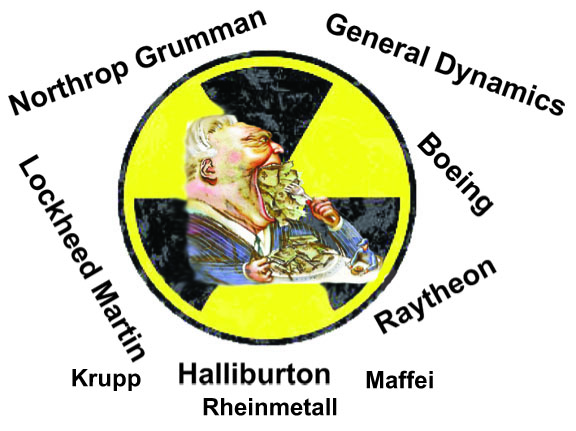
The main corporate beneficiaries making a financial killing from Ukraine are by far the American firms. They include such behemoths as Lockheed Martin, Boeing and RTX (formerly Raytheon). But also enjoying soaring profits are arms makers in other NATO countries: BAE in the United Kingdom, Airbus in France, Netherlands and Spain, Leonardo in Italy, and Germany’s Rheinmetall.
This week the Joe Biden administration requested another $24 billion in U.S. taxpayer-funded aid to Ukraine. It’s hard to keep track of the money flowing from NATO countries to prop up the Nazi regime in Kiev. Even the NATO authorities don’t seem to know the precise figures, such is the rampant corruption that is inevitably associated with the vast doling of funds. But estimates of total U.S. and NATO aid to Ukraine range from $150 billion to $200 billion over the past year alone.
What we are seeing is an audacious racket whereby the American and European public are subsidizing the funneling of their own taxpayers’ money into the coffers of weapons firms. And there is no democratic choice in the matter. It’s a fait accompli. Or, put another way, extortion.
Of course, too, part of this huge scam is the hefty financial cuts for the inner circle of the Kiev regime, including its puppet president, Vladimir Zelensky, and the brazenly sleazy defense chief Aleksy Reznikov. It is reckoned that at least $400 million has been grafted by the top members of the regime from the arms bazaar flowing into Ukraine. Reznikov has even boasted that his country serves as a testing ground for NATO weaponry.
Nearly a century ago, former U.S. Marine Corps General Smedley D Butler popularized the phrase, “war is a racket” as the title of his classic book in which he condemned how American capitalism profits obscenely from military invasions and killing.
Butler’s critique is as relevant today, perhaps more so, as evinced by the conflict in Ukraine.
Western media reports are increasingly admitting – albeit coyly – that the war is a disaster for the Kiev regime and, by extension, the NATO powers. The death toll among Ukrainian forces may be as high as 400,000 since the conflict erupted last February. The much-anticipated Ukrainian counteroffensive launched in early June has resulted in no territorial gains despite the horrendous casualties and despite the gargantuan supply of NATO weapons, training and logistical support.
A report in the Washington Post this week shows that most Ukrainian people are despairing of the grinding war and endless casualties. They see no point in the continuation of hostilities given the failure of the NATO-backed forces to make any advance against well-fortified Russian defense lines.
Yet against this grim reality, the U.S. and European officials keep running the taps of blood.
We see NATO leaders like Polish President Andrzej Duda this week urging for more weapons to be sent to Ukraine even while he concedes the military defeat so far.
Zelensky and his cronies are, not surprisingly, also demanding more NATO arms and claiming with bravado they will never negotiate with Russian President Vladimir Putin. Some people want this conflict to keep going because of their irrational Russophobia and simply because it is too lucrative for their own personal gain.
Where does democracy come into this? It doesn’t, whatsoever. Polls show that most Americans are opposed to the continuing supply of military aid to Ukraine. There are sound reasons to believe that most European citizens are also firmly against the fueling of a bloody war in which Ukrainian corpses keep piling higher. In addition, the perpetuation of this conflict runs the outrageous risk of spiraling out of control into an all-out war between the United States and Russia, the world’s biggest nuclear powers……………………………….. more https://strategic-culture.org/news/2023/08/11/war-iracket-us-nato-arms-industries-make-record-400-billion-sales-from-proxy-war-with-russia/
The blockbuster movie ‘Oppenheimer’ leaves out the real story’s main characters: New Mexicans

The terrible emptiness of “Oppenheimer” Searchlight New Mexico, by Alicia Inez Guzmán, August 8, 2023
Bernice Gutierrez was eight days old when a light 10,000 times hotter than the surface of the sun cracked open the predawn sky. No one in south-central New Mexico knew where it came from, or that the tiniest units of matter could be split to unleash such energy. Nor could they know that when the cloud that followed bloomed some 50,000 feet into the sky, it was surrounded for the briefest of seconds by a blue halo, the “glow of ionized air,” as the Manhattan Project physicist Otto Frisch described it.
The impacts of that unholy halo were all too apparent in the years after, when her great-grandfather died of stomach cancer. One person after another would receive their own wrenching cancer diagnoses — 41 people in her immediate family, spanning five generations. Every one of them had lived in the Tularosa Basin and within 50 miles of the Trinity Site, where the first atomic bomb, nicknamed “Gadget,” was detonated on the northern edge of the Chihuahuan Desert.
Gutierrez was one of a group of downwinders, including Mary Martinez White and Tina Cordova, cofounder of the Tularosa Basin Downwinders Consortium, who watched the movie “Oppenheimer” together when it opened. In one scene after another, New Mexico’s landscapes unfurled — all painfully beautiful and all, it appeared, empty and unpeopled.
In New Mexico, we have lived in the blind spot of a national narrative for eight decades, repeated once again in this box office hit. Over its exhaustive three-hour run-time, it managed to avoid mentioning what we here have been sharing with loved ones at kitchen tables for decades: the violent evictions that took place on the Pajarito Plateau to build Los Alamos, the Pueblo and Hispanic men and women who did essential work for the Manhattan Project, or the thousands of New Mexicans affected to this day by the Trinity test.
To watch J. Robert Oppenheimer’s character instead create and destroy in the state’s big, beautiful and ostensibly barren lands is to deny the presence of so many people whose lives were indelibly transformed by the dawn of the atomic era and continue to be shaped by the juggernaut that is today’s nuclear industrial complex.
Oppenheimer, the son of a wealthy businessman, had come here as part of a cultural moment. He hiked, rode horses and camped. He stayed at a dude ranch in Pecos. He fell in love with and then changed New Mexico forever.
“I am responsible for ruining a beautiful place,” he would later confess.
The film, Gutierrez said, skipped blithely over the ruin. “They leave out the fact that in those isolated areas lived ranchers whose lands they took away and who were never compensated for it.”
The blast was so hot it liquified sand and pieces of the bomb into hunks of green glass. Lead-lined tanks were dispatched to take soil samples at ground zero as fallout cascaded across 46 states. Ash fell from the sky like snow for days afterward, contaminating cisterns, acequias, crops, livestock, clothing and people. At the time of the detonation, 13,000 people lived within a 50-mile radius.
‘Love-struck’ with the beauty
Oppenheimer initially arrived in New Mexico among a wave of smitten travelers. Artists, writers, dancers, anthropologists, museum boosters, health seekers and at least one psychoanalyst (Carl Jung), all had come as well-to-do tourists in search of the ineffable — landscapes, light, exotic cultures, “a patch of America that didn’t feel American,” in the words of writer Rachel Syme.
Long before he became the father of the atomic bomb, Oppenheimer was “love-struck” with the stark beauty of New Mexico, as Kai Bird and Martin J. Sherwin wrote in “American Prometheus,” the biography upon which the movie is based. He would later lease and then buy a home in the Sangre de Cristo Mountains with his brother, Frank. Like so many others, he’d been mesmerized by the West.
New Mexico and the Southwest had long been lodged in America’s psyche. Landscape painting and photography pictured this new and alien frontier to incoming settlers and tourists as early as 1848, the year the United States annexed the region from Mexico. The art forms ended up serving the nation’s gospel, Manifest Destiny, by portraying “uninhabited” landscapes open to settlement. At the same time, U.S. forces brutally removed Indigenous peoples and others of mixed descent from their ancestral lands.
That aesthetic was at work in “Oppenheimer,” a movie that not only played up the romance of the landscape but also made it appear that the atomic bomb test only affected an elite group of scientists watching raptly in cars and bunkers.
“That’s the thing about the white supremacist imagination, right? They create alternate realities for our lives and communities and we have to live with the consequences,” said Mia Montoya Hammersley, an environmental attorney and member of the Piro-Manso-Tiwa tribe whose ancestry includes the earliest stewards of the Tularosa Basin, where the first bomb was detonated.
“This narrative that New Mexico is this empty barren place, people still really buy into that and believe it.”………………………………………………………………………………………………
There is nothing to suggest during any of that storytelling that New Mexico was essentially poisoned, its residents never warned, evacuated or educated about the health hazards of the July 16, 1945 Trinity test.
“It was,” as artist Medina put it, “a great act of desecration.”
Some geologists propose that this moment marks the start of a new epoch of geologic time, the Anthropocene. In New Mexico, it marks a new epoch of our own — when we became a nuclear colony. We are the only “cradle-to-grave” state in the nation, home to uranium mining, nuclear weapon manufacturing and waste storage. Two of the nation’s three weapons labs — Los Alamos and Sandia — are located here, and some 2,500 warheads are buried in an underground munitions complex spitting distance from the Albuquerque Sunport.
Los Alamos National Laboratory is currently undergoing a multi-billion-dollar expansion to create plutonium pits on an industrial scale — the “new Manhattan Project,” as Ted Wyka, the National Nuclear Security Administration’s field office manager, recently said in an aside before a media tour. Wyka told me he imagined himself in the role of Lt. Gen. Leslie Groves, the director of the Manhattan Project; LANL’s current director Thomas Mason was his Oppenheimer, he said.
The film gestures obliquely toward a future world irrevocably changed by the spectacle of nuclear military might. That future — our present — is now a global arms race. ………………………………………………………………………………………………………………………………………………………………………………
in the film, there are only two references to Indigenous peoples. In the first, Oppenheimer is selecting the Pajarito Plateau for the Manhattan Project. The second arrives after the U.S. decimates Hiroshima and Nagasaki. A scene in the oval office shows a crass Harry Truman asking Oppenheimer what to do with the site now that the bombs have been dropped.
Oppenheimer’s response? “Give it back to the Indians.”
Instead, the nuclear arms race was born……………………………………………………………………………………………………………
What remains is a persistent belief that the creation of atomic weapons ended World War II and made for “one of the greatest scientific achievements of all time,” as a plaque near the Santa Fe Plaza reads…………………………………………………………………………………………………………………………..
Gutierrez, White and Cordova, all three on the Tularosa Basin Downwinders Consortium’s steering committee, left the film no less resolved. Days after seeing the movie, Gutierrez was back at work, researching all the infants that died the summer of the Trinity test. Cordova was busy writing about the movie and pushing for compensation for New Mexico’s downwinders, her mission for the past 18 years. And White had helped organize a photography exhibition in Las Cruces on the legacy of Trinity from a local perspective.
The movie’s over, but the battle goes on.
At Nagasaki Memorial, Guterres Cautions of Nuclear Disaster Risk

https://www.miragenews.com/guterres-cautions-of-nuclear-disaster-risk-at-1062602/ 09 Aug 23
UN Secretary-General António Guterres called for countries to recommit to eliminating nuclear weapons in his message to mark the 78th anniversary of the atomic bombing of the Japanese city of Nagasaki, observed on Wednesday.
“We mourn those killed, whose memory will never fade. We remember the terrible destruction wrought upon this city and Hiroshima. We honour the unrelenting strength and resilience of the people of Nagasaki to rebuild,” he said.
New arms race
Yet despite the terrible lessons of 1945, humanity is now facing a new arms race as nuclear weapons are being used as tools of coercion, he noted.
He said weapons systems are being upgraded, and placed at the centre of national security strategies, making these devices of death faster, more accurate, and stealthier at a time of division and mistrust among countries and regions.
“The risk of nuclear catastrophe is now at its highest level since the Cold War,” he warned.
“In the face of these threats, the global community must speak as one. Any use of nuclear weapons is unacceptable. We will not sit idly by as nuclear-armed States race to create even more dangerous weapons.”
Strengthening disarmament efforts
Mr. Guterres stressed that disarmament is at the heart of his Policy Brief on a New Agenda for Peace, launched last month. It calls on Member States to urgently recommit to pursuing a world free of nuclear weapons, and to reinforce the global norms against their use and proliferation.
“Pending their total elimination, States possessing nuclear weapons must commit to never use them. The only way to eliminate the nuclear risk is to eliminate nuclear weapons,” he said.
The Secretary-General added that the UN will continue working with world leaders to strengthen the global efforts towards disarmament and non-proliferation, including through the Treaty on Non-Proliferation of Nuclear Weapons (NPT) and the Treaty on the Prohibition of Nuclear Weapons.
NPT talks have been taking place at the UN in Vienna this month and will conclude on Friday. The treaty entered into force in 1970 and aims to prevent the spread of nuclear weapons and further the goal of nuclear disarmament.
Tribute to survivors
Mr. Guterres also paid tribute to the survivors of the atomic bombings, known as hibakusha. He said their powerful and harrowing testimonies will forever serve as a reminder of the need to achieve a world free of nuclear weapons.
“I have pledged to do everything in my power to ensure that the voices and testimonies of the hibakusha continue to be heard,” he said.
He called on young people – the world’s future leaders and decision makers – “to carry their torch forward”, saying “we can never forget what happened here. We must lift the shadow of nuclear annihilation, once and for all.”
Another Washington declaration: U.S. nuclear weapons on the Korean Peninsula
Foreign Policy Research Institute, Joseph Su 9 Aug 23
- On July 18, the USS Kentucky docked in South Korea, marking the first visit by a potentially nuclear-armed US submarine since the 1980s on the heels of North Korean missile launches.
- After North Korea conducted a record amount of missile tests in 2022, South Korea has become increasingly worried about the nuclear threat and sought further nuclear security guarantees with the United States, signing the Washington Declaration to increase deployments of US strategic assets on the peninsula.……….
Sending Kentucky to Korea
On July 18, 2023, the USS Kentucky, an Ohio-class ballistic missile submarine, docked in Busan, South Korea. The USS Kentucky is one of 14 Ohio-class submarines tasked with conducting nuclear deterrence patrols and carries up to 20 Trident II D5 nuclear-armed ballistic missiles. This visit marks the first port call by a nuclear-capable submarine since the 1980s and the 1991 decision to withdraw US nuclear forces from the Korean Peninsula.
…………………………………………………. The USS Kentucky is an Ohio-class submarine that joined the fleet in 1983 and continues to carry the United States’ nuclear forces at sea. Equipped with 20 launch tubes for the Trident II D5 missile which carries on average four nuclear warheads per missile, a single Ohio submarine could carry a nuclear payload 1,100 times more powerful than the two bombs combined that were dropped in 1945, even abiding by treaty limitations………………………………………………………………………………………………………………………………………………………………………………. https://www.fpri.org/article/2023/08/another-washington-declaration-us-nuclear-weapons-on-the-korean-peninsula/
1 This Month




PLEASE OPPOSE HR 8255 AND S.3639 – bills would accelerate satellite deployment, with no environmental review or safeguards – https://ncstd5li.quorum.us/campaign/169331/
To see nuclear-related stories in greater depth and intensity – go to https://nuclearinformation.wordpress.com
-
Archives
- September 2026 (323)
- August 2026 (330)
- July 2026 (355)
- June 2026 (287)
- May 2026 (306)
- April 2026 (356)
- March 2026 (251)
- February 2026 (267)
- January 2026 (308)
- December 2025 (358)
- November 2025 (359)
- October 2025 (375)
-
Categories
- 1
- 1 NUCLEAR ISSUES
- business and costs
- climate change
- culture and arts
- ENERGY
- environment
- health
- history
- indigenous issues
- Legal
- marketing of nuclear
- media
- opposition to nuclear
- PERSONAL STORIES
- politics
- politics international
- Religion and ethics
- safety
- secrets,lies and civil liberties
- spinbuster
- technology
- Uranium
- wastes
- weapons and war
- Women
- 2 WORLD
- ACTION
- AFRICA
- Atrocities
- AUSTRALIA
- Christina's notes
- Christina's themes
- culture and arts
- Events
- Fuk 2022
- Fuk 2023
- Fukushima 2017
- Fukushima 2018
- fukushima 2019
- Fukushima 2020
- Fukushima 2021
- general
- global warming
- Humour (God we need it)
- Nuclear
- RARE EARTHS
- Reference
- resources – print
- Resources -audiovicual
- Weekly Newsletter
- World
- World Nuclear
- YouTube
-
RSS
Entries RSS
Comments RSS

