The Mad Propaganda Push To Normalize War Profiteering In Ukraine.

Just the other day CNN anchor Erin Burnett ………. pausing to explain to her audience that this funding is actually good for Americans, because it goes straight into the US arms industry.
CAITLIN JOHNSTONE, OCT 1, 2023
There’s been an astonishingly brazen propaganda push to normalize war profiteering in Ukraine as Kyiv coordinates with the arms industry and western governments to convert the war-ravaged nation into a major domestic weapons manufacturer, thereby turning Ukrainians into proxies of the military industrial complex as well as the Pentagon.
At an event in Kyiv which hosted 250 “defense” industry corporations from 30 different countries on Friday, President Zelensky gave a speech urging war profiteers to open factories in Ukraine to cut out the middleman of securing and delivering so many weapons from abroad. This is an investment that the arms industry would ostensibly have plenty of time to set up, given that western officials are now going out of their way to communicate to the public that this war will stretch on for many more years to come.
Zelensky’s speech twice made use of the phrase “defense-industrial complex”, and used the phrase “arsenal of the free world” no fewer than three times.
“Ukraine is developing a special economic regime for the defense-industrial complex,” Zelensky said. “To give all the opportunities to realize their potential to every company that works for the sake of defense — in Ukraine and with Ukraine or that wants to come to Ukraine.”
“Right now, the most powerful military-industrial complexes are being determined, as are their priorities and the global standard of defense. All of this is being determined in Ukraine,” Zelensky tweeted with photos from the event.
This move has been accompanied in recent weeks by some of the most appalling mass media headlines that I have ever seen, all geared toward normalizing the military industrial complex in the eyes of the public.
In an amazingly awful Wall Street Journal op-ed titled titled “In Defense of the Defense Industry” and subtitled “Populists of the right and left attack U.S. companies that make weapons. Who do they think protects us?”, Future of Capitalism’s Ira Stoll argues that the military industrial complex is actually a wonderful thing we should all love and support.
“The weapons industry protects America and its allies, keeping us safe from ruthless enemies who would otherwise exterminate or enslave us,” Stoll writes. “Raytheon helps make weapons systems that defend Israeli civilians against attacks from Iran-backed terrorist groups. These include the Iron Dome, David’s Sling, SkyHunter interceptor systems and Tamir missiles. Raytheon also produces the Javelin antitank missile that Ukraine has used against Russian armor and the early-warning radars that would detect incoming missiles aimed at the U.S.”
Stoll does not name the alternate universe he is describing in which the US military is used to keep Americans safe rather than to advance imperial interests abroad.
Another recent Wall Street Journal article titled “The War in Ukraine Is Also a Giant Arms Fair” and subtitled “Arms makers are getting orders for weapons being put to the test on the battlefield” glorifies the way war machinery is being field tested on human bodies to the benefit of war profiteers.
“The Panzerhaubitze howitzer is part of an arsenal of weapons being put to the test in Ukraine in what has become the world’s largest arms fair,” writes WSJ’s Alistair MacDonald. “Companies that make the weapons being used in Ukraine have won orders and resurrected production lines. The deployment of billions of dollars worth of equipment in a major land war has also given manufacturers and militaries a unique opportunity to analyze the battlefield performance of weapons, and learn how best to use them.”
A Reuters article from two weeks ago titled “At London arms fair, global war fears are good for business” gushes over how much money is being raked in by arms manufacturers as a result of this war, with one unnamed arms industry executive telling Reuters, “War is good for business.”
Just the other day CNN anchor Erin Burnett followed up some clips of “far right lawmakers” voicing their opposition to funding for the Ukraine proxy war by pausing to explain to her audience that this funding is actually good for Americans, because it goes straight into the US arms industry.
“It’s worthwhile with all of this gaining some steam in public perception to be clear on some facts,” Burnett said. “First and foremost, the vast majority of this money is going to American companies and jobs, right, because those are the people that are making the Abrams tanks, the ammo and everything else. And you take Lockheed Martin, which makes the HIMARS, that have been core to Ukraine’s counteroffensive, the company announced it’s going to increase its workforce in Camden, Arkansas, by 20 percent, just because of this new demand.”

“That money is going to America,” Burnett added.
All this propaganda energy is going into normalizing the act of war profiteering because if you let the idea stand on its own, it would make people scream in horror. The fact that a deliberately-provoked war is being used as a giant field demo to show prospective buyers and investors how effective various weapons systems can be at ripping apart human bodies in order to profit from all this death and destruction is more nightmarish than anything any dystopian novelist has ever come up with.
Ukraine is a giant advertisement for weapons of mass slaughter, and the cost of that corporate ad is not money but human blood. If you look right at this thing it absolutely chills you to the bone. Which is why so much effort is being poured into making sure people don’t look at it.
Return of US nuclear weapons to UK would be an escalation, says Russia
Moscow says it would respond with ‘countermeasures’, after US air force budget item hinted at possible move
Julian Borger and Andrew Roth, Wed 6 Sep 2023 https://www.theguardian.com/world/2023/sep/05/return-of-us-nuclear-weapons-to-uk-would-be-an-escalation-says-russia #nuclear #antinuclear #nuclear-free #NoNukes
The Russian foreign ministry has said Moscow will view any move to return US nuclear weapons to the UK as an escalation and will respond with “countermeasures” for its own security.
The foreign ministry spokesperson Maria Zakharova was responding to a report last week about an item in the 2024 US air force budget for building a dormitory at RAF Lakenheath in Suffolk for personnel on a “potential surety mission” – military jargon for nuclear safety and security. It raised the prospect of the return of US nuclear weapons to British soil for the first time in more than 15 years.
“If this step is ever made, we will view it as escalation, as a step toward escalation that would take things to a direction that is quite opposite to addressing the pressing issue of pulling all nuclear weapons out of European countries,” Zakharova said.
“In the context of the transition of the United States and Nato to an openly confrontational course of inflicting a ‘strategic defeat’ on Russia, this practice and its development force us to take compensating countermeasures designed to reliably protect the security interests of our country and its allies.”
The US is estimated by the Federation of American Scientists (FAS) to have 100 B61 gravity bombs deployed in Europe and another 100 B61s – the only tactical weapon in its arsenal – in storage in the US. If US nuclear weapons were sent back to Lakenheath, they would almost certainly be a modernised version of the B61.
FAS estimates Russia has 1,816 tactical, or non-strategic, weapons (shorter range and intended for use in battle rather than for the destruction of whole cities).
These have been held until now in storage facilities, but Vladimir Putin announced in June that some nuclear warheads would be deployed in Belarus within a month. There has so far been no confirmation by western intelligence that they have been moved.
The warheads are intended for use on Belarus Iskander missile launchers or as bombs to be dropped by Belarusian Su-24 or Su-25 jets. If the transfer is carried out, it would be the first time Moscow has put nuclear weapons in the hands of allies since the collapse of the Soviet Union.
Matt Korda, a senior research fellow at the FAS nuclear information project who first spotted the US budget item for a surety dormitory at Lakenheath, said: “While the potential return of US nuclear weapons to UK soil certainly merits scrutiny, it’s a bit rich to see it coming from a government who has spent the past year initiating the exact same thing with Belarus.
“It’s highly unlikely that the Russian government would describe its own nuclear sharing arrangements in Belarus as escalatory or destabilising and yet the parallels between the two situations are clearly visible.”
Contemplating the Unimaginable Costs of a Nuclear War
If you are on the road to annihilation—get off.
SCHEERPOST, By Andrea Mazzarino / TomDispatch October 1, 2023
Despite Russian hints about the use of nuclear weapons in the war in Ukraine, consider it strange — amid other world-endangering possibilities — how little attention nuclear destruction gets anymore. And that’s despite the fact that there are now nine (yes, nine!) nuclear powers on this planet, ranging from the United States, Russia, and China to Israel and North Korea.
Still, at some point in your life, you’ve probably heard about the theory of “nuclear deterrence” embraced by so many in our military and those of other major powers globally. The idea is that nuclear weapons actually keep us all “safe” by their mere presence in the hands of those powers. According to such thinking, their existence restrains the leaders of such countries from directly making war on each other for fear of setting off a world-ending nuclear conflict. And in that context, yes, the U.S. military spends tens of billions of dollars annually on the upkeep of some 5,428nuclear weapons of every sort and their delivery systems to keep us safe. Worse yet, it plans to “invest” upwards of two trillion dollars more “modernizing” that arsenal in the coming decades…………………………………………….
To take just the most obvious recent example, nuclear weapons no more prevented Russian President Vladimir Putin from invading Ukraine than they had stopped the U.S. invasion of Iraq (based, in fact, on the false claim that autocrat Saddam Hussein possessed weapons of mass destruction). Nor have they recently stopped the U.S. from sending close to $50 billion and counting in weaponry and ammunition, not to speak of training and intelligence technology, to Ukraine in response. And count on one thing: some of what our country has provided will impact Ukrainians for generations to come, including depleted uranium tank shells and cluster munitions, those bundles of bomblets banned by more than 100 countries because of their indiscriminate tendency to go off years later, often killing innocent civilians.
In an era marked by so many advances in healthcare, green energy, and food production, which would seem to offer other ways of helping stabilize weak states we fear, the U.S. has progressively expanded its military involvement to some 85 countries globally. There, our soldiers and contractors occupy bases, train local forces, run prisons and intelligence operations, fly drones, and sometimes fight alongside local armies, often in settings with far laxer human rights standards than ours.
Today’s unmanned drones also make it possible to wreak violence without having to witness the consequences………………………………………………………………………..
The Proliferation of Violence
In these decades, the lack of deterrence of violence itself, even if not the nuclear version of it, has been profound. The Costs of War Project at Brown University, which I helped found, has made it all too clear that suffering from armed conflict extends far beyond the battlefield and generations into the future. …………………………………………………………………
The question we at the Costs of War Project return to endlessly is: How do you measure the indirect effects of war? What kind of “security” — if any — has prevailed in the era following the devastation of Hiroshima and Nagasaki?
A Very Small Margin of Error
Of all our preconceptions about nuclear weapons, what’s probably the most destructive is the unstated assumption that they are the sole alternative to a more constant state of conventional warfare. There are, of course, conflict-resolution options that don’t involve violence at all, including diplomacy, the use of targeted intelligence, and anti-poverty programs the likes of which the United Nations and its affiliated human rights and humanitarian organizations promote. Conventional warfare exacts staggering opportunity costs and only makes it harder for leaders to pursue such routes.
Yet the sole type of conflict that could foreclose all alternatives whatsoever is, of course, nuclear war. It could vaporize the very skeleton of civilization — infrastructure, communications, government, and of course people in staggering numbers — all potentially in a matter of minutes, or less time than it takes you to read this piece.
These days, however, we in the U.S. seldom talk about the ever-present possibility of nuclear annihilation by, for instance, intercontinental ballistic missiles (ICBMs), warhead-bearing projectiles capable of traveling thousands of miles (of which the U.S. and Russia have about 400 each).
Scenarios that would place us all on the brink of nuclear annihilation could involve an all-too-human mix of everyday mistakes, incompetence, and heightened emotions. Consider, for instance, the possibility that a simple accident might detonate a warhead before it even leaves the ground, killing untold numbers of people………………………………………………………………………………………………….. https://scheerpost.com/2023/10/01/contemplating-the-unimaginable-costs-of-a-nuclear-war/
People Are Dying For Inches In Ukraine, The “World’s Largest Arms Fair”

CAITLIN JOHNSTONE, SEP 29, 2023 https://www.caitlinjohnst.one/p/people-are-dying-for-inches-in-ukraine?utm_source=post-email-title&publication_id=82124&post_id=137502350&utm_campaign=email-post-title&isFreemail=true&r=1ise1&utm_medium=email
There’s a heartbreaking graphic going around right now showing the almost microscopic changes that have occurred to the frontline of the war in Ukraine this year despite nonstop death and destruction of unfathomable horror the entire time.
The graphic comes from a New York Times article titled “Who’s Gaining Ground in Ukraine? This Year, No One.”, which eventually gets around to acknowledging that Russia has actually gained more ground than Ukraine in 2023 despite Kyiv’s much-hyped counteroffensive which began in June.
“When both sides’ gains are added up, Russia now controls nearly 200 square miles more territory in Ukraine compared with the start of the year,” the Times reports.
As Left I on the News noted on Twitter, this contradicts the titular claim in another New York Times article published last week under the headline “Ukraine Has Gained Ground. But It Has Much Further To Go.”
The reason the map of gains and losses is so heartbreaking is because so much has been given up for so very, very little. At least tens of thousands have died in this war with hundreds of thousands wounded, all for those teeny, tiny little blips on the map. Ukraine is now freckled with more landmines than anywhere else on earth, which experts say will take decades to clear. This giant deathtrap is exacerbated by the cluster munitions that are covering the land with greater and greater frequency, which will go on to detonate and kill civilians (mostly children) for years to come. The mines and artillery fire on the frontline of this war are reportedly creating tens of thousands of amputees, numbers comparable to what was seen in World War I.
And all for what? Essentially nothing. A few inches gained here, a few inches lost there. The meaninglessness of it all is probably one of the reasons why military-aged Ukrainian men have been fleeing and attempting to flee the nation in droves to avoid conscription.
War is the worst thing in the world. The suffering, trauma and loss of mass military violence is too much to comprehend, even for people who are right there experiencing it. And the only thing worse than a war where one side gets completely steamrolled by the other is one in which people keep killing each other and killing each other over tiny gains and losses on the battlefield without an end to the nightmare anywhere on the horizon.
And now we see western officials and media outlets telling us all to prepare for this war to drag on for years, potentially into the 2030s. This nonsensical violence, which even the head of NATO now admits could have been avoided by simply ceasing to amass a western military threat on Russia’s doorstep, is scheduled to drag on as long as possible for no grander reason than the advancement of US strategic interests.
This news from The New York Times comes out at the same time as a Wall Street Journal article titled “The War in Ukraine Is Also a Giant Arms Fair,” subtitled “Arms makers are getting orders for weapons being put to the test on the battlefield.”
“The Panzerhaubitze howitzer is part of an arsenal of weapons being put to the test in Ukraine in what has become the world’s largest arms fair,” writes WSJ’s Alistair MacDonald. “Companies that make the weapons being used in Ukraine have won orders and resurrected production lines. The deployment of billions of dollars worth of equipment in a major land war has also given manufacturers and militaries a unique opportunity to analyze the battlefield performance of weapons, and learn how best to use them.”
This is one of those things that just sounds a bit uncomfortable at first, but if you really sit with the words and deeply contemplate what’s being said here it will show up as so deeply evil it will give you nightmares. The fact that weapons systems are being tested on human bodies to the immense benefit of war profiteers over a completely avoidable and deliberately provoked war is one of the most depraved things you can possibly imagine, and is a clear sign that we are living in a profoundly sick society.
This is so, so ugly, and it’s slated to get even uglier — these freaks haven’t even gotten started on China yet. The sooner this monstrous power structure can be brought to its knees, the better it will be for everyone.
US and UK involved in attack on Crimea – Russia
https://www.rt.com/russia/583634-us-uk-crimea-strike/ 29 Sept 23
Moscow has “no doubt” about Western complicity in the attack on Sevastopol last Friday, the Foreign Ministry has said
Maria Zakharova, the spokeswoman for the Russian Foreign Ministry, has asserted that US and British intelligence agencies supported Kiev during an attack on Sevastopol last Friday. The Ukrainian assault targeted the headquarters of the Russian Black Sea Fleet.
Speaking at a weekly briefing on Wednesday, she said there was “no doubt that this attack was planned with the use of Western surveillance assets, NATO satellite equipment, and spy planes and conducted at the direction of and in close coordination with American and British special services.”
The Defense Ministry has reported that the missile strike on the fleet headquarters involved several Ukrainian missiles, with Russian air defenses successfully intercepting some of them. British media outlets have also disclosed that Kiev employed Storm Shadow missiles supplied by the UK in the attack, resulting in significant damage to the building.
Zakharova described the incident as one of many in which Kiev “targets Russian regions, using missiles and shells supplied by NATO states,” citing several other recent examples. The goals of the Ukrainian government, she said, are “to draw attention away from the Ukrainian military’s failed attempts at conducting a counteroffensive” and to destabilize Russian society.
The US and its allies have supplied tens of billions of dollars worth of military hardware to Ukraine to boost its summer charge against Russian defensive lines. The operation, however, has so far produced insignificant territorial gains at the cost of heavy losses in manpower and equipment.
Russian Defense Minister Sergey Shoigu estimated on Tuesday that over 17,000 Ukrainian troops were killed in September alone. Western officials and media have acknowledged that the counteroffensive has not turned out as Kiev and its sponsors had hoped.
The administration of US President Joe Biden, however, has urged Congress to keep financing Ukraine for the foreseeable future. An appropriation request for over $24 billion in aid is currently floating in the legislature but is opposed by some Republican lawmakers.
Senators have proposed a compromise stopgap spending bill to avoid a possible government shutdown next month. The plan involves reducing spending on Ukraine to $6.2 billion. The GOP-controlled House of Representatives would need to approve the draft before it could be voted on and sent to Biden’s desk to be signed into law.
Pentagon discloses military deal with Elon Musk

Musk’s aerospace firm is now competing for nearly $1 billion in Pentagon contracts extending into 2028, as the Space Force seeks to repurpose existing communications satellites for military use as part of its “Proliferated Low Earth Orbit” program.
The billionaire entrepreneur continues to insist that the Starlink network should not be a “participant to combat”
SpaceX has signed its first contract with the Pentagon to provide satellite services as part of its new ‘Starshield’ program. CEO Elon Musk described the effort as a military alternative to the “civilian” Starlink system, although it will apparently rely on the existing constellation of satellites.
In a post on X (formerly Twitter) on Wednesday, Musk weighed in on reports that SpaceX had reached a deal with the US Space Force, confirming that the Starshield project would be “owned by the US government and controlled by [the Department of Defense].”
“Starlink needs to be a civilian network, not a participant to combat,” he said, referring to the use of the satellites in Ukraine throughout the conflict with Russia, adding “This is the right order of things.”
However, despite Musk’s stated reluctance to be involved in the fighting, the new Space Force contract will see SpaceX effectively lease out part of its Starlink network to the Pentagon, providing service over the same satellites, according to Bloomberg.
With a $70 million price ceiling, the deal “provides for Starshield end-to-end service via the Starlink constellation, user terminals, ancillary equipment, network management and other related services,” Air Force spokeswoman Ann Stefanek told Bloomberg News.
The outlet noted that Musk’s aerospace firm is now competing for nearly $1 billion in Pentagon contracts extending into 2028, as the Space Force seeks to repurpose existing communications satellites for military use as part of its “Proliferated Low Earth Orbit” program.
Musk has come under fire from US officials for SpaceX’s decisions in Ukraine, after allegedly refusing Kiev’s demands to use the Starlink network to aid strikes on Russia’s Black Sea fleet last year. The billionaire’s biographer, Walter Isaacson, revealed earlier this month that Musk had developed a “military version of the Starlink” as a way to wash his hands of the project. more https://www.rt.com/news/583746-pentagon-musk-satellite-deal/
Scottish independence would end the UK’s nuclear delusion.
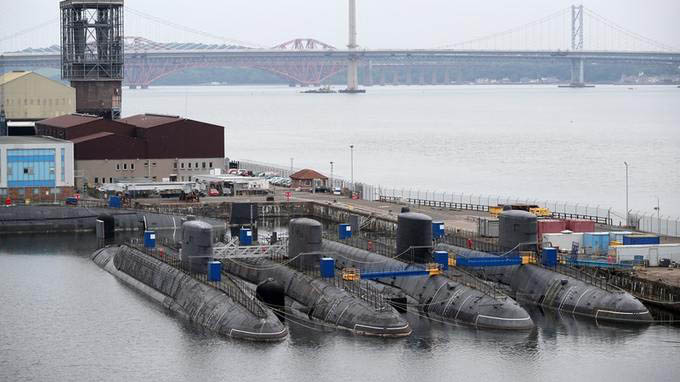
The oncoming submarine crisis is not the only threat to the UK’s ability to maintain its nuclear weapon capability. The recent upsurge in the aspiration for Scottish independence should remind us that we are in a unique position with the potential not only to rid ourselves of these horrific weapons, but also to undermine the ability of the UK to persist with them since there is no credible alternative to the Clyde bases elsewhere the UK.
29th September, By David Mackenzie
LAST week a UK nuclear weapon Vanguard-class submarine returned to its base in Faslane, covered in algae and barnacles, reportedly after a patrol that lasted more than six months.
This prompted the pro-navy (and pro-nuclear-weapon) magazine Navy Outlook to publish a long article discussing the increase in the length of patrols and suggesting that this is down to the difficulty, due to refits and maintenance problems arising from skill shortages, of maintaining the pattern of always having one boat on patrol at all times. The article acknowledges that there is now great pressure on the submariners and that risks are being taken to maintain the patrol pattern.
The four Vanguard-class boats are now more than 30 years old and the replacement Dreadnought- class is already well behind schedule, so the question arises as to whether the current submarines can be patched and crewed sufficiently to close the potential gap in availability.
The Dreadnought programme is seriously hampered by a shortage of assembly space at Barrow and delays to the Derby unit where the reactor cores will be built. The UK Government refuses to say when it expects the new boats to be ready. The stretching of the patrol length to six months and beyond suggests that the crisis point may not be far away and that in the interim more and more risks will be taken with material and personnel.
The oncoming submarine crisis is not the only threat to the UK’s ability to maintain its nuclear weapon capability. The recent upsurge in the aspiration for Scottish independence should remind us that we are in a unique position with the potential not only to rid ourselves of these horrific weapons, but also to undermine the ability of the UK to persist with them since there is no credible alternative to the Clyde bases elsewhere the UK.
When the UK was setting up Polaris, its first system for the submarine launching of nuclear weapons, the Ministry of Defence conducted a study to determine what sites would be suitable for two essential items – a port for berthing the submarines and a nearby but separate armaments depot for storing the warheads and loading them onto the missiles in the submarines.
The study rejected all the projected locations in England and Wales (including Falmouth, Milford Haven, Portland, Devonport, Barrow, and completely new “greenfield” sites). So we have the submarines based at Faslane and the warhead storage and management facility at Coulport. The Clyde sites offer deep water access and a ready route to the Atlantic. Two other locations outwith the UK have been raised – one is moving the bases to King’s Bay in Georgia, US.
This would rip away the last tissue of pretence that the UK system is an independent one. Also mooted has been the sharing of the French facilities on Île Longue near Brest but this is seen as politically beyond the pale. In short, there is no feasible alternative to the Clyde bases. This analysis is accepted by the UK defence establishment. This makes Scottish independence a critical threat to the UK’s nuclear weapons.
It has also been pointed out that the increasing fragility of the UK nuclear weapon system may have prompted the projected return of US nuclear weapons to the US base at Lakenheath in Suffolk. If the UK is seen as an increasingly wobbly part of the Nato nuclear fabric this may represent a belt-and-braces tactic.
The third shaky-nail factor is the growing worldwide movement for the complete elimination of nuclear weapons. The Treaty on the Prohibition of Nuclear Weapons (TPNW), which came into force as UN law in January 2021, has acquired huge worldwide support – to date 69 ratifications, 93 signatures and the regular support of around 130 states on the floor of the UN General Assembly, to say nothing of such strong supporters as Ireland, Austria, Pope Francis and The Elders. Meanwhile, financial institutions are disinvesting from nuclear weapons, frequently ascribing their stance to the TPNW.
The nuclear war threat is like an open petrol can that is kept close to an open fire on a shoogly table. This is a uniquely dangerous moment.
Yet there is an overwhelming desire for prohibition from the majority of UN member states, especially from those who would suffer the most from the climatic effects of an exchange of nuclear weapons.
We can hope that these three factors will enable a fundamental rethink of the UK’s nuclear posturing.
We can certainly hope that Scotland will take its own clear stance on the matter with worldwide support.
David Mackenzie is secretary of Secure Scotland
Caitlin Johnstone: Neocons Love the Ukraine War

Empire managers were openly discussing the ways a war in Ukraine would directly benefit the U.S. empire long before the invasion.
They knew exactly what they were doing when they provoked this war, and they know exactly what they’re doing by keeping it going.
And they’re loving every minute of it.
One of the dumbest things the empire asks us to believe is that this war simultaneously (A) was completely unprovoked and (B) just coincidentally happens to massively advance the strategic interests of the government accused of provoking it.
By Caitlin Johnstone, September 28, 2023
The Bill Kristol-led group “Republicans for Ukraine” has released a TV ad to help drum up GOP support for Washington’s proxy war against Russia, and it’s surprisingly honest about what this war is really about: advancing US strategic interests using Ukrainians as sacrificial pawns.
Here’s a transcript:
“When America arms Ukraine, we get a lot for a little. Putin is an enemy of America. We’ve used 5% of our defense budget to arm Ukraine, and with it, they’ve destroyed 50% of Putin’s Army. We’ve done all this by sending weapons from storage, not our troops. The more Ukraine weakens Russia, the more it also weakens Russia’s closest ally, China. America needs to stand strong against our enemies, that’s why Republicans in Congress must continue to support Ukraine.”
One of the dumbest things the empire asks us to believe is that this war simultaneously (A) was completely unprovoked and (B) just coincidentally happens to massively advance the strategic interests of the government accused of provoking it.
From the moment Russia invaded Ukraine in February 2022 Westerners were aggressively hammered over and over and over again by the mass media with the uniform propaganda message that this was an “unprovoked invasion.”
But ever since then they’ve also been receiving these peculiar messages from U.S. empire managers and spinmeisters that this war is helping the United States crush its geopolitical enemies and advance its interests abroad.
This bizarre two-step occurs because the U.S.-centralized empire needs to convey two self-evidently contradictory messages to the public at all times:
- that the U.S. is an innocent little flower who just wants to help its good friends the Ukrainians protect their democracy from the murderous Russians who invaded solely because they are evil and hate freedom, and
- that it’s in the American interest to continue this war.
The second point is required because the message that the U.S. is merely an innocent passive witness to the violence in Ukraine necessarily causes certain political factions to ask, “Okay, so what are we doing there then? Why are we pouring all this money into something that has nothing to do with us?”
So another narrative is required to explain that backing this proxy war also just so happens to be a massive boon to U.S. strategic interests abroad while creating American jobs manufacturing weapons at home.
It doesn’t benefit normal Americans at home, but it absolutely does serve the interests of the globe-spanning empire that’s centralized around Washington. That’s why the empire deliberately provoked it.
Empire managers were openly discussing the ways a war in Ukraine would directly benefit the U.S. empire long before the invasion.
In 2019 a Pentagon-funded Rand Corporation paper titled “Extending Russia —Competing from Advantageous Ground” detailed how the empire can use proxy warfare, economic warfare and other Cold War tactics to push its longtime geopolitical foe to the brink without costing American lives or sparking a nuclear conflict.
The U.S. Army-commissioned paper mentioned Ukraine hundreds of times, and explicitly discussed how a war there could be used to promote sanctions against Moscow and attack Russia’s energy interests in Europe.
In December of 2021 John Deni of NATO propaganda firm The Atlantic Council authored a piece for The Wall Street Journal, “The Strategic Case for Risking War in Ukraine,” subtitled “An invasion would be a diplomatic, economic and military mistake for Putin. Let him make it if he must.”
Deni argued that “there are good strategic reasons for the West to stake out a hard-line approach” against Moscow and refuse to negotiate or back down over Ukraine, because if doing so provokes Russia to invade it would “forge an even stronger anti-Russian consensus across Europe,” “result in another round of more debilitating economic sanctions that would further weaken Russia’s economy” and “sap the strength and morale of Russia’s military while undercutting Mr. Putin’s domestic popularity and reducing Russia’s soft power globally.”
[Related: Biden Confirms Why the US Needed This War – Consortium News]
The minds on the inside of the empire were talking about how this war would benefit the U.S. before the invasion, and they’ve been talking about how much it benefits the U.S. ever since.
As The Washington Post’s David Ignatius put it this past July:
“these 18 months of war have been a strategic windfall, at relatively low cost (other than for the Ukrainians). The West’s most reckless antagonist has been rocked. NATO has grown much stronger with the additions of Sweden and Finland. Germany has weaned itself from dependence on Russian energy and, in many ways, rediscovered its sense of values. NATO squabbles make headlines, but overall, this has been a triumphal summer for the alliance.”
The managers of the empire are getting everything they want out of this war. In public they rend their garments and cry crocodile tears and call it a terrible criminal atrocity, but every now and then they look at the camera and flash it a quick Fleabag-style grin.
They knew exactly what they were doing when they provoked this war, and they know exactly what they’re doing by keeping it going.
And they’re loving every minute of it.
It’s Time to Admit the Truth About the War in Ukraine—and Course Correct

If it wasn’t clear to Washington before the offensive started that the fundamentals of combat operations and principles of war indicated Ukraine would likely fail, it should now be crystal clear.
DANIEL L. DAVIS , SENIOR FELLOW, DEFENSE PRIORITIES ON 9/18/23 https://www.newsweek.com/we-can-no-longer-hide-truth-about-russia-ukraine-war-opinion-1826532?amp=1
As leading American politicians, generals, and pundits continue advocating for open-ended support to Kyiv in their war against Russia, a sober, accurate analysis of Ukraine’s nearly completed summer offensive reveals that the heroic sacrifice Ukraine continues to make is producing little to no meaningful progress toward the objective of evicting Russia from Ukraine’s territory.
Washington should instead employ a necessary course correction and form a new policy, based on the harsh, ground-truth combat realities in Ukraine. Revising the objectives would give Washington and Kyiv a chance to preserve Ukrainian lives and American interests.
Washington’s current policies do neither.
Despite great hopes for a rapid success, Ukraine’s months-in-the-making offensive has sputtered from the outset. That shouldn’t have surprised anyone in the White House. On April 5, two months before the start of the offensive, I wrote that “Zelensky’s troops—with little to no air power and a dearth in artillery ammunition—could suffer egregious casualties while gaining little.”
Five days later, The Washington Post revealed the contents of a leaked Top Secret U.S. intelligence assessment which likewise predicted the Ukrainian offensive would probably fall “well short” of expectations, and that “enduring Ukrainian deficiencies in training and munitions supplies probably will strain progress and exacerbate casualties during the offensive.” Total Ukrainian deaths in the war at that point were estimated to be as low as 17,500.
About a month before the start of the offensive, I again warned that the odds were stacked heavily against Kyiv. To succeed, I explained, Ukraine would “have to conduct the most difficult task in modern land warfare: a combined arms operation into the teeth of a dug-in enemy force that is prepared for an attack,” complicated by the shortage of artillery ammunition along with “limited airpower and minimal air defense.” Nevertheless, on the eve of battle, some Western analysts remained optimistic.
Once the offensive began on June 5, however, that optimism quickly evaporated. In the first two weeks of the fighting, Ukraine’s spearhead brigades suffered massive losses in armor and personnel while capturing virtually no territory. By the end of the third week, they had lost an estimated fifth of their strike force, requiring Ukraine to dramatically change tactics. Instead of leading with tanks and other armored vehicles (which were predictably getting chewed up in minefields and by Russian anti-tank missiles and artillery shells), Ukraine moved to an infantry-centric attack system.
While this change did result in producing incremental gains, the cost was exorbitant. On Aug. 29, the BBC reported that new leaked reports suggested Ukrainian battle deaths exploded since the offensive started. Whereas Ukraine was reported to have lost 17,500 troops in the first year of the war, it is presently assessed to have lost a breathtakingly high 50,000 additional deaths, for a total of 70,000 dead and 120,000 wounded.
If it wasn’t clear to Washington before the offensive started that the fundamentals of combat operations and principles of war indicated Ukraine would likely fail, it should now be crystal clear. Although Ukraine appears to have finally penetrated the first line of Russia’s main defense, the most difficult part of Russia’s defensive system has yet to be overcome: the hundreds of kilometers of dragon’s teeth, tank ditches, and yet more vast minefields.
It is unclear at this point whether Ukraine has enough striking power remaining in its offensive forces to reach, much less penetrate, Russia’s second main line—beyond which is a third main line followed by a fortress-defense at Tokmak, which is still 75 road kilometers from the Azov coast. Given these realities, the best Ukraine can likely do for the rest of the year is to hold what they have and prevent the possibility of losing more territory to a potential Russian counteroffensive this fall.
The United States, however, would be wise to adjust its policies to reflect the reality of Ukraine’s slim chances against Russia’s fortified lines. Washington has spent nearly $113 billion over the course of this war, provided Ukraine with an astounding volume of modern arms and ammunition, and delivered an impressive array of training and intelligence support. After almost a year of preparation, it hardly dented the Russian lines.
There is no realistic basis, therefore, to believe that Ukraine has the capacity to attain its stated strategic objective to reclaim all its territory, including Crimea. What is realistic is to continue providing Kyiv with the military wherewithal to defend itself from further Russian incursions. This goal should be combined with shifting an increasing percentage of the burden for additional arms and ammunition to our rich European friends. The U.S. should continue to ensure the war does not expand beyond the borders of Ukraine, and increase diplomatic efforts with all relevant parties to end the war on the best terms possible for Kyiv—all of which are beneficial to American interests.
Rather than repeating over the next year and a half what has already not worked—potentially costing Ukraine yet additional hundreds of thousands of losses—it’s time to try something that has a chance to succeed. In other words, it’s time to acknowledge objective reality and employ policies that can work.
Daniel L. Davis is a senior fellow for Defense Priorities and a former lieutenant colonel in the U.S. Army who deployed into combat zones four times. He is the author of The Eleventh Hour in 2020 America. Follow him @DanielLDavis1
Kiev’s counteroffensive unlikely to achieve its goals – US officials to New York Times
Ukrainian forces will need to pause in a few weeks to restock and recover after summer fighting, the paper reports, citing sources
Officials in Washington have suggested that Ukraine’s military forces won’t be able to cut Russia’s land bridge to Crimea as part of their counteroffensive or achieve other key goals, the New York Times has reported.
“Some American officials have said that the Ukrainian counteroffensive appears likely to fall short of its strategic goals,” the paper reported in an article on Friday.
Kiev’s forces are struggling to achieve the aim of reaching the Sea of Azov in Russia’s Zaporozhye Region, because the minefields set up by Moscow’s forces, they say, have proven to be “a potent defense,” the Times added.
According to US officials, conducting offensive operations would also soon become even more difficult for Ukraine “as the ground becomes soft and muddy” in the region.
The NYT also said that some in Washington have warned that “within a few weeks, the Ukrainian army will need time to rebuild their stockpile of equipment and to rest forces exhausted by the summer fighting.”………………………………more https://www.rt.com/news/583443-ukraine-counteroffensive-us-zelensky/—
New York Times Says ‘Evidence Suggests’ Ukrainian Missile Misfire To Blame For Market Tragedy
Radio Free Europe, 19 Sept 23
The New York Times has published a report suggesting a deadly bombing at an outdoor market in eastern Ukraine earlier this month was likely caused by an errant missile fired by Ukraine’s armed forces.
Kyiv rejected the September 19 report by the U.S. daily, again stating that the September 6 blast in Kostyantynivka that killed at least 15 people and injured 30 more was caused by a Russian missile.
The report cites “evidence collected and analyzed by The New York Times, including missile fragments, satellite imagery, witness accounts and social media posts, strongly suggests the catastrophic strike was the result of an errant Ukrainian air defense missile fired by a Buk launch system.”
It shares security footage appearing to show a missile flying at the market “from the direction of Ukrainian-held territory, not from behind Russian lines,” and images of scarring on the ground near the impact……………………….. https://www.rferl.org/a/ukraine-nyt-missile-kostyantynivka-market/32599514.html—
Is World War III About to Start? Part II: Are the Military-Industrial Complex and Deep State Driving Us to War?

given the vast exiting of civilian U.S. factories and jobs over the last half-century to cheap-labor countries abroad, the Military Industrial Complex is probably the principal economic engine of the U.S. as a whole.
By Richard C. Cook / Original to ScheerPost.
Why is the U.S. refusing to call a halt to the Ukraine madness? Why can’t an era of “Peaceful Coexistence” in Europe and the world be declared or at least sought? How about détente with Russia? With Russia and China? What is wrong with that?
We’ll start peeling the onion by looking at the U.S. military-industrial complex. Of course, President Eisenhower warned us against the MIC over 60 years ago in his “Farewell Address” of January 20, 1961. Among other remarks he said:
“In the councils of government, we must guard against the acquisition of unwarranted influence, whether sought or unsought, by the military-industrial complex. The potential for the disastrous rise of misplaced power exists and will persist.”
Today about 2.1 million people are employed by the defense industry. According to Acara Solutions, a major MIC recruiting firm, their average annual salary is $106,700, 40 percent higher than the national average. The companies they work for produced revenues in 2022 of $741 billion. How much of their production is high-priced junk, no one knows. The performance of U.S.-produced armaments in the Ukraine conflict does not seem impressive. No modern U.S. weapons have ever been tested in an industrial-type war against an equal adversary.

The MIC also includes active-duty uniformed personnel of 1.37 million and reserves of 849,000. There are 750 U.S. military bases in more than 80 countries outside of the U.S. More than 100,000 U.S. military personnel are stationed in Europe. Annual salary and benefits of the military are currently $146 billion per year, escalating with COLAs compounded at two to three percent annually, sometimes more. Some former U.S. military personnel are assumed to be fighting in Ukraine as mercenaries or helping direct the fighting from safe locations like Kiev or Lvov.
Then there are the civilian employees. According to the DoD, it employs more than 700,000 civilians “in an array of critical positions worldwide,” with compensation totaling about $70 billion. According to the Government Accountability Office, we may also add 560,000 contractor employees, whose compensation is typically higher than the career workforce.
We can also add hundreds of thousands of executives, managers, employees and contractors of the three-letter Deep State agencies, such as the CIA, NSA, DEA, FBI, and now DHS, etc., who interface with the MIC day in and day out and are part of the same fabric of state-sanctioned force and enemy identification and interdiction.
Added to the above are members of Congress who vote on military budgets and make the laws that protect the MIC from accountability, lobbyists who pressure those members to cast votes favorable to their MIC clients, private sector financial service employees who handle the retirement accounts of the MIC multitude, foreigners who are employed at overseas bases, and various scoundrels and hangers-on. I would include in the latter category the multitude of MIC cheerleaders from Hollywood who produce trashy spectacles like Top Gun.
On top of everything else, there are millions of retirees drawing annuities in excess of what most working-class Americans earn, many of these retirees double- or triple-dipping with lucrative jobs in business or government.
Each of the above individuals supports multiple family members, workers, and vendors within the civilian economy who, with the ripple effect and velocity of money, keep entire towns, cities, states, regions, and industries afloat. An example is building the F-35 that has workers assembling it in 350 congressional districts. It is probably no exaggeration to say that given the vast exiting of civilian U.S. factories and jobs over the last half-century to cheap-labor countries abroad, the MIC is probably the principal economic engine of the U.S. as a whole.
So are we going to tell what adds up to tens of millions of people, sorry, your services are no longer needed? Good luck with that. And isn’t it obvious that all these people, especially the higher echelons, are going to do everything within their power to persuade us that their jobs are so essential that without them we will shortly be overwhelmed and eaten alive by every “enemy” on the planet?
If you doubt what I am saying, ask any retired colonel or general who has hired himself out as a talking head to CNN or MSNBC. It’s also why DoD has formally declared Russia and China our two “adversaries,” because, after all, you have to point the finger at someone and blame them for your own dysfunctional society.
But as I witnessed personally in my NASA days, many MIC personnel never do a lick of honest work, or are mainly occupied with paper shuffling or other busywork, especially with work-at-home now the vogue, with many spending their days surfing the internet, or worse, while drawing a level of pay that puts most civilian workers in the shade.
Not to mention stay-at-home mothers, teachers and caregivers, first responders, law enforcement personnel, food service employees, or the unemployed, underemployed, or homeless. Yet many of these people, while working hard for low pay, if any, have a sense of fulfillment and self-worth that surpasses the swarms of MIC bureaucrats who can’t help but feel degraded in their superfluous and often pointless vocational stagnation.
Is all this enough to create an imperative for World War III? You tell me. It certainly has to be a contributing factor. Plus it saps the nation’s natural strength. We could even say that the U.S. war machine is a cancerous tumor that has metastasized throughout the entirety of American society, polluting and corrupting every aspect of life, including the body politic, the environment, the entertainment industry, the mass media, education, scientific research, etc. ……………………………………………… https://scheerpost.com/2023/09/26/is-world-war-iii-about-to-start-part-ii-are-the-military-industrial-complex-and-deep-state-driving-us-to-war/
UN warns of ‘humanitarian catastrophe’ in growing nuclear arms race

Guterres says world is plunging into a new nuclear arms race as North Korea accuses US of pushing it to the brink of war.
United Nations chief Antonio Guterres has warned of “humanitarian catastrophe of epic proportions” due to the geopolitical mistrust and competition that has made nuclear risk escalate to Cold War levels.
“Any use of a nuclear weapon – anytime, anywhere and in any context – would unleash a humanitarian catastrophe of epic proportions,” he told the UN General Assembly on the final day of its yearly session on Tuesday as North Korea warned that the US was pushing it to the brink of war.
With an evolving nuclear order in which armed nations are expanding and modernising their arsenals, the UN chief called on countries to strengthen their commitments to reducing and, eventually, eliminating nuclear weapons.
In a statement released on the International Day for the Total Elimination of Nuclear Weapons, Guterres reminded UN member states of the recently launched policy brief on A New Agenda for Peace – which calls for a recommitment to non-proliferation of nuclear weapons.
“On this important Day, we re-affirm our commitment to a world free of nuclear weapons and the humanitarian catastrophe their use would unleash,” Guterres said in the statement.
“This means nuclear-weapon States leading the way by meeting their disarmament obligations, and committing to never use nuclear weapons under any circumstances.”
North Korea on ‘brink of nuclear war’
Meanwhile, North Korea, in one of the last speeches of the week-long UN General Assembly debate, accused the United States of driving the peninsula “closer to the brink of nuclear war” because of its tighter cooperation with South Korea.
Kim Song, North Korea’s ambassador to the United Nations, pointed to the recent formation of the Nuclear Consultative Group, through which the US hopes to integrate its nuclear capacity better with South Korea’s conventional forces.
The two allies would increase information sharing and contingency planning, which Kim alleged was to execute a “preemptive nuclear strike” against North Korea.
“Due to its sycophantic and humiliating policy of depending on outside forces, the Korean peninsula is in a hair-trigger situation with imminent danger of nuclear war,” Kim said……………………………………. more https://www.aljazeera.com/news/2023/9/27/un-warns-of-humanitarian-catastrophe-in-growing-nuclear-arms-race—
North Korean parliament enshrines nuclear ambitions in constitution
Leader Kim Jong Un says the constitutional amendment will help North Korea hold a ‘definite edge’ in deterring threats.
North Korea’s parliament has unanimously moved to enshrine its nuclear programme in the country’s constitution.
The state news agency KCNA reported on the “crucial agenda item” early on Thursday, explaining that the new constitutional amendment would establish North Korea’s pursuit of a nuclear force “as the basic law of the state”.
The news follows a meeting on Tuesday and Wednesday of the Supreme People’s Assembly, North Korea’s rubber-stamp legislature. The country’s leader, Kim Jong Un, addressed the assembly to support the passage of the amendment.
Kim called to “accelerate the modernisation of nuclear weapons in order to hold the definite edge of strategic deterrence” against perceived threats, like the United States and South Korea…………………………………….
The announcement that nuclear weapons would be enshrined in the country’s constitution comes in defiance of multiple UN Security Council sanctions, meant to deter North Korea from pursuing nuclear arms.
Over the past year, North Korea has been escalating the number of weapons tests it conducts, launching an array of ballistic and cruise missiles……………. https://www.aljazeera.com/news/2023/9/27/north-korean-parliament-enshrines-nuclear-ambitions-in-constitution
Star-crossed States: No result from the UN Working Group on Reducing Space Threats
The long-standing goal of preventing an arms race in outer space could be slipping away
OPEN CANADA, BY: PAUL MEYER / 24 SEPTEMBER, 2023
It has become a challenge these days to keep up with the exponential growth in the number of satellites orbiting this planet. Current estimates of active satellites are upwards of 6000 with tens of thousands more launches planned by the end of the decade. The private sector is driving this growth with Elon Musk’s Starlink telecommunication constellation constituting almost half of the satellites operating in low earth orbit (the closest and most congested orbital slot).
The world is increasingly dependent on satellites to provide a vast spectrum of services essential for global security and well-being, and it is all the more regrettable therefore that this surge of activity in outer space is coinciding with what appears to be a nadir in the level of cooperation amongst leading space powers. Although objectively it would be in the interests of all spacefaring states, and the entire international community reliant on space-enabled services, to cooperate to ensure the continued safe and secure utilisation of outer space, the current situation is fraught with tension and mistrust. For over 40 years the UN has sought to prevent an arms race in outer space, but besides the repeated declarations that this remains a common goal there is little evidence of meaningful efforts to ensure it.
It was back in 1981 that the “Prevention of an Arms Race in Outer Space” (aka PAROS) item was added to the agenda of the UN General Assembly and the negotiating forum of the Conference on Disarmament in Geneva. While member states agreed to put this topic on the UN’s agenda, ever since they have held contending views as to how best to make progress on outer space security. The 1967 Outer Space Treaty (with 112 states parties) provided some common ground in calling for the peaceful uses of outer space and prohibiting the stationing in orbit of weapons of mass destruction, but was silent on other types of weaponry. Although the treaty required its parties to exercise “due regard” for the space operations of other states and to avoid “harmful interference” with such operations these terms have lacked a common understanding as to their import.
The Cold War era development of space weapons including anti-satellite weapons (ASATs) demonstrated that the legal regime established by the Outer Space Treaty was insufficient to ensure that the peace was kept in outer space and almost all states agreed that “further measures” would be required to strengthen it. This broad consensus that the Outer Space Treaty needed to be reinforced with complementary agreements however, quickly broke down over the specific content and form such additional measures should take.
One camp led by China and Russia, although including many other states such as Brazil, India, Mexico and Indonesia, favours legally binding agreements to supplement the Outer Space Treaty. They argue that only legal agreements will have the authority and staying power to ensure compliance with their provisions. Political measures at best might supplement a legally binding instrument, but could never substitute for one.
The other camp led by the United States, supported by many of its allies, argue that at this stage it is best to develop politically binding measures, such as so-called Transparency and Confidence Building Measures .
dherents of this approach argue that the negotiation of a legally binding agreement would take too long and would flounder over issues of definition and verification. In their view, settling on a set of practical measures would be a quicker and more effective means of agreeing “rules of the road” for state-conducted space operations.
This argument over the best diplomatic path to take to prevent armed conflict in space has gone on for decades without a resolution. As a result, in recent years the relations among leading space powers have deteriorated significantly with mutual accusations of “weaponizing” outer space and the development of “counter-space capabilities” in the arsenals of states. ……………………………………………………………… more https://opencanada.org/star-crossed-states-no-result-from-the-un-working-group-on-reducing-space-threats/
1 This Month
26 September – International Day for the Total Elimination of Nuclear Weapons





PLEASE OPPOSE HR 8255 AND S.3639 – bills would accelerate satellite deployment, with no environmental review or safeguards – https://ncstd5li.quorum.us/campaign/169331/
To see nuclear-related stories in greater depth and intensity – go to https://nuclearinformation.wordpress.com
-
Archives
- September 2026 (323)
- August 2026 (330)
- July 2026 (355)
- June 2026 (287)
- May 2026 (306)
- April 2026 (356)
- March 2026 (251)
- February 2026 (267)
- January 2026 (308)
- December 2025 (358)
- November 2025 (359)
- October 2025 (375)
-
Categories
- 1
- 1 NUCLEAR ISSUES
- business and costs
- climate change
- culture and arts
- ENERGY
- environment
- health
- history
- indigenous issues
- Legal
- marketing of nuclear
- media
- opposition to nuclear
- PERSONAL STORIES
- politics
- politics international
- Religion and ethics
- safety
- secrets,lies and civil liberties
- spinbuster
- technology
- Uranium
- wastes
- weapons and war
- Women
- 2 WORLD
- ACTION
- AFRICA
- Atrocities
- AUSTRALIA
- Christina's notes
- Christina's themes
- culture and arts
- Events
- Fuk 2022
- Fuk 2023
- Fukushima 2017
- Fukushima 2018
- fukushima 2019
- Fukushima 2020
- Fukushima 2021
- general
- global warming
- Humour (God we need it)
- Nuclear
- RARE EARTHS
- Reference
- resources – print
- Resources -audiovicual
- Weekly Newsletter
- World
- World Nuclear
- YouTube
-
RSS
Entries RSS
Comments RSS


