Defense Department announces $425M aid package for Ukraine, cleaning out USA’s long-term assistance fund
By Tony Bertuca / November 3, 2023 https://insidedefense.com/insider/dod-announces-425m-aid-package-ukraine-cleaning-out-long-term-assistance-fund
The Pentagon today announced a $425 million military aid package for Ukraine, with $125 million accounting for immediate weapons transfers from U.S. stocks and the remaining $300 million exhausting what is left of the Ukraine Security Assistance Initiative meant for long-term defense needs.
The weapons transfer package funded via presidential “drawdown” authority includes:
- Additional munitions for National Advanced Surface-to-Air Missile Systems (NASAMS);
- Additional ammunition for High Mobility Artillery Rocket Systems (HIMARS);
- 155mm and 105mm artillery rounds;
- Tube-Launched, Optically Tracked, Wire-Guided (TOW) missiles;
- Javelin and AT-4 anti-armor systems;
- More than 3 million rounds of small arms ammunition and grenades;
- Demolitions munitions for obstacle clearing;
- M18A1 Claymore anti-personnel munitions;
- 12 trucks to transport heavy equipment;
- Cold weather gear; and
- Spare parts, maintenance, and other field equipment.
The USAI portion of the package, which includes contracts for “additional laser-guided munitions to counter Unmanned Aerial Systems,” makes use of $300 million provided under a continuing resolution that Congress recently passed and “exhausts the remaining USAI funds currently available to support Ukraine,” according to the Pentagon.
Senior defense officials said the department’s weapons transfer authority is also nearly spent.
“The administration continues to call on Congress to meet its commitment to the people of Ukraine by passing additional funding to ensure Ukraine has what it needs to defend itself against Russia’s brutal war of choice,” the Pentagon said.
Congress, meanwhile, has not yet approved additional aid for Ukraine as some House Republicans oppose it. #nuclear #antinuclear #nuclearfree #NoNukes #Israel #Palestine
Russia test-fires ballistic missile from new nuclear sub
9 News, By Associated Press, Nov 6, 2023
The Russian military has reported a successful test launch of an intercontinental ballistic missile designed to carry nuclear warheads from a new nuclear submarine.
The report comes as tensions are soaring between Russia and the West over the fighting in Ukraine.
Adding to those tensions, President Vladimir Putin last week signed a bill revoking Russia’s ratification of a global nuclear test ban in a move that Moscow said was needed to establish parity with the United States…………………… more https://www.9news.com.au/world/russia-says-it-testfired-an-intercontinental-ballistic-missile-from-a-new-nuclear-submarine/34b2c5e9-8dfb-4455-92d9-910ce20d205e #nuclear #antinuclear #nuclearfree #NoNukes
US nuclear submarine has arrived at the Middle East – The Pentagon
By HAIM ISROVITCH/MAARIV ONLINENOVEMBER 6, 2023 https://www.jpost.com/breaking-news/article-771860
The US issued an unusual announcement that an Ohio-type nuclear submarine had arrived in the operational area of the US Central Command, and the command published a photo of it passing through the Suez Canal, on Monday.
The identity of the submarine was not disclosed and it is not known whether it is one of the four submarines that carry Tomahawk cruise missiles or of the 14 submarines that carry the Trident-II ballistic missiles, but it is still a significant addition to the American deterrence force in the region, and the ability to attack if necessary.
Meanwhile, in the New York Times, it was reported earlier that following the announcement of the visit that was supposed to take place this week – the head of the CIA William Burns has already arrived in Israel. Burns is expected to hold talks on the continuation of the fighting against Hamas and the issue of the abductees. #nuclear #antinuclear #nuclearfree #NoNukes #Israel #Palestine
A Dangerous Conflation -an open letter from Jewish writers
n+1 magazine, 25 Oct 23
WE ARE JEWISH WRITERS, artists, and activists who wish to disavow the widespread narrative that any criticism of Israel is inherently antisemitic. Israel and its defenders have long used this rhetorical tactic to shield Israel from accountability, dignify the US’s multibillion-dollar investment in Israel’s military, obscure the deadly reality of occupation, and deny Palestinian sovereignty. Now, this insidious gagging of free speech is being used to justify Israel’s ongoing military bombardment of Gaza and to silence criticism from the international community.
We condemn the recent attacks on Israeli and Palestinian civilians and mourn such harrowing loss of life. In our grief, we are horrified to see the fight against antisemitism weaponized as a pretext for war crimes with stated genocidal intent.
Antisemitism is an excruciatingly painful part of our community’s past and present. Our families have escaped wars, harassment, pogroms, and concentration camps. We have studied the long histories of persecution and violence against Jews, and we take seriously the ongoing antisemitism that jeopardizes the safety of Jews around the world. This October just marked the five-year anniversary of the worst antisemitic attack ever committed in the United States: the eleven worshipers at Tree of Life – Or L’Simcha in Pittsburgh, who were murdered by a gunman who espoused conspiracy theories that blamed Jews for the arrival of Central American migrants, and in so doing, dehumanized both groups. We reject antisemitism in all its forms, including when it masquerades as criticism of Zionism or Israel’s policies. We also recognize that, as journalist Peter Beinart wrote in 2019, “Anti-Zionism is not inherently antisemitic—and claiming it is uses Jewish suffering to erase Palestinian experience.”
We find this rhetorical tactic antithetical to Jewish values, which teach us to repair the world, question authority, and champion the oppressed over the oppressor. It is precisely because of the painful history of antisemitism and lessons of Jewish texts that we advocate for the dignity and sovereignty of the Palestinian people. We refuse the false choice between Jewish safety and Palestinian freedom; between Jewish identity and ending the oppression of Palestinians. In fact, we believe the rights of Jews and Palestinians go hand-in-hand. The safety of each people depends on the other’s. We are certainly not the first to say so, and we admire those who have modeled this line of thinking in the wake of so much violence. …………………………………………………………………………..
We call for a ceasefire in Gaza, a solution for the safe return of the hostages in Gaza and Palestinian prisoners in Israel, and an end to Israel’s ongoing occupation. We also call on governments and civil society in the United States and across the West to stand up against the repression of support for Palestine.
And we refuse to allow such urgent, necessary demands to be suppressed in our names. When we say never again, we mean it.
Names: ………………………………………………………………………………………………………………………………………………………………….. more https://www.nplusonemag.com/online-only/online-only/a-dangerous-conflation/ #Israel #Palestine
Nuclear Bomb Map Shows Impact if Biden’s New Weapon Dropped on Russia

NewsWeek, Nov 03, 2023 By Giulia Carbonaro, US News Reporter
nuclear bomb being developed by the Biden administration could wreak havoc in Moscow, according to a simulation analyzed by Newsweek.
The creation of a new U.S. bomb, a variation of the B61 gravity bomb developed in the 1960s during the Cold War, was announced by the Department of Defense (DoD) last week. A news release by the Pentagon said that the B61-13 is intended to “strengthen deterrence of adversaries and assurance of allies” by providing President Joe Biden “with additional options against certain harder and large-area military targets.”
While the Pentagon has not yet revealed exactly how powerful the bomb will be, officials said it would be capable of an explosive yield similar to an older model, the B61-7. That nuclear bomb had a maximum yield equivalent to 360 kilotons of TNT, roughly 24 times the explosive power of the 15-kiloton bomb that the U.S. dropped on Hiroshima, Japan, during World War II.
A visual representation was created using Nukemap, an online tool created by historian of science and nuclear technology Alex Wellerstein. It shows that a B61-13 bomb exploding over Moscow at an estimated maximum yield of 360 kilotons of TNT would cause significant devastation and kill more than 300,000 people.
Anything within roughly a half-mile radius from the bomb’s detonation site would be vaporized by a fireball, while heavy damage would demolish buildings and likely kill everyone else within a mile.
Anyone within about 2 miles from the detonation site would suffer levels of radiation exposure so high that they would be dead within a month, while 15 percent of survivors would die of cancer later in life.
Some 2 miles out from the point of the bomb’s explosion, buildings would collapse, chances of a fire starting would be high, fatalities would be widespread and injuries “universal,” according to Nukemap. Several people would suffer life-altering burns. Additional radiation-related deaths would likely occur in the larger region.
The simulation shows that fatalities in Moscow would be estimated around 311,480, while the number of those injured would be as high as 868,860. The Russian capital’s population is estimated at over 12.6 million.
If launched on St. Petersburg, the B61-13 bomb could be even more devastating, killing an estimated 360,150 and injuring another 685,930, according to the simulation created by Nukemap…………………………………………….. more https://www.newsweek.com/nuclear-bomb-map-shows-impact-if-b61-13-dropped-russia-1840606 #nuclear #antinuclear #nuclearfree #NoNukes
A small victory for nuclear justice. And international cooperation.
By Ivana Nikolić Hughes, Christian Ciobanu | November 3, 2023 https://thebulletin.org/2023/11/a-small-victory-for-nuclear-justice-and-international-cooperation/
In contrast with the grandeur of the General Assembly Hall, the uplifting design of the Trusteeship Council room, and the stunning circular table in the Security Council Chamber, Conference Room 4 at the UN Headquarters is modest and unassuming. And yet, magic can happen there. When the heads of state are long gone and even the ministers have departed New York, diplomats push forward agendas to advance international cooperation on any number of international issues. They give statements, engage in debates publicly and privately, and vote for resolutions and more, often late into the night.
A kind of diplomatic magic took place last Friday night. Voting on a series of resolutions in what is referred to as the “nuclear weapons cluster” of the United Nations General Assembly’s First Committee (which deals with disarmament and international security), diplomats considered for the first time a resolution entitled: “Addressing the Legacy of Nuclear Weapons: Providing Victim Assistance and Environmental Remediation to Member States Affected by the Use or Testing of Nuclear Weapons.” The first such victims came into being when the United States conducted its first nuclear weapons test in New Mexico and then used nuclear weapons in attacks on Hiroshima and Nagasaki in the summer of 1945.
But nuclear explosions continued over the decades and around the world, in the form of nuclear weapon tests. The victim counts are easily in the millions.
Two of the countries affected by nuclear weapons testing, the Republics of Kazakhstan and Kiribati (from Soviet Union and United Kingdom/United States tests, respectively), brought the resolution forward and advocated broadly for its adoption. The result of their work became obvious when the voting began at roughly 6:30 p.m., and a sea of green checks began to fill the screens displaying the results. With 40 co-sponsors and many countries confirming in advance that they would vote in support of the resolution, the adoption was inevitable.
Still, it would be hard to overstate what a victory it was to have 171 countries vote in support of this resolution, with only four no votes and six abstentions. This was not only a triumph for those impacted by nuclear weapons use and testing but also for international cooperation. Especially at a time when UN resolutions seem to be supported on the basis of who likes whom (or perhaps even more so, who doesn’t like whom), having 171 states stand for those who have been harmed by nuclear weapons and whose environments may still be contaminated is welcome and long overdue.
In an unlikely alliance under most other circumstances, the Democratic People’s Republic of Korea (that is, North Korea), France, Russia, and the United Kingdom all voted no. Their stance is shameful, given the context of nuclear colonialism embodied by the French nuclear testing program in Algeria and French Polynesia and the United Kingdom’s testing in Australia and Kiribati. Better than voting no, the other nuclear weapon possessors—China, India, Israel, Pakistan, and the United States—all abstained. (So did the Democratic Republic of the Congo, a non-nuclear weapons country that supports the nuclear ban treaty.) It was encouraging to see that the United States abstained rather than voting no alongside France and the United Kingdom.
None of the nine countries that possess nuclear weapons voted in favor of the resolution, leaving them isolated. Since they caused the harm and the contamination that are the topic of the resolution, voting yes on this resolution at the earliest opportunity could become the first step towards redeeming themselves and righting these historical wrongs. When the resolution comes up for a vote in December in the General Assembly, they should all reverse their votes and vote yes. They owe it to the victims and their descendants.
Upon adoption in the General Assembly in December, this resolution will pave the way for the long and hard process of information gathering and needs appraisal in affected states, followed by actual steps to assist victims and assess and remediate contaminated environments. Such work has already begun within the context of the Treaty on the Prohibiton of Nuclear Weapons (TPNW), but bringing these conversations into the broader sphere is critical. Future versions of the resolution can build in further binding steps.
The world cannot afford to create more victims of nuclear weapons or to contaminate more environments. In fact, indications are that all of humanity and life on the planet would become a victim in case of nuclear war using today’s arsenals. Therefore, while they’re deciding to come around and help victims of past nuclear weapons use and testing, the nuclear weapons countries should also recommit to nuclear disarmament in a verifiable and time-bound manner. There are lots of options for them to do so—through numerous resolutions that were also voted upon on Friday, but also through joining and/or meeting their existing obligations under key treaties, including the Nuclear Non-Proliferation Treaty, the Comprehensive Test Ban Treaty, and the TPNW. Helping existing victims is but one step. Getting rid of nuclear weapons is the only way to ensure there will be no more. #nuclear #antinuclear #nuclearfree #NoNukes
The Invisible Slaughter of Palestinian Children
CHARLES HIRSCHKIND11/03/2023 https://www.juancole.com/2023/11/invisible-slaughter-palestinian.html
Berkeley, Ca. (Special to Informed Comment; Feature) – According to our most reliable news sources, the children of Gaza are being slaughtered at a horrific rate. No, you will not find the terms “slaughter” or “horrific” in Western media accounts of Israel’s current assault on the Palestinians residents of Gaza (these terms are reserved for Israeli deaths), but nonetheless, there is little disagreement among media professionals that nearly half of the deaths resulting from Israel’s current assault on Gaza are children, as I write, close to 4000 of them. And the killing of 4000 children by aerial bombardment in the short span of 3 or 4 weeks is nothing if not a horrific and terrible slaughter.
Statements made by politicians or military personnel to mitigate the significance of this number—that Israel is making every possible effort to spare civilian lives, that collateral damage is sadly unavoidable in war, that Hamas is to blame for forcing Israel to defend itself, or, most perversely, Biden’s baseless caution about the numerical accuracy of the data—all of these qualifications seem morally obscene when weighed against the fact that close to 4000 children have been blown to shreds in a few short weeks.
According to the charity, Save the Children, “More children have been killed in the Gaza Strip over the last three weeks than in every other armed conflict annually since 2019.” Whatever viewpoint one may hold in regard to Israel’s military actions in Gaza, in one very real and empirical sense, this has been a war carried out -— to a stunning and unprecedented degree -— on the bodies of children. This, I would argue, is a salient moral fact of the conflict, one that any attempt to come to terms with Israel’s assault necessarily confronts.
Or perhaps not. For when our major news media update us on the results of Israel’s relentless bombing campaign, we hear, not that 100 Palestinian children were crushed in the day’s rubble, a now daily occurrence, but rather, that Israel successfully destroyed more of the “terrorist infrastructure,” that “terror tunnels” were eliminated, that 15 Hamas terrorists were killed by the Israeli Army and Air Force, and so on.
We are presented, in other words, with a narrative that conceals the very slaughter that we know from the available casualty statistics is occurring. The massive carnage in children’s lives -— again, an inescapable moral fact of the conflict, whatever one’s point of view—is replaced by the so-called “war on Hamas,” and presented in a language ever more obedient to Israeli military speak, where protocol seems to demand that every third word in a sentence be “terror” or one of its derivative terms.
From the standpoint of Western media, Palestinian lives are relevant precisely in proportion to their ability to resist Israel’s crushing grip upon them. Insomuch as Hamas is the primary institution of organized resistance in Gaza, it is they -— not dead children -— who are the only significant Palestinian casualties in this war. It is this perceptual regime that lays behind comments such as the following, made by a US government official, just a few days ago: “We believe that a ceasefire right now benefits Hamas, and Hamas is the only one that would gain from that right now.” The thought that thousands of Palestinian children might also derive some benefit from a ceasefire, namely by not being blown to pieces, is not even to be entertained.
The erasure of enemy deaths is an established practice within war, and the deaths of children are no exception. Thousands of children were killed by the US in the “War on Terror.” These deaths never achieved significant visibility within American public discourse, never weighed heavily on the American political conscience.
Our mainstream media present us today with two events that cannot be squared, the war on Palestinian children and the war on Hamas, and then proceed to coach us in how not to see one of them. This is the task in perception management that today sets their agenda. #Israel #Palestine
Rights group: Israel dropped equivalent to 2 nuclear bombs on Gaza

November 3, 2023 https://www.middleeastmonitor.com/20231103-rights-group-israel-dropped-equivalent-to-2-nuclear-bombs-on-gaza/
Israel has dropped more than 25,000 tonnes of explosives on the besieged Gaza Strip since the start of its large-scale bombardment on 7 October, equivalent to two nuclear bombs, Euro-Med Human Rights Monitor said in a press release issued Thursday.
The rights group said the Israeli army has admitted to bombing over 12,000 targets in the Gaza Strip; pounding the enclave with roughly 10 kilogrammes of explosives per resident.
Euro-Med Monitor highlighted that the weight of the nuclear bombs dropped by the United States on Hiroshima and Nagasaki in Japan at the end of World War II in August 1945 was estimated at about 15,000 tonnes, adding that due to technological developments affecting the potency of bombs, the explosives dropped on Gaza may be twice as powerful as a nuclear bomb.
“This means that the destructive power of the explosives dropped on Gaza exceeds that of the bomb dropped on Hiroshima,” Euro-Med Monitor said.
According to the statement, Israel uses bombs with huge destructive power, some of which range from 150 to 1,000 kilogrammes, and cited a recent statement by Israeli War Minister Yoav Gallant that declared that more than 10,000 bombs have been dropped on Gaza City alone.
The Geneva-based rights group has also documented Israel’s use of internationally banned weapons in its attacks on the Gaza Strip, especially the use of cluster and phosphorus bombs, which can cause severe fatal burns. #nuclear #antinuclear #nuclearfree #NoNukes #Israel #Palestine
US Congress Passes $14.3 Billion in Military Aid for Israel
The White House has threatened to veto the GOP version since it cuts from the IRS to pay for Israel’s war.
SCHEERPOST, By Dave DeCamp / Antiwar.com, 3 Nov 23
The House on Thursday passed a bill to provide Israel with $14.3 billion in military aid, a strong show of support for the Israeli onslaught on Gaza, which has killed over 9,000 people so far.
The Republican-authored bill would cut funds from the Internal Revenue Service to pay for Israel’s aid, drawing opposition from Democrats. The bill passed in a vote of 226-196, with only 12 Democrats voting in favor. Two Republicans voted against the bill: Reps. Thomas Massie (R-KY) and Marjorie Taylor Greene (R-GA).
Due to the IRS cuts, the White House has threatened to veto the bill, and the Democrat-controlled Senate is working on its own version. Democrats expressed frustration at the GOP bill, saying it will only delay getting more weapons to Israel, which already receives $3.8 billion in military aid from the US each year…………………………..
New House Speaker Mike Johnson (R-FL), who vowed to prioritize backing Israel when elected, said the GOP version of the bill helps Israel in its bombardment of Gaza “while we also work to ensure responsible spending and reduce the size of the federal government.”
Explaining his opposition to the bill, Rep. Massie said the US couldn’t afford it. “Soaring inflation and high interest rates are due to overspending. We can’t afford more foreign aid. I voted against the billions for Ukraine, and I am voting against $14+ billion of foreign aid for Israel tonight,” he wrote on X. https://scheerpost.com/2023/11/03/house-passes-14-3-billion-in-military-aid-for-israel/— #Israel #Palestine
Russia Says Intends to Continue Nuclear Test Moratorium
Moscow Times, 3 Nov 23
Russia intends to stick to a nuclear test ban moratorium despite withdrawing its ratification of the Comprehensive Nuclear Test Ban Treaty, the Foreign Ministry said Friday.
“We intend to keep the moratorium that was introduced more than 30 years ago in place,” said a ministry statement.
But any nuclear tests by the United States would “force us to do the same,” it added.
Russian President Vladimir Putin on Thursday signed off on a law revoking Russia’s ratification of the treaty.
The 1996 treaty outlaws all nuclear explosions, including live tests of nuclear weapons, though it never came into force because some key countries — including the United States and China — never ratified it……………………………………………………………
The Comprehensive Nuclear Test Ban Treaty Organization (CTBTO) has urged Russia to continue its commitment to the treaty, including the use of monitoring stations capable of detecting the slightest explosion in real-time. https://www.themoscowtimes.com/2023/11/03/russia-says-intends-to-continue-nuclear-test-moratorium-a82998
.
Targeting Gaza From US Spy Hub in Australia

Peter Cronau reports on Canberra’s secret support for Israel’s brutal assault on Palestinians in Gaza through NSA intelligence satellites in the U.S. Pine Gap base near Alice Springs.
Peter Cronau, Declassified Australia https://consortiumnews.com/2023/11/03/targeting-gaza-from-us-spy-hub-in-australia/
The Pine Gap U.S. surveillance base located outside of Alice Springs in Australia is collecting an enormous range of communications and electronic intelligence from the brutal Gaza-Israel battlefield — and this data is being provided to the Israel Defence Forces.
Two large Orion geosynchronous signals intelligence satellites, belonging to the U.S. and operated from Pine Gap, are located 36,000 kms above the equator over the Indian Ocean. Frosxxxdxxxxxm there, they look down on the Middle East, Europe and Africa, and gather huge amounts of intelligence data to beam back to the Pine Gap base.xxxxxc
After collecting and analysing the communications and intelligence data for the U.S. National Security Agency (NSA), Pine Gap is providing it to the Israel Defence Forces, as it steps up its brutal assault on Palestinians in the Gaza enclave.
Pine Gap facility is monitoring the Gaza Strip and surrounding areas with all its resources, and gathering intelligence assessed to be useful to Israel,” a former Pine Gap employee has told Declassified Australia.
David Rosenberg worked inside Pine Gap as “team leader of weapon signals analysis” for 18 years until 2008. He is a 23-year veteran of the NSA.
“Pine Gap has satellites overhead. Every one of those assets would be on those locations, looking for anything that could help them.”
“Pine Gap facility is monitoring the Gaza Strip and surrounding areas with all its resources, and gathering intelligence assessed to be useful to Israel.”
Rosenberg says the personnel at Pine Gap are tasked with collecting signals such as “command and control” centres in Gaza, with Hamas headquarters often located near hospitals, schools and other civilian structures. “The aim would be to minimise casualties to non-combatants in achieving their objective of destroying Hamas.”
Since the Oct. 7 Hamas attack on Israel that killed over 1,400 Israelis, both military and civilian, the Israel Defence Forces has bombed hundreds of targets inside Gaza, killing far more than Hamas militants. An estimated 9,000 people so far have been killed, including most shockingly 3,600 children.
United Nations agencies have deplored the nearly four-week Israeli bombing campaign saying,
“Gaza has become a ‘graveyard’ for children with thousands now killed under Israeli bombardment, while more than a million face dire shortages of essentials and a lifetime of trauma ahead.”
Pine Gap’s Global Role
The sprawling satellite ground station outside Alice Springs, officially titled Joint Defence Facility Pine Gap (JDFPG), has been described as the United States’ second most important surveillance base globally.
About half the 800 personnel working at the Central Australian base are American, with Australian government employees making up fewer than 100 of the increasingly privatised staff.
The base is no mere passive communication collector. Personnel at the Pine Gap base provide vital detailed analysis and reporting on SIGINT (signals intelligence) and ELINT (electronic intelligence) it collects.
As well as surveillance of civilian, commercial and military communications, it provides detailed geolocation intelligence to the U.S. military that can be used to locate with precision targets in the battlefield.
This was first conclusively documented in a secret NSA document, titled “Site Profile,” leaked from the Edward Snowden archive to this writer and first published by ABC Australia in 2017:
“RAINFALL [Pine Gap’s NSA codename] detects, collects, records, processes, analyses and reports on PROFORMA signals collected from tasked target entities.”
These PROFORMA signals are the communications data of radar and weapon systems collected in near real-time — they likely would include remote launch signals for Hamas rockets, as well as any threatened missile launches from Lebanon or Iran.
“Pine Gap detects, collects, records, processes, analyses and reports on PROFORMA signals collected from tasked target entities.
This present war in Gaza is not the first time the dishes of Pine Gap have assisted Israel’s military with intelligence, including the detecting of incoming missiles, according to this previous report.
“During the [1991] Gulf War, Israeli reports praised Australia for relaying Scud missile launch warnings from the Nurrungar joint U.S.-Australian facility in South Australia, a task now assigned to Pine Gap.”
During the early stages of the 2003 U.S. invasion of Iraq, the NSA installed a data link to send early warning of any Iraqi missile launches detected directly to Israel’s Air Force headquarters at Tel Nof airbase, south of Tel Aviv.
Israel’s Access to ‘Five Eye’ Jewels
The NSA “maintains a far-reaching technical and analytic relationship with the Israeli SIGINT National Unit (ISNU),” according to documents published by The Intercept in 2014. The documents show the NSA and ISNU are “sharing information on access, intercept, targeting, language, analysis and reporting.”
“This SIGINT relationship has increasingly been the catalyst for a broader intelligence relationship between the United States and Israel.
“The Israeli side enjoys the benefits of expanded geographic access to world-class NSA cryptanalytic and SIGINT engineering expertise.”
It’s thanks to the Pine Gap base, with its satellites so strategically positioned to monitor the Middle East region, along with its targeting and analysis capability, that Israel is able to make use of these benefits.
Another leaked document, a targeting exchange agreement from the U.K.’s surveillance agency, GCHQ, reveals one of the “specific intelligence topics” shared among the NSA, GCHQ and ISNU was “Palestinians.” The document states that “due to the sensitivities” of Israeli involvement that particular program does not include direct targeting of Palestinians themselves.
The NSA considers their intelligence-sharing arrangement as being “beneficial to both NSA’s and ISNU’s mission and intelligence requirements.”
This wide intelligence sharing arrangement potentially opens up to the Israelis the “jewels” of the Five Eye global surveillance system collected by the NSA global surveillance network, including by Australia’s Pine Gap base.
Declassified Australia asked a series of questions of the Australian Defence Department about the role of the Pine Gap base in the Israel-Gaza war, and about the legal protections that may be in place to defend personnel of the base should legal charges of war crimes be laid. No response was received by deadline.
Peter Cronau is an award-winning investigative journalist, writer, and film-maker. His documentaries have appeared on ABC TV’s Four Corners and Radio National’s Background Briefing. He is an editor and cofounder of DECLASSIFIED AUSTRALIA. He is co-editor of the recent book A Secret Australia – Revealed by the WikiLeaks Exposés.
This article is from Declassified Australia. #nuclear #antinuclear #nuclearfree #NoNukes #Israel #Palestine
Netanyahu Rejects Calls for Ceasefire as Gaza Death Toll Surpasses 8,300
By Chris Walker , TRUTHOUT, October 31, 2023 https://truthout.org/articles/netanyahu-rejects-calls-for-ceasefire-as-gaza-death-toll-surpasses-8300/?utm_source=Truthout&utm_campaign=cd5af912ac-EMAIL_CAMPAIGN_3_20_2023_13_41_COPY_06&utm_medium=email&utm_term=0_bbb541a1db-cd5af912ac-650192793&mc_cid=cd5af912ac&mc_eid=73e1cd43d0
Hundreds of thousands of protesters worldwide have demanded an immediate ceasefire in Gaza and an end to the occupation.By Chris Walker , TRUTHOUTPublishedOctober 31, 2023
sraeli Prime Minister Benjamin Netanyahu rejected international calls for an Israeli ceasefire in Gaza during a press conference on Monday.
Since the Hamas-led infiltration attack on October 7 that killed around 1,400 people, Israeli forces have waged a genocidal bombing campaign against Palestinians, killing more than 8,300 people in Gaza — more than a third of whom are children, according to the latest figures from the Gaza Health Ministry. Thousands more Gazans are estimated to be trapped under the rubble.
Israeli airstrikes have displaced millions of Gazans from their homes, many of whom are now struggling to survive — and resorting to drinking contaminated sea water — as Israel blocks food, water, electricity and medicine from entering Gaza.
“Just as the United States would not agree to a cease-fire after Pearl Harbor or after the terrorist attack of 9/11, Israel will not agree to a cessation of hostilities with Hamas after the horrific attacks of October 7,” Netanyahu told reporters on Monday.
Netanyahu’s comments come as hundreds of thousands of protesters worldwide have demanded an immediate ceasefire and for Israel to allow desperately needed aid into Gaza, as well as for an end to Israel’s illegal occupation of Palestinian land. Although Netanyahu has claimed that aid has been reaching those in need, observers on the ground have disputed these claims.
“Very few trucks, slow processes, strict inspections, supplies that do not match the requirements of UNRWA and the other aid organizations, and mostly the ongoing ban on fuel, are all a recipe for a failed system,” read a report from Thomas White, the United Nations Relief and Works Agency’s top official for Gaza.
Hundreds of thousands of people protested against the Israeli military’s siege of Gaza in cities across the globe over the weekend, including in Melbourne, Australia; London, United Kingdom; Toronto, Canada; New York, United States; Rome, Italy; Amman, Jordan; Berlin, Germany; Pretoria, South Africa; and more.
Netanyahu, who faces calls to resign from his role as prime minister for failing to prevent the October 7 attack from Hamas, didn’t appear to be moved by the calls for a ceasefire and an end to the occupation. “This is a time for war,” he said instead.
Meanwhile, residents of Israel appear to be changing their views on the attacks in Gaza. Polling from last week, taken prior to the Israeli military launching a ground campaign, indicates that close to one in two Israeli residents (49 percent) wanted the Israel Defense Forces to pause consideration of such moves, with only 29 percent stating they wanted the military to immediately launch a ground campaign, a decrease from a poll asking the same question a week before.
Other polling taken earlier this month found that the vast majority of Israeli residents agree that Netanyahu was largely responsible for failing to prepare for an attack from Hamas, with 80 percent in that poll saying so.
Evidence suggests that Netanyahu did in fact have advance warning about the Hamas attack on October 7. Egyptian officials say they repeatedly warned the prime minister days ahead of the attack that the action from Hamas was imminent. Netanyahu’s office has denied that they received any information from Egypt, although the chairman of the U.S. House Intelligence Committee, Texas Republican Rep. Michael McCaul, has said that he and other members have seen evidence of the warnings. #srael #Palestine
Nuclear Ban Treaty Members to Meet in November
Arms Control Association, November 2023, By Shizuka Kuramitsu
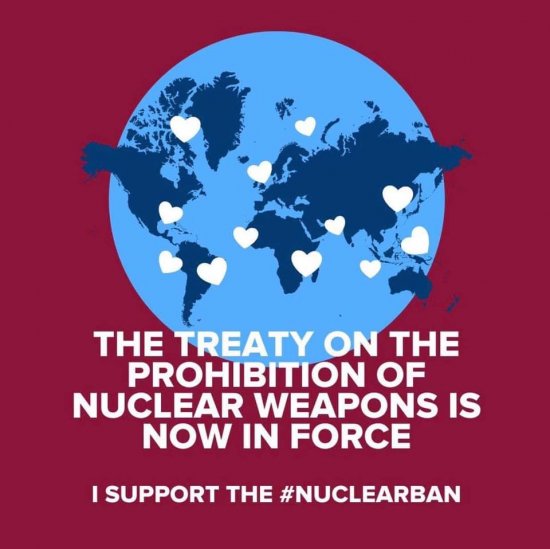
States-parties to the 2017 Treaty on the Prohibition of Nuclear Weapons (TPNW) will hold their second meeting in New York on Nov. 27-Dec. 1. Amid the crisis facing the international arms control and disarmament regime, they are expected to review and continue implementing their plans for a total ban on nuclear weapons.
The TPNW, which entered into force on Jan. 22, 2021, bans states-parties from involvement in any nuclear weapons activities, including the use, threat of use, production, development, possession, and stationing of these weapons. Spearheaded by non-nuclear-armed states and civil society groups, the treaty originated from their frustration over the long stalemate among nuclear-weapon states to engage in serious nuclear disarmament as called for by the nuclear Nonproliferation Treaty (NPT).
At their first meeting, in June 2022, TPNW states-parties produced two documents aiming to advance the treaty, a 50-point action plan and a political statement. (See ACT, July/August 2022.)
They established three informal working groups to make progress during the intercessional period on important topics such as nuclear disarmament verification, victim assistance, environmental remediation, and universalization of the treaty. In addition, the action plan agreed to create a scientific advisory group, to implement gender provisions in the treaty, and to promote TPNW complementarity with existing treaties.
For the November meeting, each working group is preparing reports on their respective intersessional activities. The meeting is expected to issue a final document, according to the provisional agenda and government officials……………………………………………………… more https://www.armscontrol.org/act/2023-11/news/nuclear-ban-treaty-members-meet-november #nuclear #antinuclear #nuclearfree #NoNukes
Australia must lobby US for ‘no first use’ of nuclear weapons, says ex-minister Gareth Evans
Former foreign minister says it is ‘sheer dumb luck’ that arms have not been used in the past 78 years and urges leadership on control measures
Daniel Hurst, Guardian, 1 Nov 23
Labor luminary and former foreign minister, Gareth Evans has urged Australia to lobby the US to promise “no first use” of nuclear weapons, warning that global arms control agreements “are now either dead or on life support”.
Evans says that in the wake of sealing the Aukus nuclear-powered submarine deal, the Albanese government should give “some comfort to ALP members and voters that we are really serious about nuclear arms control”.
Evans told Guardian Australia it was “sheer dumb luck” that the world had avoided a nuclear attack in the 78 years since the bombing of Hiroshima and Nagasaki, and “it is utterly wishful thinking to believe that this luck can continue in perpetuity”.
Evans joined arms control experts and former senior diplomats in urging the prime minister, Anthony Albanese, to take “a leadership role in addressing the rising nuclear threats in our region”.
Australia should appoint “a high-level envoy to engage our regional partners on an agenda of nuclear confidence building and preventive diplomacy measures”, according to a letter from the Asia-Pacific Leadership Network for Nuclear Non-Proliferation and Disarmament (APLN).
While the group’s letter to Albanese is not specific about policy measures, Evans offered his own view that Australia’s status as a close US ally “gives us a particularly significant potential role” in pushing to reduce nuclear risks.
“The most immediately useful step we could take would be to support the growing international movement for the universal adoption of No First Use doctrine by the nuclear-armed states,” Evans told Guardian Australia…………………………………….
In a stark warning about the security environment, Evans said the risk of nuclear weapons being used through human error, miscalculation or system error was “greater than ever, not least given new developments in AI and cyber-offence capability”.
“Nearly 13,000 nuclear warheads are still in existence, with a combined destructive capability of close to 100,000 Hiroshima- or Nagasaki-sized bombs, and stockpiles, especially in our own Indo-Pacific region … are now growing again,” he said.
“The taboo against their deliberate use is weakening, with Russia’s president, Vladimir Putin, talking up this prospect in language not heard since the height of the cold war.”
In addition to seeking universal support for “no first use”, Evans said other potential risk-reduction measures include cutting the number of weapons ready for immediate use……………………………………………….
The APLN letter gained support from high-powered experts including John Carlson, the former head of the Australian Safeguards and Non-Proliferation Office, and Ramesh Thakur, a former UN assistant secretary general.
Other signatories included John Tilemann, a former diplomat and international civil servant with the International Atomic Energy Agency, and Gary Quinlan, a former Australian ambassador to the UN.
The leader of the Greens in the Senate, Larissa Waters, backed the letter with the former Australian Democrats leader Natasha Stott Despoja and the former Labor minister for international development Melissa Parke. https://www.theguardian.com/australia-news/2023/nov/01/australia-must-lobby-us-for-no-first-use-of-nuclear-weapons-says-ex-minister-gareth-evans #nuclear #antinuclear #nuclearfree #NoNukes
1 This Month
26 September – International Day for the Total Elimination of Nuclear Weapons





PLEASE OPPOSE HR 8255 AND S.3639 – bills would accelerate satellite deployment, with no environmental review or safeguards – https://ncstd5li.quorum.us/campaign/169331/
To see nuclear-related stories in greater depth and intensity – go to https://nuclearinformation.wordpress.com
-
Archives
- September 2026 (313)
- August 2026 (330)
- July 2026 (355)
- June 2026 (287)
- May 2026 (306)
- April 2026 (356)
- March 2026 (251)
- February 2026 (267)
- January 2026 (308)
- December 2025 (358)
- November 2025 (359)
- October 2025 (375)
-
Categories
- 1
- 1 NUCLEAR ISSUES
- business and costs
- climate change
- culture and arts
- ENERGY
- environment
- health
- history
- indigenous issues
- Legal
- marketing of nuclear
- media
- opposition to nuclear
- PERSONAL STORIES
- politics
- politics international
- Religion and ethics
- safety
- secrets,lies and civil liberties
- spinbuster
- technology
- Uranium
- wastes
- weapons and war
- Women
- 2 WORLD
- ACTION
- AFRICA
- Atrocities
- AUSTRALIA
- Christina's notes
- Christina's themes
- culture and arts
- Events
- Fuk 2022
- Fuk 2023
- Fukushima 2017
- Fukushima 2018
- fukushima 2019
- Fukushima 2020
- Fukushima 2021
- general
- global warming
- Humour (God we need it)
- Nuclear
- RARE EARTHS
- Reference
- resources – print
- Resources -audiovicual
- Weekly Newsletter
- World
- World Nuclear
- YouTube
-
RSS
Entries RSS
Comments RSS

