US aid to Ukraine laundered back to military-industrial complex – congressman

https://www.rt.com/news/588617-us-ukraine-aid-congress/ 6 Dec 23
Republican representative Thomas Massie claims that the money being sent to Kiev ultimately ends up in the pockets of stockholders
The US Congress is continuing to vote in favor of sending billions of dollars to Ukraine because a lot of that money ends up being laundered back into the US military-industrial complex, Kentucky Representative Thomas Massie has said.
In an interview with Tucker Carlson on X (formerly Twitter) published on Wednesday, the politician was asked to explain why Washington continued to push for more funding for Ukraine despite it becoming obvious that Kiev’s forces “cannot win.”
Massie, who has repeatedly voted against funding Kiev’s military operations, alleged that a lot of the funds that are sent to Ukraine ultimately end up “enriching” people within specific US districts and “stockholders, some of whom are congressmen.”
“You know, people are getting rich, so let’s do it. It’s an immoral argument, but it is one. But that’s not the argument they’re making in public,” he said, noting that those supporting the funding of Ukraine with US tax dollars are instead arguing that it is a “moral obligation” to do so.
“You’re a bad person if you’re against this,” he complained, referring to a statement recently made by US National Security Advisor Jake Sullivan, who suggested that failing to support “the fight for freedom in Ukraine” meant letting Russian President Vladimir Putin “prevail.”
“But no one mentions that we have abetted the killing of an entire generation of Ukrainian men that will not be replaced. To fight a war that they cannot win,” Massie noted.
In order to support the US government’s proposals on Ukraine aid, the congressman claimed, a person has to be “economically illiterate and morally deficient.”
Meanwhile, US President Joe Biden has hit out against Republicans like Massie, who have opposed aid packages for Ukraine, calling the failure to support Kiev “absolutely crazy” and “against US interests.” The US leader has repeatedly pledged that Washington would support Kiev for “as long as it takes” in its conflict with Russia.
Congress is currently in the midst of a debate around accepting a $111 billion ‘national security supplemental request,’ which includes funding for Ukraine, as well as Israel. Republicans have said they would not let the bill pass unless Washington first boosts spending on the US-Mexico border, tightens immigration controls, revises asylum and parole laws in immigration proceedings.
Last week, former Russian President Dmitry Medvedev also stated that Washington’s continued support for Ukraine had nothing to do with defending “democracy” or battling Russia, but instead boiled down to making a profit and modernizing the US military-industrial complex.
US officials think Gaza ground operation could end by January as Biden admin privately warns Israel about its tactics, (but USA still sending weapons)

By Natasha Bertrand, MJ Lee, Alex Marquardt and Oren Liebermann, CNN 6 Dec 23
US officials expect the current phase of Israel’s ground invasion of Gaza targeting the southern end of the strip to last several weeks before Israel transitions, possibly by January, to a lower-intensity, hyper-localized strategy that narrowly targets specific Hamas militants and leaders, multiple senior administration officials tell CNN.
But as the war enters this new ground phase in the south, the White House is deeply concerned about how Israel’s operations will unfold over the next several weeks, a senior US administration official said. The US has warned Israel firmly in “hard” and “direct” conversations, they said, that the Israeli Defense Forces cannot replicate the kind of devastating tactics it used in the north and must do more to limit civilian casualties.
The US has conveyed to Israel that as global opinion has increasingly turned against its ground campaign, which has killed thousands of civilians, the amount of time Israel has to continue the operation in its current form and still maintain meaningful international support is quickly waning………………………………………………………………………………………. more https://edition.cnn.com/2023/12/05/politics/israel-ground-operation-us-warnings/index.html
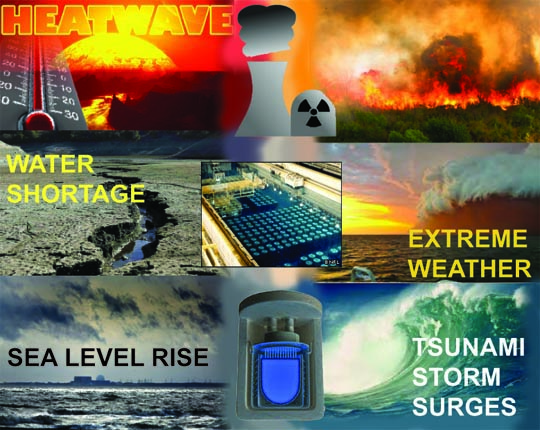
The catastrophic danger to nuclear weapons complexes, of climate change’s extreme weather

 The U.S. Nuclear Deterrent Is Not Prepared For Climate Catastrophe https://www.forbes.com/sites/matthewkorda/2020/03/16/the-us-nuclear-deterrent-is-not-prepared-for-climate-catastrophe/#2136fe1f3a1e, Matt Kord I write about the nexus between nuclear weapons, climate change, and injustice. Exactly one year ago the nerve center of the U.S. nuclear deterrent was underwater. The U.S. Nuclear Deterrent Is Not Prepared For Climate Catastrophe https://www.forbes.com/sites/matthewkorda/2020/03/16/the-us-nuclear-deterrent-is-not-prepared-for-climate-catastrophe/#2136fe1f3a1e, Matt Kord I write about the nexus between nuclear weapons, climate change, and injustice. Exactly one year ago the nerve center of the U.S. nuclear deterrent was underwater.Triggered by dramatic floods across the entire Midwest, the disaster at Offutt Air Force Base, home to U.S. Strategic Command, destroyed 137 structures and covered a large portion of the runway. Although the flooding itself only lasted a short time, black mold quickly engulfed the base and surrounding housing, and inflicted serious hardship to residents, who were largely left to deal with it on their own.
One resident, whose husband worked at Offutt, told the Omaha World Herald that she began suffering from “joint pain, headaches, shortness of breath, muscle twitches, brain fog and panic attacks within a few weeks,” and that it “almost ruined my life and put my family in serious financial burden.” Latest estimates predict that complete recovery of the base will cost over $1 billion and will take at least five years––and what’s worse, the Pentagon had apparently been made aware of the flood risks since 2011, but simply didn’t act in time. It is increasingly evident that the U.S. nuclear enterprise is ill-equipped to deal with the inevitable onslaught of climate catastrophes that will devastate nuclear bases and their employees in the coming months and years. And, by the Pentagon’s own admission, incidents like the flooding at Offutt are going to happen more frequently––and are going to get worse. In 2019, the Department of Defense delivered a report to Congress listing the top military facilities vulnerable to climate catastrophe. Of the 79 installations listed, 23 of them are related to the nuclear mission, and seven actually store nuclear weapons onsite. Those seven bases include both ballistic missile submarine bases at Kings Bay, Georgia, and Kitsap, Washington; the three ICBM bases in Montana, North Dakota, and Wyoming; Whiteman Air Force Base in Missouri, which houses 100 warheads for deployment aboard B-2 nuclear bombers; and the Kirtland Underground Munitions and Maintenance Storage Complex in Albuquerque––the largest nuclear weapons storage site within the United States. Collectively, these seven facilities are home to nearly 6,000 nuclear warheads––almost the entirety of the U.S. nuclear arsenal––and all are will be increasingly threatened by extreme weather events.
According to the Pentagon report, all of these facilities are currently affected by some combination of flooding, drought, desertification, and wildfires, and the devastation will only increase in the years to come. This is highly dangerous, as nuclear warheads and their delivery systems are relatively delicate: stored warheads need to be cooled, missile silos need to be kept clean and dry, runways can’t be underwater, and shipyards can’t be flooded. In addition to those installations that actually store nukes onsite, other mission-critical facilities like strategic radar stations, nuclear command centers, missile test ranges, and ballistic missile defense sites are also at risk. A 2018 study found that many Pacific atolls––including Kwajalein Atoll, home to the Ronald Reagan Ballistic Missile Defense Test Site and approximately 13,500 Marshall Islanders––will likely be uninhabitable by 2030, as rising tides will eventually ruin groundwater supplies and damage crops beyond recovery. Despite the inevitable, the Air Force is still spending over a billion dollars to build a new radar installation on the island, amid reports that neither the Pentagon nor the primary contractor, Lockheed Martin, “gave serious consideration to that threat when designing the installation and choosing a site.” In addition to its missile defense test range, both of the United States’ interceptor launch facilities at Fort Greely, Alaska, and Vandenberg Air Force There is little evidence that military leadership is taking the climate-nuclear threat seriously. Not only was the Pentagon’s first attempt at writing its 2019 report sent back for not meeting the legal requirements, but its revised report included no consideration of other types of extreme weather events like hurricanes and tornadoes; it also did not list a single overseas base. Meanwhile, the Navy quietly disbanded its climate change task force in March 2019, ridiculously claiming that it was “no longer needed.” The former commander of the task force subsequently remarked that he saw “little evidence” that the task force’s recommendations had been implemented by the Pentagon. All the while, U.S. emissions are increasing: a recent study by the Costs of War Project revealed that the Pentagon is the single largest institutional carbon emitter on the planet. If it were a sovereign nation, its greenhouse gas emissions would be greater than the output of entire industrialized countries like Sweden or Denmark. The United States is trending in the wrong direction. While barely acknowledging the climate risks, Congress has continuously voted in favor of needless nuclear initiatives, such as a like-for-like replacement of the entire ICBM arsenal. Not only will this cost anywhere between $85 and $150 billion to complete, but by the Air Force’s own admission, its Midwestern silos are highly vulnerable to flooding. In 2009, the Air Force was forced to physically remove and inspect a nuclear-tipped intercontinental ballistic missile from its silo in North Dakota after a record snowfall caused water to penetrate the permanent berm surrounding the site and leak into the silo. According to the Air Force, 40 additional silos in North Dakota alone are located in similarly vulnerable locations that are prone to drainage problems. Congress cannot continue blindly underwriting a nuclear force posture that is ill-suited to the inevitability of climate change. What is the point of re-capitalizing on outdated pieces of the nuclear arsenal that are likely to be rendered ineffective by flooding, when some of that money could be put towards more essential priorities––like offering free COVID-19 testing and treatment to all Americans? It is expected that the Pentagon will revise its climate report sometime in early 2020. If its drafters are thinking proactively, they will include a blunt assessment of how the U.S. nuclear complex in particular will be affected by climate catastrophe. This will give Congress, policymakers, and the public a highly useful tool with which to assess the best direction for the future of U.S. nuclear force posture. |
|

British government to send surveillance planes to facilitate Israel’s genocide
Robert Stevens, WSWS, 5 December 2023
On Saturday, Britain’s Ministry of Defence (MoD) said that the Royal Air Force (RAF) would carry out surveillance flights over Gaza.
A joint statement by the Ministry of Defence, Foreign, Commonwealth & Development Office, and Home Office, headed “UK military activity in the Eastern Mediterranean”, announced, “In support of the ongoing hostage rescue activity, the Ministry of Defence will conduct surveillance flights over the eastern Mediterranean, including operating in air space over Israel and Gaza.”………………
Britain has been up to its neck in the arming of the Israeli regime that has killed tens of thousands, mainly civilians and the vast majority women and children, and reduced Gaza to rubble. Now everyone is expected to believe that the RAF will be carrying out blanket surveillance of Gaza and a large part of the eastern Mediterranean with no military purpose and will not make information gathered available to its main military ally in the region.
British imperialism is gearing up for an escalation of the war in the Middle East and putting the necessary resources in place. Just two days before the drone surveillance announcement, Defence Secretary Grant Shapps revealed that the UK is sending one of its most lethal warships to the Gulf, HMS Diamond, a Type 45 destroyer with the ability to shoot down missiles…………………………………………..
Britain’s role in supplying Israel’s war-machine is critical. According to the Campaign Against Arms Trade (CAAT), “UK industry provides 15% of the components in the F-35 stealth combat aircraft that are currently being used in the bombardment of Gaza. The contract for the components is estimated… to be worth £336m since 2016.”
Israel has 50 F-35s on order from the US, with 22 already delivered by the end of 2022, reports CAAT. The organisation estimates that “each aircraft involves around $12 million to UK industry. This would imply a value of $72 million (£58m) for total UK deliveries of F-35s to Israel in 2022…”
Much of what the UK sends to Israel’s military is not even documented, with CAAT noting, “Between 2018 and 2022, the UK exported £146m in arms sales via Single Issue Export Licences. However, a large proportion of military equipment exported is via Open General Export Licences. These open licences, which include the F-35 components, lack transparency and allow for unlimited quantities and value of exports of the specified equipment without further monitoring.”………………………………………………….
The Sunak government refuses to confirm whether it has troops on the ground already in Gaza. On Monday, MPs were allotted just one hour to ask the government questions of the “Humanitarian Situation” in the Strip; a debate which hardly any of the mainly pro-war MPs across all parties showed up for.
Former Labour leader Jeremy Corbyn—who remains a party member but sits as an Independent having been expelled from the parliamentary party three years ago by leader Sir Kier Starmer—said in his comments that “Israel is clearly undertaking an act of cleansing of the entire population of Gaza”, which “is illegal in international law.” He then asked, “What is the role, purpose and military objective of British military participation in the whole area? Can he [Leo Docherty, a parliamentary under-secretary of state at the Foreign Office] assure us that there are no British soldiers on the ground in Gaza?”………
Britain’s military role in the region is maintained to ensure its ruling elite profit from the spoils of genocide and war, as the trusted partners of US imperialism. Bloomberg and Newsweek reported in October that the Biden administration is considering sending in “peacekeepers for the Gaza Strip”, once Hamas is wiped out and Gaza depopulated, and that the “Multinational force could include American, UK, French troops.”
Despite a November 1 statement by White House spokesperson John Kirby that there are “no plans or intention to put US military troops on the ground in Gaza, now or in the future”, Bloomberg reported that the Biden administration “is still talking to partners about what a post-conflict Gaza should look like. US Secretary of State Antony Blinken said, “if that means some sort of international presence, then that’s something we’re talking about.”
Bloomberg reported that “one option would grant temporary oversight to Gaza to countries from the region, backed by troops from the US, UK, Germany and France.”
On Monday, John Bolton, the former Republican US national security adviser, proposed at the UK’s Foreign Affairs Select Committee that the Gaza Strip should be split into two territories, with Gaza north of the Wadi Gaza River administered by Israel and an area to the south run by Egypt.
This would be initiated after the ethnic cleansing of most Palestinians and facilitate the transfer of those that remain. No Palestinians would be allowed to settle in Israel, which Bolton said would not even provide work visas, but must all be resettled in other countries. https://www.wsws.org/en/articles/2023/12/05/ttog-d05.html
Chinese Nuclear Weapons and Canada: An Uncivil-Military Connection

The United States should take action to ensure that domestic and foreign actors are not boosting the nuclear programs of adversaries.
by Henry Sokolski, https://nationalinterest.org/feature/chinese-nuclear-weapons-and-canada-uncivil-military-connection-207727 6 Dec 23
For decades, the Defense Department made little or no connection between China’s civilian nuclear power program and its military nuclear weapons buildup. No longer.
For the last three years, the Pentagon has explicitly linked Beijing’s “peaceful” fast reactor power program to China’s ramped-up weapons plutonium efforts and the projection China will acquire more than 1,000 nuclear warheads by 2030. In its latest annual China military power report, the Defense Department went further and revealed that China is using its civilian nuclear reactors to produce tritium to fuel its thermonuclear weapons.
China is doing this by placing lithium rods in power reactors and bombarding the rods with neutrons. This produces tritium, which subsequently is separated, much like how America makes its weapons tritium. It’s unclear if China uses all its power reactors—American, Canadian, Russian, French, or Chinese-designed—for this purpose.
The Pentagon report, however, notes that China uses a tritiated heavy water extraction process to cull tritium produced when hydrogen atoms absorb neutrons and become tritium atoms. The only reactors in China that use heavy water are located in Haiyan and operated by China National Nuclear Power Corporation (CNNC)—Beijing’s premier nuclear weapons contractor.
Canada supplied these reactors through Atomic Energy of Canada Limited (AECL), a Canadian government-owned firm. In addition, AECL agreed to work with CNNC on advanced heavy water reactors and related technologies. In 2011, AECL sold its heavy water reactor business to SNC-Lavalin Inc. (recently renamed AtkinsRealis). AtkinsRealis continues to collaborate with CNNC on its heavy water reactors.
However, Canada’s nuclear transfers to China aren’t limited to reactors. In late October, the Canadian firm Cameco, one of the world’s largest uranium suppliers, announced it had contracted to sell more than 97,500 metric tons of uranium to CNNC. Cameco says it will send the CNNC more than 12,700 metric tons annually for the next four years. 12,700 metric tons is roughly 200 to 300 metric tons more than China’s entire civilian sector consumes annually. The 200-to-300-ton surplus alone could fuel as many as 100 bombs each year.
This should raise eyebrows. With poor domestic uranium resources, China insists it’s only building up its uranium reserves for future nuclear power use. Perhaps, but there is no agreed way to verify this. The same is true with tritium. Currently, there are no effective controls on either nuclear substance to assure their peaceful end-use. Both, however, are critical to making nuclear weapons, and CNNC, China’s top weapons vendor, controls these materials.
What should be done?
First, our government needs to name and shame firms exporting critical nuclear materials and technologies to America’s nuclear-armed rivals. This would require spotlighting Canada’s Cameco and AkinsRealis. It also would require listing France’s nuclear firm, EDF, which this spring announced it would work with CNNC in developing advanced spent fuel recycling, a process critical to producing weapons plutonium. Yet, another entity that deserves dishonorable mention is Rosatom, Russia’s prime nuclear weapons developer, in addition to firms in business with the company. The House has already spotlighted Rosatom as a bad actor, asking the White House to sanction it for assisting China’s fast reactor program.
To expose these entities further, the Departments of Defense and the Intelligence Community should produce an unclassified annual report clarifying which domestic and foreign firms might be transferring nuclear materials and technologies to hostile states’ nuclear weapons entities.
Second, the U.S. government should prohibit government purchases and subsidies to these firms. Congress and the White House may be reticent to sanction firms for trading with hostile states’ nuclear weapons entities. But our government should, at least, not buy goods from such firms or subsidize them.
Finally, the United States and other like-minded nations should call on the International Atomic Energy Agency to track and safeguard tritium and unenriched uranium to prevent their diversion to make bombs. Fortunately, there is little commercial demand for tritium. Most of what is produced is then extracted from reactors for occupational safety reasons and is accounted for.
Similarly, most uranium ore is used to fuel legitimate civilian reactors. Yet, it too is critical to make nuclear weapons, and it is not currently tracked or safeguarded. Given that the government already tracks and sanctions certain oil and gas transfers—a daunting task—it’s difficult to understand why we don’t do the same for uranium and tritium. In the lead-up to the next Nuclear Nonproliferation Treaty Review Conference in 2026, the United States should close this gap.
Henry Sokolski is the executive director of the Nonproliferation Policy Education Center in Arlington, Virginia, and the author of Underestimated: Our Not So Peaceful Nuclear Future (2019). He served as deputy for nonproliferation policy in the office of the U.S. Secretary of Defense during the George H.W. Bush administration.
One Family’s Harrowing Journey Out of Gaza City

December 6, 2023, https://scheerpost.com/2023/12/06/one-familys-harrowing-journey-out-of-gaza-city/
Zakaria Baker and his family were forced from their home in Al-Shati refugee camp by Israeli bombs on November 7. As they traveled south over 15 kilometers they witnessed incredible horrors and not everyone survived the journey. This is their story.
By Zakaria Baker / Mondoweiss
[Mondoweiss] Editor’s Note: The following testimony was given by Zakaria Baker on November 11, 2023. The testimony was collected by Amplify Gaza Stories, an organization working on the ground in Gaza to collect and translate testimonies from Gazans, ensuring their stories of struggle, resilience, and survival are heard.
November 11, 2023
am Zakaria Baker, one of the people who were displaced from their homes four days ago in November 2023 – around November 7, 2023.
The beginning of the displacement is as follows: An Israeli intelligence officer called one of my cousins. There were about 20 of us sitting on chairs. The bombing of Al-Shati Refugee Camp did not stop for a single second. The missiles that were fired at the camp – we couldn’t see or hear them. They were barrel bombs. When they were dropped on a residential block of six or seven houses, they destroyed them completely. The scariest and most painful thing is that these missiles are fired at houses crowded with people. The bodies in Al-Shifa Camp are still under the rubble. We could smell the bodies.
The Israeli intelligence officer called one of my cousins who was sitting with us and said, “Bakers, why haven’t you left? Your neighbors have evacuated. You have 30 minutes to leave for your safety. If you don’t go, we will drop death on you.”
Ok, half an hour… What do we do? We are families and children and have to get ready to leave?
Less than half an hour later, about 20 minutes, maybe less, the bombing started a few meters away from us. It was targeting houses that were just two or three houses away. We couldn’t take anything with us, just some medication because I had had open heart surgery. So we walked – women, children, and elderly – as we kept walking, the bombing got closer to our houses. Whenever we passed a house, it was destroyed behind us.
The bombardment continued to Rono Mosque near Al-Shifa Hospital. When we were under the mosque, a bomb hit its minaret. Thousands of people were in the street. Some of them came from the hospital too. Many elderly people were with us. There were 160 people from our family in the street, and from our extended family, there were around 4 or 5 thousand.
We all started walking. When we reached the Al-Shifa there were thousands of people there. Most of them were residents from around Al-Shifa Hospital, or people who were seeking shelter inside the hospital who fled because the hospital was targeted.
We reached Dola interchange, some five to six kilometers we had already covered. We saw a scruffy-looking bus, but it was working, and we asked the driver to take us to the Dola interchange. He asked for 80 shekels, and we were approximately 40 people. We agreed on 80 shekels to take us to the Dola roundabout near Salah al-Din. We reached the Dola interchange, and we got off the bus, and we walked approximately one kilometer after the Kuwait roundabout, and we saw huge crowds, you know, don’t say hundreds or 1000s or 10s of thousands, there were hundreds of thousands of people and horrific scenes – women 80 and 90-year-olds, old men of 70 and 80 years old, some of them were wounded, some carrying children. We kept walking until we met a donkey and cart, and the owner said 20 shekels, so we loaded everything onto this cart – women, children, all our luggage, everything that we could get on the cart. Halfway up, the donkey was struggling, so the driver asked us to push. So we pushed it for the sake of helping the elderly and the children.
. We pushed until we were within 100 meters of the Israeli IDF. We got down, and we were asked to show our IDs. I picked up my grandson and played with him in order to assure him and for him to be assured by me. We walked within 10 meters of the soldiers. They said, “Stop.” We stopped. We saw three tanks move in front of us. Once they passed, we were told to walk on.
We only had one suitcase each. There were bodies everywhere. Some decomposed, some were charred. We saw a car with a person inside it dead. His bottom half was intact, his upper half was decomposed. Horrific scenes, enough to make a stone cry. Enough to make a stone cry. We left the area with the tanks, and we moved to Wadi Gaza Bridge, and they said to us now you are in a safe zone. From the area with the tanks to Wadi Gaza, my grandson was crying, he was hungry.
There was a small wall, and we let his mother use it to hide behind it so that she could breastfeed him and stop him crying just for a few minutes, about five minutes. In general, we felt easier and a little bit calmer after my grandson was fed. We continued walking in an enormous stream of humans in a column
On the bridge, we were not allowed to stop. It was forbidden to stop, in fact, one of the old women with us, who was married to my relative, she was 86 years old, her name was Kefah Bakr. She fell down from fatigue and died, she couldn’t survive the journey, the walking. She was kinda lucky because she died 10 meters after passing through the Israeli IDF-controlled area, and so she was taken to hospital.
Back in the tank area, you’re not allowed to look left or right. You must keep looking straight.
(Question from Mohammed Ghalayini, a volunteer with Amplify Gaza Stories: Were the instructions from the soldiers given by loudspeakers?)
Answer: No, the instructions were passed from one person to another. The people in the front were instructed to do something, and they would tell it to someone behind them and so on, and the instructions would be spread to all the others.
Many of the old people fell down and were left. People would walk past them. One person dropped his suitcase. His name Alaa Abu-Stata. He bent down to pick up his suitcase, and he was shot dead. Many of the old women couldn’t withstand this hard work, and they fell down to the ground. No one dared to stop to help them, they would shoot dead all those who would help her. So we had to sacrifice one old person to save 10 or 20 others from being shot or humiliated. I saw four cases, one person was called by name by loudspeakers. They stripped him down naked, and he was arrested, and no one knows where he has been taken. No one knows anything about him. This is what I have seen at a distance of 100 meters, and others have seen similar cases of arrests.
We kept on walking until Burej. Imagine! From Al-shati’ to the bridge – something like 15 kilometers. At Burej, there were no cars, only lorries. One lorry driver came along, and I told him we wanted to go to Khan Younis or the Hamad area. He said 300 shekels. I said, never mind just get us out of here. We reached Hamad, and we had another torturous journey at Hamad.
(Question: Did you find accommodation in Hamad?)
No, we couldn’t find any rooms. We spent three nights sleeping rough on the floor, unprotected, under the skies—cold nights. On the third night, only on the third night, we switched on spotlights to repel insects and flies from the eight and nine-month-old babies. On the 4th day, we managed to sort out the situation. We broke a partition that belongs to the council – some 4 meters square, and we put 40 people in it. This was my project. I made a makeshift tent from it with used plastic sheets, and six families were able to shelter there.
Since 12:00 yesterday, we haven’t been able to find a piece of bread. We have one meal a day – for two reasons: to avoid going to the toilet and because we can’t find any food. It’s a hunger war. No tinned food. We went to all the supermarkets and could not find anything. Women slept in the same clothes they left home with. This water I was given by Abu Mohammed. We were subjected to pain, suffering, anger, humiliation. I can’t talk anymore about this.
Since this story was recorded, Baker, his family, and thousands of others seeking refuge were again forced to leave their shelter in Hamad City, Khan Younis, on December 2 after receiving an evacuation order from the Israeli military.
Israel orders more Gazans to flee, bombs areas where it sends them
By Arafat Barbakh and Mohammed Salem, 6 Dec 23
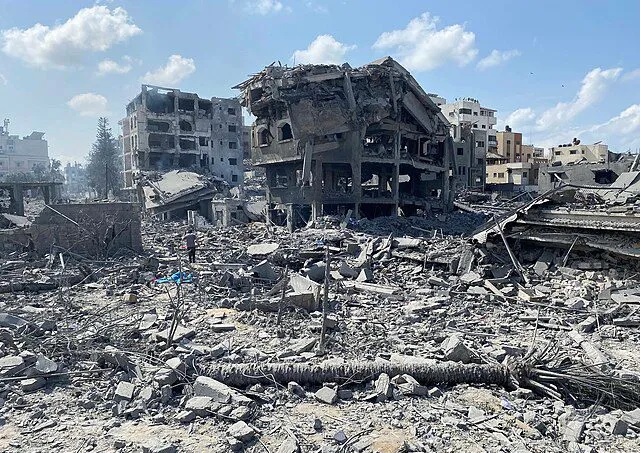
GAZA (Reuters) -Israel ordered Palestinians to leave parts of the main southern city in the Gaza Strip on Monday even as its bombs rained down on areas where it had told them to go.
Israeli troops and tanks also pressed the ground campaign against Hamas militants in the south of the enclave after having largely gained control of the now-devastated north.
Israel’s military posted a map on social media platform X on Monday morning with around a quarter of the city of Khan Younis marked off in yellow as territory that must be evacuated at once.
Three arrows pointed south and west, telling people to head towards the Mediterranean coast and towards Rafah, near the Egyptian border.
Desperate Gazans in Khan Younis packed their belongings and headed towards Rafah. Most were on foot, walking past ruined buildings in a solemn and silent procession.
But Rafah itself was coming under Israeli fire. The head of the United Nations agency in Gaza (UNWRA), Thomas White, said people there were themselves being forced to flee.
“People are pleading for advice on where to find safety. We have nothing to tell them,” he said on X.
Bombing at one site in Rafah overnight had torn a crater the size of a basketball court out of the earth. A dead toddler’s bare feet and black trousers poked out from under a pile of rubble. Men struggled with their bare hands to move a chunk of the concrete that had crushed the child…………………………………………….
Gaza’s health ministry said on Monday that at least 15,899 Palestinians, 70% of them women or under 18s, have now been killed in Israeli air and artillery strikes on the enclave since Oct. 7. Thousands more are missing and feared buried in rubble.
As many as 80% of Gaza’s 2.3 million people have fled their homes in the Israeli bombing campaign that has reduced much of the crowded coastal strip to a desolate wasteland………………………………..
The United Nations said the areas in the south that Israel has ordered evacuated in the three days since the truce had housed more than 350,000 people before the war – not counting the hundreds of thousands now sheltering there from other areas.
“We were sleeping at 5 a.m. when we felt things collapse, everything went upside down,” she told Reuters. “They told (people) to move from the north to Khan Younis, since the south is safer. And now, they’ve bombed Khan Younis. Even Khan Younis is not safe now, and even if we move to Rafah, Rafah is not safe as well. Where do they want us to go?”……………………………………………….. (Reporting by Mohammed Salem and Roleen Tafakji in Gaza, Maayan Lubell, Ari Rabinovich and Emily Rose in Jerusalem, Maggie Fick in Beirut, Andrew Mills in Doha, Writing by Peter Graff and Angus MacSwan; Editing by Mark Heinrich and Alex Richardson) https://www.msn.com/en-us/news/world/israel-orders-more-gazans-to-flee-bombs-areas-where-it-sends-them/ar-AA1kZ4rK
US Defense Secretary Austin should resign over scurrilous attack on peace community

Walt Zlotow, West Suburban Peace Coalition, Glen Ellyn IL 6 Dec 23
President Biden, struggling to gain support for his $105 billion weapons boondoggle to further US wars against Russia and Gaza, sent out his chief advocate for perpetual war, Defense Secretary Lloyd Austin, to hammer away at advocates for a sane, peaceful US foreign policy.
Austin told the Reagan National Defense Forum in California, actually a forum for perpetual war, that Americans for peace are “Americans who prefer isolation to engagement…try to pull up the drawbridge. They try to kick loose the cornerstone of American leadership. The’re Americans trying to undermine the security architecture that has produced decades of prosperity without great-power war. And you’ll hear some people try to brand an American retreat from responsibility as bold new leadership. So when you hear that, make no mistake: It is not bold. It is not new. And it is not leadership,”
Austin, shilling for his Commander in Chief Biden, seeks to keep funneling endless billions to support America’s proxy war that’s enabled hundreds of thousands of deaths in Ukraine. He’s also ensuring the genocidal ethnic cleansing of 2.3 million Palestinians in Gaza that could not happen without US weapons and immoral support.
Defense Secretary Lloyd Austin should resign forthwith. So should his boss, President Biden, who appears bent on destroying Gaza and Ukraine for reasons having nothing to do with American national security interests. Their replacements might realize perpetual war is utterly self destructive to the individuals promoting it, America; indeed, the world. It might just inspire them to pivot to peace before they get drawn into the same vortex of defeat as their predecessors.
B-2 Spirit stealth plane cleared to use B61-12 nuclear bombs
This is the first warplane that has been cleared, with the F-35 aircraft likely to be cleared next in a move that will benefit NATO allies.
Interesting Engineering Ameya Paleja, 5 Dec 23,
The B-2 Spirit stealth bomber aircraft has become the first U.S. warplane to be cleared to carry the B61-12, the newest nuclear bomb on the block. The clearance featured in the Stockpile Stewardship and Management Plan (SSMP) for Fiscal year 2024 was unclassified by the National Nuclear Security Administration (NNSA) last week.
The B61 series is one of the longest-serving weapons in the US stockpile, the first iteration having debuted in the 1960s. The B61-3, -4, and -7 continue to be part of the nuclear lineup available with the U.S., even as plans are afoot to phase them out. Details of the phase-out plan remain unknown for now……………………………………………………
The 825-pound (lb), or ~374 kilograms (kg) bomb project is being undertaken at a cost of nearly $8.3 billion, with experts suggesting that costs could rise to $10 billion, Popular Mechanics reported. Around 480 of these bombs are expected to be made using the B61-4 bombs. The effective cost of making these bombs exceeded the cost of their weight in gold…………………………………..
The US Air Force has plans to equip its F-35, F-15, and F-16s with the B61-12, even though the timeline for these clearances remains unknown for now. The availability of F-35s with NATO allies also means that the B61-12 could also serve US allies in the future, and earlier this month, the Royal Netherlands Air Force confirmed that its F-35As had received an initial certification for the weapon with the German and Italian Tornado fighter bombers also in the queue to use the B61-12………………………….. https://interestingengineering.com/culture/b2-spirit-b61-12-nuclear-bombs
How’s the nuclear ban treaty doing?
Dr Kate Hudson, CND General Secretary, https://cnduk.org/hows-the-nuclear-ban-treaty-doing/ 4 Dec 23
CND’s Chair, Tom Unterrainer, attended the recent meeting at the UN in New York, of states that back the Treaty on the Prohibition of Nuclear Weapons. Here Tom writes a guest blog about the event.
The non-nuclear majority met in New York between 27 November and 1 December for the Second Meeting of States Parties (2MSP) to the Treaty on the Prohibition of Nuclear Weapons (TPNW). This coming together was not simply ‘non-nuclear’ but decidedly anti-nuclear in outlook and approach. The TPNW represents many things: a ‘work in progress’, a part of international law, a mechanism for the eventual abolition of nuclear weapons and similar. What it represents politically, at the time of coming into force and since, is a full-frontal rejection of ‘nuclearism’ and a challenge to the nuclear-armed world. 2MSP saw discussion and decision making on how to embed this aspect of the Treaty.
Between 15 and 27 October 1953, the British government carried out ‘Operation Totem’ over an area in Southern Australia. Totem I and Totem II were atmospheric nuclear tests and together with five additional ‘non-critical’ tests, Britain delivered death and catastrophe on the First Nations people inhabiting the area. These people “felt the ground shaking and the black mist rolling”, as Karina Lester put it on the floor of 2MSP. “We know our lands are poisoned”, she went on, clearly stating that “we want governments to recognise what they have done.” What the British government did in 1953 was to consign a people and their land to death, destruction and continuing – intergenerational – harm.
The British government has refused to recognise or make recompense for what it did over seventy years ago and recently affirmed that it would not do so now. This roadblock to justice must be challenged, as should the other roadblocks to peace and justice that are erected by nuclear-armed states. The Campaign for Nuclear Disarmament has been engaged on the question of Britain’s legacy of nuclear colonialism and recently agreed a resolution at our 2023 Policy Conference to enhance this work. The message coming loud and clear from 2MSP is that this aspect of our work is urgently necessary and incredibly important. Even in states like the UK which possess nuclear weapons and which take a hostile approach to the TPNW, the overall message and intent of the Treaty has universal applicability.
The theme of ‘universalisation’ was prominent at 2MSP, with a series a working papers, proposals and speeches made to address the concept. In an early ‘thematic debate’, a representative of the International Committee of the Red Cross outlined some of what this could mean. For example, highlighting and embedding the anti-nuclear consensus that any nuclear use would have an enormous humanitarian impact; being clear that nuclear possession is “not exceptional” and does not stand above and beyond international law.
A working paper submitted by the government of Austria goes into more detail, with specific reference to concepts of security: “the argument that opponents of the Treaty frequently employ in their criticism of the Treaty is that it ‘does not take today’s security environment into account’ or that ‘the security environment is not conducive to nuclear disarmament.’” In response to these ‘arguments’, Austria is clear that “there has been little readiness by opponents of the Treaty, especially by the nuclear-armed States, to engage constructively with the legitimate security concerns formulated in and through the Treaty.” What does this mean? That State Parties to the TPNW are not simply rejecting nuclear-weapon possession for the obvious moral and ethical reasons but because they fully reject the ‘security’ arguments of nuclear-possessor states and are clear that the destructive humanitarian impact of any nuclear use must be fully recognised and accounted for.
There were many similar contributions and discussions at 2MSP, both on the floor of the meeting and in a series of lively side events. These events ranged from addressing the issues of ‘nuclear secrecy’ to more in-depth discussions and seminars on nuclear risks and global politics.
What is clear is that the Campaign for Nuclear Disarmament can and will play an important role in pressing forward with ‘universalising’ anti-nuclear ideas, including those embodied in the TPNW. It is also clear – and this is one of the more positive aspects of such international meetings – that CND and our supporters are the representatives of majority non-nuclear and anti-nuclear thinking in the UK. Given Britain’s nuclear-armed status and nuclear alliances, our work – and the work of the TPNW community globally – is as important as ever.
New information tool on nuclear weapons seeks to identify the next arms control strategies
Bulletin, By Andrew Facini | December 4, 2023
The way countries view nuclear weapons is shifting. As past arms control measures have ended or decayed, the United States, Russia, and China are investing heavily (again) in their nuclear arsenals, pursuing new capabilities and discarding constraints once seen as fundamentally stabilizing………………
Launched last week, the Nuclear Weapons Systems Project seeks a “qualitative rethink” by providing a curated data source for all major nuclear delivery systems ever deployed. By seeing more easily what has changed and when, users can better identify the benefits of states’ long trajectory of narrowing the types of nuclear capabilities in the world, understand the risks of a new expansion of nuclear capabilities, and develop ways to de-risk the current situation and prevent future security crises……………………………………………………………………………………………………….
Through this project, the CSR team hopes to provide a useful source of information and perspective that can be drawn forward and applied now to help avoid destabilizing actions and limit risk in the future. We invite the open use of the dataset by anyone interested in better understanding the arsenals of the P5 over history. For more on the methodology of our research, its limitations and qualifications, and a list of definitions, please see our launch post. https://thebulletin.org/2023/12/new-information-tool-on-nuclear-weapons-seeks-to-identify-the-next-arms-control-strategies/
Would A Nuclear Weapon Make South Korea Safer?
By Emma Sandifer, 4 Dec 23, https://armscontrolcenter.org/would-a-nuclear-weapon-make-south-korea-safer/—
The question of whether a nuclear deterrent might be necessary for South Korea has experienced a resurgence over the past few years, becoming a “mainstream feature of South Korea’s national security discourse”. With recent escalation in the pace of North Korea’s nuclear provocation, China’s aggressive buildup of its nuclear arsenal, and waning confidence in the U.S. commitment to extended deterrence, the public perception in South Korea has reflected a sense of increased vulnerability. Consequently, public polling in January of this year found that 71 percent of South Koreans support the return of nuclear weapons to their country — even if it means engaging in indigenous development. In 2023, South Korean President Yoon Suk-yeol spoke openly, for the first time, of the perceived need to either redeploy American non-strategic nuclear weapons on the Korean Peninsula or build their own. The reality is that it is not in South Korea’s national interest to have a nuclear weapon — politically, militarily or economically.
Despite this, the debate on the Peninsula is real and the country’s legitimate security concerns should be considered. With the North making regular threats, the trepidations of South Koreans are understandable and the need to take measures to reduce the threat from the North clear, but it remains questionable if nuclear weapons would serve such a purpose. More likely, a South Korean nuclear weapon would serve to fuel a destabilizing arms race in Asia and could actually undermine South Korea’s negotiating position vis-a-vis North Korea.
Politically, a nuclear weapon would not make South Korea safer. As an active member of multiple non-proliferation agreements including the Nuclear Non-Proliferation Treaty (NPT) and the 1992 Joint Declaration on the Denuclearization of the Korean Peninsula, South Korea uses these agreements to condemn North Korea’s proliferation and mobilize international support against the nuclear activities of its adversary. South Korea’s own proliferation would jeopardize its ability to do so as well as damage its standing in the international community and its relationship with its primary security ally, the United States.
Militarily, a nuclear weapon would not make South Korea safer. The ROK already has the conventional capabilities needed to strike any target in North Korea through the use of short-range ballistic missiles and precision strike weapons, has recently committed $81 billion toward strengthening its pre-existing defense capabilities, and has established a strategic command to oversee its “three-axis” defense system. Nuclear weapons would add little while increasing paranoia north of the DMZ.
To reinforce reliability of the U.S. commitment to extended deterrence, Presidents Joe Biden and Yoon announced the Washington Declaration in early 2023, as well as the creation of the bilateral Nuclear Consultative Group. In early November, the two countries updated their Tailored Deterrence Strategy agreement for the first time in a decade to reflect their “ironclad” commitment to collective security underscored by the symbolic deployment of major U.S. military assets to the country, such as a nuclear ballistic missile submarine and a nuclear capable B-52 bomber. South Korea is not only conventionally capable of deterring a nuclear attack by North Korea, but it is also protected by a renewed commitment to extended deterrence by the United States, making the development of a nuclear weapon redundant and escalatory.
Economically, a nuclear weapon would not make South Korea safer. A withdrawal from the NPT would bring an array of potential sanctions with the ability to cause real economic damage. Even if the impact of these sanctions is mitigated by allies to protect regional security interests, the impact of potential Chinese sanctions would be severe. Moreover, this withdrawal would impact international cooperation with Seoul’s nuclear energy program, an economic and energy priority.
Thus, although a nuclear weapon might make South Koreans feel safer, at least temporarily, it would not make the country any more secure. Conversely, creation of a nuclear weapon will undermine South Korean efforts to protect itself against a North Korean threat. Instead, the legitimate security concerns voiced by South Koreans could be addressed by strengthening conventional capabilities as well as engaging with international arms control efforts and dialogue across the DMZ. Such measures would do more to promote confidence among Korean citizens than engaging in a destabilizing arms race.
US warns it will ‘run out’ of Ukraine aid funds by end of year

Financial Times, Mon, 04 Dec 2023
The White House has issued a blunt warning that the US is set to run out of funds to aid Ukraine by the end of the year, saying that a failure by Congress to approve new support would “kneecap” Kyiv.
The alert from Shalanda Young, the White House budget director, in a letter to congressional leaders on Monday, represented the most specific assessment yet of Washington’s waning financial and military support for Ukraine.
“Without congressional action, by the end of the year we will run out of resources to procure more weapons and equipment for Ukraine and to provide equipment from US military stocks,” Young wrote to political leaders of both parties.
“There is no magical pot of funding available to meet this moment. We are out of money — and nearly out of time,” she said.
President Joe Biden’s request for $106bn in emergency funding for his biggest foreign policy priorities, including Ukraine, Israel, and the Indo-Pacific, remains mired in stalemate on Capitol Hill, driven by mounting Republican opposition to helping Kyiv.
Some lawmakers — especially in the Senate, where backing for Ukraine runs deeper — are trying to negotiate a bipartisan deal that would contain aid for Kyiv alongside new immigration and asylum procedures to reduce the number of undocumented people arriving in the US through its southern border.
Even if an agreement is reached in the Senate, however, it is unclear if it can pass the Republican-led House, whose new speaker Mike Johnson has been sceptical of funding for Ukraine.
“Cutting off the flow of US weapons and equipment will kneecap Ukraine on the battlefield, not only putting at risk the gains Ukraine has made, but increasing the likelihood of Russian military victories,” Young wrote to Congress.
“Already, our packages of security assistance have become smaller and the deliveries of aid have become more limited . . . while our allies around the world have stepped up to do more, US support is critical and cannot be replicated by others,” she added.
The White House warning comes as EU member states are struggling to reach a budget deal in Brussels that would send €50bn to Ukraine, people close to the discussions told the Financial Times.
Young said Ukraine also needed economic support, which is in danger of stalling.
“If Ukraine’s economy collapses, they will not be able to keep fighting, full stop,” she wrote. “Putin understands this well, which is why Russia has made destroying Ukraine’s economy central to its strategy — which you can see in its attacks against Ukraine’s grain exports and energy infrastructure,” she added.
Young also said money for Ukraine would bring benefits to the US economy. Sincethe start of Russia’s full invasion in February 2022, Washington has approved $111bn in aid to Kyiv.
“While we cannot predict exactly which US companies will be awarded new contracts, we do know the funding will be used to acquire advanced capabilities to defend against attacks on civilians in Israel and Ukraine — for example, air defense systems built in Alabama, Texas, and Georgia and vital subcomponents sourced from nearly all 50 states,” she said……… https://www.ft.com/content/ca16e42d-fda9-4c1d-b2c9-410d764745b7
Chris Hedges: Israel Reopens the Gaza Slaughterhouse
Nothing is off limits. Hospitals. Mosques. Churches. Homes. Apartment blocks. Refugee camps. Schools. Universities. Media offices. Banks. Sewer systems. Telecommunications infrastructure. Water treatment plants. Libraries. Wheat mills. Bakeries. Markets. Entire neighborhoods. Israel’s intent is to destroy Gaza’s infrastructure and daily kill or wound hundreds of Palestinians. Gaza is to become a wasteland, a dead zone that will be incapable of sustaining life.

Secretary of State Antony Blinken visited Israel this week, and while calling for Israel to protect civilians, refused to set conditions that would disrupt the $3.8 billion Israel receives in annual military assistance or the $14.3 billion supplemental aid package.
https://scheerpost.com/2023/12/01/chris-hedges-israel-reopens-the-gaza-slaughterhouse/
Phase One of Israel’s genocidal campaign on Gaza has ended. Phase Two has begun. It will result in even higher levels of death and destruction.
By Chris Hedges / Original to ScheerPost
The skies over Gaza are filled — after a seven-day truce — with projectiles of death. Warplanes. Attack helicopters. Drones. Artillery shells. Tank shells. Mortars. Bombs. Missiles. Gaza is a cacophony of explosions and forlorn screams and cries for help beneath collapsed buildings. Fear, once again, is coiling itself around every heart in the Gazan concentration camp.
By Friday evening, 184 Palestinians — including three journalists and two doctors — had been killed by Israeli air strikes in the north, south and central Gaza, and at least 589 injured, according to the Ministry of Health in Gaza. Most of them are women and children. Israel will not be deterred. It plans to finish the job, to obliterate what is left in the north of Gaza and decimate what remains in the south, to render Gaza uninhabitable, to see its 2.3 million people driven out in a massive campaign of ethnic cleansing via starvation, terror, slaughter and infectious diseases.
The aid convoys, which brought in token amounts of food and medicine — the first batch was shrouds and coronavirus tests according to the director of al-Najjar hospital — have been halted. No one, least of all President Joe Biden, plans to intervene to stop the genocide. Secretary of State Antony Blinken visited Israel this week, and while calling for Israel to protect civilians, refused to set conditions that would disrupt the $3.8 billion Israel receives in annual military assistance or the $14.3 billion supplemental aid package. The world will watch passively, muttering useless bromides about more surgical strikes, while Israel spins its roulette wheel of death. By the time Israel is done, the 1948 Nakba, where Palestinians were massacred in dozens of villages and 750,000 were ethnically cleansed by Zionist militias, will look like a quaint relic of a more civilized era.
Nothing is off limits. Hospitals. Mosques. Churches. Homes. Apartment blocks. Refugee camps. Schools. Universities. Media offices. Banks. Sewer systems. Telecommunications infrastructure. Water treatment plants. Libraries. Wheat mills. Bakeries. Markets. Entire neighborhoods. Israel’s intent is to destroy Gaza’s infrastructure and daily kill or wound hundreds of Palestinians. Gaza is to become a wasteland, a dead zone that will be incapable of sustaining life.
Israel began to bomb Khan Younis on Friday after dropping leaflets warning civilians to evacuate further south to Rafah, located on the border crossing with Egypt. Hundreds of thousands of displaced Palestinians had sought refuge in Khan Younis. Once Palestinians are pushed to Rafah, there is only one place left to flee — Egypt. The Israeli Ministry of Intelligence, in a leaked report, calls for the forcible transfer of Gaza’s population to Egypt’s Sinai Peninsula. A detailed plan to intentionally displace the Palestinians in Gaza and push them into Egypt has been embedded in Israeli doctrine for five decades. Already, 1.8 million Palestinians in Gaza have been driven from their homes. Once Palestinians cross the border into Egypt — which the Egyptian government and Arab leaders are seeking to prevent despite pressure from the U.S. — Palestinians will never return.
This is not a war against Hamas. It is a war against Palestinians.
Israeli strikes are generated at a dizzying rate, many of them from a system called “Habsora” — The Gospel — which is built on artificial intelligence that selects 100 targets a day. The AI-system is described by seven current and former Israeli intelligence officials in an article by Yuval Abraham on the Israeli sites +972 Magazine and Local Call, as facilitating a “mass assassination factory.” Israel, once it locates what it assumes to be a Hamas operative from a cell phone, for example, bombs and shells a wide area around the target, killing and wounding tens, and at times hundreds of Palestinians, the article states.
“According to intelligence sources,” the story reads, “Habsora generates, among other things, automatic recommendations for attacking private residences where people suspected of being Hamas or Islamic Jihad operatives live. Israel then carries out large-scale assassination operations through the heavy shelling of these residential homes.”
Some 15,000 Palestinians, including 6,000 children and 4,000 women, have been killed since Oct. 7. Some 30,000 have been wounded. Over six thousand are missing, many buried under the rubble. More than 300 families have lost 10 or more members of their families. More than 250 Palestinians have been killed in the West Bank since Oct. 7, and more than 3,000 injured, although the area is not controlled by Hamas. The Israeli military claims to have killed between 1,000 and 3,000 of some 30,000 Hamas fighters, a relatively small number given the scale of the assault. Most resistance fighters shelter in their vast tunnel system.
Israel’s playbook is the “Dahiya Doctrine.” The doctrine was formulated by former Israel Defense Forces (IDF) Chief of Staff Gadi Eizenkot, who is a member of the war cabinet, following the 2006 war between Israel and Hezbollah in Lebanon. Dahiya is a southern Beirut suburb and a Hezbollah stronghold. It was pounded by Israeli jets after two Israeli soldiers were taken prisoner. The doctrine posits that Israel should employ massive, disproportionate force, destroying infrastructure and civilian residences, to ensure deterrence.
Daniel Hagari, spokesman of the IDF, conceded at the start of Israel’s most recent attack on Gaza that the “emphasis” would be “on damage and not on accuracy.”
Israel has abandoned its tactic of “roof knocking” where a rocket without a warhead would land on a roof to warn those inside to evacuate. Israel has also ended its phone calls warning of an impending attack. Now dozens of families in an apartment block or a neighborhood are killed without notice.
The images of mass destruction feed the thirst for revenge within Israel following the humiliating incursion by Hamas fighters on Oct. 7 and the killing of 1,200 Israelis, including 395 soldiers and 59 police officers. There is a sadistic pleasure voiced by many Israelis over the genocide and a groundswell of calls for the murder or expulsion of Palestinians, including those in the occupied West Bank and those with Israeli citizenship.
The savagery of the air strikes and indiscriminate attacks, the cutting off of food, water and medicine, the genocidal rhetoric of the Israeli government, make this a war whose sole objective is revenge. This will not be good for Israel or the Palestinians. It will fuel a conflagration throughout the Middle East.
Israel’s attack is the last desperate measure of a settler colonial project that foolishly thinks, as many settler colonial projects have in the past, that it can crush the resistance of an indigenous population with genocide. But even Israel will not get away with killing on this scale. A generation of Palestinians, many of whom have seen most, if not all, of their families killed and their homes and neighborhoods destroyed, will carry within them a lifelong thirst for justice and retribution.
This war is not over. It has not even begun.
China, the U.S., AI and Autonomy in Nuclear Command and Control

Too Much Too Soon: China, the U.S., and Autonomy in Nuclear Command and Control
Lawfare, Ashley Deeks, Monday, December 4, 2023,
China won’t yet commit to keep autonomy out of its nuclear command and control. It will take a lot more talking to get there.
News reports leading up to the meeting between President Joe Biden and Chinese President Xi Jinping in November indicated that the United States sought to reach an agreement to keep autonomy out of nuclear command-and-control systems (C2)—or at least set up a formal dialogue on the issue. A South China Morning Post headline, citing unidentified sources, proclaimed: “Biden, Xi set to pledge ban on AI in autonomous weapons like drones, nuclear warhead control: sources.” Before the meeting, an Indo-Pacific expert at the German Marshall Fund told the press that China had signaled interest in discussing norms and rules for artificial intelligence (AI), something Biden’s team surely knew as well. The administration seemingly sought to capitalize on that interest by seeking a meeting of the minds on the narrow but important topic of nuclear C2.
But the U.S. aspirations, while laudable, proved to be too ambitious. As the New York Times reported, “On one of the critical issues, barring the use of artificial intelligence in the command and control systems of their nuclear arsenals, no formal set of discussions was established. Instead, Mr. Biden’s aides said that Jake Sullivan, the national security adviser, would keep talking with Wang Yi, China’s chief foreign affairs official.”
It is not surprising that the Biden administration was not able to make more progress with China. First, the United States and China do not seem to have had many direct bilateral conversations about military AI to date. Reaching agreement about nuclear AI—even in a statement that would be nonbinding—was an ambitious goal.
Second, the United States already committed unilaterally to maintaining human control over nuclear decisions, so the U.S. government would not have had to “give up” anything to reach a bilateral commitment about nuclear C2.
……………………………………………………………………………. The U.S. government is to be commended for fleshing out in greater detail some norms that states should pursue for their military AI systems, including through its political declaration and its efforts to open a military AI dialogue with China. But these recent developments further illustrate how difficult it will be to obtain legally binding international agreements—even very narrow ones—among states that are actively pursuing military AI.
As I wrote in an earlier Lawfare paper, “[R]egulation of national security AI is more likely to follow the path of hostile cyber operations, which have seen limited large-scale international agreement about new rules. Absent a precipitating crisis, small-group cooperation and unilateral efforts to develop settled expectations around the use of national security AI are far more likely.” It will be a good sign if future U.S.-China dialogues about AI—even informal and low-profile ones—proceed, as these meetings will give the United States more chances to explain to China how the Defense Department is trying to establish strong, high-level oversight over uses of military AI. But the bilateral trust between the United States and China is so low and the verification problems are so hard that it may take a while before the two states reach a shared view about keeping autonomy out of nuclear C2. https://www.lawfaremedia.org/article/too-much-too-soon-china-the-u.s.-and-autonomy-in-nuclear-command-and-control
1 This Month

Chernobyl: The Lost Tapes – A good documentary on Chernobyl on SBS available On Demand for the next 3 weeks– https://www.sbs.com.au/ondemand/tv-program/chernobyl-the-lost-tapes/2352741955560

of the week–London Campaign for Nuclear Disarmament

Tell the Ukrainian Government to Drop Prosecution of Peace Activist Yurii Sheliazhenko
To see nuclear-related stories in greater depth and intensity – go to https://nuclearinformation.wordpress.com
-
Archives
- April 2026 (189)
- March 2026 (251)
- February 2026 (268)
- January 2026 (308)
- December 2025 (358)
- November 2025 (359)
- October 2025 (376)
- September 2025 (257)
- August 2025 (319)
- July 2025 (230)
- June 2025 (348)
- May 2025 (261)
-
Categories
- 1
- 1 NUCLEAR ISSUES
- business and costs
- climate change
- culture and arts
- ENERGY
- environment
- health
- history
- indigenous issues
- Legal
- marketing of nuclear
- media
- opposition to nuclear
- PERSONAL STORIES
- politics
- politics international
- Religion and ethics
- safety
- secrets,lies and civil liberties
- spinbuster
- technology
- Uranium
- wastes
- weapons and war
- Women
- 2 WORLD
- ACTION
- AFRICA
- Atrocities
- AUSTRALIA
- Christina's notes
- Christina's themes
- culture and arts
- Events
- Fuk 2022
- Fuk 2023
- Fukushima 2017
- Fukushima 2018
- fukushima 2019
- Fukushima 2020
- Fukushima 2021
- general
- global warming
- Humour (God we need it)
- Nuclear
- RARE EARTHS
- Reference
- resources – print
- Resources -audiovicual
- Weekly Newsletter
- World
- World Nuclear
- YouTube
-
RSS
Entries RSS
Comments RSS
 nuclear-news