“Biden’s support for Israel’s Gaza war ties the U.S. to Israel’s escalatory cycle that may result in American soldiers dying in yet another Middle East war,” warned one analyst.
The Biden administration is reportedly drafting plans to bomb Houthi targets in Yemen amid escalating fears of a wider war in the Middle East, where the U.S. is inflaming regional tensions by heavily arming Israel’s assault on the Gaza Strip.
Politicoreported Thursday that U.S. officials are “increasingly concerned” that Israel’s devastating war on Gaza “could expand… to a wider, protracted regional conflict.” Citing unnamed U.S. officials, the outlet noted that the U.S. military is drawing up plans to “hit back at Iran-backed Houthi militants who have been attacking commercial shipping in the Red Sea.”
Usamah Andrabi, communications director for Justice Democrats, wrotein response to the new reporting that U.S. President Joe Biden is “pushing the United States to the brink of a new endless war in the Middle East, all because he doesn’t want to stop funding Benjamin Netanyahu’s attempted eradication of the Palestinian people and Palestine itself.”
Eli Clifton, a senior adviser to the Quincy Institute for Responsible Statecraft, similarly argued that “Biden’s support for Israel’s Gaza war ties the U.S. to Israel’s escalatory cycle that may result in American soldiers dying in yet another Middle East war.”
“Biden has leverage to call for a cease-fire in Gaza,” Clifton added. “He isn’t using it.”
“The most effective way of avoiding this escalation is not to bomb the Houthis but to secure a cease-fire in Gaza.”
News of the administration’s private planning comes after dozens of advocacy organizations implored Biden not to consider any military assault on Yemen, which has been ravaged by years of Saudi-led, U.S.-backed bombing.
It also comes after several recent U.S. and Israeli attacks in the Middle East intensified concerns that the region is perilously close to all-out war.
On Tuesday, an Israeli drone strike in the Lebanese capital of Beirut killed a senior Hamas official, prompting Hezbollah’s leader to vow a “response and punishment.” Days earlier, an Israeli airstrike in Syria killed a senior adviser in Iran’s Islamic Revolutionary Guard Corps.
The U.S., for its part, has bombed Syria and Iraq multiple times over the past several months in response to drone and missile attacks on American forces stationed in the region. A U.S. airstrike in central Baghdad on Thursday killed Mushtaq Jawad Kazim al-Jawari, the leader of an Iran-aligned militia group operating in Iraq and Syria.
Biden administration officials have said publicly that they don’t want the Gaza war to expand, but their continued military support for Israel’s mass atrocities in Gaza and opposition to diplomatic efforts to stop the bloodshed in the Palestinian enclave has cast serious doubt on their commitment to preventing a full-blown conflict.
“The most effective way of avoiding this escalation is not to bomb the Houthis but to secure a cease-fire in Gaza,” Trita Parsi, executive vice president of the Quincy Institute for Responsible Statecraft, wrote in response to Politico‘s reporting.
“But Biden won’t even consider that—instead, he is ‘getting ready’ for a regional war,” Parsi added. “This is a dereliction of his duty to keep Americans safe.”
Youtube clip above is from My Informant, not from the BBC
A new BBC Panorama documentary is set to look into the ongoing saga around nuclear weapons potentially being stored at RAF Lakenheath. Fears have been mounting that the north Suffolk airbase is set to host nuclear weapons for the first time in 16 years. The first US nuclear bombs arrived on British soil in September 1954, and several sources confirmed the withdrawal of the weapons from Lakenheath in 2008. Panorama’s senior foreign affairs correspondent Jane Corbin will speak to campaigners in Suffolk in the documentary that is set to air on BBC Two on Thursday, January 18.
The US Congress must approve additional funds to maintain the flow of arms to Kiev, a top general has said
The US government has exhausted its funds for military assistance to Ukraine, Pentagon spokesman Major General Patrick Ryder has said, noting that Washington is simply “out of money” unless lawmakers pass a new aid package.
Speaking to reporters at a Thursday briefing, Ryder explained that while the Pentagon is authorized to spend another $4.2 billion on weapons for Ukraine, the actual funds are not available and must be set aside by Congress.
“We have the authority to spend that [$4.2 billion] from available funds but wouldn’t have the ability to replenish the stocks by taking money out – or taking stuff out of our inventory,” the spokesman said, adding “We’re out of money.”
The admission came after Ukrainian Foreign Minister Dmitry Kuleba told CNN’s Christiane Amanpour that his country had no “plan B” without American military aid, reiterating demands for new combat drones, long-range missiles and air defense capabilities, among other gear.
Kuleba also noted growing political divisions In the US regarding Ukraine, as a vocal group of Republican critics have blocked the passage of additional aid funds while demanding sweeping immigration reforms. Though the party backed dozens of separate aid packages following the escalation of the Ukraine conflict in 2022, some GOP members have soured on the American largesse in recent months, creating a widening partisan divide on the issue.
While President Joe Biden has urged lawmakers to pass a massive aid package including some $61 billion for Kiev, Congress has remained deadlocked for weeks amid Republican opposition, though independent Senator Kyrsten Sinema has said lawmakers are “closing in” on a deal.
Nonetheless, State Department spokesman Matthew Miller told reporters on Thursday to expect decreases in US aid in the future, voicing hopes to eventually help Ukraine “build its own military industrial base so it can both finance and build and acquire munitions on its own.”
The United States has authorized nearly $45 billion in direct military assistance to Ukraine since the conflict with Russia escalated in early 2022, in addition to other indirect military aid and financial and humanitarian assistance. Moscow has repeatedly condemned Western arms shipments to Kiev, arguing they would only prolong the fighting and do little to deter its military aims.
With the daily parade of Gaza calamities, American, Saudi, and Israeli officials have quietly shelved normalizing Israeli-Saudi relations. But a Saudi-bankrolled “peace” deal and a generous US civilian nuclear agreement to get Riyadh to recognize Israel is really just a matter of time. For those within the Beltway, the deal is too audacious to let die.
The real problem is the nuclear bit, which raises the curtain on a Saudi bomb and a future nuclear food fight in the Middle East. Saudi Crown Prince Mohammed bin Salman wants Washington to green-light Saudi efforts to enrich uranium, which could bring the Kingdom within weeks of acquiring a bomb—just as enrichment capabilities already did for Iran. The Saudi crown prince, known as MBS, has been brutally frank: He will not hesitate to dump the Nuclear Nonproliferation Treaty (NPT) if he thinks Iran is building bombs. Of course, whatever Washington allows MBS to do with his nuclear program will prompt other Middle Eastern states Washington has nuclear cooperation agreements with—the United Arab Emirates, Turkey, and Egypt—to demand the same, creating not one, but potentially many nuclear weapons-ready states.
Ever eager to close a deal with Riyadh, nuclear enthusiasts will be quick to note that any cooperation would be safeguarded by the International Atomic Energy Agency (IAEA). Nuclear enthusiasts further suggest that Saudi uranium enrichment could be conducted under the watchful eyes not just of the IAEA but of Americans, and that key portions of the plant might be “black boxed” to keep the Saudis from diverting any sensitive technology. Others have suggested introducing remote shutdown mechanisms for the plant.
Cast in the context of a “breakthrough” Middle East peace package, Congress and the press will celebrate. Pro-Trump, pro-nuclear Republicans and pro-Israeli, net-zero carbon emissions Democrats will join in a bipartisan moment. The deal will be sealed.
What could go wrong? If Iran is MBS’s nuclear role model, plenty. The Islamic Republic exploited its “peaceful,” IAEA-safeguarded power reactor at Bushehr as a procurement front for illicitly acquiring bomb-making goods. By the time US and other Western intelligence agencies tracked this trade, it was too late to block. The Saudis understand this. The bottom line is clear: Even if Washington restricts its civilian nuclear cooperation with Riyadh to building IAEA-safeguarded light-water power reactors, the deal could literally bomb.
Wouldn’t our intelligence on ally Saudi Arabia be better than it has been on Iran? Perhaps, but so far, it’s been pretty awful. In 1988, the Central Intelligence Agency did discover that Riyadh bought SS-2 medium-range missiles from China but only after the deal was sealed. In 2003, when China exported DF-21 ballistic missiles to the Kingdom, the CIA again found out and was even allowed to verify the missiles were not nuclear-capable, but only after the missiles were delivered.
Several years later, when intelligence finally leaked out that China secretly built missile factories for the Saudis, the Trump administration was mum on whether there was an intelligence failure and allowed speculation that it had blessed the transaction. Then, in 2020, when US intelligence confirmed China was helping the Kingdom mill uranium domestically, it did so, again only after the mining and milling were well underway.
This track record of studied inadvertence, then, brings us to the next worry: MBS wants Washington to green-light the Kingdom enriching uranium, even though this IAEA-“safeguarded” activity is precisely what has brought Tehran to the brink of having several nuclear bombs. Will monitoring this process be enough? By the time anything suspicious gets detected, it’s too late to block the last few steps needed to make bombs. The tough part of the process—acquiring enough fissile material for a bomb—will be over. Weaponization is both faster and easier to conceal. Black-boxing key portions of this activity and employing American enrichment operators and observers would not change this calculation. On Saudi soil, foreign operators can be forced to leave. This is precisely what the Kingdom did in the 1970s when it expelled foreign oil companies.
What can be done? First, a normalization deal may be greased with US security inducements, but any nuclear carrots should be hived off from the package and treated like any other trade agreement: with a required Congressional majority approval. Currently, the Atomic Energy Act only requires the White House to announce nuclear agreements and wait 90 legislative days for them to come into force. This is a formula for congressional inattention. Instead, Congress should amend the Atomic Energy Act to require both houses to approve nuclear deals with countries that want to enrich uranium or separate out plutonium from spent fuel or that publicly announce their willingness to violate the NPT. This would cover Saudi Arabia but also other worrisome future cases.
Second, Congress should require the intelligence community to certify that it can reliably detect a potential nuclear military diversion early enough for authorities outside the Kingdom to intervene and prevent the construction of a bomb. In the nuclear field, this is called “timely warning.” The intelligence community should explain publicly how such warning can be achieved and what actions would prevent Saudi Arabia from acquiring a bomb.
These efforts may seem to be a lot, but doing anything less risks dropping the ball on blocking the bomb’s further spread.
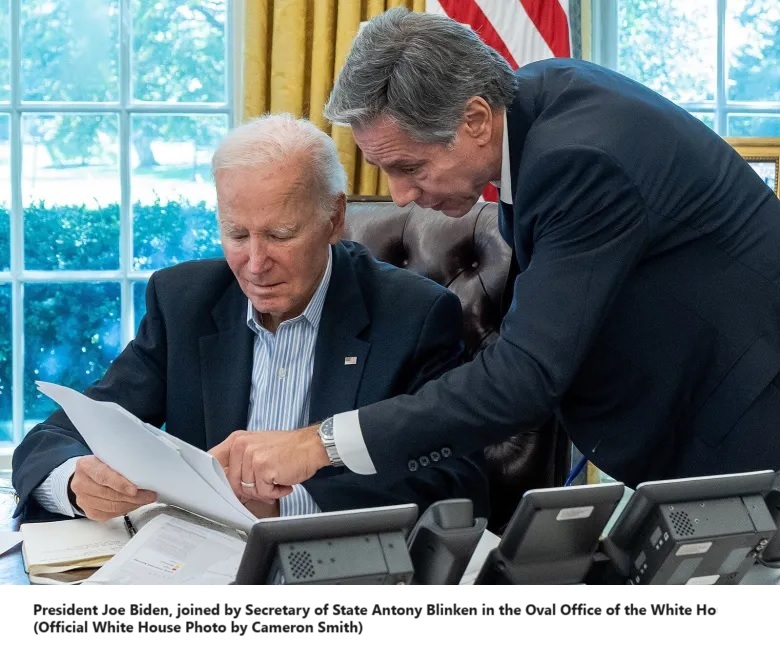
Despite these remarkable and costly debacles, one following the other, the same cast of characters has remained at the helm of US foreign policy for decades, including Joe Biden, Victoria Nuland, Antony Blinken, (both seen at left ), Jake Sullivan, Chuck Schumer, Mitch McConnell, and Hillary Clinton.
The $1.5 trillion in military outlays each year is the scam that keeps on giving—to the military-industrial complex and the Washington insiders—even as it impoverishes and endangers America and the world.
On the surface, US foreign policy seems to be utterly irrational. The US gets into one disastrous war after another — Afghanistan, Iraq, Syria, Libya, Ukraine, and Gaza. In recent days, the US stands globally isolated in its support of Israel’s genocidal actions against the Palestinians, voting against a UN General Assembly resolution for a Gaza ceasefire backed by 153 countries with 89% of the world population, and opposed by just the US and 9 small countries with less than 1% of the world population.
In the past 20 years, every major US foreign policy objective has failed. The Taliban returned to power after 20 years of US occupation of Afghanistan. Post-Saddam Iraq became dependent on Iran. Syria’s President Bashar al-Assad stayed in power despite a CIA effort to overthrow him. Libya fell into a protracted civil war after a US-led NATO mission overthrew Muammar Gaddafi. Ukraine was bludgeoned on the battlefield by Russia in 2023 after the US secretly scuttled a peace agreement between Russia and Ukraine in 2022.
To understand the foreign-policy scam, think of today’s federal government as a multi-division racket controlled by the highest bidders.
Despite these remarkable and costly debacles, one following the other, the same cast of characters has remained at the helm of US foreign policy for decades, including Joe Biden, Victoria Nuland, Jake Sullivan, Chuck Schumer, Mitch McConnell, and Hillary Clinton.
What gives?
The puzzle is solved by recognizing that American foreign policy is not at all about the interests of the American people. It is about the interests of the Washington insiders, as they chase campaign contributions and lucrative jobs for themselves, staff, and family members. In short, US foreign policy has been hacked by big money.
As a result, the American people are losing big. The failed wars since 2000 have cost them around $5 trillion in direct outlays, or around $40,000 per household. Another $2 trillion or so will be spent in the coming decades on veterans’ care. Beyond the costs directly incurred by Americans, we should also recognize the horrendously high costs suffered abroad, in millions of lives lost and trillions of dollars of destruction to property and nature in the war zones.
The costs continue to mount. US Military-linked outlays in 2024 will come to around $1.5 trillion, or roughly $12,000 per household, if we add the direct Pentagon spending, the budgets of the CIA and other intelligence agencies, the budget of the Veteran’s Administration, the Department of Energy nuclear weapons program, the State Department’s military-linked “foreign aid” (such as to Israel), and other security-related budget lines. Hundreds of billions of dollars are money down the drain, squandered in useless wars, overseas military bases, and a wholly unnecessary arms build-up that brings the world closer to WWIII.
Yet to describe these gargantuan costs is also to explain the twisted “rationality” of US foreign policy. The $1.5 trillion in military outlays is the scam that keeps on giving—to the military-industrial complex and the Washington insiders—even as it impoverishes and endangers America and the world.
To understand the foreign-policy scam, think of today’s federal government as a multi-division racket controlled by the highest bidders. The Wall Street division is run out of the Treasury. The Health Industry division is run out of the Department of Health and Human Services. The Big Oil and Coal division is run out of the Departments of Energy and Interior. And the Foreign Policy division is run out of the White House, Pentagon and CIA.
Each division uses public power for private gain through insider dealing, greased by corporate campaign contributions and lobbying outlays. Interestingly, the Health Industry division rivals the Foreign Policy division as a remarkable financial scam. America’s health outlays totaled an astounding $4.5 trillion in 2022, or roughly $36,000 per household, by far the highest health costs in the world, while America ranked roughly 40th in the world among nations in life expectancy. A failed health policy translates into very big bucks for the health industry, just as a failed foreign policy translates into mega-revenues of the military-industrial complex.
The more wars, of course, the more business.
The Foreign Policy division is run by a small, secretive and tight-knit coterie, including the top brass of the White House, the CIA, the State Department, the Pentagon, the Armed Services Committees of the House and Senate, and the major military firms including Boeing, Lockheed Martin, General Dynamics, Northrop Grumman, and Raytheon. There are perhaps a thousand key individuals involved in setting policy. The public interest plays little role.
The key foreign policy makers run the operations of 800 US overseas military bases, hundreds of billions of dollars of military contracts, and the war operations where the equipment is deployed. The more wars, of course, the more business. The privatization of foreign policy has been greatly amplified by the privatization of the war business itself, as more and more “core” military functions are handed out to the arms manufacturers and to contractors such as Haliburton, Booz Allen Hamilton, and CACI.
In addition to the hundreds of billions of dollars of military contracts, there are important business spillovers from the military and CIA operations. With military bases in 80 countries around the world, and CIA operations in many more, the US plays a large, though mostly covert role, in determining who rules in those countries, and thereby on policies that shape lucrative deals involving minerals, hydrocarbons, pipelines, and farm and forest land. The US has aimed to overthrow at least 80 governments since 1947, typically led by the CIA through the instigation of coups, assassinations, insurrections, civil unrest, election tampering, economic sanctions, and overt wars. (For a superb study of US regime-change operations from 1947 to 1989, see Lindsey O’Rourke’s Covert Regime Change, 2018).
In addition to business interests, there are of course ideologues who truly believe in America’s right to rule the world. The ever-warmongering Kagan family is the most famous case, though their financial interests are also deeply intertwined with the war industry. The point about ideology is this. The ideologists have been wrong on nearly every occasion and long ago would have lost their bully pulpits in Washington but for their usefulness as warmongers. Wittingly or not, they serve as paid performers for the military-industrial complex.
There is one persistent inconvenience for this ongoing business scam. In theory, foreign policy is carried out in the interest of the American people, though the opposite is the truth. (A similar contradiction of course applies to overpriced healthcare, government bailouts of Wall Street, oil-industry perks, and other scams). The American people rarely support the machinations of US foreign policy when they occasionally hear the truth. America’s wars are not waged by popular demand but by decisions from on high. Special measures are needed to keep the people away from decision making.
In theory, foreign policy is carried out in the interest of the American people, though the opposite is the truth.
The first such measure is unrelenting propaganda. George Orwell nailed it in 1984 when “the Party” suddenly switched the foreign enemy from Eurasia to Eastasia without a word of explanation. The US essentially does the same. Who is the US gravest enemy? Take your pick, according to the season. Saddam Hussein, the Taliban, Hugo Chavez, Bashar al-Assad, ISIS, al-Qaeda, Gaddafi, Vladimir Putin, Hamas, have all played the role of “Hitler” in US propaganda. White House spokesman John Kirby delivers the propaganda with a smirk on his face, signaling that he too knows that what he is saying is ludicrous, albeit mildly entertaining.
The propaganda is amplified by the Washington think tanks that live off of donations by military contractors and occasionally foreign governments that are part of the US scam operations. Think of the Atlantic Council, CSIS, and of course the ever-popular Institute for the Study of War, brought to you by the major military contractors.
The second is to hide the costs of the foreign policy operations. In the 1960s, the US Government made the mistake of forcing the American people to bear the costs of the military-industrial complex by drafting young people to fight in Vietnam and by raising taxes to pay for the war. The public erupted in opposition.
From the 1970s onward the government has been far more clever. The government ended the draft, and made military service a job for hire rather than a public service, backed by Pentagon outlays to recruit soldiers from lower economic strata. It also abandoned the quaint idea that government outlays should be funded by taxes, and instead shifted the military budget to deficit spending which protects it from popular opposition that would be triggered if it were tax-funded
It has also suckered client states such as Ukraine to fight America’s wars on the ground, so that no American body bags would spoil the US propaganda machine. Needless to say, US masters of war such as Sullivan, Blinken, Nuland, Schumer, and McConnell remain thousands of miles away from the frontlines. The dying is reserved for Ukrainians. Sen. Richard Blumenthal (D-Conn.) defended American military aid to Ukraine as money well spent because it is “without a single American service woman or man injured or lost,” somehow not dawning on the good Senator to spare the lives of Ukrainians, who have died by the hundreds of thousands in a US-provoked war over NATO enlargement.
This system is underpinned by the complete subordination of the U.S. Congress to the war business, to avoid any questioning of the over-the-top Pentagon budgets and the wars instigated by the Executive Branch. The subordination of Congress works as follows. First, the Congressional oversight of war and peace is largely assigned to the House and Senate Armed Services Committees, which largely frame the overall Congressional policy (and the Pentagon budget). Second, the military industry (Boeing, Raytheon, and the rest) funds the campaigns of the Armed Services Committee members of both parties. The military industries also spend vast sums on lobbying in order to provide lucrative salaries to retiring members of Congress, their staffs, and families, either directly in military businesses or in Washington lobbying firms.
It is the urgent task of the American people to overhaul a foreign policy that is so broken, corrupted, and deceitful that it is burying the government in debt while pushing the world closer to nuclear Armageddon.
The hacking of Congressional foreign policy is not only by the US military-industrial complex. The Israel lobby long ago mastered the art of buying the Congress. America’s complicity in Israel’s apartheid state and war crimes in Gaza makes no sense for US national security and diplomacy, not to speak of human decency. They are the fruits of Israel lobby investments that reached $30 million in campaign contributions in 2022, and that will vastly top that in 2024.
When Congress reassembles in January, Biden, Kirby, Sullivan, Blinken, Nuland, Schumer, McConnell, Blumenthal and their ilk will tell us that we absolutely must fund the losing, cruel, and deceitful war in Ukraine and the ongoing massacre and ethnic cleansing in Gaza, lest we and Europe and the free world, and perhaps the solar system itself, succumb to the Russian bear, the Iranian mullahs, and the Chinese Communist Party. The purveyors of foreign policy disasters are not being irrational in this fear-mongering. They are being deceitful and extraordinarily greedy, pursuing narrow interests over those of the American people.
It is the urgent task of the American people to overhaul a foreign policy that is so broken, corrupted, and deceitful that it is burying the government in debt while pushing the world closer to nuclear Armageddon. This overhaul should start in 2024 by rejecting any more funding for the disastrous Ukraine War and Israel’s war crimes in Gaza. Peacemaking, and diplomacy, not military spending, is the path to a US foreign policy in the public interest.
The gem in this whole venture, at least from the perspective of the U.S. military-industrial complex, is the roping in of the Australian taxpayer as the funder of its own nuclear weapons program.
AUKUS, the trilateral pact between the United States, the United Kingdom and Australia, was a steal for all except one of the partners.
Australia, given the illusion of protection even as its aggressive stance (acquiring nuclear-powered submarines, becoming a forward base for the U.S. military) aggravated other countries; the feeling of superiority, even as it was surrendering itself to a foreign power as never before, was the loser in the bargain.
Last month, Australians woke up to the sad reminder that their government’s capitulation to Washington has been so total as to render any further talk about independence an embarrassment. Defence Minister Richard Marles, along with his deputy, Minister for Defence Industry Pat Conroy, preferred a different story.
Canberra had gotten what it wanted: approval by the U.S. Congress through its 2024 National Defense Authorisation Act (NDAA) authorising the transfer of three Virginia class nuclear-powered submarines to the Royal Australian Navy, with one off the production line, and two in-service boats. Australia may also seek congressional approval for two further Virginia class boats.
The measures also authorised Australian contractors to train in U.S. shipyards to aid the development of Australia’s own non-existent nuclear-submarine base, and exemptions from U.S. export control licensing requirements permitting the ‘transfer of controlled goods and technology between Australia, the United Kingdom, and the United States without the need for an export license’.
For the simpleminded Marles, Congress had“provided unprecedented support to Australia in passing the National Defense Authorisation Act which will see the transfer of submarines and streamlined export control provisions, symbolising the strength of our Alliance, and our shared commitment to the AUKUS partnership”.
Either through ignorance or wilful blindness, the Australian Defence Minister chose to avoid elaborating on the less impressive aspects of the authorising statute. The exemption under the U.S. export licensing requirements, for instance, vests Washington with control and authority over Australian goods and technology while controlling the sharing of any U.S. equivalent with Australia. The exemption is nothing less than appropriation, even as it preserves the role of Washington as the drip feeder of nuclear technology.
An individual with more than a passing acquaintance with this is Bill Greenwalt, one of the drafters of the U.S. export control regime.
“After years of U.S. State Department prodding, it appears that Australia signed up to the principles and specifics of the failed U.S. export control system.”
In cooperating with the U.S. on this point, Australia would “surrender any sovereign capability it develops to the United States control and bureaucracy”.
The gem in this whole venture, at least from the perspective of the U.S. military-industrial complex, is the roping in of the Australian taxpayer as the funder of its own nuclear weapons program. Whatever its non-proliferation credentials, Canberra finds itself a funder of the U.S. naval arm in an exercise of modernised nuclear proliferation.
Even the Marles-Conroy media release admits that the NDAA helped ‘establish a mechanism for the U.S. to accept funds from Australia to lift the capacity of the submarine industrial base’. Airily, the release goes on to mention that this “investment” (would “gift” not be a better word?) to the U.S. Navy would also ‘complement Australia’s significant investment in our domestic submarine industrial base’.
A few days after the farcical spectacle of surrender by Australian officials, the Congressional Research Service provided another one of its invaluable reports that shed further light on Australia’s contribution to the U.S. nuclear submarine program. Australian media outlets, as is their form on covering AUKUS, remained silent about it. One forum, Michael West Media, showed that its contributors – Rex Patrick and Philip Dorling – were wide awake.
The report is specific to the Navy Columbia (SSBN-826) Class Ballistic Missile Submarine Program, one that involves designing and building 12 new SSBNs to replace the current, aging fleet of 14 Ohio class SSBNs. The cost of the program, in terms of 2024 budget submission estimates for the 2024 financial year, is US$112.7 billion (AU$168.2 billion).
As is customary in these reports, the risks are neatly summarised. They include the usual delays in designing and building the lead boat, thereby threatening readiness for timely deployment; burgeoning costs; the risks posed by funding the Columbia class program to other Navy programs; and‘potential industrial-base challenges of building both Columbia-class boats and Virginia-class attack submarines (SSNs) at the same time’.
Australian funding becomes important in the last concern. Because of AUKUS, the U.S. Navy “has testified” that it would require, not only an increase in the production rate of the Virginia class to 2.33 boats per year, but ‘a combined Columbia-plus-Virginia procurement rate’ of 1+2.33. Australian mandarins and lawmakers, accomplished in their ignorance, have mentioned little about this addition.
But U.S. lawmakers and military planners are more than aware that this increased procurement rate:
‘…will require investing several billion dollars for capital plant expansion and improvements and workforce development at both the two submarine-construction shipyards (GD/EB [General Dynamics’ Electric Boat in Groton, Connecticut] and HII/NSS [Huntington Ingalls Industries’ Newport News Shipbuilding]) and submarine supplier firms.’
The report acknowledges that funding towards the 1+2.33 goal is being drawn from several allocations over a few financial years, but expressly mentions Australian funding ‘under the AUKUS proposed Pillar 1 pathway’, which entails the transfer component of nuclear-powered submarines to Canberra.
The report helpfully reproduces the 25 October 2023 testimony from the Navy before the Seapower and Projection Forces Subcommittee of the House of Armed Services Committee. Officials are positively salivating at the prospect of nourishing the domestic industrial base through, for instance, ‘joining with an Australian company to mature and scale metallic additive manufacturing across the SIB [Submarine Industrial Base]’.
The testimony goes on to note that:
‘Australia’s investment into the U.S. SIB builds upon ongoing efforts to improve industrial base capability and capacity, create jobs, and utilise new technologies. This contribution is necessary to augment VACL [Virginia class] production from 2.0 to 2.33 submarines per year to support both U.S. Navy and AUKUS requirements.’
The implications from the perspective of the Australian taxpayer are significant.
‘Australian AUKUS funding will support construction of a key delivery component of the U.S. nuclear strike force, keeping that program on track while overall submarine production accelerates.’
The funding also aids the advancement of another country’s nuclear weapons capabilities, a breach, one would have thought, of Australia’s obligations under the Treaty of Non-Proliferation of Nuclear Weapons.
Defence spokesman for the Australian Greens, Senator David Shoebridge, makes that very point to Patrick and Dorling:
“Australia has clear international legal obligations to not support the nuclear weapons industry, yet this is precisely what these billions of dollars of AUKUS funding will do.”
The Senator also asks:
“When will the Albanese Government start telling the whole truth about AUKUS and how Australians will be paying to help build the next class of U.S. ballistic missile submarines?”
For an appropriate answer, Shoebridge would do well to consult the masterful, deathless British series Yes Minister, authored by Antony Jay and Jonathan Lynn.
In one episode, the relevant minister, Jim Hacker, offers this response to a query by the ever-suspicious civil service overlord Sir Humphrey Appleby on when he might receive a draft proposal:
“At the appropriate juncture. In the fullness of time. When the moment is ripe. When the necessary procedures have been completed. Nothing precipitate, of course.”
The Russian peninsula will become the conflict’s “center of gravity,” the Ukrainian leader told The Economist
Ukrainian President Vladimir Zelensky has predicted that his country’s armed forces will “isolate” Crimea in 2024. The region, which joined Russia in 2014 following a bloody nationalist coup in Kiev, hosts Moscow’s Black Sea fleet.
Kiev will seek to cut off access to the peninsula by destroying the Kerch bridge, which connects it to the Russian mainland, Zelensky claimed. For this purpose, he once again demanded German-made long-range Taurus cruise missiles, which Berlin has so far refused to supply even after France and the UK provided Kiev with Storm Shadow missiles.
Zelensky blamed information leaks for the failure of Kiev’s much-hyped summer counteroffensive against Russia, but nevertheless shared new insights into the military’s top priorities for 2024, saying in an interview with The Economist that isolating Crimea is “extremely important.”
The Ukrainian president reiterated his ambitious goal of eventually restoring the country’s 1991 borders, but stopped short of making any promises or setting timelines. The immediate goal, he said, will be “to defend the east” and protect Ukraine’s critical infrastructure.
“Russia has to know that for us this is a military object,” he said.
According to President Vladimir Putin, Russian forces now hold the strategic initiative in the Ukraine conflict, while Kiev has largely been driven by political goals, with their efforts aimed at showing “their true masters at least some results.”
Zelensky also complained that the “mobilization of Ukrainian society and of the world” was much lower now than at the beginning of the conflict, admitting that any military success will depend on assistance from the West.
“Giving us money or giving us weapons, you support yourself. You save your children, not ours,” he claimed.
Kiev announced a general mobilization in February 2022, barring most men aged 18 to 60 from leaving the country, but the campaign has been marred by corruption and draft dodging. Following Ukraine’s disappointing summer counteroffensive, which according to Moscow cost Kiev nearly 160,000 troops, Zelensky recently announced a plan to raise 500,000 more soldiers to replace battlefield losses.
“Mobilization is not just a matter of soldiers going to the front. It is about all of us. It is the mobilization of all efforts,” he told The Economist. “Let’s be honest, we have switched to domestic politics… If we continue to focus on domestic politics, we need to call elections. Change the law, the constitution. But forget about counteroffensive actions and de-occupation.”
NATO to buy 1,000 Patriot missiles to enhance Allies’ air defences
NATO 3 Jan 24
NATO’s Support and Procurement Agency will support a coalition of Allies, including Germany, the Netherlands, Romania and Spain to procure up to 1,000 Patriot missiles to strengthen their air defences amid Russia’s war against Ukraine. The contract will expand the European production of the missiles, enhancing supply and ensuring the replenishment of Allied stockpiles….
The $5.5 billion contract has been awarded to COMLOG, a joint venture between the US company Raytheon and German company MBDA, located in Schrobenhausen, Germany. The large volume of the order will support the set up of a production facility for Patriot missiles in Germany. ……….. https://www.nato.int/cps/en/natohq/news_221626.htm
Citing “the urgency of Israel’s defensive needs,” the Biden administration on Friday said it would bypass Congress for the second time this month to approve an immediate arms sale to the key Middle East ally as it continues to wage a genocidal war against Gaza.
The Associated Pressreported that U.S. Secretary of State Antony Blinken notified lawmakers of the new emergency determination involving the sale of $147.5 million in equipment including fuses, charges, and primers for 155mm artillery shells that Israel has already purchased from the United States.
The unguided explosive rounds—which Israel is using in heavily populated urban areas—have a “kill radius” of about 50 meters, with shrapnel able to inflict lethal wounds on people hundreds of meters away.
“The United States is committed to the security of Israel, and it is vital to U.S. national interests to ensure Israel is able to defend itself against the threats it faces,” the State Department explained.
The move follows a similar State Department determination on December 9, which expedited 13,000 rounds of tank ammunition to the Israel Defense Forces (IDF), whose troops have killed and maimed more than 80,000 Palestinians—mostly women, children, and elders—during 84 days of near-relentless attacks on Gaza.
Some of the deadliest Israeli attacks of the war have been carried out with U.S. weapons, including an October 31 airstrike with 2,000-pound bombs on the densely populated Jabalia refugee camp. More than 120 civilians were killed.
The State Department also said that “we continue to strongly emphasize to the government of Israel that they must not only comply with international humanitarian law, but also take every feasible step to prevent harm to civilians.”
Critics pushed back against that language, with Ibrahim Zabad, a professor of international relations at St. Bonaventure University in upstate New York, asserting on social media that the State Department’s move to bypass Congress “shows the U.S. administration wholeheartedly supports the mass slaughter of Palestinians, their ethnic cleansing, and the demolition of Gaza.”
British journalist Andy Worthington, known for his work chronicling the cases of Guantánamo Bay detainees, asked: “Do they think not enough Palestinian children are being orphaned or killed in Gaza?”
Eli Clifton, a senior researcher at the Quincy Institute for Responsible Statecraft, noted Blinken’s lamentation Thursday that 2023 “has been an extraordinarily dangerous year for press around the world.” Blinken’s statement did not mention the scores of journalists killed—sometimes allegedly on purpose—by Israeli troops during the war.
The U.S. already gives Israel almost $4 billion in nearly unconditional military aid each year. Since the October 7 Hamas-led attacks and Israel’s retaliatory onslaught, U.S. President Joe Biden has repeatedly affirmed his “unwavering” support for Israel. His administration has blockedmultiple global cease-fire efforts at the United Nations while seeking an additional $14.3 billion in armed assistance for Israel.
While Biden recently decried Israel’s “indiscriminate bombing” of Gaza, he has refused to acknowledge what many international experts have called Israel’s genocide against the people of the besieged strip. Some activists have dubbed him “Genocide Joe.”
On Friday, South Africa filed a genocide case against Israel at the International Court of Justice.
Hundreds of rights groups and a handful of progressives in the U.S. Congress have implored the Biden administration to suspend military aid to Israel, while others including Democratic lawmakers have called for conditions to be placed on such assistance.
Earlier this month, Sen. Elizabeth Warren (D-Mass.) led a letter urging Biden to boost oversight of how American arms are used against Palestinian civilians. The letter specifically mentions 155mm artillery shells.
“The IDF has previously used these shells to hit populated areas including neighborhoods, hospitals, schools, shelters, and safe zones, causing a staggering number of civilian deaths,” the senators noted.
According to a Quinnipiac University poll published on December 20, less than half of registered U.S. voters support sending military aid to Israel—an approximately 10-point decrease from the previous month.
If there’s one thing Blinken and his cohorts understand, it’s that you’re not supposed to describe the evil things you want to do in evil-sounding language. You’ve got to tapdance gracefully around the actual depravity you intend to inflict, uttering flowery prose about humanitarian concerns and compassion for both sides to keep everyone dazzled and hypnotized while the killing machines are quietly rolled out in the background. You’ve got to be eloquent and elusive about your murderousness.
“The United States rejects recent statements from Israeli Ministers Bezalel Smotrich and Itamar Ben Gvir advocating for the resettlement of Palestinians outside of Gaza. This rhetoric is inflammatory and irresponsible. We have been told repeatedly and consistently by the Government of Israel, including by the Prime Minister, that such statements do not reflect the policy of the Israeli government. They should stop immediately.
“We have been clear, consistent, and unequivocal that Gaza is Palestinian land and will remain Palestinian land, with Hamas no longer in control of its future and with no terror groups able to threaten Israel. That is the future we seek, in the interests of Israelis and Palestinians, the surrounding region, and the world.”
The offending statements by Ben Gvir and Smotrich promoted the idea of “encouraging” Palestinians to flee Gaza en masse, absurdly referring to this hypothetical outcome as “voluntary migration” despite the fact that Israel has been doing everything in its power to make living in Gaza impossible.
You will note, probably without surprise, that the statement contains nothing but empty scolding. No mention is made of the faintest possibility of any consequence of any kind being brought to bear should Israeli officials continue to openly advocate for eliminating the Palestinian population of Gaza and replacing it with Jewish settlements. This is because the US has no intention of actually doing anything to hinder Israel’s ethnic cleansing agendas.
And make no mistake, that absolutely is Israel’s agenda. The State Department can claim all it wants that “such statements do not reflect the policy of the Israeli government” and that Israeli Prime Minister Benjamin Netanyahu has assured Washington that there are no plans to resettle Palestinians outside of Gaza, but Netanyahu himself has been publicly contradicting this claim with increasing brazenness.
Just last week at a Likud party meeting Netanyahu explicitly said that his government is working on finding countries who would be willing to “absorb” Palestinian refugees from Gaza, claiming that the world is “already discussing the possibilities of voluntary immigration.”
Indeed, it’s fair to say that the extreme-right ministers Ben Gvir and Smotrich are not actually saying anything on this front that is significantly different from what Netanyahu himself has been saying. Bibi’s just a bit more polite about it, with Ben Gvir openly thumbing his nose at the State Department’s remarks saying “we aren’t another star on the American flag” and “facilitating the relocation of hundreds of thousands from Gaza will allow those in the Israeli Gaza border communities to return home and live securely while safeguarding the IDF soldiers.”
In fact, one could easily argue that Netanyahu as well as Ben Gvir and Smotrich have been entirely in alignment with the State Department’s own language on this subject. The idea of “voluntary immigration” does not contradict the position asserted by Secretary of State Antony Blinken that the US vision for Gaza involves “no forcible displacement of Palestinians from Gaza — not now, not after the war.”
Notice Blinken’s careful insertion of the word “forcible” there. His wording makes it clear that the US would only object if Palestinians were actually forced onto ships or marched across the Egyptian border at gunpoint, as middle east analyst Mouin Rabbani recently observed on Twitter:
“Alarm bells should have started ringing in early November when US Secretary of State Antony Blinken and other Western politicians began insisting there could be ‘no forcible displacement of Palestinians from Gaza’. Rather than rejecting any mass removal of Palestinians, Blinken and colleagues objected only to optically challenging expulsions at gunpoint. The option of ‘voluntary’ displacement by leaving residents of the Gaza Strip with no choice but departure was pointedly left open.”
So contrary to its self-righteous moral posturing, the State Department is not actually upset with Ben Gvir and Smotrich for advocating the ethnic cleansing of Gaza. They’re just upset they said the quiet part out loud.
If there’s one thing Blinken and his cohorts understand, it’s that you’re not supposed to describe the evil things you want to do in evil-sounding language. You’ve got to tapdance gracefully around the actual depravity you intend to inflict, uttering flowery prose about humanitarian concerns and compassion for both sides to keep everyone dazzled and hypnotized while the killing machines are quietly rolled out in the background. You’ve got to be eloquent and elusive about your murderousness. Like Obama.
The US war machine is every bit as depraved as the state of Israel, and the Biden administration is just as culpable for the horrors being unleashed in Gaza as Netanyahu and his goons. Ignore their words and watch their actions. Don’t let them dazzle you with their feigned concern for human rights.
North Korean leader Kim Jong Un pledged to launch three new military spy satellites, build attack drones and expand the country’s nuclear materials in 2024, according to state media reports.
In remarks made at the end of the ruling Workers’ Party meeting over the weekend, Kim railed against the “vicious” moves of the U.S. and its followers for working against North Korea, claiming the U.S. has helped push the Korean Peninsula to the “brink of a nuclear war,” according to the official Korean Central News Agency (KCNA).
“Because of reckless moves by the enemies to invade us, it is a fait accompli that a war can break out at any time on the Korean Peninsula,” Kim said, per KCNA.
The North Korean leader pointed to the the increase in joint military exercises by the U.S., Japan and South Korea and the deployment of U.S. military assets including bombers over the past year, arguing they show the U.S. “aims at the military confrontation” with North Korea “at any cost.”
The U.S., alongside South Korea, has maintained that the countries will continue to wage a joint defense against North Korea’s threats.
Kim vowed to launch three reconnaissance satellites in 2024, a declaration that comes nearly a month after the country launched its first reconnaissance satellite in November, KCNA said. The U.S. said that launch was a violation of United Nations Security Council resolutions.
Kim later emphasized the need to create a “reliable foundation” to make more nuclear weapons and ordered officials to boost the North’s submarine capabilities and to develop unmanned combat equipment, The Associated Press (AP) reported.
Observers told the AP that Kim expressed the belief that boosted nuclear abilities could give him the opportunity for diplomacy with the U.S. and that his country could be given sanctions relief if former President Trump wins the presidency in 2024…………………………………………………………
Diplomacy talks between the U.S. and North Korea broke down in 2019 over the amount of sanctions relief the North could get for partly surrendering its nuclear program. Since then, Kim has aimed to modernize the North’s nuclear supply through efforts including an increased production of plutonium and uranium.
North Korean leader Kim Jong Un has plans to ramp up military actions in 2024.
Kim said he would intensify weapons tests and build up the country’s nuclear stockpile.
Experts say the moves are meant to help ease sanctions should Donald Trump return as president.
North Korean leader Kim Jong Un vowed to launch three additional military spy satellites, produce more nuclear materials, and introduce modern attack drones in 2024, as he called for “overwhelming” war readiness to cope with US-led confrontational moves, state media reported Sunday.
1 International aid workers describe a growing humanitarian nightmare in the Strip.
International aid workers visiting the Gaza Strip are relaying the horrific situation Israel is inflicting on the Palestinians. UNICEF reports over 1,000 children have lost legs. Israel is forcing the 2.3 million residents of Gaza into increasingly small areas that lack the ability to accommodate basic needs for survival.
UNICEF spokesperson James Elder said, “Around 1,000 children in Gaza have lost one or both their legs.” He told journalists in Geneva that “every single child is enduring these ten weeks of hell and not one of them can escape.”
Due to the conditions in Gaza, as well as the lack of aid, doctors are often forced to conduct surgeries in unsanitary facilities and without painkillers. “Not only were they amputated without anesthesia, but many of them were amputated in a very quick fashion,” he said.
Dr. Ghassan Abu Sitta, a London-based surgeon who traveled to Gaza to treat patients, told Middle East Eye that having to perform these operations without anesthetic was “one of the most difficult things I’ve had to do in my career.” At a November press conference, he said, “One night, at Al-Ahli Hospital, I performed amputations on six children.”
The UNICEF official said that even if children recover from the amputation, they do not escape the hell of the threat of death. “As a parent of a critically sick child told me, ‘Our situation is pure misery…I don’t know if we will make it through this.’”
Spokesperson Dr. Margaret Harris added that WHO staff in Gaza spoke of not being able to walk in the emergency wards “for fear of stepping on people” lying on the floor “in severe pain” and asking for food and water. She called the situation “unconscionable” and said that it is “beyond belief that the world is allowing this to continue.”








 nuclear-news