As Israeli Forces Fire on Starving Palestinians, US Again Vetoes UN Cease-Fire Resolution
“We should ask ourselves: How many innocent lives must be sacrificed before the council deems it necessary to call for a cease-fire?” said the Algerian envoy to the United Nations.
Common Dreams JULIA CONLEY, Feb 20, 2024
As a United Nations agency halted aid deliveries in northern Gaza, where acute malnourishment is rampant among children, citing a “breakdown of social order” fueled by Israel’s bombardment of and blockade on the enclave, the United States for a third time on Tuesday vetoed a cease-fire resolution at the U.N. Security Council—saying it was an inopportune time to demand that Israel end its massacre of Palestinians.
U.S. Ambassador to the U.N. Linda Thomas-Greenfield said the cease-fire resolution, proposed by Algeria, would “negatively impact” negotiations for a truce that are ongoing.
Amar Bendjama, Algeria’s ambassador to the U.N., said the U.S. ambassador’s lone vote against the resolution “implies an endorsement of the brutal violence and collective punishment inflicted upon” Palestinians in Gaza.
Thirteen countries supported the resolution, while the U.K.—which has veto power, like the U.S., China, France, and Russia—abstained from voting.
The vote marked the third time the U.S. has vetoed a cease-fire resolution at the U.N. Security Council (UNSC). Meanwhile, the Biden administration has approved weapons transfers to Israel without the oversight of the U.S. Congress since the assault began in October, and has vehemently defended the bombardment as being focused on defeating Hamas, even as Israel has killed more than 29,000 Palestinians including more than 11,500 children.
“We should ask ourselves: How many innocent lives must be sacrificed before the council deems it necessary to call for a cease-fire?” said Bendjama. “Palestinian lives matter. Each one of us decides where to stand in this tragic chapter of history.”
As the U.S. rejected the cease-fire resolution, Al Jazeera reported on the chaos that has erupted in northern Gaza as Israel has blocked aid trucks from reaching starving civilians there.
The World Food Program (WFP) said Tuesday it was pausing deliveries after crowds of desperate people overwhelmed aid workers.
As Al Jazeera reported, children collected flour that spilled from an aid truck in Gaza City, before Israeli forces began firing on the crowd……………………………………………………………………………………………………………………………………………………….
Al Jazeera reported that Palestinians in Gaza expressed anger over the United States’ latest veto.
“There is a great deal of pessimism and frustration. Palestinians no longer trust the international community, as we have been hearing from locals here in Gaza,” correspondent Tareq Abu Azzoum reported from Rafah. “During the Security Council meeting there have been more attacks on the ground here in Gaza. People here are completely frustrated.” https://www.commondreams.org/news/us-vetoes-ceasefire
Germany and nuclear weapons: A difficult history

Volker Witting | Rina Goldenberg, 02/17/2024February 17, 2024
Donald Trump’s suggestion the US will no longer apply NATO’s principle of collective defense should he become president again has sent shockwaves through Europe.
German Defense Minister Boris Pistorius is annoyed by the current debate about European nuclear weapons.“There is no reason to discuss the nuclear umbrella now,” he told public broadcaster ARD.
Ever since Donald Trump suggested that, as US president, he would not provide military assistance to NATO countries if they invested less than 2% of their GDP in their defense, German politicians have been discussing whether French and British nuclear weapons would suffice as a protective shield or whether Europe needs new nuclear weapons.
“The debate about European nuclear weapons is a very German debate that we don’t see in any other country,” political scientist Karl-Heinz Kamp from the German Council on Foreign Relations (DGAP) told DW — especially not in Eastern Europe, where there is a constant perceived threat from Russian President Vladimir Putin’s Russia.
Germany has a special history: Germany was “seen as an intrinsically aggressive country, that had started two world wars and could not be trusted with nuclear weapons,” said Kamp.
Germany-based nukes during the Cold War
In 1954, not long after the end of World War II, the first chancellor of the Federal Republic of Germany, Konrad Adenauer, signed an agreement renouncing the production of its own nuclear, biological or chemical weapons on its territory. In return, the US included West Germany in its nuclear deterrence policy against the Soviet-led Warsaw Pact.
In 1958, the German parliament, the Bundestag, approved the deployment of US nuclear weapons, despite some pacifist protests among the population. In 1960, 1,500 US nuclear warheads were stored in West Germany and a further 1,500 in the rest of Western Europe.
The nuclear weapons were also available to the Bundeswehr for training and use in the “case of defense.” “There was never any discussion about Germany acquiring its own nuclear weapons,” said Kamp.
The West German and European peace movements grew. The protest against the “NATO Dual-Track Decision” in 1982 saw over a million people in West Germany take to the streets in protest against the planned stationing of new US medium-range missiles in the country.
Nevertheless, on November 22, 1983, a center-right majority in the Bundestag approved the stationing of the missiles in US bases shortly thereafter. At the time, the Greens were newly represented in the Bundestag and appealed to the Federal Constitutional Court against the storing and deployment of nuclear missiles on West German territory. This bid was rejected as unfounded in December 1984.
During the Cold War, East Germany, the communist German Democratic Republic (GDR), was part of the Warsaw Pact military alliance, and from 1958, nuclear missiles and warheads were stationed in Soviet military bases on GDR territory. Some were withdrawn in 1988 as part of the Intermediate-Range Nuclear Forces Treaty between the US and the Soviet Union.
After German reunification and the withdrawal of the Soviet military, the territory of the former GDR officially became free of nuclear weapons in 1991.
Post-Cold War Germany
After the fall of the Berlin Wall in 1989, the collapse of the Soviet Union and the end of the division between East and West Germany, the German position was once again cemented in the so-called “Two-Plus-Four Treaty”: No nuclear weapons! On September 12, 1990, the four victorious powers of World War II (the US, the Soviet Union, France and UK) stipulated that Germany East and West should be reunified and renounce nuclear weapons.
Kamp says this was hardly surprising, because “a German nuclear power would be something that would cause horror. For historical reasons alone.”
The US government withdrew many of these nuclear warheads after the collapse of the Soviet Union, though an estimated 180 US nuclear weapons are still stored in Europe, in Italy, Turkey, Belgium, the Netherlands and Germany.
Experts believe that 20 US nuclear warheads are currently stored in the town of Büchel in Rhineland-Palatinate, western Germany. “But the decision-making authority over these weapons lies solely with the American president,” explained Kamp.
Any debate about Germany acquiring its own nuclear weapons is completely unrealistic, says political scientist Peter Rudolf from the German Institute for International and Security Affairs. Nuclear bombs need to be stored so that they are not easy targets, he told the Frankfurter Allgemeine daily.
“Survivable nuclear weapons would have to be on nuclear-powered submarines that can remain underwater for a very long time, he said, pointing to equipment the Bundeswehr does not have. “So there are so many problems standing in the way of a German nuclear bomb that it has no relevance to current crises,” Rudolf concluded.
“Those who are now talking about a European defense dimension are not talking about German nuclear weapons, because Germany is a member of the Nuclear Non-Proliferation Treaty and has made several binding commitments under international law to renounce the possession of weapons of mass destruction — including nuclear weapons,” agreed Kamp.
Defense Minister Pistorius, meanwhile, who made headlines not so long ago saying Germany should get “war-ready”, is now keen to brush the whole debate aside: He told ARD that “the majority of those in charge in the United States of America know exactly what they have in their transatlantic partners in Europe, what they have in NATO.”
And Kamp agrees: “Trump may be able to damage NATO considerably, but he cannot destroy it. You can’t destroy decades of transatlantic relations in one term of office.”
Edited by Ben Knight and Peter Hille
UK could contribute to nuclear shield if Trump wins, suggests German minister
Comments draw Britain into debate about European security without US providing bulk of Nato’s nuclear deterrent
Patrick Wintour, Guardian, 19 Feb 24,
The UK could contribute to a new European nuclear shield if Donald Trump becomes US president again, a senior German minister has suggested, drawing British politicians into the debate about how Europe’s security could be bolstered in the event of the Republican frontrunner winning in November.
Questions over a European nuclear deterrence have intensified after Trump’s remarks on Saturday that he would not defend any Nato member that failed to spend 2% of its gross domestic product on defence – and would even encourage Russia to continue attacking.
European leaders have interpreted the comments as a warning that the alliance’s largely US nuclear shield can no longer be taken for granted if Trump returns to the White House. On Tuesday, Christian Lindner, the German finance minister and the leader of the Free Democratic party, called on politicians to consider an alternative model that could include British and French nuclear weapons……………………………………………………………..
The central issue in the nuclear debate is less whether Britain or France would put their nuclear weapons at the disposal of the EU, but whether the two countries could agree to put them at the service of a deterrence strategy for Nato’s European alliance area.
Although France keeps its nuclear deterrent outside the Nato command structure, Macron has offered to cooperate with Europe on nuclear defence. In 2020, he called for a “strategic dialogue” on “the role of France’s nuclear deterrent in [Europe’s] collective security”. Germany never took up that offer……………………………………………………………………………………..
The UK has said its nuclear weapons would be available for use at the request of Nato’s supreme allied commander Europe, the alliance’s most senior uniformed officer, and that they would only be used “in extreme circumstances of self-defence including the defence of our Nato allies”.
This offer, however, was made in the context of a US nuclear presence in Europe.
The Labour party has promised to intensify defence cooperation with Europe, including a commitment by the shadow defence secretary, John Healey, to reach an agreement with Germany within the first six months of taking office. But this modest pledge had nothing to do with the sharing of Britain’s nuclear deterrent. https://www.theguardian.com/world/2024/feb/15/uk-europe-nuclear-shield-donald-trump-germany-nato-deterrent
US Threatens to Veto New Gaza Ceasefire Resolution at UN Security Council
The US has vetoed two similar resolutions
by Dave DeCamp February 18, 2024, https://news.antiwar.com/2024/02/18/us-threatens-to-veto-new-gaza-ceasefire-resolution-at-un-security-council/
—
The US is threatening to veto a resolution calling for a ceasefire in Gaza at the UN Security Council as the US continues to provide political cover for the Israeli massacre of Palestinians.
US Ambassador to the UN Linda Thomas-Greenfield said in a statement that if the resolution, which is being drafted by Algeria, was brought to a vote, it would not be adopted.
Thomas-Greenfield justified US opposition to a ceasefire by pointing to US efforts to push for a new hostage deal between Israel and Hamas. However, Israeli Prime Minister Benjamin Netanyahu vetoed hostage talks last week, and Qatar, the mediator of the negotiations, said Saturday that things were not looking “promising.”
Thomas-Greenfield said Algeria’s resolution would “run counter” to US efforts on the hostage deal. “We have communicated this concern repeatedly to our colleagues on the Council. For that reason, the United States does not support action on this draft resolution. Should it come up for a vote as drafted, it will not be adopted,” she said.
The US has already used its veto power on the Security Council to veto two resolutions calling for an end to the onslaught. The Biden administration has also dismissed the International Court of Justice’s ruling that it’s “plausible” Israel is committing genocide and continues to provide unconditional military support for the slaughter.
Thomas-Greenfield said the resolution would get in the way of US “diplomacy” related to pushing for a hostage deal. “It is critical that other parties give this process the best odds of succeeding, rather than push measures that put it — and the opportunity for an enduring resolution of hostilities — in jeopardy,” she said.
Is there really a nuclear weapon in space?
CASSANDRA STEER, The Interpreter, 18 Feb 24
Calm down, Congressman.
Alarm was raised in the media this week about a “national security threat” to the United States from Russia, ostensibly a nuclear space-based weapon. The news came after the Republican chair of the US House of Representatives intelligence committee, Mike Turner, unusually went public with an allegation based on classified intelligence that had not yet been properly discussed across the National Security briefing channels.
The fact that a cryptic, public allegation was made about a threat in space, combined with repetitions of one unnamed source referring to a potential nuclear capability, has led to some sensationalised news articles, and a lot of misleading conclusions, that Russia has a nuclear space weapon. Lack of clarity can lead to misunderstanding, misinterpretations, and possible missteps, which are in fact the biggest threats to space security.
This news is useful in terms of raising awareness of the high stakes in space security. But as became clear when White House National Security Communications Adviser John Kirby spoke earlier today, this potential capability does “not pose an urgent threat to the United States”– i.e.: it doesn’t yet exist.
We do know all the great powers, many middle powers and even smaller nations are developing counter-space capabilities, most of which are non-kinetic, and the most effective of which have temporary, but highly impactful effects. But this is not “Star Wars”, there are no space-based nuclear weapons.
Space is critical to national, regional and international security, because of how integral space-based services are to civil life and military operations. Satellites have been key military sources of intelligence, surveillance and reconnaissance (ISR) since the 1960s, and continue to be so today. Space-based communications, internet and navigation (such as GPS) are part of our daily lives without most of us thinking about where they come from, and they are a major source of military communications, operational navigation on land, at sea and in the air, as well as guidance for precision weapons.
Because of these high dependencies, space has itself become a strategic domain. In recent decades, increasingly sophisticated counter-space capabilities have been developed globally to interfere with these systems. The most effective way to compromise an adversary’s eyes and ears is to interfere with their space systems, whether by jamming a signal, listening in on a signal, spoofing a false positioning signal, or undertaking a cyberattack on a satellite operation. These are all temporary, reversible means of targeting a satellite or the signals and data it sends to Earth. There is a reason these means are preferred over kinetic, destructive means.
Nuclear weapons (and weapons of mass destruction) are the only type of weapon prohibited in the 1967 Outer Space Treaty, in article IV. The Soviets and the United States, together with many other countries, were able to agree on this treaty at the height of the Cold War, because they realised that strategic restraint was the only way to ensure they would both continue to have access to this new critical domain. In other words, after their own nuclear and Electro-Magnetic Pulse tests in the 1960s, they realised there was no way to contain the effects of such weapons, and their own capabilities would be impacted. A lose-lose scenario.
Perhaps the strongest lessons came from the US nuclear test known as Starfish Prime, which took out US, UK and other national satellite capabilities, reaching from the east coast of the United States to Australia. US and Soviet decision-makers realised they needed to secure their own access to space by prohibiting such weapons, and other countries pushed to ensure these superpowers would not take nuclear war to space, denying access to space for others………………………………………………………………………………. more https://www.lowyinstitute.org/the-interpreter/there-really-nuclear-weapon-space
Egypt Building Walled Camp in Sinai Desert to Absorb Palestinian Refugees from Gaza
Israel will likely try to push Palestinians from Rafah into the camp
by Dave DeCamp February 15, 2024 https://news.antiwar.com/2024/02/15/egypt-building-walled-camp-in-sinai-desert-to-take-palestinian-refugees-from-gaza/
Egypt is building an 8-square-mile walled enclosure in the Sinai Desert near Gaza to prepare for an influx of Palestinian refugees as Israel is vowing to launch an assault on Rafah, which borders Egypt and is packed with about 1.5 million Palestinians.
The revelation of Egypt’s construction, which was reported by The Wall Street Journal and an Egyptian rights group, signals Cairo is caving to Israeli pressure to allow Palestinians to enter its territory.
Egyptian officials told the Journal that more than 100,000 people would be able to fit into the camps they are constructing. If a mass exodus of Palestinians from Gaza does happen, the Egyptian officials said they want to limit the number of refugees they allow in to between 50,000 and 60,000.
The Sinai Foundation for Human Rights first reported on the construction on Wednesday and said the project is expected to be completed within 10 days. Egyptian officials told the Journal they expect a broad Israeli offensive on Rafah could start “within weeks.” Israel must be aware of the construction and will likely try to push as many Palestinians into the camp as it can.
Israeli government officials have not been shy about their desire to cleanse the Gaza Strip of its Palestinian population and re-establish Jewish settlements. A document prepared by Israel’s Intelligence Ministry that was leaked back in October said the best-case scenario for Israel would be to send all 2.3 million Palestinians living in Gaza into Egypt.
But Cairo’s opposition to the plan caused Israeli officials to look elsewhere and suggest Western countries take in Palestinian refugees. According to Israeli media, Israeli Prime Minister Benjamin Netanyahu previously said he was looking for countries to “absorb” Palestinians, but he’s cooled the rhetoric since the Biden administration criticized other Israeli ministers for making similar comments.
‘Everyone needs to calm down’: experts assess Russian nuclear space threat
Attacks in Earth’s orbit as likely to damage Russian interests as western ones, says leading academic
Nicola Davis , 15 Feb 24, Guardian,
Rumours that Russia is planning to deploy nuclear weapons in space have been dampened down by experts who say that while such technology is possible, there is no need to push the panic button.
The furore kicked off on Wednesday when the head of the US House of Representatives’ intelligence committee, Mike Turner, called for the Biden administration to declassify information on what he called a “serious national security threat”.
While Turner gave no further details, it was later reported by news outlets, citing unnamed sources, to involve Russia’s potential deployment of a nuclear anti-satellite weapon in space. The Kremlin dismissed the claim as a “malicious fabrication”.
Dr Bleddyn Bowen, an associate professor at the University of Leicester who specialises in outer space international relations and warfare, said the the lack of detail was no reason to panic. “It’s so vague and cryptic, it could be a number of different things. [But] no matter what they are, none of them are a big deal, to be honest. Everyone needs to calm down about this.”
Russia is bound by several legal restrictions regarding the use or presence of nuclear weapons in space. Article 4 of the Outer Space treaty (1967) bans nuclear weapons from being put into orbit, installed on celestial bodies or otherwise stationed in outer space, while the New Start treaty aims to reduce the number of deployable nuclear arms. The Partial Nuclear Test Ban treaty (1963) bans nuclear explosions in space.
Even if Russia ignores these agreements, there are other considerations. Bowen said the rumoured threat may relate to nuclear-tipped anti-satellite weapons but that such a threat was nothing new.
“These are the first and the most crude kind of anti-satellite weapons ever built: the Americans had them in 1959.” He said any state with nuclear weapons already had the technology to use them in space, broadly speaking.
Another possibility, Bowen said, was that the threat related to space-based nuclear weapons that could be used to knock out satellites. Again, the idea is not entirely new: Russia has previously explored the stationing of nuclear weapons in space, albeit to attack ground targets……………………………………………………………………………………
Space-based nuclear weapons are vulnerable to attack from other nations, while the damage from such weapons would be indiscriminate.
“When you detonate a nuclear weapon in space you generate the fireball … but what you [also] generate is the electromagnetic pulse which fries the electrical circuits of anything that’s unshielded within a few thousand kilometres’ radius,” he said. The pulse may also knock out power grids on Earth if the bomb is detonated above or near populated areas.
“After that, you have the radiation that the bomb would generate,” Bowen said. Over time it would fry the electrical circuits of satellites in the wider part of Earth’s orbit.
The loss of satellite services could affect myriad systems on Earth, from telecoms to satellite navigation services. “That can have knock-on effects to the economy, to critical infrastructure, to the financial system, which relies on these satellites.”
In other words, while nuclear bombs could take out a desired satellites, they could also damage Russia’s technology and interests.
“You’ve got to be in a very desperate situation to want to do something like that,” he said. “So I am not losing any sleep over this.”
Russia also has other technology to hand. In 2021 Russia tested a direct-ascent anti-satellite missile, successfully knocking out one of its own defunct satellites.
But James Green, a professor of public international law at the University of the West of England, said he was also dubious that that system would be deployed. “I think Russia likes to project its space power [to appear] greater than it probably is,” he said.
https://www.theguardian.com/world/2024/feb/15/experts-russian-nuclear-space-threat
Ukraine set to lose key Donbass city – White House
https://www.rt.com/russia/592511-key-donbass-city-loss/
With Russia poised to capture Avdeevka, US National Security Council spokesman John Kirby has called on Congress to give Kiev more ammunition
Russian forces are preparing to capture the Donbass stronghold of Avdeevka after “particularly intense” fighting, White House National Security Council spokesman John Kirby told reporters on Thursday.
Situated just ten kilometers north of Donetsk, Avdeevka had been used by the Ukrainian military as a staging ground for attacks on the city since 2014, many of which targeted civilians. They constructed deep bunkers there, with Russian military bloggers comparing the town to a “fortress.”
Fighting around Avdeevka is “particularly intense,” Kirby said at a press conference. “We’re getting reports from the Ukrainians that the situation is critical, the Russians continuing to press Ukrainian positions every single day,” he stated, adding that “Avdeevka is at risk of falling into Russian control.”
It is unclear how many troops Kiev has lost attempting to hold Avdeevka. Kirby linked the impending fall of the town to ammunition shortages, a problem well documented by Western media in recent months. The White House spokesman called on Congress to pass a bill that would give Ukraine a $60 billion infusion of military aid, stating that this would “provide Ukraine with the artillery shells that they desperately need to disrupt these Russian assaults.”
While the US Senate passed the bill earlier this week, it remains a non-starter in the House of Representatives, where the slim Republican majority have demanded that it include a major tightening of US immigration law and “real border security provisions,” according to House Speaker Mike Johnson.
Ukraine appears determined to hold Avdeevka at all costs, with President Vladimir Zelensky naming Aleksandr Syrsky – a general infamous for tolerating severe losses – as commander-in-chief of his armed forces last week. Syrsky immediately deployed Ukraine’s 3rd Assault Brigade – an elite Western-armed unit made up of the remnants of the neo-Nazi Azov regiment – to Avdeevka, where they relieved the beleaguered and depleted 110th Mechanized Brigade.
While Ukrainian officials have not conceded defeat in Avdeevka, German reporter Julian Roepcke claimed on Thursday that “the Ukrainian army is in the process of pulling out,” while Russian forces are “quickly advancing inside and around the town.” According to Roepcke, the Russian flag is now flying at the entrance to the town, at the same spot where Zelensky took a selfie during a publicity visit in December.
Cut in Half by Russians, Avdiivka is Reinforced by Ukrainian Nazi Azov Battalion – Massive Missile Strike on Reinforcements Causes Some Defenders to Withdraw
The heavily fortified frontline town of Avdiivka, split in two by Russian forces, witnesses some of the Ukrainian defenders begin to retreat of some areas to ‘more favorable positions’.
The supply lines of the AFU in the southern sector are now under extreme pressure.
Besides the multi-pronged ground attack that is overextending the defenses, a reason for the rapid advance of the Russian forces in Avdiivka is the aerial support: a FAB guided munition drops almost immediately on any place where a concentration of Ukrainian military is spotted.
Telegram channel Ukraine Watch reported that in the first third of February alone, the Russian Aerospace Forces dropped about 460 aerial bombs on the positions of the Ukrainian Armed Forces. This includes FAB-250/500/1500 and ODAB.
his partial folding of the defenses is a bit surprising because up until a couple of days ago, the New Ukrainian commander Syrsky was still rumored to be withdrawing elite units from the Rabotino and Verbove fronts to immediately reinforce Avdiivka.
This reportedly includes more of the 47th as well as the 3rd Assault Brigade, better known as the Nazi ‘Azov’ battalion.
These brigades were thrown directly into the center of battle.
Simplicius the Thinker reported:
“After witnessing the nightmare of Bakhmut, they [Ukrainians] now understand what awaits the soldiers in Avdiivka. But what’s most interesting, is you’ll recall that their narrative was previously that Bakhmut was a ‘successful operation’ because it allegedly grinded down such a disproportionate number of Russian troops, that the city defense served its purpose. But when that truth is put to the test in reality, Ukrainians instead recognize that it’s actually them getting ground down amid desperate calls for withdrawal. If Bakhmut was such a ‘success’, then they would be happy to keep their men in Avdiivka and inflict another such ‘success’ against Russian attackers.”……………………………………………………………………………………………………………………..
Ukraine Watch reported:
“The current situation can be described as difficult. That is, the enemy is now advancing practically along the entire front line, and we have switched from offensive actions to a defensive operation. And the aim of our defensive operation is to exhaust the enemy’s forces, to inflict maximum losses on him, using our fortifications, our technical advantages in the use of unmanned aerial vehicles, electronic warfare and the maintenance of prepared defensive lines. The situation at the front was very tense, with the enemy making offensive movements in several directions, in fact all along the line of sight of my group.”
And finally, today, Intel Slava reported that the Ukrainian army is retreating to ‘more advantageous positions’ in Avdiivka, according to Dmitry Likhovy, speaker of the Tavria Armed Forces of Ukraine group.
“In Avdiivka, a maneuver is taking place where our units are withdrawing to more advantageous positions. Supplies to Avdiivka and evacuation from there are difficult. But a reserve logistics artery, prepared in advance, is being used.” https://www.thegatewaypundit.com/2024/02/cut-half-russians-avdiivka-is-reinforced-ukrainian-nazi/
War on Gaza: Israeli army chief urges soldiers to stop looting Palestinian homes
Herzi Halevi’s comments come after footage revealed Israeli soldiers stealing necklaces, furniture and pets.
By MEE staff, 16 February 2024,
https://www.middleeasteye.net/news/israeli-senior-official-tells-soldiers-looting-gaza-homes-impermissible
The Israeli army’s chief of staff has warned soldiers against looting homes in Gaza after numerous videos emerged showing houses being vandalised and ransacked.
According to the Israeli Ynet news website, Herzi Halevi has asked commanders and soldiers to refrain from theft, unnecessary graffiti on the walls and a “breakdown of discipline”.
He pointed to several videos posted online that showed violent and provocative acts that appeared to have little to do with furthering the stated aim of destroying Hamas.
In one video, a soldier boasts about stealing a silver necklace from Gaza to take back to his girlfriend in Israel. Another video shows a soldier stealing a rug from a Palestinian home, and a third shows a soldier stealing a traditional mirror from a house.
Other videos show an Israeli officer stealing make-up to take as a gift to Israel and a soldier setting fire to food and water supplies.
Theft and vandalism
In January, Israel’s head of the Antiquities Authority backtracked after he appeared to announce that Israel was displaying some stolen artefacts from Gaza in the Knesset.
He had published photos and videos on his Instagram account saying that his deputy went to Gaza to inspect the antiquities, which were reported to have been displayed in the Israeli parliament.
According to Ynet, Halevi’s comments were not welcomed by many commanders, who believe they will affect the morale of the Israeli soldiers.
However, he still insisted that such behaviour should be immediately stopped.
In the first days of the war, Israeli soldiers were not allowed to carry their phones with them in the field, but the restriction appears to have fallen.
Earlier in January, the Gaza government media office said the Israeli army had, since 7 October, looted money, gold, and artefacts worth around $25m.
The media office said it had “dozens of testimonies” provided by residents of the Gaza Strip regarding the thefts.
“Theft operations occurred in various ways, the first of which was at the checkpoints, such as Salah al-Din Street, where they stole from the displaced people who had moved from the northern Gaza Strip to the south, their bags containing their valuable possessions such as money, gold, and artefacts,” the office said in a statement.
Biden disparages Netanyahu in private but hasn’t significantly changed U.S. policy toward Israel and Gaza

As the reported Palestinian death toll in the Gaza Strip reaches 28,000, the president continues to believe that unequivocally supporting Israel is the right policy.
Yet, even as Biden has escalated his rhetoric, he is not yet prepared to make significant policy changes, officials said. He and his aides continue to believe his approach of unequivocally supporting Israel is the right one.
As the reported Palestinian death toll in the Gaza Strip reaches 28,000, the president continues to believe that unequivocally supporting Israel is the right policy.
NBC News, Feb. 12, 2024, By Carol E. Lee, Jonathan Allen, Peter Nicholas and Courtney Kube
WASHINGTON — President Joe Biden has been venting his frustration in recent private conversations, some of them with campaign donors, over his inability to persuade Israel to change its military tactics in the Gaza Strip, and he has named Prime Minister Benjamin Netanyahu as the primary obstacle, according to five people directly familiar with his comments.
Biden has said he is trying to get Israel to agree to a cease-fire, but Netanyahu is “giving him hell” and is impossible to deal with, said the people familiar with Biden’s comments, who all asked not to be named.
“He just feels like this is enough,” one of the people said of the views expressed by Biden. “It has to stop.”
Biden has in recent weeks spoken privately about Netanyahu, a leader he has known for decades, with a candor that has surprised some of those on the receiving end of his comments, people familiar with them said. His descriptions of his dealings with Netanyahu are peppered with contemptuous references to Netanyahu as “this guy,” these people said. And in at least three recent instances, Biden has called Netanyahu an “asshole,” according to three of the people directly familiar with his comments……………………………………………………………………………………………………………………….
Yet, people familiar with Biden’s private comments said he has told them he believes it would be counterproductive for him to be too harsh on Netanyahu publicly.
Biden’s frustrations with Netanyahu have also not led to a major policy shift, but his administration has begun to consider such options. Two weeks ago, officials told NBC News that the administration was discussing delaying or slowing U.S. weapons sales to Israel as leverage to get Netanyahu to dial down Israeli military operations in Gaza and do more to protect civilians………………….
Yet, even as Biden has escalated his rhetoric, he is not yet prepared to make significant policy changes, officials said. He and his aides continue to believe his approach of unequivocally supporting Israel is the right one…………………………
“I’m a Zionist,” Biden said, reiterating his views that Hamas must be destroyed and that Israel must be protected, according to the supporter……………………………………………….. https://www.nbcnews.com/news/investigations/biden-disparages-netanyahu-private-hasnt-changed-us-policy-israel-rcna138282
EU’s top diplomat slams US for sending arms to Israel as Gaza deaths mount
Politico, FEBRUARY 12, 2024 ,BY PAULA ANDRÉS
Western leaders have decried Israel’s planned Rafah invasion plan, but PM Netanyahu “doesn’t listen to anyone,” Josep Borrell says.
EU foreign affairs chief Josep Borrell on Monday called on the international community, and particularly the U.S., to stop providing arms to Israel in light of the growing number of civilians being killed in Gaza.
“Everybody goes to Tel Aviv begging please protect civilians, don’t kill so many. How many is too many?” Borrell said during a meeting of EU ministers.
If the international community is worried about the death toll, “maybe they have to think about the provision of arms,” he said. Borrell, the EU’s top diplomat, also cited a Monday Dutch court ruling ordering the Netherlands government to halt shipments of components to Israel for F-35 fighter jets……………….
Borrell noted the U.S. had taken a similar decision on arms supplies to Israel in its 2006 conflict with Lebanon “because Israel didn’t want to stop the war; exactly the same thing that happens today.”……………………..
Western leaders have decried Israel’s invasion plan, but Israeli Prime Minister Benjamin Netanyahu “doesn’t listen to anyone,” Borrell said. “Where are they going to evacuate [Palestinians]?” he asked. “To the moon?”
UN agency
The EU ministers voiced support for the United Nations agency for Palestinian refugees (UNRWA), which has recently taken fire amid Israeli allegations that members of its staff abetted the October 7 Hamas attacks.
“Many member states stated there is no alternative for Gaza and that we must prevent funding gaps,” said Belgium’s Minister of Development Cooperation Caroline Gennez.
Gennez said there was an “agreement amongst the member states that full transparency is needed from all sides,” adding that details of the Israeli reports haven’t been shared with donor countries or the UNRWA itself.
“It’s not a secret that the Israeli government wants to get rid of UNRWA,” Borrell said,
but “there’s only one way in which the agency can be dissolved […] through the creation of two states.”
Several EU countries and international donors have suspended funding to UNRWA since Israel’s allegations, cutting the agency’s budget by more than half.
For UNRWA chief Philippe Lazzarini, the agency’s collapse would be “short-sighted” and would not contribute to the recent ruling from the International Court of Justice to ensure humanitarian aid in Gaza. “The coming days will tell us if we will be able to continue to operate in an extraordinarily challenging environment,” he said.
Lazzarini added that Sunday was “the first time the U.N. could not operate with a minimum of protection,” and deplored the looting of trucks filled with aid for Palestinians at the border.
The European Commission has yet to decide whether it will provide an €82 million payment to the U.N. agency by the end of the month, as two investigations are underway. https://www.politico.eu/article/top-eu-diplomat-josep-borrell-united-states-sending-arms-to-israel/
Devonport Dockyard nuclear sub dismantling will be hit by delays, new report predicts
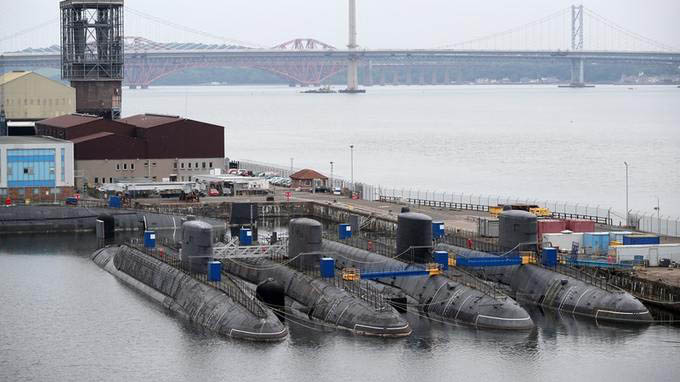
Nuclear Information Service expects no quick fix for removal of 15 decommissioned submarines laid up at Devonport
William Telford, Business Editor, 15 Feb 24 Plymouth Live
The dismantling of 15 decommissioned nuclear subs at Devonport Royal Dockyard is likely to hit delays, according to a new report. The briefing document published by the independent Nuclear Information Service says a history of infrastructure work at the Plymouth facility means “delays are more likely to materialise than not”.
The report said upgrades to 14 and 15 Docks and the Submarine Refit Complex at Devonport are overdue and progress on submarine dismantling is “on hold” while the Government focuses on its £298m “demonstrator” project to fully dismantle HMS Swiftsure at Rosyth, forecast to be complete at the end of 2026.
The Ministry of Defence told Plymouth Live it aims to dismantle the nuclear submarines at Devonport “as soon as practicably possible”. It said the Swiftsure project will “inform and refine” the dismantling process for subsequent submarines and provide more certainty on the dismantling schedule for future submarines and remains on schedule for completion by the original target date of 2026.
The Nuclear Information Service’s briefing report on Devonport Royal Dockyard gives an overview of the facility and its role in servicing the UK’s submarine fleet, including its nuclear-armed submarines. The report said: “The 15 out-of-service nuclear submarines stored at Devonport, and a further seven that are at Rosyth, together comprise every nuclear submarine the Navy has ever fielded.
“Aside from the long-overdue upgrades to 14 and 15 Docks, and the Submarine Refit Complex, progress on submarine dismantling is on hold while the Government focuses on its ‘demonstrator’ project to fully dismantle HMS Swiftsure. This work is being undertaken at Rosyth and is currently forecast to be complete at the end of 2026 at a cost of £298m.
“Three more submarines at Rosyth have had low-level waste removed from them, but it is not clear if work to defuel the nine submarines at Devonport that are still carrying nuclear fuel will begin before completion of the demonstrator project.
In 2016 the MoD estimated that fully dismantling 27 submarines would cost £2.4bn. Although the risk to in-service submarine availability from delays to submarine dismantling and defuelling is lower than from delays to the maintenance schedule, the history of problems with the project and with infrastructure work at Devonport suggests that delays are more likely to materialise than not.”…………………………..more https://www.plymouthherald.co.uk/news/plymouth-news/devonport-dockyard-nuclear-sub-dismantling-9098888—
What are Russia’s Top 5 Anti-Satellite Systems?
Sputnik, 15 Feb 24
Russia has effective means to thwart adversary satellites, including arms based on new physical principles. What are they?
Moscow trashed the groundless rumors of its alleged efforts to deploy a nuclear anti-satellite system in space on February 15.
A day earlier, mainstream US media claimed that Washington had informed Congress and its European allies about Russia’s work on a new, space-based nuclear weapon designed to undermine the US satellite network.
A new bugaboo about Russia’s supposed plans to destroy American satellites with nuclear arms is aimed at ramming a $60 billion funding package for Ukraine through US Congress, military analyst and editor-in-chief of the National Defense magazine Igor Korotchenko told Sputnik on Thursday. Even though the package in question was earlier passed in the US Senate as part of a $95 billion bill, the chances of the House approving the legislation is considered slim.
According to Korotchenko, Russia has cheaper and more effective means of anti-satellite warfare than those that Washington accuses it of developing.
This is a question of approaches. The fact is that the deployment of nuclear weapons in space is ineffective in terms of its use, especially given that Russia has much simpler and cheaper means to disable, in the event of hostilities, a significant part of the US satellite constellation,” the expert underscored.
Sputnik has taken a look at the systems that could do the job.
The Nudol System
On November 15, 2021, Moscow conducted a direct-ascent hit-to-kill anti-satellite (ASAT) test using the A-235 Nudol anti-satellite system. The test shot down an old Soviet reconnaissance satellite launched back in 1982.
The A-235 Nudol is an improved modification of the A-135 Amur strategic missile defense system. The missile can hit a target at a distance of up to 1,500 kilometers (versus 850 kilometers for the A-135), while its interception speed is increased to Mach 10 (versus Mach 3.5 for the A-135).
In contrast to its predecessor, the A-235 may use kinetic force, not nuclear or high-explosive fragmentation, to destroy the target.
The development of the A-235 Nudol started in 1985-1986 and was carried out in compliance with international ballistic missile agreements existing at the time. The weapon was designed to become the first Soviet mobile missile defense system capable of intercepting intercontinental-range missiles, spacecraft and satellites operating at high orbits.
Immediately after the Cold War, the development of the A-235 was suspended and restarted in 2011 by Almaz-Antey, nine years after the Bush administration unilaterally terminated the Antiballistic Missile Treaty (ABM) in 2002.
The system has been tested several times since 2014; however, in November 2021 the missile was fired at a specific moving space target and eventually destroyed it, causing a fuss in the Pentagon.
Nanosatellites: Nivelir, Burevestnik and Numismat
The development of Russia’s secretive project Nivelir (“Leveler”) has reportedly been carried out by the Central Scientific Research Institute of Chemistry and Mechanics Named after D.I. Mendeleyev since 2011.
The endeavor supposedly envisaged building small satellites designed to inspect other satellites in space. The first three satellite-inspectors were reportedly attached to three communications satellites launched between 2013 and 2015.
According to other sources, Russia has been experimenting with satellite inspectors since 2017. The satellites maneuvered in orbit, moving away from each other and then getting closer. In 2019, the Cosmos-2535 and Cosmos-2536 devices were launched. Their goal was to study the impact of “artificial and natural factors of outer space” on Russia’s space devices and to develop “technology for their protection.”…………………………………..
The Kontakt System
The USSR started to develop the 30P6 Kontakt (“Contact”) system in 1983. The 79М6 munition – a three-stage rocket – was supposed to be mounted on the MiG-31D fighter-interceptor.
Launched from an airplane at an altitude of 15 kilometers the munition was designed to fire a fragmentation warhead into space. It was assumed that the Kontakt system would be a stealth and inexpensive means of destroying enemy satellites……………………………………………………….
The Tirada Electronic Warfare System
According to the Russian Ministry of Defense, the Tirada-2S radio-electronic communication suppression system is capable of electronically jamming satellite communications with complete disabling. In this case, satellites can be deactivated directly from the Earth’s surface.
There is little information about the system’s specifications in the public domain. …………………………………………………………………………………..
The Peresvet Laser System
On March 1, 2018, Russian President Vladimir Putin first mentioned Russia’s laser weapon for air defense and anti-satellite warfare, the Peresvet, during his address to the Federal Assembly………………………………………….
The aforementioned systems are just a few of those potentially developed by the Russian military-industrial complex, indicating that Russia is capable of using its decades-long scientific and technological potential to ensure the nation’s security in the event of a large-scale conflict. https://sputnikglobe.com/20240215/what-are-russias-top-5-anti-satellite-systems-1116802215.html
US Gives Israel the Green Light to Kill Civilians in Rafah

US officials told POLITICO that there would be no consequences for Israel if it invades Rafah, by Dave DeCamp February 13, 2024, https://news.antiwar.com/2024/02/13/us-gives-israel-the-green-light-to-kill-civilians-in-rafah/
The US has given Israel the green light to kill civilians in Rafah despite public comments from US officials calling for Israel to come up with a plan to protect civilians in the city, which is packed with an estimated 1.5 million Palestinians.
US officials told POLITICO that the Biden administration was not planning any consequences for Israel if it went ahead with a major assault on Rafah, which would inevitably kill a huge number of civilians. “No reprimand plans are in the works, meaning Israeli forces could enter the city and harm civilians without facing American consequences,” the report reads.
White House National Security Council spokesman John Kirby made clear at a press conference on Monday that the US wasn’t thinking about cutting off Israel from military aid if it went ahead with the assault. When asked if the US has threatened to withhold aid, Kirby said, “We’re going to continue to support Israel … And we’re going to continue to make sure they have the tools and the capabilities to do that.”
President Biden is also not reconsidering his full-throated support for the Israeli slaughter in Gaza despite reports of him disparaging Israeli Prime Minister Benjamin Netanyahu in private conversations.
Congress is also on board with continuing to support the mass killing of Palestinians as the Senate voted to pass a $95 billion foreign military aid bill that includes $14 billion for Israel. Only 20 Republicans voted for the bill, but the opposition is due to the lack of a border deal, as virtually all Republicans are in favor of unconditional support for Israel, even more so than Democrats in Congress.
Rafah’s pre-war population was 275,000, meaning Palestinians displaced from other areas of the Strip increased the population fivefold. The majority of the Palestinians in the city are sheltering in tents in the streets, leaving them especially vulnerable to an Israeli attack. Israeli airstrikes on Rafah on Sunday night into Monday morning killed 27 children and 22 women.
1 This Month
Chernobyl: The Lost Tapes – A good documentary on Chernobyl on SBS available On Demand for the next 3 weeks– https://www.sbs.com.au/ondemand/tv-program/chernobyl-the-lost-tapes/2352741955560

of the week–London Campaign for Nuclear Disarmament

Tell the Ukrainian Government to Drop Prosecution of Peace Activist Yurii Sheliazhenko
To see nuclear-related stories in greater depth and intensity – go to https://nuclearinformation.wordpress.com
-
Archives
- April 2026 (152)
- March 2026 (251)
- February 2026 (268)
- January 2026 (308)
- December 2025 (358)
- November 2025 (359)
- October 2025 (376)
- September 2025 (257)
- August 2025 (319)
- July 2025 (230)
- June 2025 (348)
- May 2025 (261)
-
Categories
- 1
- 1 NUCLEAR ISSUES
- business and costs
- climate change
- culture and arts
- ENERGY
- environment
- health
- history
- indigenous issues
- Legal
- marketing of nuclear
- media
- opposition to nuclear
- PERSONAL STORIES
- politics
- politics international
- Religion and ethics
- safety
- secrets,lies and civil liberties
- spinbuster
- technology
- Uranium
- wastes
- weapons and war
- Women
- 2 WORLD
- ACTION
- AFRICA
- Atrocities
- AUSTRALIA
- Christina's notes
- Christina's themes
- culture and arts
- Events
- Fuk 2022
- Fuk 2023
- Fukushima 2017
- Fukushima 2018
- fukushima 2019
- Fukushima 2020
- Fukushima 2021
- general
- global warming
- Humour (God we need it)
- Nuclear
- RARE EARTHS
- Reference
- resources – print
- Resources -audiovicual
- Weekly Newsletter
- World
- World Nuclear
- YouTube
-
RSS
Entries RSS
Comments RSS
 nuclear-news