Netanyahu’s Post-War Plans for Gaza Call for Military Occupation ‘Without Time Limit’
The Israeli Prime Minister also wants to deploy troops along the border with Egypt
by Kyle Anzalone February 23, 2024, https://news.antiwar.com/2024/02/23/netanyahus-post-war-plans-for-gaza-call-for-military-occupation-without-time-limit/
Israel has released its first draft of its plans for post-war Gaza. Throughout the four months of a brutal onslaught, Israeli forces have decimated the Strip and killed 30,000 Palestinians. Israeli Prime Minister Benjamin Netanyahu’s post-war plans call for “operational freedom of action in the entire Gaza Strip without a time limit” and “demilitarization” of Palestinians.
The Israeli government first released the document to some media outlets on Thursday. According to the translation from NBC News, the document says, Israel will “maintain its operational freedom of action in the entire Gaza Strip, without a time limit,” and “The security perimeter being created in the Gaza Strip on the border with Israel will remain as long as there is a security need for it.”
Israel is also requesting control of the border between Egypt and Gaza. Netanyahu’s plan may face resistance in Washington and Cairo. Egypt has demanded that Israel not deploy its forces along the border. The US has asked Israel not to expand buffer zones in Gaza. However, Tel Aviv has ignored nearly all of Washington’s requests over the past four months with no impact on US aid shipments to Israel.
Netanyahu says he will not allow the rebuilding of the Strip to begin until the Palestinians have been “deradicalized.” Additionally, Tel Aviv plans to have complete control over the future political system in Gaza. Netanyahu says the Strip will be fully demilitarized.
President Joe Biden has requested that Netanyahu allow Arab states to finance the reconstruction of Gaza and allow the Palestinian Authority (PA) to govern Gaza in the process of creating a sovereign Palestine. Netanyahu’s proposal did not mention the PA.
The Israeli government has repeatedly stated that it will not allow the PA to control Gaza or the Palestinians to have a state. In the statement released by the Israeli government, Netanyahu says, “Israel utterly rejects international diktats over a final-status agreement with the Palestinians.”
Netanyahu additionally plans to shut down UNRWA, the main aid agency in Gaza, that hundreds of thousands of Palestinians rely on for survival. Tel Aviv recently accused the UN Relief and Works Agency of employing 12 people who took part in the Hamas attack in Israel. However, a US intelligence community assessment only endorsed the claim with “low confidence.”
NATO says Kiev can use F-16 jets to strike targets ‘outside Ukraine’, despite Russia’s warning
More recently, some Russian officials have threatened that further western backing for Ukraine could lead to a global nuclear war.
Financial Times, Thu, 22 Feb 2024 https://www.sott.net/article/489220-NATO-says-Kiev-can-use-F-16-jets-to-strike-targets-outside-Ukraine-despite-Russias-warning
Ukraine has the right to strike “Russian military targets outside Ukraine” in line with international law, the Nato secretary-general has said for the first time since the start of the full-scale war nearly two years ago.
Jens Stoltenberg earlier this week acknowledged that the use of western-supplied arms to strike targets in Russia had long been a point of contention among Kyiv’s allies, due to fears of escalating the conflict.
“It’s for each and every ally to decide whether there are some caveats on what they deliver, and different allies have had a bit different policies on that,” Stoltenberg told Radio Free Europe in an interview published on Tuesday.
“But in general, we need to remember what this is. This is a war of aggression by Russia against Ukraine, in blatant violation of international law. And according to international law, Ukraine has the right to self-defence,” Stoltenberg added. “And that includes also striking legitimate military targets, Russian military targets, outside Ukraine. That is international law and, of course, Ukraine has the right to do so, to protect itself.”
A Nato official confirmed to the Financial Times on Thursday that Stoltenberg said Kyiv had the right to self-defence, including by striking legitimate Russian military targets outside Ukraine.
The comments represent a step up in rhetoric from Stoltenberg, who has previously referred to Kyiv’s rights under international law without explicitly mentioning attacks on Russian territory.
Comment: There have been a significant number of attacks on Russian territory, albeit mostly sabotage, but indeed this would represent an overt escalation, and to which Russia will be forced to respond: 14th Feb Massive explosion at Russia’s Voktinsk munitions factory
The debate over using western weapons to strike Russia is likely to intensify as some Nato allies begin to ship F-16 fighter jets to Ukraine. The US-made aircraft, if armed with long-range missiles, could significantly increase the potential range of Kyiv’s strikes into Russian territory.
In recent months Kyiv has stepped up strikes on military targets inside Russia with drones and long-range missiles, including an oil depot used by the Russian army near St Petersburg.
However, due to western sensitivities around attacks on Russian territory, Ukraine has only ever alluded to its responsibility. A spokesperson for Ukraine’s air defence forces, Yuriy Ignat, said that Ukraine “as a rule, does not comment”.
France and the UK, which have already supplied Kyiv with long-range missiles, have been cautious about endorsing such strikes for fear of escalation with Moscow.
In Germany, lawmakers are seeking to persuade Chancellor Olaf Scholz to send Taurus missiles to Ukraine, a long-standing demand from Kyiv as it could use the advanced German weapon to strike Russia’s supply lines.
The government’s parliamentary majority on Thursday was set to approve a motion asking Scholz to deliver “additional long-range weapons systems” to Kyiv, which many take to mean Taurus. The German missile has a slightly longer range than its French and British equivalents and is more sophisticated against reinforced structures, such as bunkers and bridges.
Russian President Vladimir Putin hinted last year that Moscow could strike western-supplied F-16s outside Ukraine’s borders, which he said risked bringing Nato into a direct conflict with Russia. “This seriously risks dragging Nato further into this armed conflict,” Putin said in June.” The tanks are burning and the F-16s will burn just as well.”
More recently, some Russian officials have threatened that further western backing for Ukraine could lead to a global nuclear war.
“We should do everything to stop [nuclear war] happening, but the clock is ticking faster and faster,” Dmitry Medvedev, a former president and prime minister, said in an interview published on Thursday.
“And in this I also see the impotence of western governments that are always saying the same thing: ‘The Russians are trying to scare us, they’ll never do it.’ They are mistaken. If the existence of our country is at stake, then what choice does our head of state have? None.”
Long-range strike capabilities for Kyiv have become more critical as the situation on the frontline becomes increasingly stalled in a gruelling artillery battle where Russian troops are able to outfire Ukraine’s by about three to one.
While Russia captured the town of Avdiivka last week, its first major battlefield victory since May 2023, the 1,000km frontline is largely static.
“It’s also important to actually recognise that even though the situation on the battlefield is difficult, we should not overestimate Russia and underestimate Ukraine,” Stoltenberg told reporters last week, noting that Ukrainian forces were able to carry out “deep strikes” into Russian-occupied Crimea and that they succeeded in sinking one of Russia’s ships in the Black Sea.
Comment: RT explains Russia’s position:
The way the US-made jet is designed means it might have difficulties operating from Ukrainian runways, sparking speculation that they could be flown from Poland, Romania or the Baltic states instead.
Russia has repeatedly warned such a deployment would be an escalation of the conflict and may even risk nuclear war, as the F-16 is capable of delivering B61 gravity bombs.
“So, if one of those planes takes off from a NATO nation – what would that be? An attack on Russia. I shall not describe what could happen next,” Dmitry Medvedev, former Russian president and deputy head of Russia’s National Security Council, said in an interview on Thursday.
It’s becoming clear that the US is intent on escalating the situation in one way or another, and alongside this Russia has been revealing just how involved with the proxy war the West is:
Pentagon’s New Military Satellite Program Poses Threat to Russia

Ekaterina Blinova, 24 Feb 24 https://sputnikglobe.com/20240222/pentagons-new-military-satellite-program-poses-threat-to-russia-1116925932.html—
Washington recently raised a great fuss over the alleged “Russian threat”, citing, in particular, possible space-based nuclear deployments. Moscow shredded the speculations, suggesting that the US is using the rumors as a smokescreen for its own military programs.
Hours after the US press published groundless claims of Russia’s space-based nuclear program, the Pentagon sent “a missile-tracking system” into orbit – part of the Department of Defense’s new plan dubbed Proliferated Warfighter Space Architecture that aims to fill the low-Earth orbit with myriads of small and cheap satellites.
The New York Times broke the Pentagon’s new initiative on February 15, explaining that the US military had adopted an approach similar to Elon Musk’s Starlink satellite constellation. If America’s adversaries knock down even a dozen of those small and cheap Pentagon satellites, the system would continue operating shifting to other units, according to the media outlet. As Deputy Defense Secretary Kathleen H. Hicks stated last month, the Pentagon will be able to launch those small cost-effective satellites “almost weekly.”
“Now, as you all know, SPACECOM is DoD’s newest combatant command,” Hicks said at a US Space Command gathering on January 10. “Every day, SPACECOM delivers tremendous value across our Joint Force, with satellite communication, early warning radars, GPS that enable not only navigation for people, planes, trucks, and ships – but also the precision-guided munitions that have become a hallmark of how the US military fights in the modern era.”
The Pentagon’s new satellite program poses a challenge to Russia, according to Sputnik’s interlocutors, Ivan Moiseev, the head of the Russian Institute of Space Policy, and Dr. Natan Eismont, a leading researcher at the Russian Academy of Sciences’ Space Research Institute.
Starting from 2014, the Pentagon has been dramatically increasing its capabilities in space, according to Moiseev. In December 2019, then-US President Donald Trump authorized the establishment of the US Space Force (USSF), as a special military service branch of the US Armed Forces.
In addition, the Pentagon boosted cooperation with commercial firms specializing in space technologies which dramatically enhanced the DoD’s capabilities, the scientist pointed out. To illustrate his point Moiseev referred to the Pentagon’s cooperation with Musk’s SpaceX, which operates over 5,400 satellites in low Earth orbit (LEO). Commercial satellites can be used by the Pentagon as any dual-use equipment, but formally they would not be considered “military satellites”, he continued.
These satellites are controllable. And if there is a tense situation, because in order to do this, you need a very tense situation – virtually a war or at least a hybrid war – then these satellites can target any of [Russia] 160 satellites. This has never been announced, it is simply clear because such a possibility exists,” Moiseev presumed.
Presently, the United States has approximately 9,000 satellites in space with 70% of them being communication satellites to “connect the world,” as USSF Maj. Gen. Gregory Gagnon, deputy chief of Space Operations for Intelligence, outlined at the Air and Space Forces Association’s Warfare Symposium on February 13.
However, the number of US satellite constellations is rapidly growing, noted Dr. Natan Eismont.
“The composition of these [satellite] groups is growing, and literally within five years, Musk alone is expected to increase the number of these devices to more than 10,000. Does this create any additional problems? Of course it does, yes,” Eismont told Sputnik.
On the one hand, one cannot rule out collisions of various spacecraft as the low orbit would become “crowded”. On the other hand, myriads of satellites could be used for military purposes, he noted.
“That is, these are both civilian and military [satellites]. It is almost impossible to separate them. Although there were attempts to separate. And not only attempts, in general, and implementation, when these tasks were divided. But still, one cannot say that these devices are exclusively for military purposes, and those are for civilian purposes. If the device was intended for civilian purposes, then converting it for use by military structures is simple. The device will remain the same. This is something that has to be considered and taken into account,” the leading researcher continued.
Eismont agreed that in this respect, US satellite constellations pose a threat to Russia. However, he resolutely rubbished the possibility of Russia using space-based nuclear weapons, promoted by the US press: “There will be no winners here. There will only be losers,” he stressed. When it comes to space, great powers need to sit and talk; these issues should be solved solely diplomatically, Eismont concluded.
$14 Billion US Aid Package for Israel Crafted to Prepare for ‘Multi-Front War,’ Not Just Gaza

The $14 billion is included in the $95 billion foreign military aid that was recently passed by the Senateby Dave DeCamp February 22, 2024 at 1:26 pm ET CategoriesNewsTagsIsrael, Palestine
The $14 billion in additional military aid for Israel that President Biden is seeking was designed not just for operations in Gaza but also to prepare Israel for a “multi-front war,” The Times of Israel has reported.
A senior Biden administration official told The Jewish Telegraphic Agency that the $14 billion is “for Israel to defend itself in a multi-front war and to be sure it can deter a multi-front war.”
Israel has been escalating airstrikes in Lebanon against Hezbollah, though many strikes have killed civilians. The fire across the border risks a full-blown war, and there are no signs tensions will ease anytime soon. Israeli officials have been threatening to invade if Hezbollah doesn’t move back from the Israel-Lebanon border.
US officials have acknowledged to The Washington Post that Israeli Prime Minister Benjamin Netanyahu might view war in Lebanon as key to his political survival, as polling has shown Israelis want him to step down after the current conflict.
Israel also appears to be attempting to provoke Iran as several members of Iran’s Islamic Revolutionary Guard Corps (IRGC) have been killed by Israeli airstrikes in Syria since October 7. According to The New York Times, Israel was also behind a covert attack on two natural gas pipelines inside Iran.
The $14 billion is packed into the $95 billion foreign military aid bill that passed through the Senate but has yet to be brought to the House floor for a vote as Republicans are still looking for a border deal. The legislation also includes about $60 billion for Ukraine, and $4.8 billion for Taiwan and other spending in the Asia Pacific.
The $14 billion for Israel is on top of the $3.8 billion the country receives from the US each year. According to The Times of Israel, It includes $5.2 billion to go toward Israeli missile defense, which is seen as a critical necessity for a war with Hezbollah.
Another $3.5 billion will replenish munitions Israel has used in Gaza. The US will use $4 billion US to refill its own stockpiles, including a contingency stockpile located in Israel that the Israeli military has been allowed to use for its operations in Gaza.
Since October 7, the US has been shipping bombs and other types of weapons on a near-daily basis. According to the Israeli news site Ynet, the US has shipped over 25,000 tons of military equipment to support the Israeli slaughter in Gaza, which has killed over 29,000 Palestinians.
Ten years after Maidan: Why won’t the West admit that the coup was based on a lie?
Felix Livshitz, RT, Sat, 24 Feb 2024, https://www.sott.net/article/489209-Ten-years-after-Maidan-Why-wont-the-West-admit-that-the-coup-was-based-on-a-lie
—
This feature was first published on February 6, 2023. On the occasion of the 10th anniversary of the events that took place in Kiev on February 22, 2014, we are again posting it on the front page.
Political scientist Ivan Katchanovski – of the University of Ottawa – revealed last year, in a paper, that the February 2014 massacre of Ukrainian protesters by sniper fire, a defining moment of the Western-backed Maidan coup, was not published by an academic journal for “political reasons.”
Evidence that external forces were involved has been suppressed for ‘political reasons’
‘The evidence is solid’
In a lengthy Twitter thread, Katchanovski first laid out the circumstances behind the rejection of his article, and the bombshell evidence included in it. The paper was initially accepted with minor revisions after peer review, and the journal’s editor offered a glowing appraisal of his work, writing:
“There is no doubt that this paper is exceptional in many ways. It offers evidence against the mainstream narrative of the regime change in Ukraine in 2014… It seems to me that the evidence the study produces in favour of its interpretation on who was behind the massacre of the protesters and the police during the ‘Euromaidan’ mass protests on February 18-20, 2014, in Ukraine, is solid. On this there is also consensus among the two reviewers.”
As the editor noted, the massacre was a “politically crucial development,” which led to the “transition of powers in the country” from the freely elected Viktor Yanukovich to the illegitimate and rabidly nationalistic administration of Aleksandr Turchinov, a former security services chief. It was endlessly cited in Western media as a symbol of the brutality of Ukraine’s government and an unprovoked attack on innocent pro-WesternMaidan protesters, who allegedly sought nothing more than democracy and freedom.
Rumors that the killings were a false flag intended to inflame tensions among the vast crowds filling Maidan, and provoke violence against the authorities, began circulating immediately.
No serious investigation into what happened was ever conducted by the Western media, with all claims that the sniper attacks were an inside job dismissed as Kremlin “disinformation.” However, even NATO’s Atlantic Council adjunct admitted in 2020 that the massacre was unsolved and that this “cast a shadow over Ukraine.”
Ask the witnesses
It may not remain unsolved for much longer though, due to an ongoing trial of policemen at the scene on the fateful day. The legal action has been unfolding for well over a year and has received no mainstream news attention at all outside Ukraine. Katchanovski drew heavily on witness testimony and video evidence that has emerged over the course of the trial in his suppressed paper.
For example, 51 protesters wounded during the incident testified at the trial that they were shot by snipers from Maidan-controlled buildings, and/or witnessed snipers there. Many spoke of snipers in buildings controlled by Maidan protesters shooting at police. This is consistent with other evidence collected by Katchanovski, such as 14 separate videos of snipers in protester-controlled buildings, 10 of which clearly feature far-right gunmen in the Hotel Ukraina aiming at crowds below.
In all, 300 witnesses have told much the same story. Synchronized videos show that the specific time and direction of shots fired by the police not only didn’t coincide with the killings of specific Maidan protesters, but that authorities aimed at walls, trees, lampposts, and even the ground, simply to disperse crowds.
Among those targeted by apparently Maidan-aligned snipers were journalists at Germany’s ARD. They weren’t the only Western news station in town at the time – so too were Belgian reporters, who not only filmed Maidan protesters screaming towards Hotel Ukraina for snipers not to shoot them, but also participants being actively lured to the killing zone. This incendiary footage was never broadcast.
CNN likewise filmed far-right elements firing at police from behind Maidan barricades, then hunting for positions to shoot from the 11th floor of the Hotel Ukraina, minutes before the BBC filmed snipers shooting protesters from a room where a far-right MP was staying. The network opted not to report this at the time.
We needn’t rely purely on video footage. Over the course of the trial, no fewer than 14 self-confessed members of Maidan sniper groups testified they had explicitly received massacre orders, Katchanovski claims. By contrast, no police officer at the scene has said they were directed to kill unarmed protesters, no minister has come forward to blow the whistle on such a scheme, and no evidence Yanukovich approved of the killings has ever emerged.
Separate from the trial, leaders of the far-right Svoboda party have openly stated that Western government representatives expressly told them before the massacre that they would start calling for Yanukovich’s ouster once casualties among protesters reached a certain number. This figure was even actively discussed by both sides – were five enough, or 20? Or even 100? The latter was the final total reported, and indeed led to calls for the Ukrainian government’s abdication.
***
Katchanovski previously published a landmark study on the Maidan massacre in 2021, which has been referenced over 100 times by scholars and experts, already making him one of most cited political scientists specializing in Ukraine, according to Google Scholar.
Whatever the nature and source of the political pressure applied to the journal that led to the censoring of the dynamite paper, the move may well backfire massively, in the spirit of the Streisand Effect. Indeed, it could help the truth of what happened on those deadly days come out, and assist in those responsible for the killings being brought to justice.
It should also prompt a wider reconsideration of the nature of Maidan too, and the government it produced. The banning of opposition parties, attacks on the Orthodox Church, the closure of dissident media outlets, and the war on Russian culture and language are all consequences.
Comment: It is interesting that the West keeps claiming that Ukraine is fighting for European values for as the last paragraph shows, those values contain nothing democratic, just or fair in them. The West might be right though as European values in reality are getting closer and closer to those demonstrated in Ukraine, namely fascism and totalitarianism.
See also:
Donald Trump and nuclear weapons are a scary mix.
A failing British nuclear arsenal reliant on the goodwill of Donald Trump? It’s a terrifying thought
Simon Tisdall. Guardian, 24 Feb 24
Believing US-supervised nuclear weapons make Britain safer is not only delusional and unsustainable, it’s dangerous.
Donald Trump and nuclear weapons are a scary mix. As president, he greatly expanded the US nuclear arsenal, scrapped arms control treaties and repeatedly threatened to start a nuclear war. On leaving office, he stole nuclear secrets from the White House and leaked their contents. A judge recently questioned his mental health.
For close ally Britain, the scariest thought is that Trump, if re-elected in November, could fatally undermine the UK’s “independent” nuclear deterrent, or worse, pressure London into actually using it. If Trump blundered into a nuclear showdown with, say, China, Russia or North Korea, Britain would be expected to back him – and could become a target.
None of these scenarios may be ruled out, despite UK insistence that it retains sole operational control of its four Vanguard-class nuclear missile submarines. In truth, such outcomes grow more plausible as the international security situation deteriorates, Trump threatens to abandon Nato and Europe, and nuclear arms proliferate globally. Successive UK governments are primarily to blame for Britain’s deepening nuclear nightmare. All have colluded in the pretence that the UK deterrent, known generically as Trident, is independent. In fact, the Vanguard submarines rely on American technology, logistics and maintenance, as will their Dreadnought-class successors. The new W93 replacement warhead borrows from US designs.
Even the US-made Trident II D5 ballistic missiles that carry the warheads are not owned but leased under the terms of the 1958 US-UK mutual defence agreement (MDA) and 1963 Polaris sales agreement. “UK nuclear weapons are only as independent as the US wants them to be,” a new study by the anti-nuclear Pugwash scientists’ network says. “The MDA [locks] the UK into dependence on the US for the procurement of nuclear weapons,” Pugwash states. “In practice, the UK’s technical dependence on the US would constrain any attack to which Washington objected. For example, the UK is reliant on American software for all aspects of nuclear targeting.”
This chronic dependency would give a re-elected Trump huge leverage, should he choose to use it, in the not improbable event of a security or foreign policy clash with a Labour government, for example, over Ukraine. Britain’s deterrent has always ultimately relied on US goodwill, an all-party commission on Trident noted in 2014……………………………………………………………………………
Britain’s habitual willingness to follow America to war, seen again recently in the Red Sea and notoriously in Iraq in 2003, could be its undoing – unless policy changes. “The UK is more likely to use nuclear weapons in a bilateral UK-US operation than either as part of a Nato strike or independently,” Pugwash says. The House of Commons defence select committee concluded in 2006 that “the only way that Britain is ever likely to use Trident is to give legitimacy to a US nuclear attack by participating in it…. In a crisis the very existence of the UK Trident system might make it difficult for a UK prime minister to refuse a request by the US president to participate.”
Trump aside, Britain’s deterrent faces multiple problems. One estimate puts the overall cost of renewing and maintaining Trident from 2019 to 2070 at £172bn. The system already faces delays and cost overruns. The first Dreadnought submarine is not expected to enter service until the early 2030s.
Meanwhile, the four Vanguard subs and their crews are undertaking record-length patrols, continuously at sea for five months or more. This reportedly compounds maintenance and morale problems. The entire fleet is now older than its originally planned service life of 25 years, according to the independent Nuclear Information Service. And the deterrent’s reliability is in question after a second, consecutive missile test failure last month. Official secrecy hinders public and parliamentary scrutiny of ministerial claims that all is working well…………………………………………………………………………………………
An incoming Labour government must not wait until disaster strikes. It should reallocate Trident’s billions to more socially useful projects. The belief that US-supervised and controlled nuclear weapons somehow make Britain safer and boost its global influence is delusional, unsustainable, unaffordable – and, in the age of Trump, downright dangerous. https://www.theguardian.com/commentisfree/2024/feb/24/failing-british-nuclear-arsenal-reliant-on-the-goodwill-of-donald-rump-is-terrifying-thought
First 2 years of US proxy war against Russia finds both US and Ukraine in downward spiral

Between 2007, and February 24, 2022, former presidents George W. Bush, Barack Obama, Donald Trump and Joe Biden floated NATO membership to Ukraine. This was in violation of George H.W. Bush’s 1991 promise not to expand NATO eastward toward Russia.
Sensible diplomats and historians scolded the US that such a move east was a red line of provocation that would inevitably result in military Russian pushback. They compared it with JFK’s willingness to start nuclear war with Russia to prevent installation of Russian missiles just 90 miles from the US in Cuba.
But the reckless presidents occupying the While House pushed on with their lust to expand NATO till Russia was completely surrounded to the west by US allies, possibly nuclear armed, to both isolate and degrade Russia as a political rival to US European hegemony.
But it was President Biden, after 15 long years of Russian pleading with America to cease NATO expansion, to trigger a violent Russian response. While touting NATO membership for Ukraine, he poured hundreds of millions in weaponry for Ukraine to finish off the Russian leaning Ukrainian dissidents in the Donbas seeking independence from Kyiv. He rebuffed every Russian entreaty to consider Russia’s security concerns. He even told Russia thru his spokesperson that ‘Russia’s security concerns were not up for discussion.’ A first year political science student wouldn’t have made that mistake.
So, after 15 years of pleading, Russia’s military response began 2 years ago today. What has it achieved for Ukraine who lobbied the US hard for NATO membership? Over 400,000 dead soldiers and 10,000 dead civilians. Over 14 million Ukrainians displaced from their homes, with 6 million fleeing as refugees in 11 European countries. Over a third of the prewar Ukraine economy is gone, putting Ukraine on US/NATO life support just to function. The Ukrainian military is near collapse. That is quite a needless decline for the US and Ukraine to provoke a senseless war.
Tho certainly not bloody nor broken economically as Ukraine, the US is also in decline from the war it provoked 2 years ago. Our sanctions against Russia have failed spectacularly. Our call for worldwide support to defeat Russia have been, outside of NATO and a few others, ignored. Dozens of countries, large and small, have abandoned US hegemony to join BRICS AND SCO, two political economic organizations dedicated to a multi polar world of nations not dominated by America. The US has boxed itself into a decline in world influence from which it will likely never recover. That is both good and long overdue.
But rather than face reality and direct Kyiv to negotiate the best resolution possible in a hopeless war, the US slogs on,pledging Ukraine $60 billion more in weapons for which there a few soldiers left to fire.
America’s decline which began 2 years ago today is political, diplomatic and moral, a trifecta of stupidity of which the Big Fools in the Biden administration are too blind or simply unwilling to see.
Ralph Nader: What the Mass Media Needs to Cover Re: Israel/Gaza Conflict.

By Ralph Nader, February 23, 2024
Last October 27, I suggested subjects the mainstream media needed to cover relating to the saturation bombing of Gaza and its defenseless civilian families and infrastructure. Looking at these topics now, four months later, despite massive reporting, the attention to these subjects is still thin and more deserving of reporting than ever.1. How did Hamas, with tiny Gaza surrounded by a 17-year Israeli blockade, subjected to unparalleled electronic surveillance, with spies and informants, and augmented by an overwhelming air, sea and land military presence, manage to get the weapons and associated technology for their October 7th surprise raid? Readers still do not know how and from where these weapons entered Gaza year after year.
2. What is the connection between the stunning failure of the Israeli government to protect its people on the border and the policy of P.M. Netanyahu? Recall the New York Times (October 22, 2023) article by prominent journalist, Roger Cohen, to wit: “All means were good to undo the notion of Palestinian statehood. In 2019, Mr. Netanyahu told a meeting of his center-right Likud party: ‘Those who want to thwart the possibility of a Palestinian state should support the strengthening of Hamas and the transfer of money to Hamas. This is part of our strategy.’” (Note: Israel and the U.S. fostered the rise of Islamic Hamas in 1987 to counter the secular Palestine Liberation Organization (PLO)). Readers still need more information about the context of Netanyahu’s declared support for Hamas over the years and his connection to the buildup of Hamas funding and weaponry.
3. Why is Congress preparing to appropriate over $14 billion to Israel in military and other aid without any public hearings and without any demonstrated fiscal need by Israel, a prosperous economic, technological and military superpower with a social safety net superior to that of the U.S.? USDA just reported over 44 million Americans struggled with hunger in 2022. This, in the midst of a childcare crisis. Should U.S. taxpayers be expected to pay for Netanyahu’s colossal intelligence/military collapse? As an elderly Holocaust survivor told the New York Times “It should never have happened” in the first place.
4. Why hasn’t the media reported on President Biden’s statement that the Gaza Health Ministry’s body count (now over 7000 fatalities) is exaggerated? Indications, however, are that it is a large undercount by Hamas to minimize its inability to protect its people. Israel has fired over 8,000 powerful precision munitions and bombs into Gaza so far. These have struck many thousands of inhabited buildings – homes, apartments buildings, over 120 health facilities, ambulances, crowded markets, fleeing refugees, schools, water and sewage systems, and electric networks – implementing Israeli military orders to cut off all food, water, fuel, medicine and electricity to this already impoverished densely packed area the size of Philadelphia. For those not directly slain, the deadly harm caused by no food, water, medicine, medical facilities and fuel will lead to even more deaths and serious injuries.
Note that over three-quarters of Gaza’s population consists of children and women. Soon there will be thousands of babies born to die in the rubble. Other Palestinians will perish from untreated diseases, injuries, dehydration, and from drinking contaminated water. With crumbled sanitation facilities, physicians are fearing a deadly cholera epidemic.
Israel bombed the Rafah crossing on the Gaza-Egypt border. Only a tiny trickle of trucks are now allowed there by Israel to carry food and water. Fuel for hospital generators still remains blocked.
The undercount of fatalities/injuries is far greater now. The official figure is about 30,000 lives lost, with hundreds dying every day under the rubble. There is too little media interest in more realistic estimates. Undercounting lessens the pressure on Washington officials’ co-belligerents in the White House to call for a permanent ceasefire.
5. Why can’t Biden even persuade Israel to let 600 desperate Americans out of the Gaza firestorm?
6. Why isn’t the mass media making a bigger issue out of Israel’s long-time practice of blocking journalists from entering Gaza, including European, American and Israeli journalists? The only television crews left are Gazan-residing Al Jazeera reporters. Israeli bombs have already killed 26 journalists in the Gaza Strip since October 7th. Is Israel targeting journalists’ families? The Gaza bureau chief of Al Jazeera, Wael Al-Dahdouh’s family was killed in an Israeli airstrike on Wednesday. Israeli commanders now have killed over 100 journalists in addition in some cases to their entire families and continue to block foreign journalists except for a few brief “guided tours” in Israeli armored vehicles.
7. Why isn’t the mainstream U.S. media giving adequate space and voice to groups advocating a ceasefire and humanitarian aid? The message of Israeli peace groups’ peaceful solutions are drowned out by the media’s addiction to interviews with military tacticians. Much time and space are being given to hawks pushing for a war that could flash outside of Gaza big time. Shouldn’t groups such as Jewish Voice for Peace, the Arab-American Institute, Veterans for Peace and associations of clergy have their views and activities reported? Still being underreported are the activities all over the country of the Veterans for Peace and large labor unions demanding a permanent ceasefire and humanitarian aid.
8. Why is the coverage of the war overlooking the Geneva Conventions, the United Nations Charter and the many provisions of international law that all the parties, including the U.S., have been violating? (See the October 24, 2023 letter to President Biden). Under international law, Biden has made the U.S. an active “co-belligerent,” of the Israeli government’s vocal demolition of the 2.3 million inhabitants in Gaza, who are mostly descendants of Palestinian refugees driven from their homes in 1948. (See, Convention on the Prevention and Punishment of the Crime of Genocide). Coverage has expanded to include the U.S. vetoes on the Security Council and to global reporting on the International Court of Justice proceedings on South Africa’s calling for the Court to address Israel’s genocide of Palestinians in the Gaza Strip.
9. What about revealing human-interest stories? For example: How do Israeli F-16 pilots feel about their daily bombing of the completely defenseless Gazan civilian population and its life-sustaining infrastructures? The reporting on the military orders given to Israeli soldiers in Gaza who are slaying indiscriminately thousands of innocents of all ages and snipers attacking people and children in hospitals is inadequate. Why are no Hamas fighters taken as prisoners of war? Is there an order of “take no prisoners” even after capture? What are the courageous Israeli human rights and refuseniks thinking and doing in a climate of serious repression of their views as a result of Netanyahu’s defense collapse on October 7th? The open letter to President Biden on December 13, 2023, by 16 Israeli human rights groups appeared as a paid notice in the New York Times but received very little notice to its clarion call to stop the catastrophe in Gaza. (See the letter here).
10. Where is the media attention on the statements from Israeli military commentators, who, for years have declared high-tech US-backed, nuclear-armed Israel to be more secure than at any time in its history? Israel is reasserting its overwhelming military domination of the Middle East region, fully backed by U.S. militarism. The Israeli government is putting ads in U.S. newspapers wildly exaggerating long-subdued Hamas as an “existential” threat. Without Netanyahu strangely failing to keep the border guarded on October 7, 2023, what followed would not have happened!
Historians remind us that in a grid-locked conflict over time, it is the most powerful party’s responsibility to lead the way to peace.
Establishing a two-state solution has been supported by many Palestinians. All the Arab nations, starting with the Arab League peace proposal in 2002, support this solution as well. It is up to Israel and the U.S., assuming annexation of what is left of Palestine is not Israel’s objective. (See, the March 29, 2002 New York Times article: Mideast Turmoil; Text of the Peace Proposals Backed by the Arab League).More media attention on this subject matter is much needed.
The Rebellious CEO by Ralph Nader was published on November 14th. For more information go to: rebellious.ceo
U.S. Militarizes Space While Accusing Russia of Doing So

Since the creation of the U.S. Space Force in 2019, Washington has seen the militarization of space as a true strategic priority. At the time, then-American President Donald Trump had made it clear that the country’s objective was to achieve “American dominance in space.” Since then, several activities to increase American military space capabilities have been undertaken – many of them in partnership with other NATO countries and international allies.
In 2022, NATO began drafting a “space doctrine” based on “interoperability”. The following year, the alliance published a document exposing its main interests in space and pursuing American guidelines for the militarization of the orbit.
Lucas Leiroz, Strategic Culture Foundation, Tue, 20 Feb 2024, https://www.sott.net/article/489189-US-militarizes-space-while-accusing-Russia-of-doing-so
Recently, the U.S. began spreading rumors about alleged Russian space-based nuclear weapons. According to American intelligence, Moscow is developing a powerful anti-satellite weapon to be deployed in space, thus violating international norms that prohibit the militarization of Earth’s orbit.
In 2022, NATO began drafting a “space doctrine” based on “interoperability”. The following year, the alliance published a document exposing its main interests in space and pursuing American guidelines for the militarization of the orbit. According to analysts, the “interoperability” of NATO’s space activities simply means the creation of mechanisms for U.S. allies to help pay the high costs of military space development – while, on the other hand, only the Pentagon maintains real control of the activities and benefits from “space control”.
Mike Turner, head of the House Intelligence Committee, formally asked for the declassification of documents concerning the investigation on the “space-nukes”, stating that a deliberation on the case in the National Congress is necessary. According to Turner, American parliamentarians need to discuss this serious “threat” to U.S. national security, having therefore the requirement to fully release data obtained by intelligence on the subject.
Subsequently, the White House stated that there was no imminent threat to the country’s national security according to the information obtained so far. Spokespersons confirmed they are monitoring the possible existence of a Russian nuclear space program, but denied the existence of any evidence of a high-risk threat at the moment. As a result, once again American officials made contradictory statements, discrediting the image of U.S. authorities.
Moscow denied the accusations and stated that the rumors were intended to strengthen the anti-Russian establishment, pressuring parliamentarians to recognize the existence of a “threat” and thus approve the billion-dollar military aid package to Ukraine. Considering the domestic political stalemate in the U.S., with pro-war sectors failing to convince their opponents to continue aid to Kiev, it is very likely that the intention behind the spread of anti-Russian rumors is to actually increase fear among policymakers about a possible “danger”.
Obviously, as a major military power, the Russian Federation has its own anti-satellite systems and is able to employ them, if necessary, in a possible large-scale conflict scenario. However, the current tensions between Moscow and Washington, despite high, do not bring any need to use military force against American satellites, and there is therefore no “imminent threat” to the U.S. in the Russian arsenal.
In parallel, Moscow remains firmly committed to complying with international space law standards. The deployment of weapons of mass destruction in Earth’s orbit is banned by the treaties that regulate space activities. Therefore, even though it has weapons strong enough to inflict damage on enemy countries’ satellites, Russia is not willing to allocate nuclear weapons or weapons of mass destruction in outer space, as this would violate current regulations on the matter.
In fact, Russian actions regarding the outer space make it clear that Moscow intends to cooperate to prevent the militarization of Earth’s orbit. Russia, although it has the military capacity to do so, does not invest in “space-based” weapons, focusing its space activities on the peaceful and scientific sphere. This, however, is not the case with the U.S., which openly promotes the militarization of space, with constant efforts to turn Earth’s orbit into a true battlefield.
Since the creation of the U.S. Space Force in 2019, Washington has seen the militarization of space as a true strategic priority. At the time, then-American President Donald Trump had made it clear that the country’s objective was to achieve “American dominance in space.” Since then, several activities to increase American military space capabilities have been undertaken – many of them in partnership with other NATO countries and international allies.
“The U.S. Space Command planning document stated that the U.S. will ‘control and dominate space and deny other nations if necessary access to space (…) At the Space Command HQ in Colorado just above their doorway they have a sign that reads ‘Master of Space (…) Even with all its resources the U.S. can’t afford to pay for its ‘Master of Space’ plan by itself (…) [In order to maintain its dominance], the U.S. sets up a story line that it ‘must protect space’ from the dark forces in Russia, China, Iran, and North Korea (…) Interoperability’ ensures that all NATO members purchase new expensive space technologies mostly from U.S. aerospace corporations like Lockheed Martin, Raytheon, and others. In addition, ‘interoperability’ means that all space information, surveillance, and targeting is run through the U.S.-dominated system. In other words, NATO allies help pay for these costly space warfare systems but the Pentagon controls the ‘tip of the spear’,” Professor Bruce Gagnon, director of the Global Network Against Weapons and Nuclear Power in Space, once said commenting on the topic.
All these factors lead us to believe that there really was an attempt on the part of the U.S. to create a smokescreen for its own space militarization activities. By pointing out the existence of a “Russian danger”, Washington legitimizes its own “reactive” policies, thus encouraging increased investment in space weapons in NATO. In the same sense, this smokescreen helps to pressure parliamentarians to revise their stance on supporting Ukraine. With the popularity of the anti-Russian war gradually decreasing, the creation of a non-existent threat could serve as a legitimizing factor for the conflict.
In addition to all this, it is curious how contradictory U.S. narratives about Russia fluctuate. Previously, the American media accused the Russians of fighting using shovels due to the lack of weapons. Now, on the other hand, they accuse Russia of deploying nuclear weapons from space. These lies only worsen the mainstream media’s own image among Western public opinion, leading to absolute discredit.
Ukraine can’t maintain advanced US-supplied weapons – Pentagon
https://www.rt.com/news/592888-pentagon-audit-weapons-ukraine/ 23 Feb 24
The US reportedly rushed vehicles to Kiev without factoring in necessary repairs
The US has no plan in place to maintain, service or repair tanks, armored vehicles and air defense systems Washington has given to the Ukrainian military, Pentagon Inspector-General Robert P. Storch has admitted. The failure to plan “puts at risk Ukraine’s ability to fight effectively using the US-provided equipment, as well as the DoD’s readiness to address other national security threats if needed,” he added.
Storch revealed in two redacted reports released to the public on Tuesday that the US has delivered 186 Bradley and 189 Stryker Infantry Fighting Vehicles (IFV), 31 Abrams main battle tanks, and an unspecified number of Patriot air defense systems to Ukraine.
Washington’s Department of Defense “had not developed or implemented a plan” to maintain any of them, according to the inspectors cited in the reports, who warned that there is nothing to suggest the weaponry could be sustained past October 2024.
All of the weapons systems were taken from the US military’s own stocks “without limits,” under the Presidential Drawdown Authority, according to the reports. If this practice continued, it “may require the [Department of Defense] to choose between the readiness of [Ukrainian] units or the readiness of US Army units,” one official told the inspectors.
The US military-industrial complex has struggled to replace the weapons systems sent to Ukraine, due to shortage of parts and the lack of production lines or trained personnel. Maintenance was described in the reports as an “afterthought” for the Pentagon, whose main focus was to arm Ukraine “as quickly as possible.”
An official with the US European Command told the inspectors that “the current model would not be sustainable or effective over the longer term.”
“The DoD provided Ukraine with armored vehicles and air defense systems without a plan to ensure their long-term usefulness,” Storch said in a statement. “While the DoD is currently working on developing such a plan, the lack of foresight in this matter is concerning.”
The US military sent “limited spare parts, ammunition, and maintenance support” and “did not coordinate or tailor those efforts into a comprehensive sustainment plan,” according to Storch’s reports.
What was sent included “some” consumables and spare parts for field maintenance, as well as “additional items informed by US experience operating the weapon systems in Iraq, Afghanistan, and Syria,” Storch noted.
While the sustainment is not required under the current congressional authority for sending weapons to Ukraine, “the weapon systems are not likely to remain mission capable” without it, the report said.
At least one US Patriot system has been destroyed by hypersonic missiles, according to the Russian Defense Ministry. Last year’s Ukrainian offensive saw multiple Bradley and Stryker vehicles destroyed in attempts to advance against Russian defenses. There have been no public reports of Abrams tanks being used in active combat operations so far.
Arms maker BAE Systems makes record profit amid Ukraine and Israel-Gaza wars

the company was “very happy with our London listing”
Jasper Jolly and agencies 22 Feb 24
FTSE 100 company says global instability is making government focus on defence spending.
Increased military spending prompted by Russia’s war on Ukraine and the Israel-Gaza conflict helped the British weapons manufacturer BAE Systems to record profits last year, with further growth expected in the year ahead.
The FTSE 100 company made underlying profits before interest and tax of £2.7bn on record sales of £25.3bn in 2023.
Shares in weapons manufacturers have surged in the past two years after Russia’s full-scale invasion of Ukraine in February 2022 made governments reassess their plans for military spending.
There have also been increased tensions across the Middle East since 7 October, when Hamas, which runs Gaza, killed 1,139 people in an assault on Israel. Israel has responded with months of bombardment of Gaza, killing nearly 30,000 Palestinians.
BAE Systems’ sprawling interests include building nuclear submarines and fighter jets, tanks and ships, as well as guns and ammunition.
Charles Woodburn, the BAE chief executive, said the weapons manufacturer was expecting “sustained growth in the coming years”.
………………………………….. BAE said it expected sales to rise by between 10% and 12% during 2024. Its long-term order book was also boosted last year by the Aukus pact between Australia, the UK and the US to build the next generation of nuclear-powered attack submarines, and the global combat air programme between Italy, Japan and the UK to develop a new fighter jet.
BAE said that the war in Ukraine in particular had highlighted the importance of autonomous technology, while “reinforcing the critical need for munitions and maintaining legacy capabilities”.
Woodburn also said the company was “very happy with our London listing”. Several of the biggest companies listed on London’s stock market have moved to the US because of concerns that UK companies are relatively undervalued. BAE Systems is unlikely to follow their lead because of the deep influence – including a “golden share” – that the UK government holds to prevent it falling into foreign ownership.
Woodburn said: “If you go back a few years, I think we were trading at a discount to some of our US peers, but I think through the strong performance of the business over recent years, I think we’ve, in many ways, closed much of that gap.”
Ukraine: how nuclear weapons continue to increase the risks, two years on

nuclear weapons industry has profited shamelessly off the world’s concerns over nuclear war. Since the conflict in Ukraine and the increased nuclear tensions that followed, profits for the companies that produce nuclear weapons drove up, with an $15.7 billion increase in share and bond holding and $57.1 billion increase in loans and underwriting.
https://www.icanw.org/ukraine_two_years_how_nuclear_weapons_increase_the_risks— 24 Feb 24
Two years after the start of Russia’s full-scale invasion of Ukraine, the risk of nuclear weapons use continues to escalate, while the looming threat of their use protracts this conflict with a high civilian cost. Nuclear-armed states and their allies waver between condemning nuclear threats and engaging in irresponsible practices such as nuclear sharing and championing their own nuclear deterrent. But the rest of the world is pushing back, condemning these behaviors and demanding the total elimination of these weapons of mass destruction through the UN Treaty on the Prohibition of Nuclear Weapons (TPNW).
Melissa Parke, Executive Director of ICAN, said: “This terrible war with its use of nuclear blackmail and overt threats to use nuclear weapons is a wake up call that the world needs to heed – as long as the nuclear-armed states hang on to their arsenals and cling to the misguided doctrine of deterrence, we face the likelihood these weapons will be used sooner or later. Nuclear weapons should be abolished before it is too late.”
The escalating nuclear risk
Following Vladimir Putin’s initial explicit threats to use nuclear weapons, we have seen nuclear-armed states and their allies continue to erode the decades-long nuclear taboo over the past two years. The escalation in nuclear rhetoric has not just been seen in Russia (Medvedev made explicit threats just this last weekend) but also in Israel and North Korea, and in recent calls by Polish and German politicians and NATO leaders for a European nuclear weapon. Nuclear threats heighten tensions in an already dangerous environment, reduce the threshold for use of nuclear weapons, and greatly increase the risk of nuclear conflict and global catastrophe.
The risk is also increased by the irresponsible practice of nuclear sharing, or stationing nuclear weapons, which seems to be on the rise. In June 2023, Vladimir Putin said Russia delivered its first tactical weapons to Belarus, though it is unclear how many nuclear weapons were transferred. This is a reckless and dangerous escalation that was widely condemned. But for NATO states, and particularly the five states that host US nuclear weapons, simply condemning Russia’s nuclear sharing without taking any action is insufficient and hypocritical. Particularly as the US and the UK also seemingly explore the return of US nuclear weapons to Lakenheath. Any nuclear sharing complicates decision making and increases the risk of miscalculation, miscommunication and potentially catastrophic accidents. It is time to end this practice that threatens peace and security and puts us all at risk.
Deterrence theory and nuclear weapons profiteers at the heart of the problem
The use of nuclear blackmail by Russia in the context of the Ukraine war has demonstrated the flawed nature of nuclear deterrence which, instead of ensuring stability, gave Russia the cover to commense its brutal and devastating invasion. Yet Russia’s nuclear threats have failed to deter the US and European countries from supplying Ukraine with weapons and money to fight Russia.
With current conflicts directly involving two nuclear-armed states, it is clear that nuclear deterrence doesn’t keep the peace. NATO states are playing into Putin’s hands by insisting nuclear weapons are a necessary deterrent. It only strengthens Putin’s position to promote his own “deterrent” now, whereas rejecting deterrence and reinforcing the nuclear taboo would limit his options.
Meanwhile, the conflict has also accelerated the global nuclear arms race, with the nine nuclear-armed states increasing spending to $82.9 billion in 2022. As a result, the nuclear weapons industry has profited shamelessly off the world’s concerns over nuclear war. Since the conflict in Ukraine and the increased nuclear tensions that followed, profits for the companies that produce nuclear weapons drove up, with an $15.7 billion increase in share and bond holding and $57.1 billion increase in loans and underwriting.
The global response to nuclear risk: the TPNW
The way to respond to the heightened risk of nuclear war is not to increase nuclear arsenals or threaten nuclear retaliation. The answer is for all countries to condemn nuclear threats, end their reliance on nuclear deterrence and join the UN Treaty on the Prohibition of Nuclear Weapons (TPNW). The TPNW specifically outlaws the threat to use nuclear weapons, as well as the irresponsible practice of nuclear sharing.
All nuclear-armed states need to take urgent steps to de-escalate tensions and to break free from the dangerous doctrine of nuclear deterrence, and nuclear disarmament must be an essential element of a negotiated peace between Russia and Ukraine. Multilateral nuclear disarmament is the only guarantee to prevent other nuclear-armed countries from following Russia’s lead and using their nuclear weapons as a shield to commit war crimes and terrorize civilian populations. Joining the TPNW is a crucial step to delegitimize nuclear deterrence and eliminate nuclear weapons.
Over the past two years, the states parties of the TPNW have been central in pushing back against any and all nuclear threats and challenging the false narrative of nuclear deterrence. At the First Meeting of States Parties in 2021, they condemned unequivocally “any and all nuclear threats, whether they be explicit or implicit and irrespective of the circumstances.” At the second meeting in New York,they agreed “to challenge the security paradigm based on nuclear deterrence by highlighting and promoting new scientific evidence about the humanitarian consequences and risks of nuclear weapons and juxtaposing this with the risks and assumptions that are inherent innnuclear deterrence.” It is time for all responsible states to join the TPNW.
UK to consider suspending arms exports to Israel if Rafah offensive goes ahead
As situation in Gaza worsens, diplomatic pressure is mounting on UK to follow other countries and suspend arms sales to Israel
Patrick Wintour, 23 Feb 24, Guardian,
The UK government will consider suspending arms export licences to Israel if Benjamin Netanyahu goes ahead with a potentially devastating ground offensive on the Palestinian city of Rafah in southern Gaza.
As the humanitarian situation in Gaza has worsened, diplomatic pressure has been mounting on the UK to follow other countries and suspend arms exports to Israel.
Ministerial sources said that while no decision had been made about a suspension of arms export licences, the UK had the ability to respond quickly if the legal advice to ministers said that Israel was in breach of international humanitarian law.
The UK has joined other allies in pressuring Israel to avoid a ground offensive in Rafah. In a letter to the foreign affairs select committee about arms export controls to Israel published on Tuesday, David Cameron, the foreign secretary, said he could not see how an offensive in Rafah could go ahead without harming civilians and destroying homes.
In the Commons, the UK foreign minister Andrew Mitchell underscored that an offensive in Rafah represented a red line for the UK government, telling MPs on Wednesday that the UK was urging the Israeli government not to launch an attack that could have “devastating consequences”……………………………………………………………………………………………………………………………………………………….
Earlier this month The Hague district court ordered the Dutch government to stop the export of F-35 fighter jet parts to Israel within seven days due to the risk of serious violations of international humanitarian law and referred to the ATT and EU policy. https://www.theguardian.com/world/2024/feb/21/uk-to-consider-suspending-arms-exports-to-israel-if-rafah-offensive-goes-ahead
Swarming Our World. What Happens When Killer Robots Start Communicating with Each Other?
“Emergent” AI Behavior and Human Destiny
What Happens When Killer Robots Start Communicating with Each Other?
Tom Dispatch, Michael Klare, FEBRUARY 20, 2024
Make no mistake, artificial Intelligence (AI) has already gone into battle in a big-time way. The Israeli military is using it in Gaza on a scale previously unknown in wartime. They’ve reportedly been employing an AI target-selection platform called (all too unnervingly) “the Gospel” to choose many of their bombing sites. According to a December report in the Guardian, the Gospel “has significantly accelerated a lethal production line of targets that officials have compared to a ‘factory.’” The Israeli Defense Forces (IDF) claim that it “produces precise attacks on infrastructure associated with Hamas while inflicting great damage to the enemy and minimal harm to noncombatants.” Significantly enough, using that system, the IDF attacked 15,000 targets in Gaza in just the first 35 days of the war. And given the staggering damage done and the devastating death toll there, the Gospel could, according to the Guardian, be thought of as an AI-driven “mass assassination factory.”
Meanwhile, of course, in the Ukraine War, both the Russians and the Ukrainians have been hustling to develop, produce, and unleash AI-driven drones with deadly capabilities. Only recently, in fact, Ukrainian President Volodymyr Zelensky created a new branch of his country’s armed services specifically focused on drone warfare and is planning to produce more than one million drones this year. According to the Independent, “Ukrainian forces are expected to create special staff positions for drone operations, special units, and build effective training. There will also be a scaling-up of production for drone operations, and inclusion of the best ideas and top specialists in the unmanned aerial vehicles domain, [Ukrainian] officials have said.”
And all of this is just the beginning when it comes to war, AI-style, which is going to include the creation of “killer robots” of every imaginable sort. But as the U.S., Russia, China, and other countries rush to introduce AI-driven battlefields, let TomDispatch regular Michael Klare, who has long been focused on what it means for the globe’s major powers to militarize AI, take you into a future in which (god save us all!) robots could be running (yes, actually running!) the show. Tom
By combining AI with advanced robotics, the U.S. military and those of other advanced powers are already hard at work creating an array of self-guided “autonomous” weapons systems — combat drones that can employ lethal force independently of any human officers meant to command them. Called “killer robots” by critics, such devices include a variety of uncrewed or “unmanned” planes, tanks, ships, and submarines capable of autonomous operation. The U.S. Air Force, for example, is developing its “collaborative combat aircraft,” an unmanned aerial vehicle (UAV) intended to join piloted aircraft on high-risk missions. The Army is similarly testing a variety of autonomous unmanned ground vehicles (UGVs), while the Navy is experimenting with both unmanned surface vessels (USVs) and unmanned undersea vessels (UUVs, or drone submarines). China, Russia, Australia, and Israel are also working on such weaponry for the battlefields of the future.
Michael Klare, Swarming Our World
POSTED ON FEBRUARY 20, 2024
Make no mistake, artificial Intelligence (AI) has already gone into battle in a big-time way. The Israeli military is using it in Gaza on a scale previously unknown in wartime. They’ve reportedly been employing an AI target-selection platform called (all too unnervingly) “the Gospel” to choose many of their bombing sites. According to a December report in the Guardian, the Gospel “has significantly accelerated a lethal production line of targets that officials have compared to a ‘factory.’” The Israeli Defense Forces (IDF) claim that it “produces precise attacks on infrastructure associated with Hamas while inflicting great damage to the enemy and minimal harm to noncombatants.” Significantly enough, using that system, the IDF attacked 15,000 targets in Gaza in just the first 35 days of the war. And given the staggering damage done and the devastating death toll there, the Gospel could, according to the Guardian, be thought of as an AI-driven “mass assassination factory.”
Meanwhile, of course, in the Ukraine War, both the Russians and the Ukrainians have been hustling to develop, produce, and unleash AI-driven drones with deadly capabilities. Only recently, in fact, Ukrainian President Volodymyr Zelensky created a new branch of his country’s armed services specifically focused on drone warfare and is planning to produce more than one million drones this year. According to the Independent, “Ukrainian forces are expected to create special staff positions for drone operations, special units, and build effective training. There will also be a scaling-up of production for drone operations, and inclusion of the best ideas and top specialists in the unmanned aerial vehicles domain, [Ukrainian] officials have said.”
And all of this is just the beginning when it comes to war, AI-style, which is going to include the creation of “killer robots” of every imaginable sort. But as the U.S., Russia, China, and other countries rush to introduce AI-driven battlefields, let TomDispatch regular Michael Klare, who has long been focused on what it means for the globe’s major powers to militarize AI, take you into a future in which (god save us all!) robots could be running (yes, actually running!) the show. Tom
“Emergent” AI Behavior and Human Destiny
What Happens When Killer Robots Start Communicating with Each Other?
Yes, it’s already time to be worried — very worried. As the wars in Ukraine and Gaza have shown, the earliest drone equivalents of “killer robots” have made it onto the battlefield and proved to be devastating weapons. But at least they remain largely under human control. Imagine, for a moment, a world of war in which those aerial drones (or their ground and sea equivalents) controlled us, rather than vice-versa. Then we would be on a destructively different planet in a fashion that might seem almost unimaginable today. Sadly, though, it’s anything but unimaginable, given the work on artificial intelligence (AI) and robot weaponry that the major powers have already begun. Now, let me take you into that arcane world and try to envision what the future of warfare might mean for the rest of us.
By combining AI with advanced robotics, the U.S. military and those of other advanced powers are already hard at work creating an array of self-guided “autonomous” weapons systems — combat drones that can employ lethal force independently of any human officers meant to command them. Called “killer robots” by critics, such devices include a variety of uncrewed or “unmanned” planes, tanks, ships, and submarines capable of autonomous operation. The U.S. Air Force, for example, is developing its “collaborative combat aircraft,” an unmanned aerial vehicle (UAV) intended to join piloted aircraft on high-risk missions. The Army is similarly testing a variety of autonomous unmanned ground vehicles (UGVs), while the Navy is experimenting with both unmanned surface vessels (USVs) and unmanned undersea vessels (UUVs, or drone submarines). China, Russia, Australia, and Israel are also working on such weaponry for the battlefields of the future.
The imminent appearance of those killing machines has generated concern and controversy globally, with some countries already seeking a total ban on them and others, including the U.S., planning to authorize their use only under human-supervised conditions. In Geneva, a group of states has even sought to prohibit the deployment and use of fully autonomous weapons, citing a 1980 U.N. treaty, the Convention on Certain Conventional Weapons, that aims to curb or outlaw non-nuclear munitions believed to be especially harmful to civilians. Meanwhile, in New York, the U.N. General Assembly held its first discussion of autonomous weapons last October and is planning a full-scale review of the topic this coming fall.
For the most part, debate over the battlefield use of such devices hinges on whether they will be empowered to take human lives without human oversight. Many religious and civil society organizations argue that such systems will be unable to distinguish between combatants and civilians on the battlefield and so should be banned in order to protect noncombatants from death or injury, as is required by international humanitarian law. American officials, on the other hand, contend that such weaponry can be designed to operate perfectly well within legal constraints.
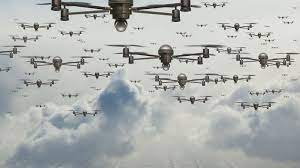
However, neither side in this debate has addressed the most potentially unnerving aspect of using them in battle: the likelihood that, sooner or later, they’ll be able to communicate with each other without human intervention and, being “intelligent,” will be able to come up with their own unscripted tactics for defeating an enemy — or something else entirely. Such computer-driven groupthink, labeled “emergent behavior” by computer scientists, opens up a host of dangers not yet being considered by officials in Geneva, Washington, or at the U.N.
For the time being, most of the autonomous weaponry being developed by the American military will be unmanned (or, as they sometimes say, “uninhabited”) versions of existing combat platforms and will be designed to operate in conjunction with their crewed counterparts. While they might also have some capacity to communicate with each other, they’ll be part of a “networked” combat team whose mission will be dictated and overseen by human commanders. The Collaborative Combat Aircraft, for instance, is expected to serve as a “loyal wingman” for the manned F-35 stealth fighter, while conducting high-risk missions in contested airspace. The Army and Navy have largely followed a similar trajectory in their approach to the development of autonomous weaponry.
The Appeal of Robot “Swarms”
However, some American strategists have championed an alternative approach to the use of autonomous weapons on future battlefields in which they would serve not as junior colleagues in human-led teams but as coequal members of self-directed robot swarms. Such formations would consist of scores or even hundreds of AI-enabled UAVs, USVs, or UGVs — all able to communicate with one another, share data on changing battlefield conditions, and collectively alter their combat tactics as the group-mind deems necessary.
“Emerging robotic technologies will allow tomorrow’s forces to fight as a swarm, with greater mass, coordination, intelligence and speed than today’s networked forces,” predicted Paul Scharre, an early enthusiast of the concept, in a 2014 report for the Center for a New American Security (CNAS). “Networked, cooperative autonomous systems,” he wrote then, “will be capable of true swarming — cooperative behavior among distributed elements that gives rise to a coherent, intelligent whole.”
As Scharre made clear in his prophetic report, any full realization of the swarm concept would require the development of advanced algorithms that would enable autonomous combat systems to communicate with each other and “vote” on preferred modes of attack. This, he noted, would involve creating software capable of mimicking ants, bees, wolves, and other creatures that exhibit “swarm” behavior in nature. As Scharre put it, “Just like wolves in a pack present their enemy with an ever-shifting blur of threats from all directions, uninhabited vehicles that can coordinate maneuver and attack could be significantly more effective than uncoordinated systems operating en masse.”
In 2014, however, the technology needed to make such machine behavior possible was still in its infancy. To address that critical deficiency, the Department of Defense proceeded to fund research in the AI and robotics field, even as it also acquired such technology from private firms like Google and Microsoft. A key figure in that drive was Robert Work, a former colleague of Paul Scharre’s at CNAS and an early enthusiast of swarm warfare. Work served from 2014 to 2017 as deputy secretary of defense, a position that enabled him to steer ever-increasing sums of money to the development of high-tech weaponry, especially unmanned and autonomous systems.
From Mosaic to Replicator
Much of this effort was delegated to the Defense Advanced Research Projects Agency (DARPA), the Pentagon’s in-house high-tech research organization. As part of a drive to develop AI for such collaborative swarm operations, DARPA initiated its “Mosaic” program, a series of projects intended to perfect the algorithms and other technologies needed to coordinate the activities of manned and unmanned combat systems in future high-intensity combat with Russia and/or China…………………………………………………………………………………………………………..
To obtain both the hardware and software needed to implement such an ambitious program, the Department of Defense is now seeking proposals from traditional defense contractors like Boeing and Raytheon as well as AI startups like Anduril and Shield AI. While large-scale devices like the Air Force’s Collaborative Combat Aircraft and the Navy’s Orca Extra-Large UUV may be included in this drive, the emphasis is on the rapid production of smaller, less complex systems like AeroVironment’s Switchblade attack drone, now used by Ukrainian troops to take out Russian tanks and armored vehicles behind enemy lines.
At the same time, the Pentagon is already calling on tech startups to develop the necessary software to facilitate communication and coordination among such disparate robotic units and their associated manned platforms. To facilitate this, the Air Force asked Congress for $50 million in its fiscal year 2024 budget to underwrite what it ominously enough calls Project VENOM, or “Viper Experimentation and Next-generation Operations Model.” Under VENOM, the Air Force will convert existing fighter aircraft into AI-governed UAVs and use them to test advanced autonomous software in multi-drone operations. The Army and Navy are testing similar systems.
When Swarms Choose Their Own Path
In other words, it’s only a matter of time before the U.S. military (and presumably China’s, Russia’s, and perhaps those of a few other powers) will be able to deploy swarms of autonomous weapons systems equipped with algorithms that allow them to communicate with each other and jointly choose novel, unpredictable combat maneuvers while in motion. Any participating robotic member of such swarms would be given a mission objective (“seek out and destroy all enemy radars and anti-aircraft missile batteries located within these [specified] geographical coordinates”) but not be given precise instructions on how to do so. That would allow them to select their own battle tactics in consultation with one another. If the limited test data we have is anything to go by, this could mean employing highly unconventional tactics never conceived for (and impossible to replicate by) human pilots and commanders.
…………………………………… In military terms, this means that a swarm of autonomous weapons might jointly elect to adopt combat tactics none of the individual devices were programmed to perform — possibly achieving astounding results on the battlefield, but also conceivably engaging in escalatory acts unintended and unforeseen by their human commanders, including the destruction of critical civilian infrastructure or communications facilities used for nuclear as well as conventional operations………………………………………………..
What then? Might they choose to keep fighting beyond their preprogrammed limits, provoking unintended escalation — even, conceivably, of a nuclear kind? Or would they choose to stop their attacks on enemy forces and instead interfere with the operations of friendly ones, perhaps firing on and devastating them
……………………………….. Many prominent security and technology officials are, however, all too aware of the potential risks of this “emergent behavior” in future robotic weaponry and continue to issue warnings against the rapid utilization of AI in warfare.
Of particular note is the final report that the National Security Commission on Artificial Intelligence issued in February 2021. Co-chaired by Robert Work (back at CNAS after his stint at the Pentagon) and Eric Schmidt, former CEO of Google, the commission recommended the rapid utilization of AI by the U.S. military to ensure victory in any future conflict with China and/or Russia. However, it also voiced concern about the potential dangers of robot-saturated battlefields……………………………………………………………..
When the leading advocates of autonomous weaponry tell us to be concerned about the unintended dangers posed by their use in battle, the rest of us should be worried indeed. Even if we lack the mathematical skills to understand emergent behavior in AI, it should be obvious that humanity could face a significant risk to its existence, should killing machines acquire the ability to think on their own…………… more https://tomdispatch.com/emergent-ai-behavior-and-human-destiny/—
Israel Demolishing Buildings to Construct Road in Gaza to Cut the Strip Into Two

The construction demonstrates Israel’s long-term plan to occupy Gaza.
By Dave DeCamp / Antiwar.com, https://scheerpost.com/2024/02/21/israel-demolishing-buildings-to-construct-road-in-gaza-to-cut-the-strip-into-two/
Israel is demolishing buildings to build a road through central Gaza that will cut the Strip in two, demonstrating Israel’s long-term plans to occupy the territory.
Israel’s Channel 14 reported on the road, which is being built in an area known as the Netzarim Corridor. The new road, known as Highway 749, will separate Gaza City from the rest of the Strip.
Israel is creating a 1-kilometer “buffer zone” to the north and south of the road, similar to the zone it’s creating along the entire Israel-Gaza border. According to The New Arab, among the structures likely to be demolished to build the road is the Turkish-Palestinian Friendship Hospital, which was shut down in November due to an Israeli siege that cut off fuel.
The construction will also require the demolition of Al-Aqsa University, several villages, amusement parks, and agricultural land. Israeli soldiers said the purpose of the road was to make it easier to launch incursions into Gaza, and it could also prevent the movement of Palestinians from the south to the north.
The Wall Street Journal also reported on the highway and said it would effectively create a militarized belt across Gaza that will help prevent the 1 million Palestinians who fled the north from returning to their homes. Israeli officials told the Journal that the road will be patrolled until Israel’s military operations are complete, which they say could be years away.
The Israeli officials also claimed that they don’t seek to occupy the Gaza Strip but plan to maintain “security control” within its borders for an indefinite period, which amounts to a military occupation. Israeli government ministers have also not been shy about their desire to re-establish Jewish settlements in Gaza.
1 This Month
Chernobyl: The Lost Tapes – A good documentary on Chernobyl on SBS available On Demand for the next 3 weeks– https://www.sbs.com.au/ondemand/tv-program/chernobyl-the-lost-tapes/2352741955560

of the week–London Campaign for Nuclear Disarmament

Tell the Ukrainian Government to Drop Prosecution of Peace Activist Yurii Sheliazhenko
To see nuclear-related stories in greater depth and intensity – go to https://nuclearinformation.wordpress.com
-
Archives
- April 2026 (152)
- March 2026 (251)
- February 2026 (268)
- January 2026 (308)
- December 2025 (358)
- November 2025 (359)
- October 2025 (376)
- September 2025 (257)
- August 2025 (319)
- July 2025 (230)
- June 2025 (348)
- May 2025 (261)
-
Categories
- 1
- 1 NUCLEAR ISSUES
- business and costs
- climate change
- culture and arts
- ENERGY
- environment
- health
- history
- indigenous issues
- Legal
- marketing of nuclear
- media
- opposition to nuclear
- PERSONAL STORIES
- politics
- politics international
- Religion and ethics
- safety
- secrets,lies and civil liberties
- spinbuster
- technology
- Uranium
- wastes
- weapons and war
- Women
- 2 WORLD
- ACTION
- AFRICA
- Atrocities
- AUSTRALIA
- Christina's notes
- Christina's themes
- culture and arts
- Events
- Fuk 2022
- Fuk 2023
- Fukushima 2017
- Fukushima 2018
- fukushima 2019
- Fukushima 2020
- Fukushima 2021
- general
- global warming
- Humour (God we need it)
- Nuclear
- RARE EARTHS
- Reference
- resources – print
- Resources -audiovicual
- Weekly Newsletter
- World
- World Nuclear
- YouTube
-
RSS
Entries RSS
Comments RSS
 nuclear-news