Did the West Intentionally Incite Putin to War?
by GORDONHAHN, February 27, 2024
Over the last year the US and NATO countries have undertaken no effort to convince Ukrainian President Volodomyr Zelenskiy to begin talks with Putin, despite: the death of more than half a million Ukrainians; the destruction of much of Ukraine’s economy, finances, physical infrastructure, human capital, civil society; and the West’s inability to sustain financial and military support even as Ukraine loses the war when said support was at its height.
The West’s war strategy now seems to be to prolong a ‘long war’ in the hope either that the war begins to affect Russia and Putin’s standing there or that Putin’s health wanes and his system destabilizes. All this and much more written below raises suspicions the West intentionally, maybe even ‘subconsciously’ – the actions of small policy victories won in order to ‘confront Putin’ by competing elements within it, especially inside Washington – drew Russia into the NATO-Russia Ukrainian War. Aside from the background cause and main driver of this decision – NATO expansion – and more immediate precipitants of Putin’s decision in mid- to late February 2022, what efforts, of any, did the West undertake perhaps intentionally to drive this decision?
If we look at the course of events in reverse chronological order it seems to me even more glaringly so that the West sought this war and indeed drew Russia into it intentionally with the the strategy of using the war to weaken Russia’s economic and political stability. The strategic goal is the reinforcement of US hegemony and power maximalization by achieving two long-standing, interrelated sub-goals: (1) NATO expansion and (2) the removal from power of Russian President Vladimir Putin. Let’s reverse engineer the course of events.
……………………………………………………………………………………………………………. A final side note. All this has led to NATO and the US being combatants in a war against Russia, which threatens us with world war and nuclear conflagration https://gordonhahn.com/2024/02/27/did-the-west-intentionally-incite-putin-to-war/—
Full Transcript of German Top Military Officials’ Leaked Plot to Attack Crimean Bridge
On February 19, 2024, a conversation took place among Grafe (department head for operations and exercises at the Air Force Forces Command of the Bundeswehr), Gerhartz (Bundeswehr Air Force Inspector), Fenske and Frohstedte (employees of the Air Operations Command within the Space Operations Center of the Bundeswehr).
Earlier in the day, Margarita Simonyan, editor-in-chief of RT and Rossiya Segodnya, Sputnik’s parent media group, published the text of a conversation among high-ranking Bundeswehr representatives discussing the attack on the Crimean Bridge with Taurus missiles and other issues. Full audio is here and full transcript is below.
Gerhartz: Greetings, everyone! Grafe, are you currently in Singapore?
Grafe: Yes.
Gerhartz: Good. We need to verify the information. As you’ve probably heard, Defense Minister Pistorius intends to carefully consider the issue of supplying Taurus missiles to Ukraine. We have a meeting scheduled with him. We need to discuss everything so that we can start working on it. So far, I don’t see any indication of when these deliveries will start. The Chancellor never told him, “I want the information now, and tomorrow morning we’ll make the decision.” I haven’t heard anything like that. On the contrary, Pistorius is evaluating all this ongoing discussion. Nobody knows why the Federal Chancellor is blocking these deliveries. Of course, the most incredible rumors are going around. For example, yesterday a journalist, who is very close to the Chancellor, called me. She heard somewhere in Munich that the Taurus missiles would not work. I asked her who told her that. She replied that someone in a military uniform did. Of course, this is a low-level source of information, but the journalist clung to these words and now wants to make it into a piece of news with a headline like: “Now we know why the Chancellor refuses to send Taurus missiles – they won’t work.” All this is nonsense. Such topics are only available to a limited circle of people. However, we see what kind of garbage is spreading in the meantime. I want to coordinate this issue with you so that we don’t move in the wrong direction. Firstly, I have some questions for Frohstedte and Fenske. Has anyone spoken to you about this? Did Freyding approach you?
Frohstedte: No. I only spoke to Grafe.
Fenske: Same here, I only spoke to Grafe.
Gerhartz: He might reach out to you later. I might have to participate in budget committee hearings because there are issues related to the escalating costs of upgrading the F-35 in Büchel. I have already passed my recommendations through Frank that we have slides to visualize the material. We showed him a draft presentation where Taurus missiles were mounted on a Tornado carrier or other carrier required by the mission. However, I can hardly imagine that. Remember, it’s a half-hour meeting, so don’t prepare a 30-slide presentation. The report should be brief. We need to show what the missile can do and how it can be used. We need to consider the consequences if we make a political decision to transfer missiles as aid to Ukraine. I would appreciate it if you could inform me not only about the problems we have, but also on how we can solve them. For example, if we’re talking about delivery methods… I know how the English do it. They always transport them on Ridgback armored vehicles. They have several people on-site. The French don’t do it that way. They deliver Q7s to Ukraine with Scalp missiles. Storm Shadows and Scalps have similar technical specifications for their installation. How are we going to solve this problem? Are we going to transfer MBDA missiles to them using Ridgbacks? Will one of our people be posted to MBDA? Grafe, report to us on our position on this issue. Fenske and Frohstedte, Gentlemen, report on how you see the situation.
Grafe: I’ll start with the most sensitive issues, with the existing criticism regarding the deliveries. Discussions are taking place almost everywhere. There are several key aspects here. Firstly, it’s about the delivery timelines. If the Chancellor decides now that we should deliver missiles, they will be transferred from the Bundeswehr. Fine, but they will only be ready for use in eight months. Secondly, we cannot shorten the time. Because if we do, there might be an error in its use, the missile might hit a kindergarten, and there will be civilian casualties again. These aspects need to be considered. It must be noted in the negotiations that without the manufacturer, we cannot do anything. They can equip, rearm, and deliver the initial missiles. We can speed up production a bit, but we shouldn’t wait until 20 units have accumulated. We can deliver them in batches of five. The delivery time of these missiles directly depends on the industry. Who will pay for this? Another question to consider is which weapon systems will these missiles be mounted on? And, how should the interaction between the company and Ukraine be maintained? Is there already some form of integration established?
Gerhartz: I don’t think so. Because the manufacturer, TSG, stated that, they can solve this problem within six months, whether it’s a Sukhoi aircraft or an F-16.
Grafe: If the Federal Chancellor decides to go for this, there must be an understanding that it will take six months just for the production of mounts. Thirdly, theoretically, the question of training may concern us. I’ve already mentioned that we cooperate with the missile manufacturer. They handle the maintenance training, and we handle the tactical application. This takes about three to four months. This part of the training can take place in Germany. When delivering the initial missiles, we need to make quick decisions regarding the mounts and training. We may have to turn to the British for these matters and use their know-how. We can provide them with databases, satellite images, and planning stations. Apart from the delivery of the missiles themselves, which we have, everything else can be provided by the industry or the IABG.
Gerhartz: We need to consider that they can use aircraft with mounts for both Taurus and Storm Shadow missiles. The British have been there and outfitted aircraft. There is not much difference between the systems, they can be used for Taurus as well. I can talk about the experience of using the Patriot system. Our experts initially also tallied up long timeframes, but they managed to do it within a few weeks. They managed to get everything up and running so quickly and in so much quantity that our staff said, “Wow. We didn’t expect that.” We are currently fighting a war that uses much more modern technology than our good old Luftwaffe. This all suggests that when we plan deadlines, we shouldn’t go overboard with them. And now, Fenske and Frohstedte, Gentlemen, I would like to hear your opinion on possible deliveries to Ukraine.
Fenske: I would like to focus on the question of training. We have already looked into this, and if we deal with personnel who already have relevant training and will undergo training concurrently, it would only take approximately three weeks for them to become familiar with the equipment and then proceed directly to Air Force training, which would last about four weeks. Thus, it is much less than 12 weeks. However, this is all under the assumption that the personnel meet the necessary qualifications, training can be conducted without the need for translators, and a few other conditions are met. We have already engaged in discussions with Mrs. Friedberger regarding this matter. If we are talking about combat deployment, then in that case, de facto, we will be advised to support at least the initial group. Planning for this undertaking has proven to be challenging; it took approximately a year to train our personnel initially, and we are now aiming to reduce this timeframe to just ten weeks. Moreover, there is the added concern of ensuring they are capable of handling off-road driving in an F1 car. One possible option is to provide scheduled technical support; theoretically, this can be done from Büchel provided secure communication with Ukraine is established. If this were available, then further planning could be carried out. This is the main scenario at least – to provide full manufacturer support, support through the user support service, which will solve software problems. Basically, it’s the same as we have in Germany.
Gerhartz: Hold on a moment. I understand what you’re saying. Politicians might be concerned about the direct closed connection between Büchel and Ukraine, which could imply direct involvement in the Ukrainian conflict. But in that case, we can say that information exchange is going to take place through MBDA, and we’ll send one or two of our specialists to Schröbenhausen. Of course, this is cunning, but from a political standpoint, it probably looks different. If the information exchange goes through the manufacturer, then it has nothing to do with us.
Fenske: The question will arise as to where the information goes. If we’re talking about information on target engagement, ideally including satellite images providing maximum accuracy of up to three meters, then we must first process them in Büchel. I think regardless of this, we can somehow organize an information exchange between Büchel and Schröbenhausen, or we can explore the possibility of transmitting information to Poland, doing it where it’s accessible by car. This matter needs to be examined more closely; options will surely emerge If we are supported, in the worst case scenario we can even travel by car, which will reduce the reaction time. Of course, we won’t be able to react within an hour because we’ll need to give our consent. In the very best case, only six hours after receiving the information will the planes be able to execute an order. For hitting specific targets, an accuracy of more than three meters is sufficient, but if target refinement is necessary, we’ll need to work with satellite images that allow for modeling. And then the reaction time can be up to 12 hours. It all depends on the target. I haven’t studied this issue in detail, but I believe such an option is possible. We just need to figure out how to organize information transmission.
Gerhartz: Do you think we can hope that Ukraine will be able to do everything on its own? After all, it’s known that there are numerous people there in civilian attire who speak with an American accent. So it’s quite possible that soon they’ll be able to use everything themselves, right? After all, they have all the satellite images.
Fenske: Yes, they get them from us. I would also like to touch on air defense issues briefly. We need to seriously consider having equipment in Kiev to receive information from IABG and NDK. We must ensure this is provided to them, which is why I have to fly there on February 21. It is crucial that we plan everything meticulously, unlike what happened with the Storm Shadows where we failed to plan out checkpoints properly. We need to think about how to fly around or fly below the radar coverage sector. If everything is prepared, the training will be more effective. And then we can revisit the question of the number of missiles. If we give them 50, they will be used up very quickly.
Gerhartz: Exactly, it won’t change the course of military actions. That’s why we don’t want to hand them all over. And not all at once. Perhaps 50 in the first batch, then maybe another batch of 50 missiles. It’s perfectly clear, but that’s all big politics. I suppose that’s what it’s really about. I’ve learned from my French and British colleagues that in reality, with these Storm Shadow and Scalp missiles, it’s the same as with the Winchester rifles—they might ask, “Why should we supply the next batch of missiles when we’ve already supplied them? Let Germany do it now.” Perhaps, Mr. Frohstedte wants to say something on this matter?
Frohstedte: Allow me to add a bit of pragmatism. I want to share my thoughts on the Storm Shadow’s characteristics. Regarding air defense, flight time, flight altitude, and so on, I’ve come to the conclusion that there are two interesting targets—the bridge to the east and the ammunition depots, which are higher up. The [Crimean] bridge to the east is difficult to reach, it’s a relatively small target, but the Taurus can do it, and it can also strike the ammunition depots. Considering all this and comparing it with how much the Storm Shadows and HIMARS have been used, I have a question: “Is our target the bridge or the military depots?” Is it achievable with the current shortcomings that the REDs and Patriots have? And I’ve come to the conclusion that the limiting factor is that they usually only have 24 shells…
Gerhartz: That’s clear.
Frohstedte: It makes sense to involve Ukraine in the process. It’ll take a week. I think it’s advisable to consider task planning and centralized planning. Task planning in our unit takes two weeks, but if there’s interest, it can be done faster. If we’re considering the bridge, then I believe Taurus is insufficient, and we need to have an understanding of how it can work, and for that, we need satellite data. I don’t know if we can prepare the Ukrainians for such a task in a short time, in a month, for instance. What would a Taurus attack on the bridge look like? From an operational perspective, I can’t assess how quickly the Ukrainians will learn to plan such actions and how quickly integration will occur. But since we’re talking about the bridge and military bases, I understand they want to seize them as soon as possible.
Fenske: I would like to add something regarding the destruction of the bridge. We’ve been intensely studying this issue, and unfortunately, we’ve come to the conclusion that due to its size, the bridge is akin to a runway. Therefore, it may require more than 10, or even 20 missiles.
Gerhartz: There’s an opinion that the Taurus can achieve this if the French Dassault Rafale fighter aircraft is used.
Fenske: They would only be able to create a hole and damage the bridge. And before making important statements, we ourselves…
Frohstedte: I’m not advocating for the idea of targeting the bridge; I pragmatically want to understand what they want. And what we need to teach them, so it turns out that when planning these operations, we will need to indicate the main points on the images. They will have targets, but it’s important to consider that when working on smaller targets, planning needs to be more meticulous, rather than just analyzing pictures on the computer. When targets are confirmed, it’s simpler, and less time will be spent on planning.
Gerhartz: We all know they want to destroy the bridge, which ultimately signifies how it’s guarded—not only because of its military-strategic importance but also its political significance. Even though they have a ground corridor now. There are certain concerns if we have direct communication with the Ukrainian armed forces. So the question arises: can we use such a ruse and assign our people to MBDA? Thus, direct communication with Ukraine will only be through MBDA, which is much better than if such communication exists with our Air Force.
Grefe: Gerhartz, it doesn’t matter. We have to make sure that from the very beginning there is no language that makes us a party to the conflict. I’m exaggerating a bit, of course, but if we tell the minister now that we are going to plan meetings and travel by car from Poland so that no one notices, that’s already participation, and we won’t do that. If we’re talking about the manufacturer, the first thing to ask is whether MBDA can do it. It doesn’t matter if our people will then deal with it in Büchel or in Schröbenhausen—it still means involvement. And I don’t think we should do that. From the very beginning, we defined this as a key element of the “red line,” so we’ll participate in the training. Let’s say we’ll prepare a “roadmap.” The training process needs to be divided into parts. The long track will take four months, where we’ll thoroughly train them, including practicing scenarios with the bridge. The short track will be two weeks so that they can use the missiles as soon as possible. If they are already trained, then we’ll ask the British if they are ready to take over at this stage. I believe these actions will be the right ones—just imagine if the press finds out that our people are in Schröbenhausen or that we’re driving somewhere in Poland! I find such an option to be unacceptable.
Gerhartz: If such a political decision is made, we must say that the Ukrainians should come to us. First and foremost, we need to know whether such a political decision constitutes direct involvement in task planning. In that case, the training will take a bit longer, and they will be able to tackle more complex tasks, possibly with some experience and high-tech equipment already in use. If there’s a possibility to avoid direct involvement, we can’t participate in task planning, do it in Büchel, and then forward it to them—that’s a “red line” for Germany. We can train them for two months; they won’t learn everything, but they’ll learn something. We just need to ensure they can process all the information and work with all the parameters.
Grefe: Zeppel said we can create both an extended and a brief “roadmap.” The goal is to get a quick result. And if the initial task is to hit ammunition depots rather than complex objects like bridges, then we can proceed with an abbreviated program and get results quickly. As for information from IABG, I don’t see this as a critical issue since they are not tied down to a specific location; they must conduct reconnaissance themselves. It’s clear that efficiency depends on this. This is what we discussed regarding missile delivery. It’s not decided yet, but that’s the plan for now.
Gerhartz: And this will be the main point. There are ammunition depots where short-term preparation won’t be possible due to very active air defense. We’ll need to seriously look into it. I believe that our people will find a solution. We just need to be allowed to try first so that we can provide better political advice. We need to prepare better so as not to fail because, for example, the KSA may not have an accurate idea of where the air defense systems actually are. The Ukrainians have this information, and we have data from the radars. But if we’re talking about precise planning, we need to know where the radars are installed and where the stationary installations are, and how to bypass them. This will allow us to develop a more accurate plan. We have a superb means, and if we have precise coordinates, we can apply it accurately. But there’s no basis to say we can’t do this. There’s a certain threshold where the “red line” politically passes, there’s a “long” and “short” path, and there are differences in terms of utilizing the full potential, which the Ukrainians will be able to utilize better over time as they practice and continually work on it. Personally, I don’t think I need to be present at the meeting. It’s important for us to give a clear-headed assessment and not add fuel to the fire like others do by supplying Storm Shadow and Scalp missiles.
Grefe: The longer they take to make a decision, the longer it will take us to implement it. We need to break everything down into stages. Start with the simple first, and then move on to the complex. Or we can ask the British if they can support us at the initial stage, and have them take on the planning issues? We should facilitate whatever falls within our area of responsibility. Developing mounts for missiles is not our task; Ukraine should resolve this with the manufacturers on their own.
Gerhartz: Right now, we wouldn’t want to encounter problems with the budget committee. It could make it impossible to start construction work at the airbase in Büchel in 2024. Right now, every day counts when it comes to the program.
Conscious and Unconscionable: The Starving of Gaza
March 1, 2024, Dr Binoy Kampmark, https://theaimn.com/conscious-and-unconscionable-the-starving-of-gaza/
The starvation regime continues unabated as Israel continues its campaign in the Gaza Strip. One of the six provisional measures ordered by the International Court Justice entailed taking “immediate and effective measures” to protect the Palestinian populace in the Gaza Strip from risk of genocide by ensuring the supply of humanitarian assistance and basic services.
In its case against Israel, South Africa argued, citing various grounds, that Israel’s purposeful denial of humanitarian aid to Palestinians could fall within the UN Genocide Convention as “deliberately inflicting on the group conditions of life calculated to bring about its physical destruction in whole or in part.”
A month has elapsed since the ICJ order, after which Israel was meant to report back on compliance. But, as Amnesty International reports, Israel continues “to disregard its obligation as the occupying power to ensure the basic needs of Palestinians in Gaza are met.”
The organisation’s regional director for the Middle East and North Africa, Heba Morayef, gives a lashing summary of that conduct. “Not only has Israel created one of the worst humanitarian crises in the world, but it is also displaying callous indifference to the fate of Gaza’s population by creating conditions which the ICJ has said placed them at imminent risk of genocide.” Israel, Morayef continues to state, had “woefully failed to provide for Gazans’ basic needs” and had “been blocking and impeding the passage of sufficient aid into the Gaza strip, in particular to the north which is virtually inaccessible, in a clear show of contempt for the ICJ ruling and in flagrant violation of its obligation to prevent genocide.”
The humanitarian accounting on this score is grim. Since the ICJ order, the number of aid trucks entering Gaza has precipitously declined. Within three weeks, it had fallen by a third: an average of 146 a day were coming in three weeks prior; afterwards, the numbers had fallen to about 105. Prior to the October 7 assault by Hamas, approximately 500 trucks were entering the strip on a daily basis.
The criminally paltry aid to the besieged Palestinians is even too much for some Israeli protest groups which have formed with one single issue in mind: preventing any aid from being sent into Gaza. As a result, closures have taken place at Kerem Shalom due to protests and clashes with security forces.
Their support base may seem to be small and peppered by affiliates from the Israeli Religious Zionism party of Finance Minister Bezalel Smotrich, but an Israeli Democracy Institute poll conducted in February found that 68% of Jewish respondents opposed the transfer of humanitarian aid to the residents of Gaza. Rachel Touitou of Tzav 9, a group formed in December with that express purpose in mind, stated her reasoning as such: “You cannot expect the country to fight its enemy and feed it at the same time.”
Hardly subtle, but usefully illustrative of the attitude best reflected by the blood curdling words of Israeli Defence Minister, Yoav Gallant, who declared during the campaign that his country’s armed forces were “fighting human animals and we are acting accordingly” in depriving them of electricity, food and fuel.
-ADVERTISEMENT-
In December 2023, the UN Security Council passed a resolution demanding, among other things, that the warring parties “allow and facilitate the use of all available routes to and throughout the entire Gaza Strip, including border crossings.” Direct routes were also to be prioritised. To date, Israel has refused to permit aid through other crossings.
In February, the Global Nutrition Cluster reported that “the nutrition situation of women and children in Gaza is worsening everywhere, but especially in Northern Gaza where 1 in 6 children are acutely malnourished and an estimated 3% face the most severe form of wasting and require immediate treatment.”
The organisation’s report makes ugly reading. Over 90% of children between 6 to 23 months along with pregnant and breastfeeding women face “severe food poverty”, with the food supplied being “of the lowest nutritional value and from two or fewer food groups.” At least 90% of children under the age of 5 are burdened with one or more infectious diseases, while 70% have suffered from diarrhoea over the previous two weeks. Safe and clean water, already a problem during the 16-year blockade, is now in even shorter supply, with 81% of households having access to less than one litre per person per day.
Reduced to such conditions of monumental and raw desperation, hellish scenes of Palestinians swarming around aid convoys were bound to manifest. On February 29, Gaza City witnessed one such instance, along with a lethal response from Israeli troops. In the ensuing violence, some 112 people were killed, adding to a Palestinian death toll that has already passed 30,000. While admitting to opening fire on the crowd, the IDF did not miss a chance to paint their victims as disorderly savages, with “dozens” being “killed and injured from pushing, trampling and being run over by the trucks.” The acting director of Al-Awda Hospital, Dr. Mohammed Salha, in noting the admission of some 161 wounded patients, suggested that gun fire had played its relevant role, given that most of those admitted suffered from gunshot wounds.
If Israel’s intention had been to demonstrate some good will in averting any insinuation that genocide was taking place, let alone a systematic policy of collective punishment against the Palestinian population, little evidence of it has been shown. If anything, the suspicions voiced by South Africa and other critics aghast at the sheer ferocity of the campaign are starting to seem utter plausible in their horror.
Nuclear space-based ASAT weapons – A brief international legal perspective

Charlie JP Bennett, 27 Feb 24, https://www.ejiltalk.org/nuclear-space-based-asat-weapons-a-brief-international-legal-perspective/
On 14th February 2024, US and UK media reported the emergence of serious national security concerns by senior American officials and lawmakers that the Russian state was pursuing the deployment of a nuclear-based weapon designed to eliminate (enemy) satellites. It was added that such a weapon had not yet been deployed, but had reached some stage of development.
The exact severity of the development remains hotly contested (also here) and presently unknown, but was described as a ‘destabilising foreign military capability’ to the US and its allies. There is speculation that it may be a political ploy to further pressure the US house to authorise further aid to Ukraine in its conflict against Russia. There has also been speculation regarding a critically-important ambiguity in the information released – is it a nuclear weapon, or merely a nuclear-powered weapon? The latter is far less destructive.
Yet, the White House NSC strategic communications coordinator, John Kerby, stated on February 15th, without any hesitation whatsoever, that the weapon, if deployed, would be ‘space based, and a violation of the Outer Space Treaty’. Assuming this is true, and though not definitive evidence, the fact that no other weapons are prohibited by the Outer Space Treaty except for nuclear weapons/WMDs (see below) means that we have to consider the nuclear weapon scenario. The scenario for a weapon to be so definitively contrary to the treaty, and not nuclear, is small. Even if true in part, it would mark a frightening turning point in the decades-long consensus regarding nuclear-based weapons in space; and yet another compounding issue for an international legal order stretched to its limits.
How such weapons may work
It seems highly likely that the intent of such a space-based nuclear explosion would be to knock out satellites through the emission of a powerful Electromagnetic Pulse (EMP) as a consequence of the explosion: rendering all electronics caught in the (potentially enormous) area – and thus also any satellites – damaged or outright inoperable. These effects can linger for years, forming an artificial radiation belt around earth.
One of the last nuclear tests in outer space, the American ‘starfish prime’, produced an EMP so (unexpectedly) powerful that it damaged all electronics within a ~900 mile / ~1450 kilometre radius – including on the ground in Hawaii. That explosion had a large yield of approximately 1.4 megatons. Its resulting electromagnetic effects carried by the planet’s magnetic field, flattening them into a radioactive belt, almost immediately rendered three satellites in Low Earth Orbit (LEO) inoperable, and ultimately destroyed eight in the months that followed due to lingering radiation in orbit. Not many in absolute terms – but roughly a third of those deployed in 1962; at time of writing, there are approximately 8,300. This was not even a weapon designed to produce as large an EMP as possible, or to target specific orbits – both things a new weapon might do. There is little doubt that deployment of such an EMP through a nuclear medium would be a highly destructive weapon.
Some observers have pointed out that use of such a weapon would damage Russia’s (or any nuclear-ASAT deploying nation’s) own interests; its own space-based infrastructure – with the implication being that they would thus never actually use it. Given the events of the past several years, however, can we really rely on the assumption that a state will not – even severely – damage itself to prevent another state from achieving/acquiring/joining something? No. Absolutely not.
Tearing up the nuclear-space consensus
It is pertinent to distinguish between the use/deployment of a nuclear weapon in space, and the mere placing of such a weapon into outer space. Both are prohibited through different instruments.
Use of such a weapon in space is, flatly, prohibited. The most obvious legal violation would be against the “1963 Treaty Banning Nuclear Weapon Tests in the Atmosphere, in Outer Space and Under Water” (otherwise known as the ‘Partial test-ban treaty’), to which Russia is (and for now remains) a founding party. It is a short treaty with one operable article, created immediately after the Cuban Missile Crisis of 1962. It simply states the following:
Article 1
1. Each of the Parties to this Treaty undertakes to prohibit, to prevent, and not to carry out any nuclear weapon test explosion, or any other nuclear explosion, at any place under its jurisdiction or control:
a. in the atmosphere; beyond its limits, including outer space […]
The provision includes no further qualification. For now Russia remains a party to this treaty, though has pulled out of similar cold-war era treaties in recent years given the restrictions they place on military operations.
Further, the mere placement of such a weapon into space is clearly prohibited by international space law. The Outer Space Treaty is sometimes known as the ‘Space Constitution’, and is the most fundamental treaty governing outer space activities. All major space powers, including the US, Russia, China, Japan, and leading European states, are party to it. It plainly states:
Article IV
States Parties to the Treaty undertake not to place in orbit around the earth any objects carrying nuclear weapons or any other kinds of weapons of mass destruction, install such weapons on celestial bodies, or station such weapons in outer space in any other manner.
[…]
These provisions are rather simple as international legal provisions go. They reflect an agreement between the Soviet Union and the US established after repeated nuclear crises in the 1960s that the use of nuclear weapons must be limited as far as possible – including in outer space.
Desecration of the space environment
In addition to the above, there is also (as is so common when talking about space-based issues) the issue of the debris it will cause. Dead, inoperable satellites-turned-debris cannot manoeuvre to avoid orbital collisions with debris. They will remain in orbit, as debris, for potentially indefinitely depending on their altitude. While there is no binding international law or custom (yet) that prohibits the production of space debris, it could certainly be argued that the desecration of the space environment in this manner violates the Outer Space Treaty, Article IX of which prohibits the ‘contamination’ of the space environment and its celestial bodies.
We also know from the long-lasting consequences of Starfish Prime that, depending on the size and calibration of the weapon, entire regions of Low Earth Orbit could be rendered (near-)uninhabitable zones for satellites – or indeed any electronic systems – for potentially several years. This is strikingly similar, in terms of severity and also duration, with a Kessler Syndrome/Cascade; the worst case scenario following the continuous build-up of conventional space debris multiple decades from now. Entire regions of LEO could be rendered inoperable for satellites post-deployment of such a weapon, without considering the more immediate damage it would cause.
The Legality of the Threat or Use of Nuclear Weapons Advisory Opinion, though inconclusive in its final determination of the legality of a nuclear weapon’s use, does make clear that the long-term, and widespread nature of nuclear effects may well be in violation of international humanitarian law. The Court did not apply its reasoning to the realm of space specifically. However, it is worth noting that the effects of rendering regions of space uninhabitable is notably far more widespread than the effects of a typical nuclear weapon detonated on the ground (actually a little above) – whereas the latter may affect an area of hundreds of square kilometres, the former may affect an area of hundreds of thousands of cubic kilometres. Whether this changes the proportionality equation (preserved by the Court in relation to an extreme circumstance of self-defence) is perhaps worth further thought.
Further consequences
There has not been a known nuclear deployment in space since the 60s. Since then, the Partial Nuclear Test Ban and Outer Space Treaties have held firm, albeit with a couple of allegations of relatively minor primarily procedural breaches by various parties, from which no consequence followed. The mere deployment of such weapons may therefore tear up over 55 years of legal and geopolitical consensus, and throw astropolitics into a new era of threat – one where, as is increasingly common in many areas, international rules give way to military and strategic interests.
It is far from clear whether or not the US or its allies have capabilities to stop such a weapon from being deployed should it reach space. In theory, conventional ASAT weapons (also heavily restricted) might be able to take them out before deployment, but this would of course amount to direct military engagement at a time where military intervention could have explosive consequences. Thus, once there, such a weapon would hang in orbit like a Sword of Damocles ready to swing – potentially crippling parts of civil (or even military) infrastructure at least for a time if used – and causing significant military, economic and societal damage. Given that a nation could send a nuclear weapon into space atop a ballistic missile if it wanted to, the insecurity and fear of having a nuclear weapon orbiting above a country at any point might even be its primary destructive power. They could also be extremely difficult to detect/verify as there – unlike a ballistic launch.
Concluding remarks
If Russia, or any nation, were to do this, there is no doubt that the placement, or detonation, of nuclear-based weapons in outer space would amount to a flagrant violation of several enduring international treaties. A great deal remains unknown, and seemingly contradictory. It is nonetheless important (also for international lawyers) to prepare for all scenarios – including purportedly stupid, self-harming ones. Russia has already harmed its (and all of our) space environment via conventional ASAT testing.
This further raises the question about whether Russia may withdraw from further nuclear-restricting treaties to do this, as has been hypothesised. It already has with several. The departure of one of the most prominent space-faring nations from the Outer Space Treaty would be legally monumental at a critical juncture in the development of international space law. It would further reflect yet more dismantling of the most basic rules of the ‘rules-based international order’.
Finally, this threat – the ambiguity of its imminence and its true existence aside – highlights the importance of the defence of space-based infrastructure upon which so much of the modern world – and modern military – relies. The vulnerability of these systems is now plain for all to see, and may perhaps induce concrete action to mitigate their risks. The threat of an outer-space arms race remains firmly on the table as a result of these developments, to the detriment of global safety, and especially to outer-space activities.
China urges largest nuclear states to negotiate a ‘no-first-use’ treaty
States with the largest nuclear arsenals should negotiate a treaty on no-first-use of nuclear weapons against each other or make a political statement in this regard, the Chinese foreign ministry’s arms control department said.
Director general of the department, Sun Xiaobo, called on nuclear states to fulfil their “special and priority responsibilities” on nuclear disarmament according to the U.N. Conference on Disarmament, which seeks to prevent nuclear war, official news agency Xinhua said on Wednesday.
During the forum’s weekly meeting in Geneva on Monday, Sun said the body should define a roadmap or timetable for an international legal instrument that would protect non-nuclear-weapon states from the threat of nuclear weapons.
“Nuclear-weapon states should negotiate and conclude a treaty on no-first-use of nuclear weapons against each other or make a political statement in this regard,” Sun said.
China and India are currently the only two nuclear powers to formally maintain a no first use policy. Russia and the United States have the world’s biggest nuclear arsenals.
Sun also called for a universal, non-discriminatory, non-proliferation, export control order to address global security challenges, and promote more compliance in the field of biochemistry to maintain the authority of the arms control treaty system.
The U.N. disarmament forum should also respond to emerging scientific and technological challenges such as artificial intelligence, outer space and cyber, he said.
Sun described the international strategic security situation as facing new challenges, and that countries with the strongest military power have repeatedly “broken treaties” in order to “seek their own absolute superiority”.
Atlantic Council report lays out options and possible first use of nuclear weapons against China over Taiwan.

The United States might also find itself in a situation in which it could not stop a Chinese invasion force from reaching Taiwan with conventional forces, but it could do so with nuclear weapons.
In this instance, the United States should be prepared to consider nuclear first use as well.
The Atlantic Council: Scowcroft Center for Strategy and Security has produced for us their report entitled: “DELIBERATE NUCLEAR USE IN A WAR OVER TAIWAN: Scenarios and Considerations for the United States” by Matthew Kroenig
Here below is the Conclusion of their 20 page report:
As US planners grow increasingly focused on the risk of a US-China war over Taiwan, they should be sure to pay attention to the nuclear dimension of such a possible conflict. Either side might rationally choose to gamble on nuclear escalation rather than risk defeat in such a high-stakes conflict.
To respond to possible Chinese nuclear use, the United States should identify a variety of targets on and off the Chinese mainland that would pose a setback to China’s war progress without making Chinese leadership fear for its own survival or for its nuclear force. These targets could include PLA Navy vessels; Chinese beachheads on Taiwan; or mainland ports, air bases, or headquarters supporting the invasion.
The United States might also find itself in a situation in which it could not stop a Chinese invasion force from reaching Taiwan with conventional forces, but it could do so with nuclear weapons. In this instance, the United States should be prepared to consider nuclear first use as well.
The United States should prepare for the possibility of nuclear use in a Taiwan Strait contingency by developing the strategies, alliance and partnership coordination mechanisms, and forces required to optimally deter Chinese nuclear use in these scenarios or to employ nuclear weapons if necessary. This report has set out some of those items for consideration.”
COMMENT from David Cooley: This Atlantic Council report lays out options and possible first use of nuclear weapons against China over Taiwan. This report, these folks think they can fight a nuclear war and “manage” it. This is slim possibility to outright fallacy to believe this possible. For survivability nuke control is dispersed, and there in lies human fallibility, and the best laid plans go out the window at first detonation. Escalation likely to follow based on simple use it or lose it for all sides. No where is it acknowledged that this is pure hubris, attempt to maintain world domination, they like to delude themselves with niceties like RBWO. This thinking outdoes Bibi and then some, crazy.
France creates coalition to arm Ukraine with long-range weapons

28 Feb 24 https://www.rt.com/news/593253-france-macron-coalition-long-range-weapons-ukraine/
The aim is to enable Kiev to “carry out deep strikes” amid flagging US support, President Emmanuel Macron has said
France is leading a new coalition that aims to provide Ukraine with “medium and long-range missiles and bombs,” President Emmanuel Macron has announced. He has also not ruled out deploying ground forces to support Kiev in future.
Macron made the remarks following a summit of Ukraine’s backers on Monday, intended to demonstrate unwavering support for Kiev amid the suspension of American aid.
According to the French leader, the newly established coalition seeks to enable Ukraine to “carry out deep strikes.” There is a “broad consensus to do even more and faster together” to support Kiev, Macron added.
The move comes as continued US aid to Ukraine remains in doubt. President Joe Biden’s latest package, which envisages an additional $60 billion for Kiev, has been in limbo for months due to opposition from Republicans in the House of Representatives. Lawmakers have made clear they will only relent if the White House agrees to tighten US border controls and stems the flow of illegal migrants from Mexico.
Speaking on Monday, Macron also claimed that the deployment of Western troops to Ukraine cannot be ruled out, insisting that Paris will “do everything necessary to ensure that Russia cannot win this war.” His remarks were echoed by French Prime Minister Gabriel Attal in comments to the RTL broadcaster on Tuesday.
In response, Kremlin spokesperson Dmitry Peskov warned that “in this case, we have to talk not about the probability, but rather the inevitability” of a direct conflict between NATO and Russia, should Western military personnel be deployed to Ukraine.
Earlier this month, Paris and Kiev signed a bilateral security pact under which France pledged €3 billion ($3.26 billion) worth of defense aid by the end of the year.
In January, Macron revealed plans to provide Ukraine with 40 more SCALP-EG long-range cruise missiles and “hundreds of bombs.”
Paris agreed to ship the rockets, which have a range of over 250km (155 miles), last July, months after the UK agreed a similar move.
Russia has consistently condemned Western deliveries of long-range weaponry, saying it will only serve to prolong the hostilities unnecessarily without changing the final outcome.
Victoria Nuland accidentally reveals the true aim of the West in Ukraine


“And by the way, we have to remember that the bulk of this money is going right back into the US to make those weapons,” Nuland said, pleading in favor of the latest Ukraine aid package “
Ukrainians are a convenient pretext to keep the tax cash flowing in the direction of the US military industrial complex
SOTT, Rachel Marsden, Tue, 27 Feb 2024
US State Department fixture and Under Secretary of State for Political Affairs, Victoria Nuland, aka “Regime Change Karen,” apparently woke up one day recently, took the safety off her nuclear-grade mouth, and inadvertently blew up the West’s Ukraine narrative.
Until now, Americans have been told that all the US taxpayer cash being earmarked for Ukrainian aid is to help actual Ukrainians. Anyone notice that the $75 billion American contribution isn’t getting the job done on the battlefield? Victory in military conflict isn’t supposed to look like defeat. Winning also isn’t defined as, “Well, on a long enough time axis, like infinity, our chance of defeat will eventually approach zero.” And the $178 billion in total from all allies combined doesn’t seem to be doing the trick, either. Short of starting a global war with weapons capable of extending the conflict beyond a regional one, it’s not like they’ve been holding back. The West is breaking the bank. All for some vague, future Ukrainian “victory” that they don’t seem to want to clearly define. We keep hearing that the support will last “as long as it takes.” For what exactly? By not clearly defining it, they can keep moving the goal posts.
But now here comes Regime Change Karen, dropping some truth bombs on CNN about Ukrainian aid. She started off with the usual talking point of doing “what we have always done, which is defend democracy and freedom around the world.” Conveniently, in places where they have controlling interests and want to keep them – or knock them out of a global competitor’s roster and into their own. “And by the way, we have to remember that the bulk of this money is going right back into the US to make those weapons,” Nuland said, pleading in favor of the latest Ukraine aid package that’s been getting the side eye from Republicans in Congress.
So there you have it, folks. Ukrainians are a convenient pretext to keep the tax cash flowing in the direction of the US military industrial complex. This gives a whole new perspective on “as long as it takes.” It’s just the usual endless war and profits repackaged as benevolence. But we’ve seen this before. It explains why war in Afghanistan was little more than a gateway to Iraq. And why the Global War on Terrorism never seems to end, and only ever mutates. Arguably the best one they’ve come up with so far is the need for military-grade panopticon-style surveillance, so the state can shadow-box permanently with ghosts while bamboozling the general public with murky cyber concepts that it can’t understand or conceptualize. When one conflict or threat dials down, another ramps up, boosted by fearmongering rhetoric couched in white-knighting. There’s never any endgame or exit ramp to any of these conflicts. And there clearly isn’t one for Ukraine, either.
Still, there’s a sense that the realities on the ground in Ukraine, which favor Russia, now likely mean that the conflict is closer to its end than to its beginning. Acknowledgements abound in the Western press. And that means there isn’t much time left for Europe to get aboard the tax cash laundering bandwagon and stuff its own military industrial complexes’ coffers like Washington has been doing from the get-go.
Which would explain why a bunch of countries now seem to be rushing to give Ukraine years-long bilateral security “guarantees,” requiring more weapons for everyone. France, Germany, Canada, and Italy have all made the pledge. Plus Denmark, which also flat-out said that it would send all its artillery to Ukraine………………………………………………
Thanks to Nuland’s nuking of any plausible deniability on Ukrainian “aid” not going to Washington, it’s now clear that Ukrainians continue to die so poor weapons makers don’t end up shaking tin cans on street corners.………………………………………………………………………….. more https://www.sott.net/article/489314-Nuland-accidentally-reveals-the-true-aim-of-the-West-in-Ukraine
Leaked Russian military files reveal its nuclear strike rules

A doctrine for tactical nuclear weapons is outlined in training scenarios, including for a possible invasion by China.
Max Seddon and Chris Cook, Feb 29, 2024
ladimir Putin’s forces have rehearsed using tactical nuclear weapons at an early stage of conflict with a major world power, according to leaked Russian military files that include training scenarios for an invasion by China.
The classified papers, seen by the Financial Times, describe a threshold for using tactical nuclear weapons that is lower than Russia has publicly admitted, according to experts who reviewed and verified the documents.
The cache consists of 29 secret Russian military files drawn up between 2008 and 2014, including scenarios for war-gaming and presentations for naval officers, which discuss operating principles for the use of nuclear weapons.
Criteria for a potential nuclear response range from an enemy incursion on Russian territory to more specific triggers, such as the destruction of 20 per cent of Russia’s strategic ballistic missile submarines.
“This is the first time that we have seen documents like this reported in the public domain,” said Alexander Gabuev, director of the Carnegie Russia Eurasia Centre in Berlin. “They show that the operational threshold for using nuclear weapons is pretty low if the desired result can’t be achieved through conventional means.”
Russia’s tactical nuclear weapons, which can be delivered by land or sea-launched missiles or from aircraft, are designed for limited battlefield use in Europe and Asia, as opposed to the larger “strategic” weapons intended to target the US. Modern tactical warheads can still release significantly more energy than the weapons dropped on Nagasaki and Hiroshima in 1945.
Deep suspicions of China
Although the files date back 10 years and more, experts say they remain relevant to current Russian military doctrine. The documents were shown to the FT by Western sources.
The defensive plans expose deeply held suspicions of China among Moscow’s security elite even as Putin began forging an alliance with Beijing, which as early as 2001 included a nuclear no-first-strike agreement.
In the years since, Russia and China have deepened their partnership, particularly since Xi Jinping took power in Beijing in 2012……………………………………………………………………………………………..
more https://www.afr.com/world/europe/leaked-russian-files-reveal-nuclear-strike-rules-20240229-p5f8mz—
The Cost of Nuclear War in Space
Putting a weapon into orbit is not just a military threat. It’s also a risk to the billions of dollars pouring into the space economy.
https://www.nytimes.com/2024/02/24/business/dealbook/the-cost-of-nuclear-war-in-space.html By Ephrat Livni and Vivienne Walt
Just before the Russian-Ukrainian war reached its two-year milestone today, U.S. intelligence agencies warned that Russia might aim a nuclear weapon at an unusual target: not any place on Earth, but satellites orbiting in space.
Putting a weapon into orbit is not just a military threat. It’s also a risk to the space economy — and the one on the ground. There is a little-known but fast-growing industry that insures satellites, but it doesn’t provide insurance against nuclear arms.
What’s at stake: hundreds of billions (and probably trillions) of dollars when including the services that rely on satellites, according to David Wade, an underwriter at the Atrium Space Insurance Consortium, which insures satellites for Lloyd’s.
Of more than 8,000 satellites in orbit, thousands belong to private companies, according to Orbiting Now, a site that compiles real-time satellite tracking data from NASA and other sources. The Russian weapon is said to be designed to target satellites in low Earth orbit, where most commercial satellites operate.
SpaceX’s Starlink dominates the space-based internet services industry, and Amazon also has big aspirations in space. But the sharp drop in launch costs in recent years — driven largely by SpaceX — has made entry possible for many smaller players, leading to a satellite-business frenzy that prompted the Federal Communications Commission to open a Space Bureau last year.
Wade estimated the total value of all insured satellites in orbit at $25 billion. That doesn’t include the revenue they generate. The Satellite Industry Association estimated revenues for nongovernmental satellite services at $113 billion in 2022.
Investment in the space economy is increasing quickly. Space activity could total $620 billion this year, according to the most recently available estimate. That’s up from $545 billion in 2022, according to an estimate from the Space Foundation, a nonprofit that promotes space education and enterprise.
Aspirations for the space economy include mining for rare minerals and water, tourism, communications, and data transfer infrastructure. On Thursday, a lunar lander from Intuitive Machines, traveling on a SpaceX rocket, became the first private craft to land on the moon, which some are hopeful leads to mining for water that could be used to make fuel for more distant industrial missions.
A space weapon would cast a pall across other businesses, too. Industries from agriculture to tech depend on satellites, and sectors like shipping, transport, banking and supply chain management rely on GPS, which uses satellites. The threat would also have “a depressive effect” on space company valuations broadly, said Donald Moore, C.E.O. of the Space Finance Corporation and a space policy lecturer at the University of Michigan Law School.
The new threat could also put a dent in the U.S. government’s plans to rely on private players just as the Department of Defense is expected to release details of a new strategy to integrate commercial satellites in national security, noted Brian Weeden, the chief program officer for the Secure World Foundation, a nonprofit that works on space policy.
Some are skeptical of the risk. The precise effects would depend on unknowns about the weapon, company contingency planning and other factors. “We could still communicate,” said Henry Hertzfeld, a space policy professor at George Washington University and former chief economist at NASA. “We still have some landlines,” he added, speaking from his office phone. And he doubts that Russia will introduce this menace, as it would also endanger its space activities. Notably, it would also violate an international space treaty.
But the risk is not covered by insurance. “Exclusions for acts of war, antisatellite devices and nuclear reaction, nuclear radiation or radioactive contamination (except for radiation naturally occurring in the space environment) are typically listed in a space insurance policy,” Wade said in an email.
The U.S. space model depends heavily on commercialization, noted Russell Sawyer, a space insurance broker at Lockton in London. The government has pushed risk out onto private companies, he said, and this trend could shift if this nuclear threat really is serious: “The government would be needed.” — Ephrat Livni
Shock Horror! Serious risk TO INVESTORS of nuclear war in space!
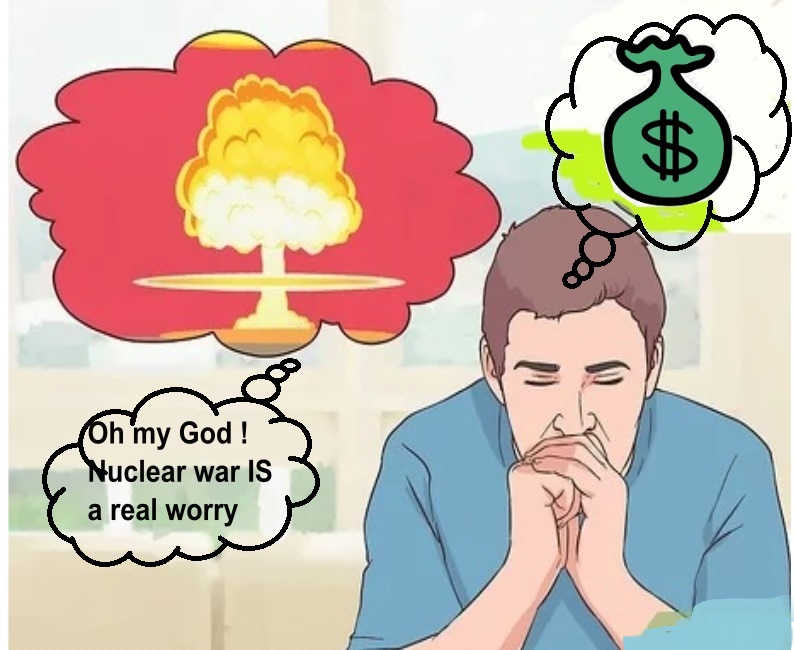
Are investors prepared for *checks notes* nuclear war in space? Space boom, meet actual boom
F.com Sinead O’Sullivan FEBRUARY 24 2024 Sinéad O’Sullivan is a former Senior Researcher at Harvard Business School’s Institute for Strategy and Competitiveness.
Imagine if a country launched a 1.4-megaton nuclear warhead into space and detonated it 400 kilometres above the Pacific Ocean, generating such a huge burst of electromagnetic energy that it resulted in an artificial aurora while disrupting electrical systems over land masses up to 1,500km away and destroying several satellites…………………………………..
This actually happened in 1962. And the actor, naturally, was the United States of America. In the early 1960’s, the United States conducted a series of nuclear tests in space, which were primarily aimed at studying the effects and potential military applications of deploying nuclear weapons in space. The explosion test, called Starfish Prime, was a high-altitude nuclear test conducted as a joint effort of the Atomic Energy Commission and the Defense Atomic Support Agency.
One of the test’s consequences was to catalyse Russian enthusiasm for some ground rules: the Outer Space Treaty was adopted by the United Nations General Assembly a few years later, in 1967……
Today, most people — including investors who have bet billions of dollars on SpaceX’s Starlink constellation — have probably not heard of Starfish Prime, and don’t worry much about the impact of mega-radiation war in space………………….
Regardless, what we do know is that any nuclear weapon in space would — along with a great number of other consequences — pose a huge risk to the $300bn of private capital invested into the space sector in the last decade………………..
It is unideal that there are currently no globally binding rules that protect investor interests and assets in space. Consider the $180bn valuation of SpaceX, which is largely credited to its Starlink satellite communications constellation. This constellation could disappear in the space of minutes with the use of a single nuclear anti-satellite weapon in space — Russian or otherwise. It is possible many investors have not considered that a single adversarial event could destroy value so quickly. …………………………………..
The Outer Space Treaty says that nations cannot militarise space, place weapons in space, or take ownership of any celestial space bodies. This makes it an established investor’s friend, not foe — especially if that investor is American.
It is overseen by the United Nations Committee on the Peaceful Uses of Outer Space (UN COPUOUS), but this body cannot legally mandate any nation to follow it. After all, in the jurisdiction of space, adherence is done via the complex mechanisms of diplomacy, something capital markets grossly lack……………….. https://www.ft.com/content/5a9c4477-6db9-4ea5-8ba2-7065f2370b02
Tax-payer to take bigger financial risks under new payment plan for nuclear command satellites

Under cost-plus or cost-reimbursement contracts, the government pays contractors for allowed expenses, plus an agreed upon profit margin. In fixed-price agreements, the contractor is paid a negotiated amount regardless of expenses incurred.
the development will move forward with the government absorbing the inherent risks.
Space Force bucks fixed-price trend for nuclear command satellites
Acquisition executive Frank Calvelli said the Space Force will award cost-plus contracts for the upcoming Evolved Strategic Satellite Communications System
Space News Sandra Erwin, February 26, 2024
WASHINGTON — In a departure from recent guidance, the Space Force will use cost-plus contracts for its high-priority strategic communications satellite program.
Space Force acquisition executive Frank Calvelli said Feb. 23 that the service has decided to not use fixed-price contracts for the Evolved Strategic Satellite Communications System (ESS), a critical component of the U.S. military’s nuclear command, control, and communications (NC3) network that provides nuclear-survivable communications.
Calvelli has previously indicated a preference for fixed-price contracts as a means to control costs and incentivize efficiency in satellite procurements. However, he said that an exception will be made for the ESS program.
Boeing and Northrop Grumman were selected in 2020 to build ESS satellite prototypes but Calvelli suggested that these designs are not mature enough to transition to fixed-price production.
“It’s not as far along as I would like for us to probably use fixed price,” Calvelli said at an event hosted by the Center for Strategic and International Studies.
The ESS program is estimated to be worth $8 billion. These new satellites are intended to augment and eventually replace the Advanced Extremely High Frequency (AEHF) network of nuclear-hardened satellites made by Lockheed Martin.
Draft solicitation in the works
Calvelli said the Space Systems Command is still working on a draft solicitation for ESS proposals, expected to be released this year.
He said he had expected the ESS payload designs to be more mature by now and nearing the prototyping stage. ESS was one of the programs selected for rapid-prototyping under a Pentagon initiative known as “middle tier acquisition”
“But it seems like we spent a lot of time in MTA just doing tech risk reduction or technology maturity,” said Calvelli. “Had we built a real payload or actually built the prototype, then maybe we could actually go off and do something fixed-price.”
Under cost-plus or cost-reimbursement contracts, the government pays contractors for allowed expenses, plus an agreed upon profit margin. In fixed-price agreements, the contractor is paid a negotiated amount regardless of expenses incurred.
Cost-plus contracts are used in higher risk projects where technical requirements are uncertain or unknown and the work involves “non-recurring engineering.” These are upfront costs associated with the design and development of a new product.
“Given the amount of NRE that still has to go into the ESS program, and feedback I’ve gotten from industry, we are probably looking more towards the traditional cost-plus model for something like that,” Calvelli said.
The use of cost-plus versus fixed-price contracts has been a contentious issue recently, with some defense companies experiencing significant losses on fixed-price contracts. Executives from major defense contractors, including Boeing, Northrop Grumman and Lockheed Martin, have warned that they would be reluctant to bid on some fixed-price programs due to the financial risk.
Calvelli has said the preference is to use fixed-price vehicles once new systems are proven but ESS does not meet that threshold so the development will move forward with the government absorbing the inherent risks.
No excuses for late deliveries
Calvelli during his talk at CSIS also said he plans to crack down on program delays, especially those blamed on supply chain woes or pandemic impacts. ……………………………….. https://spacenews.com/space-force-bucks-fixed-price-trend-for-nuclear-command-satellites/
Iran Reduces Near-Weapons-Grade Stockpile, Defying Expectations
Move could signal an effort to de-escalate nuclear tensions with Washington
By Laurence Norman, Feb. 26, 2024
VIENNA—Iran reduced its stockpile of near-weapons-grade nuclear material even as it continued expanding its overall nuclear program, the United Nations’ atomic watchdog said Monday, marking a surprise step that could ease tensions with Washington.
The move comes at a moment when Iran and the U.S. have sought to avoid direct confrontation in the regional conflict that grew out of Hamas’s terrorist attack on Israel on Oct. 7 and Israel’s aggressive response………… (Subscribers only) more https://www.wsj.com/world/middle-east/iran-reduces-near-weapons-grade-stockpile-defying-expectations-ba384777
An Anxious Europe Ponders Nuclear Weapons
To acquire nuclear weapons, European states would have to withdraw from the NPT which would, no doubt, undermine the international rules-based order that they wish to preserve.
Australian Institute of International Affairs, 26 FEB 2024, By Jasper Hufschmidt Morse
After comments made by the US presidential candidate, Donald Trump, some Europeans are considering the possibility of acquiring nuclear weapons. They should think again.
On 10 February, former United States President Donald Trump recounted a conversation with an unnamed European counterpart in which he stated that he “would not protect” them from a possible Russian attack because they failed to allocate two percent of their gross domestic product to defence, and thus fell short of North Atlantic Treaty Organization (NATO) spending targets. Such delinquency would lead Trump to “encourage [Russia] to do whatever the hell they want.”
Given Trump is the probable Republican candidate at the election in November, and currently polling ahead of incumbent President Joe Biden, these comments have triggered concern among European leaders, including German Foreign Minister Annalena Baerbock, Polish Defence Minister Wladyslaw Kosiniak-Kamysz, as well as NATO Secretary General Jens Stoltenberg. These concerns were exacerbated on 9 February when Danish Defence Minister Troels Lund Poulsen warned that Russia might militarily challenge NATO’s mutual defence article within the next three to five years, considering “new knowledge.” Some are now calling for the expedited integration of European defence capabilities to the point of acquiring nuclear weapons. This conversation was initiated by European Union (EU) parliamentary vice president Katarina Barley who perceives a joint nuclear deterrent as part of Europe’s path toward to an eventual joint EU army. Her fellow social democrat, former German foreign minister Sigmar Gabriel concurs, as does German Finance Minister Christian Lindner. However, others – such as chancellor Olaf Scholz, Defence Minister Boris Pistorius, or Marie-Agnes Strack-Zimmermann, who chairs Germany’s parliamentary defence committee – deem a European nuclear option “unrealistic.” According to political scientist Karl-Heinz Kamp, “debate about European nuclear weapons is a very German debate.” Nonetheless, non-Germans have also chimed in, including the chair of the EU Military Committee Robert Brieger – who argues in favour of European nuclear weapons – and Stoltenberg, who opposes them.
Until recently, discussion of a European nuclear deterrent was unthinkable. Current debate fluctuates between proposals for joint EU nuclear procurement, merging existing capabilities, and individual European states acquiring nuclear weapons. Indeed, there are many barriers to all of these options, including the Nuclear Non-Proliferation Treaty (NPT), and the ongoing stationing of American nuclear warheads on European soil.
One suggestion might propose that the two existing European nuclear powers, namely the United Kingdom and France, could increase their stockpiles and integrate them into a joint framework. However, this is also unrealistic as the cost of these two powers expanding their stockpile would be exorbitant. For instance, Britain is already projected to spend 34 percent of its military budget on maintaining its existing nuclear arsenal. Moreover, it is unlikely that the UK would participate in an EU nuclear weapons program post-Brexit.
European states would do well to consider Australia’s pursuit of nuclear-powered submarines through the AUKUS agreement to inform their own ongoing debate. While these submarines will not carry nuclear warheads, regional powers such as Indonesia did question AUKUS’ legitimacy, considering Australia’s commitment to non-proliferation. Certainly, the outright pursuit of nuclear warheads by the EU would be legitimately challenged in the same way. To acquire nuclear weapons, European states would have to withdraw from the NPT which would, no doubt, undermine the international rules-based order that they wish to preserve.
Furthermore, it would be hypocritical of Europe to insist on non-proliferation, for instance toward Iran through the Joint Comprehensive Plan of Action (JPCOA) or other states which might wish to acquire nuclear weapons, such as Saudi Arabia or South Korea, but then become a proliferator itself. This would set a dangerous precedent, potentially perceived as a “go ahead” by other states who wish to acquire nuclear weapons.
Similarly, it is questionable whether the US would tolerate nuclear proliferation in Europe. Certainly, the US has the means to prevent the pursuit of nuclear weapons, as seen in 2009 and 2010 when it allegedly employed the Stuxnet computer virus to sabotage Iranian enrichment centrifuges. Even if the US were to abstain from sabotaging European efforts, it would nonetheless constitute a rupture in the transatlantic alliance. ………………………………………………… more https://www.internationalaffairs.org.au/australianoutlook/an-anxious-europe-ponders-nuclear-weapons/
Fatal Flaws Undermine America’s Defense Industrial Base
Many elements of the traditional DIB have yet to adopt advanced manufacturing technologies, as they struggle to develop business cases for needed capital investment.
In other words, while adopting advanced manufacturing technologies would fulfill the purpose of the US Department of Defense, it is not profitable for private industry to do so.
Despite virtually all the problems the report identifies stemming from private industry’s disproportionate influence over the US DIB, the report never identifies private industry itself as a problem.
If private industry and its prioritization of profits is the central problem inhibiting the DIB from fulfilling its purpose, the obvious solution is nationalizing the DIB by replacing private industry with state-owned enterprises. This allows the government to prioritize purpose over profits. Yet in the United States and across Europe, the so-called “military industrial complex” has grown to such proportions that it is no longer subordinated to the government and national interests, but rather the government and national interests are subordinated to it.
US defense industrial strategy built on a flawed premise
Beyond private industry’s hold on the US DIB, the very premise the NDIS is built on is fundamentally flawed, deeply rooted in private industry’s profit-driven prioritization.
The report claims:
The purpose of this National Defense Industrial Strategy is to drive development of an industrial ecosystem that provides a sustained competitive advantage to the United States over its adversaries.
The notion of the United States perpetually expanding its wealth and power across the globe, unrivaled by its so-called “adversaries” is unrealistic.
China alone has a population 4-5 times greater than the US. China’s population is, in fact, larger than that of the G7 combined. China has a larger industrial base, economy, and education system than the US. China’s education system not only produces millions more graduates each year in essential fields like science, technology, and engineering than the US, the proportion of such graduates is higher in China than in the US.
China alone possesses the means to maintain a competitive advantage over the United States now and well into the foreseeable future. The US, attempting to draw up a strategy to maintain an advantage over China (not to mention over the rest of the world) regardless of these realities, borders on delusion.
Yet for 60 pages, US policymakers attempt to lay out a strategy to do just that.
Not just China, but also Russia
While China is repeatedly mentioned as America’s “pacing challenge,” the ongoing conflict in Ukraine is perhaps the most acute example of a shifting balance of global power.
Despite a combined population, GDP, and military budget many times greater than Russia’s, the collective West is incapable of matching Russian production of even relatively simple munitions like artillery shells, let alone more complex systems like tanks, aircraft, and precision-guided missiles.
While the US and its allies appear to have every conceivable advantage over Russia on paper, the collective West has organized itself as a profit-driven rather than purpose-driven society.
In Russia, the defense industry exists to serve national security. While one might believe this goes without saying, across the collective West, the defense industry, like all other industries in the West, exists solely to maximize profits.
To best serve national security, the defense industry is required to maintain substantial surge capacity – meaning additional, unused factory space, machines, and labor on standby if and when large surges in production are required in relatively short periods of time. Across the West, in order to maximize profits, surge capacity has been ruthlessly slashed, deemed economically inefficient. Only rare exceptions exist, such as US 155 mm artillery shell production.
While the West’s defense industry remains the most profitable on Earth, its ability to actually churn out arms and ammunition in the quantities and quality required for large-scale conflict is clearly compromised by its maximization of profits.
The result is evident today as the West struggles to expand production of arms and ammunition for its Ukrainian proxies.
The NDIS report would note:
Prior to the invasion, weapon procurements for some of the in-demand systems were driven by annual training requirements and ongoing combat operations. This modest demand, along with recent market dynamics, drove companies to divest excess capacity due to cost. This meant that any increased production requirements would require an increase in workforce hours in existing facilities—commonly referred to as “surge” capacity. These, in turn, were limited further by similar down-stream considerations of workforce, facility, and supply chain limitations.
Costs are most certainly a consideration across any defense industry, but costs cannot be the primary consideration.
A central element of Russia’s defense industry is Rostec, a massive state-owned enterprise under which hundreds of companies related to national industrial needs including defense are organized. Rostec is profitable. However, the industrial concerns organized under Rostec serve purposes related to Russia’s national interests first and foremost, be it national health, infrastructure or security.
Because Russia’s defense industry is purpose-driven, it produced military equipment because it was necessary, not because it was profitable. As a result, Russia possessed huge stockpiles of ammunition and equipment ahead of the Special Military Operation (SMO) in February 2022. In addition to this, Russia maintained large amounts of surge capacity enabling production rates of everything from artillery shells to armored vehicles to expand quickly over the past 2 years.
Only relatively recently have Western analysts acknowledged this.
Continue reading

“military industrial complex” has grown to such proportions that it is no longer subordinated to the government and national interests, but rather the government and national interests are subordinated to it.
the collective West has organized itself as a profit-driven rather than purpose-driven society………………………………across the collective West, the defense industry, like all other industries in the West, exists solely to maximize profits.
By Brian Berletic, Orinoco Tribune. February 24, 2024 https://popularresistance.org/fatal-flaws-undermine-americas-defense-industrial-base/
The first-ever US Department of Defense National Defense Industrial Strategy (NDIS) confirms what many analysts have concluded in regard to the unsustainable nature of Washington’s global-spanning foreign policy objectives and its defense industrial base’s (DIB) inability to achieve them.
The report lays out a multitude of problems plaguing the US DIB including a lack of surge capacity, inadequate workforce, off-shore downstream suppliers, as well as insufficient “demand signals” to motivate private industry partners to produce what’s needed, in the quantities needed, when it is needed.
In fact, the majority of the problems identified by the report involved private industry and its unwillingness to meet national security requirements because they were not profitable.
For example, the report attempts to explain why many companies across the US DIB lack advanced manufacturing capabilities, claiming:
Many elements of the traditional DIB have yet to adopt advanced manufacturing technologies, as they struggle to develop business cases for needed capital investment.
In other words, while adopting advanced manufacturing technologies would fulfill the purpose of the US Department of Defense, it is not profitable for private industry to do so.
Despite virtually all the problems the report identifies stemming from private industry’s disproportionate influence over the US DIB, the report never identifies private industry itself as a problem.
If private industry and its prioritization of profits is the central problem inhibiting the DIB from fulfilling its purpose, the obvious solution is nationalizing the DIB by replacing private industry with state-owned enterprises. This allows the government to prioritize purpose over profits. Yet in the United States and across Europe, the so-called “military industrial complex” has grown to such proportions that it is no longer subordinated to the government and national interests, but rather the government and national interests are subordinated to it.
US defense industrial strategy built on a flawed premise
Beyond private industry’s hold on the US DIB, the very premise the NDIS is built on is fundamentally flawed, deeply rooted in private industry’s profit-driven prioritization.
The report claims:
The purpose of this National Defense Industrial Strategy is to drive development of an industrial ecosystem that provides a sustained competitive advantage to the United States over its adversaries.
The notion of the United States perpetually expanding its wealth and power across the globe, unrivaled by its so-called “adversaries” is unrealistic.
China alone has a population 4-5 times greater than the US. China’s population is, in fact, larger than that of the G7 combined. China has a larger industrial base, economy, and education system than the US. China’s education system not only produces millions more graduates each year in essential fields like science, technology, and engineering than the US, the proportion of such graduates is higher in China than in the US.
China alone possesses the means to maintain a competitive advantage over the United States now and well into the foreseeable future. The US, attempting to draw up a strategy to maintain an advantage over China (not to mention over the rest of the world) regardless of these realities, borders on delusion.
Yet for 60 pages, US policymakers attempt to lay out a strategy to do just that.
Not just China, but also Russia
While China is repeatedly mentioned as America’s “pacing challenge,” the ongoing conflict in Ukraine is perhaps the most acute example of a shifting balance of global power.
Despite a combined population, GDP, and military budget many times greater than Russia’s, the collective West is incapable of matching Russian production of even relatively simple munitions like artillery shells, let alone more complex systems like tanks, aircraft, and precision-guided missiles.
While the US and its allies appear to have every conceivable advantage over Russia on paper, the collective West has organized itself as a profit-driven rather than purpose-driven society.
In Russia, the defense industry exists to serve national security. While one might believe this goes without saying, across the collective West, the defense industry, like all other industries in the West, exists solely to maximize profits.
To best serve national security, the defense industry is required to maintain substantial surge capacity – meaning additional, unused factory space, machines, and labor on standby if and when large surges in production are required in relatively short periods of time. Across the West, in order to maximize profits, surge capacity has been ruthlessly slashed, deemed economically inefficient. Only rare exceptions exist, such as US 155 mm artillery shell production.
While the West’s defense industry remains the most profitable on Earth, its ability to actually churn out arms and ammunition in the quantities and quality required for large-scale conflict is clearly compromised by its maximization of profits.
The result is evident today as the West struggles to expand production of arms and ammunition for its Ukrainian proxies.
The NDIS report would note:
Prior to the invasion, weapon procurements for some of the in-demand systems were driven by annual training requirements and ongoing combat operations. This modest demand, along with recent market dynamics, drove companies to divest excess capacity due to cost. This meant that any increased production requirements would require an increase in workforce hours in existing facilities—commonly referred to as “surge” capacity. These, in turn, were limited further by similar down-stream considerations of workforce, facility, and supply chain limitations.
Costs are most certainly a consideration across any defense industry, but costs cannot be the primary consideration.
A central element of Russia’s defense industry is Rostec, a massive state-owned enterprise under which hundreds of companies related to national industrial needs including defense are organized. Rostec is profitable. However, the industrial concerns organized under Rostec serve purposes related to Russia’s national interests first and foremost, be it national health, infrastructure or security.
Because Russia’s defense industry is purpose-driven, it produced military equipment because it was necessary, not because it was profitable. As a result, Russia possessed huge stockpiles of ammunition and equipment ahead of the Special Military Operation (SMO) in February 2022. In addition to this, Russia maintained large amounts of surge capacity enabling production rates of everything from artillery shells to armored vehicles to expand quickly over the past 2 years.
Only relatively recently have Western analysts acknowledged this.
Continue reading
1 This Month
Chernobyl: The Lost Tapes – A good documentary on Chernobyl on SBS available On Demand for the next 3 weeks– https://www.sbs.com.au/ondemand/tv-program/chernobyl-the-lost-tapes/2352741955560

of the week–London Campaign for Nuclear Disarmament

Tell the Ukrainian Government to Drop Prosecution of Peace Activist Yurii Sheliazhenko
To see nuclear-related stories in greater depth and intensity – go to https://nuclearinformation.wordpress.com
-
Archives
- April 2026 (152)
- March 2026 (251)
- February 2026 (268)
- January 2026 (308)
- December 2025 (358)
- November 2025 (359)
- October 2025 (376)
- September 2025 (257)
- August 2025 (319)
- July 2025 (230)
- June 2025 (348)
- May 2025 (261)
-
Categories
- 1
- 1 NUCLEAR ISSUES
- business and costs
- climate change
- culture and arts
- ENERGY
- environment
- health
- history
- indigenous issues
- Legal
- marketing of nuclear
- media
- opposition to nuclear
- PERSONAL STORIES
- politics
- politics international
- Religion and ethics
- safety
- secrets,lies and civil liberties
- spinbuster
- technology
- Uranium
- wastes
- weapons and war
- Women
- 2 WORLD
- ACTION
- AFRICA
- Atrocities
- AUSTRALIA
- Christina's notes
- Christina's themes
- culture and arts
- Events
- Fuk 2022
- Fuk 2023
- Fukushima 2017
- Fukushima 2018
- fukushima 2019
- Fukushima 2020
- Fukushima 2021
- general
- global warming
- Humour (God we need it)
- Nuclear
- RARE EARTHS
- Reference
- resources – print
- Resources -audiovicual
- Weekly Newsletter
- World
- World Nuclear
- YouTube
-
RSS
Entries RSS
Comments RSS
 nuclear-news