Soldier exposed to depleted uranium has cancer, but no disability compensation

 Cancer-stricken soldier denied disability claim over exposure to depleted uranium CTVNews.ca Staff , January 20, 2015 A cancer-stricken warrant officer who served with the Canadian military for nearly three decades is facing a long appeal process after Veterans Affairs denied his application for disability compensation.
Alain Vachon of Calgary spent 27 years in military service, which included deployments to Afghanistan, Kuwait, Bosnia and Kosovo, among other places. For the past two years, he has been battling Hodgkin’s Lymphoma, a form of cancer that affects the lymphatic system.
Vachon believes his exposure to depleted uranium at Camp Doha in Kuwait caused his illness. Although Canadians did not use depleted uranium, the American troops at the base did, Vachon said. There was an incident in which “their ammunition dump blew up,” he said in an interview with CTV Calgary………
The couple has a letter from the military admitting that Vachon was exposed to depleted uranium, pesticides and other unknown substances………. http://www.ctvnews.ca/canada/cancer-stricken-soldier-denied-disability-claim-over-exposure-to-depleted-uranium-1.2198339#ixzz3PhSiGCYs
Depleted uranium weapons – a propaganda victory for ISIS?
The UK and depleted uranium, International Coalition to Ban Uranium Weapons, A retired British General has urged the UK to persuade the US not to use depleted uranium in operations against ISIS in Iraq, Sir Hugh Beach argues that the use of the weapons will be a propaganda victory to their opponents. 9 January 2015 – Gen Sir Hugh Beach (Rtd)
Too much money at stake, for USA and UK to address the issue of depleted uranium and health

Christina Macpherson’s websites & blogs
Amazing! The fact that depleted uranium is so cheap – in fact, free- and that it solves DOE’s problem of what to do with this radioactive trash – these practical and financial considerations apparently outweigh any concern for the health of America’s finest, let alone for the health of Iraqui civilians!
It will cost in the end, care of sick soldiers, lawsuits from soldiers, lawsuits from Iraq.
But I suppose, by that time, the worthy decision makers in the Pentagon and the arms business will have passed away – leaving the bill for everyone’s grandchildren
Par for the course, in all matters nuclear.
Depleted Uranium: The New Agent Orange Source: Jiang, George C.-T. and Aschner, Michael. “Neurotoxicity of Depleted Uranium: Reasons for Increased Concern.” Biological Trace Element Research. Vol. 110, 2006 Bellingcat, December 8, 2014 By Aliaume Leroy
On one hand, “misinformation disseminated by both the Iraqi government and the US Department of Defense has made analysis of DU’s impact difficult.”[2] On the other hand, the medias had the tendency to over-sensationalize the issue. Even worst was the fact that scientists themselves were caught in the midst of this politicization. On top of that, Iraq does not have the laboratory capacity to establish the existence of a direct link between DU and the health issues it is facing at the moment.[3]………..
DU has been used in various civilian and commercial fields: medicine, aviation, space and petroleum industry. Since it is 1.7 times denser that lead, it is used as ballast for commercial aircraft, ships, as well as satellites.[8] Another example of the civilian use of DU is in the medical industry where DU is employed in radiotherapy units as part of radiation shields.[9] However, the most fervent customers of DU have been the military-industrial complexes. “The United States began exploring, developing, and testing ways to employ depleted uranium in the early 1970’s in what were termed ‘kinetic energy penetrators’ and tank armor.”[10]As DU is extremely dense and pyrophoric, DU projectiles melt when they hit a hard target, sharpen and thus pierce the heavy armor.[11] Furthermore, the DU contained in shells ignites and aerosolizes upon impact, “forming tiny particles suspended in the air and dispersing them over an area.”[12] DU also becomes a very resistant material when it is mixed with other metals, like titanium, thus creating a shield for tank that no conventional weapon can penetrate……………
Interestingly, the US military’s true reason behind its choice of DU stems from an economic stance. DU is available in large stocks in the US. Currently, the Department of Energy (DoE) keeps “over 700, 000 metric tons of depleted uranium tails in about 63, 000 metal cylinders in storage yards at its Paducah, Kentucky, and Portsmouth, Ohio, enrichment plants.”[15] Furthermore, DU is free of charge since it is under the control of the DoE. This means that the US military does not have to spend money importing or producing other materials. DU is thus absolutely cost-effective: the military spends nothing and retrieves all the benefits. This practical mindset explains why the American government has so far refused to remove DU from its military arsenal. In light of the economic reason, the DU effectiveness argument appears to be nothing more than a justifying smoke screen. This view is reinforced by the words of Lieutenant Colonel M.V. Ziehmn of the Los Alamos Laboratory: “If no one makes the case for the effectiveness for DU on the battlefield, DU rounds may become politically unacceptable and thus, be deleted from the arsenal… I believe we should keep this sensitive issue in mind when after-action reports are being written.”[16]
The human body intakes DU in three ways: inhalation, ingestion, and dermal contact. With DU ammunitions, the inhalation route is the most common. As stated earlier, DU projectiles aerosolize when they hit a target, projecting small particles all over an area, which then remain suspended in the air by wind or settle down on the soil for later resuspension.[17] Dermal contact is less important. DU does not penetrate the skin unless a fragment enters the organism. American and British veterans were exposed to DU through these two pathways: inhaling the particles or being wounded by DU shrapnel. However, the ingestion route should not be underestimated. Iraqi children playing in conflict zone are more likely to ingest DU because of hand-to-mouth activity. Furthermore, it is known that children are “10 to 20 times more susceptible to the carcinogenic effects than adults.”[18] This statement leads us to the following question: Does DU present health risks?………..
no one can deny today that DU did play a key role in aggravating the Iraqi health crisis.
DU ammunitions appear to be correlated with increased health risks. The various discordant claims and the politicization of the issue however impede the formulation of a conclusive and definitive statement. As Doug Rokke, a former Pentagon DU expert, eloquently puts it: “[DU] is the Agent Orange of the 1990s.”[28] More research is certainly needed to understand clearly DU’s impacts on health. Yet, the US army is still using DU despite the controversy that surrounds it and the fact that its efficiency has remained unaccounted for.
Why? Too much is at stake. If DU was found to be highly dangerous for the health and the environment, governments – mainly the US, UK, France, China and Russia – will be forced to remove this effective weaponry from their respective military arsenals and stop short nuclear plants (that uses enriched uranium): An unwanted scenario for those countries as well as for the defence and nuclear industries. https://www.bellingcat.com/news/2014/12/08/depleted-uranium-the-new-agent-orange/
USA Air Force set up and ready to use depleted uranium weapons in Middle East
U.S. Sends Planes Armed with Depleted Uranium to Middle East Aletho News, By David Swanson | War is a Crime | October 28, 2014 The U.S. Air Force says it is not halting its use of Depleted Uranium weapons, has recently sent them to the Middle East, and is prepared to use them.
A type of airplane, the A-10, deployed this month to the Middle East by the U.S. Air National Guard’s 122nd Fighter Wing, is responsible for more Depleted Uranium (DU) contamination than any other platform, according to the International Coalition to Ban Uranium Weapons (ICBUW). “Weight for weight and by number of rounds more 30mm PGU-14B ammo has been used than any other round,” said ICBUW coordinator Doug Weir, referring to ammunition used by A-10s, as compared to DU ammunition used by tanks.
Public affairs superintendent Master Sgt. Darin L. Hubble of the 122nd Fighter Wing told me that the A-10s now in the Middle East along with “300 of our finest airmen” have been sent there on a deployment planned for the past two years and have not been assigned to take part in the current fighting in Iraq or Syria, but “that could change at any moment.”
The crews will load PGU-14 depleted uranium rounds into their 30mm Gatling cannons and use them as needed, said Hubble. “If the need is to explode something — for example a tank — they will be used.” Continue reading
United Nations call for clean-up of depleted uranium contaminated countries
 New United Nations depleted uranium resolution calls for states to help with clean-up A fifth United Nations resolution has been tabled which calls for states to provide assistance to countries affected by contamination and for research into DU’s health and environmental effects. 17 October 2014 – ICBUW
The Non-Aligned Movement has submitted a fifth resolution on depleted uranium weapons (DU) at the First Committee of the United Nations General Assembly. As with previous years, new language has been added to the resolution. This year the wording includes a call for states to assist countries affected by the weapons…….http://www.bandepleteduranium.org/en/new-un-depleted-uranium-resolution-calls-for-clean
“Genocide” by birth defects, cancers, in Iraq, due to depleted uranium weapons
 Iraqi Doctors Call Depleted Uranium Use “Genocide” TruthOut 14 October 2014 By Dahr Jamail, | Report Contamination from depleted uranium (DU) munitions is causing sharp rises in congenital birth defects, cancer cases and other illnesses throughout much of Iraq, according to numerous Iraqi doctors.
Iraqi doctors and prominent scientists believe that DU contamination is also connected to the emergence of diseases that were not previously seen in Iraq, such as new illnesses in the kidney, lungs and liver, as well as total immune system collapse. DU contamination may also be connected to the steep rise in leukaemia, renal and anaemia cases, especially among children, being reported throughout many Iraqi governorates.
There has also been a dramatic jump in miscarriages and premature births among Iraqi women, particularly in areas where heavy US military operations occurred, such as Fallujah during 2004, and Basra during the 1991 US war on Iraq.
It is estimated that the United States used 350 tons of DU munitions in Iraq during the 1991 war, and 1,200 tons during its 2003 invasion and subsequent occupation. Official Iraqi government statistics show that, prior to the outbreak of the first Gulf War in 1991, the country’s rate of cancer cases was 40 out of 100,000 people. By 1995, it had increased to 800 out of 100,000 people, and, by 2005, it had doubled to at least 1,600 out of 100,000 people. Current estimates show the trend continuing.
The actual rate of cancer and other diseases is likely to be much higher than even these figures suggest, due to a lack of adequate documentation, research and reporting of cases. Continue reading
Birth defects – the effects of depleted uranium on the city of Basra, Iraq
 Iraqi Doctors Call Depleted Uranium Use “Genocide” TruthOut 14 October 2014 By Dahr Jamail,
“………..Basra Iraq’s southern city of Basra was heavily bombarded with DU munitions by US warplanes during the 1991 war.
Al-Ali, an expert oncologist at the Basra Cancer Treatment Center, was heavily involved in working on two birth defect studies carried out in the wake of that war.
“The types of birth defects were hydrocephaly [an abnormal buildup of cerebrospinal fluid (CSF) in the ventricles of the brain], anencephaly [the absence of a large part of the brain and the skull], cleft lip and phacomelia [loss of limbs],” al-Ali told Truthout. “Other consequences are the cancers which increased three-fold during the last two decades.”
He said that clusters of cancers occurring at higher incidence within the same family were another new phenomenon seen in Iraq only after the 1991 and 2003 wars.
“Other diseases related to effects of DU were the kidney failure of unknown cause and stone formation,” he added. “Respiratory problems like asthma and also myopathy and neuropathy are now very common as well.”
In Babil Province in southern Iraq, cancer rates have been escalating at alarming rates since 2003. Dr. Sharif al-Alwachi, the head of the Babil Cancer Center, blames the use of depleted uranium weapons by US forces during and following the 2003 invasion.
“The environment could be contaminated by chemical weapons and depleted uranium from the aftermath of the war on Iraq,” Alwachi told Truthout. “The air, soil and water are all polluted by these weapons, and as they come into contact with human beings they become poisonous. This is new to our region, and people are suffering here.”
According to a study published in the Bulletin of Environmental Contamination and Toxicology, there was a sevenfold increase in the number of birth defects in Basra between 1994 and 2003.
In addition, never before has such a high rate of neural tube defects (“open back”) been recorded in babies as in Basra, and the rate continues to rise. According to the study, the number of hydrocephalus (“water on the brain”) cases among newborns is six times as high in Basra as it is in the United States.
Childhood cancer also appears to be unusually prevalent in Basra.
“We have noticed bouts of malignant tumors affecting children’s limbs,” an Iraqi doctor who has worked in various parts of the country for 20 years told Truthout. He requested anonymity for security reasons. “These malignancies are usually of very aggressive types and in the view of the shortage of facilities we are running in our hospitals they usually have a fatal outcome.”
His prognosis was grim.
“The only help we can provide to those children is amputation, which sometimes does nothing but prolonging their suffering, in addition to the great psychological impact on both the child and the parents,” he said. “We know that it is possible to save most of these children in specialized oncology centers by advanced salvage surgery, with the attendant chemotherapy and radiotherapy. Unfortunately, this seems to be a kind fantasy for our government and health administrations, which are currently busy with the large amount of trauma overwhelming our hospitals’ resources.”…….http://www.truth-out.org/news/item/26703-iraqi-doctors-call-depleted-uranium-use-genocide
Time for USA Department of Defense (DOD) to come clean on use of depleted uranium weapons
 Depleted uranium coordinates needed for clean-up of dangerous sites in Iraq International Coalition to Ban Uranium Weapons
As the US launches new military actions in the Middle East, the groups say getting information about the military’s use of DU in weaponry and its long-term effects is as urgent as ever. According to “In a State of Uncertainty,” a report by the Netherlands-based organization PAX, Iraq has been subject to the largest use of DU munitions of all areas of conflict and test sites, conservatively estimated to be at least 440 metric tons, though the United Nations Environment Programme has estimated an amount up to five times that based on satellite imagery. Iraqi civilians thought to have been exposed to DU and remaining debris have suffered high rates of cancer and birth defects and U.S. veterans report unexplained illnesses.
Is USA again using depleted uranium weapons in Middle East?
US urged to clarify depleted uranium policy as A-10 gunships deploy to the Middle East http://www.bandepleteduranium.org/en/us-to-deploy-a-10-gunships-to-the-middle-east 23 Sept 14
The Pentagon has announced plans to send 12 A-10 gunships from the 122nd Fighter Wing to an unspecified location in the Middle East as part of its wider campaign against Islamic State (IS) fighters. The aircraft, which can fire 30mm DU cannon rounds, are designed for use in close air support of grounds troops. However President Obama has given assurances that US troops will not be involved in ground combat operations during the conflict.
In June, Iraq called for a global treaty ban on DU, highlighting the need for technical assistance for clearance and urging the UN and member states to act with more urgency on the issue. The renewed use of DU on its territory when contamination from 1991 and 2003 remains unresolved would be politically problematic. ICBUW strongly urges the US not to use DU and to state publicly that it will not do so. The arrival of the A-10s in the Middle East will coincide with debate over a fifth UN General Assembly resolution expressing concern over DU weapons.
With the aircraft not due in the Middle East until mid-October, there is an opportunity for US campaigners to seek clarification on whether DU will be used. Those in countries forming part of the new coalition, such as France and the UK, should ask their governments whether they endorse any use of DU by US forces in the conflict.
US DU usage policy unclear
The deployment may provide a new test for US policy on DU use – namely when does it view its use acceptable or unacceptable. Following the short-lived use of A-10s in Libya in 2011, the US claimed that no DU had been used – although reserved the right to use it in future. Concern over the potential use of DU in Libya had been raised by parliamentarians in a number of NATO countries, including the UK and Belgium. Analysts expressed surprise at the US decision, as tackling Libya’s armoured vehicles seemed like a logical use for the A-10, a role for which the US claims DU ammunition is critically important. This remains the political line although information revealed earlier this year demonstrated that DU was also used against non-armoured targets, unmounted troops and buildings in Iraq in 2003.
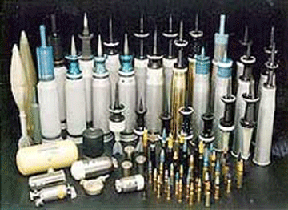
A-10 aircraft fire 30mm PGU-14 armour piercing incendiary DU ammunition from a cannon fitted beneath the cockpit. The GAU-8 cannon normally fires a standard combat mixture of PGU-14 and PGU-13 high explosive rounds, which are pre-loaded on an ammunition belt before the plane takes off. The A-10 has been responsible for more DU contamination than any other platform. In the case of Libya, and if the US statement was correct, then it was the first public acknowledgement by the US that A-10s were being loaded only with the high explosive PGU-13 rounds during combat of this type, although the practice has previously been identified in photographs of A-10 units in Afghanistan.
At issue is therefore whether the US has set itself a voluntary code of conduct that determines whether DU use is acceptable or not in any given conflict. Perhaps it is cost/benefit analysis of perceived military necessity versus impact on public relations? The calculation underlines the continuing global stigmatisation of the weapons, which is also reflected in the increasingly large majorities voting in favour of DU resolutions at the UN General Assembly. It is highly likely that, given the level of concern about the weapons in the region, any use of DU by the US would be a propaganda victory for IS.
Depleted uranium munitions threaten anyone near to them for a long period
Radiation Being Emitted by Consolidated Quantities of Concentrated “Depleted” Uranium Ammunition Not Yet Used in Battle Affects:
1. Workers in ammunition manufacturing facilities, military and civilian.
2. Truck drivers, both military and civilian who transport these munitions.
3. Anyone else military or civilian who must spend long hours in close proximity of
stockpiled concentrated “depleted” uranium ammunition.
4. Workers, military and civilian engaged in demilitarization of DU munitions.
A few examples of those who are likely to be at high risk are: anyone who sat on ammo boxes for long periods of time; pilots of A-10 Thunderbolt Warthogs and Apache Helicopters, as they sat right over their payloads of 30mm concentrated DU munitions while on sorties.
 DU – You Don’t Have To Inhale Or Ingest It For It To Make You Sick, Veterans Today, by Elaine A. Hunter Concentrated “Depleted” Uranium Munitions Emit: Alpha + Beta + Gamma rays + Neutrons + X-rays, Can Wreak Havoc in the Human Body While Waiting to be Used in Battle!
From Multiple Horses’ Mouths: More, Much More on Ignored and Suppressed US Government and Military Data that Show the Threat of Harmful Effects of “Consolidated Quantities” of Concentrated “Depleted” Uranium (DU) Munitions
Heads up people concerned about the harmful effects of concentrated “depleted” uranium munitions, this is very important. This article is not an easy read. If you or anyone you know and love has been around “consolidated quantities” of concentrated “depleted” uranium (DU) munitions please read it anyway. They are a threat to the health of workers, military and civilian, national and international while they are in fabrication, transit or just sitting around waiting to be used in battle. The concentrated DU in munitions is not inert; it does not suddenly become radioactive only when it is fired in battle.
When I plugged in to what is broadcast on the internet, I was mystified that all the concern was about DU inhaled, ingested or embedded as fragments. Those aspects ARE important, without a doubt, and the most obvious. Yet unless the rest of the story is made known, the rest of the causes of illnesses and deaths of those exposed to concentrated DU will continue to be ignored. The rest of the story is this: it is not necessary for the munitions to be used in combat for them to make a person sick, even sick unto death…….. Continue reading
Depleted uranium as a carcinogen and genotoxin
Malignant Effects: depleted uranium as a carcinogen and genotoxin http://www.bandepleteduranium.org/en/malignant-effects
A PDF version of Malignant Effects is available to download at the end of this article.
Executive summary
What is depleted uranium?
Depleted uranium (DU) is a by-product of the uranium enrichment process. It is used by a number of states in armour-piercing tank shells and bullets.
The use of DU weapons is controversial because DU is radioactive and chemically toxic. Its use can generate particles that can be inhaled or ingested. DU creates large quantities of contaminated wreckage and hotspots of persistent contamination that present a hazard to civilians long after conflict ends. Continue reading
Internal radiation emitters causing cancers, birth deformities: depleted uranium’s legacy in Iraq
Depleted Uranium And The Iraq War’s Legacy Of Cancer, Mint Press News, Depleted uranium was used in Iraq warzone weaponry, and now kids are playing in contaminated fields and the spent weapons are being sold as scrap metal. By Frederick Reese @FrederickReese | July 2, 2014 As instability in Iraq is forcing the United States to consider a third invasion of the Middle Eastern nation, the consequences of the first two invasions are coming into focus. For large sectors of the Iraqi population, American intervention has led to sharp spikes in the rates of congenital birth defects, premature births, miscarriages and leukemia cases.
According to Iraqi government statistics, the rate of cancer in the country has skyrocketed from 40 per 100,000 people prior to the First Gulf War in 1991, to 800 per 100,000 in 1995, to at least 1,600 per 100,000 in 2005.
The culprit behind all of these health issues is depleted uranium, a byproduct of uranium enrichment. With a mass fraction a third of what fissile uranium would have, depleted uranium emits less alpha radiation — up to 60 percent less than natural uranium, according to the U.S. Department of Defense. This “relative” safety offered a rationale for many nations — particularly, the U.S. — to put the waste material to use.
As depleted uranium is 1.67 times denser than lead, a depleted uranium projectile can be smaller than an equivalent lead projectile but produce similar results. This smaller size means a smaller diameter, less aerodynamic drag and a smaller area of impact, meaning that depleted uranium bullets can travel faster and inflict more pressure on impact, causing deeper penetration. Additionally, depleted uranium is incendiary and self-sharpening, making depleted uranium ideal for anti-tank ammunition. It is also used as armor plating for much of America’s tank fleet.
The problem with using depleted uranium, however, lies in the fact that depleted uranium is mostly de-energized. In practical terms, depleted uranium can have — at a minimum — 40 percent the radioactivity of natural uranium with a half-life that can be measured in millennia (between 703 million to 4.468 billion years). While the depleted uranium presents little to no risk to health via radiation due to its relatively weak radioactivity, direct internal contact with the heavy metal can have chemical toxicity effects on the nervous system, liver, heart and kidneys, with DNA mutations and RNA transcription errors being reported in the case of depleted uranium dust being absorbed in vitro.
While depleted uranium is not as toxic as other heavy metals, such as mercury or lead, pronounced toxicity is still possible through repeated or chronic exposure………http://www.mintpressnews.com/depleted-uranium-iraq-wars-legacy-cancer/193338/
Netherlands reveal facts on US use of depleted uranium weapons in civilian areas
US fired depleted uranium rounds in civilian areas during 2003 Iraq campaign – report http://rt.com/news/167220-depleted-uranium-us-iraq/ June 20, 2014 US-led forces in Iraq used depleted uranium weapons in civilian-populated areas during the 2003 military campaign, according to a new Dutch NGO study that also exposes a lack of adequate cleanup efforts by the invading troops.
Depleted uranium used by US forces blamed for birth defects and cancer in Iraq
For the first time the location of several sites where the invaders fired some 10,000 depleted uranium rounds were released by the Dutch Defense Ministry, and published in a study by Dutch peace group PAX.
Most of the DU rounds fired by the US-led coalition were in heavily populated areas, the group says. Samawah, Nasiriyah and Basrah are just some urban areas where ammunition was deployed – with around 1,500 anti-armor rounds fired directly at Saddam Hussein’s infantry forces. The GPS coordinates of DU rounds were initially handed over to the Dutch Defense Ministry because the Netherlands was worried about the potential contamination of its own troops in the country. The ministry later shared the information with PAX under a freedom of information law.
Most of the firing locations remain unknown, as more than 300,000 DU rounds are believed to have been fired by US-led coalition.
NGO says that the health risks of more than 440,000 kg of DU fired by Western forces remains unclear, as “neither coalition forces nor the Iraqi government have supported health research into civilian DU exposure.”
“Coalition forces were aware of the potential health and environmental impact of DU munitions, yet refrained from undertaking the necessary clean-up of DU outside their own bases,” a summary of the report reads.
Wim Zwijnenburg, the author of the report, said the US Air Force knew of the consequences of using DU ammunition.
“The use of DU against these targets questions the adherence of coalition forces to their own principles and guidelines. They should be held accountable for the consequences,” Zwijnenburg said, citing a 1975 memo from the Air Force Office of the Judge Advocate that restricted the use of such ammunition.
“Use of this munition solely against personnel is prohibited if alternative weapons are available,” the memo said, because of “unnecessary suffering and poison.”
According to an earlier PAX report, more than 300 sites in Iraq are currently contaminated with depleted uranium and it would cost at least $30 million to clean up.
Depleted uranium’s massive death toll
DEPLETED URANIUM: Leaving An Eternal Legacy Of Environmental Radioactivity Wherever It’s Used In War http://stateofthenation2012.com/?p=5585 June 1, 2014 by State of the Nation 2014 THE GREATEST CRIME OF HISTORIC TIME by Victor Connor
“The greatest crime against humanity in all historic time has now been committed by the United States government. It dwarfs Joseph Stalin’s killing of 7,000,000 Ukrainians in the 1930s and Adolph Hitler’s killing of 6,000,000 Jewish people in the 1940s. This crime will cause the premature deaths of TENS of MILLIONS of people and will give a horribly debilitating disease to TENS of MILLIONS more. It is indiscriminate mass murder – genocide. My statements may be dramatic, but they are absolutely true. “Since October of 2001, the United States military has used approximately 3,000 tons of depleted uranium munitions against people in Afghanistan and Iraq. This will soon cause serious health issues including respiratory disease, kidney problems, rashes, birth defects, and the number of cancers of these people will jump to over 500,000 each year.
How do I know this? Because the United States military used 375 tons of depleted uranium munitions against Iraq in 1991, and the cancer rate in children measured in Iraqi hospitals rose from 32,000 per year in 1990 to 130,000 in 1997. According to U.S. Department of Veterans Affairs official reports, U.S. casualties from Gulf War 1 now exceed 180,000 and already over 30,000 are now disabled from Gulf War 2. We’ve now used eight times what we did in 1991 and radiation has long been known to cause cancer. This is well known by our federal government. Continue reading
As weapons companies make money, depleted uranium destroys lives
Uranium Weapons Still Making Money, Wreaking Havoc http://www.counterpunch.org/2014/05/15/uranium-weapons-still-making-money-wreaking-havoc/ by JOHN LAFORGE The US Army has awarded General Dynamics a $12 million contract to deconstruct and dispose of 78,000 depleted uranium anti-tank shells. The Pentagon’s May 6 announcement calls for “demilitarization” of the aging shells, as newer depleted uranium rounds are added to the US arsenal.
In the perpetually profitable business of war production, General Dynamics originally produced and sold some of the 120-millimeter anti-tank rounds to the Army. One of the richest weapons builders on earth, General Dynamics has 95,000 employees and sells its wares in 40 countries on six continents.
The International Coalition to Ban Uranium Weapons in Manchester, England, reports the armor-piercing shells to be disassembled are thought to be the large 105-millimeter and 120-millimeter anti-tank rounds. Depleted uranium, or DU, weapons are made of extremely dense uranium-238. More than 700,000 tons of DU has been left as waste in the US alone from the production of nuclear weapons and nuclear reactor fuel rods. The urankum-238 is left when fissionable uranium-235 is separated for H-bombs and reactor fuel. DU is only ‘depleted’ of this U-235. It is still a radioactive and toxic heavy metal. A tax and ecological liability, DU is given away free to weapons builders.
The Pentagon is replacing older DU shells in spite of international appeals for a moratorium on their use. The military is set to buy 2,500 large anti-tank rounds just this year at a cost of $30 million or over $10,000 each from Alliant Tech Systems, formerly of Minneapolis.
In 1991, during its 40-day, 1,000-sorties-per-day bombardment, between 300 and 800 tons of DU was blasted into Iraq by US forces. Another estimated 170 tons were used in the 2003 bombing and annexation. Toxic, radioactive contamination left from the use of these weapons (the DU burns and turns to dusty aerosol on impact) has been linked to the skyrocketing incidence of birth abnormalities in southern Iraq and to the Gulf War Syndrome among tens of thousands of US combat veterans.
After the US/NATO bombardment of Kosovo in 1999, our DU weapons were discovered to be spiked with plutonium and other isotopes. This news created a political uproar in Europe and led to the admission by the US Energy Department that “the entire US stock of depleted uranium was contaminated” with plutonium, americium, neptunium and technetium. United Nations investigators in Kosovo found sites hit with DU to be poisoned with all four isotopes. The Nation magazine reported that about 150,000 tons uranium-238 was dirtied with plutonium-239 and neptunium-237 and that “some apparently found its way to the Persian Gulf and Balkans battlefields.” (Robert Alvarez, “DU at Home,” The Nation, April 9, 2001, p. 24)
European papers shouting “Plutonium!” in headlines saw US and NATO officials rushing to microphones to claim with straight faces that their shells contained “mere traces of plutonium, not enough to cause harm,” and that the highly radioactive materials “were not relevant to soldiers’ health because of their minute quantities.” But plutonium is 200,000 times more radioactive than U-238 and ingesting less than 27 micrograms of plutonium-239 a millionth of an ounce — will cause lung cancer.
(One indication of just how poisonous these weapons are is that in 30 years of resisting nuclear weapons and the war system, the only ‘not guilty of trespass’ verdict I ever won from a jury followed a protest at Alliant Tech over its DU program. The jury agreed with four of us that since poison weapons are banned by the Geneva and Hague Conventions our action was an attempt at crime prevention.)
Long-term disposal plans for the uranium from 78,000 shells were not outlined by the Army. Uranium in the shells is often alloyed with titanium or molybdenum, and if these metals are not recycled, they could become part of our vast stockpile of DU, requiring indefinite storage as intermediate-level radioactive waste. Other parts of the munitions are currently disposed of as low-level rad’ waste in spite of the plutonium content.
1 This Month

Website of the Week

New book – https://www.amazon.com/dp/1923372157?utm_source=substack&utm_medium=email
Now until to February 10, 2026 Radioactive waste storage in France: the debate is finally open! How to participate?
-
Archives
- January 2026 (74)
- December 2025 (358)
- November 2025 (359)
- October 2025 (377)
- September 2025 (258)
- August 2025 (319)
- July 2025 (230)
- June 2025 (348)
- May 2025 (261)
- April 2025 (305)
- March 2025 (319)
- February 2025 (234)
-
Categories
- 1
- 1 NUCLEAR ISSUES
- business and costs
- climate change
- culture and arts
- ENERGY
- environment
- health
- history
- indigenous issues
- Legal
- marketing of nuclear
- media
- opposition to nuclear
- PERSONAL STORIES
- politics
- politics international
- Religion and ethics
- safety
- secrets,lies and civil liberties
- spinbuster
- technology
- Uranium
- wastes
- weapons and war
- Women
- 2 WORLD
- ACTION
- AFRICA
- Atrocities
- AUSTRALIA
- Christina's notes
- Christina's themes
- culture and arts
- Events
- Fuk 2022
- Fuk 2023
- Fukushima 2017
- Fukushima 2018
- fukushima 2019
- Fukushima 2020
- Fukushima 2021
- general
- global warming
- Humour (God we need it)
- Nuclear
- RARE EARTHS
- Reference
- resources – print
- Resources -audiovicual
- Weekly Newsletter
- World
- World Nuclear
- YouTube
-
RSS
Entries RSS
Comments RSS
 nuclear-news