Israel Is Still Starving Gaza, And Other Notes
Caitlin Johnstone, Nov 06, 2025
In an article titled “Not enough tents, food reaching Gaza as winter comes, aid agencies say,” Reuters reports that “Far too little aid is reaching Gaza nearly four weeks after a ceasefire” due to Israeli restrictions preventing aid trucks from getting to their destinations, and that according to an OSHA report last week “a tenth of children screened in Gaza were still acutely malnourished.”
A report from the UK’s Channel 4 News shows warehouses full of food that aid groups say isn’t being allowed into Gaza nearly as rapidly as needed.
In an article titled “‘Under the Guise of Bureaucracy’ — Israel Blocks Humanitarian Groups From Delivering Essential Aid Despite Calm in Gaza,” Israeli outlet Haaretz reports that “Israel has implemented a new procedure requiring all humanitarian organizations operating in Gaza and the West Bank to reapply for official approval, with many denied, despite the relative calm in Gaza following the cease-fire.”
They’re using bureaucratic red tape and arbitrary restrictions to put as much inertia on the effort to rush aid into Gaza as possible. As Electronic Intifada’s Ali Abunimah put it, Israel has “successfully rebranded its genocide as a ‘ceasefire.’”
❖
Still can’t wrap my head around the fact that internationally renowned activist Greta Thunberg said she was tortured and sexually humiliated by Israeli soldiers when she was abducted for trying to bring aid to starving civilians, and the world just shrugged and moved on.
❖
It’s so silly when US empire apologists cite “the Monroe Doctrine” to defend US warmongering in Latin America, as though “the entire western hemisphere is our property” is a perfectly legitimate policy to have.
The Monroe Doctrine was just American imperialists telling Europe, “You see all these brown people over here south of our border? These are our brown people. You can do whatever you want to those brown people over there in Africa and Asia, but these brown people over here belong to us. Only we get to dominate and exploit them.”
That’s all it has ever been, and people cite it to justify warmongering toward Venezuela or wherever as though saying “yeah well that’s the Monroe Doctrine” is a complete argument in and of itself. It’s bat shit insane nonsense and it should be rejected in its entirety.
US regime change interventionism is reliably disastrous wherever it happens. It always causes immense suffering and instability, it’s always justified by lies, and it never accomplishes what its proponents claim it will accomplish. No amount of bleating the words “Monroe Doctrine” will ever change that.
The US empire backs genocidal Gulf state monarchies like the UAE and Saudi Arabia because if those states were democratically governed their people would prioritize their own interests over the agendas of the west. They wouldn’t permit US military bases on their territory, and they never would have tolerated Israel and its abuses in the region. Fossil fuel policy would be set without regard for western interests. The entire region could long ago have united into a superpower bloc which rivaled or outmuscled the western power structure using its critical resources and trade routes.
That’s why you see the US and its allies preaching about the values of Freedom and Democracy to the public while privately telling these tyrannical monarchies they can do whatever they want and receive the backing of the imperial machine. Not until their pet tyrant fails to sufficiently kowtow to the interests of the empire does the west suddenly get interested in advancing Freedom and Democracy in their nation.
This is one of the major dynamics at play in Sudan. The United Arab Emirates has been backing the genocidal atrocities of the RSF and the US empire is placing no pressure on them to stop, because that’s part of the deal. As long as the UAE plays along with the agendas of the empire, the empire will tolerate or actively facilitate its abuses……………………………………………………………….. https://www.caitlinjohnst.one/p/israel-is-still-starving-gaza-and?utm_source=post-email-title&publication_id=82124&post_id=178143727&utm_campaign=email-post-title&isFreemail=true&r=1ise1&triedRedirect=true&utm_medium=email
‘Groundhog Day’: Israel Breaks Ceasefire to Attack Gaza, Killing 104 People, Including 46 Children.
Democracy Now, October 30, 2025
Israel launched major airstrikes on Gaza, killing at least 104 people, including 46 children, in the deadliest attacks since the U.S.-brokered ceasefire was announced. Israeli Prime Minister Benjamin Netanyahu ordered “powerful strikes” on Gaza Tuesday after Israeli officials accused Hamas of killing an Israeli soldier in Rafah — which Hamas has denied. Netanyahu is trying “everything possible to resume the genocide in Gaza,” says Muhammad Shehada, a writer and analyst from Gaza. “The only condition is that he needs to maintain the facade of the ceasefire.”
Transcript
AMY GOODMAN: Israel launched major airstrikes on Gaza beginning Tuesday night, killing at least 104 people, including at least 35 children — about a third of the dead — in the most lethal attacks since a U.S.-brokered ceasefire began on October 10th.
Israeli Prime Minister Benjamin Netanyahu ordered what he called “powerful strikes,” unquote, on Gaza after Israeli officials accused Hamas of killing an Israeli soldier in Rafah. Hamas denied involvement in the soldier’s death.
President Trump defended Israel’s attacks while also saying nothing is going to jeopardize the ceasefire……………………………………………………………………………………………………………………………………………………………….. https://www.democracynow.org/2025/10/29/gaza_israel_strikes_muhammad_shehada
It’s Just Wall-To-Wall News Stories About The US And Its Allies Abusing The World.
Caitlin Johnstone, Oct 29, 2025, https://www.caitlinjohnst.one/p/its-just-wall-to-wall-news-stories?utm_source=post-email-title&publication_id=82124&post_id=177462655&utm_campaign=email-post-title&isFreemail=true&r=1ise1&triedRedirect=true&utm_medium=email
It’s just news story after news story about the US and its allies terrorizing the world today.
The Rapid Support Forces (RSF) have been filming themselves committing horrific massacres in Sudan over the last couple of days, reportedly murdering some two thousand civilians. You can see the bloodstains on the ground in satellite images. As we discussed the other day, the RSF and its atrocities are backed by the UAE, a close partner of the United States.
Meanwhile Israel has committed another wave of massacres of its own throughout the Gaza Strip, reportedly killing 104 people in a single day, including 46 children. This is as many Palestinians as would typically be killed on any given day in Gaza prior to the so-called “ceasefire”.
CBS News’ 60 Minutes has released a cartoonishly blatant war propaganda piece on “Nicolas Maduro, Venezuela’s dictator” about how poor and unhappy the people of Venezuela are under their current government. The piece featured an interview with Republican Senator Rick Scott, who said that “If I was Maduro I’d head to Russia or China right now; his days are numbered.”
The US can make threats, impose sanctions and amass war machinery, but you don’t truly know they’re serious about attacking a country until they start churning out Pentagon propaganda in the mainstream press.
In the same interview, Scott also said that if Maduro is successfully ousted, “it’ll be the end of Cuba.”
“America is gonna take care of the southern hemisphere and make sure there’s freedom and democracy,” he added.
The senator’s statements suggest that the US is preparing a push in Latin America similar to what it has been executing with Israel in the middle east, eliminating any powers which refuse to bend the knee. South of the US border the top two disobedient governments are the socialist states of Venezuela and Cuba. In the middle east the US and Israel have spent the last two years bombing Iran and Yemen, securing a regime change in Syria, and doing everything they can to eliminate Hamas and Hezbollah in order to rule the region uncontested.
And of course we’ve still got the horrifying US proxy war in Ukraine, where men continue to be dragged off against their will to fight in a nightmarish conflict that most Ukrainians now oppose, but which Zelensky is saying he intends to keep fighting for years against the will of the public. This whole miserable ordeal could have been avoided with a little diplomacy and a few low-cost concessions, but the western power alliance avoided off-ramp after off-ramp in order to ensure that Russia would get sucked into another costly military quagmire.
All over the world the US and its allies are murdering and abusing people in order to dominate the planet and ensure the survival of the capitalist system with which its power is intertwined. It is a giant murder machine feeding on human blood and the life force of our biosphere while providing nothing but obstacles to a healthy world.
The US-centralized empire is a disease that affects our entire species. We had better find a cure, and fast.
A Torturous Sanitation Disaster Is Unfolding in Gaza’s Displacement Camps
Every morning we wake to disease, dust, and the unbearable stench of open sewage.
By Sara Awad , Truthout, October 25, 2025
Ceasefire is a relief. After two years of surviving war, we can finally breathe — but that doesn’t mean our suffering is over. For many of us, it’s only just begun. The tents, and the people still living in them, stand as a heavy reminder that our struggles are far from over. After two years of immense destruction by the Israeli military, most families in Gaza are now living in tents — nylons and fabric that don’t protect them either from summer or winter.
In tent life, there is an unlivable war — a war that doesn’t begin with bombs, but with the absence of everything that makes life human. It is a war whose weapons are the denial of clean water, the lack of hygiene, the absence of toilets, dignity, and safety. I am not writing this as a distant witness. No — I am writing this from within it. From the ground. From inside the tent. These are not stories I’ve heard; these are the sensations I experience.
One month living in a tent was enough for me to understand the immense sanitation disaster and horrific conditions that make displaced people feel suffocated by everything around them. This kind of news doesn’t make headlines, and you might not have heard about it. But it is a silent kind of violence — one that kills us every day.
I am here to tell you how my people — including my family — are facing the devastating consequences of the sanitation crisis in these tents.
Thousands of makeshift tents at displacement camps all across Gaza are full of families seeking refuge.
A lack of sufficient toilets, access to clean water, and the presence of open sewage are catastrophic consequences faced by displaced Palestinians — conditions that have persisted since the early months of Gaza’s displacement crisis.
After spending over a month in Gaza City under Israeli occupation, 39-year-old Asma Mohammad and her family fled to the central Gaza Strip, seeking refuge in Al-Nuseirat Camp to escape the ongoing Israeli offensive. Speaking to me via WhatsApp, she described the daily struggle to access basic sanitation. “I have to walk nearly half an hour just to reach the bathroom,” Asma said. “I stopped drinking coffee or tea so I wouldn’t have to walk so far to use a filthy toilet that’s shared by hundreds of people.”
This is something that touches our dignity. I know what she meant because I am experiencing the same thing. Here where I am in az-Zawayda, in central Gaza, men spend a whole week building a bathroom — a toilet. It takes so long because there is no sewage system anywhere anymore. Israel has destroyed the vast majority of sewage facilities in every part of Gaza……………………………………………………………………………………………………………………………………………………………………………. https://truthout.org/articles/a-torturous-sanitation-disaster-is-unfolding-in-gazas-displacement-camps/?utm_source=Truthout&utm_campaign=ec58022e30-EMAIL_CAMPAIGN_2025_10_25_06_42&utm_medium=email&utm_term=0_bbb541a1db-ec58022e30-650192793
Israel and US Scorn ICJ Ruling Against Starving Civilians as Method of Warfare

The World Court says Israel has a duty as the occupying power to cooperate with UN relief efforts, not impede them.
By Marjorie Cohn , Truthout. October 24, 2025
World Court) told Israel what seems obvious to any reasonable person — that it cannot starve civilians as a method of warfare. But Israel does not act in accordance with international law, as evidenced by its two-year campaign of genocide against the Palestinian people in Gaza, during which it has killed over 68,000 Gazans (more likely 680,000, UN Special Rapporteur Francesca Albanese said on September 15).
In its 71-page advisory opinion, issued on October 22, the ICJ reiterated that Israel is illegally occupying the Gaza Strip. The court unanimously held that as the occupying power, Israel has obligations under international humanitarian law to ensure that the population of the Occupied Palestinian Territory, including Gaza, has essential supplies of everyday life, including water, food, shelter, clothing, bedding, and fuel, as well as medical equipment and services. The court also held that Israel must respect and protect all medical and relief personnel and facilities.
The ICJ ruled 10-1 in its advisory opinion that Israel has an obligation to facilitate humanitarian relief by the United Nations Relief and Works Agency for Palestine Refugees in the Near East (UNRWA) and other international organizations and third states, and must refrain from impeding that relief.
And the court unanimously held that Israel must respect the prohibition on deportation and forcible transfer in the Occupied Palestinian Territory, and the right of the Palestinian prisoners held in Israel to be visited by the International Committee of the Red Cross. The court noted that transfer is forcible not just when it is achieved by physical force, but also when people have no choice but to leave because the occupying power has inflicted conditions of life that are intolerable.
The ICJ rejected Israel’s bogus defense that its national security trumped its obligations under international humanitarian law, saying that the protection of security interests is not a “free-standing exception” allowing a state to violate its international humanitarian law obligations………………………………………………………………………….
Impacts of ICJ Advisory Opinions
Although advisory opinions of the ICJ are nonbinding, they carry great moral, political, and diplomatic weight with third states. On July 19, 2024, the ICJ held that Israel’s occupation of Palestinian territory is illegal and all states have an obligation not to recognize as legal the situation arising from the unlawful presence of Israel in the Occupied Palestinian Territory, and not to render aid or assistance in maintaining that situation. As a result of that ruling (and domestic pressure), several states have now recognized Palestine as an independent state…………………………………………………………………………………………………………….
The Israeli Foreign Ministry said that it “categorically rejects” the ICJ’s October 22 advisory opinion, stating that the court ignored the “extensive evidence” Israel provided of what it claimed was UNRWA’s “infiltration” by Hamas and UNRWA’s complicity in terrorist activities. “This is yet another political attempt to impose political measures against Israel under the guise of ‘International Law,’” the ministry alleged.
Likewise, the U.S. State Department called the advisory opinion “corrupt,” claiming that it “unfairly bashes Israel and gives UNRWA a free pass for its deep entanglement with and material support for Hamas terrorism.”………………………………………………………………………………………………………………………………………………………………………………………………….
The Current Situation
Before the October 10 ceasefire deal between Israel and Hamas took effect, UN-supported global experts warned that over 640,000 Palestinians were facing catastrophic levels of food insecurity and that there was an “entirely man-made” famine in Gaza City.
Since the ceasefire began, Israel has started allowing some aid into Gaza, but nowhere near enough to meet its legal obligations and assist the starving Gazans. The UN World Food Program is getting about 750 tons of food aid into Gaza daily, still far below its target of 2,000 tons per day. Although the ceasefire agreement requires 600 trucks per day of food and other humanitarian supplies, only 263 trucks entered Gaza on October 20, and 281 trucks entered Gaza on October 22, less than half of the agreed-upon number.
The Gaza Humanitarian Foundation has suspended operations, as it runs out of money and faces leadership problems and logistical obstacles to a resumption of its work.
Meanwhile, the ICJ is considering the merits of South Africa’s case against Israel that alleges Israel breached the Genocide Convention. Arrest warrants for Israeli Prime Minister Benjamin Netanyahu and former Defense Minister Yoav Gallant for war crimes and crimes against humanity — for intentionally and knowingly depriving the civilian population in Gaza of objects indispensable to their survival and intentionally directing an attack against a civilian population — are pending in the International Criminal Court.
During the past two years, millions of people globally have demonstrated in solidarity with the Palestinian people, and the Boycott, Divestment, Sanctions movement has achieved widespread popular support.
The new advisory opinion issued by the ICJ will continue to shame Israel in the eyes of the world. https://truthout.org/articles/israel-and-us-scorn-icj-ruling-against-starving-civilians-as-method-of-warfare/
Vaunted Trump Ceasefire? Israel has a genocidal Palestinian ethnic cleaning to complete
Walt Zlotow, West Suburban Peace Coalition, Glen Ellyn IL, 22 Oct 25, https://theaimn.net/vaunted-trump-ceasefire-faggedaboudit-israel-has-a-genocidal-palestinian-ethnic-cleaning-to-complete/#google_vignette
The tremendous support given to Trump’s second ceasefire in Israel’s genocide in Gaza ignores reality and history.
How quickly the Trump high-fivers forget Israel abandoned Trump’s first ceasefire that lasted from January 19 to March 18. During that time Israel continued to kill hundreds of Palestinians while restricting food, water and medicine. Then, with Trump’s bombs, they resumed their grotesque genocide further obliterating Gaza while killing tens of thousands more Palestinians.
The first ceasefire released 33 Israeli hostages, leaving 48 to languish as Israel returned to their first priority, ridding Gaza of its Palestinians not yet disappeared. It took nearly 7 months for pressure to build on Israel to agree to a second ceasefire to return remaining hostages, 20 living and 28 dead.
But like Ceasefire 1, Ceasefire 2 is just genocidal ethnic cleansing by subtler means. In the first 9 days, Israel’s military has killed or wounded nearly 400 Palestinians, while again restricting food, water and medicine. Israel still occupies over half of Gaza, establishing yellow lines forbidding Palestinians to cross.
On ceasefire day 10 Israel unleased massive air strikes across Gaza. In their most grotesque ceasefire violation, Israel bombed a vehicle that strayed across Israel’s yellow line, killing 11 family members including 3 women and 7 kids.
Was Trump outraged? Only at Hamas who he’s threatening to obliterate by giving Israel the green light to ‘finish the job.’
This should surprise no one with a moral conscience. Israel has been violating the ceasefire in Lebanon for nearly a year. During that time they’ve killed over 4,000 Lebanese, destroyed tens of thousands of homes and gobbled up 5 Lebanese areas.
That’s some ceasefire you negotiated Mr. Trump. All you accomplished is delay Israel’s one and only goal…bringing a Palestinian free Gaza into Greater Israel.
Why Tony Blair governing Gaza would result in more war crimes.
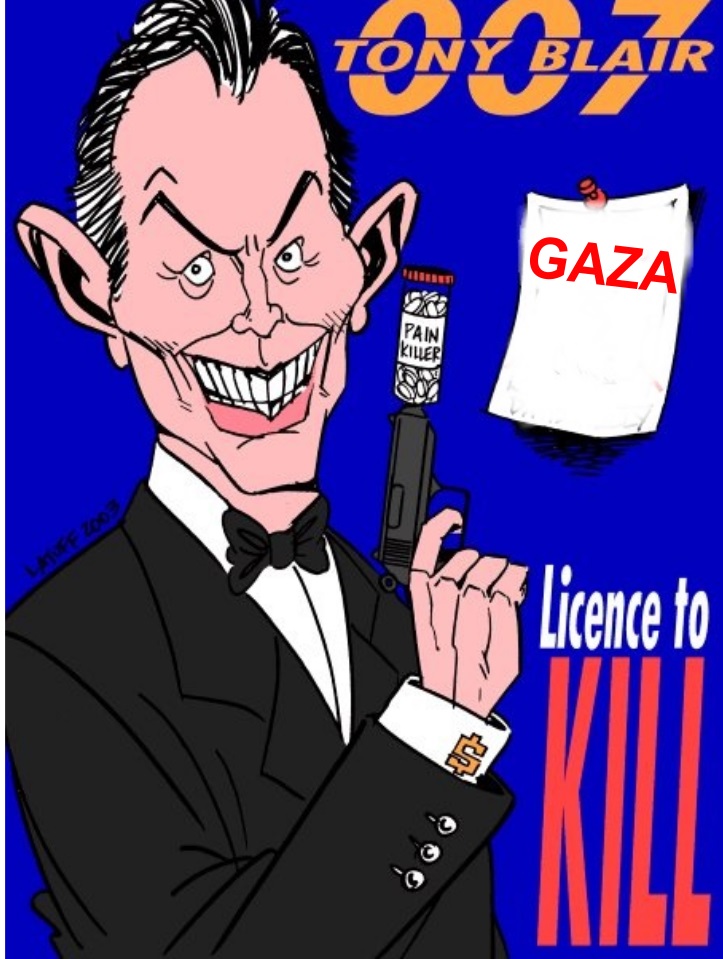
Soldiers who served under his command in Iraq got away with sexually assaulting prisoners, in scenes similar to Israel’s torture of Palestinians.
IRFAN CHOWDHURY, 8 October 2025, https://www.declassifieduk.org/why-tony-blair-governing-gaza-would-result-in-more-war-crimes/
Under US president Donald Trump’s new plan for Gaza, former British prime minister Tony Blair has been touted as having a senior role in governing Gaza, acting as a deputy to Trump himself.
Aside from the obvious neo-colonial implications of this – Western Viceroys ruling over occupied Arabs, as opposed to those occupied Arabs being granted self-determination – Blair’s track record of human rights violations makes him deeply unsuitable for the job.
Blair made the decision in 2003 to join with the US in invading and occupying Iraq. Human Rights Watch has noted that “UK nationals committed abuses in Iraq after 2003 on a significant scale”.
Many of these abuses stemmed from policies that were implemented by Britain’s Ministry of Defence (MoD) under Blair’s leadership, wherein abusive interrogation techniques were authorised from above.
Under Blair’s MoD, ‘harshing’ was authorised – this constitutes a technique of psychological abuse wherein an interrogator screams into a detainee’s face, making implicit threats of violence and engaging in personal insults and vitriol.
‘Uncontrolled fury’
Justice Andrew Collins observed at the High Court in 2013: “There can be no doubt that the practices carried out under the guidelines then in place were unacceptable. The harsh technique included the following elements which could be deployed as the questioner considered necessary.
“The shouting could be as loud as possible. There could be what was described as uncontrolled fury, shouting with cold menace and then developing, the questioner’s voice and actions showing psychotic tendencies, and there could be personal abuse.”
Sir William Gage, who chaired the Baha Mousa Inquiry in 2011, noted: “The teaching of the ‘harsh’ permitted insults not just of the performance of the captured prisoner but personal and abusive insults including racist and homophobic language.
“The ‘harsh’ was designed to show anger on the part of the questioner. It ran the risk of being a form of intimidation to coerce answers from prisoners.
“It involved forms of threats which while in some senses indirect were designed to instil in prisoners a fear of what might happen to them, including physically.”
Footage published by The Guardian in 2010 of Iraqi detainees being harshed by British soldiers makes for harrowing viewing.
Nicholas Mercer, who served as the British Army’s chief legal advisor in Iraq in 2003, has stated that in his view, harshing is a violation of the Geneva Conventions.
Sexually abusing prisoners
In 2005, under Blair’s MoD, training documents at the headquarters of the British Army’s Intelligence Corps in Chicksands encouraged interrogators to sexually humiliate detainees as a form of conditioning and for punitive purposes.
One training aid stated: “Get them naked. Keep them naked if they do not follow commands.”
Another training aid encouraged the use of blindfolds in order to put pressure on detainees; harshing was also encouraged.
During the same period, a training document at Chicksands explicitly stated that “Sexual frustration” was a vulnerability that interrogators were allowed to exploit in detainees.
I have written about how between 2006 and 2007, evidence suggests that interrogators from the Intelligence Corps subjected detained Iraqi men to widespread sexual abuse at the Shaibah Logistics Base in southern Iraq.
Ian Cobain noted in regard to these training documents at Chicksands: “This material was created for the instruction of ‘tactical questioners’, who conduct initial interrogations of prisoners of war, as well as for the instruction of servicemen and women from all three branches of the armed forces who conduct ‘interrogation in depth’.
“The material suggests not only that British military interrogators have employed techniques that may be in breach of the International Criminal Court Act, but that the MoD has spent a considerable amount of time and money training them to do just that.”
‘Misguided zeal’
Blair’s MoD also oversaw a near-total lack of accountability for even the most serious war crimes in Iraq.
After photographs emerged in 2005 showing British soldiers physically abusing Iraqi civilians, stripping them naked, and forcing them to simulate oral and anal sex at Camp Breadbasket in southern Iraq, none of the Iraqi victims were called to give evidence at the subsequent court martial proceedings.
The Army Prosecuting Authority’s excuse for not calling the victims to give evidence is that it could not locate them – this is despite the fact that the Independent on Sunday was able to locate the victims and interview them.
None of the soldiers who were responsible for what the Judge Advocate described as “perhaps the worst of these offences” – namely, forcing detainees to simulate oral and anal sex – were prosecuted.
The images are reminiscent of what Israel has done to Palestinian detainees at its Sde Teiman camp in the Negev desert.
Captain Dan Taylor, who issued the order for the detainees to be “worked hard” at Camp Breadbasket, was exonerated by the British Army before the court martial proceedings even began.
The military determined that while his order was “unlawful”, he had “acted with well-meaning and sincere but misguided zeal”. He was subsequently promoted from the rank of Captain to Major.
‘Unacceptable’
Similarly, in the 2003 case of Ahmed Jabbar Kareem Ali – a 15-year-old Iraqi boy who British soldiers beat and forced to enter a canal, where he drowned – the Royal Military Police’s Special Investigation Branch failed to conduct a proper investigation into the killing.
The MoD also massively delayed the court martial proceedings, which saw all of the soldiers being acquitted.
The court martial of the soldiers did not convene until 28 months after the incident – a delay which Brigadier Robert Aitken, who was commissioned to look into cases of detainee abuse, criticised as “unacceptable”.
These soldiers were all later deemed culpable for Ahmed’s death in a public judicial inquiry that took place in 2016, although some still dispute its findings.
The European Court of Human Rights examined this case, and found that “the Special Investigation Branch was not, during the relevant period, operationally independent from the military chain of command”.
It added: “no explanation has been provided by the Government in respect of the long delay between the death and the court martial.
“It appears that the delay seriously undermined the effectiveness of the investigation, not least because some of the soldiers accused of involvement in the incident were by then untraceable.”
The man who oversaw all these abuses – Tony Blair – should not be appointed to have any role in governing the people of Gaza; a people who have been subjected to a campaign of genocide, who are deeply traumatised, and who deserve to live with dignity and safety.
Most troubling is Trump’s stipulation that the people of Gaza must be “deradicalized” – if this “deradicalization” process is overseen by Blair, and involves a programme of detention and punishment, then it is virtually guaranteed that egregious human rights violations will occur.
This is not to mention that if anyone needs to be “deradicalized” in this conflict, it is the genocidal Israeli leadership and Israeli society who have perpetrated one of the gravest crimes in modern history in Gaza, as well as the likes of Blair himself – who appears to view the lives of Arabs as inferior to his own.
Irfan Chowdhury is a freelance writer and PhD student at the University of Brighton. His PhD is titled: ‘’How systematic were the British Army’s war crimes in Iraq between 2003 and 2009? An investigation into Britain’s abuse of underage Iraqi boys’. He has had articles published in Bella Caledonia, Iraq Now, Mondoweiss, Roar News, Peace News, Hastings In Focus, Interfere Journal, and Norman Finkelstein’s website.
Israeli soldiers reveal thousands of tons of aid ‘buried, burned’ in Gaza as famine took over strip
Rights groups say Israel has been carrying out a ‘deliberate campaign of starvation’ in Gaza
News Desk, OCT 17, 2025, https://thecradle.co/articles-id/33742
Over the past two months, the Israeli army has buried or burned more than a thousand truckloads worth of humanitarian aid in Gaza, including food, medical supplies, and bottled water, amid the ongoing starvation of Palestinians in the strip, Israeli broadcaster Kan reported on 17 October.
“We buried everything in the ground, and we even burned some of the things,” said an army source. “Even today, there are thousands of packages waiting in the sun, and if they are not transferred to the Gaza Strip, we will be forced to destroy them too.”
The humanitarian aid, which had spoiled while standing for many weeks on the Palestinian side of the Kerem Shalom crossing, was allegedly not distributed because the mechanism to do so is not functioning.
“It simply doesn’t work,” the military source claimed to the Israeli broadcaster.
“The trucks are getting stuck, there’s a mechanism that doesn’t work, there’s a problem with the quality of the axles, and the coordination isn’t working either,” the source added.
“We have the largest grain warehouse in existence here. If the goods that are there today aren’t collected, we’ll evacuate and bury the equipment.”
The source also questioned the ability to drop aid into Gaza by air.
“There has already been such an attempt, and it was a complete failure, just like the port they built,” he said.
Throughout the two-year genocide of Palestinians in Gaza, Israel has armed and funded Palestinian gangs to loot humanitarian aid convoys, while blaming Hamas.
On Friday, the UN reported that an average of 560 tons of food has entered Gaza daily since a ceasefire between Israel and Hamas took effect last week, but deliveries have struggled to reach the north of the strip, including Gaza City, due to road closures and damage from past Israeli bombing.
The difficulty in delivering aid is raising concerns that famine conditions will persist in Gaza despite the current halt in the Israeli bombing.
“We’re still below what we need, but we’re getting there … The ceasefire has opened a narrow window of opportunity, and WFP is moving very quickly and swiftly to scale up food assistance,” stated UN World Food Programme(WFP) spokesperson Abeer Etefa while speaking with reporters in Geneva.
In August, Amnesty International warned that “Israel is carrying out a deliberate campaign of starvation in the occupied Gaza Strip, systematically destroying the health, well-being and social fabric of Palestinian life.”
“It is the intended outcome of plans and policies that Israel has designed and implemented, over the past 22 months, to deliberately inflict on Palestinians in Gaza conditions of life calculated to bring about their physical destruction – which is part and parcel of Israel’s ongoing genocide against Palestinians in Gaza,” the rights group added.
Gaza to become a tax-free ‘billionaire haven’ according to Jared Kushner and Zionist billionaires

Jared Kushner, Donald Trump’s son-in-law, along with Epstein-linked Palantir boss Peter Thiel and pro-Israel Oracle billionaire Larry Ellison, plan to turn Gaza into a haven for billionaires. They plan to do so with a city of tax-free startups, with scattered server farms for cloud processing and artificial intelligence. That will supplement factories with cheap labour, and simple regulations will also smooth the way for “normalization with Saudi Arabia”, according to Israeli media outlet N12.
The article – which, interestingly, does not seem to appear on the site’s English-search version – says that:
The huge economic project of rebuilding Gaza after the war is already attracting interest from countries, billionaires and former leaders [and] from Trump’s son-in-law, Jared Kushner, who aspires to establish Al centers in the Strip, to foreign investors looking for enabling regulation.
Experts predict [that] the development initiatives could serve as leverage to promote normalization with Saudi Arabia, also through Kushner’s involvement, but the road there is still fraught with political and security obstacles.
It notes that Ellison is ready to put $350 million into the plan, which is in line with Trump’s notorious and unlawful ‘Gaza riviera‘ ethnic cleansing plan and fascist Israeli ministers’ Gaza ‘real estate bonanza’.
Fascist Israeli minister Smotrich calls Gaza genocide a “real estate bonanza”
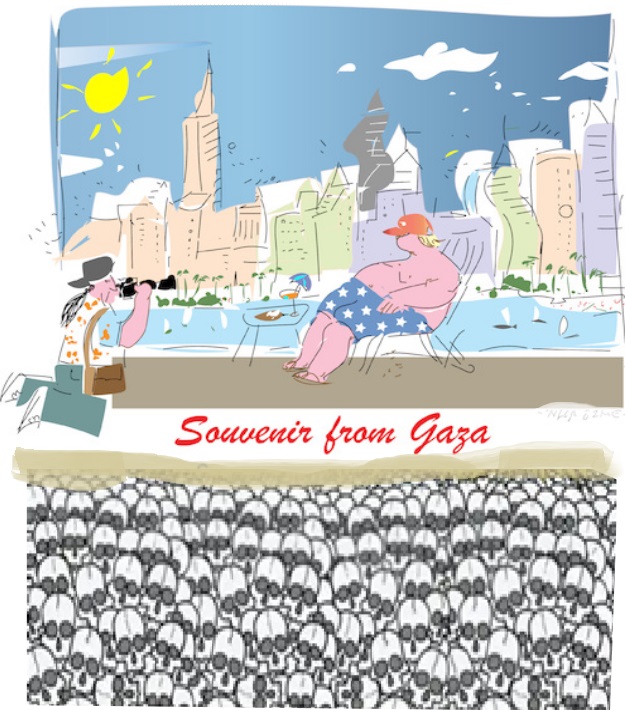
Oops, your real motives are showing
 by Skwawkbox, 19 September 2025, https://www.thecanary.co/skwawkbox/2025/09/19/smotrich-gaza/
“We paid a lot of money for the war, so we need to decide how to divide the percentages of the land” – these are the words of self-described ‘fascist and homophobe’ Israeli finance minister Bezalel Smotrich as he discussed how Israel and the US plan to divide up Gaza between themselves this week.
“We paid a lot of money for the war, so we need to decide how to divide the percentages of the land” – these are the words of self-described ‘fascist and homophobe’ Israeli finance minister Bezalel Smotrich as he discussed how Israel and the US plan to divide up Gaza between themselves this week.
Smotrich: Gaza is a ‘real estate bonanza’
Speaking in Hebrew at a property conference, Smotrich added:
The Gaza Strip is becoming a real estate bonanza.
The Israeli and Trump regimes – to be more accurate the Israeli-Trump regime – have long been discussing the US ‘Trump-Gaza plan’ to turn Gaza, after the extermination or expulsion of its rightful Palestinian owners, into a beach-front resort money-making project, a plan even accompanied by a deranged AI video posted by Trump to his social media.
We paid a lot of money for the war, so we need to decide how to divide the percentages of the land in Gaza. The demolition phase is always the first phase of urban renewal. We did that, now we need to start building.
Trump’s plan was first developed for him by the same people who came up with the so-called ‘Gaza Humanitarian Foundation’ whose ‘aid’ stations have killed more than 2,000 desperate refugees seeking food and wounded more than 15,000 – a group of Israeli business people.
BCG, the consulting firm who financialised the plan, calculated that it would return to its backers four times the initial investment of $100 billion, according to the plan. The firm has since tried to distance itself from the plan, claiming to have sacked all the partners who approved it.
Smotrich should be in the Hague. No ifs, no buts.
They Said The Massacres Would Stop When The Hostages Were Released. They Haven’t Stopped.
Caitlin Johnstone, Oct 18, 2025,https://www.caitlinjohnst.one/p/they-said-the-massacres-would-stop?utm_source=post-email-title&publication_id=82124&post_id=176485051&utm_campaign=email-post-title&isFreemail=true&r=1ise1&triedRedirect=true&utm_medium=email
Last year I banged out an angry rant about the way Israel supporters would yell “release the hostages!” at anyone who talked about the latest massacre of Palestinian civilians, saying Hamas was to blame for the killing because of their refusal to release the Israeli captives, and that it would all stop once the hostages are free. I’m remembering that essay today because the hostages are free, but the massacres are continuing.
On Friday Israel reportedly blew up a vehicle carrying a Palestinian family of eleven people, including seven children. The IDF gave its usual excuse for the massacre: the civilians were deemed to have crossed an invisible line into a forbidden zone which made the Israeli soldiers feel unsafe. They did this exact same thing constantly during the last “ceasefire” as well.
In my polemic last year I argued that the slaughter we were seeing in Gaza plainly had nothing to do with pushing for the release of Israeli hostages, and that even if it did it would still be barbaric to massacre children until your enemies caved in to your demands.
But two years of genocide have made it clear that the Israeli military was never killing Palestinian civilians in order to push for the release of hostages or force Hamas to cave in to their demands. The Israeli military kills Palestinian civilians in order to kill Palestinian civilians. The killing is the goal, and it always has been.
We see this illustrated over and over again, in all sorts of ways. Israel apologists always argued that the only reason the IDF had destroyed Gaza’s healthcare system with nonstop hospital attacks was because Hamas was using those hospitals as secret military bases. But then multiple independent reports from western doctors in Gaza confirmed that Israeli forces had been entering the hospitals after attacking them and systematically destroying individual pieces of medical equipment one by one in order to make them unusable. Hamas wasn’t the target in those hospital attacks, the hospitals themselves were the target.
And now we are seeing the “Israel is killing people because Hamas has Israeli hostages” narrative debunked in exactly the same way the “Israel keeps bombing hospitals because there are Hamas bases in all of them” narrative was. The hostages are free, but the massacres continue.
None of which will surprise anyone who was paying attention these last two years. Israel’s genocidal intent has been on full display every minute of every day, and it continues to be even during this joke of a “ceasefire” where the genocide was theoretically supposed to be on pause for a little while.
Israel Tortured And Sexually Humiliated Greta Thunberg.
Caitlin Johnstone, Oct 16, 2025, https://www.caitlinjohnst.one/p/israel-tortured-and-sexually-humiliated?utm_source=post-email-title&publication_id=82124&post_id=176291910&utm_campaign=email-post-title&isFreemail=true&r=1ise1&triedRedirect=true&utm_medium=email
In an interview with Swedish paper Aftonbladet, Greta Thunberg has corroborated earlier eyewitness reports that she and her fellow Global Sumud Flotilla activists were subjected to monstrous abuses by Israeli officials after being abducted from their boats carrying aid for Palestinians in Gaza.
Here are some excerpts (quotes from Thunberg are italicized, quotes from Aftonbladet are in bold):
“They grab me, pull me to the ground, and throw an Israeli flag over me.”
“They dragged me to the opposite side from where the others were sitting, and I had the flag around me the whole time. They hit and kicked me.”
“They moved me very brutally to a corner that I was turned towards. ‘A special place for a special lady’, they said. And then they had learned ‘Lilla hora’ (Little whore) and ‘Hora Greta’ (Whore Greta) in Swedish, which they repeated all the time.”
In the corner where Greta was sitting, the police placed a flag. “The flag was placed so that it would touch me. When it fluttered and touched me, they shouted ‘Don’t touch the flag’ and kicked me in the side. After a while, my hands were tied with cable ties, very tightly. A bunch of guards lined up to take selfies with me while I was sitting like that.”
“They were thrown to the ground and beaten. But I could only see it out of the corner of my eye, because every time I lifted my head from the ground, I was kicked by the guard standing next to me.”
Greta was then taken into a building to be searched and undressed. “The guards have no empathy or humanity, and they keep taking selfies with me. There’s a lot I don’t remember. So much is happening at once. You’re in shock. You’re in pain, but you go into a state of trying to stay calm.”
Outside, she was forced to take off her clothes again, she says. “It was mockery, rough handling, and everything was filmed. Everything they do is extremely violent.”
“It was so hot, like 40 degrees. We begged the whole time: Can we have water? Can we have water? In the end, we screamed. The guards walked in front of the bars the whole time, laughing and holding up their water bottles. They threw the bottles with water in them into the trash cans in front of us.”
“When people fainted, we banged on the cages and asked for a doctor. Then the guards came and said, ‘We’re going to gas you.’ It was standard for them to say that.”
“This shows that if Israel, with the whole world watching, can treat a well-known, white person with a Swedish passport this way, just imagine what they do to Palestinians behind closed doors.”
Thunberg told Aftonbladet that the Swedish government greatly downplayed the abuse she and her fellow Sumud Flotilla activists suffered, and wouldn’t even bring them water:
“We were together and told them about the treatment we received. About the lack of food, water, about the abuse. The torture. We showed them the physical injuries we had — bruises and scratches. We gave them all our contact details — I gave them my father’s number and the number of our contact in the organization. We were clear: everything we say now must be released to the media.”
“They didn’t do anything, they just said: ’Our job is to listen to you. We are here and you are entitled to consular support.’”
“We said over and over again: we need water. And they saw that the guards had water bottles. The embassy staff said: ’We’ll make a note of that.’ One of us, Vincent, said: ’Next time we meet you, you must bring water.’”
Then it took two days before the embassy staff showed up again.
“They didn’t bring any water, except for a small bottle of their own that was half empty. Vincent, who was in the worst shape, got to drink it. We kept asking the guards, ‘Can we have some water?’ but they just walked around with their water bottles and didn’t answer.”
“I said, ‘Are you going to leave us like this? If you leave now, they will beat us up.’ But they just kept walking.”
When Aftonbladet compares emails sent by the Ministry of Foreign Affairs to relatives, with what the captives describe telling embassy staff, it becomes clear that the seriousness of the situation has been downplayed.
The Ministry of Foreign Affairs describes the scene at the port, where Greta Thunberg was beaten for hours, as follows: “She told us about harsh treatment and that she had been sitting on a hard surface for a long time.”
On Saturday, several media outlets published testimonies that Greta had been subjected to torture.
Aftonbladet has spoken to three other members of the flotilla who largely confirm what Greta Thunberg says and who have all experienced various types of abuse and humiliation. We have also spoken to relatives. Everyone is highly critical of how the Swedish embassy staff acted.
Thunberg’s statements are not just in alignment with eyewitnesses who said these things were done to her, but with statements from the Israeli government itself.
Israeli National Security Minister Itamar Ben-Gvir said last month that Sumud activists must be treated as terrorists in order to “create a clear deterrent” from future flotilla activism, declaring that “Anyone who chooses to collaborate with Hamas and support terrorism will meet a firm and unyielding response from Israel.”
“We will not allow individuals who support terrorism to live in comfort. They will face the full consequences of their actions,” Ben-Gvir said at the time.
After the flotilla activists were abducted by the IDF, Ben-Gvir filmed himself taunting them and calling them “terrorists” and said he “was proud that we treat ‘flotilla activists’ as terror supporters.”
Israel, needless to say, has an extensively documented record of torturing and raping individuals who’ve been given the “terrorist” label by the regime.
So what Thunberg is describing would be Israel doing what it said it was going to do in order to send a message and deter future efforts to feed starving Palestinians — perhaps singling out the most high-profile activist on the flotilla for special abuse in order to really drive the point home.
Israel is so evil it’s actually hard to wrap your mind around it.
Palestinians freed from Israeli prison denied reunion with families as Trump claims a ‘forever’ peace
At the end of the prisoner exchange, between 9,000 and 10,000 Palestinians will remain behind bars, including around 5,000 Palestinians who are being held without charge or trial, and without clear release dates, under Israel’s system of “administrative detention.”
Palestinians gathered in the West Bank to reunite with loved ones set to be released as part of the prisoner exchange between Israel and Hamas. But many were devastated to learn that Israel had deported them instead.
Mondoweisss, By Qassam Muaddi October 13, 2025
Palestinians in Gaza lived another day without bombs dropping over their heads as the first phase of the ceasefire between Israel and Hamas continued into Monday, which saw the release of Israeli captives from Gaza and the release of 1,718 out of 10,000 Palestinians held in Israeli prisons.
At around 8:00 a.m. local time, Hamas’s armed wing, the al-Qassam Brigades, handed the first group of seven Israeli captives to the International Committee of the Red Cross in Gaza, without any ceremonies or media exposure. The second group of 13 Israeli captives came an hour later. Meanwhile, the Israeli prison services moved hundreds of Palestinians out of its detention centers.
Palestinians in Gaza lived another day without bombs dropping over their heads as the first phase of the ceasefire between Israel and Hamas continued into Monday, which saw the release of Israeli captives from Gaza and the release of 1,718 out of 10,000 Palestinians held in Israeli prisons.
At around 8:00 a.m. local time, Hamas’s armed wing, the al-Qassam Brigades, handed the first group of seven Israeli captives to the International Committee of the Red Cross in Gaza, without any ceremonies or media exposure. The second group of 13 Israeli captives came an hour later. Meanwhile, the Israeli prison services moved hundreds of Palestinians out of its detention centers.
A total of 1,718 Palestinians were released into the Gaza Strip, all of whom were abducted by Israeli forces from within Gaza during the past two years. In addition, Israel released 250 Palestinians who had been serving high or life sentences in Israeli prisons, 88 of whom were released in the West Bank, while the rest were deported to Gaza and Egypt.
In the town of Beitunia, adjacent to Ramallah, dozens of Palestinians gathered in expectation of the released prisoners, who were announced to be released from Israel’s Ofer detention center just outside of the town. Israeli drones flew over the gathering, dropping leaflets that read “we are watching you everywhere. If you show any support for a terrorist group, you will expose yourself to arrest and punishment.”
At around 11:00 a.m., two Red Cross-marked buses drove through Beitunia as Palestinians waved at the released prisoners along the way, in decidedly smaller numbers than the crowds that had received released prisoners during the previous January-March ceasefire.
At the Ramallah Cultural Palace, prisoners’ families and crowds of Palestinians gathered to receive the released prisoners. In the crowds, the family of a prisoner, Murad Abu al-Rub, 45, including two of his sisters, his cousin, and his paralyzed mother, stood on a sidewalk trying with difficulty to get a glimpse of the Red Cross buses as they arrived.
“He has been in jail for 19 years with a life sentence, and the last time we visited him was before October 2023,” the cousin told Mondoweiss. “For more than two years, we haven’t seen him, and the news we have had about him through lawyers is very limited.”
“His father and one of his brothers died during his time in jail,” the cousin explained. “And his mother suffered a stroke last year that left her unable to move or speak. But we brought her because she has been very anxious to see him.”
The family left Jenin in the northern West Bank at 6 a.m. to avoid the Israeli army’s expected road closures, as it did during the previous ceasefire. “The Israeli Shabak came to our house yesterday and warned us not to show any signs of celebration, and they told us that Murad will be released here.”
After all the prisoners left the bus, the family discovered that Murad wasn’t among them. Minutes later, they received confirmation from the Red Cross that he had been deported to Egypt.
As the cousin shared the news, the elderly mother broke into tears and random screams in her wheelchair. As her daughters helped her into the car, one of them tried to console her. “He went to Egypt to study! He’ll be back later,” she said. The mother moved her hand in an apparent refusal to hear, continuing to weep.
Meters away, the older brother of Abdallah Barham, 40, one of the prisoners set to be released, had just learned that he, too, had been deported. The brother was in Ramallah by 7 a.m. to wait for Abdallah, who had served 18 years of his life sentence in Israeli prison.
“The family and the entire village are waiting in Kufr Qadoum to celebrate his release,” he explained. “And the Shabak came yesterday and warned us not to celebrate.”
“Our younger brother and our mother died during his period of imprisonment,” he continued. “And our father has been waiting for this day for the past 18 years. The feeling is tragic.” ………………………………………………………………………………..
At the end of the prisoner exchange, between 9,000 and 10,000 Palestinians will remain behind bars, including around 5,000 Palestinians who are being held without charge or trial, and without clear release dates, under Israel’s system of “administrative detention.”……………………………….
Donald Trump speaks before the Knesset, Sharm al-Sheikh summit
……………………………………. In his speech, Trump said it was a “historic dawn of a new Middle East” and the beginning of a “grand concord and lasting harmony for Israel.” Trump praised Netanyahu, whom he called “hard to deal with.” The U.S. President also lauded special envoy Steve Witkoff and his son-in-law, Jared Kushner, whom he said was “called in” to draft the plan for the end of the war, all with a wave of applause by the Knesset members. Trump also thanked the Arab and Muslim countries that participated in his plan for the end of the war, which did not receive any applause from the Knesset.
During Trump’s speech, Palestinian Knesset member Ayman Odeh and left-wing anti-Zionist Knesset member Ofer Kasif raised signs calling for the recognition of Palestine as a state, and were forcibly removed from the hall
…………………………………………………………… Israel and Hamas still have to negotiate terms for the definitive end to the war based on Trump’s plan. This includes the body meant to rule over the Strip, which Hamas and Palestinian factions insist must be an independent Palestinian body of technocrats. In contrast, Trump’s plan would include a “board of peace” headed by Trump himself that would be in charge of running Gaza.
Another point to be negotiated is the disarmament of Hamas and other Palestinian resistance factions. Palestinian factions, including Hamas, insist that they would lay down their arms upon the establishment of a Palestinian state, while Trump’s plan would see the resistance movement’s disarmament and makes no mention of Palestinian statehood. https://mondoweiss.net/2025/10/palestinians-freed-from-israeli-prison-denied-reunion-with-families-as-trump-claims-a-forever-peace/
Israeli Soldiers Torched Food, Homes, and a Critical Sewage Treatment Plant in the Wake of Ceasefire Announcement
Soldiers called the mass arson of Gaza City their “final touches.”
Drop Site, Younis Tirawi and Yaniv Cogan, Oct 13, 2025
In the immediate aftermath of Donald Trump’s announcement on Thursday that both Hamas and Israel had signed off on an agreement to stop the fighting, the Israeli military launched an arson spree, setting fire to civilian infrastructure, including the destruction of an essential sanitation plant in Gaza City. After publication, the Israel Defense Forces told Drop Site it “is aware of the incident and it is being reviewed.”
The destruction of Palestinian structures following the departure of soldiers who had used them as temporary bases has been a hallmark of Israel’s approach to Gaza for two years. In July, Israeli reporter Yuval Abraham collected testimonies from soldiers describing a myriad of arson methods. “Every Arab house we entered had olive oil […] We poured the oil on the sofas, on anything flammable in the apartment, and then we ignited [it] or threw in a smoke grenade. This was a common practice,” one of them described.
The agreement came after months of a concerted effort to render Gaza uninhabitable by destroying residences and civilian infrastructure, culminating in the ground invasion of Gaza City and the leveling of several high rises in Gaza City. In September, Israeli government minister Gila Gamliel told Channel 7 News, “We have already completely annihilated 75% of the entire [Gaza] Strip. There remains 25%, which, as you know, it too…we are now taking over [the city of] Gaza—there will be nothing left there that would really [have] the potential to be habitable.”
The scope of the arson perpetrated in Gaza City on the night of October 9th and early morning of October 10—Thursday night into Friday, just after the ceasefire was agreed to but before Israel’s cabinet approved it—was broader than at any other time Drop Site has tracked during the assault on the strip. …………………………………………………………………………………………………………………….
The Torching of Gaza City’s Sewage Treatment Plant: “[One] last memory”……………………………………………………………………………………………
Mass Arson Campaign Around Sheikh Radwan Market, Gaza City……………………………………………………………………………………………..
Burning Homes Across Gaza City Israeli troops also shared photos of torched houses in other locations accompanied by captions musing about the arson. One soldier dubbed the burning of several buildings the “finishing touches.”……………………………………………………………………………………..
As the ceasefire takes hold, Gaza has already been rendered largely uninhabitable. One Israeli colonel recently bragged to the Israeli media, “We are leaving behind us only dust. There’s nothing here.” For officials like Gamliel, who have expressed satisfaction with the level of destruction in Gaza, the upshot is clear:
“Look at the hypocrisy of all European countries. They constantly go ‘starvation, starvation’ Well…? Open [your] doors! Why, when it was about Ukraine, it was fine, when it was about Syria, it was fine. When it comes to the Palestinians, they want to perpetuate this conflict structurally.
Now, just for your information: one million and seven hundred thousand inside the Gaza Strip are defined as UNRWA refugees. Meaning, once they get out of there, they are not coming back! Because as refugees, this is not the place where they actually have the right of basic belonging.” https://www.dropsitenews.com/p/israel-idf-soldiers-set-fire-food-homes-sewage-treatment-plan-after-ceasefire-announced
After 2 years, Israel genocidal ethnic cleansing of Gaza has failed

Walt Zlotow, West Suburban Peace Coalition, Glen Ellyn IL 9 Oct 25
Israel has a grisly method of negotiating peace and release of remaining Israeli hostages in Gaza. They’re continuing their genocidal ethnic cleansing of those pesky Palestinians who just won’t leave so Israel can annex Gaza to Greater Israel.
On Tuesday Israel bombed Gaza City, Khan Younis, even the Mawasi safe zone, killing at least 10. Hundreds of been slaughtered in the five days Israel has ignored President Trump’s demand to stop the genocide while peace talks continue in Egypt.
That should surprise no one interested in ending the genocide. Israel’s primary goal since the Hamas attack 2 years ago Tuesday was to exploit the attack to rid Gaza of all 2,300,000 Palestinians. While killing over 100,000, with the remaining 2,200,000 suffering starvation, degraded health, no habitable living conditions, Israel has failed to achieve its cherished goal: no Palestinians left in a Gaza annexed into Greater Israel.
Israeli Prime Minister Benjamin Netanyahu needs to maintain the genocide for political and personal reasons. The political is the aforementioned completion of Greater Israel including not only Gaza but the West Bank. The personal reason is to delay indefinitely his possible date with prison on corruption crimes.
Dead last on Netanyahu’s grotesque agenda? Getting back the remaining 48 Israeli hostages. Had he cared a whit about the original 251, many of whom his delay killed, he wouldn’t have embarked on genocide.
None of this could have occurred without the $20 billion in genocide weapons gifted to Israel by presidents Biden and Trump, paid for by John Q. Taxpayer. US near total support of the genocide continues even tho an increasing majority of Americans call it genocide and demand we end enabling it.
The current talks in Egypt are doing nothing to achieve the only path to peace: Palestinian statehood, recognized by 158 of 193 UN countries but not the US. Trump’s 20 point peace plan is simply US imagined neocolonialism to keep Gaza totally controlled by outside forces. Palestinians are excluded, keeping Gaza stateless in perpetuity.
The peace plan may release the remaining 48 hostages and achieve ceasefire. But it will neither achieve a Palestinian state nor Netanyahu’s dream of a Palestinian free Gaza annexed to Israel. Both likely outcomes may doom the peace negotiations to failure.
1 This Month
To see nuclear-related stories in greater depth and intensity – go to https://nuclearinformation.wordpress.com/
12 February – Webinar The Big Push: New Nuclear Projects in Canada

Thursday, February 12, 7 pm Eastern | 2nd of 4 sessions in the 2026 Nuclear Waste Online webinar series
Join a webinar on the push for new nuclear generation in Canada. Go to Northwatch.org to register or use the registration link https://us02web.zoom.us/webinar/register/WN_ZfWOf1GITqSRIZX8CB-A9w
-
Archives
- February 2026 (115)
- January 2026 (308)
- December 2025 (358)
- November 2025 (359)
- October 2025 (376)
- September 2025 (258)
- August 2025 (319)
- July 2025 (230)
- June 2025 (348)
- May 2025 (261)
- April 2025 (305)
- March 2025 (319)
-
Categories
- 1
- 1 NUCLEAR ISSUES
- business and costs
- climate change
- culture and arts
- ENERGY
- environment
- health
- history
- indigenous issues
- Legal
- marketing of nuclear
- media
- opposition to nuclear
- PERSONAL STORIES
- politics
- politics international
- Religion and ethics
- safety
- secrets,lies and civil liberties
- spinbuster
- technology
- Uranium
- wastes
- weapons and war
- Women
- 2 WORLD
- ACTION
- AFRICA
- Atrocities
- AUSTRALIA
- Christina's notes
- Christina's themes
- culture and arts
- Events
- Fuk 2022
- Fuk 2023
- Fukushima 2017
- Fukushima 2018
- fukushima 2019
- Fukushima 2020
- Fukushima 2021
- general
- global warming
- Humour (God we need it)
- Nuclear
- RARE EARTHS
- Reference
- resources – print
- Resources -audiovicual
- Weekly Newsletter
- World
- World Nuclear
- YouTube
-
RSS
Entries RSS
Comments RSS
 nuclear-news