Britain prepares for new wave of nuclear decommissioning
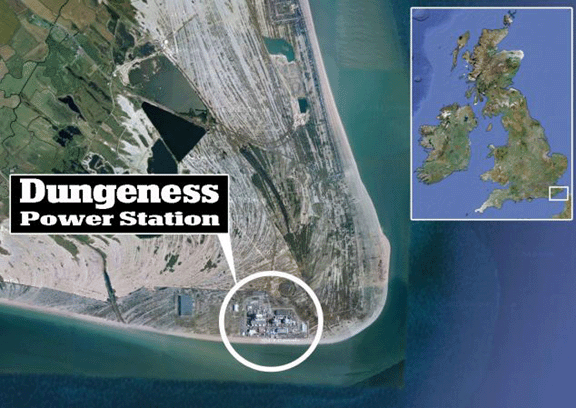
Sceptics of the fuel argue the plans demonstrate why no new plants should be built, Ft.com Nathalie Thomas in Edinburgh 23 June, 21, At Dungeness B nuclear power station on a remote stretch of the Kent coast in south-east England, workers are making preparations to carefully remove thousands of radioactive fuel elements from its reactors and transfer them to a purpose-built pond for at least 90 days for cooling. The spent fuel will later be packed into 53-tonne “flasks” fortified with 39cm-thick steel walls before being transported across country by train to Sellafield in Cumbria.
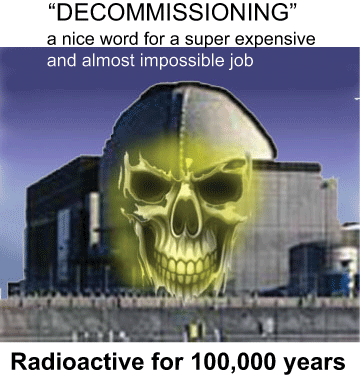
The nuclear facility in north-west England is host to most of the radioactive remnants of Britain’s civil nuclear programme that dates back to the 1950s. These include highly toxic waste that will remain there until a suitable site is found for an underground repository where it will have to be stored for more than 100,000 years to make it safe.
Preparations for the “defuelling” of Dungeness B started with “immediate effect” on June 7 when its majority owner, French state-controlled utility EDF, announced it would close the plant seven years early. It had not been operational since September 2018 as engineers tried to fix problems, including corrosion and cracks in its pipework.
The 1.1GW plant is the first of seven built in the UK between the mid-1960s and late-1980s using advanced gas-cooled reactor (AGR) technology to come out of service. It will kickstart a decommissioning process spanning generations, which sceptics argue strikes at the heart of why no new nuclear plants should be built.
The remaining six AGR plants are due to be retired by the end of this decade at the latest, leaving the more modern Sizewell B plant in Suffolk, which uses pressurised water reactor technology, as the only one operational out of the existing fleet
. “[Decommissioning of] many of these facilities will continue well into the 22nd century,” said Paul Dorfman of University College London’s Energy Institute. “The problem with decommissioning is it always turns out to be more complex than one had imagined.”
Critics also point out that the decommissioning of Britain’s 17 earliest atomic power sites has been extremely costly. The latest clean-up bill for those sites, which include a generation of nuclear plants known as the “Magnox” stations, is estimated at more than £130bn over 120 years. ……
Climate activists, such as E3G and Greenpeace, have long argued that the debate over building costly, complex new nuclear plants detracts from investment in cheaper, climate-friendly technologies……….
The exact arrangements for the decommissioning of Dungeness and the six other AGR plants are subject to negotiation between EDF and the government. It will be financed via a £14.5bn fund set up in 2005.
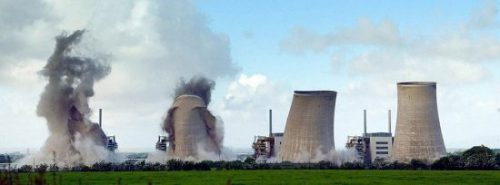
The French utility is expected to take at least three years to remove all fuel from each site and potentially carry out some early demolition work before handing them over to the UK state-owned Nuclear Decommissioning Authority. EDF declined to comment. The next stage will probably involve the treatment and removal of waste and demolition of facilities that are no longer needed. Some facilities will be left untouched for 85 years — to allow residual radioactive materials to decay — before demolition. …….. https://www.ft.com/content/0381e567-d088-4802-a2e4-e125c8099605
Renewables should be the focus of Indonesia’s net-zero pledge. (IEEFA Indonesia): In growing energy markets like Indonesia, decision makers are facing a barrage of pro-nuclear media coverage as the nuclear industry floods the market with panels and webinars focused on the potential of nuclear power.
A new report from the Institute for Energy Economics and Financial Analysis (IEEFA) highlights that while nuclear is promising as a baseload substitute for coal power, it currently has no technical, financial, or market viability in the Indonesian context. Author of IEEFA’s report Elrika Hamdi says that Indonesian nuclear power supporters often promise that nuclear will be an affordable, safe and sustainable solution for the problem of over-reliance on fossil fuel.
Yet, 70 years after the first nuclear power developments were announced, the technology is quickly losing market share as global power markets pivot toward more cost-competitive renewables and storage solutions.
“Despite the steady erosion of nuclear power’s competitive potential, key Southeast Asian energy ministries continue to be lobbied by nuclear advocates. Many of these lobbyists are international backers of new small modular reactor (SMR) technologies, who are actively engaging with governments and utilities around the region,” says Hamdi.
As old generation large-scale nuclear units face decommissioning, there is little consensus about how long it will take for newer small-scale nuclear technologies to be economically viable or how long-standing safety and waste disposal risks will be addressed.
“Determining the suitability of nuclear for the Indonesian power market will be a challenging task that will require honest and deep engagement by senior policymakers to ensure there is a high degree of accountability as Indonesians need to know the real cost of having nuclear in the power system as well as how the government will handle the problem of nuclear waste.”
Hamdi says that the short-list of nuclear power issues includes technology reliability, safety and safeguards, the geographic conditions of Southeast Asia, the prospects for decommissioning, waste treatment and permanent disposal, fuel availability, affordability, and the risk of persistent cost overruns and frequently overlooked shut-down costs.
Research has shown that an estimated 97% (175 out of 180 projects examined) of nuclear power projects exceed their initial budgets. The average cost overrun for a nuclear power plant was US$1.3 billion per project with construction delays adding 64% more time than initially projected.
Nuclear waste disposal costs also complicate the cost estimation process—typically raising project costs as political risk factors crystallize. The inability of leading nuclear nations to find safe and affordable solutions for permanent high-level nuclear waste disposal leaves expensive back-end cost issues on the table.
The economics of nuclear power in Indonesia is also blurred by the fact that under existing regulations, nuclear accident liabilities for nuclear owners/operators are capped at a maximum of IDR 4 trillion (US$276 million) for power plants with a capacity of more than 2000MWe. It is cut in half as the capacity decreases. This means smaller nuclear reactors would be liable for only a fraction of potential accident costs.
“These open-ended cost issues make it hard to evaluate claims about the market viability of nuclear power in Indonesia’s cost-sensitive market. This is particularly true when most established nuclear nations are pivoting away from commitments to new nuclear power facilities as more flexible renewable plus storage options reshape power sector economics,” says Hamdi.
“If a decision is reached to move ahead with pilot stage nuclear projects, policymakers and the government will need to do a lot of policy work including the technical evaluation, the regulatory preparation and the financial support, including preparation of the currently non-existent third-party liability insurance framework.
“This will place a serious burden on a government already taxed by the response to the COVID-19 pandemic and efforts to revitalize the financially constrained PT Perusahaan Listrik Negara (PLN), Indonesia’s national power company.”
PLN also recently pledged to become carbon neutral by 2060. However, the plan released shows nuclear only entering the energy mix in 2040. This demonstrates that PLN is realistic about the technical, financial, and market challenges that need to be overcome if nuclear power is to successfully integrate into Indonesia’s future energy mix.
Hamdi says that until these issues have been acknowledged and fully addressed, the safe path for Indonesia, for now, would be to pause and set realistic goals for its power development strategy.
This includes taking advantage of Indonesia’s abundance of renewable energy resources and market viability.
“Currently only 2.5% of Indonesia’s 400GW renewable energy potential has been utilized. That means that new technology options such as nuclear must compete with the deflationary cost curve in evidence with increasingly low-cost and low-risk renewable power solutions.
“New innovations to support grid flexibility such as demand response and storage are providing a cost-effective alternative to baseload-heavy planning disciplines. This trend raises questions about how small-scale nuclear reactors will fit into a more diverse power market where more cost-competitive renewable options could under-cut untested technologies that are years away from realizing economies of scale.
“The smaller, easily dispatchable, and walk-away safe promise of the new Gen-IV SMR technology offer is promising, IF and when the technology reaches commercial stage. But until such technology is proven to be technically and financially feasible, Indonesia’s safest option is to pause and set a more realistic net-zero scenario with resources and technologies that are already readily available with less cost, less risk, and less future liabilities.”
LADBible 15th May 2021, A scientist has warned that Chernobyl nuclear power plant must be dismantled in the next 100 years or else it will collapse.
Professor Neil Hyatt is the Royal Academy of Engineering and Nuclear Decommissioning Authority’s research chair in radioactive waste management. Speaking to LADbible about recent developments that nuclear reactions had been detected from deep within the mummified plant – 35 years after its core exploded in what is widely viewed as history’s worst nuclear disaster – he says it’s time to act.
“If we don’t take it down, it’s going to fall down,” says Professor Hyatt, who teaches at Sheffield University. “The original shelter was built as a temporary facility to stabilise a situation and the New Safe Confinement is essentially the same thing – to buy us time. [But] it only buys us around 100 years or so.
“If you think about nuclear decommissioning, which I do all the time, look at the projects that are going on around the world. “There’s the Sellafield site in the UK – that’s one hundred years to decommission the Sellafield site at a cost of £132 billion, at least. “That probably tells you it’s going to take at least 50 years, if we started today, probably at a cost of about £900 million, to decommission Chernobyl.
“These are orders of magnitude, and the reason is because we still don’t know everything we need to know to decommission it, about the material inside.” He adds: “If we don’t take it down, it’s gonna collapse eventually. If you’ve bought yourself 100 years, you really need to start cracking on with the dismantling – probably in the next 20 years.
Kent Online 10th May 2021, A power station in Kent could start its defuelling phase seven years early unless a number of “significant and ongoing technical challenges” are overcome. Dungeness B power station on Romney Marsh has been off-line since September 2018 while a multi-million pound maintenance programme was carried out.
This work was due to be completed last year but that timeline changed to August 2021 following a series of delays. But now EDF say the ongoing challenges and risks “make the future both difficult and uncertain”.
As a result, the energy company is now exploring a range of options – including starting the procedure to shut the station down later this year, seven years ahead of its planned defuelling phase. A statement from EDF reads: “Dungeness B power station last generated electricity in September 2018 and is currently forecast to return to service in August 2021.
“The station has a number of unique, significant and ongoing technical challenges that continue to make the future both difficult and uncertain. “Many of these issues can be explained by the fact that Dungeness was designed in the 1960s as a prototype and suffered from very challenging construction and commissioning delays. “We expect to have the technical information required to make a decision in the next few months, as it is important we bring clarity to the more than 800 people that work at the station, and who support it from other locations, as well as to government and all those with a stake in the station’s future.”
Overdue Shutdown of the Indian Point Nuclear Plant
Environmental groups write that gains in energy efficiency and renewable power exceed the plant’s annual output.
“Nuclear Plant’s Shutdown Means More Fossil Fuel in New York”(news article, April 13):
New York State is making good on its promise to replace the aging, unsafe Indian Point nuclear plant with clean energy. Gains in energy efficiency and renewable power over the last decade already exceed the plant’s total annual output, with much more to come.
We can expect year-to-year changes given fluctuations in energy demand and prices. But the overall trend in New York is clear: Clean energy is here to stay, and emissions reductions are on track to reach the state’s ambitious climate goals.
Closing this dangerous plant is overdue. Over the years Indian Point has experienced reactor structure problems with the potential for structural failure, as well as leaks, fires and unplanned shutdowns.
For the 20 million people who live within 50 miles of it, Indian Point’s long-planned closure ends a risky chapter. Paul GallayKit Kennedy Mr. Gallay is president of Riverkeeper and Ms. Kennedy is senior director, climate and clean energy program, at the Natural Resources Defense Council. https://www.nytimes.com/2021/04/21/opinion/letters/indian-point-nuclear.html
Sierra Club 16th April 2021, After announcing it would drop one of its leases in the Palo Verde Nuclear plant last year, this month PNM proposed replacing the energy with 100% solar and battery. In support of its proposal, PNM cited the Energy Transition Act’s requirements and the Public Regulation Commission’s decision last year to choose a 100% solar/storage proposalrather PNM’s favored gas-inclusive replacement scenario for San Juan Generating Station coal. The replacement proposal will need to be approved by the commission. In selecting carbon emission-free generation to replace Palo Verde, PNM states in testimony it has taken into consideration “the state’s energy transition policies and long-term mandate for a carbon emission-free generation portfolio.” While we have yet to delve into all of the details of PNM’s application, this is very encouraging and we look forward to supporting PNM’s request for prompt approval of replacement resources.
Reuters 8th April 2021, DF Energy, owned by French utility EDF, is exploring a range of scenarios for its Dungeness B nuclear plant in Britain, including bringing forward its decommissioning date of 2028, it said on Thursday. The 1.1 gigawatt Dungeness B plant, in Kent on the south coast of England, has been offline since 2018 as the company has been carrying out inspections and maintenance of pipes carrying steam to the turbine. EDF Energy has also been trying to complete repair work on corrosion identified during inspections of safety back-up systems.
The plant is currently forecast to return to service in August. It was designed in the 1960s and first started generating electricity in 1983. EDF Energy said it has spent more than 100 million pounds ($138 million) on the plant during its current outage and it has a number of ongoing technical challenges that make its future uncertain.
Decade After Fukushima Disaster, Greenpeace Sees Cleanup Failure, Bloomberg Green, By Aaron Clark,
Land identified for cleanup remains contaminated: Study
Long-term threat to human and environmental health remains
Ten years after the worst nuclear accident since Chernobyl, land Japan identified for cleanup from the triple reactor meltdown of the Fukushima Dai-Ichi atomic power plant remains contaminated, according to a report from Greenpeace.
In addition, Greenpeace said its own radiation surveys conducted over the last decade have consistently found readings above government target levels, including in areas that have been reopened to the public. The lifting of evacuation orders in places where radiation remains above safe levels potentially exposes people to an increased risk of cancer, the report said.
On average, just 15% of land in the “Special Decontamination Area,” which is home to several municipalities, has been cleaned up, according to the environmental advocacy group’s analysis of government data. That’s despite the government’s claims that the area has largely been decontaminated, the group said.
……..While the government has been steadily lifting evacuation orders on towns since 2014, roughly 36,000 people are still displaced.
Nuclear Engineering International 3rd March 2021, REPORTS IN THE UK THAT EDF Energy’s Hinkley Point B station would close ‘early’, in 2022, sounded a strange note for nuclear industry veterans. They knew that the venerable advanced gas-cooled reactor (AGR) on the west coast, on its startup in 1979, was originally expected to have a lifetime of around 25 years.
But in fact, it has been in operation for 40 years and could have more than one more year remaining, if owner EDF Energy takes it to its final end date in mid 2022. But those newspapers had noted that EDF had hoped to delay final shutdown until 2023. For longstanding opponents of the plant, however, closure comes not a moment too soon — and they believe equally that operation should end at the UK’s remaining AGRs.
At issue is the interlocking graphite blocks that in the AGR design form the reactor core. Opponents argue that years of irradiation have caused so much damage to the blocks that the plants should be out of operation. This is indeed one of the ageing issues that affects AGRs, but the situation, and the decision on whether to close the plant, is more complicated.
Seattle Times 3rd March 2021,The head of the wrecked Fukushima nuclear plant says there’s no need to extend the current target to finish its decommissioning in 30-40 years despite uncertainties about melted fuel inside the plant’s three reactors.
Ten years after meltdowns of three of its reactors following a massive March 2011 earthquake and tsunami that devastated northeastern Japan, the Fukushima Daiichi plant has stabilized but faces new challenges.
Nuclear regulators recently found fatal levels of contamination under the lids of two reactors, a test removal of melted fuel debris from one reactor has been delayed for a year, and a recent earthquake may have caused new damage to the reactors.
About 900 tons of melted fuel debris remain inside the plant’s three damaged reactors, and its safe removal is a daunting task that its operator, Tokyo Electric Power Co., or TEPCO, and the government say will take 30-40 years to finish. The removal of spent fuel units from cooling pools is already being delayed for up to five years. But Akira Ono, who as head of the plant is also its chief decommissioning officer, said he doesn’t plan to change the current goal to finish decommissioning between 2041 and 2051.
Lawsuit looks to block dismantlement of Southern California’s San Onofre nuclear plant, Herald Mail Media Rob Nikolewski The San Diego Union-Tribune (TNS) 26 Feb 21, SAN DIEGO — An advocacy group based in Del Mar is taking the California Coastal Commission to court, looking to stop the dismantlement work underway at the now-shuttered San Onofre Nuclear Generating Station.
Officials with the Samuel Lawrence Foundation say the commission should not have granted a permit to Southern California Edison, the majority owner of the plant, to take down buildings and infrastructure at the plant.
“We felt compelled to file this lawsuit because the Coastal Commission really didn’t do what they are supposed to do as an agency to protect the public interest, to protect the environment and the coast,” said Chelsi Sparti, Samuel Lawrence Foundation associate director.
The nine-page suit has been filed in Los Angeles County Superior Court and assigned to Judge Mitchell L. Beckloff. An opposition brief from the Coastal Commission is expected to be filed in May and a trial is anticipated to begin in late June………
Among the issues Edison critics had with the permit centered on the planned demolition of two spent storage pools. Highly radioactive fuel rods were placed into the 40-feet-deep pools to be cooled before they being put into stainless steel canisters and then slowly moved to a “dry storage” facility at the north end of the plant.
Edison says the pools are not necessary now that all the canisters have been transferred to the dry storage facility but the Samuel Lawrence Foundation says the pools should remain in case something goes wrong.
“We need the ability to replace storage canisters as they degrade from age or damage,” foundation President Bart Ziegler said in a statement. “The only available facility is the spent fuel pool and the Coastal Commission is permitting the utility to destroy it.”
Edison told the commission that keeping the pools would “pose significant challenges” to decontaminate and dismantle the plant. Plus, the Nuclear Regulatory Commission has approved amendments to the plant’s operating license requiring that no used-up fuel goes into the pools once the waste has been transferred to the dry storage facility.
The storage pools have not yet been demolished.
The Coastal Commission approved the permit on the condition that Edison establish an enhanced inspection and maintenance program for the canisters, which cumulatively hold 3.55 million pounds of used-up nuclear fuel, or waste, that helped power the facility.
The utility complied and last July, the commission approved the program on a 10-0 vote.
Starting in 2024, Edison agrees to inspect two spent fuel storage canisters every five years and inspect a test canister every 2 1/2 years. The program also calls for Edison to apply a metallic overlay on canisters, using robotic devices, in case canisters get scratched.
The permit, which lasts 20 years, includes a special condition that allows the commission by 2035 to revisit whether the storage site should be moved to another location in case of rising sea levels, earthquake risks, potential canister damage or other scenarios.
Despite the added measures, Coastal Commission members reluctantly approved the permit, saying their options were limited because the federal government has never opened a site where waste from commercial nuclear plants can be sent. About 80,000 metric tons of spent fuel has piled up at 121 sites in 35 states…….
Decommissioned Crimea nuclear plant to be demolished: government , S and P Global, Vladislav Vorotnikov , EditorSteven Dolley 8 Feb 21, Moscow — The government of Crimea has decided to fully demolish the Crimean Atomic Energy station near Shcholkine, construction of which was halted after the Chernobyl accident in 1986, the government said in a statement on its website Feb. 5.
Construction of the plant and its one 1,000-MW VVER-1000 started in 1976, and by 1986 was nearly complete. However, a Soviet government inspection after the Chernobyl accident found the plant to be located on a geologically volatile site and construction was canceled in 1989.
By the end of 2021, the authorities plan to demolish two diesel generator stations, the turbine hall, machine block foundation, pumping station, and the nuclear power plant’s reactor compartment, the government said Feb. 5.
“IAEA guidance that entombment is not considered an acceptable strategy for planned decommissioning of existing [nuclear power plants] and future nuclear facilities.”
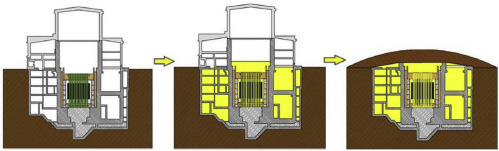
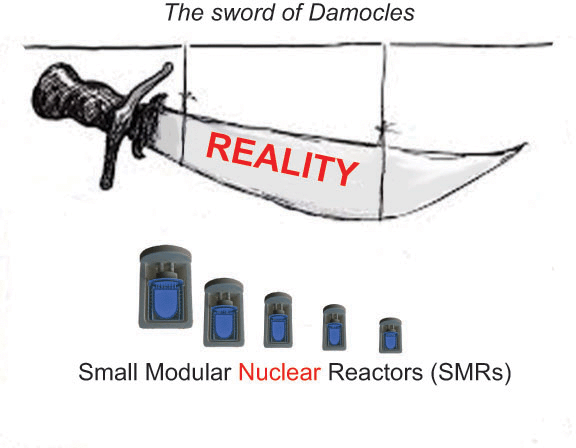
Groups oppose plans to abandon defunct nuclear reactors and radioactive waste, https://rabble.ca/columnists/2021/02/groups-oppose-plans-abandon-defunct-nuclear-reactors-and-radioactive-wasteThe Canadian Nuclear Safety Commission (CNSC) has just given a green light to the preferred industry solution for disposal of nuclear reactors — entomb and abandon them in place, also known as “in-situdecommissioning.” This paves the way for the introduction of a new generation of “small modular” nuclear reactors or SMRs. SMRs bring many challenges, including safety of untested designs, nuclear weapons proliferation risks, high costs, disposal of radioactive waste, and public acceptance. Groups concerned about nuclear safety are objecting to plans in the works to abandon these nuclear reactors and the radioactive waste they produce once they are shut down.
Over 100 Indigenous and civil society groups have signed a public statement opposing SMR funding, noting that the federal government currently has no detailed policy or strategy for what to do with radioactive waste. Many of these groups are also participating in a federal radioactive waste policy review launched in November 2020.
The Assembly of First Nations passed resolution 62/2018 demanding that the nuclear industry abandon plans for SMRs and that the federal government cease funding them. It calls for free, prior and informed consent “to ensure that no storage or disposal of hazardous materials shall take place in First Nations lands and territories.”
SMR waste includes not only reactor fuel but also the reactors themselves.
An SMR emits no radiation before start-up (other than from uranium fuel) and could easily be transported at that stage. But during reactor operation, metal and concrete components absorb neutrons from the splitting of uranium atoms — and in the process, transform into radioactive waste. Removing an SMR after shut-down would be difficult and costly, and comes with the need to shield workers and the public from its radioactivity.
Abandoning nuclear reactors on site has been in the works for some time. CNSC helped draft a 2014 nuclear industry standard with in-situ decommissioning as an option and then included it in a July 2019 draft regulatory document.
However, when the International Atomic Energy Agency (IAEA) released a peer-reviewed report on Canada’s nuclear safety framework last February, it said in-situ decommissioning is “not consistent” with IAEA safety standards.
The IAEA suggested that CNSC “consider revising its current and planned requirements in the area of decommissioning to align with the IAEA guidance that entombment is not considered an acceptable strategy for planned decommissioning of existing [nuclear power plants] and future nuclear facilities.” It also noted that CNSC is reviewing license applications for in-situ decommissioning of shut-down federal reactors in Ontario and Manitoba, and encouraged Canada “to request an international peer review of the proposed strategy” for legacy reactors.
But CNSC continued to pursue this strategy. Clever language in a June 2020 document appeared to rule out on-site reactor disposal, but left the door open where removal is not “practicable”:
“In-situ decommissioning shall not be considered a reasonable decommissioning option for planned decommissioning of existing nuclear power plants or for future nuclear facilities in situations where removal is possible and practicable.”
At public meeting last June, CNSC Commissioner Sandor Demeter asked: “why are future facilities in this sentence when in fact we should be designing them so that in-situ decommissioning is not the option?” Former CNSC staff member Karine Glenn replied that “leaving some small parts of a structure behind…especially if you are in a very, very remote area, may be something that could be considered.”
Commissioners decided to approve the regulatory document, but with added text to clarify where in-situ decommissioning would be acceptable. They asked for additional text on “legacy sites” and “research reactors,” stating that “[t]he Commission need not see this added text if it aligns with the oral submissions staff made in the public meeting.”
But no new clarifying text was added to the final version of the document published on January 29, 2021. It enables abandonment of SMRs — by retaining the reference to future nuclear facilities — and of “research and demonstration facilities, locations or sites dating back to the birth of nuclear technologies in Canada for which decommissioning was not planned as part of the design.”
The CNSC seems willing to ignore international safety standards — and a decision of its own commission — to accommodate nuclear industry proponents of SMRs and allow radioactive waste to be abandoned in place.
Meanwhile, the federal government has assigned the nuclear industry itself — via the Nuclear Waste Management Organization — the task of developing a radioactive waste strategy for Canada. Barring public outcry, that strategy will be abandonment.
Ole Hendrickson is a retired forest ecologist and a founding member of the Ottawa River Institute, a non-profit charitable organization based in the Ottawa Valley.
the rising demand for power generated from renewable energy sources is propelling the decommissioning of nuclear power reactors
Europe Nuclear Decommissioning Service Market Forecast to 2027: COVID-19 Impact and Analysis by Reactor Type; Strategy; Application; Capacity and Country – ResearchAndMarkets.com Yahoo Finance, 3 Feb 21,The “Europe Nuclear Decommissioning Service Market Forecast to 2027- COVID-19 Impact and Analysis by Reactor Type; Strategy; Application; Capacity and Country” report has been added to ResearchAndMarkets.com’s offering.The nuclear decommissioning service market in Europe was valued US$ 2.68 billion in 2019 and is projected to reach US$ 4.29 billion by 2027; it is expected to grow at a CAGR of 6.2% from 2020 to 2027.
The growing health concerns due to radioactive emissions from aging infrastructures have compelled the European countries to decommission nuclear power plants that are nearing the end of their operational lives. France and Germany are among the leading countries in the nuclear decommissioning services market in this region.
The two countries rely heavily on nuclear power generation; however, the rising demand for power generated from renewable energy sources is propelling the decommissioning of nuclear power reactors in the countries mentioned above. The main countries contributing to the European nuclear decommissioning services market include the UK, Italy, Russia, and the Rest of Europe (Sweden and Belgium).
In Germany, the nuclear energy generation sector contributes 12% to the total electricity generation. The country has no plans to construct newer nuclear power plants in the coming years. Germany decommissioned 11 nuclear power plants in the past decade, including Philippsburg nuclear facility that retired in 2019.
The German government has laid down its plans to decommission the remaining 6 nuclear power plants by 2022; these plants are Gundremmingen nuclear plant (2021), Grohnde nuclear power plant (2021), Brokdorf nuclear power plant (2021), Neckarwestheim nuclear power plant (2022), Isar nuclear plant (2022), and Emsland nuclear power plant (2022). The decommissioning strategies laid down by the government have been creating business growth opportunities for decommissioning service providers.
With the growth in the demand for electricity generated via renewable sources, rise in thermal power plants, and aging of long-established nuclear power plants, the governments are undertaking significant steps to decommission several power plants that are nearing the end of operational life. This is boosting the demand for services offered by the nuclear decommission services market players. The average lifespan of a commercial power reactor is 35-40 years.
A large number of commercial reactors operating today are soon likely to reach the end of operational life, and the governments of respective countries have approved the plans for their decommissioning. The cost of dismantling and decommissioning a commercial nuclear power plant is high and requires huge workforce.
The Italian nuclear power generation and transmission sector contributes to only 8% of the country’s overall electricity generation and transmission. The country had 4 reactors in the past, but it has been decommissioning the reactors following the Chernobyl disaster in 1986. Italy relies heavily on import of electric power and is the world’s second-largest net importer of electricity. Sogin S.p.A., a government-owned nuclear decommissioning service provider, has been engaged in dismantling and decommissioning several nuclear power plants in the country. ……….https://finance.yahoo.com/news/europe-nuclear-decommissioning-market-forecast-124000767.html
Clean Air Alliance (accessed) 8th Jan 2021, Ontario’s new Minister of Finance, Peter Bethlenfalvy, can create 16,000 person-years of employment in Pickering by directing Ontario Power Generation (OPG) to immediately dismantle the Pickering Nuclear Station after its operating licence expires in December 2024.
According to the International Atomic Energy Agency, immediate dismantling is “the
preferred decommissioning strategy” for nuclear plants. In fact, dismantling is the one area of employment growth in the nuclear industry.
Immediate dismantling will permit most of the 600-acre site to be returned to the local community by 2034 for parkland, recreational facilities, dining, entertainment, housing and other employment uses. That is among the reasons why Pickering City Council unanimously supports having the plant dismantled as “expeditiously as possible” after it is shut down.
Unfortunately, OPG wants to delay dismantling until 2054 to put off its
dismantling costs for 30 years despite the fact that it already has more
than $7.5 billion in its decommissioning and dismantling fund.









 nuclear-news