Britain now facing a horror cost in burying its dead nuclear reactors
 Nuclear decommissioning A glowing review Britain is paying dearly for neglecting its nuclear waste, The Economist, Apr 5th 2014 SWILLING around murky ponds in the oldest part of Sellafield, a nuclear research and reprocessing centre in Cumbria, is a soupy, radioactive sludge. For years boffins working on Britain’s first military and civil nuclear programmes abandoned spent fuel and other nastiness into the pools and tanks, which now grow decrepit. Though perhaps not the “slow-motion Chernobyl” which some environmental campaigners make out, the site is subject to one of the most complex nuclear clean-ups in the world.
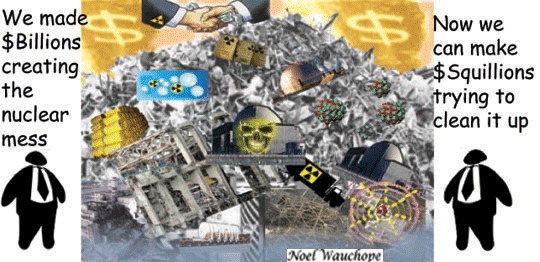
Sellafield is the trickiest of several challenges facing the Nuclear Decommissioning Authority (NDA), a government body that manages the contractors who swab out Britain’s defunct facilities. Their projects swallow up about two-thirds of the budget of the Department of Energy and Climate Change; Sellafield alone costs £1.7 billion ($2.8 billion) a year, almost as much as the roughly £2 billion spent subsidising renewable energy in 2013. On March 31st NDA awarded a £7 billion contract to decommission 12 more of Britain’s oldest reactor sites over 14 years to a consortium including Babcock, a British engineering firm, and Fluor, an American one.These big sums reflect problems peculiar to Britain. It ploughed into nuclear bomb-making in the 1940s, and nuclear power in the 1950s, with little plan for how contaminated structures would be dealt with. …….
Entergy’s dilemma – can’t afford to decommission uneconomic Vermont Nuclear Plant
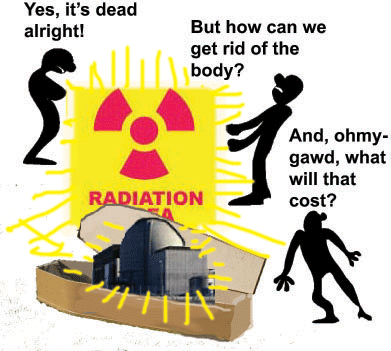 Vermont Nuclear Plant Seeks Decommission But Lacks Funds, Clean Technica 3 April 14, On Friday, the Vermont Public Service Board voted to authorize Entergy Nuclear Operations, Inc., the operators of the Vermont Yankee electricity generating station at 546 Governor Hunt Rd. in Vernon, to close down their nuclear power plant by the end of this year. Because Entergy planned to shut the Vermont nuclear plant down prior to its licensed end-term, the board was required to approve the shutdown……..
Another remaining issue is a 12-year-old National Pollutant Discharge Elimination Systempermit that has been under review by the Vermont Agency of Natural Resources for the past eight years. Continued discharges of warm water into the Connecticut River appear to have adversely affected water quality downstream and altered ecological systems in the watershed.
Entergy has reserved just over $600 million to date for decommissioning the Vermont nuclear plant, according to the Department of Public Service. This amount will not be adequate to meet the costs of full deconstruction, estimated at more than $1 billion according to the company’s 2012 Decommissioning Cost Analysis report.
The company has pledged to put $25 million toward site restoration after decommissioning the plant. However, presumably, the pledge would be moot if Entergy cannot totally decommission the plant.
“That $400 million gap raises issues about where the money will come from to dismantle the plant safely,” MassLive editorializes. http://cleantechnica.com/2014/04/02/vermont-nuclear-plant-seeks-decommission-lacks-funds/
UK awards lucrative nuclear clean-up job to Babcock and Fluor
Babcock wins UK nuclear clean-up deal, Guardian UK, British engineering contractors and US group Fluor given £7bn contract covering sites such as Hinkley, Sizewell and Dungeness Britain has awarded a 14-year, £7bn contract to manage the decommissioning of its nuclear sites to engineering contractors Babcock and US group Fluor. The deal covers some of Britain’s oldest nuclear power sites, including Hinkley, Sizewell and Dungeness, and is one of the largest contracts the country has put out to tender.,,,,,,,,
Aside from EnergySolutions and Bechtel, Babcock beat two other consortiums: Serco, Areva and CH2M Hill; and Amec, Atkins and Rolls-Royce in a two-year-long bidding process.
Cavendish Fluor, the joint venture between Babcock-owned subsidiary Cavendish Nuclear and Fluor, will be formally awarded the contract – pending legal approval – on 1 September , after a ten-day mandatory standstill and a five-month transition period.
“Cavendish Fluor Partnership bring a successful track record and extensive nuclear experience that will bring enormous benefits to the decommissioning and clean-up programme,” NDA chief executive John Clarke said………http://www.theguardian.com/business/2014/mar/31/babcock-uk-nuclear-clean-up-contract
Decommissioning – a bonanza for nuclear firms
Government set to award £7bn nuclear decommissioning contract http://www.ft.com/intl/cms/s/0/7a4ee910-b7fa-11e3-92f9-00144feabdc0.html By Gill Plimmer 31 March 14, A private sector consortium will be told on Monday it has won the £7bn job of decommissioning Britain’s oldest nuclear power plants.
The work is one of the largest and most sensitive public sector contracts to be awarded in the UK so far. The reactors, built in the 1960s originally to produce plutonium to make nuclear weapons, include those at Sizewell, Hinkley and Dungeness. They are now at the end of their lives and the government is preparing to decommission them this year. The overall contract is worth about £7bn over 14 years.
The Nuclear Decommissioning Authority, the government-funded body responsible for Britain’s state-owned nuclear sites, started the competition two years ago, and work is expected to start in September.
Currently the sites are being run by Magnox, a company owned by Salt Lake City-based EnergySolutions. It is bidding for the new work in partnership with Bechtel. The only Magnox station still in use is in Wylfa in Anglesey, though this is due to stop producing electricity in the next two years.
The contract covers Britain’s 10 reactors as well two old nuclear research sites in Oxfordshire and Dorset. The oldest nuclear power plant, Calder Hall in Cumbria, was the world’s first commercial scale nuclear reactor and was opened by the Queen in 1959 before it closed a decade ago.
The incumbent Magnox is competing against consortiums made up of Amec, Atkins and Rolls-Royce; CH2M Hill, Areva and Serco; and Babcock and Fluor. The clean-up contract that the companies hope to take over employs about 3,000 workers on the 12 ageing nuclear sites across the country.
Unions are concerned that awarding the company to an overseas consortium willerode Britain’s nuclear expertise.
“The reality is the way we are breaking up our nuclear industry will go down as another Great British missed opportunity,” Gary Smith, a GMB spokesman said. “Britain was a world leader in nuclear. Successive governments have hived off our nuclear industry piecemeal. There is absolutely no strategy around nuclear which reflects the fact that wider energy policy is a mess.”
Vermont nuclear decommissioning may be a model for other States
State Involvement Key for Decommissioning Old Nuclear Plants, Nasdaq, By Oilprice.com, January 03, 2014 The beginning of 2014 marks the final year of operation for the Vermont Yankee Nuclear Power Plant, ending a contentious battle between the state and the plant’s owner. On December 23, Entergy (ETR) and the state of Vermont announced a deal that will end all litigation surrounding the plant’s operation, shut down the plant at the end of 2014, and lead to a compressed schedule to study decommissioning.
The conflict started when Entergy sought a 20-year license renewal to keep the Yankee plant operating into the 2030’s. Vermont, however, requires approval from the state legislature for license renewal, the only state in the country that does so. Yet Entergy sued the state, arguing that authority over nuclear license renewals rests only with the Nuclear Regulatory Commission (NRC), and that federal authority trumps state authority.
Although a series of court decisions affirmed Entergy’s position, the company ultimately decided to close the plant anyway, largely due the inability to compete with cheap natural gas. In August 2013 it announced that it would cease operations at the end of 2014…….
The deal to close Vermont Yankee does offer a useful model for decommissioning as it tackles some of the key areas of conflict between the industry and the areas in which it operates. Entergy agreed to complete adecommissioning study in one year, much quicker than the four years allotted for by the NRC. It also agreed to move nuclear waste from onsite pool storage into dry casks within seven years, even though the NRC allows the company to keep waste in pools for sixty years. The deal also calls for Entergy to pay millions of dollars to the state for economic development for the county in which Vermont Yankee is located.
One of the interesting features of the deal is that it allowed for active involvement of the state in shaping the path towards decommissioning and waste disposal, which is often absent elsewhere. To be sure, huge question marks remain, including how the state will make up for the shortfall in electricity generation, and where funding for decommissioning will come from. But, the U.S. has thus far failed to implement a strategy to decommission old nuclear power plants. And with most of the 100 or so nuclear power plants obtaining 20-year license renewals, that conversation has been pushed off into the future. The Vermont Yankee deal, while incomplete, does offer lessons for decommissioning. http://www.nasdaq.com/article/state-involvement-key-for-decommissioning-old-nuclear-plants-cm315680#ixzz2pRYlLxGz
Decommissioning problems with Vermont Yankee Nuclear reactor
RECAP 2013: VERMONT YANKEE, RENEWABLE ENERGY CAPS AND WIND PROJECTS STIR CONTROVERSY HTTP://VTDIGGER.ORG/2013/12/29/RECAP-2013-VERMONT-YANKEE-RENEWABLE-ENERGY-CAPS-WIND-PROJECTS-STIR-CONTROVERSY/ JOHN HERRICK DEC. 29, 2013 VERMONT YANKEE, THE STATE’S ONLY NUCLEAR REACTOR, DOMINATED HEADLINES THIS YEAR.
Entergy Corp., the company that runs the reactor, is plagued by financial problems, and operating the Vermont plant was an expense it could no longer afford. In late August, Entergy announced it would close the plant, ironically just days after the Louisiana corporation won a long-running court battle with the state over the right continue operating the Vernon facility for an additional 20 years.
Entergy amended its application with the Public Service Board and is now seeking a one year license to operate the plant through the end of 2014, when Vermont Yankee is slated to close.
The board held off from ruling on the relicensure case at the request of the Shumlin administration while state officials settled differences over decommissioning, the economic impact of the plant closure, hot water discharges into the Connecticut River and a generation tax.
Many of those issues were resolved when the state and Entergy reached an agreement last week that sets a decommissioning completion date of 10 to 15 years, decades sooner than required by the federal Nuclear Regulatory Commission’s 60-year timeframe. Entergy also agreed to pay millions of dollars in payments to the state in tax revenues and in support for regional economic development efforts. In addition, the agreement settled all pending federal litigation.
The settlement is contingent on the Public Service Board approving the plant’s certificate of public good before March 31, 2014.
There are other outstanding issues that have yet to be resolved. The two parties disagree over whether Entergy’s Decommissioning Trust Fund is sufficient to support decommissioning. In addition, the state and the company do not yet have a common understanding of how the site will be restored. Entergy must file a decommissioning plan with the NRC after the plant is closed.
The state is concerned that the 42-year old merchant plant’s worsening financial foundation could compromise the operational safety of the facility in the near term and the decommissioning process over the long haul.
It is unclear what the plant will do with 530 tons of radioactive waste stored on the premises. Vermont Yankee has 3,879 fuel rod assemblies submerged in a spent fuel pool that was originally designed to hold about 350. Spent fuel rods must be kept under water to prevent them from igniting, but once they are cooled, they can be transferred into long-term cement “dry casks.” Vermont Yankee will need 58 casks in all. Right now, the facility has 13. Each cask costs about $1 million.
The agreement requires that all the spent nuclear fuel stored on site pools be placed in dry cask storage, which Gov. Peter Shumlin said could take up to seven years.
Entergy’s decision to close Vermont Yankee was the result of declining wholesale market prices and competition with natural gas. Merchant plants are investor-funded; early this year a Swiss financial services firm UBS Securities downgraded Entergy Corp.’s stock and urged investors to sell.
The downgrade came on the heels of a report by UBS Securities that found Entergy “is unlikely to generate any meaningful cash” from wholesale commodities in 2013 and 2014.
Entergy’s nuclear fleet includes the Pilgrim Nuclear Power Station in Massachusetts, Vermont Yankee in Vermont, Indian Point Energy Center and the James A. Fitzpatrick Nuclear Power Plant in New York, and the Palisades Power Plant in Michigan.
New agreement on decommissioning Vermont Yankee Nuclear Power Station
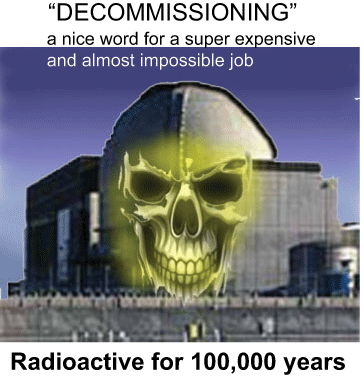 Vermont, Entergy Announce Deal On Nuclear Power Plant Decommissioning http://boston.cbslocal.com/2013/12/23/vermont-entergy-announce-deal-on-nuclear-power-plant-decommissioning/ December 23, 2013 MONTPELIER, Vt. (CBS) — The state of Vermont and Entergy have announced a deal on decommissioning the Vermont Yankee Nuclear Power Station.
Gov. Peter Shumlin, Attorney General Bill Sorrell and Bill Mohl, president of Entergy Wholesale Commodities, announced a settlement agreement Monday between the state and the owner and operator of the Vermont Yankee Nuclear Power Station, Entergy Nuclear Vermont Yankee LLC and Entergy Nuclear Operations Inc., the company said in a prepared statement.
The deal brings more certainty to the plant’s operation through next year and its transition — including commitments related to economic development, timely decommissioning and site restoration, the company reported. The pact also helps set a path for a constructive and transparent working relationship between Entergy and the state as they continue to work on long-term issues related to the decommissioning of the nuclear power plant. Continue reading
Controversial entombment of Illinois nuclear power plant
state regulators will not have authority to question how the dismantling is performed or EnergySolutions’ spending decisions.
A group of local citizens has filed suit over the financial handling of the project, claiming there are no safeguards to ensure that EnergySolutions isn’t wasting ratepayer money.
How Zion’s nuclear waste will be entombed on site http://www.chicagotribune.com/business/ct-biz-1215-zion-fuel-20131215,0,7912496.story Third-party EnergySolutions to embark on unprecedented, yearlong process By Julie Wernau, Chicago Tribune reporter December 15, 2013
In January, EnergySolutions will begin the most crucial part of its 10-year dismantling of the shuttered Zion nuclear power plant: Safely removing its radioactive fuel rods.
The project is the largest in the history of the U.S. nuclear power industry and the first in which a plant’s owner has turned over its license to a third party for the purpose of dismantling it. Utah-based EnergySolutions is staking its future on the project. How it handles the most expensive and risky phase of the project will be crucial to it winning other such work going forward.
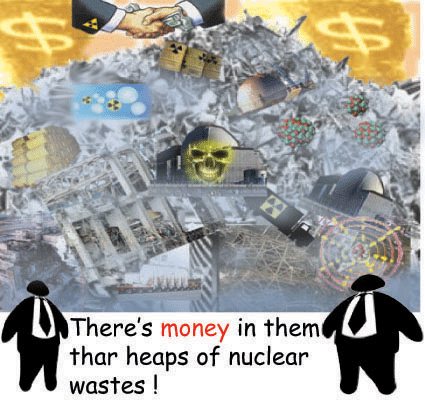
The Zion plant, owned by Chicago-based Exelon Corp., the parent of Commonwealth Edison, generated electricity on the shores of Lake Michigan for close to a quarter of a century. By the time the project is complete, it will have taken nearly as long to destroy it. Continue reading
The coming epidemic of nuclear reactor shutdowns: where to put the wastes?
The NRC believes the fuel can be safely stored for at least 100 in casks. But the radioactive half life is 16 million years, with a defined hazardous life of 160 million years. The world will soon be dotted with these ad-hoc radioactive dumps.
For aging nuclear reactors, a coming surge of shutdowns How safe will these ad-hoc radioactive dumps be?, Kevin Gray, SmartPlanet, 20 Nov 13
When it first fired up its twin reactors in 1973, the Zion nuclear power plant in Illinois — roughly 40 miles north of Chicago — was the largest in the world. It was a stunning work of technology that supplied electricity to some two million homes. And it could have easily lived on into the new century. But in 1998, its parent company, the energy giant Exelon Corp, turned off its lights and shuttered the facility rather than face some costly upgrades.For 12 years, Zion sat dormant on prime Lake Michigan shorefront as Exelon shelled out $10 million a year to maintain it and protect it with round-the-clock patrols of armed guards. By 2010, the facility had become home to drifting weeds and nesting falcons.
But that year, the federal government — in an arrangement never tried before — agreed to allow Exelon to transfer custody of the plant to EnergySolutions, a nuclear-waste storage outfit. The deal was worth a potential $1 billion in clean-up fees to EnergySolutions. It would be the largest nuclear power plant decommissioning ever undertaken in the United States. And it pledged to return the 375-acre site back to Exelon as grass and local shrubbery at the end of 10 years……..
EnergySolutions has spent the past year removing Zion’s fuel rods from a cooling pool and putting them into the canisters and casks for dry storage. The fuel, which is still about 400 degrees, can now be air cooled. Christian expects the company to begin moving the casks, via a heavy-haul rail, 100 yards south of the reactors by mid-October.
They will remain there until the feds come up with an alternative to Yucca Mountain. “Until we have a national repository open, this spent fuel has to stay where it is,” says Lawrence Boing, a nuclear decommissioning specialist at Argonne National Laboratory’s nuclear engineering division. “The big question now is what do we do with this stuff?” Continue reading
Call for German utilities to pay more of nuclear decommissioning costs
German parties want utilities to shoulder nuclear shutdown costs BY MARKUS WACKET BERLIN Thu Nov 14, 2013 (Reuters) – German parties negotiating the formation of a coalition government want to make utilities pay more to dismantle their nuclear power plants and protect taxpayers from billions of euros in related costs, documents obtained by Reuters show.
Such a move, if adopted by a coalition of Chancellor Angela Merkel’s conservatives and the Social Democrats (SPD), would be a blow to E.ON, RWE, Vattenfall and EnBW who have already put aside 30 billion euros in provisions.
“A … fund could be considered to safeguard the financing of the disposal of nuclear assets,” the paper from the working group on environmental policies said.
Under the new proposal, the utility companies could be forced to pay into the fund which would be under political control.
Over a dozen working groups are hammering out policy compromises on a range of issues with the aim of forming a government in December. The nuclear proposal would have to be approved by a larger coalition panel led by Merkel and other party leaders before it was set in stone.
“We expect cooperation from the nuclear power operators in the switch to renewable energy and an acknowledgement of their responsibility for the orderly ending of the use of atomic energy,” the paper said.
The idea of a fund reflects concerns that Germany’s four nuclear power companies have taken insufficient precautions to pay for the dismantling of the plants and storage of atomic waste…….
The SPD is also keen to raise nuclear fuel tax and to extend the levy beyond 2016, when it is currently due to expire. However conservatives oppose this notion.
(Writing by Madeline Chambers; Editing by Susan Fenton) http://www.reuters.com/article/2013/11/14/us-germany-coalition-nuclear-idUSBRE9AD0HN20131114
Growing world realisation that nuclear power is an economic disaster
Because of costs, the de facto “solution” is firstly to extend reactor operating lifetimes, then partly decommission and dismantle reactors when they are taken out of service, delaying the decontamination of nuclear sites, and pushing all costs into the future. Unfortunately and until the reactors are made safe, they by definition pose almost open-ended risks. These extend from “simple” accidents and technical malfunction, to operator errors, and to the risk of them becoming giant Dirty Bomb targets in civil war, international war, or terror attacks. Even the most extreme non-nuclear industrial risks, notably at “Seveso or Bhopal type” chemical facilities, are pale by comparison.
Nuclear Power Dirty Bomb The Market Oracle, Oct 28, 2013 By: Andrew_McKillop THE 100-YEAR CURSE Within the next 15 – 20 years as many as 100 industry standard Westinghouse-type 900 MW PWR pressurized water reactors, concentrated in the “old nuclear’ countries will have to be decommissioned, dismantled and their sites made safe – unless political deciders maintain the sinister farce of rubber stamping reactor operating lifetime extensions. The decontamination process could take as long as 100 years. In several countries, especially Germany, Switzerland and probably Japan the dangerous game of politically-decided reactor life extensions – to push back the date of final decommissioning – has already ended or is ending.
But when it does end, nuclear debt will go into overdrive from its already extreme high setting. Nuclear power is capital intensive, lives on subsidies, thrives on false hopes and dies in debt.

Putting a figure on how much the nuclear “decomm” story will cost and how long it will take is in fact impossible – and is signalled by the tell-tale anticipative action of nuclear friendly governments. One stark example is the UK, which now sets decomm as an activity that will only need to start at a generous, or foolhardy 30 or 40 years after the reactor was powered down and removed from the national power grid. Until then, the reactor can sit on the horizon as a contribution to national culture or something “in perfect safety of course”. Decomm periods could or might therefore be 100 years.
DECOMMISSIONING SAGAS As already noted above, there are no rules, standards and best practice in decommissioning, dismantling and “making safe” or “securing” the former sites of reactors. So there is no standard cost for getting rid of reactors. It is a case-by-case process. This alone prods the highly political decision to set a “delay” between reactor shut down, and decommissioning which as noted above, in the extreme UK case is now set at 30-40 years.
Before the final shut down, of course, reactor operating life extensions can squeeze some more power out of the reactor – and further delay the moment when it has to be decommissioned. Only idiots can pretend this does not expose the reactor to increased risks of accidents. Ask yourselves if you prefer to fly in a 40-year-old airplane, or a new one.
Real-life decomm sagas, as distinct from emergency dismantling following a serious or catastrophic accident as in the case of Three Mile Island, Chernobyl and Fukushima are always – always – a tale of vastly underestimated initial costs and timelines for decomm, followed by massive cost overruns and time overruns. Plenty of examples concern the now-quarter-century old projects, and longer, where initial cost estimates have been exceeded by actual spending by 5 or 10 times, and the decomm project’s time for completion multiplied by 3. And today the projects are not yet fully completed!…….. Continue reading
Just under 100 years to clean up UK nuclear plant – if they’re lucky
The final decommissioning at Trawsfynydd and elsewhere depends on finding a safe long term solution for where to deposit the ILW as well as the High Level Waste (HLW) currently stored at Sellafield. This includes the spent nuclear fuel which was removed when the plant closed.
Trawsfynydd timeline
1959: Construction started
1965 to 1991: Electricity generation
1993 to 1995: Decommissioning starts – fuel removed and sent to Sellafield
1995 to 2016: Recovery of waste and preparations to put the plant into a ‘passively safe’ state
2020-26: Reduction in height of reactor buildings
2040s: Scheduled removal of Intermediate Level Waste to deep geological storage
2074: Final site clearance starts
2083: Site returned to pre-existing state

How do you close a nuclear power station? BBC By Steven Green 28 Oct 13 As the UK embarks on building what could be a new generation of nuclear power plants, work continues to decommission the first generation of nuclear power stations at sites including Trawsfynydd in Snowdonia which will take an estimated 90 years to complete. Continue reading
Public meeting on the disposal of dead San Onofre nuclear power plant
Nuclear Regulatory Commission Debates San Onofre Plant Shutdown At (includes Video) First Public Meeting http://losangeles.cbslocal.com/2013/09/26/nuclear-regulatory-commission-debates-san-onofre-plant-shutdown-at-first-public-meeting/ September 26, 2013 SAN ONOFRE (CBSLA.com) — The Nuclear Regulatory Commission met on Thursday to debate the potential effects of shutting down the troubled San Onofre Nuclear Generating Station.
KCAL9′s Stacey Butler reports hundreds of residents gathered for their first chance to hear what’s next for the plant since it was permanently closed earlier this year.
Gary Headrick led the charge to have the plant shut down for good.
“There are issues that can challenge us even more than having a reactor operating,” he said.
Headrick and others asked the NRC what they plan to do with the radioactive spent fuel rods.
He says they don’t have a proven storage technique. “Not only nuclear waste, but toxic waste that’s part of the decommissioning process will be released into the ocean and the environment. There is high burn-up fuel which is much different than at other nuclear facilities which makes it harder to store nuclear waste,” he said.
Activist Carol Jahnkow is asking for a citizens oversight committee.
“We don’t want to wait two years to find out what they’re going to do, how much they’ve been spending in the interim and what safety precautions they’ve taken,” she said.
An NRC spokesman said the agency will be watching Edison’s every move. “The decommissioning activity will be done safely under the watchful eyes of the NRC, and it’s not over until we say it’s over,” he said.
An Edison spokesperson declined an on-camera interview but said that it will cost over $4 billion to decommission the plant. Customers’ rates, the spokesperson said, will not go up for five years.
An NRC spokesperson said Edison is looking at either disassembling the plant quickly or letting it sit for 30 years while waiting for the radioactivity to decay.
Citizens want to oversee decommissioning of San Onofre nuclear plant
 Citizens seek role in San Onofre decommissioning By ERIKA I. RITCHIE / ORANGE COUNTY REGISTER, 26 Sept 13, CARLSBAD – Speaking on behalf of several hundred people, Gene Stone asked officials from the Nuclear Regulatory Commission on Thursday night to consider the formation of a citizens coalition that would help oversee the decommissioning of the San Onofre Nuclear Generating Station, a process that could take decades.
“We are here today in the hope that the Nuclear Regulatory Commission will make San Onofre the flagship project for a safe-and-sane cleanup of America’s effort at decommissioning our old and … http://www.ocregister.com/articles/decommissioning-528288-nuclear-edison.html
Japanese government considers taking over the Fukushima radiation cleanup
J
 apan LDP Plan Would Put Government in Control of Fukushima Cleanup, WSJ, Proposal Would Reduce Tepco’s Financial Burden By MARI IWATA, 20 Sept 13 TOKYO—Japan’s ruling Liberal Democratic Party is considering a plan that would give the government sole responsibility for containing and cleaning up contamination from the stricken Fukushima Daiichi nuclear-power plant, allowing its operator, Tokyo Electric Power Co., 9501.TO -2.28% to focus its dwindling resources more efficiently on decommissioning the facility……..
The government had already effectively nationalized Tepco by buying a majority of its shares, but the stock still trades on the Tokyo Stock Exchange, and Prime Minister Shinzo Abe’s administration is eager to see the cash-strapped company return to financial health, a significant challenge, given lost revenue from the idling of all of the company’s nuclear reactors, as well as the costs of the cleanup and purchasing of more liquefied natural gas than before the accident to fuel thermal-power plants to make up for lost nuclear generation.
Tepco has posted two straight years of large net losses since the accident. It swung to a profit in the April-June quarter, solely on the back of a large government subsidy to help it pay compensation to Fukushima victims but it carries Y800 billion ($8.14 billion) in debt that should be refinanced this fall. On top of that, Tepco estimates it must borrow an additional Y300 billion by the end of December if it wants to stay afloat, a spokesman said……..
Tepco President Naomi Hirose said Thursday that the company would prepare Y1 trillion ($10 billion) to decommission the entire plant in addition to Y960 billion it had reserved for the work by the end of June. This doesn’t include costs associated with handling contaminated water at the site. There hasn’t been any estimate on the total cost of decommissioning the stricken plant…….Japan’s Nuclear Regulation Authority Chairman Shunichi Tanaka has urged the government and Tepco to intensify the decommissioning effort, saying “the deadliest risk is another huge natural disaster,” which would “destroy all these makeshift tanks and water processing systems, releasing all the radioactive materials there into the environment.” http://online.wsj.com/article/SB10001424127887324492604579086742989825408.htm
1 This Month


Tell the Ukrainian Government to Drop Prosecution of Peace Activist Yurii Sheliazhenko

Petition to revoke the licensing of the Near Surface Nuclear Disposal Facility (NSDF) at Chalk River. https://www.ourcommons.ca/petitions/en/Petition/Details?Petition=e-7247


of the week – STOP SMALL MODULAR REACTORS IN CANADA
To see nuclear-related stories in greater depth and intensity – go to https://nuclearinformation.wordpress.com
-
Archives
- March 2026 (212)
- February 2026 (268)
- January 2026 (308)
- December 2025 (358)
- November 2025 (359)
- October 2025 (376)
- September 2025 (258)
- August 2025 (319)
- July 2025 (230)
- June 2025 (348)
- May 2025 (261)
- April 2025 (305)
-
Categories
- 1
- 1 NUCLEAR ISSUES
- business and costs
- climate change
- culture and arts
- ENERGY
- environment
- health
- history
- indigenous issues
- Legal
- marketing of nuclear
- media
- opposition to nuclear
- PERSONAL STORIES
- politics
- politics international
- Religion and ethics
- safety
- secrets,lies and civil liberties
- spinbuster
- technology
- Uranium
- wastes
- weapons and war
- Women
- 2 WORLD
- ACTION
- AFRICA
- Atrocities
- AUSTRALIA
- Christina's notes
- Christina's themes
- culture and arts
- Events
- Fuk 2022
- Fuk 2023
- Fukushima 2017
- Fukushima 2018
- fukushima 2019
- Fukushima 2020
- Fukushima 2021
- general
- global warming
- Humour (God we need it)
- Nuclear
- RARE EARTHS
- Reference
- resources – print
- Resources -audiovicual
- Weekly Newsletter
- World
- World Nuclear
- YouTube
-
RSS
Entries RSS
Comments RSS
 nuclear-news