The risky jobs of closing down 200 nuclear reactors around the world
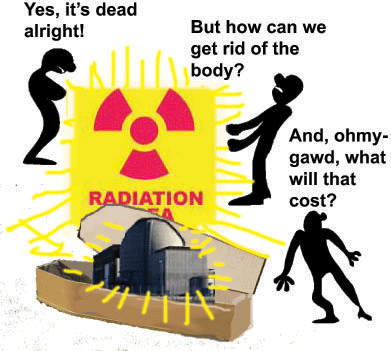 Here’s what dismantling a nuclear reactor involves: Robots, radiation, risk IEA says about 200 nuclear reactors around the world will be shut down over the next quarter century http://www.business-standard.com/article/international/here-s-what-dismantling-a-nuclear-reactor-involves-robots-radiation-risk-117061200298_1.html Reuters | Muelheim-Kaerlich, Germany June 12, 2017 As head of the Muelheim-Kaerlich nuclear reactor, Thomas Volmar spends his days plotting how to tear down his workplace. The best way to do that, he says, is to cut out humans.
About 200 nuclear reactors around the world will be shut down over the next quarter century, mostly in Europe, according to the International Energy Agency. That means a lot of work for the half a dozen companies that specialise in the massively complex and dangerous job of dismantling plants.
Those firms — including Areva, Rosatom’s Nukem Technologies Engineering Services, and Toshiba’s Westinghouse — are increasingly turning away from humans to do this work and instead deploying robots and other new technologies.
That is transforming an industry that until now has mainly relied on electric saws, with the most rapid advances being made in the highly technical area of dismantling a reactor’s core — the super-radioactive heart of the plant where the nuclear reactions take place.
The transformation of the sector is an engineering one, but companies are also looking to the new technology to cut time and costs in a competitive sector with slim margins.
Dismantling a nuclear power plant can take decades and cost up to 1 billion euros ($1.1 billion), depending on its size and age. The cost of taking apart the plant in Muelheim-Kaerlich will be about 800 million euros, according to sources familiar with the station’s economics.
Some inroads have already been made: a programmable robot arm developed by Areva has reduced the time it takes to dismantle some of the most contaminated components of a plant by 20-30 per cent compared with conventional cutting techniques.
For Areva and rival Westinghouse, reactor dismantling is unlikely to make an impact on the dire financial straits they are mired in at present as it represents just a small part of their businesses, which are dominated by plant-building.
But it nonetheless represents a rare area of revenue growth; the global market for decommissioning services is expected to nearly double to $8.6 billion by 2021, from $4.8 billion last year, according to research firm MarketsandMarkets. Such growth could prove important for the two companies should they weather their current difficulties.
“We’re not talking about the kind of margins Apple is making on its iPhone,” said Thomas Eichhorn, head of Areva’s German dismantling activities. “But it’s a business with a long-term perspective.”
When reactors were built in the 1970s, they were designed to keep radiation contained inside at all costs, with little thought given to those who might be tearing them down more than 40 years later.
First, engineers need to remove the spent nuclear fuel rods stored in reactor buildings — but only after they’ve cooled off. At Muelheim-Kaerlich this took about two years in total. Then peripheral equipment such as turbines need to be removed, a stage Muelheim-Kaerlich has begun and which can take several years.
Finally, the reactor itself needs to be taken apart and the buildings demolished, which takes about a decade. Some of the most highly contaminated components are cocooned in concrete and placed in iron containers that will be buried deep underground at some point.
Robots under water
While the more mundane tasks, including bringing down the plants’ outer walls, are left to construction groups such as Hochtief, it’s the dismantling of the reactor’s core where more advanced skills matter — and where the use of technology has advanced most in recent years.
Enter companies such as Areva, Westinghouse, Nukem Technologies, GE Hitachi as well as GNS, owned by Germany’s four nuclear plant operators. They have all begun using robots and software to navigate their way into the reactor core, or pressure vessel.
“The most difficult task is the dismantling of the reactor pressure vessel, where the remaining radioactivity is highest,” said Volmar, who took charge of the RWE-owned Muelheim-Kaerlich plant two years ago. “We leave this to a specialised expert firm.”
The vessel — which can be as high as 13 metres and weigh up to 700 tonnes — is hidden deep inside the containment building that is shaped like a sphere to ensure its 30-centimetre thick steel wall is evenly strained in case of an explosion.
The 2011 Fukushima disaster and the Chernobyl accident of 1986 are imprinted in the world’s consciousness as examples of the catastrophic consequences of the leakage of radioactive material.
France’s Areva recently won the contract to dismantle the pressure vessel internals at Vattenfall’s 806 megawatts (Mw) Brunsbuettel nuclear plant in Germany, which includes an option for the Swedish utility’s 1,402 MW Kruemmel site.
There, the group will for the first time use its new AZURo programmable robot arm. It hopes this will help it outstrip rivals in what is the world’s largest dismantling market following Germany’s decision to close all its last nuclear plants by 2022, in response to the Fukushima disaster.
AZURo operates under water because the liquid absorbs radiation from the vessel components — reducing the risk of leakage and contamination of the surrounding area. The chamber is flooded before its work begins.
Areva’s German unit invests about 5 per cent of its annual sales, or about 40 million euros, in research and development, including in-house innovation such as AZURo. By comparison, the world’s 1,000 largest corporate R&D spenders, on average, spent 4.2 per cent last year, according to PwC.
The robot arm technology helped Areva beat Westinghouse by winning tenders to dismantle pressure vessel internals at EnBW’s Philippsburg 2 and Gundremmingen 2 blocks, industry sources familiar with the matter said.
Areva and EnBW both declined to comment. Westinghouse — whose US business filed for bankruptcy in March — did not respond to repeated requests for comment. Time and money
Britain’s OC Robotics has built the LaserSnake2, a flexible 4.5-metre snake arm, which can operate in difficult spaces and uses a laser to increase cutting speeds — thus reducing the risk of atmospheric contamination. It was tested at the Sellafield nuclear site in west Cumbria last year.
This followed France’s Alternative Energies and Atomic Energy Commission (CEA), whose laser-based dismantling technology generates fewer radioactive aerosols — a key problem during cutting — than other technologies.
The complexity of the dismantling process is also giving rise to modelling software that maps out the different levels of radiation on plant parts, making it easier to calculate the most efficient sequence of dismantling – the more contaminated parts are typically dealt with first – and gives clarity over what safety containers will be needed to store various components.
GNS, which is jointly owned by E.ON, RWE, EnBW and Vattenfall, is currently helping to dismantle the German Neckarwestheim 1 and Philippsburg 1 reactors, using its software to plan the demolition.
The company also hopes to supply its software services for the dismantling of PreussenElektra’s Isar 1 reactor, which is being tendered, and aims to expand to other European countries.
“Two things matter: time and money,” said Joerg Viermann, head of sales of waste management activities at GNS.
“The less I have to cut, the sooner I will be done and the less I will spend.”
Japan’s struggle to decommission Fukushima nuclear reactors
The passage route to the first reactor was flanked by gigantic storage tanks that hold contaminated water.
Reactors still showing skeletal steel frames and roof debris remind a 17-meter-high tsunami which flooded the facility on March 11 in 2011 and caused a hydrogen explosion, bringing the plant to a complete standstill.
Tokyo Electric Power Co. (Tepco), the operator of the plant, has deployed 7,000 workers including its own staff to the site. Their first priority is to tackle the influx of contaminated groundwater. Workers erected a cutoff wall and pumped out upstream groundwater, but still, about 100 to 150 tons of contaminated water is generated every day, according to Tepco. The amount of the contaminated water in storage tanks reaches nearly 1 million tons. It has not yet been decided how to treat the water.
The operation for complete decommissioning is a long way to go. It will take 30 years to finish the job, including the treatment of contaminated water, said Yuichi Okamura, Tepco communication manager.
The Japanese government is going all out to develop advanced robot and drone technology to accurately grasp the internal situation of the reactors to support decommissioning.
Permanent shutdown of unit 1 of South Korea’s Kori nuclear power plant
World Nuclear News 9th June 2017, The permanent shutdown of unit 1 of the Kori nuclear power plant has been approved by the South Korea’s nuclear safety regulator. The unit – the country’s oldest operating reactor unit – will be taken offline on 19 June.
Kori 1 is a 576 MWe pressurized water reactor that started commercial operation in 1978. A six-month upgrading and inspection outage at Kori 1 in the second half of 2007 concluded a major refurbishment program and enabled its relicensing for a further ten years. A subsequent relicensing process could have taken Kori 1 to 2027, but Korea Hydro & Nuclear Power (KHNP) announced in August 2015 that it had withdrawn its application to extend the unit’s operating licence. In June last year, the company applied to decommission the reactor. http://www.world-nuclear-news.org/C-Final-shutdown-approaches-for-Koreas-oldest-reactor-0906175.html
Planning for new phase in getting rid of Dounreay – UK’s 1950s nuclear reactor complex
 BBC 7th June 2017 A planning application is being prepared for a new phase in the decommissioning of the Dounreay nuclear power complex in Caithness.
Buildings on the experimental nuclear energy site, which dates to the 1950s, are being emptied of radioactive material and demolished. Starting in 2018, the planned next stage would involve dismantling reactors.
New temporary buildings would also need to be built to aid the new phase. The new buildings would include facilities for handling the clean up and demolition of areas of the site called the Silo and The Shaft. Also included are plans for restoration and landscaping work to restore areas of land to close to how they looked before the construction of Dounreay. The phase would take the site near Thurso to what is called its interim end state. Dounreay Site Restoration Limited has notified Highland Council that it expects to submit the planning application later this year.
http://www.bbc.co.uk/news/uk-scotland-highlands-islands-40188815
On costs of decommissioning Fort Calhoun nuclear plant, and on security
Q&A session on Fort Calhoun nuclear plant focuses on cost of decommissioning, security, By Cole Epley / Omaha World-Herald staff writer, Jun 1, 2017
OPPD’s plan to fund dismantling and cleanup of its Fort Calhoun nuclear plant is expected to be sufficient to cover the cost, and the now-closed plant will retain its 24-hour armed security force even after the last building is no longer needed.
That was the message from federal regulators to Omaha Public Power District ratepayers and members of the public Wednesday night at a meeting on decommissioning the reactor. The plant, which closed in October, is 20 miles north of Omaha.
Questions about security — both in terms of armed guards and spent nuclear fuel left on site — and the cost of tearing down and cleaning up the plant were among issues addressed during a question-and-answer session at the Doubletree Hotel in downtown Omaha.
Decommissioning the plant is expected to cost about $1.5 billion in 2016 dollars. By the time the work is completed in some 60 years, the inflation-adjusted cost is expected to be roughly $3 billion…….
Within five years, OPPD will be pulling spent fuel from the storage pool inside one of the buildings and putting it in concrete casks on site. Because the U.S. has no functioning long-term storage site for spent nuclear fuel, the Fort Calhoun site will hold spent fuel in the above-ground casks indefinitely. At least as long as the fuel is there, security guards will be there, the public was told Wednesday.
Significant demolition isn’t expected until the 2050s, once much of the radioactivity at the site has decayed.
Doug Broaddus, head of the NRC branch that oversees plants like Fort Calhoun that are transitioning from operating to decommissioning, said utilities that fall short of the money needed to close their plants generally look to the same place.
“It really goes back to ratepayers,” Broaddus said. http://www.omaha.com/money/q-a-session-on-fort-calhoun-nuclear-plant-focuses-on/article_2e65396e-34b0-59ad-ab20-e80381db1640.html
With UK terror threat raised, decommissioning continues as normal at Dounreay nuclear site
Decommissioning continues as normal at Dounreay under heightened response rate, John O’Groat Journal, 26 May 17, DOUNREAY said decommissioning work is continuing as normal as the UK terror threat level has been raised to critical.
Prime Minister Theresa May announced on Tuesday night the threat level was raised from severe to critical, the highest possible level after the Manchester Arena bombing on Monday night.
Critical level means an attack is expected imminently in the UK.
A spokeswoman at Dounreay has announced the site is operating at a heightened response rate but work continues as normal.
She said: “Security at Dounreay and other sites owned by the Nuclear Decommissioning Authority is kept under continuous review.
“The site is continuing to operate at a “heightened” response state and decommissioning work is continuing as normal….http://www.johnogroat-journal.co.uk/News/Decommissioning-continues-as-normal-at-Dounreay-under-heightened-response-rate-24052017.htm
German energy groups turn to lucrative business of decommissioning nuclear power stations
Dismantling nuclear: German power firms sell new skills,http://www.reuters.com/article/us-toshiba-accounting-nuclearpower-decom-idUSKBN1850GP 9 May 17, | FRANKFURT\ Energy groups E.ON and EnBW are tearing down their nuclear plants at massive cost following Germany’s decision to abandon nuclear power by 2022, but they are seeking to turn a burden into business by exporting their newfound dismantling skills.

Germany is the only country in the world to dump the technology as a direct consequence of Japan’s Fukushima disaster in 2011, a decision that came as a major blow to the two energy firms which owned most of Germany’s 17 operational nuclear stations.
E.ON and EnBW have already shut down five plants between them and must close another five by 2022. Not only are they losing a major profit driver – a station could earn 1 million euros ($1.1 million) a day – but are also facing combined decommissioning costs of around 17 billion euros.
This tough new reality has nonetheless forced them to rapidly acquire expertise in the lengthy and complex process of dismantling nuclear plants – presenting an unlikely but potentially lucrative business opportunity in a world where dozens of reactors are set to be closed over the next 25 years.
They say their skills are attracting the interest of international customers. Continue reading
Concern that Plymouth’s representatives will have little say in decommissioning process of the Pilgrim Nuclear Power Plant.
Nuclear Decommissioning Citizens Advisory Panel strategizes with selectmen, Wicked Local, Plymouth – The state’s Nuclear Decommissioning Citizens Advisory Panel will hold its first meeting in Plymouth on May 24, but there is already concern that that Plymouth’s representatives on the panel will have little say in the decommissioning process of the Pilgrim Nuclear Power Plant.
Based on the numbers alone, Plymouth’s interests should be well represented on the panel……..
Their basic mission, Grassie said, was to meet four times a year, advise the governor, general court and the public on the issues, “serve as a conduit of communications and encourage public involvement” and receive and issue reports.
Meanwhile, Grassie said, Entergy would hold its own meetings, including with the NRC, and making decisions including, as happened with the recently closed Entergy-owned Vermont Yankee nuclear plant, selling the decommissioning function to a separate entity altogether……..
The basic priorities that town officials and panelists will take are, however, becoming clear.
Because of safety concerns the town does not want spent fuel to be left in the pool inside the reactor building. Fortunately Entergy likely doesn’t want that either because, when the spent fuel is out of the pool they can dramatically reduce on-site staff and, therefore, reduce their management costs as well.
The town does not want spent fuel stored forever on site permanently. Unfortunately there is neither a temporary or permanent national spent fuel storage facility available at this time.
In the event that spent fuel in dry cask storage remains on site for the foreseeable future the town wants to be fairly compensated.
The town does not want to see the decommissioning fund used to pay for other costs associated with the continued presence of radioactive materials at the site. That has been happening at Vermont Yankee, where the decommissioning fund has been used to pay the tax payments charged by the host community……
The town wants the rights to the so-called “1,500 acres,” the largely pristine buffer around the plant that stretches from the waterfront around the plant, to the top of the Pine Hill.
The town wants a lot but the question on the minds of the panel members right now is simple: How can they influence the process effectively toward those goals?……..http://plymouth.wickedlocal.com/news/20170506/nuclear-decommissioning-citizens-advisory-panel-strategizes-with-selectmen
Failure of legal attempt to halt shutdown of Indian Point Nuclear Station
Indian Point lawsuit dead before arrival, Rye City Review, May 5, 2017 A lawsuit seeking to halt the shutdown of a long controversial nuclear power plant located at Indian Point in Buchanan is dead on arrival after staunch opposition from Westchester County’s Democratic lawmakers.
Last week, the Board of Legislators’ Democratic caucus voted to kill the lawsuit, proposed by County Executive Rob Astorino, a Republican, earlier this month, before it was even sent to committee, and well short of a vote by the full Legislature, which is required by law.
“Instead of engaging in a wasteful lawsuit where both sides are funded with taxpayer money, the best approach is to work with all of the affected communities on how to mitigate the economic, social, and environmental impacts of Indian Point closing,” said Democratic Majority Leader Catherine Borgia, of Ossining……..
County Democrats say they plan to host community meetings with affected residents and stakeholders in Indian Point as a part of their own initiative.
To lessen the economic impact on workers at the plant, Cuomo has floated a potential transition into the renewable energy sector for workers laid off by the plant’s closure.
Details of what the decommissioning process will look like will continue to be hashed out by a recently formed task force, which consists of both state and local lawmakers as well as various officials from Cuomo’s administration. http://www.ryecityreview.com/lead-stories/indian-point-lawsuit-dead-before-arrival/
Nuclear Decommissioning makes every other disaster in the post-war period pale into insignificanc
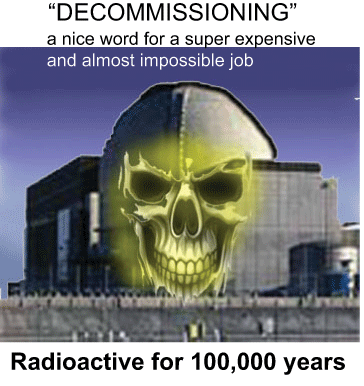
 nuClear News No.94 April 2017 The UK Government has been forced to pay nearly £100m in a settlement with two US companies – Energy Solutions and Bechtel – for mishandling the way it awarded a £6.1bn nuclear decommissioning contract. Ministers have ordered an inquiry headed by the former boss of National Grid to find out why the procurement process was so flawed. Labour said the payout showed “dramatic levels of incompetence”. The Nuclear Decommissioning Authority (NDA) will also terminate the contract it awarded for cleaning up the UK’s old Magnox reactor sites nine years early. The sites include Bradwell, Chapelcross, Hinkley A and Hunterston A. (1)
The High Court ruled last summer that the NDA had “manipulated” and “fudged” the tender process. It meant that the wrong company won the work to decommission 12 UK nuclear sites (10 Magnox sites plus Harwell and Winfrith). The move opens the door for other bidders to attempt to reclaim their bid costs, which could run to an additional £50m. The contract was awarded in 2014 to Cavendish Fluor Partnership, a joint venture between the UK’s Babcock International and Texas-based Fluor. However, the consortium cannot be asked to take on the extra work because that could increase potential compensation claims by companies that wrongly lost out in the tender. Some industry sources have complained that the government plumped for an unrealistically low bid for the work at the outset. Another losing bidder, UK Nuclear Restoration Ltd, which is a consortium of Amec Foster Wheeler, Atkins and Rolls-Royce, said that the settlement “raises serious concerns” about the procurement process and that it has raised the implications of the judgment with the government and the NDA. (2)
Former National Grid chief executive Steve Holliday has been appointed to lead an independent inquiry into what went wrong. The inquiry will look at how the mistakes were made and by who, how the litigation was handled, and the relationship between the NDA and the government departments. Holliday will publish an interim report in October. The government now has the daunting task of starting a new tendering process for the 12 sites, as the deal with Cavendish Fluor Partnership (CFP) will end early, in September 2019 instead of 2028. (3)
Babcock said in a statement the CFP, in which it has a 65% stake, has come to a mutual agreement with the NDA to bring to an end the contract at the end of August 2019, having operated the contract for a full five years. Babcock said it had become apparent that the work that needs to be done is now materially different in volume from that specified in the NDA’s tender, and this puts the contract at risk of a legal challenge. What those material differences are remains a mystery.
The Business Secretary, Greg Clark, said: “It has become clear to the NDA through this consolidation process that there is a significant mismatch between the work that was specified in the contract as tendered in 2012 and awarded in 2014, and the work that actually needs to be done. The scale of the additional work is such that the NDA board considers that it would amount to a material change to the specification on which bidders were invited in 2012 to tender.” (4)
The failure of the contract award process was “inevitable” according to nuclear power expert Dr Paul Dorfman, from University College London’s Energy Institute. “They were set up to fail and have failed because the understanding of costs and complexity to nuclear decommissioning is changing all the time,” he said. “Magnox reactors were thrown up in a rush to give electricity too cheap to meter and create plutonium and there was no thought of how they would be decommissioned. Each Magnox reactor is bespoke so decommissioning each one is different with its own complexities and challenges. The more we learn about dealing with the ‘back end’ of nuclear power, the more we see how complex and costly it is.” (5)
Stop Hinkley Spokesperson Roy Pumfrey said: “Why should anyone believe that this astonishing level of incompetence will suddenly end when we start to build new reactors? Just because Hinkley Point C is not a Magnox reactor doesn’t just suddenly make the industry competent.” (6)
The Daily Telegraph declared today “if we could, we would stop this madness … In committing to new nuclear, we seem to have joined a runaway train, with no hope of getting off. Has not the time finally arrived for a fully fledged rethink of the merits of Britain’s nuclear energy strategy?” (7)
Roy Pumfrey continued: “We agree – it is time to stop this madness. The UK’s nuclear decommissioning costs have increased from £55.8 billion in 2008 to £117.4 billion at the last count. Although EDF is required to set aside funds for decommissioning Hinkley Point C, this is only up to an agreed limit. The taxpayer will be on the hook for the all too predictable shortfall.”
Chris Huhne, former energy secretary for the coalition government, said the remit for the enquiry by Steve Holliday was not broad enough and it needed to look at the total cost of nuclear decommissioning. “It is a complete mess, it’s deeply embarrassing but it’s actually I’m afraid only the latest in a long line of embarrassments,” Huhne told BBC Radio 4. “We’re not even scraping the surface with the problem that this legal case has exposed.” Huhne, who was energy secretary between 2010 and 2012 and left the before the contract was awarded, said the cost of decommissioning the UK’s old nuclear fleet had increased £107bn in the last five years to £161bn. “In terms of industrial strategy this makes every other disaster in the post-war period pale into insignificance.” He said the problem stemmed from how early reactors stations were complex bespoke constructions made without consideration to how they would later be disassembled. “We ordered a whole series of Savile Row suits rather than a bunch of work-a-day Marks & Spencer suits… Every single one of those reactors is different. Even the fuel rods in every single one of those reactors are different – crazy.” (8) Huhne called on the government not to allow subsidies for new reactors. That was the coalition government policy. It should be the policy again but the government seems to be relenting – it’s opening the door to exactly a repetition of the sort of disaster that we see today. (9) http://www.no2nuclearpower.org.uk/nuclearnews/NuClearNewsNo94.pdf
EDF’s nuclear decommissioning – financial problems
Another month in UK’s failing new nuclear programme nuClear News No.94 April 2017 EDF Finances A French Parliamentary report from the National Assembly’s Commission for Sustainable Development and Regional Development says the clean-up of French reactors will take longer, be more challenging and cost much more than French nuclear operator EDF anticipates. Whereas Germany has set aside €38 billion to decommission 17 nuclear reactors, and the UK Nuclear Decommissioning Authority estimates that clean-up of UK’s 17 nuclear sites will cost between €109‒250 billion over the next 120 years, France has set aside only €23 billion to decommissioning its 58 reactors. In other words France estimates it will cost €300 million per gigawatt (GW) of generating capacity to decommission a nuclear reactor, Germany estimates €1.4 billion per GW and the UK estimates €2.7 billion per GW.
EDF says it wants to set aside a €23 billion fund to cover decommissioning and waste storage for an estimated €54 billion final bill ‒ and the difference between these two figures will be closed through the appreciating value of its equities, bonds and investments ‒ in other words, ‘discounting’. Unfortunately, recent experience has taught us that markets can go up and down over time ‒ especially the very long-time periods involved in radioactive waste management. But for a company that has huge borrowings and an enormous debt of €37 billion, €23 billion is a large sum of money to find. Any significant change in the cost of decommissioning would have an immediate and disastrous impact on EDFs credit rating ‒ something that the debt-ridden corporation can simply not afford. EDF is already in financial trouble. Along with bailing out collapsing AREVA, EDF also has to bear the huge financial burden of the failing reactor newbuild at Flamanville. It will also have to pay for extending the life of France’s existing nuclear power stations (to 2025), at a cost of €55 billion.
On top of all this the French authority tasked with disposal of all the countries vast and increasing waste burden (Andra) has recently ramped up the estimated cost for the planned national nuclear waste repository at Cigéo, to €25 billion ‒ and EDF must pay for most of Cigéo’s construction. Although €5 billion more than EDF anticipated, it still seems a gross underestimation, and the costs are likely to rise considerably. (21) http://www.no2nuclearpower.org.uk/nuclearnews/NuClearNewsNo94.pdf
Demolition of McCluskey Room at Hanford’s Plutonium Finishing Plant
Workers demolish site of nuclear mishap in Washington state , San Franciso Chronicle, NICHOLAS K. GERANIOS, ASSOCIATED PRESS, March 30, 2017, SPOKANE, Wash. (AP) — Workers at the Hanford Nuclear Reservation in Washington state have finished demolishing the site of a famous nuclear accident during the Cold War that exposed a man to the highest dose of radiation from the plutonium byproduct americium ever recorded, the U.S. Department of Energy announced Thursday.
Nuclear decommissioning debacle is costly for Britain
UK nuclear decommissioning debacle costs government nearly £100m
Business secretary orders inquiry into flawed tendering process for dismantling old reactors at 12 sites as US firms get paid for out of court settlement, Guardian, Adam Vaughan, 27 Mar 17, The government has been forced to pay nearly £100m in a settlement with two US companies for mishandling the way it awarded a £6.1bn nuclear decommissioning contract.
Ministers have ordered an inquiry headed by the former boss of National Grid to find out why the procurement process was so flawed. Labour said the payout showed “dramatic levels of incompetence”.
The government body tasked with decommissioning old reactors will also terminate the contract it awarded for cleaning up a dozen of the UK’s old nuclear sites nine years early……..
The government now has the daunting task of starting a new tendering process for the 12 sites, as the deal with Cavendish Fluor Partnership will end early, in September 2019 instead of 2028…….
The contract is being terminated early because the NDA underestimated the scale of the decommissioning required to clean up the Magnox sites, which form part of the UK’s first generation of nuclear power stations.
The share price of Babcock International Group, which has a stake in the Cavendish Fluor Partnership, has fallen by more than 3% since the government announcement…….
The NDA has an annual budget of £3.1bn, two thirds of which is spent on Sellafield in Cumbria, which stores most of Britain’s nuclear waste. https://www.theguardian.com/business/2017/mar/27/uk-nuclear-decommissioning-debacle-costs-government-100m
Decommissioning San Onofre Nuclear Generating Station
Trump’s budget could help get rid of the nuclear waste along the San Onofre coastline http://www.latimes.com/business/la-fi-nuclear-waste-20170320-story.html Rob Nikolewski
A sense of momentum is building about finding a way to deal with the massive amounts of radioactive waste from nuclear power plants, including Southern California’s San Onofre Nuclear Generating Station.
Last week’s Trump administration “skinny budget” proposal, which calls for boosts in defense spending but cuts in domestic funding and federal agencies, found $120 million for starters to “initiate a robust interim storage program” while also looking at reviving the Yucca Mountain nuclear waste repository in Nevada.
Decommissioning San Onofre Nuclear Generating Station
A president’s budget proposals are ultimately subordinate to what Congress decides. But David Victor, chairman of the SONGS Community Engagement Panel, said the appropriation for nuclear waste may be one of the only topics in the current political environment that can generate support from members of both parties.
There are 3.6 million pounds of nuclear waste sitting along the coastline at the San Onofre plant, part of the 76,000 metric tons of spent fuel at sites nationwide.
“There’s a lot of Trump’s proposed budget that horrifies me, in particular around cutting funding for science and energy, but [long-term nuclear storage] is an area where I think the nation is now starting to make some progress,” Victor said.
Rep. Darrell Issa (R-Vista), who has introduced a bill called the Interim Consolidated Storage Act, said he thinks the chances for funding the White House nuclear waste proposal are “extremely good.”
“You have an active group of members, some of whom are Democratic members, who have a vested interest” in moving legislation forward, Issa said. “And … the fingerprints of whoever wanted to force it out would show all over.”
“As a budget line item it’s not a bad number at all,” Issa said in a telephone interview from Washington. “It’s sufficient to do the feasibility of these sites.”
Consolidated interim storage sites are designed to be built in isolated locations where multiple nuclear facilities could deposit their waste.
Two potential interim storage locations have been discussed — one in western Texas and another in eastern New Mexico.A company in Andrews, Texas, has filed an application to accept 5,000 metric tons of nuclear material. The district is represented by Republican Rep. Mike Conaway, who has co-sponsored Issa’s bill.
Getting the massive nuclear waste repository at Yucca Mountain, located about 100 miles from Las Vegas, back on track assuredly would involve a battle on Capitol Hill.
Democrats as well as Republicans from Nevada blasted the Trump proposal. “Washington needs to understand what Nevada has been saying for years: We will not be the nation’s nuclear waste dump,” said Sen. Dean Heller (R-Nev.).
The federal government spent about $15 billion to build the facility at Yucca Mountain to house nuclear waste from sites across the country. But then-Sen. Harry Reid (D-Nev.) led the fight to shut the repository down, and in 2010 President Obama suspended licensing for the site.
Yucca Mountain was scheduled to open in 2017.
While taking a tour of San Onofre last month with Issa, Rep. John Shimkus (R-Ill.), who is chairman of the House subcommittee that reviews nuclear sites, was asked if Yucca Mountain was coming back onto the bargaining table.
“It’s never been off the table,” Shimkus said.
Issa’s bill would be paid for by using part of the federal government’s Nuclear Waste Fund, which is worth upward of $40 billion and was funded by ratepayers in areas powered by nuclear plants.
A 2014 court order stopped the federal government from taking fees from electricity customers because, with Yucca Mountain sidelined, the government had no place to send nuclear waste.
“We’re paying a lot of money for the privilege of not having a solution that we were obligated to have,” Issa said. “It’s not free. It’s going to cost every taxpayer money until there’s a working solution.”
But even if Congress adopts a plan roughly similar to the White House proposal, there are a series of practical and regulatory hurdles to clear.
For example, sites such as San Onofre, which closed in 2013, would still need to place some of their spent fuel into canisters. Then federal law would need to be changed to install a reliable funding mechanism for interim sites, and a strategy would need to be adopted in order to move the waste from one place to another.
“There is still a long way to go,” Victor said. “We could have troubles on any of those fronts, but I think what’s encouraging is that on every single one of those fronts, we’re starting to see progress.”
Millions of people live within 50 miles of San Onofre, which hasn’t produced electricity since January 2012 after a steam generator leaked a small amount of radiation.
Southern California Edison is the majority owner of the plant, which is in the process of being decommissioned.
Edison officials said they were heartened by the news of $120-million proposal.
“We are pleased to see funding proposed to restart the Yucca licensing process, and continue to also support interim storage proposals that would enable [Southern California Edison] to move San Onofre’s used fuel to an off-site location,” spokeswoman Maureen Brown said
Global nuclear industry heading towards a decommissioning crisis
Lobbyists debate responses to the nuclear power crisis, Online opinion, .By Jim Green – , 27 March 2017The Era of Nuclear Decommissioning (END) “……….The ageing of the global reactor fleet isn’t yet a crisis for the industry, but it is heading that way. The assessment by the ‘Environmental Progress’ lobby group that 151 GW of worldwide nuclear power capacity could be shut down by 2030 is consistent with figures from the World Nuclear Association (132 reactor shut-downs by 2035), the International Energy Agency (almost 200 shut-downs between 2014 and 2040) and Nuclear Energy Insider (up to 200 shut-downs in the next two decades)
It looks increasingly unlikely that new reactors will match shut-downs. Another 20 years of stagnation is possible, but only if China continues to do the heavy lifting. And if China’s nuclear program slows, worldwide nuclear decline is certain.
Perhaps the best characterisation of the global nuclear industry is that a new era is approaching – the Era of Nuclear Decommissioning (END). Nuclear power’s END will entail:
- a slow decline in the number of operating reactors (unless growth in China can match the decline elsewhere);
- an increasingly unreliable and accident-pronereactor fleet as ageing sets in;
- countless battles over lifespan extensions for ageing reactors;
- many battles over the nature and timing of decommissioning operations;
- many battles over taxpayer bailouts for companies and utilities that haven’t set aside adequate funding for decommissioning;
- more battles over proposals to impose nuclear waste repositories on unwilling or divided communities; and
- battles over taxpayer bailouts for companies and utilities that haven’t set aside adequate funding for nuclear waste disposal.
Nuclear power is likely to enjoy a small, short-lived upswing in the next couple of years as reactors ordered in the few years before the Fukushima disaster come online. Beyond that, the Era of Nuclear Decommissioning sets in, characterised by escalating battles ‒ and escalating sticker-shock ‒ over lifespan extensions, decommissioning and nuclear waste management.
In those circumstances, it will become even more difficult than it currently is for the industry to pursue new reactor projects. A positive feedback loop could take hold and then the industry will be well and truly in crisis………http://onlineopinion.com.au/view.asp?article=18929&page=0
1 This Month


Tell the Ukrainian Government to Drop Prosecution of Peace Activist Yurii Sheliazhenko

Petition to revoke the licensing of the Near Surface Nuclear Disposal Facility (NSDF) at Chalk River. https://www.ourcommons.ca/petitions/en/Petition/Details?Petition=e-7247


of the week – STOP SMALL MODULAR REACTORS IN CANADA
To see nuclear-related stories in greater depth and intensity – go to https://nuclearinformation.wordpress.com
-
Archives
- March 2026 (204)
- February 2026 (268)
- January 2026 (308)
- December 2025 (358)
- November 2025 (359)
- October 2025 (376)
- September 2025 (258)
- August 2025 (319)
- July 2025 (230)
- June 2025 (348)
- May 2025 (261)
- April 2025 (305)
-
Categories
- 1
- 1 NUCLEAR ISSUES
- business and costs
- climate change
- culture and arts
- ENERGY
- environment
- health
- history
- indigenous issues
- Legal
- marketing of nuclear
- media
- opposition to nuclear
- PERSONAL STORIES
- politics
- politics international
- Religion and ethics
- safety
- secrets,lies and civil liberties
- spinbuster
- technology
- Uranium
- wastes
- weapons and war
- Women
- 2 WORLD
- ACTION
- AFRICA
- Atrocities
- AUSTRALIA
- Christina's notes
- Christina's themes
- culture and arts
- Events
- Fuk 2022
- Fuk 2023
- Fukushima 2017
- Fukushima 2018
- fukushima 2019
- Fukushima 2020
- Fukushima 2021
- general
- global warming
- Humour (God we need it)
- Nuclear
- RARE EARTHS
- Reference
- resources – print
- Resources -audiovicual
- Weekly Newsletter
- World
- World Nuclear
- YouTube
-
RSS
Entries RSS
Comments RSS
 nuclear-news