$25 million a year decommissioning fee proposed for Pilgrim nuclear plant Andy Metzger, State House News Service, Nov 6, 2017 BOSTON — Without sufficient funds for safely decommissioning the Pilgrim Nuclear Power Station, the state could be left holding the proverbial (glowing) bag once the plant ceases operations, environmental activists warned lawmakers Monday, asking them to impose a $25 million annual fee on the station if it misses deadlines.
The plant is set to close in a year and a half and its owner, Entergy, said the timetable for completing the decommissioning five years after closing is unrealistic.
“Physically it’s impossible to decommission in five years,” Tom Joyce, a lobbyist for Entergy, told the Committee on Telecommunications, Utilities and Energy. The fuel that was delivered to the power plant on the Plymouth coast about six months ago is “very hot and being used now to fuel the reactor and produce electricity, which will stay in the pool and can’t be touched for five years,” Joyce said.
Pilgrim went into operation in 1972, and it has been a source of major safety concern for residents of the South Shore and Cape Cod, especially after the meltdown in Fukushima, Japan, demonstrated the devastation that can follow a nuclear disaster……..
The plant, which is rated one notch above the Nuclear Regulatory Commission’s ranking of unacceptable, is set to close at the end of May 2019, and federal regulators will oversee the decommissioning process.
Pilgrim has a fund to pay for decommissioning that Joyce said stands at around $1 billion and anti-Pilgrim activists said was recently priced at about $960 million. Activists say that amount won’t be enough to cover the cost of safely securing the spent fuel and other decommissioning responsibilities.
Decommissioning Vermont Yankee, a smaller plant, had an estimated cost of $1.23 billion, according to Claire Miller, a community organizer for Toxics Action Center.
“If there’s not enough money the reactor could be mothballed for 60 years, and during that time obviously the workforce would be reduced to a skeleton [crew], offsite emergency planning would be eliminated, and offsite environmental monitoring eliminated or reduced,” Miller told the committee. “If Entergy … skips town, we are left holding the bag, along with lots of radioactive waste.”
Legislation filed by Plymouth Republicans Sen. Vinny deMacedo and Rep. Mathew Muratore would establish a Nuclear Power Station Post-Closure Trust Fund financed with $25 million annual payments by any nuclear plant that is not completely decommissioned five years after it stops making electricity. Pilgrim is the only remaining nuclear plant in Massachusetts.
“This is a detriment to our community,” deMacedo told the committee about the soon-to-be shuttered plant…… http://plymouth.wickedlocal.com/news/20171106/25-million-year-decommissioning-fee-proposed-for-pilgrim-nuclear-plant
November 8, 2017
Posted by Christina Macpherson |
business and costs, decommission reactor, USA |
Leave a comment
 TMR 3rd Nov 2017.Strict regulations pertaining to nuclear disaster are likely to have a core
impact on the growth of the global market for nuclear decommissioning
services, states TMR Research in a research report. The report has been
titled, “Nuclear Decommissioning Services Market – Global Industry
Analysis, Size, Share, Trends, Analysis, Growth, and Forecast 2017 –
2025.”
https://tmrresearchblog.com/alarming-rise-accidents-trigger-use-nuclear-decommissioning-services/
Le Monde 4th Nov 2017, Europe faces the burden of nuclear decommissioning. In Germany and Italy,
as in France, the deconstruction of the reactors will spread over decades,
producing huge volumes of waste difficult to manage.
http://www.lemonde.fr/planete/article/2017/11/04/l-europe-face-au-fardeau-du-demantelement-nucleaire_5210174_3244.html
November 6, 2017
Posted by Christina Macpherson |
2 WORLD, decommission reactor |
Leave a comment

 Oi nuclear reactors set to be decommissioned , Japan News , October 17, 2017 Kansai Electric Power Co. intends to decommission the No. 1 and No. 2 reactors at the Oi nuclear power plant in Fukui Prefecture when the plant reaches 40 years of service in 2019, it has been learned.
KEPCO made the decision because the distinctive structure of the reactors’ containment vessels would require massive spending to apply safety measures that would meet the new standards set after the crisis at Tokyo Electric Power Company Holdings Inc.’s Fukushima No. 1 nuclear power plant.
The power company is expected to make an official decision by the end of this year and submit an application to the Nuclear Regulation Authority.
Since the 2011 Great East Japan Earthquake, decisions have been made to decommission six nuclear reactors, not counting those at the Fukushima No. 1 plant. The Oi reactors will be the first large-scale reactors, with a maximum output of over 1 million kilowatts, to be decommissioned……..
The deadline for the Nos. 1 and 2 Oi reactors to apply for an operating period extension is approaching in 2018. With work to improve safety likely being a difficult challenge, KEPCO has no prospect of cutting back on the cost, which is expected to be over ¥100 billion. The company therefore gave up on restarting the reactors.
Tens of billions of yen are expected to be spent over 30 years to complete the decommissioning of the reactors, but that is still much cheaper than restarting them. ….. http://the-japan-news.com/news/article/0004008184
October 18, 2017
Posted by Christina Macpherson |
decommission reactor, Japan |
Leave a comment
FT 15th Oct 2017, Decommissioning Britain’s first generation of atomic reactors is likely
to be brought back “in-house” by the UK nuclear clean-up agency after
the collapse of a £6.2bn outsourcing contract that exposed “fundamental
failures” at the organisation.
Ministers have been considering whether
the work, involving 12 Magnox nuclear plants and research sites, should be
offered to another private contractor or run directly by the Nuclear
Decommissioning Authority. A final decision has not yet been made but
industry figures with knowledge of the process said the most likely outcome
was for the NDA to create a new subsidiary to take control of the Magnox
clean-up programme.
Such an outcome would bring an end to an embarrassing
episode in which Greg Clark, business secretary, in March cancelled a deal
with Cavendish Fluor Partnership, a joint venture between UK-based Babcock
International and Fluor of the US, at a cost of £122m to British
taxpayers. https://www.ft.com/content/b83c5ada-b014-11e7-beba-5521c713abf4
October 16, 2017
Posted by Christina Macpherson |
decommission reactor, UK |
Leave a comment
Nuclear Authority’s failure to carry out decommissioning deal cost taxpayer £122million
Energy Voice by Reporter – 12/10/2017 Fundamental failures in awarding a £6.2 billion deal to decommission the UK’s ageing fleet of Magnox nuclear power stations cost the taxpayer £122 million, an official report has found.
The National Audit Office said the saga raised “serious questions” about the Nuclear Decommissioning Authority’s (NDA) understanding of procurement regulations.
The NDA ran a competitive procurement exercise for decommissioning services at 12 nuclear sites, resulting in the award of a 14-year contract for up to £6.2 billion, but the High Court found it had wrongly decided the outcome of the process.
The NDA agreed to settle claims in March 2017, the same month as the Government set up an inquiry into the Magnox contract.
Energy Solutions unsuccessfully bid for the contract, and later issued legal claims against the NDA for damages.
The High Court found that, had the NDA applied its evaluation criteria correctly, the winning bidder, Cavendish Fluor Partnership (CFP), would have been excluded from the competition.
The NDA agreed to settle legal claims with Energy Solutions and its consortium partner at the time of the bid, Bechtel, at a cost of £97.3 million.
It also spent £13.8 million on legal and external advisers, while in-house staff time cost £10.8 million.
Amyas Morse, head of the National Audit Office, said: “The NDA’s fundamental failures in the Magnox contract procurement raise serious questions about its understanding of procurement regulations; its ability to manage large, complex procurements; and why the errors detected by the High Court judgement were not identified earlier…….https://www.energyvoice.com/otherenergy/nuclear/153035/nuclear-authoritys-failure-carry-decommissioning-deal-cost-taxpayer-122million/
October 14, 2017
Posted by Christina Macpherson |
decommission reactor, UK |
Leave a comment
State troubled by Vermont Yankee rubble plan, Vt Digger, By Mike Faher, Oct 1 2017 BRATTLEBORO – State regulators and anti-nuclear activists are taking a stand against a proposal to reuse large amounts of Vermont Yankee’s concrete as fill when the plant is decommissioned.
The latest objections to the so-called “rubblization” plan come from the Vermont Agency of Natural Resources and the state Public Service Department. Officials want to know whether concrete from the retired nuclear plant is safe for burial on the Vernon property.
“We want to feel comfortable … that the material is truly clean,” said Chuck Schwer, director of the agency’s Waste Management and Prevention Division…….
The restoration of the Vermont Yankee site appears to be the biggest point of contention. At issue is how much NorthStar, after satisfying the NRC’s radiological cleanup requirements, will safely restore the site for future reuse……..
even after decommissioning, Vermont Yankee’s spent fuel will remain on site under 24-hour security surveillance until the federal government develops a central repository for high level nuclear waste.
“I wouldn’t say you wouldn’t be able to live there. I’m just not sure people would want to,” State said.
Whatever the property’s future, NorthStar’s plan to bury rubble on site is coming under intense scrutiny……..
Schwer told the advisory panel that, contrary to Entergy’s claims, the full extent of radiation contamination at Vermont Yankee remains a mystery. And officials say it’s not yet clear how NorthStar will address contamination before crushing and burying the concrete.
Schwer wrote in testimony filed with the utility commission that if tainted concrete is buried, “there is the potential that residual contamination could remain undetected below the surface, spread over time and pose a risk to public health and the environment.”…… https://vtdigger.org/2017/10/01/state-troubled-vermont-yankee-rubble-plan/#.WdFrqI-CzGg
October 2, 2017
Posted by Christina Macpherson |
decommission reactor, USA |
Leave a comment

$9 Billion Nuclear Scrapyard: New Aerial Photos of SCE&G’s Abandoned V.C. Summer Nuclear Project Reveal Disarray
Reactor Building and Components Left Unprotected; Most Cranes Removed, Friends of the Earth, 27 Sept 17 COLUMBIA, S.C. – Newly obtained aerial photographs of the abandoned V.C. Summer nuclear reactor construction site reveal that there is no protection of installed reactor components from the weather. (See notes on original for links to photos.)
The photos provided to Friends of the Earth are being released in the middle of the political firestorm in South Carolina about the terminated project. It has become clear that South Carolina Electric & Gas (SCE&G) and its partner, Santee Cooper, withheld key information for years about the faltering project and were finally forced to simply walk away from on-going construction with no site shut-down plan in place.
The photos of the debacle, on which $9 billion was wasted, confirm that when work was abruptly halted on July 31, no preparation had been made to protect buildings and key components associated with reactor units 2 and 3. One existing reactor, visible in the photos, has operated at the site since 1982.
The photos, taken on September 18, reveal that nuclear reactor modules installed inside the open containment vessels are exposed to the weather. The partially finished ‘shield buildings,’ in which the reactors are located, lack roofs and sit fully exposed to the elements. Construction was only about 37% complete when the work was halted and had been continuing at a snail’s pace.
“Almost two months after the project was halted the V.C. Summer reactor construction site still looks like it was abruptly abandoned with no shut-down plan,” said Tom Clements, senior adviser to Friends of the Earth. “Not only was SCE&G grossly negligent during construction of the project, but the photos of the site reveal that the company also exhibited imprudent behavior in abandoning the project without proper closure plans. The forlorn site looks like a nuclear ghost town best suited for a Hollywood movie set,” added Clements. (Duke Energy’s abandoned nuclear reactor project in Cherokee County, South Carolina, was used as a set for the science fiction film The Abyss in 1989.)
Years of weathering will ravage the unprotected reactor components and partially constructed shield buildings and turbine buildings, according to Friends of the Earth. The turbine buildings, located adjacent to the reactors, sit without roofs and with open walls. A large number of white tent-like temporary buildings are visible and, according to information provided by site workers to Friends of the Earth, protect unused components. The short lifespan of the shelters will necessitate long-term plans if components are to be retained and not sold off.
The photos were taken by High Flyer, an anonymous pilot who for years has provided photos of V.C. Summer. The photos were taken in compliance with regulations of the Federal Aviation Administration and have been provided to Friends of the Earth for distribution in the public interest, including for regulators and law enforcement investigators. The photos can be used with credit to High Flyer (e.g. Courtesy of High Flyer © 2017). SCE&G has not provided photos of the abandoned site……… https://foe.org/9-billion-nuclear-scrapyard-new-aerial-photos-scegs-abandoned-v-c-summer-nuclear-project-reveal-disarray/
September 30, 2017
Posted by Christina Macpherson |
decommission reactor, politics, USA |
Leave a comment
 Reuters 29th Sept 2017, Britain’s Nuclear Decommissioning Authority (NDA) has given a notice of
termination to Cavendish Fluor Partnership (CFP) for its management and
decommissioning of the country’s 12 Magnox nuclear power reactors and
research sites, it said on Friday.
The termination notice was effective
from Sept. 1 and allows for a 24-month notice period, ending CFP’s
contract on Aug. 31, 2019.
CFP – a joint venture between British firm
Cavendish Nuclear, a subsidiary of Babcock International, and U.S. company
Fluor Inc. – was awarded the contract in 2014. But earlier this year the
government said there was a “mismatch” between the work specified in
the contract and the work that actually needed to be done.
http://uk.reuters.com/article/britain-nuclear/uk-nuclear-authority-gives-notice-to-end-cfps-magnox-decommissioning-contract-idUKL8N1MA129?rpc=401&
September 30, 2017
Posted by Christina Macpherson |
business and costs, decommission reactor, politics |
Leave a comment

 BBC 12th Sept 2017, Work has begun on the “challenging” task of removing radioactive fuel
elements stuck inside the most famous of Dounreay’s reactors. Closed since
1977, the Dounreay Fast Reactor is known for its dome-shaped exterior.
Almost 1,000 fuel elements have been in the reactor for years after the work to remove them was halted because they were swollen and jammed in.
New technology has now been developed to make it possible to remove them. It
could take three years to complete the job at the nuclear power site near
Thurso in Caithness. Once all the elements have been removed work can begin
on dismantling the reactor.
http://www.bbc.co.uk/news/uk-scotland-highlands-islands-41245375
September 14, 2017
Posted by Christina Macpherson |
decommission reactor, UK |
Leave a comment

Swiss utility BKW jumps into nuclear plant dismantling business, Reuters, 7 Sept 17 Reuters Staff
- DfN already works with BKW at Muehleberg station
- GE, Hitachi and Veolia also looking at decommissioning business
By John Miller ZURICH, Sept 7 (Reuters) – Swiss utility BKW AG bought a small German nuclear services company on Thursday, joining firms including GE that are banking on rising revenue from the decommissioning of European nuclear plants.
BKW, which plans to dismantle its own Muehleberg nuclear station after shuttering it in 2019, bought Dienstleistungen fuer Nukleartechnik GmbH (DfN). Its services include verifying that components removed from nuclear facilities are no longer radioactive.
Other companies, including Finland’s Fortum, privately held U.S.-based Bechtel and the GE Hitachi Nuclear Energy alliance, are also seeking to benefit from plant decommissioning in Sweden as well as Germany.
Germany decided to exit nuclear power by 2022 following the Fukushima disaster in Japan in 2011.
Similarly, energy groups E.ON and EnBW, which are now tearing down their German nuclear plants, are seeking to parlay newfound dismantling expertise by offering similar services elsewhere in the world…….https://www.reuters.com/article/bkw-nuclearpower-dismantling/swiss-utility-bkw-jumps-into-nuclear-plant-dismantling-business-idUSL8N1LO4R1
September 9, 2017
Posted by Christina Macpherson |
decommission reactor, Switzerland |
Leave a comment
A historic chimney is set for demolition at Sellafield. The Primary
Separation Plant Chimney Stack was built in the 1950s to provide
ventilation for surrounding buildings.
It is now one of the biggest risks at Sellafield because it does not meet modern safety standards. Demolishing
a 61-metre chimney in the middle of Europe’s most complex, congested
nuclear site is a challenge. Explosives are not an option and there is no
space for a crane so engineers have spent the last seven months getting a
self-climbing platform to the top of the chimney metre by metre so they can
begin demolition.
Demolishing this chimney will cost more than £60m. The
Nuclear Decommissioning Authority which oversees Sellafield says the
complexity of this one project demonstrates why cleaning up this site is so
expensive. £2bn was spent at Sellafield last year alone. http://www.itv.com/news/border/2017-08-29/historic-sellafield-chimney-ready-for-demolition/
September 1, 2017
Posted by Christina Macpherson |
decommission reactor, UK |
Leave a comment
Aboard the NS Savannah, America’s first (and last) nuclear merchant ship, Years after shutdown, Savannah still waits for funding for its reactor decommissioning. Ars Technica, SEAN GALLAGHER – 7/26/2017 Constructed at a cost of $46.9 million ($386.8 million in 2016 dollars) and launched on July 21, 1959, the Savannah was the world’s first nuclear cargo ship and the second nuclear-powered civilian ship (coming just two years after the Soviet nuclear icebreaker Lenin). Owned by the US Maritime Administration (MARAD) and operated by commercial cargo companies, for nearly a decade she carried cargo and passengers around the world. She also acted as a floating herald for America’s seemingly inevitable, cool Atomic Age future. Savannah boasted all the latest conveniences, including one of the world’s first microwave ovens.
Many critics have since called the Savannah an expensive Cold War-era.boondoggle,………
Ultimately, the bright atomic future Savannah was supposed to herald quickly lost its luster. The $2 million in annual subsidies required to operate made her a target for budget cuts—especially when the price of oil was low. In 1971, she was taken out of service. By the 1980s, both Japan and Germany abandoned their own nuclear merchant programs; only Russia still operates nuclear-powered merchant ships from its Arctic port in Murmansk. The country has a lone nuclear icebreaking cargo ship and six icebreakers in service…….
So more than 45 years after her last voyage, the Savannah remains moored here at the Canton Marine Terminal in a sort of limbo. It has been defueled and had nearly all of its radioactive materials removed, but the Savannah‘s reactor is still intact—as is the ship’s license to operate from the Nuclear Regulatory Commission (NRC)……
the ship is also still regulated by the NRC and awaiting congressional funding for full decommissioning. It’s a step that the US government didn’t really even think about back when Savannah was built……. t the ship is also still regulated by the NRC and awaiting congressional funding for full decommissioning. It’s a step that the US government didn’t really even think about back when
July 28, 2017
Posted by Christina Macpherson |
decommission reactor, USA |
Leave a comment
 ANTI-NUCLEAR GROUP DOUBTS VERMONT YANKEE CLEANUP PLAN, VTDIGGER,JUL. 9, 2017, 4:17 PM BY MIKE FAHER BRATTLEBORO – The company that wants to buy Vermont Yankee hasn’t properly assessed the plant for radiological contamination and “cannot know” the true cleanup cost, a Brattleboro anti-nuclear group contends.
The New England Coalition, in new filings with the Nuclear Regulatory Commission, seeks to intervene in the federal review of Vermont Yankee’s proposed sale to NorthStar Group Services.
One of the coalition’s biggest concerns mirrors worries that have been previously expressed by Vermont officials: that NorthStar could run into unforeseen problems and run out of money before finishing decommissioning.
NorthStar “cannot reasonably assure that it has adequate financial resources to own and operate Vermont Yankee for the purpose of decommissioning and fuel storage,” wrote Ray Shadis, a New England Coalition technical adviser…….
NorthStar has promised to clean up the majority of the site no later than 2030. That would make the property available for redevelopment much sooner, but some have expressed skepticism about the company’s ability to follow through.
That sentiment has spilled over to the NRC’s review of NorthStar’s plans.
In documents filed last month with the Atomic Safety and Licensing Board – an independent judicial body of the NRC – Vermont officials declared there is “significant risk” in NorthStar’s proposal due to “numerous, thus-far-unanalyzed health, safety and environmental concerns.”
State officials focused on financial issues, arguing that unexpected contamination, complications related to long-term spent fuel storage, and other issues could drastically drive up decommissioning costs.
Like Vermont officials, the New England Coalition is asking the Atomic Safety and Licensing Board for intervention status and a hearing in connection with the Vermont Yankee license transfer. The coalition offers two main contentions.
First, Shadis says the license transfer application is incomplete because it does not offer any environmental impact statement or “any substantive and reliable information about the varieties, quantities, depth and extent of radiological contamination.”
Shadis is critical of what he calls the NRC’s “tunnel vision” approach to NorthStar’s application.
He says the scope of NorthStar’s decommissioning proposal is far greater than a standard license transfer application. Instead, NorthStar is pitching “an untested method of managing decommissioning under new and unanalyzed circumstances.”……..https://vtdigger.org/2017/07/09/anti-nuclear-group-doubts-vermont-yankee-cleanup-plan/
July 17, 2017
Posted by Christina Macpherson |
decommission reactor, USA |
Leave a comment
 http://www.fairewinds.org/newsletter-archive//oegf127i8zwvkcg5koxzivdipspzk9, June 22, 2017, Demystifying Nuclear Power, Atomic Power and a Just Transition for ‘Host Communities’ By Maggie Gundersen &Ben Shulman-Reed, Atomic power plants are shutting down faster than they are being built. These reactors conceptualized in the 1960s are failing because they are old and they are being closed because they are not competitive with renewables and therefore economically unfeasible. People around the world understand that a Fukushima-like disaster can happen anywhere, anytime. The nuclear power industry that dreams of building a new nuke every twelve days for the next 35 years) – totaling 1000 new rectors by 2050) are facing the harsh reality that atomic energy is not needed and is no longer wanted.
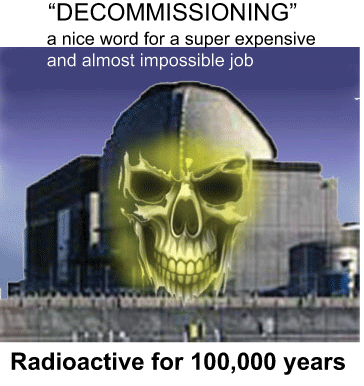
In the United States (U.S.), where largest amount of atomic power reactors in the world are located, Pilgrim in Massachusetts, Indian Point outside New York City, Oyster Creek in New Jersey, Diablo Canyon in California, and most recently Three Mile Island in Pennsylvania have recently announced their intent to close in the near future. While the shutdown of American nukes is good for our economy as well as the planet’s environment, decommissioning is a costly and complicated process that takes a toll on the local communities that hosted these giant facilities. When a nuclear power reactor shuts down, an incredible amount of work must be done to ensure a just, smooth financial transition for the local economy and also to create long-term viable storage for its toxic radioactive waste, which the U.S. Government has failed to provide. In addition to hosting the physical radioactive carcass of the power reactor for decades, the local community must restructure its economy to make it more diverse and self-sufficient as well as creating a more healthy and sustainable energy future.
Unfortunately, the usually small and economically stifled cities and towns, often referred to as ‘host communities’ to these atomic power reactors are not always given a voice at the table when it comes to deciding plans for their future – yet they are the true stakeholders. Fairewinds has continuously monitored and reported upon the challenges and defects of the Vermont Yankee atomic reactor and the lack of stakeholder respect given to its Windham County host. When it came time to close reactor in 2014, the Vermont Legislators and State Officials found themselves having to stand up to both Entergy (Vermont Yankee’s parent corporation), and the Nuclear Regulatory Commission (NRC) the alleged federal regulator for the nuclear power industry, for the Vermont’s own State’s rights and for the rights of all Vermont citizens.
Vermont is still negotiating the terms of the decommissioning process for Vermont Yankee – the state’s lone nuclear power plant and is becoming a leading example for nationwide regarding how to advocate for a smooth and just transition from atomic power operations to decommissioning and dismantlement. Vermont is seeking a just transition that will protect all the stakeholders, not only the profit interests of the power plant’s corporate owners.
The real question for all nuclear power plant host communities is: who is protecting and advocating for the rights of the ratepayers, for the level of decontamination at the site, nearby aquifers and watersheds, and an orderly economic transition for all the people in the impacted surrounding communities? The Nuclear Regulatory Commission (NRC), while the controlling interest in radiological standards and decommissioning processes on each site, does not examine or consider any of these critical human rights issues. All the environmental justice and human rights issues of assuring ongoing open access to clean air, safe water, and uncontaminated food from the remaining carcass of a shutdown atomic power reactor falls upon local and state governments throughout the US. Vermont is leading the way in creating an open and transparent process for local communities to self-advocate in creating a safer and more transparent decommissioning process and transition to a safe and permanently uncontaminated dismantlement of these highly radioactive nukes.
By opening a wide dialogue as we all advocate for an open and transparent decommissioning process, we believe the U.S. can shed its title of founding nuclear energy and instead become a global leader in cleaning up the mess we started. By following Vermont’s of paying close attention to the interests of our local governments, ratepayers and host communities, we all will begin to achieve just and safe transitions from the glut of toxic radioactive nuclear power plant carcasses coming our way as atomic power continues to become economically unviable.
It is Fairewinds’ goal to help communities work together to achieve a safer transition in their energy futures by shifting energy paradigms to an economically feasible and environmentally compatible model for the health and survival of our species and our planet.
June 23, 2017
Posted by Christina Macpherson |
decommission reactor, USA |
Leave a comment
 Korea’s oldest nuclear reactor ceases operation, http://www.koreaherald.com/view.php?ud=20170618000190 By Kim Da-sol (ddd@heraldcorp.com), Kori No. 1, South Korea’s oldest nuclear reactor located in Busan, ceased operation Sunday at midnight after four decades.
Its operator Korea Hydro and Nuclear Power Co. said that it cut the power supply Saturday and began the cooling-down process of the reactor. It was officially decommissioned, with the temperature of the reactor gradually dropping to 90 degrees Celsius, from its normal operation at 300 degree Celsius, the KHNP said. Officials will then relocate the spent nuclear fuel stored inside the rector to a liquid sodium-cooled reactor for reprocessing.
The actual dismantling of the facilities is expected to start no later than 2022. The KHNP expects that at least 634 billion won ($559 million) is required for the dismantling. They also need to submit a dismantlement plan within five years for the NCCS’ approval.
The state-run Nuclear Safety and Security Commission, which approved earlier this month the permanent shutdown of Kori No. 1, said it will continue to check the safety management of the suspended reactor on a regular basis until the dismantlement.
Following the government’s approval in 2007, Kori No. 1’s operation was extended by 10 years after a 30-year run.
Some experts oppose the planned reprocessing of nuclear waste, saying the technology, though effective in reducing the volume of waste, could complicate waste disposal by creating different types of radioactive waste.
Under President Moon Jae-in, the South Korean government aims to close all nuclear power plants by shutting down aged facilities and eventually phasing out the rest over the next 40 years.
June 19, 2017
Posted by Christina Macpherson |
decommission reactor, South Korea |
Leave a comment














 nuclear-news