Decommissioning of Oyster Creek nuclear station – a nasty precedent for closing down of other USA reactors.
|
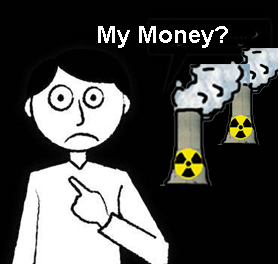
The decommissioning at Oyster Creek was funded by ratepayers and amounted to almost $1 billion when it was sold, presumably for significantly less than its billion-dollar-fund balance. Authoritative sources had previously estimated the cost to decommission Oyster Creek at over $1.4 billion. The original decommissioning schedule was to occur over a 60-year period, but the new owners are betting they can decommission the plant faster, and for significantly less than their investment, pocketing the difference. The quicker they can do this, the more they earn. Of course, if they find they bit off more than they can chew and look like they are on a pathway to failure, they can pack up their wrenches and backhoes and abandon the project, leaving New Jersey ratepayers to fund whatever actions remain to safely complete decommissioning. Seems like a win-win for both buyer and seller. For the new owner, if the challenges exceed their abilities, they can simply cut and run before depleting their newly acquired billion-dollar decommissioning fund. For the seller, they have unloaded an unpleasant responsibility in a way that’s sadly reminiscent of the actions of a deadbeat dad. Current questions on nuclear subsidiesThe current question before the BPU on subsidies presents a rare opportunity for regulators to exert some leverage considering tangential, but critical, questions on nuclear energy. Are safety practices sufficient to deter today’s technology-savvy terrorists? How reliable are their storage processes for spent fuel and what are the long-term plans for its disposal or relocation? What are the plans for the eventual decommissioning of remaining New Jersey nuclear reactors that combined are almost five times the size of Oyster Creek? Are we comfortable following the path blazed by Oyster Creek with the potential of a pre-emptive sale if the new owners make their way out of Dodge before the sheriff shows up …. |
|
Holtec wants to build new nuclear reactor at site of USA’s oldest, most dangerous nuclear station
 New Jersey nuclear plant proposed at site of old reactor PBS, Jan 5, 2021
LACEY, N.J. (AP) — The company that’s in the process of mothballing one of the nation’s oldest nuclear power plants says it is interested in building a new next-generation nuclear reactor at the same site in New Jersey.
Holtec International last month received $147.5 million — $116 million of which will come from the U.S. Department of Energy — to complete research and development work on a modern nuclear reactor that could be built at the site of the former Oyster Creek Nuclear Generating Station in the Forked River section of Lacey Township, New Jersey.
Holtec owns that facility and oversaw its shutdown in 2018……
company spokesperson Joe Delmar said Holtec is “actively engaged with the Nuclear Regulatory Commission” about the project, but has not yet formally applied to build the reactor…..
Jeff Tittel, director of the New Jersey Sierra Club and a longtime opponent of the Oyster Creek plant, called the proposal “a threat to health and safety.”
“Things are going from bad to worse,” he said. “What was supposed to be the cleanup and ending of the Oyster Creek nuclear plant is now being looked at for another nuclear power plant. The whole point of closing and decommissioning this site was to get rid of the oldest and probably most dangerous nuclear plant. Putting all of that nuclear material in one area that is vulnerable to climate impacts like sea-level rise is a disaster waiting to happen.”……. https://www.pbs.org/newshour/economy/new-nuclear-plant-could-rise-at-site-of-former-one-in-nj
Fukushima nuclear clean-up hugely affected by discovery of lethal radiation levels

|
Lethal Levels of Radiation Found in Damaged Fukushima Reactor Will Have ‘Huge Impact’ on Shutdown, Regulators Warn https://www.commondreams.org/news/2020/12/30/lethal-levels-radiation-found-damaged-fukushima-reactor-will-have-huge-impact The radiation levels reported around shield plugs at two reactors are high enough to kill a worker exposed for even an hour. Brett Wilkins, staff writer
In what Japanese regulators on Wednesday called an “extremely serious” development, lethal levels of radiation have been recorded inside the damaged reactor building at the Fukushima No. 1 nuclear power plant, threatening the shutdown and decommissioning of the site of the second-worst peacetime nuclear disaster in history.”This will have a huge impact on the whole process of decommissioning work.” —Toyoshi Fuketa, Nuclear Regulation Authority According to The Asahi Shimbun, Japan’s Nuclear Regulation Authority (NRA) reported that massive amounts of radioactive materials have been found around shield plugs of the containment vessels in the No. 2 and No. 3 reactors. NRA officials estimated radiation levels at 10 sieverts per hour—enough to kill a worker who spends just one hour there. Decommission of the reactor requires workers to remove the shield plugs, which block radiation from the reactor core during normal plant operation. This discovery has forced officials to reconsider their shutdown plans. NRA chair Toyoshi Fuketa said that removing the highly irradiated shield plugs made safe retrieval of nuclear fuel debris—an already dangerously daunting task—all the more difficult.. “It appears that nuclear debris lies at an elevated place,” Fuketa said at a news conference earlier this month. “This will have a huge impact on the whole process of decommissioning work.” The latest alarming find is the result of an investigation that resumed in September after a five-year pause in which the NRA took new measurements of radiation levels around the shield plugs at the No. 2 and No. 3 reactors. Tokyo Electric Power Co., the operator of the plant, announced December 24 that nuclear fuel debris removal would be postponed until 2022 or later due to the coronavirus pandemic. As Common Dreams reported in October, Greenpeace and other environmental and anti-nuclear advocates expressed shock and outrage after the Japanese government announced a plan to release stored water from the ill-fated plant into the Pacific Ocean. Greenpeace subsequently released a report claiming that radioactive carbon-14 released into the ocean “has the potential to damage human DNA.” The Fukushima Daiichi disaster—the result of a 2011 earthquake and tsunami that killed more than 15,000 people in northeastern Japan—was the worst nuclear incident since the 1986 Chernobyl meltdown in the former Soviet Union, and the worst in Japan since the United States waged a nuclear war against the country in 1945 that killed hundreds of thousands of people. |
Dismantling Duke Energy’s Crystal River nuclear plant
|
Work begins soon on dismantling Duke Energy’s Crystal River nuclear plant
The utility’s contractor began the decommissioning process this fall, which will ramp up in 2021. By Malena Carollo Nov. 27
CRYSTAL RIVER — Decommissioning of Duke Energy Florida’s nuclear plant is finally underway.Accelerated Decommissioning Partners — Duke Energy’s decommissioning contractor — began its work this fall to dismantle the shuttered nuclear portion of the Crystal River Energy Complex…… The nuclear portion of the plant was shut down in 2009 after Duke Energy’s predecessor, Progress Energy Florida, failed at a do-it-yourself repair to the building housing the reactor, cracking its 42-inch-thick concrete walls in the process…… https://www.tampabay.com/news/business/2020/11/27/what-does-it-take-to-decommission-duke-energys-nuclear-plant/ |
|
£132billion and counting – Britain’s nuclear decommissioning mess could take 120 years

UK taxpayers foot huge bill for the incompetence of The Nuclear Decommissioning Authority (NDA)
 UK’s nuclear sites costing taxpayers ‘astronomical sums’, say MPs
Public accounts committee says ignorance, incompetence and weak oversight to blame, Guardian, Damian Carrington Environment editor @dpcarrington Fri 27 Nov 2020 The Nuclear Decommissioning Authority (NDA) has a perpetual lack of knowledge about the state and location of waste on the 17 sites it is responsible for making safe, a powerful committee of MPs has found.
This results from decades of poor record keeping and weak government oversight, the MPs said. Combined with a “sorry saga” of incompetence and failure, this has left taxpayers footing the bill for “astronomical sums”, they said.
The NDA acknowledges that it still does not have full understanding of the condition of its sites, including 10 closed Magnox stations from Dungeness in Kent to Hunterston in Ayrshire, the MPs report said.
The NDA’s most recent estimate is that it will cost current and future generations of UK taxpayers £132bn to decommission the civil nuclear sites, with the work not being completed for another 120 years.
Since 2017, the NDA’s upper estimate of the cost of the 12-15-year programme just to get the sites to the ”‘care and maintenance” stage of the decommissioning process has increased by £3.1bn to £8.7bn. “Our past experience suggests these costs may increase further,” said the MPs’ report.
The lack of knowledge of the sites was a significant factor in the failure of a 2014 contract the NDA signed with a private sector company to decommission the Magnox sites. The government was forced to take back the contract in 2018 and the botched tender has now cost taxpayers £140m, the MPs found.
Sir Geoffrey Clifton-Brown, deputy chair of the public accounts committee (PAC), said: “Although progress has been made since our [2018] report, incredibly, the NDA still doesn’t know even where we’re currently at, in terms of the state and safety of the UK’s disused nuclear sites. Without that, and after the Magnox contracting disaster, it is hard to have confidence in future plans or estimates.” ……….
The UK has eight operating nuclear power plants, with all but one due to retire in the next decade. Only one new plant is being built, at Hinkley Point in Somerset, and it is years behind schedule and billions over budget.
Despite recent speculation over another new plant being given the go-ahead at Sizewell in Suffolk, Boris Johnson failed to announce this in his green industrial revolution plan last week. The government’s new national infrastructure strategy, published on Wednesday, said: “The government is pursuing large-scale nuclear projects, subject to clear value for money for both consumers and taxpayers.”
In 2015, the government stripped another private consortium of a £9bn contract to clean up the nuclear waste site at Sellafield. The company had been heavily criticised for its executives’ expense claims which included a £714 bill for a “cat in a taxi”. https://www.theguardian.com/environment/2020/nov/27/uks-nuclear-sites-costing-taxpayers-astronomical-sums-say-mps#_=_
NRC approves financially dodgy sale of Indian Point Nuclear Station to Holtec
Sale of NYC-Area Nuclear Power Plant Gets Federal Approval, https://www.nbcnewyork.com/news/local/sale-of-nyc-area-nuclear-power-plant-gets-federal-approval/2742312/, 23 Nov 20, After the plant shuts down in the spring, the current operator plans to transfer its license to another company to dismantle the reactors and clean up the site along the Hudson River by 2033.
The Nuclear Regulatory Commission has approved sale of the Indian Point nuclear power plant to a dismantling company without granting requests by lawmakers and environmental groups for public hearings.
The NRC announced Monday that it has signed off on its staff’s recommendation last week to approve Entergy Corp.’s sale of the plant north of New York City to New Jersey-based Holtec International. After the plant shuts down in the spring, Entergy plans to transfer its license to Holtec to dismantle the reactors and clean up the site along the Hudson River by 2033.
The NRC agreed to rescind or modify the transfer after it decides whether to grant New York state and the environmental group Riverkeeper’s requests for hearings about their concerns regarding the sale. New York Attorney General Letitia James has called the Holtec deal “very risky,” questioning Holtec’s financing and experience.
During a Zoom conference Friday organized by the Hudson River Sloop Clearwater environmental group, Assistant New York Attorney General Joshua Tallent said he would like to see money for spent radioactive fuel management set aside in a supplemental fund until the decommissioning is done to reduce the chance that taxpayers are stuck with the tab for cost overruns.
Hinkley Point B nuclear power station to be closed down by July 2022
Nuclear power station to close down by 2022, BBC, A nuclear power station in Somerset will be closed down within the next two years.
EDF said Hinkley Point B power station will be decommissioned no later than July 2022……… Once Hinkley Point B stops generating power, EDF will begin defueling the station – the first stage of nuclear decommissioning.,,, https://www.bbc.com/news/uk-england-somerset-55008752
Hinkley Point B nuclear reactor offline now, and will be shut down earlier than planned
 EDF confirms Hinkley Point B to be shut down earlier than planned
Cracks in reactor’s graphite core leads to decision to begin process no later than July 2022, Jillian Ambrose Energy correspondent, Fri 20 Nov 2020 . EDF Energy has confirmed it will begin shutting down the 45-year-old reactors at Hinkley Point B nuclear power plant in Somerset within the next two years, earlier than scheduled.
The “defuelling” will begin no later than July 2022, according to the French energy group.
The shutdown was scheduled for 2023, but cracks were discovered in the graphite core of the reactor.
…….. The power plant, which has been Britain’s most productive and whose operational life was extended, is offline for further inspections and is scheduled to return to service next year, pending approval from Britain’s nuclear safety watchdog…….
However, the scheduled start date has been delayed to between 2025 and 2026 owing to slow progress in agreeing with the government a guaranteed price for the electricity produced……
Boris Johnson’s 10-point climate plan, which was revealed on Tuesday, promised to advance large-scale nuclear projects and the developments of so-called “mini nuclear reactors” with a £525m support package.
But the plan failed to give the greenlight to EDF Energy’s planned followup to the Hinkley Point C project at the Sizewell site, which the firm hopes to build alongside a Chinese nuclear company.
The NIA said it hoped the government provided a clear path towards new nuclear capacity in an energy white paper, which is expected before Christmas. https://www.theguardian.com/uk-news/2020/nov/19/edf-confirms-hinkley-point-b-to-be-shutdown-earlier-than-planned
UK: Both Hinkley Point B and Hunterston B nuclear power stations will close early due to cracks in graphite cores
 Times 20th Nov 2020, The Hinkley Point B nuclear power station will close by July 2022 at the
latest, EDF has announced, triggering renewed calls to invest in
replacement reactors. The Somerset plant started generating in 1976 and was
due to close in 2016 but in 2012 EDF secured an extension until March 2023.
However, the reactor developed cracks in its graphite core, which has
limited its operation. EDF said this summer that the Hunterston B plant in
Scotland, which also has cracks in the core, would close earlier than
planned, in January 2022. Tom Greatrex of the Nuclear Industry Association,
said it was “a reminder of the urgency of investing in new nuclear
capacity to hit net zero”.
Hazardous plan for Peel Ports to take over the decommissioning of Britain’s dead nuclear submarines
|
Ferret 17th Nov 2020. The company that runs the port at Hunterston in North Ayrshire wants to useit to break up the radioactive hulks of defunct nuclear submarines, The Ferret can reveal. A plan by Peel Ports, released under freedom of information law, discloses that the firm sees “opportunities” for military submarine decommissioning at Hunterston.
But the idea has brought condemnation from politicians, environmental and community groups. They warn that the transport and dismantling of submarines would be “potentially hazardous” and could cause “significant environmental damage”. The 50-strong group of nuclear free-local authorities (NFLA) in the UK pointed out that prolonged public consultations had resulted in
agreement that decommissioning should only take place at Rosyth and Devonport. “If Peel Ports is lobbying for a change in that policy to undertake this work at Hunterston port, we would be concerned,” said NFLA Scotland’s convenor, SNP Glasgow councillor, Feargal Dalton. There were “complicated and potentially hazardous transport issues of moving
submarines from the east to the west coast of Scotland, and the required level of expertise to do this,” he argued. “It would also require a new consultation process at a time when the last one took years to deliver. I doubt the Ministry of Defence would like to reopen that process – and if they do, we and others will robustly challenge any significant change that increases the hazards to this operation.” https://theferret.scot/hunterston-peel-ports-nuclear-submarines/ |
Russia shuts down West Russian nuclear reactor
Russia retires Leningrad 2 RBMK, 10 November 2020
The Leningrad 2 nuclear power unit in in Sosnovy Bor in Western Russia was shut down permanently today. The RBMK, which has been in operation for 45 years, is to be replaced by Leningrad II-2, a VVER-1200, which on 6 November received regulatory approval to start pilot operation…… https://www.world-nuclear-news.org/Articles/Russia-retires-Leningrad-2-RBMK
Dismantling of Trawsfynydd nuclear power plant held back due to coronavirus outbreak
 Covid outbreak at former Trawsfynydd nuclear power plant, BBC 11 Nov 20, Covid outbreak at former Trawsfynydd nuclear power plant, BBC 11 Nov 20,
Work has been scaled back on the site of former nuclear power station following an outbreak of Covid. Magnox said a “small number” of employees tested positive at the Trawsfynydd site in Gwynedd, where they are working to remove nuclear reactors and towers. Those affected and others found through track and trace are self-isolating. It said some key work will continue on site but other staff can work from home. ………. T https://www.bbc.com/news/uk-wales-54904337rawsfynydd was shut down in 1991 after operating for a quarter of a century.
The twin reactors will become the first in the UK to be fully decommissioned. Over 20 years the remaining reactor buildings will be demolished, while a new low-level radioactive waste store is built on the site to hold the material. https://www.bbc.com/news/uk-wales-54904337 |
|
How the iconic domes of San Onofre nuclear station will be dismantled

|
|
How and when the twin domes at San Onofre nuclear plant will come down, Key pieces of the reactor vessels will be
 removed via underwater operations San Diego Union Tribune. By ROB NIKOLEWSKI, OCT. 23, 2020 removed via underwater operations San Diego Union Tribune. By ROB NIKOLEWSKI, OCT. 23, 2020
They are perhaps the most distinctive features of the San Onofre Nuclear Generating Station — the pair of containment domes from Units 2 and 3, rising nearly 200 feet above the ground on the northern edge of San Diego County that every motorist sees on the drive along Interstate 5.
But in about six years, the twin domes will be gone — obliterated — provided the schedule holds true for dismantling the now-shuttered plant, known as SONGS. Taking down the domes is part of a much larger project that will remove all but just a few structures at the plant, which produced electricity from 1968 to late 2012 and is being decommissioned by the federal government’s Nuclear Regulatory Commission. Southern California Edison operates the facility but the massive job of taking the plant apart — and removing the heavy equipment inside it — is being done by a general contractor named SONGS Decommissioning Solutions. The group is a joint venture of the Los Angeles-based infrastructure and engineering company AECOM and Energy Solutions, a Salt Lake City firm that specializes in disposing of nuclear material. ……….. The costs for dismantling SONGS will come from about $4.5 billion in existing decommissioning trust funds. The money has been collected from ratepayers and invested in dedicated trusts. According to Edison, customers have contributed about one-third of the trust funds while the remaining two-thirds have come from returns on investments made by the company…….. What will be left at SONGS? When the eight-year dismantlement project is completed, all that will remain will be the two dry storage sites; a security building with personnel to look over the waste; a seawall 28 feet high, as measured at average low tide at San Onofre Beach; a walkway connecting two beaches north and south of the plant, and a switchyard with power lines……. The canisters of nuclear waste remain between I-5 and the Pacific because the federal government has not found a place to put all the used-up commercial fuel that has stacked up at some 121 sites in 35 states. There are some 80,000 metric tons of waste from commercial nuclear plants across the country. SONGS accounts for 1,609 metric tons, or about 3.55 million pounds. https://www.sandiegouniontribune.com/business/story/2020-10-23/twin-domes-at-san-onofre-nuclear-plant-expected-to-come-down-in-2026 |
|
Speeded up decommissioning of Crystal River nuclear reactor – some concerns about this
Duke nuclear plant demolition timeline cut from half-century to 7 years, By KEVIN SPEAR, ORLANDO SENTINEL |OCT 07, 2020 Duke Energy is poised to begin demolition of its shuttered nuclear plant, with a timeline reduced from nearly six decades to seven years because of a drop in costs.
Duke’s 890-megawatt reactor near Crystal River at the Gulf of Mexico has been out of commission since 2009, when a construction accident crippled the containment building. In 2015, facing a projected demolition cost of more than $1 billion, Duke was prepared to let the plant remain for 60 years before removing it.
But with the aging of nuclear power around the world and competitive advances in demolition technology, Duke is proceeding with a fixed contract of $540 million to remove the plant. That cost is to be covered by a trust fund of $717 million already paid for by the utility’s customers.
A newly formed company, Accelerated Decommissioning Partners, has begun engineering designs for demolition and is about to remove structures and infrastructure outside of the reactor building.
Accelerated Decommissioning Partners is a joint venture that includes NorthStar Group Services, which describes itself as the world’s largest demolition company, with services ranging from hurricane cleanup to asbestos removal, and is currently taking down the Vermont Yankee Nuclear Power Station.
The other partner is Orano USA, a supplier of nuclear materials and services. In 2018, the company transferred the Crystal River plant’s used nuclear fuel from a storage pool to containment within dry casks that are now stored in concrete bunkers at the plant site. There is no designated disposal facility in the U.S. for used fuel, and the dry casks could remain at Duke’s Crystal River site for years or decades………
In 2009, a major effort to extend the life of the the reactor damaged the reactor-containment building’s 3-foot-thick wall. After botched repair attempts, the plant was declared economically beyond repair.
The additional cost that customers had to absorb for the attempted upgrade and trying to fix the containment building was an estimated $1.7 billion, according to the Florida Office of Public Counsel, a legislatively created agency that serves as an advocate for utility customers.
Other lost nuclear costs would arise from Duke’s move to build a $22 billion plant in Levy County. That initiative was announced in 2006 but abandoned within a decade, resulting in costs that customers had to absorb of more than $870 million .
Charles Rehwinkel of the Office of Public Counsel said Duke’s contract with Accelerated Decommissioning Partners should have included better protections in case of demolition or financial problems.
“We remained concerned that this process, which is fairly new, could have a problem down the road,” Rehwinkel said. “The problems we would be concerned about would be cost overruns and if they get part way through the process in an area where there is still contaminated metal components and there is a bankruptcy or some halt that leaves them in the position of Duke having to get somebody else to come in.”
Edward Lyman, director of nuclear power safety at the Union of Concerned Scientists, said there isn’t much track record yet for the kind of accelerated decommissioning and demolition being performed at Duke’s plant.
But his initial concern is that Duke’s fixed-price contract with the joint venture leaves little flexibility for dealing with unexpected challenges.
“They are going to have a strong incentive to minimize cost and that could potentially come at the cost of safety,” Lyman said……..
The most challenging work will involve the reactor vessel, a cylindrical assembly the size of a semitruck, with steel walls at least 5 inches thick.
Roberts said crews will cut the vessel into pieces while submerged underwater, which blocks radiation.
Cuts will be done with robots and other remotely controlled machines with a variety of band saws, diamond-wire saws and high pressure water jets with abrasive ingredients. Cutting will be according to specific sizes, shapes and weights.
While still underwater, pieces will be inserted into canisters, which, in turn, will be inserted into steel casks for shipment “more than likely by rail” to a disposal site in west Texas, Roberts said…… https://www.orlandosentinel.com/news/environment/os-ne-duke-nuclear-plant-demolition-20201007-oa4bvubxanevnof2dzyzyshg2a-story.html
1 This Month


Tell the Ukrainian Government to Drop Prosecution of Peace Activist Yurii Sheliazhenko

Petition to revoke the licensing of the Near Surface Nuclear Disposal Facility (NSDF) at Chalk River. https://www.ourcommons.ca/petitions/en/Petition/Details?Petition=e-7247


of the week – STOP SMALL MODULAR REACTORS IN CANADA
To see nuclear-related stories in greater depth and intensity – go to https://nuclearinformation.wordpress.com
-
Archives
- March 2026 (204)
- February 2026 (268)
- January 2026 (308)
- December 2025 (358)
- November 2025 (359)
- October 2025 (376)
- September 2025 (258)
- August 2025 (319)
- July 2025 (230)
- June 2025 (348)
- May 2025 (261)
- April 2025 (305)
-
Categories
- 1
- 1 NUCLEAR ISSUES
- business and costs
- climate change
- culture and arts
- ENERGY
- environment
- health
- history
- indigenous issues
- Legal
- marketing of nuclear
- media
- opposition to nuclear
- PERSONAL STORIES
- politics
- politics international
- Religion and ethics
- safety
- secrets,lies and civil liberties
- spinbuster
- technology
- Uranium
- wastes
- weapons and war
- Women
- 2 WORLD
- ACTION
- AFRICA
- Atrocities
- AUSTRALIA
- Christina's notes
- Christina's themes
- culture and arts
- Events
- Fuk 2022
- Fuk 2023
- Fukushima 2017
- Fukushima 2018
- fukushima 2019
- Fukushima 2020
- Fukushima 2021
- general
- global warming
- Humour (God we need it)
- Nuclear
- RARE EARTHS
- Reference
- resources – print
- Resources -audiovicual
- Weekly Newsletter
- World
- World Nuclear
- YouTube
-
RSS
Entries RSS
Comments RSS
 nuclear-news