Nuclear secret: India’s space program uses plutonium pellets to power missions
Rt.com 5 Feb 24
New Delhi is experimenting with radioisotopes to charge its robotic missions to the Moon, Mars and beyond.
Indians are ecstatic over their space program’s string of successes in recent months. The Indian Space Research Organization (ISRO) has a couple of well-kept tech secrets – one of them nuclear – that will drive future voyages to the cosmos.
In the Hollywood sci-fi movie ‘The Martian’, astronaut Mark Watney, played by Matt Damon, is presumed dead and finds ways to stay alive on the red planet, mainly thanks to a big box of Plutonium known as a Radioisotope Thermoelectric Generator (RTG).
In the film, Watney uses it to travel in his rover to the ‘Pathfinder’, a robotic spacecraft which launched decades ago, to use its antenna to communicate with his NASA colleagues and tell them he’s still alive. Additionally, the astronaut dips this box into a container of water to thaw it.
In real life, the RTG generates electricity from the heat of a decaying radioactive substance, in this case, Plutonium-238. This unique material emits steady heat due to its natural radioactive decay. Its continuous radiation of heat, often lasting decades, made it the material of choice for producing electrical power onboard several deep-space missions of the erstwhile USSR and the US.
For short-duration voyages, Soviet missions used other isotopes, such as a Polonium-210 heat source in the Lunokhod lunar rovers, two of which landed on the Moon, in 1970 and 1973.
NASA has employed Plutonium-238 to produce electricity for a wide variety of spacecraft and hardware, from the science experiments deployed on the Moon by the Apollo astronauts to durable robotic explorers, such as the Curiosity Mars rover and the Voyager 1 and 2 spacecraft, which are now at the edge of the solar system.
The ISRO first used nuclear fuel to keep the instruments and sensors going amid frigid conditions during a successful lunar mission, Chandrayaan-3. A pellet or two of Plutonium-238 inside a scaled-down version of the RTG known as the radioisotope heating unit (RHU) made its way to space aboard the rocket. It was provided by India’s atomic energy experts.
RHUs are similar to RTGs but smaller. They weigh 40 grams and provide about one watt of heat each. Their ability to do so is derived from the decay of a few grams of Plutonium-238. However, other radioactive isotopes could be used by today’s space explorers……………………………………………………………………………………..
Meanwhile, the Indian space agency has also kept under wraps two critical technologies developed for future missions by a Bengaluru-based space tech startup, Bellatrix Aerospace.
These unique propulsion systems – engines that utilize electricity instead of conventional chemical propellants onboard satellites – were tested in space aboard POEM-3 (PSLV Orbital Experimental Module-3), which was launched by PSLV on January 1, 2024. The crew also tried replacing hazardous Hydrazine with a non-toxic and environment-friendly, high-performing proprietary propellant.
Hydrazine, an inorganic compound that is used as a long-term storable propellant has been used in the past by various space agencies; even for thrusters on board NASA’s space shuttles. However, it poses a host of health hazards; engineers wear space suits to protect themselves while loading it before the launch of a satellite or a deep-space probe.
In 2017, the European Union recommended banning its use as a satellite fuel, prompting the European Space Agency (ESA) to research alternatives to Hydrazine. The US administration has proposed a ban on the use of Hydrazine to propel satellites in outer space by 2025……… https://www.rt.com/india/591138-india-space-program-plutonium-pellets/
NNSA Issues Final Surplus Plutonium Environmental Impact Statement

The Department of Energy’s National Nuclear Security Administration (NNSA) published a Notice of Availability (NOA) in the Federal Register on Jan. 19, 2024, announcing the availability of the final Surplus Plutonium Disposition Program (SPDP) Environmental Impact Statement (EIS). The SPDP would employ the dilute and dispose strategy to safely and securely dispose of up to 34 metric tons of plutonium surplus to the Nation’s defense needs, using new, modified, or existing facilities at sites across the Nation.
The EIS satisfies NNSA’s obligations under the National Environmental Policy Act (NEPA) as the agency seeks to fulfill two important goals:
- Reduce the threat of nuclear weapons proliferation worldwide by dispositioning surplus plutonium in the United States in a safe and secure manner.
- Meet NNSA’s domestic and international legal obligations.
The 34 metric tons of surplus plutonium covered in the EIS was previously intended for use in fabricating mixed oxide (MOX) fuel. After irradiation in commercial power reactors, the fuel would have been stored pending disposal in a deep geologic repository for spent nuclear fuel. DOE cancelled the MOX project in 2018.
NNSA’s preferred alternative, the dilute and dispose strategy, also known as “plutonium downblending,” includes converting pit and non-pit plutonium to oxide, blending the oxidized plutonium with an adulterant, compressing it, encasing it in two containers, then overpacking and disposing of the resulting contact-handled transuranic (CH-TRU) waste underground in the Waste Isolation Pilot Plant (WIPP) facility in New Mexico. The approach would require new, modified, or existing capabilities at the Savannah River Site (SRS) in South Carolina, Los Alamos National Laboratory (LANL) in New Mexico, the Pantex Plant in Texas, and WIPP.
Under the No Action Alternative, up to 7.1 metric tons of non-pit plutonium would be processed at either LANL or SRS. If the processing occurs at LANL, then the resulting plutonium oxide would be transported to SRS. If it occurs at SRS, then the resulting material would remain there. In both cases the processed material would be diluted, characterized, packaged, and transported as CH-TRU defense waste to the WIPP facility for disposal.
The final SPDP EIS is posted on the NNSA NEPA reading room web page. NNSA will publish a Record of Decision (ROD) for the program after Feb. 20, 2024. The ROD will be published in the Federal Register and posted on the DOE NEPA and NNSA NEPA Reading Room websites.
NNSA announced its intent on Dec. 16, 2020, to prepare an EIS to evaluate the environmental impacts of the dilute and dispose strategy. It released the draft EIS for public comment on Dec. 16, 2022. It conducted three in-person public hearings and one virtual public hearing in January 2023. NNSA has incorporated public comments and developed the final SPDP EIS and is committed to complying with all appropriate and applicable environmental and regulatory requirements.
The mystery of a Truchas woman who died with extraordinary amounts of plutonium in her body
KUNM | By Alice Fordham, https://www.kunm.org/local-news/2024-01-08/the-mystery-of-a-truchas-woman-who-died-with-extraordinary-amounts-of-plutonium-in-her-body
With the release of the movie Oppenheimer last year, there has been a resurgence of interest in the history of the Los Alamos National Laboratory. But for writer Alicia Inez Guzmán at the investigative nonprofit Searchlight New Mexico, that interest has been there for years as she has covered the past and present of the lab and its impact on the people of northern New Mexico. Her reporting includes the town of Truchas, where she grew up. In her latest report, Guzmán looks at the story of one woman who lived in Truchas, and died in 1972, inexplicably with extraordinarily high levels of plutonium in her body. Guzmán spoke with KUNM about her reporting.
ALICIA INEZ GUZMAN: When I first heard about this mystery woman, it was on an airplane coming back to Santa Fe. And I was sitting next to Jay Coghlan, who’s the executive director of Nuclear Watch New Mexico. And he said something to the effect of, the woman with the most plutonium in her body after the Trinity Site detonation, was from Truchas. And I just thought it was so fascinating and cryptic that I actually got the source of the information, which is the LAHDRA report or the Los Alamos Historical Document and Retrieval Assessment. And that’s where I was able to read for myself that there was a woman from Truchas, who had 60 times the amount of plutonium than the average New Mexico resident, and it was attributed to the Trinity Site, which led me on a wild goose chase basically
KUNM: Why was this so intriguing to you?
GUZMAN: Sure, so Truchas is 225 miles away from the Trinity Site. It’s in northern New Mexico in the Sangre de Cristo Mountains. And we know of course, the fallout did reach places like Truchas and far beyond, but in order for somebody to have plutonium in their body, they have to ingest it or inhale it. And so that was part of the question that I had was: well, she’s 225 miles away, could she have ingested or inhaled plutonium at that distance?
KUNM: So you had these questions, how did you go about finding out more about this person?
GUZMAN: When she was listed in the larger report, simply she was from Truchas, alive when Trinity detonated. So I had two pieces of information to go on. But what I realized was that the reason why they had that information about her at all was because the lab had conducted a series of autopsies on not only workers from Los Alamos National Laboratory, but the surrounding community. And once I found that information out, I was able to determine that there had actually been a class action lawsuit made on behalf of families of people who had been autopsied, because their families had never given informed consent. So I had to go to the courthouse here in Santa Fe, and from there, I found an issue of Health Physics magazine from 1979. And her name was not given, but it gave her age, at death, where she was from, what she did — a housewife — and the year that she died. And so, when I did a search in obituaries for that set of criteria, only one woman came up. And it turns out, as I suspected, that I knew the family.
KUNM: And what did they learn from you, and what did you learn from them?
GUZMAN: I should start out with what they learned, because I had to basically call them and reveal that possibly their grandmother had been involved in this clandestine study. And that if it was her, she had by far the most amount of plutonium in her body than anybody else who had been autopsied as a resident in that study. So, I think it was a huge shock to them.
Of course, what I learned from them was that this woman, whose name is Epifania Trujillo, she ended up moving in with her daughter and son in law, and her son in law, as it happened, worked at the laboratory as a janitor in a hot site, a hot site being somewhere where there was radiation, and that all of his children, he had seven children, all of his children except for one ended up getting cancer, and his wife. And so, I started talking to epidemiologists and toxicologists and physicists to really think through: is it possible that instead of having been exposed or contaminated from the Trinity Site, could it be Epifania and her family had been exposed and contaminated by what I later came to know or find out was take-home toxins? And largely what I hypothesize in the story was it is far more likely that her exposure came from Los Alamos National Laboratory, then it would be from Trinity Site.
Rokkasho redux: Japan’s never-ending nuclear reprocessing saga

By Tatsujiro Suzuki | December 26, 2023, https://thebulletin.org/2023/12/rokkasho-redux-japans-never-ending-reprocessing-saga/

The policy seeks to at least begin to deal with the huge stocks of plutonium Japan has amassed
According to a recent Reuters report, Japan Nuclear Fuel Ltd (JNFL) still hopes to finish construction of Japan’s long-delayed Rokkasho reprocessing plant in the first half of the 2024 fiscal year (i.e. during April-September 2024). The plant—which would reprocess spent nuclear fuel from existing power plants, separating plutonium for use as reactor fuel—is already more than 25 years behind schedule, and there are reasons to believe that this new announcement is just another wishful plan that will end with another postponement.
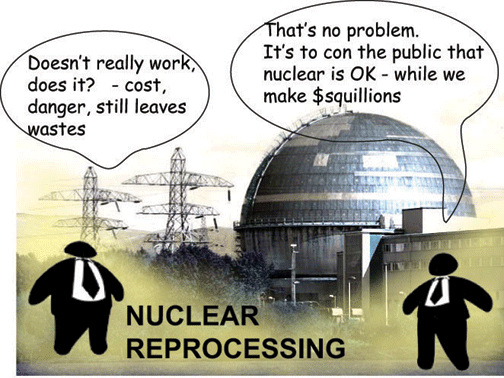
One indication of further possible delays: On September 28, 2023, Naohiro Masuda, president of JNFL, stated that the safety review of the reprocessing plant by Japan’s Nuclear Regulation Authority will be difficult to complete by the end of 2023. He nevertheless insisted that the company could still meet completion target date in 2024.
Here is a partial history of past key developments that make completion in 2024 seem unlikely:
1993: Construction starts.
1997: Initial target for completion.
2006-2008: Hot tests conducted, revealing technical problems with the vitrification process for dealing with waste produced during reprocessing.
2011: Fukushima Dai-ichi nuclear plant accident.
2012: New safety regulation standards introduced.
2022: Completion target date postponed to June 2024)
The 2022 postponement was the 26th of the Rokkasho project.
Why so many postponements? There seem to be at least five underlying reasons for the postponements for the Rokkasho plant. First, JNFL lacks relevant expertise to manage such a technologically complex and hazardous project, which is owned by nine nuclear utilities plus all other major companies associated with nuclear power in Japan. Most of the firm’s senior executives are from shareholding companies (especially utility companies) and are not necessarily experts in the field of reprocessing spent nuclear fuel.
Second, the technologies in the plant came from different companies and institutions. The management of the project is therefore technically complex.
Third, the post-Fukushima-accident nuclear facility safety licensing review process is much more stringent than what existed before the accident. For example, the Nuclear Regulation Authority told JNFL at their November 25, 2023 meeting: “JNFL should immediately make improvements because it is clear that JNFL does not understand the contents of the permit well enough to confirm the adequacy of the design of the facilities on site and has not visited the site.”
Fourth, the financial costs to JNFL of postponement are covered by the utilities’ customers, because the utilities must pay a “reprocessing fee” every year, based on the spent fuel generated during that year, whether or not the reprocessing plant operates. The system by which the Nuclear Reprocessing Organization of Japan decides the reprocessing fee is not transparent.
Fifth, the project lacks independent oversight. Even though JNFL’s estimate of the cost of building and operating the Rokkasho plant has increased several-fold, no independent analysis has been done by a third party. One reason is that some of the shareholders are themselves contractors working on the plant and have no incentive to scrutinize the reasons for the cost increases or the indefinite extension of the construction project.
After so many postponements, there is reason to wonder whether the plant will ever operate, but the government and utilities continue to insist that the plant will open soon. Even if Rokkasho were to operate, it may suffer from the same kinds of problems that marked Britain’s light-water reactor spent fuel reprocessing experience, as described in Endless Trouble: Britain’s Thermal Oxide Reprocessing Plant (THORP).
Why does Japan’s commitment to reprocessing continue?
Despite the serious and longstanding problems the Rokkasho plant has faced (and continues to face), Japanese regulators and nuclear operators have doggedly pursued the project. There are four reasons:
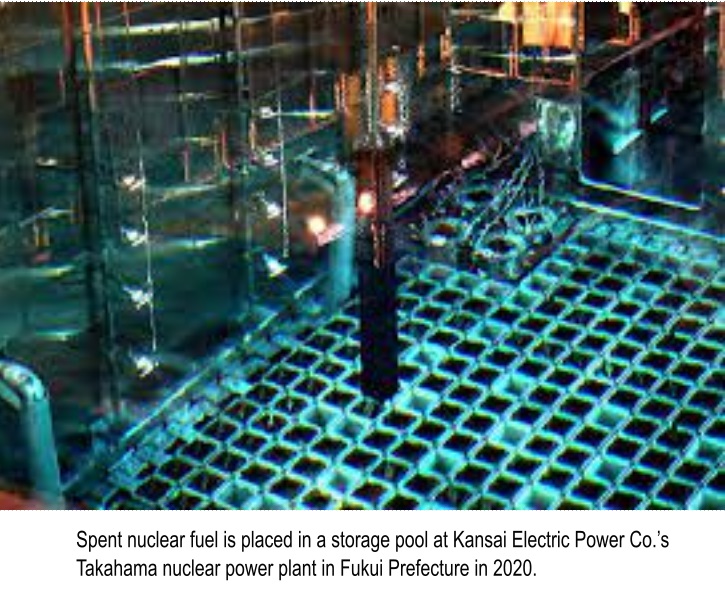
Spent fuel management. Currently, most of Japan’s spent nuclear fuel is stored in nuclear power plant cooling pools. But the pool capacities are limited, and the 3,000-ton-capacity Rokkasho spent fuel pool is also almost full. The nuclear utilities must therefore start operating the Rokkasho plant unless they can create additional spent fuel storage capacity, either on- or off-site. The Mutsu spent fuel storage facility is a candidate for additional capacity, but due to the concern that spent fuel could stay there forever, Mutsu city refuses to accept spent fuel unless the Rokkasho reprocessing plant begins to operate. The Rokkasho plant design capacity is 800 tons of spent fuel per year.
Legal and institutional commitments. Under Japan’s nuclear regulations, utilities must specify a “final disposal method” for spent fuel. The law on regulation of nuclear materials and nuclear reactors states that “when applying for reactor licensing, operators must specify the final disposal method of spent fuel” (Article 23.2.8). In addition, there was a clause that “disposal method” should be consistent with implementation of the government policy, which specified reprocessing as the disposal method. Although that clause was deleted in the 2012 revision of the law after the Fukushima accident, the Law on Final Disposal of High-Level Radioactive Waste still bans direct disposal of spent fuel. In addition, the 2016 Law on Reprocessing Fees legally requires utilities to submit reprocessing fees for all spent fuel generated every year since they stated in their applications that “final disposal method” for their spent fuel would be reprocessing.
Commitments to hosting communities. The nuclear utilities committed—albeit tacitly—to the communities hosting nuclear power plants that they would remove the spent fuel to reprocessing plants, since that was the national policy. Separately, JNFL signed an agreement with Rokkasho village and Aomori prefecture that says that if the Rokkasho reprocessing plant faces “severe difficulties,” other measures will be considered—including the return of spent fuel stored at Rokkasho to the nuclear power plants.
Local governments hosting nuclear power plants were not involved in this deal, however. They could therefore just refuse to receive spent fuel from Aomori.
In fact, after the Fukushima accident, when the government was considering amending the nuclear fuel cycle policy to include a “direct disposal option” for spent fuel in a deep underground repository, the Rokkasho village parliament (at the behind the scenes suggestion by the then JNFL president, Yoshihiko Kawai), issued a strong statement asking for “maintenance of the current nuclear fuel cycle policy.”
The statement continued that, if Japan’s fuel cycle policy changed, Rokkasho would: refuse to accept further waste from the reprocessing of Japan’s spent fuel in the UK and France; require the removal of reprocessing waste and spent fuel stored in Rokkasho; no longer accept spent fuel; and seek compensation for the damages caused by the change of the policy.
Institutional and bureaucratic inertia. In Japan, bureaucrats rotate to new positions every two or three years and are reluctant to take the risk of changing existing policies. They therefore tend to stick with past commitments. Institutional inertia becomes stronger as a project becomes bigger. The Rokkasho reprocessing project is one of the largest projects ever in Japan. Changing the project is therefore very difficult.
Will Japan’s new plutonium capping policy have any real impact? In 2018, Japan’s Atomic Energy Commission announced a new policy on “Basic Principles on Utilization of Plutonium” (see also this post). Under the new policy, the commission proposed that Japan would reduce its stockpile of separated plutonium, starting with a commitment not to increase it, and that reprocessing would take place only when a credible plan to use the separated plutonium existed.
The policy seeks to at least begin to deal with the huge stocks of plutonium Japan has amassed, both in European separation facilities (some 36.7 tons) and in Japan (10.5 tons), in anticipation of using the plutonium widely to fuel nuclear reactors—which so far has not materialized. In conjunction with the new Reprocessing Fee Law, the new plutonium policy gives the government legal authority to control the pace of reprocessing.
But it is not clear how the “capping policy” will be implemented. It is not a legally binding document, and no regulation has been introduced to control reprocessing. Utilities must submit specific plans for plutonium use to the Atomic Energy Commission for its review before reprocessing of their fuel begins. But the commission can only give advice to the government about the credibility of these plans, giving rise to questions about whether the policy will lead to sustained changes in reprocessing activity. A similar “paper rule” on plutonium has existed since 2003.
A way out. Japan could extricate itself from its reprocessing and plutonium problems in several ways. All involve significant changes in policy that would:
Find additional spent fuel storage capacity, on- or off-site. Local communities may be more willing to accept on-site dry cask storage of spent fuel if they are told that it is safer than spent fuel pool storage. For example, Saga Prefecture and Genkai-town, which host Kyushu Electric’s Genkai Nuclear Power Plant, have agreed to host dry cask storage starting in 2027. Host communities may want guarantees that spent fuel will be removed after a specified storage period. Such a guarantee could be given by the central government.
Amend the law on final disposal of high-level radioactive waste. An amendment could allow direct disposal of spent nuclear fuel in a deep underground repository. This would provide more flexibility in spent fuel management and make it easier for communities to host interim spent fuel storage.
Amend the Reprocessing Fee Law and shut down Rokkasho. An amendment to the law on reprocessing fees could allow the government to use reprocessing funds to implement a shutdown of the Rokkasho reprocessing plant. Such a plan could include payment of the debt JNFL has incurred while pursuing the Rokkasho project and funds for dry cask interim storage. This would enable the government to finally end the problem-plagued Rokkasho reprocessing plant project.
Buried secrets, plutonium poisoned bodies

Why did a Truchas woman die with extraordinary amounts of plutonium in her body — and why was she illegally autopsied? For this reporter, the answers hit close to home.
Searchlight, by Alicia Inez Guzmán, December 20, 2023
The first reference to her comes, of all places, on an airplane. It’s the end of April and sitting next to me is Jay Coghlan, the executive director of Nuclear Watch New Mexico. Both of us are on our way back to Santa Fe from Washington, D.C., after the Alliance for Nuclear Accountability’s weeklong annual gathering. Coghlan, galvanized by the last several days of activities, spends most of the flight ticking down his list of Los Alamos National Laboratory’s most recent sins. But suddenly he turns to the past.
“Did you know that the person with the highest levels of plutonium in her body after the atomic detonation at Trinity Site was a woman from Truchas?” he asks me. The remark, more hearsay than fact, piques my interest. As Coghlan knows, that’s my pueblito, the place in northern New Mexico where I grew up on land passed down through many generations of women. Tina Cordova — co-founder of the Tularosa Basin Downwinders Consortium — would know more, he adds. “Ask her.”
Truchas, short for Nuestra Señora del Rosario, San Fernando y Santiago del Río de las Truchas, sits on a ridge in the Sangre de Cristo mountains, 8,000 feet above sea level. With some 370 people in town, most everybody keeps up with the latest mitote, or gossip, at the local post office. A regional variation of Spanish is still spoken by elders. Bloodlines go back centuries. And neighbors might also be relatives. If she is from this tiny, but remarkable, speck on the map, I must at least know of her. My mom, a deft weaver of family trees, definitely would.
Truchas is also 225 miles north of the Trinity Site, the location of the world’s first atomic blast. On July 16, 1945, at the peak of monsoon season, a clandestine group of scientists lit up the skies of the Chihuahuan Desert with the equivalent of 24.8 kilotons of TNT. In the first 10 days, wind would carry the radioactive fallout across 46 states — so far, in fact, that the Eastman Kodak Company in Rochester, New York, traced spots on film to radioactive material released by the bomb.
It’s plausible, given such an expansive reach, that this Trucheña who Coghlan casually mentions is among a wave of Trinity’s first unknowing victims. Historically, she signals a profound rupture in time — before nuclear weapons and after. But at the moment, his comment seems impossible to grasp. It’s only in hindsight that the single most important question takes form, one that will dog me for more than six months: Who is she?
Incomprehensible autopsies
Just over a month later, I hear about her for the second time, at a journalism conference…………………………………………………. this time adding the original source of the information: the Los Alamos Historical Document Retrieval and Assessment project, known as the LAHDRA report.
Published in 2010 by the Centers for Disease Control and Prevention — and based on millions of classified and unclassified documents from the earliest years of the Manhattan Project to the late 1990s — the report’s stated purpose was to identify “all available information” concerning radioactive materials and chemicals released at Los Alamos National Laboratory (known as the Los Alamos Scientific Library from 1947 to 1981).
Some of the documents are autopsy records, I come to find. The lab routinely released plutonium into the air from several facilities on its campus, but it wasn’t until 1978 that it began to measure those releases consistently. One question that preoccupied researchers was whether data culled from the autopsies would reveal higher rates of plutonium in people who lived near or worked in those nuclear facilities.
There is another cache of autopsies, too, for the scientific equivalent of a control group — randomly selected people who simply lived and died in northern New Mexico. Cases from the control group were also analyzed, the report added, “in an effort to review the possible plutonium exposure from the July 16, 1945 Trinity test.”
I quickly scroll down to see which person in this group had the highest plutonium levels. And there it is: The highest levels do indeed belong to an unnamed woman from Truchas, alive at the time of the Trinity detonation.
But what comes next in the report will preoccupy me for months: “The plutonium concentration in her liver was 60 times higher than that of the average New Mexico resident.”
The number is incomprehensible to me. First, the actual amount is never stated, nor is the amount for the average New Mexican. But there is also a glaring contradiction that I detect only after reading the paragraph’s final cryptic line many times over. Fallout from Trinity, it essentially explains, didn’t cascade over Truchas until 12 hours after the initial blast. At that distance, there was no telling whether fallout could be inhaled or ingested — the most direct and harmful paths of entry.
It’s a paradox. Trinity stood out as the most obvious culprit — she was, after all, alive when it was detonated — but even the researchers weren’t certain. The only fact is the plutonium itself. Somewhere, somehow it entered her body in the form of barely visible specks of alpha radiation. And once there, those particles began a long migration, from her bloodstream to her kidneys and, ultimately, to her liver. The question is how?
The entry is most striking for its brevity, no more than a paragraph amid the report’s 638 pages. Partly, this has to do with the expansive scope of the LAHDRA project, which covers far more than these autopsies, and partly because of the secrecy and laws that protect personal privacy.
Through the prism of science, this Trucheña is a single, mysterious data point. From this same prism, the unwritten parts of her life look like negative space. But when I imagine who she is, I also imagine what would fill that space — all the parts of her story that must exist but have been left out.
For now, I don’t even know her name.
Exotic poison
In an interview with the Atomic Heritage Foundation in 1965, chemist Glenn Seaborg described plutonium as “one of the most exotic metals in the periodic table — maybe the most.” Seaborg had created plutonium out of uranium in 1940 and still, 25 years later, at least some of its properties were anomalous.
How plutonium poisoned the body was also largely unknown. The survivors in Nagasaki, Japan, where U.S. forces dropped a plutonium bomb on August 9, 1945, began to see increased rates of leukemia in the years immediately following the blast, most notably among children. Twelve years later, tumor registries were founded to track the cancer incidences in both Nagasaki and Hiroshima, where the United States detonated “Little Boy,” a uranium bomb, on Aug. 6, 1945.
But in Los Alamos, there were only three instances of acute radiation poisoning — Harry Daghlian in 1945, Louis Slotin, in 1946, and Cecil Kelley, in 1958. Daghlian and Slotin both received a fatal blast of radiation while handling the same core of plutonium, the “demon core” as it was later dubbed. Daghlian died 25 days after the accident; Slotin survived for only nine. Kelley died within 35 hours of performing an operation to purify and concentrate plutonium in a large mixing tank. As the tank swirled, the plutonium inside it assumed the right shape and size to produce a brief nuclear chain reaction. The injuries the men suffered were ghastly.
Besides those were the less dramatic cases: Nuclear workers who were routinely exposed to much smaller amounts of plutonium on the job, and citizens exposed through atmospheric testing, which began in Nevada in 1951 and didn’t end in America until 1963. By the time of Kelley’s death, data on those other groups had yet to be collected, much less analyzed.
When I email Joseph Shonka, the primary author of the LAHDRA report, I get my first insights about the Human Tissue Analysis Program, a landmark project that gathered data about how plutonium exposure affected people’s health long-term.
“During the concerns about global fallout in the late 1950s and 1960s, the Atomic Energy Commission conducted a research program to measure the levels of plutonium in US residents,” he replied by email in August. The research was based on “plutonium workers who voluntarily agreed to contribute their bodies to research, as well as appropriately obtained tissues from autopsies from nearby residents of AEC facilities and from random individuals across the US, including New Mexico.”
I can’t help but obsess over two words: “appropriately obtained.” History tells of doctors performing grisly acts in the name of science, but that was before the dawn of biomedical ethics. I’d assumed that those ethics had become self-evident in modern-day autopsy practices and that tissues were always “appropriately obtained.” That’s not the case here, I realize after an Internet search. How the tissues for this research program were obtained was, in fact, deeply controversial, if not unlawful.
Autopsy authority from ‘God’
In 1996, Cecil Kelley’s wife and daughter filed a class-action lawsuit against the Regents of the University of California, the school that had managed the lab since 1943, and 10 other defendants, including former lab director Norris E. Bradbury. The autopsies, unlawful and fraudulent, were conducted on both lab employees and the general public “without the knowledge, informed consent, or permission of the families involved,” the complaint asserted. What occurred, it went on, was the “unauthorized and illegal research and experimentation” on the corpses of hundreds of New Mexico residents and others around the country. And plaintiffs only became aware of it, “to their extreme shock and horror,” many decades after the fact. In the press, it was known as the case of the “body snatchers.”
The human tissue program began on Jan. 1, 1959, a day after Cecil Kelley’s horrific death. Clarence Lushbaugh, who worked for the lab and was also the pathologist and chief of staff at Los Alamos Medical Center, had long been waiting for “an employee with known exposure to radioactive substances to die so that the body could be autopsied and the radioactivity of the lungs could be counted,” legal filings said. “Mr. Kelley’s accident and subsequent death provided Defendant Lushbaugh with the opportunity he’d been waiting for.”
By the program’s end in 1985, 271 lab workers and 1,825 members of the general population, from New Mexico and across the country, had been secretly autopsied and their organs sent to the lab to be studied for plutonium content. Besides the obvious transgressions, the project had a number of other yawning flaws, including 489 tissue samples that were lost when a freezer failed.
Participating pathologists, first at Los Alamos Medical Center, the program’s unofficial headquarters in New Mexico, and then in other cities, ostensibly performed the autopsies to determine a person’s cause of death. But that was just a cover for the real motive, which was to entirely remove and analyze lungs, kidneys, spleen, vertebrae, lymph nodes and, in men, gonads, the class action asserted.
The pathologists “exercised a clause in their autopsy permit form that allowed collection of tissues for ‘scientific research,’ a U.S. General Accounting Office report later said. “As a result, Los Alamos officials did not feel it was necessary to obtain their own informed consent documentation.” Families, in other words, were never asked for permission.
Among the records, I read about Kelley’s particularly ghoulish autopsy; Lushbaugh stored his entire nervous system in a mayonnaise jar and sent his brain to Washington, D.C., for study. When asked in his deposition who granted him the authority to do so, Lushbaugh said “God.”
Clues without names
A kind of armor protects the lab’s nuclear secrets. For that reason alone, I have little faith that I will be able to identify her — the anonymous Trucheña with 60 times more plutonium in her body than any other New Mexican autopsied in this hair-raising study. But I keep looking. Maybe it’s that I believe finding her can reaffirm, in some small measure, her humanity. All I know is that I need a tangible public record. And the class-action lawsuit is the best and only place to start.
……………………………………………………………………………………………. volume 37 of “Health Physics,” a medical journal devoted to radiation safety. Published in 1979, it contains the biggest lead yet — a list of the Human Tissue Analysis Program’s decedents in New Mexico and across the country, all unnamed.
Each entry reads like a bullet point: Case number, occupation, residence, state and cause of death. A separate column includes sex, age, years of living in Los Alamos — if they did live there — and year of death. The columns reveal, in clinical and unnerving detail, each organ by weight and radioactivity, if any.
Here, there is no whole greater than the sum of its parts. In fact, it’s the parts that so preoccupied researchers — line after line of organs measured down to the gram, and line after line of radioactivity measured down to disintegrations per minute. But the story I glean is more complicated than these facts and figures alone. It’s about the scientific desire to reduce people into mere objects of study and the violence of that reduction.
…………………………………………………………………………..“Epifania S. Trujillo, a lifelong resident of Truchas died at the age of 91, September 26, in the Los Alamos Medical Center following a long illness,” reads the October 1972 obituary in the Rio Grande Sun. “She is survived by two daughters, Mrs. Cosme Romero of Truchas and Mrs. Glenn Manges of Gallup; a sister Veronice Padilla of Truchas, 25 grandchildren and 35 great-grandchildren.”
…………………………………………….I tell them (descendants of Epifania Trujillo), she had by far the most plutonium in her body of any other New Mexico resident who was autopsied as part of that macabre program.
…………………It might explain, she (Cecilia Romero, granddaughter) continues, “why so many in the family have gotten cancer.” She begins to run down the list.
“My oldest brother, Sam, died of multiple myeloma. Susie had pancreatic cancer. My mom died of pancreatic cancer. Nora got pancreatic cancer, which is metastatic, so she now suffers from lung cancer. Mary Helen and I have both had breast cancer. And Henry had prostate cancer.” Only one sibling, Bernice, was spared. (Cecilia and Nora said they had genetic testing for both pancreatic and breast cancer risk that showed those cancers were not hereditary.)
I’m shocked. The only time I’ve heard of such a pervasive history of cancer is in conversations with Tina Cordova, Bernice Gutierrez and Mary Martinez White, all members of the Tularosa Basin Downwinders Consortium, who lived within 50 miles of the Trinity Site, where the world’s first atomic bomb was detonated. But this is different. Truchas is 225 miles from Trinity. How did a woman living at that distance end up with such an extraordinary amount of plutonium in her liver?
As I keep talking to the two sisters, I realize the answer might lie closer to home — Los Alamos.
Cosme (Cecilia’s father) was the only one in the family who worked at the lab. That he could have unwittingly carried home undetectable radioactive particles on his clothing and boots and trigger illness throughout the family had long flickered in the Romeros’ minds. But they never could have guessed that Epifania might be the bellwether. She lived to the age of 91 — no small feat — and did not suffer from cancer herself. But over the long arc of time, almost everyone around her did.
…………………………………………………. Cosme worked at Technical Area 8, a “hot site.”
Rare photos from TA-8
Technical Area 8, also known as Gun Site, was named after the gun-type design used in Little Boy, the bomb dropped on Hiroshima. The War Department built the facility off of Los Alamos’s West Jemez Road, complete with three “bombproof” concrete buildings and a firing range for scientists to study projectiles and ballistics. Research there involved “high explosives, plutonium, uranium, arsenic, lithium hydride, and titanium oxide,” as one lab document read.
……………………………………………………… What, precisely, did Cosme do at the lab? And could he have brought home the plutonium that affected Epifania?
……………………….Safety measures at LANL have changed since Cosme’s time and today include shielding, protective clothing, air sampling, radiation safety evaluations and other precautions, all aimed at safeguarding workers, the environment and the community, according to LANL spokespeople.
………. The Nuclear Regulatory Commission itself has recorded instances of radioactive “take-home toxins.” How many times might workers have taken toxins home and never known?
“I’ve visited hundreds of nuclear workers’ homes over the years, possibly thousands,” says Marco Kaltofen, a specialist in nuclear forensics at Worcester Polytechnic Institute in Massachusetts, who wrote a 2018 report on nuclear workers’ house dust.
…………………………………….. The kind of plutonium used to make nuclear weapons, plutonium 239, has a 24,000-year radioactive half-life. With that lifespan, the particles could still be present today in a forgotten corner of an attic, cellar or basement, Kaltofen says. Radioactive dust is not only a “potential source of internal radiation exposure to nuclear site workers,” his report warned: It could also expose their families “via secondary contamination.”
Plutonium and cancer
Health studies have shown that residents downwind of the Hanford Nuclear Site in Washington state, where plutonium was first produced at full-scale, have high incidences of all cancers, including uterine, ovarian, cervical and breast.
There is also evidence suggesting that exposure to ionizing radiation, which includes alpha particles emitted by plutonium, is linked to an increase in pancreatic cancer. Additional research at LANL — the unpublished Zia Study — posits that increased radiation exposure among male employees between 1946 and 1978 led to increased rates of pancreatic cancer deaths. Any cumulative exposure to low doses of radiation is associated with higher risks of death by cancer, recent research shows.
………………………………………..It’s almost too easy to think of all the ways the Romero children, and the cousins who occasionally lived with them, could have come into contact with radioactive dust, and how their bodies, still growing, could have been poisoned.
The last clue
…………………………………………………………………………. Seeing her name among the court records is definite proof — Epifania was unlawfully autopsied as part of the Human Tissue Analysis Program.
……………………………………Indeed, it’s not until over a decade after the suit was settled that the Romeros get all the wrenching news at once: Their father might have brought home toxic plutonium on his work clothes; their grandmother was unlawfully autopsied; the family was left out of the settlement altogether; and Los Alamos had a hand in all of it. Epifania, emblematic of so much, fell through the cracks in every way possible…………………………………………………………………………………………………………………………………………………
Alicia Inez Guzmán
Raised in the northern New Mexican village of Truchas, Alicia Inez Guzmán has written about histories of place, identity, and land use in New Mexico. She brings this knowledge to her current role at Searchlight. https://searchlightnm.org/buried-secrets-poisoned-bodies/?utm_source=Searchlight+New+Mexico&utm_campaign=c42014a33e-12%2F20%2F2023+-+Buried+secrets%2C+poisoned+bodies&utm_medium=email&utm_term=0_8e05fb0467-c42014a33e-395610620&mc_cid=c42014a33e&mc_eid=a70296a261
As the world starts to panic over climate change, nuclear evangelists offer spurious solutions


I too wish that the things that the nuclear industry says about itself were true—I wish it was green and renewable. I wish that there weren’t multiple uranium mining sites around the world with thousands of tons of uranium tailings abandoned and open to the elements, continuing to harm the health of generations born long after mining ceased.
I wish that it didn’t take immense, carbon-intensive mining projects to extract uranium from the Earth, and then again to “deposit” the spent nuclear fuel from reactors back half a kilometer underground.
Nuclear Stockholm Syndrome, https://www.counterpunch.org/2021/07/09/nuclear-stockholm-syndrome/
BY ROBERT JACOBS 9 July 21, Bhaskar Sunkara’s recent opinion piece extoling the virtues of nuclear power and castigating its opponents as paranoid and ill-informed, is clearly motivated by his deep concerns over the dire impacts of global warming, which loom closer by the hour. Unfortunately, his arguments amount to little more than regurgitated industry talking points, in their traditional form of a Jeremiad.
First, Sunkara poses the decline of the nuclear industry in the West as an achievement of progressive political movements. Specifically, he cites the decline of nuclear power in Germany as attributable to a “Green party-spearheaded campaign.” This decline has been more reasonably ascribed to both market conditions and missteps by nuclear industry giants such as Westinghouse and AREVA. From its inception, nuclear power has been heavily dependent on government subsidies to appear economically viable (subsidies such as insurance and the disposal of waste largely configured as taxpayer burdens).
Rather than succumbing to its political opponents on the left, the industry has been sunk by its structural economic dysfunctions. In the US, this has sparked schemes to secure additional taxpayer subsidies in legislative fixes such as guaranteed returns for nuclear utilities, and outright bribery of legislators for taxpayer bailouts of failing companies.
The most simplistic recitation of nuclear industry talking points is when Sunkara dismisses concerns about nuclear waste, and extolls the mythic separation between “civilian” and “military” nuclear technologies. He asserts that most nuclear waste “can be recycled to generate more electricity,” an assertion that goes back more than half a century and has been ritualistically recited by an army of nuclear industry PR professionals before him…yet here we are 50 years later and very little spent nuclear fuel has actually been recycled. The most successful nuclear recycling nation is France which, nevertheless, is experiencing a “nuclear exit” and is unlikely to ever use this recycled fuel. AREVA, the French nuclear giant, has gone bankrupt. Reprocessing facilities like the Rokkasho plant here in Japan have never functioned properly, unless you consider their role enabling the stockpiling of plutonium by Japan to hedge against future weapon needs to be an elemental goal.
There is a difference between what can be done, and what actually happens. Rather than being recycled, hundreds of thousands of metric tons of spent nuclear fuel await “final disposal” in deep geological repositories. Some have been waiting for over 70 years. Just last week, a panel advising the EU on categorizing nuclear plant as “green” energy, and thus eligible to receive EU funding as a “sustainable investment,” concluded that the problems of nuclear waste preclude that designation.
I would point out that even though plastics manufacturers assure us that most plastic can be recycled, we still seem to be living a world with ever increasing amounts of plastic waste. Their greenwashing has not eventuated in a world full of plastics made from recycled materials. The market reality is that it is cheaper to manufacture new plastic than it is to manufacture plastic from recycled materials. Similarly, it is cheaper to discard spent nuclear fuel than it is to reprocess it.
Sunkara dismisses the irrevocable link between military and civilian nuclear technologies as imaginary. First, let’s consider the present imbrication. A 2019 Atlantic Council study places the value of the US civilian nuclear complex to the US national security apparatus at $26 billion annually simply in terms of the human capital assets: “In terms of nuclear technology innovation, export capacity, and geopolitics, a vibrant civilian nuclear energy sector is a critically important national security asset.”
However, the civilian operation of nuclear power plants also places future generations at military risk. I have written that, historically, nuclear reactors were “born violent.” That is to say, they were invented by the Manhattan Project in the early 1940s to manufacture plutonium for use in nuclear weapons, and were instrumental in killing almost 100,000 people in 1945. The “first” American commercial atomic plant in Shippingport, PA that went critical in 1958, was actually the 14th industrial nuclear reactor built in the United States, the other 13 only manufactured plutonium, which by then formed the fissile cores of thousands of nuclear weapons.
In nuclear reactors used to make electricity, this plutonium is not separated out for use in weapons. However, all nuclear power plants remain plutonium production factories. The fact that most of those tons of plutonium remain in the spent fuel rods does not mean they will stay there forever. Thousands of years from now, some government or military may dig up the spent fuel in our deep geological repositories and separate that plutonium out to build nuclear weaponry. All it would take is the technology (technology we currently possess) and the will. We continue to manufacture that plutonium—perhaps for them to weaponize. Every nuclear power plant that operates adds to that inventory; more than 99% of existing plutonium was manufactured in nuclear reactors. In 1962, the US successfully detonated a nuclear weapon assembled with just such “reactor-grade” plutonium. Our generation’s use of nuclear power silently stockpiles fissile material that will remain militarily viable for millennia.
I too wish that the things that the nuclear industry says about itself were true—I wish it was green and renewable. I wish that there weren’t multiple uranium mining sites around the world with thousands of tons of uranium tailings abandoned and open to the elements, continuing to harm the health of generations born long after mining ceased. I wish that it didn’t take immense, carbon-intensive mining projects to extract uranium from the Earth, and then again to “deposit” the spent nuclear fuel from reactors back half a kilometer underground. Estimates before construction began at Onkalo spent fuel repository in Finland were that the site would entail a “half-billion-euro construction project will generate some 2,500 person years of employment,” and would take 100 years to complete. That is just to contain the spent fuel from five nuclear power plants. The United States, by contrast, has 94 commercial nuclear power plants. There is still no actual plan for the astonishingly large and carbon-intensive site it will take to bury the more than 140,000 metric tons of spent nuclear fuel, with some hope of containing it for thousands of generations of future human beings. This doesn’t include the thousands of tons of spent nuclear fuel from the nuclear reactors operated by the US military to provide the fissile cores of more than 70,000 nuclear weapons during the Cold War.
The panic-inducing impacts of anthropic climate change spark a desperate need for immediate reassurance and calming: we want to fix it now. We long to turn some corner that will change the situation. It is unlikely that the same short-sighted military-industrial technophilia that brought us to this climate crisis will flip over and provide us the urgent path to its resolution. Technological evangelists have been auditioning for the part of Climate Change Savior to anyone who will listen. Some proffer a Reagan-era Star Wars pitch: they will fill the skies with material to block the enemy (in this case sunlight rather than Soviet ICBMs). These geoengineering quick-fix schemes are more likely to cause unplanned outcomes than to achieve their missions.
At one time nuclear weapon producers imagined they too could geoengineer the planet to shape it to human desires. They tested the use of nuclear weapons to sculpt harbors into coastlines, and to release natural gas trapped in rock formations. These experiments led to some of the most significant radiological distributions and contaminated sites in the wide panoply of nuclear testing. Still, hyper-capitalist techno utopians like Elon Musk envision the key to human habitation on Mars is the detonation of a massive arsenals of thermonuclear weapons to shape it to our needs.
The nuclear industry will ignore its market dilemmas as long as taxpayers continue to backstop its investors. However, to believe that this massive, for-profit, military-based industry has concern for the welfare of the Earth and its inhabitants is akin to believing the plastic industry is actually beavering away to make the plastic waste disappear. Repackaging their talking points out of a genuine concern for living creatures is a resource they will continue to tap so long as it flows freely. Sunkara would do better to advocate for the mass social movements that have shifted giant industries towards social welfare in the past rather than preaching that the industries themselves are saviors. Time is obviously short, wrong turns are catastrophic.
Robert (Bo) Jacobs is a historian at the Hiroshima Peace Institute and Graduate School of Peace Studies at Hiroshima City University. He has written and edited multiple books and articles on nuclear history and culture including, The Dragon’s Tail: Americans Face the Atomic Age, and Filling the Hole in the Nuclear Future: Art and Popular Culture Respond to the Bomb. He is a founder and a principal researcher of the Global Hibakusha Project, studying radiation exposed communities around the world. His book, Nuclear Bodies: The Global Hibakusha, will be published by Yale University Press in 2022. His Global Hibakusha blog can be found here.
Behind the Scenes at a U.S. Factory Building New Nuclear Bombs

The workers who make pits face these risks every day
The U.S. is ramping up construction of new “plutonium pits” for nuclear weapons
Scientific American, BY SARAH SCOLES 1 Dec 23 [excellent illustrations]
This article is part of “The New Nuclear Age,” a special report on a $1.5-trillion effort to remake the American nuclear arsenal.
Within every American nuclear weapon sits a bowling-ball-size sphere of the strangest element on the planet. This sphere, called a plutonium pit, is the bomb’s central core. It’s surrounded by conventional explosives. When those explosives blow, the plutonium is compressed, and its atoms begin to split, releasing radiation and heating the material around it. The reaction ignites the sequence of events that makes nuclear weapons nuclear.
In early nuclear bombs, like the ones the U.S. dropped on Japan in World War II, the fission of plutonium or uranium and the fatal energy released were the end of the story. In modern weapons, plutonium fission ignites a second, more powerful stage in which hydrogen atoms undergo nuclear fusion, releasing even more energy. The U.S. hasn’t made these pits in a significant way since the late 1980s.
But that is changing. The country is modernizing its nuclear arsenal, making upgrades to old weapons and building new ones. The effort includes updated missiles, a new weapon design, alterations to existing designs and new pits. To accomplish the last item, the National Nuclear Security Administration has enacted a controversial plan to produce 50 new pits a year at the Savannah River Site in South Carolina and 30 pits a year at Los Alamos National Laboratory in New Mexico, the birthplace of the bomb. The first pits will be designed for a weapon called W87-1, which will tip the new intercontinental ballistic missile, called Sentinel. After that the complex will produce pits for other bomb designs.
Not everyone believes this work is necessary. Pit production foments controversy because it’s costly and potentially risky and because the existing pits might still work for a while. The physics of plutonium is complex, and no one knows when the original pits will expire. The details of how the pits are made and how they work are among America’s most closely guarded secrets. Yet in June 2023 Los Alamos officials invited a group of journalists to tour the facility for the first time in years.
We were there as the lab and the broader National Nuclear Security Administration Complex were embarking on a charm offensive to support the new plutonium work. They have to win over the tax-paying public and recruit some 2,500 new employees for the job. Some of those workers must do high-hazard work that requires expertise the country has largely let slip since the last days of the cold war. ………………………………………………………………………………………………………………..
…………………..The plutonium used for weapons exists only because people made it.
……………………………………………….. …….Plutonium’s genesis was repeated in reactors for decades. In fact, scientists made so much that no new plutonium is required for the new pits at Savannah River and Los Alamos—the current supply can be repurposed, reshaped, reborn.
None of those actions, though, will be simple because plutonium is not simple……………………………………………………………………………………….. Its most famous trick, of course, is its propensity for radioactive decay, through which it transforms itself out of existence.
This tendency is also what makes it so dangerous. Inhaled plutonium decays in the body, releasing alpha particles (helium nuclei) that can wreak havoc. The isotope plutonium 238, used as a heat and power source but not in weapons, exhibits other strange behaviors. “If you spill it in the laboratory, it will move around on its own,” Martz says. The oomph from a plutonium atom’s decay sends it shooting across a surface. “It can get everywhere,” he adds.
Plutonium’s strangeness comes from its arrangement of electrons……………………………………………………………………………………………………………………………………………………………………..
In the excitement of these early scientific discoveries, the point of the work would sometimes get lost: it was all in the service of creating a deadly superweapon. In 1945 the U.S. dropped a uranium fission bomb on Hiroshima and then sent a plutonium bomb—essentially a pit encased in explosives—to devastate Nagasaki. The bombs killed tens of thousands of people immediately and more after the fact. As Manhattan Project physicist I. I. Rabi had feared, according to a quotation in the 2005 book American Prometheus, “the culmination of three centuries of physics” was a weapon of mass destruction.
Soon after the war, production of plutonium pits migrated to a facility outside Boulder, Colo. Called Rocky Flats, it could churn out thousands of pits a year—a level of productivity perhaps enabled by its violation of environmental regulations, which in 1989 resulted in a federal raid and then a permanent shutdown. “The public wasn’t considered at the time,” says Bob Webster, deputy director of weapons at Los Alamos. ………………………………………………………………………………………………………………………………….
How aging affects a pit is the subject of contention, but some things are certain: As the plutonium atoms in a pit decay, their products damage the crystal structure of the plutonium that remains, creating voids and defects. These decays also contaminate the pit with helium, americium, uranium and neptunium, among other things. In 50 years a kilogram of plutonium will amass around 0.2 liter of helium. As pits change, their performance and safety in any conditions—including just sitting on a shelf—become questionable.
Scientists still don’t know the lifetime of a plutonium pit. …………………………………………………….. The National Nuclear Security Administration’s own studies have suggested the pits will last at least 150 years but also that their degradation could result in surprise defects. And scientists may never know exactly what those defects do or how they would affect an explosion because the ostensible point of nuclear weapons is to never use them.
So far restarting American pit production is proving challenging. Los Alamos’s efforts are at least a year behind schedule, and Savannah River’s are more like five years delayed.
The Defense Nuclear Facilities Safety Board and other critics have claimed that PF-4 isn’t resilient enough against the kind of earthquake geologists now know could occur in Los Alamos. Such significant shaking and the fires it could cause, the board alleged at a hearing last year, could result in plutonium contamination that reaches the public.
……………………… Other safety concerns have come up recently, though. In May the National Nuclear Security Administration released an investigation about four 2021 incidents: one criticality safety violation, one breach that resulted in skin contamination for three workers, and two flooding events that sent water toward fissionable materials. The agency determined that the contractor that manages Los Alamos had violated safety, procedural, management and quality-assurance rules.
………………………………………………………………………………………….. On the tour, we are forbidden from setting our notebooks down lest potential contamination stick to them. Should we drop them, a radiological control technician—who has been following us the whole time and scans our hands and feet for radioactivity anytime we leave a room—would measure each page before returning them.
…………………… In some rooms, radioactive waste is packaged and waiting to go to a storage facility, with the dosage one might receive from standing near it written on the ground. We are never allowed to forget that this is a dangerous place.
The workers who make pits face these risks every day………………………………………………………………………………
All of this effort and investment is being made in the hopes that the pits never serve their active purpose. The U.S., like all nuclear nations, stockpiles weapons in a delicate game of deterrence, the idea being that the existence of our equally or more capable weapons will stop others from using theirs. In this strategy, the pits’ true purpose is to sit idly as a threat. But for the strategy to work, the country must be willing to follow through on that threat.
……………………………………. The fear people feel when confronted with plutonium has degraded over time. But the atomic age is renewing, and we will all have to grapple afresh with the coiled terror of these powerful weapons. https://www.scientificamerican.com/article/behind-the-scenes-at-a-u-s-factory-building-new-nuclear-bombs/
Chess, cards and catnaps in the heart of America’s nuclear weapons complex
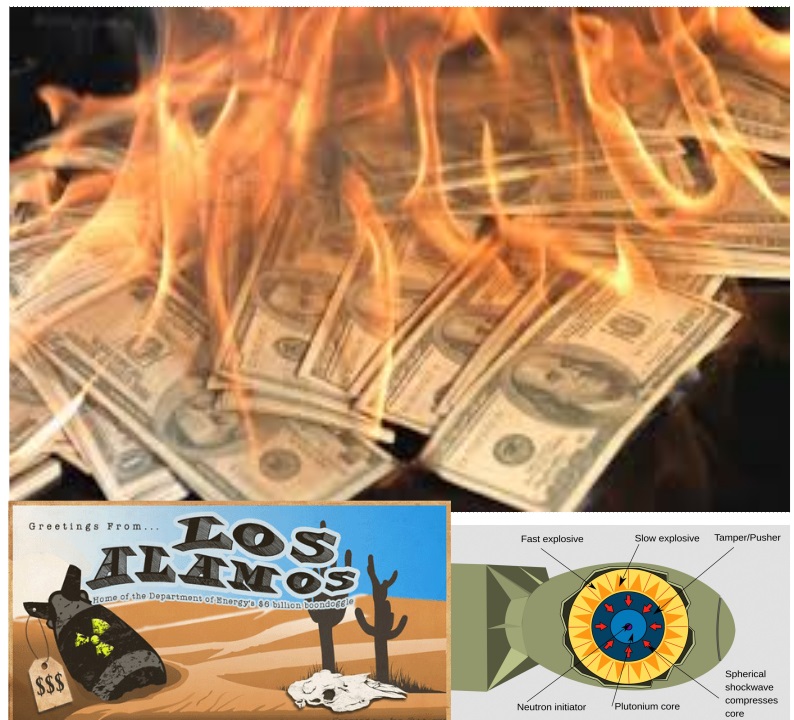
At Los Alamos National Laboratory, workers collect full salaries for doing nothing
Across those decades, the notion of keeping secrets from adversaries has simultaneously morphed into keeping secrets from the American public — and regulators.
| by Alicia Inez Guzmán. Searchlight New Mexico, 8 Nov 23 |
| A few days after beginning a new post at Los Alamos National Laboratory, Jason Archuleta committed a subversive act: He began to keep a journal. Writing in a tiny spiral notebook, he described how he and his fellow electricians were consigned to a dimly lit break room in the heart of the weapons complex. “Did nothing all day today over 10 hrs in here,” a July 31 entry read. “This is no good for one’s mental wellbeing or physical being.” |
“I do hope to play another good game of chess,” noted another entry, the following day.
A journeyman electrician and proud member of the International Brotherhood of Electrical Workers Local 611, Archuleta had been assigned to Technical Area 55 back in July. He had resisted the assignment, knowing that it was the location of “the plant,” a sealed fortress where plutonium is hewn into pits — cores no bigger than a grapefruit that set off the cascade of reactions inside a nuclear bomb. The design harks back to the world’s first atomic weapons: “Gadget,” detonated at the Trinity Test Site in New Mexico in 1945, and “Fat Man,” dropped on Nagasaki shortly afterward.
It has been almost that long since LANL produced plutonium pits at the scale currently underway as part of the federal government’s mission to modernize its aging stockpile. The lab, now amidst tremendous growth and abuzz with activity, is pursuing that mission with single-minded intensity. Construction is visible in nearly every corner of the campus, while traffic is bumper to bumper, morning and evening, as commuters shuttle up and down a treacherous road that cuts across the vast Rio Grande Valley into the remote Pajarito Plateau on the way to the famous site of the Manhattan Project.
But from the inside, Archuleta tells a different story: that of a jobsite in which productivity has come to a standstill. With few exceptions, he says, electricians are idle. They nap, study the electrical code book, play chess, dominoes and cards. On rare occasions, they work, but as four other journeymen (who all requested anonymity for fear of retaliation) confirmed, the scenario they describe is consistent. At any given time, up to two dozen electricians are cooling their heels in at least three different break rooms. LANL officials even have an expression for it: “seat time.”
The lab recognizes that the expansion at TA-55, and especially the plant, presents challenges faced by no other industrial setting in the nation. The risk of radiation exposure is constant, security clearances are needed, one-of-a-kind parts must be ordered, and construction takes place as the plant strives to meet its quota. That can mean many workers sit for days, weeks, or even, according to several sources, months at a time.
“I haven’t seen months,” said Kelly Beierschmitt, LANL’s deputy director of operations, “It might feel like months,” he added, citing the complications that certain projects pose. “If there’s not a [radiation control technician] available, I’m not gonna tell the craft to go do the job without the support, right?”
Such revelations come as red flags to independent government watchdogs, who note that the project is already billions of dollars over budget and at least four years behind schedule. They say that a workplace filled with idle workers is not merely a sign that taxpayer money is being wasted; more troublingly, it indicates that the expansion is being poorly managed.
“If you have a whistleblower claiming that a dozen electricians have been sitting around playing cards for six months on a big weapons program, that would seem to me to be a ‘where there is smoke, there is fire’ moment,” said Geoff Wilson, an expert on federal defense spending at the independent watchdog Project on Government Oversight.
Given the secrecy that surrounds LANL, it is virtually impossible to quantify anything having to do with the lab. That obsession is the subject of Alex Wellerstein’s 2021 book, “Restricted Data: The History of Nuclear Secrecy in the United States.” Wellerstein, a historian of science at Stevens Institute of Technology, traces that culture of secrecy from the earliest years of the Manhattan Project into the present. Across those decades, the notion of keeping secrets from adversaries has simultaneously morphed into keeping secrets from the American public — and regulators.
“What secrecy does is it creates context for a lack of oversight,” said Wellerstein in a recent interview. “It shrinks the number of people who might even be aware of an issue and it makes it harder — even if things do come out — to audit.”
The code of secrecy at LANL is almost palpable. The lab sits astride a forbidding mesa in northern New Mexico some 7,500 feet above sea level, protected on the city’s western flank by security checkpoints. Its cardinal site, TA-55, is ringed by layers of razor wire and a squadron of armed guards, themselves bolstered by armored vehicles with mounted turrets that patrol the perimeter day and night. No one without a federal security clearance is allowed to enter or move about without an escort — even to go to the bathroom. Getting that clearance, which requires an intensive background investigation, can take up to a year.
Sources for this story, veterans and newcomers alike, said they fear losing their livelihoods if they speak publicly about anything to do with their work. Few jobs in the region, much less the state (one of the most impoverished in the nation), can compete with the salaries offered by LANL. Here, journeyman electricians can earn as much as $150,000 a year; Archuleta makes $53 per hour, almost 70 percent more than electricians working at other union sites.
Nevertheless, in late September, Archuleta lodged a complaint with the Inspector General’s office alleging time theft. He and two other workers told Searchlight New Mexico that their timesheets – typically filled out by supervisors – have shown multiple codes for jobs they didn’t recognize or perform. To his mind, the situation is “not just bordering on fraud, waste and abuse, it’s crossing the threshold.”
………………………………………………………………………………………………………………………………………“By all the normal measures our society uses to evaluate cost, benefit, risk, reliability, and longevity, this latest attempt has now already failed as well,” said Greg Mello of the Los Alamos Study Group (LASG), a respected nonprofit that has been monitoring LANL for 34 years. “Federal decision makers will have to ask ‘Will the LANL product still be worth the investment,’” Mello said, referring to the plant, which will have exceeded its planned lifetime of 50 years by 2028.
The cogs of this arms race have been turning for years. In May 2018, a few months after President Donald Trump tweeted that he had a much “bigger & more powerful” nuclear button than North Korea’s Kim Jong Un, the Nuclear Weapons Council certified a recommendation to produce plutonium pits at two sites.
That recommendation was enacted into law by Congress, which in 2020 called for an annual quota of plutonium pits — 30 at LANL and 50 at the Savannah River plutonium processing facility in South Carolina — by 2030. According to the LASG, the cost per pit at LANL is greater than Savannah River. The organization estimates that each one will run to approximately $100 million.
Whether such production goals are achievable is another question: Just getting those sites capable of meeting the quota will cost close to $50 billion—and take up to two decades from the project’s start. After that, another half a century may pass before the nation’s approximately 4,000 plutonium pits are all upgraded, according to the calculations of Peter Fanta, former deputy assistant secretary of defense for nuclear matters.
…………………………………………………………………………………………………………………………………………………………Plutonium is one of the most volatile and enigmatic of all the elements on the periodic table. It ages on the outside like other metals, while on the inside, “it’s constantly bombarding itself through alpha radiation,” as Siegfried Hecker, a former LANL director and plutonium metallurgist put it. The damage is akin, in his words, to “rolling a bowling ball through [the plutonium’s] crystal structure.” Most of it can be healed, but about 10 percent can’t. “And that’s where the aging comes in.”
The renewed urgency dodges the most resounding “unanswered question at the heart of the U.S.’s nuclear arsenal,” Stephen Young, the Washington representative for the Global Security program at the Union of Concerned Scientists, wrote in “Scientific American.” “What is the lifetime of a pit?” And why hasn’t the NNSA — the federal agency tasked with overseeing the health of the nuclear weapons stockpile — dedicated the resources to finding out?
“It seems entirely possible that this was not an oversight on the part of NNSA but reflects that the agency does not want to know the answer,” Young went on. With novel warhead designs on the horizon, it was entirely plausible, he posited, that the NNSA wasn’t merely seeking to replace old pits but instead wanted to populate entirely new weapons — a desire driven less by science than by politics.
Booms and blind spots
This uncertainty has worked in LANL’s favor, propelling the mission forward and all but securing the lab’s transformation. As Beierschmitt, the deputy director of operations, publicly described the lab’s goals this summer: “Keep spending and hiring.”
Meanwhile, the Government Accountability Office, which investigates federal spending and provides its findings to Congress, has pointed to a gaping blind spot in the mission. A January report detailed how the NNSA lacked a comprehensive budget and master schedule for the entire U.S. nuclear weapons complex — essential for achieving the goal of producing 80 pits per year. The agency, in other words, has thus far failed to outline what it needs to do to reach its target — or what the overall cost will be, the GAO concluded.
“How much they’ve spent is pretty poorly understood because it shows up in so many different buckets across the budget,” said Allison Bawden, the GAO’s director of natural resources and environment. “We tried to identify these buckets of money ultimately tied to supporting the pit mission. But it’s never presented that way by NNSA, so it’s very difficult to look across the entire pit enterprise and say, ‘this is how much has been spent, and this is how much is needed going forward.’” The GAO includes the DOE on its biennial list of federal agencies most vulnerable to fraud, waste and abuse — and has done so since 1990. A major reason is the Möbius strip of contractors and subcontractors working on DOE-related projects at any given time.
The DOE, for instance, oversees the NNSA, which oversees Triad National Security — a company owned by Battelle Memorial Institute, the Texas A&M University and the University of California. Triad oversees its own army of subcontractors on lab-related projects, including construction, demolition and historic preservation. And many of those subcontractors outsource their work to yet other subcontractors, creating money trails so byzantine they defy tracking.
But one thing is known: Subcontractors will rake in billions of dollars. “We expect to be executing at least $5.5 billion in construction over the next five years and $2.5 billion in subcontracting labor and materials,” Beierschmitt said at a 2019 forum.
“Most people think that for something so giant and so supposedly important to the nation, there would be some kind of well-thought through plan,” said Mello of LASG. “There is no well-thought through plan. There never has been.”
Secrets on the plateau
……………………………………………….. Over time, systems at LANL and across the U.S. weapons complex have ossified into “their own little universes,” said Wellerstein, the science historian. “And when you combine that with the kind of contractor system they use for nuclear facilities, you create the circumstances where there’s very little serious oversight and ample opportunities and incentives for everybody to pat themselves on the back for a job well done…………………………………………………….. https://searchlightnm.org/chess-cards-and-catnaps-in-the-heart-of-americas-nuclear-weapons-complex/?utm_source=Searchlight+New+Mexico&utm_campaign=77629f0906-11%2F08%2F2023+-+Chess%2C+cards+and+catnaps&utm_medium=email&utm_term=0_8e05fb0467-77629f0906-395610620&mc_cid=77629f0906&mc_eid=a70296a261 #nuclear #antinuclear #nuclearfree #NoNukes #radioactive
“Enhanced regulation” as Aurora – new £2.5bn plutonium facility – is added to UK”s AWE Aldermaston

Project Aurora, a new plutonium manufacturing facility at AWE Aldermaston
was added to the government’s 2023 list of major projects, and is
currently estimated to cost between £2bn and £2.5bn. The facility, which
was originally planned as part of the Nuclear Warhead Capability
Sustainment Programme (NWCSP) at AWE, will likely replace the current A90
facility at Aldermaston, which was built in the 1990s.
Nuclear Information Service 31st Oct 2023
The Chief Nuclear Inspector’s 2023 annual report has revealed that AWE
Aldermaston and the Devonport Royal Dockyard (DRDL) are to remain under
enhanced regulatory attention. Aldermaston has been under enhanced
attention since 2013 and Devonport since 2014. Of the three categories of
regulatory attention used by the Office for Nuclear Regulation (ONR),
enhanced is the second highest. The highest category is used only for the
four most hazardous facilities at Sellafield. ONR said that for both sites
the decision for them to remain in this category was due to “longstanding
issues”.
Nuclear Information Service 31st Oct 2023 #nuclear #antinuclear #nuclearfree #NoNukes #plutonium
Nuclear experts raise new concerns about industry-led policy proposals to separate plutonium in Canada
Canadian Coalition for Nuclear Responsibility Sept. 25 2023 http://www.ccnr.org/Media_Release_final_Sept_25_2023.pdf
Twelve internationally recognized nuclear experts have sent an open letter to Prime Minister Justin Trudeau, expressing new concerns over nuclear weapons proliferation risks associated with a government-funded nuclear reprocessing project in New Brunswick.
The authors cite new information obtained through Access to Information. They quote from recently released internal documents that reveal a governmental “policy-making process on reprocessing in collaboration with the international CANDU Owners Group (COG)”.
The letter points out that such activity runs counter to the G7 statement that Canada endorsed in Hiroshima, on 19 May 2023, pledging “to reduce the production and accumulation of weapons-usable nuclear material for civil purposes around the world.”
In 2021, Ottawa gave $50.5 million to Moltex, a UK-based company. Moltex plans to separate plutonium and other materials from used nuclear fuel already stored at Point Lepreau nuclear plant on the Bay of Fundy. Moltex hopes to use the materials as fuel in its “molten salt” reactor.
Moltex says its technology is proliferation resistant, that the material extracted is not “weapons usable”. However, the letter cites two expert U.S. studies , published in 2009 and 2023, that challenge that claim. Both conclude that protection against weapons use is marginal at best.
Reprocessing is a technology for extracting plutonium from used nuclear fuel. It is a sensitive technology because plutonium is a nuclear explosive. Any nation or subnational group with access to separated plutonium can use it to make a nuclear bomb.
In 1974 India exploded its first atomic bomb using plutonium from a Canadian research reactor. U.S. President Carter banned reprocessing in 1977, and Canada followed suit by nixing commercial reprocessing in Canada.
Civilian reprocessing runs the risk of spreading the bomb by making weapons-usable materials more easily available. This is especially true when such technology is exported, as Moltex eventually hopes to do. But even without exports, government funding of reprocessing sends a signal to other countries that reprocessing is perfectly acceptable as a civilian energy strategy.
The Canadian Coalition for Nuclear Responsibility warns that the new information raises questions about the extent to which nuclear promoters are writing public policy on nuclear issues in Canada.
In fact, Canada’s 2019 Impact Assessment Act exempts reprocessing plants of a certain size from Environmental Assessment, implying that such plants are under consideration. A plant producing 100 tonnes of plutonium per year (enough for 15,000 A-Bombs annually) is exempt from review.
Frank von Hippel, PhD, Professor of Peace and International Affaoirs, Princton University, fvhippel@princeton.edu
Gordon Edwards, PhD, Canadian Coalition for Nuclear Responsibility, ccnr@web.ca, (514) 489 5118.
Susan O’Donnell, Coalition for Responsible Energy Development N.B., susanodo.ca@gmail.com , (506) 261 1727
Are They Already Cutting Corners on Worker Protection at DOE’s New Plutonium Processing Plant?
plutonium is toxic at the scale of micrograms, deadly at the scale of milligrams, and useable in nuclear weapons of mass destruction at the scale of kilograms. This is why plutonium work requires rigid, intensive safety systems, referred to as “defense in depth,” to protect workers and the surrounding people and landscape; as well as extreme levels of security and material accounting.
CounterPunch, BY DON MONIAK 11 Sept 23
As of this past Labor Day, there are strong indications that future workers at the planned, new Savannah River Plutonium Processing Plant (SRPPF) may face unnecessary, increased risks of exposure to radiological hazards inherent in plutonium toxicity and chemical complexity.
According to an August 3, 2023 letter from the Defense National Facilities Safety Board (DNFSB) to the Department of Energy’s (DOE) National Nuclear Security Agency (NNSA), the SRPPF project leadership team does not consider vital plutonium processing safety equipment as “safety significant controls.”
According to the letter, NNSA’s project leadership team believes a reliance on worker sense of sight, hearing, taste, smell, and touch is sufficient to detect and/or prevent accidents such as plutonium fires and dispersal of plutonium oxide powder.
In the hierarchy of nuclear safety, the Department of Energy standards place “Safety Significant Controls” above administrative controls that are reliant upon the absence of human error.
The motive for SRPPF project team’s preference for administrative controls is unknown.
The New Plutonium Processing Plant.
The plutonium/MOX (Pu/MOX) fuel facility was a massive, multi-billion dollar endeavor designed to help dispose of dozens of tons of surplus nuclear weapons plutonium (Pu). This Savannah River Site(SRS) project was abandoned in the late 2010’s, following a chronic array of technical issues, mismanagement, major cost overruns, cutting of corners, and the lack of commercial Pu/MOX fuel customers.
After the project was abandoned, the Department of Energy’s (DOE) National Nuclear Security Agency (NNSA) decided to repurpose the unfinished facility into a new “plutonium pit”production plant. The Mixed Oxide Fuel Fabrication Facility (MFFF) was then renamed the Savannah River Plutonium Processing Plant (SRPPF). This $11 billion plus repurposed facility is already burdened by cost overruns—-the original estimate was $3.7 billion.
Plutonium pits are referred to as the primary nuclear explosives, or triggers,” (1) that dominate the known U.S. nuclear weapons arsenal. Pits acquired their quaint nickname by virtue of the resemblance of the configuration of high explosives surrounding the primary nuclear explosive to stone fruit like peaches and plums—an example of early nuclear weaponeers’ inside humor.
The Pu pits are pressure vessels with nested shells of material, comprised of other non-nuclear parts, including the metal cladding, welds, a pit tube, neutron tamper(s) and initiator, as well as the usually hollow-cored plutonium hemispheres. In most pit designs, a sealed pit tube carries deuterium-tritium gas into the hollow-core to boost the nuclear explosive power of weapons.
But unlike the sweet, fruity, and and delectable flesh surrounding plum and peach pits, a Pu pit is surrounded by a high explosives package powerful enough to implode the plutonium metal sphere contained in the pit. This is not like compressing a tin can, as plutonium is the most durable of the transuranic heavy metals.
The current plan is to annually produce at least eighty new plutonium pits in the SRPPF. Pit fabrication was once the exclusive task at the long-closed Rocky Flats plant in Colorado, and the work processes constitute the most dirty—in terms of waste production—and dangerous workplace in the national nuclear weapons complex. In this century, Los Alamos National Laboratory (LANL) has failed miserably to reconstitute a tiny fraction of the Rocky Flats pit production rate.
Pit production is unlikely to be the only task at the SRPPF. An estimated ten to twelve-thousand surplus plutonium pits, containing a sum of 30 to 34-metric tonnes of plutonium, could also be processed at a plutonium pit disassembly and conversion line at the SRPPF. The resulting plutonium oxide powder would then be sent to the SRS K-Area’s Pu waste production facility, where the powder is diluted to a three to five percent level within a larger mixture of inert materials………………………….
Some Plutonium Processing Hazards
There is a negligible level of debate that plutonium is toxic at the scale of micrograms, deadly at the scale of milligrams, and useable in nuclear weapons of mass destruction at the scale of kilograms. This is why plutonium work requires rigid, intensive safety systems, referred to as “defense in depth,” to protect workers and the surrounding people and landscape; as well as extreme levels of security and material accounting.
The most hazardous plutonium operations involve plutonium pit fabrication. After pit disassembly, the plutonium within pits is converted to a finely dispersed powder form (2), made up of sticky grains containing energetic alpha particles that easily damage soft lung tissues. Sticky plutonium oxide particles clinging to ductwork can also hinder ventilation systems over time.
Recycling plutonium for pit production then requires difficult and dangerous processes to remove impurities and undesirable decay products such as intensely radioactive Americium-241. (3) The resulting plutonium form is transferred to the next step, the plutonium foundry.
The foundry work involves a complex ten-step process, summarized as melting, casting, and heat treating of plutonium metal. Gallium is added at a one-percent ratio to produce an alloy that is considered almost as easy to machine as aluminum or silver. The risk from explosion, criticality, and spill hazards must be rigidly controlled; while contaminated parts such as crucibles pose unique waste management measures.
The final plutonium processing step is machining the foundry product into a precise sub-critical configuration. Like any machining, Plutonium metal work casts tiny shavings and creates fine dust.
These shavings can ignite upon exposure to air and lead to larger fires that can destroy glove boxes and ventilation systems, and cause large releases of plutonium into the atmosphere. The Rocky Flats experience suggests that fires of any size are not a remote possibility, they are a probability.
The task is to keep Pu metal fires small and nondestructive, while preventing injury and harmful exposures to workers. A small fire can render costly equipment useless. A large fire can lead to a countryside contaminated with particles that become more intensely radioactive for decades.
Extreme care must also be taken to keep plutonium metal in a non-critical configuration at all times. The wrong geometry or placement of metal pieces in the wrong configuration can produce the deadly blue light that signifies criticality accidents. In 2009, a number of Los Alamos criticality engineers walked off the job at the lab’s pit production line, citing a casual approach to criticality safety.
The final step is assembly, where the parts that make pits tick are introduced. The making of these parts pose their own toxic hazards, such as the fine dust from machining beryllium metal.
Those are just several aspects of the safety issues involved with the plutonium pit fabrication.
The True, and False, Necessity for New Pit Fabrication and Production. ……………………………………………………………………………………………………………………………………………………………………………….
The Pit Plant’s Initial Design: One Less Layer of Safety Depth?
Because of all these factors, new pit production is considered essential, and a new, smaller scale—by Cold War Standards—plutonium pit fabrication capacity is presently in the preliminary design phase at the SRPPF complex.
The highest standards of safety are expected to prevent accidents or mitigate the impacts of spills, fires, leaks, and dispersion of fine radioactive dust. A less rigid approach to safety is quite unexpected for a high hazard, hardened nuclear facility that would only be the second its kind in the weapons complex—-the last being the Rocky Flats plant built in the 1950’s.
But according to the August 3, 2023 letter from the Defense Nuclear Facilities Safety Board (DNFSB), the DOE/NNSA’s project leadership team does not consider vital plutonium processing safety equipment as “safety significant controls.”…………………………………………………………………………………………………………………………………………………………………………………………….more https://www.counterpunch.org/2023/09/11/are-they-already-cutting-corners-on-worker-protection-at-does-new-plutonium-processing-plant/
UK / ‘No Easy Options’ For Disposal Of Plutonium Stockpile, Says Report
“simpler and cheaper to consider it a waste material alongside the other legacies from the nuclear industry, and safely dispose of it.”
NUCNET, bBy David Dalton, 6 September 2023
There are no easy options when it comes to the “unavoidably complex” task of managing the UK’s plutonium stockpile, but more research, development and innovation is needed to underpin any decision, a report says.
The report, prepared by the Dalton Nuclear Institute at Manchester University, calls for a national dialogue led by “trusted voices” and based on a clear view of the government’s thinking of the role, if any, plutonium might play in meeting future UK energy needs.
The stockpile could be used as fuel for existing or future thermal reactors. It could also be combined with the UK’s 100,000 tonne supply of depleted, natural and low-enriched uranium to fuel new fast reactors, which has the potential to power the UK for centuries. Both options could lead to the reduction of the UK’s nuclear legacy burden.
Another option is to dispose of the stockpile in the planned UK deep geological repository.
Professor Clint Sharrad, acting director of the Dalton Nuclear Institute, said while this all sounds promising, successfully delivering such outcomes would take time, money, organisation, and commitment.
The Nuclear Decommissioning Authority, a government body, is in the process of repackaging the plutonium stocks, stored at Sellafield in northwest England, into more robust containment.
“Being wary of the current global political and economic climate, it may be that extracting the energy from UK plutonium in the not-too-distant future becomes unnecessarily expensive and political barriers may be too difficult to overcome,” Prof Sharrad said.
“Therefore, it might be simpler and cheaper to consider it a waste material alongside the other legacies from the nuclear industry, and safely dispose of it.”
The stockpile originates from reprocessing spent fuel from the UK’s reactor fleets, plus some material derived from outside the UK….. https://www.nucnet.org/news/no-easy-options-for-disposal-of-uranium-stockpile-says-report-9-3-2023
Biden’s horse-trading on nuclear technology and fuels is an unprecedented proliferation risk

he is funding not just prudent nuclear research, but also their boondoggles to expand use of plutonium and HEU fuel. To ensure US military support for the trilateral Australia-United Kingdom-United States (AUKUS) deal, he is acquiescing to Navy insistence on using weapons-grade uranium reactor fuel, even in exported submarines. However, recent spikes in demand for nuclear weapons, among friends and foes alike, suggests this is a dangerously short-sighted approach.
Bulletin, By Alan J. Kuperman | September 6, 2023
News media in the United States rarely report on nuclear proliferation until it reaches the crisis stage—as in North Korea and Iran. By then, however, it is typically too late to stop the spread of nuclear weapons. Effective nonproliferation must begin much earlier, not only by suppressing demand for nuclear weapons but also by restricting supplies of the fissionable materials necessary to build them in the first place. Sadly, the Biden administration is bungling this latter responsibility.
To acquire the bomb, nuclear aspirants must first obtain its key ingredient: plutonium or highly enriched uranium (HEU). So, as demand for nuclear weapons grows in Asia, the Middle East, and Europe, one would expect the US government to do everything it can to clamp down on supply. Instead, President Joe Biden is actually doing just the opposite, by promoting commerce in weapon-usable nuclear materials as a bargaining chip for other issues. Unless the president reverses course, one of his greatest foreign policy legacies could wind up being global nuclear proliferation.
The spike in demand for nuclear weapons has been driven by several key events over the past two decades………………………………………………………………………………………………………….
Considering this growing demand for nuclear weapons, an essential policy to avert proliferation is to block the supply of the necessary fissionable materials. Regrettably, the Biden administration instead has taken four steps that would foster proliferation of both plutonium and weapons-grade uranium.
First, President Biden is funding US companies like Oklo that want to reprocess used reactor fuel—how plutonium is obtained in the first place, by separating it from nuclear waste—and then deploy its fuel recycling technology “on a global scale.” This would reverse nearly half a century of bipartisan US policy opposing such activity at home and abroad, which has succeeded at restricting commercial reprocessing to only two countries, France and Russia, both of which already have nuclear weapons.

Second, the Biden administration is providing a $2 billion subsidy to Bill Gates (currently the fifth richest person in the world) to develop exotic “fast” nuclear reactors, which originally were designed explicitly to increase supplies of plutonium. Gates’s nuclear energy startup Terrapower promises not to use them this way, but the reactors are so expensive that countries importing them could cite economics to justify turning them into plutonium factories.

Third, the president is pursuing construction of a civilian US research reactor using weapons-grade HEU fuel for the first time since the 1960s, thereby threatening to undermine decades of progress in delegitimizing this dangerous fuel globally.

Fourth, the White House has agreed to export tons of weapons-grade uranium—an amount sufficient for hundreds of nuclear bombs—to fuel Australia’s forthcoming SSN-AUKUS nuclear-powered submarines. This announcement already has prompted at least one other country, Iran, to suggest that it too may produce HEU for naval fuel—a well-known back door to nuclear weapons. The good news is that Australia’s submarines likely could be redesigned to use low-enriched uranium that is unsuitable for nuclear weapons. Unfortunately, the Biden administration recently canceled funding for the eight-year-old program to develop such proliferation-resistant naval fuel.
Why is President Biden doing all this? The US president seems to think he can prevent proliferation solely by quashing demand—using carrots and sticks to persuade countries not to seek the bomb—despite evidence to the contrary. So, he feels free to relax supply restrictions in political horse-trades. For example, to persuade legislators to support solar and wind power, he is funding not just prudent nuclear research, but also their boondoggles to expand use of plutonium and HEU fuel. To ensure US military support for the trilateral Australia-United Kingdom-United States (AUKUS) deal, he is acquiescing to Navy insistence on using weapons-grade uranium reactor fuel, even in exported submarines. However, recent spikes in demand for nuclear weapons, among friends and foes alike, suggests this is a dangerously short-sighted approach.
Of course, the United States should continue trying to reduce demand for proliferation, including by avoiding attacking any more countries that have halted their nuclear weapons programs like Iraq and Libya. But if President Biden imagines that demand-suppression is a silver bullet that gives him license to expand civilian commerce in nuclear weapons-usable materials, he is deeply mistaken. Unless Biden changes course, his promotion of such dangerous nuclear technologies will enable supply to meet demand—in the market of mass destruction. https://thebulletin.org/2023/09/bidens-horse-trading-on-nuclear-technology-and-fuels-is-an-unprecedented-proliferation-risk/
USA government – more money, $19 billion, grant for making deadly plutonium

Senate appropriators boost funding for plutonium, uranium production facilities, By Dan Parsons, 21 Jul 23
Nearly $19 billion is included in the Senate Appropriations Committee’s 2024 spending bill for National Nuclear Security Administration nuclear-weapon programs, with funding boosts for planned facilities that will process plutonium and uranium for refurbished…………… (Subscribers only) https://www.exchangemonitor.com/senate-appropriators-boost-funding-for-plutonium-uranium-production-facilities/
Safety lapses at Los Alamos National Laboratory
By Searchlight New Mexico
by Alicia Inez Guzmán, Searchlight New Mexico https://nmpoliticalreport.com/2023/07/17/safety-lapses-at-los-alamos-national-laboratory/
In a windowless corridor of PF-4, the Los Alamos National Laboratory’s plutonium processing facility, the deputy director of weapons stood among a cluster of journalists and National Nuclear Security Administration officials, all clad in anti-contamination lab coats and booties, safety goggles and dosimeters.
“It’s not that scary,” said Robert Webster, during a rare media tour of several rooms brimming with glove boxes, some almost as old as the Cold War-era building itself, others newly installed. “You just have to be careful.”
In these highly classified rooms, each task is the sum of its many protocols, a meticulous choreography that was palpable on a recent morning — June 22 — even in the absence of workers. The respirators, protective clothing, ventilation systems and dosimeters — fail-safes aimed, according to officials, at reducing or detecting the risk of exposure — are routine and required controls at “the plant,” as PF-4 is popularly known. Here, no task can be taken for granted and no movement unintended.
Five years ago, LANL began embarking on a controversial mission — to produce an annual quota of plutonium pits, the triggers for nuclear weapons. Matt Johnson, head of the lab’s Pit Technologies division, characterized it as “probably one of the safest places in New Mexico.”
A recent NNSA investigation portrays another version of the plant, a place cited for its “significant lack of attention or carelessness” in protecting workers and the public, as a Preliminary Notice of Violation read. Released on May 18, the findings detailed four “nuclear safety events” that took place over a five-month period in 2021, including one glove box breach, two floods, and an instance in which too much fissionable material was placed in one area.
The NNSA, as a result, withheld nearly $1.5 million from its 2021 contract award to Triad National Security, the organization that manages and operates the lab. (The NNSA, nonetheless, refrained from exacting additional civil penalties, which could have totalled an extra half a million dollars.)
Its 11-page report revealed an environment in which workers were either too underqualified to perform certain tasks or overburdened by too many tasks to perform them well. Another problem stemmed from faulty equipment, which had presented problems since 1990 and had not been replaced under Triad’s tenure, despite multiple requests.
The report emphasized that Triad routinely focused on “human errors rather than on the conditions that make those errors more likely.”
That particular oversight, in part, led to water entering a ventilation system for multiple rooms and glove boxes — the windowed, stainless-steel containers where radioactive materials are handled. According to the NNSA, it amounted to a violation of “criticality safety requirements.” Water has long been known to enhance fission and, in certain circumstances, cause plutonium to go critical, sending out a blast of blue light and radiation.
The four nuclear safety events cited by the NNSA represented only a small fraction of the many “process deviations” and compliance concerns around handling nuclear materials that have beset the plant since May 2018. That’s the same year the lab was recommended as one of two sites in the country to produce plutonium pits for nuclear warheads.
In an attempt to understand a fuller picture of risks at the plant, Searchlight New Mexico culled through the last five years of weekly reports by the Defense Nuclear Facility Safety Board (DNFSB), a federal watchdog that oversees the U.S. nuclear weapons complex and makes recommendations to the Department of Energy. An analysis like this has never been conducted before, according to the DNFSB.
Searchlight counted at least 100 process deviations at the plant during that period: a mix of safety incidents, emergency events and protocol violations. The examples were wide ranging — from construction accidents and small fires, to floods and worker contamination. Not all had the potential to be catastrophic, but at a facility like PF-4, the consequences can be much higher than in other workplaces.
In 2019, one worker was nearly felled by a 320-pound toxic nuclear waste container and, in 2020, another inhaled plutonium oxide powder — the most dangerous form of plutonium. There was a broken finger, a mysterious head injury and several instances in which containers of toxic waste were backlogged, up to 80 at one point, in a single storage room. The all-important protective gloves inside the glove boxes have on occasion become separated from their ports in the box wall; they’ve also torn on sharp objects or been worn down by tools or overuse. The DNFSB called glove box glove failures and floods “repeat events” — serious incidents they attribute to “poor conduct of operations.” Records show at least 20 such incidents in the last five years that resulted in several instances of skin contamination, though only 2 reports indicated an “uptake” — an absorption of plutonium into the body.
“NNSA is investing billions of dollars in production-related infrastructure at Los Alamos,” a DNFSB spokesperson wrote in an email to Searchlight, “and the Board is continuing to urge commensurate investment in the safety infrastructure needed to ensure workers and the public are adequately protected from potential accidents at PF-4.”
In the June 2020 glove box breach, the worker underwent chelation therapy for significant radiation — on hair, skin and by inhalation — when he “pulled out of the glovebox gloves after weighing and packaging plutonium-238 oxide powder.” As a soluble form of plutonium, oxide powder can begin to circulate in the bloodstream almost immediately and eventually end up in the liver and bones, according to reports. Fourteen other workers were also exposed in that same incident.
Searchlight found other incidents that could be considered outliers. In July 2021, for example, a 4.2 magnitude earthquake hit some 30 miles northwest of the lab, located within the Pajarito Fault System.
The plant’s new glove boxes have been built to withstand an earthquake, according to the DNFSB. But, there are “a large number of existing gloveboxes that do not meet current seismic standards,” the agency’s email to Searchlight made clear.
The worst possible scenario would be a cataclysmic earthquake that triggers a fire at the plant. For almost two decades, the DNFSB has argued that the building’s “passive confinement system” — essentially its capacity to prevent a release of radioactive material from leaking out and reaching the public — is insufficient. After years of back and forth on the matter, and piecemeal enhancements to the plant, the NNSA, in 2022, deemed significant upgrades, including to the ventilation system, were unnecessary — despite DNFSB’s strong recommendations to the contrary.
Another one-off event occurred in February 2019, when two electricians were “inadvertently locked inside a caged storage location” for 40 minutes. “During this time,” the DNFSB reported, “the workers would have been unable to properly respond to alarms associated with a nuclear criticality, an airborne radioactive material release, fire, or other emergency situations requiring egress.”
When asked about a recent spate of glove box and other safety matters at the plant, the lab responded with the following statement:
“PF-4 is one of the safest places in the country as a result of the many redundant safety and security measures in place to protect our workforce, the environment, and the community. We have ongoing programs to ensure the safe handling of materials at TA-55. In the case of glove box breaches, training and controls identified the breaches and allowed us to address them immediately. Employees’ personal protective equipment and the facility and room ventilation systems help keep workers safe at all times.”
Searchlight produced the interactive graphics in this story to help visualize the DNFSB reports. Searchlight’s counts are based on the findings of site inspectors and confirmed by the DNFSB. While there could be many reasons behind an incident, site inspectors categorized the events according to a complex set of procedures. The number of reported incidents in 2022 rose by 33 percent compared to the previous year. In 2022, Triad commenced round-the-clock operations.
Noah Raess contributed to the reporting of this story.
Safety Report Graph:
https://public.tableau.com/app/profile/christian.marquez/viz/Safety_Reports/Dashboard1
Searchlight New Mexico is a nonpartisan, nonprofit news organization dedicated to investigative reporting in New Mexico.
-
Archives
- February 2026 (199)
- January 2026 (308)
- December 2025 (358)
- November 2025 (359)
- October 2025 (376)
- September 2025 (258)
- August 2025 (319)
- July 2025 (230)
- June 2025 (348)
- May 2025 (261)
- April 2025 (305)
- March 2025 (319)
-
Categories
- 1
- 1 NUCLEAR ISSUES
- business and costs
- climate change
- culture and arts
- ENERGY
- environment
- health
- history
- indigenous issues
- Legal
- marketing of nuclear
- media
- opposition to nuclear
- PERSONAL STORIES
- politics
- politics international
- Religion and ethics
- safety
- secrets,lies and civil liberties
- spinbuster
- technology
- Uranium
- wastes
- weapons and war
- Women
- 2 WORLD
- ACTION
- AFRICA
- Atrocities
- AUSTRALIA
- Christina's notes
- Christina's themes
- culture and arts
- Events
- Fuk 2022
- Fuk 2023
- Fukushima 2017
- Fukushima 2018
- fukushima 2019
- Fukushima 2020
- Fukushima 2021
- general
- global warming
- Humour (God we need it)
- Nuclear
- RARE EARTHS
- Reference
- resources – print
- Resources -audiovicual
- Weekly Newsletter
- World
- World Nuclear
- YouTube
-
RSS
Entries RSS
Comments RSS
 nuclear-news