UK government and its crazy economics of a plutonium Mox nuclear plant

“This is crazynomics – the reality is that the nuclear fairytale is a nuclear nightmare. Having announced the closure of a Mox plant because it was colossally inefficient and because there was no market for its service, the government now wants to build another one that will fast become a hugely expensive white elephant.
Mox plant U-turn by coalition stuns anti-nuclear campaigners, Guardian UK, Terry Macalister, 2 Dec 11 Having closed down a massively loss-making mixed-oxide fuel
reprocessing plant at Sellafield, the government amazes Greenpeace by proposing to build a new one
The government has astonished the anti-nuclear lobby by outlining plans to spend £3bn of public money building a new mixed-oxide fuel (Mox) plant – months after announcing the closure of a similar facility that lost taxpayers hundreds of millions of pounds….. Continue reading
Nuclear power for space research (another ploy to keep nuclear industry alive?)
Nuclear or Solar, Where Does the Future of Space Exploration Lie? Oil Price.com , James Burgess, 24 November 2011 “………The major problem that NASA faces when pursuing this form of technology is that, as Dr. John M. Logsdon, a space expert at George Washington University, said “It’s really only possible with plutonium-238 to do what it’s intending to do,” and the United States stopped making Plutonium-238 in the 1980’s. Since then they have bought it from Russia, but now they no longer make it either. A 2009 report by the National Academy of Sciences called for restarting production, but this has not been done, mostly for cost reasons….
Therefore, solar cells have always been used where possible. Steven W. Squyres, a professor of astronomy at Cornell who is the chief scientist behind the Opportunity and Spirit rovers, said: “You always use solar when you can; it’s simpler, cheaper, just easier to do. You only use nuclear when you have to.’’ This thought was obviously prevalent when NASA launched their Jupiter-bound, Juno space shuttle, as that too relies upon solar cells….”
http://oilprice.com/Energy/Energy-General/Nuclear-or-Solar-Where-Does-the-Future-of-Space-Exploration-Lie.html
New nuclear weapons complex makes a mockery of USA’s nuclear disarmament posture
 “The warhead cores of these “plants,” would be “the successors to the bombs used on Nagasaki. They’d each have a yield that’s 50 times greater than the bomb used there in World War II.”
Despite President Obama’s campaign rhetoric of a world without nuclear weapons, despite the recent catastrophe at Japan’s Fukushima complex, and despite the new START nuclear arms control treaty between the U.S. and Russia last February, it seems the desire among our leaders for nuclear power and nuclear weaponry remains as strong today as it was at the height of the Cold War. What’s just as disturbing, though, is the disregard our government shows for any input from its citizenry — pro or con. Continue reading
USA’s MOX plutonium nuclear fuel plant a costly, dangerous, flop
 “The government would be crazy to consider building another MOX plant. MOX cannot be recycled.”….
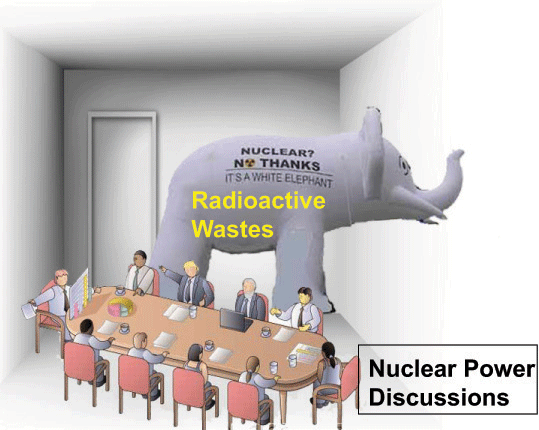 The Bomb Plant: A MOX White Elephant?, DC Bureau By Joseph Trento, on October 20th, 2011 The National Nuclear Security Administration may have a $10 billion taxpayer-financed white elephant on its hands based on Britain’s experience with a similar plant that has been shuttered after a decade of failed operations. Continue reading
Japan will no longer measure plutonium
Japan ceases measuring the plutonium, Paul Langley’s Nuclear History Blog, 4 Oct 11, At the press conference of TEPCO and related ministries of Japanese government, Ministry of Education, Culture, Sports, Science and Technology stated they will not measure plutonium anymore.
The measurement of plutonium was abandoned in Japan.It was announced on 10/3/2011 by staff from Ministry of Education, Culture, Sports, Science and Technology.
Now Japanese people are allowed to take 1~10 Bq/kg of plutonium. However, 1 in a million gram of plutonium causes cancer.
They announced that plutonium and strontium were detected in 45km / 79km area on 9/30.They seem afraid of having the contamination situation known by more people. http://fukushima-diary.com/2011/10/breaking-news-the-measurement-of-plutonium-was-abandoned-in-japan/#.Tomr6dmxwk4.facebook
JGov and TEPCO are disgusting.
http://nuclearhistory.wordpress.com/2011/10/03/japan-ceases-measuring-the-plutonium/
Plutonium in soil 40 Km from Fukushima nuclear plant
 Plutonium 40km from Fukushima plant, FT.com Asia Pacific By Mure Dickie in Tokyo, 3 Oct 11 Small amounts of plutonium believed to have escaped from Japan’s tsunami-crippled nuclear plant have been detected in soil more than 40km away, say government researchers, a finding that will fuel already widespread fears about radiation risk……
The plutonium was found at six sites – including one in Iitate around 40km from the plant – all of which are subject to evacuation orders. However, plutonium’s long half-life and the potential for even small amounts to pose a health hazard if ingested is likely to make it a focus of popular concern.
Japanese authorities, who significantly underestimated radiation releases from the plant in the early days of the crisis, have since struggled to convince the public that they are able effectively to guard against radiation health threats…. http://www.ft.com/intl/cms/s/0/7e3af460-ece6-11e0-be97-00144feab49a.html#axzz1Zkkm68Sy
New plutonium nuclear fuel plant, costly, delayed, and unsafe, too?
 More than a decade later, the mixed oxide fuel [2] (MOX) plant is running into mounting troubles [3], including long delays, soaring costs and the lack of utilities committed to use the new fuel in their reactors
But there’s another aspect of the story that has received little attention…
Safety Reviewers Raise Questions about Construction of New Nuclear Fuel Plant, ProPublica By Donna Deedy, w ith Michael Grabell, May 5, 2011, . In the late 1990s, U.S. policymakers approved a plan to turn plutonium from nuclear weapons into fuel for commercial reactors. The first-of-its kind plant [1], now being built in South Carolina, was intended to reduce the Cold War stockpile and the threat of nuclear material theft while supplying the country’s energy needs. Continue reading
Facts on plutonium and Mox nuclear fuel
some reactors do use Mox, but only as a small percentage (less than 30 per cent) of the total fuel. The rest of the fuel is conventional uranium oxide…Mox, which in any case remains far more expensive than conventional uranium fuel…
 (UK) Government’s doomed £6bn plan to dispose of nuclear waste, The Independent, 11 April 11“……Q & A: Why has it come to this?
Q: What is Britain’s “plutonium mountain”?
A: It is the nation’s stockpile of radioactive plutonium, kept as plutonium dioxide powder, packed into special drums stored at Sellafield in Cumbria. A further, smaller amount is stored at the Dounreay nuclear facility in Scotland, the site of the doomed nuclear fast-breeder reactor programme. Continue reading
Britain has world’s biggest pile of plutonium and now Japan won’t buy it
Chubu Electric and nine other Japanese power companies have also indicated that because of long-term production problems that have dogged the SMP, they will not now be taking any reprocessed fuel from Britain until at least the end of the decade – nearly 20 years after the plant was opened to serve the Japanese market.
Government’s doomed £6bn plan to dispose of nuclear waste, The Independent, 11 April 11, One month after the Japanese tsunami, the world’s biggest reserve of plutonium waste is reaching crisis point. It was meant to be reprocessed and sold – but now no nation will take it. So where is this vast stockpile? Not Fukushima, but Sellafield, CumbriaBy Steve Connor, Science Editor The nuclear crisis in Japan threatens a carefully choreographed UK Government plan to tackle the world’s biggest mountain of plutonium waste stored at the Sellafield site in Cumbria. Continue reading
Refuting George Monbiot on the dangers of ionising radiation
If you inhale a millionth of a gram of plutonium, the surrounding cells receive a very, very high dose. Most die within that area, because it’s an alpha emitter. The cells on the periphery remain viable. They mutate, and the regulatory genes are damaged. Years later, that person develops cancer….]t’s imperative that people understand that internal emitters cause cancer, but the incubation time for cancer is any time from two to 60 years. …
 VIDEO Nuclear industry propaganda about low-level radiation is “absolute rubbish” says physician who taught at Harvard Med School — It’s all about internal emitters (VIDEO) « Energy News Energy News, HELEN CALDICOTT, 4 April 11, : … Up to a million people have already died from Chernobyl, and people will continue to die from cancer for virtually the rest of time. Continue reading
-
Archives
- February 2026 (211)
- January 2026 (308)
- December 2025 (358)
- November 2025 (359)
- October 2025 (376)
- September 2025 (258)
- August 2025 (319)
- July 2025 (230)
- June 2025 (348)
- May 2025 (261)
- April 2025 (305)
- March 2025 (319)
-
Categories
- 1
- 1 NUCLEAR ISSUES
- business and costs
- climate change
- culture and arts
- ENERGY
- environment
- health
- history
- indigenous issues
- Legal
- marketing of nuclear
- media
- opposition to nuclear
- PERSONAL STORIES
- politics
- politics international
- Religion and ethics
- safety
- secrets,lies and civil liberties
- spinbuster
- technology
- Uranium
- wastes
- weapons and war
- Women
- 2 WORLD
- ACTION
- AFRICA
- Atrocities
- AUSTRALIA
- Christina's notes
- Christina's themes
- culture and arts
- Events
- Fuk 2022
- Fuk 2023
- Fukushima 2017
- Fukushima 2018
- fukushima 2019
- Fukushima 2020
- Fukushima 2021
- general
- global warming
- Humour (God we need it)
- Nuclear
- RARE EARTHS
- Reference
- resources – print
- Resources -audiovicual
- Weekly Newsletter
- World
- World Nuclear
- YouTube
-
RSS
Entries RSS
Comments RSS
 nuclear-news