Concerned Citizens for Nuclear Safety (CCNS) Nuclear Literacy Program to Educate Nuevomexicano Communities on the LANL Programmatic Environmental Impact Statement for Plutonium Pit Production

For over eighty years, the People of New Mexico have borne the burden of the 1943 establishment of Los Alamos National Laboratory (LANL). Through the Congressional continuing resolution process, LANL may receive an additional $1 billion dollars to support expansion of the number of plutonium triggers, or plutonium pits, fabricated for nuclear weapons. The people of northern New Mexico are unaware of the effects that this potentially may have on nearby communities. The effects of eight decades of nuclear weapons development has had a cumulative impact on New Mexico, especially in Rio Arriba County, which borders Los Alamos County to the north and west.
During the Bush II and Obama Administrations, the U.S. Department of Energy (DOE) proposed three new weapons systems: the Robust Nuclear Earth Penetrator (RNEP), the Reliable Replacement Warhead (RRW), and the Interoperable Warhead (IW). Grassroots organizations networked, educated each other, spoke at public meetings, wrote informed public comments, and worked with technical experts, elected officials and the media to understand how increased weapons development would impact frontline communities, which are mostly comprised of Indigenous and Hispanic people. With leadership from New Mexico and colleagues and NGOs throughout the world and through active organizing and public engagement in the National Environmental Policy Act (NEPA) process, those proposed weapons systems were defeated and eventually canceled.
Los Alamos National Laboratory Reneges on Active Confinement Ventilation Systems at Plutonium Facility, PF-4.

| Concerned Citizens for Nuclear Safety .14 Nov 25 |
Los Alamos National Laboratory (LANL) continues to neglect its obligations to safely operate its nuclear weapons facilities in a manner required by laws, orders, guidance and common sense.
A recent report from the Defense Nuclear Facilities Safety Board (DNFSB or the Board) details the threats from the release of plutonium contaminated air during a seismic event from the LANL Plutonium Facility, or PF-4. For over 20 years, the Board has recommended that LANL establish active confinement ventilation systems for PF-4, and LANL agreed. https://www.dnfsb.gov/content/review-los-alamos-plutonium-facility-documented-safety-analysis
Active confinement ventilation systems require negative air pressure in rooms and buildings where plutonium is stored, handled and processed. In the event of seismic activity, or other possible catastrophic events, the negative air pressure would keep the contamination inside where it could be held and filtered before being released.
The converse, which is called passive confinement systems, would do nothing. No filtration would occur. Contaminated air would move out of the building and into the air we breathe. Depending on the wind direction, radioactive plutonium particles would be deposited in neighborhoods, on hiking trails, fields, school grounds, and in the Rio Grande.
Los Alamos National Laboratory Prioritizes Plutonium “Pit” Bomb Core Production Over Safety

Santa Fe, NM – The independent Defense Nuclear Facilities Safety Board recently released its Review of the Los Alamos Plutonium Facility Documented Safety Analysis. It concluded that:
“While LANL facility personnel continue to make important upgrades to the Plutonium Facility’s safety systems, many of those projects have encountered delays due to inconsistent funding and other reasons. DOE and LANL should consider prioritizing safety-related infrastructure projects to ensure that the Plutonium Facility safety strategy adequately protects the public, as the facility takes on new and expansive national security missions.” (Page 24)
In early October 2024, the Department of Energy’s semi-autonomous National Nuclear Security Administration (NNSA) announced with great fanfare that the Los Alamos Lab had produced its first “diamond stamped” plutonium pit for the nuclear weapons stockpile. Tens of billions of taxpayers’ dollars have been sunk into LANL’s long delayed and over budget pit production program. Given no further announcements, it is not currently known whether or not the Lab is meeting its congressionally required production goals. Endemic nuclear safety problems have long been an intractable issue, at one point even forcing a three-year halt to plutonium operations at LANL’s Plutonium Facility-4 (“PF-4”).
In its recent Review, the Safety Board reported:
“The [2009] Plutonium Facility safety basis described very large potential [radioactive] dose consequences to the public following seismic events…. DOE committed to upgrade and seismically qualify the ventilation system, with a particular focus on a specific ventilation subsystem…”
“As the only facility in the DOE complex that can process large quantities of plutonium in many forms, [PF-4] represents a unique capability for the nation’s nuclear deterrent. The Board has long advocated for the use of safety-related active confinement systems in nuclear facilities for the purposes of confining radioactive materials…Passive confinement systems are not necessarily capable of containing hazardous materials with confidence because they allow a quantity of unfiltered air contaminated with radioactive material to be released from an operating nuclear facility following certain accident scenarios. Safety related active confinement ventilation systems will continue to function during an accident, thereby ensuring that radioactive material is captured by filters before it can be released into the environment… (Page 2, bolded emphases added)
The Safety Board referred to DOE Order 420.1C, Facility Safety, which has a clear requirement that:
“Hazard category 1, 2, and 3 nuclear facilities… must have the means to confine the uncontained radioactive materials to minimize their potential release in facility effluents during normal operations and during and following accidents, up to and including design basis accidents… An active confinement ventilation system [is] the preferred design approach for nuclear facilities with potential for radiological release. Alternate confinement approaches may be acceptable if a technical evaluation demonstrates that the alternate confinement approach results in very high assurance of the confinement of radioactive materials.” (Page 2, bolded emphases added; PF-4 is a Hazard Category 2 nuclear facility)
Plutonium pit production at LANL is slated for a 15% increase to $1.7 billion in FY 2026. But in a clear example of how the NNSA prioritizes nuclear weapons production over safety, the DNFSB reported:
The active confinement safety system “remained the planned safety strategy for the Plutonium Facility for many years… However, in a March 2022 letter to the Board, the NNSA Administrator stated that the planned strategy would shift away from safety class active confinement… A safety class would require substantial facility upgrades far in excess to those that are currently planned… facility personnel also noted that some projects [for alternate confinement approaches] have been paused or delayed due to funding issues…” (Pages 3 and 21, bolded emphases added)
Instead of a technical evaluation demonstrating that “the alternate confinement approach results in very high assurance of the confinement of radioactive materials,” the Board concluded:
“Predicting the amount of release under passive confinement conditions can be quite complex. Fire or explosions could add energy to the facility’s atmosphere and introduce a motive force that could carry hazardous materials through an exhaust path… Therefore, determination of the amount of radioactive material that could escape the facility becomes very complex and uncertain.” (Page 8, bolded emphases added)
In sum, DOE reneged on its commitment to retrofit a safety class confinement system at PF-4, even as it ramps up plutonium pit production. At the same time, LANL has not demonstrated that its “alternate confinement approach results in very high assurance of the confinement of radioactive materials” in the event of an accident or earthquake.
This also contradicts the NNSA’s position that potential radioactive doses are vanishingly small. For example, the agency claims that the “Most Exposed Individual” of the public would have only a one in a million chance of developing a “Latent Cancer Fatality” from an accidental fire in gloveboxes at PF-4, which commonly process molten, pyrophoric plutonium. (Draft LANL Site-Wide Environmental Impact Statement, January 2025, Page D-23)
Moreover, pit production that involves plutonium-239 is not the only nuclear safety issue. PF-4 also processes plutonium-238, a dangerous gamma emitter, as a heat source for radioisotope thermoelectric generators (AKA nuclear batteries). The Safety Board’s Review noted:
While newly installed gloveboxes meet seismic requirements, and facility modifications associated with the pit production mission prioritize upgrades for some gloveboxes, others have known seismic vulnerabilities and will not be able to perform their credited post-seismic function. Many of these deficient gloveboxes are associated with processing heat source plutonium, a high-hazard material which accounts for much of the facility’s overall safety risk… Upgrading glovebox support stands is important to return the facility to a safety posture more reliant on credited engineered features…” (Pages 22-23, bolded emphases added)
Nuclear safety issues will always be inherent to plutonium pit production, yet new pit production itself is simply not necessary. No currently planned production is to maintain the safety and reliability of the existing nuclear weapons stockpile. Instead, it is all for new-design nuclear weapons, which could prompt the U.S. to resume full-scale testing, as Trump has recently ordered. Pit production is the NNSA’s most expensive program ever, but it has no credible cost estimates. Independent experts have concluded that pits last at least a century (their average age now is ~43) and there are at least 15,000 existing pits already stored at the Pantex Plant near Amarillo, TX.
Moreover, the future of the independent Defense Nuclear Facilities Safety Board is in doubt, without whom the DOE’s chronic nuclear safety record would not be publicly known. The DNFSB’s five-member Board recently lost its quorum because of term limits. The Board desperately needs nominations from the Trump Administration, which so far has not happened either by design or neglect.
Jay Coghlan, Director of Nuclear Watch New Mexico, commented, “We are facing a perfect storm of expanding plutonium pit production and diminishing oversight by the Safety Board. LANL’s expanding nuclear weapons programs are sucking money from the Lab’s other programs that are truly needed, such as nonproliferation, cleanup and renewable energy research (which is being completely eliminated). NNSA’s prioritization of plutonium pit production for the new nuclear arms race and the erosion of nuclear safety could have disastrous results for northern New Mexico.”
The DNFSB’s Review of the Los Alamos Plutonium Facility Documented Safety Analysis is available at https://www.dnfsb.gov/sites/default/files/2025-10/Review of the Los Alamos Plutonium Facility Documented Safety Analysis %5B2026-100-001%5D.pdf https://nukewatch.org/wp-content/uploads/2025/11/LANL-Prioritizes-Plutonium-Pit-Bomb-Core-Production-Over-Safety.pdf
Some 890 tons of Tepco nuclear fuel kept at Aomori reprocessing plant
Aomori – Nov 1, 2025,
https://www.japantimes.co.jp/news/2025/11/01/japan/tepco-nuclear-fuel-aomori-plant/
Some 890 tons of spent nuclear fuel from Tokyo Electric Power Company Holdings are being stored at Japan Nuclear Fuel’s reprocessing plant under construction in Aomori Prefecture — the first time a specific amount of nuclear fuel at the plant from an individual company has been confirmed.
Also kept at the nuclear fuel reprocessing plant in the village of Rokkasho are about 180 tons of fuel from Japan Atomic Power.
Both numbers were included in the Aomori Prefectural Government’s answer dated Oct. 7 to a questionnaire from a civic organization in the prefecture. The prefecture’s answer was based on explanations from Tepco and Japan Atomic Power
The plant keeps a total of 2,968 tons of used nuclear fuel.
The plant, planned to be completed in fiscal 2026, will start to extract plutonium from used nuclear fuel once it becomes operational.
Under the principle of the peaceful use of plutonium, the Japanese government has a policy of not possessing the radioactive material unless there are specific purposes for it such as use for uranium-plutonium mixed oxide (MOX) fuel, because it can be used to make nuclear weapons.
With none of the nuclear reactors at Tepco and Japan Atomic Power having restarted and neither companies having clear plans to start so-called pluthermal power generation using MOX fuel, there are concerns that a situation may occur in which Japan possesses plutonium without specific purposes.
In the prefecture’s answer to the questionnaire, Tepco said that it “plans to implement pluthermal power generation at one of its reactors based on a policy that it will consume plutonium definitely.”
The firm also said it assumes that some plutonium will be supplied to a nuclear plant of Electric Power Development, better known as J-Power, which is now being constructed in the town of Oma, Aomori Prefecture. The Oma plant is expected to use MOX fuel at all reactors.
“There is no change in our policy to use our plutonium with our responsibility,” Japan Atomic Power said.
Contacted by reporters, Tepco offered the same explanation as that given to the Aomori government.
Meanwhile, Japan Atomic Power said that it plans to conduct pluthermal power generation at the Tsuruga nuclear power station’s No. 2 reactor in Fukui Prefecture and at the Tokai nuclear plant in Ibaraki Prefecture, although when this would start has yet to be decided.
Members of Congress object to plutonium giveaway

October 26, 2025, https://beyondnuclear.org/senators-object-to-plutonium-giveaway/
On December 31, the Trump White House will start revealing which lucky startup companies will receive free plutonium needed for their new reactor fuel. Trump will give away between 20-25 tons, according to reports, going against US energy policy that has long avoided the transfer of nuclear weapons-usable materials into the commercial sector. One likely recipient is Oklo, on whose board Trump’s present energy secretary, Chris Wright, once sat, raising serious conflict of interest issues.
Several Members of Congress have already written to Trump expressing their concerns. In the letter sent by Senator Ed Markey and Reps. Don Beyer and John Garamendi, all Democrats, they pointed out that dishing out plutonium “to private industry for commercial energy use,” crossed a line that “goes against long-standing, bipartisan US nuclear security policy. It raises serious weapons proliferation concerns, makes little economic sense, and may adversely affect the nation’s defense posture.” They also pointed out that the amount of plutonium Trump is preparing to move into the commercial sector “is enough for at least 2,000 nuclear bombs.”
And they also took care to remind Trump that “commercial nuclear energy does not require separated plutonium, and today there is no global demand for plutonium to make civilian nuclear reactor fuel. Nuclear power reactors instead rely on uranium fuel, which is safer and cheaper to process.”
Roll up, roll up for your free plutonium.
The 19-25 metric tons of plutonium Trump would be redirecting into the civil nuclear sector had previously been slated for permanent disposal as nuclear waste left over from the Cold War era. Disposing of it is far cheaper than reprocessing it — $20 billion versus $49 billion according to the senators’ letter — and also isolates it from potentially falling into the wrong hands.
Trump is preparing a dangerous giveaway to struggling commercial nuclear startups, writes Linda Pentz Gunter
Imagine you are a commercial nuclear reactor startup company but you just can’t quite start up because there’s one little problem. Your “new” reactor design needs a special kind of fuel. And that fuel requires a particular ingredient: plutonium.
Plutonium is the trigger component of a nuclear bomb. The countries that developed nuclear weapons — as well as those that have reprocessed irradiated reactor fuel in order to separate the plutonium from uranium — have massive surplus piles of plutonium left over, an ever-present security threat.
Now imagine that a former board member of one of those struggling startup companies, Oklo, is Chris Wright, the current US Secretary of Energy in the Trump government. Lo and behold, all of a sudden, that same carnival barker who passes for a US president is offering your former company plutonium for free from a stockpile of close to 20 metric tons or more.
The White House has announced that it will begin revealing its lucky free plutonium recipients on December 31 based on applications received by the US Department of Energy by November 21, according to Reuters. The news agency put the plutonium surplus amount at 19.7 metric tons, although the Trump administration has suggested it has 25 tons to spare.
That amount, according to a letter sent to the Trump administration by one senator — Ed Markey — and two representatives— Don Beyer, John Garamendi — all Democrats — is enough for at least 2,000 nuclear bombs.
Dishing out plutonium “to private industry for commercial energy use,” the trio wrote in their September 10 letter, “goes against long-standing, bipartisan US nuclear security policy. It raises serious weapons proliferation concerns, makes little economic sense, and may adversely affect the nation’s defense posture.”
Markey wrote to Trump again on September 23, specifically enquiring whether it was more than just a peculiar coincidence that Wright’s former company, Oklo, would be the beneficiary of the plutonium handout.
Earlier, with his colleagues, Markey had expressed concern that “the transfer of weapons-usable plutonium to private industry would increase the risk of nuclear weapons proliferation, including to rogue states or terrorists.”
Markey now wanted to know whether “a serious conflict of interest may exist within your Administration on this issue because the plutonium transfer will benefit Secretary of Energy Chris Wright’s former company.”
Saying that he had “questions about the propriety of the transaction,” Markey noted that in addition to the free plutonium, Trump’s Department of Energy was also supporting Oklo to build a $1.7 billion reprocessing plant in Tennessee that would enable Oklo to further extract the plutonium needed for its as yet unlicensed micro-reactors.

Markey went on to question whether the administration even cared whether or not a new Oklo-owned reprocessing plant made any sense but was instead backing the project with taxpayer money “because Oklo stands to benefit financially and Secretary Wright is acting in his former company’s interest.”
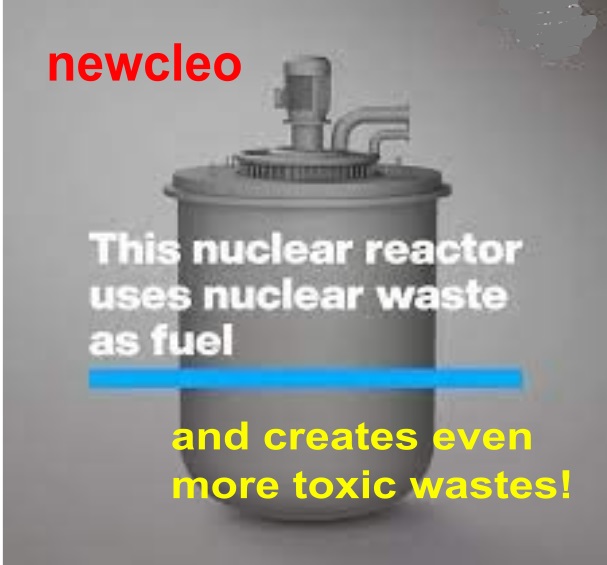
Among the eager corporations already lined up for their plutonium handouts are not only Oklo but also a foreign corporation, the now French-based but originally British nuclear company, newcleo, as well as US-based Valar Atomics, which has been criticized for developing a reactor that would not only consume but also produce plutonium.
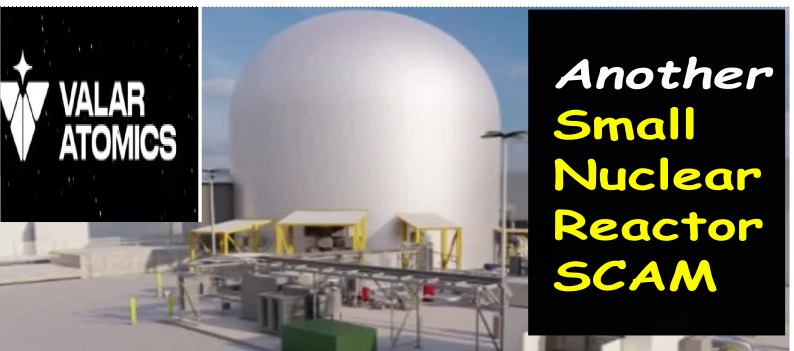
Perhaps to celebrate the impending largesse, newcleo announced on October 20 that it has entered into a partnership with Oklo and will invest $2 billion to develop advanced nuclear fuel fabrication and manufacturing facilities.
On the very day — May 23rd —that Trump released his executive orders fast-tracking nuclear power expansion, Valar Atomics put out its own statement celebrating the news. (Do you think they’d seen the EOs in advance, or maybe even written parts of them themselves?)
Echoing the identical language repeatedly used by Trump officials, the Valar Atomics statement said: “There’s a new arm to national nuclear security: Dominance. Dominance in civilian nuclear technology development, dominance in nuclear energy infrastructure deployment, dominance in shaping global development.”
We should note here that the word “dominance” appears 35 times in the Heritage Foundation’s Project 2025 guide to autocracy, which contains an entire section called American Energy and Science Dominance and another called Restoring American Energy Dominance.
Accordingly, we now have something called the National Energy Dominance Council, headed by Secretary of the Interior Doug Burgum. Burgum heralded the newcleo-Oklo deal, saying: “This agreement to implement newcleo’s advanced fuel expertise into Oklo’s powerhouses and invest $2 billion into American infrastructure and advanced fuel solutions is yet another win for President Donald J. Trump’s American Energy Dominance Agenda.”
Standing in the way of such dominance, according to Valar Atomics and others, remains the US Nuclear Regulatory Commission (NRC). In April, Valar Atomics had joined the states of Texas, Utah, Louisiana, Florida, and Arizona, as well as fellow reactor companies Last Energy and Deep Fission, to sue the NRC. Their beef is that, going back to the days of NRC predecessor, the Atomic Energy Commission, there has been an annoying insistence “to require licenses even for reactors that use small amounts of special nuclear material that have no effect on US defense and security or public health and that the NRC itself has stated do not pose public health and safety risks.”
Innovation, complains Valar Atomics, is made “virtually impossible,” by the NRC. “Their rules — created in the overreaction to the Three Mile Island incident — shuttered the nuclear industry. Simply testing a reactor prototype takes five to seven years, at best. This is not the way to foster innovation! To regain our dominance in nuclear energy, the status quo must change, quickly.”
The suit is currently under discussion for a possible resolution, given that the Trump DOE is moving fast to rein in any excessive safety oversight by the newly downsized NRC, where the mission statement now extolls the “benefits” of nuclear energy for the US public.
The 19-25 metric tons of plutonium Trump would be redirecting into the civil nuclear sector had previously been slated for permanent disposal as nuclear waste left over from the Cold War era. Disposing of it is far cheaper than reprocessing it — $20 billion versus $49 billion according to the senators’ letter — and also isolates it from potentially falling into the wrong hands. ……………………………………………………………………………………………………………………………..
Plutonium has no place in the civil nuclear sector. But it should have no place in our lives, period, if we really want to avoid nuclear proliferation or worse.
Linda Pentz Gunter is the founder of Beyond Nuclear and serves as its international specialist. Her book, No To Nuclear. Why Nuclear Power Destroys Lives, Derails Climate Progress and Provokes War, can be pre-ordered now from Pluto Press. https://beyondnuclearinternational.org/2025/10/26/roll-up-roll-up-for-your-free-plutonium/
US offers nuclear energy companies access to weapons-grade plutonium
US offers nuclear energy companies access to weapons-grade plutonium.
Expert warns commercial use of the radioactive material from cold war-era
warheads carries safety risks.
The US has offered energy companies access
to nuclear waste that they can convert into fuel for advanced reactors in
an attempt to break Russia’s stranglehold over uranium supply chains. The
Department of Energy on Tuesday published an application that nuclear
energy groups can use to seek up to 19 metric tonnes of the government’s
weapons-grade plutonium from cold war-era warheads.
In the document seen by
the Financial Times, the energy department said being selected to receive
the plutonium could help companies secure faster approval for a Nuclear
Regulatory Commission license, which is required to operate a nuclear
facility. At least two companies, Oklo, which is backed by OpenAI’s Sam
Altman, and France’s Newcleo, are expected to apply to access the
government’s plutonium stockpile.
FT 21st Oct 2025, https://www.ft.com/content/2fbbc621-405e-4a29-850c-f0079b116216
1000s of nuclear bombs? Russia exits US nuke pact to reclaim 34 tons of plutonium
The pact required both nations to dispose of 34 metric tons of weapons-grade plutonium.
Kapil Kajal Oct 09, 2025 , https://interestingengineering.com/military/russia-dumps-us-nuclear-deal
ussia has officially pulled out of an important agreement with the United States regarding how to dispose of weapons-grade plutonium.
According to Russia’s state news agency TASS, the lower house of the Parliament passed a legislation on October 8 to officially denounce the 2000 Plutonium Management and Disposition Agreement (PMDA).
The pact required both nations to dispose of 34 metric tons of weapons-grade plutonium, enough for thousands of nuclear warheads, by converting it into fuel for civilian power reactors.
Terminating nuclear pact
The deal, signed in 2000 and ratified in 2011, was designed to ensure that plutonium declared surplus for defense needs could never again be used for weapons.
However, Russia is no longer willing to follow its agreements with the United States regarding plutonium.
Deputy Foreign Minister Sergey Ryabkov told lawmakers that the current situation makes it unacceptable to keep these obligations.
Ryabkov pointed out that Russia’s demands for restoring the deal have not been met. These demands include lifting US sanctions, reversing the Magnitsky Act, and reducing NATO’s military presence near Russia’s borders.
The Russian government explained to parliament that it is withdrawing from the deal due to “fundamental changes in circumstances,” including NATO expansion, US sanctions, and military support from Washington for Ukraine.
Although the agreement was technically in place, Russia stopped participating in 2016. It accused the US of not meeting its obligations and using the agreement for political gain.
The Kremlin at the time demanded concessions unrelated to the agreement, such as restrictions on NATO activities in Eastern Europe and the lifting of sanctions imposed after Moscow’s 2014 annexation of Crimea.
34 tons of plutonium
The termination of the PMDA means that the 34 tons of plutonium Russia had pledged to render unusable for weapons could now be reclassified as part of its strategic reserves.
The State Duma’s official statement described further commitments on the material as “inexpedient.”
The decision adds to the growing list of suspended or terminated arms control agreements between Moscow and Washington.
Russia has already withdrawn from the Conventional Armed Forces in Europe (CFE) treaty, suspended its participation in New START, and halted cooperation under the Open Skies treaty.
The plutonium agreement was among the few remaining technical measures of nuclear risk reduction from the early 2000s.
While smaller in scale than New START, the PMDA was seen as a pragmatic step toward reducing stockpiles of weapons-usable material in both nations.
Tomahawk cruise missiles
The move comes as geopolitical tensions between the US and Russia continue to escalate over the war in Ukraine.
On the same day the withdrawal was announced, the Kremlin condemned Washington’s reported deliberations over providing Tomahawk cruise missiles to Kyiv.
“If the U.S. administration ultimately makes that decision, it will not only risk escalating the spiral of confrontation, but also inflict irreparable damage on Russian-US relations,” Foreign Ministry spokeswoman Maria Zakharova said, according to TASS.
She added that Moscow was “closely monitoring” the situation and urged the US to exercise restraint
The United States has not yet commented on Russia’s decision to terminate the plutonium deal.
However, the move underscores the growing collapse of bilateral nuclear cooperation amid the deepest rift between Washington and Moscow in decades.
The developments also come as Bloomberg reported on September 30 that Russia remained the largest supplier of enriched uranium to the United States in 2024, providing about 20 percent of the fuel used in American nuclear reactors despite formal import restrictions.
US waivers still permit deliveries through 2028 for national energy security reasons.
As both countries move further away from long-standing nuclear agreements, experts warn that ending the PMDA shows a growing risk to global nuclear safety and a widening rift in US-Russia relations.
U.S. Dept. of Energy steps up plutonium pit manufacturing at Savannah River Site

The site is part of the nation’s effort of “re-establishing capabilities retired after the Cold War,” the national nuclear stockpile plan stated. And also, provide a home for another data center.
Jillian Magtoto, Savannah Morning News, 9 Oct 25,
Key Points
ENVIRONMENT
U.S. Dept. of Energy steps up plutonium pit manufacturing at Savannah River Site
The site is part of the nation’s effort of “re-establishing capabilities retired after the Cold War,” the national nuclear stockpile plan stated. And also, provide a home for another data center.
Jillian Magtoto, Savannah Morning News
- The Department of Energy is accelerating construction of the new facility, aiming to produce 50 plutonium pits annually by 2030.
- While production ramps up, concerns remain about existing radioactive waste and the diversion of funds from cleanup efforts.
More than two hours up the river from Savannah is a nuclear Superfund site, about the size of Augusta just across the border. Despite decades of cleanup, radionuclides still trickle from nearby streams to cow udders, and lurk in the tissues and bones of alligators, hogs, and deer, and the flesh of tadpoles and fish. In July, workers discovered a radioactive wasp hive at one of its hazardous waste tank farms. The site spanning three South Carolina counties is still active as the country’s only plant extracting and purifying tritium, a radioactive isotope that boosts the efficiency and explosivity of nuclear weapons.
But the Savannah River Site (SRS) is about to be re-awakened to produce plutonium pits, hollow bowling-ball sized spheres of plutonium at the core of warheads that causes the nuclear blast. Plutonium is a heavier metal that, according the Environmental Protection Agency (EPA), can enter the bloodstream upon inhalation, resulting in lung scarring, disease, and cancer. It carries a half-life of about 24,000 years.
Last October, the Department of Energy’s (DOE) National Nuclear Security Administration (NNSA) assumed primary responsibility of the SRS to produce 50 of the country’s 80 annual plutonium pits by 2030. The remaining 30 will be made in the Los Alamos National Laboratory in New Mexico, where plutonium pits were first created in the 1940s.
Over 80 years later, “NNSA is being asked to do more than at any time since the Manhattan Project,” stated NNSA Administrator Jill Hruby at the 2024 Nuclear Deterrence Summit. For SRS, the goal “is aggressive, complete construction by 2032 so that rate production can support the W93 schedule.” W93 is the newest and 93rd nuclear weapon design the U.S. has considered after a 30-year hiatus, planned for deployment by U.S. Navy submarines…………………………………………………………………………………………………
While plans are accelerating, “most of the public doesn’t even know what’s going on out there,” said Tom Clements, founder of his one-man watchdog website, Savannah River Site Watch, who has monitored the plant since the 1970s. “They don’t know they’re building the pit plant.” And likely, also a data center…………………………………………………………………………………………..
Plutonium’s pitfall
It’s one thing to stop plutonium production, but it’s an entire other affair to dispose it.
Because weapons-grade plutonium cannot be blended with other materials to render it unusable for weapons, Russia and the U.S. agreed it would instead be made into mixed oxide (MOX) fuel and irradiated in civil nuclear power reactors for electricity. For the U.S., that MOX facility would be housed at the SRS, which began construction in 2007.
But the promise was a far cry from what the DOE was able to do.
Technical issues, delays, and mismanagement reported by outlets like the Post & Courier ended its operations in 2018. In 2022, the MOX building contractor paid $10 million to the DOE for fraudulent invoices for nonexistent materials. If completed, SRS’ MOX facility would have been 32 years behind schedule and $13 billion over budget, according to the DOE.
Meanwhile, the state of South Carolina was growing wary of the tanks sitting on its soils. In 2014, the state sued the U.S. government and six years later, won the state’s largest single settlement of $600 million and the DOE’s commitment to remove all 9.5 metric tons of plutonium from the state by 2037. Until then, South Carolina has waived its right to bring any lawsuit against DOE for plutonium disposal.
So the DOE went with a cheaper and quicker alternative: diluting the plutonium with a plutonium powder into a “more secure” and less weapon-usable form—though the potential of reversibility led Russia to back out of the deal. SRS has undergone a flurry of expansion, automation, tank transport, and construction of mega-sized disposal units all to dilute the plutonium into a Superfund smoothie that gets vitrified into obsidian-like glass and shipped to a waste isolation pilot plant 2,000 feet underground in a New Mexico salt mine, according to SRS. It completed the first shipment in December 2023.
Still, radioactive byproduct remains in 35 million gallons of waste stored in roughly 43 of the original 51 underground carbon steel containers according to most recently published updates this January.
“These tanks have outlived their design lives, posing a threat to the environment,” stated a Savannah River National Laboratory webpage. “Some of the tanks have known leaks.”
A new mission swipes cleanup funds
From aging plutonium pits housed at the Pantex facility in Texas, the SRS will generate new plutonium pits at the SRS unit originally intended to retire weapons-grade plutonium…………………………………..
But as the site shoulders the new plan, remediation funds get pulled. When the DOE EM handed over primary responsibility of the site to the NNSA last year, $173 million were reallocated from cleanup to weapons activities and transition costs. And it seems some environmental processes fell though the cracks.
“They basically named SRS as the second [plutonium pit] plant site without doing an environmental analysis,” said Clements. “And that’s we got them for, violating the National Environmental Policy Act.”
In 2021, Clements, the Savannah River Site Watch and a few other plaintiffs sued the DOE and NNSA, resulting in a settlement that will play out over the next couple of years. Until the DOE conducts a Programmatic Environmental Impact Statement (PEIS) examining the environmental impact of other approaches to pit production and reach a Record of Decision filed by July 17, 2027, the DOE will not introduce nuclear material into the SRPPF’s main processing building…………………………………. https://www.savannahnow.com/story/news/environment/2025/10/09/savannah-river-site-takes-on-an-enduring-mission-to-make-plutonium-pits-and-also-take-a-data-center/86442685007/
U.S. to gift Plutonium-239 to private nuclear industry
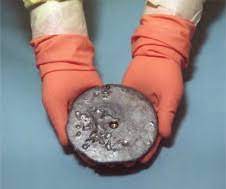
The Trump Administration’s trafficking of nuclear weapons-grade usable plutonium would significantly increase the global proliferation of nation state-sponsored nuclear weapon programs as well as the nuclear weapons material acquisition by thief and purchase for acts of nuclear terrorism.
The Trump Administration’s trafficking of nuclear weapons-grade usable plutonium would significantly increase the global proliferation of nation state-sponsored nuclear weapon programs as well as the nuclear weapons material acquisition by thief and purchase for acts of nuclear terrorism.
October 2, 2025, https://beyondnuclear.org/u-s-to-gift-pu-239-to-private-nuclear-utilities/
Trump Administration’s give away of 20 MT of US plutonium weapons stockpile to private companies threatens nuclear proliferation
According to previously unreleased government documents obtained and reviewed by Politico and addressed in a letter from three Democrat members of Congress to President Donald Trump, The White House is preparing to give away 20 metric tons of weapons-usable plutonium to new nuclear start companies. The Trump deal calls for the equivalent of 2000 nuclear bombs previously slated for permanent disposal as nuclear waste) from the nation’s Cold War era nuclear weapons stockpile to be freed up to help jump start privately-owned U.S. commercial nuclear startup companies. The fledgling nuclear companies would instead use the plutonium fuel in a still unproven and unlicensed new generation of nuclear power plants for domestic power production. The plan includes U.S. startups to reprocess plutonium used in nuclear fuel for international export. The Trump Administration’s trafficking of nuclear weapons-grade usable plutonium would significantly increase the global proliferation of nation state-sponsored nuclear weapon programs as well as the nuclear weapons material acquisition by thief and purchase for acts of nuclear terrorism.
The White House proposal calls for the U.S. Department of Energy (DOE), currently charged with the nation’s nuclear weapons development and nuclear power promotion, to “alter” the military-grade plutonium so it can be used as fuel by civilian startup power companies in new reactor designs. Theses unfinished and yet to be approved designs (such as the sodium cooled metal fuel fast reactors “Aurora” by the Santa Clara, CA start-up Oklo, Inc.’s and Bill Gates’ TerraPower’s “Natrium”) are already being privately marketed for the domestic and international export of fast reactors by companies such as Oklo.
The White House Executive Orders originally issued in May 2025 as part of the President Trump’s national call to “Unleash Nuclear Energy” had directed that the US Department of Energy draw down the from the nation’s plutonium surplus. The current White House plan now additionally includes the military to civilian utility transfer of reserve warhead parts known as “plutonium pits.
The Politico article quotes Oklo’s CEO Jacob DeWitte, “Oklo, wants to take advantage of the plutonium fuel program. Unlike its competitors, Oklo’s fast-neutron reactors can use plutonium as a ‘bridge’ fuel to get around the bottlenecks that exist in obtaining the more desirable grades of uranium.” Those “desirable grades of uranium” fuel are currently only commercially available from the Russia global monopoly on High Assay Low Enriched Uranium (HALEU) which is just less than 20% enriched U-235.
Oklo’s prestigious former board member, Chris Wright, stepped down from the company when he was confirmed to be President Trump’s new Secretary of Energy. Oklo’s Aurora reactor design now under review by the U.S. Nuclear Regulatory Commission is a controversial liquid sodium-cooled metal fueled fast reactor. The fast reactor design is controversial chiefly because it can be retrofitted as a “dual purpose” (military and commercial) reactor to breed more plutonium for nuclear weapons and commercial power generation.
The concept for Oklo’s plan was opposed in a July 25, 2025 letter to Congress signed by 17 scientific experts on global non-proliferation of nuclear weapons. First and foremost, nothing has fundamentally changed to break with the five decades that the United States has opposed from using plutonium fuel in commercial power plants due to security and economic concerns. Their letter further pronounces that authorizing funds for the proposed civilian use of nuclear weapons-usable plutonium as fuel in nuclear power plants will only accelerate the global spread of nuclear weapons in two obvious ways; 1) US companies plan to internationally export plutonium fuel and the plutonium extraction technology, and; 2) the US cannot discourage other countries from further trafficking of weapons-usable plutonium as civilian nuclear fuel if the US is doing it ourselves.
Moreover, pyro-processing or “recycling” to extract plutonium and uranium for reuse as reactor fuel has already proven to be unsustainable economically and will only deepen the already bad economics of nuclear power. The processing is acknowledged as “very costly, due to safety and security concerns, both to extract from nuclear waste and to fabricate into fuel.”
Democrats alarmed as Trump eyes weapons material to fuel nuclear reactors
The scramble to build new reactors to supply power to AI data centers may include plutonium from the nation’s nuclear deterrent.
Politico, By Zack Colman, 09/29/2025
The Trump administration is considering a proposal to divert plutonium that plays a central role in the U.S. nuclear weapons stockpile to fuel a new generation of power plants, according to an Energy Department official and previously undisclosed department documents.
The proposal calls for the department to alter the plutonium so it can be used by civilian power companies, including startups pitching advanced reactor designs. It’s part of a broader push by President Donald Trump to convert tons of the Energy Department’s plutonium to civilian use, a notion that some lawmakers argue would undermine the U.S. weapons program for the benefit of untested private companies.
The initiative would involve harvesting plutonium on a large scale: According to a department official and a July 31 DOE memo seen by POLITICO, more than a fifth of the plutonium needed to meet Trump’s mandates would come from the highly radioactive spheres manufactured for the cores of nuclear weapons. DOE already faces a crunch to make more of those spheres, known as plutonium pits — it’s lagging behind Congress’ demands that it boost pit production to modernize the country’s nuclear deterrence.
The department is “not meeting the current pit manufacturing schedule,” said a former DOE official who is familiar with the department’s plutonium reserves. “So to make pit plutonium available would be a huge shift, and I’d be shocked.”
Both the current and former officials were granted anonymity to share sensitive details about national security matters.
Trump didn’t mention the pits in a May executive order in which he directed DOE to draw from another source — its stores of surplus plutonium — to help revive the nuclear power industry and meet the soaring electricity demands of data centers used in artificial intelligence. The U.S. officially halted its program that made weapons-grade plutonium in 1992.
The department declined to confirm or deny any details of its plutonium plans in response to questions from POLITICO.
“The Department of Energy is evaluating a variety of strategies to build and strengthen domestic supply chains for nuclear fuel, including plutonium, as directed by President Trump’s Executive Orders,” the department said in a statement. “We have no announcements to share at this time.”
The White House referred POLITICO’s questions about the plutonium plans to DOE. The Defense Department referred questions to the White House.
Government watchdogs and congressional Democrats have spent weeks objecting to the entire notion of transferring government-owned plutonium to the power sector. Such a move “goes against long-standing, bipartisan U.S. nuclear security policy,” Democratic Sen. Ed Markey and Reps. Don Beyer and John Garamendi wrote in a Sept. 10 letter to Trump. “It raises serious weapons proliferation concerns, makes little economic sense, and may adversely affect the nation’s defense posture.”
In a separate Sept. 23 letter to Trump, Markey said he was concerned that Energy Secretary Chris Wright was pushing the plutonium proposals to help a Californian nuclear power startup named Oklo, on whose board Wright once sat………….
Oklo spokesperson Paul Day declined to comment on Markey’s concerns of a possible conflict of interest. He also declined to comment on how much plutonium the company intends or has agreed to acquire from DOE. He said DOE “has not, as far as we know, established a plutonium fuel program.”
One nuclear safety watchdog echoed many of the Democrats’ concerns in an interview, saying DOE’s proposal could hollow out the nation’s nuclear defenses and compromise the Pentagon’s long-term deterrence strategy. And it appears to be happening without coordination with the Defense Department, said Hans Kristensen, director of the nuclear information project at the Federation of American Scientists, a nonprofit group that focuses on global security.
…………………………………………..U.S. civilian reactors now use only uranium for their nuclear fuel, but some reactors under development are planning to use plutonium. Spent plutonium from reactors is far more radioactive than uranium — and could pose a greater security risk than uranium if it were to fall into the hands of hostile nations or terrorist groups.
………………………………………… The DOE memo called for delivering 18.5 metric tons of the government’s surplus plutonium and an additional 6.5 metric tons pulled from “material in classified form once it has been declassified.” That latter term, the current DOE official who spoke to POLITICO said, refers to the plutonium pits, whose shape and characteristics can reveal information about nuclear weapons.
The company where Wright was once a board member, Oklo, wants to take advantage of the plutonium fuel program. Unlike its competitors, Oklo’s fast-neutron reactors can use plutonium as a “bridge” fuel to get around the bottlenecks that exist in obtaining the more desirable grades of uranium, CEO Jacob DeWitte told POLITICO in an interview.
DeWitte said Oklo has not publicly revealed how much plutonium the company is seeking to run its new reactors, or from where precisely it plans to obtain that plutonium. He also said the Trump administration has not detailed exactly how much plutonium it will make available, noting that “there is disagreement” over how much surplus plutonium the federal government can hand off before harming nuclear deterrence……………………………………………………………………………………………………………………………………… https://www.politico.com/news/2025/09/29/trumps-nuclear-power-push-stirs-worries-about-us-weapons-stockpile-00583424
£154m plan hatched to move UK’s 140-tonne cache of powdered plutonium from nuclear reactor waste at Sellafield.
Britain could finally solve the problem of
what to do with its radioactive waste by converting it into ceramic
pellets, The Telegraph can reveal. Government scientists want to store the
radioactive plutonium, which is a national security risk because it can be
used to make nuclear weapons, in an underground nuclear graveyard. The
UK’s cache of 140 tonnes of powdered plutonium from nuclear reactor waste
is currently under armed guard at Sellafield in Cumbria.
Telegraph 28th Aug 2025 https://www.telegraph.co.uk/news/2025/08/28/britain-solution-radioactive-waste-problem-cumbria/
Trump plans to make Cold War-era plutonium available for nuclear power

By Timothy Gardner, August 23, 2025, https://www.reuters.com/business/energy/trump-plans-make-cold-war-era-plutonium-available-nuclear-power-2025-08-22/
- Summary
- Radioactive, fissile plutonium from Cold War a headache for US
- US wants to halt disposal of it, use 20 metric tons for fuel
- Trump administration sees it as potential fuel for new reactors
- Critic points out similar program failed due to costs
The Trump administration plans to make available about 20 metric tons of Cold War-era plutonium from dismantled nuclear warheads to U.S. power companies as a potential fuel for reactors, according to a source familiar with the matter and a draft memo outlining the plan.
Plutonium has previously only been converted to fuel for commercial U.S. reactors in short-lived tests. The plan would follow through on an executive order signed by President Donald Trump in May ordering the government to halt much of its existing program to dilute and dispose of surplus plutonium, and instead provide it as a fuel for advanced nuclear technologies.
The Department of Energy, or DOE, plans to announce in coming days it will seek proposals from industry, said the source who spoke on the condition of anonymity. The source cautioned that because the plan is still a draft, its final details could change pending further discussions.
The plutonium would be offered to industry at little to no cost — with a catch. Industry will be responsible for costs of transportation, designing, building, and decommissioning DOE-authorized facilities to recycle, process and manufacture the fuel, the memo said.
The details on the volume of the plutonium, industry’s responsibilities in the plan and the potential timing of a U.S. announcement, have not been previously reported. The 20 metric tons would be drawn from a larger, 34-metric-ton stockpile of weapons-grade plutonium that the United States had previously committed to dispose of under a non-proliferation agreement with Russia in 2000.
The Department of Energy did not confirm or deny the Reuters reporting, saying only that the department is “evaluating a variety of strategies to build and strengthen domestic supply chains for nuclear fuel, including plutonium,” as directed by Trump’s orders.
Boosting the U.S. power industry is a policy priority for the Trump administration as U.S. electricity demand rises for the first time in two decades on the boom in data centers needed for artificial intelligence.
The idea of using surplus plutonium for fuel has raised concerns among nuclear safety experts who argue a previous similar effort failed.
Under the 2000 agreement, the plutonium was initially planned to be converted to mixed oxide fuel, or MOX, to run in nuclear power plants. But in 2018, the first Trump administration killed the contract for a MOX project that it said would have cost more than $50 billion.
The U.S. Energy Department holds surplus plutonium at heavily guarded weapons facilities including Savannah River in South Carolina, Pantex in Texas, and Los Alamos in New Mexico. Plutonium has a half-life of 24,000 years and must be handled with protective gear.
Until Trump’s May order, the U.S. program to dispose of the plutonium has involved blending it with an inert material and storing it in an experimental underground storage site called the Waste Isolation Pilot Plant (WIPP) in New Mexico.
The Energy Department has estimated that burying the plutonium would cost $20 billion.
“Trying to convert this material into reactor fuel is insanity. It would entail trying to repeat the disastrous MOX fuel program and hoping for a different result,” said Edwin Lyman, a nuclear physicist at the Union of Concerned Scientists.
“The excess plutonium is a dangerous waste product and DOE should stick to the safer, more secure and far cheaper plan to dilute and directly dispose of it in WIPP.”
Reporting by Timothy Gardner; Editing by Richard Valdmanis and Lisa Shumaker
Plutonium Levels in Sediments Remain Elevated 70 Years After Nuclear Tests

June 24, 2025,
https://www.marinetechnologynews.com/news/plutonium-levels-sediments-remain-650328
Researchers from Edith Cowan University (ECU) in Australia have confirmed plutonium levels in sediment up to 4,500 times greater than the Western Australian coastline.
Three plutonium-based nuclear weapons tests were conducted at the Montebello Islands in the 1950’s, which introduced radioactive contamination to the surrounding environment. The first nuclear test, coded Operation Hurricane, had a weapon’s yield of some 25kT, and formed a crater in the seabed, while the second and third tests, dubbed Operation Mosaic G1 and G2, had weapons yields of around 15kT and 60kT, respectively.
The three tests released radioactive isotopes including plutonium, strontium (90Sr) and caesium (137Cs) into the surrounding marine environment.
“Plutonium is anthropogenic, which means that it doesn’t exist on its own in nature. The only way it is introduced into an environment is through the detonation of nuclear weapons and from releases from nuclear reprocessing plants and, to a lesser extent, accidents in nuclear power plants,” said ECU PhD student and lead author Madison Williams-Hoffman.
“When plutonium is released into a coastal setting in the marine environment, a significant fraction will attach to particles and accumulate in the seabed, while some may be transported long distances by oceanic currents.”
The region is not inhabited by humans and has not been developed, however it is visited by fishing boats, so collecting data on the levels of contamination in the marine environment is important.
Currently, the protected island archipelago and surrounding marine areas also reside within the Montebello Islands Marine Park (MIMP). The MIMP is ecologically significant due to the presence of numerous permanent or migratory species, and its high-value habitat is used for breeding and rearing by fish, mammals, birds and other marine wildlife.
The water and sediment quality within the MIMP are currently described as ‘generally pristine’, and it is fundamental to maintain healthy marine ecosystems in the region.
The concentrations of plutonium at Montebello Islands were between 4 to 4,500 times higher than those found in sediment from Kalumburu and Rockingham from the Western Australian coastline, with the northern area of the archipelago, close to the three detonation sites, having four-fold higher levels than the southern area.
The concentrations of plutonium found in the sediment at Montebello Islands were similar to those found in the sediment at the Republic of Marshall Islands (RMI) test sites, despite 700-fold higher detonation yields from nuclear testing undertaken at RMI.
Plutonium is an alpha emitter so, unlike other types of radiation, it cannot travel through the skin and is most dangerous when ingested or inhaled.
The research was undertaken by Williams-Hoffman, under the co-supervision of Prof. Pere Masqueand at ECU and Dr Mathew Johansen at ANTSO.
Sellafield Plutonium treatment plant moves a step closer to completion

COMMENT. So now they think they can make more of the toxic stuff?
And provide more dirty dangerous jobs for the boys?
Sellafield Ltd and Nuclear Decommissioning Authority 15 May 2025
The Sellafield Product and Residue Store Retreatment Plant (SRP) is one of our largest and most complex construction projects.
When finished it will play an essential role in managing the UK’s plutonium stockpile.
The project celebrated an important milestone this week as its roof was sealed with a final concrete pour, making the main building watertight and ready for internal fit-out.
Once operational, the plant will retreat and repackage existing material into more durable, long-term storage packages, ensuring they can be safely stored into the next century and beyond.
The project is being delivered under Sellafield’s Programme and Project Partners (PPP) infrastructure delivery model which brings together KBR, Amentum, Morgan Sindall Infrastructure, Altrad Babcock, and a wider supply chain, to deliver a 20-year pipeline of major infrastructure projects.
Completing the vast roof slab required 12 weeks of work and over 2,700 cubic metres of concrete to be poured and pumped to heights up to 30 metres.
The achievement moves the project closer to active commissioning and operations in support of the government’s plutonium disposition strategy announced earlier this year……… https://www.gov.uk/government/news/flagship-sellafield-project-seals-major-milestone
1 This Month

of the week – Shut Down Drone Warfare!


Tell the Ukrainian Government to Drop Prosecution of Peace Activist Yurii Sheliazhenko

Petition to revoke the licensing of the Near Surface Nuclear Disposal Facility (NSDF) at Chalk River. https://www.ourcommons.ca/petitions/en/Petition/Details?Petition=e-7247
To see nuclear-related stories in greater depth and intensity – go to https://nuclearinformation.wordpress.com
-
Archives
- April 2026 (19)
- March 2026 (251)
- February 2026 (268)
- January 2026 (308)
- December 2025 (358)
- November 2025 (359)
- October 2025 (376)
- September 2025 (257)
- August 2025 (319)
- July 2025 (230)
- June 2025 (348)
- May 2025 (261)
-
Categories
- 1
- 1 NUCLEAR ISSUES
- business and costs
- climate change
- culture and arts
- ENERGY
- environment
- health
- history
- indigenous issues
- Legal
- marketing of nuclear
- media
- opposition to nuclear
- PERSONAL STORIES
- politics
- politics international
- Religion and ethics
- safety
- secrets,lies and civil liberties
- spinbuster
- technology
- Uranium
- wastes
- weapons and war
- Women
- 2 WORLD
- ACTION
- AFRICA
- Atrocities
- AUSTRALIA
- Christina's notes
- Christina's themes
- culture and arts
- Events
- Fuk 2022
- Fuk 2023
- Fukushima 2017
- Fukushima 2018
- fukushima 2019
- Fukushima 2020
- Fukushima 2021
- general
- global warming
- Humour (God we need it)
- Nuclear
- RARE EARTHS
- Reference
- resources – print
- Resources -audiovicual
- Weekly Newsletter
- World
- World Nuclear
- YouTube
-
RSS
Entries RSS
Comments RSS
 nuclear-news