Western Shoshone land stolen for nuclear weapons tests and waste dump
Western Shoshone land stolen for nuclear weapons tests and waste dump, By Ian Zabarte Shoshone land was illegally seized by the U.S government, breaking a historic treaty, first for the atomic test site in Nevada, and then for the planned — but still canceled — Yucca Mountain high-level radioactive waste dump. Throughout, the Shoshone people have paid a terrible price.
To hide the impacts from nuclear weapons testing, Congress defined Shoshone Indian ponies as “wild horses.” There is no such thing as a wild horse. They are feral horses, but the Wild Horse and Burrow Acts of 1971 gave the Bureau of Land Management (BLM) the affirmative act to take Shoshone livestock while blaming the Shoshone ranchers for destruction of the range caused by nuclear weapons testing.
My livelihood was taken and the Shoshone economy destroyed by the BLM. On the land, radioactive fallout destroyed the delicate high desert flora and fauna, creating huge vulnerabilities where noxious and invasive plant species took hold.
Nuclear weapons testing at the Nevada National Security Site has left a dark legacy of radiation exposure to Americans downwind from the battlefield of the Cold War. Among the victims are the Shoshone people, who, by no fault of our own, were exposed to radiation in fallout from more than 924 nuclear tests.
“Yucca Mountain is a serpent…and if you don’t do the things you’re supposed to do the snake will release its poison.” Ian ZabarteToday, the media does not report Native American past exposure to radioactive fallout from US/UK secret nuclear testing and disproportionate burden of risk.
The Shoshone people cannot endure any increased burden of risk from any source including resumption of WMD testing by US/UK, plutonium disposal from the Savannah River Site, depleted uranium disposal, proposed high-level nuclear waste disposal at Yucca Mountain, coal ash uranium or fracking released radiation.
Nuclear testing is a violation of the peace treaty with the Shoshone, the Treaty of Ruby Valley, and the U.S. Constitution, Article 6 Section 2, the treaty supremacy clause. Nothing in the treaty contemplated the secret massacre of Shoshone people with radioactive poison from nuclear weapons testing within our own homelands. My tribe and family are the victims.
The enduring purpose of nuclear technology is the creation of weapons of mass destruction. Their tests within the Shoshone homelands are deliberate acts that destroy the Shoshone people. No Shoshone, not one person, should be sacrificed for the benefit of some Americans and the profit of the military industrial complex.
What the Shoshone people experience is a deliberate intent by the US to systematically dismantle the living life-ways of the Shoshone people for the benefit of the US and the profit of the nuclear industry. This meets the minimum threshold of genocide under both the UN Convention and the US enactments of the crime of genocide.
Nuclear weapons development in Shoshone homelands violates humanitarian law, human rights law and environmental law and is racist. Racism is a crime. It is called genocide, “a crime against humanity.”
To prove intent to commit genocide, we have only to look at the culture of secrecy of the military occupation of Shoshone homelands during and since the Cold War at the test site. The acts committed in nuclear weapons development and testing against the Shoshone people benefit other Americans. The Shoshone people suffer without relief or acknowledgement of our silent sacrifice. Secrecy is not transparent. Secrecy is not democratic and is unconstitutional when the acts are conducted in and upon the Shoshone land and people.
Nothing in the Nuclear Waste Policy Act of 1982, as amended in 1987, considered the fact of Shoshone ownership of the proposed Yucca Mountain high-level nuclear waste repository. Almost $15 billion was spent to characterize the site, giving it the label as, “the most studied piece of real estate in the world.” The Nuclear Regulatory Commission admitted in the licensing proceedings that the Department of Energy has not proven ownership.
Nevada took hundreds of millions of dollars for characterization studies from the federal government in grants equal to taxes from Shoshone property and gave nothing to the Shoshone. A clear case of taxation without representation to defraud the Shoshone people of our property interests.
What is needed now are hearings on and support for the extension and funding of the Radiation Exposure Compensation Act of 2019. The Shoshone people need DNA testing and funding for tribal community health education on radiation basics and information on appropriate protective behavior to mitigate radiation exposure.
The Shoshone people are committed to the enforcement of law in the service of justice and human dignity. That is human growth and development, not nuclear weapons.
Ian Zabarte is Principal Man for the Western Bands of the Shoshone Nation of Indians.
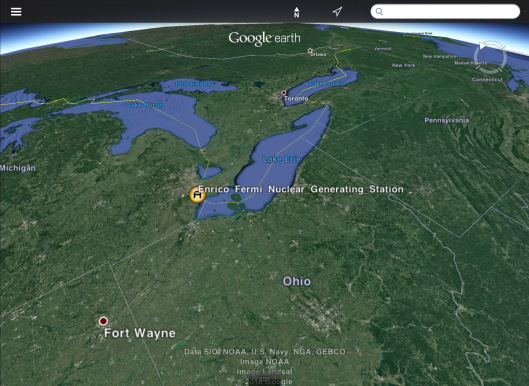
The next threat: A high-level nuclear waste dump near Lake Huron
|
The next threat: A high-level nuclear waste dump near Lake Huron https://www.voicenews.com/news/the-next-threat-a-high-level-nuclear-waste-dump-near-lake-huron/article_674abc28-c779-11ea-a297-c7742bb35220.html NWMO selects site near scrapped Ontario DGR, By Jim Bloch For MediaNews Group, Jul 16, 2020
No sooner than the Saugeen Ojibway Nation had voted overwhelmingly against Ontario Power Generation’s effort to build a deep geological repository for low and intermediate nuclear waste the repository on the lip of Lake Huron, a similar, perhaps more lethal threat has emerged. The Nuclear Waste Management Organization, the industry group tasked in 2002 with finding a permanent waste site for Canadian high-level nuclear waste, announced earlier this year that it had landed on two possible locations, down from 22 prospective sites — Ignace in northwest Ontario and the municipality of South Bruce, virtually next door to the now scrapped site for low and intermediate nuclear waste storage. “High-level radioactive waste in Canada is used (irradiated) nuclear fuel that has been declared as radioactive waste. Used nuclear fuel produces ionizing radiation,” according to the Canadian Nuclear Safety Commission. “This type of radiation has a strong ability to penetrate matter, so shielding against the radiation is required. Since used nuclear fuel contains significant quantities of radionuclides with long half-lives, it requires long-term management and isolation.” Low and intermediate nuclear waste refers to all other forms of nuclear waste. Calling any kind of radioactive waste “low level” is somewhat inaccurate, according to Diane D’Arrigo, the radioactive waste project director at the Nuclear Information and Resource Service, headquartered in Tacoma Park, Maryland. “A lot of what’s in that waste might be low level, but it’s not low risk,” said D’Arrigo. Both can contain the same dangerous radioactive elements. Like the scrapped plan, the new effort calls for a deep geological repository. The effort relies on core samples from the shelved DGR to demonstrate the ostensible suitability of the site. “In Huron-Kinloss and South Bruce, detailed assessment of available historic local and regional geo-scientific studies, including recent deep borehole data from the Bruce nuclear site, showed that the geological setting has a number of favourable characteristics for hosting a deep geological repository for used nuclear fuel,” according to information on the NWMO website. OPG proposed to excavate a storage chamber in a layer of limestone 2,200 feet underground, capped by shale on the top and granite below; OPG geologists estimated that the rock had been stable for 450 million years. The proposed site would be about 600 feet less deep. The members and financiers — via dedicated trust funds — of the NWMO are Ontario Power Generation, New Brunswick Power, Hydro-Québec and Atomic Energy of Canada Limited. Huron-Kinloss, which neighbors South Bruce, is no longer under consideration for the dump. South Bruce sits 29 miles southeast of Bruce Power nuclear station and about 20 miles east of Lake Huron. The DGR proposed for the Bruce Power site, home to eight reactors, was a half mile from Lake Huron. The nuclear complex is on the shore of Lake Huron, roughly 125 miles uplake of Port Huron and 150 miles uplake and upstream from Algonac. The new high-level waste dump would accept spent fuel rods from the 18 nuclear reactors in Ontario and the single reactor at Point Lepreau, New Brunswick. Like the previously proposed dump, the high-level dump is within the Great Lakes basin, inland from Kincardine, said Emily Grant, a South Bruce activist opposed to the project, via email. Grant is a member of the group Protect Our Waterways – No Nuclear Waste. NWMO optioned about 1,300 acres of land in January and “the site will lie directly below the Teeswater River, a tributary of Lake Huron,” said Grant. “As you know, the Great Lakes provide drinking water to over 30 million Americans and 10 million Canadians … There isn’t a single DGR that houses high-level radioactive material in the world, and this experiment does not belong anywhere near the world’s largest body of freshwater.” The Teeswater River flows generally north and joins the Saugeen River in Paisley, which then runs northwest and flows into Lake Huron at Southampton, 19 miles north of the Bruce Power nuclear station. “Spent fuel is thermally hot as well as highly radioactive and requires remote handling and shielding,” according to the U.S. Nuclear Regulatory Commission. Three of the byproducts of the fission process used to generate nuclear power remain dangerous for long periods of time. “Strontium-90 and cesium-137 have half-lives of about 30 years (half the radioactivity will decay in 30 years). Plutonium-239 has a half-life of 24,000 years.” Strontium-90 acts like calcium in the body, seeking out bones, where it can cause cancer; cesium-137 is a muscle seeker; plutonium-239 ends up in the bones, liver and spleen. “Some can give a lethal dose in 15-20 minutes unshielded,” D’Arrigo said. There is no level at which human exposure to radiation has been deemed safe. High-level nuclear waste will remain toxic for more than 100,000 years, ten times longer than the Great Lakes are old, and some of it for more than a million years. NWMO acknowledges this potential problem. “There is some uncertainty about how the system will perform over the very long term because we cannot obtain advance proof of actual performance over thousands of years,” says the organization. Protect Our Waterways – No Nuclear Waste announced on July 3 that it had hired environmental lawyer David Donnelly to help fight the repository. Right now, reactor operators are required to store high-level nuclear waste onsite. According to the Detroit Free Press in a December story, nearly 60,000 tons of spent fuel is parked at reactors that dot the shores of the Great Lakes in the U.S. and Canada. Nearly 3,000 spend fuel bundles await permanent interment in Canada. According to the NWMO’s prospective timeline, a final site will be chosen by 2023 and construction will begin in 2033. Ten years later, after costs of at least $23 billion, the dump will be in operation, accepting high-level waste for 50 years. Over the course of its construction and operating life, more than 2,000 people will be employed. The repository would be sealed and monitored for a certain amount of time and then essentially Right now, reactor operators are required to store high-level nuclear waste onsite. According to the Detroit Free Press in a December story, nearly 60,000 tons of spent fuel is parked at reactors that dot the shores of the Great Lakes in the U.S. and Canada. Nearly 3,000 spend fuel bundles await permanent interment in Canada. According to the NWMO’s prospective timeline, a final site will be chosen by 2023 and construction will begin in 2033. Ten years later, after costs of at least $23 billion, the dump will be in operation, accepting high-level waste for 50 years. Over the course of its construction and operating life, more than 2,000 people will be employed. The repository would be sealed and monitored for a certain amount of time and then essentially Right now, reactor operators are required to store high-level nuclear waste onsite. According to the Detroit Free Press in a December story, nearly 60,000 tons of spent fuel is parked at reactors that dot the shores of the Great Lakes in the U.S. and Canada. Nearly 3,000 spend fuel bundles await permanent interment in Canada. According to the NWMO’s prospective timeline, a final site will be chosen by 2023 and construction will begin in 2033. Ten years later, after costs of at least $23 billion, the dump will be in operation, accepting high-level waste for 50 years. Over the course of its construction and operating life, more than 2,000 people will be employed. The repository would be sealed and monitored for a certain amount of time and then essentially abandoned. Like the proposed dump for low and intermediate level nuclear waste, the NWMO says that the high-level dump will not go forward without the approval of the Saugeen Ojibway Nation, on whose historic lands the DGR will sit. “I would imagine that we will not allow high-level waste to be buried within our territory either, because that was the big fear with the last project, that high-level waste would go into it,” Vernon Roote, a former chief with the Saugeen First Nation, told CTV News London in March. Eighty-six percent of the first nation voted against the low and intermediate nuclear waste dump, 1,058-170, in January. Jim Bloch is a freelance writer. Contact him at bloch.jim@gmail.com. |
|
Los Alamos Study Group press Santa Fe Council – to stop Santa Fe becoming a nuclear sacrifice zone
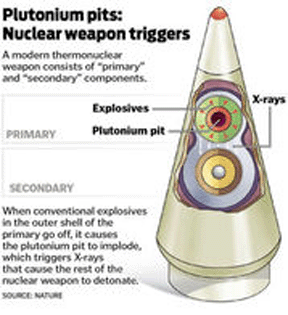 Santa Fe shouldn’t become a nuclear sacrifice zone https://www.abqjournal.com/1477033/santa-fe-shouldnt-become-a-nuclear-sacrifice-zone-ex-where-does-the-city-stand-in-matters-of-peace-the-environment-and-citizens-health-and-welfare.html,BY LYDIA CLARK, July 19th, 2020 This is an open letter to Santa Fe Mayor Alan Webber and the City Council:We, the Los Alamos Study Group, have now written to the Santa Fe City Council and the mayor of Santa Fe numerous times regarding two very important resolutions we have proposed, with no response of any significance from anyone.
These resolutions are of great import to the safety, health and welfare of the city and citizens of Santa Fe, and we are very concerned the City Council and mayor are ignoring these issues.
The City of Santa Fe has had a long-standing policy of resolutions supporting nuclear disarmament, supporting environmental impact statements and opposing production of nuclear weapons, specifically plutonium pit production.
Santa Fe has also been and is still a member of “Mayors for Peace,” which states that “nuclear weapons are inhumane” and calls for “their abolition.”
Recently, Mayor Webber attended a “peaceful protest” regarding racial issues. Is the destruction of humanity and the planet less important in keeping the peace?
The safety, health and welfare are only a part of the impact created from nuclear weapons production at Los Alamos National Laboratory. It uses and diverts much-needed funding for education, health care, sustainable jobs, and real safety and security away from New Mexico. The proposed FY2021 federal budget solely for plutonium pit production at LANL is now $1.1 billion (an increase since our last letter). How many truly beneficial programs for New Mexico would this support?
Nuclear weapons production creates vast amounts of toxic waste that has no safe method of disposal, with the potential to contaminate our environment from spills, leakage, fire hazard, seismic activity and human error. The waste currently being stored at LANL will not be transported for disposal any time in the near future. Where will the new waste be stored?
The recent exposure to LANL workers from a breach in a plutonium glove box is foreshadowing of things to come with the proposed plutonium pit factory at the facility. LANL has a history of safety failures.
The last plutonium pit factory, Rocky Flats (in Colorado), was forcibly closed for egregious environmental violations, worker injuries and deaths. Is New Mexico willing to create Rocky Flats II?
Why would the city officials not support asking for a Site-Wide Environmental Impact Statement (which is part of one of the above-referenced resolutions) that can help protect not only Santa Fe, but also the entire northern New Mexico region in this crucial matter?
The other resolution would bar the city from entering into development agreements with LANL or other nuclear weapons agencies. (There has been talk of a LANL presence on the city-owned Midtown Campus).
Your lack of concern and response is disturbing, and we ask once more for a prompt response to the request for support and implementation of these two resolutions, and an explanation to the public of the position of the city of Santa Fe in matters of peace, sustainability, environmental protection, and the health and welfare of our citizens, and the citizens of New Mexico.
Do not allow our city to become a nuclear sacrifice zone.
Lydia Clark is outreach director-Santa Fe for the Los Alamos Study Group.
California Coastal Commission unanimously approves storage plan at San Onofre Nuclear Generating Station
California Coastal Commission unanimously approves storage plan at San Onofre Nuclear Generating Station CBS8, 17 Jul 20, The Commission voted 10-0 to approve the program to allow storage of spent nuclear fuel on-site. SAN DIEGO COUNTY, Calif. — The California Coastal Commission voted 10-0 in a special meeting today to approve an inspection and maintenance program allowing Southern California Edison to store spent nuclear fuel in a storage site at the San Onofre Nuclear Generating Station.
The program outlines actions SCE will take to inspect the canisters that contain spent nuclear fuel, as well as how potential issues with the canisters will be remedied.
Robotic devices will be used to inspect the canisters and site conditions will be simulated on a test canister, which will be observed for potential degradation. Two spent fuel storage canisters will be inspected every five years starting in 2024, and the test canister will be inspected every two to three years.
Canister flaws will be repaired by the application of a nickel-based metallic spray, and the presence of flaws may result in increased canister inspection frequency and an increase in the number of canisters inspected.
The inspection and maintenance program was also reviewed by the engineering consulting firm LPI, which provided recommendations that included the increase in canister inspections should flaws arise.
Nearly 3.6 million pounds of spent nuclear fuel are stored at the plant, which stopped producing electricity in 2012.
Concerns remain over the plant’s proximity to the ocean and the potential for the site to be affected by rising sea levels, tsunami inundation, seismic hazards.
By 2035, the commission may look to relocate the canisters to another site, although no such location is available, according to a commission report. ……. https://www.cbs8.com/article/news/local/san-onfre-nuclear-power-plant-storage-approval/509-b0c102a6-86b7-45c3-a5d7-b5013cfc19c4
Nuclear waste is piling up in California: leadership is needed
Gov. Gavin Newsom and leaders from the Legislature must demand action on nuclear waste and fill gaps in oversight. By Bart Ziegler, CalMatters, 17 Jul 20,
Bart Ziegler is president of the Samuel Lawrence Foundation, a nonprofit based in Del Mar, bart@samuellawrencefoundation.org.
From San Onofre to Humboldt Bay, nuclear waste is piling up in California.
This most-toxic waste – tons and tons of it – is deadly for 200,000 years. Stranded next to a rising ocean at aging and decommissioned plants, the waste has no permanent home.
California is overdue in showing leadership.
Just as California has broken ranks with the federal government on regulating greenhouse gas emissions, Gov. Gavin Newsom and leaders from the Legislature must demand action on nuclear waste and fill gaps in oversight.
With federal regulators all but cornering nuclear policy, the industry all too often is left to regulate itself. Meanwhile, private contractors slop at ratepayer-funded decommissioning troughs while running loose with safety.
Enough is enough, California!
In north San Diego County, conditions at the shuttered San Onofre Nuclear Generating Station scream for state intervention, as Rep. Mike Levin, a Democrat from San Juan Capistrano, concluded in a task force report issued recently.
First, some background.
Decommissioning started this year at the San Onofre plant, which quit making electricity in 2012. The plant’s majority owner, Southern California Edison, has opened its $4 billion decommissioning purse to Holtec International as lead contractor in charge of transferring 3.6 million pounds of spent nuclear fuel from cooling pools to a storage system of Holtec’s design.
That’s where things get dicey.
Edison’s contractors are cramming the spent fuel assemblies into thin-walled, steel canisters. Workers hoist the canisters from wet storage with a behemoth, track-driven gantry crane and crawl them to a concrete, dry-storage vault. That’s where the 73 canisters will stay. Indefinitely.
Public hand-wringing intensified after a near-accident in 2018 involving a fully-loaded canister and the release of reports showing the canisters are prone to gouging during transfer. That can lead to corrosion and failure, especially in a marine environment. To make matters worse, the canisters cannot be repaired, monitored, inspected or transported once entombed in the vault.
What can California do? For starters, leaders can immediately improve oversight of nuclear waste storage.
Nuclear plant owners admit to not having developed procedures to replace fully-loaded canisters. That’s why, as part of decommissioning California’s coastal nuclear plants at San Onofre, Diablo Canyon and Humboldt Bay, the state Coastal Commission must demand the construction of handling facilities – known as “hot cells” – where canisters can be repaired or replaced.
State lawmakers should order construction of a hot cell at the decommissioned Rancho Seco Nuclear Generating Station, just 40 miles south of their offices in Sacramento.
In San Diego County, near the border with Orange County, 8.2 million people live within 50 miles of the old San Onofre plant. On July 16, the California Coastal Commission is set to act on a staff recommendation to approve Edison’s application to dismantle the plant’s cooling pools. That approval would be disastrous. For now at least, the spent fuel cooling pools provide our last option for dealing with a damaged canister.
Coastal Commissioners are appointed by the same Legislature that should prepare for a crisis instead of responding to one. You don’t wait for a fire to create a fire department. Preparation is cheaper and faster than responding to a crisis. Tragically, the COVID-19 pandemic has shown that preparation is not always our strongest suit.
As recommended in the Report of the San Onofre Nuclear Generating Station Task Force, a state model would improve agency coordination on waste storage permit applications and increase engagement with federal agencies to advance solutions for containing and handling deadly nuclear waste. The solutions should be tied to strict, economic enforcement.
Coastal commissioners, lawmakers, regulators and anyone else with a stake in California – that’s nearly 40 million of us – should read the report and demand action on nuclear waste.
State of Texas allows reduction in price of importing nuclear waste
State allows reduction in price of importing nuclear waste to Texas https://news4sanantonio.com/news/trouble-shooters/state-allows-drastic-reduction-in-price-of-importing-nuclear-waste-to-texas by APRIL MOLINA, Friday, July 17th 2020 SAN ANTONIO — The state has agreed to allow a private company in West Texas to drop the price charged for incoming nuclear waste.
Waste Control Services (WCS) has been disposing of the nation’s low level nuclear waste in Andrews County at a cost of $100 dollars per cubic foot for Class A waste and $1000 dollars per cubic foot for Class B and C waste.
There is an additional surcharge of 40 cents per unit of radioactivity, but The Texas Commission on Environmental Quality recently approved the request by WCS to drop the price to 5 cents per unit.
A spokesman for WCS explained the market is dynamic so when the price drops, they need to be able to continue to compete.
Public Citizen Texas Office Director, Adrian Shelley worries that by allowing WCS to import nuclear waste at a fraction of the cost, it could result in massive liability for the state.
“If WCS collects less money to import waste in Texas, then there will be less money available should an accident occur and ultimately we’re concerned Texas taxpayers will be on the hook should an accident occur,” Shelley said.
The company doesn’t expect less revenue, rather they anticipate more income as a result of the price drop.
WCS reports Andrews County gets 5% of their revenue and the state gets 25%.
WCS has also been working to get approval for years to temporarily store the nation’s high level nuclear waste that would include spent nuclear fuel rods.
Blistering debate over San Onofre’s “nuclear waste dump by the sea,”
 Plan to inspect San Onofre’s aging nuclear waste expected to spark debate at Coastal Commission meeting Plan to inspect San Onofre’s aging nuclear waste expected to spark debate at Coastal Commission meeting
Although the analysis suggests doomsday scenarios may be more fantastical than factual, an engineering firm did suggest several improvements By TERI SFORZA | tsforza@scng.com | Orange County Register July 13, 2020 As debate continues to blister over San Onofre’s “nuclear waste dump by the sea,” an independent analysis concludes that the giant canisters housing that waste — and the program Southern California Edison has created to monitor and potentially repair them — will keep everything safe at least through 2035.Edison’s inspection and maintenance plan for its Holtec dry storage system — the “concrete monolith” now holding 69 of the 73 radioactive waste canisters it will hold by summer’s end, when all radioactive waste is finally removed from its spent fuel pools — is unveiled years earlier than the California Coastal Commission originally envisioned. It will be the subject of fiery debate at the Coastal Commission’s online meeting beginning 9 a.m. Thursday, July 16. Commission staff recommends approval of Edison’s plan, but critics are expected to vigorously oppose it………. How will it work?There are several layers to the inspection and maintenance program. Edison will keep tabs on the “concrete bunker” itself. Every day, workers will monitor temperatures and inspect air passageways and vent screens to make sure they remain free of blockage. Every month, air vent screens will be inspected for damage. Every year, there will be visual inspections of external surfaces for degradation. And every five years, there will be inspections of the structure for concrete settlement. How will it work?There are several layers to the inspection and maintenance program. Edison will keep tabs on the “concrete bunker” itself. Every day, workers will monitor temperatures and inspect air passageways and vent screens to make sure they remain free of blockage. Every month, air vent screens will be inspected for damage. Every year, there will be visual inspections of external surfaces for degradation. And every five years, there will be inspections of the structure for concrete settlement………. Bigger problemThe national paralysis over long-term storage of spent nuclear fuel is the elephant in the room. The federal government agreed to start collecting commercial nuclear waste for permanent disposal more than 20 years ago — but it hasn’t collected an ounce. That’s why it’s stuck at San Onofre, and dozens of commercial nuclear plants nationwide. There are hopes that temporary storage facilities in Texas and New Mexico might be licensed by the NRC while the federal government tries to find a permanent solution, but waste is likely to remain at San Onofre for many years. That’s why a maintenance and inspection program is required. While the Coastal Commission approved two dry storage systems at San Onofre Nuclear Generating Station, “it also has expressed concern regarding storing spent nuclear fuel at SONGS because of the facility’s location adjacent to the Pacific Ocean and Interstate-5, proximity to major population centers, and site topography and potential effects from coastal hazards,” the staff report says. “Because of the lack of a long-term repository for spent nuclear fuel, SONGS — like other nuclear power plants in the United States — has had to resort to interim storage of spent nuclear fuel on site.” Officials urge those who want spent fuel moved from San Onofre to focus on prodding the federal government toward a solution. Edison also is working on a strategic plan to explore the possibility of moving the waste off the bluff over the Pacific, and expects to finish by the end of the year. https://www.ocregister.com/2020/07/13/plan-to-inspect-san-onofres-aging-nuclear-waste-expected-to-spark-debate-at-coastal-commission-meeting/ |
|
New Mexico nuclear facility is bad news
|
New Mexico nuclear facility is bad news, https://lasvegassun.com/news/2020/jul/06/new-mexico-nuclear-facility-is-bad-news/ By Judy Treichel Monday, July 6, 2020 It may seem like good news in Nevada that an effort is underway in New Mexico to build a private storage facility for nuclear waste there.
But don’t be mistaken: This facility wouldn’t be an alternative to the disastrous Yucca Mountain nuclear waste repository. In fact, its existence depends on Yucca Mountain becoming an operating repository. That’s unacceptable, because the Nevada facility poses far too many risks for our state.
The license application for the New Mexico facility calls for it to operate over 40 years, after which the waste stored in it would go to Yucca Mountain. Twelve years ago, the Department of Energy submitted an application for a construction authorization and license to make Yucca Mountain the nation’s high-level nuclear waste repository. Two years later, in 2010, the department attempted to withdraw the application. It had determined that the plan was “unworkable” due to the opposition and unending resistance of the people of Nevada, but the court decided that the licensing process should proceed. It did, until funding ran out, and today those deliberations are on an indefinite hold. Now comes the New Mexico license application to the Nuclear Regulatory Commission, which in the opinion of the Nevada Nuclear Waste Task Force the commission should not have accepted with the assumption that Yucca Mountain would be an operating repository. We have submitted comments to that effect to the commission. During all of the time that Nevada has been fighting the Yucca Mountain proposal, we were repeatedly assured that we could place our trust in the commission because before any license was granted for construction or operation, a thorough and unbiased process would fully play out. We were told there was no reason for questioning the fairness of the commission’s licensing process. Nevadans have been accused of having a NIMBY (not in my backyard) attitude about nuclear waste — that we would be pleased if some other place were forced to host a repository instead of us. That is not true. We know that Yucca Mountain is unsuitable and should have been disqualified, and we have respected the democratic right of others to oppose dangers or threats where they live. Any siting of a facility that creates risk for the community should require informed consent, and the people of New Mexico do not consent. What we see happening with this so-called interim site is that it does not solve the nuclear waste problem. In fact it increases the risks by putting the waste on the roads and rails, and requiring it to be loaded and unloaded multiple times and transported more than once. Additionally, the only way a site can be considered “interim” is to know that the waste will leave, and the assumption here is that it will leave New Mexico and come to Nevada. The incentive for the company proposing to build the facility is purely financial — specifically, it’s to gain access to the $42 billion in the federal nuclear waste fund. An interim site does not increase or improve public safety, but rather does just the opposite. It creates one more nuclear waste site and provides more room at reactor sites for more waste. And it moves the waste closer to Nevada. A national high-level nuclear waste repository at Yucca Mountain is an overwhelmingly unsafe idea. Nevada residents, elected officials and people across the country living near transport routes know it. For 20 years, the Department of Energy studied the site and discovered — or were forced to admit — that there were conditions present that, according to their own guidelines, disqualified the site. If the licensing process ever restarts, how could we trust the Nuclear Regulatory Commission to fairly judge the science when it has previously assumed a licensed and operating repository at Yucca Mountain? Congress needs to reverse the action it took naming Yucca Mountain as the only site to be considered for a national repository, and take a fresh and fair look at nuclear waste disposal. Initiatives like the interim storage site in New Mexico are simply misguided and misleading diversions. Judy Treichel is executive director of the Nevada Nuclear Waste Task Force. |
|
Problems and dangers face the dismantlement of damaged Three Mile Island nuclear reactor
“The smell was a combination of rotting eggs, diesel fuel and a smoldering fire pit,” he said.
The plant’s Unit 2 reactor had partially melted down about 4 a.m. March 28, 1979, and as Mohr remembers it, locals panicked, fearing for their safety. Some fled, others hid inside.
“I can remember this like it was yesterday,” said Mohr, who has been a longtime township supervisor. “There was definitely an air of uncertainty. People were confused.”
Four decades later, confusion and concern have returned near the now-inactive power plant as officials at Utah-based EnergySolutions plan to dismantle the historic reactor.
It’s a plan that has state environmental officials and local nuclear watchdogs ringing proverbial alarm bells, pointing to concerns that money set aside for the decommissioning could run out before the work is finished.
That’s in addition to fears about the potential for indefinite radioactive contamination on the island, which sits just upstream from Lancaster County on the Susquehanna River.
Old concerns resurface
To Arthur Morris, Lancaster city’s mayor from 1980 to 1990, some of those worries are familiar. They existed in the years after the 1979 accident, when Morris sat on a state advisory board that focused on radioactive decontamination of Unit 2.
Back then — and now — the Susquehanna River served as the primary source for several downstream Lancaster County drinking water systems, including in Lancaster city.
As mayor, Morris said one of his priorities on the panel was to make sure radiation wasn’t carried downstream and piped through Lancaster residents’ faucets — a priority that led to regular testing near the plant that persists today.
Last week, Morris said he isn’t surprised that some of those old concerns have resurfaced with Unit 2 coming back under scrutiny.
“Those things don’t go away until the island is cleaned up,” Morris said.
‘Worst-case scenario’
However, it’s a cleanup plan that has nuclear watchdog Eric Epstein speaking out on signs of pending danger.
“It’s the worst-case scenario,” said Epstein, a leader of the Harrisburg-based group Three Mile Island Alert.
Last fall, Unit 2’s owners at Ohio-based FirstEnergy Corp. announced that they planned to transfer all related licenses and assets to TMI-2 Solutions LLC, an EnergySolutions subsidiary.
The transfer would mean that EnergySolutions also would take over the responsibility of eventually dismantling the Unit 2 reactor.
And that eventuality had already been planned for by the time the proposed transfer was announced in October. Then, EnergySolutions revealed plans to contract decommissioning work out to New Jersey-based construction company Jingoli, which has had past success with nuclear projects in the United States and Canada.
Despite a track record, state Department of Environmental Protection officials warned that planning for and beginning decommissioning work too early could put the island and surrounding areas at risk.
After all, DEP Secretary Patrick McDonnell noted, Unit 2 is the site of the worst commercial nuclear accident in United States history — an accident that released radioactive gases and grossly contaminated the reactor and its surrounding buildings.
“Because of this, we understand there are very high radiation areas within TMI Unit 2 that present a grave risk to personnel that enter,” a letter signed by McDonnell reads.
That high radiation has prevented all but minor exploration of the Unit 2 area, meaning the radiological conditions inside large portions of the plant remain a mystery, according to the letter.
“I firmly believe TMI Unit 2 is the most radiologically contaminated facility in our nation outside of the Department of Energy’s weapons complex,” it reads.
Postponing the cleanup for “several decades” could allow for a decrease in radioactive potency, possibly lessening the chance of further environmental contamination, McDonnell wrote.
All of that is in addition to raising questions about how radioactive waste will be disposed, transported and stored. That includes concerns about whether any of that waste will be stored on the island — a site that Epstein believes could remain indefinitely radioactive.
Both McDonnell’s writings and Epstein’s concerns were submitted this spring to officials at the U.S. Nuclear Regulatory Commission, which must approve the FirstEnergy-to-EnergySolutions transfer request.
Commission officials have been reviewing the request since November, and similar reviews have been completed in a year or less, according to spokeswoman Diane Screnci.
Financial concerns
But it’s not only environmental issues that will be weighed as part of that review, with Epstein and state officials also raising serious financial concerns.
Specifically, they’ve drawn attention to a largely ratepayer-funded $901 million trust set aside to cover the cost of decommissioning, which has been estimated at upward of $1.2 billion.
Further complicating the issue, according to McDonnell’s letter, is the fact that trust fund dollars are tied to the stock market, which has seen large fluctuations due to the ongoing COVID-19 pandemic.
“Given the obvious uncertainties and complexities associated with cleaning up the remains … the demonstration of adequate funding to complete the decommissioning of TMI-2 and restoration of the site, is a significant concern of the department and the citizens of Pennsylvania,” McDonnell wrote.
Beyond sharing McDonnell’s letters, DEP officials said they could not further discuss the proposed decommissioning, citing litigation. Nondisclosure agreements stipulated by EnergySolutions also prevent DEP and Epstein from sharing some details.
EnergySolutions spokespeople did not respond to multiple requests for comment, though they indicated they are aware of concerns about their work.
Jennifer Young, a FirstEnergy spokeswoman, said company officials have faith the job will be completed on budget despite the existing disparity between the trust fund and estimated cost.
Cost estimates show there are sufficient funds given the project schedule for decommissioning,” she said. “Keep in mind that those funds will continue to accumulate value throughout the decommissioning process, which takes place over many years. Not all the money will be required or spent at one time.”
Epstein said it’s important to point out that the Unit 2 trust is full of ratepayer money, which will be under the full control of EnergySolutions’s TMI-2 Solutions LLC, a private company, with little public scrutiny.
Right company for the job
Despite those concerns, Young said FirstEnergy officials believe EnergySolutions is the right company to dismantle Unit 2. In fact, EnergySolutions decommissioning proposal was selected over offers from two other companies, she said. The unsolicited EnergySolutions proposal was made in 2018, Young said.
By Nuclear Regulatory Commission decree, the plant must be decommissioned within 60 years of halting operation, and Three Mile Island’s functioning Unit 1 was taken offline by its owner, Exelon, in 2019.
“We were faced with a decision to decommission the unit now or wait to start in the 2030s,” Young said.
“Waiting would not guarantee there would be companies available to start the dismantlement in time to comply with the 60-year requirement due to the large number of nuclear plant licenses that will expire in the 2030s,” he said.
Still, Epstein said he’d like a Nuclear Regulatory Commission decision on the transfer to remain delayed until his and DEP’s concerns can be worked through.
Like a big gravestone
Back in Conoy Township, Mohr said his full faith is in the commission to make the right decision — an opinion steeped in the immediate aftermath of the 1979 partial meltdown.
It was a commission official, Harold Denton, who shared the first details with locals, offering assurances that everything would be alright, he said.
“When he was done speaking, it was like the world calmed down,” Mohr said of the commission official. “He put it into a perspective that even we understood.”
For decades since, the plant has meant local jobs and local money, but since the 2019 shutdown, much of that has fallen by the wayside, he said. And it’s mostly for that reason that Mohr said he’s indifferent to the island’s fate.
“It’s almost to the point now that it was never there. If we drive north, we see it,” he said. “It reminds me of the biggest gravestone that I ever saw.”
Book: Doom With A View: Historical and Cultural Contexts of the Rocky Flats Nuclear Weapons Plant.
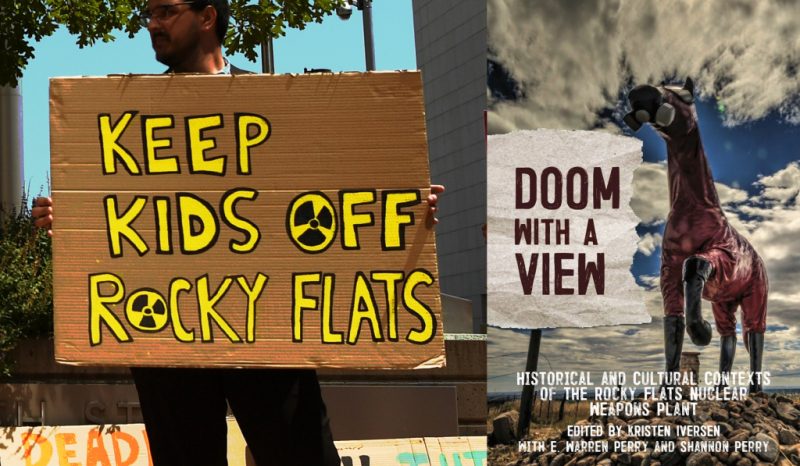
The Grieving Landscape, LONGREADS, Heidi Hutner | Fulcrum Publishing | June 2020 | 16 minutes (4,305 words)
We’re delighted to bring you an excerpt by Heidi Hutner from the anthology Doom With A View: Historical and Cultural Contexts of the Rocky Flats Nuclear Weapons Plant. Edited by Kristen Iverson, with E. Warren Perry and Shannon Perry, the anthology arrives from Fulcrum Publishing in August, 2020.
At thirty-five, I was diagnosed with Hodgkin’s lymphoma. One year before my diagnosis, my mother died from complications after heart surgery. At the time of her death, my mother had cancer — lymphoma. Five years prior to Mom’s death, my father passed away from a brain tumor, a metastasis from the cancer melanoma.
Two years after I had completed my chemotherapy treatment for cancer, I gave birth to Olivia. My miracle baby.
At first, I was ecstatic about the pregnancy. I had always wanted children, and with my cancer, I feared this would never happen. My doctors said I was lucky to give birth to a biological child after chemotherapy (my treatment left me with a 50 percent chance of remaining fertile afterward). But now, a mother-to-be, I was also afraid. How could I protect my child from our family cancer blight?
My desire to protect my daughter from a future cancer diagnosis drove me into a rabbit hole of reading and learning about the reasons for my family’s affliction. I began with Rachel Carson’s Silent Spring and moved forward to more recent literature by Sandra Steingraber, Theo Colburn, and numerous others, including the President’s Cancer Panel Report. I learned that the cancer rates today are off the charts: one in two men and one in three women will get cancer in their lifetimes. Carson predicted this plague in 1963. She warned us of humankind’s “hubris” in carelessly polluting our earth with toxic chemicals and ionizing radiation. The epidemiologist Alice Stewart’s study on the grave danger of X-rays on babies in the womb in the 1950s, sounded the alarm about ionizing radiation as well. Today, our world swirls with pollutants — these carcinogens penetrate mothers’ wombs and breasts. Mother’s milk is a toxic cocktail. Newborns today are born with hundreds of synthetic chemicals in their umbilical cord blood. Synthetic chemicals and ionizing radiation change our makeup, harm our genes, and cause mutagenetic damage. More than 80,000 unregulated pollutants fill our environment.
We are guinea pigs.
Fast forward about eleven years: one summer day, in 2009, on the Upper West Side of Manhattan, at lunch with a close friend (and cousin) of my deceased mother, Phyllis Resnick, I stumbled upon a story about my mom that I had never heard before. The tale Phyllis told would radically change my life. My then-preteen daughter, Olivia, was by my side. She listened rapt with me as we learned of our maternal nuclear legacy.
Phyllis described how in the early 1960s, my mother and she, along with their good friend Thalia Stern Broudy, had been a members of Women Strike for Peace (WSP), an antinuclear group led by Dagmar Wilson and the future congresswoman, Bella Abzug. During the Cold War 1950s and early 60s, the U.S. had detonated one hundred above-ground nuclear test bombs in the Nevada desert and one hundred and six atmospheric test bombs in the South Pacific. The government claimed these test bombs posed no harm and the fallout had not spread, but scientists and medical professionals were concerned. A team of experts in St. Louis, MO, directed by Dr. Louise Reiss, initiated a survey to determine the extent of the impact of the bomb testing. With a chemical makeup similar to calcium, strontium-90, a radioisotope found in fallout, is easily absorbed in teeth and bones. Thousands of baby teeth from across the U.S. were collected between 1958 and 1971 for the St. Louis Baby Tooth Survey. In 1961, preliminary results showed high levels of strontium-90 in baby teeth of children born after 1945 and these levels increased over the time period, as the test-bombing continued. When the mothers of Women Strike for Peace learned the results of the survey, they banded together to stop atmospheric bomb testing. 50,000 WSP members from across the U.S. wrote letters, gathered petitions, lobbied congressional representatives, initiated lawsuits, and protested through marches and street demonstrations. My mother and her cohort of 15,000 WSP members traveled to D.C. to protest, lobby, and meet with their legislators November, 1961. In 1963, the United States, the U.K., and the Soviet Union signed the Partial Nuclear Test Ban Treaty, an agreement to halt atmospheric, under water, and outer space bomb testing. The signing of this treaty has been attributed to the efforts of WSP.
The government claimed these test bombs posed no harm and the fallout had not spread, but scientists and medical professionals were concerned.
After discovering this remarkable story about WSP, I became obsessed with feminist nuclear history. I wondered: Why had I never been told this tale when my mother was alive? What other vital nuclear histories involving women had been buried? So began my journey of exploring women’s antinuclear tales, traveling to nuclear disaster sites, and meeting with members of impacted communities. On this path, I met Kristen Iversen, the author of Full Body Burden, an investigative memoir about growing up next door to Rocky Flats, the former nuclear weapons facility in Arvada, Colorado. Kristen invited me to visit her in Colorado. She would introduce me to experts, scientists, and community members there. I brought my then eighteen-year-old daughter, Olivia, with me. She was about to leave for college. I wanted to share our maternal antinuclear and activist legacy with her before she left home. ………….
Operating from 1952 to 1992, the Rocky Flats nuclear weapons facility was located approximately 15 miles northwest of Denver, a city built by an influx of miners during the gold rush in the nineteenth century. During the years of its operation, the plant constructed more than 70,000 triggers for nuclear bombs. Rocky Flats would be the site of two major secret plutonium fires, blowing radioactive poison into sections of Arvada and Denver in 1957 and 1969. Hundreds of smaller fires also took place, as well as regular leaks, spills, and atmospheric plutonium releases. Plutonium clouds blew over houses, swimming pools, schools, churches, farms, fields, and streams. Rocky Flats is known for powerful Chinook winds — winds that would blow plutonium dust into local neighborhoods. Locals did not know that Rocky Flats was a weapons factory for most of its years of operation. Workers employed there were forbidden to speak of their work and often didn’t comprehend the full extent of the factory’s activities.
By 1989, The FBI and EPA suspected criminal negligence at Rocky Flats, which led to a raid, led by FBI agent Jon Lipsky.
A federal grand jury began an investigation, a settlement was negotiated, the court documents were sealed, and the plant closed. The story of this federal grand jury is fraught and complex, and cover-ups are suspected in the sealing of the documents and lack of full prosecution. The Rocky Flats cleanup was officially completed in 2004; however, numerous scientists, nuclear experts, local citizens, and antinuclear activists argue the cleanup is far from finished. Unknown but large amounts of plutonium and other contaminants remain on the land in what has been turned into a Superfund site, a designation made under the Comprehensive Environmental Response, Compensation, and Liability Act of 1980. The primary industrial site (the Superfund area — 485 acres) was never completely remediated. There is a buffer zone, also heavily contaminated, although the EPA claims this area is fully remediated. The surrounding area, now called a National Wildlife Refuge, was not remediated. Significant contamination has been detected there in the soil and groundwater. Many other toxic and radioactive contaminants have also been found at Rocky Flats in addition to plutonium: americium, uranium, cadmium, PCBs, beryllium, and more. A 2019 study found plutonium “hot particles” in the soil frighteningly close to the homes abutting the Flats………
Rocky Flats is “a national sacrifice zone,” says Robert Alvarez, associate fellow at the Institute for Policy Studies and former senior policy advisor to the secretary at the US Department of Energy. “That’s what it is, although no one will say so officially. How much remains buried there? A tremendous amount — plutonium doesn’t go away. No one has done this yet — it’s costly and complex — but someone needs to go into those houses nearby in Arvada and take samples. We don’t know how much plutonium is in them.”…….. https://longreads.com/2020/06/30/the-grieving-landscape/amp/
Reducing radioactive waste in processes to dismantle nuclear facilities
 Reducing radioactive waste in processes to dismantle nuclear facilities
https://www.eurekalert.org/pub_releases/2020-07/uotb-rrw070820.phpThe University of the Basque Country (UPV/EHU) has produced a methodological guide of in situ measurements for the purpose of optimizing waste management in nuclear dismantling processesUNIVERSITY OF THE BASQUE COUNTRY Recent years have seen a move into a phase to decommission and dismantle nuclear power stations and facilities, above all in Europe. By 2015, 156 reactors at nuclear facilities across the world had been shut down or were being decommissioned, and by 2050 over half of the current nuclear capacity of 400 GW across the world is programmed to be decommissioned so that it can be dismantled. “In Europe this will result in an increase in radioactive waste while current storage facilities have limited capacity. Optimizing this management is crucial,” said the UPV/EHU professor Margarita Herranz.
In situ measurements in constrained environments.
“The dismantling of facilities of this type is a very costly process, the waste takes up a huge amount of space and, what is more, people do not like having repositories of this type on their doorstep. And if we also talk about dismantling many nuclear facilities, it is crucial to specify what has to be regarded as radioactive waste inside a nuclear power station and what does not; this is because the cost of managing this waste increases significantly in terms of its level of activity, and the dismantling of a nuclear power station may result in the extracting of tonnes upon tonnes of waste,” explained the researcher in the UPV/EHU’s Department of Nuclear Engineering and Fluid Mechanics. Although the dismantling conducted so far has exhaustively complied with the regulations in force, “a considerable part of what has been regarded as nuclear and radioactive waste does not in fact fit into that category”, she said. “Erring too much on the side of caution has occurred in this respect.”
Margarita Herranz, who leads the working group responsible for organising and implementing measures in situ and conducting the subsequent analysis of the results, said that “it is essential to optimize the in situ measurements of radioactivity in walls, partition walls, machinery, metal shields, etc. owing to the impossibility of moving them in their entirety to the lab”. It is worth highlighting that these are difficult measurements “because you have to see what equipment has been adapted for this purpose and obtain good results in terms of the atmosphere existing in each environment: radiation, temperature, pressure, humidity, etc.”. In this context “we have specified the constrained environments from the standpoint of in situ measurements in nuclear and radioactive facilities, how these constraints affect the type of equipment that is going to be used, and how these constraints may end up affecting the results or the assessment of the results that are going to be obtained,” she said. They are also working to describe the different zones of a nuclear/radioactive facility and the problems that may be present in them, and also to recommend the types of instruments to be used in each of these zones.
Herranz pointed out that this project “is contributing towards optimizing the dismantling processes and towards improving the public perception of these processes. In other words, to show that they are being monitored and that work is being done in this respect. A lot of technology has been placed at the service of this aim. Basically, it is a social aim”. Within the framework of the European INSIDER project, many scientific articles are being published and are being used to compile an extensive methodological guide which can be accessed via the INSIDER website. The project is hoping to improve EU policy: “We hope this work will end up influencing the drawing up of international regulations,” concluded the researcher.
This study was conducted in collaboration with Raquel Idoeta, lecturer in the UPV/EHU’s Department of Nuclear Engineering and Fluid Mechanics. It also had the participation of Frederic Aspe and Gregoire Auge of the French company Onet Technologies, which is involved in taking measurements at French nuclear facilities.
Fukushima nuclear waste decision also a human rights issue
Fukushima nuclear waste decision also a human rights issue https://english.kyodonews.net/news/2020/07/1145e5b3970f-opinion-fukushima-nuclear-waste-decision-also-a-human-rights-issue.html
By Baskut Tuncak, KYODO NEWS – In a matter of weeks, the government of Japan will have the opportunity to demonstrate to the world how much it values protecting human rights and the environment and to meet its international obligations.
In the aftermath of the Fukushima Daiichi nuclear disaster, myself and other U.N. special rapporteurs consistently raised concerns about the approaches taken by the government of Japan. We have been concerned that raising of “acceptable limits” of radiation exposure to urge resettlement violated the government’s human rights obligations to children.
We have been concerned of the possible exploitation of migrants and the poor for radioactive decontamination work. Our most recent concern is how the government used the COVID-19 crisis to dramatically accelerate its timeline for deciding whether to dump radioactive wastewater accumulating at Fukushima Daiichi in the ocean.
Setting aside the duties incumbent on Japan to consult and protect under international law, it saddens me to think that a country that has suffered the horrors of being the only country on which not one but two nuclear bombs were dropped during war, would continue on a such a path in dealing with the radioactive aftermath of the Fukushima Daiichi disaster.
Releasing the toxic wastewater collected from the Fukushima nuclear plant would be, without question, a terrible blow to the livelihood of local fishermen. Regardless of the health and environmental risks, the reputational damage would be irreparable, an invisible and permanent scar upon local seafood. No amount of money can replace the loss of culture and dignity that accompany this traditional way of life for these communities.
The communities of Fukushima, so devastated by the tragic events of March 11, 2011, have in recent weeks expressed their concerns and opposition to the discharge of the contaminated water into their environment. It is their human right to an environment that allows for living a life in dignity, to enjoy their culture, and to not be exposed deliberately to additional radioactive contamination. Those rights should be fully respected and not be disregarded by the government in Tokyo.
The discharge of nuclear waste to the ocean could damage Japan’s international relations. Neighboring countries are already concerned about the release of large volumes of radioactive tritium and other contaminants in the wastewater.
Japan has a duty under international law to prevent transboundary environmental harm. More specifically, under the London Convention, Japan has an obligation to take precaution with the respect to the dumping of waste in the ocean. Given the scientific uncertainty of the health and environmental impacts of exposure to low-level radiation, the disposal of this wastewater would be completely inconsistent with the spirit, if not the letter, of this law.
ndigenous peoples have an internationally recognized right to free, prior and informed consent. This includes the disposal of waste in their waters and actions that may contaminate their food. No matter how small the Japanese government believes this contamination will be of their water and food, there is an unquestionable obligation to consult with potentially affected indigenous peoples that it has not met.
The Japanese government has not, and cannot, assure itself of meaningful consultations as required under international human rights law during the current pandemic. There is no justification for such a dramatically accelerated timeline for decision making during the covid-19 crisis. Japan has the physical space to store wastewater for many years.
I have reported annually to the U.N. Human Rights Council for the past six years. Whether the topic was on child rights or worker’s rights, in nearly each and every one of those discussion at the United Nations, the situation of Fukushima Daiichi is raised by concerned observers for the world to hear. Intervening organizations have pleaded year-after-year for the Japanese government to extend an invitation to visit so I can offer recommendations to improve the situation. I regret that my mandate is coming to an end without such an opportunity despite my repeated requests to visit and assess the situation.
The disaster of 2011 cannot be undone. However, Japan still has an opportunity to minimize the damage. In my view, there are grave risks to the livelihoods of fishermen in Japan and also to its international reputation. Again, I urge the Japanese government to think twice about its legacy: as a true champion of human rights and the environment, or not.
(Baskut Tuncak has served as U.N. special rapporteur on the implications for human rights of the environmentally sound management and disposal of hazardous substances and wastes since 2014.)
European Commission demands that Romania adopt a nation radioactive waste management programme
 Radioactive waste: Commission calls on ROMANIA to enact correctly EU law in this field act, Media Romania News Agency , July 3, 2020
The Commission has decided to send reasoned opinions to Bulgaria, Denmark, Greece, Lithuania, Poland and Romania for failing to adopt a national programme for radioactive waste management compliant with the requirements of the Spent Fuel and Radioactive Waste Directive (Council Directive 2011/70/Euratom), and has also sent another reasoned opinion to Romania for failing to transpose correctly certain requirements of the same Directive. ….
The Directive establishes a Community framework for ensuring the responsible and safe management of spent fuel and radioactive waste to ensure a high level of safety and avoid imposing undue burdens on future generations. In particular, it requires Member States to draw up and implement national programmes for the management of all spent fuel and radioactive waste generated on their territory, from generation to disposal.
The aim is to protect workers and the general public from the dangers arising from ionising radiation. Member States were required to transpose the Directive by 23 August 2013 and to notify their national programmes for the first time to the Commission by 23 August 2015. The Member States concerned have three months to act. Otherwise, the Commission may decide to refer these cases to the Court of Justice of the EU. https://www.actmedia.eu/daily/radioactive-waste-commission-calls-on-romania-to-enact-correctly-eu-law-in-this-field/87391
Scepticism over USA Dept Energy report that the Runit nuclear waste dome is “safe”
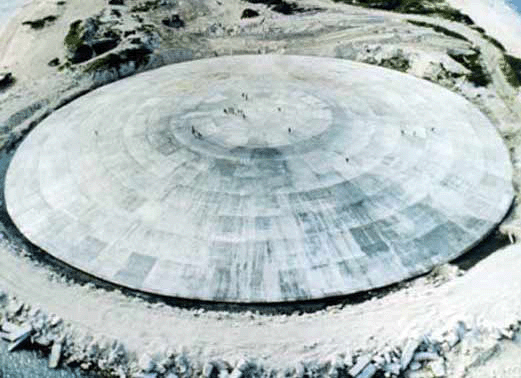
The new report does not include a plan to repair the dome, which was required by Congress.
In 1981, the U.S. government declared in a report that the island should be quarantined indefinitely and that the “possibility would always exist that high levels of plutonium-contaminated subsurface soil could be exposed by wave or storm action.”
The DOE report found that Runit Dome, a repository for atomic waste the United States produced during Cold War weapons testing, is sound and that radioactive leakage into the nearby lagoon is not significant.
After Congress grew concerned last year about the leaking dome, it ordered the DOE to produce a report on the dome’s structural integrity amid climate change and rising sea levels.
The report noted that while sea level rise could increase storm surge, swells, and “lead to wave-induced over-wash of lower sections of the dome,” there is not enough definitive data to determine “how these events might impact on the environment.”
One Marshallese leader was disappointed the DOE again downplayed the risks and declined to take responsibility for Runit Dome and its leaking contents.
“We don’t expect the Enewetak community to feel any safer based on this report as it doesn’t contain any new information from what they’ve seen…and don’t trust,” said Rhea Christian-Moss, the chairperson of the Marshall Islands’ National Nuclear Commission, a government-operated nuclear waste and radiation oversight panel.
“The report offers nothing new and is more or less what we expected to see,” she said, lamenting the Senate’s redaction of a critical line in the House’s mandate, which stipulated that the Department of Energy provide a plan detailing the removal of the radioactive waste into a “safer and more stable location.”
The Department of Energy report is signed by Dan Brouillette, the agency’s secretary. Terry Hamilton, the department’s lead contractor on the project, was not available for comment.
In November last year, The Times published an investigation of the lingering radiation legacy in the Marshall Islands, and the refusal of U.S. authorities to take ownership for the hazards posed by Runit Dome
In December, Congress signed the National Defense Authorization Act for 2020, which required the DOE to provide a plan to repair the dome, evaluate the environmental effects of the dome on the lagoon over the next 20 years, and assess its structure and the potential risk to the people who live near it.
The department was also required to assess how rising sea levels could affect the dome.
Christian-Moss noted data gaps in the report, as well, including the level of radiation in groundwater leaking from the dome into the lagoon.
In 2019, at a presentation delivered in the Marshall Islands to Marshallese and U.S. officials, the DOE’s contractor, Hamilton, mentioned elevated levels of radioactivity in giant clams living near the dome.
The new report does not mention the clams but states that not enough information is available to understand how leakage from the dome is affecting marine life. However, according to the energy department, studies of people living nearby show normal levels of radiation — suggesting they are not being adversely affected.
“The absence of data to show any risk does not mean that there is no risk.” she said. “So my main takeaway from the report is that many risks are still ‘unknown.’”
Nowhere else has the United States saddled another country with so much of its nuclear waste, a product of its Cold War atomic testing program.
The waste site, known alternatively as the Tomb, holds more than 3.1 million cubic feet — or 35 Olympic-size swimming pools — of U.S.-produced radioactive soil and debris, including lethal amounts of plutonium.
The radioactive material was collected, moved and contained by U.S. soldiers during the late 1970s. Many of those veterans say they were unaware of the contents and did not wear protective equipment.
“All in all the message seems to be that we should be concerned but not alarmed,” said Michael Gerrard, a legal scholar at Columbia University’s law school. “It is as if Runit is like a radioactive sore in the middle of the Pacific, but one that can get by with band-aids for the foreseeable future unless they find more bleeding.”
The DOE authors also maintain that the lagoon’s sediments are so contaminated with radioactive elements that any additional spillage from the dome would be undetectable.
“It remains to be seen whether the Marshallese will accept this report by the Americans, given how poorly the U.S. has treated the Marshallese in so many ways since 1945,” said Gerrard.
In July 2019, DOE officials responded claiming they didn’t have the funding to build a fence and installation of a perimeter would be logistically too complex.
In 1981, the U.S. government declared in a report that the island should be quarantined indefinitely and that the “possibility would always exist that high levels of plutonium-contaminated subsurface soil could be exposed by wave or storm action.”
France’s oldest nuclear power plant at Fessenheim finally shut down
The two reactors at Fessenheim began operation in 1977 and 1978 and were already three years beyond their projected 40-year life span.
Although there is no legal limit on the operating life of French nuclear power plants, EDF had envisaged a 40-year lifetime for all second-generation PWRs.
Fessenheim had become a focus for anti-nuclear campaigners after the 2011 Fukushima accident in Japan, prompting then President Francois Hollande to promise its closure. However, it was not until 2018 that his successor Emmanuel Macron finalised the decision.,,,….. https://www.neimagazine.com/news/newsfessenheim-closes-down-8004216
1 This Month

of the week – Shut Down Drone Warfare!


Tell the Ukrainian Government to Drop Prosecution of Peace Activist Yurii Sheliazhenko

Petition to revoke the licensing of the Near Surface Nuclear Disposal Facility (NSDF) at Chalk River. https://www.ourcommons.ca/petitions/en/Petition/Details?Petition=e-7247
To see nuclear-related stories in greater depth and intensity – go to https://nuclearinformation.wordpress.com
-
Archives
- April 2026 (103)
- March 2026 (251)
- February 2026 (268)
- January 2026 (308)
- December 2025 (358)
- November 2025 (359)
- October 2025 (376)
- September 2025 (257)
- August 2025 (319)
- July 2025 (230)
- June 2025 (348)
- May 2025 (261)
-
Categories
- 1
- 1 NUCLEAR ISSUES
- business and costs
- climate change
- culture and arts
- ENERGY
- environment
- health
- history
- indigenous issues
- Legal
- marketing of nuclear
- media
- opposition to nuclear
- PERSONAL STORIES
- politics
- politics international
- Religion and ethics
- safety
- secrets,lies and civil liberties
- spinbuster
- technology
- Uranium
- wastes
- weapons and war
- Women
- 2 WORLD
- ACTION
- AFRICA
- Atrocities
- AUSTRALIA
- Christina's notes
- Christina's themes
- culture and arts
- Events
- Fuk 2022
- Fuk 2023
- Fukushima 2017
- Fukushima 2018
- fukushima 2019
- Fukushima 2020
- Fukushima 2021
- general
- global warming
- Humour (God we need it)
- Nuclear
- RARE EARTHS
- Reference
- resources – print
- Resources -audiovicual
- Weekly Newsletter
- World
- World Nuclear
- YouTube
-
RSS
Entries RSS
Comments RSS
 nuclear-news
