Nuclear: more than 3,000 radioactive drums discovered off the coast of Brest!

More than 3,000 radioactive drums have been discovered in the waters off Brest. Very old nuclear fuel.
Jean-Baptiste Giraud, July 17, 2025,
https://lenergeek.com/2025/07/17/nucleaire-3-000-futs-radioactifs-brest/
In the nuclear sector, the issue of radioactive waste storage is posing increasing problems. During a mission off the coast of Brest, Ifremer and the CNRS counted more than 3,000 drums deposited on the seabed. They could pose a threat to France.
Nuclear waste is accumulating at the bottom of the Atlantic Ocean
The return of a scientific mission off the coast of Brest has shaken the scientific community. After a month of intensive research, a team of experts revealed they had located more than 3,000 radioactive drums submerged in the Atlantic Ocean , a discovery that inevitably raises the question: should we be worried?
Behind this large-scale mission, a specific objective: to understand the fate of nuclear waste dumped between 1946 and 1993 by several European countries . During this period, more than 200,000 drums containing radioactive waste were dumped in international waters, at depths reaching 4,700 meters in the abyssal plain of the northeast Atlantic. The NODSSUM (Nuclear Ocean Dump Site Survey Monitoring) project has mapped an area of 163 km² where these drums are concentrated, some of which are in an advanced state of degradation.
The mission, led by the CNRS and Ifremer with the support of several national and international partners, used cutting-edge technologies to study the abyss. Aboard the ship L’Atalante, scientists deployed an autonomous submarine, UlyX, equipped with a sophisticated sonar system, allowing them to probe the seabed and obtain precise images of the condition of the 3,350 barrels.
No worrying radioactivity… for now
After several weeks of research, the good news is that the mission did not observe any “anomalous radioactivity” in the areas analyzed. For the researchers, there is therefore, as of yet, no reason to panic. However, not everything is that simple. Although the radioactivity does not appear to have crossed any worrying thresholds, some drums have shown signs of advanced corrosion, suggesting that material leaks may be occurring. The mission reveals that these leaks, although still difficult to identify precisely, could be due to the presence of bitumen, a material often used to seal waste in drums.
However, this is only a hypothesis. Future sampling will be necessary to better understand the exact nature of these substances and their impact on the marine environment.
This discovery raises many questions about nuclear waste management. Why were these drums submerged at a time when radioactive waste management was not as strictly regulated? While the practice of dumping waste has been banned since 1993, the question of the environmental impact of these repositories remains open. The results of this mission, still preliminary, underline that special attention will need to be paid in the future.
The next stage of the research will be to analyze the sediment, water and marine organisms in the area to detect possible contamination . In addition, a new mission is already planned for the coming years to study the barrels more closely and take additional samples , particularly of marine fauna that could be affected by this waste.
Toxic radioactive legacy of rare earths processing plan.

Industrial health expert T Jayabalan told FMT that he lived in Bukit Merah for three years during the 1980s, “collecting data” on the residents there. According to him, Lai Kwan and Cheah were only two of the many people he studied before presenting his findings to Malaysian courts. “Birth defects still exist,” he said, “and the number of miscarriages is incredibly high. Even if a foetus survives, it can still be born with leukemia and brain damage.”
“I’ve seen it happen with my own eyes. I’ve seen the suffering of these people. The only good thing about Lynas is that it hasn’t happened yet.”
 (includes VIDEO) Inside the world of a radiation victim, Free Malaysia Today Patrick Lee, November 24, 2011 VIDEO Tan Chui Mui’s short documentary is also about a mother’s undying love. Cheah was born in 1983, a year after Lai Kwan worked as a bricklayer at the Mitsubishi rare earth plant in Bukit Merah, Perak.
Cheah has multiple congenital defects, including a hole in the heart. He is also mentally deficient and virtually blind. And Lai Kwan is beside her son nearly every hour of her life, as portrayed in a short film entitled “Lai Kwan’s Love”…..
she tells the camera that she had no idea that the rare earth plant where she worked was handling toxic materials.
“We were working at the factory’s extension site. We didn’t know what kind of factory it was. We simply worked there….
Lai Kwan said she had not received compensation for her son’s disability, and that two men attempted to pay her into keeping quiet over Cheah.
“They asked me not to say my son’s sickness is related to the rare earth plant. I said I didn’t want the money, whatever the amount was. If I take your money, I said, and your factory continues to operate here, more newborns will get sick. What good is the money then?”
The film is the second in a four-part series called “Survival Guide Untuk Kampong Radioaktif”, a project designed to show viewers the adverse effects of radiation.
The Asian Rare Earth plant in Bukit Merah was closed in 1992 following years of protests from local residents. The area is still going through a massive RM303 million clean-up by Mitsubishi Chemicals.
None of the people in Bukit Merah were compensated, although Mitsubishi Chemicals donated RM500,000 to the community’s schools in an out-of-court settlement.
Locals in the 11,000-large town have blamed the plant for the population’s many birth defects and eight leukemia cases. Seven of the leukemia cases have since died……
Birth defects still exist’
Industrial health expert T Jayabalan told FMT that he lived in Bukit Merah for three years during the 1980s, “collecting data” on the residents there.
According to him, Lai Kwan and Cheah were only two of the many people he studied before presenting his findings to Malaysian courts. “Birth defects still exist,” he said, “and the number of miscarriages is incredibly high. Even if a foetus survives, it can still be born with leukemia and brain damage.”
Jayabalan also said that many people associated with Bukit Merah had since passed away, including “lawyers and plaintiffs” involved with the case.
“They died of cancer. Some of them died very young.”
He said he worried that the controversial Lynas rare earth plant near Kuantan, which is expected to see operations begin early next year, would see a “tenfold” effect.
“The amount of metals to be used is huge compared to Bukit Merah, and it’s going to leak, and these areas (in Kuantan) are prone to flooding,” he said.
“I’ve seen it happen with my own eyes. I’ve seen the suffering of these people. The only good thing about Lynas is that it hasn’t happened yet.”
http://www.freemalaysiatoday.com/2011/11/24/inside-the-world-of-a-radiation-victim/
Tonnes of nuclear waste from Gentilly-1 secretly rolled down Quebec roads

A federal appeals court has already ruled that CNL and Canada’s nuclear regulator, the Canadian Nuclear Safety Commission (CNSC), both acted improperly by not consulting the Kebaowek FN on the proposed “megadump” at Chalk River.
Shockingly, many of the radioactive species proposed for permanent storage in that earthen mound – the megadump, the NSDF – will remain dangerous for tens of thousands of years.
Gordon Edwards, 15 July 25
Since 2015, a consortium of multinational corporations led by two American firms has been contracted by the Government of Canada to “manage” all federally-owned nuclear facilities and all federally-owned radioactive waste.
The consortium, operating under the banner of Canadian Nuclear Laboratories (CNL), has already been paid several billions of dollars from the Canadian treasury. In September a new consortium of three American multinationals is slated to take over the reins of CNL
and will continue to receive close to a billion dollars a year of federal tax dollars.
There is a federal petition in the House of Commons calling on the government to pause the contract until a federal audit has been conducted to determine where all that money is going. If you are a Canadian citizen, please sign your name to that petition and tell your friends and colleagues about it.
The article below indicates that all the high-level radioactive waste – used nuclear fuel – from the defunct Gentilly-1 nuclear reactor in Quebec has been secretly transported to Chalk River Ontario by the consortium, even though its current licence does not authorize such a transfer.
In typical grandiose fashion, CNL spokespersons boast that the consortium has “eliminated” a major liability. In actual fact the high-level waste has merely been moved upstream, to Chalk River, right on the border of Quebec, right beside the Ottawa river that flows down to Montreal.
There is no mention of how much Canadians have had to pay the consortium for this operation, which was both unnecessary and ill-advised. The high-level waste cannot stay at Chalk River, it will have to be moved again at further taxpayer expense – because there is as yet no permanent home for any such highly radiotoxic waste – waste that will remain dangerous for many hundreds of thousands of years.
CNL falsely claims that municipalities and indigenous people were fully informed about the shipments. This is not true. For example, Keboawek First Nation (on whose ancestral land Chalk River is situated) was completely blind-sided by the Gentilly-1 radioactive waste being imported onto their territory without their full prior and informed consent, as required by law.
A federal appeals court has already ruled that CNL and Canada’s nuclear regulator, the Canadian Nuclear Safety Commission (CNSC), both acted improperly by not consulting the Kebaowek FN on the proposed “megadump” at Chalk River. KFN knew nothing about this operation until after it was completed. You cannot consult someone about a “fait accompli”.
The Chalk River megadump – euphemistically called the Near Surface Disposal Facility (NSDF) – is intended to hold a million tons of so-called “low level radioactive waste” in a glorified landfill operation perched on a height of land not far from the Ottawa River.
Shockingly, many of the radioactive species proposed for permanent storage in that earthen mound – the megadump, the NSDF – will remain dangerous for tens of thousands of years.
The megadump has been opposed by over a hundred Quebec municipalities, including the City of Montreal and its “agglomeration” partners. As far as we can determine, none of these municipalities were notified or consulted about the Gentilly-1 waste shipments.
Has Canada granted American multinational corporations, all of them closely linked to the American nuclear weapons program, “carte blanche” to do what it likes without even notifying or consulting those Canadians that are most directly affected by their actions?
CNL is concentrating all federally-owned radioactive wastes of human origin at Chalk River, right across from Quebec, on a river that empties into the St. Lawrence River at Montreal. Large volumes of radioactive waste from Quebec and Manitoba, as well as from Kincardine and Rolphton in Ontario, is being accumulated at this one location It is astonishing that the present Quebec government has absolutely nothing to say about this.
Past Quebec leaders have had the audacity to speak up. When Quebec activists intervened to prevent a high level nuclear waste dump in Vermont, Premier Bourassa stated that Quebec would never allow a permanent nuclear waste repository “in its territory or on its frontiers”. The Quebec National Assembly passed a unanimous resolution against the import of radioactive waste into Quebec for permanent disposal. Just on the border is OK?
Apparently, out of sight is out of mind. How times have changed….
The operation was completed at the end of June, after several months.
Sylvain Larocque, Le Journal de Montréal, 14 July 2025, https://tinyurl.com/msasbd4w
Over the past few months, dozens of trucks have been secretly driving the roads of Quebec to transport tonnes of irradiated fuel from the Gentilly-1 plant in Bécancour to Chalk River, Ontario.
– Also read: Hydro-Québec CEO Michael Sabia cautious on the nuclear issue
– Also read: Looking back: the nuclear adventure lasted only 29 years in Quebec
How many convoys were there?
Where exactly did they go?
It’s impossible to know.
‘To ensure the safe and secure transport of these materials, we cannot divulge specific information about the routes,’ Alexandra Riopelle, a spokeswoman for the Canadian Nuclear Laboratories (CNL), which was responsible for the operation, told Le Journal.
In all, there were 2985 fuel bundles to be transferred. These contained 62.8 tonnes of uranium, occupying a total volume of 12.1 cubic metres.
The trips began last autumn and ended a fortnight ago,” says Ms Riopelle.
Protected by the provincial police (Sûreté du Québec)
Quebec police officers provided security for each of the convoys.
‘I can confirm that we saw these materials being transported,’ says Sûreté du Québec inspector Richard Gauthier, although he declined to give any further details.
CNL, a consortium made up of the engineering firms Atkins-Réalis (formerly SNC-Lavalin), Jacobs and Fluor [both based in Texas], discreetly issued a press release last week highlighting the ‘success’ of the ‘removal of fuel from Gentilly-1, more quickly than expected’.
‘Canadian Nuclear Laboratories has eliminated a major nuclear liability and paved the way for the next stages in the decommissioning’ of the former experimental power station, which operated intermittently from 1972 to 1977, the organisation declared in a tone of self-congratulation.
No clear announcement
However, CNL has never made a clear announcement about the start of transport activities. In the spring of 2025, CNL provided information [no details!] on the decommissioning of Gentilly-1, but the question of transporting nuclear waste was only vaguely addressed.
It was a Montreal citizen, Jacques Dagenais, who alerted Le Journal in May. ‘If there were an accident, half the Montreal and Gatineau-Ottawa regions would have to be evacuated,’ he said.
Although the nuclear waste from Gentilly-1 left the Centre-du-Québec region, it did not go very far: the Chalk River Laboratories are located on the banks of the Ottawa River, a stone’s throw from Quebec.
Gordon Edwards, a well-known anti-nuclear campaigner, also condemns the transport of spent fuel from Gentilly-1.
‘Even after 40 years, irradiated fuel still emits significant quantities of radioactivity’, he says. [Correction: it is not radioactivity that is emitted; radioactive materials emit ‘ionizing radiation’ often referred to as ‘atomic radiation’]
Terrorist risks
Guy Marleau, a professor at Polytechnique Montréal, maintains that it is to reduce risks, particularly terrorist risks, that nuclear waste shipments are not announced in advance.
“We make sure that the transport is carried out at times and on routes where the risk of collision is minimised,” explains the expert. As far as possible, we try to avoid crossing watercourses….
“Even if there is a collision with fire, the fuel is protected. The thing we’re most afraid of is it ending up at the bottom of a river.”
CNL asserts that it has notified the municipalities and aboriginal communities along the convoy route. The town of Bécancour and the Abenakis of Wôlinak did not reply to the Journal on this subject.
‘Quebec is notified and consulted’ when highly reactive waste is transported, ‘to ensure that risks are properly managed’, says Marjorie Larouche, spokesperson for the Ministry of the Environment.
As for Hydro-Québec’s Gentilly-2 power station, which ceased operations in 2012, its decommissioning [dismantling] could also be accelerated. It is not yet known whether its irradiated fuel will remain on site or be shipped elsewhere in Canada.
We must count the real costs of nuclear power
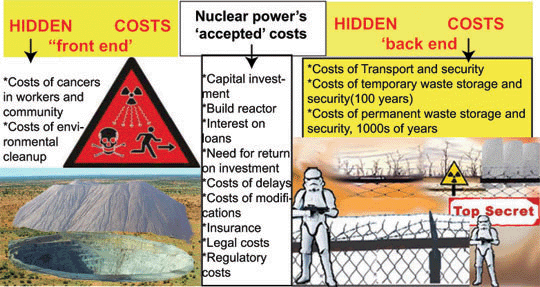
Letter: Your author, in his enthusiasm to highlight the cheaper costs to
build new nuclear plants, failed to include the ever-increasing costs of
decommissioning nuclear plants at the end of their working life. This must
be included in any comparison of costs. He also failed to mention the
problems of vast amounts of highly dangerous radioactive nuclear waste and
accidents, freak weather – such as the tsunamis causing radioactive leaks
in Japan – and potential terrorist attacks. Nuclear may not cause
atmospheric carbon waste but it does create hugely toxic radioactive waste
that remains dangerous for hundreds of thousands of years. A problem that
threatens the health of all life.
Guardian 9th July 2025, https://www.theguardian.com/environment/2025/jul/09/we-must-count-the-real-costs-of-nuclear-power
From Scotland to Cumbria – Not All Waste Is Equal.
Next week Cumberland Councillors will be asking questions about the
“unacceptable” transport of wastes from Scotland to Cumbrian landfill.
Meanwhile the transport of thousands of tonnes of radioactive wastes from
Scotland to Cumbrian landfill continues entirely unchallenged.
Letter belowto Cumberland councillors and Scotland’s First Minister John Swinney.
Dear Councillor Dobson, Councillor Rollo and First Minister John Swinney,
Radiation Free Lakeland agree completely with the reported statement by
Scotland’s First Minister, that the situation of landfill waste arriving
from Scotland into England and specifically Cumbria is “not
acceptable..” A related issue of great concern is that so called High
Volume Very Low Level and Exempt Radioactive wastes from Scotland are being
increasingly diverted to landfill. We note that the Low Level Waste
Repository (LLWR) at Drigg, Cumbria, now only accepts less than 5% of waste
with the remainder being diverted to recycling (radioactive scrap metal),
landfills or via incineration.
Radiation Free Lakeland 6th July 2025, https://radiationfreelakeland.substack.com/p/from-scotland-to-cumbria-not-all
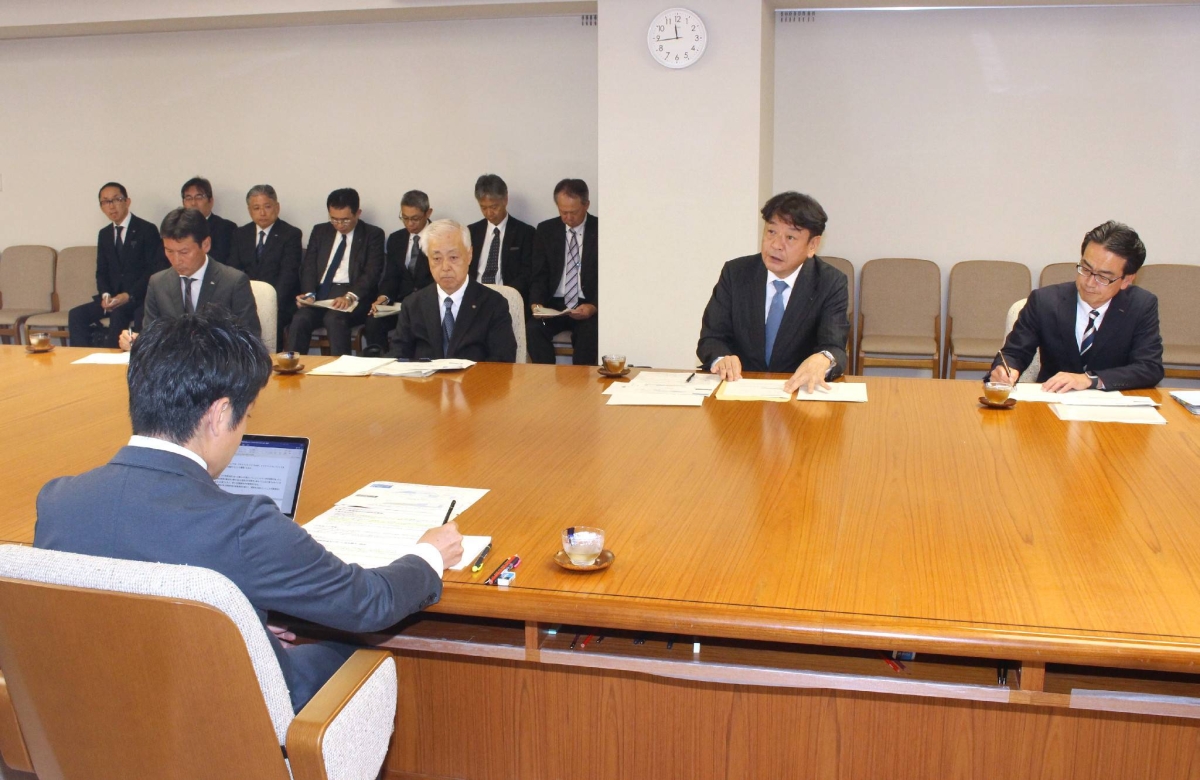
Tepco plans to move spent nuclear fuel from Fukushima to Mutsu facility
Tokyo Electric Power Company Holdings (Tepco) suggested Monday that it
plans to transfer spent nuclear fuel from its Fukushima No. 1 nuclear power
plant to an interim storage facility in the city of Mutsu in Aomori
Prefecture. The plan was included in a medium- to long-term program for the
facility, presented to Aomori Gov. Soichiro Miyashita by Tepco President
Tomoaki Kobayakawa at a meeting in the Aomori Prefectural Government office
the same day.
Spent nuclear fuel stored at the plant’s No. 5 and No. 6
reactors, a joint storage pool and the Fukushima No. 2 plant at the time of
the March 2011 nuclear meltdown at the No. 1 plant is set to be transferred
to the Mutsu facility.
Japan Times 8th July 2025, https://www.japantimes.co.jp/news/2025/07/08/japan/tepco-move-mutsu/
Plutonium Levels in Sediments Remain Elevated 70 Years After Nuclear Tests

June 24, 2025,
https://www.marinetechnologynews.com/news/plutonium-levels-sediments-remain-650328
Researchers from Edith Cowan University (ECU) in Australia have confirmed plutonium levels in sediment up to 4,500 times greater than the Western Australian coastline.
Three plutonium-based nuclear weapons tests were conducted at the Montebello Islands in the 1950’s, which introduced radioactive contamination to the surrounding environment. The first nuclear test, coded Operation Hurricane, had a weapon’s yield of some 25kT, and formed a crater in the seabed, while the second and third tests, dubbed Operation Mosaic G1 and G2, had weapons yields of around 15kT and 60kT, respectively.
The three tests released radioactive isotopes including plutonium, strontium (90Sr) and caesium (137Cs) into the surrounding marine environment.
“Plutonium is anthropogenic, which means that it doesn’t exist on its own in nature. The only way it is introduced into an environment is through the detonation of nuclear weapons and from releases from nuclear reprocessing plants and, to a lesser extent, accidents in nuclear power plants,” said ECU PhD student and lead author Madison Williams-Hoffman.
“When plutonium is released into a coastal setting in the marine environment, a significant fraction will attach to particles and accumulate in the seabed, while some may be transported long distances by oceanic currents.”
The region is not inhabited by humans and has not been developed, however it is visited by fishing boats, so collecting data on the levels of contamination in the marine environment is important.
Currently, the protected island archipelago and surrounding marine areas also reside within the Montebello Islands Marine Park (MIMP). The MIMP is ecologically significant due to the presence of numerous permanent or migratory species, and its high-value habitat is used for breeding and rearing by fish, mammals, birds and other marine wildlife.
The water and sediment quality within the MIMP are currently described as ‘generally pristine’, and it is fundamental to maintain healthy marine ecosystems in the region.
The concentrations of plutonium at Montebello Islands were between 4 to 4,500 times higher than those found in sediment from Kalumburu and Rockingham from the Western Australian coastline, with the northern area of the archipelago, close to the three detonation sites, having four-fold higher levels than the southern area.
The concentrations of plutonium found in the sediment at Montebello Islands were similar to those found in the sediment at the Republic of Marshall Islands (RMI) test sites, despite 700-fold higher detonation yields from nuclear testing undertaken at RMI.
Plutonium is an alpha emitter so, unlike other types of radiation, it cannot travel through the skin and is most dangerous when ingested or inhaled.
The research was undertaken by Williams-Hoffman, under the co-supervision of Prof. Pere Masqueand at ECU and Dr Mathew Johansen at ANTSO.
Supreme Court clears the way for temporary nuclear waste storage in Texas and New Mexico

By ASSOCIATED PRESS, 19 June 2025, https://www.dailymail.co.uk/wires/ap/article-14825147/Supreme-Court-clears-way-temporary-nuclear-waste-storage-Texas-New-Mexico.html
WASHINGTON (AP) – The Supreme Court on Wednesday restarted plans to temporarily store nuclear waste at sites in rural Texas and New Mexico, even as the nation is at an impasse over a permanent solution.
The justices, by a 6-3 vote, reversed a federal appeals court ruling that invalidated the license granted by the Nuclear Regulatory Commission to a private company for the facility in southwest Texas. The outcome should also reinvigorate plans for a similar facility in New Mexico roughly 40 miles (65 kilometers) away.
The federal appeals court in New Orleans had ruled in favor of the opponents of the facilities.
The licenses would allow the companies to operate the facilities for 40 years, with the possibility of a 40-year renewal.
The court’s decision is not a final ruling in favor of the licenses, but it removes a major roadblock. Justice Brett Kavanaugh’s majority opinion focused on technical procedural rules in concluding that Texas and a major landowner in southwest Texas forfeited their right to challenge the NRC licensing decision in federal court.
The justices did not rule on a more substantive issue: whether federal law allows the commission to license temporary storage sites. But Kavanaugh wrote that “history and precedent offer significant support for the commission´s longstanding interpretation” that it can do so.
Justice Neil Gorsuch wrote in dissent that the NRC’s “decision was unlawful” because spent nuclear fuel can be temporarily stored in only two places under federal law, at a nuclear reactor or at a federally owned facility. Justices Samuel Alito and Clarence Thomas signed on to the dissenting opinion.
Roughly 100,000 tons (90,000 metric tons) of spent fuel, some of it dating from the 1980s, is piling up at current and former nuclear plant sites nationwide and growing by more than 2,000 tons (1,800 metric tons) a year. The waste was meant to be kept there temporarily before being deposited deep underground.
The NRC has said that the temporary storage sites are needed because existing nuclear plants are running out of room. The presence of the spent fuel also complicates plans to decommission some plants, the Justice Department said in court papers.
Plans for a permanent underground storage facility at Yucca Mountain, northwest of Las Vegas, are stalled because of staunch opposition from most Nevada residents and officials.
The NRC´s appeal was filed by the Biden administration and maintained by the Trump administration. Texas Gov. Greg Abbott, a Republican, and New Mexico Gov. Michelle Lujan Grisham, a Democrat, are leading bipartisan opposition to the facilities in their states.
Lujan Grisham said she was deeply disappointed by the court´s ruling, reiterating that Holtec International, awarded the license for the New Mexico facility, wasn´t welcome in the state. She vowed to do everything possible to prevent the company, based in Jupiter, Florida, from storing what she called “dangerous” waste in New Mexico.
“Congress has repeatedly failed to secure a permanent location for disposing of nuclear waste, and now the federal government is trying to force de-facto permanent storage facilities onto New Mexico and Texas,” she said. “It is a dangerous and irresponsible approach.”
The NRC granted the Texas license to Interim Storage Partners, based in Andrews, Texas, for a facility that could take up to 5,500 tons (5,000 metric tons) of spent nuclear fuel rods from power plants and 231 million tons (210 million metric tons) of other radioactive waste. The facility would be built next to an existing dump site in Andrews County for low-level waste such as protective clothing and other material that has been exposed to radioactivity. The Andrews County site is about 350 miles (560 kilometers) west of Dallas, near the Texas-New Mexico state line.
The New Mexico facility would be in Lea County, in the southeastern part of the state near Carlsbad.
Associated Press writer Susan Montoya Bryan contributed to this report from Albuquerque, N.M.
Inside Britain’s top nuclear bunker.

Secure vaults containing decades-old enriched uranium and plutonium are
dotted across Britain’s sprawling atomic weapons establishment site in
the Berkshire countryside. Some are underground, inside 1960s-era
buildings, guarded by police on the roof tops armed with C8 Carbine assault
rifles used by the Special Air Service (SAS).
Cameras keep watch and
security guards patrol the perimeter — lined by a fence and razor wire,
like a prison — and 56 dogs are on hand to sniff out any sign of toxic
chemicals. “The guards and guns are not here to protect us, they are here
to protect the material,” said one of the scientists giving a tour of the
grounds. “You can’t get anywhere near them [the vaults] even if you
tried,” added another.
Times 19th June 2025,
https://www.thetimes.com/uk/defence/article/uk-nuclear-uranium-bunker-fr6szg6tn
Survey Results Show Tremendous Dissatisfaction with Nuclear Waste Project and Proponent.
We the Nuclear Free North 12 June 25
| Dryden – A not-for-profit organization that tracks a nuclear waste burial project proposed for northwestern Ontario has released the results of a recent survey gauging public attitudes towards the Nuclear Waste Management Organization and its project. We the Nuclear Free North‘s survey results show an overwhelmingly negative response to the NWMO’s project and communications. |
An invitation to complete the survey was distributed by email and through social media on a wide variety of sites. Over 300 responses were received in the ten-day survey period. Just under 60% of respondents were from northern Ontario (northwestern and northeastern), 36% were from the rest of Canada, and the remainder international or unknown. Respondents include nuclear industry employees, Indigenous people, residents of Ignace and members of Wabigoon Lake Ojibway Nation, and residents from across northern Ontario and across Canada.
Overwhelmingly, respondents expressed a negative view of NWMO operations:
- 94% were not confident that the NWMO’s safety culture would keep Canadians safe.
- A very large majority found that NWMO communications were not transparent or honest.
- 93% were not confident in the NWMO’s ability to implement the safe, long-term management of nuclear fuel waste.
- 94% were not confident that NWMO’s work aligned with Reconciliation or Indigenous Knowledge.
- 96% were not comfortable with the nuclear industry being in charge of the NWMO
- 92% did not believe that the siting process was fair or gained the necessary consent
Every year the Nuclear Waste Management Organization (NWMO) releases their annual report and a five year “implementation plan” which – according to the NWMO – sets out what the nuclear waste corporation will be doing over the coming years. The NWMO also invites feedback through a survey. WTNFN has heard from many that they are reluctant to provide the NWMO with their personal information, and they are uncertain how the NWMO will use their responses. Providing an alternative means for Canadians to express their views motivated the deployment of an alternate survey.
“We think it’s important to hear the views and responses of Canadians to the NWMO’s plans and proposal to transport, process, bury and then abandon the high-level nuclear fuel waste from all Canadian reactors at the NWMO’s selected site in the heart of Treaty #3 territory in northwestern Ontario”, explained Brennain Lloyd, project coordinator with Northwatch and a volunteer with We the Nuclear Free North.
Lloyd explained that potential respondents were invited to take five minutes and complete the simple survey, with the assurance that their personal information would be used only to verify responses and would not be shared with the Nuclear Waste Management Organization or government, or any other parties.
The results of the survey have been reported by We the Nuclear Free North to the federal Minister of Energy and Natural Resources and the Minister of the Environment and Climate Change, along with a letter summarizing key messages from the survey results and providing backgrounders on the NWMO project, site selection and public and Indigenous opposition. A copy of the survey report has also been provided to the NWMO.
In writing to the federal Ministers, the group also conveyed that throughout the NWMO’s lengthy siting processes there have been many expressions of opposition to and rejection of the NWMO’s siting process and their project.
“These expressions have come in many forms, including resolutions passed by Grand Council Treaty #3 just weeks before the NWMO announced the selection of the Revell site – in the heart of Treaty #3 territory – in November 2024. More recently, Eagle Lake First Nation has initiated legal action against the NWMO’s site selection. Earlier resolutions have been passed by Nishnawbe Aski Nation, Anishnabek Nation, and many First Nations and municipalities” commented Wendy O’Connor, a volunteer with Nuclear Free Thunder Bay and We the Nuclear Free North.
The group has requested to meet with the Minister of Energy and Natural Resources and the Minister of Environment and Climate Change and will be seeking meetings with Members of Parliament who represent northeastern and northwestern Ontario ridings throughout the summer break.
Sizewell C Nuclear not just a waste of money – a waste of time, too!
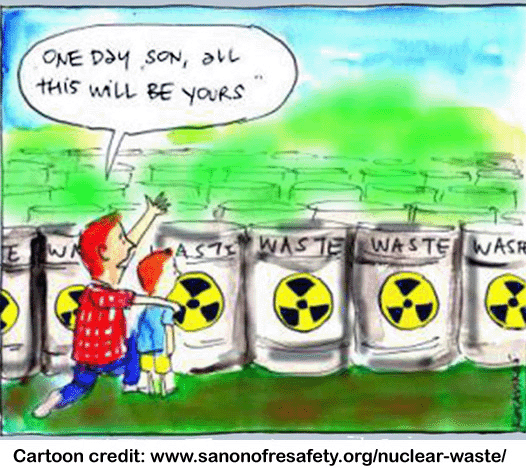
But there is another type of waste even more expensive than the construction costs of nuclear power stations and one that the public will be paying for way into the far future: the storage of toxic high-level radioactive wastes. The public is seldom told that these will be stored on site until at least the middle of the next century, partly to cool down before they can be moved. But moved to where? There is currently no national repository in sight for new build reactors like Sizewell C and there may never be.
Blackwater Against New Nuclear Group (BANNG) 10 June, 25, https://www.banng.info/news/press-releases/10-june-2025/
The Blackwater Against New Nuclear Group (BANNG) agrees with Stop Sizewell C that the proposed new Sizewell C nuclear power station is ‘HS2 Mark 2’. But the public is seldom told about another, much more expensive – and dangerous – waste arising from new nuclear development: toxic high-level radioactive wastes.
The Government has announced that £14BN of public money will be spent over the next four years on the construction of Sizewell C (SZC) new nuclear power station in Suffolk. The amount of taxpayers’ money to be expended at the end of that period is not mentioned, nor is the actual levy to be placed on energy bills to pay for the construction.
The belief of Secretary of State for Net Zero, Ed Miliband, that SZC will be built in a decade flies in the face of the large body of evidence that shows construction of new nuclear power stations runs well over time and over budget. Hinkley Point C (HPC), on which Sizewell C is based, was estimated to cost £16BN in 2012 and to be cooking the Christmas turkey in 2017. Current estimates are £46BN, with operations starting in 2031 (at the earliest).
But there is another type of waste even more expensive than the construction costs of nuclear power stations and one that the public will be paying for way into the far future: the storage of toxic high-level radioactive wastes. The public is seldom told that these will be stored on site until at least the middle of the next century, partly to cool down before they can be moved. But moved to where? There is currently no national repository in sight for new build reactors like Sizewell C and there may never be.
The £14BN package will also cover the construction of Rolls Royce Small Modular Reactors (SMRs) and the Bradwell site, unfortunately, remains a remote possibility for these. But SMRs have the same problems as major new nuclear stations. And don’t be fooled they will be anything but small!
Varrie Blowers, Secretary of BANNG, says: ‘Building one or more SMRs at Bradwell is inconceivable. The site will be wiped out by Climate Change. It is far too remote with no good grid connections. Above all the Blackwater communities and Councils are as resolutely opposed today as they have been for many years.
“As far as public finances are concerned, nuclear power stations, large or small, are not just for life, but forever.”
NFLAs welcome new group opposed to nuke waste dump in South Copeland

Hot on the heels of the victory in Lincolnshire, the UK/Ireland Nuclear
Free Local Authorities have welcomed the formation of a new ‘Anti GDF
Community Group’ in opposition to a Geological Disposal Facility (GDF) on
land near Millom and Haverigg in West Cumbria.
The GDF would be the final
repository for Britain’s inventory of legacy and future high-level
radioactive waste. Nuclear Waste Services has declared its interest in land
surrounding His Majesty’s Prison Haverigg and Bank Head Estate West of
Haverigg as the potential location for a future surface site for this
facility. This site is designated the Area of Focus in the South Copeland
GDF Search Area.
Following a meeting held by Whicham Parish Council on
Wednesday, at which a resolution was carried unanimously calling on NWS to
withdraw this area from consideration, a statement was issued by the new
group. There is also now a new private Facebook group for impacted
residents to join and a group logo.
The ‘Anti GDF Community Group’ will
aim to support and seek support from both Whicham and Millom Council in
their respective rejections of the area of focus and try to ensure that NWS
and Cumberland Council abide by the NWS statement “that express consent
must be given by those living alongside a GDF” Presently the group is
formed by a small committee and is seeking members to support the group
objective of removal from the process of the Kirksanton/Haverigg site. The
group will aim to support those who have and are being severely impacted
now and seek to demonstrate the flawed process and the contempt our
communities have been shown within that process.
NFLA 9th June 2025, https://www.nuclearpolicy.info/news/nflas-welcome-new-group-opposed-to-nuke-waste-dump-in-south-copeland/
Cumbrians receive postal call to back nuke dump democracy petition
NFLA 9th June 2025, https://www.change.org/p/massive-mine-shafts-and-nuclear-dump-for-cumbria-coast-tell-cumberland-council-vote-now
Residents of Millom, Seascale and Gosforth have just received a flyer from campaign group Radiation Free Lakeland calling on them to back a petition which asks Cumberland Councillors to host a debate followed by a vote about their engagement with the siting process for a Geological Disposal Facility in West Cumbria.
The GDF would be the eventual repository for Britain’s high-level radioactive waste which would be placed in tunnels beneath the seabed. A site in East Lincolnshire was also under consideration as a possible site. With the withdrawal of Lincolnshire County Council from the process last week, only sites in Mid and South Copeland in West Cumbria remain in contention and then only because Cumberland Council remains engaged in the process.
Bizarrely Cumberland Council only became involved in the process by default. The new authority on replacing Copeland District Council chose to accept unquestionably that Council’s decision to participate in the GDF process, even though the decision to participate had been taken by only four Copeland Councillors. There has never been any debate or vote amongst Cumberland Councillors about whether they should have accepted this obligation or still wish to continue with the process.
The petition calls on Cumberland Council to convene a belated special meeting of the Full Council where Councillors can debate and then vote on whether to continue to remain engaged or remain represented on the Mid and South Copeland GDF Community Partnerships. If Councillors say no, then the process would end, and NWS would withdraw. The NFLAs is happy to support Radiation Free Lakeland in urging all Cumbrians to sign it.
Here are links to the petition:
www.change.org/CumbriaNuclearDump https://www.change.org/p/massive-mine-shafts-and-nuclear-dump-for-cumbria-coast-tell-cumberland-council-vote-now
Today is World Ocean Day – Protect the Lake District Coast and Irish Sea from an Unprecedented Atomic Experiment
On By mariannewildart,
https://mariannewildart.wordpress.com/2025/06/08/today-is-world-ocean-day-protect-the-lake-district-coast-and-irish-sea-from-an-unprecedented-atomic-experiment/
This World Ocean Day Do Something Amazing and Sign and Share the Petition to Protect The Lake District Coast from a Giant Atomic Heat Sink. There are 1,753 signatures – lets make it tens of thousands! This plan is going forward on the say so of just four councillors in Cumberland (the West of Cumbria, UK). The Petition is calling for a FULL debate and FULL vote by the whole Cumberland Council on whether to continue in partnership with the developer Nuclear Waste Services to deliver a “geological disposal facility” aka an up to 50km square, wholly experimental, sub-sea nuclear dump for HOT nuclear wastes. Note the developer NWS is a Government owned limited liability company.
£127M wasted on failed UK nuclear cleanup plan

Don’t worry, only 100 more years of Sellafield nuclear site cleansing to go
Lindsay Clark, Sat 7 Jun 2025,
https://www.theregister.com/2025/06/07/mps_find_127_million_wasted_sellafield/
The center for the UK’s nuclear industry wasted £127 million ($172 million) during delays and replanning as it scrambled to find alternatives for facilities which treat and repackage plutonium, a Parliamentary report found.
In the face of a 2028 deadline to replace its 70-year-old analytical lab, Sellafield Limited, part of a group of companies and government bodies on the northwest England Sellafield site, has abandoned plans for its Replacement Analytical Project (RAP). Ditching RAP was chalked up to multiple expected delays from 2028 until at least 2034 and a half-a-billion-pounds cost increase to £1.5 billion ($1.93 billion).
A new report from the Parliament’s public spending watchdog says RAP “has been managed very poorly indeed.”
Sellafield, formerly known as Windscale, has been the center of the UK’s nuclear industry since the 1950s. While the site is home to a number of companies, and the government’s Nuclear Decommissioning Authority, Sellafield Limited, is a British nuclear decommissioning Site Licence Company controlled by the NDA.
In October last year, the UK’s public spending watchdog said Sellafield depends on an on-site laboratory that is “over 70 years old, does not meet modern construction standards and is in extremely poor (and deteriorating) condition.”
The National Audit Office said [PDF] the laboratory is “not technically capable of carrying out the analysis required to commission the Sellafield Product and Residue Store Retreatment Plant (SRP)” to treat and repackage plutonium.
Sellafield’s plan in 2016 was to convert a 25-year-old laboratory on the site, which would replace the 70-year-old lab, under the “Replacement Analytical Project.” The outline business case was approved in 2019 with an estimated cost of between £486 million and £1 billion ($626 million – $1.3 billion).
It later emerged that it could take until December 2034 to deliver the full capability, while cost could reach £1.5 billion ($1.93 billion). Sellafield “strategically paused” RAP in February 2024.
In a report this week, the House of Commons’ Public Accounts Committee said: “Sellafield Ltd’s performance in delivering major projects (such as new buildings to store waste or make it safe) has historically been very poor, with large cost increases and delays occurring all too frequently.
“There are signs of improvement – however, given Sellafield’s track record, we are yet to be fully convinced that this is not another false dawn. Another reason to be skeptical is Sellafield’s poor management of the RAP. At the point it paused work, the forecast cost had risen by £820 million, and the project was five years delayed,” the PAC report said.
After abandoning the RAP, Sellafield plans to convert a different building to support a Store Retreatment Plant, which re-treats and repackages existing plutonium material, making it more suitable for durable, long-term storage. It also plans to refurbish the 70-year-old existing building — including replacing the roof — so it can carry on using it until 2040. The alternative plan would provide a service until 2040, whereas the RAP was expected to remain in use until 2070.
However, the Nuclear Decommissioning Authority told PMs the new plan would cost between £420 million and £840 million ($570 million – $1.1 billion), much less than the RAP. Although some of the costs from the early projects could be recouped in the new plan, the PAC said £127 million ($172 million) spent on RAP will have been wasted.
The NDA expects the clean-up of the Sellafield site to go on until 2125 and cost £136 billion ($184 billion), an estimate which has increased nearly 19 percent since March 2019. ®
1 This Month

of the week – Shut Down Drone Warfare!


Tell the Ukrainian Government to Drop Prosecution of Peace Activist Yurii Sheliazhenko

Petition to revoke the licensing of the Near Surface Nuclear Disposal Facility (NSDF) at Chalk River. https://www.ourcommons.ca/petitions/en/Petition/Details?Petition=e-7247
To see nuclear-related stories in greater depth and intensity – go to https://nuclearinformation.wordpress.com
-
Archives
- March 2026 (244)
- February 2026 (268)
- January 2026 (308)
- December 2025 (358)
- November 2025 (359)
- October 2025 (376)
- September 2025 (257)
- August 2025 (319)
- July 2025 (230)
- June 2025 (348)
- May 2025 (261)
- April 2025 (305)
-
Categories
- 1
- 1 NUCLEAR ISSUES
- business and costs
- climate change
- culture and arts
- ENERGY
- environment
- health
- history
- indigenous issues
- Legal
- marketing of nuclear
- media
- opposition to nuclear
- PERSONAL STORIES
- politics
- politics international
- Religion and ethics
- safety
- secrets,lies and civil liberties
- spinbuster
- technology
- Uranium
- wastes
- weapons and war
- Women
- 2 WORLD
- ACTION
- AFRICA
- Atrocities
- AUSTRALIA
- Christina's notes
- Christina's themes
- culture and arts
- Events
- Fuk 2022
- Fuk 2023
- Fukushima 2017
- Fukushima 2018
- fukushima 2019
- Fukushima 2020
- Fukushima 2021
- general
- global warming
- Humour (God we need it)
- Nuclear
- RARE EARTHS
- Reference
- resources – print
- Resources -audiovicual
- Weekly Newsletter
- World
- World Nuclear
- YouTube
-
RSS
Entries RSS
Comments RSS
 nuclear-news