The Asse nuclear waste interim storage facility continues to cause controversy.
www.nuclearwastewatch.ca Germany, By David Sadler May 4, 2023
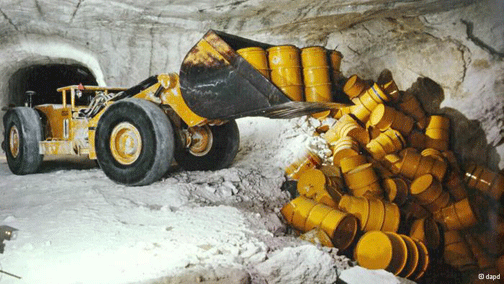
What to do with thousands of barrels of nuclear waste as long as there is no repository? This question concerns the federal government and the residents of Asse. The former mine is dilapidated and needs to be cleared. Environment Minister Lemke got an idea on site.
In the dispute over the Asse site in Lower Saxony as an interim storage facility for nuclear waste, the fronts remain hardened. The former salt dome is dilapidated and should be cleared in about ten years. Around 126,000 barrels of low- and medium-level radioactive nuclear waste are currently stored there. As long as there is no repository in Germany, they have to be stored temporarily. The plans of the responsible Federal Agency for Disposal (BGE) to look for a site near the Asse are met with resistance.
When Federal Environment Minister Steffi Lemke visited the site, several citizens’ initiatives called for the Green politician to give her authority. Lemke must instruct the BGE as the operator to finally arrange for the site comparison for an interim storage facility requested by environmental groups and residents, explained the Asse II coordination group. For years, the BGE has acted against the interests of people and the environment in the area around the dilapidated salt dome.
BGE wants intermediate transports avoid
“We say that the interim storage facility has to be close to where we collect and treat the waste,” replied BGE Managing Director Stefan Studt. It is important to avoid intermediate transports. From the point of view of the operating company, the location is suitable and, above all, can be approved, which Studt described as a “relevant standard”.
Lemke: conditions “absolutely unacceptable”
Environment Minister Lemke does not see a quick solution either. “I don’t have an alternative interim storage facility in my luggage,” she told the representatives of the citizens’ initiatives. But you have to ensure that this nuclear waste is taken out and stored as responsibly as possible – until it can go to a repository. “We will certainly continue this discussion,” she said. The nuclear waste in the former Asse mine was stored under conditions that were “absolutely unacceptable”.
Therefore, the German Bundestag decided to salvage the radioactive waste from the Asse as quickly as possible. A retrieval of the waste is planned and should start around 2033. The plan has long been the subject of strong criticism in the affected region and recently even led to a critical monitoring process ended became.
A challenge arises with the search for safe disposal of the nuclear waste.Problems due to the lack of a repository
“I’m really happy that we shut down the last three nuclear power plants in Germany on April 15 and were thus able to prevent even more highly radioactive waste from accumulating,” said the Greens politician. “I can tell you that this is not a matter of course, but that it has kept me busy in recent months.” In some cases, continued operation was demanded with great carelessness and the problems with the non-existent repository were completely ignored.
There is currently more than 120,000 cubic meters of low- and intermediate-level radioactive waste in interim storage facilities throughout Germany. The garbage is, for example, parts of plants that have been contaminated, protective clothing, tools and equipment from nuclear power plants. According to the Federal Office for the Safety of Nuclear Waste Management (BASE), this only accounts for one percent of the activity, but accounts for 95 percent of the total volume of radioactive waste.
In an even slower scenario, a repository could even not be found until 2068.billion cost after nuclear phase-out
Then there are the costs: A commission has estimated the total costs for decommissioning and dismantling of the reactors as well as the transport and storage of the waste at 48.8 billion euros. As a result, a fund was set up into which the operators of the nuclear power plants had to pay. The interim and final storage is to be paid for with this amount – however, it is still uncertain whether the sum will be sufficient.
Critics and some experts see the camps as a security risk. With the former iron ore mine Schacht Konrad in Salzgitter, a repository for low-level and intermediate-level radioactive waste has been identified, which is scheduled to go into operation in 2027. The search for a repository for high-level radioactive waste has so far been unsuccessful.
Reply to UK government’s nuclear dump consultation – STOP Undersea Nuclear Dump NOW!
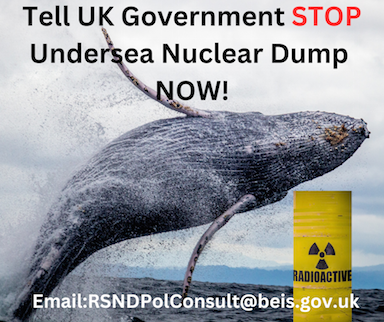
Radiation Free Lakeland have just put together a reply to the Government’s consultation on the nuclear dump plans. You don’t have to write a long reply to all their (loaded) questions. The main thing is to say that the GDF and Near Surface plans are too dangerous and that the Government should think again. Please do use the below for inspiration for your own replies to the consultation which can be found here https://www.gov.uk/government/consultations/managing-radioactive-substances-and-nuclear-decommissioning
Your reply does not need to be long – even a sentence or two explaining why the Government should halt GDF plans would be good – Email your reply to the consultation here: RSNDPolConsult@beis.gov.uk
Managing radioactive substances and nuclear decommissioning
Consultation by: Department for Energy Security and Net Zero
1 March 2023 Notes from Radiation Free Lakeland sent by email to:RSNDPolConsult@beis.gov.uk 3rd May 2023
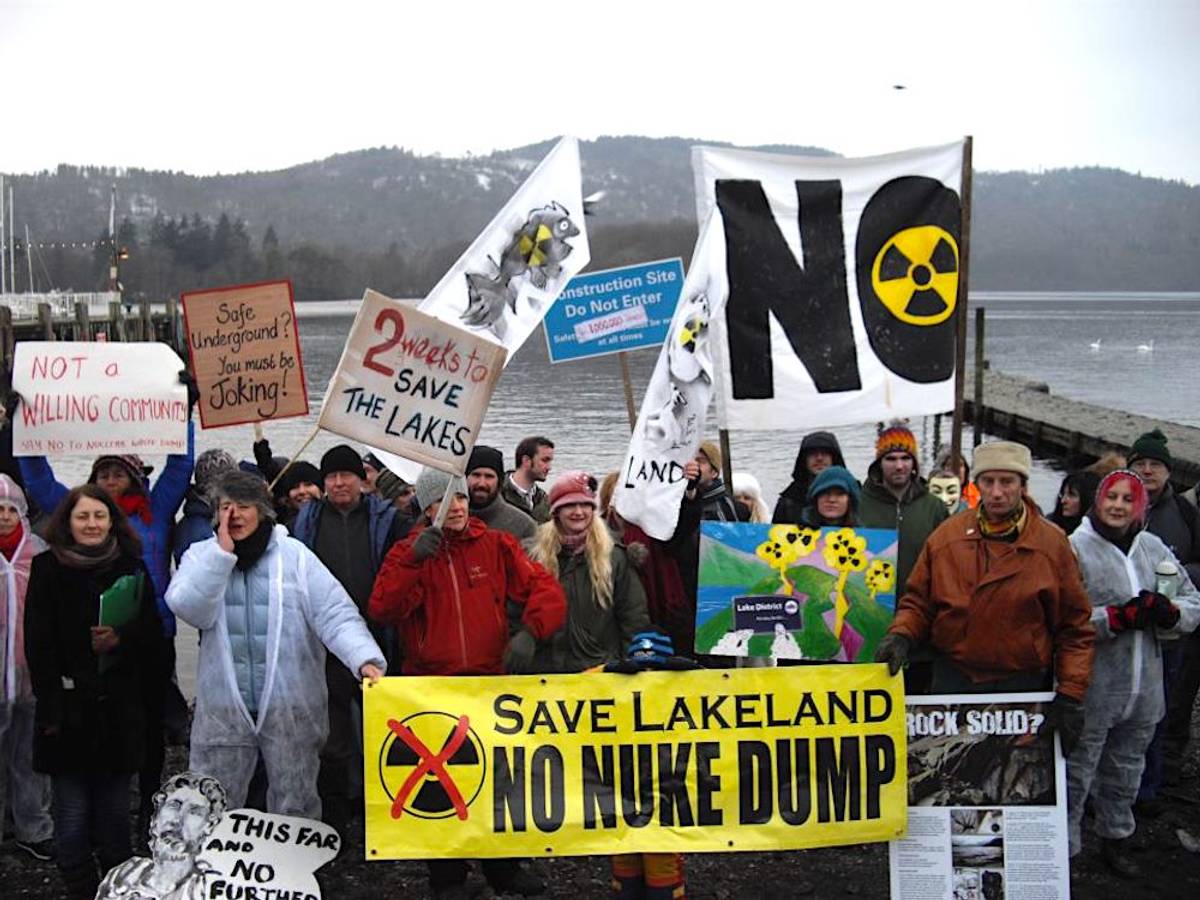
Radiation Free Lakeland are a volunteer civil society group who formed in 2008 as a response to the Managing Radioactive Waste Safely’s (now RWM/NWS) ‘steps to Geological Disposal’ which were halted by Cumbria County Council in 2013.. RaFL’s focus is nuclear safety.
Introduction: RaFL do not recognise the validity of this consultation for the following reasons:
a) TIMING – It is taking place at a time when the most expedient ( proximity to Sellafield ) target area for nuclear waste disposal is undergoing the upheaval of Local Government Organisation.
b) CRONYISM – The NDA and Nuclear Waste Services are being advised on “Investigation Techniques,” “Construction” and “Costings for Scenarios” including “co-location” of a GDF and NSD by the CEO of West Cumbria Mining. Mark Kirkbride’s coal mine, now approved by Government, lies directly between the target areas of Mid Copeland and Allerdale.
c) SAFE ENOUGH – The public are being misled over escalating radiation risks by the use of ALARP (As Low As Reasonably Practicable), the Waste Hierarchy and Best Available Techniques to recycle, incinerate and dispose of radioactive wastes by increasingly novel routes from recycling radioactive scrap metal to burial of high level wastes in sub-sea geology.
Consultation: Part I UK policy proposals for managing radioactive substances and nuclear decommissioning
- 1. Do you agree with the proposal to require the application of a risk-informed approach as a decision-making framework for the management of all solid radioactive waste?
NO. The public are being misled into answering Yes to this question – who would disagree with a “risk informed approach?” But what the consultation fails to reveal (or even refer to as far as we can see) is that the industry uses a device called ALARP which was instigated following a court case in 1949. A coal mine employee had been killed by a rock fall that might have been prevented if the tunnel roof had been shored up by the operator the UK National Coal Board (NCB). The appeal court’s decision was that the NCB did not have to take every possible physical measure to eliminate risk; it only had to provide protection where it was required.
This judgement enabled business owners to defend themselves from successful legal action by showing that they had taken all “reasonably practicable” measures to ensure safe operation, and that therefore risks were “As Low As Reasonably Practicable” or ALARP. The nuclear industry has taken this principle and used it to apply to radiation protection for the public – the consultation does not make any mention of ALARP but does mention its facilitator “Best Available Technique” which aims to provide “value for money” ie the cheapest option measured against human life.
If risk is either impossible or hugely expensive to reduce the industry chooses to do what is “reasonably practicable” to manage it and label the process “ALARP”. The obvious alternative is that the process would have to shut down. The ALARP principle for fatality risk is effectively set at 1 in 10,000 per annum for members of the public and 1 in 1000 per annum for nuclear workplace risks. Even by this optimistic industry standard the public risk from radioactive emissions is twice that of a fatality by car accident (one in approx 20,000 according to some statistics) and in a reverse lottery many times greater than that of winning the National Lottery – the difference being that the public can choose to avoid the fatal traffic accident or winning lottery ticket. This equates to thousands of ALARP deaths every year due to radioactive emissions even by the industry’s own optimistic standard.
An example of this is the decommissioning of Sellafield’s Pile 1 and 2. A new landfill area called Calder Landfill Extension Segregated Area Disposals (CLESA) for nuclear waste dumping was created to dispose of wastes from the demolition. “This Best Available Techniques (BAT) justification demonstrates that the environmental permit for CLESA should be varied to allow it to accept radioactive waste material with higher levels of tritium..” Despite the Environment Agency previously pointing out in 2014 “ it is doubtful whether the location of the LLWR site (at nearby Drigg) would be chosen for a new facility for near-surface radioactive waste disposal if the choice were being made now. It would not be in accordance with current national and international siting practice for new facilities.” Despite knowing that radioactive wastes that will still be dangerous to the public in many decades to come will sooner or later end up scattered along the beach and in the sea the Environment Agency have acquiesced to Sellafield’s ‘necessity’ for a newly enlarged landfill just metres from the Irish Sea containing radioactive rubble using ALARP and BAT to justify the industry’s ‘need’. Coinciding with ALARP and BAT is the fact that in recent years the Environment Agency once fully autonomous from Government (and the nuclear industry) have been systematically declawed with massively reduced funding over recent years to become less of a watch dog than a lap dog.
Image the Calder Landfill is Expanding next to the Irish Sea in order to dump decommissioning wastes from Piles 1and 2 along with radioactively contaminated animal carcasses etc https://consult.environment-agency.gov.uk/cumbria-and-lancashire/sellafield-rsa-major-permit-review/supporting_documents/10.%20MARP003_CLESA%20PCRSA%20Updated%20Report%206.12.17.pdf-1
- 2. Do you agree that application of the waste hierarchy should be an explicit policy requirement for the management of all solid radioactive waste where practicable?
NO. Radiation Free Lakeland have previously warned that the application of the “waste hierarchy” has opened up novel routes to the environment with increasing radioactive risks to the public. Examples:…………………………………………………………………………………………..
- 3. Do you agree with the proposed amendment to current policies on geological disposal to allow disposal of Intermediate Level Waste in near surface facilities?
No. The NIREX inquiry of 1997 rejected the deep disposal of Intermediate Level Wastes. Nirex’s aim was “to prevent radioactive material from coming into contact with groundwater in which it could dissolve, because this is the principal route by which radioactive material could be transported from a repository through the overlying rock to the surface where it could affect humans.” The Nirex inquiry concluded that this aim could not be achieved with deep disposal of ILW. Roll on 20 years and this fact is airbrushed out with the plan for Near Surface Disposal which would mean that Intermediate Level radioactive wastes would reach groundwater and the surface far sooner than the rejected NIREX plan for deep disposal………………………………………………………………
- 4. Do you agree with the proposed policy framework for the development of near surface disposal facilities by the NDA for the disposal of less hazardous ILW?
No. See answer above. “less hazardous” does not mean safe to “dispose” by shallow grave.
- 5. Do you agree that the policy of the UK Government and devolved administrations should promote the use of on-site disposal of radioactively contaminated waste from the decommissioning of nuclear sites, subject to environmental permits?
No. See 3. and 4. Waste cannot be “disposed” unless radioactivity has reduced to background levels. Radioactive waste should be retrievable, monitorable and able to be repackaged/shielded giving future generations the ability to protect themselves.
- 6. Are there any further improvements that we might consider in relation to the proposed update of the nuclear decommissioning and clean-up policy?
Yes – see 3. 4. And 5. In addition the first step is to stop the process of generating more nuclear wastes.
- 7. Do you agree with our proposed updates to the policy statement on the management of spent fuel?
No. See 6. Reprocessing spent fuel should be banned completely. Reprocessing generates ever more waste streams to be discharged to the environment and increases the volume of nuclear wastes dangerous to all life forms by at least 160 times. Sellafield’s reprocessing wastes are found in the Arctic but much of the waste has settled on the Irish Sea bed to be resuspended with the tides and activities such as borehole drilling and subsidence from sub-sea mining.
- 8. Do you agree with our proposed policy statement on the management of uranium?
No. Uranium should not be ‘re-used.’ Uses of uranium include military use which should be banned as it is effectively a chemical weapon. Depleted uranium is used for tank armour, armour, armour piercing bullets and aircraft weights. Depleted uranium is both a toxic chemical and radiation health hazard when inside the body.
- 8. Do you agree with our proposed policy statement on the management of uranium?
No. Uranium should not be ‘re-used.’ Uses of uranium include military use which should be banned as it is effectively a chemical weapon. Depleted uranium is used for tank armour, armour, armour piercing bullets and aircraft weights. Depleted uranium is both a toxic chemical and radiation health hazard when inside the body
……………………………………………………………………………. https://mariannewildart.wordpress.com/2023/05/03/tell-uk-government-stop-undersea-nuclear-dump-now/
What happens to the UK’s nuclear waste?
Elly Foster. 2nd May 2023 https://ecohustler.com/technology/what-happens-to-the-uks-nuclear-waste
What are the plans for disposing of the UK’s nuclear waste?
Let’s not talk about it!
Nuclear reactors have existed in the UK since 1956, 67 years. In all this time no single government nor the industry itself has come up with a decent plan for getting rid of the dangerous waste. I have been a science teacher for many years and in the curriculum on electricity generation, students are always taught the advantages and disadvantages of nuclear power. They are simply taught that it is expensive to dispose of the waste. What they are not taught is how it is being stockpiled in places like Sellafield and how open concrete ponds of water filled with dangerous waste exist right next to the Irish Sea.
We have all seen what happened in Japan when Fukushima was affected by an earthquake. But this is the UK and we don’t suffer earthquakes here, or do we? Listening to our Government, to the Labour Party, to the Liberal Democrats and to Plaid Cymru, nuclear power is the way to get us out of the climate emergency hole. Of course what they really want to promise voters is that they can carry on consuming electricity with abandon. They like to argue that nuclear power is clean. What they mean is that it produces no CO2 as a by-product of the reaction process, but they fail to tell you how much CO2 is emitted in the construction of the power station, the transport and the decommissioning. They like you to think that only nuclear power can provide a baseload so that we can ‘keep our lights on’. They don’t tell you that it is possible to generate enough electricity if we were to drastically cut our unnecessary consumption and use our grid in a smart way.
And they never talk about the waste issue
We need to have a close look at the plans for nuclear waste dumping. In the industry’s parlance this is called a Geological Disposal Facility. The name says it all. Find some geologically stable rocks and dispose of the waste for millennia. A previous government asked all communities politely who would be prepared to have such a facility on their doorstep. Naturally not many communities came forward willingly, one in Lincolnshire and one which is the subject of this article.
It’s not that the local people were shouting hoorah, no; it’s more that their local council chiefs shouted JOBS and COMMUNITY BENEFIT. And it is seen as a community with a nuclear ‘heritage’, hence it is the obvious choice. Certain local people immediately started campaigning against this idea as they understood the reality on the ground, or rather under the ground. They knew that in fact the geology in their area is not that stable at all.
Coal consipracy?
It gets worse. The community I am describing is in West Cumbria. Many of you will know of plans to open a new coal mine there. We have heard the arguments that it is for coking coal and that we need it for the steel industry or otherwise we’ll have to import it, stated to be the unsustainable option. The pro’s love to pull this sustainability argument out of the hat; they think they sound so green.
Now, did you know that the CEO of West Cumbria Mining is none other than the same guy the Government has appointed to be its chief advisor on dumping nuclear waste? Something stinks, doesn’t it? His name is Mark Kirkbride. The two areas in Cumbria assigned for the nuclear waste dump are absolutely adjacent to the proposed under the sea coal mine. And this is a deep coal mine, prone to worse earthquakes than fracking. I have checked major news outlets for linking the new coal mine approval with nuclear waste dumping but cannot find one item.
Harm to marine animals
It gets worse still. In 2006 an organisation I was involved with called Save Our Sea (SOS) was set up to stop drilling for oil and gas in Cardigan Bay. The companies involved couldn’t just start drilling, and they couldn’t just start carrying out seismic testing to see if there was any oil or gas. An environmental assessment had to be done. They needed to know if there are animals affected by this. In Cardigan Bay there is a resident population of bottlenose dolphins and there are harbour porpoises, common dolphins and other migratory cetaceans.
What makes Cardigan Bay so different from the Cumbrian Coast? Just recently a stretch of this Cumbrian coastline has been designated a Marine Conservation Zone. So there must be plenty to protect. And in any case, migrating species swim all over the Irish Sea. But for some unfathomable reason, no environmental assessment has been carried out and apparently is not needed. Says who? Answer: the Nuclear Waste Services, Radioactive Waste Management (this is the body with Mark Kirkbride as its key advisor) and the Nuclear Decommissioning Authority.
Local people didn’t get a say but they did find lots of dead harbour porpoises, seals and hundreds of jellyfish. The seismic testing itself delivered blasts every 5 seconds, 24 hours a day, for 20 days. The dump pit in the Irish Sea they hope to create would be 25km2. Last year the seismic testing was carried out near Copeland, centred on Seascale, this year they are planning to do the same at Allerdale.
It’s up to us all to stop this madness
Please read the following links and help stop these plans. Demand an answer from your MP if they are in favour of nuclear power as to how they think the waste should be disposed of, and demand that they find out why no environmental assessment or public consultation needs to be carried out before any seismic testing can take place. Also demand to know why a person like Mark Kirkbride can be both CEO of a coal mine and advise on nuclear dump sites next to his coal mine. Then sign the petition and share it with your friends. We must stand by the campaigners of West Cumbria who are a seriously good bunch of activists and defeat plans for nuclear dumping and for coal mining.
Useful links
The long and dirty legacy of nuclear power

The trouble is that nuclear-power adherents are now seriously contemplating for future generations a ghastly rerun of the decommissioning nightmare. Small-to-medium-sized reactors, such as envisaged for Trawsfynydd and Wylfa, are the smart way forward, they chorus. Once more, the probably insoluble decommissioning and nuclear waste-management problem is being blanked out.
https://www.cambrian-news.co.uk/opinion/the-long-and-dirty-legacy-of-nuclear-power-610039By Patrick O’Brien Sunday 30th April 2023
In the normal course of events, you’d know when you were financing a dodgy venture. It’s hard to imagine your money being ploughed into an enterprise doomed from the start and being ignorant of the fact.
So how many of us knew we’re bankrolling an outfit with a boat in the Irish Sea embarked on a mission guaranteed to be a very bad idea all round?
The craft in question operates with a simple instruction: to blast off underwater seismic guns – to the certain detriment of dolphins and porpoises – as part of a madcap exercise to find a subterranean cemetery for large amounts of lethal radioactive waste from Cumbria’s Sellafield nuclear site.

I refer to pollutants that, for the last 70 years, have contaminated seas off vast coastal areas of Wales and Ireland, and parts of England, with radioactive substances that take, literally, tens of thousands of years to decay.
Let me introduce Nuclear Waste Services, an entirely taxpayer-funded public body under the wing of the UK government, which is engaging marine geological surveyors to comb the seabed for an out-of-sight-out-of-mind repository for the terrifying remnants of a dangerous and long discredited system of energy-generation.
Yes, the UK is looking for a storage site for the world’s biggest stockpile of untreated nuclear waste, including 100 tonnes of plutonium.
Currently the search centres on the seabed off Cumbria. The nearby notorious Sellafield nuclear complex having, since 1952, openly discharged substantial quantities of liquid and solid radioactive waste into the Irish Sea, a disreputable industry’s servants are now embarked on a final fling, dressed up, naturally, as a service to the UK population.
Thus Chris Eldred, a Nuclear Waste Services senior manager, expounding on the benefit of the gorgeously clinically named geological disposal facilities (GDFs) his company has set its heart on.
GDFs, he vouchsafes, “will protect future generations from the risks of keeping hazardous radioactive waste in surface stores for thousands of years.” Thank goodness, therefore, that we have the sea at our unfettered disposal, there to hide away nuclear power’s abiding torment – what to do with the reverberating remnants of a spent technology that will never in thousands of years be stilled.
To help us with this vital work”, Mr Eldred says, “we will undertake surveys to provide a better understanding of the deep geology beyond the coast, while doing everything we can to minimise any environmental impact.”
In his apparent innocence, you wonder whether he has in mind earplugs for dolphins and porpoises, which are observed to be disorientated, distraught and damaged by the monstrous decibels of seismic guns. These theoretically protected animals, let it be remembered, are in all probability some of those we marvel at off the Ceredigion coast.
Not that the UK government or Nuclear Waste Services or anyone else has checked with us, the funders of this desperate exploration.
Not that they have seen fit, either, to mention that sea-borne radioactive waste, pumped for seven decades into the sea at Sellafield, has been detected off coasts of Wales, as well as hundreds of miles further south and west of the Cumbria nuclear site.
We’re talking here about insoluble radionuclides, such as highly dangerous plutonium-239, which has a half life of, truly, 24,110 years and can attach to particles in the sea, there to be transported over long distances and timescales and ultimately deposited into fine sediments. such as estuarine and coastal mudflats and salt-marshes. Since the early 1950s, this stuff has floated unhindered down from Sellafield off Wales’s west coast, ending up as far away as the Bristol Channel and the southern North Sea.
Sellafield’s tentacles have even reached inland Wales. In the late 1980s, the then Dyfed County Council commissioned a study of radioactivity in the county which found Caesium-137 – proved to have come from Sellafield sea discharges – in pasture grass seven miles inland from the Cardigan Bay coast. Radiocaesium, which has a 30-year half-life, can increase the risk for cancer.
The size of the current nuclear power-station decommissioning conundrum is mind-boggling. Even the UK government admits the seabed dump site it seeks for the world’s largest stockpile of untreated nuclear waste would need to keep its terrible debris “safe and secure over the hundreds of thousands of years it will take for the radioactivity to naturally decay”.
Meanwhile, councils signed up to the Nuclear Free Local Authorities grouping, including Ceredigion’s and Gwynedd’s, believe the pretty well obvious: no matter how effective the marine storage barriers, some radioactivity would eventually leak to the surface of the sea. They prefer the idea of a “near surface, near site storage of waste” to allow for monitoring and management.
Trying to show willing, they’re seizing on a least-worst option, which is nevertheless woefully inadequate.
The trouble is that nuclear-power adherents are now seriously contemplating for future generations a ghastly rerun of the decommissioning nightmare. Small-to-medium-sized reactors, such as envisaged for Trawsfynydd and Wylfa, are the smart way forward, they chorus. Once more, the probably insoluble decommissioning and nuclear waste-management problem is being blanked out.
All that’s left is for the realists among us to resolve, very firmly, that we will never allow a return to the insanity of a 1950s future.
Japanese authorities doubtful of removal process of Fukushima radioactive sandbags
Japanese authorities have expressed doubt over the removal of radioactive sandbags at the Fukushima nuclear plant as the plant operator aims to start the recycling procedure this fiscal year, NHK reported on Monday.
Japan’s Nuclear Regulation Authority said the recycling approach needs to be fully verified, adding that it was unclear whether the procedure can be carried out as expected.
The zeolite-packed sandbags were put on the basement floors of the factory building as an emergency measure to lower radiation levels of contaminated water after the 2011 nuclear disaster.
Although their radiation levels have weakened with time, the sandbags can still emit radiation levels of up to 4.4 sieverts per hour, which could kill people exposed to the high reading for two hours.
The plant operator Tokyo Electric Power Co. (TEPCO) plans to use robots to collect the sandbags and store them in other receptacles. The company is expecting the plan to be approved in September.
The regulator said tests need to be carried out this summer to verify the plan’s safety.
Dealing with a debacle: A better plan for US plutonium pit production

Bulletin, By Curtis T. Asplund, Frank von Hippel | April 27, 2023
For two decades, the Pentagon and Congress have been increasingly concerned that the United States does not have a reliable capability to produce plutonium “pits,” the cores of US thermonuclear warheads. In 2018, the agency responsible for the production and maintenance of US nuclear warheads, the National Nuclear Security Administration (NNSA), responded with a plan to build, on a crash basis, pit production lines in New Mexico and South Carolina at the same time, with a combined production capacity of 80 pits per year.
One of the production lines is in an advanced state of installation at the Los Alamos National Laboratory in New Mexico, the home of US pit-production expertise. The other is to be installed at the Department of Energy’s Savannah River Site (SRS) in South Carolina, where there is no pit-production expertise, in a massive building that the Department of Energy built for another purpose and was then forced to abandon because of huge cost overruns. South Carolina’s congressional delegation, led by Sen. Lindsey Graham, successfully prevailed on the Trump administration to repurpose this $6 billion building—once known as Mixed Oxide Fuel Fabrication Facility and intended to downblend surplus military plutonium for use as commercial reactor fuel—to plutonium pit production. History is repeating itself, however. The NNSA’s cost estimate for using the Savannah River facility to manufacture warhead pits has already risen from $3.6 billion in 2017 for an 80 pit-per-year production capacity to $11.1 billion for a 50 pit-per-year capacity in 2023.
The NNSA’s rationale for its ambitious pit production program is, to say the least, questionable. The agency proposes to first build 800 pits for new US intercontinental ballistic missile (ICBM) warheads, which would be needed only if the US decides to increase the number of warheads on each missile from one to three. Previous US administrations have considered such uploading destabilizing; silo-based ICBMs are targetable and increasing the number of warheads they each carry would make them more attractive targets. Loading the ICBMs with more warheads would also make compliance with the New START arms control agreement with Russia extremely difficult, should that agreement be extended in 2026.
After producing the ICBM warheads, the NNSA plans to replace all 1,900 US submarine-launched ballistic missile warheads with new warheads, equipped with what is known as insensitive high explosive, which is shock resistant and therefore less susceptible to accidental explosions that could disperse a warhead’s plutonium. No such accident has ever happened with ballistic missile warheads, and it is unclear how much this program would actually improve safety. The warheads in the Trident II missile used by US submarines are located near the missile’s third stage, which carries propellant that is as detonable as conventional explosive.
There is also another concern about the NNSA’s plans: The designs of new warheads in which new plutonium pits would be used may depart from designs that have been previously tested. This could result in demands to resume explosive testing, which would undermine the moratorium on nuclear testing that has been observed by all nuclear-weapon states (other than North Korea) since 1998.
Given these questionable production plans and the already out-of-control cost and schedule of the Savannah River pit production facility, and because the remaining life expectancy of the pits in current US warheads is at least 60 years and perhaps much longer, we propose that the Savannah River facility be put on hold and that the Los Alamos program be focused on demonstrating reliable production of 10 to 20 pits per year. Such a demonstration production line would establish that the United States has the capacity to produce pits and would reduce the time required to build additional production lines, if they are needed.
The NNSA should also renew research programs at the Livermore and Los Alamos Laboratories to study the aging of the already existing plutonium pits in the US arsenal and also the older pits from retired warheads. ……………………………………………………………………………….. more https://thebulletin.org/2023/04/dealing-with-a-debacle-a-better-plan-for-us-plutonium-pit-production/
A means to dispose of nuclear waste remains elusive and Canada continues to store the most per capita.
Maybe we could store nuclear waste at Saskatchewan legislature, Murray Marien, Saskatoon https://thestarphoenix.com/opinion/letters/letter-maybe-we-could-store-nuclear-waste-at-saskatchewan-legislature 29 Apr 23
With all the talk about small nuclear reactors (SMR), I thought I would do some research on how the nuclear waste is being disposed of. Apparently it’s not being disposed of at all! There are no plans to dispose of the waste.
It’s “managed” at the facilities that produce it. So 75 years of discussion about nuclear waste disposal hasn’t produced a solution.
There also are some other interesting facts that you can search online. Canada has the largest amount of nuclear waste per person in the world, according to the Nuclear Waste Management Organization website. We have 3.2 million used nuclear bundles as of 2022.
As quoted from the organization’s website: “While the hazard continues to diminish over time, for practical purposes, used nuclear fuel remains hazardous, essentially indefinitely.”
Since it’s highly toxic and the current solution is to store it in a safe place where it can be monitored, I might suggest that we store it in the legislature building in Regina. That building has been known to contain some toxic stuff.
So while we’re already monitoring that toxic waste, adding the nuclear waste would be at no extra cost. Another solution would be for those that support SMRs to take some nuclear waste home with them to dispose of it as they see fit. You just can’t beat hands-on experience when looking for a solution.
Nuclear waste from small modular reactors – Simon Daigle comments on recent article

Simon J Daigle, B.Sc., M.Sc., M.Sc.(A) Concerned Canadian Citizen. Occupational / Industrial Hygienist, Epidemiologist. Climatologist / Air quality expert (Topospheric Ozone). 27 Apr 23
A recent article on SMRs in 2022 on potential nuclear waste risks and other proximate information on industrial and hazardous waste streams globally [References 2 to 5] below.
Nuclear waste from small modular reactors. PNAS Publication. Lindsay M. Kralla, Allison M. Macfarlaneb, and Rodney C. Ewinga. Edited by Eric J. Schelter, University of Pennsylvania, Philadelphia, PA; received June 26, 2021; accepted March 17, 2022 by Editorial Board Member Peter J. Rossky.
Simon Daigle comments:
- Development of SMRs have security issues and threats globally according to many experts including Dr Gordon Edwards (CCNR).
- SMR will produce more toxic radionuclides and waste stream analysis for potential SMR wastes streams are unknown in Canada and currently the Canadian government have no plans to complete this analysis yet or confirmed by an environmental impact assessment.
- SMR development and potential nuclear wastes generated will be extremely dangerous and toxic comparatively with current NPP SNF and other LILW [Ref. 1].
- SMR nuclear waste challenges of DGR disposal risks are unknown and are technically difficult to achieve even with safety assurances by governments globally, even more so for current nuclear wastes from NPP and other nuclear waste streams such as medical radiological waste streams.
- On a global scale, industrial and hazardous wastes are mismanaged to a point where poor countries are the favored territories to dump industry’s hazardous and industrial wastes because of poor regulatory or no regulatory legal framework to be followed by industries and corporations [Ref. 5].
- Global governments want to take on industrial and hazardous wastes for a financial benefit with no real ROI (Return on Investment) for any government or taxpayer when industrial waste companies know they can make a profit and unfortunately, the environment and population health in that country are impacted considerably without their own government helping out [Ref. 5]. This is also the case for nuclear wastes independent of point of origin and all coming from the nuclear industry’s operators, and similar industrial and hazardous waste operators on global scale.
- SMR development (and use) will have the same problems in disadvantaged poor or rich country that will accept SMR as a technology, and the result of a “free for all” dumping ground for nuclear waste that the nuclear industry chooses to dump on will inevitably happen in time. Poor countries are not equipped to deal with hazardous and industrial wastes generally to begin with and especially true for nuclear waste or any potential SMR waste streams.
- Hazardous wastes are already a problem in the province of Alberta. Alberta’s Oil Patch lands are contaminated and polluted to a point where taxpayers are on the hook for 260 billion dollars for the clean-up estimated in 2018 by one Alberta accountability office (Alberta Energy Regulator) [Ref. 2]. This figure is likely even higher in 2023. You could put a “financial” and hazardous caution tape all around Alberta for all the taxpayers in that province.
- If Alberta cannot clean the oil sands and patches, with its hazardous waste legacy coming from the oil industry because of failed financial securities, including the federal government oversight, we will also have a difficult time resolving any SMR nuclear waste issues and existing NPP nuclear waste streams and/or contaminated oil patch lands over decades or millennia as we are already having a difficult time resolving nuclear waste issues in Canada. The short-term benefit has always been profits for corporations and the Alberta taxpayer inherits the legacy waste [Ref. 2]
- International law is clearly inadequate for oil tanker spill accidents, oil platforms, oil exploration, under water gas pipelines, etc. Governments rely on corporate “citizenship” and due-diligence but we have already learned these failures over time with so much damages to the environment and to the population including maritime nuclear waste transport in international waters by nuclear merchants and inadequate insurance and financial securities. [Ref. 4].
- The impact of any nuclear waste accident or incident in open international waters by a nuclear waste operator independent of origin will be the same in the biosphere, financially and ecologically. It is highly likely to occur in time because there is no adequate emergency and contingency plan that exists with international agencies, corporations or governments including adequate financial insurance and securities [Ref. 4] to cover the damages. Very few international ocean cargo shippers accept to transport nuclear waste to any destinations because of the risks (including threats to security) with inadequate insurance and financial liabilities from any point of origin during an accident in international waters. So, who will pay the damages? No one.
- We have yet not cleared the lost nuclear bombs from WWII from the ocean floor so this makes you wonder who will take care of these nuclear wastes and other hazardous materials in time? Will it be IAEA or other international agency such as the IMO (International Maritime Organization). These hazardous and nuclear wastes, including lost nuclear warheads from WWII, in international waters are left to live on the ocean floor for archeologist to discover the “why they were lost” or “left there” to begin with in time [Ref. 3]. They are all plainly left out of sight for anyone to see. These lost nuclear warheads and similar weapons lost at sea remain a serious explosion hazard and ocean contamination is happening to this very day.
- If we can’t resolve current nuclear waste issues in Canada, and globally, we won’t be able to resolve (ever) new development of SMR technology accompanied with even more toxic nuclear wastes, as history showed us, we simply can’t.
- Similarly, we can’t even resolve our current issues for any hazardous and industrial wastes in Canada or globally, because somehow, somewhere, someone will inherit these wastes indefinitely in their backyard including all of its impacts on the biosphere and the general population. One example is clearly worrisome for Alberta with a 260 billion CDN clean up cost in 2018 in which will remain indefinitely [Ref. 2].
- Industries and governments are spreading hazardous wastes and pollution through a thin layer across the globe (air, water and soil), some thicker in concentration and toxicity in different geographic zones and all for a profit by corporations and industries. The population is always disadvantaged.
- In Feb 2023, one article proposed nuclear energy for maritime shipping and we are now looking at it to decarbonize international maritime transport, such as nuclear merchant ships, while further complicating nuclear risks and harm in international waters with nuclear pollution, risks and harm where insurance and financial securities are inadequate to this very day. [Ref. 4]. This is ridiculous to even consider given the risks and legacy waste generated but this article’s authors are from China where the government is planning to expand the nuclear industry.
- While NPP plants are decommissioning in some countries, we will se more advanced countries looking to take on nuclear waste processing and waste management and all will require land and ocean transportation.
- Air transport of nuclear materials or wastes are possible with air transport according to IATA (International Air Transport Association in Montreal) but are limited to Low Specific Activity (LSA) and Shipping Low-Level Radioactive Waste but we won’t see that happening on a large scale because of the obvious threats. IATA also provides information to irradiated individuals (from a source other than medical diagnosis or treatment) that needs to travel in order to reach a suitable treatment facility and new guidance was provided in 2011 by IATA.
- Usually, airlines do not know about radiation from within the body resulting from diagnostic procedures or may not know about contamination of an individual by radioactive material on the skin or clothes and the aviation industry monitoring these activities are inadequate. Just to add my personal experience, in 2006, I had a flight to New Baltimore (US) (within the US) to conduct an EHS audit for a company, and by curiosity, I noticed one traveller was equipped with medical equipment and I asked the flight attendant if there are any radionuclides in the equipment (with a radioactive symbol) or if the passenger had received oncology radiation treatment recently, and the answer was “I don’t know”! So I picked another seat in a different row but the other passengers were oblivious so I kept to myself the question that I even asked until the plane touchdown. Yes, people undergoing radiation treatment can be hazardous to family members at home and on flights. I won’t explain today, I will let an oncologist explain if one is brave and keen to explain.
- Self-governance by corporations is not acceptable for nuclear, hazardous and industrial wastes, and that includes the nuclear industry.
- The Canadian Government must adopt and practice better foresight, insight, hindsight, and oversight with SMRs and nuclear wastes with clear Authority, Accountability and Responsibility for Canadians and indigenous peoples, by Canadians and by indigenous peoples.
- Governments are not playing by their own rules as well for preventing the production of nuclear waste, nuclear risks or reducing harm and not even following IAEA’s ALARA principle “As Low as Reasonably Achievable”. It’s ironic and all for profit in which is a clear negative financially from the get go, even decades, for any taxpayer or any government.
Plans to release nuclear wastewater into Hudson River delayed following outcry
Spectrum News, By John Camera Hudson Valley, Apr. 28, 2023
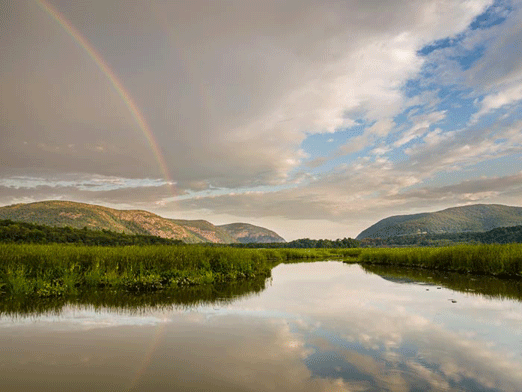
Manna Jo Greene, an Ulster County legislator and environmental director for Hudson River Sloop Clearwater, does not want to see the proposed release of nuclear wastewater from Indian Point into the Hudson River to go forward.
She says standards that deem the proposed discharge safe are outdated.
“And we’re also looking into whether or not this could impact communities that take their drinking water from the Hudson,” Greene said.
……………………………… For now, the release of about 300,000 gallons of nuclear wastewater has been slated for September, giving more time to determine the best path forward.
The next meeting from the Indian Point Decommissioning Oversight Board will take place June 15. https://spectrumlocalnews.com/nys/hudson-valley/news/2023/04/28/release-of-nuclear-wastewater-into-hudson-pushed-to-fall
What now for Germany’s remaining nuclear waste?
Jens Thurau, 24 Apr 23 https://www.dw.com/en/what-now-for-germanys-remaining-nuclear-waste/a-65420338
Germany has shut down its last nuclear power stations. But the issue isn’t going anywhere, as the country faces the question of what to do with its remaining nuclear waste.
Nuclear energy in Germany has been history since mid-April. At one time, up to 20 nuclear power plants fed electricity into the German grid. But all that is over now. The last three nuclear power plants ended their operations on April 15.
To Germany’s environment minister Steffi Lemke of the Green Party, the date marks a new dawn: “I think we should now put all our energy into pushing forward photovoltaics, wind power storage, energy saving, and energy efficiency, and stop these backward-looking debates,” she said in a recent radio interview.
April 15 also effectively ended a decades-long political dispute in Germany. In light of the tense situation on the energy market due to Russia’s war in Ukraine, there are still voices demanding that nuclear power be extended
The waste issue
And yet, the issue of nuclear energy will linger for Germany for some time yet, as the reactors still have to be dismantled, and the final disposal of the radioactive nuclear waste has not yet been clarified.
Like almost all other countries that have operated, or continue to operate nuclear power plants, Germany has yet to find a place to safely store the spent fuel. Currently, Germany’s nuclear waste is in interim storage at the sites of abandoned power plants, but the law requires that nuclear waste be safely stored in underground repositories for several millennia.
“The interim storage facilities are designed to last for quite some time,” Wolfram König, president of the Federal Office for the Safety of Nuclear Waste Disposal (BASE), told DW. “They are supposed to bridge the time until a final repository is available. … What we are looking for is geological depth, a suitable layer of salt, in granite or in clay rock, which will ensure that no radioactive substances reach the surface again for an indefinitely long period of time.”
Location, location, location
That’s a principle that Germany shares with all of the 30 or so countries that still operate, or have operated nuclear power plants in the past: Radioactive waste is to be disposed of underground. But where exactly? For a long time, Gorleben, located in the Wendland region of Lower Saxony, northeastern Germany, was the site most favored by politicians looking for an underground repository for nuclear waste.
But Gorleben became the location of fierce protests against nuclear energy, so politicians decided a few years ago to abandon the site. Now, the search is on throughout Germany, with more than 90 possible sites under consideration. “We can and must assume that the search process in Germany, with the construction of a final repository, will take approximately as long as we have used nuclear energy, namely 60 years,” König said.
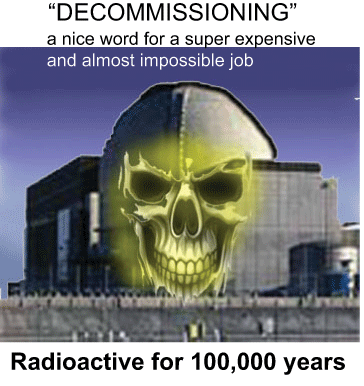
Meanwhile, the dismantling of Germany’s 20 or so nuclear power plants that have been built will also take time. That, according to König, is the responsibility of their operators, who estimate it could take between 10 and 15 years.
A worldwide headache
So far, reactors have been shut down in Italy, Kazakhstan, and Lithuania, while other countries, including the United Arab Emirates and Belarus, are building new nuclear plants.
But the permanent, safe storage of radioactive waste is an unresolved issue everywhere.
Finland is furthest along in its planning. In a report by German public broadcaster ARD, Vesa Lakaniemi, administrative head in the municipality of Eurajoki, southern Finland, talked about the construction of the final storage facility for nuclear waste in his town: “Whoever profits from electricity must also take responsibility for the waste. And that’s how it is in Finland.” The estimated construction costs for the Eurajoki repository is €3.5 billion ($3.8 billion).
According to the International Atomic Energy Agency (IAEA), there are currently 422 nuclear reactors in operation worldwide, with an average age of about 31 years. The recent “World Nuclear Industry Status Report” said that, despite a few countries building new nuclear power stations, there was no evidence of a “nuclear renaissance.” In 1996, some 17.5% of the world’s energy was produced in nuclear reactors — in 2021 it was below 10%. Nevertheless, the radioactive legacy will keep Germany preoccupied for many years to come.
The Human Dimension to Kazakhstan’s Plutonium Mountain

April 24, 2023, Sig Hecker https://nonproliferation.org/the-human-dimension-to-kazakhstans-plutonium-mountain/
The following is an excerpt from the Stanley Center for Peace and Security.
As we drove deeper into the Semipalatinsk Nuclear Test Site, we found kilometer-long trenches that were clearly the work of professional thieves using industrial earth-moving equipment, rather than hand-dug trenches made by nomad copper-cable-searching amateurs on camelback. Our Kazakh hosts said they could do nothing to stop these operations. In fact, they weren’t sure they had a legal right to stop them from “prospecting” on the site.
It was the sight of these trenches that urged me to convince the three governments that they must cooperate to prevent the theft of nuclear materials and equipment left behind when the Soviets exited the test site in a hurry as their country collapsed.
When the Soviet Union collapsed in December 1991, the most urgent threat to the rest of the world was no longer the immense nuclear arsenal in the hands of the Russian government but rather the possibility of its nuclear assets—weapons, materials, facilities, and experts—getting out of the hands of the government. As director of the Los Alamos National Laboratory, I helped to initiate the US–Russia lab-to-lab nuclear cooperative program in 1992 to mitigate these nuclear threats.
The trilateral US–Russia–Kazakhstan cooperation began in 1999 to secure fissile materials that were left behind by the Soviets at the Semipalatinsk Nuclear Test Site, which was now in the newly independent country of Kazakhstan. The project was kept in confidence until the presidents of the three countries announced it at the Seoul Nuclear Security Summit in 2012
In Doomed to Cooperate, individuals from the three countries recount their cooperative efforts at Semipalatinsk. Unlike the US–Kazakhstan projects initiated earlier on nuclear test tunnel closures, identifying experiments that left weapons-usable fissile materials (plutonium and highly enriched uranium) at the huge test site—whether in the field, in tunnels, or in containment vessels—required trilateral cooperation. The Russian scientists who conducted these experiments were the only ones who knew what was done and where. It required American nuclear scientists who conducted similar tests in the United States to assess how great a proliferation danger the fissile materials in their current state may constitute. And it required Kazakh scientists and engineers to take measures to remediate the dangers. The project also required the political support of all three countries and the financial support of the American government because it was the only one at the time with the financial means. That support came from the US Cooperative Threat Reduction (or Nunn-Lugar) program.
Continue reading at the Stanley Center for Peace and Security.
Maori workers exposed to radiation in cleaning up USA’s failed nuclear reactor in Antarctica
Detour: Antarctica – Kiwis ‘exposed to radiation’ at Antarctic power plant, https://www.nzherald.co.nz/travel/detour-antarctica-kiwis-exposed-to-radiation-at-antarctic-power-plant/NY5WTQ72JF4OFUW4F35ZSUCB6U/ 8 Jan, 2022 By Thomas Bywater, Thomas Bywater is a writer and digital producer for Herald Travel
In a major new Herald podcast series, Detour: Antarctica, Thomas Bywater goes in search of the white continent’s hidden stories. In this accompanying text series, he reveals a few of his discoveries to whet your appetite for the podcast. You can read them all, and experience a very special visual presentation, by clicking here. To follow Detour: Antarctica, visit iHeartRadio, or wherever you get your podcasts.
The Waitangi Tribunal will consider whether NZ Defence Force personnel were appropriately warned of potential exposure to radiation while working at a decommissioned nuclear reactor in Antarctica.
It’s among a raft of historic claims dating from 1860 to the present day before the Military Veterans Inquiry.
After an initial hearing in 2016, the Waitangi Tribunal last year admitted the Antarctic kaupapa to be considered alongside the other claims.
“It’s been a bloody long journey,” said solicitors Bennion Law, the Wellington firm representing the Antarctic claimants.
Between 1972 and the early 1980s, more than 300 tonnes of radioactive rubble was shipped off the continent via the seasonal resupply link.
Handled by US and New Zealand personnel without properly measuring potential exposure, the submission argues the Crown failed in its duty of care for the largely Māori contingent, including NZ Army Cargo Team One.
“This failure of active protection was and continues to be in breach of Te Tiriti o Waitangi,” reads the submission.
The rubble came from PM3A, a portable nuclear power unit on Ross Island, belonging to the US Navy. Decommissioned in 1972, its checkered 10-year operating history led it to be known as ‘Nukey Poo’ among base inhabitants. After recording 438 operating errors it was shut off for good.
Due to US obligations to the Antarctic Treaty, nuclear waste had to be removed.
Peter Breen, Assistant Base Mechanic at New Zealand’s Scott Base for 1981-82, led the effort to get similar New Zealand stories heard.
He hopes that NZDF personnel involved in the cleanup of Ross Island might get medallic recognition “similar to those who were exposed at Mururoa Atoll”. Sailors were awarded the Special Service Medal Nuclear Testing for observing French bomb sites in the Pacific in 1973, roughly the same time their colleagues were helping clear radioactive material from Antarctica.
A public advisory regarding potential historic radiation exposure at McMurdo Station was published in 2018.
Since 1975 the Waitangi Tribunal has been a permanent commission by the Ministry of Justice to raise Māori claims relating to the Crown’s obligations in the Treaty of Waitangi.
The current Military Veterans’ Kaupapa includes hearings as diverse as the injury of George Nepata while training in Singapore, to the exposure of soldiers to DBP insecticides during the Malayan Emergency.
Commenced in 2014 in the “centenary year of the onset of the First World War” the Māori military veterans inquiry has dragged on to twice the duration of the Great War.
Of the three claimants in the Antarctic veterans’ claim, Edwin (Chaddy) Chadwick, Apiha Papuni and Kelly Tako, only Tako survives.
“We’re obviously concerned with time because we’re losing veterans,” said Bennion Law.
Detour: Antarctica is a New Zealand Herald podcast. You can follow the series on iHeartRadio, Apple Podcasts, Spotify or wherever you get your podcasts.
France’s radioactive waste management agency Andra wants to increase storage capacity at Cires waste dump
French radioactive waste management agency Andra has applied to the
department of Aube in north-eastern France for environmental permission to
increase the current authorised storage capacity of Cires, the country’s
dedicated disposal facility for very-low-level radioactive waste (VLLW).
World Nuclear News 12th April 2023
https://www.world-nuclear-news.org/Articles/Application-to-raise-capacity-of-French-very-low-l
Shining a light on St Louis’ radioactive waste landfill scandal

ST. LOUIS PREPS FOR “CATASTROPHIC” NUCLEAR EVENT http://armydotmil.com/st-louis-preps-for-catastrophic-nuclear-event/
To offer your help, email: westllakemoms@gmail.com http://armydotmil.com/epa-does-nothing-as-nuclear-waste-calamity-inches-closer/
Nuclear waste abandonment risks the dangers of amnesia
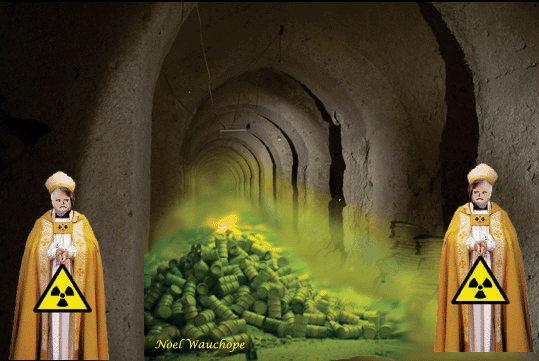
Broad-stroke reassurances from supporters of a proposed deep geological repository for Canada’s nuclear waste have failed to allay important environmental and security concerns.
The Hill Times, BY ERIKA SIMPSON | April 13, 2023
A plan to store Canada’s nuclear waste deep underground in northern Ontario raises serious safety concerns for current and future generations.
In light of this, the Nuclear Waste Management Organization (NWMO)—which is responsible for developing and implementing the plan—should reconsider other options, such as a rolling stewardship model, which actively plans for retrieval and periodic repackaging of nuclear waste.
From April 4-5, the South Bruce Nuclear Exploration Forum considered the NWMO plan to store all of Canada’s high-level nuclear waste in one deep geological repository (DGR). An earlier plan had proposed burying intermediate- and low-level nuclear waste in limestone caverns constructed under the Bruce reactor, but was met with a “no” vote from members of the Saugeen-Ojibway Nation. That led to Bruce Power withdrawing its own proposal in June 2020.
The current proposal for a $23-billion DGR project at Teeswater, Ont., may be constructed 50 km away from the Bruce Nuclear Generating Station, the world’s largest operating nuclear site that supplies 30 per cent of Ontario’s power. Whether the proposal goes ahead in partnership with a willing host community will be decided by the Governor in Council. Once one of the two remaining possible host communities—either Teeswater or Ignace, Ont.—is selected, the Canadian Nuclear Safety Commission (CNSC) and the Impact Assessment Agency of Canada will continue to lead decades-long consultation processes…………………………..
the broad-stroke reassurances of the DGR proponents have failed to allay concerns.
There are questions about how 700 engineers and construction workers could possibly be housed. I have written about SNC-Lavalin—an engineering company that was prosecuted internationally for corruption—yet remains the leading contractor and possible steward of Canada’s nuclear wastes. Heavily subsidized by Canadian tax dollars, the company is driven by the quest for money, not the quest for nuclear security. Although no questions were publicly asked about SNC-Lavalin, a project officer from the Wastes and Decommissioning Division at CNSC explained each engineering and closure stage could be halted, if deemed necessary.
There are also questions about impacts on future generations. Would the underground nuclear waste containers be monitored, in perpetuity, and what might be safety concerns about situating any such site in the Great Lakes’ water basin, the world’s largest body of fresh water and the drinking water for up to 40 million people? The hydrogeologists and geologists were confident that the DGR concept—possibly the first or fourth underground nuclear waste site in the world—would not be beyond Canada’s engineering and scientific capabilities.
I asked DGR proponents about four U.S. Senators who asked President Joe Biden to raise the issue with Prime Minister Justin Trudeau last month. I was told this would be a local decision—made by area residents in next year’s referendum—combined somehow with a municipal town council majority decision, and a possible veto by First Nations—and therefore the United States would have nothing to do with it, even though Canada’s federal cabinet would have the final say.
I asked Tiina Jalonen, the senior vice president of development at Posiva Oy about Finland’s proposed used-fuel disposal facility and her government’s plans for “signage.” It could be important to warn our great-great-great-grandchildren to refrain from curiously digging out whatever leaks into rock formations below.
What about the legacy of strikes on nuclear sites, like the Russian assault on Ukraine’s Zaporizhzhia nuclear plant, that has made evident that nuclear power plants and waste disposal sites could become targets in conflict zones? Nobody publicly asked about terrorist threats, and whether the site could become hostage to nefarious bargaining.
What else might go wrong? I asked two fire chiefs, but they had not heard about the fire at the Waste Isolation Pilot Plant in New Mexico that shut down the site in 2014 due to a major radiation release that contaminated workers at the surface. I asked a geologist about Germany’s Asse Salt Mine that still leaks water into radioactive containers.
Perhaps continual monitoring and the ‘rolling stewardship’ concept—that actively plans for retrieval and periodic repackaging—would be most effective, because wholesale abandonment could lead to amnesia.
Erika Simpson is an associate professor of international politics at Western University, the author of Nuclear Waste Burial in Canada? The Political Controversy over the Proposal to Construct a Deep Geologic Repository and Nuclear waste: Solution or problem? and the president of the Canadian Peace Research Association.
https://www.hilltimes.com/story/2023/04/13/nuclear-waste-abandonment-risks-the-dangers-of-amnesia/384800/
1 This Month

of the week – Shut Down Drone Warfare!


Tell the Ukrainian Government to Drop Prosecution of Peace Activist Yurii Sheliazhenko

Petition to revoke the licensing of the Near Surface Nuclear Disposal Facility (NSDF) at Chalk River. https://www.ourcommons.ca/petitions/en/Petition/Details?Petition=e-7247
To see nuclear-related stories in greater depth and intensity – go to https://nuclearinformation.wordpress.com
-
Archives
- April 2026 (79)
- March 2026 (251)
- February 2026 (268)
- January 2026 (308)
- December 2025 (358)
- November 2025 (359)
- October 2025 (376)
- September 2025 (257)
- August 2025 (319)
- July 2025 (230)
- June 2025 (348)
- May 2025 (261)
-
Categories
- 1
- 1 NUCLEAR ISSUES
- business and costs
- climate change
- culture and arts
- ENERGY
- environment
- health
- history
- indigenous issues
- Legal
- marketing of nuclear
- media
- opposition to nuclear
- PERSONAL STORIES
- politics
- politics international
- Religion and ethics
- safety
- secrets,lies and civil liberties
- spinbuster
- technology
- Uranium
- wastes
- weapons and war
- Women
- 2 WORLD
- ACTION
- AFRICA
- Atrocities
- AUSTRALIA
- Christina's notes
- Christina's themes
- culture and arts
- Events
- Fuk 2022
- Fuk 2023
- Fukushima 2017
- Fukushima 2018
- fukushima 2019
- Fukushima 2020
- Fukushima 2021
- general
- global warming
- Humour (God we need it)
- Nuclear
- RARE EARTHS
- Reference
- resources – print
- Resources -audiovicual
- Weekly Newsletter
- World
- World Nuclear
- YouTube
-
RSS
Entries RSS
Comments RSS
 nuclear-news