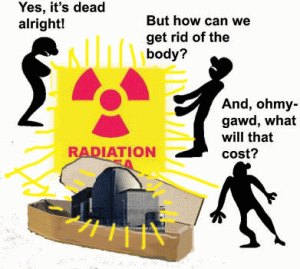
Dismantling of deactivated Fort Greely nuclear power plant to resume.
Alaska Public Media By Tim Ellis, KUAC – Fairbanks, August 25, 2023
The decommissioning of an old nuclear power plant at Fort Greely can move forward now that the federal agency overseeing the project has resolved a contract dispute that delayed work for more than a year.
Work on the final phase of decommissioning and dismantling the long-mothballed SM-1A heat and power plant has been on hold since late last year, when a company that was competing for the contract began filing protests over how the Army Corps of Engineers handled the bid proposals…………………………………………………………………………………………
Barber said the year-long, back-and-forth process of reviewing and re-evaluating the proposals means the completion date of the project also will be pushed back by a year.
“So we’re looking at 2029, at this point,” she said, adding that it’ll take a while for A3D to begin work on the facility……………..
The SM-1A’s highly enriched uranium dioxide fuel and most highly radioactive components of the facility were removed after it was shut down in 1972. Remaining materials have been entombed in concrete or safely stored onsite. Much of that will be removed as part of the contract with A3D……
Barber says when the the remaining work is completed, the SM-1A, like two other prototype military nuclear power plants developed during the Cold War, will finally all be decommissioned and dismantled. https://alaskapublic.org/2023/08/25/dismantling-of-deactivated-fort-greely-nuclear-power-plant-to-resume/
.
At Fukushima Daiichi, decommissioning the nuclear plant is far more challenging than water release.
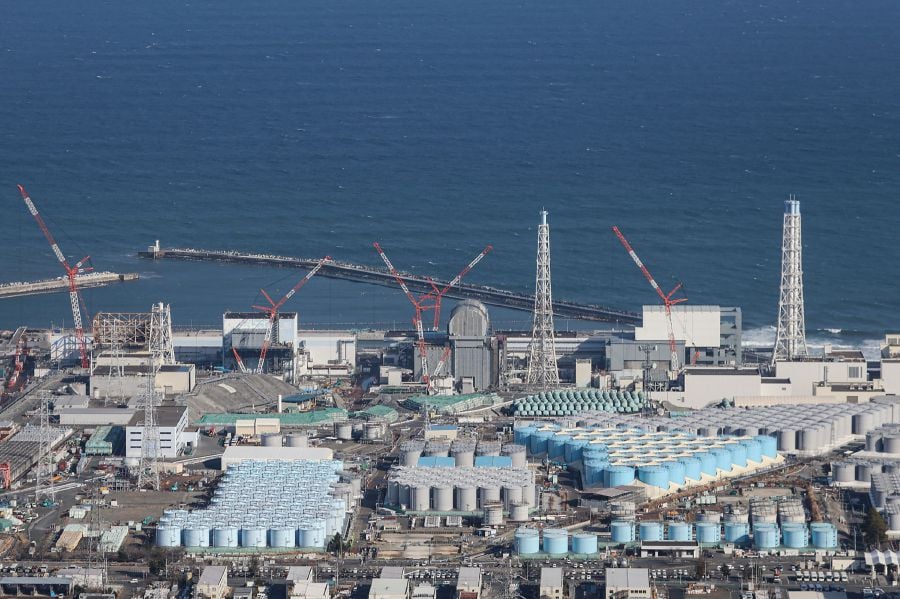
“technical difficulty involving the decommissioning is much higher” than the water release and involves higher risks of exposures by plant workers to remove spent fuel or melted fuel.
Some experts say it would be impossible to remove all the melted fuel debris by 2051 and would take 50-100 years, if achieved at all.
BY MARI YAMAGUCHI, August 27, 2023
FUTABA, Japan (AP) — For the wrecked Fukushima Daiichi nuclear plant, managing the ever-growing volume of radioactive wastewater held in more than 1,000 tanks has been a safety risk and a burden since the meltdown in March 2011. Its release marks a milestone for the decommissioning, which is expected to take decades.
But it’s just the beginning of the challenges ahead, such as the removal of the fatally radioactive melted fuel debris that remains in the three damaged reactors, a daunting task if ever accomplished.
Here’s a look at what’s going on with the plant’s decommissioning:
…………………………………………………… WILL THE WASTEWATER RELEASE PUSH DECOMMISSIONING FORWARD?
Not right away, because the water release is slow and the decommissioning is making little progress. TEPCO says it plans to release 31,200 tons of treated water by the end of March 2024, which would empty only 10 tanks out of 1,000 because of the continued production of wastewater at the plant.
The pace will later pick up, and about 1/3 of the tanks will be removed over the next 10 years, freeing up space for the plant’s decommissioning, said TEPCO executive Junichi Matsumoto, who is in charge of the treated water release. He says the water would be released gradually over the span of 30 years, but as long as the melted fuel stays in the reactors, it requires cooling water, which creates more wastewater.
Emptied tanks also need to be scrapped for storage. Highly radioactive sludge, a byproduct of filtering at the treatment machine, also is a concern.
WHAT CHALLENGES ARE AHEAD?
About 880 tons of fatally radioactive melted nuclear fuel remain inside the reactors. Robotic probes have provided some information but the status of the melted debris remains largely unknown.
Earlier this year, a remote-controlled underwater vehicle successfully collected a tiny sample from inside Unit 1’s reactor — only a spoonful of the melted fuel debris in the three reactors. That’s 10 times the amount of damaged fuel removed at the Three Mile Island cleanup following its 1979 partial core melt.
Trial removal of melted debris using a giant remote-controlled robotic arm will begin in Unit 2 later this year after a nearly two-year delay. Spent fuel removal from Unit 1 reactor’s cooling pool is set to start in 2027 after a 10-year delay. Once all the spent fuel is removed, the focus will turn in 2031 to taking melted debris out of the reactors. But debris removal methods for two other reactors have not been decided.
Matsumoto says “technical difficulty involving the decommissioning is much higher” than the water release and involves higher risks of exposures by plant workers to remove spent fuel or melted fuel.
“Measures to reduce radiation exposure risks by plant workers will be increasingly difficult,” Matsumoto said. “Reduction of exposure risks is the basis for achieving both Fukushima’s recovery and decommissioning.”
HOW BADLY WERE THE REACTORS DAMAGED?
Inside the worst-hit Unit 1, most of its reactor core melted and fell to the bottom of the primary containment chamber and possibly further into the concrete basement. A robotic probe sent inside the Unit 1 primary containment chamber found that its pedestal — the main supporting structure directly under its core — was extensively damaged.
Most of its thick concrete exterior was missing, exposing the internal steel reinforcement, and the nuclear regulators have requested TEPCO to make risk assessment.
CAN DECOMMISSIONING END BY 2051 AS PLANNED?
The government has stuck to its initial 30-to-40-year target for completing the decommissioning, without defining what that means.
An overly ambitious schedule could result in unnecessary radiation exposures for plant workers and excess environmental damage. Some experts say it would be impossible to remove all the melted fuel debris by 2051 and would take 50-100 years, if achieved at all.
Endless fallout: the Pacific idyll still facing nuclear blight 77 years on
The film Oppenheimer has shone a global spotlight on the dawn of US nuclear weapons tests. In the Marshall Islands, where 23 of those earth-shattering blasts happened, people have never been able to forget
by Lucy Sherriff, 25 Aug 23, https://www.theguardian.com/environment/2023/aug/25/endless-fallout-marshall-islands-pacific-idyll-still-facing-nuclear-blight-77-years-on
t first glance, the aquamarine waters that surround the Marshall Islands seem like paradise. But this idyllic Pacific scene hides a dark secret: it was the location of 67 nuclear detonations as part of US military tests during the cold war between 1946 and 1958.
The bombs were exploded above ground and underwater on Bikini and Enewetak Atolls, including one device 1,100 times larger than the Hiroshima atom bomb. Chernobyl-like levels of radiation forced hundreds from their homes. Bikini Atoll remains deserted. At the US government’s urging, residents have begun returning slowly to Enewetak.
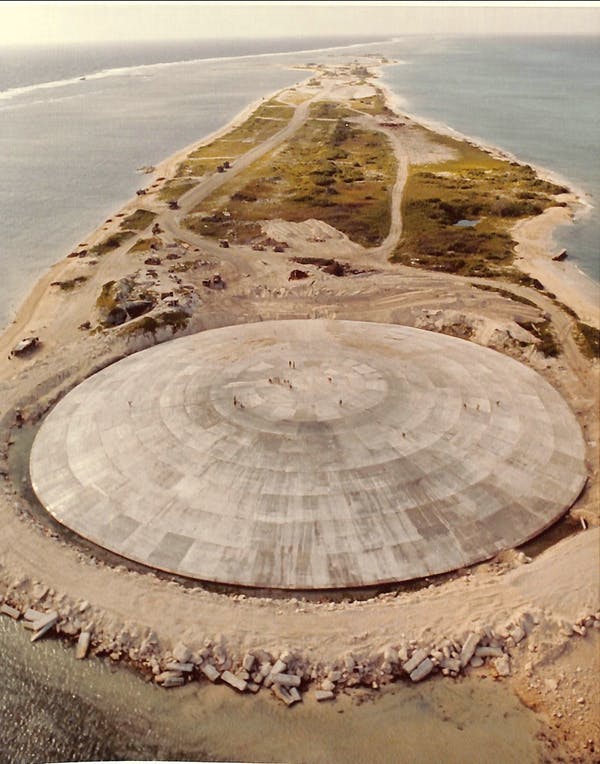
Today, there is little visible evidence of the tests on the islands except for a 115-metre (377ft)-wide cement dome that locals nickname the Tomb – for good reason.
Built in the late 1970s and now aged and cracking, the huge concrete lid on Runit Island covers more than 90,000 cubic metres (3.1m cubic ft) – or roughly 35 Olympic-sized swimming pools – of radioactive soil and nuclear waste. Unbeknown to the Marshallese people, the US shipped the waste from Nevada, where it was testing nuclear weapons on Native American land.
The legacy of America’s nuclear testing on Indigenous communities both on the US mainland and its territories has come under renewed scrutiny with the release of Oppenheimer, the blockbuster film about the physicist who led development of the atomic bomb.
Although his team tested the nuclear weapons on Native American land – there were 928 large-scale nuclear weapons tests in Nevada, Utah and Arizona during the cold war, dispersing huge clouds of radioactive material – the film never mentions the impact of the testing on the local Native Americans.
The legacy of America’s nuclear testing on Indigenous communities both on the US mainland and its territories has come under renewed scrutiny with the release of Oppenheimer, the blockbuster film about the physicist who led development of the atomic bomb.
Although his team tested the nuclear weapons on Native American land – there were 928 large-scale nuclear weapons tests in Nevada, Utah and Arizona during the cold war, dispersing huge clouds of radioactive material – the film never mentions the impact of the testing on the local Native Americans.
“The film completely ignores the experiences of our people,” says Ian Zabarte, principal man of the Western Bands of the Shoshone Nation – who have been described as “the most bombed nation on earth”
Zabarte is attempting to forge connections with those Pacific Islanders who were similarly affected by nuclear testing. Earlier this year, he met representatives from the Marshall Islands when they visited Nevada to discuss the effects on their health from nuclear weapons testing.
“The health impacts on our people have never been investigated,” Zabarte says. “We have never received an apology, let alone any kind of compensation.”
Separately, a band of Marshallese activists are now sailing around the country’s 29 atolls, along with artists and climate scientists, on a 12-day tour that aims to raise awareness of nuclear testing on the archipelago.
The 520-mile ocean voyage is being operated by Cape Farewell, a cultural programme founded by the British artist David Buckland and funded by the Waverley Street Foundation, Laurene Powell Jobs’s climate charity.
“Cancers continue from generation to generation,” says Alson Kelen, a master navigator and community elder who grew up on Bikini Atoll and is joining the expedition.
“If you ask anyone here if there’s a legacy of nuclear impact on their health, the answer would be yes. The Marshall Islands Nuclear Claim Tribunal has a list of cancers that are related to nuclear throughout our people. These cancers are hereditary.”
The US maintains that the Marshall Islands are safe. It seized them from Japan in 1944, and eventually granted the islands independence in 1979, but the fledgling nation remained in “free association” with the US. Under this system, along with Micronesia and Palau, the Marshall Islands are self-governing but economically remain largely dependent on Washington, which also retains a military presence. Today it continues to use the US dollar, and American aid still represents a large percentage of its GDP.
In 1988, an independent international tribunal was established to adjudicate between the two countries, and it later ordered the US to pay $2.3bn (£1.8bn) to the Marshall Islands in healthcare and resettlement costs.
The US government has refused, arguing that its liabilities ended when it paid $600m in the 1990s. In 1998, the US stopped providing medical care for cancer-stricken islanders, leaving many in financial hardship.
The agreement is up for renegotiation this year, and the Marshallese hope they will have stronger negotiating power with the US now that China is showing an interest in the islands due to their strategic location. The islanders are pushing for the $2.3bn they feel they are owed, and a cleanup of the Runit Dome, which is at risk of collapsing due to rising sea levels and the natural ageing of concrete structures.
“Of course it’s going to break,” says Stephen Palumbi, a Stanford University marine scientist who led a research trip to the islands in 2016. “What else can you expect? You can’t just build something like that and walk away from it and expect it to stay there. You wouldn’t do that with your patio.”
According to a 2019 investigation by the LA Times, many US military personnel present at the construction of Runit Dome realised that radioactive material was leaking from it, and would continue to do so – yet did not alert the Marshallese government.
The threat to the Tomb is particularly acute because the islands, which lie just 2 metres above sea level on average, are very vulnerable to rising sea levels. The country’s capital, Majuro, is highly likely to be at risk of frequent flooding, according to a World Bank study.
The US says it has discharged its responsibilities to the Marshall Islands, and because the dome is on Marshallese land, the onus is not on Washington to fix it.
It is not clear what will happen to the environment when the Tomb crumbles, and has also been hard to track how the ecosystem has behaved over time as “there’s just not many people” on Bikini Atoll to even casually monitor changes, Palumbi says.
But a 2012 United Nations report said the effects of radiation on the Marshall Islands are long-lasting and have caused “near-irreversible environmental contamination”.
On Palumbi’s visit, locals warned his team not to eat the coconuts – which are radioactive due to the contaminated groundwater – or the coconut crabs that feed on them. “You do not grow crops, you do not eat coconut, you do not drink the water,” Palumbi says.
In general, it has been shown that nuclear blasts represent an extreme threat to local biodiversity. A 1973 US government-funded study on nuclear testing in Alaska found both immediate harm and long-term damage to marine species: fish exploded when their gas-filled swim bladders reacted to the change in pressure underwater, and hundreds of sea otters were also killed instantly.
Researchers have recently found that sea turtle shells can be used to study nuclear contamination, with traces of uranium found in animals not born when testing in the Pacific Islands ended. The turtles are thought to accumulate human-made radionuclides in their bony outer shell, which is usually made of keratin, through the food chain by eating uranium-contaminated algae.
Japan recently announced it would start dumping waste from the Fukushima nuclear power plant, which had meltdowns in 2011, into the ocean. Although the UN’s nuclear watchdog says it is safe to do so, there are fears that there is still not enough understanding of how radioactive nuclear waste affects the ecosystem to be sure of this.
Palumbi notes that the resilience of the ocean is impressive, with corals regrowing on the Marshall Islands as soon as 10 years after the bombs were exploded. “This is the most destructive thing we have ever done to the ocean, dropping 23 atomic bombs on it, yet the ocean is really striving to come back to life.”
There are, however, eerie reminders of what happened decades ago, including a fine talcum powder-like sediment covering the reefs – and still-visible damage to the reef itself. “On the inside of the lagoon, where the actual bombs were, it’s still an amazing mess,” Palumbi says. “The reef has cracked in half, and you realise that it was the bomb.”
Kelen says he would not trust anyone who says releasing nuclear material into the water is safe. “Everybody who has talked to me about nuclear has been lying,” he says. This, he says, includes the US “who promised our islands were safe to live in. This continues. I do not trust politicians who say this will be OK.”
Zabarte, who has numerous family members who have died of cancer, is similarly concerned about the long-term impacts of radiation. “My people have nowhere to go,” he says. “We have to stay there, exposing ourselves on a daily basis. We have no choice.”
“We have to keep repeating this story,” says Kelen. “We have forever been moved around by people who make decisions over us, telling us our lives will be safe and how to live. But no matter what life has thrown at us, from nuclear testing to rising sea levels, our home and life are very much still here.
“We live this story, and it informs us culturally, but we do not let it define who we are.”
Fukushima waste-water decision disregards scientific evidence, violates the human rights of Pacific region communities

Japan announces date for Fukushima radioactive water release
Greenpeace International, 22 August 2023 https://www.greenpeace.org/international/press-release/61364/japan-announces-date-for-fukushima-radioactive-water-release/
Tokyo – Greenpeace Japan criticises the Japanese government’s announcement of the start date for radioactive water discharges from the Fukushima Daiichi nuclear station into the Pacific Ocean.
The decision disregards scientific evidence, violates the human rights of communities in Japan and the Pacific region, and is non-compliant with international maritime law. More importantly it ignores its people’s concerns, including fishermen. The Japanese government and Tokyo Electric Power Company (TEPCO) – the nuclear power plants’ operators – falsely assert that there is no alternative to the decision to discharge and that it is necessary to move towards final decommissioning. This further highlights the failure of the decommissioning plan for the nuclear plants destroyed in the 2011 earthquake, stating that tens of thousands of tons of contaminated water will continue to increase with no effective solution.
“We are deeply disappointed and outraged by the Japanese Government’s announcement to release water containing radioactive substances into the ocean. Despite concerns raised by fishermen, citizens, Fukushima residents, and the international community, especially in the Pacific region and neighboring countries, this decision has been made,” said Hisayo Takada, Project Manager at Greenpeace Japan.
The increasing volumes of and the pending release of the radioactive water demonstrate the failure of the decommissioning plan for the Fukushima Daiichi. The contaminated water will continue to accumulate for many years without effective measures to stop it. The Japanese Government and TEPCO falsely claim that discharge is the only viable option necessary for eventual decommissioning. Nuclear power generation, which experiences shutdowns due to accidents and natural disasters, and perpetually requires thermal power as a backup, cannot serve as a solution to global warming.
“The deliberate pollution of the Pacific Ocean through these radioactive waste discharges is a consequence of the 2011 nuclear disaster and Japan’s decades long nuclear power program. Instead of acknowledging the flaws in the current decommissioning plan, the ongoing nuclear crisis, and the massive amount of public funds required, the Japanese government intends to restart more nuclear reactors despite evidence of major earthquakes and safety risks. The current government energy plan fails to deliver secure and sustainable renewables such as wind and solar energy that the climate emergency demands,” said Takada.
As of 8 June 2023, there were 1,335,381 cubic meters of radioactive wastewater stored in tanks[1], but due to the failure of the ALPS (Advanced Liquid Processing System) processing technology, approximately 70% of this water will have to be processed again. Scientists have warned that the radiological risks from the discharges have not been fully assessed, and the biological impacts of tritium, carbon-14, strontium-90 and iodine-129, which will be released in the discharges, have been ignored.[2]
The International Atomic Energy Agency (IAEA) endorsed Japan’s plans for discharge. However, the IAEA has failed to investigate the operation of the ALPS, has completely ignored the highly radioactive fuel debris that melted down which continues every day to contaminate ground water – nearly 1000 cubic meters every ten days. Furthermore, the discharge plan has failed to conduct a comprehensive Environmental Impact Assessment, as required by its international legal obligations, given that there is a risk of significant transboundary harm to neighboring countries. The IAEA is not tasked with protecting the global marine environment but it should not encourage a state to violate it.
“The myth is being perpetuated that discharges are necessary for decommissioning. But the Japanese government itself admits that there is sufficient water storage space in Fukushima Daiichi.[3] Long-term storage would expose the current government decommissioning roadmap as flawed, but that is exactly what needs to happen. The Fukushima Daiichi nuclear station is still in crisis, posing unique and severe hazards, and there is no credible plan for its decommissioning,” emphasized Shaun Burnie, Senior Nuclear Specialist at Greenpeace East Asia.
Member states at the United Nations Human Rights Council in Geneva, as well as UN Special Rapporteurs, have opposed and criticized Japan’s discharge plans.[4] Japan’s discharge plans also disregard the groundbreaking Human Rights Council resolution 48/13, which in 2021 determined that it is a human right to have a clean, healthy and sustainable environment.[5] Furthermore, Japan has failed to comply with its legal obligations under the United Nations Convention for the Law of the Sea (UNCLOS), to protect the marine environment including its legal requirement to conduct a comprehensive Environmental Impact Assessment into the discharges into the Pacific Ocean, given the risk of significant transboundary harm to neighboring countries.[6]
“Instead of engaging in an honest debate about this reality, the Japanese government has opted for a false solution – decades of deliberate radioactive pollution of the marine environment – during a time when the world’s oceans are already facing immense stress and pressures. This is an outrage that violates the human rights of the people and communities of Fukushima, and other neighboring prefectures and the wider Asia-Pacific region,” said Burnie.
North County Report: What’s the Deal with San Onofre’s Nuclear Power Plant?
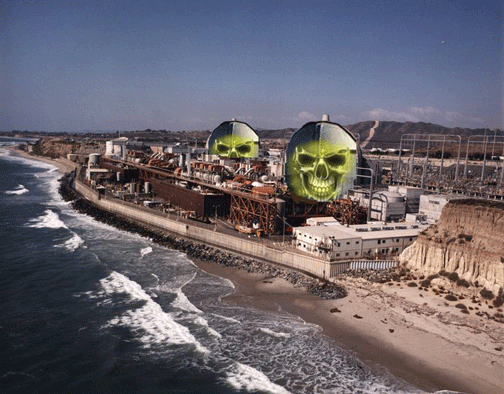
Federal and public officials have been working to dismantle the San Onofre nuclear power plant for about a decade, but there’s still a long way to go. Here are the latest developments.
Voice of San Diego, by Tigist Layne, 24 Aug 23
“………………………………………………………. For the past several years, SoCal Edison has been dismantling the plant, a process known as decommissioning. Once that process is complete, the land will go back to its owner, the U.S. Navy.
Before that can happen, though, there’s the issue of the 3.55 million pounds of nuclear waste currently sitting inside the facility.
The latest: Manuel Camargo, principal manager of the San Onofre Decommissioning Project, said 50 percent of the plant has been decommissioned so far. The San Onofre Decommissioning Project was created by SoCal Edison.
As for the nuclear waste, also known as spent nuclear fuel, the Department of Energy is moving forward with a plan to transport the fuel into a temporary storage facility. Once that happens, officials can complete the decommissioning process.
Decommissioning of the Plant Is Carried Out in Three Phases
- First, after allowing the spent nuclear fuel to cool for a few years, the decommissioning team packaged the spent fuel into seal-welded stainless-steel canisters and transferred it to an onsite storage system. That transfer was completed in 2020, Edison International spokesperson Jeff Monford wrote in an email.
- Next is the demolition of above-ground structures like pressure vessels, pumps, motors, fans, cables and structural steel, which are removed from the buildings, packaged and sent offsite for disposal. The rest of the concrete structures are then demolished and transported to a disposal facility in Utah.
- Remaining underground structures will be decontaminated according to federal guidelines for cleanup of the site. The team anticipates this to be completed by 2028, Camargo said.
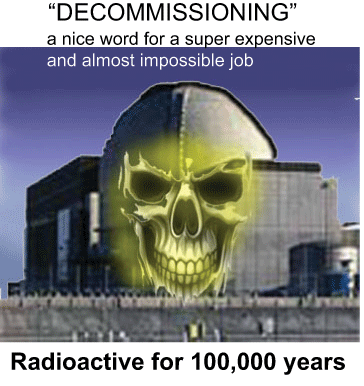
The final phase of decommissioning and site restoration will occur after the spent nuclear fuel is removed from the site.
The two containment domes are expected to come down sometime in 2025 or 2026.
The big storage issue: By now, you’ve probably gathered that without a place to store the spent nuclear fuel, the decommissioning can’t be completed. And there’s a reason it’s been so hard to find storage space: The federal government doesn’t have a single designated place in the United States to permanently store and/or dispose of spent nuclear fuel.
Let’s rewind to 1982 when the Nuclear Waste Policy Act became law. It established a national program for the disposal of highly radioactive waste and supports the use of deep geologic repositories to store and/or dispose of that waste.
A deep geologic repository is essentially a cavern a couple thousand feet below the Earth’s crust where the spent fuel would be placed, and it would stay there forever. It’s a way to store the waste while avoiding the contamination of the air, ground and underground water.
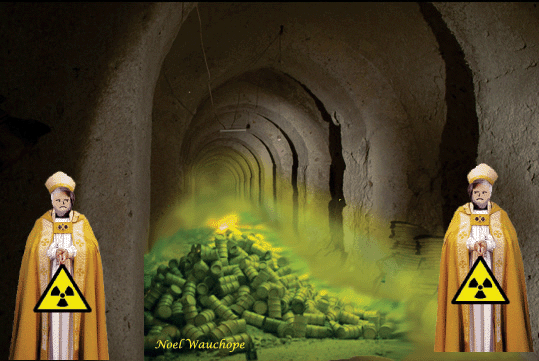
…………………………. until a permanent site is established by the federal government, the Department of Energy is stepping in.
……………………………………… ….Officials are planning to use consent-based siting to establish these storage facilities, meaning only cities and jurisdictions that are willing and able to store the spent nuclear fuel will be considered and chosen.
But these storage sites will be temporary. ……………………
The Department of Energy also needs approval from Congress to create these interim storage sites because the Nuclear Waste Policy Act would have to be modified to allow for it. It will also be up to lawmakers to eventually amend the act and establish another permanent deep geologic repository for spent fuel.
A few different groups are now working together to get this done: the Spent Nuclear Fuel Solutions Congressional Caucus established by Rep. Mike Levin; the Department of Energy; and the Spent Fuel Solutions coalition, which includes San Diego County, Orange County, Riverside County, SoCal Edison, San Diego Gas & Electric and the City of Riverside. https://voiceofsandiego.org/2023/08/23/north-county-report-whats-the-deal-with-san-onofres-nuclear-power-plant/
New York governor blocks discharge of radioactive water into Hudson River from closed nuclear plant.
A measure to block discharges of radioactive
water into the Hudson River as part of the Indian Point nuclear plant’s
decommissioning was signed into law Friday by New York Gov. Kathy Hochul.
The bill was introduced to thwart the planned release of 1.3 million
gallons of water with traces of radioactive tritium from the retired
riverside plant 25 miles (40 kilometers) north of New York City.
The plan sparked a groundswell of opposition in the suburban communities along the
river. Many feared the discharges would depress real estate values and
drive away sailors, kayakers and swimmers after decades of progress in
cleaning up the Hudson River.
AP 18th Aug 2023
Poisoning the planet
Radioactive water dump is just latest example our reckless destruction of habitat
By Linda Pentz Gunter, 20 Aug 23, https://beyondnuclearinternational.org/2023/08/20/poisoning-the-planet/
Much has been made — and rightly so — about the potential impact on human health and the Japanese fishing industry if Japan moves forward with its proposal to dump 1.2 million cubic meters — that’s 1.3 million tons —of radioactively contaminated water into the Pacific Ocean from the destroyed Fukushima Daiichi nuclear power plant site.
Unfortunately, this looks likely to happen sometime this month or next despite the worldwide outcry. But when I say “happen”, that rather suggests a one-off dump. Instead, the discharge of these liquid nuclear wastes could go on for at least 17 years according to the Atomic Energy Society of Japan, but likely longer as decommissioning work at the site is expected to take at least 30-40 years.
It is perfectly right and reasonable that the Japanese fishing community sees its livelihood under threat from this proposal. Indeed, it has already taken a hit, as imports of Japanese fish stock to South Korea were down by 30% in May, before the dumping even began. This was clearly driven by jitters around the on-going safety of Japanese fish supplies once those radioactive discharges get underway.
And Pacific Island nations, along with an international team of scientific experts, have equally decried the plan as premature, unnecessary and in need of far greater confidence and further study before such discharges are executed, if ever.
But there is a greater moral issue here, one that speaks to humankind’s reckless and selfish behavior on planet Earth ever since mechanization and the various so-called industrial revolutions began.
For almost three centuries in the developed world, we have continuously and wantonly destroyed vast areas of precious habitat for numerous species. We have clear cut forests, sliced the tops off mountains, broken open the earth to mine minerals, exploded atomic weapons, spewed mercury and carbon into our air, drilled for oil, sprayed pesticides at will and filled the oceans with plastics, to name just a few environmental atrocities.
The toxic mess these activities leave behind has been dumped into rivers, streams, lakes and oceans, or on the lands where the less influential and powerful amongst us live — in the United States almost always in communities of color or on Native American reservations.
One of the worst offenders on this list is nuclear waste. In keeping with our heedless irresponsibility we have kept making lethal radioactive waste without the slightest idea how to safely manage or store it for the longterm. For years, barrels of the stuff were dumped into the sea, until a 1994 amendment to the London Dumping Convention, put an end to it.
But of course the nuclear industry found a way around this. Routine liquid discharges through a pipe circumvented this law. Institutions such as the LaHague reprocessing site on the northern French coast, have discharged radioactive liquids (and gases) for decades. Didier Anger, the now retired expert activist on the environmental crimes at La Hague, uses this history to warn us urgently and eloquently of the folly of discharging nuclear waste into our oceans.
At times, the liquid wastes from La Hague, measured at the discharge point by vigilant groups such as Greenpeace, could have been classified as high-level radioactive waste that would normally require a deep geological repository.
As we approach the moment when radioactive liquids are once more poured into the sea, this time in Japan, imposing a toxic burden on the creatures who are already struggling to survive there, we must ask whether human beings have some sort of divine right of kings to trash the habitat of other living things?
The answer should surely be ‘no’. That humans can generate a radioactive mess and “dispose” of it into some other creatures’ habitat, poisoning their environment is, frankly, both arrogant and abhorrent.
We have already done this everywhere and it has come with a terrible price to other creatures as well as to ourselves. The destruction and contamination of habitat has led to mass extinctions. The US has lost three billion birds since 1970. That’s one in four birds. We may have thought the birds were back in abundance during the start of the covid pandemic, but that was just us hearing what’s left of them more clearly, in the quiet of lockdown.
Bees, who perform around 80% of all pollination, are dying out and hives collapsing, all due to human activities. These include pesticides, drought, habitat destruction, nutrition deficit, air pollution, and, of course, the climate crisis.
Absent these and other essential members of the web of life, our own extinction is not far behind.
We need to stop this behavior and we need to stop it now. We should do it not only for ourselves but for the countless innocent creatures who should not be expected to offer up their homes as our dustbins.
Loading up the Pacific Ocean with liquid radioactive waste — whether it dilutes and disperses or not — is a crime of immorality representative of so many that have come before. If we are truly to change our plundering, polluting and profligate ways, banning the radioactive water dump at Fukushima would be an excellent place to start.
Linda Pentz Gunter is the international specialist at Beyond Nuclear and writes for and curates Beyond Nuclear International.
Japan’s nuclear plants are short of storage for spent fuel. A remote town could have the solution.
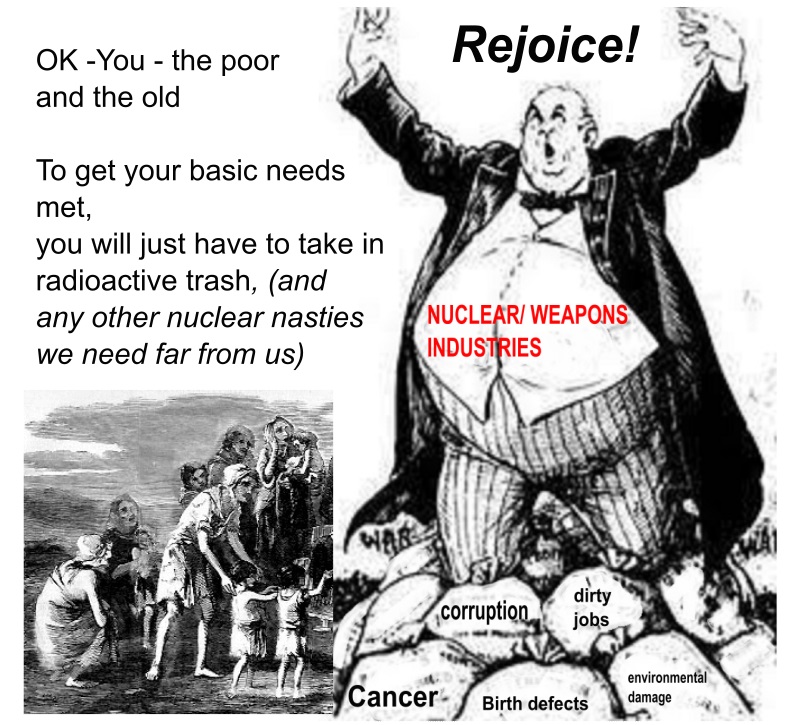
Chugoku Electric’s plan to build a nuclear power plant in Kaminoseki has been stalled for more than a decade since the Fukushima Daiichi disaster, delaying subsidies for the remote town, whose population is aging and shrinking.
“The town will only get poorer if we just keep waiting,” Kaminoseki Mayor Tetsuo Nishi – “We should do whatever is available now.”
ByMARI YAMAGUCHI Associated Press, https://abcnews.go.com/Business/wireStory/japans-nuclear-plants-short-storage-spent-fuel-remote-102373016 August 19, 2023
TOKYO — A Japanese town said Friday it has agreed to a geological study to determine its suitability as an interim storage site for spent nuclear fuel.
Kaminoseki, a small town in the southwestern prefecture of Yamaguchi, said it would accept the offer of a survey by Chugoku Electric Power Co., one of two major utility operators, along with Kansai Electric Power Co., whose spent fuel storage pools are almost full.
The Japanese government is promoting the greater use of nuclear power as a low-carbon energy source, but the country’s nuclear plants are running out of storage capacity.
The problem stems from Japan’s stalled nuclear fuel recycling program to reprocess plutonium from spent fuel for reuse. The government has continued to pursue the program, despite serious technical setbacks. A plutonium-burning Monju reactor failed and is being decommissioned, while the launch of the Rokkasho reprocessing plant in northern Japan has been delayed for almost 30 years.
After the meltdown of the Fukushima Daiichi nuclear power plant in 2011, many reactors were temporarily taken offline and their restarts delayed, helping to reduce the spent fuel stockpile.
However, when Prime Minister Fumio Kishida’s government decided to reverse a phaseout and maximize nuclear power as clean energy, concerns over the lack of storage space were rekindled.
Earlier this month, Chugoku put forward a proposal to build a storage facility jointly with Kansai Electric, but the plan was met by angry protests from residents, who surrounded the mayor and yelled at him.
Chugoku Electric’s plan to build a nuclear power plant in Kaminoseki has been stalled for more than a decade since the Fukushima Daiichi disaster, delaying subsidies for the remote town, whose population is aging and shrinking.
“The town will only get poorer if we just keep waiting,” Kaminoseki Mayor Tetsuo Nishi told a televised news conference Friday. “We should do whatever is available now.”
Kansai Electric, Japan’s largest nuclear plant operator, is urgently seeking additional storage for spent fuel: the cooling pools at its plants are more than 80% full. The company pledged to find a potential interim storage site by the end of this year.
About 19,000 tons of spent fuel, a byproduct of nuclear power generation, is stored at power plants across Japan, taking up about 80% of their storage capacity, according to the economy and industry ministry.
The continuation of spent fuel reprocessing program and the delay have only added to Japan’s already large plutonium stockpile, raising international concern. Japan also lacks a final repository for high-level nuclear waste.
An intermediate facility is designed to keep nuclear spent fuel in dry casks for decades until it is moved to a reprocessing or to a final repository. Experts say it is a much safer option than keeping it in uncovered cooling pools at their plants.
If the storage is actually built, it will be the second such facility in Japan. The only other one is in Mutsu, near Rokkasho, which is reserved for Tokyo Electric Power Co. and a smaller utility.
Scottish ministers test attitudes to building radioactive waste facilities near homes

The Scottish Government said the work was ‘very long-term’ and no decisions had been made regarding locations
Ministers are looking to test public attitudes to radioactive waste management, including potentially building facilities near where people live.
The Scottish Government has budgeted up to £30,000 to commission a survey of public
opinion, documents published online show. Questions will cover topics such
as trust in the government and the nuclear industry, as well as “attitudes
towards constructing facilities for radioactive waste in proximity to where
people live, if proven to be safe and resulting in significant economic
benefits”.
The move forms part of the Higher Activity Waste Implementation
Strategy, which was published in 2016 and sets out long-term plans for
disposing of such material. The Scottish Government said it was a “very
long-term programme of work” and no decisions had been made regarding
locations.
A tender document says the work “will help improve Scotland’s
environment by informing radioactive waste policy makers about the views of
Scottish citizens, as storage and disposal options are considered as part
of Scottish ministers’ obligations to manage the nuclear legacy clean-up
programme”.
It adds: “The nuclear waste landscape in Scotland remains
complex, with a mixture of civilian and military nuclear waste liabilities
requiring careful management to help protect people and the environment.
The Scottish Government is responsible for developing national radioactive
waste plans to help manage this nuclear legacy and in 2016, published its
Higher Activity Waste (HAW) Implementation Strategy. This strategy included
an illustrative timeline towards construction of a national nuclear waste
repository and a commitment to undertake various research activities such
as carrying out public attitude surveys and developing near-surface
disposal concepts.”
Scotsman 13th Aug 2023
Concrete tomb filled with deadly nuclear waste is leaking as it’s starting to crack
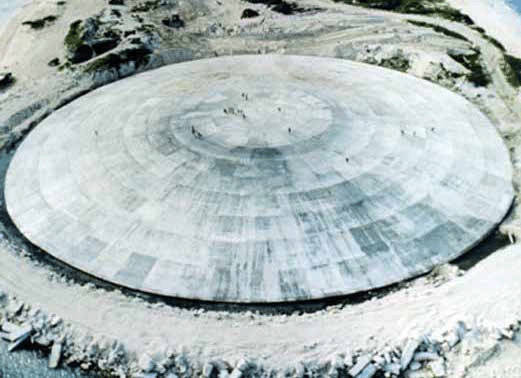
Joe Harker, 12 August 2023 https://www.unilad.com/news/world-news/qin-xi-huang-tomb-china-emperor-terracotta-army-345786-20230809
43 years ago a concrete container of nuclear waste was constructed on a tiny island in the Pacific Ocean, but there’s a big problem with that, it’s leaking.
During the Cold War, the US used islands in the Pacific to test nuclear weapons, and between 1946 and 1958 carried out a series of tests on Enewetak Atoll.
Of course, nuclear bombs poison the ground around them and the waste from these weapons is a dangerous commodity in and of itself. So between 1977 and 1980, a concrete dome was built to store the nuclear waste from the bomb tests.
That ended up being called the Runit Dome, because it was located on Runit Island, though it was also referred to as ‘the tomb’.
Housing radioactive debris, including poisonous plutonium, thousands of people scraped nuclear waste into a blast crater and covered it over with concrete to stop it from getting out.
Unfortunately that plan isn’t going quite so well as, according to IFL Science, a report from 2019 warns that changing conditions on the island are causing the concrete dome to crack.
Increasing temperatures are not helping the problem, while a rise in sea levels is also compounding the problem as the dome is not elevated off the ground, and the lapping waters of the sea are eroding it further.
This is all resulting in radioactive material bleeding out into the ground on the rest of the island and leaking out into the sea as well.
As long as the plutonium stays within the crater covered by the dome then it won’t be a major new source of contamination into the ocean.
That could all change if the cracking dome were to give way and seawater was able to flow in and out of the crater.
This concrete tomb could be a cracking nuclear coffin with a monster inside just waiting to be released, but for now things are still within acceptable levels.
According to the Woods Hole Oceanographic Institution, marine radioactivity expert Dr Ken Buesseler said they’d ‘known for years that the dome is leaking’, but for now only a ‘small amount of radioactivity’ was getting out.
For context, this isn’t putting the surrounding area beyond safety standards just yet, and the plutonium sealed beneath the Runit Dome is only a fraction of what was released during nuclear testing.
While he said things were alright at the moment, he warned that they ‘hadn’t considered sea level rise in the 1970s when they built this’, and said the dome would be ‘at least partially submerged by the end of this century’.
Plush new building for UK’s Nuclear Decommissioning Authority (NDA)
A government agency is moving into a plush 53,000 sq ft building at the
Harwell Science Campus. The Nuclear Decommissioning Authority (NDA) will
have a new office space after Vale of White Horse District Council granted
permission for the building in June. It will be occupied by the NDA but has
been designed to provide flexibility. In addition to workspaces, the
planning consent also includes breakout areas inside and outside of the
building for staff and visitors, enhanced landscaping and tree planting, as
well as car and cycle parking on site.
Oxford Mail 11th Aug 2023
https://www.oxfordmail.co.uk/news/23714472.new-office-space-occupied-harwell-science-campus/
Chinese UN mission releases working paper on Fukushima nuclear-contaminated wastewater issue, urging Japan to discharge in responsible manner
By Global TimesP Aug 09, 2023 https://www.globaltimes.cn/page/202308/1295954.shtml
Chinese UN mission releases working paper on Fukushima nuclear-contaminated wastewater issue, urging Japan to discharge in responsible manner
China’s Permanent Mission to the United Nations (UN) and Other International Organizations in Vienna has submitted the working paper on the disposal of nuclear-contaminated water of Japan’s Fukushima Daiichi Nuclear Power Station to the First Preparatory Committee for the Eleventh Review Conference of the Treaty on the Non-Proliferation of Nuclear Weapons (NPT).
The disposal of nuclear-contaminated water from Fukushima concerns the global marine environment and public health. There is no precedent for artificially discharging nuclear-contaminated water into the ocean and no internationally recognized disposal standards.
The international community should attach great importance to Japan’s ocean discharge of the nuclear-contaminated water and urge Japan to dispose of the contaminated water in a responsible manner, according to the working paper released on Wednesday.
The working paper pointed out that Japan had previously discussed five ways to dispose of the contaminated water, namely injection into the ground, discharge into the ocean, vapor release, release as hydrogen gas into the atmosphere, and underground burial. However, Japan did not conduct a thorough study of all disposal options and insisted on choosing ocean dumping, which was the lowest cost option, thus transferring the risk of nuclear contamination.
If the so-called ”treated-water” is really safe and harmless, why does Japan not dispose of it within its own territory or use it for industrial and agricultural purposes? The working paper pointed out.
The paper noted that Japan fails to prove the long-term effectiveness and reliability of the purification equipment for treating the contaminated water. According to the data released by Japan, nearly 70 percent of the nuclear-contaminated water treated by Japan’s ALPS (Advanced Liquid Processing System) still fails to meet the discharge standard and needs to be purified again.
Japan has failed to prove the authenticity and accuracy of the data on contaminated water. Fukushima power plant operator TEPCO has repeatedly concealed and falsified nuclear-contaminated water related data in recent years. The IAEA conducted its review and assessment solely based on the data and information provided by Japan, and carried out inter-laboratory comparative analyses of only a small number of nuclear-contaminated water samples collected by Japanese officials, read the working paper.
According to general international law and the provisions of UN Convention on the Law of the Sea, Japan has the obligation to protect and preserve the marine environment. The Convention on the Prevention of Marine Pollution by Dumping of Wastes and Other Matter 1972 (the London Convention) prohibits the dumping of radioactive waste into the sea by means of man-made structures at sea. Japan’s discharging of nuclear-contaminated water into the sea by means of submarine pipelines is in violation of the relevant provisions of the London Convention.
Japan has failed to demonstrate the perfection of the monitoring program. Tokyo must not start discharging until the long-term monitoring mechanism is established, and must stop discharging water once anomalies are detected in the data on the discharge of nuclear contaminated water.
The Chinese UN mission stressed that Japan should not confuse the concept of nuclear-contaminated wastewater with the wastewater from the normal operation of nuclear power plants.
The working paper warned Japan of not making use of IAEA’s comprehensive assessment report on the disposal of Fukushima nuclear-contaminated water as ”shield” or ”greenlight” for the dumping plan.
In addition, the paper urged Japan to fully respond to the concerns of China and the international community, and dispose of the nuclear-contaminated water in a responsible manner in line with its obligations under international law, stop pushing through the dumping plan, fully consult with stakeholders including neighboring countries, make sure to handle the nuclear contaminated water in a science-based, safe and transparent way, and subject itself to rigorous international oversight
Final Hearing on the Chalk River Megadump – Thursday, August 10, Commission hearing, 9am to 12 noon

Gordon Edwards, 9 Aug 23
Thursday, August 10, from 9 am to noon – CNSC will be conducting its final public hearings on the planned “megadump” at Chalk River — a gigantic mound of radioactive and non-radioactive toxic wastes, five to seven stories high, about one kilometre from the Ottawa River. About two-thirds of the radionuclides in the listed radioactive inventory have half-lives in excess of 5000 years. To tune in to the live webcast, visit http://cnsc.isilive.ca
Thursday’s hearings will be for the sole purpose of allowing the Algonquin communities of Kebaowek and Kitigan-Zibi to make their final presentations to the Commissioners. The Chalk River site is situiated on the unceded territory of 11 Algonquin communities. The Commission will not allow the Algonquin representatives to appear in person, they must make their case by zoom. The Indigenous leaders are explicitly forbidden from introducing any new evidence, they are asked to simply summarize the evidence that has already been presented to the CNSC.
Although the United Nations Declaration on the Rights of Indigenous Peoples (UNDRIP) states that hazardous materials cannot be stored or disposed of on Indigenous land without the free, prior, informed consent of the Indigenous people whose land is affected, and although the Government of Canada acknowledges that it has a duty to consult with Indigenous Peoples, the Algonquins were not brought into the process until after all the major decisions had been made, including the site for the megadump (euphemistically called a Near Surface Disposal Facility NSDF).Keboawek Ashinbeg Nation, and Kitigan-Zibi Nation, do not consent to the project. They particularly object to the siting of these very long-lived highly toxic wastes so close to the Ottawa River.
All the key decisions about this project were made by a consortium of multinational corporations headed by SNC-Lavalin — a Quebec-based company that the Prime Minister has been eager to protect from criminal prosecution in the past. SNC-Lavalin was banned for 10 years from bidding on any international projects funded by the World Bank because of a proven record of fraudulent practices in many countries. In Quebec, SNC-Lavalin corporate executives went to jail for fraudulent practices connected with a “Super-Hospital” and a major Bridge, and for an elaborate corporate scheme to funnel illegal donations to political parties while hiding the true facts in its duplicitous corporate ledgers using an elaborate coding system.
The consortium, operating under the name “Canadian Nuclear Laboratories (CNL)”, was originally hired under the Harper administration but with a premature renewal of their contract by the Trudeau administration. CNL has been receiving close to a billion dollars a year in taxpayers money since the consortium was hired.
All Canadians should be concerned that long-lived human-made post-fission wastes are about to be permanently “disposed of” (i.e.placed in a gigantic glorified landfill) without the consent of the Indigenous people or of the 174 municipalities (including the City of Montreal) that have strongly objected to the project. Apparenlty, the convenience of the nuclear promoters with the complicity of a captured nuclear regulator over-rules the wishes of Canadian citizens or the long-term protection of a major river from unnecessary ultimate contamination.
Niger’s 20 million tonnes of radioactive waste
Uranium tailings in Niger are blowing in the wind and poisoning the water
By Linda Pentz Gunter
Note: In late July, a military coup ousted Niger’s president, Mohamed Bazoum. Since then, those who have declared themselves in charge have announced a halt to uranium exports to France. France relies on Niger for around 17% of the uranium that fuels its troubled commercial reactor fleet (with Kazakhstan and Uzbekistan the main suppliers). Since Russia’s invasion of Ukraine, European countries have been wrestling with their uncomfortable dependence on Russian-sourced uranium supplies. The Russian mercenary group, Wagner, already has a strong presence in Africa, and one that is now growing.
The grey mountain looms, mirage-like, on the horizon of the uranium mining town of Arlit in Niger. (Picture below is of Kyrgyzstan’s mountain of uranium tailings, not Niger’s – but the same type)

This lethal legacy has been confirmed by the independent French radiological research laboratory — Commission de Recherche et d’Information Indépendantes sur la Radioactivité — known in international circles simply as CRIIRAD. The lab, and its director, Bruno Chareyron, have been studying the situation around uranium mines in Niger for years. In 2009 his lab measured the radioactive levels of the wastes at 450,000 Becquerels per kilogram.
In a recent video, CRIIRAD describes the waste pile— mostly radioactive sludges — as “a sword of Damocles hanging over the drinking water supply for more than 100,000 people.” (You can watch the video below, in French with English subtitles. If you understand French, you can also listen to the CRIIRAD podcast episodes on this topic on Spotify.)
Under its subsidiary, Cominak, Orano exploited mines near Arlit for 40 years. Much of the uranium extracted was used as fuel for reactors in France and other countries in the European Union.
As part of the extraction process, radon gas was released into the air along with fine radioactive dusts, inhaled by the uranium mine workers and local residents. Radioactively contaminated materials ended up in workers’ homes, used to fashion furniture and utensils and even as construction materials for the homes themselves. And yet, no effort was made by Orano to contain this waste. Instead, as the Radio France International report says, “it was simply dumped on the ground.”
Some workers who were treated in the local Areva-run hospital were told their illnesses had nothing whatever to do with the uranium mines.
Diners along the Seine, sitting under their Parisian fairy lights, rarely if ever thought about the workers in Arlit who helped turn those lights on, and who suffered all the negative health consequences while enjoying none of the financial gain. Niger remains one of the world’s poorest countries.
Niger is yet another example of colonialism, its people burdened effectively with a radioactive smallpox blanket. It’s a story and a pattern that repeats itself across the world where people of color toil in uranium mines or other foreign-imposed government or corporate methods of exploitation, working to benefit white western customers thousands of miles away.
And it’s an exploitation that could now be prolonged at Orano’s only remaining uranium mine in Niger — Somair. Earlier this year, Orano and the then Niger government signed an agreement to extend operations at Somair until 2040, 11 years longer than its originally projected closure date. That agreement may now be in doubt under the current political uncertainty brought about by the July coup.
Imouraren in northern Niger, with potentially 200,000 tonnes of uranium deposits, is still also potentially within Orano’s sights, although what would become the world’s biggest uranium mine has been on hold for some time, even before the current coup.
Meanwhile, in Arlit, many live without electricity at all. Or even running water. That water, according to Chareyron, has already been contaminated by the 40 years of waste discharges from the mines —chemicals and heavy metals along with radioactive uranium and its daughter products such as radium and polonium— which have migrated into groundwater. Absent other alternatives, local populations are obligated to keep drinking it.
According to the Radio France International report, “Orano’s Niger subsidiary, Cominak, said that it will cover the radioactive mud with a two-metre layer of clay and rocks to contain the radiation.” But, even though it is a necessary first step to prevent further dispersal into the air, the measure will scarcely be an enduring barrier, given the wastes will be dangerous to human health for hundreds of thousands of years.
But while it is dangerous for Arlit locals to wash their hands in their radioactively contaminated water supply, has Cominak washed its hands of them? In the two years since the mines closed, nothing has happened to safeguard the waste piles.
Almoustapha Alhacen, a former mine worker who heads the local NGO, Aghir’n Man and collaborates with CRIIRAD, told Chareyron that the reason given for inaction is lack of financing.
In reality, the problem is an even bigger one than miserly corporate inaction. Worldwide, points out Chareyron, authorities have yet to figure out how to confine lethal radioactive waste safely over the longterm. The simple answer is that, when it comes to radioactive waste, no one really knows what to do.
The nuclear arms race’s legacy: Toxic contamination, staggering cleanup costs and a culture of government secrecy
Advocates for a full Hanford cleanup warn that without such a commitment, the site will become a “national sacrifice zone,” a place abandoned in the name of national security.
By William J. Kinsella, 6 Aug 23, https://japantoday.com/category/features/opinions/the-nuclear-arms-race’s-legacy-at-home-toxic-contamination-staggering-cleanup-costs-and-a-culture-of-government-secrecy
RALEIGH, North Carolina
Christopher Nolan’s film “Oppenheimer” has focused new attention on the legacies of the Manhattan Project – the World War II program to develop nuclear weapons. As the anniversaries of the bombings of Hiroshima and Nagasaki on Aug. 6 and Aug. 9, 1945, approach, it’s a timely moment to look further at dilemmas wrought by the creation of the atomic bomb.
The Manhattan Project spawned a trinity of interconnected legacies. It initiated a global arms race that threatens the survival of humanity and the planet as we know it. It also led to widespread public health and environmental damage from nuclear weapons production and testing. And it generated a culture of governmental secrecy with troubling political consequences.
As a researcher examining communication in science, technology, energy and environmental contexts, I’ve studied these legacies of nuclear weapons production. From 2000 to 2005, I also served on a citizen advisory board that provides input to federal and state officials on a massive environmental cleanup program at the Hanford nuclear site in Washington state that continues today.
Hanford is less well known than Los Alamos, New Mexico, where scientists designed the first atomic weapons, but it was also crucial to the Manhattan Project. There, an enormous, secret industrial facility produced the plutonium fuel for the Trinity test on July 16, 1945, and the bomb that incinerated Nagasaki a few weeks later. (The Hiroshima bomb was fueled by uranium produced in Oak Ridge, Tennessee, at another of the principal Manhattan Project sites.)
Later, workers at Hanford made most of the plutonium used in the U.S. nuclear arsenal throughout the Cold War. In the process, Hanford became one of the most contaminated places on Earth. Total cleanup costs are projected to reach up to US$640 billion, and the job won’t be completed for decades, if ever.
Victims of nuclear tests
Nuclear weapons production and testing have harmed public health and the environment in multiple ways. For example, a new study released in preprint form in July 2023 while awaiting scientific peer review finds that fallout from the Trinity nuclear test reached 46 U.S. states and parts of Canada and Mexico.
Dozens of families who lived near the site – many of them Hispanic or Indigenous – were unknowingly exposed to radioactive contamination. So far, they have not been included in the federal program to compensate uranium miners and “downwinders” who developed radiation-linked illnesses after exposure to later atmospheric nuclear tests.
On July 27, 2023, however, the U.S. Senate voted to extend the Radiation Exposure Compensation Act and expand it to communities near the Trinity test site in New Mexico. A companion bill is under consideration in the House of Representatives.
The largest above-ground U.S. tests, along with tests conducted underwater, took place in the Pacific islands. Meanwhile, the Soviet Union and other nations conducted their own testing programs. Globally through 2017, nuclear-armed nations exploded 528 weapons above ground or underwater, and an additional 1,528 underground.
Estimating how many people have suffered health effects from these tests is notoriously difficult. So is accounting for disruptions to communities that were displaced by these experiments.
Polluted soil and water
Nuclear weapons production has also exposed many people, communities and ecosystems to radiological and toxic chemical pollution. Here, Hanford offers troubling lessons.
Starting in 1944, workers at the remote site in eastern Washington state irradiated uranium fuel in reactors and then dissolved it in acid to extract its plutonium content. Hanford’s nine reactors, located along the Columbia River to provide a source of cooling water, discharged water contaminated with radioactive and hazardous chemicals into the river through 1987, when the last operating reactor was shut down.
Extracting plutonium from the irradiated fuel, an activity called reprocessing, generated 56 million gallons of liquid waste laced with radioactive and chemical poisons. The wastes were stored in underground tanks designed to last 25 years, based on an assumption that a disposal solution would be developed later.
Seventy-eight years after the first tank was built, that solution remains elusive. A project to vitrify, or embed tank wastes in glass for permanent disposal, has been mired in technical, managerial and political difficulties, and repeatedly threatened with cancellation.
Now, officials are considering mixing some radioactive sludges with concrete grout and shipping them elsewhere for disposal – or perhaps leaving them in the tanks. Critics regard those proposals as risky compromises. Meanwhile, an estimated 1 million gallons of liquid waste have leaked from some tanks into the ground, threatening the Columbia River, a backbone of the Pacific Northwest’s economy and ecology.
Radioactive trash still litters parts of Hanford. Irradiated bodies of laboratory animals were buried there. The site houses radioactive debris ranging from medical waste to propulsion reactors from decommissioned submarines and parts of the reactor that partially melted down at Three Mile Island in Pennsylvania in 1979. Advocates for a full Hanford cleanup warn that without such a commitment, the site will become a “national sacrifice zone,” a place abandoned in the name of national security.
A culture of secrecy
As the movie “Oppenheimer” shows, government secrecy has shrouded nuclear weapons activities from their inception. Clearly, the science and technology of those weapons have dangerous potential and require careful safeguarding. But as I’ve argued previously, the principle of secrecy quickly expanded more broadly. Here again, Hanford provides an example.
Hanford’s reactor fuel was sometimes reprocessed before its most-highly radioactive isotopes had time to decay. In the 1940s and 1950s, managers knowingly released toxic gases into the air, contaminating farmlands and pastures downwind. Some releases supported an effort to monitor Soviet nuclear progress. By tracking deliberate emissions from Hanford, scientists learned better how to spot and evaluate Soviet nuclear tests.
In the mid-1980s, local residents grew suspicious about an apparent excess of illnesses and deaths in their community. Initially, strict secrecy – reinforced by the region’s economic dependence on the Hanford site – made it hard for concerned citizens to get information.
Once the curtain of secrecy was partially lifted under pressure from area residents and journalists, public outrage prompted two major health effects studies that engendered fierce controversy. By the close of the decade, more than 3,500 “downwinders” had filed lawsuits related to illnesses they attributed to Hanford. A judge finally dismissed the case in 2016 after awarding limited compensation to a handful of plaintiffs, leaving a bitter legacy of legal disputes and personal anguish.
Cautionary legacies
Currently active atomic weapons facilities also have seen their share of nuclear and toxic chemical contamination. Among them, Los Alamos National Laboratory – home to Oppenheimer’s original compound, and now a site for both military and civilian research – has contended with groundwater pollution, workplace hazards related to the toxic metal beryllium, and gaps in emergency planning and worker safety procedures.
As Nolan’s film recounts, J. Robert Oppenheimer and many other Manhattan Project scientists had deep concerns about how their work might create unprecedented dangers. Looking at the legacies of the Trinity test, I wonder whether any of them imagined the scale and scope of those outcomes.
1 This Month

of the week – Shut Down Drone Warfare!


Tell the Ukrainian Government to Drop Prosecution of Peace Activist Yurii Sheliazhenko

Petition to revoke the licensing of the Near Surface Nuclear Disposal Facility (NSDF) at Chalk River. https://www.ourcommons.ca/petitions/en/Petition/Details?Petition=e-7247
To see nuclear-related stories in greater depth and intensity – go to https://nuclearinformation.wordpress.com
-
Archives
- April 2026 (114)
- March 2026 (251)
- February 2026 (268)
- January 2026 (308)
- December 2025 (358)
- November 2025 (359)
- October 2025 (376)
- September 2025 (257)
- August 2025 (319)
- July 2025 (230)
- June 2025 (348)
- May 2025 (261)
-
Categories
- 1
- 1 NUCLEAR ISSUES
- business and costs
- climate change
- culture and arts
- ENERGY
- environment
- health
- history
- indigenous issues
- Legal
- marketing of nuclear
- media
- opposition to nuclear
- PERSONAL STORIES
- politics
- politics international
- Religion and ethics
- safety
- secrets,lies and civil liberties
- spinbuster
- technology
- Uranium
- wastes
- weapons and war
- Women
- 2 WORLD
- ACTION
- AFRICA
- Atrocities
- AUSTRALIA
- Christina's notes
- Christina's themes
- culture and arts
- Events
- Fuk 2022
- Fuk 2023
- Fukushima 2017
- Fukushima 2018
- fukushima 2019
- Fukushima 2020
- Fukushima 2021
- general
- global warming
- Humour (God we need it)
- Nuclear
- RARE EARTHS
- Reference
- resources – print
- Resources -audiovicual
- Weekly Newsletter
- World
- World Nuclear
- YouTube
-
RSS
Entries RSS
Comments RSS
 nuclear-news