Reconciling With Truth Requires Listening… what about nuclear waste?
September 30, 2023 https://mailchi.mp/preventcancernow/reconciling-with-truth-requires-listening?e=ba8ce79145 #nuclear #antinuclear #nuclear-free #NoNukes
As Canadians look back and Remember the Children who suffered at residential schools, we wish to highlight Algonquin First Nations’ important work to protect the health of children, and the Kitchi Sibi (Ottawa) River watershed from pollution.
The First Nations oppose a hillside nuclear waste Near-Surface Disposal Facility (NSDF) proposed on unceded Algonquin territory at the Chalk River Nuclear Laboratories. In a remarkable turn of events, rainfall during the final hearing on the NSDF demonstrated that the Canadian Nuclear Safety Commission (CNSC) is unlikely to meet its goal to keep nuclear waste secure for hundreds of years.
At Chalk River Nuclear Laboratories scientists first worked on the atomic bomb in the 1940s; ongoing nuclear research ever since has resulted in voluminous waste, that will remain toxic longer than planning horizons. People oppose transportation of nuclear waste through their communities, so the CNSC concluded that it had to deal with waste onsite. A federal Environmental Impact Statement (EIS) was published for a nuclear waste NSDF.
Disturbingly, assessment of the natural environment is absent from the federal EIS, so the Algonquin First Nations retained experts and published Assessment of the CNSC NSDF and Legacy Contamination in June 2023.
The federal assessment found that the top risk for stability of hillside waste disposal was severe rainfall. Too much rain could sweep the nuclear waste down the hill and into Perch Lake, polluting Perch Creek and the Kitchi Sibi River a kilometre away. This could pollute the ecosystem and food sources, as well as drinking water for millions of people downstream in smaller towns, Ottawa and cities.
On Aug. 10, 2023, at the sacred site where the Rideau, Kitchi Sibi and Gatineau rivers tumble together, Chiefs of Kebaowek, Kitigan Zibi Anishinabeg and Mitchibikonik Inik First Nations, Elders and other experts, made final submissions to the CNSC. As witnesses spoke, attendees heard a roar of rain drumming on the roof.
This rain flooded Ottawa streets and basements, stopped traffic, took out power, and backed up sewers. Five centimetres of rain fell in an hour, and more than 300 million litres of untreated water flowed into the Ottawa River.
The EIS vastly under-estimates future weather severity, defining “heavy rainfall” as over only 0.7 cm per hour. The EIS also cites a 2013 estimate of low tornado risks—an insult to fresh memories of catastrophic tornadoes and derechos in Eastern Ontario.
The acceleration of climate disasters is boggling Canada’s long-term predictions of the scale of extreme weather. The nuclear waste disposal facility was designed to withstand end-of-the-century estimates of less than five cm of precipitation in a day for Deep River, and over five cm in a day—not an hour—for Ottawa.
Ottawa’s not alone in breaking rainfall records and disproving future estimates. July 2023 brought rainfall disasters to Nova Scotia, with rainfall up to 50 cm per hour measured in one location. Much of the province experienced 20 cm in a day, causing widespread damage. Canadian federal climate predictions call for much less—up to 9 cm in a day by the end of the century.
If an Environmental Impact Assessment for a bridge was discovered to be this flawed—that the bridge would not withstand a storm as severe as what just occurred—it would be a good reason to reconsider the plans. The Canadian Nuclear Safety Commission should heed the warning from Mother Nature and deny the present proposal.
2
UK’s Nuclear Waste Service has said that a willing community could trump unsuitable geology.

NWS is on record as saying that a willing community could trump unsuitable
geology. Nuclear Waste Services have taken this decision to withdraw
Allerdale without carrying out seismic blasting in the Solway area to
‘investigate the geology.’
We believe that this is because of the
vigorous campaign we have led against the invasive and damaging seismic
testing by Nuclear Waste Services and the bad publicity this has generated
for the nuclear dump plans.
For more analysis and opportunities to resist
the ongoing nightmare of a massive, deep and very hot nuclear dump (or more
than one what with all the even hotter new nuclear waste this government is
planning) please visit our new campaign site Lakes Against Nuclear Dump
Radiation Free Lakeland 4th Oct 2023
As Japan releases more Fukushima water, what about the rest of the plant?

A second batch of treated water is being released into the Pacific, but the entire decommissioning process will be far more complex.
all that will need to take place in an environment where the level of radiation is so high, it is nearly impossible for workers to get inside.
Japan has not yet worked out where all the waste will go
Aljazeera, By Hanako Montgomery, 5 Oct 2023 #nuclear #anti-nuclear #nuclear-free #NoNukes
“…………………………………………………………………………………………Japan has promised to decommission the power station as part of its recovery plan for Namie town and the rest of Fukushima prefecture. The plant’s six reactors suffered catastrophic damage, after the tsunami smashed into the complex, crippling the plant’s cooling systems. As radioactive material leaked from the site, 470,000 people were forced to evacuate.
But while the plant had been rendered useless, progress towards its decommissioning has been slow.
Complex challenge
According to Tokyo Electric Power Company (TEPCO), the plant operator, that is partly because of the accumulation of 1.3 billion tonnes of treated radioactive wastewater that was used to cool the three reactors that were in operation at the time of the disaster.
The 1,000 or so blue and white tanks to store the water have taken up space needed for decommissioning, according to TEPCO, which has had to contend with strong criticism from local fishing communities and neighbouring countries like China, which have continued to protest against Japan’s plan to discharge the water into the ocean.
………………………………………………………………… According to TEPCO, the entire decommissioning process will take between 30 and 40 years. That is at least six times longer than it typically takes to decommission a plant under normal circumstances, Brent Heuser, a nuclear engineering professor from the University of Illinois in the United States, told Al Jazeera.
“Decommissioning involves removing fuel stored in structured arrangements. Japan, however, is facing unique challenges such as widely dispersed fuel, requiring both human and robotic efforts for detection,” he told Al Jazeera.
Japan has not yet worked out where all the waste will go.
TEPCO is planning to reduce some of it through incineration or recycling onsite, but that does not include the waste that will be produced from the dismantling of reactor buildings, and there is no estimate for how much radioactive waste there will be as the process moves forward.
To decommission the Daiichi plant, TEPCO must first remove the spent fuel and the fuel debris that is stuck inside the damaged units. Experts will then place the collected debris in storage containers before they can transport it to a new facility that will be built onsite.
The reactor buildings must also be dismantled.
Later this year, TEPCO will carry out a trial removal of melted debris from Unit 2. The retrieval will be expanded in stages if successful.
By 2027, plant operators hope to be able to turn their attention to Unit 1, the most seriously damaged of the reactors, which they plan to enclose with a large cover.
By 2031, they will focus on removing the melted debris.
But all that will need to take place in an environment where the level of radiation is so high, it is nearly impossible for workers to get inside.
“The doses they would receive would go way beyond any allowable limit, so that certainly is playing a role in the extended timeline for the decommission process,” Heuser said, suggesting more staff may be needed given the short period of time they will be able to remain on site.
“They’re spreading the worker dose exposure over a much larger body of people.”
Help from robots
The level of radiation means Japan is also yet to understand the full extent of the damage inside the corroded reactors.
TEPCO has used robotic probes to try and get a sense of the destruction. Equipped with 3D scanners, sensors, and cameras, robots have mapped the terrain, measured radiation levels, and searched for the elusive missing fuel.
Although some headway has been made in assessing the condition of the reactors, the data is far from reassuring.
Since 2022, TEPCO has dispatched a robotic probe into Unit 1.
The probe’s findings revealed the core had largely melted and settled at the bottom of the containment chamber – which serves as a vital safeguard against the release of radioactive material – and possibly Unit 1’s concrete basement. Furthermore, it suggested significant damage to the pedestal, the primary support structure directly beneath Unit 1’s core.
Financial considerations also loom large in Japan’s struggle with decommissioning
Ordinarily, the decommissioning of a standard nuclear plant would cost between $300m to $400m, according to the US nuclear regulator.
But given the extensive damage, compensation paid to local residents and the specialised equipment required for managing one of the world’s worst nuclear disasters, the Japanese government predicts the final bill could come to about 21.5 trillion yen ($141bn).
Akira Ono, who leads TEPCO’s decommissioning unit, has admitted the work is “challenging”. Earlier this year, a remotely-operated vehicle managed to collect only a tiny sample from Unit 1’s reactor, which is thought to contain some 880 tonnes of melted fuel debris -10 times the amount removed during the cleanup of Three Mile Island in the northeastern United States in 1979………………………………………………………………………….. https://www.aljazeera.com/news/2023/10/5/as-japan-releases-fukushima-water-into-the-sea-what-about-everything-else
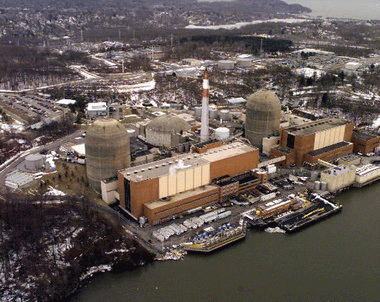
Fate of Indian Point #Nuclear Wastewater Still Unclear
The Highlands Current, By Brian PJ Cronin, Reporter | September 29, 2023 #antinuclear #nuclear-free #NoNukes
Holtec considering ‘multiple options’ but won’t say more
A month after Gov. Kathy Hochul signed a bill preventing Holtec from discharging water from Indian Point’s spent fuel pools into the Hudson River, the company said it hasn’t yet decided what it will do with the waste.
At the Sept. 21 meeting of the Indian Point Decommissioning Oversight Board, a representative for Holtec, which is decommissioning the plant on the Hudson River near Peekskill, said he was not going to discuss what options it was considering. But he did say it expects the process will take longer.
“There will be a schedule impact; I don’t think you can avoid it,” said Rich Burroni, who was attending his last oversight meeting because he was recently promoted to become Holtec’s chief nuclear officer.
No remaining options are without their opponents. Boiling the water so that it evaporates would transfer its radiation to the air. Dumping it in the ocean would violate international law. Mixing it with concrete and shipping it to the western U.S. to be buried, which other decommissioned plants have done, has been criticized as an environmental justice violation, since it passes the risks to another community………………………………………………………………………………………
Dave Lochbaum, the oversight board’s nuclear expert, noted that in 2009 a tank at Indian Point failed, leaking 10,000 gallons a day “for a while” until the leak was discovered. “The result of that is the contamination gets into places it shouldn’t be, in higher levels of contamination,” he said.
When asked why the tanks fail so often, Lochbaum said that the federal Nuclear Regulatory Commission’s (NRC) policies don’t encourage the development of better tanks.
“If you’ve ever paid a nickel for an overdue library book, you’ve paid a nickel more than the NRC has ever fined anyone for spilling millions of gallons of contaminated water,” he said. “Because there’s no sanction for doing wrong, there’s no incentive for getting it right.”
Lochbaum also had harsh words for the NRC when making a presentation on how the dry casks that store the spent fuel itself are inspected. Almost all of Indian Point’s spent nuclear fuel has been loaded into metal canisters, which are lowered into concrete hulls to protect them until they can be shipped to a yet-to-be-built permanent facility. The casks are supposed to be inspected on a regular basis to make sure they aren’t leaking or in danger of cracking.
But an audit by the NRC released this year found that for the past 20 years, nuclear power plants in the Southeast weren’t being inspected nearly as often or as robustly as they should have been. And inspectors weren’t qualified. Lochbaum said that in some cases, the inspectors didn’t even enter the fenced areas where the dry casks were located.
“They walked around the outside of the fence,” Lochbaum said. “That’s probably not adequate inspections.”
He also took issue with the fact that the NRC only spot-checks casks, rather than inspecting them all. At the same time, inspecting all of the casks properly is impractical because the process exposes inspectors to a low dose of radiation.
Public records indicate that the casks at Indian Point have been inspected more often and more thoroughly than those in the Southeast, but Lochbaum said that it’s still not clear if the inspectors are qualified or how many hours were spent.
The oversight board has asked the NRC for more detailed information on the inspection process at Indian Point, and expects to have answers in time for its next public meeting on Dec. 6. https://highlandscurrent.org/2023/09/29/fate-of-indian-point-wastewater-still-unclear/?fbclid=IwAR0Qd18gKvQAQcMkvF9g6si1l5b3OlNV5oHaOo-t7r3df8FVVXPf8SaqfXQ
Editorial: Japan city’s rejection of nuclear waste site probe casts doubt on gov’t stance.

Tsushima Mayor Naoki Hitakatsu announced on Sept. 27 that
the Nagasaki Prefecture city will not accept a reference material-based
preliminary survey for the construction of a final disposal facility for
nuclear waste, going against the local assembly’s initial adoption of a
petition calling for the survey’s approval.
The Japanese government must accept the reality that the search for a candidate site to dispose ofhighly radioactive nuclear waste, which will continue to accumulate as long
as nuclear power plants are in operation, is proving difficult.
Mainichi 30th Sept 2023
https://mainichi.jp/english/articles/20230930/p2a/00m/0op/009000c
Nuclear waste ship makes unprecedented port call at Novaya Zemlya
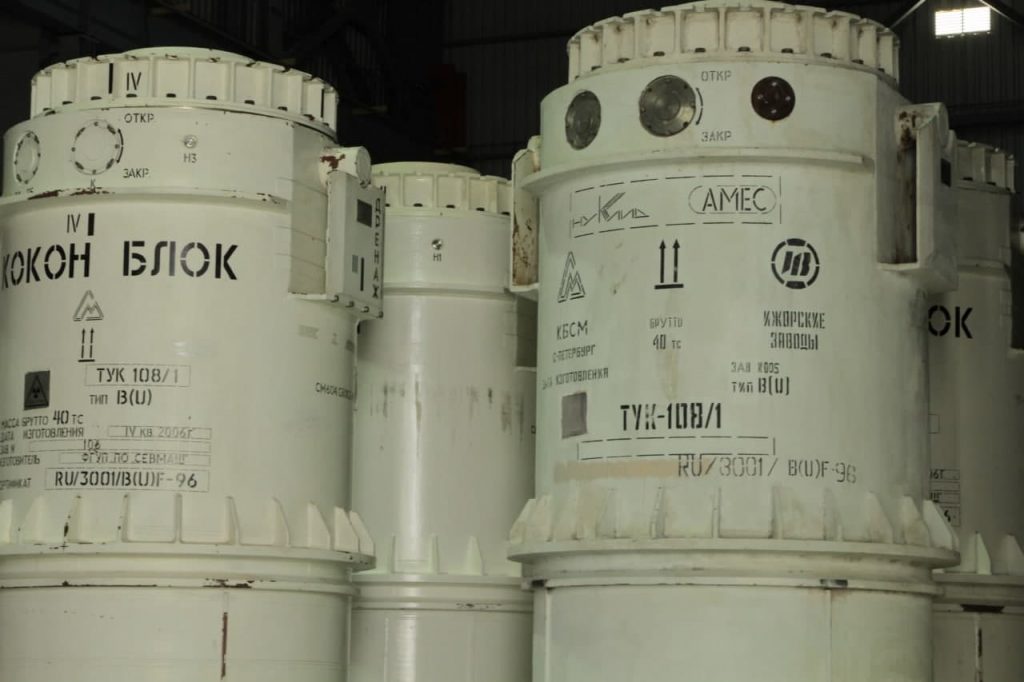
“I am deeply worried if Russia has started to move nuclear waste from the Kola Peninsula to the Arctic archipelago,” says Frederic Hauge with the Bellona foundation.
Much of the remaining uranium fuel elements in Andreeva Guba are damaged and pose special problems to handle. For that reason, the reprocessing plant in Mayak has been unwilling to receive.
Thomas Nilsen, September 29, 2023 https://thebarentsobserver.com/en/nuclear-safety/2023/09/nuclear-waste-ship-makes-port-call-novaya-zemlya
Last week, the “Rossita” could be seen on ship tracking services as it sailed outside Gremikha, a shutdown submarine base east on the Kola Peninsula. Now, the specially designed ship is moored at the pier in Severny, a military town on the shores of the Matochkin Strait diving the northern and southern islands of Novaya Zemlya
Severny is the settlement serving Russia’s nuclear weapons tests, nowadays in the form of sub-critical experiments taking place deep inside tunnels in the permafrost mountains. The last real detonation of a nuclear warhead was on October 24, 1990.
The “Rossita” was built in Italy with Italian taxpayers money. It was a helping hand from a European nation aimed to transport spent nuclear fuel from the run-down storage site in Andreeva Guba on the shores of the Litsa fjord, a short 60 km from the border with Norway.
Some 21,000 spent fuel elements from the Soviet Union’s fleet of Cold War submarines were stored. Italy’s contributions were part of a larger international cooperation to assist Russia in securing the lethal highly radioactive waste.
Other contributing nations were Norway, the United Kingdom and Sweden.
The “Rossita” shuttled between Andreeva Bay and Atomflot in Murmansk. From there, the containers with the fuel elements were sent by train to Mayak north of Chelyabinsk where Russia’s reprocessing plant is located.
With Moscow’s all-out war against Ukraine, the Western partners stopped all cooperation with Russia in regard to nuclear waste handling.
For the last 19 months, little information about what happens in Andreeva Bay has reached the public.
What is known is that two of the Northern Fleet’s most potent nuclear-powered submarines, the “Severodvinsk” and the “Kazan” of the Yasen class are moored across the bay at the piers in Nerpicha, part of Zapadnaya Litsa naval base.
“All reasons to monitor”
Frederic Hauge with the Bellona Foundation in Norway will not speculate too much about reasons Russia might have to move nuclear waste to the Arctic archipelago of Novaya Zemlya.
“What we do know is that “Rossita” is specially designed to carry TUK-18 containers modified to hold damaged spent nuclear fuel,” he says.
Much of the remaining uranium fuel elements in Andreeva Guba are damaged and pose special problems to handle. For that reason, the reprocessing plant in Mayak has been unwilling to receive.
“There are all reasons to monitor what now happens at Novaya Zemlya,” Hauge notes.
His team of nuclear experts in Oslo and Vilnius are now analyzing the limited available information with the hope of understanding what happens.
“A week ago, Rosatom’s larger carrier “Sevmorput” sailed to Novaya Zemlya. We are also told that there have been busy days at Severny and near the tunnels designed for nuclear weapons testing,” Hauge says in a phone interview with the Barents Observer.
“The big unanswered question is if what we now are witnessing is a Russia that brings dangerous nuclear waste to Novaya Zemlya for long-term storage in the permafrost.”
Japan city forgoes applying for government survey on nuclear waste site

The mayor of Tsushima in southwestern Japan said Wednesday he has decided
against applying to the state for a preliminary survey to gauge the island
city’s suitability to host an underground disposal site for highly
radioactive waste from nuclear power generation. The decision comes in
contrast with the local assembly’s approval earlier this month of a request
filed by proponents urging the city to accept the survey.
“There is insufficient consensus among the public,” Mayor Naoki Hitakatsu said at a city assembly session, with some fearing the potential impact on tourism and primary industries such as fisheries.
He later told reporters he also has concerns about reputational damage that may arise from conducting the survey.
The preliminary survey is the first step in a three-stage process spanning two decades to select a permanent disposal site for nuclear waste. Struggling to find one, the central government is looking for municipalities willing to accept the survey, but only two municipalities in Hokkaido have so far done so.
Tsushima, on a remote island in Nagasaki Prefecture, was identified as a potential disposal site on a map of such locations released by the central government in 2017.
Hitakatsu has raised worries about hosting such a site, saying, “The risks that may arise from unperceived factors cannot be ruled out.”
Opponents of the plan have also said it would not be appropriate for the city to host a disposal site for nuclear waste given the history of the U.S. atomic bombing of Nagasaki city in 1945.
Local construction groups and other proponents argued that state subsidies of 2 billion yen ($13.4 million) for accepting the survey could be used for measures to rev up the shrinking city’s economy and support child-rearing.
The mayor, who may seek a third four-year term after his current term expires in March, told a press conference that the reputational damage that may arise from carrying out the survey “cannot be covered by a subsidy of 2 billion yen.”
He also said he “judged it would become difficult to reject” the subsequent geological research if the preliminary survey showed that the city is suited as a site for the final disposal of nuclear waste.
The surveys, conducted by the Nuclear Waste Management Organization, a quasi-government body in Tokyo, involve checking land conditions and volcanic activity based on published geological sources.
Following Tsushima’s decision, the central government said it will continue efforts to find more areas to carry out preliminary surveys.
“We are very grateful that Tsushima showed interest and had considered” accepting the survey, said Chief Cabinet Secretary Hirokazu Matsuno at a press conference.
Fast-aging Tsushima, where the number of residents fell below 30,000 in 2020, depends on squid fishing and pearl farming but is struggling to find young people to carry on the running of its industries.
It is located closer to the South Korean port city of Busan, 50 kilometers away, than any major Japanese cities.
High-level radioactive waste, produced when extracting uranium and plutonium from spent fuel, must be stored in bedrock at least 300 meters underground for tens of thousands of years until the radioactivity declines to levels that pose no harm to human health or the environment.
Japan, like many other countries with nuclear plants, is struggling to find a site for such disposal.
Kyodo News 27th Sept 2023
UK government decides not to take Allerdale further in GDF nuclear waste siting process due to limited suitable geology
Nuclear Waste Services (NWS) has been engaging
with the Allerdale community about the potential for hosting a Geological
Disposal Facility (GDF) to dispose of the UK’s most radioactive waste. As
part of this process NWS obtained existing data and undertook assessments
to understand if six siting factors, safety and security, community,
environment, engineering feasibility, transport, and value for money, could
be supported if a GDF were sited in Allerdale.
Following a comprehensive
and robust evaluation of information it was concluded only a limited volume
of suitable rock was identifiable and the geology in the area was unlikely
to support a post closure safety case. NWS has therefore taken the decision
not to take Allerdale further in the search for a suitable site to host a
GDF. Initial assessments of existing data and information for the other
three communities in the siting process have indicated potentially suitable
geology, which is why NWS is continuing in the siting process with those
communities.
Nuclear Waste Services 28th Sept 2023
Many years for UK government to find a nuclear waste sit with suitable geology and a willing community
NWS chief executive Corhyn Parr said: “We need enough suitable geology to
accommodate a GDF and to support safety cases to build, operate and close
the facility. “Our assessments show evidence of limited volume of suitable
rock for a GDF in the Allerdale search area, including the adjacent inshore
area.”
NSW said finding a suitable site and a willing community, along with
securing the necessary consents and permits, could take about 15 years. The
assessment of three other potential sites is continuing and “the door also
remains open” for new communities to join the process, it added.
BBC 28th Sept 2023
British communities torn between the lure of government bribes and the realities of hosting toxic radioactive trash virtually forever
#nuclear #antinuclear #nuclear-free #NoNukes
Ken Smith moved to the Lincolnshire coast to see out his retirement,
writing crime novels while surrounded by beaches, arcades, holiday parks
and nature reserves. Recently, however, his retreat has been disturbed. The
Mablethorpe resident has found himself unexpectedly on the front lines of a
struggle affecting countries across the world, centred on how to deal with
nuclear waste.
The fate of Mablethorpe will determine how Britain tackles a
problem that has been building for seven decades. As the government seeks a
better solution to radioactive waste, communities are torn between the lure
of economic opportunities versus the realities of living next to a disposal
site. Theddlethorpe, a few miles up the road, is one of three areas in
England being considered by the UK for a 36km square underground site to
dispose of nuclear waste as it decays, some of it over hundreds of
thousands of years.
FT 28th Sept 2023
https://www.ft.com/content/29961733-a72c-406c-8884-4091c0dfd828
Finland’s nuclear waste: delay in completing the review of operating licence application and safety assessment.

Finland’s Radiation and Nuclear Safety Authority (STUK) said its review of
Posiva Oy’s operating licence application for the world’s first used fuel
disposal facility is taking longer than expected and will not be completed
by the end of this year as planned.
Radioactive waste management company
Posiva submitted its application, together with related information, to the
Ministry of Economic Affairs and Employment (TEM) on 30 December 2021 for
an operating licence for the used fuel encapsulation plant and final
disposal facility currently under construction at Olkiluoto. The repository
is expected to begin operations in the mid-2020s. Posiva is applying for an
operating licence for a period from March 2024 to the end of 2070.
The government will make the final decision on Posiva’s application, but a
positive opinion by STUK is required beforehand. The ministry requested
STUK’s opinion on the application by the end of this year. The regulator
began its review in May 2022 after concluding Posiva had provided
sufficient material. However, STUK has now said its safety assessment and
opinion on the application will not be completed this year.
World Nuclear News 28th Sept 2023
https://www.world-nuclear-news.org/Articles/Completion-of-Finnish-repository-review-delayed
Japan to release second batch of wastewater from Fukushima nuclear plant next week
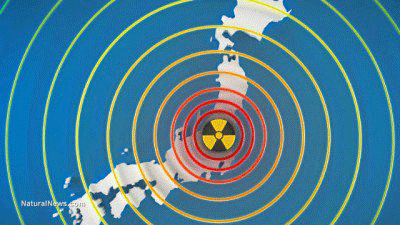
UN-approved release to go ahead despite China’s ban on all Japanese sea imports following first batch
Japan will begin releasing a second batch of wastewater from the crippled
Fukushima nuclear plant from next week, its operator has said, an exercise
that angered China and others when it began in August.
Guardian 29th Sept 2023
Nuclear experts raise new concerns about industry-led policy proposals to separate plutonium in Canada
Canadian Coalition for Nuclear Responsibility Sept. 25 2023 http://www.ccnr.org/Media_Release_final_Sept_25_2023.pdf
Twelve internationally recognized nuclear experts have sent an open letter to Prime Minister Justin Trudeau, expressing new concerns over nuclear weapons proliferation risks associated with a government-funded nuclear reprocessing project in New Brunswick.
The authors cite new information obtained through Access to Information. They quote from recently released internal documents that reveal a governmental “policy-making process on reprocessing in collaboration with the international CANDU Owners Group (COG)”.
The letter points out that such activity runs counter to the G7 statement that Canada endorsed in Hiroshima, on 19 May 2023, pledging “to reduce the production and accumulation of weapons-usable nuclear material for civil purposes around the world.”
In 2021, Ottawa gave $50.5 million to Moltex, a UK-based company. Moltex plans to separate plutonium and other materials from used nuclear fuel already stored at Point Lepreau nuclear plant on the Bay of Fundy. Moltex hopes to use the materials as fuel in its “molten salt” reactor.
Moltex says its technology is proliferation resistant, that the material extracted is not “weapons usable”. However, the letter cites two expert U.S. studies , published in 2009 and 2023, that challenge that claim. Both conclude that protection against weapons use is marginal at best.
Reprocessing is a technology for extracting plutonium from used nuclear fuel. It is a sensitive technology because plutonium is a nuclear explosive. Any nation or subnational group with access to separated plutonium can use it to make a nuclear bomb.
In 1974 India exploded its first atomic bomb using plutonium from a Canadian research reactor. U.S. President Carter banned reprocessing in 1977, and Canada followed suit by nixing commercial reprocessing in Canada.
Civilian reprocessing runs the risk of spreading the bomb by making weapons-usable materials more easily available. This is especially true when such technology is exported, as Moltex eventually hopes to do. But even without exports, government funding of reprocessing sends a signal to other countries that reprocessing is perfectly acceptable as a civilian energy strategy.
The Canadian Coalition for Nuclear Responsibility warns that the new information raises questions about the extent to which nuclear promoters are writing public policy on nuclear issues in Canada.
In fact, Canada’s 2019 Impact Assessment Act exempts reprocessing plants of a certain size from Environmental Assessment, implying that such plants are under consideration. A plant producing 100 tonnes of plutonium per year (enough for 15,000 A-Bombs annually) is exempt from review.
Frank von Hippel, PhD, Professor of Peace and International Affaoirs, Princton University, fvhippel@princeton.edu
Gordon Edwards, PhD, Canadian Coalition for Nuclear Responsibility, ccnr@web.ca, (514) 489 5118.
Susan O’Donnell, Coalition for Responsible Energy Development N.B., susanodo.ca@gmail.com , (506) 261 1727
What will happen to 140-tonne stockpile of combustible sodium at Dounreay?
Dounreay’s operators have still to decide what to do with the remaining 140
tonne stockpile of sodium on site. Plans are afoot to build a new plant to
neutralise what is one of the most hazardous legacies from its days as the
UK’s testbed for fast reactors.
But Magnox Ltd has not ruled out hauling
the material to a disposal plant, if it can find one able and willing to do
the job. An update was given at Wednesday evening’s meeting of Dounreay
Stakeholder Group (DSG) when the site management came under fire for not
dealing with the issue years ago.
John O’Groat Journal 25th Sept 2023
Andreyeva Bay cleanup slows to a snail’s pace since invasion of Ukraine

https://bellona.org/news/nuclear-issues/2023-09-andreyeva-bay-cleanup-slows-to-a-snails-pace-since-invasion-of-ukraine 18 Sept 23 Charles Digges
In 2017, Russia began a landmark project ridding one of its most dangerous Cold War relics of spent nuclear fuel and radioactive waste. The effort to clean up Andreyeva Bay — a submarine base near Murmansk uniquely positioned to contaminate the Barents Sea — was the culmination of a years-long and often strained cooperative effort between Moscow and numerous European nations, chief among them Norway and the United Kingdom.
The outbreak of war in Ukraine in February 2022 disrupted that progress and drained the project of millions in international funding as European nations suspended their contributions in protest of Moscow’s invasion.
In the early days of the war, officials with Rosatom, Russia’s state nuclear corporation, insisted they would continue Andreyeva Bay’s cleanup without international assistance, though it was unclear on what funding that would be done.
It wasn’t until Rosatom’s annual conference convened in Murmansk this past July that any news of how these projects were progressing saw the light of day. But even then, the audience a was select one. Bellona — which had attended the annual Rosatom meeting in prewar times — has only viewed the conference presentations in written form.
In fact, none of Rosatom’s former international partners whose funding has driven the Andreyeva Bay project — nations like Norway, France, the United Kingdom and others from Europe— were invited. Instead, the international delegation consisted primarily of countries like Belarus, Kirgizstan, Uzbekistan and others from the Moscow-dominated Commonwealth of Independent States.
“Most of these countries don’t know anything about the Arctic,” said Bellona’s Alexander Nikitin, who is a former member of Rosatom’s Public Council, which was disbanded when the invasion began. “They were invited so the organizers could call the event ‘international.’”
As it turns out, Rosatom hasn’t made any significant progress on the cleanup since the war estranged it from its primary international partners. The problems that remained at the Andreyeva Bay site before war broke out are the same problems Rosatom is addressing now. And where the cleanup was forecast to be completed by 2028 before the Ukraine invasion, current projections by Rosatom officials put the completion date much later.
The disruption to Andreyeva Bay and other cleanup projects threatens to turn back the clock on more than two decades of environmental progress in Northwest Russia.
History
Throughout the Cold War, the Soviet Union and the United States built more than 400 nuclear submarines, assuring each superpower the ability to fire nuclear missiles from sea even after their land-based silos had been decimated by a first strike. The fjords and coastlines around Murmansk adjacent to Norway became the hub of the Soviet Northern Fleet, and a dumping ground for radioactive waste and spent nuclear fuel.
After the Iron Curtain was drawn back, the disturbing scale of this legacy came to light. It was revealed that a storage building at Andreyeva Bay — the now notorious Building No 5 — had leaked some 600,000 metric tons of irradiated water into the Barents Sea from a nuclear fuel storage pool in 1982. The site contained 22,000 spent nuclear fuel assemblies pulled from more than 100 subs, many kept in rusted containers stored in the open air.
This slow-motion nuclear disaster continued to unfold in near secrecy until Bellona brought it to international attention in 1996, when it published a groundbreaking report on Northwest Russia’s nuclear woes.
Fearing contamination, Norway spearheaded a sweeping cleanup effort with other Western nations. Combined they spent more than $1 billion to dismantle 197 decommissioned Soviet nuclear subs that rusted dockside, still loaded with spent nuclear fuel. One thousand Arctic navigation beacons powered by strontium batteries were replaced, many with solar powered units provided by the Norwegians.
Then, six years ago, the first batches of spent nuclear fuel began their journey away from Andreyeva Bay to safer storage — a process meant to continue for another decade thereafter. By 2021, more than half of the spent fuel assemblies had been removed. Later that year, damaged spent fuel fragments lying at the bottom of Building No 5’s storage pools had also been extracted. Real progress was being made.
Progress since the beginning of the war
Since the beginning of the war, however, the tempo of removing spent fuel assemblies has nearly ground to a halt. If 2017, the first year of the removal, saw 18 batches of spent fuel transported away from the site, then in 2022, according to various reports, only two batches left Andreyeva Bay.
The disposition of solid radioactive waste at the site, which includes solid waste inside the storage buildings, also remains unclear and appears to have slowed considerably as a result of the war. As of 2022, some 9,500 cubic meters of it — or roughly 51 percent of the entire legacy waste at the site — remained in place. This waste was scheduled to depart for other storage bases, such as the Gremikha site, by 2026. Now, that’s schedule may be unrealistic.
About half of Andreyeva Bay’s infrastructure— structures like Building No 5 and Building No 3-A, to which spent fuel in Building No 5 was rushed after the 1982 leak — remains irradiated and in need of safe rehabilitation or dismantlement. But since the schedule for removing solid waste from these structures has been pushed back from 2026 to sometime in the 2030s, dates for the completion of the dismantlement are likewise unclear.
Should that ever get done, what’s left of Building No 5 will present other problems. On the whole, the building itself represents some 15,300 tons of low- to medium level radioactive waste. The two options for dealing with this are to demolish the building and bury the debris in a radioactive waste storage facility, or encasing it in a sarcophagus, not unlike the one used at Chernobyl. As with the other issues at Andreyeva Bay, no real prospective conclusion date for disposing of Building No 5 has been discussed since the outbreak of war.
This is the first in a series of articles examining the state of nuclear cleanup in Russia since the beginning of the invasion of Ukraine. charles@bellona.no
1 This Month

of the week – Shut Down Drone Warfare!


Tell the Ukrainian Government to Drop Prosecution of Peace Activist Yurii Sheliazhenko

Petition to revoke the licensing of the Near Surface Nuclear Disposal Facility (NSDF) at Chalk River. https://www.ourcommons.ca/petitions/en/Petition/Details?Petition=e-7247
To see nuclear-related stories in greater depth and intensity – go to https://nuclearinformation.wordpress.com
-
Archives
- April 2026 (91)
- March 2026 (251)
- February 2026 (268)
- January 2026 (308)
- December 2025 (358)
- November 2025 (359)
- October 2025 (376)
- September 2025 (257)
- August 2025 (319)
- July 2025 (230)
- June 2025 (348)
- May 2025 (261)
-
Categories
- 1
- 1 NUCLEAR ISSUES
- business and costs
- climate change
- culture and arts
- ENERGY
- environment
- health
- history
- indigenous issues
- Legal
- marketing of nuclear
- media
- opposition to nuclear
- PERSONAL STORIES
- politics
- politics international
- Religion and ethics
- safety
- secrets,lies and civil liberties
- spinbuster
- technology
- Uranium
- wastes
- weapons and war
- Women
- 2 WORLD
- ACTION
- AFRICA
- Atrocities
- AUSTRALIA
- Christina's notes
- Christina's themes
- culture and arts
- Events
- Fuk 2022
- Fuk 2023
- Fukushima 2017
- Fukushima 2018
- fukushima 2019
- Fukushima 2020
- Fukushima 2021
- general
- global warming
- Humour (God we need it)
- Nuclear
- RARE EARTHS
- Reference
- resources – print
- Resources -audiovicual
- Weekly Newsletter
- World
- World Nuclear
- YouTube
-
RSS
Entries RSS
Comments RSS
 nuclear-news