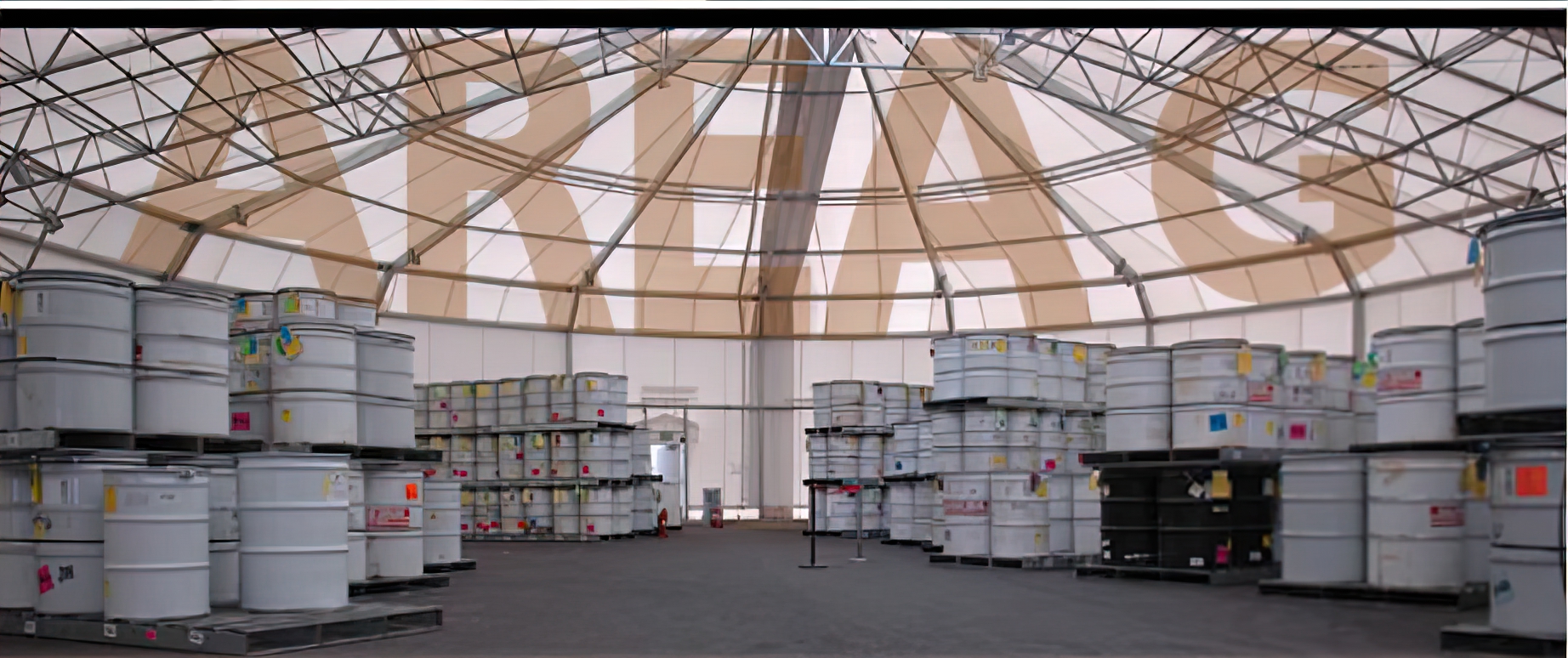
Behind the (somewhat dirty) scenes of nuclear waste processing

Behind the (somewhat dirty) scenes of nuclear waste processing. Nuclear
energy, even if many call it “clean”, produces a lot of waste (and costs
“crazy money”). A researcher was able to carry out a survey lasting
approximately one year on two French waste landfill sites. How are these
things managed? Exclusive interview. “There is no such thing as
decontamination. This is an abuse of language. You don’t kill the
radioactivity, you move it.”
Mediapart 9th Jan 2024
The mystery of a Truchas woman who died with extraordinary amounts of plutonium in her body
KUNM | By Alice Fordham, https://www.kunm.org/local-news/2024-01-08/the-mystery-of-a-truchas-woman-who-died-with-extraordinary-amounts-of-plutonium-in-her-body
With the release of the movie Oppenheimer last year, there has been a resurgence of interest in the history of the Los Alamos National Laboratory. But for writer Alicia Inez Guzmán at the investigative nonprofit Searchlight New Mexico, that interest has been there for years as she has covered the past and present of the lab and its impact on the people of northern New Mexico. Her reporting includes the town of Truchas, where she grew up. In her latest report, Guzmán looks at the story of one woman who lived in Truchas, and died in 1972, inexplicably with extraordinarily high levels of plutonium in her body. Guzmán spoke with KUNM about her reporting.
ALICIA INEZ GUZMAN: When I first heard about this mystery woman, it was on an airplane coming back to Santa Fe. And I was sitting next to Jay Coghlan, who’s the executive director of Nuclear Watch New Mexico. And he said something to the effect of, the woman with the most plutonium in her body after the Trinity Site detonation, was from Truchas. And I just thought it was so fascinating and cryptic that I actually got the source of the information, which is the LAHDRA report or the Los Alamos Historical Document and Retrieval Assessment. And that’s where I was able to read for myself that there was a woman from Truchas, who had 60 times the amount of plutonium than the average New Mexico resident, and it was attributed to the Trinity Site, which led me on a wild goose chase basically
KUNM: Why was this so intriguing to you?
GUZMAN: Sure, so Truchas is 225 miles away from the Trinity Site. It’s in northern New Mexico in the Sangre de Cristo Mountains. And we know of course, the fallout did reach places like Truchas and far beyond, but in order for somebody to have plutonium in their body, they have to ingest it or inhale it. And so that was part of the question that I had was: well, she’s 225 miles away, could she have ingested or inhaled plutonium at that distance?
KUNM: So you had these questions, how did you go about finding out more about this person?
GUZMAN: When she was listed in the larger report, simply she was from Truchas, alive when Trinity detonated. So I had two pieces of information to go on. But what I realized was that the reason why they had that information about her at all was because the lab had conducted a series of autopsies on not only workers from Los Alamos National Laboratory, but the surrounding community. And once I found that information out, I was able to determine that there had actually been a class action lawsuit made on behalf of families of people who had been autopsied, because their families had never given informed consent. So I had to go to the courthouse here in Santa Fe, and from there, I found an issue of Health Physics magazine from 1979. And her name was not given, but it gave her age, at death, where she was from, what she did — a housewife — and the year that she died. And so, when I did a search in obituaries for that set of criteria, only one woman came up. And it turns out, as I suspected, that I knew the family.
KUNM: And what did they learn from you, and what did you learn from them?
GUZMAN: I should start out with what they learned, because I had to basically call them and reveal that possibly their grandmother had been involved in this clandestine study. And that if it was her, she had by far the most amount of plutonium in her body than anybody else who had been autopsied as a resident in that study. So, I think it was a huge shock to them.
Of course, what I learned from them was that this woman, whose name is Epifania Trujillo, she ended up moving in with her daughter and son in law, and her son in law, as it happened, worked at the laboratory as a janitor in a hot site, a hot site being somewhere where there was radiation, and that all of his children, he had seven children, all of his children except for one ended up getting cancer, and his wife. And so, I started talking to epidemiologists and toxicologists and physicists to really think through: is it possible that instead of having been exposed or contaminated from the Trinity Site, could it be Epifania and her family had been exposed and contaminated by what I later came to know or find out was take-home toxins? And largely what I hypothesize in the story was it is far more likely that her exposure came from Los Alamos National Laboratory, then it would be from Trinity Site.
Carlsbad depositary- 79% of waste came from nuclear wastes from Idaho National Laboratory
Hundreds of shipments of nuclear waste were buried at a facility near
Carlsbad in 2024, and the federal government was poised to send even more
waste to the site in 2024. For that work, the Department of Energy’s
contractor Salado Isolation Mining Contractors (SIMCO) earned about $11.5
million or about 89% of its available $13 million fee between Feb. 4, 2023
when SIMCO took over the contract and the end of the last federal fiscal
year on Sept. 30, 2023.
DOE records show 479 shipments of transuranic (TRU)
nuclear waste were received at the Waste Isolation Pilot Plant between Jan.
1 and Dec. 31, 2023, from federal labs and other nuclear facilities around
the U.S. TRU waste is made of clothing materials, equipment and other
debris irradiated during nuclear activities, and it is buried in a salt
deposit at WIPP about 2,000 feet underground. The DOE said in 2023 it
worked to increase shipments to 17 per week, and hold that level in the
coming years. Most of the waste, about 79%, came from Idaho National
Laboratory in the form of 377 waste shipments.
Carlsbad Current-Argus 7th Jan 2024
Challenging questions concerning UK’s Geological Disposal Facility (GDF)Test of Public Support.
Nuclear Waste Services (NWS), the division of the taxpayer-funded Nuclear
Decommissioning Authority, charged with identifying a location for a
Geological Disposal Facility (GDF) into which Britain’s legacy and future
high-level radioactive waste will be deposited, has stated that the two
criteria that will determine the location are – the availability of
sufficient ‘suitable’ geology and the consent of a ‘willing
community’.
Three ‘Search Areas’ are known to be under consideration
for the GDF – Theddlethorpe on the East Lincolnshire coast and Mid and
South Copeland on the West coast of Cumbria.
According to the government
and industry guidance that governs the conduct of this investigation,
whether such consent exists will ultimately be determined by a Test of
Public Support amongst the members of the Potential Host Community (PHC).
The timing of the test is down to the Relevant Principal Local Authorities
(RPLAs) – Cumberland Council in Cumbria and Lincolnshire County Council
and East Lindsey District Council in Lincolnshire, but its nature and the
participants in it are determined by the Community Partnerships that have
been established supposedly to provide stakeholder oversight to the
process.
Whether the test is then carried out by the RPLAs, NWS staff or
both is not specified, but if the result is negative, NWS are required to
withdraw the area from further consideration.
NFLA 2nd Jan 2024
UK’s Nuclear Waste Service (NWS) to grant £millions to the 3 Community Partnerships, to seek a site for nuclear waste dump.

In Phase 1, Community Investment Funding of up to £1 million per annum is
made available by Nuclear Waste Services (NWS) to each of the three
Community Partnerships currently engaged in the siting process for a
Geological Disposal Facility (GDF).
Where a Community Partnership / Search
Area is taken forward into Phase 2, involving the commencement of borehole
investigations, this sum will increase to £2.5 million per annum.
A decision on which two Search Areas will be taken forward is anticipated in
2026. The grants can be used to fund projects, schemes or initiatives
benefiting the community of each Search Area that: provide economic
opportunities, enhance the natural and built environment, or improve
community wellbeing. Each Community Partnership can also agree its own
criteria for awards based on local circumstances.
A Freedom of Information
request was submitted to NWS with a short question set which was identical
for each of the Community Partnerships. The responses received from NWS
follow.
NFLA 5th Jan 2024
Rokkasho redux: Japan’s never-ending nuclear reprocessing saga

By Tatsujiro Suzuki | December 26, 2023, https://thebulletin.org/2023/12/rokkasho-redux-japans-never-ending-reprocessing-saga/
The policy seeks to at least begin to deal with the huge stocks of plutonium Japan has amassed
According to a recent Reuters report, Japan Nuclear Fuel Ltd (JNFL) still hopes to finish construction of Japan’s long-delayed Rokkasho reprocessing plant in the first half of the 2024 fiscal year (i.e. during April-September 2024). The plant—which would reprocess spent nuclear fuel from existing power plants, separating plutonium for use as reactor fuel—is already more than 25 years behind schedule, and there are reasons to believe that this new announcement is just another wishful plan that will end with another postponement.
One indication of further possible delays: On September 28, 2023, Naohiro Masuda, president of JNFL, stated that the safety review of the reprocessing plant by Japan’s Nuclear Regulation Authority will be difficult to complete by the end of 2023. He nevertheless insisted that the company could still meet completion target date in 2024.
Here is a partial history of past key developments that make completion in 2024 seem unlikely:
1993: Construction starts.
1997: Initial target for completion.
2006-2008: Hot tests conducted, revealing technical problems with the vitrification process for dealing with waste produced during reprocessing.
2011: Fukushima Dai-ichi nuclear plant accident.
2012: New safety regulation standards introduced.
2022: Completion target date postponed to June 2024)
The 2022 postponement was the 26th of the Rokkasho project.
Why so many postponements? There seem to be at least five underlying reasons for the postponements for the Rokkasho plant. First, JNFL lacks relevant expertise to manage such a technologically complex and hazardous project, which is owned by nine nuclear utilities plus all other major companies associated with nuclear power in Japan. Most of the firm’s senior executives are from shareholding companies (especially utility companies) and are not necessarily experts in the field of reprocessing spent nuclear fuel.
Second, the technologies in the plant came from different companies and institutions. The management of the project is therefore technically complex.
Third, the post-Fukushima-accident nuclear facility safety licensing review process is much more stringent than what existed before the accident. For example, the Nuclear Regulation Authority told JNFL at their November 25, 2023 meeting: “JNFL should immediately make improvements because it is clear that JNFL does not understand the contents of the permit well enough to confirm the adequacy of the design of the facilities on site and has not visited the site.”
Fourth, the financial costs to JNFL of postponement are covered by the utilities’ customers, because the utilities must pay a “reprocessing fee” every year, based on the spent fuel generated during that year, whether or not the reprocessing plant operates. The system by which the Nuclear Reprocessing Organization of Japan decides the reprocessing fee is not transparent.
Fifth, the project lacks independent oversight. Even though JNFL’s estimate of the cost of building and operating the Rokkasho plant has increased several-fold, no independent analysis has been done by a third party. One reason is that some of the shareholders are themselves contractors working on the plant and have no incentive to scrutinize the reasons for the cost increases or the indefinite extension of the construction project.
After so many postponements, there is reason to wonder whether the plant will ever operate, but the government and utilities continue to insist that the plant will open soon. Even if Rokkasho were to operate, it may suffer from the same kinds of problems that marked Britain’s light-water reactor spent fuel reprocessing experience, as described in Endless Trouble: Britain’s Thermal Oxide Reprocessing Plant (THORP).
Why does Japan’s commitment to reprocessing continue?
Despite the serious and longstanding problems the Rokkasho plant has faced (and continues to face), Japanese regulators and nuclear operators have doggedly pursued the project. There are four reasons:
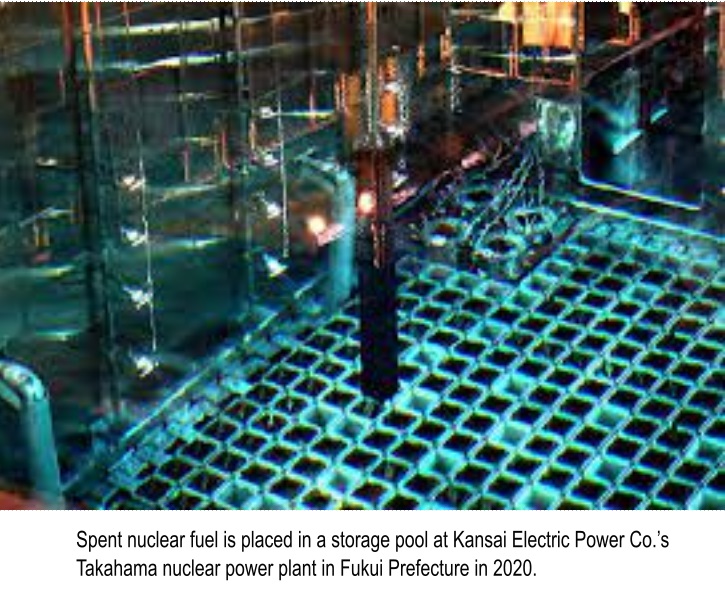
Spent fuel management. Currently, most of Japan’s spent nuclear fuel is stored in nuclear power plant cooling pools. But the pool capacities are limited, and the 3,000-ton-capacity Rokkasho spent fuel pool is also almost full. The nuclear utilities must therefore start operating the Rokkasho plant unless they can create additional spent fuel storage capacity, either on- or off-site. The Mutsu spent fuel storage facility is a candidate for additional capacity, but due to the concern that spent fuel could stay there forever, Mutsu city refuses to accept spent fuel unless the Rokkasho reprocessing plant begins to operate. The Rokkasho plant design capacity is 800 tons of spent fuel per year.
Legal and institutional commitments. Under Japan’s nuclear regulations, utilities must specify a “final disposal method” for spent fuel. The law on regulation of nuclear materials and nuclear reactors states that “when applying for reactor licensing, operators must specify the final disposal method of spent fuel” (Article 23.2.8). In addition, there was a clause that “disposal method” should be consistent with implementation of the government policy, which specified reprocessing as the disposal method. Although that clause was deleted in the 2012 revision of the law after the Fukushima accident, the Law on Final Disposal of High-Level Radioactive Waste still bans direct disposal of spent fuel. In addition, the 2016 Law on Reprocessing Fees legally requires utilities to submit reprocessing fees for all spent fuel generated every year since they stated in their applications that “final disposal method” for their spent fuel would be reprocessing.
Commitments to hosting communities. The nuclear utilities committed—albeit tacitly—to the communities hosting nuclear power plants that they would remove the spent fuel to reprocessing plants, since that was the national policy. Separately, JNFL signed an agreement with Rokkasho village and Aomori prefecture that says that if the Rokkasho reprocessing plant faces “severe difficulties,” other measures will be considered—including the return of spent fuel stored at Rokkasho to the nuclear power plants.
Local governments hosting nuclear power plants were not involved in this deal, however. They could therefore just refuse to receive spent fuel from Aomori.
In fact, after the Fukushima accident, when the government was considering amending the nuclear fuel cycle policy to include a “direct disposal option” for spent fuel in a deep underground repository, the Rokkasho village parliament (at the behind the scenes suggestion by the then JNFL president, Yoshihiko Kawai), issued a strong statement asking for “maintenance of the current nuclear fuel cycle policy.”
The statement continued that, if Japan’s fuel cycle policy changed, Rokkasho would: refuse to accept further waste from the reprocessing of Japan’s spent fuel in the UK and France; require the removal of reprocessing waste and spent fuel stored in Rokkasho; no longer accept spent fuel; and seek compensation for the damages caused by the change of the policy.
Institutional and bureaucratic inertia. In Japan, bureaucrats rotate to new positions every two or three years and are reluctant to take the risk of changing existing policies. They therefore tend to stick with past commitments. Institutional inertia becomes stronger as a project becomes bigger. The Rokkasho reprocessing project is one of the largest projects ever in Japan. Changing the project is therefore very difficult.
Will Japan’s new plutonium capping policy have any real impact? In 2018, Japan’s Atomic Energy Commission announced a new policy on “Basic Principles on Utilization of Plutonium” (see also this post). Under the new policy, the commission proposed that Japan would reduce its stockpile of separated plutonium, starting with a commitment not to increase it, and that reprocessing would take place only when a credible plan to use the separated plutonium existed.
The policy seeks to at least begin to deal with the huge stocks of plutonium Japan has amassed, both in European separation facilities (some 36.7 tons) and in Japan (10.5 tons), in anticipation of using the plutonium widely to fuel nuclear reactors—which so far has not materialized. In conjunction with the new Reprocessing Fee Law, the new plutonium policy gives the government legal authority to control the pace of reprocessing.
But it is not clear how the “capping policy” will be implemented. It is not a legally binding document, and no regulation has been introduced to control reprocessing. Utilities must submit specific plans for plutonium use to the Atomic Energy Commission for its review before reprocessing of their fuel begins. But the commission can only give advice to the government about the credibility of these plans, giving rise to questions about whether the policy will lead to sustained changes in reprocessing activity. A similar “paper rule” on plutonium has existed since 2003.
A way out. Japan could extricate itself from its reprocessing and plutonium problems in several ways. All involve significant changes in policy that would:
Find additional spent fuel storage capacity, on- or off-site. Local communities may be more willing to accept on-site dry cask storage of spent fuel if they are told that it is safer than spent fuel pool storage. For example, Saga Prefecture and Genkai-town, which host Kyushu Electric’s Genkai Nuclear Power Plant, have agreed to host dry cask storage starting in 2027. Host communities may want guarantees that spent fuel will be removed after a specified storage period. Such a guarantee could be given by the central government.
Amend the law on final disposal of high-level radioactive waste. An amendment could allow direct disposal of spent nuclear fuel in a deep underground repository. This would provide more flexibility in spent fuel management and make it easier for communities to host interim spent fuel storage.
Amend the Reprocessing Fee Law and shut down Rokkasho. An amendment to the law on reprocessing fees could allow the government to use reprocessing funds to implement a shutdown of the Rokkasho reprocessing plant. Such a plan could include payment of the debt JNFL has incurred while pursuing the Rokkasho project and funds for dry cask interim storage. This would enable the government to finally end the problem-plagued Rokkasho reprocessing plant project.
Nuclear waste could threaten rare spot where endangered mussel thrives, experts say
Vast underwater cave in Ottawa River provides habitat for hickorynut mussel
Stu Mills ·CBC Ottawa reporter, Jan 02, 2024
Researchers with the Canadian Museum of Nature say a proposed nuclear waste storage facility upstream could destroy the delicate balance of two endangered species thriving in an Ottawa River cave network.
Last month, the museum’s André Martel lowered his scuba goggles and plunged into what he deemed an “extraordinary” segment of the river around Lac Coulonge east of Pembroke, Ont.
An absence of hydroelectric dams, a fast-flowing current, naturally forming fluvial sand dunes and the country’s longest freshwater cave network have made this an Eden for an endangered, wavy brown mollusc called the Hickorynut mussel.
Martel believes the delicate population of the freshwater mussel has a secret ally in a fish just as enigmatic and just as threatened: the lake sturgeon………………………………………………………………………………………
New facility at Chalk River
Though they don’t yet have the full answer, there is real concern about a proposal to dump nuclear waste near the shoreline upstream in Deep River, Ont.
A consortium led by SNC-Lavalin has proposed a “near surface disposal facility” waste site just one kilometre from the river.
The Canadian Nuclear Safety Commission plan has been panned by Montreal-area mayors whose millions of residents draw drinking water from the Ottawa River and by Algonquins who compared the proposal to building an outhouse next to a drinking well.
“Let’s be sure that we are aware of what we’re doing, what is at stake,” Martel said.
He said special protection is needed for the 141-kilometre segment of river where the fragile hickorynut and ancient sturgeon are working together to filter silt and bacteria from the water like a massive river kidney.
Katriina Ilves, a Canadian Museum of Nature ichthyologist — a marine biologist who studies different fish species — called the Lac Coulonge-area sturgeon population “an important, and enigmatic species.”
“I would have some concerns over any type of development that would have the potential to lead to contamination of this water system,” she said.
In an email, a spokesperson with the nuclear safety commission said it couldn’t answer specific questions about the proposal while the decision was likely just a few weeks away. https://www.cbc.ca/news/canada/ottawa/ottawa-river-nuclear-waste-hickorynut-mussel-cave-1.7065462
Burial review – deep dive into underworld of nuclear power and its toxic legacy
Emilija Škarnulytė’s hypnotic documentary zooms into the science of uranium and radioactivity, as well as cold war politics.
Occupying the liminal space between a geological excavation and speculative realism, Emilija Škarnulytė’s hypnotic documentary effortlessly moves between the micro and the macro. Zooming into a 3D-configuration of uranium ore, the film’s opening cuts to X-ray-esque renderings of radioactive household objects, all cast in an eerie shade of sickly green. These abstractions soon give way to something seemingly concrete yet equally mysterious: the camera plunges underwater, bringing us face to face with the remains of a 1950s uranium mine in Poland, once dug out in secrecy under the Soviet Union. Slithering through the wreckage is a water python, whose glistening presence serves as a kind of cosmic counterpart to the exploitation of natural resources.
Such slipperiness, both in terms of the imagery and the camera’s point of view, recurs throughout Škarnulytė’s film. Cutting to the Ignalina nuclear power station in Lithuania, a sister plant of Chernobyl, the film uses on-screen text to describe its decommissioning process, which produced millions of cubic metres of reinforced concrete structures to be demolished. This colossal waste will, hopefully, be processed at a research facility at Meuse in France, which is situated about 500 metres below sea level.
Though moving through these highly technological spaces, Škarnulytė’s film also makes space for bursts of surrealism. The python reappears in the Ignalina plant, as its gleaming form coils around the station’s switchboards. Bringing together the lush forests, the mushroom clouds of nuclear tests, and closeups of a snake shedding its skin, Burial questions the very possibility of rebirth and transformation. Even as Ignalina is ground into dust and buried away from prying eyes, the political spectre of the Soviet Union control continues to lurk, as the film offers a final message of support for Ukraine.
Burial is available from 5 January on True Story.
WIPP’s Legacy Transuranic Waste Disposal Plan Demonstrates DOE’s Broken Promises; Get Your Comments in by Friday, January 3rd, 2025
https://nuclearactive.org/ 30 Dec 24
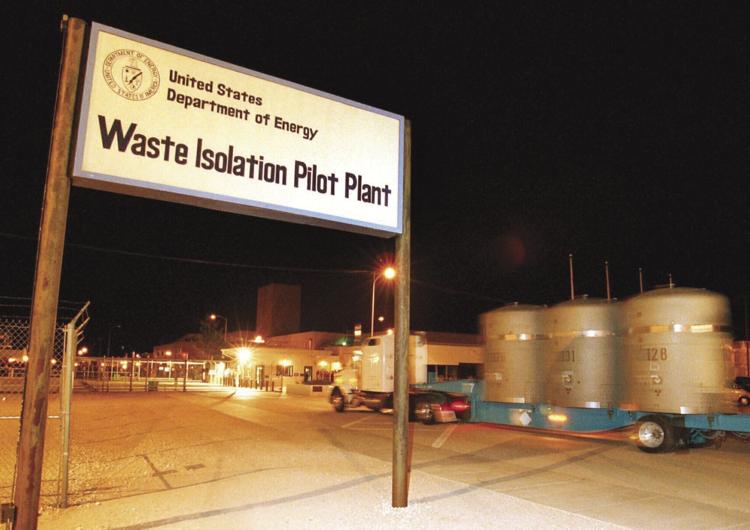
The New Mexico Environment Department’s hazardous waste permit for the Waste Isolation Pilot Plant (WIPP) requires the Department of Energy (DOE) to submit a Legacy Transuranic, or TRU, Waste Disposal Plan to the Environment Department. DOE submitted its inadequate plan on November 4th for a 60-day public comment period, which ends on Friday, January 3rd, 2025. https://wipp.energy.gov/Library/documents/2024/24-0772-s.pdf
A sample public comment letter you can use to create your comments is available HERE.
The DOE plan ignores the promises DOE made to New Mexicans. WIPP was sold as a pilot project to clean up Cold War legacy radioactive and hazardous waste at DOE’s nuclear weapons sites located across the country. It was a test case for the deep geologic disposal of transuranic, or plutonium-contaminated, nuclear waste made during the Cold War. DOE promised it would cleanup all its transuranic waste, ship it to WIPP for disposal and close WIPP after 25 years of operations. WIPP opened in 1999 and was scheduled to close in 2024.
But DOE changed its mind. DOE now wants to keep WIPP open until at least 2083 for the transuranic waste created by fabricating new plutonium triggers, or pits, for nuclear weapons at Los Alamos National Laboratory (LANL) and the Savannah River Site in South Carolina.
DOE is ignoring its promises and the buried transuranic waste at LANL that needs to be packaged and shipped to WIPP. Further, there are 2,025 transuranic waste containers stored aboveground in the Area G fabric tents in a wildfire zone. https://n3b-la.com/area-g-tru/ New Mexicans can challenge DOE’s plan through the WIPP Hazardous Waste Permit and the three new permit conditions that address the need for another nuclear waste repository in a state other than New Mexico; the need to prioritize and reduce risk of transuranic waste stored in New Mexico; and the need for a Legacy TRU Waste Disposal Plan that prioritizes disposal of Cold War legacy waste over newly generated nuclear waste, including at LANL. https://www.env.nm.gov/hazardous-waste/wipp-permit-page/ , see permit conditions 2.14.3 Repository Siting Annual Report; 4.2.1.4 Prioritization and Risk Reduction of New Mexico Waste; and 4.2.1.5 Legacy TRU Waste Disposal Plan on the attached. 240924 NMED WIPP HazWaste Renewal Permit Conditions
DOE’s plan fails to define legacy waste. DOE’s definition is explicitly intended to include as legacy waste whatever any DOE site describes as legacy, including waste generated more than a decade after WIPP opened. The plan also includes as legacy waste “surplus” plutonium that DOE plans to ship and process at LANL and dispose of at WIPP.
DOE will submit the public comments to the Environment Department before the end of January. The Environment Department will determine whether DOE met the permit requirements for the plan.
The public comments that have been submitted so far are available on the WIPP homepage at the third blue box labeled “Legacy TRU Waste Disposal Plan” or at https://wipp.energy.gov/Legacy-TRU-Waste-Disposal-Plan.asp
Cold War nuclear waste is prioritized at Carlsbad-area repository. How much is there?
Ed comment. This article is yet another example of what a mess the nuclear industry really is!.

Whatever label they give it, nuclear waste is just long-lasting toxic radioactive trash, with no real solution in sight.
Yet our revered leaders still think it’s OK to just keep on making this trash!!
Adrian Hedden, Carlsbad Current-Argus
Concerns were raised by government watchdog groups for a plan to dispose of Cold War nuclear waste at the Waste Isolation Pilot Plant repository in southeast New Mexico, as the federal government could soon generate more new waste through weapons development that would also need disposal.
In a recent 10-year renewal of the Department of Energy’s permit with the New Mexico Environment Department for WIPP’s operations, the NMED added a mandate to prioritize “legacy waste” held for decades at DOE sites and ensure there was adequate space in the underground for its disposal.
At a Dec. 13 public meeting held in Carlsbad and virtually, required by the new permit enacted Nov. 3, DOE and WIPP officials sought input on officially defining legacy waste and how it would be disposed of at WIPP.
:More than 400 shipments of nuclear waste came to Carlsbad-area repository in 2023
Joni Arends with New Mexico-based Concerned Citizens for Nuclear Safety argued the DOE had held inadequate public meetings with the generator sites, and needed to work quicker to determine how much legacy waste was needing disposal around the U.S.
“You’ve got to do more to get people involved in this very important issue so that we have a complete inventory by the due date in November 2024,” she said.
The permit specified that a legacy waste disposal plan must be developed and submitted to NMED a year after the permit takes effect, and reserved Panel 12 for the disposal of this waste.
That panel was one of two new panels approved for mining in the permit, intended to replace space lost to contamination in a 2014 incident……………………………………………………………………
Edward Holbrook, with the Department of Ecology’s nuclear waste program at Washington State University said legacy waste is not officially defined at the DOE’s Hanford Site in Washington.
He proposed meetings at the local level as the project moves forward to better determine what the term meant to specific sites, and how much of the waste was present.
“I don’t have those answers right now,” Holbrook said.
Former-NMED scientist Steve Zappe said during the meeting the legacy waste requirement was added to the permit amid concerns that newer streams of waste, such as from increased plutonium pit production at Los Alamos and other facilities, could take up space originally intended for older waste.
“Newly-generated waste which might be easier to dispose of could displace legacy waste which is maybe difficult to characterize or retrieve,” he said.
Tom Clements, executive director at Savannah River Site Watch, a government watchdog group focused on the DOE facility in South Carolina, worried an ongoing project to “down-blend” or dilute surplus weapons-grade plutonium at the facility could result in excess waste needing disposal.
This new stream would likely not be considered legacy waste, and Clements argued the DOE would need to find a process to balance such emerging needs, including planned pit production at Savannah River.
“This is not legacy material,” Clements said. “The pit-TRU is not included. I wonder how the plutonium down-blended material is going to be categorized. To me it is not legacy waste.”
Chavez agreed that the wastes Clements mentioned were not legacy waste.
That could be a problem, said Don Hancock with the Southwest Research and Information Center in Albuquerque.
Hancock pointed to a 2020 study from the National Academies of Science finding there may not be enough space at WIPP for the waste the DOE plans to produce in the coming years. https://www.currentargus.com/story/news/2023/12/28/cold-war-nuclear-waste-disposed-of-new-mexico-amid-space-concerns/72014679007/
Site for Canada’s underground nuclear waste repository to be selected next year

They don’t know if this vastly expensive nuclear waste disposal system will work – to protect future generations from toxic ionising radiation.
Yet they still keep making the poisonous stuff any way !!!
Allison Jones, The Canadian Press, December 27, 2023
A critical milestone is on the horizon for Canada’s 175-year-long plan to bury its nuclear waste underground, with two pairs of Ontario communities set to decide if they would be willing hosts.
Late next year, the Nuclear Waste Management Organization plans to select the site for Canada’s deep geological repository, where millions of bundles of used nuclear fuel will be placed in a network of rooms connected by cavernous tunnels, as deep below the Earth’s surface as the CN Tower is tall — if the process goes according to plan.
The sites are down to the Wabigoon Lake Ojibway Nation-Ignace area in northwestern Ontario and the Saugeen Ojibway Nation-South Bruce area in southern Ontario. The municipalities and First Nations are planning votes for next year, the culmination of a years-long information gathering process that some say has left deep divisions within their communities.
The process to move ahead with a deep geological repository is already more than 20 years along. The NWMO was established under legislation in 2002 and is funded by the corporations that generate nuclear power and waste, such as Ontario Power Generation and Hydro-Quebec.
While officials say they are confident at least one area will say yes, two rejections would be a major setback for the $26-billion project.
Ultimately, if both areas say no, then we have to start over — and by we I mean Canada,” said Lise Morton, the vice-president of site selection.
“We as a country would then be really pushing the resolution of this issue to the next generation.”
Both the municipality and First Nation in the area of either proposed site must confirm willingness to host the repository before the NWMO will proceed.
…………………………..there are a good number of people in the community who are not convinced — about 20 per cent are with Protect Our Waterways, the main opposition group, Goetz estimates — and it has caused “quite a friction.”
South Bruce is also in the shadow of Walkerton, Ont., where seven people died and thousands fell ill after drinking contaminated water in 2000. Fears about drinking water have lingered there long after the tragedy, said Bill Noll, vice chair of Protect Our Waterways.
Water also weighs heavily on the minds of members of the Wabigoon Lake Ojibway Nation, who have seen members of another northwestern Ontario First Nation on the English-Wabigoon river system grapple with generations of mercury poisoning after a mill in Dryden dumped 9,000 kilograms of the substance in the 1960s.
“That’s the evidence right now of how an industry went astray or how government oversight wasn’t there,” said Wabigoon Lake Ojibway Nation Chief Clayton Wetelain…………………………………………………….
all the tests and planning and modelling are not easing the fears of the project’s critics, either with the southern Ontario-based Protect Our Waterways or We the Nuclear Free North.
“The whole thing is a grand experiment,” said Brennain Lloyd, with the northern group.
“There’s not a deep geological repository … operating anywhere in the world. The NWMO likes to say, ‘Well, this is best international practice,’ but practice implies that it’s been done before. And there is no practice. Nobody has done this before.”…………………………………………………………………………….more https://www.cp24.com/news/site-for-canada-s-underground-nuclear-waste-repository-to-be-selected-next-year-1.6701756
“There is a big concern relative to water,” Noll said. “Once you pollute the water, there’s not much you can do about it.”
Buried secrets, plutonium poisoned bodies

Why did a Truchas woman die with extraordinary amounts of plutonium in her body — and why was she illegally autopsied? For this reporter, the answers hit close to home.
Searchlight, by Alicia Inez Guzmán, December 20, 2023
The first reference to her comes, of all places, on an airplane. It’s the end of April and sitting next to me is Jay Coghlan, the executive director of Nuclear Watch New Mexico. Both of us are on our way back to Santa Fe from Washington, D.C., after the Alliance for Nuclear Accountability’s weeklong annual gathering. Coghlan, galvanized by the last several days of activities, spends most of the flight ticking down his list of Los Alamos National Laboratory’s most recent sins. But suddenly he turns to the past.
“Did you know that the person with the highest levels of plutonium in her body after the atomic detonation at Trinity Site was a woman from Truchas?” he asks me. The remark, more hearsay than fact, piques my interest. As Coghlan knows, that’s my pueblito, the place in northern New Mexico where I grew up on land passed down through many generations of women. Tina Cordova — co-founder of the Tularosa Basin Downwinders Consortium — would know more, he adds. “Ask her.”
Truchas, short for Nuestra Señora del Rosario, San Fernando y Santiago del Río de las Truchas, sits on a ridge in the Sangre de Cristo mountains, 8,000 feet above sea level. With some 370 people in town, most everybody keeps up with the latest mitote, or gossip, at the local post office. A regional variation of Spanish is still spoken by elders. Bloodlines go back centuries. And neighbors might also be relatives. If she is from this tiny, but remarkable, speck on the map, I must at least know of her. My mom, a deft weaver of family trees, definitely would.
Truchas is also 225 miles north of the Trinity Site, the location of the world’s first atomic blast. On July 16, 1945, at the peak of monsoon season, a clandestine group of scientists lit up the skies of the Chihuahuan Desert with the equivalent of 24.8 kilotons of TNT. In the first 10 days, wind would carry the radioactive fallout across 46 states — so far, in fact, that the Eastman Kodak Company in Rochester, New York, traced spots on film to radioactive material released by the bomb.
It’s plausible, given such an expansive reach, that this Trucheña who Coghlan casually mentions is among a wave of Trinity’s first unknowing victims. Historically, she signals a profound rupture in time — before nuclear weapons and after. But at the moment, his comment seems impossible to grasp. It’s only in hindsight that the single most important question takes form, one that will dog me for more than six months: Who is she?
Incomprehensible autopsies
Just over a month later, I hear about her for the second time, at a journalism conference…………………………………………………. this time adding the original source of the information: the Los Alamos Historical Document Retrieval and Assessment project, known as the LAHDRA report.
Published in 2010 by the Centers for Disease Control and Prevention — and based on millions of classified and unclassified documents from the earliest years of the Manhattan Project to the late 1990s — the report’s stated purpose was to identify “all available information” concerning radioactive materials and chemicals released at Los Alamos National Laboratory (known as the Los Alamos Scientific Library from 1947 to 1981).
Some of the documents are autopsy records, I come to find. The lab routinely released plutonium into the air from several facilities on its campus, but it wasn’t until 1978 that it began to measure those releases consistently. One question that preoccupied researchers was whether data culled from the autopsies would reveal higher rates of plutonium in people who lived near or worked in those nuclear facilities.
There is another cache of autopsies, too, for the scientific equivalent of a control group — randomly selected people who simply lived and died in northern New Mexico. Cases from the control group were also analyzed, the report added, “in an effort to review the possible plutonium exposure from the July 16, 1945 Trinity test.”
I quickly scroll down to see which person in this group had the highest plutonium levels. And there it is: The highest levels do indeed belong to an unnamed woman from Truchas, alive at the time of the Trinity detonation.
But what comes next in the report will preoccupy me for months: “The plutonium concentration in her liver was 60 times higher than that of the average New Mexico resident.”
The number is incomprehensible to me. First, the actual amount is never stated, nor is the amount for the average New Mexican. But there is also a glaring contradiction that I detect only after reading the paragraph’s final cryptic line many times over. Fallout from Trinity, it essentially explains, didn’t cascade over Truchas until 12 hours after the initial blast. At that distance, there was no telling whether fallout could be inhaled or ingested — the most direct and harmful paths of entry.
It’s a paradox. Trinity stood out as the most obvious culprit — she was, after all, alive when it was detonated — but even the researchers weren’t certain. The only fact is the plutonium itself. Somewhere, somehow it entered her body in the form of barely visible specks of alpha radiation. And once there, those particles began a long migration, from her bloodstream to her kidneys and, ultimately, to her liver. The question is how?
The entry is most striking for its brevity, no more than a paragraph amid the report’s 638 pages. Partly, this has to do with the expansive scope of the LAHDRA project, which covers far more than these autopsies, and partly because of the secrecy and laws that protect personal privacy.
Through the prism of science, this Trucheña is a single, mysterious data point. From this same prism, the unwritten parts of her life look like negative space. But when I imagine who she is, I also imagine what would fill that space — all the parts of her story that must exist but have been left out.
For now, I don’t even know her name.
Exotic poison
In an interview with the Atomic Heritage Foundation in 1965, chemist Glenn Seaborg described plutonium as “one of the most exotic metals in the periodic table — maybe the most.” Seaborg had created plutonium out of uranium in 1940 and still, 25 years later, at least some of its properties were anomalous.
How plutonium poisoned the body was also largely unknown. The survivors in Nagasaki, Japan, where U.S. forces dropped a plutonium bomb on August 9, 1945, began to see increased rates of leukemia in the years immediately following the blast, most notably among children. Twelve years later, tumor registries were founded to track the cancer incidences in both Nagasaki and Hiroshima, where the United States detonated “Little Boy,” a uranium bomb, on Aug. 6, 1945.
But in Los Alamos, there were only three instances of acute radiation poisoning — Harry Daghlian in 1945, Louis Slotin, in 1946, and Cecil Kelley, in 1958. Daghlian and Slotin both received a fatal blast of radiation while handling the same core of plutonium, the “demon core” as it was later dubbed. Daghlian died 25 days after the accident; Slotin survived for only nine. Kelley died within 35 hours of performing an operation to purify and concentrate plutonium in a large mixing tank. As the tank swirled, the plutonium inside it assumed the right shape and size to produce a brief nuclear chain reaction. The injuries the men suffered were ghastly.
Besides those were the less dramatic cases: Nuclear workers who were routinely exposed to much smaller amounts of plutonium on the job, and citizens exposed through atmospheric testing, which began in Nevada in 1951 and didn’t end in America until 1963. By the time of Kelley’s death, data on those other groups had yet to be collected, much less analyzed.
When I email Joseph Shonka, the primary author of the LAHDRA report, I get my first insights about the Human Tissue Analysis Program, a landmark project that gathered data about how plutonium exposure affected people’s health long-term.
“During the concerns about global fallout in the late 1950s and 1960s, the Atomic Energy Commission conducted a research program to measure the levels of plutonium in US residents,” he replied by email in August. The research was based on “plutonium workers who voluntarily agreed to contribute their bodies to research, as well as appropriately obtained tissues from autopsies from nearby residents of AEC facilities and from random individuals across the US, including New Mexico.”
I can’t help but obsess over two words: “appropriately obtained.” History tells of doctors performing grisly acts in the name of science, but that was before the dawn of biomedical ethics. I’d assumed that those ethics had become self-evident in modern-day autopsy practices and that tissues were always “appropriately obtained.” That’s not the case here, I realize after an Internet search. How the tissues for this research program were obtained was, in fact, deeply controversial, if not unlawful.
Autopsy authority from ‘God’
In 1996, Cecil Kelley’s wife and daughter filed a class-action lawsuit against the Regents of the University of California, the school that had managed the lab since 1943, and 10 other defendants, including former lab director Norris E. Bradbury. The autopsies, unlawful and fraudulent, were conducted on both lab employees and the general public “without the knowledge, informed consent, or permission of the families involved,” the complaint asserted. What occurred, it went on, was the “unauthorized and illegal research and experimentation” on the corpses of hundreds of New Mexico residents and others around the country. And plaintiffs only became aware of it, “to their extreme shock and horror,” many decades after the fact. In the press, it was known as the case of the “body snatchers.”
The human tissue program began on Jan. 1, 1959, a day after Cecil Kelley’s horrific death. Clarence Lushbaugh, who worked for the lab and was also the pathologist and chief of staff at Los Alamos Medical Center, had long been waiting for “an employee with known exposure to radioactive substances to die so that the body could be autopsied and the radioactivity of the lungs could be counted,” legal filings said. “Mr. Kelley’s accident and subsequent death provided Defendant Lushbaugh with the opportunity he’d been waiting for.”
By the program’s end in 1985, 271 lab workers and 1,825 members of the general population, from New Mexico and across the country, had been secretly autopsied and their organs sent to the lab to be studied for plutonium content. Besides the obvious transgressions, the project had a number of other yawning flaws, including 489 tissue samples that were lost when a freezer failed.
Participating pathologists, first at Los Alamos Medical Center, the program’s unofficial headquarters in New Mexico, and then in other cities, ostensibly performed the autopsies to determine a person’s cause of death. But that was just a cover for the real motive, which was to entirely remove and analyze lungs, kidneys, spleen, vertebrae, lymph nodes and, in men, gonads, the class action asserted.
The pathologists “exercised a clause in their autopsy permit form that allowed collection of tissues for ‘scientific research,’ a U.S. General Accounting Office report later said. “As a result, Los Alamos officials did not feel it was necessary to obtain their own informed consent documentation.” Families, in other words, were never asked for permission.
Among the records, I read about Kelley’s particularly ghoulish autopsy; Lushbaugh stored his entire nervous system in a mayonnaise jar and sent his brain to Washington, D.C., for study. When asked in his deposition who granted him the authority to do so, Lushbaugh said “God.”
Clues without names
A kind of armor protects the lab’s nuclear secrets. For that reason alone, I have little faith that I will be able to identify her — the anonymous Trucheña with 60 times more plutonium in her body than any other New Mexican autopsied in this hair-raising study. But I keep looking. Maybe it’s that I believe finding her can reaffirm, in some small measure, her humanity. All I know is that I need a tangible public record. And the class-action lawsuit is the best and only place to start.
……………………………………………………………………………………………. volume 37 of “Health Physics,” a medical journal devoted to radiation safety. Published in 1979, it contains the biggest lead yet — a list of the Human Tissue Analysis Program’s decedents in New Mexico and across the country, all unnamed.
Each entry reads like a bullet point: Case number, occupation, residence, state and cause of death. A separate column includes sex, age, years of living in Los Alamos — if they did live there — and year of death. The columns reveal, in clinical and unnerving detail, each organ by weight and radioactivity, if any.
Here, there is no whole greater than the sum of its parts. In fact, it’s the parts that so preoccupied researchers — line after line of organs measured down to the gram, and line after line of radioactivity measured down to disintegrations per minute. But the story I glean is more complicated than these facts and figures alone. It’s about the scientific desire to reduce people into mere objects of study and the violence of that reduction.
…………………………………………………………………………..“Epifania S. Trujillo, a lifelong resident of Truchas died at the age of 91, September 26, in the Los Alamos Medical Center following a long illness,” reads the October 1972 obituary in the Rio Grande Sun. “She is survived by two daughters, Mrs. Cosme Romero of Truchas and Mrs. Glenn Manges of Gallup; a sister Veronice Padilla of Truchas, 25 grandchildren and 35 great-grandchildren.”
…………………………………………….I tell them (descendants of Epifania Trujillo), she had by far the most plutonium in her body of any other New Mexico resident who was autopsied as part of that macabre program.
…………………It might explain, she (Cecilia Romero, granddaughter) continues, “why so many in the family have gotten cancer.” She begins to run down the list.
“My oldest brother, Sam, died of multiple myeloma. Susie had pancreatic cancer. My mom died of pancreatic cancer. Nora got pancreatic cancer, which is metastatic, so she now suffers from lung cancer. Mary Helen and I have both had breast cancer. And Henry had prostate cancer.” Only one sibling, Bernice, was spared. (Cecilia and Nora said they had genetic testing for both pancreatic and breast cancer risk that showed those cancers were not hereditary.)
I’m shocked. The only time I’ve heard of such a pervasive history of cancer is in conversations with Tina Cordova, Bernice Gutierrez and Mary Martinez White, all members of the Tularosa Basin Downwinders Consortium, who lived within 50 miles of the Trinity Site, where the world’s first atomic bomb was detonated. But this is different. Truchas is 225 miles from Trinity. How did a woman living at that distance end up with such an extraordinary amount of plutonium in her liver?
As I keep talking to the two sisters, I realize the answer might lie closer to home — Los Alamos.
Cosme (Cecilia’s father) was the only one in the family who worked at the lab. That he could have unwittingly carried home undetectable radioactive particles on his clothing and boots and trigger illness throughout the family had long flickered in the Romeros’ minds. But they never could have guessed that Epifania might be the bellwether. She lived to the age of 91 — no small feat — and did not suffer from cancer herself. But over the long arc of time, almost everyone around her did.
…………………………………………………. Cosme worked at Technical Area 8, a “hot site.”
Rare photos from TA-8
Technical Area 8, also known as Gun Site, was named after the gun-type design used in Little Boy, the bomb dropped on Hiroshima. The War Department built the facility off of Los Alamos’s West Jemez Road, complete with three “bombproof” concrete buildings and a firing range for scientists to study projectiles and ballistics. Research there involved “high explosives, plutonium, uranium, arsenic, lithium hydride, and titanium oxide,” as one lab document read.
……………………………………………………… What, precisely, did Cosme do at the lab? And could he have brought home the plutonium that affected Epifania?
……………………….Safety measures at LANL have changed since Cosme’s time and today include shielding, protective clothing, air sampling, radiation safety evaluations and other precautions, all aimed at safeguarding workers, the environment and the community, according to LANL spokespeople.
………. The Nuclear Regulatory Commission itself has recorded instances of radioactive “take-home toxins.” How many times might workers have taken toxins home and never known?
“I’ve visited hundreds of nuclear workers’ homes over the years, possibly thousands,” says Marco Kaltofen, a specialist in nuclear forensics at Worcester Polytechnic Institute in Massachusetts, who wrote a 2018 report on nuclear workers’ house dust.
…………………………………….. The kind of plutonium used to make nuclear weapons, plutonium 239, has a 24,000-year radioactive half-life. With that lifespan, the particles could still be present today in a forgotten corner of an attic, cellar or basement, Kaltofen says. Radioactive dust is not only a “potential source of internal radiation exposure to nuclear site workers,” his report warned: It could also expose their families “via secondary contamination.”
Plutonium and cancer
Health studies have shown that residents downwind of the Hanford Nuclear Site in Washington state, where plutonium was first produced at full-scale, have high incidences of all cancers, including uterine, ovarian, cervical and breast.
There is also evidence suggesting that exposure to ionizing radiation, which includes alpha particles emitted by plutonium, is linked to an increase in pancreatic cancer. Additional research at LANL — the unpublished Zia Study — posits that increased radiation exposure among male employees between 1946 and 1978 led to increased rates of pancreatic cancer deaths. Any cumulative exposure to low doses of radiation is associated with higher risks of death by cancer, recent research shows.
………………………………………..It’s almost too easy to think of all the ways the Romero children, and the cousins who occasionally lived with them, could have come into contact with radioactive dust, and how their bodies, still growing, could have been poisoned.
The last clue
…………………………………………………………………………. Seeing her name among the court records is definite proof — Epifania was unlawfully autopsied as part of the Human Tissue Analysis Program.
……………………………………Indeed, it’s not until over a decade after the suit was settled that the Romeros get all the wrenching news at once: Their father might have brought home toxic plutonium on his work clothes; their grandmother was unlawfully autopsied; the family was left out of the settlement altogether; and Los Alamos had a hand in all of it. Epifania, emblematic of so much, fell through the cracks in every way possible…………………………………………………………………………………………………………………………………………………
Alicia Inez Guzmán
Raised in the northern New Mexican village of Truchas, Alicia Inez Guzmán has written about histories of place, identity, and land use in New Mexico. She brings this knowledge to her current role at Searchlight. https://searchlightnm.org/buried-secrets-poisoned-bodies/?utm_source=Searchlight+New+Mexico&utm_campaign=c42014a33e-12%2F20%2F2023+-+Buried+secrets%2C+poisoned+bodies&utm_medium=email&utm_term=0_8e05fb0467-c42014a33e-395610620&mc_cid=c42014a33e&mc_eid=a70296a261
Shuttering the Nuclear Weapons Sites: There’s Gold in Those Warheads but the Scrap Metal is Radioactive
by Robert Alvarez, Dec 18, 2023, https://washingtonspectator.org/shuttering-the-nuclear-weapons-sites-theres-gold-in-those-warheads-but-the-scrap-metal-is-radioactive/
As one of my first tasks early in the first Clinton Administration as the newly appointed Deputy Assistant Secretary for Policy, I conducted the first (and only) asset inventory of the U.S. Department of Energy (DOE). In carrying it out, we departed from the usual reliance on DOE contractors, and established a team of federal employees throughout the DOE complex to scour the system for data. In doing this we saved a lot of money and time that would otherwise be consumed by DOE contractors that had perfected the art of cost maximization.
After six months we briefed Energy Secretary O’Leary on what we found. With real estate holdings of more than 2.4 million acres–an area larger than Rhode Island and Delaware combined–the DOE was the largest government-owned industrial energy supply and research enterprise in the country, responsible for:
- More than 20,700 specialized facilities and buildings, including 5,000 warehouses, 7,000 administrative buildings, 1,600 laboratories, 89 nuclear reactors, 208 particle accelerators, and 665 production and manufacturing facilities.
- More than 130,000 metric tons of chemicals, a quantity roughly equivalent to the annual output of a large chemical manufacturer.
- More than 270,000 metric tons of scrap metal—equivalent to more than two modern aircraft carriers in weight. (The dismantlement of three gaseous diffusion plants will generate about 1.4 million metric tons of additional scrap.)
- More than 17,000 pieces of large industrial equipment.
- More than 40,000 metric tons of base metals and more than 10,000 pounds of precious metals, such as gold, silver, and platinum.
- About 700,000 metric tons of nuclear materials, mostly depleted uranium but also including weapons-grade and fuel-grade plutonium, thorium, and natural and enriched uranium.
- About 320,000 metric tons of stockpiled fuel oil and coal for 67 power plants.
- About 600 million barrels of crude oil stored at the Strategic Petroleum Reserve.
- Electrical distribution systems for the Bonneville, Western Area, Southwestern, Southeastern, and Alaska power administrations.
If the Energy Department were a private concern with more than 100,000 employees, it would be one of the nation’s largest and most powerful corporations. And, we determined, if it were privately held, it would be filing for bankruptcy.
Major elements of Energy’s complex were closing down, leaving a huge unfunded and dangerous mess. After more than a half century of making nuclear weapons, the DOE possessed one of the world’s largest inventories of dangerous nuclear materials and it has created several of the most contaminated areas in the Western hemisphere.
We discovered that a significant percentage of overhead expenses at several shuttered sites were from hoarding fungible assets that were no longer needed. The challenge was to empty these warehouses and to generate an income for the U.S. government by selling off valuable excess materials.
Our first effort was aimed at the large amount of uncontaminated precious metals contained in nuclear weapons that would generate millions-of-dollars in revenue from warheads scheduled for dismantlement under the 1991 Strategic Arms Reduction Treaty (START). For the first time, nuclear disarmament would actually make money for the taxpayer.
We were astounded to find that for decades intact weapons components containing large amounts of precious metals were being disposed at great expense in a classified landfill under heavy guard. It took a direct order from the Secretary for DOE’s PANTEX weapons assembly and dismantlement facility near Amarillo, TX to obtain an industrial scale hydraulic hammer to smash non-nuclear components into little pieces so that the gold and other metals can be recovered without revealing design secrets.
Further complicating the process for dismantling weapons, the DOE had failed to properly maintain its system for assessing and evaluating each nuclear weapon for reliability, aging problems, and safe dismantlement. Known as configuration management (CM), this system is a fundamental element in the control of the nuclear stockpile and is based on careful documentation of “as built” drawings and product definitions made during the design, manufacture, assembly, and deployment of a nuclear weapons.
My staff discovered that DOE could not find nearly 60 percent of the “as built” drawings that document all changes made to active weapons selected for dismantlement. I threw a fit and reported it to the front office, which promptly took action.
Over the ensuing decade, we wound up sending about $50 million from the sale of precious metals extracted from dismantled weapons back to the treasury. As a side benefit, we also set up the DOE’s first electronic recycling center to recover fungible materials from DOE’s huge inventory of excess computers.
After receiving a Secretarial Gold Medal for our asset management program, I became increasingly isolated from the DOE front office, and spent most of my time involved with environment, safety and health problems afflicting the DOE nuclear weapons complex. As soon as Secretary O’Leary departed in late 1996, our asset inventory was buried and barred from public disclosure.
However, I drew the line when it came to the disposition of radiologically contaminated materials, such as the vast amount of scrap metal resulting from the decommissioning of nuclear weapons facilities.
In 1994, I blocked a deal that would have allowed some 10,000 tons of radiation-contaminated nickel from nuclear weapons operations to be recycled into the civilian metal supply, where some percentage of it would inevitably wind up in stainless steel items such as intrauterine devices, surgical tools, children’s orthodontic braces, kitchen sinks, zippers, and flatware. However, that confrontation was not to be the end of the scrap metal gambit.
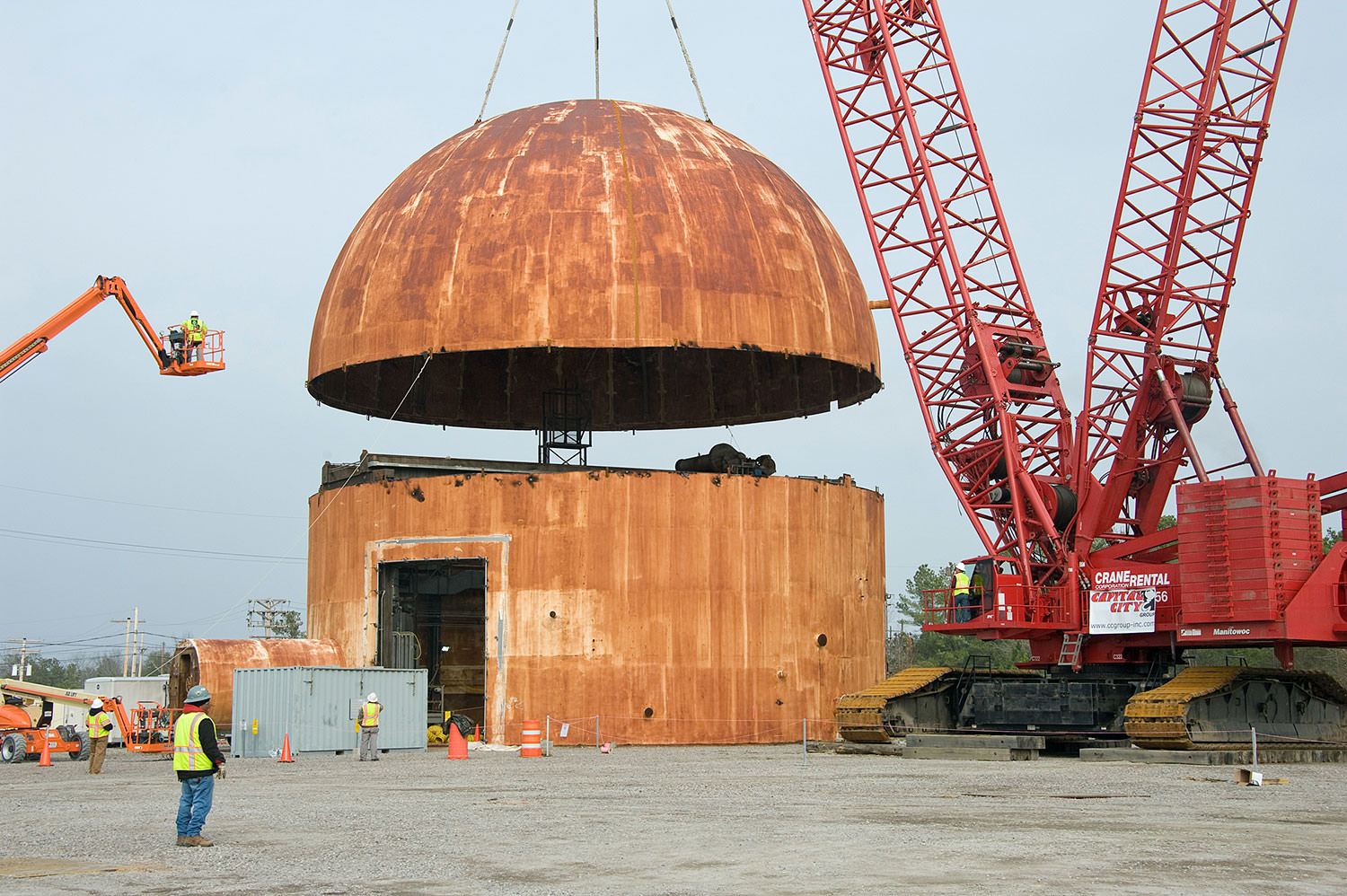
The pressures to recycle 1.7 million metric tons of contaminated metal scrap (equivalent to 17 U.S. aircraft carriers in weight) at nuclear weapons facilities in Tennessee, Kentucky and Ohio were enormous.
I dug in my heels and opposed an effort, supported by Vice President Gore’s office, to release tens of thousands of tons of radiologically contaminated metals into commerce. By claiming cost savings associated with foregoing landfill disposal, DOE contractors would be able to pocket the profits from the sale of scrap. Going forward however, I was seen as obstructionist and was effectively shunned from decision-making circles.
After Hazel O’Leary left as Energy Secretary in late 1996, I lost my political “air cover” and was perceived in the words of a colleague by the incoming leadership of the agency (Secretary Frederico Pena’s team) as “too radioactive.”
Even though I was being excluded from policy decisions, I still persisted.
As a former environmental activist, I had no compunctions about going outside of the Department to convince an old friend at the Natural Defense Resource Council to file a lawsuit to block the free release of the contaminated metal.
I knew that if DOE and its contractors got their way, this practice would lead to a major public backlash. Not to mention the market impacts the contaminated material would create for the U.S. steel industry, which was almost totally dependent on recycled metal for its feedstock. Steel makers had been burned before by errant radiation sources and the last thing they wanted was for the public to realize that the stainless-steel fork on the dinner table had some plutonium in it from a nuclear weapons plant. But consideration of these consequences could easily get overlooked in the DOE, where decisions were made in isolation and secrecy.
The lawsuit stopped the train temporarily. Judge Gladys Kessler, in a strongly worded opinion, stated: “It is . . . startling and worrisome that from an early point on, there has been no opportunity at all for public scrutiny or input in a matter of such grave importance.” Calling the recycling effort “entirely experimental at this stage,” she concluded, “The potential for environmental harm is great, especially given the unprecedented amount of hazardous materials which the defendants seek to recycle.”
In the summer of 1998, I received a call from the White House indicating that I was being fired within the next 30 days. This was the third time my detractors sought to end my tenure as a senior political appointee in DOE’s Policy office. This time, it seemed to be final.
A week before my departure, I was summoned to meet with Bill Richarson – the newly installed Secretary of Energy. He was slouched on the sofa and disheveled after a long day. “I don’t know why you got on the list. You must have pissed-off quite a few people,” he said with a devilish smile. “But you have a lot of folks that want to keep you around. When I visited DOE sites, members of Congress, union officials, Indian tribes, and environmental activists, would ask me about this Alvarez guy.”
He then pulled out a news clipping from the Seattle Times about a walk-out staged by the members of a DOE advisory panel at the Hanford facility in protest to my sacking. “You must be a fighter, I like fighters,” he said approvingly. Richardson reversed the White House decision and appointed me as his Senior Policy Advisor, where I was tasked among other things to end the “hot scrap” recycling scam.
A senior scholar at the Institute for Policy Studies, Robert Alvarez served as senior policy adviser to the Energy Department’s secretary and deputy assistant secretary for national security and the environment from 1993 to 1999.
Theddlethorpe nuclear waste site: Informed decision needed, says council.
Residents must be clear about plans to build a nuclear waste site in their
village before deciding on them, a council leader has said.
A former gas terminal in Theddlethorpe, near Mablethorpe in Lincolnshire, was announced
as a possible location for an underground disposal facility in 2021. A
public vote on whether to approve the plans may not take place until 2027.
Craig Leyland of East Lindsey District Council said it was “critical”
voters made an “informed decision”. The proposal by Nuclear Waste Services
– formerly known as Radioactive Waste Management – for a Geological
Disposal Facility (GDF) would see nuclear waste from the UK being stored
underneath up to 1,000m of solid rock until its radioactivity had naturally
decayed.
The plans have “had a detrimental effect on physical and mental
health” of residents, according to Travis Hesketh, an Independent Group
councillor at East Lindsey District Council. He called for a review into
residents’ views on the GDF at a meeting on Wednesday, the Local Democracy
Reporting Service said.
BBC 14th Dec 2023
As the world starts to panic over climate change, nuclear evangelists offer spurious solutions


I too wish that the things that the nuclear industry says about itself were true—I wish it was green and renewable. I wish that there weren’t multiple uranium mining sites around the world with thousands of tons of uranium tailings abandoned and open to the elements, continuing to harm the health of generations born long after mining ceased.
I wish that it didn’t take immense, carbon-intensive mining projects to extract uranium from the Earth, and then again to “deposit” the spent nuclear fuel from reactors back half a kilometer underground.
Nuclear Stockholm Syndrome, https://www.counterpunch.org/2021/07/09/nuclear-stockholm-syndrome/
BY ROBERT JACOBS 9 July 21, Bhaskar Sunkara’s recent opinion piece extoling the virtues of nuclear power and castigating its opponents as paranoid and ill-informed, is clearly motivated by his deep concerns over the dire impacts of global warming, which loom closer by the hour. Unfortunately, his arguments amount to little more than regurgitated industry talking points, in their traditional form of a Jeremiad.
First, Sunkara poses the decline of the nuclear industry in the West as an achievement of progressive political movements. Specifically, he cites the decline of nuclear power in Germany as attributable to a “Green party-spearheaded campaign.” This decline has been more reasonably ascribed to both market conditions and missteps by nuclear industry giants such as Westinghouse and AREVA. From its inception, nuclear power has been heavily dependent on government subsidies to appear economically viable (subsidies such as insurance and the disposal of waste largely configured as taxpayer burdens).
Rather than succumbing to its political opponents on the left, the industry has been sunk by its structural economic dysfunctions. In the US, this has sparked schemes to secure additional taxpayer subsidies in legislative fixes such as guaranteed returns for nuclear utilities, and outright bribery of legislators for taxpayer bailouts of failing companies.
The most simplistic recitation of nuclear industry talking points is when Sunkara dismisses concerns about nuclear waste, and extolls the mythic separation between “civilian” and “military” nuclear technologies. He asserts that most nuclear waste “can be recycled to generate more electricity,” an assertion that goes back more than half a century and has been ritualistically recited by an army of nuclear industry PR professionals before him…yet here we are 50 years later and very little spent nuclear fuel has actually been recycled. The most successful nuclear recycling nation is France which, nevertheless, is experiencing a “nuclear exit” and is unlikely to ever use this recycled fuel. AREVA, the French nuclear giant, has gone bankrupt. Reprocessing facilities like the Rokkasho plant here in Japan have never functioned properly, unless you consider their role enabling the stockpiling of plutonium by Japan to hedge against future weapon needs to be an elemental goal.
There is a difference between what can be done, and what actually happens. Rather than being recycled, hundreds of thousands of metric tons of spent nuclear fuel await “final disposal” in deep geological repositories. Some have been waiting for over 70 years. Just last week, a panel advising the EU on categorizing nuclear plant as “green” energy, and thus eligible to receive EU funding as a “sustainable investment,” concluded that the problems of nuclear waste preclude that designation.
I would point out that even though plastics manufacturers assure us that most plastic can be recycled, we still seem to be living a world with ever increasing amounts of plastic waste. Their greenwashing has not eventuated in a world full of plastics made from recycled materials. The market reality is that it is cheaper to manufacture new plastic than it is to manufacture plastic from recycled materials. Similarly, it is cheaper to discard spent nuclear fuel than it is to reprocess it.
Sunkara dismisses the irrevocable link between military and civilian nuclear technologies as imaginary. First, let’s consider the present imbrication. A 2019 Atlantic Council study places the value of the US civilian nuclear complex to the US national security apparatus at $26 billion annually simply in terms of the human capital assets: “In terms of nuclear technology innovation, export capacity, and geopolitics, a vibrant civilian nuclear energy sector is a critically important national security asset.”
However, the civilian operation of nuclear power plants also places future generations at military risk. I have written that, historically, nuclear reactors were “born violent.” That is to say, they were invented by the Manhattan Project in the early 1940s to manufacture plutonium for use in nuclear weapons, and were instrumental in killing almost 100,000 people in 1945. The “first” American commercial atomic plant in Shippingport, PA that went critical in 1958, was actually the 14th industrial nuclear reactor built in the United States, the other 13 only manufactured plutonium, which by then formed the fissile cores of thousands of nuclear weapons.
In nuclear reactors used to make electricity, this plutonium is not separated out for use in weapons. However, all nuclear power plants remain plutonium production factories. The fact that most of those tons of plutonium remain in the spent fuel rods does not mean they will stay there forever. Thousands of years from now, some government or military may dig up the spent fuel in our deep geological repositories and separate that plutonium out to build nuclear weaponry. All it would take is the technology (technology we currently possess) and the will. We continue to manufacture that plutonium—perhaps for them to weaponize. Every nuclear power plant that operates adds to that inventory; more than 99% of existing plutonium was manufactured in nuclear reactors. In 1962, the US successfully detonated a nuclear weapon assembled with just such “reactor-grade” plutonium. Our generation’s use of nuclear power silently stockpiles fissile material that will remain militarily viable for millennia.
I too wish that the things that the nuclear industry says about itself were true—I wish it was green and renewable. I wish that there weren’t multiple uranium mining sites around the world with thousands of tons of uranium tailings abandoned and open to the elements, continuing to harm the health of generations born long after mining ceased. I wish that it didn’t take immense, carbon-intensive mining projects to extract uranium from the Earth, and then again to “deposit” the spent nuclear fuel from reactors back half a kilometer underground. Estimates before construction began at Onkalo spent fuel repository in Finland were that the site would entail a “half-billion-euro construction project will generate some 2,500 person years of employment,” and would take 100 years to complete. That is just to contain the spent fuel from five nuclear power plants. The United States, by contrast, has 94 commercial nuclear power plants. There is still no actual plan for the astonishingly large and carbon-intensive site it will take to bury the more than 140,000 metric tons of spent nuclear fuel, with some hope of containing it for thousands of generations of future human beings. This doesn’t include the thousands of tons of spent nuclear fuel from the nuclear reactors operated by the US military to provide the fissile cores of more than 70,000 nuclear weapons during the Cold War.
The panic-inducing impacts of anthropic climate change spark a desperate need for immediate reassurance and calming: we want to fix it now. We long to turn some corner that will change the situation. It is unlikely that the same short-sighted military-industrial technophilia that brought us to this climate crisis will flip over and provide us the urgent path to its resolution. Technological evangelists have been auditioning for the part of Climate Change Savior to anyone who will listen. Some proffer a Reagan-era Star Wars pitch: they will fill the skies with material to block the enemy (in this case sunlight rather than Soviet ICBMs). These geoengineering quick-fix schemes are more likely to cause unplanned outcomes than to achieve their missions.
At one time nuclear weapon producers imagined they too could geoengineer the planet to shape it to human desires. They tested the use of nuclear weapons to sculpt harbors into coastlines, and to release natural gas trapped in rock formations. These experiments led to some of the most significant radiological distributions and contaminated sites in the wide panoply of nuclear testing. Still, hyper-capitalist techno utopians like Elon Musk envision the key to human habitation on Mars is the detonation of a massive arsenals of thermonuclear weapons to shape it to our needs.
The nuclear industry will ignore its market dilemmas as long as taxpayers continue to backstop its investors. However, to believe that this massive, for-profit, military-based industry has concern for the welfare of the Earth and its inhabitants is akin to believing the plastic industry is actually beavering away to make the plastic waste disappear. Repackaging their talking points out of a genuine concern for living creatures is a resource they will continue to tap so long as it flows freely. Sunkara would do better to advocate for the mass social movements that have shifted giant industries towards social welfare in the past rather than preaching that the industries themselves are saviors. Time is obviously short, wrong turns are catastrophic.
Robert (Bo) Jacobs is a historian at the Hiroshima Peace Institute and Graduate School of Peace Studies at Hiroshima City University. He has written and edited multiple books and articles on nuclear history and culture including, The Dragon’s Tail: Americans Face the Atomic Age, and Filling the Hole in the Nuclear Future: Art and Popular Culture Respond to the Bomb. He is a founder and a principal researcher of the Global Hibakusha Project, studying radiation exposed communities around the world. His book, Nuclear Bodies: The Global Hibakusha, will be published by Yale University Press in 2022. His Global Hibakusha blog can be found here.
1 This Month

of the week – Shut Down Drone Warfare!


Tell the Ukrainian Government to Drop Prosecution of Peace Activist Yurii Sheliazhenko

Petition to revoke the licensing of the Near Surface Nuclear Disposal Facility (NSDF) at Chalk River. https://www.ourcommons.ca/petitions/en/Petition/Details?Petition=e-7247
To see nuclear-related stories in greater depth and intensity – go to https://nuclearinformation.wordpress.com
-
Archives
- April 2026 (91)
- March 2026 (251)
- February 2026 (268)
- January 2026 (308)
- December 2025 (358)
- November 2025 (359)
- October 2025 (376)
- September 2025 (257)
- August 2025 (319)
- July 2025 (230)
- June 2025 (348)
- May 2025 (261)
-
Categories
- 1
- 1 NUCLEAR ISSUES
- business and costs
- climate change
- culture and arts
- ENERGY
- environment
- health
- history
- indigenous issues
- Legal
- marketing of nuclear
- media
- opposition to nuclear
- PERSONAL STORIES
- politics
- politics international
- Religion and ethics
- safety
- secrets,lies and civil liberties
- spinbuster
- technology
- Uranium
- wastes
- weapons and war
- Women
- 2 WORLD
- ACTION
- AFRICA
- Atrocities
- AUSTRALIA
- Christina's notes
- Christina's themes
- culture and arts
- Events
- Fuk 2022
- Fuk 2023
- Fukushima 2017
- Fukushima 2018
- fukushima 2019
- Fukushima 2020
- Fukushima 2021
- general
- global warming
- Humour (God we need it)
- Nuclear
- RARE EARTHS
- Reference
- resources – print
- Resources -audiovicual
- Weekly Newsletter
- World
- World Nuclear
- YouTube
-
RSS
Entries RSS
Comments RSS
 nuclear-news