Opposition to USA plan to commercialise plutonium wastes at Savannah
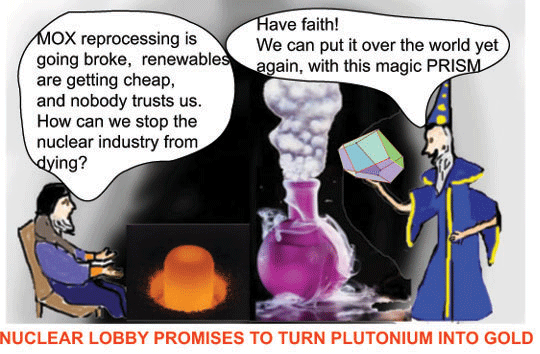 The preferred plan under consideration calls for the shipment of 7.1 metric tons of so-called pits — or cores — of an undisclosed number of nuclear warheads now stored at the Pantex plant in West Texas to Los Alamos National Laboratory in New Mexico and the Savannah River Site for disarmament and processing into fuel for commercial nuclear reactors.
Anti-nuclear activists question plan for shipping plutonium from warheads to New Mexico By Associated Press, August 22 LOS ALAMOS, N.M. — Nuclear watchdogs are fighting a proposal to ship tons of plutonium to New Mexico, including the cores of nuclear warheads that would be dismantled at an aging and structurally questionable lab atop an earthquake fault zone.
Opponents voiced their opposition at a series of public hearings that opened this week on the best way to dispose of the radioactive material as the federal government works to reduce the nation’s nuclear arsenal.
The Department of Energy is studying alternatives for disposing of plutonium in light of federal budget cuts that have derailed plans for new multi-billion-dollar facilities at the Savannah River Site in South Carolina. Continue reading
Urgent nuclear waste problem in Ukraine

 Ukraine badly needs waste nuclear fuel storage facility, says Emergencies Ministry Interfax, 17 Aug 12, Ukraine needs to give a serious thought to building a centralized storage facility for waste nuclear fuel since waste fuel from Ukrainian nuclear power plants (NPPs), which is temporary stored in the Russian Federation will start to come back from 2013, the Emergencies Ministry said. Continue reading
UK’s plans for nuclear waste burial in Cumbria
 Full report published on Cumbria nuclear waste burial and local involvement http://www.guardian.co.uk/uk/the-northerner/2012/aug/17/lakedistrict-nuclearpower-west-cumbria-managing-nuclear-waste-safely-partnership?newsfeed=true
by Martin Wainwright 17 August 2012 Findings of three-year review by the West Cumbria Managing Radioactive Waste Safely Partnership are now in print and online The complicated and contentious issue of burying nuclear waste in Cumbria is heading for a milestone on 11 October when the three local councils which have expressed an interest meet to debate further involvement.
A useful waymarker has now been published in full, based on the views of some 2,300 people and organisations whose submissions, while often very different and sometimes in direct conflict, have led to changes and hesitations, albeit not altering the general approach of cautiously making headway.

The document was summarised on 19 July and you can read a precis of that here. The full report has now gone up online and that is availablehere. It is the work of the West Cumbria Managing Radioactive Waste Safely Partnership which is made up of the councils – Cumbria countyand Allerdale and Copeland districts – and other groups including the National Farmers Union, the Lake District national park authority and representatives of all the parish councils potentially involved. Continue reading
Eastern Connecticut’s nuclear waste problem
if no national repository is built, the nuclear waste will have to stay there forever and the property will not be marketable.
Public Voices Concerns About More Nuclear Waste In Eastern Connecticut
At a public forum by Dominion, neighbors voiced their concerns about Millstone increasing its capacity for nuclear waste, although said there is little other choice. Groton Patch 17 Aug 12, By Paul Petrone At a public forum Wednesday night, neighbors and an anti-nuclear activist raised concerns about Millstone Power Station’s plans to vastly increase the amount of nuclear waste it can store on site , although most agreed there was no other option.
“I feel bad for the people growing up in this area,” said Ed Saller, who lives within 2,000 feet of Millstone. “We have a dysfunctional government, I don’t know how they can ever solve this issue.”
Dominion, owners of Millstone, are asking the Connecticut Siting Council if they can put on the top layer of a nearly two-acre concrete pad that would hold nearly 60 years of nuclear waste in dry cask storage. Continue reading
No confidence in USA’s “Waste Confidence Rule” – so nuclear licensing stopped
puts waste where it belongs, front and center in the debate over the future of nuclear power in this country
NRC elevates nuclear waste to front and center of debate http://www.thereporteronline.com/article/20120815/OPINION01/120819748/nrc-levates-nuclear-waste-to-front-and-center-of-debate&pager=2 08/15/12 BECAUSE THE U.S. Nuclear Regulatory Commission is a part of the federal bureaucracy, it can make even groundbreaking news seem mundane.
Take this understated sentence in its ruling Aug. 7 delaying the final issuance of any nuclear permits, for existing or new power plants:
“Waste confidence undergirds certain agency licensing decisions, in particular new reactor licensing and reactor licensing renewal.”
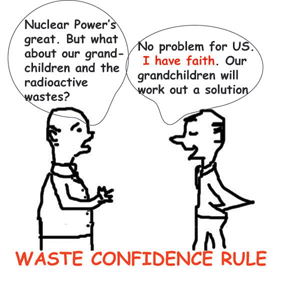
Translation: The country cannot continue to talk about building new nuclear plants without figuring out what it is going to do with the dangerous waste that literally is stacking up at sites all over the country, including at Ameren Missouri’s Callaway County plant.
That means that because Americans can have no confidence that the NRC has seriously dealt with the growing problem of nuclear waste, the NRC will stop making the problem worse by extending nuclear plant licenses. Continue reading
Allison Macfarlane speaks out on USA’s nuclear waste problem
New U.S. Nuclear Regulator Says Spent Fuel a Top Priority Bloomberg News, By Kasia Klimasinska August 14, 2012 The new chairman of the U.S. Nuclear Regulatory Commission said she plans to concentrate on the disposal of spent atomic fuel, an issue that is holding up decisions on power-plant licenses.
Allison Macfarlane, in her first news conference since taking over at the NRC on July 9, today also called on Congress and the White House to identify a permanent disposal site for spent fuel from the nation’s 104 nuclear reactors. Continue reading
VIDEO: Norway cops radioactive water waste from UK’s Sellafield nuclear site


 Norway’s Nuclear Problem http://www.sbs.com.au/shows/thalassa/ Radioactive material from the Sellafield nuclear plant in the UK has been detected in Norwegian waters.In the early 1990s in Norway, scientists discovered the presence of radioactive material in the seawater, seaweed and lobster. But Norway has no nuclear facilities, and no nuclear weapons, so it had to be coming from another country.
Russia was a prime suspect, but it is in fact in southern Scotland on the edge of the Irish Sea that the problem originated. Over fifty years ago the British government built the Sellafield plant to produce electricity and plutonium for the making of atomic bombs. Now it has reconverted into a nuclear waste processing plant, but security is still not guaranteed and fires, leakage and accidental toxic discharge have occurred over the years.
Some speak of negligence. Environmental activists around the world are on the case, demanding the closure of the site once and for all. In 1997, a huge rock concert was organised by U2 to raise the alarm.
Poisonous legacy of rare earths mining in China
Rare-earth mining in China comes at a heavy cost for local villages Guardian UK Pollution is poisoning the farms and villages of the region that processes the precious minerals , 7 August 2012 From the air it looks like a huge lake, fed by many tributaries, but on the ground it turns out to be a murky expanse of water, in which no fish or algae can survive. The shore is coated with a black crust, so thick you can walk on it. Into this huge, 10 sq km tailings pond nearby factories discharge water loaded with chemicals used to process the 17 most sought after minerals in the world, collectively known as rare earths.
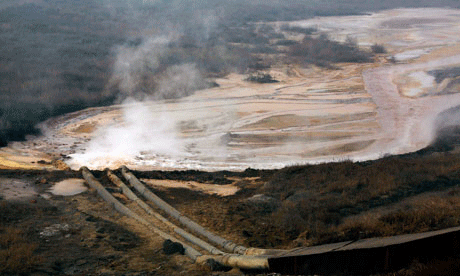
The town of Baotou, in Inner Mongolia, is the largest Chinese source of these strategic elements, essential to advanced technology, from smartphones to GPS receivers, but also to wind farms and, above all, electric cars. The minerals are mined at Bayan Obo, 120km farther north, then brought to Baotou for processing.
The concentration of rare earths in the ore is very low, so they must be separated and purified, using hydro-metallurgical techniques and acid baths. China accounts for 97% of global output of these precious substances, with two-thirds produced in Baotou.
The foul waters of the tailings pond contain all sorts of toxic chemicals, but also radioactive elements such as thorium which, if ingested, cause cancers of the pancreas and lungs, and leukaemia. “Before the factories were built, there were just fields here as far as the eye can see. In the place of this radioactive sludge, there were watermelons, aubergines and tomatoes,” says Li Guirong with a sigh.
It was in 1958 – when he was 10 – that a state-owned concern, the Baotou Iron and Steel company (Baogang), started producing rare-earth minerals. The lake appeared at that time. “To begin with we didn’t notice the pollution it was causing. How could we have known?” As secretary general of the local branch of the Communist party, he is one of the few residents who dares to speak out.
Towards the end of the 1980s, Li explains, crops in nearby villages started to fail: “Plants grew badly. They would flower all right, but sometimes there was no fruit or they were small or smelt awful.” Ten years later the villagers had to accept that vegetables simply would not grow any longer. In the village of Xinguang Sancun – much as in all those near the Baotou factories – farmers let some fields run wild and stopped planting anything but wheat and corn.
A study by the municipal environmental protection agency showed that rare-earth minerals were the source of their problems. The minerals themselves caused pollution, but also the dozens of new factories that had sprung up around the processing facilities and a fossil-fuel power station feeding Baotou’s new industrial fabric. Residents of what was now known as the “rare-earth capital of the world” were inhaling solvent vapour, particularly sulphuric acid, as well as coal dust, clearly visible in the air between houses.
Now the soil and groundwater are saturated with toxic substances. Five years ago Li had to get rid of his sick pigs, the last survivors of a collection of cows, horses, chickens and goats, killed off by the toxins.
The farmers have moved away. Most of the small brick houses in Xinguang Sancun, huddling close to one another, are going to rack and ruin. In just 10 years the population has dropped from 2,000 to 300 people…… http://www.guardian.co.uk/environment/2012/aug/07/china-rare-earth-village-pollution
No nuclear waste solution in sight, as USA suspends new and renewing nuclear power licences
The suspension is likely to lower confidence in the nuclear industry, both on the part of the public and lawmakers. At least one congressman called for the end of new nuclear power in response to the order.
A century after a reactor shuts down, “the entity that operates reactors might not exist; the NRC might not exist. How do you say with a straight face that’s going to be safe?”

 US nuke plant delay fails to solve storage conundrum http://www.newscientist.com/article/dn22165-us-nuke-plant-delay-fails-to-solve-storage-conundrum.html 10 August 2012 by Sara Reardon The gauntlet has been thrown: until the US figures out what to do with its nuclear waste, new nuclear plants can’t be licensed and existing licences can’t be renewed.
The dramatic decision, taken by the Nuclear Regulatory Commission on 8 August, is a sign of mounting pressure over the issue of nuclear waste storage, and is likely to rekindle doubts over the future of the nuclear industry. But whether it will result in a solution anytime soon is still unclear.
In taking the decision, the NRC was responding to a complaint from 24 organisations, demanding that it set more specific guidelines for its plans regarding nuclear waste.
The current modus operandi is for US nuclear plants to store spent fuel in pools onsite in the hope that a permanent geological repository, such as Nevada’s Yucca Mountain – or even better, somewhere else – becomes available within the coming decades. Continue reading
Secret shipment of radioactive spent nuclear fuel to South Carolina
This shipment of research reactor fuel to SRS in no way means that the public is open to receipt of highly radioactive commercial spent fuel from U.S. nuclear reactors for consolidated storage at SRS, which some narrow special interests are eyeing
Radioactive Spent Fuel Containing Bomb-Grade Uranium Arriving at SRS http://aikenleader.villagesoup.com/blog/blogpost/radioactive-spent-fuel-containing-bomb-grade-uranium-arriving-at-srs/881381
By Thomas Clements | Aug 09, 2012 A secretive shipment of radioactive spent research reactor fuel containing highly enriched uranium (HEU) from Germany is soon to arrive at the Department of Energy’s (DOE) Savannah River Site (SRS) near Aiken, South Carolina, where it will be indefinitely stored. The shipment is likely to be transiting the Naval Weapons Station in Charleston, South Carolina. Continue reading
USA’s mounting nuclear wastes influenced NRC decision to halt reactor licensing
 More than 65,000 tons of spent nuclear fuel is stored at operating and shuttered reactor sites across the country. But those 72 sites in 34 states are filling up. Some 2,000 additional tons of waste are produced each year, according to a report released this year by the president’s Blue Ribbon Commission on America’s Nuclear Future. …..
As Nuclear Waste Problem Persists, Federal Regulators Freeze Licensing for Reactors Aug. 8, 2012 Jim Malewitz, Stateline.org The U.S. Nuclear Regulatory Commission (NRC) won’t sign off on licenses for news and existing nuclear power plants until the commission addresses a decades-old problem plaguing states: what to do with spent fuel rods and other hazardous waste piling up at storage sites across the country.
In a unanimous decision on Tuesday (August 7), the commission said it
will hold off licensing plants that are new or up for renewal. That’s
until it responds to a court’s ruling that the NRC failed to consider
the environmental impacts of continuing to store waste at sites meant
to be temporary.
Licensing reviews will continue, the commission said, but no final
decisions will be made.
More than 65,000 tons of spent nuclear fuel is stored at operating and shuttered reactor sites across the country. But those 72 sites in 34 states are filling up. Some 2,000 additional tons of waste are produced each year, according to a report released this year by the
president’s Blue Ribbon Commission on America’s Nuclear Future. …..
In June, a federal appeals court threw out the commission’s “waste
confidence rule” and “temporary storage rule,” decisions that
collectively approved the status quo for onsite storage. Siding with
environmentalists and four states led by New York, the court said the
commission’s rulemaking process was flawed in that it did not
calculate the environmental effects of failing to secure a permanent
disposal site _ “a possibility that cannot be ignored,” the court
ruled. The NRC also, according to the court, “failed to examine future
dangers and key consequences,” in its determination that spent nuclear
fuel could be safely stored at nuclear sites for up to 60 years after
their license expires. ….
Eric Schneiderman, New York’s attorney general, hailed the NRC’s
decision to halt the licensing of reactors.
“The storage of nuclear waste at nuclear power facilities poses
long-term health and environmental risks, including the risk of leaks
from spent fuel pools and fires, he said in a statement yesterday.
“The NRC’s commitment is a welcome step toward ensuring a full, fair
and open examination of the numerous critical questions about the
safety and environmental impact of Indian Point before any decisions
are made about extending its operating licenses for another 20 years.”
 Bingaman Proposes Overhaul Of Nuclear Waste Disposal, By Erica Teichert Law360, Washington (August 02, 2012,) –– Sen. Jeff Bingaman, D-N.M., introduced a bill Wednesday that could alter the country’s approach to nuclear waste management policy based on recommendations of a presidential panel, saying he hoped the bill
would foster more constructive bipartisan negotiations on the issue.
The bill — S. 3469, the Nuclear Waste Administration Act of 2012 — pushes for a new oversight body separate from the U.S. Department of Energy to oversee nuclear waste management and recommends a content-based approach to determine the sites for waste
repositories….. Subscriber only
http://www.law360.com/energy/articles/366065/bingaman-proposes-overhaul-of-nuclear-waste-disposal
Los Alamos National Laboratory – plutonium facility not safe
The plutonium facility was designed and built in the 1970s and lacks the earthquake resistance required by modern building codes
 Safety Board Calls Nuclear Lab’s Earthquake Resistance Analysis ‘Technically Inadequate’ HUFFINGTON POST, Mia SteinleInvestigator, Project On Government Oversight, 30 july 12, An ongoing government analysis of an important nuclear weapons laboratory’s ability to withstand earthquakes may be flawed, according to a federal oversight panel. Continue reading
UK hastening plan to bury radioactive waste
Govt fast-tracks nuclear dumps despite warnings, The Independent/London, 29 July 12 The burial of radioactive nuclear waste is to be fast-tracked by the government despite warnings about the risks.
Ministers have revealed an “enduring ambition” for Britain’s first burial of waste from nuclear power stations to happen as early as 2029, instead of 2040 as originally planned, The Independent on Sunday revealed. Continue reading
Veil of secrecy over France’s unaffordable nuclear power decommissioning
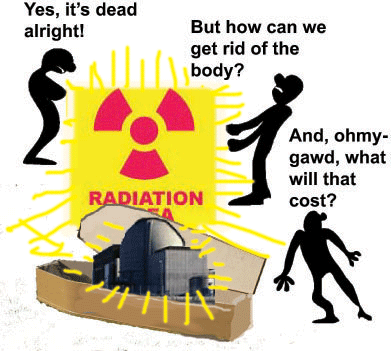 “What is not tolerable is that the funds are managed by the operators”
Over the past six years there has been a veritable veil pulled over this subject.”
 French Nuclear Dismantling Funds May Fall Short, Report Says http://www.bloomberg.com/news/2012-07-24/french-nuclear-dismantling-funds-may-fall-short-report-says.html By Tara Patel – Jul 24, 2012 Electricite de France SA and Areva SA (AREVA), along with other French nuclear operators, may not be setting aside enough funds to pay for future dismantling of reactors and treatment and storage of atomic waste, according to a parliamentary report. Continue reading
1 This Month
23-25 October – on Zoom – World BEYOND War’s annual global conferenc


Shut down the radiation-damaged Heysham nuclear reactors now
To see nuclear-related stories in greater depth and intensity – go to https://nuclearinformation.wordpress.com

Say No to NASA’s Reckless Nuclear Reactor on the Moon
Say No to NASA’s Reckless Nuclear Reactor on the Moon

-
Archives
- October 2026 (231)
- September 2026 (339)
- August 2026 (330)
- July 2026 (355)
- June 2026 (287)
- May 2026 (306)
- April 2026 (356)
- March 2026 (251)
- February 2026 (267)
- January 2026 (308)
- December 2025 (358)
- November 2025 (359)
-
Categories
- 1
- 1 NUCLEAR ISSUES
- business and costs
- climate change
- culture and arts
- ENERGY
- environment
- health
- history
- indigenous issues
- Legal
- marketing of nuclear
- media
- opposition to nuclear
- PERSONAL STORIES
- politics
- politics international
- Religion and ethics
- safety
- secrets,lies and civil liberties
- spinbuster
- technology
- Uranium
- wastes
- weapons and war
- Women
- 2 WORLD
- ACTION
- AFRICA
- Atrocities
- AUSTRALIA
- Christina's notes
- Christina's themes
- culture and arts
- Events
- Fuk 2022
- Fuk 2023
- Fukushima 2017
- Fukushima 2018
- fukushima 2019
- Fukushima 2020
- Fukushima 2021
- general
- global warming
- Humour (God we need it)
- Nuclear
- RARE EARTHS
- Reference
- resources – print
- Resources -audiovicual
- Weekly Newsletter
- World
- World Nuclear
- YouTube
-
RSS
Entries RSS
Comments RSS

