USA’s budgetary tug of war between nuclear weapons and radioactive trash clean-up
The clean-up work, which includes a mixture of radioactive and chemical wastes, “is the largest environmental remediation ever undertaken by mankind and the most technically challenging”
One reason for the Energy Department’s struggles is a budgetary tug of war within the agency. One part of the department maintains the US’s atomic arsenal, and another is in charge of cleaning up the contamination from nuclear work. Funds for both come from the same pot, and in a shift from the 1990s, an increasing portion is going towards ensuring the readiness of the weapons arsenal

 Toxic remnants of US nuclear program http://www.theaustralian.com.au/business/wall-street-journal/toxic-remnants-of-us-nuclear-program/story-fnay3ubk-1227591352430m JOHN R. EMSHWILLER, GARY FIELDS THE WALL STREET JOURNAL NOVEMBER 03, 2015
About 70km southeast of San Francisco, in an 320ha mini-city built to create atomic bombs, there’s a contaminated building slated for eventual demolition.
Mark Costella, a facilities manager at the Energy Department’s Lawrence Livermore National Laboratory, would prefer to tear down the structure, but doesn’t have the tens of millions of dollars needed.
Instead, he is spending $US500,000 ($700,000) to fix the roof.
These are the kinds of contradictions at the heart of the complicated, expensive and struggling effort to clean up the US’s 70-year-old nuclear weapons program.
The Energy Department’s clean-up operation is wrestling with reduced budgets, tens of billions of dollars in ballooning cost estimates and 2700 structures on its to-do list. Officials said more than 350 additional unneeded facilities controlled by other programs in the Energy Department are probably eligible for transfer to the clean-up operation. But that office said its funds were limited and it was not accepting any more projects, no matter their significance.
That means some of the nation’s toughest threats are now on the backburner, possibly for decades, while relatively low-priority work moves forward.
Dirty and decaying structures where weapons work and other nuclear activities were carried out — some the size of several football fields and old enough to qualify for Social Security — are clustered in federal sites from South Carolina to California. Some are within easy walking distance of people’s homes. Continue reading
What’s happening? USA’s weapons program and nuclear waste clean-up funds come from the same kitty!
 Q&A: What’s Next for America’s Nuclear-Waste Clean-Up, http://blogs.wsj.com/washwire/2015/11/02/qa-whats-next-for-americas-nuclear-waste-clean-up/ WSJ, By GARY FIELDS and JOHN R. EMSHWILLER
The Senate and House are expected as early as this week to take up the defense authorization bill President Barack Obama vetoed last month and try to push a version of it through again. Buried in the bill is a proposal that could dramatically re-order nuclear-weapons clean-up activities, a decades-long effort that is costing taxpayers hundreds of billions of dollars
The proposal is five paragraphs, barely noticeable in the 1,000-plus-page document. But, if implemented, its effects could be felt in communities around the country. Here’s a Q&A:
What is the problem?
Creating America’s nuclear arsenal left thousands of structures around the U.S. tainted with radioactive and chemical contamination. Over the past quarter century, the Energy Department clean-up office has disposed of about 2,800 of them with a like number still to do. However, for various reasons some of the dirtiest and most dangerous buildings aren’t yet on that clean-up list and might not be added for decades.
How many structures are in this sort of limbo?
An Energy Department inspector general’s report this year put the number at over 350. Among them is Alpha 5 in Tennessee. Larger than ten football fields, it produced uranium for the Hiroshima bomb but is now a decaying structure of radioactive and chemical contamination where “the speed of degradation is far outpacing” maintenance funding, said an Energy Department report.
Why aren’t these places getting addressed?
The issue, as with many things, is money. The Energy Department’s money for the weapons program and the clean-up effort come from the same the same kitty. A quarter century ago, with the end of the Cold War, more money for the first time started flowing into clean-up than weapons. In recent years that situation has reversed. Plus, much of the money available to the clean-up operation is committed at various sites and there isn’t enough money to take to address some of these other buildings–even if they are more in need of attention than some of the structures being dealt with.
What are Congress and the administration doing?
The energy secretary has appointed a working group to review clean-up priorities. The provision in the vetoed defense bill would require buildings such as Alpha 5 to be added to the clean-up operation within three years—a timetable the Obama administration says isn’t possible.
Banking-industry style regulation needed for Europe’s nuclear decommissioning costs
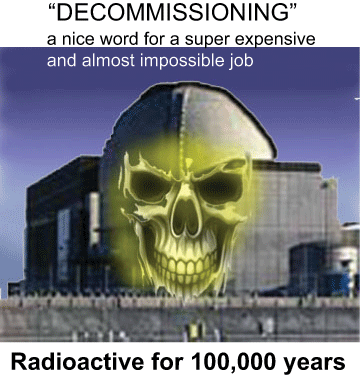 EU regulation of nuclear decommissioning costs needed -Capgemini http://www.reuters.com/article/2015/11/02/nuclear-decommissioning-idUSL8N12X22J20151102 Europe needs banking-industry style regulation to bring more transparency to the costs of nuclear reactors, consultancy Capgemini said in its annual energy market report.
Capgemini said gross provisions for decommissioning and long-term spent fuel management work out at 4.7 billion euros ($5.2 billion) per reactor in Germany, compared to just 1.2 billion in France and 3.38 billion euros in Britain.
Even if France’s nuclear fleet of 58 reactors is much bigger than Germany’s 17 reactors, economies of scale from the standardization of processes look too big to account for such a difference by themselves, according to Capgemini.
“Establishing what methodology is used to estimate the overall cost is essential, but it is never explained in annual reports, with each player relying on the estimates of their own experts in that area,” Capgemini said.
Nuclear operators like France’s EDF, Germany’s E.ON and RWE and Sweden’s Vattenfall all use different discount and inflation rates to calculate the present value of long-term liabilities and the parameters for these calculations are left to individual companies to decide, the consultancy said. “For obvious reasons to do with transparency, it is urgent that a process be instituted at European level … similar to the international regulatory framework for banks (Basel III) following the financial crisis that affected most European countries,” Capgemini said.
There are also strong disparities with regards to nuclear operators’ legal obligations in terms of covering these future costs, it said.
Only Finland’s Fortum, Vattenfall (for its Swedish activities), EDF and the Czech Republic’s CEZ have portfolios dedicated to the financing of these long-term obligations, with coverage ratios of 100, 78, 68 and 31 percent respectively, Capgemini said.
Other sector players do not have dedicated assets on their balance sheets, and German utilities currently do not cover their provisions, it added.
Last month, E.ON dropped plans to spin off its German nuclear power plants, bowing to political pressure to retain liability for billions of euros of decommissioning costs when the plants are shut down.
The International Energy Agency said late last year that almost 200 of the world’s 434 reactors in operation would be retired by 2040, and estimated the decommissioning cost at more than $100 billion, but many experts view this figure as way too low. ($1 = 0.9057 euros) (Reporting by Geert De Clercq; Editing by Susan Fenton)
USA’s radioactive waste pile-up is ‘constipating’ the nuclear industry
 Beyond Yucca Mountain: The present impasse and uncertain future of nuclear waste storage, SNL By Andrew Coffman Smith, October 28, 2015
“If we don’t clean up the legacy of the past, there won’t be a nuclear future,”declared Mike Simpson, Idaho Congressman and chairman of the House Subcommittee on Energy and Water Development, during an Oct. 27 panel discussion on the issue….Thirty-three years after Congress passed the Nuclear Waste Policy Act and several years after the defunding of the proposed Yucca Mountain nuclear waste storage project, America has yet to find a permanent home for its nuclear waste, and a panel of experts said the future of nuclear storage lay with consenting communities.
Simpson said not having a solution for the long term storage of nuclear waste in the U.S. is “constipating” the nuclear energy sector…..
While the House continues to include funding for Yucca Mountain in budget proposals every year, the Senate has instead followed the recommendations of a Blue Ribbon Commission set up in 2010 by President Barack Obama and examined alternatives to Yucca Mountain using a community consent-based approach, said Simpson…..
Simpson said the current refurbishing of New Mexico’s Waste Isolation Pilot Plant, or WIPP, has led to a buildup of nuclear waste across the country at the expense of states because the facility cannot receive any more waste until the construction is completed. Simpson said that he expects that a surface facility will be built at WIPP to store the waste until the underground storage facilities at WIPP reopens to store nuclear waste in its deep geological repository.
Simpson also said the challenges faced in getting WIPP’s “relatively small” facility operating gives him great pause as to what will happen when the decision is made to operate the larger waste treatment plant in Hanford, Washington.
“We have to convince the American people that you can clean up this stuff that we have been doing for the last 50 years and the biggest challenge we face and the most eminent threat we face is probably at Hanford,” Simpson said.
Simpson said a third storage site that is in trouble is the Savannah River mixed oxide fuel facility, or MOX, in South Carolina that the U.S. Department of Energy is seeking to shut down. The DOE is seeking to have MOX’s uranium down blended and stored at WIPP or another location. Simpson said the problem with MOX is that the U.S. has an agreement with Russia that requires the existence of MOX and the support of both Russia and New Mexico is needed to transport the nuclear waste at MOX to WIPP…..
One of the things that we heard really pretty consistently across the country was a lack of confidence that the federal government was able or intended to live up to the commitments that it’s already made,” said Brailsford. “Once the waste is somewhere, that ‘somewhere’ has lost a lot of its bargaining power so how are you even going to hold the federal government’s feet to the fire to live up to what it has committed to?”
Radioactive trash burning underground near major USA city
“Nuclear fire” erupts at radioactive facility near major US city — Footage shows underground explosions, massive smoke plumes — AP: “Unknown amount of radioactive waste burned” — EPA sends emergency radiological team — Residents: “We were flat out lied to… Why didn’t they evacuate the town?” (VIDEO) http://enenews.com/nuclear-fire-erupts-radioactive-dump-100-miles-major-city-footage-shows-underground-explosions-massive-smoke-plumes-ap-unknown-amount-radioactive-waste-burned-epa-sends-radiological-emergency?utm_source=feedburner&utm_medium=email&utm_campaign=Feed%3A+ENENews+%28Energy+News%29
CBS Las Vegas, Oct 22, 2015 (emphasis added): Government officials are still looking into what may have caused a low-level radiological storage facility [~100 miles outside Las Vegas] to go up in flames… “We didn’t even hear about it when it happened, according to Cindy Craig, a resident. “We weren’t even get told about it until the next day.”
Las Vegas Review-Journal, Oct 21, 2015: Carol Johnston, owner of KC’s Outpost [in Beatty, Nevada]… said she was serving customers on a patio Sunday when she “heard a big boom” then looked up and saw a big puff of smoke. “Why didn’t they evacuate the town then?” she asked in a telephone interview Wednesday.
CBS Las Vegas, Oct 22, 2015: In the 40-second cellphone video… you can see the explosion in the shooting from the ground causing massive plumes of smoke. The explosion caused the facility to go up in flames. State officials said the fire started inone of 22 covered trenches used to store low-level radioactive material…
AP, Oct 19, 2015: EPA said the unknown amount of low-level radioactive waste that burned had been deposited… before 1992… [USGS previously] found high concentrations of radionuclides underground, the Nuclear Resource and Information Service said.
Las Vegas Review-Journal, Oct 22, 2015: Fire Marshal Chief Peter Mulvihill said [it] “burned very hot“… Items buried in the low-level nuclear waste dump include… nuclear reactor crud…
AP, Oct 21, 2015: Mulvihill said the fire burned unabated after starting Sunday during intense thunderstorms and flash flooding… Now, first-responders have backed off while investigators locate archived paperwork to determine what was buried in the burned trench… [I]ncident managers initially feared about 2,000 people in the sprawling rural area would need to be evacuated if radiation had been detected. Mulvihill told reporters that all but two employees left the… facility adjacent to the radioactive waste dump…
Las Vegas Review-Journal, Oct 20, 2015: “We don’t know exactly what caught fire. We’re not exactly sure what was burning in that pit,” Fire Marshal Chief Peter Mulvihill said… “there was some energetic burning” that blew a hole in the cover soil that caps trench No. 14, where low-level radioactive materials were buried.
AP, Oct 19, 2015: [EPA] is sending a radiological emergency team to look for contamination… EPA spokesman Rusty Harris-Bishop says no dangerousgamma radiation has been detected… The fire eruptedSunday during heavy rain…
KSNV, Oct 20, 2015: [R]esidents are still concerned because of what was burning, and because they say they were “flat out lied to“… As the fire burned, the US 95 was closed for a 140 mile stretch for nearly 24 hours. People waiting in their cars say they were told a much different reason for the traffic jam. “They told us it was debris in the road,” one resident told News 3. “We found out it was a nuclear waste fire.”
KSNV, Oct 20, 2015: This small town voiced big concerns at Tuesday night’s town hall after a fire at a low-level radioactive waste dump… “We don’t find out about it in the city of Beatty until we watch the news the next morning. What if that was extremely hazardous?” [a resident] said. “I’m very, very upset about it.”… many questions remain including what exactly was burning?… “We have absolutely no idea… what it is” [Sheriff Sharon Wehrly] said…
Las Vegas Sun, Oct 23, 2015: Sunday’s nuclear fire… reportedly did not emit above-average doses of radiation.
Las Vegas Sun, Oct 22, 2015: Media buzzed with reports of a low-level nuclear fire… [T]he plume of smoke — determined by the… government to not be hazardous to public health — billowed… residents, though, were unaware of the details of the emergency situation.
Las Vegas Review-Journal, Oct 19, 2015: Mulvihill said investigators would be taking a close and methodical look at the site “once it is safe to go down there.”… [The fire] was allowed to burn itself out over the course of about 12 hours… US Ecology officials said they created “an exclusion zone around the facility” at the request of state regulators… As part of their investigation, state officials said they will be looking at the [dump’s] overall stability…
KTNV, Oct 22, 2015: You can see a column of white smoke… Then multiple underground explosions in trench 14 send more smoke spewing out. The ground erupts… We don’t know what these explosions kicked up into the air but we do know state leaders were well aware of the risks buried at the U.S. Ecology site… Minutes from legislative hearings detail concerns about “unknown contamination levels.” The state expressed concern because it was not sure of the contamination levels or when a fissure might occur.
KTNV transcript, Oct 22, 2015 (at 2:20 in): “We’ve just learned… there are 2 new areas of land that are sinking from recent flooding at the site, and a crater where the fire broke out.”
Watch broadcasts: KTNV | NBC Las Vegas
NRC allows nuclear companies to use decommissioning funds for waste storage, violating rules
 Nuclear plants dip into dismantling funds to pay for waste By Dave Gram, The Associated Press DAILY NEWS, 10/25/15, MONTPELIER, VT. WITH A FEDERAL PROMISE TO TAKE HIGHLY RADIOACTIVE SPENT FUEL FROM NUCLEAR PLANTS STILL UNFULFILLED, CLOSED REACTORS ARE DIPPING INTO FUNDS SET ASIDE FOR THEIR EVENTUAL DISMANTLING TO BUILD WASTE STORAGE ON-SITE, RAISING QUESTIONS ABOUT WHETHER THERE WILL BE ENOUGH MONEY WHEN THE TIME COMES.
It violates Nuclear Regulatory Commission rules for the plants to take money from their decommissioning trust funds to pay for building the concrete pads and rows of concrete and steel casks where waste is stored after it is cooled in special storage pools. But the NRC is granting exemptions from those rules every time it is asked.
“All of the plants that have permanently shut down in recent years have sought, and been approved for, the use of decommissioning funds for spent fuel storage costs,” NRC spokesman Neil Sheehan wrote in an email in response to questions from The Associated Press this past week.
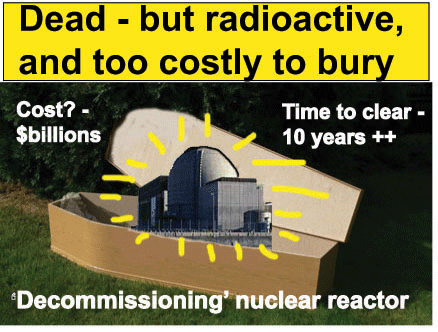
These include the Kewaunee plant in Wisconsin, San Onofre 1 and 2 in California, Crystal River 3 in Florida, and Vermont Yankee in Vernon, in Vermont’s southeast corner, which closed at the end of last year. The Zion 1 and 2 reactors in Illinois, which shut down in the late 1990s, had gotten a similar OK to use decommissioning money for spent fuel storage, Sheehan said.
Ratepayers chipped in during nuclear plants’ lives to set aside the money it would take eventually to tear down reactors, remove their radioactive components and restore the sites. It was not envisioned they also would have to pay for indefinite storage of spent fuel on the roughly 100 nuclear plant sites around the country.
And long-term, on-site storage of nuclear waste is a bad idea, said Arnold Gundersen, a former nuclear industry executive turned consultant who frequently criticizes the industry.
“You build power plants near water because you have to cool them, and you build nuclear waste storage sites away from water” because of the threat of radioactive materials reaching it, Gundersen said
“It would be much better to get the stuff underground where terrorists couldn’t fly a plane into it,” he said.
Nuclear industry spokespeople, government officials and industry critics agree the retirement fund raids have been triggered by the failure to date of the U.S. Department of Energy to open a permanent disposal site for spent nuclear fuel. For years, the government had been planning a disposal site at Nevada’s Yucca Mountain, but that plan has been scuttled by a lack of funding from Congress.
That has left reactors redesigning the racks in their spent fuel pools to accommodate more of the waste and expanding into “dry cask” storage, both of which Vermont Yankee did in the years before its owner, Entergy Corp., closed the plant at the end of last year because it was becoming less competitive against electricity generated with cheap natural gas.
The spent fuel bottleneck leaves closed and soon-to-close nuclear plants with the prospect that for the indefinite future, they will look like the site of the former Maine Yankee plant. That plant was permanently shut down in 1997, nearly two decades ago. Today, the reactor is gone, but the site in the coastal town of Wiscasset still features 60 steel canisters encased in concrete that contain the 550 metric tons of spent fuel the plant generated in its 25-year life. The site is guarded 24 hours a day, 7 days a week………..http://www.dailynews.com/business/20151025/nuclear-plants-dip-into-dismantling-funds-to-pay-for-waste
Federal authorities cancel shipment of high level radioactive trash to Idaho
Feds cancel research shipment of spent nuclear fuel to Idaho, Salt Lake Tribune, By KEITH RIDLER The Associated Press, 25 Oct 15, Boise, Idaho • Federal authorities have canceled the first of two proposed research shipments of spent nuclear fuel to eastern Idaho but still hope to deliver the second.
The U.S. Department of Energy said Friday that 25 fuel rods weighing about 100 pounds will not be sent to the Idaho National Laboratory.
The move comes after federal and state officials couldn’t come to terms on a waiver to a 1995 agreement that ties such shipments to nuclear waste cleanup at the 890-square-mile site. The federal agency is currently in violation of the agreement because of its failure to convert 900,000 gallons of liquid waste into solid form due to malfunctions at a $571 million plant……..
The Department of Energy wants to better understand “high burnup” spent fuel that is accumulating at nuclear power plants in the U.S. High burnup fuel remains in nuclear reactor cores longer to produce more energy but comes out more radioactive and hotter. It’s cooled in pools before being encased in steel and concrete.

The first proposed shipment to Idaho initially set for August would have come from the Byron Nuclear Power Station in Illinois.
The second shipment, also of 25 spent nuclear fuel rods weighing about 100 pounds, is scheduled for January 2016, from the North Anna Nuclear Power Station in Virginia.
The Department of Energy “will continue to work with the state of Idaho in an effort to identify a path forward for the proposed second shipment,” the agency said……..http://www.sltrib.com/home/3097310-155/feds-cancel-research-shipment-of-spent
Decadesof bungling over radioactive landfill in St Louis County
 How a six-figure deal from the 1960s blocked clean-up of radiotoxic site, Examiner, Byron DeLear , 13 Oct 15 One hundred and twenty-six thousand dollars. That’s how much money was offered by Contemporary Metals Corporation in 1962 to acquire all the contents of the world’s first nuclear waste dump. It may seem unbelievable and incredibly reckless by today’s standards for the U.S government to even consider off-loading thousands of tons of highly dangerous radioactive material to a small private entity, but at that time the dangers were neither fully known nor appreciated. A subsequent owner illegally dumped a large quantity of this radioactive material at the West Lake Landfill.
Today, an underground fire threatens to ignite these dangerous substances inundated with uranium, thorium, and radium — a radiotoxic concoction found to be unique to nuclear weapons-related waste. Recently, experts brought by Missouri Attorney General Chris Koster estimate the fire could reach the radioactive waste in as little as 3-6 months. These same experts cite evidence of the radioactive contaminants leaching off-site into trees and groundwater. Emergency evacuation plans warning of a potential “catastrophic event” have also been released by St. Louis County — naturally, as can be expected, folks are growing restless.
Yesterday, four local school districts have sent letters to parents letting them know of the potential emergency and that the circumstances are being closely monitored. “We remain frustrated by the situation at the Landfill,” said Mike Fulton, superintendant of the Pattonville School District. “This impacts not only our community, but the entire St. Louis region.”
With the underground fire burning for nearly six years, four decades of inaction by a rotating cavalcade of shape-shifting private interests, numerous state and federal agencies, officials, and politicians, one might wonder:
What’s makes the West Lake Landfill case so special? — so absolutely unique a situation to have foisted upon this region a decades-long, ongoing saga of bungled management, finger-pointing, and negligence? Why hasn’t the site been cleaned-up? Continue reading
Anxieties, disputes, over St Loius underground fire burning near radioactive trash dump
“I can say with some confidence that a flood, fire, earthquake, tornado, what have you, is going to move this radioactive material and other contaminants at the landfill in a way we cannot control.”
Officials squabble as underground fire burns near radioactive waste dump in St. Louis area , LA Times, 21 Oct 15Matt Pearce Contact Reporter A fire is smoldering beneath a landfill in a densely populated suburb of St. Louis — and it has been there for five years.
Underground landfill fires, or “smoldering events” as some officials call them, aren’t rare. What makes the fire at the landfill in Bridgeton, Mo., so unusual is that it’s less than a quarter of a mile from a large deposit of nuclear waste — with no barrier in its way.
The radioactive legacy of St. Louis’ role in the World War II atomic weapons program has unleashed Cold War-style nuclear paranoia in the area, as some residents debate what kind of gas masks to buy or whether to move away. Corporate, federal and state officials don’t agree on what kind of threat West Lake Landfill poses to residents, or even if it poses a threat at all. Various scientists and officials have presented clashing stories to the public about whether the underground fire is moving and what might happen if it reaches the nuclear waste.
A year later, uncertainty over management of Vermont Yankee’s radioactive trash
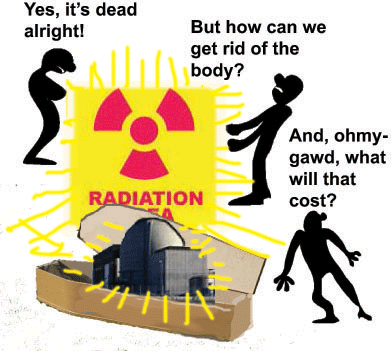 Nearly A Year After Shutdown, Vermont Yankee Continues To Spark Debate http://digital.vpr.net/post/nearly-year-after-shutdown-vermont-yankee-continues-spark-debate#stream/0By JANE LINDHOLM & SAM GALE ROSEN • OCT 12, 2015 Almost a year after its shutdown, the Vermont Yankee nuclear power plant is still sparking debate over safety, spending and the disposal of nuclear waste.
Vermont Edition spoke to Susan Smallheer, a reporter with theRutland Herald, about what’s been happening since the Vermont Yankee nuclear power plant shut down last December, as well as the back and forth between Entergy Corporation and the state of Vermont as mediated by the Nuclear Regulatory Commission.
On what’s currently happening at the plant
Entergy is putting a majority of buildings in what is called “safe and dark” mode, and demolishing minor buildings. Ultimately, they are preparing to transfer fuel from the spent pool into a facility that will begin construction in 2016.
“That will hold the spent nuclear from Vermont Yankee until the year 2052, when Entergy is expecting the Department of Energy to take away the fuel,” says Smallheer.
Uncertainties arise when discussing where this spent fuel will be held next. Vermont and Vermont Yankee have a contract with a Texas facility, owned privately by Waste Control Specialists, which holds a federal permit until 2045. According to filings that Entergy has made with the NRC, Vermont Yankee does not expect to begin deconstruction until 2068.
“Vermont Yankee has to be demolished, decommissioned and decontaminated before the waste can be shipped to Texas,” says Smallheer.
On how decommissioning funds are being spent
A point of contention for the state and Entergy is how Entergy Vermont Yankee is spending money from the decommissioning trust fund, which had reached approximately $660 million as of the shutdown.
“Now it’s down to about $600 million,” says Smallheer. “Yankee has made quite a few withdrawals with this so-called 30-day notification to the NRC, which is how the state of Vermont learns about it.”
The state claims that Entergy is not providing enough information on how these funds are being spent. “Vermont has a very vested interest in not only getting the plant decommissioned as quickly as possible, because Entergy said they’ll start decommissioning as long as there’s adequate funds in the decommissioning trust fund, but because whatever’s leftover goes back to Vermont ratepayers who started the fund,” says Smallheer.
“[The state] needs to know how [Entergy] is spending it, and if they can say it’s being spent wisely,” says Smallheer.
New York nuclear stations can’t afford costly shutdowns – so prolong decommissioning
 New York nuclear plants phase out, challengingly http://www.capitalnewyork.com/article/albany/2015/10/8579839/new-york-nuclear-plants-phase-out-challengingly One doesn’t have look hard in New York and throughout the region to see that the nuclear power industry has hit a rough patch.
The James FitzPatrick nuclear plant in Oswego County may be closing. The Ginna plant is on life support. Gov. Andrew Cuomo says he wants to close Indian Point.
Those closings and potential closings, combined with closure of Vermont Yankee in December and the announcement this month that Pilgrim in Massachusetts would be shuttered, herald what nuclear experts say is a denouement to the story of nuclear power in the United States.
“I would call it an organic phaseout,” said Mycle Schneider, a nuclear consultant based in Paris, during a conference at the New York Society for Ethical Culture on Thursday. “Nuclear’s position is threatened by a number of factors.”
Among those threats, he and others said, are the increasing costs of safely providing nuclear power, stagnant demand, a decrease in electricity use, and “ferocious competitors,” including natural gas and renewable power.
The question for state and federal regulators becomes how to safely and efficiently retire the nation’s nuclear fleet, a task infinitely more complex than getting rid of a typical power plant. Continue reading
Radioactive trash ship on its way to Australia, despite safety concerns
Ship carrying nuclear waste heads to Australia, West Australian CHERBOURG, AFP October 16, 2015 A ship carrying 25 tonnes of reprocessed nuclear waste is steaming to Australia despite protests from activists about an “environmental disaster waiting to happen”.
The BBC Shanghai left the northern French port of Cherbourg after approval from local officials, who carried out an inspection on Wednesday, and is due to arrive by the end of the year in NSW. It is laden with radioactive waste from spent nuclear fuel that Australia sent to France for reprocessing in four shipments in the 1990s and early 2000s, the Australian Nuclear Science and Technology Organisation says.
The reprocessing involves removing uranium, plutonium and other materials, with the remaining substances stabilised in glass and stored in a container…….
Greenpeace, French environmental campaign group Robin des Bois (Robin Hood) and a leading Greens MP have called for the shipment, sent by Areva, to be halted. “Areva, almost bankrupt, are using a dustbin ship to carry waste, without any serious inspection!” Denis Baupin a senior MP with the French green party, tweeted.
Greenpeace Australia Pacific said the ship, owned by German firm BBC Chartering, was an “environmental disaster waiting to happen”, claiming the Shanghai was “blacklisted by the United States because of its safety record”……
But Areva’s external relations director, Bernard Monnot, said the ship was “not banned from ports in the United States but banned from transporting material for the American government”.
Nathalie Geismar from Robin des Bois said other ports had found it had a “staggering number of flaws”……
ANSTO said the material would be kept at the Lucas Heights facility in southern Sydney until a nuclear waste dump site, which has yet to be chosen, is found and constructed……https://au.news.yahoo.com/thewest/a/29834316/ship-carrying-nuclear-waste-heads-to-australia/
Closure of Pilgrim nuclear station opens a new era of costly, dangerous, radioactive trash clean-up
Decommissioning Pilgrim could take decades, millions Boston Globe By Nestor Ramos and David Abel GLOBE STAFF OCTOBER 13, 2015 Shutting off the power at a nuclear plant takes only a few minutes. But decommissioning one — safely removing and storing dangerous radioactive material and closing down the plant for good — can take decades.
In announcing Tuesday that it planned to close the Pilgrim Nuclear Power Station, owner Entergy Corp. revealed few details about how it plans to decommission its aging plant in Plymouth, rated among the least safe in the country. But recent history at nuclear plants in New England and beyond suggests that the process could be long, contentious and cost hundreds of millions of dollars.
Entergy has 60 years to close the plant, according to Nuclear Regulatory Commission guidelines, and that clock may not even start running until 2019, the year by which the company plans to cease operations at Pilgrim. That means it could be 2079 before radioactivity is reduced to safe levels — the ultimate goal of decommissioning.
Company officials say Pilgrim shouldn’t take that long. “We don’t intend to wait until 60 years,” said Bill Mohl, president of Entergy Wholesale Commodities, which oversees most of its nuclear plants.
Still, decommissioning any nuclear power plant takes time. Giant industrial edifices such as the reactor, where the fuel generates heat that is converted to steam, would be difficult to dismantle even if they were not brittle and dangerously radioactive. Radioactive nuclear fuel must remain in storage pools for years after the plant has ceased to generate power.
And even after the fuel is stowed in giant canisters called dry casks, deciding where to store the nuclear waste is still tied up by debate in Washington, and remains years away.
“It’s going to take years in any event,” said Geoffrey Fettus, a senior attorney at the Natural Resources Defense Council. “It’s very complicated, very expensive industrial cleanup.” Continue reading
Burial of radioactive trash at San Onofre? NOT a good idea
Kelly Slater Weighs In on the State Decision to Bury Nuclear Waste at San Onofre, The Inertia,
OCTOBER 9, 2015 Kelly is pissed. And it’s with good reason. Despite widespread opposition, the California Coastal Commission approved on Tuesday the controversial plans to bury 2,700 steel castes of spent nuclear fuel in concrete bunkers 125 feet from the sea wall at San Onofre Beach. One proponent of the project claimed, “I wish that there were other options that were available now, but frankly I don’t see them.” Really? Burying them 125 feet from the water’s edge is the most viable solution? Kelly Slater thinks not:
So they’re planning on burying San-o’s nuclear waste at San-o for the next 20 years. Then what? They really gonna take it ‘away’? To where? At what point will we wake up before the fact and stop listening to people trying to sell Nuclear to the masses claiming it’s the safest and least expensive option? The endgame of this stuff is no joke. It won’t go away during our time on earth. We have the technology to move past this nowadays. Humans are a mess. What we leave in our wake is just a symptom of our ways of thinking. But now back to San onofre…thoughts?
Bill Alley, author of Too Hot to Touch, a book about the problems associated with storing nuclear waste, suggests that it would be much safer to transport the fuel to dry casks rather than leaving it in cooling ponds on site at San Onofre.
“The casks are fine for a couple of decades—certainly better than the pools,” Alley said. “But there’s no solution in the longer term, and that’s what really needs to be worked through.”
Alley and Slater touch on an important note: this is just a temporary solution to a much bigger problem. We must look beyond 20 years if we truly want to safeguard from another disastrous incident. After all, this is precisely the mentality that contributed to the most catastrophic oil and nuclear waste spills. Metal and concrete are NOT indestructible. Period……
With the daunting thought of “The Big One” looming in the minds of California residents, a quick, long-term solution is of the utmost importance. That is, unless we want a repeat of Fukishima, in which case the entire world should be concerned. Let’s do something about this and let’s do it now.

Germany says nuclear utilities can pay for decommissioning reactors
Germany Says Utilities’ Reserves Adequate for Nuclear-Power http://www.wsj.com/articles/germany-says-utilities-reserves-adequate-for-nuclear-power-exit-1444464002 Exit In wake of Fukushima, country plans to exit nuclear power by 2022 By STEFAN LANGE And MONICA HOUSTON-WAESCH Oct. 10, 2015 FRANKFURT—German utilities’ reserves for the country’s planned exit from nuclear power are adequate, the ministry for economics and energy said, citing a government-commissioned report on the matter.
“The affected companies have fully covered the costs with the designated provisions,” economics minister Sigmar Gabriel said in a statement.
The Federal Ministry of Economic Affairs and Energy had called for the stress test to determine whether utilities’ reserves are up to the task of financing nuclear waste and the decommissioning of plants. In the wake of the Fukushima disaster in 2011, Chancellor Angela Merkel said Germany would exit nuclear power by 2022, taking utilities by surprise. In the interim, politicians have voiced concern that nuclear operators could try to duck the long-term costs, leaving taxpayers with the bill.
Existing reserves for the country’s nuclear exit amount to €38.3 billion, the report said. In a worse-case scenario, costs could come to as much as €77 billion, however this assumes an average interest rate of a negative 1.6% until the year 2099, a highly unlikely event, the report noted.
Utilities have said that since the government supported the construction of nuclear facilities, it should also participate in dismantling them. Earlier this month, the economics ministry dashed those hopes.
“There will be no state assistance,” a ministry spokeswoman said on Oct. 5.
Separately, Germany’s cabinet is due to pass a draft law within days, giving utilities longer-lasting liabilities for the costs of a nuclear exit. In mid-September, shares of RWE AG and E.ON SE, the two largest utilities in the country, plummeted over 10% amid speculation that initial results of the test showed utilities’ reserves were inadequate. At the time, Mr. Gabriel said no preliminary results were available, and that the stress test was just one factor of many in determining future policy.
At the end of 2014, E.ON had earmarked €16.6 billion, while RWE set aside €10.4 billion in reserves for the nuclear exit.
“In real terms, these are the highest provisions for an asset like this on the planet,” E.ON chief executive Johannes Teyssen said in September following his company’s decision to retain its German nuclear operations. E.ON has three nuclear plants in operation and minority stakes in a number of others.
Mr. Teyssen made the comments after the company scrapped plans to shift its nuclear operations to a new company, Uniper. E.ON will proceed with plans to split, moving conventional power, trading and exploration and production to Uniper, but E.ON will keep its German nuclear operations, it said. At the time, the company also said it expected a substantial net loss for the full year.
Write to Stefan Lange at stefan.lange@wsj.com and Monica Houston-Waesch at nikki.houston@wsj.com
1 This Month



9 September – online public forum THREE MILE ISLAND:
7-8:30 PM ET,
Legacy, resistance to reopening – https://us02web.zoom.us/webinar/register/WN_-LGJU4j6TD2Hgf0rpgAr1A#/registration
The nuclear industry and the U.S. Nuclear Regulatory Commission are threatening to restart Pennsylvania’s permanently closed and decommissioning Three Mile Island Unit 1 nuclear power station. Three expert speakers will present the resistance to this dangerous misadventure in a webinar hosted by the Clamshell Alliance, Beyond Nuclear and Massachusetts Peace Action.

No Nuclear in Cwm Llynfi! Stop the nuclear power station near Maesteg.
To see nuclear-related stories in greater depth and intensity – go to https://nuclearinformation.wordpress.com
-
Archives
- September 2026 (104)
- August 2026 (330)
- July 2026 (355)
- June 2026 (287)
- May 2026 (306)
- April 2026 (356)
- March 2026 (251)
- February 2026 (267)
- January 2026 (308)
- December 2025 (358)
- November 2025 (359)
- October 2025 (375)
-
Categories
- 1
- 1 NUCLEAR ISSUES
- business and costs
- climate change
- culture and arts
- ENERGY
- environment
- health
- history
- indigenous issues
- Legal
- marketing of nuclear
- media
- opposition to nuclear
- PERSONAL STORIES
- politics
- politics international
- Religion and ethics
- safety
- secrets,lies and civil liberties
- spinbuster
- technology
- Uranium
- wastes
- weapons and war
- Women
- 2 WORLD
- ACTION
- AFRICA
- Atrocities
- AUSTRALIA
- Christina's notes
- Christina's themes
- culture and arts
- Events
- Fuk 2022
- Fuk 2023
- Fukushima 2017
- Fukushima 2018
- fukushima 2019
- Fukushima 2020
- Fukushima 2021
- general
- global warming
- Humour (God we need it)
- Nuclear
- RARE EARTHS
- Reference
- resources – print
- Resources -audiovicual
- Weekly Newsletter
- World
- World Nuclear
- YouTube
-
RSS
Entries RSS
Comments RSS
 nuclear-news