Spent nuclear fuel staying put near closed San Onofre nuclear power station
 Where is the San Onofre nuclear waste going? Spent fuel staying put for now, San Diego Union Tribune By Rob Nikolewski March 25, 2016 Some 3.6 million pounds of nuclear waste is stored at the now-shuttered San Onofre Nuclear Generating Station (SONGS) but when the waste will be transferred and where it will end up are still very open questions.
“I think everyone can agree we want to get the spent fuel off the San Onofre site sooner rather than later,” said Garry Brown, executive director and CEO of the nonprofit clean water organization Orange County Coastkeeper, Thursday night at the quarterly meeting of the Community Engagement Panel.
After the California Coastal Commission approved a site permit last October, a plan was approved to bury the waste in concrete casks within 125 feet of a seawall and the beach on a low-lying plain at the plant operated by Southern California Edison.
“We need to de-energize the plant as soon as we can,” Tom Palmisano, chief nuclear officer at Southern California Edison, told the 18-member panel during a Powerpoint presentation in Oceanside.
The prospect of casks on site has generated plenty of opposition. “We may never be able to move these,” said Gary Headrick, co-founder of San Clemente Green. “These storage containers are not reliable.”….
Among the problems is the near-paralysis on the part of the federal government to permanently deal with nuclear waste……..http://www.sandiegouniontribune.com/news/2016/mar/25/songs-nuclear-waste/
Vulnerability of San Onofre’s nuclear wastes

 Concerns over nuclear waste stored at San Onofre http://www.cbs8.com/story/31565017/concerns-over-nuclear-waste-stored-at-san-onofrePosted: Mar 26, 2016 SAN DIEGO (CBS 8) – North County residents voice their concerns over the plan to store nuclear waste at the former San Onofre power plant Thursday.
The troubled plant closed four years ago, but the spent fuel could be there for much longer.The process of decommissioning it is expected to be complete by the year 2030.
Some say it’s a plan that has sparked concern over the public safety.
“This nuclear waste at this site is as vulnerable a target as you can possibly have for the terrorist to attack us here,” Mike Aguirre, San Diego Attorney said.
Representatives from Southern California Edison countered that the stored fuel would not be a vulnerable target.
“We have a well-trained security force, reviewed and approved by the NRC to meet, what they consider the credible threats that we need to meet,” Thomas Palmisano said.
The Department of Energy has made a push to create temporary storage sites in west Texas and New Mexico. If the plan gets the green light, it could expedite the removal of nuclear waste from San Onofre.
America’s nationwide problem of nuclear wastes, and Edison’s experimental Holtec solution
 O.C. Watchdog: Could there be an ‘early’ nuclear cleanup at San Onofre? Orange County Register, By TERI SFORZA / March 23, 2016 “…….NATIONWIDE PROBLEM Some 72,000 metric tons of highly radioactive waste has piled up at 75 commercial reactor sites in America over the past half-century, according to a recent review by the U.S. Government Accountability Office.
That’s not how it was supposed to be.
To encourage the development of nuclear power, the federal government passed the Nuclear Waste Policy Act of 1982, promising to accept and dispose of spent fuel and high-level waste by Jan. 31, 1998.
Utilities operating nuclear power plants made payments into a Nuclear Waste Fund to pay for disposal.
About $750 million a year was collected from ratepayers, and the disposal program’s funding grew to $41 billion over three decades. But the federal government never accepted any commercial nuclear waste for permanent disposal.
The nuclear industry sued, and a federal judge found that the U.S. Department of Energy couldn’t continue charging for a service it not only wasn’t providing, but wouldn’t provide for many decades. In 2014, utilities stopped collecting the charge – about 20 cents a month on the average electric bill. After the government spent $10 billion on a now-abandoned plan to create a permanent disposal site at Nevada’s Yucca Mountain, about $30 billion remains in the fund, earning about $1 billion in interest a year.
Local governments, including San Clemente, Laguna Beach, Oceanside, Encinitas and San Diego County, are pressing Washington to fulfill its obligations.
“We all want it gone,” said San Clemente City Councilman Tim Brown last month.
BREAKTHROUGH?
Edison agrees.
“We are very much in alignment with our nearby communities, which are making efforts to get the nuclear fuel moved off-site to another location,” said Maureen Brown, Edison spokeswoman. “Before it can be moved off-site, though, it has to be in a dry storage canister for transport. We are continuing with preparations to expand dry storage and get all the fuel out of the spent fuel pools.”
That’s supposed to be done by 2019. Edison has chosen Holtec International’s Hi-Storm Umax underground system for dry storage. The fuel is expected to remain in an “underground monolith” on-site through 2049, when Edison assumes the federal government will take custody of all spent nuclear fuel.)
The Department of Energy will begin public meetings on the new push for interim storage sites on Tuesday in Chicago.A second hearing is scheduled in Atlanta on April 11 and a third in Sacramento on April 26.
“(W)e in the communities surrounding SONGS have a keen interest in removing the spent fuel from the site,” Victor wrote in a recent memo to the Community Engagement Panel. “As the option of Yucca Mountain has stalled, spent fuel has been backing up at sites around the country with no place for permanent disposal. The idea of consolidated interim storage (CIS) could be a solution.
San Onofre’s storage system will be part of a real-time experiment, as Edison partners with the Electric Power Research Institute to develop inspection techniques to monitor casks as they age.
No entity has previously done what Edison is planning – burying this kind of spent fuel in dry casks for decades. Critics have raised concerns about the ability of the casks to withstand the heat of the fuel over time.
Some don’t think temporary storage is the answer.
“If such a site were ever built, it would be a disaster for the hosting community,” said activist Ace Hoffman of Carlsbad. “DOE calls it ‘consent-based,’ but how can future generations that will have to deal with the mess give their consent? And why on earth would they?
“DOE calls it ‘interim,’ but what exactly that means has never been defined, except to mean ‘until a permanent repository opens up somewhere.’ Who’s going to fall for that line?” http://www.ocregister.com/articles/fuel-709466-nuclear-san.html
Nuclear dump plan for Chernobyl area
 Area around Chernobyl plant to become a nuclear dump KYODO HTTP://WWW.JAPANTIMES.CO.JP/NEWS/2016/03/24/WORLD/AREA-AROUND-CHERNOBYL-PLANT-BECOME-NUCLEAR-DUMP/#.VVRVA9J97GH KIEV – A heavily contaminated area within a 10-kilometer radius of the Chernobyl nuclear power plant in Ukraine will be used to store nuclear waste materials, the chief of a state agency managing the wider exclusion zone said in an interview.
“People cannot live in the land seriously contaminated for another 500 years, so we are planning to make it into an industrial complex,” said Vitalii Petruk, the head of the State Agency of Ukraine on Exclusion Zone Management. The zone is 30-km radius from the site of the 1986 nuclear accident — the world’s worst nuclear disaster.
“We are thinking of making land that is less contaminated a buffer zone to protect a residential area from radioactive materials,” he said.
Petruk said the agency does not plan to narrow down the exclusion zone because there is no privately owned land within the area and few people are wishing to return, unlike Fukushima, home to the 2011 nuclear disaster in Japan.
The complex will be used to store and process nuclear waste including spent nuclear fuel sent from power plants in Ukraine, he said.
“We are considering building a facility for alternative energy such as solar panels” so as to utilize the remaining electricity infrastructure including power grids for the Chernobyl nuclear power plant there, he added.
Petruk said the agency also wants to invite foreign companies to the complex. “We will ensure the maximum safety” to help their activities in the complex, he said.
As for the future dismantlement of the Chernobyl plant, Petruk said his country has been in talks with France for some two years about possible cooperation and it also wants to consider talks with Japan.
Scepticism on San Onofre nuclear station cleanup plan
O.C. Watchdog: Could there be an ‘early’ nuclear cleanup at San Onofre? Orange County Register, By TERI SFORZA / March 23, 2016 Federal efforts to speed up the removal of spent radioactive fuel from power plants like the mothballed San Onofre Nuclear Generating Station are gaining momentum and inspiring guarded optimism among local officials.
Critics, however, remain deeply skeptical.
In January, the U.S. Department of Energy launched a new push to create temporary nuclear waste storage sites in regions eager for the business, currently in West Texas and New Mexico.
Several such sites could be up and running while the prickly question of finding a location for a permanent repository – the root of the present paralysis in nuclear waste disposal – is hashed out.
“That could mean moving the fuel from San Onofre a decade earlier than is envisioned now, maybe more,” said David Victor, who chairs the San Onofre Community Engagement Panel. The volunteer group of academic, industry, environmental and local government representatives advises the plant’s owner, Southern California Edison.
“I am cautiously optimistic,” he said. Victor, director of the Laboratory on International Law and Regulation at UC San Diego, met with officials in Washington this month to convey populous Southern California’s eagerness to solve the nuclear waste storage problem. An update on those efforts, as well as the latest on plans to dismantle the shuttered twin reactors, will be presented at 6 p.m. today at the San Onofre Community Engagement Panel’s quarterly meeting in Oceanside.
Decommissioning the plant south of San Clemente is expected to cost $4.1 billion and be mostly completed by 2030. But spent nuclear fuel is expected to remain on the beachside bluff much longer………… http://www.ocregister.com/articles/fuel-709466-nuclear-san.html
South Carolina does not want to be the world’s nuclear waste dump
 “We strongly object to foreign-origin plutonium coming into South Carolina
over the next seven years we will continue to see dangerous shipments of nuclear waste routed through Charleston harbor
More Nuclear Dumping In South Carolina, FITSNEWS, 22 Mar 16 “……This week, nuclear shipments to the Palmetto State are back in the news – specifically the latest round of foreign plutonium slated to arrive in South Carolina from Japan.
That’s right: South Carolina is no longer the nation’s dumping ground … we are taking toxic waste from all over the world.
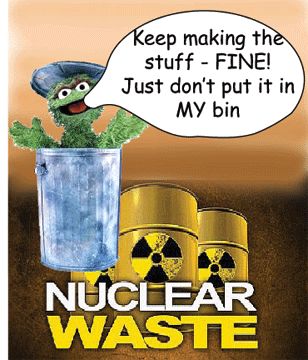 Foreign waste has been shipped to SRS for years – but the latest scheduled arrival in Charleston Harbor this month has finally sparked some criticism from nuclear watchdogs. “We strongly object to foreign-origin plutonium coming into South Carolina when DOE’s program to manage surplus weapons plutonium is in shambles,” said Tom Clements, director of Savannah River Site Watch. “As DOE’s plutonium fuel project has totally failed, it’s time for DOE to live up to its commitment to remove plutonium from South Carolina and not bring in more with no viable disposition path out of the state.”…..
The Japanese shipment – an estimated 331 kilograms of highly fissionable material – is reportedly being transported by British warships to Charleston harbor later this month. Its arrival and subsequent transfer to SRS is a matter of intense speculation and secrecy.
Why are we taking Japan’s plutonium? So terrorists don’t steal it, according to the feds …
In fact we reached out to the S.C. State Ports Authority (SCSPA) seeking information about the shipment, but the agency’s leadership told us it had “no idea” about the details.
S.C. governor Nikki Haley has merely stated that she wants the twelve metric tons of plutonium on-site at SRS to be processed prior to new waste arriving. She’s threatened lawsuits to that effect, too……….
over the next seven years we will continue to see dangerous shipments of nuclear waste routed through Charleston harbor en route to SRS with absolutely nothing resembling a long-term disposal agreement in place.
DOE recently indicated its intention to send six metric tons of stored plutonium from SRS to a facility in New Mexico, but this transfer is nothing but further confirmation of the abandonment of the MOX program – which was subsidizing an estimated 2,100 South Carolina jobs………..http://www.fitsnews.com/2016/03/22/more-nuclear-dumping-in-sc/
South Australia’s Nuclear Royal Commission grossly exaggerates benefits of nuclear waste dump
 Economic benefits of nuclear dump exaggerated: report, INDAILY, 22 Mar 16
The multi-billion dollar benefits of establishing a local nuclear waste dump were grossly exaggerated in last month’s royal commission tentative findings, according to a response by the Australia Institute released today……..
The report argues the primary beneficiaries of a nuclear storage industry would not be South Australian taxpayers, but “companies involved in the international nuclear industry, [which] are anxious to reduce financing and other costs, as nuclear power is already uncompetitive with most other generation technologies”.
The Australia Institute is scathing about the methodology of consultancy firm by Jacobs MCM, which provided the data underpinning Scarce’s conclusions.
“Jacobs assume that some 37 countries could send waste to Australia [but] many of these countries are yet to develop nuclear programs, have their own storage options, or have contractual obligations to other countries,” the report argues, adding that the much-cited potential economic benefits to SA “such as over $5 billion per year in revenue… should be closely questioned and have not received adequate scrutiny from the Royal Commission so far”.
“There is no data on the prices that the South Australian proposals might attract [and] estimating the price that environmental externalities might attract in such a market is notoriously difficult,” it says.
Denniss told InDaily: “When it comes to economic modeling it’s always the same: garbage in – garbage out.”
“If the assumptions are wrong, then the conclusions are wrong, and the Jacobs report has a very optimistic assumption for the price that other countries will be willing to pay for storage of nuclear waste,” he said.
“They’re very optimistic about the number of countries that will want to pay for this service and they’re very optimistic about the future of the nuclear industry as a whole, where many people think renewable energy will get cheaper and cheaper and displace the existing nuclear energy industry.
“If any of those assumptions are optimistic, the business base for the dump is exaggerated.”
Deniss argues that “if any other industry said ‘start building us $145 billion worth of infrastructure, it will take 120 years to finish, we’ll start paying you in 10 years, trust us’, they’d be laughed out of town”.
“This proposal is about SA taxpayers picking up the tab to help nuclear companies out of the economic hole they’re in,” he said.
He argues the business case is also predicated on “cheap, above-ground storage… for nearly a century before it’s all ultimately, expensively put underground”.
“But if this project goes belly-up halfway through, SA will be left with all the waste and none of the future revenues,” he said……….
“We’re always vocal opponents of people who use exaggerated economic claims to sell projects that would otherwise be unpopular,” Denniss said today of the institute’s anti-nuclear stance.
“Not many South Australians have a long-term desire to have a nuclear waste dump, but some of them believe if the state can make a lot of money out of it, maybe it’s worth doing… the problem is reports like the Jacobs report exaggerate the likely benefits to SA, while minimising debate about the very real economic and environmental and human risks of having a high-level nuclear waste dump.”
Conservation Council SA chief Craig Wilkins – a former adviser to Parnell who has also held a briefing for Key’s Ashford sub-branch – again seized on the Australia Institute’s research today, saying it “confirms what many South Australians suspect – the dump proposal being pushed by the Royal Commission seems way too good to be true”.
“The big question is: if it such as good deal, then why aren’t other countries rushing to do it?” he said.
“Something just doesn’t add up.”…….
UniSA economist and InDaily columnist Richard Blandy – who has also written against the economic imperative for a waste dump – joined Denniss at a media conference at the Grosvenor Hotel this morning. By chance, over the road in parliament, the Government was introducing legislative changes to allow unfettered debate about the establishment of a nuclear storage facility. http://indaily.com.au/news/2016/03/22/economic-benefits-of-nuclear-dump-exaggerated-report/
Problems of decommissioning nuclear reactors
Commentary on report: The Nationwide Failures of Decommissioning Regulation: Decommissioning Trust Funds or Slush Funds?
Fairewinds Energy Education DOWNLOAD THE REPORT
MiningAwareness, 24 Mar 16 After so many years rats can set up and spread contamination. However, where will they be decommissioned to? While the rats are a problem, letting the reactors sit up does actually allow some of it to become less radioactive. Some period of letting it sit up also allows time for a real solution, if there is any outside of a 24/7 monitored bunker.
A few years would allow construction of such a facility. Certainly Vermont is happy to send its large nuclear parts to sit outside and be buried at the Clive facility in Utah or West Texas.
Who wouldn’t be happy to get shot of this lethal waste? Eventually it’s going to come back up from its burial ground and land on the eastern states too. To be fair I haven’t read this document. However, I think that Vermont’s “waste pact” is with west Texas, WCS (Waste Control Specialists).
Although Vermont may not be suitable for radioactive waste due to rain, west Texas is unsuitable due to heat and alternating rain and dry spells, in conjunction with burial in concrete lined clay. Plus it’s hard to see the fairness in this, except there is a good chance that the rain out following the inevitable explosion at WCS will be over Vermont. Burial of waste is unacceptable everywhere. And, that’s what they do at WCS and Clive.
It’s easy to see people in the eastern US think that what happens out west has nothing to do with them, but weapons testing proved otherwise. Interestingly, if German nuclear waste is buried in South Carolina, rather than further west, Germany may be more impacted by the inevitable explosion than the US. Certainly Europe may be. But, like Europe’s unwanted people, the movement of the waste will be gradually westward.
USA’s failure of f Decommissioning Regulation: are these trust funds really slush funds?

 The Nationwide Failures of Decommissioning Regulation: Decommissioning Trust Funds or Slush Funds? http://www.fairewinds.org/nuclear-energy-education//03tj9289ut746v9sb3cbkrhfzqgtdzFairewinds Energy Education has submitted a new decommissioning report entitled: The Nationwide Failures of Decommissioning Regulation: Decommissioning Trust Funds or Slush Funds? to the Nuclear Regulatory Commission (NRC). Research was funded by a Lintilhac Foundation Grant. First submitted a year ago, the report evaluates utility owner Entergy’s plan to use the NRC sanctioned SAFSTOR process to decommission Vermont Yankee.
Developed by the NRC, SAFSTOR is a subsidy that benefits nuclear power plant owners like Entergy by providing them with a 60-year window to decommission nuclear plants. With an increasing number of aging atomic power plants shutting down in the United States, Fairewinds’ report is an ongoing case study of the decommissioning process at Vermont Yankee where nuclear energy corporations have been allowed by the NRC to raid decommissioning funds procured by ratepayers like you and me. From unregulated withdrawals of funds, a 60-year timeline with no basis in science, to zero responsibility in regards to emergency planning, it’s clear that NRC regulations are benefitting corporations and not the public.
The Nationwide Failures of Decommisioning Regulation: Decommisioning Trust Funds or Slush Funds?, Comments Submitted to the Nuclear Regulatory Commission
March 17, 2016, Fairewinds Energy Education
Armed UK vessels secretly take weapons grade plutonium from Japan to USA
The Pacific Egret and its escort ship Pacific Heron are reportedly lightly armed UK flagged vessels and arrived in Kobe port from Barrow-in-Furness, England on March 4th. The Egret docked in Tokai for pre-transport logistics last week. Both ships after departing Tokai port will sail together most likely through the South Pacific to the east coast of the United States.
NPT and Nuclear Security Risks’ Exposed by Secret Plutonium Shipment: NGOs, March 18, 2016 Tokyo- (PanOrient News) A coalition of five non-governmental organizations warned today that a shipment of weapons-grade plutonium scheduled to
depart the port of the Japanese Tokai nuclear station in Ibaraki prefecture this coming weekend highlights the failure, but also the proliferation risks, of the current Japanese nuclear policy.
A cargo of 331kg of plutonium will be loaded on to the Pacific Egret, an armed British nuclear transport ship, prior to departure under armed escort to the United States. It will be the largest shipment of separated plutonium since 1.8 tons of plutonium was delivered to Japan by controversial Akatsuki-maru in 1992. The two month voyage to the Joint Base Charleston-Weapons Station will then see the plutonium dumped at the Department of Energy Savannah River Site (SRS) in South Carolina. The U.S. National Nuclear Security Administration, which is responsible for the shipment, has identified that storage in Japan poses a security risk justifying its removal.
The organizations, Citizen Nuclear Information Center (Japan); Green Action (Japan); Savannah River Site Watch (U.S.); CORE (England), and Greenpeace, said in a statement they condemn the shipment as a dangerous distraction from the major problem in Japan which is its overall nuclear energy policy, where over 9 tons of plutonium remains stockpiled and there are plans to produce many tons more during the coming decade. The representatives of the five organizations have worked together over the past quarter century against Japan`s plutonium and nuclear fuel cycle program.
For the U.S. and Japanese government, the Tokai shipment will be mistakenly hailed as demonstrating their commitment to reducing the threat from fissile materials, the statement noted. Both Prime Minister Abe and President Obama plan to announce the ‘success’ of the removal from Japan, at the fourth Nuclear Security Summit from March 31st -April 1st in Washington, D.C., while Japan will be desperate to avoid any discussion of the proliferation and security threat posed by its plutonium fuel cycle program.
“If 331 kg of plutonium warrants removal from Japan on the grounds of its vulnerability and in the interests of securing nuclear weapons material, then there is no credible justification for Japan’s current program and future plans to increase its plutonium stockpiling. Hailing a shipment of hundreds of kilograms of plutonium as a triumph for nuclear security, while ignoring over 9 tons of the weapons material stockpiled in Japan and in a region of rising tensions, is not just a failure of nuclear non proliferation and security policy but a dangerous delusion,” said Shaun Burnie, senior nuclear specialist at Greenpeace Germany, who is currently in Japan. ……..
Failure of Japanese nuclear reprocessing plan. What to do with all that plutonium?
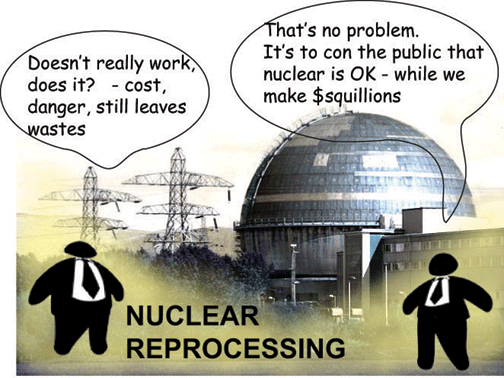 Two reactors, Takahama 3 and 4, owned by Kansai Electric, began operation in January and February 2016 loaded with plutonium MOX fuel, with unit 3 operating with 24 assemblies containing 1,088kg of plutonium and unit 4 with 4 assemblies containing 184kg of plutonium. Unit 4 shutdown due to an electrical failure three days after start up, while unit 3 was forced to shutdown on March 10th following a court order. Both reactors remain shutdown and are subject of a court injunction preventing operation issued by the Otsu district court, Shiga prefecture on March 9th. They are expected to be non operational for many months. Of the 26 reactors under review by the Nuclear Regulation Authority (NRA), Ikata-3, Genkai-3 and Tomari-3 are all intended to operate with plutonium MOX fuel.
“On current plans, and if ever the Rokkasho-mura reprocessing plant begins operation, Japan`s program could yield as much as 93,000kg by 2025 – most of which will remain unused. The reactor program in Japan is in crisis with no credible program for either restarting most reactors or using large amounts of this plutonium. If ever there was a time to abandon its current doomed nuclear energy policy, it is now. The Obama administration in its last year has an opportunity to step up and actively reduce the spiraling proliferation dynamic in East Asia – this should be top of the agenda in Washington instead of being ignored. The next step is to challenge the basis of the U.S.-Japan nuclear cooperation agreement which runs to 2018 – approval for Japan to continue acquiring plutonium must be reversed,” said Burnie.
South Australian Aborigines strongly resist plans for international nuclear waste importing
18 Mar 16 Traditional Owners and members of the Aboriginal-led Australian Nuclear Free Alliance (ANFA) have today reaffirmed their opposition to the suggestion that South Australia should host a high level international nuclear waste dump. This announcement comes as the submission period closes for comments on the tentative findings of South Australian Nuclear Fuel Cycle Royal Commission
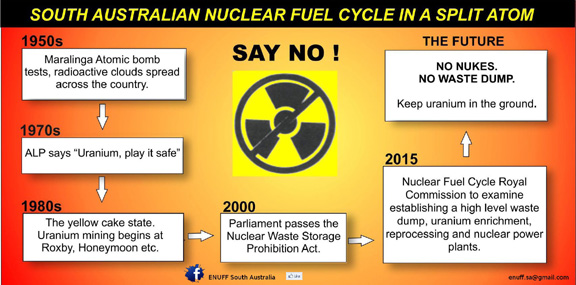
A major recommendation of the Commission to date has been that South Australia could host an international waste storage and disposal facility. This suggestion is strongly rejected by Aboriginal people across the state because of the risks posed to country and culture. Several Aboriginal communities throughout South Australia live with the negative impacts of the nuclear industry through uranium mining and nuclear weapons testing and are committed to resisting any further nuclear proposals.
“We have long memories; we remember the atomic weapons tests at Maralinga and Emu Fields and the ongoing denial around the lost lives and health impacts for Aboriginal people. We don’t want any nuclear projects here in South Australia and we won’t become the world’s nuclear waste dump,” said Arabunna elder and Australian Nuclear Free Alliance president Kevin Buzzacott.
Enice Marsh, senior Adnyamathanha woman and Australian Nuclear Free Alliance member said:
“Any kind of radioactive waste dump would put our groundwater at risk. Groundwater is about survival; we don’t want to be faced with another huge risk like this.”
Sue Coleman-Haseldine is a Kokatha-Mula woman and co-chair of the Australian Nuclear Free Alliance. She has recently travelled to Vienna to share her family’s experience with the nuclear industry: “They’ve poisoned us once and there’s no way in the world they’re going to do it again.”
“This problem doesn’t stop at South Australia’s border, there is nowhere that should be designated an international waste dump,” Ms Coleman-Haseldine concluded.
Plutonium and ” fourth generation nuclear power”
Bill Gates’ Nuclear Pipe Dream: Convert Depleted Uranium to Plutonium to Power Earth for Centuries, Truth Out Tuesday, 15 March 2016 By Josh Cunnings and Emerson Urry, EnviroNews | Video Report Cunnings: “………..EnviroNews Editor-in-Chief Emerson Urry chatted with the esteemed nuclear industry expert and whistleblower Arnie Gundersen to explore whether Gates’ plan is a good idea or not.
 Emerson Urry: Let’s go back to Bill Gates again, [and] the fourth generation nuclear power. I’ve heard him out there speaking about this, and essentially his ambition to, let’s say, convert Paducah, Kentucky [to plutonium]. What can you tell us about Paducah, Kentucky? We understand it went bankrupt a couple years back, and I think there is quite a bit of radioactive material still there. We’ve heard at one point in time it was also one of the world’s largest greenhouse gas emitters from the Freon — not to mention having four allocated coal-fired power plants. What can you tell us about Paducah, Kentucky? What does the situation on the ground look like there, and how do you think they will deal with all that?
Arnie Gundersen: Paducah didn’t have centrifuges, it had gaseous diffusion, and there’s no need for the plant anymore, so the plant has to be decommissioned and destroyed. What’s happened is, the way they shut the plant down was, to be nice, sub-optimal. And what they allowed it to do was for all that uranium to cake inside the pipes. So, had they done it in a more orderly fashion, the plant could have been much cleaner when they went to shut it down — but they didn’t. So, the Paducah site is a very expensive cleanup that is going to take 20 or 30 years to decontaminate. You know, it’s like all of these bomb legacy sites — Hanford in Washington State…
Urry: … that has the plutonium leak in AY-102 correct? Which has that been ratcheted down? Have they been able to ratchet down AY-102?
Gundersen: No. Hanford is going to take 70 years and cost 110 billion dollars to clean up. So, here we are paying over half of a century for the legacy of building bombs for five years in 1940. And so, Paducah is another one of those sites. It was built to enrich uranium. Why did we do that? Because we had a bomb program. And now we’re stuck with these huge costs that are underfunded or unfunded by Congress. That plant is going to sit there for 30 years. It will create a lot of employment for a lot of people knocking it down, but it also is highly radioactive, and it’s got to be done so cautiously, and it’s a really difficult problem.
Cunnings: There’s no known disintegration of plutonium small enough that doesn’t possess the ability to cause cancer. To be clear, there is no safe amount to be exposed to whatsoever.
Plutonium, though a naturally occurring element was virtually non-existent on planet earth before the dawn of the nuclear age. Now, each of the roughly 400 uranium-powered nuclear reactors in the world create approximately 500 pounds of plutonium each year — or enough to create about 100 nuclear warheads each.
Coming from a “humanitarian” concerned with curing diseases, the notion that plutonium is the way to save ourselves from a runaway climate catastrophe seems the epitome of oxymoronic — utterly and woefully contradictory. But stay tuned for more on that topic, as in episode 14 of this series we examine whether or not we really need nuclear to solve the climate quandary.
But, in the meanwhile, let’s just say that Bill Gates’ nuclear ambitions go beyond mere ideas. He actually possesses financial holdings in one very dangerous situation indeed — a situation that is presently causing residents around St. Louis, Missouri to live under an all-out nuclear nightmare. And that scenario will be the topic of discussion in the next episode of our short series.
So please, tune in tomorrow for part three, where we explore the scary situation at hand in the Westlake Landfill in St. Louis, Missouri. Signing off for now, this is Josh Cunnings…… http://www.truth-out.org/news/item/35229-bill-gates-nuclear-pipe-dream-convert-mountains-of-depleted-uranium-to-plutonium-to-power-earth-for-centuries
Hanford Nuclear Reservation ordered by federal judge to comply with new deadlines for nuclear waste clean-up
 Federal judge sets new deadlines for nuclear waste cleanup at Hanford http://www.bendbulletin.com/localstate/4113014-151/federal-judge-sets-new-deadlines-for-nuclear-waste# The Associated Press /Mar 13, 2016 SPOKANE, Wash. — A federal judge has set new deadlines for cleaning up nuclear waste at the Hanford Nuclear Reservation after Washington state went to court to prod the U.S. Department of Energy over the flagging efforts.
U.S. District Judge Rosanna Malouf Peterson issued the new deadlines in a 102-page order late Friday. Among them: A plant designed to treat low-activity radioactive waste must begin operating by 2022, and a plant to convert the most dangerous waste into glass for burial must be fully operating by 2036.
Washington and Oregon sued the U.S. Energy Department nearly a decade ago over missed cleanup deadlines, and after a settlement, Washington went back to court in 2014, leading to the judge’s order Friday.
Peterson criticized the Energy Department for what she described as a “total lack of transparency” as to the delays. She said that if the department had kept the states better apprised of the status of the cleanup efforts, the states could have sought further funding from Congress to help avert delays.
“The passage of time and the urgency of waste clean-up are inextricablylinked: the longer that DOE takes to satisfy its obligations under the Consent Decree the greater the likelihood of irreversible damage to the environment,” the judge wrote. “No party can ‘win’ this litigation. The public and environment only can ‘lose’ as more time passes without an operational solution to the radioactive waste problems at the Hanford Site.”
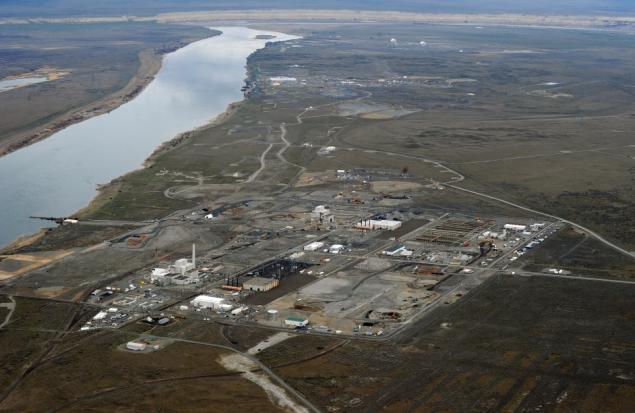
The government used the Hanford site during World War II and the Cold War to produce plutonium for nuclear weapons. Hanford’s 586 square miles house over 50 million gallons of nuclear waste in 177 underground tanks, many of which are leaking.
Washington Gov. Jay Inslee and Attorney General Bob Ferguson welcomed the court’s ruling, which they said Saturday will hold federal authorities accountable for the cleanup and which set firmer deadlines than the Energy Department wanted.
“Cleaning up the legacy waste at Hanford is the federal government’s legal and moral responsibility to the Tri-Cities community and the Pacific Northwest,” Inslee said. “I have been repeatedly frustrated by the delays and lack of progress toward meeting key milestones in waste cleanup and treatment. We cannot consider any further delays, and I am pleased that the court clearly agrees.”
One day before Washington deadline Workers begin removing nuclear waste from leaking Hanford tank
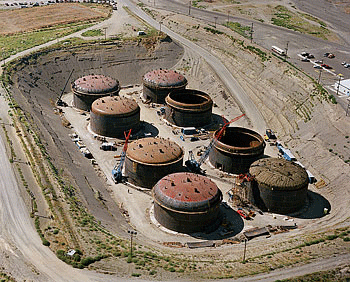 Workers begin removing nuclear waste from leaking Hanford tank http://www.seattletimes.com/seattle-news/workers-begin-removing-nuclear-waste-from-leaking-hanford-tank/ March 4, 2016 Workers have started removing nuclear waste from a leaking tank at the Hanford Site just one day before a state of Washington deadline. By Seattle Times staff The Associated Press KENNEWICK, Wash. — Workers have started removing nuclear waste from a leaking tank at the Hanford Site just one day before a state of Washington deadline.
The Tri-City Herald reports that Hanford workers began pumping waste from the nuclear reservation’s oldest double-shell tank Thursday afternoon.
The tank contains about 150,000 gallons of radioactive sludge covered by about 650,000 gallons of liquid waste. The liquid could be removed by early next week if things go smoothly, but removing the sludge is more complicated.
The Washington Department of Ecology had ordered the U.S. Department of Energy and its contractor Washington River Protection Solutions to begin emptying the waste by March 4 and finish the work within a year.
1 This Month


31st January – Challenging the War Machine – a DECLASSIFIED UK SUMMIT


Website of the Week
Now until to February 10, 2026 Radioactive waste storage in France: the debate is finally open! How to participate?
-
Archives
- January 2026 (227)
- December 2025 (358)
- November 2025 (359)
- October 2025 (377)
- September 2025 (258)
- August 2025 (319)
- July 2025 (230)
- June 2025 (348)
- May 2025 (261)
- April 2025 (305)
- March 2025 (319)
- February 2025 (234)
-
Categories
- 1
- 1 NUCLEAR ISSUES
- business and costs
- climate change
- culture and arts
- ENERGY
- environment
- health
- history
- indigenous issues
- Legal
- marketing of nuclear
- media
- opposition to nuclear
- PERSONAL STORIES
- politics
- politics international
- Religion and ethics
- safety
- secrets,lies and civil liberties
- spinbuster
- technology
- Uranium
- wastes
- weapons and war
- Women
- 2 WORLD
- ACTION
- AFRICA
- Atrocities
- AUSTRALIA
- Christina's notes
- Christina's themes
- culture and arts
- Events
- Fuk 2022
- Fuk 2023
- Fukushima 2017
- Fukushima 2018
- fukushima 2019
- Fukushima 2020
- Fukushima 2021
- general
- global warming
- Humour (God we need it)
- Nuclear
- RARE EARTHS
- Reference
- resources – print
- Resources -audiovicual
- Weekly Newsletter
- World
- World Nuclear
- YouTube
-
RSS
Entries RSS
Comments RSS
 nuclear-news