France’s nuclear corporation faces massive costs for decommissioning nuclear reactors
Nuclear reactor clean-up weighs on EDF, FT.com, 19 Apr 16, Michael Stothard in Paris French utility faces questions about whether it has set aside enough to decommission power plants
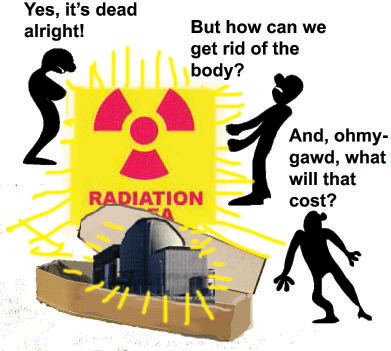 In 1997 French utility EDF started to dismantle its first nuclear power plant, a 30-year-old heavy water reactor in Brennilis, north-western France. It was expected to cost €250m.
The bill is now set to be at least half as much again, and the decommissioning is still not done. In fact, there has never been a full dismantling of a reactor in France, the only European country to get three-quarters of its electricity from nuclear power.
EDF, the operator of all 58 of France’s reactors, is preparing to build a new £18bn plant at Hinkley Point in the UK that some at the Paris-based company have warned is too dangerous given its stretched balance sheet. EDF’s other big reactor project, at Flamanville in France, is already six years behind schedule and €7.2bn over budget.
Hinkley and Flamanville have focused attention on another looming challenge for EDF: has the company set aside enough money to cover the huge cost of dismantling and cleaning up its existing nuclear power stations in France?
Unlike the UK, where the state has assumed much of the financial risk of taking apart nuclear reactors, in France it all falls on EDF, which has established a €23bn special fund for this purpose.
The €23bn — much of it invested in equities and bonds — has been set aside to cover what EDF estimates will be the €54bn cost of decommissioning the 58 reactors and safely storing their radioactive waste. This includes €23bn for dismantling the power stations, and €26bn for managing spent fuel………..
EDF faces several major investments. As well as the £18bn Hinkley Point project, EDF is involved in bailing out reactor designer Areva by buying a controlling stake in its reactor business for €2.5bn. It is also extending the life of France’s existing nuclear power stations until 2025, at a cost of €55bn.
And it is not just the decommissioning of the 58 reactors that is of concern. The estimated cost of storing radioactive waste — potentially for thousands of years — has been steadily rising………..http://www.ft.com/cms/s/0/c82ae2c4-0582-11e6-9b51-0fb5e65703ce.html#axzz46IzsG72i
Waste Isolation Pilot Plant (WIPP) still not open, and USA’s toxic nuclear waste mounts

 Changing nuclear landscape alters WIPP’s role Local News Santa Fe Apr 10, 2016. By Rebecca Moss The New Mexican “………Don Hancock of the Southwest Research and Information Center, a nuclear safety watchdog group, said more environmental assessments under the National Environmental Policy Act need to be conducted to assess WIPP’s capacity or ability to handle additional plutonium.
“There is more of that waste in existence than there is room at WIPP,” Hancock said. “Insofar as they want to bring in foreign plutonium, they have to get the law changed.”
He said Japan’s civilian plutonium would be in direct violation of the Land Withdrawal Act’s stipulation that the waste stored at WIPP come from U.S. defense activities.
The Land Withdrawal Act states: “The Secretary shall not transport high-level radioactive waste or spent nuclear fuel to WIPP or emplace or dispose of such waste or fuel at WIPP.”
“Geological repositories kind of win by default. If the decision is to put it in the ground, then it could be done someplace else,” Hancock said.
“We the public were always told, ‘Oh no, none of this prohibited materials — ignitable, reactive, potential explodable materials — will ever come to WIPP. We are not allowed to ship those ignitable, reactive [materials]. We have lots of safeguards so that will never happen,’ ” Hancock said, adding, that has been proven wrong.
U.S. Sen. Tom Udall, D-N.M., said in a statement that the future of MOX and what that will mean for New Mexico are questions that should be rigorously considered by Congress. He said it is likely “this debate will continue into the next administration.”
“My understanding is that the amount of defense waste in South Carolina likely would require an expansion at WIPP and a change in its total radiation limits, which are set by law,” he said. “And that is not a small issue to address.”
Before the diluted plutonium in South Carolina can be transported to WIPP, he said, an environmental assessment, public comment and an agreement from the state of New Mexico should occur.
Many “ifs” exist regarding the safety of the waste and the remaining capacity at WIPP, he said. If the waste is transported, he said, New Mexico should be compensated and workers trained to deal with a radiological emergency.
“We shouldn’t talk about new missions for WIPP until it’s open,” he said. “And until we know that it will be able to safely complete its current mission.”
Expanded nuclear waste role for USA’s Waste Isolation Pilot Plant
 Changing nuclear landscape alters WIPP’s role Local News Santa Fe Apr 10, 2016. By Rebecca Moss The New Mexican When the salt bed trenches of the Waste Isolation Pilot Plant were mined on the outskirts of Carlsbad in the mid-1980s, Congress dictated specific guidelines for what could be held within its chambers. Only low-level transuranic waste — rags, tools and even soil that had been contaminated with potent radiation through the creation and testing of nuclear weapons in the U.S. — could fill the 6.2 million-cubic-foot cavern more than 2,000 feet below ground.
Even within these limited parameters, finally approved by the Environmental Protection Agency in 1998, it took WIPP 20 years to open. When the first waste-bearing truck drove from Los Alamos to Carlsbad the following year, two women sat on the pavement and a man parked his car in the middle of the road, hoping to prevent its passage. Others waved American flags in support.
But in the 17 years since the facility opened, the nation’s nuclear landscape has changed. WIPP remains the world’s only underground geological repository for nuclear waste, and a confluence of budget constraints, geopolitical issues, the threat of terrorists obtaining nuclear materials and other concerns have led many to consider whether WIPP’s mission should be expanded to include not only higher levels of waste from the U.S. but also waste from around the world. Plans are already in motion to accept plutonium from Japan.
The U.S. now has 61.5 metric tons of plutonium that require a path to disposal — a path that increasingly points to WIPP, despite vulnerabilities exposed by an underground truck fire at the plant in 2014 and an unrelated radiation leak that followed days later, shutting down the plant for the past two years. Officials say it might reopen by the year’s end.
In late March, the National Nuclear Security Administration announced that more than 6 tons of plutonium would be diluted with a blend of chemical compounds called oxides — a process known as down-blending — at the Savannah River Site in South Carolina and would then be shipped to New Mexico. A portion of that plutonium — just under 1 metric ton, or 2,000 pounds — from “foreign sources” could be included in the shipment, the agency said.
The Department of Energy then announced a $6 billion contract spanning a 10-year period for the Savannah River Site to prepare and package the waste. And on April 1, President Barack Obama and Japanese Prime Minister Shinzō Abe announced that “critical” highly enriched uranium and separated plutonium had been removed from the Fast Critical Assembly nuclear reactor research facility in Japan and shipped to the U.S.
Despite objections from the state of South Carolina, the plutonium from Japan was sent to the Savannah River Site. NNSA spokeswoman Francie Israeli confirmed to The New Mexican last week that the plutonium ultimately will be placed at WIPP.
WIPP originally was intended to be the nation’s first deep-underground nuclear repository — not the only such facility in the U.S. or in the world. A high-level waste storage site planned for Yucca Mountain in Nevada was abandoned in 2011 following extensive public and political outcry in the state. No other sites have been designated as nuclear repositories since.
Meanwhile, the Obama administration set a goal in 2009 “to secure all vulnerable nuclear materials” worldwide by 2013, and while that deadline has gone unmet, the president has remained a strong proponent of a “global zero” campaign to eliminate the spread of nuclear weapons. Part of this mission rests on an agreement to secure or dispose of all vulnerable nuclear materials.
Critics say storing plutonium from Japan at WIPP would directly violate the laws that govern the underground repository and could fundamentally reshape the facility’s mission — which stipulated storing only transuranic waste from U.S. defense projects. Others say that because the plutonium will be heavily diluted, it will meet WIPP’s criteria.
Since WIPP opened its doors, the original scope of its mission has slowly shifted. Exceptions have been made to allow more than 3 tons of plutonium from the Savannah River Site and the Rocky Flats Plant in Colorado to be secured in the salt caverns below Carlsbad — including classified molds that shaped plutonium pits used to trigger nuclear bombs.
The plant’s mission also included a pledge to “open clean and stay clean,” but a runaway reaction from an improperly packaged waste drum from Los Alamos in 2014 caused a radiation leak that escaped the cavern, contaminating the air above ground and breaking that promise.
Meanwhile, the plant is still pegged to take waste waiting at national laboratories, as well as new waste the labs create. The U.S. Department of Energy’s budget for the coming year proposes funding to enhance the nation’s nuclear stockpile and ramp up plutonium pit production at Los Alamos National Laboratory — work certain to contribute to the waste stream.
Todd Shrader, Carlsbad Field Office manager for the Department of Energy, addressed the plan to bring plutonium to New Mexico during a WIPP public forum Thursday night.
“As with all waste that comes here, it has to meet our waste acceptance criteria and the hazardous waste permit,” he said. “In our mind, it is frankly the same.”………
He also said that plutonium disposal through a nuclear reactor fuel program or storage at WIPP has not been thoroughly studied to show which path — if either of them — is the clear route forward in getting rid of such sensitive materials.
“I worry that we might be trying to jump off of one horse before we are sure that the other horse will be better and faster,” he said.
He [William Tobey, a senior fellow at the Harvard Kennedy School’s Belfer Center for Science and International Affairs and the former deputy administrator of the Office of Defense Nuclear Proliferation at the NNSA.] said spending money to solve the problem is necessary.
“The people who fought World War II bore significant burdens, but they realized they had a responsibility to do that,” Tobey said. “My argument is we also have a responsibility to bear some burden for the disposition of plutonium” that resulted from the weapons program at that time. “There is a symmetry,” he said………….. Contact Rebecca Moss at 505-986-3011or rmoss@sfnewmexican.com. http://www.santafenewmexican.com/news/local_news/changing-nuclear-landscape-alters-wipp-s-role/article_2a57716d-4e92-5e94-bc3a-d2a6ce1ae26c.html
Fennovoima not permitted to store its radioactive trash at Onkalo disposal site
 Fennovoima still looking for final nuclear waste disposal site http://yle.fi/uutiset/fennovoima_still_looking_for_final_nuclear_waste_disposal_site/8795028. 7 Apr 16
The nuclear waste management company Posiva has remained steadfast in its refusal to allow waste from the planned Fennovoima nuclear power plant to be stored in its Onkalo disposal site in south-western Finland. The company had indicated that it would not accommodate Fennovoima’s nuclear waste even before the Pyhäjoki project got off the ground.
Nuclear waste management company Posiva said that it has not changed its mind about allowing spent fuel from the Fennovoima nuclear power plant in Pyhäjoki to be stored in its Onkalo waste facility being built further south on the west coast.
Posiva has said that the subterranean cave is reserved for use only by joint owners Teollisuuden Voima, TVO, which operates a series of reactors at the Olkiluoto nuclear power plant in Eurajoki, western Finland, and energy giant Fortum, which operates its own nuclear power facilities in Loviisa, southern Finland. The latter also has a six-percent stake in the controversial Fennovoima project.
Posiva chief executive Janne Mokka said that the spent nuclear fuel depository and its surrounding areas have been reserved only for waste generated by TVO and Fortum.
Fennovoima has expressed the hope that possible waste from its Pyhäjoki nuclear facility could be accommodated in the Posiva cave.
However Posiva CEO Mokka said that the firm had so far mainly discussed how it could pass on the expertise earned from the Posiva deep geological depository to the Pyhäjoki project.
Disposal plan to be filed with ministry officials
Posiva began working on the depository in 2004, but only received a final green light for the project in November last year. It is to begin operations sometime in the early 2020s.
Fennovoima is currently planning a final waste disposal plan that is due to be lodged with the Ministry of Employment and the Economy in a few months.
However if the company cannot reach an agreement with Posiva, it will have to present ministry officials with an environmental impact assessment as part of alternative disposal plan.
Steadfast refusal from Posiva
Fennovoima has remained tight-lipped about possible cooperation with Posiva, but would only say that the matter is being discussed. A Fennovoima spokesperson said that the company is currently preparing a report into a waste disposal facility with the help of internal consultants.
Back in 2012, Posiva had already indicated that it would not accept waste from any other nuclear facility apart from that produced by its owners, TVO and Fortum. The Eurajoki subterranean disposal site is the world’s first permanent deep storage facility.
Spent fuel from the Fortum and TVO plants will have to be stored for 40-60 years before it cools enough to be stored underground. As the oldest Finnish reactors have been in operation since the late 1970s, some of their waste will soon be old enough for encapsulation.
40-year, €3.3bn project
The facility, which has been planned since 1983, is intended to keep the waste safe for some 100,000 years. The companies have estimated the price tag for the entire project at 3.3 billion euros.
Posiva’s initial refusal to host the waste from the Fennovoima project came just as Finland’s Supreme Administrative Court overturned appeals to block the project’s progress.
The motions were filed by one private individual and a number of environmental protection organisations seeking to block construction at two sites under consideration, one at Simo and the other at Pyhäjoki, both in the northwest.
The project has otherwise been beset by setbacks and controversy, but infrastructure work began in September last year.
Under Finnish law, all waste from nuclear facilities must be permanently stored in Finland.
USA facing up to the dilemma of mounting nuclear waste
“Don’t fall for an idea that this is unsafe to keep it where it is and now we have to move it. I would say it is unsafe, but it’s not going to be safer somewhere else.”
Meanwhile some attendees questioned whether a true consent-based siting process is possible and argued that no fully-informed communities would consent to hosting nuclear waste.
“It will be very hard to find communities that will be willing,” said Wasserman-Nieto. “We really needto stop the creation of this waste.
“I begged and pleaded with the Blue Ribbon commission, do not target Native American tribes again for these dumps,” . “This is an environmental injustice, this is radioactive racism.”
Energy Department Seeks Public Process for Nuclear Waste Storage, TruthOut, Friday, 08 April 2016 By Kari Lydersen, Midwest Energy News | Report Half a century ago when the town of Zion, Illinois agreed to site a nuclear power plant on its Lake Michigan shoreline, civic leaders felt they were helping to secure a clean and dependable energy source through the turn of the century.
They never intended to become a nuclear waste dump.
But since the Zion plant closed in 1998, waste has been stored on-site as it is at working and defunct reactors across the country. And since neither a permanent geologic repository nor proposed interim storage sites for nuclear waste have been created, the waste may remain in Zion for quite some time……..
city leaders decided it was worth it, in part because, “There was an understanding that when the operating license of the plant expired, these 400 acres would be returned to pristine condition,” Hill said. “That was the deal — it was an unwritten deal but that was the deal the people of Zion understood. There was never an understanding that once the plant closed the people of Zion would play host to a radioactive dump.”
The Chicago hearing is part of a new Department of Energy effort aimed at avoiding situations like the debacle surrounding efforts to build a permanent repository at Yucca Mountain and other controversies regarding the storage of nuclear waste. The process will include public comments in the Federal Register, public meetings around the country, webinars and small group meetings, with a summary of the findings to be published in late 2016.
The process builds on a Blue Ribbon Commission launched in 2010 to study the waste issue…….
A Voluminous Problem
There are about 70,000 metric tons of spent fuel from power generation stored at operating and defunct commercial reactors and a small number of sites managed by the Department of Energy nationwide. Waste is usually stored in pools for about five years, and then moved to dry casks.
Illinois has the most reactors and waste sites of any state, with the decommissioning Zion reactor and six operating plants. About 2,200 metric tons of waste are being produced each year, and currently operating reactors will over their lifetime bring the total inventory to about 140,000 metric tons of spent fuel, according to the government.
In remarks delivered by video to the Chicago event, Energy Secretary Ernest Moniz stressed that no specific sites for permanent or interim storage are currently being considered; rather the department is seeking input on how to construct a consent-based process to choose sites so waste can be removed from individual reactors…….
Some proposed creating a new entity or agency to carry out the process, since there is a “long history with DOE.”
Some compared the issue to genetically modified foods, worrying that “what people don’t know can hurt them,” as one group put it. They expressed concerns about trains, trucks and barges carrying nuclear waste through communities to storage sites. Some questioned whether new storage sites are necessary, and proposed turning reactor sites where waste is currently stored into interim sites.
“If it’s a safety issue, then why has it been safe to keep the nuclear waste there for as long as we have?” asked Gail Snyder, board president of the anti-nuclear group Nuclear Energy Information Service. “Don’t fall for an idea that this is unsafe to keep it where it is and now we have to move it. I would say it is unsafe, but it’s not going to be safer somewhere else.”
Speaking on a panel before the group discussions, environmental activist Kim Wasserman-Nieto stressed the need for a meaningful consent-based process, not a token one with a predetermined outcome……
John Kotek, DOE acting assistant secretary for the Office of Nuclear Energy, said that the department plans to make grants to local governments, states, communities and tribal nations to participate in the consent-based siting process. He said the department has requested $25 million from Congress for such grants.
Meanwhile some attendees questioned whether a true consent-based siting process is possible and argued that no fully-informed communities would consent to hosting nuclear waste.
“It will be very hard to find communities that will be willing,” said Wasserman-Nieto. “We really need to stop the creation of this waste to avoid having these conversations every couple years.”
During the public comment period, Kevin Kamps, radioactive waste watchdog of the anti-nuclear organization Beyond Nuclear, argued that Native American leaders have been offered financial incentives in an effort to coerce them to accept radioactive waste.
“I begged and pleaded with the Blue Ribbon commission, do not target Native American tribes again for these dumps,” said Kamps. “This is an environmental injustice, this is radioactive racism.” http://www.truth-out.org/news/item/35562-energy-department-seeks-public-process-for-nuclear-waste-storage
UK sending nuclear wastes to America – dangerous and unwise
In such circumstances it becomes tempting to look for short cuts. One occasionally raised is to put all the world’s problematic waste somewhere very remote like the west Australian desert. This is a non-starter. The Czech and Slovak experience illustrated this. As a single country they planned a single repository, but after their “velvet divorce” each insisted it would not permanently manage the other’s waste. Such an international solution also contradicts the aforementioned issue of being responsible for your own legacy.
The other major hope is that science will find a convincing way either to use waste as fuel for reactors, and/or that “partitioning and transmutation” would drastically reduce the half-lives of the relevant isotopes. Yet these approaches are complex and expensive, involving molten salt reactors or accelerator-driven systems. And critically, there would still be some volume of long-lived waste that needed to be managed – no method can yet promise to drastically reduce the half-lives of all the different waste types. The only credible way forward is deep burial.
 Britain is sending a huge nuclear waste consignment to America – why?, The Conversation, Gordon MacKerron, April 5, 2016 “……..The vast majority of the UK’s waste comes from its fleet of nuclear power stations. Most of it is stored at the Sellafield site in north-west England. But the material being sent to the US is a particularly high (weapons usable) grade of enriched uranium that you wouldn’t want to move to Sellafield from its current location at Dounreay in the north of Scotland without building a new storage facility – presumably more expensive than the cost of transportation.
The decision to move this radioactive waste out of the UK has been presented as making it harder for nuclear materials to get into the hands of terrorists, but this is implausible. The UK is capable of managing homegrown highly enriched uranium itself. The plan also contradicts the principle that countries are responsible for managing their own nuclear legacy…….
we are talking about substances which could harm human health for tens of thousands of years into the future. It raises profound ethical issues of equity between generations.
Deep burial
The scientific community does in fact agree on how to dispose of these materials safely: deep underground in appropriate geology such as clay or granite, with well engineered radiation barriers as an extra defence. Yet only Sweden and Finland, with political systems built on more trust and consensus than most countries, have a clear repository plan – and it will be several years before they become operational.
Most of the storage facilities at Sellafield are designed to last mere decades. The UK has been sporadically focused on deep disposal since the early 1980s, but for a long time approached it top-down and secretively. This became known as the “DAD” method – decide, announce, defend. But it has always led to “abandon” when local communities, having had no part in the siting decision, have rebelled successfully.
It was not until 2008 that the government introduced a system of rules under which local communities would conditionally volunteer a site and then negotiate a deal with the authorities. So far it has produced no result: attempts by district councils around Sellafield to volunteer it were overruled in 2013 by Cumbria county council, the local-authority tier above them, and no other communities have come forward. The government has reserved the right to override the voluntary process but shows no sign of doing so yet.
In such circumstances it becomes tempting to look for short cuts. One occasionally raised is to put all the world’s problematic waste somewhere very remote like the west Australian desert. This is a non-starter. The Czech and Slovak experience illustrated this. As a single country they planned a single repository, but after their “velvet divorce” each insisted it would not permanently manage the other’s waste. Such an international solution also contradicts the aforementioned issue of being responsible for your own legacy.
The other major hope is that science will find a convincing way either to use waste as fuel for reactors, and/or that “partitioning and transmutation” would drastically reduce the half-lives of the relevant isotopes. Yet these approaches are complex and expensive, involving molten salt reactors or accelerator-driven systems. And critically, there would still be some volume of long-lived waste that needed to be managed – no method can yet promise to drastically reduce the half-lives of all the different waste types. The only credible way forward is deep burial…….. https://theconversation.com/britain-is-sending-a-huge-nuclear-waste-consignment-to-america-why-57074
Dangerous, pointless nuclear race in East Asia
The plutonium plans of each of the three East Asian countries, reinforced by worst-case assumptions about the intentions of the others, are further destabilizing an increasingly unstable region.
The ultimate goal, however, should be to end the costly, dangerous, pointless industry of plutonium separation. The U.S. has pursued that goal since 1974, when India used plutonium from its nominally civilian breeder reactor development program to launch a nuclear weapons program. Since that time, Belgium, Germany, Switzerland and other countries have abandoned their reprocessing programs and the United Kingdom has decided to do so as well.
A Little-Known Nuclear Race Taking Place in East Asia Is Dangerous and Pointless http://www.huffingtonpost.com/frank-von-hippel/nuclear-race-asia_b_9609116.html 5 Apr 16 Frank von HippelSenior Research Physicist, Emeritus, Program on Science and Global Security, Princeton University Fumihiko YoshidaVisiting Scholar, Carnegie Endowment for International Peace
 Plutonium was first produced and separated during America’s World War II nuclear weapons project. Its destructive power became apparent at the end of the war when, in one-millionth of a second, one kilogram of plutonium in the Nagasaki bomb fissioned and destroyed the city below.
Today, a number of countries — including France and Japan — are separating plutonium from the spent fuel of their reactors and building dangerous stockpiles of this weapon-usable nuclear material with no good economic purpose.
Japan, the only non-nuclear weapons state that separates plutonium today, has accumulated almost 50 metric tons. Last month, Japan shipped more than 700 pounds of mostly weapons-grade plutonium — enough for about 50 nuclear bombs — to a more secure location in the U.S. But Prime Minister Shinzo Abe has been simultaneously pushing through a law to guarantee funding for a new spent fuel “reprocessing” plant designed to separate hundreds of tons of plutonium for use in reactor fuel.
Meanwhile, China’s new five-year plan includes a proposal to buy a reprocessing plant from France that will separate plutonium that will probably accumulate like Japan’s. And South Korea insists that it should have the same right to separate plutonium as Japan.
These plans and desires are troubling. As President Obama said during the 2012 Nuclear Security Summit, “We know that just the smallest amount of plutonium — about the size of an apple — could kill hundreds of thousands and spark a global crisis … We simply can’t go on accumulating huge amounts of the very material, like separated plutonium, that we’re trying to keep away from terrorists.”
Nuclear scientists working on weapons in the U.S. during World War II had a vision that plutonium could have a peaceful use. They proposed a plutonium “breeder” reactor that would convert uranium-238 into chain-reacting plutonium whose fission could power civilization for millennia. During the 1960s, this vision infected the global nuclear energy establishment. Since the 1970s, industrialized countries havespent about $100 billion on attempts to commercialize breeder reactors. Fortunately, this effort failed. We now understand the increased dangers of nuclear terrorism and proliferation that would have resulted had plutonium, a nuclear weapons material, become a commodity like petroleum. Conventional reactors are fueled by low-enriched uranium that is not usable in weapons.
In the absence of breeders, however, France has been continuing to separate plutonium and using it to fuel some of its conventional reactors; Japan has been trying less successfully to do the same.
The plutonium-uranium “mixed oxide” fuel produced in this way costs 10 timesmore than the low-enriched uranium that is the primary fuel for conventional reactors. But France’s government insists that Électricité de France continue to fund the bankrupt government-owned company AREVA to separate plutonium from EDF’s spent fuel. Meanwhile, Japan’s government is obliging its utilities to separate more plutonium as well. Globally, including failed plutonium programs in Russia and the United Kingdom, a surplus of more than 250 tons of plutonium — enough for 30,000 Nagasaki-type nuclear weapons — has been accumulated in civilian plutonium programs.
How can one explain the continuing interest in France, Russia, Japan, China and South Korea in separating plutonium? Institutional inertia is most of the answer in France and Russia but, in East Asia, the original use of plutonium — nuclear weapons — is also a factor. In South Korea, demands that the nation should have the right to be able to separate plutonium peak after North Korean nuclear tests. Security experts in Japan also increasingly justify its plutonium program as providing a latent nuclear deterrent against North Korea and China. China’s nuclear energy establishment is still enthralled with breeder reactors, but some analystsworry that China could use the reprocessing plant it plans to buy from France to quickly build up its nuclear weapons stockpile to the same scale as those of Russia and the United States.
The plutonium plans of each of the three East Asian countries, reinforced by worst-case assumptions about the intentions of the others, are further destabilizing an increasingly unstable region.
The United States cannot dictate to any of these countries. But it has a lot of leverage by virtue of being South Korea and Japan’s most important military ally and its agreements on peaceful nuclear cooperation with both.
In the recently completed negotiations over the renewal of the U.S.-Republic of Korea Agreement for Peaceful Nuclear Cooperation, the two countries kicked the issue of South Korea’s demand for the right to reprocess spent fuel down the road by launching a joint 10-year study of the “feasibility” of South Korea’s proposed program.
If the U.S. cannot convince France to hold off selling a reprocessing plant to China, it should at least insist that, as a part of the deal, both countries commit to “just-in-time” plutonium separation — that is, no stockpiling.
The ultimate goal, however, should be to end the costly, dangerous, pointless industry of plutonium separation. The U.S. has pursued that goal since 1974, when India used plutonium from its nominally civilian breeder reactor development program to launch a nuclear weapons program. Since that time, Belgium, Germany, Switzerland and other countries have abandoned their reprocessing programs and the United Kingdom has decided to do so as well.
The U.S. must continue to press the holdouts.
Sellafield – what to do with its dilapidated nuclear waste facilities, and its wastes
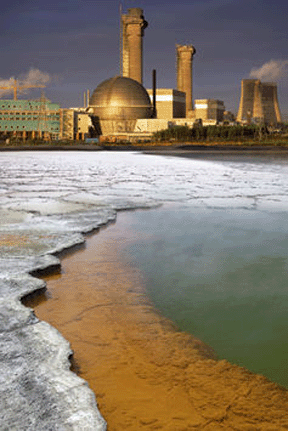 Britain is sending a huge nuclear waste consignment to America – why?, The Conversation, Gordon MacKerron, April 5, 2016 “…..In the absence of a deep-disposal plan, the UK has a more immediately pressing issue – what to do with Sellafield’s contaminated materials and waste from the UK’s near-70 years in the nuclear power and weapons business, much of which is housed in dilapidated facilities that are not fit for purpose. The Nuclear Decommissioning Authority (NDA) expects itwill cost some £68 billion to clean up Sellafield by stabilising and safely packaging the waste and building new stores. This will only be completed by around 2120.
This problem is at least now getting serious attention and resource – despite the climate of public austerity. Currently the country is spendingover £1.5 billion a year on the site, which is one of the most hazardous in Europe.
Sellafield stores a further 140 tonnes of waste plutonium that also stems from British and some overseas nuclear power. If used in bombs this amount could obliterate humanity several times over. The NDA is now focusing on what to do about this too, after years of political inattention. Yet the decision-making is laboured and the currently favoured solutionof using the plutonium as fuel for conventional reactors lacks credibility – no operator wants to use plutonium-based fuel because it is more difficult and expensive to manage than conventional fuel; and moving it around the country is a security risk.
So nuclear waste remains the Achilles heel of the nuclear industry, in the UK and elsewhere. While the financial problems behind the proposed new nuclear station Hinkley Point C attract most of the headlines, the waste problem hangs over the industry behind the scenes. Until we find a way forward that is scientifically and politically acceptable, it will continue to do so.https://theconversation.com/britain-is-sending-a-huge-nuclear-waste-consignment-to-america-why-57074
Amusement Park built from failed $5.3 billion nuclear reprocessing plant
This failed $5.3 billion nuclear power plant in Germany is now an amusement park that gets hundreds of thousands of visitors each year (great photos) http://www.businessinsider.com/nuclear-power-plant-into-amusement-park-2016-4/?r=AU&IR=TCourtney Verrill
The SNR-300 was supposed to be Germany’s first fast breeder nuclear reactor when construction began in 1972. The reactor was made to use plutonium as fuel, and it would output 327 megawatts of energy.
Built in Kalkar, the government had some concerns about the safety of the nuclear reactor, which delayed construction. The power plant was finished in 1985 — $5.3 billion later.
But after the Chernobyl disaster in 1986, the SNR-300 never got a chance to fully operate, and by 1991 the project was officially canceled.
This left the power plant completely unused, and it was eventually sold to a Dutch investor who decided to turn it into an amusement park: Wunderland Kalkar.
Plutonium shipped from Japan to go to Waste Isolation Pilot Plant (WIPP), New Mexico
Plutonium from Japan to be disposed of underground in New Mexico, Japan  Times, KYODO APR 2, 2016 U.S.-bound plutonium that has recently been shipped out of Japan will be disposed of at a nuclear waste repository in New Mexico after being processed at the Savannah River Site facility in South Carolina, according to an official of the National Nuclear Security Administration.
“The plutonium will be diluted into a less sensitive form at the SRS and then transported to the Waste Isolation Pilot Plant (WIPP) for permanent disposal deep underground,” said Ross Matzkin-Bridger, who is in charge of the operation at the NNSA, a nuclear wing of the Department of Energy.
“The dilution process involves mixing the plutonium with inert materials that reduce the concentration of plutonium and make it practically impossible to ever purify again,” he said in a recent phone interview.
The official made the remarks ahead of the latest Nuclear Security Summit, sponsored by President Barack Obama, which began Thursday in Washington.
On Friday, Prime Minister Shinzo Abe said Japan will give up more highly enriched uranium (HEU) as part of what Obama hailed as an unprecedented bid to tighten control over unused nuclear material…..
Japan received the plutonium and HEU fuels from the U.S, Britain and France from the late 1960s to early 1970s for research purposes in the name of “Atoms for Peace.” The nuclear fuel delivery, however, has generated controversy in South Carolina since it was reported that it was en route to the U.S. government-run SRS facility in the state.
South Carolina is “at risk of becoming a permanent dumping ground for nuclear materials,” Gov. Nikki Haley said in a recent letter to Energy Secretary Ernest Moniz, calling for the shipment to be stopped or rerouted…….
In the statement, the Japanese government made a new pledge to remove and transfer HEU fuels from the Kyoto University Critical Assembly (KUCA), another Japanese research institute, to the United States for down-blending and “permanent threat reduction.”…….
the materials recently transferred from Japan are only the tip of the iceberg. Currently, Japanese utilities possess over 47 metric tons of separated plutonium, which is equivalent to about 6,000 nuclear bombs http://www.japantimes.co.jp/news/2016/04/02/national/politics-diplomacy/plutonium-japan-disposed-underground-new-mexico/#.VwGXrZx97Gj
US govt no longer worried about Japan’s plutonium stockpiling as weapons proliferation risk?
U.S. official changes stance on Japan’s nuclear policy http://the-japan-news.com/news/article/0002840098 By Seima Oki / Yomiuri Shimbun Correspondent , 29 Mar 16, WASHINGTON — U.S. Assistant Secretary of State Thomas Countryman said in a press conference by telephone on Monday that Japan’s nuclear fuel cycle project, which reuses spent nuclear fuel from nuclear power plants to extract plutonium, does not raise concerns about nuclear nonproliferation, effectively changing his earlier position on the matter.
At a hearing of the U.S. Senate’s Foreign Relations Committee on March 17, the assistant secretary in charge of international security and nuclear nonproliferation had voiced his concerns about Japan’s nuclear policy and said that it would be desirable for Japan to halt its nuclear fuel reprocessing project.
In the press conference, Countryman said that Japan was a pioneer in the civilian use of nuclear energy and that no other country was closer or more important as a partner to the United States than Japan.
Japan’s stockpiling of plutonium has been criticized by China at U.N. meetings and on other occasions. To this, Countryman said that Japan has been proceeding in a transparent manner, which was understandable to the rest of the world.
He also expressed his stance that the U.S. government will cooperate with Japan as an ally to wipe out anxiety in the international community.Speech
North Dakota rejects plan for experimental deep borehole
 This time, it’s North Dakota that sinks an experiment related to burying nuclear waste, Science,By Warren Cornwall Mar. 23, 2016 , The history of failed attempts to deal with U.S. nuclear waste gained another chapter this month, when local opposition prompted scientists to abandon tests of a new disposal technique in eastern North Dakota.
In early March, Battelle Memorial Institute, a large research nonprofit based in Columbus, quietly withdrew plans to drill two holes up to 5 kilometers deep into the granite bedrock beneath the rolling prairie there. Those were supposed to be the centerpiece of an $80 million, federally funded project to see whether the government could get rid of some highly radioactive waste by sticking it deep underground.
The retreat followed objections from residents of rural Pierce County, who feared the drilling would open the door to nuclear waste. It underscores the treacherous path facing any major effort tied to nuclear waste, even when federal officials insist the project was a test that would never involve radioactive material.

“If we would have allowed this, the next step we really feel would have been (nuclear waste) in our backyard,” says David Migler, chair of the Pierce County Commission, which voted unanimously to oppose the tests……..
the Department of Energy (DOE) in recent years has directed money to so-called “deep boreholes” as a less-objectionable and cheaper way to deal with some of the waste.(Click here to read “Deep Sleep,” a Science feature story on the initiative.) Advocates said the approach could entomb waste in stable rock deep in Earth, far from underwater aquifers . Fuel rods—the vast majority of high-level waste—have been ruled out as too big to easily fit in these boreholes. But Moniz has said it could be ideal for some kinds of waste, particularly 1936 slender, half-meter-long tubes of highly radioactive cesium-137 and strontium-90. Those are currently stored in a pool of water at a federal nuclear facility in eastern Washington state.
But there are many unanswered questions about the borehole strategy. Scientists need to figure out how practical and how expensive it will be to drill a 43-centimeter-wide hole that deep. They also want to test ways to ensure the surrounding rock at the bottom of the hole is solid enough, and that any water there can’t travel up toward the surface. DOE hired Battelle, which manages a number of the department’s research labs, to lead the pilot project to answer such questions.
Battelle officials say they picked the North Dakota site—8 hectares of state-owned land approximately 25 kilometers south of the county seat of Rugby—because it was far from any active earthquake zones, had the kind of solid crystalline “basement” rock the government wanted, and wasn’t near oil and gas drilling. They teamed up with the University of North Dakota’s (UND’s) Energy and Environmental Research Center (EERC) in Grand Forks.
The project quickly struck a sour note in Pierce County. The problems began when local officials didn’t learn about it until an article appeared in the newspaper in the capital city of Bismarck, Migler says. Concerns grew when news coverage stated a goal of the study was to find out if the geology was suitable for storing nuclear waste, he said. The history of Nevada’s fight over Yucca Mountain added to the worries………http://www.sciencemag.org/news/2016/03/time-it-s-north-dakota-sinks-experiment-related-burying-nuclear-waste
Deep sleep for high level nuclear wastes
Deep sleep Warren Cornwall*, Science 10 Jul 2015: Vol. 349, Issue 6244, pp. 132-135
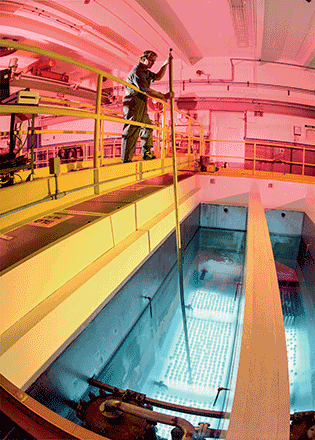 DOI: 10.1126/science.349.6244.132 One of the world’s biggest radioactive headaches sits in an aging cinderblock building in the desert near Hanford, Washington, at the bottom of a pool of water that glows with an eerie blue light. The nearly 2000 half-meter-long steel cylinders are filled with highly radioactive cesium and strontium, leftover from making plutonium for nuclear weapons. The waste has been described as the most lethal single source of radiation in the United States, after the core of an active nuclear reactor. It could cause a catastrophe if the pool were breached by an unexpectedly severe earthquake, according to the U.S. Department of Energy (DOE), the waste’s owner.
Now, a deceptively simple-sounding solution is emerging: Stick the cylinders in a very deep hole. The approach, known as deep borehole disposal, involves punching a 43-centimeter-wide hole 5 kilometers into hard rock in Earth’s crust. Engineers would then fill the deepest 2 kilometers with waste canisters, plug up the rest with concrete and clay, and leave the waste to quietly decay.
The idea has been around for decades, but not long ago scientists had all but abandoned it. Over the past 5 years, however, as improved drilling technologies converged with the political and technical woes bedeviling other nuclear waste solutions, boreholes have regained their allure. DOE has gone from spending almost nothing on borehole research to planning a full-scale field test, costing at least $80 million. And earlier this year U.S. Energy Secretary Ernest Moniz gave boreholes a dash of publicity during a major speech, mentioning them as a promising way to deal with the cesium and strontium waste at DOE’s Hanford Site nuclear complex.
Boreholes have “been plan B and just missed the boat for years,” says nuclear engineer Michael Driscoll, a retired professor from the Massachusetts Institute of Technology (MIT) in Cambridge and one of the concept’s leading advocates. “Maybe now is the time.”
Many nuclear waste veterans, however, are skeptical. The technical challenges are daunting, they argue, and boreholes won’t end political opposition to building new nuclear waste facilities. “The borehole thing to me is a red herring,” says attorney Geoff Fettus of the Natural Resources Defense Council (NRDC) in Washington, D.C., which supports underground disposal in a shallower mine, but has sued DOE over now abandoned plans to bury the waste inside Nevada’s Yucca Mountain……..
This past March, a White House policy shift opened the door further. Moniz announced that the Obama administration would abandon previous plans to put all high-level waste in one spot and instead would seek separate sites for disposing of commercial nuclear waste—about 85% of the total—and military waste. Moniz called some of the defense waste, including Hanford’s radioactive cylinders, “ideal candidates for deep borehole disposal.”………
Yet borehole disposal is not as straightforward as it might seem. The Nuclear Waste Technical Review Board, an independent panel that advises DOE, notes a litany of potential problems: No one has drilled holes this big 5 kilometers into solid rock. If a hole isn’t smooth and straight, a liner could be hard to install, and waste containers could get stuck. It’s tricky to see flaws like fractures in rock 5 kilometers down. Once waste is buried, it would be hard to get it back (an option federal regulations now require). And methods for plugging the holes haven’t been sufficiently tested. “These are all pretty daunting technical challenges,” says the board’s chair, geologist Rod Ewing, of Stanford University in Palo Alto, California.
Even if those technical problems are surmounted, boreholes might solve only a fraction of the nation’s waste problem. That’s because much of the high-level waste simply wouldn’t fit down a hole without extensive repackaging. “Due to the physical dimensions of much of the used nuclear fuel, it is not presently considered to be as good of a candidate [for borehole disposal] as the smaller waste forms,” said William Boyle, director of DOE’s Office of Used Nuclear Fuel Disposition Research and Development, in a statement to Science. Spent fuel rods from commercial power reactors, for instance, are often bundled into casks that are about 2 meters across.
Then there’s the same problem that dogged Yucca Mountain: the politics of finding a place to drill the holes. “Let’s just assume [boreholes] could work better than anybody ever imagined,” says Fettus, the NRDC attorney. “You still wouldn’t solve the nut that everyone has been unable to solve”: persuading state and local governments to take on waste from across the nation………
Other nations with nuclear waste, including China, are watching. But, for now, the United States is the only country getting ready to drill. “Nobody else has stepped forward,” says Geoff Freeze, a nuclear engineer at Sandia who is overseeing the U.S. experiment. “It kind of fell to us.” http://science.sciencemag.org/content/349/6244/132.full
Problem of Hanford’s highly radioactive pool of CESIUM-137 AND STRONTIUM-90
Deep sleep Warren Cornwall*, Science 10 Jul 2015: Vol. 349, Issue 6244, pp. 132-135 DOI: 10.1126/science.349.6244.132 “………..CESIUM-137 AND STRONTIUM-90 are the hot potatoes of the nuclear waste world, packing a powerful radioactive punch in a relatively short half-life of 30 years. At Hanford, there’s barely enough to fill the back of a pickup truck. Yet it contains more than 100 million curies of radiation, roughly one-tenth the radiation in the core of a large nuclear reactor. And it produces enough heat to power more than 200 homes.
To prevent the tubes from causing trouble, they sit under about 4 meters of water in what resembles a giant swimming pool, emanating a blue glow known as Cherenkov radiation as high-energy particles slam into the water. The 1974 building housing the pool is past its 30-year life span, according to DOE’s inspector general. Bombarded by radiation, the pool’s concrete walls are significantly weakened in places. Some of the tubes have failed and been stuck inside larger containers. In a review of DOE facilities conducted after the 2011 disaster at Japan’s Fukushima Daiichi Nuclear Power Station, the department’s Office of Environmental Management concluded that the Hanford pool had the highest risk of catastrophic failure of any DOE facility, for example in a massive earthquake, according to a report from the department’s inspector general. DOE says it plans to move the pool waste into dry casks for safer storage, but it hasn’t said when.
It’s an urgent situation and a huge safety risk,” says Tom Carpenter, executive director of the watchdog group Hanford Challenge in Seattle, Washington, which has been critical of DOE’s efforts to secure the waste.
Borehole advocates point out that the Hanford tubes are less than 7 centimeters in diameter, narrow enough to fit down a hole without extensive repackaging. All could fit into a single shaft. Other military waste could also go down a borehole, advocates add. One candidate is plutonium that DOE has extracted from dismantled nuclear weapons. Most of it is currently stored as softball-sized metal spheres at a DOE facility in Texas. In contrast to Hanford’s cesium and strontium, the plutonium is fairly cool, but extremely long-lived, with a half-life of 24,000 years. DOE is considering other options for the plutonium, including turning it into fuel for nuclear reactors or combining it with other nuclear waste and burying it. But boreholes could be an effective way to put it far out of the reach of anyone trying to lay their hands on bombmaking material……….http://science.sciencemag.org/content/349/6244/132.full
Spent nuclear fuel staying put near closed San Onofre nuclear power station
 Where is the San Onofre nuclear waste going? Spent fuel staying put for now, San Diego Union Tribune By Rob Nikolewski March 25, 2016 Some 3.6 million pounds of nuclear waste is stored at the now-shuttered San Onofre Nuclear Generating Station (SONGS) but when the waste will be transferred and where it will end up are still very open questions.
“I think everyone can agree we want to get the spent fuel off the San Onofre site sooner rather than later,” said Garry Brown, executive director and CEO of the nonprofit clean water organization Orange County Coastkeeper, Thursday night at the quarterly meeting of the Community Engagement Panel.
After the California Coastal Commission approved a site permit last October, a plan was approved to bury the waste in concrete casks within 125 feet of a seawall and the beach on a low-lying plain at the plant operated by Southern California Edison.
“We need to de-energize the plant as soon as we can,” Tom Palmisano, chief nuclear officer at Southern California Edison, told the 18-member panel during a Powerpoint presentation in Oceanside.
The prospect of casks on site has generated plenty of opposition. “We may never be able to move these,” said Gary Headrick, co-founder of San Clemente Green. “These storage containers are not reliable.”….
Among the problems is the near-paralysis on the part of the federal government to permanently deal with nuclear waste……..http://www.sandiegouniontribune.com/news/2016/mar/25/songs-nuclear-waste/
1 This Month


31st January – Challenging the War Machine – a DECLASSIFIED UK SUMMIT



Website of the Week
Now until to February 10, 2026 Radioactive waste storage in France: the debate is finally open! How to participate?
-
Archives
- January 2026 (220)
- December 2025 (358)
- November 2025 (359)
- October 2025 (377)
- September 2025 (258)
- August 2025 (319)
- July 2025 (230)
- June 2025 (348)
- May 2025 (261)
- April 2025 (305)
- March 2025 (319)
- February 2025 (234)
-
Categories
- 1
- 1 NUCLEAR ISSUES
- business and costs
- climate change
- culture and arts
- ENERGY
- environment
- health
- history
- indigenous issues
- Legal
- marketing of nuclear
- media
- opposition to nuclear
- PERSONAL STORIES
- politics
- politics international
- Religion and ethics
- safety
- secrets,lies and civil liberties
- spinbuster
- technology
- Uranium
- wastes
- weapons and war
- Women
- 2 WORLD
- ACTION
- AFRICA
- Atrocities
- AUSTRALIA
- Christina's notes
- Christina's themes
- culture and arts
- Events
- Fuk 2022
- Fuk 2023
- Fukushima 2017
- Fukushima 2018
- fukushima 2019
- Fukushima 2020
- Fukushima 2021
- general
- global warming
- Humour (God we need it)
- Nuclear
- RARE EARTHS
- Reference
- resources – print
- Resources -audiovicual
- Weekly Newsletter
- World
- World Nuclear
- YouTube
-
RSS
Entries RSS
Comments RSS
 nuclear-news