REGIONAL RISKS in America’s Spent Nuclear Fuel Rods and Storage Pools
 Spent Nuclear Fuel Rods and Storage Pools: A Deadly and Unnecessary Risk in the United States. Based on an Institute for Policy Studies report by Robert Alvarez entitled “Spent Nuclear Fuel Pools in the U.S.: Reducing the Deadly Risks of Storage.”
“…….New York. If a spent fuel fire were to happen at one of the two Indian Point nuclear reactors located 25 miles from New York City, it could result in as many as 5,600 cancer deaths and $461 billion in damages. Indian Point spent fuel storage has about three times more radioactivity than the combined total in the spent fuel pools at the four troubled Fukushima reactors.
Los Angeles. The spent fuel at Diablo Canyon nuclear reactors have nearly 2.7 times more radioactivity than the combined total in the spent fuel pools at the four troubled Fukushima reactors.
Miami. Turkey Point reactors 65 miles from Miami have 2.5 times more radioactivity than the combined total in the spent fuel pools at the four troubled Fukushima reactors.
Dallas. The Comanche Peak nuclear station 60 miles southwest of Dallas has spent fuel that contains about 2.3 times more radioactivity than the combined total in the spent fuel pools at the four troubled Fukushima reactors.
Atlanta. The Vogtle nuclear reactors near Augusta are 147 miles northeast of Atlanta. These reactors have generated 2.5 times more radioactivity than the combined total in the spent fuel pools at the four troubled Fukushima reactors. https://ratical.org/radiation/NuclearExtinction/IPS-RA-ReportFactSheet.pdf
Foolish greed in South Australia’s unwise plan to import nuclear wastes
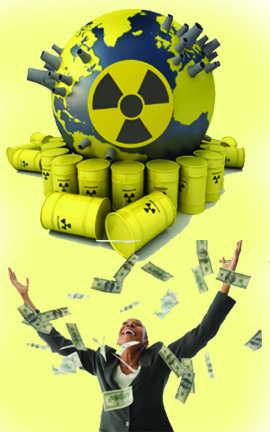 Poison In The Heart: The Nuclear Wasting Of South Australia Counter Currents by Vincent Di Stefano — July 22, 2016
“Nuclear weapons and nuclear power are both leading instances of the irrationalities
Our planet is deeply burdened. It presently harbours 390,000 tons of high level nuclear waste produced by nuclear reactors and weapons programs over the past 70 years. Spent nuclear fuel is one of the most dangerous materials on earth. Most of it is stored underwater in numerous cooling ponds throughout the world. High level nuclear waste is dangerous to all life for unthinkable periods of time. Plutonium, which is produced in every nuclear fuel rod, has a toxic lifespan of 240,000 years. With each passing year, a further 10,000 tons of spent fuel is added to the world’s accumulated stores of deadly waste. In addition to the spent fuel from nuclear reactors, vast amounts of lower-level radioactive waste lie scattered in mining sites, tailings dams, undersea dumps and soil-borne contamination on every continent.
We have no idea what to do with the stuff. The Americans sank over $13 billion into the construction of a massive underground repository at Yucca Mountain in Nevada. It was closed down in 2010 without taking in a single gram of nuclear waste. The Soviets didn’t bother with such elaborate schemes and until recently, simply dumped much of their waste – including obsolete submarines complete with nuclear reactors – into the Kara Sea and elsewhere in the Arctic Circle where they slowly corrode, leaching their lethal contents into the cold waters of the Arctic Ocean.
In the meantime, a small cadre of aspirational Promethean technocrats in South Australia have somehow decided that Australia holds the solution to the global problem of nuclear waste. The recently releasedNuclear Fuel Cycle Royal Commission Report recommends that the South Australian government accepts over one third of the world’s high level waste for above-ground storage and eventual burial in yet-to-be-built underground repositories in the South Australian desert. The report proposes that South Australia imports 138,000 tons of high level radioactive waste in the form of spent fuel rods as well as an additional 390,000 cubic metres of intermediate level waste for storage and eventual disposal.
This has all been spruiked as a fail-safe commercial venture that will relieve the South Australian Government of its financial problems ever after and create a rosy economic future for generations that have yet to be born. Such madness blithely ignores the fact that the genetic and biological futures of those generations may thereafter be a different story……. ww.countercurrents.org/2016/07/22/poison-in-the-heart-the-nuclear-wasting-of-south-australia/
Priority to remove Wylfa nuclear waste
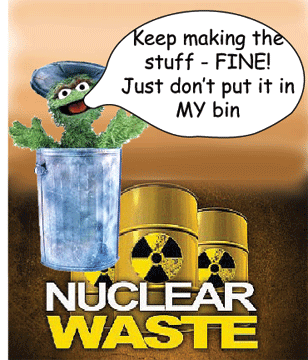 Removing Wylfa nuclear plant’s radioactive fuel ‘priority’, BBC News, 22 July 2016
The push to recover used radioactive fuel from the last nuclear power station of its kind is under way.
Wylfa nuclear plant’s last reactor was turned off after 44 years at an outage ceremony on Anglesey in December.Workers have spent the past six months putting decommissioning plans into action, including a new safety regime.Removing 800 tonnes of spent Magnox fuel will now be the “dominant” focus over the next three years, officials have said.
“Once we are fuel free, over 99% of all the radioactivity on the site will have left,” said Gordon Malcolm, deputy site director at Wylfa. “Then the whole site moves on to the next phase of work, preparations for care and maintenance… which will last for the rest of this century.”
Spent fuel from Wylfa will be taken to Sellafield in Cumbria for reprocessing, before much of the site is cleared, leaving just the reactor buildings and fuel stores.
According to officials, 99% of the fuel used to power Reactor One remains on site after it was shut down last year.On top of this, 60% of the old fuel used in Reactor Two until it was closed in 2012 is also at Wylfa………
Site staff also have one eye on developments next to their plant, where there are plans for a new nuclear plant built by Japanese-owned Horizon Nuclear Power.
The Wylfa Newydd developers are still waiting for approval to use their design for a new reactor and hope to submit planning applications in 2017. In the meantime, Horizon has been carrying out preliminary site investigations,including a seabed study…….http://www.bbc.com/news/uk-wales-36836836
Spent nuclear fuel pools are unsafe
Spent Nuclear Fuel Rods and Storage Pools: A Deadly and Unnecessary Risk in the United States. Based on an Institute for Policy Studies report by Robert Alvarez entitled “Spent Nuclear Fuel Pools in the U.S.: Reducing the Deadly Risks of Storage.”
Ì More than 30 million highly radioactive spent nuclear fuel rods are submerged in vulnerable storage pools at reactors all over the United States. These pools at 51 sites contain some the largest concentrations of radioactivity on the planet. Yet, they are stored under unsafe conditions, vulnerable to attacks and natural disasters.
Ì Spent nuclear fuel rods have enough pop to cause a catastrophic radiation fire, a nuclear chain reaction, or explosion. As the Fukushima Dai-Ichi tragedy shows, the risk to the public is all too real.
Ì Spent nuclear fuel rods are so deadly that a motorcyclist blasting past them at 60 mph at a distance of one foot would be killed from the effects of that fleeting radiation exposure.
Ì The metal tubing that holds the spent nuclear fuel is thinner than a credit card. This thin sheath is the only major barrier preventing the escape of radioactive materials. Cracked or damaged metal tubing that was holding deadly nuclear material at the Fukushima Dai-Ichi nuclear reactors resulted in the release of an enormous amount radioactivity, much of which seeped into air, soil, and nearby ocean water.
Ì Approximately 75 percent of U.S. spent nuclear fuel rods are kept tightly packed together in storage racks, submerged in pools located at nuclear reactors. These storage facilities resemble large above-ground swimming pools and this practice puts the American public at risk. Spent fuel storage pools are often housed in buildings no more secure than a car dealership. Instead, these fuel rods should be safely stored in dry, hardened, and sealed storage casks.
Ì Spent fuel storage pools are vulnerable. Massive land contamination, radiation injuries, and myriad deaths would result from a terrorist attack, earthquake, or even a prolonged electricity blackout — as happened at the Fukushima DaiIchi reactor site in Japan following an earthquake and tsunami. Pools need electricity to pump water to cool the rods, as well as to maintain a high water level to diffuse the escape of radiation. Despite these dangers, the Nuclear Regulatory Commission (NRC) doesn’t require nuclear reactor operators to even have back-up power supplies for these spent-fuel pools to prevent disaster.
Ì If the water in a spent nuclear fuel pool drains to six feet above the fuel rods, it would give off life-threatening radiation doses to workers on site. These pools were originally designed to hold less than one fifth of the radioactive material they now contain.
Ì If the water were to drain entirely from a spent fuel pool, it could trigger a catastrophic radioactive fire that would spew toxins and render hundreds of thousands of square miles uninhabitable. The devastated area would be larger than the wasteland that resulted from the 1986 Chernobyl nuclear accident.
Ì Life-threatening incidents have occurred at multiple U.S. spent fuel storage pools. In Haddam Neck, Connecticut, a pool sprung a leak in August 1984. About 200,000 gallons of water drained in just 20 minutes, according the NRC.
Ì Dry cask storage is a much safer alternative to pools — which were originally designed to hold less than one-fifth of what they now contain. It doesn’t rely upon a constant supply of electricity or water, and it also can be stored in separate blast-proof containers, making it less susceptible to terrorist attack or earthquakes.
Ì Over the next 10 years, we could remove all spent fuel older than five years for a cost of $3 billion-$7 billion. The cost of fixing America’s nuclear vulnerabilities may be high, but the price of doing too little is incalculable……..https://ratical.org/radiation/NuclearExtinction/IPS-RA-ReportFactSheet.pdf
Czech Republic’s headache about its mounting nuclear wastes
Czech nuclear waste deep storage will only be sited where there is local support says ministry Radio Czech Republic, 15-07-2016 Chris Johnstone Nuclear power means nuclear waste and the Czech Republic, like many other European countries, is faced with the headache of where to store the waste long term. A shortlist of seven locations for geological tests for suitable deep storage resulted in howls of protest from most of the citizens and mayors living near the sites. And that has forced a rethink from the ministry and state body piloting the selection process.
The Czech Republic has been producing nuclear power for just over 30 years now with the two plants at Dukovany and Temelín responsible for producing around a third of the country’s electricity. And there are plans to boost that proportion with more plants in the future.
But the high level nuclear waste produced from the process is still being stocked on site at the plants with plans for a deep storage site hitting furious opposition from most of the seven preliminary sites earmarked for geological tests. Five of those sites have launched or allied themselves to legal proceedings aimed at stopping the surveys and sent back millions of crowns in payments aimed at compensating locals for the inconvenience.
Now the Ministry of Industry and Trade says it will bow to the opposition and seek to push ahead with surveys at one locality near Třebíč in Vysočina and another straddling Vysočina and South Moravia.
Minister Jan Mládek said the decision was not a defeat for the ministry………..
What’s the time pressure to get this done – how long can you keep storing it [the waste] at nuclear sites?
“It’s a really long term process and the storage should be built by 2065, but we have milestones and what for us at this moment is very important is that the decision about the location should be decided by the Czech government in 2025. This is a milestone we are targeting, we are not yet about building but about picking the place where it will be built.” http://www.radio.cz/en/section/curraffrs/czech-nuclear-waste-deep-storage-will-only-be-sited-where-there-is-local-support-says-ministry
How to warn future society about nuclear wastes – 100,000 years on?

all nuclear agencies have a duty to try to prevent radioactive sites from being disturbed by future civilisations, who may decide to excavate an area in ignorance or even in the misguided hope of finding some kind of treasure buried underground. To this end, they are trying to find a way to communicate with the distant future, in order to warn its inhabitants about what will happen if they become too curious, and also to encourage them to look out for any technical problems at the site. This is not just a moral obligation. In the US, for example, there is a legal obligation to try to keep the “memory” of the site alive so that it can be managed “in perpetuity”.

This is a mind-bending task. About 100,000 years ago Europe was populated by a different species of human, Homo neanderthalensis. We know they had heavy, ape-like facial features, and used basic hunting tools, but we have no knowledge of the language they used. We have no idea what will happen in the next hundred thousand years, and what kinds of societies will populate the planet, let alone how we might communicate with them.
Nuclear waste: keep out for 100,000 years, Ft.com Michael Stothard, 14 July 16 Nuclear agencies are searching for the signs, language and solutions that will warn our descendants to stay away We are in a red metal cage bumping slowly down a mineshaft to our destination, half a kilometre under the ground near the small town of Bure in eastern France. Above us are yellow fields of oilseed rape. Below is the maze of reinforced concrete tunnels that, if it wins final approval from the French government, will from 2025 be the last resting place for the most destructive and indestructible waste in history. This is the €25bn deep geological storage facility for France’s high and medium-level radioactive waste, the residue of more than half a century of nuclear power. When the work here is finally finished, no one must ever take this journey again or, at least, not for 100,000 years.
France is the world’s largest exporter of electricity and the world’s most committed nuclear nation, with 58 reactors producing 75 per cent of the country’s power. As a result, it also produces enough toxic radioactive waste every year to fill 120 double-decker buses (about 13,000 cubic metres worth, or 2kg a year for every French person). The challenge at Bure is not only to build a massive dump for radioactive trash but also to guard it from human intervention for an impossible amount of time — more than 4,000 human generations.
Our cage stutters and almost comes to a halt. The French workers dangling with me continue chatting about their shifts, but I quickly check the emergency oxygen tank on my belt. When we finally reach the cavern floor, we are at the start of a 1.6km network of winding laboratory tunnels. The air is thick and dusty; dozens of men in blue and grey overalls drill into the walls with car-sized machines. Others walk around checking the scientific equipment embedded in the rock. Above us, the curved grey ceilings are covered by a dense thicket of wires and tubes sending data back to technicians on the surface.
The waste, which will be placed in a quarter of a million sealed containers slotted into horizontal tunnels more than 100m long, is the byproduct of burning uranium in the nuclear reactors and includes some of the most deadly and long-lasting radionuclides in the world. Chlorine-36 has a half-life of 300,000 years and neptunium-237 a half-life of 2 million years. People do not often come into direct contact with such materials, aside from in a nuclear accident, but those that do meet a horrific end. In 1987, thieves in Brazil stole a source of high-level radiation from an old abandoned hospital. It was sold, its lead case broken open. After three days, four people who were handling it began to suffer internal bleeding in their limbs, eyes and digestive tracts, according to doctors. Then their hair fell out. Within weeks, they were dead……..
nuclear agencies have two problems, however, as they try to devise schemes that will win regulatory approval for deep geological repositories. The first is to design a site that can last for ever, even as tectonic plates shift and a new ice age — which scientists expect to occur within 100,000 years — radically erodes the soil above. The nightmare scenario is that the radioactive elements will seep out into the groundwater, gradually, silently poisoning wildlife and humans. In Germany the Asse former salt mine, where 126,000 drums of nuclear waste were buried in the 1970s, is already collapsing, forcing the authorities to dig up the dangerous material to place it elsewhere.
The second issue is that all nuclear agencies have a duty to try to prevent radioactive sites from being disturbed by future civilisations, who may decide to excavate an area in ignorance or even in the misguided hope of finding some kind of treasure buried underground. To this end, they are trying to find a way to communicate with the distant future, in order to warn its inhabitants about what will happen if they become too curious, and also to encourage them to look out for any technical problems at the site. This is not just a moral obligation. In the US, for example, there is a legal obligation to try to keep the “memory” of the site alive so that it can be managed “in perpetuity”.
This is a mind-bending task. About 100,000 years ago Europe was populated by a different species of human, Homo neanderthalensis. We know they had heavy, ape-like facial features, and used basic hunting tools, but we have no knowledge of the language they used. We have no idea what will happen in the next hundred thousand years, and what kinds of societies will populate the planet, let alone how we might communicate with them. Will they even understand our language? A large part of the written Mayan language, used until the 17th century in Central America, is indecipherable to us today……..
Today, a fragile new consensus is evolving around the world. Under the umbrella of the Nuclear Energy Agency (NEA) in Paris, 17 organisations from 13 countries came together in 2011 to form the RK&M initiative, or Preservation of Records, Knowledge and Memory across Generations. At a landmark conference in 2014 in Verdun, France, it was agreed there should be some form of marker for a nuclear waste site to warn future generations. On the marker should be basic information about what is buried, not just emotive messages to keep out, and this information should also be archived around the world to maximise the chance that it will not be forgotten.
But there is still no consensus at all on what should be written and what the markers should be…….. http://www.ft.com/cms/s/2/db87c16c-4947-11e6-b387-64ab0a67014c.html
Connecticut lawmaker seeks justice over “stranded nuclear waste”

 Connecticut lawmaker pushes nuclear waste bill http://wtnh.com/2016/07/12/connecticut-lawmaker-pushes-nuclear-waste-bill/ By Keith Kountz July 12, 2016 New Haven, Conn. (WTNH)– Connecticut congressman Joe Courtney is part of a bi-partisan group of house lawmakers to introduce a bill to help communities that are struggling with the cost of storing what’s known as ‘stranded nuclear waste’.
The legislation is important to people in Courtney’s district, which includes the former home of the Connecticut Yankee nuclear power plant.
The Stranded Nuclear Waste Accountability act of 2016 would help communities cover any losses they’ve racked up associated with the storage of nuclear waste.
In a statement, Courtney says in part that ‘we cannot allow small communities and municipalities across this country to fall into financial distress because of the congressional gridlock which is holding up the establishment of a federal nuclear waste storage facility’.
Britain’s nuclear submarines’ radioactive wastes will NOT be going to Scotland

 Chapelcross site ruled out for nuclear submarine waste BBC News 8 July 2016 The Ministry of Defence has ruled out a Scottish site as a possible location to store waste from nuclear submarines.
Chapelcross near Annan was on a shortlist of five potential locations.
Capenhurst in Cheshire has been selected to store the nuclear components, with Aldermaston in Berkshire as a “fall back” option. The Scottish site was ruled out along with Sellafield in West Cumbria and Burghfield in Berkshire following public consultation…….
The nuclear components are from 18 redundant submarines and nine still in service.
The redundant Royal Navy submarines are currently stored afloat at Devonport in Plymouth and Rosyth in Fife, but cannot be dismantled until the reactor components have been removed.
The radioactive parts will be stored until after 2040, when the UK’s Geological Disposal Facility, for the permanent disposal of spent fuel and nuclear waste, is planned to come into operation……..http://www.bbc.com/news/uk-scotland-south-scotland-36745287
Old submarines’ nuclear waste – leaks – trash to be sent to North of England
 Nuclear waste from scrapped Plymouth subs to be sent up country, Herald, UK WMNlynbarton July 08, 2016
Radioactive fuel cells on a dozen disused nuclear submarines languishing in Plymouth are to be removed and taken to a site in the North of England for storage and eventual disposal.
The Ministry of Defence yesterday revealed the fate of the boats which are currently stationed at Devonport but said no date has yet been fixed for the process to begin
Defence Minister Philip Dunne said the highly toxic part of the decommissioned submarines would be removed at a date to be set.
“When submarines in the Royal Navy fleet reach the end of their lives, we need to dispose of them in a way that is safe, secure and environmentally sound,” he said………
It emerged last year that the ministry was spending £16million to store the vessels, with the ones in Plymouth having been taken out of service in 1994.
The MoD said it was working on a plan to safely dispose of the Reactor Pressure Vessels (RPV), the thick steel containers which weigh between 90-135 tonnes and held nuclear fuel when the reactors operated.
There have been a number of leaks of nuclear waste associated with the submarines based in Devonport.
*March 25, 2009: radioactive water escaped from HMS Turbulent while the reactor’s discharge system was being flushed.
*November 2008: 280 litres of water likely to have been contaminated with the radioactive isotope tritium, poured from a burst hose as it was being pumped from the submarine.
*October 2005: 10 litres of water leaked out as the main reactor circuit of HMS Victorious as it was being cleaned to reduce radiation.
*November 2002: Around ten litres of radioactive coolant leaked from HMS Vanguard……..In May this year, it was revealed extra radioactivity could be discharged into the atmosphere during the refit of a nuclear submarine at Devonport Dockyard.
Babcock’s Devonport Royal Dockyard Limited submitted an application for a variation to an environmental permit which covers operations on their Dockyard site in Plymouth.
If approved, the application will enable them to increase discharges of carbon-14 to the atmosphere during the refit of the Royal Navy submarine, HMS Vanguard…..http://www.plymouthherald.co.uk/disused-nuclear-submarines-at-devonport-will-be-broken-up-says-mod/story-29490710-detail/story.html
Giant vault for Sellafield’s nuclear waste
http://www.nwemail.co.uk/Giant-vault-for-Sellafields-nuclear-waste-6bdc62b1-31d2-422f-a98d-e5c511a5fc99-ds 7 July 2016 BACK in January 1989 the Evening Mail got a first look at the new £8.6m store at Drigg for low-level radioactive waste generated by British Nuclear Fuels – much of it from nearby Sellafield.
The site was screened by thousands of conifer trees and it took 70 contractors to gouge out an eighth huge hole – Vault Eight – to take an expected five-years’ worth of waste.
Contaminated paper, plastic and metal was put in drums ready to go in 20-tonne steel containers before burial, 20 miles north of Millom.
A report in the Mail on January 26 in 1989 noted: “More than 250,000 cubic metres of earth had to be torn from the ground by huge excavators to create a hole 800ft by 550ft and 16ft deep.
“The result is a roofless building resembling a huge unfilled swimming pool the size of eight soccer pitches.
“A single fork lift truck with tyres six feet high lifts the massive steel containers into place.”
In 1959 the nuclear industry took over and found Drigg’s geology suitable for burying waste in deep trenches hundreds of feet long.
Germany’s struggle over nuclear waste storage

 Germany may wait 100 years for nuclear waste storage site https://au.news.yahoo.com/world/a/31991613/germany-may-wait-100-years-for-nuclear-waste-storage-site/#page1 July 6, 2016, Berlin (AFP) – Germany may not have a final storage facility for its nuclear waste up and running until the next century, an expert report released on Tuesday suggested.
For the past two years, a commission of scientists, industry leaders and civil society representatives have debated the question of where Germany should store waste from its soon-to-be-retired nuclear reactors.
Initially, the commission had hoped to reach a decision on the final site of the highly radioactive spent fuel from the country’s power plants by 2031, with the facility itself slated to open in 2050.
But even that decades-spanning timetable was described by commission president Michael Mueller as “ambitious”.
The final report, published on Tuesday, stated that the storage facility might only enter service “in the next century”. For many years now, a site in Gorleben, in the northern state of Lower Saxony, had been under discussion, drawing often violent clashes between police and anti-nuclear demonstrators.
But choosing a site for the permanent nuclear waste dump has become all the more pressing since 2011, when Chancellor Angela Merkel announced plans to shut down all eight remaining reactors in the country by 2022 following the Fukushima disaster in Japan.
In the wake of that decision, the expert commission was instructed to go back to square one and choose a suitable spot within Germany based on scientific criteria.
Gorleben is still one of the possible options, but a series of other sites are also being looked at. Germany’s vocal environmentalist movement was quick to lash out at the report’s findings on Tuesday.
Commission members had simply “delayed” the decision, said Jochen Stay of anti-nuclear organisation Ausgestrahlt.
“The recommendations they’ve made are so vague that they could justify choosing any site,” Stay added.
Germany’s government has been locked in battles with industry for years over who should foot the bill for the nuclear phase-out, with the costs of storing the waste and safely dismantling the reactors representing a very substantial financial risk for the country’s four biggest power suppiers, RWE, Vattenfall, EON and EnBW.
South Australia’s financially risky nuclear waste import scheme
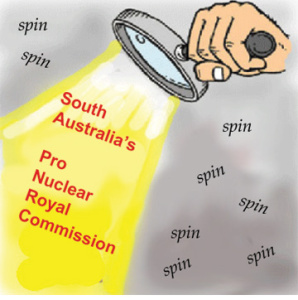 Shunning nuclear power but not its waste: Assessing the risks of Australia becoming the world’s nuclear wasteland http://www.sciencedirect.com/science/article/pii/S2214629616301323 Mark Diesendorf
Abstract
The South Australian Nuclear Fuel Cycle Royal Commission has undertaken ‘an independent and comprehensive investigation into the potential for increasing South Australia’s participation in the nuclear fuel cycle’. In its Final Report, issued 6 May 2016, it acknowledges that nuclear power would not be commercially viable in South Australia in the foreseeable future. However it recommends that ‘the South Australian Government establish used nuclear fuel and intermediate level waste storage and disposal facilities in South Australia’.
This is a business proposition to store a large fraction of global nuclear wastes, providing interim above-ground storage followed by permanent underground storage in South Australia.
The present critical evaluation of the scheme finds that the Royal Commission’s economic analysis is based on many unsubstantiated assumptions. Furthermore, the scheme is financially risky for both Australian taxpayers and customers and has a questionable ethical basis.
Kiev’s new nuclear project puts Europe at risk
 ‘Threat of 2nd Chernobyl’: Kiev’s new nuclear project puts Europe at risk, Greens warn
The Ukrainian Greens Association, a non-profit environmentalist organization, listed the risks in a statement released on Monday.
“We are deeply concerned about plans to build a spent nuclear fuel storage in the upper reaches of the Dnepr River close to densely populated places,” the statement said, citing a speech made by the association’s spokeswoman, Anna Rak, at the first Nuclear Energy Policy Forum in Brussels on June 30.
Rak also emphasized that the government plans “to secretly fast-track the construction of a surface dry, spent nuclear fuel storage system… close to the Dnepr river,” ignoring basic safety standards and “creating the threat of a second Chernobyl.”
Ukraine’s Greens stressed that the decision to build the facility just 70 kilometers away from the Ukrainian capital of Kiev, in Chernobyl’s exclusion zone, was taken “without a proper environmental impact assessment and public consultation with the [local] residents.”
They also warned that the contractor for the project, Holtec International, actually lacks sufficient experience while the technology it plans to use in construction has never been tested or tried in any other country.
The association added that the procedure of choosing the contractor was “neither transparent nor open,” warning that Ukraine may once again become a subject to “unpredictable and dangerous nuclear experiments,” apparently referring to the Chernobyl nuclear disaster.
The organization demanded that Ukrainian authorities “ensure that the project complies with all international rules and standards before the construction is launched” and emphasized that the residents of the Kiev region have “an unconditional right” to get all relevant information about the project and to take part in the discussion concerning its construction.
The Ukrainian Greens Association also urged the European Commission, the European Parliament and international environmental bodies to carry out an “independent environmental assessment of the project.”……..https://www.rt.com/news/349590-nuclear-fuel-ukraine-eu/
Struggling nuclear company EDF now looking for a nuclear shut-down business
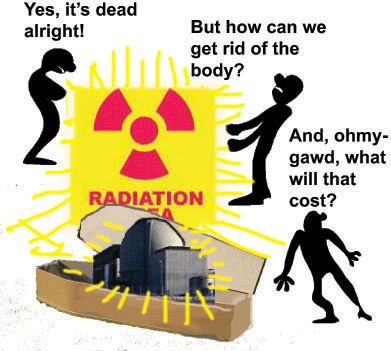 France’s EDF sets sights on $200 bln nuclear decommissioning market By Bate Felix and Benjamin Mallet PARIS, July 4 (Reuters) – EDF aims to snare a sizeable share of the global nuclear decommissioning market, worth an estimated 200 billion euros ($222 billion) over the next 15 years, by virtue of experience gained in dismantling its old reactors.
The French state-controlled utility is in the process of dismantling nine reactors and has 58 others in operation, supplying France with about 75 percent of its energy needs.
Worldwide, 110 reactors have been halted and will need to be safely dismantled, EDF executives said, adding that the company has a team of 800 experts in the complex process.
“Nuclear decommissioning is a very important market with opportunities for the international and local nuclear sector,” Dominique Miniere, executive director for EDF’s nuclear and thermal plants, told journalists in Paris……
Based on the completed decommissioning of reactors in the United States, EDF estimates that it will cost about 400 million euros to dismantle a 900 megawatt pressurised water reactor — a process that could take up to 15 years.
The company’s first dismantling of a nuclear reactor in France — the Chooz A reactor that ceased operating in 1991 — is expected to be completed in 2022. ($1 = 0.8974 euros) (Editing by David Goodman) http://af.reuters.com/article/energyOilNews/idAFL8N19Q3N4
Plutonium being collected in China and Japan? Fears of another nuclear arms race
Confronting plutonium nationalism in Northeast Asia, Bulletin of the Atomic Scientists,
Japan has already accumulated about 11 metric tons of separated plutonium on its soil—enough for about 2,500 nuclear bombs. It also plans to open a nuclear spent fuel reprocessing plant at Rokkasho designed to separate eight tons of plutonium—enough to make roughly 1,500 nuclear warheads a year—starting late in 2018. The Japanese plutonium program has raised China’s hackles. China’s new five-year plan includes a proposal to import a reprocessing plant from France with the same capacity as Rokkasho. Meanwhile, South Korea insists that it should have the same right to separate plutonium as Japan has.
Each of these countries emphasizes that it wants to separate plutonium for peaceful purposes. Yet in each country, there are skeptics who respond whenever this argument is made by a neighbor. China and South Korea suspect that Japan’s large stockpile of plutonium and its plans to operate the Rokkasho plant are designed to afford Tokyo some latent form of nuclear deterrence, i.e. a nuclear weapon option. A huge new Chinese commercial plutonium separation program could give Beijing an option to make far more nuclear weapons than it already has. It is unclear what Russia might make of all of this, or North Korea. One possibility is that either might use such “peaceful” plutonium production as an excuse to further expand its own nuclear arsenal. China might do the same as deterrence to Japan. If Seoul joined in, it would be even more difficult to cap North Korea’s nuclear program………
The Obama administration and Congress need to speak more clearly. As Countryman said, “(t)here is a degree of competition among the major powers in East Asia. It is a competition that in my view extends into irrational spheres…”
The United States can stop Japan from separating more plutonium and the spread of “plutonium nationalism” in East Asia only by bringing security issues to the front burner in politics and diplomacy. If the United States clearly announces that operations at Rokkasho constitute a security concern, Japan is almost sure to listen. Having the plutonium discussion between Japan and the United States is critically important; the Abe administration puts a high priority on security issues and is also very pro-United States.
Now is the time to speak clearly on these security issues—before China and Japan lock themselves into a plutonium production rivalry that will make cooperation between them and South Korea on pressing issues, including North Korea’s nuclear program, all the more difficult to secure. http://thebulletin.org/confronting-plutonium-nationalism-northeast-asia9617
1 This Month


31st January – Challenging the War Machine – a DECLASSIFIED UK SUMMIT


Website of the Week
Now until to February 10, 2026 Radioactive waste storage in France: the debate is finally open! How to participate?
-
Archives
- January 2026 (220)
- December 2025 (358)
- November 2025 (359)
- October 2025 (377)
- September 2025 (258)
- August 2025 (319)
- July 2025 (230)
- June 2025 (348)
- May 2025 (261)
- April 2025 (305)
- March 2025 (319)
- February 2025 (234)
-
Categories
- 1
- 1 NUCLEAR ISSUES
- business and costs
- climate change
- culture and arts
- ENERGY
- environment
- health
- history
- indigenous issues
- Legal
- marketing of nuclear
- media
- opposition to nuclear
- PERSONAL STORIES
- politics
- politics international
- Religion and ethics
- safety
- secrets,lies and civil liberties
- spinbuster
- technology
- Uranium
- wastes
- weapons and war
- Women
- 2 WORLD
- ACTION
- AFRICA
- Atrocities
- AUSTRALIA
- Christina's notes
- Christina's themes
- culture and arts
- Events
- Fuk 2022
- Fuk 2023
- Fukushima 2017
- Fukushima 2018
- fukushima 2019
- Fukushima 2020
- Fukushima 2021
- general
- global warming
- Humour (God we need it)
- Nuclear
- RARE EARTHS
- Reference
- resources – print
- Resources -audiovicual
- Weekly Newsletter
- World
- World Nuclear
- YouTube
-
RSS
Entries RSS
Comments RSS
 nuclear-news