Delay in legal order to move plutonium stockpiled in South Carolina
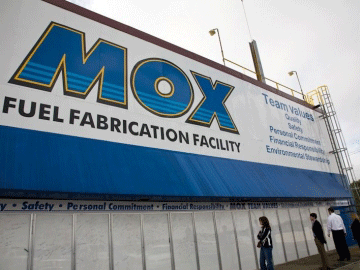 MOX injunction delayed until at least July 31 http://www.aikenstandard.com/news/mox-injunction-delayed-until-at-least-july/article_01a4ce3c-25f5-11e7-9f5c-8fd2c77c42e0.html By Michael Smith msmith@aikenstandard.com Apr 20, 2017
Experimental deep bore project under consideration
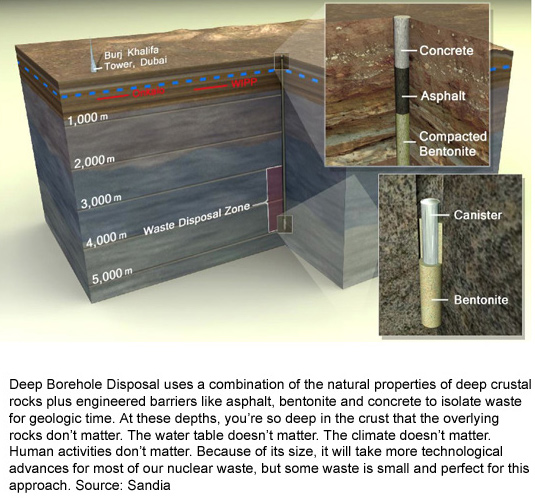 County commissioners weigh nuclear waste storage project http://www.wral.com/county-commissioners-weigh-nuclear-waste-storage-project/16647314/ ALAMOGORDO, N.M. — County commissioners in southern New Mexico are in debate over a federal project that aims to determine whether nuclear waste can be stored far underground.
The Otero County Commission discussed a proposed resolution in opposition of the project Thursday, but the panel decided to hold off on taking any action, The Alamogordo Daily News reported (http://bit.ly/2oaS2oL).
Commissioners say they have received comments from residents both for and against the project, which involves the drilling of narrow, vertical holes deep into the ground to test whether they can hold disposed nuclear material.
The U.S. Department of Energy is paying for the testing by New Mexico-based TerranearPMC and has said no nuclear waste will be involved.
Fred Stong, director of FIRST Robotics New Mexico, voiced his support for the project during Thursday’s meeting, saying he would like to see it continue because there are many residents who support science and technology.
“There is no waste in this program. This is a wonderful geographical opportunity,” Stong said. “Our job is to bring technology in, not drive away technology from this community.” But resident Bobby Jones said the federal government’s plan was too risky and he doesn’t “support the project because of what might happen afterwards.”
TerranearPMC CEO Kenneth Fillman said he shares residents’ concerns and an environmental assessment will be conducted before the company moves forward with the project.
The Otero County Commission meeting came the same day Harding County passed a resolution opposing a similar borehole project in neighboring Quay County.
Delay in Ontario Power Generation’s (OPG’s) planned underground storage facility for nuclear waste
 OPG nuclear waste site remains on hold, pending more studies http://www.ecolog.com/issues/ISArticle.asp?aid=1003960830&PC=EN&issue=04132017&utm_content=bufferc4714&utm_medium=social&utm_source=twitter.com&utm_campaign=buffer by Mark Sabourin EcoLog, 4/13/2017
Progress remains stalled on Ontario Power Generation’s (OPG’s) planned underground storage facility for nuclear waste following review of its latest submission to the Canadian Environmental Assessment Agency (CEAA). The CEAA has told OPG that the additional information it supplied at the CEAA’s request is not good enough and has asked for more about alternatives to OPG’s preferred site 680 metres below the surface and 1.2 km from the shore of Lake Huron.
The report and recommendation of the Joint Review Panel on the project have been on the desk of the federal Minister of Environment and Climate Change since May 2015. Though the report found that, with certain mitigation measures, the project was not likely to cause significant adverse environmental effects, it remains widely unpopular on both sides of the Canada-US border. The minister has so far avoided making a decision by requesting studies on technically and economically feasible alternative sites and an updated analysis of cumulative environmental effects of OPG’s recommended site.
OPG is proposing a deep geologic repository for low- and intermediate-level nuclear waste in a geologically stable rock formation 680 metres below the site of its Bruce nuclear power plant. According to OPG, the bulk of the waste, which is currently stored aboveground, will decay within 300 years, though a portion will remain radioactive for another 100,000 years. It argues that entombment deep below ground in geologically stable rock is the safest long-term option.
However, opponents argue that a site near the shore of one of the Great Lakes, the source of water for more than 40 million people, is the wrong choice.
Almaraz nuclear incident sparks calls for probe, halt to storage plan
Portugal news Online, BY TPN/ LUSA 12-04-2017 Environmental campaigners have called for an investigation into an unplanned stoppage at the nuclear plant at Almaraz, near the border with Portugal, while a member of the European parliament for Portugal’s governing Socialist Party said such incidents should prompt an “immediate halt” in the construction of a waste storage facility on the site.
“These incidents should prompt the Spanish authorities to immediately halt construction of the waste storage and to plan, in consultation with Portugal and the European Union, for the plant’s closure”, said EU MP Carlos Zorrinho, in a statement sent to Lusa News Agency.
While the incidents “are apparently without systemic risk (…) in the case of nuclear energy the precautionary principle and that of zero tolerance should apply”, he concluded.
Zorrinho’s comments came following an incident at the plant earlier this week, on Monday, when an unplanned stoppage occurred in one of the main pumps…….
In February, Spain and Portugal agreed to settle a dispute involving plans to build a nuclear waste storage facility at Almaraz with the help of European Union mediators.
That was after Portugal lodged a formal complaint because of Spain’s failure to carry out a full environmental impact study before advancing with the plan. http://www.theportugalnews.com/news/almaraz-nuclear-incident-sparks-calls-for-probe-halt-to-storage-plan/41642?utm_content=buffer6ac89&utm_medium=social&utm_source=twitter.com&utm_campaign=buffer
The Sahara’s little known nuclear wasteland
 In the Sahara, a Little-Known Nuclear Wasteland, “There’s nothing nuclear in what I do. It’s just rocks we dilute into powder.”, Catapult, Hannah Rae Armstrong Apr 12, 2017 Activist Azara Jalawi lives with her mother, a nomad; her daughter Amina, who watches Mexican soap operas and dates a local human trafficker; her son Doudou, nicknamed “Slim Shady,” and a lean girl, probably a slave, in the town of Arlit, Niger, a mining hub of about forty thousand set deep within the Tuareg Sahara, a slow-baking proto-Chernobyl, a little-known nuclear wasteland.
Around Arlit, prehistoric volcanoes and petrified forests rise from the sand. Beneath it lie the skulls of giant crocodiles who preyed on dinosaurs a hundred million years ago. Within the rocky plateaus are havens like the oasis at Timia, where orange, grapefruit, and pomegranate groves ripen and flower in the desert. For forty years, the French nuclear-energy giant Areva has mined uranium here, and milled it into yellowcake, the solid concentrate that is the first step towards enriching uranium for nuclear fuel or weapons. Three miles outside the town, fifty million tons of radioactive tailings—a waste byproduct containing heavy metals and radon—sit in heaps that resemble unremarkable hills. In strong winds and sandstorms, radioactive particles scatter across the desert. “Radon daughters,” odorless radioactive dust, blanket the town. Public health and the environment exhibit strange symptoms of decay—mysterious illnesses are multiplying; grasses and animals are stunted. The people of Arlit are told that desertification and AIDS are to blame. ………..
Living atop an open-pit uranium mine has made the people ill, in ways they do not understand. Breathing radioactive dust, drinking contaminated well water, and sleeping between walls stitched from radioactive scrap metal and mud, the people tell stories to fill the gaps in their knowledge. ………
At her brother Doudou’s high school, funded by the mining company, students are told not to do drugs or set things on fire. Teachers tell Doudou nothing about the contaminated well water he consumes daily. At lunch on my first day in Arlit, I ask nervously about the source of the water in a chilled glass bottle on the table. “Don’t worry, it’s the well water,” they assure me. “We drink it all the time.” I learn later that well water readings reveal contamination one hundred times beyond the World Health Organization’s threshold for potable water.
………. a dim awareness of the contamination risks was just beginning. Almoustapha Alhacen, a yellowcake miller and environmental activist, recognizes himself on the cover of a 2012 book I’ve brought with me: “Being Nuclear: Africans and the Global Uranium Trade.” He is the man wearing a gas mask and gloves. “The problem with Areva is it never informed people that radioactivity exists and that it is dangerous,” he says. An NGO called the Commission for Independent Research and Information on Radioactivity (CRIIRAD), created by a French EU deputy after the 1986 Chernobyl catastrophe, equipped him with a device and trained him to take readings. Once, he recalls, he saw a pregnant woman eating mud next to the road that leads from the mine to the town. This road is often tamped down with clay from the mines, and the tires that cross it regularly give it a fresh, invisible wash of radon. Almoustapha took a reading there and found radioactivity twenty-four times higher than the safe level. At markets selling scrap metal used for building houses, and at the community taps where people draw water, he took readings that were off the charts.
“Arlit was built around uranium. And humanity needs uranium,” Almoustapha says, speaking quickly and with rage. “But what happens next for us, when the uranium runs out, Areva leaves, and we are left with 50 million tons of radioactive waste?” As an activist, he ponders the future and the environment with seriousness. But these become abstract concerns before the fact of his job, which he needs right now. In a white turban and sunglasses, with sequined leather jewelry adorning his chest, he protests: “There’s nothing nuclear in what I do. It’s just rocks we dilute into powder, powder we dilute into liquid. It’s just mechanics, like for any car.” …….
If any state benefits from the distraction counter-terrorism provides from these underlying issues, it is France. Insecurity shields the mines from environmental scrutiny. Threats justify deepening militarization, an ongoing erosion of Nigerien sovereignty and independence. And the French mines still face no real obstacle to radiating the radiant desert. In fact, they’re expanding. A new mine—Africa’s largest—is being built near Arlit, at a site called Imouraren. There, a “security belt” encircles 100,000 acres, marking the land off limits to nomads.
https://catapult.co/stories/in-the-sahara-a-little-known-nuclear-wasteland#
Trump’s plans to revive Yucca nuclear waste dump idea
 Trump plans to revive nuclear waste plans axed by Obama in 2010 https://www.newscientist.com/article/2127269-trump-plans-to-revive-nuclear-waste-plans-axed-by-obama-in-2010/By
The Trump administration last month revived controversial plans to bury the US’s growing stockpile of highly radioactive spent fuel from nuclear power plants and weapons factories in tunnels dug into Yucca mountain in Nevada.
But, with local opposition to the plan axed by President Obama undimmed, scientists at the Department of Energy are already hedging their bets.
They are pursuing an alternative scheme to drop the hot radioactive waste down hundreds of deep shafts across the US, where it can mix with molten granite in the Earth’s crust. Next month, they are expected to announce the site for the first test drilling.
The US currently has some 79,000 tonnes of spent fuel in at least 76 power-station cooling ponds and secure dry stores across the country. Another 2000 tonnes are added each year. The stores contain an estimated 444,000 petabecquerels of radioactivity, which is some 50 times more than released from all atmospheric nuclear weapons tests.
“US spent fuel pools are densely packed and at severe risk of a fuel fire in the event of an earthquake or terrorist attack that drained cooling water from the pools,” says Edwin Lyman of the Union of Concerned Scientists in Washington DC.
Dry air-cooled stores are safer. The Nuclear Regulatory Commission says such stores could act as a stopgap for up to 160 years. But all agree that geological burial is eventually needed for waste that will be dangerous for tens of thousands of years. The question is where?
Desert fuel dump
Yucca Mountain, which is part of the former atomic weapons testing grounds in the Nevada desert near Las Vegas, has for 30 years been earmarked as the sole burial ground for spent fuel, the most dangerous radioactive waste. A tunnel was dug 500 metres into the mountain in the early 1990s.
The plan was to start taking spent fuel in 1998. But local opposition blocked the plan, and some geologists questioned its safety, warning of the risks of local volcanoes erupting magma into the storage tunnels and blasting radioactivity to the surface.
President Obama effectively abandoned the $100-billion project in 2010 by pulling funding for the licensing process. But he failed to find a replacement site, and Washington is already liable for an estimated $30 billion to compensate power companies for its failure to deliver a final burial ground for their waste fuel.
Last month, President Trump asked Congress to approve $120 million to resume licensing for Yucca Mountain. But the state’s governor and senators vowed to continue blocking the plan.
Quietly, since 2010 the Department of Energy (DOE) has established an alternative disposal route. The idea is to bury the spent fuel in hundreds of narrow shafts drilled 5 kilometres down into solid granite.
Up to 40 per cent of the US might have suitable bedrock, but the technique has still to be tested. In December, the DOE selected four companies to find somewhere with the right geology and local support for test drilling.
And last month, at a conference in Phoenix, Arizona, Tim Gunter, the DOE’s head of spent fuel management said he expected to announce a test site in May. One site being discussed is in granite bedrock beneath Haakon County in South Dakota. Others are in Texas and New Mexico.
Fergus Gibb of the University of Sheffield, UK, who first came up with the idea 15 years ago, says the radioactive waste would generate so much heat it would melt the surrounding rock and then slowly solidify into a ”granite coffin”. Yucca may soon be yesterday’s news.
Nuclear Decommissioning makes every other disaster in the post-war period pale into insignificanc
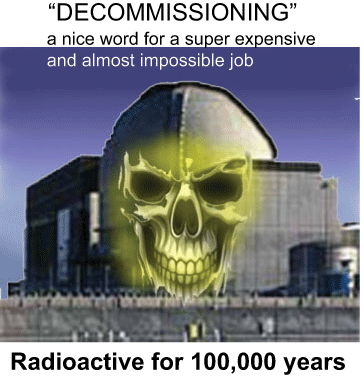
 nuClear News No.94 April 2017 The UK Government has been forced to pay nearly £100m in a settlement with two US companies – Energy Solutions and Bechtel – for mishandling the way it awarded a £6.1bn nuclear decommissioning contract. Ministers have ordered an inquiry headed by the former boss of National Grid to find out why the procurement process was so flawed. Labour said the payout showed “dramatic levels of incompetence”. The Nuclear Decommissioning Authority (NDA) will also terminate the contract it awarded for cleaning up the UK’s old Magnox reactor sites nine years early. The sites include Bradwell, Chapelcross, Hinkley A and Hunterston A. (1)
The High Court ruled last summer that the NDA had “manipulated” and “fudged” the tender process. It meant that the wrong company won the work to decommission 12 UK nuclear sites (10 Magnox sites plus Harwell and Winfrith). The move opens the door for other bidders to attempt to reclaim their bid costs, which could run to an additional £50m. The contract was awarded in 2014 to Cavendish Fluor Partnership, a joint venture between the UK’s Babcock International and Texas-based Fluor. However, the consortium cannot be asked to take on the extra work because that could increase potential compensation claims by companies that wrongly lost out in the tender. Some industry sources have complained that the government plumped for an unrealistically low bid for the work at the outset. Another losing bidder, UK Nuclear Restoration Ltd, which is a consortium of Amec Foster Wheeler, Atkins and Rolls-Royce, said that the settlement “raises serious concerns” about the procurement process and that it has raised the implications of the judgment with the government and the NDA. (2)
Former National Grid chief executive Steve Holliday has been appointed to lead an independent inquiry into what went wrong. The inquiry will look at how the mistakes were made and by who, how the litigation was handled, and the relationship between the NDA and the government departments. Holliday will publish an interim report in October. The government now has the daunting task of starting a new tendering process for the 12 sites, as the deal with Cavendish Fluor Partnership (CFP) will end early, in September 2019 instead of 2028. (3)
Babcock said in a statement the CFP, in which it has a 65% stake, has come to a mutual agreement with the NDA to bring to an end the contract at the end of August 2019, having operated the contract for a full five years. Babcock said it had become apparent that the work that needs to be done is now materially different in volume from that specified in the NDA’s tender, and this puts the contract at risk of a legal challenge. What those material differences are remains a mystery.
The Business Secretary, Greg Clark, said: “It has become clear to the NDA through this consolidation process that there is a significant mismatch between the work that was specified in the contract as tendered in 2012 and awarded in 2014, and the work that actually needs to be done. The scale of the additional work is such that the NDA board considers that it would amount to a material change to the specification on which bidders were invited in 2012 to tender.” (4)
The failure of the contract award process was “inevitable” according to nuclear power expert Dr Paul Dorfman, from University College London’s Energy Institute. “They were set up to fail and have failed because the understanding of costs and complexity to nuclear decommissioning is changing all the time,” he said. “Magnox reactors were thrown up in a rush to give electricity too cheap to meter and create plutonium and there was no thought of how they would be decommissioned. Each Magnox reactor is bespoke so decommissioning each one is different with its own complexities and challenges. The more we learn about dealing with the ‘back end’ of nuclear power, the more we see how complex and costly it is.” (5)
Stop Hinkley Spokesperson Roy Pumfrey said: “Why should anyone believe that this astonishing level of incompetence will suddenly end when we start to build new reactors? Just because Hinkley Point C is not a Magnox reactor doesn’t just suddenly make the industry competent.” (6)
The Daily Telegraph declared today “if we could, we would stop this madness … In committing to new nuclear, we seem to have joined a runaway train, with no hope of getting off. Has not the time finally arrived for a fully fledged rethink of the merits of Britain’s nuclear energy strategy?” (7)
Roy Pumfrey continued: “We agree – it is time to stop this madness. The UK’s nuclear decommissioning costs have increased from £55.8 billion in 2008 to £117.4 billion at the last count. Although EDF is required to set aside funds for decommissioning Hinkley Point C, this is only up to an agreed limit. The taxpayer will be on the hook for the all too predictable shortfall.”
Chris Huhne, former energy secretary for the coalition government, said the remit for the enquiry by Steve Holliday was not broad enough and it needed to look at the total cost of nuclear decommissioning. “It is a complete mess, it’s deeply embarrassing but it’s actually I’m afraid only the latest in a long line of embarrassments,” Huhne told BBC Radio 4. “We’re not even scraping the surface with the problem that this legal case has exposed.” Huhne, who was energy secretary between 2010 and 2012 and left the before the contract was awarded, said the cost of decommissioning the UK’s old nuclear fleet had increased £107bn in the last five years to £161bn. “In terms of industrial strategy this makes every other disaster in the post-war period pale into insignificance.” He said the problem stemmed from how early reactors stations were complex bespoke constructions made without consideration to how they would later be disassembled. “We ordered a whole series of Savile Row suits rather than a bunch of work-a-day Marks & Spencer suits… Every single one of those reactors is different. Even the fuel rods in every single one of those reactors are different – crazy.” (8) Huhne called on the government not to allow subsidies for new reactors. That was the coalition government policy. It should be the policy again but the government seems to be relenting – it’s opening the door to exactly a repetition of the sort of disaster that we see today. (9) http://www.no2nuclearpower.org.uk/nuclearnews/NuClearNewsNo94.pdf
Owners of the failed San Onofre nuclear plan agree to relocate radioactive waste from the San Diego County coastline.
 Edison agrees to negotiate new home for San Onofre plant’s nuclear waste. EIN NewsDesk, 7 Apr 17, Jeff McDonald,
Owners of the failed San Onofre nuclear plant agreed Friday to begin negotiations aimed at relocating tons of radioactive waste from the San Diego County coastline.
The announcement came in the form of a brief filed in San Diego County Superior Court, where a showdown hearing was looming next week between majority plant owner Southern California Edison and environmentalists who want the spent fuel shipped off-site.
The change of heart is significant for Edison, which has long said that storing 3.6 million pounds of nuclear waste on the grounds for decades to come is a safe and reasonable option.
Edison and San Diego attorney Michael Aguirre, who filed the lawsuit that led to the settlement negotiations, declined to comment beyond a single-page joint news release.
Advocacy groups opposed to the burial plan were thrilled with the announcement.
“That’s huge,” said Charles Langley of Public Watchdogs when told about the deal. “The fact that they are willing to consider moving it is an amazing situation.”
The mutual notice filed in court Friday requests that the judge postpone next week’s scheduled hearing at least until July to provide lawyers from both sides of the dispute time to work out a settlement……….
There was no word Friday on where the spent fuel may end up.
Possible locations include Palo Verde in Arizona, where Edison is part-owner of another nuclear plant; Nevada, where federal regulators have long planned a national repository; or one of a handful of proposed private dumps.
Edison is in the process of moving the San Onofre waste from climate-controlled pools to so-called dry cask storage — steel-lined canisters scheduled to be buried near the shuttered twin reactors north of Oceanside.
The company plans to complete the transfer by 2019 and return the leased property to the federal government as soon as possible.
The Citizens Oversight lawsuit sought an injunction against the Coastal Commission permit, arguing that the location was unsafe because more than 8 million people live within 50 miles of the site.
The plaintiffs also complained that the canisters are subject to leaks, saltwater intrusion, tsunamis and earthquakes. The storage devices Edison is planning to use have been certified by federal regulators for 20 years of use. Critics of the dry-cask plan note that radioactive waste remains dangerous for thousands of years……more http://world.einnews.com/article/375009931/Ps5PTUKu7YV1uQvl?lcf=QMQeMDaQotZLzLzMmdW3i1dNGT2MdIk5fPNm1KjmkUg%3D

EDF’s nuclear decommissioning – financial problems
Another month in UK’s failing new nuclear programme nuClear News No.94 April 2017 EDF Finances A French Parliamentary report from the National Assembly’s Commission for Sustainable Development and Regional Development says the clean-up of French reactors will take longer, be more challenging and cost much more than French nuclear operator EDF anticipates. Whereas Germany has set aside €38 billion to decommission 17 nuclear reactors, and the UK Nuclear Decommissioning Authority estimates that clean-up of UK’s 17 nuclear sites will cost between €109‒250 billion over the next 120 years, France has set aside only €23 billion to decommissioning its 58 reactors. In other words France estimates it will cost €300 million per gigawatt (GW) of generating capacity to decommission a nuclear reactor, Germany estimates €1.4 billion per GW and the UK estimates €2.7 billion per GW.
EDF says it wants to set aside a €23 billion fund to cover decommissioning and waste storage for an estimated €54 billion final bill ‒ and the difference between these two figures will be closed through the appreciating value of its equities, bonds and investments ‒ in other words, ‘discounting’. Unfortunately, recent experience has taught us that markets can go up and down over time ‒ especially the very long-time periods involved in radioactive waste management. But for a company that has huge borrowings and an enormous debt of €37 billion, €23 billion is a large sum of money to find. Any significant change in the cost of decommissioning would have an immediate and disastrous impact on EDFs credit rating ‒ something that the debt-ridden corporation can simply not afford. EDF is already in financial trouble. Along with bailing out collapsing AREVA, EDF also has to bear the huge financial burden of the failing reactor newbuild at Flamanville. It will also have to pay for extending the life of France’s existing nuclear power stations (to 2025), at a cost of €55 billion.
On top of all this the French authority tasked with disposal of all the countries vast and increasing waste burden (Andra) has recently ramped up the estimated cost for the planned national nuclear waste repository at Cigéo, to €25 billion ‒ and EDF must pay for most of Cigéo’s construction. Although €5 billion more than EDF anticipated, it still seems a gross underestimation, and the costs are likely to rise considerably. (21) http://www.no2nuclearpower.org.uk/nuclearnews/NuClearNewsNo94.pdf
Monsanto’s slag dumping: hazardous chemicals and rdaioactive wastes

Monsanto’s Superfund Secret https://www.dissentmagazine.org/online_articles/monsanto-roundup-production-superfund-sites-radioactive Bart Elmore April 1, 2017 The world’s most widely used herbicide, Roundup, has faced intense scrutiny in recent weeks, since documents surfaced revealing a close relationship between Monsanto, the creator of Roundup, and EPA officials tasked with regulating herbicide use in the United States. One email exchange included a Monsanto executive boasting that an EPA official had told him he “should get a medal” if he could “kill” an agency investigation into the herbicide.
This news was troubling, considering the fact that the World Health Organization recently declared Roundup’s active ingredient “probably carcinogenic to humans.” The 2015 WHO announcement raised major alarms because roughly 89 percent of American corn and over 90 percent of all soybeans produced in the United States—millions of tons of which are exported every year to dozens of countries around the world—are genetically engineered to be herbicide resistant, Roundup Ready being a preferred variety. These findings gave new scientific fodder to many GMO opponents who have long alleged that the world’s food supply is awash in dangerous chemicals.
But while new emails raise serious questions about the safety of consuming food contaminated with Roundup, historical documents reveal troubling issues further upstream. I obtained files from the EPA via a Freedom of Information Act request that tell the story of Roundup’s origins at a Superfund hazardous waste site. These documents show that there are disturbing environmental and human health concerns at the beginning, not just at the end, of Roundup’s lifecycle.
Monsanto’s weedkiller comes from beneath the soil. The active ingredient in Roundup is glyphosate, which is ultimately derived from elemental phosphorous extracted from phosphate rock buried below ground. Monsanto gets its phosphate from mines in Southeast Idaho near the town of Soda Springs, a small community of about 3,000 people. The company has been operating there since the 1950s.
I went to visit last summer, and what I found was startling. I stood just beyond a barbed-wire fence at about nine o’clock at night and watched as trucks dumped molten red heaps of radioactive refuse over the edge of what is fast becoming a mountain of waste. This dumping happened about every fifteen minutes, lighting up the night sky. Horses grazed in a field just a few dozen yards away, glowing in the radiating rays coming from the lava-like sludge. Rows of barley, for Budweiser beer, waved in the distance.
When phosphate ore is refined into elemental phosphorous, it leaves a radioactive by-product known as slag. Monsanto’s elemental phosphorous facility, situated just a few miles from its phosphate mines, produces prodigious quantities of slag that contains elevated concentrations of radioactive material. For years, this slag was actually sold to the town of Soda Springs and nearby Pocatello, and people built their homes and roadways out it. In the 1980s, however, the EPA conducted a radiological survey of the community and warned that citizens might be at risk from elevated gamma ray exposure. The study concluded that if business continued as usual in Soda Springs, within four decades “the probability of contracting cancer due to exposure from elemental phosphorous slag” would “be about one chance in 2,500 in Pocatello and one chance in 700 in Soda Springs.”
The EPA, facing serious pressure from Monsanto and community members who feared what this study might mean for property values, later agreed to submit the report for review, and ultimately recommended the initiation of new studies. In the meantime, the mayor of Soda Springs worked with the city council to ban the further sale of slag in the community.
I spoke with a radiological scientist who studied the slag issue in the area for many years, and he assured me that homeowners in Southeast Idaho are exposed to only small levels of gamma radiation that should not be harmful—currently the EPA’s official position.
Nevertheless, a website created by the Phosphorous Slag Technical Work Group—a coalition that includes Monsanto, EPA officials, local public health agents, and other mining concerns—offers advice to Idahoans, including the helpful tip that if dangerous contamination is found, homeowners might consider “spending less time in the basement.”
Monsanto’s Soda Springs plant is currently an active Superfund site, having achieved that toxic waste site designation in 1990. Harmful onsite pollutants include cadmium, selenium, and radioactive radium all of which can cause serious health problems in humans in high concentrations.
In 2013, over two decades after EPA declared Monsanto’s Soda Springs plant a Superfund site, the EPA explained that pollution problems continued to plague the facility: “The remedy for the Monsanto site is currently not protective because concentrations” of “contaminants of concern” continued to leach into groundwater. In a five-year review of the site, the EPA found that some harmful chemicals were increasing in plumes migrating from the plant. The agency offered a disheartening conclusion: “Monitoring trends indicate that the groundwater performance standards will not be met in the foreseeable future.” This was the last five-year review of the site to date. Currently, the EPA’s website for the facility reports that groundwater contamination is “not under control” even as elemental phosphorous production continues.
In the past, Monsanto has also had elevated levels of mercury emissions at the plant. Citing an EPA study, Keith Riddler of the Associated Press reported that in 2006 “about 684 pounds of mercury was emitted in [Idaho], 659 of that from Monsanto Co.’s Soda Springs phosphate processing plant in eastern Idaho.” In 2015, the company reported mercury compound emissions topping 875 pounds. For context, the third- and fourth-largest emitters of mercury compounds among power plants in the United States—which the Obama administration targeted for serious mercury emissions reductions under the Clean Power Plan—put out 823 pounds and 782 pounds respectively in 2013.
Toxic chemicals are not confined to Monsanto’s processing facility. In 2003, the EPA began Superfund remediation assessments at three closed Monsanto mine sites nearby—Ballard, Henry, and Enoch Valley—due in large part to selenium contamination in mining debris.
According to the U.S. Government Accountability Office, since 1996, “an estimated 600 head of livestock (including horses, cattle, and sheep) have died after ingesting plants or surface water containing high concentrations of selenium.” Some of these incidents took place at mine sites owned by other phosphate companies in the area, such as FMC, but Monsanto mines have contributed to this casualty count over the years.
Radioactive waste piles, groundwater pollution, mercury emissions, and poisoned livestock: these are just some of the supply-side costs of producing Roundup, an herbicide that Monsanto dubs the lynchpin of its “environmentally responsible weed control program.”
The prospects for resolution of these problems are bleak. President Trump’s EPA administrator, Scott Pruitt, is an avowed adversary of the agency he now heads, and he has given clear signs that he intends to annul regulations designed to curb polluting practices. If the EPA’s relationship with corporations like Monsanto was already cozy, it is likely only to become more so. In other words, Monsanto is not likely to face renewed federal pressure to clean up its act anytime soon.
As Monsanto looks to seal a multibillion-dollar merger with German rival Bayer, its power to spread Roundup around the world is due to expand in the years ahead. And if the past is any indication, Monsanto’s message to the world will be one of agricultural salvation through biotechnology. But communities that are the target of these corporate promises should take heed. The sustainable future Monsanto hawks remains tied to a toxic Superfund past that is not even past.
Bart Elmore is an assistant professor of environmental history at the Ohio State University and a Carnegie Fellow at New America.
Cover-up of America’s nuclear waste disaster: Hanford, Oak Ridge, Los Alamos, Westlake…
Hanford, Oak Ridge, Los Alamos and West Lake provide only a snapshot of the wider picture. Consider the Rocky Flats Plant, a former nuclear weapons production site not far from Denver, Colorado.
 “It’s a Cover-Up, Not a Clean-Up”: Nuclear Waste Smolders in Sites Across the US truth Out March 30, 2017 By Daniel Ross, Truthout | Report Renowned wartime journalist Wilfred Burchett described the damage from the atomic bomb that flattened Hiroshima as “far greater than photographs can show.” When it comes to the enduring legacy of the Manhattan Project on home soil, the damage to the environment and human health is proving similarly hard to grasp.
The covert project to create the world’s first atomic weapon during WWII, coupled with the nuclear proliferation of the Cold War era, has left a trail of toxic and radioactive waste at sites across the nation that will necessitate, by some margin, the largest environmental cleanup in the nation’s history. The amount of money that has been poured into remediating the waste already is staggering. Still, it appears that the scale of the problems, and the efforts needed to effectively tackle them, continue to be underestimated by the authorities responsible for their cleanup.
Since 1989, the Department of Energy’s (DOE) Office of Environmental Management — the agency charged with cleaning up “legacy” radioactive waste — has spent over $164 billion disposing of nuclear waste and contamination, completing the cleanup at 91 of 107 sites across the country. And yet between 2011 and 2016, the DOE’s Environmental Management environmental liability grew by roughly $94 billion.
Though the president’s proposed 2018 budget siphons $6.5 billion into the DOE’s Environmental Management program, up slightly from $6.2 billion this year and last, that figure is still below the roughly $8.5 billion (after adjustment for inflation) the program received in 2003. It is also well below the amount required to effectively meet urgent issues head on, said Don Hancock, director of the Nuclear Waste Program at the Southwest Research and Information Center……..
The fight over what the final budget will look like has only just begun. But beyond these hovering questions marks is something much more concrete: the sheer magnitude of the legacy waste problem, which can be traced all the way back to that game-changing atomic project of the 1940s.
Hanford: Beset With Costly Overruns Continue reading
Nevada’s determined fight against plan for Yucca Mountain nuclear dump
Decades-old war over Yucca Mountain nuclear dump resumes under Trump budget plan, LA Times, Ralph Vartabedian, 29 Mar 17 An abandoned tunnel in the desolate Nevada desert, barricaded only by a chain-link fence, is all that remains of the nation’s tortured effort to create a permanent repository for nuclear waste 100 miles northwest of Las Vegas.
After spending $11 billion, the Energy Department met with unrelenting opposition from Nevada and was forced to shut down the program at Yucca Mountain — the only remotely viable option for storing tons of deadly waste that currently has nowhere to go — in 2010……..
At an estimated cost of $100 billion, the Yucca Mountain nuclear waste dump would rival the International Space Station in cost and complexity, requiring construction of roughly 300 miles of new railroad tracks to transport the waste, development of advanced robots to work underground and fabrication of special titanium shields to keep the waste intact for, it is hoped, hundreds of thousands of years.
The $120 million outlined by Trump this month in his budget blueprint would restart the ponderous licensing process that was abandoned by the Obama administration and begin plans for a temporary storage facility at an undetermined location…….
Nevada officials have put every ounce of their political muscle into stopping the dump…….The state is quickly gearing up for a new fight, readying new legal strategies and pushing a resolution through the state Legislature.
“The Trump administration’s attempt to revive Yucca Mountain is naive and a waste of taxpayer dollars,” said Sen. Catherine Cortez Masto (D-Nev.), who successfully fought off the Energy Department for years when she was the state’s attorney general. “It is a nonstarter.”
Cortez Masto said the state is united against the dump across party lines, including Republican Gov. Brian Sandoval, another former attorney general……..
Nevada has filed some 300 legal “contentions” against the Energy Department’s license, each of which must be examined by a special board. The state is swinging into action to file even more contentions if the license action is resumed, said Robert Halstead, chief of the state’s nuclear office.
“They think because Reid is gone, this will be a cakewalk. Wrong,” Halstead said. “I see them going through a licensing procedure that will cost $1.5 billion and take five years, with a 50% chance of success.”……
The Energy Department’s failure to keep its promise to move forward with a disposal project, even while it collected the money, has created a swamp of litigation.
Most of the nation’s commercial reactors, including the shuttered San Onofre plant in northern San Diego County, are located on rivers, lakes and oceans — a risky location for storing highly radioactive fuel rods. And much of the nation’s nuclear weapons waste, which could also end up at Yucca Mountain, is stored in leaky tanks and steel drums.
The nation’s nuclear utilities have won judgments and settlements of $6.1 billion, arguing that the government’s failure to take the waste has increased their storage and operation costs, said Jay Silberg, an attorney representing the industry. And the Energy Department has projected that it may be liable for up to $25 billion more…….http://www.latimes.com/local/california/la-na-yucca-revival-20170329-story.html
Demolition of McCluskey Room at Hanford’s Plutonium Finishing Plant
Workers demolish site of nuclear mishap in Washington state , San Franciso Chronicle, NICHOLAS K. GERANIOS, ASSOCIATED PRESS, March 30, 2017, SPOKANE, Wash. (AP) — Workers at the Hanford Nuclear Reservation in Washington state have finished demolishing the site of a famous nuclear accident during the Cold War that exposed a man to the highest dose of radiation from the plutonium byproduct americium ever recorded, the U.S. Department of Energy announced Thursday.
Concern about nuclear waste shipments to South Carolina
Among the materials with no disposition plan include weapons-grade plutonium, depleted uranium oxide, highly enriched uranium and heavy water.
Specifics about the quantity and timetables were redacted from the report. Lastly, the DOE report states that there is no disposition path for surplus plutonium stored at K-Area.
The DOE’s short-term strategy of continuing nuclear shipments to SRS runs counter to South Carolina’s long-held aversion to the state becoming a dumping ground for nuclear waste.
 More nuclear shipments to Savannah River Site likely, report says http://www.aikenstandard.com/news/more-nuclear-shipments-to-savannah-river-site-likely-report-says/article_4a380b86-13db-11e7-87c8-c3869ab88afe.html By Michael Smith msmith@aikenstandard.com Mar 28, 2017 Shipments of plutonium and other nuclear materials are expected to continue to the Savannah River Site in Aiken County for the foreseeable future, according to government records released by a watchdog group.
Nuclear decommissioning debacle is costly for Britain
UK nuclear decommissioning debacle costs government nearly £100m
Business secretary orders inquiry into flawed tendering process for dismantling old reactors at 12 sites as US firms get paid for out of court settlement, Guardian, Adam Vaughan, 27 Mar 17, The government has been forced to pay nearly £100m in a settlement with two US companies for mishandling the way it awarded a £6.1bn nuclear decommissioning contract.
Ministers have ordered an inquiry headed by the former boss of National Grid to find out why the procurement process was so flawed. Labour said the payout showed “dramatic levels of incompetence”.
The government body tasked with decommissioning old reactors will also terminate the contract it awarded for cleaning up a dozen of the UK’s old nuclear sites nine years early……..
The government now has the daunting task of starting a new tendering process for the 12 sites, as the deal with Cavendish Fluor Partnership will end early, in September 2019 instead of 2028…….
The contract is being terminated early because the NDA underestimated the scale of the decommissioning required to clean up the Magnox sites, which form part of the UK’s first generation of nuclear power stations.
The share price of Babcock International Group, which has a stake in the Cavendish Fluor Partnership, has fallen by more than 3% since the government announcement…….
The NDA has an annual budget of £3.1bn, two thirds of which is spent on Sellafield in Cumbria, which stores most of Britain’s nuclear waste. https://www.theguardian.com/business/2017/mar/27/uk-nuclear-decommissioning-debacle-costs-government-100m
1 This Month


31st January – Challenging the War Machine – a DECLASSIFIED UK SUMMIT



Website of the Week
Now until to February 10, 2026 Radioactive waste storage in France: the debate is finally open! How to participate?
-
Archives
- January 2026 (220)
- December 2025 (358)
- November 2025 (359)
- October 2025 (377)
- September 2025 (258)
- August 2025 (319)
- July 2025 (230)
- June 2025 (348)
- May 2025 (261)
- April 2025 (305)
- March 2025 (319)
- February 2025 (234)
-
Categories
- 1
- 1 NUCLEAR ISSUES
- business and costs
- climate change
- culture and arts
- ENERGY
- environment
- health
- history
- indigenous issues
- Legal
- marketing of nuclear
- media
- opposition to nuclear
- PERSONAL STORIES
- politics
- politics international
- Religion and ethics
- safety
- secrets,lies and civil liberties
- spinbuster
- technology
- Uranium
- wastes
- weapons and war
- Women
- 2 WORLD
- ACTION
- AFRICA
- Atrocities
- AUSTRALIA
- Christina's notes
- Christina's themes
- culture and arts
- Events
- Fuk 2022
- Fuk 2023
- Fukushima 2017
- Fukushima 2018
- fukushima 2019
- Fukushima 2020
- Fukushima 2021
- general
- global warming
- Humour (God we need it)
- Nuclear
- RARE EARTHS
- Reference
- resources – print
- Resources -audiovicual
- Weekly Newsletter
- World
- World Nuclear
- YouTube
-
RSS
Entries RSS
Comments RSS
 nuclear-news