On May 9, workers discovered a 20-foot-diameter hole where the roof had collapsed on a makeshift nuclear waste site: a tunnel, sealed in 1965, encasing old railroad cars and equipment contaminated with radiation through years of plutonium processing. Potential radiation levels were high enough that some workers were told to shelter in place while others donned respirators and protective suits as they repaired the hole.
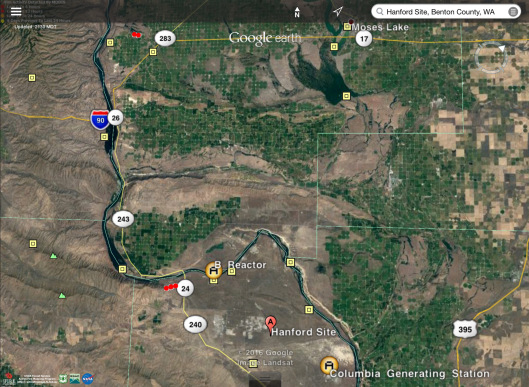
The Hanford complex, which dates back to 1943, produced the plutonium for the atomic bomb dropped on Nagasaki. Half the size of Rhode Island, it is often described as the most contaminated place in the United States. Until its last reactor closed in 1987, it churned out plutonium for the roughly 70,000 nuclear weapons the United States built during the Cold War. As the historian Kate Brown documents in her book Plutopia, which explores the uncanny similarities between Hanford and its Soviet counterpart Ozersk, Hanford has been a slow-motion environmental disaster since its opening, constantly excreting radioactive contaminants into the air and water.
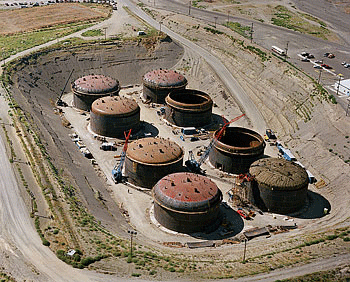
More dangerous than the tunnels are the giant tanks of liquid nuclear waste: 177 of them containing 56 million gallons of radioactive soup whose composition is only approximately known. The contents of some have to be stirred periodically to prevent the formation of hydrogen bubbles that would cause the tanks to explode. One million gallons of this witches’ brew have already leaked into the groundwater from tanks that were built to last only 20 years. The US government projects that it will cost more than $107 billion to clean up the site, with remediation finished by 2060. Few knowledgeable people put much credence in either number. Continue reading →
Climate Change Could Uncover An Abandoned Arctic Nuclear Base, HuffPost Canada | By Sarah Rieger, 05/25/2017
Climate change is causing record levels of ice to disappear from the Arctic, and the melt is unearthing something that was supposed to stay buried for centuries — an abandoned U.S. nuclear base.
The US army’s top secret arctic city Under the Ice! “Camp Century” Restored Classified Film
Camp Century was built in Greenland in 1959 during the peak of the Cold War. The subterranean base held between 85 and 200 soldiers year-round. The base was built under the pretense that it would be a centre for scientific experiments on the icecap and a space to test construction techniques in Arctic conditions.
The base was really part of “Project Iceworm,” a top secret U.S. army program that intended to build a network of missile launch sites under the ice sheet.
The camp was essentially a small town under the ice. When abandoned in 1967, the trenches and buildings — including houses, a town store and even a hospital — were left behind, too.
The engineers stationed there also abandoned a nuclear generator that was “minimally” decommissioned, as they assumed it would be “‘preserved for eternity‘ by perpetual snowfall,” according to a 2016 study by Geophysical Research Letters. Other than the nuclear reaction chamber, all of the infrastructure and nuclear waste at the site was left intact.
The researchers weren’t totally off-base with their belief that the site wouldn’t melt. The camp was established on what’s known as the “dry snow zone” of the Greenland ice sheet, where almost no surface melting was known to occur at the time.
According to NASA’s Earth Science Communications Team, geoscientists in the ’60s believed that the climate could only change on a large timescale, over thousands of years. It wasn’t until 1979 that it was proven that increased carbon dioxide in the atmosphere would result in significant negative changes to the earth’s climate.
Climate change is hitting the Arctic hard. Surface ice melt in Northern Canada grew by 900 per cent between 2005 and 2015, a recent study found, and melting glaciers have begun to release pollutants like DDT and PCBs into the environment.
Hanford Nuclear Cleanup Budget Slashed in Energy Proposal, Bloomberg Business, By Chuck McCutcheon, 25 May 17Washington state’s Hanford Nuclear Reservation, scene of a recent collapse of a tunnel containing nuclear waste, would see its funding slashed under President Donald Trump’s new budget proposal…..
Trump’s budget blueprint calls for reducing cleanup at Hanford from $921 million to $716 million, a 22 percent reduction. That comes as the budget proposes to boost overall departmental defense-related environmental cleanup of materials from $5.28 billion to $5.54 billion.
Hanford Cleanup Needed
Washington state’s congressional delegation, including Democratic Sens. Patty Murray and Maria Cantwell, long have pressed various administrations to commit to cleaning up Hanford. The site in eastern Washington has milllons of gallons of highly radioactive wastes stored in 177 aging underground tanks, some of which have leaked.
“Previous administrations and Congress have repeatedly supported the legal and moral obligation of the federal government to clean up the Hanford site, and we urge you to continue this important work to protect health and safety,” the two senators and Rep. Dan Newhouse (R-Wash.) said in a May 19 letter to Perry.
The Hanford tunnel, containing radioactive wastes that were byproducts of producing plutonium for nuclear weapons, partially collapsed on May 9, prompting nearby workers to evacuate. A worker’s clothing also was exposed to radioactive contamination in what Washington Gov. Jay Inslee (D) called an “alarming incident.”…. https://www.bna.com/hanford-nuclear-cleanup-n73014451452/
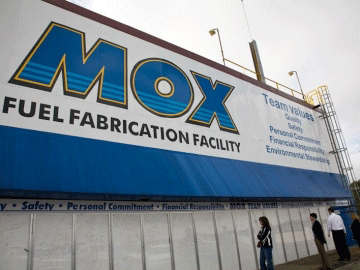
Platts 23rd May 2017 The Trump administration is proposing to end construction of a facility deigned to convert 34 mt of plutonium from surplus nuclear weapons to nuclear reactor fuel, concluding it would “be irresponsible to pursue this approach when a more cost-effective alternative exists.”
The administration, which Tuesday unveiled its proposed fiscal 2018 budget, said it will direct CB&I Areva MOX Services to develop a plan “as soon as practical,” to halt construction of the Mixed Oxide Fuel Fabrication Facility at the Savannah River Site in South Carolina and securely shut the facility by late 2018.
The 2018 fiscal year starts October 1. Congress must authorize and appropriate fiscal 2018 spending and the president must sign the budget bill. The $340 million that Congress appropriated in an omnibus budget resolution for fiscal 2017 was earmarked primarily for the installation of ductwork and to seal openings in the facility used during
construction.
The fiscal 2018 proposal states appropriations for the MOX project after this fiscal year are “to be determined,” with no dollar amount specified. A justification for terminating the MOX project that the US Department of Energy provided Tuesday noted that the facility’s $4.8 billion cost projected in 2007, with a startup date of 2015, had ballooned
to $17.2 billion by 2016, with 2048 the earliest date, by which mix-oxide fuel could be produced. DOE now estimates the completion cost at up to $26 billion.
DOE noted that analysis it and “external independent analyses” have conducted “have consistently concluded that the MOX approach to plutonium disposition is significantly costlier and would require a much higher annual budget than an alternate disposition method, ‘Dilute and Dispose.'” https://www.platts.com/latest-news
How To Dismantle A Nuclear Weapon, Gizmodo, Terrell Jermaine Starr and Jalopnik, May 24, 2017 “…..Getting Rid Of Plutonium Is Harder
For one, there is no civilian use for plutonium in the United States because you can’t break it down or blend it. In other words, it is always ready to be used for weapons. In fact, according to Live Science, of its five common isotopes, only plutonium-238 and plutonium-239 are used for anything.
Pu-238 is used for powering space probes and Pu-239, the isotope we’re talking about, goes through a fission chain reaction when concentrated enough. And when that process takes place, it is nuke-ready.
By the way, Plutonium is pretty damn radioactive and contains the “worst kind of fission byproducts that could enter the environment as a result of the Fukushima nuclear disaster,” as Live Science notes (emphasis ours):
According to the Environmental Protection Agency, plutonium enters the bloodstream via the lungs, then moves throughout the body and into the bones, liver, and other organs. It generally stays in those places for decades, subjecting surrounding organs and tissues to a continual bombardment of alpha radiation and greatly increasing the risk of cancer, especially lung cancer, liver cancer and bone sarcoma.
There are documented cases of workers at nuclear weapons facilities dying within days of experiencing brief accidental exposure to plutonium, according to the Hazardous Substances Data Bank.
Furthermore, among all the bad things coming out of Fukushima, plutonium will stay in the environment the longest. One isotope of plutonium, Pu-239, has a half-life of 24,100 years; that’s the time it will take for half of the stuff to radioactively decay. Radioactive contaminants are dangerous for 10 to 20 times the length of their half-lives, meaning that dangerous plutonium released to the environment today will stick around for the next half a million years.
That is why Japan’s reported goal to use plutonium for civilian reactors have the U.S. and China worried. At one point, Japan had around 10 tons of unseparated plutonium in-country; 37.1 tons are in France and the United Kingdom. China fears Toyko could possibly use the plutonium to develop nuclear weapons, although the Japanese did give up 331kg of it in 2016.
Collina said it’s a good thing the U.S. has no plans to use plutonium for civilian purposes.
“You can’t blend down plutonium,” he says. “It’s always weapons-usable. So if you use this stuff at nuclear power plants, you’re basically spreading weapons-usable nuclear material all around. It’s a proliferation problem because we don’t want to set the example for other nations to say, ‘I’m going to use plutonium in my civilian power program’ and therefore create a cover for a secret weapons program. We want to have a pretty clear line that says, ‘Plutonium is only used for weapons and you should not use plutonium if you’re not using it for weapons.'”
As for actually getting rid of plutonium, the process is not environmentally friendly and it never will be. Most of the plutonium that is separated from nukes is stored at the Savannah River Site (SRS), near the Georgia border. Plutonium is also stored at the Pantex Plant. It’s authorised to store 20,000 plutonium pits; current estimates find that 14,000 are stored in the facility.
But here’s the catch: you can never make it truly safe, and no one wants it near them. For example, the Department of Energy, through the Nuclear Regulatory Commission, is currently overseeing construction of a facility at SRS to make MOX fuel from weapons-ready plutonium. It would then be used for commercial use.
The problem is that no one wants plutonium storage facilities in their backyards. The American ambassador to the United Nations, Nikki Haley, expressed concerns over the MOX fuel initiative when she was governor of South Carolina. Her issue was that the feds were supposed to remove a ton of plutonium from the state by January 2016 and ship it to another facility in New Mexico or process it for commercial use through the facility; neither happened, so she sued the Department of Energy. A federal circuit court dismissed the case.
Officially, MOX fuel is not being used in the United States, according to the Nuclear Regulatory Commission. Europe uses MOX fuel, but its plutonium is from spent nuclear fuel rather than nuclear weapons.
Former Nevada Senator Harry Reid resisted the Yucca Mountain Nuclear Waste Repository project, which was supposed to be a deep geological repository storage facility for spent nuclear fuel and radioactive waste like Pu-239. Under the Nuclear Waste Policy Act amendments of 1987, the Yucca Mountains were supposed to be the key destination for storing this waste, but Reid worked with Obama to end funding for the project.
Where To Send It?
So, if no one wants plutonium in their backyard here on planet earth, where can it be disposed? Well, there have been a bunch of wild ideas, like blasting it into the sun. Which, as the video below explains, is a pretty bad idea.
Hitting the Sun is HARD
You also have to factor in the possibility the space ship won’t make it to orbit. “Space shuttles crash,” Collina said. “So if you had just one crash with a space shuttle full of plutonium, that would ruin your whole day.”
Beachfront Nuclear Wasteland in Southern California? Nuclear storage plan at San Onofre beach leaves out tribal voices, Indian Country Today Dina Gilio-Whitaker • May 15, 2017
A controversial plan to temporarily store more than three million pounds of spent nuclear fuel 100 feet from one of Southern California’s most popular beaches, San Onofre, is meeting with fierce resistance from local communities, including tribal members. The problem for the Native population is that while the formal decision-making process systematically involved a wide variety of stakeholders including local and state governments, community groups, environmentalists, academics, military, and business, education, and labor leaders, tribal governments were excluded.
The Backstory
Halfway between Los Angeles and San Diego, and with eight million people living within a 50-mile radius, the San Onofre Nuclear Generating Station (SONGS) looms above what is otherwise a pristine stretch of coastline. It is surrounded by San Onofre State Park, one of the state’s busiest parks, which sits within the Camp Pendleton Marine Base. San Onofre is the traditional territory of the Acjachemen people, who know the area as Panhe. Prior to colonization, San Onofre was also territory shared by the San Luis Rey Band of Mission Indians (Luiseño). Both are state-recognized tribes. All these factors mean there are many different people with strong opinions about nuclear waste storage near their communities.
The aging “nuke plant,” as local residents call it, is owned primarily by Southern California Edison, and was permanently shut down in 2013 after a discovery that it was leaking radioactive gas. It is scheduled for full decommissioning; at issue is how and where to store the accumulated radioactive waste in the short term before a long-term plan can be worked out.
“To the best of our knowledge, our tribal government was never contacted by Edison,” Rebecca Robles, Acjachemen tribal member and co-director of the United Coalition to Protect Panhe, told ICMN. Other local tribal leaders declined to comment……
Spent fuel rods currently stored in cooling pools in SONGS’ two reactors need to be removed to dry storage, which according to studies is safer. SONGS planned to move more than 100 steel casks encased in concrete containers and bury them onsite just 100 feet from the high-tide mark in an area already plagued by erosion. In addition, ocean levels at that site are rising faster than expected, according to a recent study by the U.S. Geological Survey. Google Earth images highlight the reason that residents are so alarmed by the location of the storage, as the San Diego Union-Tribune reported.
With increased awareness of the issue has come increased public criticism. Critics believe burying the waste so close to the beach in an earthquake-prone region is a recipe for disaster, in light of the 2011 Fukushima catastrophe, according to the Orange County Register.
They also believe that the 5/8-inch steel casks that SONGS plans to use are far too flimsy, according to a report by the citizen group San Onofre Safety.
Because SONGS is in the coastal zone it is subject to California Coastal Commission rules, and was granted a permit by the commission to temporarily store the waste for 20 years. In November 2015 the community watchdog group Citizen’s Oversight filed a lawsuit against the Coastal Commission, demanding that the permit be revoked and another site found, Reuters reported. Citizen’s Oversight and the state are now negotiating a settlement, Fox 5 News reported on April 7.
Decisions Made Without Tribal Input……. State law AB 52 requires consultation with tribal governments before it issues permits for development-related projects, prompting questions about why local Native nations weren’t consulted in this case……
It remains to be seen if or how the lawsuit negotiations will affect the location of the waste storage site. No matter what happens, however, this is only the beginning stage of the interim storage at SONGS and there will be a need for the Community Engagement Panel for years to come to monitor the issue. That means there is still plenty of reason for a tribal appointment.https://indiancountrymedianetwork.com/news/environment/beachfront-nuclear-wastelandsouthern-california/
Rod Ewing also told the Spokane Spokesman-Review it was “surprising” that mounds of dirt and pressure-treated timber were used to address the problem.
“How can waste be left in a tunnel? Whose idea was that?” Ewing said in an interview with the newspaper. “I’ve been to Hanford many, many times for conferences and things like that, and I don’t recall anyone saying that there was waste in tunnels underground. I can’t imagine why that would be the case.”
On May 9, part of a railcar tunnel collapsed near the Plutonium Uranium Extraction Plant. U.S. Department of Energy officials have claimed there was no release of radioactive materials.
The Hanford Nuclear Reservation is 400 kilometres southeast of Vancouver, B.C.
On a site the size of the City of Seattle, it has 56 million gallons of untreated nuclear waste left over from the U.S. nuclear-weapons program.
The video below explains the scope of the problem and why it should be of concern.
The Waste That Remains From Arming Nuclear Weapons
“The current unfolding crisis at Hanford, the bursting barrel at Waste Isolation Pilot Plant (WIPP) in New Mexico in 2014, and the exploding radioactive waste dump in Beatty, Nevada in 2015, show that radioactive waste management is out of control,” Kevin Kamps, radioactive waste watchdog at Beyond Nuclear, said in a news release earlier this week.
Beyond Nuclear notes that the Hanford site was part of the Manhattan Project and was a “major supplier of military plutonium”.
“It houses 177 storage tanks containing liquid radioactive sludges, some of which have been leaking radioactive effluent that could eventually threaten the Columbia River,” the group states on its website. “Cleanup at the site did not begin until 1989.”
According to Beyond Nuclear, the Hanford tunnel collapse may have been caused by vibrations from nearby road works.
The Centre for Public Integrity pointed out on its website that a 2015 report noted that this tunnel “had been seriously weakened and that a ‘partial or complete failure’ could expose individuals even 380 feet away to dancerous levels of radiation”.
“No action was taken by the department in response, and earlier this month—the precise date remains uncertain because conditions at the site were not closely monitored—a portion of the roof collapsed at the tunnel, creating a 20-foot square hole,” wrote Peter Cary and Patrick Malone. “Afterwards, the managers of the Hanford site were forced on May 9 to order 3,000 workers to shelter indoors. But instead of shoring up the beams inside the tunnel in question, they poured in 54 new truckloads of dirt.”
The U.S. government is spending US$2 billion per year on a clean-up operation that’s not expected to be finished for another 75 years.
But the lifespan of rail car tunnels designed to temporarily store radioactive material is much shorter than the half-life of the waste itself, as witnessed by the 20-by-20-foot hole that was spotted above one of the caverns on Tuesday morning.
The two tunnels were built more than 50 years ago as a stopgap measure. Today, there is still no permanent solution as the cleanup drags on, with administration after administration claiming their commitment to safety as it pushes back deadlines.
The feds have spend $19 billion at Hanford, and the deadline for completion is 2060, or 115 years after the first plutonium for a nuclear explosion was produced. It’s a national embarrassment, with serious consequences for this region.
Workers are plugging the hole of the partially collapsed tunnel with a sand and soil mix. Fifty-four truckloads were dumped as of Wednesday night. No airborne radioactivity has been detected. The tunnel, constructed of wood and concrete, has stored eight rail cars filled with contaminated material since the 1960s, the Tri-City Herald reported. The other tunnel is larger, containing 28 rail cars filled with waste.
The fact that radioactive material is still being stored in such a way says everything about the failure of the federal government to come up with a permanent solution. A 2015 U.S. Department of Energy report said the tunnels were susceptible to earthquakes or deterioration, and the nearby Yakama Nation was warned, the Associated Press reported. The tribe says nothing was done.
Earlier reports also warned the tunnels would deteriorate due to time and radiation.
The state of Washington has filed a legal order outlining its expectations, including a plan for the safe storage of materials in those tunnels.
The tunnels aren’t even the worst of it. A total of 177 tanks with 56 million gallons of radioactive sludge are buried beneath Hanford and close to the Columbia River. At least 67 tanks have leaks. If the Columbia River were to be contaminated, it would be catastrophic for the entire Northwest.
The long-term plan has been to convert the waste into glass logs by a process known as vitrification. The logs would be put into permanent storage deep beneath Yucca Mountain in Nevada. But the planned $17 billion vitrification plant has been plagued by design and safety concerns. Politics has stymied the Yucca repository. Former Nevada Sen. Harry Reid, who served as Senate majority leader, blocked it.
In yet another twist, a recent Government Accountability Office report advises abandoning vitrification and encasing the waste in a cement-like mixture. It’s always something.
President Donald Trump’s initial budget increased U.S. Energy Department spending on cleanups, from $6.1 billion to $6.5 billion. New Secretary of Energy Rick Perry has much to learn about Hanford, and he will be counted on to follow up on the tunnel breach.
But it takes a truckload of faith to believe the curse will be lifted.
The satellite images, however, only reveal what is visible on the surface. Most of the actual warheads are underground.
What now takes place in regard to submarine-launched ballistic missiles’ facilities hasn’t been seen at the naval bases on Kola since the large-scale infrastructure construction to support the Typhoon submarines at the Nerpichya base in Zapadnaya Lista happened in the 1980s.
Norway pays for nuclear safety While nuclear weapons are stored inside the mountain on the east side of the Litsa fjord, huge amounts of nuclear waste are stored just two kilometers away, across the fjord in the infamous Andreeva Bay. Thousands of cubic meters of solid radioactive waste and nearly 22,000 spent nuclear fuel elements from submarine reactors are stored here. Neighbouring Norway, along with other donor countries, have spent hundres of millions kroner (tens of millions euros), on nuclear safety projects aimed at upgrading the infrastructure in Andreeva Bay.
Satellite images show expansion of nuclear weapons sites on Kola, Barents Observer [excellent pictures] By Thomas Nilsen, May 08, 2017 The reverse gear seems to hang up for continuing disarmament of nuclear weapons in the Arctic. Barents Observer has made a comprehensive review of satellite images from naval base-level storage facilities that confirms heavy construction works.
The New START Treaty says USA and Russia must limit the numbers of deployed strategic nuclear warheads to 1,550 by February 5, 2018. Over the last two years, Russia has increased the number of deployed warheads and is now 215 over the max limit to be reached.
There are extensive construction work at two of the Northern Fleet’s facilities for storage of warheads and ballistic missiles for submarines (SLBM) on the coast of to the Barents Sea. The Barents Observer has studied satellite images of the Kola Peninsula open available via Google Earth, combined with open-source data on numbers of nuclear warheads in Russia. The results are frightening.
Expansion of the two base-level storages in Okolnaya Bay near Severomorsk and Yagelnaya Bay in Gadzhiyevo are clearly visible. At both locations, new reinforced bunkers, auxiliary buildings and infrastructure partly finished and partly still under construction can be seen.
The satellite images, however, only reveal what is visible on the surface. Most of the actual warheads are underground.
What now takes place in regard to submarine-launched ballistic missiles’ facilities hasn’t been seen at the naval bases on Kola since the large-scale infrastructure construction to support the Typhoon submarines at the Nerpichya base in Zapadnaya Lista happened in the 1980s.
There are four storages for nuclear weapons on Kola. From satellite images, these storages are not too difficult to find. All are surrounded by double or triple layer barrier of barbed wire fences with extraordinary security at the single entry-exit checkpoints. Also inside the outer fences, the different sections of the facilities are separated with similar security fence barriers. Comparing satellite images with photos posted on internet by naval officers or their family members makes it possible to get a pretty good impression of the current situation.
Several of the storage locations are visible on photos, although mainly in distance, available by searching Yandex, Russia’s own search engine. Also, Wikimapia, an online editable map where people can mark and describe places, has been a good source to information when writing this article.
Zaozersk is the nuclear weapons storage nearest to Norway in a distance of 65 kilometers to the border in Grense Jakobselv. The Norwegian town of Kirkenes is 94 kilometers away. Distance to Finland is 120 kilometers. All four storage sites on Kola are within a radius of 190 kilometers from Norway and 180 kilometers from the Finnish border………..
Today, Kristian Åtland estimates that around 60 percent of Russia’s more than 700 sea-based strategic nuclear warheads are concentrated on the Kola Peninsula, whereas the remaining 40 percent is based with the Pacific Fleet at Kamchatka.
«The numerical increase in Russia’s strategic nuclear arsenal, including the part of it that is based on submarines operating from the Kola Peninsula, is neither dramatic nor unexpected. The increase is to be understood in the context of Russia’s long-standing and still on-going defense modernization. The modernization of Russia’s strategic nuclear forces has been a key priority in the State Armaments Program for the period up to 2020 (“GPV-2020”), which was launched in 2010. In addition, the general deterioration of Russia’s relationship with the West, particularly since 2014, seems to have led to a renewed focus on the issue of nuclear deterrence, in Russia as well as in the United States,» Åtland elaborates.
Gorbachev called for nuclear-free zone
2017 marks the 30-years anniversary since Michael Gorbachev’s famous Murmansk-speech on October 1st 1987 where he called for a nuclear-free zone in Northern Europe. Since then, the numbers of nuclear warheads based on the Kola Peninsula saw a continuing decrease until 2015, five years after Barack Obama and Dmitry Medvedev signed the New START Treaty in Prague. In July 2015, Russia reportedly had less deployed strategic nuclear warheads than the United States, 1,582 versus 1,597, the Bureau of Arms Control with the U.S. Departement of State reported.
215 over New START Treaty limit
Latest exchange and verification numbers from the same bureau dated April 1, 2017 shows that Russia now has 1,765 versus the United State’s 1,411. In other words; Russia has 215 warheads more than the maximum set to be achieved nine months ahead. The questions is whether Moscow is likely to dismantle over 200 warheads in less than a year.
Katarzyna Zysk, Associate Professor with the Norwegian Defense University College, says to the Barents Observer that Russia has a vested interest in maintaining the New START agreement. «Russia has a vested interest in maintaining the New START given that it keeps the development of the US strategic nuclear capabilities under control, provides Russia transparency measures and valued insight into to the US nuclear forces, thus increasing predictability,» she says, but underscore that the numbers must down.
«In order to meet the New START Treaty limits when it enters into effect in February 2018, Russia will have to decrease the numbers. However, Russia has been moving toward meeting the obligations as the number of Russia’s deployed strategic warheads has been decreasing compared with 2016. The US is now below the treaty limit and is in fact increasing the number of strategic deployed warheads,» Zysk explains.
Åtland agrees and underscores that today’s numbers do not constitute a treaty violation.
«The fact that Russia is now above the maximum warhead limits of the new START Treaty, which entered into force in 2011, does not in itself constitute a treaty violation. The treaty does not mandate any particular schedule for reductions other than that the agreed-upon limits must be met by February 2018, which is in nine months from now. Reductions in the number of deployed warheads are fairly easy to achieve once the political will is there, either by phasing out old delivery platforms or by removing deployed warheads to central storage. Thus, the identified “peak” may be temporary,» Åtland says. He hopes both the United States and Russia will work towards an extension of the Treaty.
«Hopefully, Russia will stand by its commitments under the current START Treaty regime. In any event, it is important that Russia and the U.S. continue to exchange data about the status of their nuclear arsenals and that they provide for mutual inspections and other transparency measures outlined in the START Treaty and other documents. The parties should also work towards an extension or replacement of the Treaty when it expires in February 2021.»…………..
Norway pays for nuclear safety
While nuclear weapons are stored inside the mountain on the east side of the Litsa fjord, huge amounts of nuclear waste are stored just two kilometers away, across the fjord in the infamous Andreeva Bay. Thousands of cubic meters of solid radioactive waste and nearly 22,000 spent nuclear fuel elements from submarine reactors are stored here. Neighbouring Norway, along with other donor countries, have spent hundres of millions kroner (tens of millions euros), on nuclear safety projects aimed at upgrading the infrastructure in Andreeva Bay.
On June 27, Norway’s Minister of Foreign Affairs, Børge Brende, travels to Andreeva Bay to mark the first shipping of spent nuclear fuel out of the area, a job that is likely to continue for more than five years. Meanwhile, Russia continues to spend huge amounts of money on new nuclear weapons in the border areas. ………..
Bolshoye Ramozero – the most secret
The most secret of all secret nuclear weapons storages on the Kola Peninsula is located some 20 kilometers to the northeast of the mining town Olenegorsk, on a side road towards Lovozero. The location, diffcult to find referances to on the internet, has several names; Katalya is one, Bolshoye Ramozero is another (the nearby lake). Like other secret towns in the Soviet Union, also this one had a post-code name; Olenegorsk-2. The nickname is Tsar City, allegedly because of the priviliges the inhabitants had. The town is also simply known as Military Unit 62834 or Object 956.
While it is easy to find selfies and blogposts from most Russian military garrisons and bases, few can be found from this town. Not too strange; the town is under full supervison of the 12th Chief Directorate of the Ministry of Defense. This directorate is responsible for all of Russia’s nuclear weapons, including storages, technical maintenance and transportation.
The 12th Chief Directorate is probably the most secretive organization in the Russian Armed Forces, even more than the foreign military intelligence agency GRU and the strategic missile forces, according to Wikipedia.
Bolshoye Ramozero serves a national-level nuclear weapons facility, one of 12 such storages across Russia, according to a recent report written by Pavel Podvig and Javier Serrat. The report, focusing on non-strategic nuclear weapons in Europe, is published by the United Nations Institute for Disarmament Research (UNIDIR).
It is believed that all non-strategic nuclear warheads possible aimed for naval, air force and army weapons for the Kola area, and maybe even more, are stored at the central national level storage in Bolshaya Ramozero. According to the UNIDIR report, the 12th Chief Directorate is responsible for providing the nuclear warheads to the different military units “when deemed necessary.” If a threatening situation occurs, warheads can be transported by trucks from this site to the different military units on the Kola Peninsula which holds weapons systems that could be armed with tactical nuclear weapons, like naval cruise missiles or torpedoes, or cruise missiles carried by aircrafts.
The nearest airbase to the central storage on Kola is Olenogorsk where Tu-22 bombers are stationed.
Inside the underground storage bunkers in Bolshaya Ramozero are only the warheads stored.
Nuclear Waste From the Cold War Is Being Stored in Unsafe Conditions. Time to Fix the Problem is Running Out, TIME, Nicholas K. Geranios and Manuel Valdes / AP, May 11, 2017 (RICHLAND, Wash.) — The collapse of a tunnel containing radioactive waste at the Hanford nuclear weapons complex underscored what critics have long been saying: The toxic remnants of the Cold War are being stored in haphazard and unsafe conditions, and time is running out to deal with the problem.
“Unfortunately, the crisis at Hanford is far from an isolated incident,” said Kevin Kamps of the anti-nuclear group Beyond Nuclear.
For instance, at the Savannah River Site in South Carolina, which opened in the 1950s and produced plutonium and tritium, the government is laboring to clean up groundwater contamination along with 40 million gallons of radioactive liquid waste stored in tanks that are decades past their projected lifespan. The job is likely to take decades.
In addition to the tunnel collapse discovered Tuesday, dozens of underground storage tanks at the Hanford Nuclear Reservation in Washington state — some dating to World War II — are leaking highly radioactive materials.
The problem is that the U.S. government rushed to build nuclear weapons during the Cold War with little thought given to how to permanently dispose of the resulting waste.
Safely removing it now is proving enormously expensive, slow-going, extraordinarily dangerous and so complex that much of the technology required simply does not exist. The cleanup has also been plagued with political and technical setbacks.
For example, the nation’s only underground nuclear waste repository, in New Mexico, closed to new shipments in 2014 after an improperly packed drum of waste ruptured. The site just recently reopened.
The U.S. Department of Energy spends about $6 billion a year on managing waste left from the production of nuclear weapons. “The temporary solutions DOE has used for decades to contain radioactive waste at Hanford have limited lifespans,” said Sen. Ron Wyden, an Oregon Democrat and frequent Hanford critic. “The longer it takes to clean up Hanford, the higher the risk will be to workers, the public and the environment.”
U.S. Energy Secretary Rick Perry acknowledged the problem with nuclear waste, saying the nation can no longer delay fixing the problem because lives are at stake.
During a tour Wednesday of the Los Alamos National Laboratory in New Mexico, Perry said the federal government has failed to remove the waste in a timely manner and he pledged to make progress.
A recently approved bipartisan federal budget deal for this fiscal year includes $2.3 billion for the ongoing Hanford cleanup, which matches the amount that Sen. Patty Murray, a Washington Democrat, worked to include last year. President Donald Trump is expected to release his 2018 proposal later this month.
Washington Gov. Jay Inslee said the state plans to issue an order making sure the federal government determines the cause of the tunnel collapse. The order will also require the Energy Department to assess if there’s an immediate risk of failures in any other tunnels and take actions to safely store waste in the tunnels until a decision is made about how to permanently handle the material.
Nuclear Waste From the Cold War Is Being Stored in Unsafe Conditions. Time to Fix the Problem is Running Out, TIME, Nicholas K. Geranios and Manuel Valdes / AP, May 11, 2017 (RICHLAND, Wash.) “………Officials said they detected no release of radiation and no one was injured in the collapse, though thousands of workers were forced to take shelter for several hours as a precaution. The cause of the collapse was not immediately known.
A gravel road was built to the collapse site, and workers wearing protective suits and breathing masks planned to fill the hole with 50 truckloads of dirt, the Energy Department said.
The rail tunnel was built in 1956 out of timber, concrete and steel, topped by 8 feet of dirt. It was 360 feet long (110 meters). Radioactive materials were brought into the tunnel by railcars. The tunnel was sealed in 1965 with eight loaded flatbed cars inside.
Gerry Pollet, a Washington state legislator and longtime Hanford critic, said the collapse of a waste storage tunnel at Hanford had been feared for years.
“This disaster was predicted and shows the federal Energy Department’s utter recklessness in seeking decades of delay for Hanford cleanup,” he said.
He noted the Energy Department last year received permission to delay removing waste from the tunnels until 2042. The waste was supposed to be gone by 2024, Pollet said.
The radiation levels of the waste in the tunnel that collapsed would be lethal within an hour, Pollet said.
Hanford, a 500-square-mile expanse in remote interior Washington about 200 miles from Seattle, was created during World War II as part of the Manhattan Project to build the atomic bomb.
Hanford made most of the plutonium for the nation’s nuclear weapons, including the bomb dropped on Nagasaki, Japan, during the war. It now contains the nation’s greatest volume of radioactive waste left over from the production of weapons plutonium.
The cleanup there has cost $19 billion to date and is not expected to be finished until 2060, at an additional cost of $100 billion.
The most dangerous waste at Hanford is 56 million gallons stored in 177 underground tanks, some of which have leaked.
Plans to embed the toxic stew in glass logs for burial have floundered. Construction of a $17 billion glassification factory has stopped because of design and safety issues.
The plan is to bury the glass logs at a nuclear waste dump carved inside Nevada’s Yucca Mountain, a project that has been on the drawing board for three decades but has run into resistance from Nevada politicians, including former U.S. Sen. Harry Reid.
President Donald Trump has proposed $120 million to restart the licensing process for the dump.
Beyond Nuclear, TAKOMA PARK, MD, May 9, 2017— A tunnel at the Hanford Nuclear Site in Washington State collapsed today on top of railcars stored there that contain “mixed” radioactive waste, an accident that local watchdog group, Hanford Challenge, describes as a “crisis.”
The tunnel is located next to the Plutonium Uranium Extraction Facility, also known as PUREX, and contains substances classified as “dangerous waste.” The collapse prompted an initial evacuation of workers in the area that then spread to a “take cover” order for the entire site.
The already embattled Hanford site was originally part of the Manhattan Project, and a major supplier of military plutonium. It houses 177 storage tanks containing liquid radioactive sludges, some of which have been leaking radioactive effluent that could eventually threaten the Columbia River. Cleanup at the site did not begin until 1989. The Hanford tunnel collapse may have been caused by soil subsidence due to vibrations from nearby road works.
“The current unfolding crisis at Hanford, the bursting barrel at Waste Isolation Pilot Plant (WIPP) in New Mexico in 2014, and the exploding radioactive waste dump in Beatty, Nevada in 2015, show that radioactive waste management is out of control,” said Kevin Kamps, Radioactive Waste Watchdog at Beyond Nuclear
”That’s why the Yucca Mountain dump in Nevada, the Canadian dump targeted at the Great Lakes shore, and the parking lot dumps in Texas and New Mexico must be blocked, to prevent future disasters,” Kamps added.
WIPP, a radioactive waste repository mainly for military waste and situated near Carlsbad, NM, suffered an accident on February 14, 2014. The explosion there released radioactivity that exposed workers who were stationed above ground at the time and forced an almost three-year shutdown of the site. The disaster cost $2 billion and counting. As at Hanford, a relatively minor event — the use of the wrong kitty litter for cleanup — was blamed for the WIPP accident, prompting serious questions about competence and safeguards at such critically dangerous sites.
A leak in a massive nuclear waste storage tank at Hanford in April 2016 was described as “catastrophic” by a former tank farm worker there, even as the U.S. Department of Energy tried to downplay the problem.
Most commercial radioactive waste is currently stored at reactor sites around the country. However, military radioactive waste has continued to pose an on-going storage nightmare. Beyond Nuclear advocates for commercial reactor waste to be stored on-site but in facilities known as Hardened On-Site Storage, or HOSS, and not in the risky pools and inadequate waste casks, as is the current practice. -30- Beyond Nuclear aims to educate and activate the public about the connections between nuclear power and nuclear weapons and the need to abandon both to safeguard our future.
Beyond Nuclear advocates for an energy future that is sustainable, benign and democratic. The Beyond Nuclear team works with diverse partners and allies to provide the public, government officials, and the media with the critical information necessary to move humanity toward a world beyond nuclear. Beyond Nuclear: 6930 Carroll Avenue, Suite 400, Takoma Park, MD 20912. Info@beyondnuclear.org. www.beyondnuclear.org.
Dismantling nuclear: German power firms sell new skills,http://www.reuters.com/article/us-toshiba-accounting-nuclearpower-decom-idUSKBN1850GP 9 May 17, By Christoph Steitz| FRANKFURT\ Energy groups E.ON and EnBW are tearing down their nuclear plants at massive cost following Germany’s decision to abandon nuclear power by 2022, but they are seeking to turn a burden into business by exporting their newfound dismantling skills.
Germany is the only country in the world to dump the technology as a direct consequence of Japan’s Fukushima disaster in 2011, a decision that came as a major blow to the two energy firms which owned most of Germany’s 17 operational nuclear stations.
E.ON and EnBW have already shut down five plants between them and must close another five by 2022. Not only are they losing a major profit driver – a station could earn 1 million euros ($1.1 million) a day – but are also facing combined decommissioning costs of around 17 billion euros.
This tough new reality has nonetheless forced them to rapidly acquire expertise in the lengthy and complex process of dismantling nuclear plants – presenting an unlikely but potentially lucrative business opportunity in a world where dozens of reactors are set to be closed over the next 25 years.
They say their skills are attracting the interest of international customers. Continue reading →
AUSTIN, Texas — Today marked a win for environmentalists and opponents of nuclear waste storage in Texas. Under pressure from his peers in the legislature, Texas Rep. Brooks Landgraf (R-Odessa) removed key provisions from his bill (CSHB 2662) proposing to expand storage capacity at the low-level radioactive waste site in Andrews County, Texas.
Public Citizen mobilized its members in Texas to oppose the bill.
“This was the latest attempt by Waste Control Specialists to expand its low-level radioactive waste site,” said Adrian Shelley, director of Public Citizen’s Texas office. “The company is in dire financial straits already, and digging another pit won’t change that. It would have created an expensive radioactive mess that the people of Texas would have been left to clean up.”
“The pared-back bill is a great victory for the health and safety of Texans,” said Karen Hadden, director of the SEED Coalition. The bill, which the House of Representatives approved, only commissions a study of storage capacity at the site.
The Senate companion bill, SB 1137, is pending in committee and contains the original language to expand nuclear waste storage capacity at the Andrews County site. But in floor comments, Landgraf, pledged to stick with his House version of the bill during future negotiations with the Senate.
“They can study this all they want,” added Shelley. “They’re going to find that it’s a bad idea.”
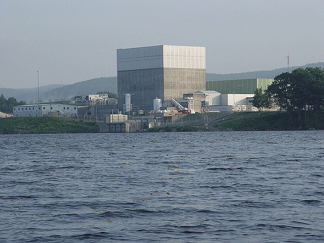
Vermont Yankee: Expert says faster reuse unrealistic amid national waste dilemma, Brattelboro Reformer, May 5, 2017 By Lissa Weinmann, BRATTLEBORO — Hopes for an expedited decommissioning and eventual reuse of the shuttered Vermont Yankee nuclear reactor are unrealistic and potentially misplaced, according to a radioactive waste policy expert and activists who will visit Brattleboro for a community discussion on “Nuclear Waste: The Road from Vermont Yankee to Texas” on Saturday, May 6, from 4:30 to 6 pm at the community room at the Brattleboro Food Co-op.
The presentation comes as federal and state authorities consider the sale of the plant to NorthStar Industries Inc., which has touted a faster decommissioning at a lower price than Entergy had planned.
Kevin Kamps, Radioactive Waste Watchdog for Maryland-based Beyond Nuclear, who has studied nuclear waste issues in the U.S. and globally for 25 years and is to be featured at the event, said he expects decommissioning will be hampered by deeper levels of radioactive contamination and reuse delayed by the continued presence of high level nuclear waste in dry cask storage on the Yankee site for many decades to come.
Kamps’ warning of a long wait amid hot controversy was underscored by testimony at an April 26 House Energy and Commerce Committee hearing on the draft Nuclear Waste Policy Amendments Act, which would break with current law to allow private companies like Waste Control Specialists, a Texas-based partner in the proposed Yankee sale, to build consolidated interim storage facilities to accept waste from the power plant site before a permanent deep geologic repository that could best contain lethal material for hundreds of thousands of years is available. ……
The Trump Administration’s congressional budget request in March 2017 includes “$120 million to restart licensing activities for the Yucca Mountain nuclear waste repository and initiate a robust interim storage program.” The nuclear industry in 2014 stopped paying a fee on nuclear energy generation to build a central repository; That $46 billion Nuclear Waste Fund falls far short of the “trillions” the DOE anticipates will be required to fund the facility.
WCS applied to the NRC in April 2016 for a license to construct and operate a centralized interim storage site adjacent to its lower-level radioactive dump (where thousands of tons of concrete and other waste from the Vernon site will be transported) in Andrews, Texas, stipulating that the DOE must bear sole and full liability for the waste even though, under current law, liability and title remain with the generators until the waste is taken away to an operating repository.
But the effort to quickly clean up the Vernon site was dealt a significant blow when Rod Baltzer, Waste Control Specialists president and chief executive officer, wrote a letter asking the NRC to “temporarily suspend” its review of the company’s application for a high-level waste dump. Baltzer cited a “magnitude of financial burdens.” The cost of the NRC review now is estimated at $7.5 million, “which is significantly higher than we originally anticipated,” he wrote.
“The bottom line for this push to interim storage is that nuclear companies want to reduce their liability for this highly problematic waste product as quickly as possible,” said Kamps. “Republican leaders in Congress and the nuclear companies who contribute to them want to weaken the law to allow privately owned de facto permanent parking lot dumps in Texas and New Mexico where liability for any problems is transferred to the U.S. taxpayer.”……..
UCS has yet to see an analysis demonstrating that the benefits of interim storage clearly outweigh the additional costs and risks associated with siting and licensing new storage facilities and the extra transportation that would be required,” Dr. Edwin Lyman, Senior Scientist at the Union of Concerned Scientists — a group that is not against nuclear power — testified to Congress, adding that interim sites raise the potential of terrorists getting bomb-making material.
“Transporting waste is the weakest link of a nonsensical interim plan that has nothing to do with finding a permanent repository,” Kamps said. “It plays musical chairs with deadly waste on US highways and rail lines, exposing millions of people to addition risk for no good reason.”
Advocates of interim storage say radioactive materials are transported all the time without incident, but Kamps said incidents do occur and that NorthStar partner Areva had acknowledged `numerous violations of surface contamination many hundreds of times above the allowable limits’ when transporting waste in France.
“CAN advocates for hardened on site storage to protect reactor communities until there is a scientifically sound and environmentally just solution for this toxic waste,” Katz said. “The communities targeted for nuclear waste are routinely rural, low income people of color and Native Americans. It is terrible to put people in the position of having to choose between short term economic survival and long term health and safety. Reactor and targeted communities need to work together to advocate for solutions that do the least harm.”……
Kamps says there is a reason that Entergy estimated $1.2 billion cleanup and NorthStar is estimating it will take less than half of that. “I have no doubt that the site is massively contaminated. We don’t know how long the underground pipes Entergy lied about having were leaking radioactive particles into the ground.”
Katz agreed. “NorthStar will find a much larger problem as all nuclear decommissionings have, but on a fixed contract, it will devise every trick in the book to limit cleanup,” so the public must remain vigilant, Katz said. “With Yankee Rowe and Connecticut Yankee, we had to bring documents to the state to show them that Yankee was putting the test wells exactly where the contamination wasn’t.”…….http://www.reformer.com/stories/vermont-yankee-expert-says-faster-reuse-unrealistic-amid-national-waste-dilemma,506578












 nuclear-news