Hinkley nuclear site radioactive mud to be dumped near Cardiff
 Critics say dredging of sediment could increase risks of contamination on Welsh side of Severn estuary, Guardian, Jamie Doward, 15 Oct 17, More than 300,000 tonnes of “radioactive” mud, some of it the toxic byproduct of Britain’s atomic weapons programme, will be dredged to make way for England’s newest nuclear power station and dumped in the Severn estuary just over a mile from Cardiff.
The mud to be dredged contains 50-year-old deposits from Hinkley Point A, where radioactive material for Britain’s atomic weapons was produced. Nuclear historian Dr David Lowry said some of the plutonium produced at the plant was sent to the US in a controversial and confidential exchange. “That deal is coming back to haunt today’s nuclear industry as plans for the third generation of nuclear plants at Hinkley are literally running into the sparkling radioactive mud,” Lowry said………. https://www.theguardian.com/uk-news/2017/oct/14/hinkley-point-radioactive-mud-dumped-cardiff-severn-estuary
Britain’s nuclear watchdog slams nuclear cleanup contract that cost public £122m
Watchdog slams nuclear cleanup contract that cost public £122m https://www.theguardian.com/politics/2017/oct/11/watchdog-slams-nuclear-cleanup-contract-that-cost-public-122m
Contract to dispose of material from 12 sites went ‘wrong on a fundamental level’ and led to multimillion pound payouts, Guardian, Rajeev Syal, 11 Oct 17, The government agency responsible for mishandling a major nuclear cleanup contract – costing the state more than £122m – has been severely criticised by Whitehall’s spending watchdog.
A National Audit Office inquiry into a bungled £6.2bn contract to dispose of material from 12 different nuclear sites has questioned whether the Nuclear Decommissioning Authority (NDA) is capable of understanding procurement rules.
The head of the NDA has apologised for “past mistakes” after the contract collapsed, leading to multimillion pound payouts to firms cut out of deal.
The NAO report published on Wednesday also criticised the Department for Business, Energy and Industrial Strategy’s oversight of the contract.
MP Meg Hillier, chair of the public accounts committee, said: “The NDA was badly mistaken about the work it needed to do on its sites when it let this contract, and has had to cancel it nine years early. It now has to start again from scratch.
“This was one of government’s biggest ever contracts and it has gone wrong on a fundamental level. Its failure raises serious questions about the NDA’s capability.”
Between 2012 and 2014, the NDA ran a competitive procurement exercise for 10 nuclear outlets and two research facilities resulting in the award of a 14-year contract for up to £6.2bn to Cavendish Fluor Partnership.
The deal collapsed after the high court found there was “a significant mismatch between the work specified … and the work that actually needs to be done”.
The NDA was forced to settle claims to the losing bidders in March of this year, when the government launched an inquiry into the contract.
Auditors found that the NDA: breached its obligation under public contracting regulations; settled legal claims with the rival bidders at a cost of £97.3m; and spent £13.8m on legal and external advisers, while in-house staff time cost £10.8m.
Civil servants from the business department and UK Government Investments were aware of the delays but did not raise concerns with ministers until last year, the report said.
Responding to the report, NDA’s chief executive officer David Peattie said: “I would like to apologise for these past mistakes.
“Since taking over earlier this year, I have made a number of improvements to the way the NDA operates to provide greater focus, discipline, standardisation and simplification to our work.”
A department spokesperson said the business secretary, Greg Clark, would scrutinise the auditors’ findings.
“The secretary of state has been clear that the reasons for the failure of the Magnox procurement should be exposed and understood, which is why he commissioned the independent Magnox Inquiry earlier this year,” he said.
“The government will carefully scrutinise the NAO report.”
The environmental cost of an iPhone
 This is a timely and important article. As an antinuclear campaigner, I also must deplore the lack of insight shown by most environmentalists on this issue. We rightly oppose the nuclear industry, with its focus on endless growth in energy use. However, the growth in renewable energy and in modern technology should not mean endless energy use and endless mining of rare earths.
The environmental cost of an iPhone http://www.wildcat.arizona.edu/article/2017/10/the-environmental-cost-of-an-iphone Thanks to advances in metallurgy and integrated circuit design, computers are working themselves into every aspect of our lives. From appliances to smart phones, it seems like everything these days has a microprocessor buried somewhere inside it. But remember, all of these pieces come from somewhere, and the metals they’re made from aren’t easy to come by. They are called “precious metals,” after all.
From the earth to your smart fridge, rare earth metal mining consists of three stages: mining, refining and disposal, all of which create waste byproducts. In the case of electronics, a lot of these waste products are r (http://www.electronicstakeback.com/toxics-in-electronics/wheres-the-harm-extraction/)adioactive because rare earth elements are usually mixed in with thorium or iridium, two radioactive substances.
To separate the minerals from their radioactive neighbors, large amounts of sulfates, ammonia and hydrochloric acid are used. With today’s refinement technology, producing one ton of refined rare earth metals produces 2,000 tons of toxic waste. And the waste doesn’t stop after the electronics are produced.
Another large threat to the environment is the disposal of electronics after they’ve completed their life cycle. Throwing a smart phone in the trash leads to a plethora of environmental toxins. From the chemicals in the battery to the plastics in the case, these materials eventually make their way into soil or waterways, damaging these natural resources in the process.
A study from the Massachusetts Institute of Technology showed that out of the 120 million mobile phones purchased in the U.S. in 2011, only 12 million mobile phones were collected for recycling. That’s 10 percent.
According to the United Nations Environmental Program, 90 percent of electronic waste ends up being illegally dumped. This occurs via a black market for exporting e-waste to countries with more lax environmental regulations. Countries such as Ghana and Vietnam take on the environmental burden of other countries’ e-waste at a monetary and human cost.
Once the waste has been dumped, the metals are extracted to be re-sold and reused. However, this isn’t clean recycling. A simple way to extract metals from electronics is to burn the surrounding plastic, and it shouldn’t come as news to you that burning plastic is bad on many levels, from the air pollution it causes to the respiratory and neurological damage that occurs when humans breathe these fumes.
In the countries where such recycling practices take place, not much is done in the way of worker safety. Studies have found alarming levels of toxic compounds linked to cancer, developmental damage and other health problems present in both these workers and those that live near these plants.
To combat this growing trend, many companies and countries are pushing legislation and practices in order to minimize these impacts.
Apple has made the claim on its website that it wants to move toward using 100 percent recycled parts in the coming years, and the UN is continuing to create policy that will apply harsher punishments to those who illegally dump electronic waste.
In the meantime, the need for the latest gadgets continues to propel this problem forward. One of the biggest surges in electronic waste is around Christmas, when people are getting their newest tech-toys and getting rid of the old ones.
Maybe the next time you want the newest iPhone, take a moment first to stop and think about what consequences for both people and the planet stem from this decision. While just being conscious of the impact won’t solve the problem, by realizing the weight of this decision, we can maybe slow it down some. What’s your new tech-toy really worth?
Controversial plan to ship nuclear waste down the Hudson River
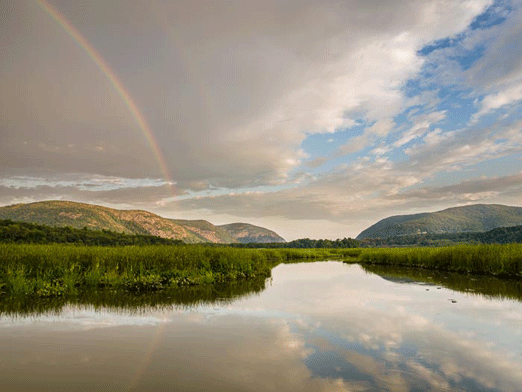
PLAN TO SHIP NUCLEAR WASTE DOWN HUDSON CAUSES DEBATE, Rockland County Times, on In recent months, routes to dispose of 76,000 metric tons of used fuel have been discussed in Congress.
In a 2002 report, the Department of Energy laid out a plan to get rid of the nation’s spent nuclear power plants’ waste, which has been piling up for several decades.
The report envisioned shipped the county’s nuclear waste from various locations via barge, rail and truck routes to the Yucca Mountain in the Mojave Desert, 100 miles northwest of Las Vegas.
Among the report’s more controversial proposals is a plan to move spent fuel out of Indian Point in Buchanan along with 16 other power plants without direct access to railroad lines, by barge, down the Hudson River.
Over the course of decades 58 shipments of nuclear waste would be loaded on barges at Indian Point for the 42 miles trip down the River, passing under the new Mario Cuomo Bridge and past New York City on the way to the seaport in New Jersey.
At the NJ seaport, cement and steel casks of spent nuclear matter weighing up to 100 tons, would be placed on rail cars for a 2,600-mile trip west to the Yucca Mountains.
The plan has caused much debate among politicians in New York. Former New Jersey Sen. Robert Torricelli stated the New Jersey ports should not be used “as rest stops for nuclear material.” http://www.rocklandtimes.com/2017/10/12/49179/
Muddled maths on the supposed costs of storing nuclear waste at Yucca Mt
UK taxpayers forked out £122million for failed nuclear decommissioning deal
Nuclear Authority’s failure to carry out decommissioning deal cost taxpayer £122million
Energy Voice by Reporter – 12/10/2017 Fundamental failures in awarding a £6.2 billion deal to decommission the UK’s ageing fleet of Magnox nuclear power stations cost the taxpayer £122 million, an official report has found.
The National Audit Office said the saga raised “serious questions” about the Nuclear Decommissioning Authority’s (NDA) understanding of procurement regulations.
The NDA ran a competitive procurement exercise for decommissioning services at 12 nuclear sites, resulting in the award of a 14-year contract for up to £6.2 billion, but the High Court found it had wrongly decided the outcome of the process.
The NDA agreed to settle claims in March 2017, the same month as the Government set up an inquiry into the Magnox contract.
Energy Solutions unsuccessfully bid for the contract, and later issued legal claims against the NDA for damages.
The High Court found that, had the NDA applied its evaluation criteria correctly, the winning bidder, Cavendish Fluor Partnership (CFP), would have been excluded from the competition.
The NDA agreed to settle legal claims with Energy Solutions and its consortium partner at the time of the bid, Bechtel, at a cost of £97.3 million.
It also spent £13.8 million on legal and external advisers, while in-house staff time cost £10.8 million.
Amyas Morse, head of the National Audit Office, said: “The NDA’s fundamental failures in the Magnox contract procurement raise serious questions about its understanding of procurement regulations; its ability to manage large, complex procurements; and why the errors detected by the High Court judgement were not identified earlier…….https://www.energyvoice.com/otherenergy/nuclear/153035/nuclear-authoritys-failure-carry-decommissioning-deal-cost-taxpayer-122million/
Scotland’s Dounreay nuclear site: health experts to be appointed by the operator
Scottish nuclear site looks to hire ‘health boffins’, Energy Voice, by Reporter , 12 Oct 17, A nuclear site criticised over its safety is seeking a team of health boffins – with starting salaries of £46,000 “upwards.”
Dounreay near Thurso in Caithness is being decommissioned at a cost of £2.32bn.
Safety concerns were raised in August about the handling of radioactive waste at the plant. The Nuclear Decommissioning Authority said safety has “deteriorated” at Dounreay and warned improvements made after a fire in 2014 had not been kept up.
Environmental protection agency Sepa rated the handling of waste last year as ‘at risk’ and called the management of vaults used to store it ‘poor’.
There were three serious incidents at the 60-year-old plant, where decommissioning work has been under way since the 1990s……
The Scottish Government has called for urgent action to address the problems at Dounreay, which were revealed in the NDA’s latest annual report. Gail Ross, SNP MSP for Caithness, Sutherland and Ross, has also said she was “seriously concerned” about Dounreay’s safety record.
But now its operators wants to recruit “a number” of senior health physicists…….
The boffins must be an appointed Radiation Protection Adviser, provide radiation protection advice, give advice and support to emergency arrangements at Dounreay and develop and provide specialist radiation protection training as well as contributing to the development of a safety culture……. https://www.energyvoice.com/otherenergy/nuclear/153131/scottish-nuclear-site-looks-hire-health-boffins/ –
Radioactive waste is to be removed from a contaminated section of Ridgewood
EPA targets radioactive site in Ridgewood, Times Ledger, 13 Oct 17, Radioactive waste is to be removed from a contaminated section of Ridgewood which was once the location of a chemical plant that harvested raw materials from sand and dumped the refuse into the sewer.
The parcel of land — which became contaminated while under use by the Wolff-Alport Chemical Company from 1920 to 1954 — will see all business tenants relocated, buildings demolished, soil removed and sewers replaced, according to the EPA. The three-quarter-acre patch of contaminated land is located at 1125 to 1139 Irving Ave. and 1514 Cooper Ave. It used to be home to Jarabacoa Deli Grocery, as well as office space, residential apartments, several auto repair shops and warehousing space…….https://www.timesledger.com/stories/2017/41/radioactive_2017_10_13_q.html
South Wales petition calls for reviewing the dumping of radioactive mud off coast of Cardiff
More than 5,500 sign anti-dumping petition, Ian Craig, -South Wales, Argus, 9 Oct 17, MORE than 5,000 people have signed a petition calling for a stop to plans to dump waste from the nuclear power station off the coast of Cardiff.
The petition was launched after it was revealed EDF Energy had applied to be allowed to dredge 300,000 tonnes of mud from near Hinkley Point in Somerset and dump it off Cardiff Bay.
Although some have claimed the mud could be radioactive, both EDF and the Welsh Government have denied this is the case.
A petition launched by South Wales Central AM Neil McEvoy calling for the plans to be reviewed has been signed by more than 5,500 people, meaning it must be debated in the Assembly.
Mr McEvoy, who was suspended from Plaid Cymru for the second time this year last month and is currently sitting as an Independent AM, said: “This isn’t just about radioactive mud, even though that’s bad enough.
“This is about Wales’ future.
“We’re not here to have the things other people don’t want being dumped on us, whether that’s potentially radioactive mud from a nuclear reactor or mass numbers of prisoners.”
To view the petition visit tinyurl.com/ybqnvaax.
Ignoring the danger of ionising radiation: nuclear waste dumping in the sea
 The idea that nuclear pollution can be rendered safe by extreme dilution has been proven wrong
radioactive materials bioaccumulate. A worm can contain 2,000 to 3,000 times higher levels than its environment. The worm is then eaten by another marine animal, which gets eating by another, and so on. At each step, the radioactive level rises. Barbey has identified reproductive defects in sea crabs, caused by radioactive contamination, and these genetic defects are passed on to future generations of crabs.
Are we to believe the same is not happening in humans, who are at the top of the food chain?
The fact of the matter is that a certain number of cancer deaths are considered acceptable in order to keep costs for the nuclear waste industry down. The question no one has the answer to is: At what point do the deaths begin to outweigh the cost-savings of the nuclear industry?
As to where such cost-benefit considerations came from in the first place, the filmmakers identify the International Commission on Radiological Protection (ICRP)
the nuclear industry is hardly operating for the benefit of the many.
The Rarely Discussed Reality of Radioactive Pollution https://articles.mercola.com/sites/articles/archive/2017/10/07/radioactive-pollution-exposure.aspx?utm_source=dnl&utm_medium=email&utm_content=art1&utm_campaign=20171007Z1_UCM&et_cid=DM16
Story at-a-glance
- For decades, the common method of nuclear disposal was to dump plutonium-filled steel barrels into the ocean. Today, many if not most of these barrels have corroded and disintegrated, releasing radioactive material into the environment
- “Versenkt und Vergessen” (Sunk and Forgotten) investigates what happened to the barrels of nuclear waste, and how radioactive material is disposed of today
- In 1993, nuclear waste dumping into the ocean was banned worldwide, yet the ocean remains a primary dumping ground for radioactive waste
- Instead of ditching barrels overboard, the nuclear waste industry built pipes along the bottom of the sea, through which the radioactive material is discharged directly into the open sea
- Cancer deaths are considered acceptable to keep costs for the nuclear waste industry down. According to the International Commission on Radiological Protection, this cost-benefit consideration is part of Epicurus’ utilitarian ethics, which states that the needs of the many outweigh the needs of the few
By Dr. Mercola
A rarely addressed environmental problem is radioactive pollution from nuclear waste disposal. For decades, the common method of nuclear disposal was to simply dump plutonium-filled steel barrels into the ocean. Continue reading
Native Americans warn against nuclear waste dumping at Yucca Mountain
Warnings from First Americans: Insidious Changes Are Underway that Will Affect Us All, In These Times,
For an update, Rural America In These Times spoke to Native Americans—people whose survival requires being extremely well informed about what all branches of the federal government are up to. From their vantage point as sovereign entities with direct government-to-government relationships with the United States, the tribes have a unique perspective on issues including voting rights, the economy, the extractive industries’ hold over this administration and more.
In each case below, they explain how powerfully and comprehensively this administration’s misguided policies would impinge on each and every one of us. After all, “everything is connected,” as Timbisha Shoshone Tribal Historic Preservation Officer Barbara Durham puts it.
Fire on the mountain
Kim Jong-un can relax! We have already nuked ourselves and are looking into a great way to poison ourselves even more with radioactive waste. In June, Department of Energy (DOE) Secretary Rick Perry suggested using the Nevada National Security Site, aka the Nevada Test Site, as an interim waste dump and at the same time reopening licensing procedures for nearby Yucca Mountain. Under Perry’s plan, the mountain, revered as a sacred site by area tribes, would eventually become the permanent repository for spent nuclear fuel and other radioactive material.
The waste would travel via roads and railroads through communities throughout the country as it made its way to Nevada. Once it arrived, its home would be deep inside the earthquake-prone mountain. The DOE’s Final Environmental Impact Statement (FEIS) for the project admits that Yucca Mountain may be shaken by “ground motion” and that “beyond-the-design” events could collapse the waste facility.
The Timbisha Shoshone government blasted the Perry proposal, citing the groundwater contamination that the Nuclear Regulatory Commission has said will likely occur, even without earthquakes. …….
The United States faces one more very large barrier at Yucca Mountain, adds Bob. In 1863, Shoshone tribal heads and United States representatives signed the Treaty of Ruby Valley, which declared friendship between the parties and guaranteed the tribes a homeland that encompasses most of Nevada and massive chunks of Idaho, Oregon, California and Utah. The federal government seemed to forget all about the agreement for decades, though of course there were distractions—the Civil War, Lincoln’s assassination, the Sioux defending their homelands and more. After the United States woke up to the gigantic gap in the national map, it tried unsuccessfully for decades to pay off the Shoshone tribes.
“We respect the treaty,” says Bob. “And we don’t want the nuclear waste.”
DOE offers one bright spot in all the controversy: According to the FEIS, Yucca Mountain is “highly unlikely” to erupt as a volcano.
This land is whose land?
The Trump administration is trying to shovel vast and pristine portions of the United States into the maw of the extractive industries, such as mining concerns and fossil-fuel companies…..
Equality redefined
It’s not just Russians anymore. Attacks against voting rights are proliferating beyond Putin’s pals hacking into state election systems or manipulating public opinion via social media. With the Trump administration’s all-out assault on ballot-box access, non-Natives are getting a taste of what Native people have long experienced, according to OJ Semans, the Rosebud Sioux executive director of Four Directions, a nonprofit that advocates for equal rights.
“To put it bluntly,” Semans says, “as the Trump administration chips away at the ability to cast a ballot, you non-Natives are becoming as ‘equal’ as we are.”……..http://inthesetimes.com/rural-america/entry/20583/tribal-sovereignty-economy-environment-voting-rights-extractive-industry
South Carolina’s Citizens Advisory Board has “had enough” of the nuclear waste burden

 ‘Enough is enough’ nuclear waste http://www.postandcourier.com/opinion/editorials/enough-is-enough-nuclear-waste/article_5875b0fc-aadc-11e7-baa8-13314076fcb5.html 8 Oct 17 South Carolina has been generally accommodating to the federal government’s nuclear waste disposal needs over the decades, based on the promise that the highly radioactive material would be eventually shipped out of Savannah River Site to a permanent storage facility. Unfortunately, the federal government hasn’t been willing to live up to its part of the bargain.
So the SRS Citizens Advisory Board recently said “enough is enough” in response to federal plans to ship a ton of uranium from Germany through the port of Charleston then by rail to the Aiken facility. While the board’s role is advisory, its decision can have a major impact on federal policy. For example, a federal committee examining nuclear waste disposal options during the Obama administration backed off a plan in 2013 to formalize SRS’ use as a waste treatment and disposal site when the citizens panel balked.
The uranium was originally sent to Germany for research purposes as part of the U.S. Atoms for Peace Program — and the U.S. government agreed to take it back when Germany was finished with it. No question, SRS has the experience and the capability to process the material so it can’t be used to produce a nuclear weapon, but CAB reasonably balked at the transfer.
“The proposal will unnecessarily add to an already large burden of … high-level radioactive waste storage at SRS with no established path for disposal,” the CAB stated in its response to the Department of Energy request. “DOE failures to faithfully keep pace with its SRS cleanup commitments impede the acceptability of this deficient proposal by the citizens of South Carolina.”
Among those failures are the previous administration’s unwillingness to continue funding a plant to process weapons grade plutonium into fuel for commercial nuclear reactors. The federal government agreed to build the mixed-oxide facility as a condition of sending 34 tons of plutonium to SRS. The decision to abandon the project came after the plutonium already had been shipped to SRS.
Meanwhile, the planned permanent storage site for high level nuclear waste at Yucca Mountain, Nevada, was shut down in 2011 by the then-chairman of the Nuclear Regulatory Commission, with the Obama administration’s approval. There are ongoing efforts to restart the project on which $15 billion has already been spent since the 1980s.
So don’t blame the SRS Citizens Advisory Board for being less than accommodating to the federal government’s latest radioactive waste disposal plan. As CAB member Larry Powell said, “I would just like to see less of this fuel coming into SRS, especially when there’s no exit plan out of state.”
South Carolina should emphasize its opposition to becoming the dump site for federal nuclear waste at every possible turn — in the courts, in Congress and by state government. The state has assumed more than its share of responsibility for nuclear defense production and waste management since the early years of the Cold War. The federal government should have to live up to its promises to the state.
Vale of Glamorgan Council to express concerns on Cardiff radioactive dredging, to UK govt
Vale of Glamorgan Council 6th Oct 2017, A report to Cabinet on Monday 9 October will seek authority for Cllr John
Thomas, the Leader of the Vale of Glamorgan Council, to write urgently to
the Cabinet Secretary for Environment and Rural Affairs and the Chief
Executive of Natural Resources Wales to express the Council’s concerns
and request a meeting to discuss the disposal of dredged radioactive
material in the Bristol Channel at a site referred to as the Cardiff
Grounds near to Penarth.
https://www.valeofglamorgan.gov.uk/en/our_council/press_and_communications/latest_news/2017/October-2017/Council-urgently-considering-action-on-Hinkley-Point-dredging.aspx
Dear oh dear! USA hasn’t enough plutonium for both space exploration and nuclear weapons

Why is it that the citizens of teh United States put up with their tax money going to produce toxic plutonium for useless dangerous space travel and even more useless dangerous and illegal nuclear weapons.?
What happens when a spacecraft powered by plutonium crashes into a city?
 Report: It’s space travel power versus pits at Los Alamos By Mark Oswald / Journal Staff Writer, Thursday, October 5th, 2017 SANTA FE – At Los Alamos National Laboratory, a mandate to produce more of the plutonium triggers for nuclear weapons is bumping up against goals to produce power systems for NASA’s “long duration space missions.”
The U.S. Government Accountability Office reports that lab officials say that plutonium work for NASA systems “must compete with other priorities for facility space” at the LANL’s plutonium facility, specifically production of nuclear weapons “pits.”
The problem could significantly effect a key step in production of “radioisotope power systems” (RPS) and delay delivery  of the systems for NASA’s missions, says the GAO report.
RPS produce power by converting heat from decay of plutonium-238 into electricity and can operate where solar panels or batteries would be ineffective and can operate for more than a decade, according to the report.
An RPS is currently used to power the roving Mars Science Laboratory, known as Curiosity, that has been exploring the Red Planet since 2012. Other missions in the coming years are slated to use the power systems, including another rover, Mars 2020.
The GAO was asked to review the situation in part because the National Academy of Sciences has expressed concern about future NASA missions because of a diminishing supply of plutonium-238. Until 2015, it hadn’t been made in the U.S. for more than 25 years. Various laboratories within the Department of Energy are involved. The GAO report says LANL maintains capability for producing Pu-238 and its work involves Pu-238 storage, chemical processing, analysis, fuel processing and encapsulation of Pu-238…..
LANL is also under orders to produce as many as 80 plutonium pits by 2030, as part of an expansive update of the nation’s nuclear arsenal. None have been made for several years.
The GAO report says the National Nuclear Security Administration, a semi-autonomous agency within DOE that includes LANL and the rest of the U.S. nuclear weapons complex, is currently “focused primarily” on making pits and has not coordinated with the Pu-238 program in connection with potential modifications of the Los Alamos plutonium facility…….https://www.abqjournal.com/1074021/report-its-space-travel-power-versus-pits-at-los-alamos.html
Piketon, Ohio, fighting radioactive disposal site
Piketon continues to fight radioactive disposal site , By Nikki Blankenship – nblankenship@aimmediamidwest.co NEWS 4 Oct 17,PIKETON – The Department of Energy (DOE) confirmed at Monday night’s Piketon Village Council meeting that concerns expressed by Piketon Mayor Billy Spencer, members of Council, various other public officials and members of Citizens Against Radioactive Dump (CARD) are valid. The DOE’s local site lead Joel Bradburne and Manager of the Portsmouth/Paducah Project Office for DOE Robert Edwards were both present at the meeting to answer questions from community members who expressed frustrations, claiming that the DOE has repeatedly lied to the them.Over recent months, the Village of Piketon has urged the DOE to reconsider the on-site waste disposal facility that the department feels is a solution to the waste problem at the Piketon plant. Thus far, options have been to do nothing, ship waste off-site or create a place on-site to dump it.
During the meeting, DOE representatives explained that it is expected to cost an estimated $1 billion less to dispose of the waste on-site. The facility would be 100-acre dump that DOE representatives state would hold low-level contaminants from site cleanup.
Earlier this year, Piketon hired an third-party consultant to evaluate plans for the site. The conclusion brought about several concerns that Piketon officials addressed directly during Monday night’s meeting.
The first concern was that there are fragments in the bedrock which could allow for waste to contaminant underground water sources, proximity to Piketon residents and compliance with the Toxic Substances Control Act provision mandating that the bottom of a landfill line system be installed at least 50 feet from historic high-water tables.
According to the results of the study, data from DOE states the depth of groundwater in some areas of the landfill site is as shallow as 21 feet below the surface.
“We worry about our water,” Spencer stated during the meeting.
Spencer and other frustrated Piketon officials and residents demanded DOE address these concerns……….
The waste disposal facility (referenced as a radioactive dump by opponents) is expected to be ready to accept waste as early as late 2021.
Reach Nikki Blankenship at 740-353-3101 ext. 1931. http://www.portsmouth-dailytimes.com/news/19756/piketon-continues-to-fight-radioactive-disposal-site
1 This Month


31st January – Challenging the War Machine – a DECLASSIFIED UK SUMMIT



Website of the Week
Now until to February 10, 2026 Radioactive waste storage in France: the debate is finally open! How to participate?
-
Archives
- January 2026 (211)
- December 2025 (358)
- November 2025 (359)
- October 2025 (377)
- September 2025 (258)
- August 2025 (319)
- July 2025 (230)
- June 2025 (348)
- May 2025 (261)
- April 2025 (305)
- March 2025 (319)
- February 2025 (234)
-
Categories
- 1
- 1 NUCLEAR ISSUES
- business and costs
- climate change
- culture and arts
- ENERGY
- environment
- health
- history
- indigenous issues
- Legal
- marketing of nuclear
- media
- opposition to nuclear
- PERSONAL STORIES
- politics
- politics international
- Religion and ethics
- safety
- secrets,lies and civil liberties
- spinbuster
- technology
- Uranium
- wastes
- weapons and war
- Women
- 2 WORLD
- ACTION
- AFRICA
- Atrocities
- AUSTRALIA
- Christina's notes
- Christina's themes
- culture and arts
- Events
- Fuk 2022
- Fuk 2023
- Fukushima 2017
- Fukushima 2018
- fukushima 2019
- Fukushima 2020
- Fukushima 2021
- general
- global warming
- Humour (God we need it)
- Nuclear
- RARE EARTHS
- Reference
- resources – print
- Resources -audiovicual
- Weekly Newsletter
- World
- World Nuclear
- YouTube
-
RSS
Entries RSS
Comments RSS
 nuclear-news