Since President Donald Trump took office, some members of Congress have shown renewed interested in the mothballed Yucca Mountain project in Nevada as a long-term solution. But the industry has shown support for temporary storage as part of the storage equation because of the amount of time it would take to license a facility at Yucca Mountain.
Heavy guarding for Ukraine’s spent nuclear fuel dump near Chernobyl

| Nuclear waste storage facility near Ukraine’s Chernobyl to be heavily guarded: report http://www.xinhuanet.com/english/2018-03/16/c_137042132.htm |
KIEV, March 15 (Xinhua) — The Ukrainian government has included the facility for nuclear waste near the destroyed Chernobyl nuclear power plant into a list of heavily guarded objects, local media reported Thursday, citing a government decree.
The decree, which was adopted by the cabinet earlier this week, envisages that the central spent fuel storage facility (CSFSF) will be guarded by the officers of the National Guard of Ukraine.
The building of the CSFSF, which will store spent nuclear fuel from three Ukrainian nuclear power plants, is currently underway at the 30-km-radius exclusion zone around the plant.
The construction of the facility has started in November 2017 and its first stage is due to be completed in 2019.
The building of the CSFSF is aimed at boosting Ukraine’s capabilities in managing and storing its nuclear waste. Currently, the East European country relies heavily on Russia for storing spent fuel from its power plants.
Ukraine generates over half of its electricity from nuclear energy. Currently, 15 reactors in four nuclear power plants are operating in the East European country.
The Chernobyl plant, located some 130 km from Kiev, witnessed one of the worst nuclear accidents in human history on April 26, 1986.
The blasts at the No. 4 reactor spread radiation across Ukraine, Belarus, Russia and other European countries.
Nuclear waste containers: the problem of corrosion in copper canisters
The court said no to the application because it considered that there were problems with the copper canister that had to be resolved now and not later.
the UK’s National Nuclear Laboratory (NNL) is to carry out an expert peer review of a Canadian research programme on microbiologically influenced corrosion of canisters that will be used to dispose of used nuclear fuel.
 The Copper Corrosion Conundrum No2Nuclear Power http://www.no2nuclearpower.org.uk/wp/wp-content/uploads/2018/03/NuClearNews_No105.pdf
The Swedish Environmental Court has rejected the Nuclear Waste Company SKB’s license application for a final repository for spent nuclear fuel in Forsmark, Sweden. This is a huge triumph for safety and environment – and for the Swedish NGO Office for Nuclear Waste Review (MKG), the Swedish Society for Nature Conservation (SSNC), and critical scientists. Now it is up to the Swedish government to make a final decision.
The Environmental Court took into consideration viewpoints from all parties in the case, including scientists who have raised concerns about disposing spent nuclear fuel in copper canisters. During the legal proceedings, the Swedish NGO Office for Nuclear Waste Review (MKG) and the Swedish Society for Nature Conservation (SSNC) presented the shortcomings of this method of disposal. For many years, the environmental organisations have been arguing that the Nuclear Waste Company SKB need to listen to critical scientists, and investigate alternative disposal methods, especially the possibility of developing a very deep boreholes disposal system. (1) Johan Swahn, Director at MKG said:
“Several independent researchers have criticized both the applied method and the selected site. There is a solid documentation base for the Environmental Court’s decision. It is hard to believe the Swedish Government’s conclusions will be any different from the Court’s.”
MKG has made an unofficial translation into English of the Environmental Court opinion. (2)
The court said no to the application because it considered that there were problems with the copper canister that had to be resolved now and not later. The translation shows the courts judicial argumentation and why it decided not to accept the regulator – the Swedish Radiation Safety Authority’s (SSM’s) opinion that the problems with the integrity of the copper canister were not serious and could likely be solved at a later stage in the decision-making process. The court is quite clear in its statement and argumentation:
“The Land and Environmental Court finds that the environmental impact assessment meets the requirements of the Environmental Code and can therefore be approved. All in all, the investigation meets the high standards set out in the Environmental Code, except in one respect, the safety of the canister.” (Emphasis added)
“The investigation shows that there are uncertainties, or risks, regarding how much certain forms of corrosion and other processes can impair the ability of the canister to contain the nuclear waste in the long term. Overall, these uncertainties about the canister are significant and have not been fully taken into account in the conclusions of SKB’s safety analysis. The Land and Environmental Court considers that there is some leeway for accepting further uncertainties. The uncertainties surrounding certain forms of corrosion and other processes are, however, of such gravity that the Court cannot, based on SKB’s safety analysis, conclude that the risk criterion in the Radiation Safety Authority’s regulations has been met. In the context of the comprehensive risk assessment required by the Environmental Code, the documentation presented to date does not provide sufficient support for concluding that the final repository will be safe in the long term.” (Emphasis added)
The court says that the application is only permissible if the nuclear waste company SKB:
“…produces evidence that the repository in the long term will meet the requirements of the Environmental Code, despite remaining uncertainties regarding how the protective capability of the canister may be affected by: a. corrosion due to reactions in oxygen-free water; b. pit corrosion due to reaction with sulphide, including the contribution of the sauna effect to pit corrosion; c. stress corrosion due to reaction with sulphide, including the contribution of the sauna effect to stress corrosion; d. hydrogen embrittlement; e. radioactive radiation impact on pit corrosion, stress corrosion and hydrogen embrittlement.”
The main difference between the court’s and the regulator’s decision-making was that the court decided to rely on a multitude of scientific sources and information and not only on the material provided by SKB. It had also been uncovered that the main corrosion expert at SSM did not want to say yes to the application at this time that may have influenced the court’s decision-making. In fact there appear to have been many dissenting voices in the regulator despite the regulator’s claim in the court that a united SSM stood behind its opinion.
The court underlines in its opinion that the Environmental Code requires that the repository should be shown to be safe at this stage in the decision-making process, i.e. before the government has its say. The court says that some uncertainties will always remain but it sees the possible copper canister problems as so serious that it is not clear that the regulator’s limits for release of radioactivity can be met. This is a reason to say no to the project unless it can be shown that the copper canister will work as intended. The copper canister has to provide isolation from the radioactivity in the spent nuclear fuel to humans and the environment for very long time-scales.
It is still unclear how the process will proceed. The community of Östhammar has cancelled the referendum on the repository, as there will be no question from the government in the near future. The government has set up a working group of civil servants to manage the government’s handling of the opinions delivered by the court and SSM. SKB has said that it is preparing documentation for the government to show that there are no problems with the canister. Whether the government thinks this will be enough remains to be seen. This is likely not what the court had in mind. The government would be wise to make a much broader review of the issue. There is a need for a thorough judicial review on the governmental level in order to override the court’s opinion. Otherwise the government’ decision may not survive an appeal to the Supreme Administrative Court.
There are eminent corrosion experts who believe that copper is a bad choice as a canister material. There is also increasing experimental evidence that this is the case. The court’s decision shows the importance of democratic and open governance in environmental decisionmaking. It is important that the continued decision-making regarding the Swedish repository for spent nuclear is transparent and multi-faceted. (3)
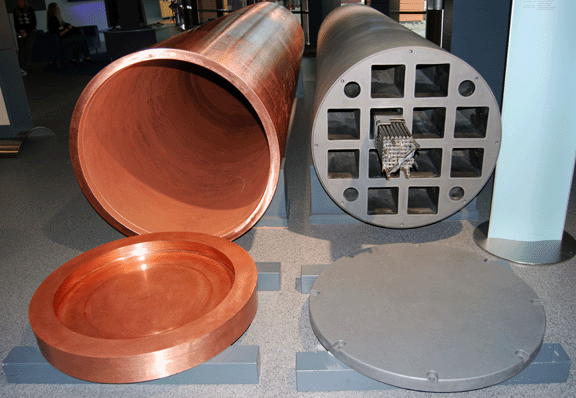
Copper Canisters The canister has to enclose the nuclear waste for a very long; it is the final repository’s primary safety function. The canister has a 50 mm thick copper shell with an insert of cast iron. The canister must withstand corrosion and mechanical stress.
The investigation on the capability of the canister is extensive and involves complex technical and scientific issues. These include groundwater chemistry, corrosion processes, as well as creep and hydrogen embrittlement (this latter affects the mechanical strength of the canister). However, the parties taking part in the court proceedings disagreed on several issues crucial to the final repository’s long-term security.
The Land and Environmental Court considered the following uncertainties regarding the canister to be most important in the continued risk assessment:
- 1. General corrosion due to reaction in oxygen-free water. The parties have different views on scientific issues surrounding this kind of corrosion. The Court found that there is considerable uncertainty on this topic that has not been taken account of in SKB’s safety analysis
- .· 2. Local corrosion in the form of pit corrosion due to reaction with sulphide. The Court found that there is significant uncertainty regarding pit-corrosion due to reaction with sulphide. This uncertainty has not been included in the safety analysis. In addition, there is uncertainty about the sauna effect, which may have an amplifying effect on pit corrosion.
- · 3. Local corrosion in the form of stress corrosion due to reaction with sulphide. The Court found that there is significant uncertainty regarding stress corrosion due to reaction with sulphide. This uncertainty has not been included in the safety analysis. In addition, there is uncertainty about the sauna effect, which may have an amplifying effect on stress corrosion.
- · 4. Hydrogen embrittlement is a process that affects the mechanical strength of the canister. The Court found that significant uncertainty regarding hydrogen embrittlement remains. This uncertainty has not been taken account of in the safety analysis.
- · 5. The effect of ionizing radiation on pit corrosion, stress corrosion and hydrogen embrittlement. There is significant uncertainty regarding ionizing radiation impact on pit corrosion, stress corrosion and hydrogen sprays. This uncertainty has been included to a limited extent in the safety assessment.
Meanwhile, the UK’s National Nuclear Laboratory (NNL) is to carry out an expert peer review of a Canadian research programme on microbiologically influenced corrosion of canisters that will be used to dispose of used nuclear fuel. The NNL has been contracted by Canada’s National Waste Management Organisation (NWMO) to review its work on the potential for corrosion of the copper-clad canisters. The NWMO is responsible for designing and implementing the safe, long-term management of Canada’s used nuclear fuel under a plan known as Adaptive Phased Management. This requires used fuel to be contained and isolated in a deep geological repository, with a comprehensive process to select an informed and willing host for the project.
The used fuel will be isolated from the environment using a series of engineered barriers. Fuel elements comprise ceramic fuel pellets, which are themselves highly durable, contained inside corrosion-resistant zircaloy tubes to make fuel elements. Bundles of fuel elements are placed into large, durable copper-coated steel containers which are designed to contain and isolate used nuclear fuel in a deep geological repository, essentially indefinitely. The canisters will be placed in so-called “buffer boxes” containing by bentonite clay, providing a fourth barrier.
World Nuclear News reports that although copper is highly resistant to corrosion, under anoxic conditions – that is, where no oxygen is present – sulphate-reducing bacteria have the potential to produce sulphide, which can lead to microbiologically induced corrosion (MIC) of copper. Waste management organisations and regulators therefore need to understand the levels of sulphide that will be present in a geological disposal facility, to understand its potential to migrate to the canister surface and the potential for it to cause copper corrosion, the NNL said.
The NWMO has been actively developing computer models that will be used to evaluate the potential for MIC once a disposal site has been selected, and has selected the NNL to carry out a peer review of its work because of the UK laboratory’s expertise in the biogeochemical processes that could affect repository performance and in developing computer modelling techniques that simulate the effects of sulphate-reducing bacteria. The work is linked closely with NNL’s participation in the European Commission Horizon-2020 MIND (Microbiology in Nuclear waste Disposal) project. (4
UK renews process – geological screening for nuclear waste dump
Geological Screening, NO2 NuclearPower 14 Mar 18 On 30th January 2013, Cumbria County Council rejected the Government’s plans to undertake preliminary work on an underground radioactive waste dump. (See Cumbria Plan Dumped nuClear News No.47) The county and its western district councils Allerdale and Copeland were the only local authorities in the UK still involved in feasibility studies for a £12bn – £19bn disposal facility. So the rejection left the UK once again, without a plan for dealing with its nuclear waste legacy, let alone waste from proposed new reactors.
Then, in July 2014 the UK Government published a renewed process for siting a Geological Disposal Facility (GDF) – the ‘Implementing Geological Disposal’ White Paper. (1)
The White Paper explained that certain ‘Initial Actions’ would have to happen before formal discussions between communities interested in hosting a GDF and the delivery body Radioactive Waste Management Limited (RWM) could take place. (2)
These ‘Initial Actions’ included: · A National Geological Screening exercise; · The establishment of a policy framework for planning decisions in England; and · Development of a process of Working with Communities, including Community Engagement, Community Representation, Community Investment and the Test of Public Support…….http://www.no2nuclearpower.org.uk/wp/wp-content/uploads/2018/03/NuClearNews_No105.pdf
New York Times inadequate coverage of South Australia’s problem about nuclear waste dumping
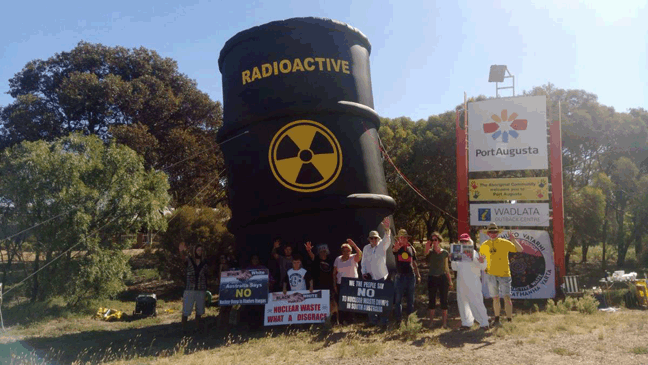
This New York Times author gives a fair coverage to the Kimba radioactive waste dump issue. But it’s misleading in 3 important ways, as if the author completely buys the nuclear lobby’s propaganda.:
- States that “The country has no nuclear power plants.” But fails to mention the Lucas Heights nuclear reactor [which is the source of the really important radioactive trash for Kimba]
- Fails to mention the fact that South Australia has a clear law prohibiting establishment of any nuclear waste facility
- Seems unaware of the huge distances (2000 km) involved, which would mean that the vast majority of medical wastes would no longer be radioactive, in transport from the main points of production and use.
A Farming Town Divided: Do We Want a Nuclear Site that Brings Jobs?, NYT, By MARCH 7, 2018 “……… Now, as the federal government considers whether to build the site on one of these two farms in Kimba, this community of about 650 people finds itself divided and angry. The prospect of jobs and subsidies that the site would bring has split locals between those who want to preserve rural Australia’s way of life and those who say the glory days of farming are over…..
Despite the distances, locals say Kimba always had a strong sense of community, at least until the nuclear site was proposed. Some said the allure of millions of dollars’ worth of grants and subsidies that the government was offering the host community had blinded people to the risks.
Who will pay the astronomic cost of storing America’s nuclear trash? NRC reviews New Mexico proposal
 Goodbye Yucca? NRC to review New Mexico nuclear waste storage proposal, https://www.utilitydive.com/news/goodbye-yucca-nrc-to-review-new-mexico-nuclear-waste-storage-proposal/518653/ Robert Walton
Dive Brief:
- agreed to review a spent fuel storage site proposed for New Mexico by a private company, raising the possibility of a solution for a decades-old problem.
- Yucca Mountain, in Nevada, was identified by legislation as a permanent solution in 1987, but has been debated even since. Funding was canceled by the Obama administration in 2010, and continuing development will require significant capital.
- In March 2017, Holtec International submitted an application to construct a facility to store up to 8,680 metric tons of uranium, using a canister storage system for a 40-year license term.
Dive Insight:
Lawmakers are reportedly not going to fund Yucca Mountain development this year, despite a $120 million request from President Trump who has indicated he wants to revive development. That will maintain the status quo for dealing with spent fuel, a process which involves companies suing the federal government to recover their costs.
Processing and storing the spent fuel was supposed to be done by the government under the terms of a 1983 contract. Instead, generators file breach of contract lawsuits to cover the costs, and so far there have been more than 70 judgments resulting in payments to nuclear operators upwards of $6 billion.
Holtec is proposing an interim storage site, and last month the NRC informed the company that it would review the project. Regulators said the application “is sufficiently complete for the staff to begin its detailed safety, security and environmental reviews.”
Holtec is just the second private company to file such an application, according to Power Magazine. Waste Control Specialists proposed a site in Texas, but subsequently put its application on hold due to escalating
costs.
NRC staff informed Holtec that the cost to review its application would likely reach $7.5 million. The company would use a the Hi-Storm UMAX canister storage system, which stores loaded canisters underground. According to Holtec, the Hi-Storm system “is widely considered by industry experts to be the last word on public safety and security.”
The facility would be constructed on 1,000 acres of unused land, about midway between the cities of Carlsbad and Hobbs, N.M. The company says the area has many advantages, not least of which is being located 35 miles from the nearest populations.
The costs to store spent nuclear fuel are astronomical: The U.S. Department of Energy has estimated the government’s total liability will be $29 billion by 2022, assuming that the government starts accepting nuclear waste by then. Some estimates put the cost as high as $50 billion.
Waste Isolation Pilot Plant (WIPP) seeks permit to allow more nuclear waste storage
 WIPP Facility Officials Seek Permit Changes http://krwg.org/post/wipp-facility-officials-seek-permit-changes, By KRWG NEWS AND PARTNERS , CARLSBAD, N.M. (AP) 7 Mar 18, — Officials are seeking permit changes to allow more nuclear waste to be stored in an underground facility in southeastern New Mexico.
The Carlsbad Current-Argus reports Waste Isolation Pilot Plant officials are looking to redefine how the volume of the waste is calculated at the facility near Carlsbad.
The facility is about halfway to capacity under the current calculations, which take into account the air between the waste containers for the total volume.
The drums of waste are packed into another case to protect against spills.
Officials are seeking to change the volume calculations to be based on the inner containers, which they say is a more accurate measurement.
Officials say the facility is about a third full under the new volume calculations.
Washington State to give more help to sick Hanford nuclear workers and former workers
Help on the way for ill Hanford workers Tri City Herald, March 07, 2018
Ill Hanford workers will no longer have to prove to the state that their poor health was caused by working at the nuclear reservation.
On Wednesday, Gov. Jay Inslee signed sweeping legislation that should help more Hanford workers win approval for state worker compensation claims.
“Washington state has recognized the often terrible price Hanford workers on the front lines of nuclear production and cleanup have to pay for their service to the nation,” Tom Carpenter, executive director of the Seattle-based watchdog group Hanford Challenge, said in a statement………
Workers who spend as little as one eight-hour day at many areas of the nuclear reservation will no longer have to show that working at Hanford caused illnesses ranging from respiratory disease to many cancers.
Instead, the state Department of Labor and Industries must presume that the sickness was the result of a chemical or radiological exposure at Hanford.
The presumption may be rebutted by evidence that proves other causes for the disease, including smoking, lifestyle, hereditary factors, physical fitness or exposures to toxic substances at other jobs or at home.
The bill was first introduced in 2017 out of concern for central Hanford workers who can be exposed to toxic chemical vapors associated with chemicals held in underground tanks.
In March 2017, Lawrence Rouse stood before a state Senate committee and attempted to talk about his illness called toxic encephalopathy, a brain dysfunction caused by exposure to chemicals. He had worked at Hanford for more than 20 years.
As he struggled to get a few clipped words out, his wife took over saying, “He doesn’t speak well. I pretty much speak for him all the time.”
Hanford Challenge and the pipefitters union Local 598 promoted the bill, saying tank farm workers have developed serious neurological and chemical diseases from exposure to chemical vapors………
Under the new law, workers, and families of workers who have died, and been denied compensation in the past can refile a claim under the new standards, according to Hanford Challenge.
…………The claims may be filed any time within the lifetime of the worker, since many illnesses can take years to develop after exposure.
………. Covered diseases under the law include:
▪ respiratory disease
▪ beryllium sensitization or disease
▪ heart problems experienced within 72 hours of an exposure
▪ neurological disease
▪ many cancers, including leukemia, some lymphomas and cancer of the thyroid, breast, esophagus, colon, bone, brain and others, with some exceptions.
The state compensation program is separate from a federal program, the Energy Employees Occupational Illness Compensation Program, that also offers compensation and medical coverage for cancers and other diseases that could have been caused by Hanford exposure.
DOE plans to open a new center to help ill Hanford workers and their survivors sort out their options for compensation and care, including available federal and state programs.
The center is expected to open this spring at 309 Bradley Blvd., Suite 120, Richland.
West Lake Landfill: residents in the area want 100% removal of radioactive trash
Residents voice support for plan to remove all radioactive waste from West Lake Landfill http://fox2now.com/2018/03/06/residents-voice-support-for-plan-to-remove-all-radioactive-waste-from-west-lake-landfill/ MARCH 6, 2018, BY KATHERINE HESSEL,
Keeping a tally of the dry storage of San Onofre’s spent nuclear fuel rods
 How much nuclear waste has gone into dry storage at San Onofre? Here are the latest numbers, Orange County Register, 4 Mar 18, After “safely and successfully” loading the first multi-purpose spent fuel canister into its new home inside a concrete monolith at San Onofre in early February, Southern California Edison continues to move spent fuel into containers just a short distance from where surfers take on waves at the world-famous surf break.
The most recent fuel tally as of Feb. 20 shows that:
- The reactor known as Unit 2 had 1,207 fuel assemblies in its spent fuel pool. Three canisters, containing 111 fuel assemblies, had been moved to dry storage.
- Unit 3 had 1,350 fuel assemblies in its pool, with none yet moved to dry storage.
Dry storage is far safer than pools, nuclear experts say. All of the spent fuel is slated to be moved into the “concrete bunker” that is the Holtec HI-STORM UMAX dry storage system by the middle of 2019, Edison said.
Opponents fear it will remain there for decades and pose grave danger to people and the environment.
The most recent fuel tally as of Feb. 20 shows that:
- The reactor known as Unit 2 had 1,207 fuel assemblies in its spent fuel pool. Three canisters, containing 111 fuel assemblies, had been moved to dry storage.
- Unit 3 had 1,350 fuel assemblies in its pool, with none yet moved to dry storage.
Dry storage is far safer than pools, nuclear experts say. All of the spent fuel is slated to be moved into the “concrete bunker” that is the Holtec HI-STORM UMAX dry storage system by the middle of 2019, Edison said.
Opponents fear it will remain there for decades and pose grave danger to people and the environment………
The most recent fuel tally as of Feb. 20 shows that:
- The reactor known as Unit 2 had 1,207 fuel assemblies in its spent fuel pool. Three canisters, containing 111 fuel assemblies, had been moved to dry storage.
- Unit 3 had 1,350 fuel assemblies in its pool, with none yet moved to dry storage.
Dry storage is far safer than pools, nuclear experts say. All of the spent fuel is slated to be moved into the “concrete bunker” that is the Holtec HI-STORM UMAX dry storage system by the middle of 2019, Edison said.
Opponents fear it will remain there for decades and pose grave danger to people and the environment………https://www.ocregister.com/2018/03/02/how-much-nuclear-waste-has-gone-into-dry-storage-at-san-onofre-here-are-the-latest-numbers/
Thorium reactors – NOT a solution to nuclear waste problem
Dispelling Claim 5: Thorium decreases the waste problem
Thorium ‒ a better fuel for nuclear technology? Nuclear Monitor, by Dr. Rainer Moormann 1 March 2018
Thorium use delivers virtually the same fission products
as classical uranium use. That is also true for those
isotopes that are important in issues around long-term
disposal. Those mobile long-lived fission products
(I-129, Tc-99, etc.) determine the risk of a deep geological
disposal when water intrusion is the main triggering event
for accidents. Thorium therefore does not deliver an
improvement for final disposal.
Proponents of thorium argue that thorium use does not
produce minor actinides (MA)5, nor plutonium. They argue
that these nuclides are highly toxic (which is correct) and
they compare only the pure toxicity by intake into the body
for thorium and uranium use, without taking into account
that these actinides are hardly mobile in final disposal
even in accidents.
Nevada residents urged to renew the fight against Yucca Mountain nuclear waste dump plan
 Nevada, keep up the fight against nuclear waste: RGJ Editorial Board (includes poll – currently 45% opposed) http://www.rgj.com/story/opinion/editorials/2018/03/01/nevada-keep-up-fight-against-nuclear-waste-rgj-editorial-board/387365002/
A new proposal to store nuclear waste in New Mexico
Proposal advances to store nuclear waste in New Mexico, https://abcnews.go.com/Technology/wireStory/proposal-advances-store-nuclear-waste-mexico-53456176
A new proposal to store nuclear waste underground in southern New Mexico — this time from nuclear reactors across the country — has cleared an initial regulatory hurdle and can now be vetted for detailed safety, security and environmental concerns, the Nuclear Regulatory Commission announced Thursday.
Federal nuclear regulators said the proposal from Holtec International to temporarily store spent nuclear fuel in southeastern New Mexico is sufficiently complete to begin the technical review process that eventually involves expert testimony and public comment.
Holtec is seeking an initial 40-year license for an underground storage facility that could accept radioactive used fuel piling up at reactors across the United States.
Southern New Mexico already is the site of the nation’s only underground nuclear waste repository that handles radioactive material from decades of bomb-making nuclear research. A 2014 radiation release at the Waste Isolation Pilot Project caused by an inappropriately packed container of waste forced the closer of that facility for three years, with extended repairs estimated to cost more than half a billion dollars.
For the proposed spent nuclear fuel storage facility, safety advocates have warned of transportation risks associated with moving massive casks of used fuel thousands of miles to New Mexico, and urged the public to speak up about the proposal.
“Up to now, it’s been Holtec talking to the Nuclear Regulatory Commission for the last 11 months,” said Don Hancock, nuclear programs director for the Southwest Research and Information Center, an Albuquerque-based environmental protection group. “Now the public is going to be able to get involved.”
Many local residents and politicians including New Mexico Gov. Susana Martinezhave voiced support for Holtec’s plans.
In a written notice to Holtec, federal nuclear regulators outlined a series of reviews that could be completed by July 2020 — or be delayed and suspended, based on responses from the company and safety determinations.
Federal officials have long acknowledged that the future of nuclear energy in the U.S. depends on the ability to manage used fuel and high-level radioactive waste.
Britain’s Nuclear Decommissioning Authority (NDA) wasted tax-payers’money bigtime , in its failed contract with Cavendish Fluor
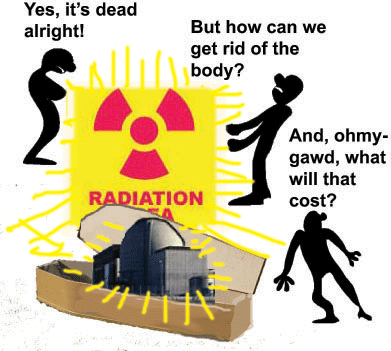
 Nucnet 1st March 2018, The Nuclear Decommissioning Authority (NDA) completely failed in both the procurement and management of a contract to clean up the UK’s Magnox
nuclear reactor and research sites, a report by the Public Accounts
Committee says.
The report, released on 28 February 2018, says this
disrupted an important component of vital nuclear decommissioning work and
cost the taxpayer upwards of £122m (€137m, $167m). The £6.2bn contract
— one of the largest awarded by the UK government — was to dismantle 12
first-generation Magnox nuclear sites.
It was awarded to Cavendish Fluor Partnership, a joint venture between UK-based Babcock International and
Fluor of the US. The committee, which oversees government expenditure,
said: “The NDA ran an overly complex procurement process, resulting in it
awarding the contract to the wrong bidder, and subsequently settling legal
claims from a losing consortium to the tune of nearly £100m.”
The committee also said the NDA, a public body established in 2004 to oversee
the clean-up of the UK’s nuclear legacy, “drastically
under-estimated” the scale of the work needed to decommission the sites
at the time it let the contract – a failure which ultimately led to the
termination of the Magnox contract nine years early.
The NDA did not have sufficient capability to manage the procurement or the complex process of
resolving differences between what the contractor was told to expect on the
sites and what it actually found, the committee concluded.
The NDA will now have to spend even more effort and money to find a suitable way of managing
these sites after the contract comes to an official end in September 2019,
the committee said. The NDA may have further wasted taxpayers’ money by
paying its previous contractor for work that was not done. The NDA cannot
fully account for £500m of the £2.2bn increase in the cost of the
contract between September 2014 and March 2017. In particular, it does not
know whether the £500m cost increase was due to its incorrect assumptions
about the state of the sites when it let the contract or underperformance
by the previous contractor.
https://www.nucnet.org/all-the-news/2018/03/01/accounts-committee-says-nda-completely-failed-with-6-2-billion-uk-magnox-contract
Politicians promote nuclear power – as the radioactive wastes pile up for future generations

Nuclear waste mountains just go on growing http://www.eco-business.com/news/nuclear-waste-mountains-just-go-on-growing/ Some politicians still claim atomic energy is the answer to climate  change while leaving the problem of nuclear waste to our descendants.
Nuclear waste has been an intractable problem since nuclear power was invented more than 50 years ago, and for many countries it is becoming an ever more expensive and politically embarrassing issue.
Not that politicians would admit this: many still argue that nuclear power is an answer to climate change, forgetting that they are passing the waste buck to future generations.
To those in power the solution to the waste problem is always just around the corner, conveniently just beyond their term of office. But the history of the industry over the last four decades, across the globe, is of dozens of failed schemes.
Currently the United States, France and the UK are yet again wrestling with the problem of repeated failed attempts to find a solution, as scientists warn that continued neglect of the issue is placing citizens in increasing danger.
The situation in China and Russia is not known, apart from the fact that in Russia there have recently been mysterious atmospheric leaks of radiation detected as far away as Switzerland.
Getting an honest overall situation report from the Russian government or from China seems unlikely, since many of their nuclear sites remain closed territories.
Long-lived radioactivity
The problem is that civil nuclear industries, especially when they are combined with a weapons programme, produce plutonium and other by-products in spent fuel that take as long as 100,000 years to decay.
Identifying somewhere to put these wastes where they could be safe for that length of time requires stable geological formations that are very hard to find anywhere. Since international law requires the state that produced the waste to dispose of it within its own boundaries, this is even more difficult.
If democracy is added into the mix, and people are given the right to object to a deep depository being built in their backyard, then in some countries the problem appears to be insoluble.
Two countries are close to solving the issue of their waste mountains, Swedenand Finland, although there are still regulatory hurdles to overcome.
Both are building deep depositories for their biggest problem, spent nuclear fuel. Fortunately spent fuel is less complex than the waste generated by the UK, France or the US, because it has no highly dangerous detritus remaining from nuclear weapon manufacturing.
For these three states, which have all reprocessed spent fuel to extract weapons grade plutonium, the situation is far more difficult. Despite this, all three countries are continuing to build nuclear power stations, potentially making the problem even worse for future generations.
The prime example is the UK, which wants to build a new generation of ten nuclear stations, but has just started its sixth search for a nuclear waste dump site in 42 years.
Various governments have gone through many proposals, some of them surviving through years of public consultations, planning inquiries and geological investigations, only to be finally rejected.
One favoured site, at Sellafield in Cumbria, next to the country’s two vast reprocessing facilities, was rejected on geological grounds – the rock it was to be built into has too many cracks to keep the waste from leaching into the water supply.
The latest scheme launched by the UK’s Department for Business, Energy and Industrial Strategy involves finding a community somewhere in Britain willing to take the waste in return for a very large bribe in the form of cash to develop schools, roads, industries and anything else that takes their fancy—as long as they host the nation’s nuclear waste for the next 100,000 years. It remains to be seen whether there are any takers.
Pledge ignored
The problem for the government is that it has frequently pledged not to build any more nuclear power stations until it has solved the problem of the waste, something it has patently failed to do. Meanwhile ever larger quantities of waste are being stored, much of it in unsatisfactory and sometimes dangerous conditions. Just keeping it safe costs £3bn (US$4.2bn) a year.
In the US, where the situation is as bad or worse, President Trump has re-opened the long-running saga of Yucca Mountain nuclear depository. This is a scheme that has been fought over for decades and abandoned because of local opposition.
The problem is that the waste stored in numerous US nuclear facilities is dangerous and urgently needs to be packaged and found a final resting place.
One of the most critical places is Hanford, once a place for making nuclear weapons that now has stores of unstable waste. The tanks full of liquid waste alone will cost an estimated $111bn to package and make safe. Trump’s reaction to this has been to slash Hanford’s budget by 10 per cent.
Meanwhile the answer from Nevada state officials to Trump’s proposal to re-open the Yucca Mountain depository scheme was to approve a $5.1mn legal contract to fight the proposal. It seems unlikely the situation will be resolved soon.
Eviction criticised
In north-eastern France hundreds of riot police were employed this month to evict 15 protestors living in tree houses to protect a zone in the forest of Lejuc, near Meuse.
The use of 500 armed gendarmes to evict 15 people has been strongly criticised, not least because the government has not yet finally agreed that this is the right site to bury 85,000 cubic metres of waste that will remain dangerous for 100,000 years.
The problem for these three governments—and others in Germany, Belgium, Switzerland and many other states that built nuclear power stations in the last century—is the growing urgency of finding a solution.
In Britain, France and the US there are “swimming pool-size tanks” of high-level waste which are unstable and need work without delay.
With one third of Europe’s operating nuclear power stations due to be shut down by 2025, and European utilities short of €118bn (US$145bn) in decommissioning and waste management funds to pay for the work, it looks as though taxpayers will be left to foot this enormous bill.
Knowing this, companies are queuing up to get into the nuclear waste business, confident that governments will sooner or later be forced to step in and provide the money to keep their citizens safe.
Plan to seal off South end of USA’s Nuclear Waste Isolation Pilot Project
 South end of WIPP to be sealed. But how? March 1, 2018 Officials are hoping to seal off the south end of the Waste Isolation Pilot Plant’s underground salt mine, where radiation was accidentally released in 2014, to allay safety concerns and ensure workers have clean air and stable ground in the future.
1 This Month
Chernobyl: The Lost Tapes – A good documentary on Chernobyl on SBS available On Demand for the next 3 weeks– https://www.sbs.com.au/ondemand/tv-program/chernobyl-the-lost-tapes/2352741955560

of the week–London Campaign for Nuclear Disarmament

Tell the Ukrainian Government to Drop Prosecution of Peace Activist Yurii Sheliazhenko
To see nuclear-related stories in greater depth and intensity – go to https://nuclearinformation.wordpress.com
-
Archives
- April 2026 (139)
- March 2026 (251)
- February 2026 (268)
- January 2026 (308)
- December 2025 (358)
- November 2025 (359)
- October 2025 (376)
- September 2025 (257)
- August 2025 (319)
- July 2025 (230)
- June 2025 (348)
- May 2025 (261)
-
Categories
- 1
- 1 NUCLEAR ISSUES
- business and costs
- climate change
- culture and arts
- ENERGY
- environment
- health
- history
- indigenous issues
- Legal
- marketing of nuclear
- media
- opposition to nuclear
- PERSONAL STORIES
- politics
- politics international
- Religion and ethics
- safety
- secrets,lies and civil liberties
- spinbuster
- technology
- Uranium
- wastes
- weapons and war
- Women
- 2 WORLD
- ACTION
- AFRICA
- Atrocities
- AUSTRALIA
- Christina's notes
- Christina's themes
- culture and arts
- Events
- Fuk 2022
- Fuk 2023
- Fukushima 2017
- Fukushima 2018
- fukushima 2019
- Fukushima 2020
- Fukushima 2021
- general
- global warming
- Humour (God we need it)
- Nuclear
- RARE EARTHS
- Reference
- resources – print
- Resources -audiovicual
- Weekly Newsletter
- World
- World Nuclear
- YouTube
-
RSS
Entries RSS
Comments RSS
 nuclear-news