Bank Head Estate residents attend public meeting over nuke dump blight
The UK/Ireland Nuclear Free Local Authorities wish to congratulate our
friends in Millom and District Against the GDF for organising a successful
meeting last month at which the residents of the Bank Head Estate, Millom
met with local Councillors to raise their concerns that in the future a
nuclear waste dump might become their unwanted neighbour.
Although for
several years, Nuclear Waste Services has been working, first with a local
Working Group and then through a Community Partnership, on plans to bring a
Geological Disposal Facility, or GDF, to the South Copeland Search Area it
was at the end of January that NWS revealed the Area of Focus in which more
detailed investigations will be conducted to determine its potential as the
eventual site for a waste receiving centre. Nuclear Waste Services have
previously revealed that the surface site will approximately one kilometre
square; once built the facility would from the 2050s, receive regular
shipments of radioactive waste which would be transported underground and
through access tunnels out under the seabed.
NFLA 5th March 2025 https://www.nuclearpolicy.info/news/bank-head-estate-residents-attend-public-meeting-over-nuke-dump-blight/
Most Contaminated U.S. Nuclear Site Is Set to Be the Largest Solar Farm.
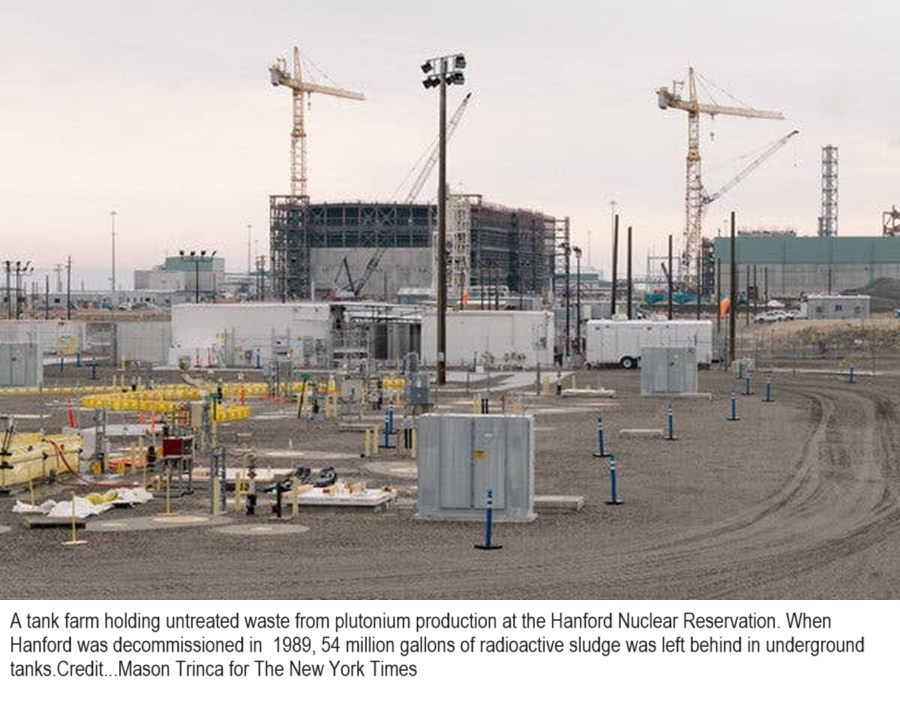
Plans to transform Hanford, which was integral to the nation’s nuclear arsenal after World War II, had just begun inching forward when President Trump started his second term.
New York Times, By Keith Schneider, Reporting from Richland, Wash, March 5, 2025,
In the weeks since President Trump has taken office, he has pushed to unleash oil and gas production and has signed executive orders halting the country’s transition to renewable energy.
But in Washington State, a government-led effort has just started to build what is expected to be the country’s largest solar generating station. The project is finally inching forward, after decades of cleaning up radioactive and chemical waste in fits and starts, at the Hanford Nuclear Reservation, a sweep of desert that was pivotal to the nation’s weapons arsenal from 1943 until it was shut down in 1989. A developer, Hecate, was brought on last year to turn big stretches of the site into solar farms.
Hecate will have access to 10,300 acres that the government has determined sufficiently safe to redevelop. The company has already started site evaluation on 8,000 acres, an area nearly 10 times the size of Central Park in New York and enough space for 3.45 million photovoltaic panels. (Hanford’s site is nearly 400,000 acres.)
If all goes according to plan, the Hecate project, which is expected to be completed in 2030, will be by far the largest site the government has cleaned up and converted from land that had been used for nuclear research, weapons and waste storage. It is expected to generate up to 2,000 megawatts of electricity — enough roughly to supply all the homes in Seattle, San Francisco, and Denver — and store 2,000 more in a large battery installation at a total cost of $4 billion. The photovoltaic panels and batteries will provide twice as much energy as a conventional nuclear power plant. The nation’s current biggest solar plant, the Copper Mountain Solar Facility in Nevada, can generate up to 802 megawatts of energy.
The big unknown still hanging over the plan is whether the Trump administration will thwart efforts that the Biden administration put in place to develop more clean electricity generation………………………………………….
While a clean energy project may clash with Mr. Trump’s policies, there’s a reason the administration may allow Hecate’s solar development to move forward: the revenue the government will get for the land lease. Hecate and the Energy Department declined to discuss the land’s market value, but private solar developers in the region said such easements typically paid landowners $300 an acre annually.
Two officials at the Energy Department, who asked not to be named for fear of retaliation, said that neither the president nor the leaders of the administration’s effort to reshape federal agencies had yet to intervene in the solar project, but that the future of the initiative was uncertain. One of the officials said the new energy secretary, Chris Wright, a former oil executive, had not yet reviewed the project as of late February.
Alex Pugh, Hecate’s director of development, said the company was moving ahead despite shifting political winds. “The fundamentals of the project are strong regardless of policy direction,” he said. “The region needs the project. There is a huge demand for electricity here.”
…………………….Hecate identified the large expanse of open ground alongside high-voltage transmission lines at Hanford as a potential site for its plant several years ago, Mr. Pugh said — long before the Energy Department solicited proposals. The potential benefits, he said, were plainly apparent.
………………….What they also have, however, is risk. The site where Hecate plans to build its photovoltaic panels is near an area where groundwater and soil were decontaminated and alongside an experimental 400-megawatt nuclear reactor complex that was decommissioned in 2001. It’s also about 20 miles south of B Reactor, the world’s first full-scale nuclear reactor, which produced the plutonium for the atomic
First shipment of 280,000 tons Aggregate arrives by rail at Cumbria low-level nuclear waste site for final capping
The first shipments via rail of 280,000t of aggregate by Nuclear Transport
Solutions (NTS) have been delivered to the Low Level Waste Repository
(LLWR) site in Cumbria, which will form a 100-year barrier for nuclear
wastes.
Nuclear Waste Services (NWS) is responsible for managing the
disposal of the UK’s low-level radioactive waste including at the LLWR
site. NTS is a transport and logistics provider which operated Direct Rail
Services (DRS) which transports nuclear and radioactive materials via rail.
Both NWS and NTS are part of the Nuclear Decommissioning Authority, which
itself is an executive non-departmental public body, sponsored by the
Department for Energy Security and Net Zero (DESNZ). The LLWR is the only
facility in the UK permitted to receive all categories of radioactive and
nuclear low level waste (LLW) and NWS describes it as “the nation’s
principal disposal facility for LLW”.
New Civil Engineer 26th Feb 2025, https://www.newcivilengineer.com/latest/aggregate-arrives-by-rail-at-cumbria-low-level-nuclear-waste-site-for-final-capping-26-02-2025/
The Supreme Court faces the absurdly difficult problem of where to put nuclear waste

And so it now falls to the Supreme Court to decide whether this latest attempt to find a place to store some of the most undesirable trash on the planet must falter on the shores of NIMBYism.
America’s worst NIMBY problem comes to the Supreme Court.
by Ian Millhiser, Vox , 26th Feb 2025,
https://www.vox.com/scotus/399304/supreme-court-nuclear-waste-texas-nrc-nimby
On March 5, the Supreme Court will hear a case that may involve one of the most toxic examples of NIMBYism in American history. The issue at the heart of Nuclear Regulatory Commission v. Texas arises out of a predictable problem: Absolutely no one wants radioactive waste anywhere near where they live or work, but that waste has to go somewhere.
Texas, as the case name suggests, involves an effort by the federal government to store nuclear waste in Texas, and at the same time, solve a problem it’s struggled with for nearly 40 years.
To fully understand what’s before the Supreme Court in Texas, we need to go back to 1982, when Congress passed a law that was supposed to establish a permanent repository for all of the radioactive waste produced by America’s nuclear power plants. This waste remains dangerous for thousands or even tens of thousands of years after it is produced, so it made sense to find a spot far from human civilization where it can be buried.
But then NIMBY — that’s “not in my backyard” — politics set in.
The US Department of Energy identified several possible sites for the waste, and eventually culled those sites down to three — one in Texas, one in Washington state, and Yucca Mountain in Nevada. But, in 1987, before these officials could complete the selection process, Congress stepped in and chose the Nevada site for them.
According to a Slate article on the eventual collapse of the Yucca Mountain plan, this choice is easy to explain when you look at who ran Congress at the time. The House speaker was Jim Wright, a representative from Texas. The House majority leader was Tom Foley, from Washington. So Nevada, which had the weakest congressional delegation at the time, lost out.
Indeed, according to Rod McCullum of the Nuclear Energy Institute, “the 1987 Amendment is now commonly referred to as the ‘screw Nevada’ bill.”
By the time President Barack Obama took office, however, the balance of power in Congress had changed. Sen. Harry Reid, of Nevada, was the majority leader. He set out, with the Obama administration’s support, to kill the Yucca Mountain project. Congress, at Obama’s urging, zeroed out funding for Yucca Mountain. Then, just in case the project wasn’t already dead enough, a 2013 court decision ordered the government to stop collecting taxes that would have funded the permanent storage facility until it could figure out where that facility would be located.
And that brings us to the present date, and to the issue before the Supreme Court in the Texas case. Without a permanent storage facility on the horizon, the federal Nuclear Regulatory Commission turned to an older statute which has been understood to allow it to authorize temporary storage facilities for nuclear waste since the 1970s, licensing a private facility to handle storage in Andrews County, Texas.
Texas eventually sued to block this facility, as did a nearby landowner. Their case wound up before a three-judge panel of the United States Court of Appeals for the Fifth Circuit. Two of these judges are from Texas. It’s not hard to guess what happened next.
And so it now falls to the Supreme Court to decide whether this latest attempt to find a place to store some of the most undesirable trash on the planet must falter on the shores of NIMBYism.
Indeed, the 1954 law’s language allowing the NRC to license possession of these three kinds of material is quite broad. The NRC may license possession of special nuclear material for reasons that it “determines to be appropriate to carry out the purposes” of the law. It may license possession of source material for any “use approved by the Commission as an aid to science or industry.” And it may license possession of byproduct material for “industrial uses” or for “such other useful applications as may be developed.”
Though both Texas and the landowner claim that this language should not be read to permit the kind of license at issue in the Texas case, they are swimming against at least a half-century of precedent. The landowner’s brief concedes that the NRC first claimed the authority to license facilities under the 1954 law in 1975 (it claims that this fact cuts against the government’s case, because the NRC waited two decades to claim this power, but the fact remains that this question has been settled for 50 years). The landowner’s brief also concedes that the NRC finalized regulations governing licenses for such facilities in 1980.
That said, the landowner’s brief does make a plausible — if not, exactly, airtight — argument that the 1982 law overrides the 1954 law’s provisions concerning private storage facilities. (Texas’s brief, by contrast, is heavy on overwrought rhetoric claiming that nuclear waste must be stored at Yucca Mountain, and light on the kind of statutory analysis that a responsible judge would rely upon in deciding this case.)
Among other things, the landowner’s legal team points to three provisions of the 1982 law which say that the NRC shall “encourage” storage of nuclear waste “at the site of each civilian nuclear power reactor,” and take other steps to promote such onsite storage. They also point to a provision calling for a federal storage facility. And, they highlight a provision stating that the 1982 law should not be read to “encourage” or “authorize” private storage facilities away from a reactor.
As the landowner’s legal team writes, allowing the Texas facility to exist would “discourage” creating new storage capacity at reactor sites, the opposite of what the 1982 law was supposed to accomplish.
It’s safe to say that, when Congress wrote the 1982 law, they imagined a world where nuclear waste would be stored either at reactor sites or at a federal facility, and not at a private facility like the one at issue in Texas. But the 1982 law also does not explicitly repeal the 1954 law’s provisions governing the three kinds of nuclear material. So the government has a very strong argument that it can still rely on those provisions to license the facility in Texas.
There is a possibility that the Supreme Court will simply make this case go away
There’s a real possibility that the Supreme Court will get rid of this case on procedural grounds, effectively handing a victory to the government.
Briefly, the federal law that both Texas and the landowner relied upon to bring their case to the Fifth Circuit permits “any party aggrieved by the final order” of the NRC to challenge that decision in a federal appeals court. The government argues that, to qualify as a “party,” Texas or the landowner must have participated “as a litigant” in the NRC’s internal proceeding governing the Andrews County license.
While both the state and the landowner took some steps to make their views known to the NRC during that proceeding, neither ever officially became litigants. Thus, the government argues, they do not count as a “party” to that proceeding which can appeal the NRC’s decision, and the Court should toss the case out. The key thing to know about this legal argument is that it may be enough to prevent the justices from reaching the merits of this particular case.
If the Court does reach the merits, however, it faces a difficult decision. Allowing the Andrews County project to move forward will undoubtedly trigger the same kind of political backlash that has accompanied every other attempt to pick a site to store nuclear waste. But, if this project is not allowed, it’s far from clear where the waste would go.
Tonnes of nuclear waste to be sent back to Europe
Federica Bedendo, BBC News, North East and Cumbria, 27th Feb 2025,
https://www.bbc.co.uk/news/articles/cpwddyg7e4do
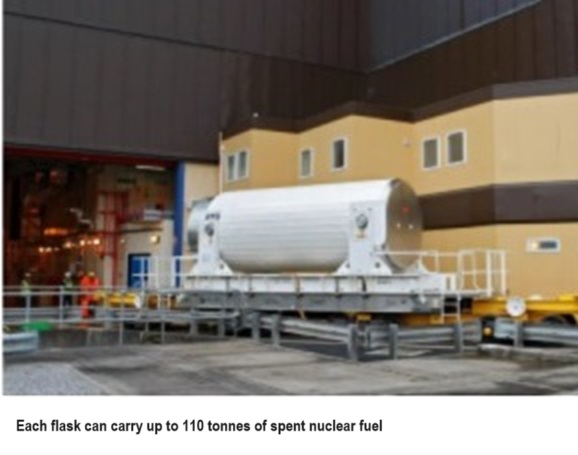
More than 700 tonnes of nuclear waste is due to be shipped to Europe as part of a project to send back spent fuel to the countries that produced it.
The Sellafield nuclear plant in West Cumbria was tasked with reprocessing the nuclear material used to produce electricity in Germany.
Seven cylindric containers, each carrying up to 110 tonnes of recycled nuclear waste, are due to make the journey to the Isar Federal storage facility by sea on a specialist vessel.
A Sellafield spokesman said the move was a “key component” of the strategy to “repatriate high level waste from the UK”.
This will be the second of three shipments from the UK to the European country.
The first shipment of six containers – known as flasks – to Biblis, was completed in 2020.
Each flask is about 20ft (6m) long, with a 8ft (2.5m) diameter.
The waste will be transported by sea on a specialist vessel to a German port, then onwards by rail to its final destination.
Letter: Hinkley Point C will be a Sellafield waste dump
By Jo Smoldon,
Burnham & Highbridge Weekly News 25th Feb 2025, https://www.burnhamandhighbridgeweeklynews.co.uk/news/24957412.letter-hinkley-point-c-will-sellafield-waste-dump/
In response to your Hinkley article around all the jobs created at Hinkley Point C, yes, of course it is good that the nuclear industry is training people to understand the nuclear sites and maybe later the nuclear process.
Nuclear, due to its very, very long-term footprint, has to be understood for thousands of years to come when the radioactive waste will need managing at high costs and high risk on this Hinkley location.
Trying to attract young people into a subject that is very antiquated in its science has been something that government and business will have to invest in forever.
Nuclear power for electricity is made by the last century science of steam driving turbines to condense to hot water.
Two-thirds of the energy produced from the reactors is thrown out in the form of hot water to be discharged into the Severn Estuary, hardly a ‘low-carbon energy’ if looked at in real terms!
What hasn’t been mentioned with all this bigging up the Hinkley site is that it will be the big Sellafield waste dump of the south, as after B station waste has been transferred to Sellafield, no more nuclear waste will move from Somerset.
Radioactive waste will remain on the North Somerset coast forever, how does that fit with the predicted sea level rise, extreme coastal events and Somerset’s regular flooding events?
Nuclear Decommissioning Authority budget raises Sellafield safety concerns
Wednesday 26 February 2025,
https://www.unitetheunion.org/news-events/news/2025/february/nuclear-decommissioning-authority-budget-raises-sellafield-safety-concerns
Safety could also be impacted at 16 other Nuclear Decommissioning Authority sites
Safety concerns over the Nuclear Decommissioning Authority (NDA) budget, which includes Sellafield as well as UK-wide services for nuclear waste and restoration, have been raised by Unite, the UK’s leading union.
The NDA group is responsible for decommissioning and cleaning up 17 nuclear sites. The group’s key operating companies include Sellafield, Nuclear Restoration Services (NRS) and Nuclear Waste Services (NWS).
The CEOs of all the operating companies have all stated that their current budgets are not enough to provide full services.
Unite general secretary Sharon Graham said: “Unite is extremely concerned that UK’s workers at Sellafield, NRS and NWS could be put at risk through efforts to cut costs. If the NDA budget isn’t fit for purpose, the government needs to increase it. Unite will not tolerate attacks on our members’ jobs or any changes that could jeopardise their health and safety.”
Unite national officer Simon Coop said: “Sellafield, NRS and NWS must fully consult with Unite before taking any steps that could endanger workers or impact their jobs, pay or conditions. We will not hesitate to defend our members if actions are taken that put them at risk.”
SCOTUS goes nuclear: Justices’ decision could seal spent fuel storage options for decades.

Ultimately, the Supreme Court will not be hearing technical, economic, or social arguments in this case; the matters of interest are purely legal. These legal interpretations, however, will have profound implications for how commercial spent nuclear fuel is handled until plans for permanent repositories are developed.
Bulleting of Atomic Scientists, By Riley Fisher, Muhammad Abdussami, Aditi Verma | February 20, 2025
US nuclear waste policy is at a critical turning point. Mired in decades of disappointments and shortcomings, the monkey on nuclear power’s back is just weeks away from being freed—or being strapped in place. The issue at hand: whether the Nuclear Regulatory Commission (NRC) had the legal authority to grant a permit for the construction and operation of a privately-owned temporary spent nuclear fuel storage facility in Texas.
On March 5, 2025, representatives from the NRC and the state of Texas will convene in Washington, D.C., to argue this issue in front of the United States Supreme Court. The NRC v. Texas case will end a battle of nearly three and a half years over the legality of privately-owned interim nuclear waste storage in the United States. However, while the Supreme Court’s ruling will settle the battle, it will resolve only one aspect of the US nuclear waste management problem.
A ruling favoring the NRC would help the nuclear waste problem in the short term but might harm the long-term management situation, allowing the consolidation of spent nuclear fuel at interim storage facilities—a state of affairs that could place new constraints on the permanent solution of geological disposal. Conversely, a ruling against the NRC would hurt the waste problem short-term by halting interim storage plans—including those of Interim Storage Partners in Texas and Holtec International in New Mexico—but it would leave future permanent storage options unconstrained.
Temporary storage. For more than 40 years, temporary, consolidated nuclear waste storage has been a hot-button issue. The Nuclear Waste Policy Act of 1982 tasked the president and the Energy Department with identifying, constructing, and operating nuclear waste storage facilities in underground repositories. With this act, Congress intended to create a program that permanently stowed away the hazardous waste produced by nuclear power operations.
The original provisions of the Nuclear Waste Policy Act gave the president four years to start the construction of a geologic repository site following congressional approval. During this process, nuclear power plants were still operating and producing spent nuclear fuel, and Congress clarified that plant operators were primarily responsible for waste management while the executive branch did their repository siting and construction work. Under exceptional circumstances, however, the federal government was allowed to provide a limited amount of “interim” storage before the waste was transferred to a permanent facility. The federal interim storage program would temporarily consolidate spent fuel away from reactor sites that have limited capacity.
But when efforts for a permanent repository at Yucca Mountain in Nevada stalled, the role of consolidated interim storage was put in a precarious position. Spent fuel continued to accumulate at nuclear power plants across the country, the federal government could not provide more temporary storage because it would violate the Nuclear Waste Policy Act, and the NRC did not have explicit authority to license an external body to create temporary storage. This tension is the impetus for NRC v. Texas case now at the Supreme Court.
There are a variety of arguments both for and against temporary storage of commercial spent nuclear fuel in the United States. Proponents cite that reactor host communities should not be subjected to living near radioactive waste for more time than they initially consented; interim storage, they say, would increase safety and economic efficiency through consolidation. Critics, in contrast, argue that a community near an interim facility risks the same fate of non-consent in the event of further delay in creating a permanent waste repository and that the safety risks from additional transportation and shuffling outweigh the benefits of consolidation.
Ultimately, the Supreme Court will not be hearing technical, economic, or social arguments in this case; the matters of interest are purely legal. These legal interpretations, however, will have profound implications for how commercial spent nuclear fuel is handled until plans for permanent repositories are developed.
Lower court’s contradictory ruling. Two main questions will be argued in NRC v. Texas. The first is a matter of administrative process and pertains to whether Texas had the legal right to challenge the NRC in the first place. Texas first challenged the commission under the 1950 Hobbs Act (which is not the Hobbs Act used in criminal prosecutions of organized crime), an administrative law statute that gives “aggrieved parties” the right to challenge federal agency actions. The NRC claims Texas did not follow proper procedure to be considered an aggrieved party and, therefore, did not have authority to challenge the license.
The second question is a matter of the function and authority of the NRC and is rooted in the language of the Atomic Energy Act of 1954. Texas argues that the NRC only has authority to grant temporary spent nuclear fuel storage licenses on the site of the reactor from which the waste originated. Therefore, Texas claims, the commission had no right to grant the license for a temporary storage facility in the state. The NRC, however, cites multiple previous court decisions that uphold this authorization. These federal-state disputes make a case like this ripe for Supreme Court intervention.
Like most other Supreme Court cases, NRC v. Texas is an appeal of a previously decided case in a lower court: Texas v. NRC. …………………………………………………………………………………………………………
NRC’s appeal. The Supreme Court may decide in a variety of ways concerning Texas’ authority under the Hobbs Act and the NRC’s authority under the Atomic Energy Act and the Nuclear Waste Policy Act. While clarification as to whether Texas was a proper “party aggrieved” is certainly important, it is likely the Supreme Court will take the opportunity to define the scope of the NRC’s abilities regardless of the interpretation of the Hobbs Act. Even if the Supreme Court finds that Texas was not a proper “party aggrieved,” the Court will still have the ability to hold the issued license void despite improper administrative procedures taken by Texas.
………………………………………………………. Because there is no explicit authorization in either act, the Supreme Court will likely rule that the NRC lacks clear congressional approval. If this is the case, then the Supreme Court will have to decide whether private, off-reactor spent fuel storage is a matter of major national significance— also known as a “major question.” While the Supreme Court has yet to hear arguments on this specific issue, there are reasonable explanations for either ruling.
……………………………………Some legal experts argue that private off-reactor waste is not a major question. Because on-site storage is exorbitantly expensive, a consolidated interim facility operated by a private entity will likely alleviate taxpayers’ burden. The West Virginia case was decided partially on its nationwide economic implications, but such implications are not present in this case. Another argument is that the NRC issued its regulations for private off-reactor storage two years before the Nuclear Waste Policy Act was passed. The fact that Congress did not revoke this authority from the NRC when passing the act could be interpreted as implicit approval. If the Supreme Court agrees with this perspective, it will likely allow Interim Storage Partners’ license to stand, even if the NRC did not have the explicit authority to issue that license.
Other arguments exist for this issue being a major question……………………………………
No perfect ruling. Either ruling will no doubt have vast consequences on the US nuclear waste management problem. A ruling in favor of the NRC would provide support for the nuclear industry’s ability to manage spent fuel, particularly during the continuous delays in permanent repository development. This result could also encourage private investment in nuclear energy by providing clearer pathways for managing waste, potentially revitalizing confidence in the industry’s long-term viability. However, a decision in NRC’s favor would not resolve all concerns with nuclear waste management. Many communities oppose the siting of temporary storage facilities, citing safety risks and the lack of a permanent solution. Resistance will continue to grow at local and state levels if these broader concerns go unaddressed. Congress will need to continue developing directives that strengthen and complement private solutions to waste management. A ruling in favor of the NRC would undoubtedly be a win for the nuclear industry, the federal government, and reactor host communities, as short-term pressures caused by on-site waste storage can finally be addressed. In the long term, this ruling will do little to permanently solve the waste problem and may place the nuclear industry into a false sense of security amidst concerns of interim facilities becoming de facto repositories.
If the Supreme Court rules against the NRC, it will create substantial uncertainty for the nuclear industry by rejecting the NRC’s authority to license private off-site storage facilities. Other corporations that currently plan to construct such facilities, such as Holtec International in New Mexico, will risk the revocation of their licenses. Decommissioned reactors with on-site storage may face danger to their storage license renewals, which will force active reactor sites to take in external waste while still generating their own. Situations like these can heighten safety and security risks, as many sites lack the infrastructure or oversight necessary for long-term storage and management.
However, a ruling against the NRC may bring increased attention to the issue and compel Congress to act decisively. ……………………………………… . A ruling against the NRC will likely be to the immediate detriment of the nuclear industry, the federal government, and reactor host communities. These pressures, however, may urge lawmakers to develop a new, permanent solution once and for all.
In the context of the nuclear waste problem, a ruling in favor of the NRC will be a short-term benefit but bring long-term risks. A ruling against the NRC will be a short-term detriment but may spur renewed action for long-term solutions. Regardless of the Supreme Court’s decision, Congress must dictate a permanent solution, which will be less likely to occur if short-term pressures are alleviated by ruling in favor of the NRC. In the absence of immediate Congressional intervention, the nuclear industry and the Energy Department must still work closely and in good faith with host communities. Anything else will result in complete failure of fair and democratic planning—as has been observed time and time again.
Editor’s note: Arguments on the NRC v. Texas case will be held before the Supreme Court on March 5, 2025. Summaries, audio files, and opinions will be accessible here after the hearing. The Supreme Court will issue its opinion before recess in late June 2025. Proceedings and orders will be made available as they come here. https://thebulletin.org/2025/02/scotus-goes-nuclear-justices-decision-could-seal-spent-fuel-storage-options-for-decades/
Election candidates should face nuclear waste questions: group

THE CHRONICLE-JOURNAL, Feb 25, 2025, https://www.chroniclejournal.com/news/local/election-candidates-should-face-nuclear-waste-questions-group/article_e5e12318-f322-11ef-aede-0bca88dc7589.htm
With just two days to go before the provincial election, two citizen watchdog groups are urging voters to grill candidates over where they stand regarding alternatives to nuclear power, and what to do with the nuclear waste that exists now.
In particular, the We The Nuclear Free North and Northwatch groups want candidates to commit to giving first responders notice before nuclear waste is transported through areas in which they provide emergency services.
The groups maintain that question is crucial in the Thunder Bay district, since the Nuclear Waste Management Organization is proposing to build an underground storage site for spent nuclear fuel rods at a remote location between Ignace and Dryden.
The two groups have set up an online tool that can be used to put questions to provincial-election candidates about the project and request a response. The link to the tool is: tinyurl.com/2x9uct7a.
Radioactive fuel rods are to be shipped to the storage site by truck or rail in specialized containers designed to withstand fiery crashes, hard impacts and immersion in water, according to the Nuclear Waste Management Organization.
The storage site is expected to take 20 years to build once all approvals have been obtained.
93% say NO: latest polls in Lincolnshire condemn nuke dump plan

In yet another demonstration that the people of East Lincolnshire are a far from ‘willing community’, recent polling at public events hosted by Nuclear Waste Services and amongst the parishioners of Gayton-le-Marsh have delivered a resounding NO vote to any plans to bring a nuclear waste dump to the area.
Nuclear Waste Service have recently resolved to move its Area of Focus in the Theddlethorpe GDF Search Area from the former Conoco gas terminal inland to 1,000 acres of prime farmland between the villages of Great Carlton and Gayton-le-Marsh.
NWS has held a series of information meetings to explain their decision. Theddlethorpe and Withern Councillor Travis Hesketh and activists from the Guardians of the East Coast established a polling booth outside events held in Gayton-le-Marsh, Strubby, Beesby, Maltby-le-Marsh, Great Carlton, Little Carlton, Withern, Theddlethorpe, Legbourne, Grimoldby, Manby and Saltfleetby, and invited members of the public to cast their secret ballot on the latest iteration of NWS’s plans to bring a Geological Disposal Facility to the area.
Of the 535 residents attending the events, 93% voted in the secret ballot; of these 93% voted for the process to be ended or for a Test of Public Support to be held now.
24th February 2025
93% say NO: latest polls in Lincolnshire condemn nuke dump plan
In yet another demonstration that the people of East Lincolnshire are a far from ‘willing community’, recent polling at public events hosted by Nuclear Waste Services and amongst the parishioners of Gayton-le-Marsh have delivered a resounding NO vote to any plans to bring a nuclear waste dump to the area.
Nuclear Waste Service have recently resolved to move its Area of Focus in the Theddlethorpe GDF Search Area from the former Conoco gas terminal inland to 1,000 acres of prime farmland between the villages of Great Carlton and Gayton-le-Marsh.
NWS has held a series of information meetings to explain their decision. Theddlethorpe and Withern Councillor Travis Hesketh and activists from the Guardians of the East Coast established a polling booth outside events held in Gayton-le-Marsh, Strubby, Beesby, Maltby-le-Marsh, Great Carlton, Little Carlton, Withern, Theddlethorpe, Legbourne, Grimoldby, Manby and Saltfleetby, and invited members of the public to cast their secret ballot on the latest iteration of NWS’s plans to bring a Geological Disposal Facility to the area.
Of the 535 residents attending the events, 93% voted in the secret ballot; of these 93% voted for the process to be ended or for a Test of Public Support to be held now.
Carlton Parish Council has previously passed a resolution calling for an immediate Test of Public Support, and the villagers of Gayton-le-Marsh made a similar resolution in a parish poll. 80% of parishioners participated, with 106 residents or 91% calling for the proposal to be withdrawn and 108 or 93% seeking a Test of Public Support.
These are the two latest blows in a whole series showered on Nuclear Waste Services, who must by now be punch-drunk, with most local Parish and Town Councils also passing resolutions calling for an immediate withdrawal or Test of Public Support.
In the last local elections held in 2023, a slate of anti-dump candidates was elected in wards within the Theddlethorpe GDF Search Area to East Lindsey District Council, Mablethorpe and Sutton Town Council, and local parish councils.
Surveys carried out by Guardians of the East Coast have previously indicated at least 85% are opposed to the nuclear waste dump plan.
The local Conservative MP for Louth and Horncastle Victoria Atkins has expressed her opposition to the plan and even the Leader of East Lindsey District Council Councillor Craig Leyland has had a change of heart indicating that he shall now be recommending to his Executive that the Council withdraw from the process.
To the NFLAs, Nuclear Waste Services continued efforts to pursue a GDF in East Lincolnshire represents the ultimate exercise in futility, for there are NO conceivable circumstances in which this will ever be a ‘willing community’.
Public concern increasing about nuclear waste shipments west of Sudbury
Northern Ontario News, By Ian Campbell, February 24, 2025
Officials in Nairn & Hyman Township say they are encouraged by the turnout at last week’s public information meeting as they continue to oppose the shipment of nuclear materials near Agnew Lake.
The Township of Nairn and Hyman and the Township of Baldwin held a joint emergency council meeting this week to discuss a plan to move radioactive material from the former Beaucage Mine. (Photo from video)
The township, along with the neighbouring community of Baldwin, has been vocal in its opposition to plans that would see nuclear waste transported to a nearby tailings management area west of Sudbury.
While the shipment plan is currently on hold, concerns remain about the potential environmental and health impacts of the proposal.
Nairn & Hyman Mayor Amy Mazey said the municipalities have been told not to expect answers to their questions until March 15.
In the meantime, Mazey and the township’s chief administrative officer said studies conducted by the municipality suggest the shipments could pose a risk to the local drinking water supply.
“When we get answers to our questions, we’re hoping to do another town hall meeting and show the town residents what we have received,” Mazey said.
“I’m pretty sure they’ll still be pretty negative towards it, but [we’ll] give them that update and then go to council and make a decision on how to move forward from there.”
The townships have garnered support from several political figures, including Nickel Belt’s Member of Parliament, a former Member of Provincial Parliament and the current candidate for the Algoma-Manitoulin riding.
Neighbouring communities along the North Shore have also joined the effort to oppose the shipments.The issue has sparked significant public interest, with residents expressing concerns about the long-term implications of storing nuclear materials in the area.
Mazey emphasized the importance of keeping the community informed and involved as the situation develops, when speaking with CTV News.
For now, the townships await further information and continue to prepare for next steps, including potential council decisions and further public engagement.
NWMO closing Teeswater office, to dispose of DGR site lands
The Post Rob Gowan, Feb 21, 2025
The Nuclear Waste Management Organization’s offices in Teeswater was to close to the public on Feb. 14 and the organization plans to dispose of the lands it had secured for a potential underground used nuclear fuel vault in South Bruce.
The more than 1,800 acres of land the organization had secured in South Bruce through a series of option and purchase agreements between 2019 and 2021 will be disposed of “in a manner respectful of the original commercial agreements and considerate to market conditions and appropriate timing,” an NWMO spokesperson said via email on Feb. 12.
“We cannot disclose any specific details regarding the agreements, as these are private commercial transactions,” NWMO’s regional communications manager for South Bruce, Carolyn Fell, said via email.
Bill Noll of the Protect Our Waterways – No Nuclear Waste group opposed to the DGR, said they are hopeful that NWMO does dispose of the land, as there continues to be some nervousness about the ultimate plans in the area.
“We know the NWMO is considering another DGR, the intermediate-level and non-fuel high level waste,” Noll said. “We have always been concerned about getting the last chapter done.”
In December, the NWMO announced that it had selected the Township of Ignace and Wabigoon Lake Ojibway Nation in northern Ontario as the future site for its deep geological repository. South Bruce was the only other site under consideration. ………………………………………………………………
the NWMO announced in late November it had selected the northern Ontario site.
Fell said on Feb. 12 that as part of the NWMO’s site investigations, several boreholes were drilled in the potential siting area in South Bruce, used to advance the understanding of the subsurface geology in the area.
With the site selected, the deep boreholes and shallow groundwater monitoring wells in South Bruce will be decommissioned, Fell said.
“This means the monitoring equipment will be removed and the boreholes then sealed in compliance with the applicable Ontario regulations (Ontario Water Resources Act/Oil Gas and Salt Resources Act),” Fell wrote. “This work is anticipated to be completed by the end of 2025.” ………………………………………………………………..
“While communities engaged in the used fuel DGR process may choose to participate, there is no requirement for them to do so,” Fell noted.
One potential impediment to a DGR being cited in the area could be SON’s willingness. For the used-fuel DGR process, the NWMO was insistent a project would not move ahead without the support of the local First Nation whose traditional territory the site falls within.
SON announced in late January that it would issue a moratorium on future nuclear intensification and waste projects if substantial progress is not made on nuclear legacy issues in its territory within six months. https://www.thepost.on.ca/news/local-news/nwmo-closing-teeswater-office-to-dispose-of-dgr-site-lands
Debris extracted from Fukushima nuclear plant revealed to media
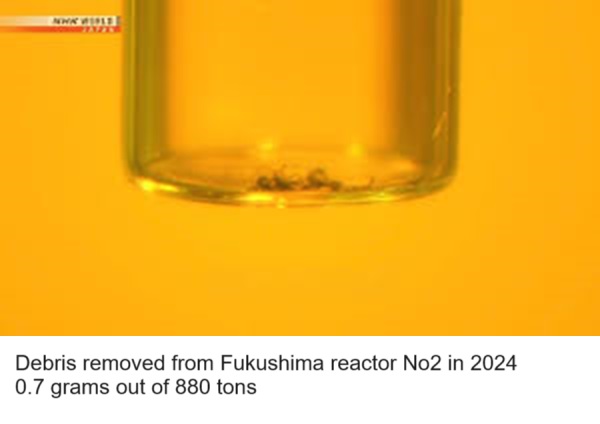
Friday, Feb. 21, https://www3.nhk.or.jp/nhkworld/en/news/20250221_08/?fbclid=IwY2xjawInSAlleHRuA2FlbQIxMQABHSRSw2PSosgQ6p28ndBqzler46N1Sr9mAHZH_X5SQL5hfjsJ5Tr3M48JTg_aem_xXho8cY6EkFQUvxp6aOcZQNuclear fuel debris that was extracted from the damaged Fukushima Daiichi nuclear power plant last year has been revealed to reporters for the first time.
The debris taken from the plant’s No.2 reactor consists of molten fuel mixed with surrounding structural components. The operator, Tokyo Electric Power Company, successfully retrieved 0.7 grams of the material in its first test extraction operation through November last year.
The debris was first transferred to a research facility of the Japan Atomic Energy Agency in Oarai Town, Ibaraki Prefecture, for the initial analysis, including surface observation.
The researchers then split the debris into smaller pieces to be examined at five research facilities, including a large one in Hyogo Prefecture.
Reporters were given the opportunity to observe the samples, which were placed in two separate transparent containers at a facility in Ibaraki Prefecture. One container held a particle about 2 millimeters in size that appeared silver, while the other had multiple dark fragments.
So far, the researchers have detected uranium, which is contained in nuclear fuel, on the surface of the debris, as well as metals such as iron, which are believed to have come from the reactor’s structure.
The researchers plan to examine the characteristics of the debris, including its hardness and adhesiveness. They will also expose the samples to lasers to determine whether the uranium inside is prone to triggering a nuclear fission reaction.
The agency says it will use these analyses to evaluate potential methods for full-scale extraction of the debris, and to determine the risk of a renewed criticality event, in which a self-sustaining chain reaction could occur.
The agency plans to release the findings of the major analyses in the middle of this year.
Ogino Hideki, the chief engineer at the agency’s Collaborative Laboratories for Advanced Decommissioning Science, spoke to the reporters.
He said it is difficult to fully grasp the overall characteristics of the debris based on the ongoing analyses alone. But he expressed his commitment to contributing to the decommissioning efforts through analyzing the samples using the technology that he and his fellow researchers have developed.
It is estimated that there is a total of around 880 tons of fuel debris in the No. 1, 2 and 3 reactors.
Nuclear waste dump agency pumps money into community projects in Mablethorpe

By Richard Silverwood
The organisation behind plans for a possible nuclear waste
dump in the Louth or Mablethorpe areas is continuing to pump money into
important community projects there. Nuclear Waste Services (NWS), a
government agency that specialises in the management of radioactive waste,
has earmarked Lincolnshire or Cumbria as the location for the dump, known
as a GDF (geological disposal facility).
Two potential sites – a former gas terminal at Theddlethorpe, near Mablethorpe, and agricultural land close to the villages of Hayton le Marsh and Great Carlton, near Louth –
have been mooted – and both have attracted widespread opposition.
Lincolnshire World 17th Feb 2025, https://www.lincolnshireworld.com/news/people/nuclear-waste-dump-agency-pumps-money-into-community-projects-in-mablethorpe-4995509
Ancient historic sites under threat from South Copeland nuke waste dump.
The Nuclear Free Local Authorities have written to the prisons’ minister
seeking a government guarantee that Haverigg Prison, will remain open, and
local jobs saved, were the nuclear waste dump to be built in South
Copeland.
Nuclear Waste Services have recently identified ‘Areas of
Focus’ in each of the three Search Areas which are being investigated for
their potential to host a Geological Disposal Facility. The GDF shall be
the eventual ‘forever’ repository for Britain’s stockpile of legacy
and future high-level nuclear waste. The facility will require a surface
site which shall receive waste shipments before they are taken beyond
ground and out through tunnels under the seabed.
One of these ‘Areas of Focus’, designated ‘West of Haverigg’, wraps around the prison site.
In his letter to Lord Timpson, the Chair of the NFLAs, Councillor Lawrence
O’Neill, identifies that over 200 staff work at the prison, including
over 100 from the local area, and that many local businesses also supply
goods and services to HMP Haverigg.
NFLA 18th Feb 2025 https://www.nuclearpolicy.info/news/can-there-be-any-guaranteed-future-for-haverigg-prison/
1 This Month

of the week – Shut Down Drone Warfare!


Tell the Ukrainian Government to Drop Prosecution of Peace Activist Yurii Sheliazhenko

Petition to revoke the licensing of the Near Surface Nuclear Disposal Facility (NSDF) at Chalk River. https://www.ourcommons.ca/petitions/en/Petition/Details?Petition=e-7247
To see nuclear-related stories in greater depth and intensity – go to https://nuclearinformation.wordpress.com
-
Archives
- April 2026 (79)
- March 2026 (251)
- February 2026 (268)
- January 2026 (308)
- December 2025 (358)
- November 2025 (359)
- October 2025 (376)
- September 2025 (257)
- August 2025 (319)
- July 2025 (230)
- June 2025 (348)
- May 2025 (261)
-
Categories
- 1
- 1 NUCLEAR ISSUES
- business and costs
- climate change
- culture and arts
- ENERGY
- environment
- health
- history
- indigenous issues
- Legal
- marketing of nuclear
- media
- opposition to nuclear
- PERSONAL STORIES
- politics
- politics international
- Religion and ethics
- safety
- secrets,lies and civil liberties
- spinbuster
- technology
- Uranium
- wastes
- weapons and war
- Women
- 2 WORLD
- ACTION
- AFRICA
- Atrocities
- AUSTRALIA
- Christina's notes
- Christina's themes
- culture and arts
- Events
- Fuk 2022
- Fuk 2023
- Fukushima 2017
- Fukushima 2018
- fukushima 2019
- Fukushima 2020
- Fukushima 2021
- general
- global warming
- Humour (God we need it)
- Nuclear
- RARE EARTHS
- Reference
- resources – print
- Resources -audiovicual
- Weekly Newsletter
- World
- World Nuclear
- YouTube
-
RSS
Entries RSS
Comments RSS
 nuclear-news