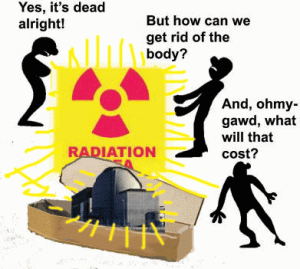
FES nuclear decommissioning funds inadequate, consumer groups tell NRC, Cleveland Business, When FirstEnergy Solutions closes the Perry nuclear power plant east of Cleveland, the Davis-Besse nuclear plant near Toledo and the Beaver Valley nuclear plant near Pittsburgh it will have up to 60 years to decommission the reactors and clean up the land at a cost of billions of dollars. A coalition of consumer and environment groups is arguing that the decommissioning trust funds are inadequate, that FES will not be able to begin decommissioning for years after the plants are closed and that parent company FirstEnergy Cop. must be held responsible to make up the funding deficit.(Plain Dealer file)
CLEVELAND, Ohio — The trust funds that FirstEnergy created years ago to pay for the demolition of its nuclear power plants and clean-up are no longer adequate, a coalition of consumer and environmental groups is arguing today at the Nuclear Regulatory Commission.
Japan to cap plutonium stockpile to allay U.S. concerns, THE ASAHI SHIMBUN, June 17, 2018
Japan plans to boost measures to curb surplus plutonium extracted from the reprocessing of spent fuel at nuclear power plants, including capping the country’s stockpile of the highly toxic material.
The move followed the U.S. and other countries’ calls for Japan to reduce excess plutonium in light of nuclear nonproliferation and the threat of terrorist attacks involving nuclear materials.
The Cabinet Office’s Japan Atomic Energy Commission will incorporate the measures in the five-point basic nuclear policy expected at the end of this month, the first revision in 15 years.
A reduction in the volume of plutonium held by Japan will also be specified in the government’s basic energy plan, which will be revised next month.
Japan possesses about 10 tons of plutonium inside the country and about 37 tons in Britain and France, the two countries contracted to reprocess spent nuclear fuel. The total amount is equivalent to 6,000 of the atomic bomb that devastated Nagasaki in 1945.
In the policy, announced in 2003, the government vowed not to possess plutonium that has no useful purpose. The government has pledged not to have surplus plutonium to the International Atomic Energy Agency………
Japan can reprocess spent nuclear fuel under the Japan-U.S. Nuclear Cooperation Agreement.
The 30-year pact is expected to be automatically extended beyond its expiration on July 16.
After the expiration, however, the pact will be scrapped six months after either Japan or the United States notifies the other side of its intention to do so.
Foreign Minister Taro Kono has expressed concern about the “unstable” future of the agreement after July, and Japan has worked to meet a request from Washington to clearly spell out steps to reduce Japan’s plutonium stocks.
The government’s draft policy calls for allowing retrieval of plutonium strictly based on the projected amount to be used at conventional nuclear reactors as mixed plutonium-uranium oxide fuel, commonly known as MOX fuel.
It will also step up oversight on utilities with the aim of reducing the amount of plutonium to a level allowing the nuclear reprocessing plant under construction in Rokkasho, Aomori Prefecture, and other facilities to operate properly.
In addition, electric power companies will cooperate with each other in the use of MOX fuel, so that the amount of Japan’s surplus plutonium that is now overseas will be reduced.
For example, Kyushu Electric Power Co. and Kansai Electric Power Co., two utilities that began using MOX fuel ahead of other utilities, will consider using more MOX fuel at their nuclear plants for the benefit of Tokyo Electric Power Co., whose prospect of bringing its Kashiwazaki-Kariwa nuclear power plant in Niigata Prefecture back on line remains uncertain.
When the 2.9 trillion yen ($26.37 billion) reprocessing plant in Rokkasho goes into full operation, about eight tons of new plutonium will be added annually as Japan’s surplus plutonium…..
of nine reactors that have resumed operations following the introduction of more stringent safety standards after the Fukushima No. 1 nuclear disaster in 2011, only four can use MOX fuel.
The operation of the Rokkasho plant will likely be significantly curtailed even if it is completed amid that environment.
The inhabitants of Jaroměřice nad Rokytnou, a village in the Vysočina region between Bohemia and Moravia, voted overwhelmingly against the construction of a nuclear waste storage site on their land in a referendum on Saturday.
Jaroměřice nad Rokytnou is one of nine Czech locations being considered by experts for the purposes of a nuclear waste store. About 45 percent of the village’s inhabitants took part in the vote, which makes the referendum valid.
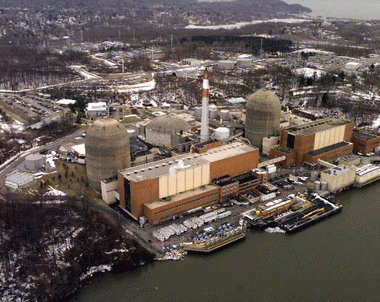
The report lays out for the public complex issues regarding spent fuel management, current U.S. Nuclear Regulatory Commission regulations, the radiological contamination of the site, effects on communities and workers, and useful references regarding other reactors that have closed. It also clarifies that replacement energy is already available even without new gas power plants.
However, on site reuse, the task force report fails to examine one of the best options, which would be to decommission and clean up the whole Indian Point site within a reasonable period, such as 20 years. Instead, the task force goes into details on options for the reuse of small parcels that are highly constrained and that Entergy has said it will not make available until the site is decommissioned.
The task force took this limited approach because the the NRC, which oversees decommissioning, allows nuclear power plants up to 60 years to decommission. However, the NRC is focused on the interests of nuclear licensees, not the local community. It is therefore necessary and appropriate for the state and its task force to act as a champion of local concerns and interests during the forthcoming Indian Point decommissioning process. Experience with decommissioning so far shows that it can be done within 20 years or even faster if the will is there.
Above – Sellafield’s massive Magnox nuclear waste storage pool
Only Cthulhu can solve Sellafield’s sludgy nuclear waste problem, Wired, ByDAVID HAMBLING , 14 June 18
Cleaning up Sellafield’s nuclear waste costs £1.9 billion a year. To help with the toxic task, robots are evolving fast. Sellafield has been called the most dangerous place in the UK, the most hazardous place in Europe and the world’s riskiest nuclear waste site. At its heart is a giant pond full of radioactive sludge, strewn with broken metal, dead animals and deadly nuclear rods. The solution to clearing up Sellafield’s nuclear waste and retrieving the missing nuclear fuel? Robots, of course. And to tackle this mammoth task, the robots are being forced to evolve.
Sellafield’s First-Generation Magnox Storage Pond is a giant outdoor body of water that’s the same size as two Olympic swimming pools. It was built in the 1960s to store used fuel rods from the early Magnox reactors – which had magnesium alloy cladding on the fuel rods – as part of Britain’s booming nuclear program. In 1974, there was a delay in reprocessing; fuel rods started corroding and the pond became murky. The pool was active for 26 years until 1992 and is now finally being decommissioned as part of the £1.9 billion spent each year on Sellafield’s mammoth cleanup operation.
The pond contains about six metres of radioactive water and half a metre of sludge, composed of wind-blown dirt, bird droppings and algae – the usual debris that builds up in any open body of water. Unlike other mud, it conceals everything from dropped tools and bird carcasses to corroded Magnox cladding and the remains of uranium fuel rods.
A number of robotic creations have bee used to get to the bottom of the pool’s sludge but struggle to break through the hostile environment. Tethered swimming robots do not have the sensors to find objects in the fine mud, and lack the leverage to lift chunks of metal. Experience at Fukushima has shown robots that are not well adapted to the environment are a waste of time.
Enter Cthulhu, a tracked robot that can drive along the pond bed, feeling its way with tactile sensors and sonar. The robot, which is currently in development, is approaching Sellafield’s problem differently. The robot will be able to identify nuclear rods and then pick them up. “Rather than trying to mimic a human, we’re building a robot that can do things humans can’t do with senses that humans don’t have,” says Bob Hicks of QinetiQ, which is leading the project.
The name stands for ‘Collaborative Technology Hardened for Underwater and Littoral Hazardous Environment,’ but it’s also a nod to Cthulhu, the godlike alien created by HP Lovecraft: both are amphibious, dwell in strange surroundings, and have sensory feelers. “Much like a walrus detecting molluscs, we hope to be able to detect and identify objects in the sludge with the whiskers,” says Plamen Angelov of Lancaster University’s School of Computing and Communications.
QinetiQ is supplying the tracked body, originally from a bomb disposal robot, and Bristol Maritime Robotics is developing the tactile sensors, while Angelov’s team is providing the neural network AI. It is planned the robot will use deep learning to fuse tactile and sonar data into a single picture of the world. Existing neural networks can handle video data, and ‘image classifiers’ to distinguish objects are well-established. But nobody has tried to fuse data from different types of sensor before.
Cthulhu’s classifier will learn to divide objects into ‘fuel rods’ and ‘everything else’………
The work at Sellafield is due to take several decades to complete fully. Nuclear waste is spread through several buildings in a variety of silos and pools. Each has its own challenges for cleaning-up. For the First Generation Magnox Pond, documents from the government show all the bulk fuel should be removed by the early 2030s. http://www.wired.co.uk/article/sellafield-nuclear-robots-cleanup-waste
Workers will pump radioactive sludge to an adjacent building near the Columbia River, where it will be packaged and transported to the middle of the Hanford site. Allison Sundell, June 13, 2018
Hanford employees began work to remove radioactive sludge from a storage facility near the Columbia River and move it to a location near the center of the Hanford site, the U.S. Department of Energy announced Wednesday.
The 35 cubic yards of sludge are a mixture of tiny fuel corrosion particles, metal fragments, and dirt. It’s the result of deteriorating fuel rods that were exposed to radiation and is some of the most hazardous material at Hanford, according to the Department of Energy.
The sludge is currently stored in a facility about 400 yards from the Columbia River.
Workers will first pump the sludge to an adjacent building where they will package and prepare the material to be transported to the middle of the Hanford site. The work is expected to last until 2019.
Sludge Removal Process Near the Columbia River at the Hanford
The new storage facility has safety features including secondary containment basins, leak detectors, and vents.
The move away from the Columbia River and to a safer storage facility is to reduce risk, according to Doug Shoop, manager of the Department of Energy’s Richland Operations Office.
Hanford’s contractor, CH2M HILL Plateau Remediation Company, says workers spent years developing the sludge removal system and took extensive preparations before the work began.
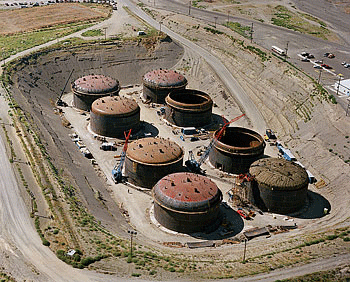
A Hanford watchdog group is objecting as the Department of Energy takes the first step toward a plan to fill underground, radioactive waste storage tanks with concrete-like grout and leave them permanently in place. The C Tank Farm, which would be closed first, has not had enough radioactive waste removed to have tanks filled with grout, said Tom Carpenter, executive director of Seattle-based Hanford Challenge.
“This would be a serious setback for the cleanup at Hanford if the DOE is allowed to turn Hanford into the nation’s high-level nuclear waste dump,” Carpenter said. “This will be challenged.”
Geoffrey Fettus, a senior attorney at the Natural Resources Defense Council, said that “the people of the Pacific Northwest deserve better, and we’ll be there with them opposing this unsound and unsafe effort.”
Nikkei Asian Review 10th June 2018, US demands Japan reduce its plutonium stockpiles. Trump-Kim summit raises
questions about Tokyo’s nuclear exemption. The U.S. has called on Japan to
reduce its high levels of stockpiled plutonium, a move that comes as the
Trump administration seeks to convince North Korea to abandon its nuclear
weapons, Nikkei has learned. https://asia.nikkei.com/Politics/International-Relations/US-demands-Japan-reduce-its-plutonium-stockpiles
RICHLAND, Wash. — A Hanford watchdog group is objecting as the Department of Energy takes the first step toward a plan to fill underground, radioactive waste storage tanks with concrete-like grout and leave them permanently in place.
The C Tank Farm, which would be closed first, has not had enough radioactive waste removed to have tanks filled with grout, said Tom Carpenter, executive director of Seattle-based Hanford Challenge.
“This would be a serious setback for the cleanup at Hanford if the DOE is allowed to turn Hanford into the nation’s high-level nuclear waste dump,” Carpenter said. “This will be challenged.”
Geoffrey Fettus, a senior attorney at the Natural Resources Defense Council, said that “the people of the Pacific Northwest deserve better, and we’ll be there with them opposing this unsound and unsafe effort.”
DOE has completed a draft evaluation of the waste remaining in the C Tank Farm, concluding that radioactive waste has been removed to the extent possible and that the remaining waste, if grouted in place, would meet requirements for disposing of it as low-level radioactive waste.
The draft evaluation is a step toward classifying the waste as low-level to allow it to be left in place as tanks are filled with grout and then covered with an above-ground cap to prevent precipitation from infiltrating.
An all-day meeting is planned starting at 9 a.m. Monday at the Richland Public Library to explain the draft document and its findings. A public comment period started June 4.
DOE worked steadily to empty most of the waste in the 16 tanks of C Tank Farm from 2003 until late 2017.
The federal court-enforced consent decree requires DOE to get as much radioactive waste from the tanks as possible, with an overall goal of getting an average of 99 percent of waste removed from the 149 single-shell tanks at Hanford.
It is roughly the equivalent of a little less than an inch of waste if it were spread evenly across the bottom of a tank.
In the C Tank Farm, about 96 percent of the volume of the waste was removed, according to DOE.
The 16 tanks held 1.8 million gallons of mostly sludge and salt cake when retrieval of solids began. They now hold an estimated 64,000 gallons of waste.
DOE was required to use up to three different technologies at each tank until each technology was no longer able to remove waste under the terms of the federal court-enforced consent decree.
Technologies included various methods to spray high-pressure streams of liquid on the waste within the enclosed tanks and move it toward a pump for removal, different vacuuming systems, and soaking hardened waste in water or a caustic chemical.
Much of the remaining waste is difficult to retrieve safely without exposing workers to radiation or damaging the walls and floor of the tanks, which already are prone to leaking. Some of the remaining waste is clinging to the walls of the tank.
Hanford Challenge is not proposing that workers be put in harm’s way, Carpenter said.
In 10 to 20 years, there could be better technology to retrieve remaining waste, provided the tanks have not already been filled with grout to make that impossible, he said.
In the meantime, the solid waste in the tanks could be monitored and DOE could focus on the more pressing issue of removing waste from its other leak-prone, single-shell tanks, Carpenter said. Just one tank in addition to the 16 C Farm tanks has been emptied to regulatory standards.
Grout has not been shown to effectively contain nuclear waste for periods of more than 100 years, according to Hanford Challenge. Water can infiltrate grout, and grout can break down quickly in the presence of caustic materials such as nuclear waste, it said.
Plutonium would reach the groundwater and then the Columbia Point at some point in the future, Carpenter said.
The draft proposal would challenge the consensus that Hanford’s tank waste should be vitrified, or immobilized in glass, according to Hanford Challenge.
“Hanford is proposing shortcuts to the cleanup that will save money, but will in the end further damage the environment and impact human health and safety and future generations,” Carpenter said.
DOE said in its announcement of the draft report and public meeting that “closing the emptied tanks would be a significant achievement in DOE’s Hanford cleanup mission. DOE has a record of safely and successfully closing emptied underground waste tanks at the Savannah River Site in South Carolina and the Idaho National Laboratory.”
Public comment will be accepted through Sept. 7 at WMACDRAFTWIR@rl.gov. It also can be mailed to Jan Bovier; DOE Office of River Protection; P.O. Box 450, MSIN H6-60; Richland, WA 99354.
For more information on the report, click on the revolving banner at www.hanford.gov.
Further steps in the regulatory process will be required before the C Tank Farm is closed.
DOE will have to make a decision on whether tanks could be filled with grout or must be dug up. The Washington state Department of Ecology, a Hanford regulator, also would have to agree that tanks could be grouted.
a minimum requirement for any form of political consent to onsite storage would be a clear commitment by the government to phase out all nuclear power by a fixed date, so that the final amount of waste can be determined and will not just keep growing, along with the burden on local people.
CNIC Seminar report: The problems with Japan’s Plutonium: What are they and how do we deal with them? http://www.cnic.jp/english/?p=4135Caitlin Stronell, CNIC BY CNIC_ENGLISH · JUNE 4, 2018 On April 20, CNIC organized a seminar with guest speaker Prof. Frank von Hippel, a nuclear physicist from Princeton University’s Program on Science and Global Security, presenting alternative ways to dispose of spent fuel instead of reprocessing, as well as options for disposal of separated plutonium. After this presentation of technical solutions, a panel discussion took place. Prof. Eiji Oguma, a historical sociologist from Keio University’s Faculty of Policy Management and a well-known commentator on the post-Fukushima anti-nuclear movement in Japan, pointed out the political barriers that must be overcome if any of these technical solutions were to be actually implemented, no matter how much more reasonable they may seem from economic and safety perspectives. CNIC’s General Secretary, Hajime Matsukubo was also on the panel and brought into the discussion the international implications of Japan’s plutonium policy including the US-Japan Nuclear Agreement.
Prof. von Hippel explained that plutonium disposal is a global problem, with more than half of the existent separated plutonium being produced as a result of civilian reprocessing, the rest produced for military purposes. Disposing of the plutonium that had been produced for weapons during the cold war has been a huge headache for the United States with planned disposal by burning it as MOX fuel in commercial reactors proving hugely expensive. America has all but abandoned its half-built MOX plant and is now looking towards the ‘dilute and dispose’ option.
This process would use glove boxes to mix 300 grams of plutonium oxide into a can of ‘star dust’ (a secret ingredient from which plutonium would be difficult to separate again). This can would then be placed in a plastic bag and another ‘outer blend can.’ Another way of immobilizing plutonium is the Hot Isostatic Pressing method, which is being developed in the UK and utilizes radiation-resistant, low-solubility ceramic. After plutonium has been immobilized, it is safer to bury it underground than keep it on the surface and Prof. von Hippel mentioned the deep borehole disposal method which uses techniques developed for drilling oil and geothermal wells that can bore five kilometers into the earth. In the US, however, plans for a demonstration project of this method of radioactive waste disposal were rejected by local governments.
Prof. von Hippel stressed that the main lesson for Japan is that separated plutonium is extremely difficult to dispose of and that it is definitely better not to separate any more than is already stockpiled. Instead of sending spent fuel from the nation’s nuclear power plants to Rokkasho for reprocessing, it would be safer and much cheaper and more efficient to set up dry cask storage for the spent fuel onsite at the plant. Prof. von Hippel showed us successful examples of this method in the US and suggested that there were moves in this direction in Japan as well.
Prof. von Hippel’s detailed technical solutions were very convincing. Yet despite the dangers of holding such a large plutonium stockpile (47 metric tons, enough for approximately 6,000 nuclear weapons), despite the massive costs involved and despite having no concrete viable plans as to how to actually use the separated plutonium, official Japanese government policy is to continue to separate even more plutonium at the Rokkasho Reprocessing Plant, which is currently due to commence operations in 2021.
In the panel discussion which followed Prof. von Hippel’s presentation, Prof. Oguma agreed that reprocessing was most certainly problematic, but, he pointed out, it will be extremely difficult to just put up onsite storage of spent fuel, no matter how reasonable a technical solution it is. Political consent must be gained from the people in communities, which will not just be hosting the nuclear power plant, but will be asked to store its radioactive waste as well. As Prof. Oguma pointed out, especially post-Fukushima Daiichi, no one trusts the Japanese Government’s nuclear policy and the likelihood that they will agree to yet another imposition that can be perceived to be long-term and dangerous, is very low. Much of the Japanese public also believes that onsite storage is merely an excuse for the nuclear industry to keep afloat. If spent fuel pools fill up, utilities will not be able to operate their plants. For many activists this is one way of closing them down, which is their main aim. Prof. Oguma argued that a minimum requirement for any form of political consent to onsite storage would be a clear commitment by the government to phase out all nuclear power by a fixed date, so that the final amount of waste can be determined and will not just keep growing, along with the burden on local people.
This is a significant difference in perspective. Prof. von Hippel’s main aim is to stop reprocessing and reduce stocks of separated plutonium, even if nuclear power generation continues, but Prof. Oguma claims that without an overall reassessment of the entire nuclear power policy it will be impossible to gain political consent for Prof. von Hippel’s proposed onsite storage.
The economics is not as straightforward as it sounds either. While it is undoubtedly cheaper, in a purely mathematical sense, to simply dispose of spent fuel as waste, instead of reprocess it and fabricate MOX fuel, the accounting systems of utilities make the more efficient alternative of direct disposal very difficult. At the moment, spent fuel is counted as an asset on utility balance sheets under the premise that it will become MOX fuel. If reprocessing is officially abandoned, all of the spent fuel ‘assets’ will become ‘liabilities’ and many utilities will be facing possible bankruptcy. Prof. Oguma suggested that the only way to overcome all these political and economic barriers is for the government to disclose all information on nuclear power and reprocessing and to conduct an open public debate on how to proceed. If a public consensus is reached, based on all the scientific, technical and economic data available, then reprocessing should be stopped.
CNIC’s Hajime Matsukubo pointed out that the Japanese government’s accountability crisis was not just domestic, but international. Building up such large stocks of plutonium at huge cost and with no credible purpose inevitably makes neighboring countries suspect Japan’s intentions. Indeed documents recently revealed show that the present Vice Minister of the Ministry of Foreign Affairs has long been an advocate of Japan becoming a nuclear weapons state. Japan’s opposition to President Obama’s proposal that the US adopt a no first-use of nuclear weapons policy, was reported in the Japanese media. Thus Japan’s credibility as a strong advocator of non-proliferation is already failing and the plan to separate even more plutonium at Rokkasho could easily provoke a regional nuclear arms race, destabilizing the region, just as hopes rise that the situation in North Korea may improve.
Mr. Matsukubo also pointed out that Japan is the only non-nuclear weapons state that is permitted to separate plutonium under the US-Japan Nuclear Cooperation (123) Agreement. This creates double standards which weaken the entire global non-proliferation regime. For example, Saudi Arabia is negotiating a 123 Agreement with the US and demands that it also be allowed to reprocess spent fuel ‘like Japan.’
For all of the above safety, economic and non-proliferation reasons, it would seem that there is plenty of ammunition for the movement against reprocessing. Indeed, Mr. Matsukubo said that in many ways it should be easier to stop reprocessing than stop nuclear power generation. Why hasn’t this happened? As well as the difficulties mentioned by Prof. Oguma, there is also the factor that the movement against reprocessing in Japan has not been as strong as the movement against nuclear power. Reprocessing seems like a more convoluted, more removed issue, perhaps difficult for people to grasp and focus on. All speakers agreed that the movement against reprocessing must be strengthened. The first thing that must be done to achieve this is to raise awareness and understanding regarding this issue within the broader anti-nuclear movement (both power generation and weapons) and the general public. Providing accurate information on the nuclear fuel cycle in a format that people can understand is the vital first step. As many people as possible must be informed about the costs, the dangers and the alternatives. The movement must be strong enough to demand that governments and utilities disclose all data, engage in an open debate and commit to implementing the consensus which emerges.
Prof. Oguma said that he and many other activists in Japan were committed to conveying the messages of Fukushima to the larger world, and to contributing to international solidarity on ending nuclear power. This also includes understanding how other countries see Japan. The plutonium issue is one that has particularly strong international impacts and implications and by pursuing this present policy the Japanese government is only damaging Japan’s international credibility, especially regarding non-proliferation.
The seminar concluded that, whether on an international level or a domestic one, the Japanese government must restore accountability and democracy, it must formulate a responsible nuclear policy that is demonstrably safe, economic and realistic and which has the consent of the people. Viable technical alternatives to reprocessing spent fuel are available but can only be implemented through raising awareness and a change in political will, which as a movement, we must focus on with added strength.
The spending bill, which includes appropriations for military construction and other federal departments, contains $267 million to restart the licensing process to open the Yucca Mountain nuclear repository in Nye County, about 90 miles northwest of Las Vegas.
An amendment to strip that spending from the bill died on a voice vote.
The amendment was filed by Rep. Ruben Kihuen and supported by Rep. Dina Titus and Rep. Jacky Rosen, all Nevada Democrats.
A Senate spending bill approved last month does not include funding for Yucca Mountain.
Differences in the two bills must be reconciled by a House-Senate conference committee.
Sellafield to store nuclear waste on site for up to 100 years
Waste will be stored in a facility until there is a long-term disposal solutionNWE Mail, UK, By Jenny Barwise, 8 June 2018
Sellafield is seeking permission to store extra nuclear waste in a specialised facility on the site for up to 100 years.
An application has been lodged with the county council to built two extra plant rooms in the existing Self Shielded Box Storage (SSBS) facility. The facility itself was granted permission three years ago and completed earlier this year. It is designed solely for the interim storage of boxes of waste from the Magnox storage pond which ceased operations 25 years ago.
The waste would be stored in the facility as an interim measure until a long term disposal solution – such as a geological waste facility which the Government is currently consulting on – was created. ……..
“This year we completed the construction of a new store which will hold hundreds of self-shielded boxes – these are specially built 30-tonne metal containers which safely hold radioactive waste and provide the necessary shielding from the waste inside them.”…….
As well as creating the extra plant rooms, the security fence needs to be raised by four-metres.
The application has been lodged with the county council as it is the authority which deals with minerals and waste matters, but Copeland Council has been consulted on the plans.
Officials at the Waste Isolation Pilot Plant in southern New Mexico confirmed this week that processing and handling resumed June 2.
In disposing the waste, seven 55-gallon (208-liter) drums are wrapped together in a tight formation to go deep inside the ancient salt formation where the repository is located. The idea is that the shifting salt will eventually entomb the waste.
Work was halted when employees found one drum wasn’t aligned with the others that made up the waste package. The package was eventually repacked and disposed of underground.
Officials say no radiation was released and no injuries were reported.
At the Savannah River Site, the future of the Mixed Oxide Fuel Fabrication Facility is in jeopardy after a report last month by the National Nuclear Safety Administration recommended the facility be repurposed to produce plutonium pits while also maximizing pit production activities at Los Alamos National Laboratory in New Mexico.
Fifty pits per year would be produced at SRS and 30 per year at Los Alamos, the report said, and “is the best way to manage the cost, schedule, and risk of such a vital undertaking.”
The MOX project arose from an agreement between the U.S. and Russia to dispose of 68 metric tons of weapons-grade plutonium. The material would be enough to create about 17,000 nuclear weapons. But the project has been beset by years of delays and cost overruns, over which the state has several times sued the federal government.
South Carolina’s legislators said the plan to re-purpose the MOX facility is premature considering shipment of diluted plutonium to the Waste Isolation Pilot Plant hasn’t been fully vetted.
Oyster Creek, the oldest of New Jersey’s four nuclear power plants, will shut down Sept. 17, but some of its main buildings will remain standing for nearly six decades at the Ocean County site.
The company also said it had chosen a method that will span 60 years to complete the dismantling of the plant, versus beginning immediately.
Exelon had originally planned to shutter Oyster Creek in 2019 then, this past February, moved the date up to this October. That’s now going to be mid-September at the end of the station’s current fuel cycle, according to Suzanne D’Ambrosio, spokeswoman for Oyster Creek said Tuesday.
According to the report Exelon filed with the NRC, it has chosen to put the plant into long-term storage — a method known as SAFSTOR — and take advantage of the NRC’s rules on decommissioning plants which allow a company up to 60 years to raze a facility. “The SAFSTOR option is the most economical and radiologically safe plan for decommissioning,” D’Ambrosio said. “It allows for normal radioactive decay, produces less waste and exposes our workers to lower levels of radiation.”
Once it stops producing electricity Sept. 17, the process of moving the radioactive fuel from the reactor core to a spent fuel storage pool begins, something Exelon says should be done by Sept. 30.
In the coming years work will begin to remove some smaller buildings at the site, according to the report. The radioactive spent fuel rods will eventually be removed from the fuel pool and be placed in dry storage casks, a task Exelon says will be done by 2024.
The site will be maintained for 50-plus years until Exelon begins removing the larger components at the site beginning in June 2075 and wrapping up by December 2077, according to its report.
Some of the larger sections of the plant may actually be barged from near the site, according to the report.
The decommissioning is expected to cost the utility about $1.4 billion, Exelon says.
Environmentalists who have long been critical of the 620-megawatt plant, said they are glad to see it close.
“Oyster Creek has been a safety threat to Ocean County, polluting Barnegat Bay, and killing thousands of fish over the years,” said Jeff Tittel, director of the New Jersey Sierra Club. “Shutting down the Oyster Creek plant will reduce the algae blooms, improve fish populations and help restore the overall ecosystem of the Barnegat Bay.”
Nuclear Energy Insider 6th June 2018, As France’s EDF expands into new decommissioning markets, learnings at the
group’s first pressurized water reactor dismantling is informing new cutting, tooling and waste strategies.
A new partnership agreement between EDF’s decommissioning subsidiary Cyclife and Sweden’s Fortum highlights
EDF’s aim to become a leader in the European nuclear decommissioning space.
Cyclife and Fortum announced May 30 they will jointly develop services in
nuclear decommissioning and waste management, focusing on the Nordic
region. European nuclear decommissioning activity is on the rise as ageing
fleets and energy policy shifts combine with stubbornly-low wholesale power
prices. By 2020, some 150 European reactors will have reached a 40-year
lifespan. https://analysis.nuclearenergyinsider.com/edf-ramps-nuclear-decommissioning-efficiency-eyes-europe











 nuclear-news